
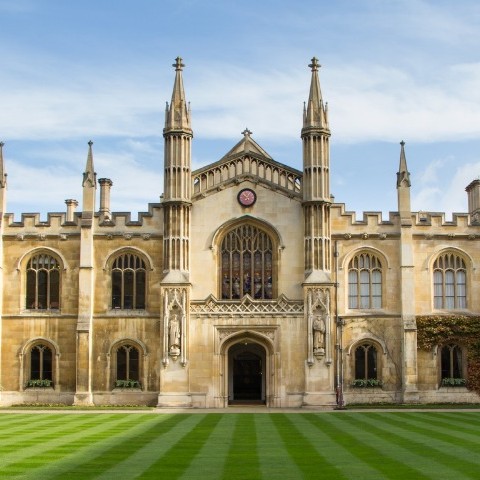
University of Cambridge
Overview
The University of Cambridge was established in the year 1209 which makes it one of the oldest universities in the world. Technically, it is a public collegiate research university in England. The University has been accredited at number 2 by the QS World University Rankings 2024.
Presently, the University of Cambridge is the home to 24,720 students with 9000 international students from 140 countries. The acceptance rate of the university ranges between 18 to 21% which makes it a fairly difficult institution in the world to get admission.
University of Cambridge Key highlights
The University of Cambridge is the 4th oldest university in the world. It is considered one of the top five universities in the United Kingdom. The college has 22 affiliated colleges offering Undergraduate, Postgraduate and Doctoral courses. Cambridge University boasts of a 95% placement rate.
It also offers 500 scholarships via the Cambridge Trust supporting 1200 students annually. Presently, the university has a male-female ratio of 49:51. Whereas, the university is considered best with its student-faculty ratio of 11:1.
University of Cambridge Overview
Particulars
Details
Application Fee
£50 (5,245 INR)
Establishment Year
1209
World Ranking
3
QS Rank
2
Scholarship
30% off tuition fees
No. Of International Students
9000
Website
www.cam.ac.uk
Placement%
95%
English Language Tests are accepted.
IELTS / TOEFL
University of Cambridge Acceptance Rate
19%
University of Cambridge Ranking
The University of Cambridge is one of the most prestigious universities in the world and has consistently ranked highly in both national and global rankings. In the most recent national rankings, the university ranked first in the Complete University Guide for 2024, while ranking third in both the Guardian and Times / Sunday Times rankings.
In terms of global rankings, the university ranked fourth in the Academic Ranking of World Universities (ARWU) for 2023, second in the QS rankings for 2024, and fifth in the Times Higher Education (THE) rankings for 2024.
University of Cambridge Ranking
Ranked By
2018
2019
2020
2021
2022
2023
2024
ARWU (Shanghai Ranking) - Universities Rankings
3
3
3
3
4
NA
NA
QS - World University Ranking
NA
NA
7
7
3
2
2
THE (Times Higher Education) - University Ranking
NA
2
3
6
5
3
NA
The Complete University Guide - University Ranking UK
NA
NA
1
1
2
2
1
The Guardian - University Rankings
NA
1
1
3
2
3
3
US News & World Report - Global Universities
NA
9
9
9
8
8
NA
University of Cambridge Scholarships
The University of Cambridge offers around 500 scholarships on an annual basis thus supporting at least 1400 students annually. These scholarships are offered based on the course opted by them, qualifications, and eligibility. Other than this, IELTS and GMAT scores are also considered for the scholarship process.
Award/Fellowship
Amount in Pound
Eligibility
Cambridge Trust Scholarship (undergraduate)- BA (Hons) Economics
23,340
The candidates scoring 90% or higher marks in ICSE, NIOS or CBSE board exam will be eligible for this scholarship.
Subject required: Mathematics
IELTS: 7.5 with 7.0 or above in each element
Cambridge Trust Scholarship (undergraduate)- BA (Hons) Computer Science
37,293
The candidates scoring 90% or higher marks in ICSE, NIOS or CBSE board exam will be eligible for this scholarship.
Subject required: Mathematics
IELTS: 7.5 with 7.0 or above in each element
The Oxford and Cambridge Society of India Scholarships- University of Cambridge
1900
A Graduate or Post Graduate candidate must be a citizen of India with an age not more than 30 years of age as of 01 September.
Cambridge Trust Scholarship (undergraduate)- Bachelors of Architecture
30,537
Only International applicants who are offered a place by Cambridge College will get the Cambridge Trust Scholarships
The Oxford and Cambridge Society of India Scholarships- University of Cambridge
1901
The candidate must be a citizen of India with an age of not more than 30 years on 01 September
A Graduate of an Indian University or a Post Graduate course.
Candidate must have applied for and secured admission to study a full-time course at the University of Cambridge.
St John’s College Khattar Harrison Scholarship
5,000
Applicable for only women candidates pursuing undergraduate studies at St John's College.
Gates Cambridge Scholarship- MBA
82,906
Bachelor of Arts (3 years) (From University of Delhi and Mumbai) with a grade of 70% or Masters with a passing marks
IELTS: 7.5 with min score of 7.0 in each section
GMAT/ GRE: test score is required
Work Experience
Interview
Gates Cambridge Scholarship- MPhil in Engineering for Sustainable Development
6,500
IELTS: 7.5 with min score of 7.0 in each section
GMAT/ GRE: test score is required
Work Experience
Interview
LOR
SOP
Irene Hallinan Scholarship
6,172
Graduation in any subject with First Class from a recognised university
English Language Proficiency-
IELTS: overall 7.5 with 7 in each component
University of Cambridge Top courses
The University of Cambridge offers a range of UG courses across five categories namely, Science, Social Science, Technology, Medicine, and Humanities. The students can choose from 30 UG courses across 65 subject areas. They can choose courses based on their qualification and area of interest.
The cost of attendance at the University of Cambridge depends on the course chosen by the student along with their status. The status of the fee is based on the nationality and residence. Those who have been a resident of the UK for the last three years will have a home fee status or they will be likely to have an international status.
Other than the fees, miscellaneous expenses like food, accommodation, personal items and study costs also determine the University of Cambridge cost of attendance.Note:-The fee structure mentioned below is subject to change in accordance with the university's policies. The university reserves the right to modify the fees at any time without prior notice
Course
Annual Cost (£)
Annual Cost (INR)
Anglo-Saxon, Norse, and Celtic; Archaeology; Asian and Middle Eastern Studies; Classics; Economics; Education; English; History; History and Modern Languages; History and Politics; History of Art; Human, Social, and Political Sciences; Land Economy; Law; Linguistics; Modern and Mediaeval Languages; Philosophy; Theology, Religion, and Philosophy of Religion (Group 1)
25,734
2,613,030
Mathematics (Group 2)
28,704
2,914,604
Architecture; Design; Geography; Music (Group 3)
33,672
3,419,055
Chemical Engineering; Computer Science; Engineering; Management Studies; Manufacturing Engineering; Natural Sciences; Psychological and Behavioural Sciences (Group 4)
39,162
3,976,509
Medical and Veterinary Science (including for this purpose the Second M.B. and Second Vet.M.B. Examinations) (Group 5)
67,194
6,822,879
University of Cambridge Campus
The University of Cambridge has a sprawling campus spreading across 617 hectares (1,520 acres) across the historic city centre of Cambridge, England. The University offers a vibrant campus life to 24,000+ students enrolled in different courses under 150 departments.
Cambridge University Press & Assessment is the largest department of the university with a whopping £1 billion of annual revenue. The university has a total of 116 libraries that consist of 16 million books.University of Cambridge Major Intakes The University of Cambridge has three intakes namely, Michaelmas, Lent and Easter. The application deadline for each of these intakes has been prescribed in the table below.
University of Cambridge Major Intakes
Intake
Admission Timelines
Michaelmas
October – December
Lent
Jan – March
Easter
April – June
University of Cambridge Work-Study Programs
The University of Cambridge offers work-study programmes for students offering them the opportunity to gain work experience while pursuing their course. However, they have to adhere to the work restrictions and policies. The following are the major rules that students have to abide by when pursuing a UG or PG course.
UG students are not expected to work during term time
Advanced Diploma students are expected not to work during term time.
Masters students undertaking less than twelve months are expected not to work during term time.
Job Hours Allowed
If you're a postgraduate research student pursuing over twelve months, the University advises you to limit your work hours to 6-10 per week. It's essential to keep in mind that the academic year for postgraduate research students runs continuously from 1st October to 30th September. It's strictly recommended that students should not exceed a maximum of 20 hours of work each week, which includes both paid and unpaid work
The students who are not studying on a Tier 4/student visa can continue to work full-time unless the visa result is revised and resubmitted for a total period of 20 hours a week
University of Cambridge Notable Alumni
The University of Cambridge is one of the oldest public research universities and has been home to some exemplary students who have made significant contributions in the fields of Art, Science and Humanities. Till date, 121 Cambridge alumni have won the prestigious Nobel Prize for their iconic work.
Jawaharlal Nehru (First Indian Prime Minister)
Jawaharlal Nehru, the first Indian PM was a notable alumni of the University of Cambridge. He graduated from Trinity College with honours in Natural Science in 1910.
King Charles III (England)
King Charles III, the reigning monarch of England pursued his degree in History from Trinity College, Cambridge University. Then he went on to serve in the Royal Air Force and Royal Navy. He ascended to the throne on 08 September 2022.
Emma Thompson (British Actor)
Emma Thompson a prominent British actress, screenwriter and author has also completed her degree in English at Newnham College, University of Cambridge. Apart from being an actor, she is also an extraordinary screenwriter and has won an Oscar for both acting and screenwriting.
Stephen Hawking (Physicist)
Known for his exemplary contribution to Astro Physics for his discovery of Black Holes, Stephen Hawking was a renowned Physicist and cosmologist. He completed his PhD degree in applied mathematics and theoretical physics, specialising in general relativity and cosmology.
Cost of living in United Kingdom
The cost of living in UK depends on international students on several expenses from the locality and the type of lifestyle. The international students can expect to spend around (£) 750 to 800 every month.
Some of the major factors that decide the cost of living in the UK are books and materials, food, transport, phone, and interest. While yearly, the students have to spend (£) 2000 to 2250. The following table can be checked to get the cost breakup for all the expenses.
Cost of Living in UK
Expense
in Pound (£)
in INR
Books and Material (yearly)
Up to 800
84,000
Health Insurance (monthly)
800-915
84,000 - 95,775
Food (monthly)
300-330
31,500- 34,650
Transport (monthly)
40-55
4,200- 5,775
Entertainment (monthly)
85-100
8,925- 10,500
Phone & Internet (monthly)
40-45
4,200- 4,725
Courses & Tuition Fees
M.B.A
BA (Hons.) Computer Science
MASs in Pure Mathematics
BA (Hons.) Architecture
General Requirements
English Proficiency
Campus Gallery

Location
Student Reviews
Apply for Admission
Get direct admission support for University of Cambridge.