
Graduate Pharmacy Aptitude Test
Imported from Collegedunia.
Overview
The NBEMS has scheduled the GPAT 2026 Exam for 7 March 2026 in CBT mode in a single session for 3 Hours.
Candidates are required to carry their GPAT 2026 Admit Card to their exam center, as without the admit the entry will not be allowed. You can still download your admit card by using your User Id and password through the official website.
- The GPAT Exam will have 125 MCQs, which carry a total of 500 marks. For each correct answer, +4 marks will be given and -1 mark for an incorrect answer.
- The GPAT Syllabus is based on the B.Pharm Pattern, with a major focus on Pharmaceutics, Pharmacology, Pharmaceutical Chemistry, and Pharmacognosy.
For better preparation, you should revise the B.Pharm Syllabus and practice the previous year’s question papers along with the mock tests.
Check:
- GPAT Question Paper: Download GPAT Question Paper with Solutions PDF (2025-1988)
- GPAT Syllabus 2026: Download PDF, Check Changes, Exam Pattern & Topic-Wise Weightage
- GPAT Mock Test 2026, Attempt Free Topicwise and Subjectwise
Key Summary
In this Article, we have discussed GPAT 2026, including the dates, registration, eligibility, exam pattern, syllabus & colleges.
- The GPAT official notification was released on 22 December 2025.
- The GPAT 2026 Exam is scheduled to be conducted on 7 March 2026, and the results will be declared in 7 April 2026.
- The GPAT Exam will be held in a CBT Mode for a duration of 3 hours.
- The GPAT Exam will include 125 MCQs, making a total of 500 marks, with +4 marks for each correct answer and -1 mark for each incorrect answer.
- The GPAT Syllabus will include Pharmaceutics, Pharmacology, Pharmaceutical Chemistry, and Pharmacognosy.
What is GPAT 2026?
The GPAT is a national-level entrance examination to be conducted by NBEMS to get admission into M.Pharm programs in India.
The GPAT Exam is used to get AICTE Postgraduate scholarships, which makes it an important exam for pharmacy graduates who are looking for higher education and financial support.
| Parameter | Details |
|---|---|
| Conducting Body | National Board of Examinations in Medical Sciences (NBEMS) |
| Exam Mode | Online, Computer-Based Test (CBT) |
| Duration | 3 Hours |
| Total Questions | 125 Multiple-Choice Questions |
| Total Marks | 500 |
| Marking Scheme | +4 for correct, -1 for incorrect answers |
| Exam Date | March 7, 2026 |
| Tentative Notification | February–April 2026 |
| Result Declaration | By April 7, 2026 |
| Eligibility | B.Pharm graduates or final-year students |
| Total Seats (Approx.) | 24,000 seats across India |
| Syllabus Focus | Pharmaceutics, Pharmacology, Pharmaceutical Chemistry, Pharmacognosy, and related subjects |
| Difficulty Level | Moderate to High |
| Purpose | Admission to M.Pharm programs and AICTE scholarships |
Ques. What is GPAT exam for?
Ans. GPAT exam is conducted for admission to M.Pharm programs offered by participating institutes. The exam is conducted by NBEMS as national level entrance examination.
- GPAT 2026 Exam Dates
- GPAT Eligibility 2026
- GPAT 2026 Registration
3.2 GPAT Registration Statistics
- GPAT 2026 Exam Pattern
- GPAT Syllabus 2026
5.1 GPAT Syllabus: Pharmaceutics & Allied Subjects
5.2 GPAT Syllabus: Pharmaceutical Chemistry & Allied Subjects
5.3 GPAT Syllabus: Pharmacology
5.4 GPAT Syllabus: Pharmacognosy
5.5 GPAT Syllabus: Other Subjects (Interdisciplinary)
- GPAT Books 2026
- GPAT Preparation Tips
- GPAT Previous Year Question Paper
- GPAT 2026 Result & Counselling
- GPAT 2026 Expected Cutoff
10.1 GPAT 2026 Expected Cutoff (Category-Wise)
- GPAT Reservation and Seats
- Courses offered after GPAT
- Colleges Accepting GPAT Score
- FAQs for GPAT 2026
GPAT 2026 Exam Dates
The GPAT Exam Notification was released on 22 December 2025, and the exam will be held on 7 March 2026.
| Date(s) | Event |
|---|---|
| 23 December 2025 (05:00 PM onwards) | Start of online application submission |
| 12 January 2026 (till 11:55 PM) | Last date for online application submission |
| 16–19 January 2026 | Edit window for payment-successful applications (except name, nationality, email, mobile number & test city) |
| 06–09 February 2026 | Pre-final image correction window (photo, signature, thumb impression) |
| 17–19 February 2026 | Final image correction window (no further chance) |
| 24 February 2026 | Test city intimation |
| 02 March 2026 | Admit card release |
| 07 March 2026 | Examination date |
| By 07 April 2026 | Result declaration |
Check: GPAT Exam Dates
Ques. Is GPAT valid for 3 years?
Ans. The GPAT Score is valid for 3 years after the date of result declaration.
- The Candidates can use the M.Pharm score for admission to apply for the AICTE Scholarship during this time period.
- The GPAT Score is used for admission and Scholarships, with a validity of 3 years.
Ques. Is GPAT conducted twice a year?
Ans. The GPAT Exam is conducted once every year by NBEMS. Candidates should register and appear in the scheduled session.
In the GPAT Exam, there is no mid-year or second attempt available.
| Exam | Conducting Body | Frequency | Mode |
|---|---|---|---|
| GPAT | NBEMS | Once a year | CBT (Online) |
GPAT Eligibility 2026
The GPAT Exam is for candidates who have completed or are currently studying in the final year of the B.Pharm Program.
- There is no upper age limit for the exam, which makes it more accessible for the candidates.
- Candidates should have a Degree/Provisional certificate, marksheets, a Photo ID and a Passport-size photograph.
Check: GPAT Eligibility
Ques. How many marks are needed to qualify for GPAT?
Ans. The GPAT Qualifying marks differ every year according to the difficulty level and number of candidates.
In GPAT 2024, the cutoff was around 125-163 marks for the general category candidates out of 500, with a lower cutoff for the reserved category candidates.
GPAT Qualifying Marks
| Category | Qualifying Marks (Approx.) |
|---|---|
| General (UR) | 163 |
| EWS | 163 |
| OBC-NCL | 131 |
| SC | 103 |
| ST | 76 |
| PwD | 76 |
Ques. Can a 3rd year student give the GPAT exam?
Ans. No, 3rd year B.Pharm Students are not eligible for the GPAT Exam. Candidates who have completed the B.Pharm Exam or are currently in the final year of the program can apply.
- Final-year B.Pharm students: Eligible
- B.Pharm graduates: Eligible
- 3rd-year B.Pharm students: Not eligible
- D.Pharm holders: Not eligible
Ques. Can I write GPAT after 12th?
Ans. No, aspirants can not appear for GPAT 2026 after 12th. As per the GPAT eligibility criteria, aspirants must have completed or must be in the final year of B.Pharm program.
GPAT 2026 Registration
The GPAT Registration process will be conducted online by NBEMS.
- To complete the registration process, candidates should fill in their personal, academic, and contact details, also upload the required documents and pay the registration fees.
- The GPAT Registration was started on 23 December 2025, and the last date apply is 12 January 2026 and candidates should apply before the last date to avoid any issues at the last minute.
GPAT Registration Fees
To register for GPAT, Candidates should submit the required registration fees, the fees should be paid online:
- For the General/OBC and EWS candidates, the registration fees are Rs. 2,500.
- For the SC/ST/PwD and Transgender candidates, the registration fees are Rs. 2,000.
GPAT Registration Statistics
Every year, thousands of pharmacy graduates take the GPAT Exam to get admission in M.Pharm Programs and AICTE Scholarships.
- There has been an increase in the attendance rate from 91.0% in 2023 to 100% in 2025, which shows improvement in candidate engagement and a better registration process.
- The Number of registered candidates decreased in 2024, from 68,439 in 2023 to 40,548 in 2024 and then increased in 2025 to 47,142.
| Year | Registered Candidates | Appeared Candidates | Attendance Rate |
|---|---|---|---|
| 2025 | 47,142 | 47,142 | 100% |
| 2024 | 40,548 | 39,341 | 97.00% |
| 2023 | 68,439 | 62,275 | 91.00% |

Eligibility
GPAT eligibility criteria 2025 mentions the requirements regarding the nationality, academic qualification, and other details. There is no age limit for appearing in GPAT 2025.
- As per GPAT Eligibility Criteria 2025, only citizens of India can apply and appear for the exam. Before applying for the exam, the candidates need to remember that they can register for GPAT 2025 without considering the maximum or minimum age barrier. Read the article to know more about the age limit, qualifying exams, eligibility, etc.
| Table of Contents |
GPAT 2025 Eligibility Criteria Highlights
| Parameters | Details |
| Qualification | Bachelor's degree in Pharmacy or equivalent (10+2+4) |
| Minimum Age | No limit |
| Attempt Limit | No |
| Nationality | Indian |
Quick Links:
GPAT Eligibility Criteria 2025: Nationality
The National Testing Agency has set up the following criteria for GPAT 2025.
- To be eligible for GPAT 2025, the candidate must be a citizen of India.
- No foreign nationals are eligible for appearing in GPAT 2025.
GPAT Eligibility Criteria 2025: Education Qualification
Only the candidates who specify the following pointers will be eligible for appearing in GPAT 2025.
- The candidate must have qualified for the examination of the 11th and 12th standards.
- The candidate must possess a valid degree in Pharmacy or equivalent from a recognized institute.
- The candidates in the final year of B.Pharmacy (10+2+4) can also apply for GPAT 2025
- The candidates who possess a degree in B.Tech (Pharmaceutical and Fine Chemical Technology) are not eligible to apply for GPAT 2025.
GPAT Eligibility Criteria 2025: Age Limit
- There is no age limit upon the candidates who wish to appear for GPAT 2025.
- The candidates must possess a bachelor’s degree in Pharmacy or equivalent before appearing for GPAT 2025.
GPAT Eligibility Criteria 2025: PwD
The authorities allow the candidates who have the following under the PwD category to appear for GPAT 2025.
- Blindness and weak vision
- Hearing impairment
- Disabilities under the Locomotor category
- Autism and other intellectual disabilities
GPAT Reservation Criteria 2025
Below is tabulated the reservation criteria for the different categories who wish to appear for GPAT 2025.
| Category | Percentage of Seats Reserved |
|---|---|
| Scheduled Caste (SC) | 15% |
| Scheduled Tribe (ST) | 7.5% |
| OBC | 27% |
| EWS | 10% |
Note: Each category will have 5% reservation for the candidates with 40% or more disability.
GPAT Eligibility 2025 FAQs
Ques. Who fulfills the GPAT Eligibility 2025?
Ans. The Indian citizens who possess a valid degree in B. pharmacy from the recognized institute fulfill GPAT Eligibility 2025. The candidates need to go through the official brochure of the exam before appearing for the exam to see if they are eligible for the exam or not.
Ques. Candidates up to how old can appear for the exam according to GPAT Eligibility 2025?
Ans. GPAT Eligibility 2025 does not specify an upper age limit for the candidates. Candidates up to any age can appear for the exam. However, they need to make sure that they fulfill the rest of the criteria before appearing for the exam.
Ques. As per GPAT Eligibility 2025, what is the minimum age required to appear for GPAT 2025?
Ans. GPAT Eligibility 2025 has not set any upper age limit for the exam. However, it states that the candidates need to possess a bachelor’s degree in Pharmacy to be eligible for GPAT 2025. The eligible candidates can register for the exam as soon as the authorities release the application form.
Ques. The candidates native to which state can apply for the exam under GPAT Eligibility 2025?
Ans. GPAT 2025 is a national-level exam. Hence, the students native to all the states in India can appear for GPAT 2025. The foreign nationals should, however, keep in mind that they are not permitted to appear for the exam as per GPAT Eligibility 2025.
Ques. Do GPAT Eligibility 2025 allow the foreign nationals to appear for GPAT 2025?
Ans. GPAT Eligibility 2025 does not allow foreign nationals to appear for GPAT 2025. The students need to be a native citizen of India alone. The candidates are advised to go through the eligibility before registering for GPAT 2025.
Ques. Does GPAT Eligibility 2025 permit the final year candidates to appear for GPAT 2025?
Ans. GPAT Eligibility 2025 clearly states that the candidates in the final year of B.Pharmacy (10+2+4) or equivalent degree can apply for GPAT 2025. Hence the students can register for the exam but they need to make sure that the results of their final examination are declared before the commencement of the next academic session.
Ques. Can candidates of 18 age appear for GPAT 2025 as per GPAT Eligibility 2025?
Ans. GPAT Eligibility 2025 mentions that candidates up to any age can appear for GPAT 2025. However, it also mentions that candidates need to possess a bachelor’s degree in Pharmacy. Hence, students of 18 age can not appear for GPAT 2025 unless they do possess the required degree.
Ques. Can candidates with backlogs appear for GPAT 2025?
Ans. The candidates are advised to clear all their backlogs and then appear for GPAT 2025.
Ques. Does GPAT Eligibility 2025 demand work experience from the candidates?
Ans. No, GPAT Eligibility 2025 does not demand work experience from the candidates. However, it is advised to gain the required expertise to excel in GPAT 2025. To do the same the students need to attempt a good amount of mock tests. Also Check, GPAT Preparation Tips
Application Process
GPAT registration 2026: The National Board of Examinations in Medical Sciences (NBEMS) has opened the GPAT 2026 registration window on 23 December 2025. Candidates must check out the GPAT Eligibility Criteria before filling out the registration form.
- The Gen/OBC/EWS candidates will have to pay INR 3500 while SC/ST/PWD candidates need to pay INR 2500. Candidates who will complete the application process, including the payment of the application fee will be eligible to avail of the application correction facility
- The GPAT Form Correction window will be opened after the completion of the registration process.
- The GPAT exam is scheduled to be conducted on 7 April 2026 in online mode across various centres.
A direct link for GPAT registration window 2026 will be provided below. Check GPAT 2026 Document Upload Guidelines
Check: GPAT 2026 Exam Dates| Table of Contents |
GPAT Registration 2026: Important Dates
| Date(s) | Event |
|---|---|
| 23 December 2025 (05:00 PM onwards) | Start of online application submission |
| 12 January 2026 (till 11:55 PM) | Last date for online application submission |
| 16–19 January 2026 | Edit window for payment-successful applications (except name, nationality, email, mobile number & test city) |
| 06–09 February 2026 | Pre-final image correction window (photo, signature, thumb impression) |
| 17–19 February 2026 | Final image correction window (no further chance) |
| 24 February 2026 | Test city intimation |
| 02 March 2026 | Admit card release |
| 07 March 2026 | Examination date |
| By 07 April 2026 | Result declaration |
GPAT Registration: Eligibility Criteria 2026
In the below table, the basic eligibility criteria for GPAT 2026 are tabulated below.
| Citizenship Status | Age Limit | Academic Qualification |
|---|---|---|
| Candidates must have the citizenship status of India | Candidates from any age can appear in the exam | Must hold a bachelor degree in Pharmacy with the duration of years after passing the higher secondary board examination. |
Note:
- Candidates from lateral entry need to have the similar eligibility criteria mentioned above.
- Applicants who are appearing in the final exam of B. Pharmacy can also apply for the test.
- Candidates who have passed their Graduation/B.Tech with Pharmaceutical and Fine Chemical Technology)/ equivalent will not be allowed for the test.
GPAT Registration 2026: Documents Required
The following documents are required for the process of GPAT Registration:
- 10th class mark sheet
- 12th class mark sheet
- B.Pharm Mark Sheet
- Scanned copy of candidate’s passport-sized photograph
- Scanned copy of candidate’s signature
- Valid ID proof
How to Fill Up GPAT Application Form 2026?
All the candidates are advised to keep some important documents to complete the application process. The complete list of documents are given below.
- A computer with good Internet connectivity
- All your qualification details
- Scanned clear passport photograph in JPG/JPEG format
- Scanned clear signature in JPG/JPEG format
- A valid e-mail ID as all communication will be made on it
- A valid mobile number as all information via SMS will be sent to this number
- A valid debit/credit card or Net bank account if you want to pay ONLINE
- A printer connected to your system to print e-challan and confirmation page
Steps to Fill GPAT 2026 Application Form
In the below section, the process to fill up and complete of GPAT Application Form and process are mentioned.
Step 1: Registration for Online Application
- Go to the official website of NTA-GPAT, i.e, gpat.nta.nic.in.
- Navigate to the link on ‘Fill Online Application Form’. The following window will be displayed:
- Go to the ‘New Registration’ tab placed under the New Candidate Registration box.
- Go through the Instructions and Procedure.
- Download the Information Bulletin
- Following this, select the ‘Click here to Proceed’ tab.
- Enter all the details i.e.
- Personal details
- Contact details
- Choose Password
- Security Pin
- Review all the particulars carefully.
- For any changes, select the ‘Edit Registration Form’.
Step 2: Complete Application Form
- Enter application number and a password to login again.
- Choose and enter four preferences for the exam cities.
- Fill up all the information and review the application form again.
Step 3: Upload Images
Candida must scan and upload the following:
- Photograph
- Signature
- Enter the security pin.
- Select ‘I have verified Uploaded images carefully.
Step 4: Fee Payment
After the completion of the application procedure mentioned above, candidates need to pay the required amount as the application fee by following the process.
- Pay the fee by SBI MOPS using Net Banking/Debit/Credit Card/ PayTM.
- Check the validity of the Debit/ Credit Card and preserve it to log in on to the website. Enter the details as asked for and pay via Debit/ Credit Card.
- Log in with credentials of net banking and make payment through Net Banking.
Service/ Processing Charges and GST:
| Mode of Payment | Bank | Service/ Processing charges/ transaction (GST applicable @18%) |
|---|---|---|
| Net Banking | SBI | INR 5.00 + GST |
| Other Banks | ||
| Debit Card | SBI/ other Banks | NIL |
| Credit Card | Domestic | 0.80% of Fee + GST (min. INR 11) |
| International | 3.50% of Fee + GST (min. INR 11) | |
| E-challan | At all SBI Branches in India | NIL |
| UPI | (-) | NIL |
Also Check GPAT 2026 Syllabus
GPAT Registration Fees
To appear in GPAT 2026, candidates need to pay the application fee via online mode. Candidates applying for GPAT 2026 have to pay a nominal application fee. This year, the fee for the application has been increased. Category wise application fee for GPAT 2026 is tabulated below.
| Category | Fee | |
|---|---|---|
| Boys | Girls | |
| General | 3500/- | 3500/- |
| SC/ST/PwD/ Transgender/OBC (NCL) | 2500/- | 2500/- |
Also Check GPAT Exam Pattern
GPAT Registration Details
In GPAT 2026 Application Form, candidates need to enter their personal details along with the academic and contact information. In the below table, the details on the application form are given.
| Specification | Detail Information |
|---|---|
| Name | Enter your full name |
| Father’s name | Enter your Father’s full name |
| Mother’s Name | Enter your mother’s full name |
| Gender | Choose your gender |
| Date of Birth | Fill your birth date |
| Email ID | Enter a valid Email ID |
| Phone Number | Enter your contact number |
| Nationality | Indian or other |
| State of Eligibility | State from which you have passed 12th standard |
| Name of Institution | Name of the school from which you passed Class XII |
| Name of College | College name from where you got the Bachelor’s degree |
| Name of the Board | Name of your Board in Class 12 |
| Year of Passing | Year in which you studied Class XII |
| Year of Graduation | Year in which you graduated from college |
| Uploading documents | Upload your photo, signature and finger impression in JPG format |
| Size of photos | Photo<60 KB and Signature<30 KB |
| City Choice | Choose your test city preference |
GPAT Registration Form Correction Details
GPAT 2026 Form Correction window is expected to be activated by 2nd week of May 2026 or 3 days after the last date of registration. Through this, candidates can make any changes or edit some information in their online application form including the uploaded photograph and signature.
- To correct the information on GPAT Application Form 2026, candidates need to login to the website.
- After the due date of the application correction process, non-request regarding the application correct will be accepted.
- Candidates will not be allowed to make any changes on the online application form through any offline mode.
After entering the details on GPAT Application Form 2026, candidates need to finally save and submit the edited information on the application form. There are certain charges that can be levied in a situation where candidates demand to rectify some basic details like candidates name, contact particulars, etc.
Quick Links:
What after GPAT registration 2026?
After completing the GPAT 2026 registration process, here are the subsequent steps:
-
Admit Card Issuance: Following the closure of the GPAT 2026 application form and the correction window, authorities will generate admit cards for registered candidates. Only those candidates whose applications have been accepted by the NTA will receive the GPAT admit card.
-
Admit Card Download: Applicants can download the GPAT 2026 admit card from the official website gpat.nta.nic.in. To access the admit card, candidates need to log in using their provided credentials.
-
Mandatory Admit Card: It is imperative to carry the admit card to the GPAT 2026 exam center on the scheduled examination day. Without the admit card, candidates will not be allowed to sit for the entrance test.
-
Exam Day Compliance: On the day of the GPAT exam, candidates must strictly adhere to the guidelines and instructions provided by the authorities at the examination center.
GPAT Registration 2026: Important Reminders
-
Failure to complete all four specified steps will result in an incomplete GPAT 2026 application form.
-
Please note that the application fee is non-refundable.
-
Sending the GPAT application form confirmation via postal mail to the NTA is unnecessary.
-
The NTA is not responsible for verifying the information provided by the candidate or the documents uploaded by them.
Payment Options Accepted:
- Credit Card
- Debit Card
- Internet Banking
- UPI
- Paytm
GPAT Registration News
Last date for GPAT Registration fee payment is expected to be in the 2nd week of May 2026. GPAT application form correction window is also expected to be closed by the second week of May, 2026. Candidates are requested to undertake the correction(s) very carefully as no further chance of correction will be provided after that. NTA is yet to announce the GPAT exam date 2026.
GPAT Registration FAQs
Ques. Shall I receive any notification via my registered mail ID after the completion of GPAT Application 2026 process?
Ans. No, any such notification will not be sent by the concerned authority to any candidates after the completion of GPAT Application 2026 process. For either application or admit card, no notification will be sent by the concerned authority.
Ques. How long do I need to wait for GPAT Admit Card 2026 after the completion of GPAT Application 2026 process?
Ans. Generally, the admit card is released within a week after the completion of GPAT Application 2026. For GPAT 2026 the duration is expected to remain the same.
Ques. How long do I need to preserve the print out of GPAT Application Form 2026?
Ans. You need to keep the print out of GPAT Application Form 2026 until the admission process is over. You can keep it after that as a reference.
Ques. What if I am unable to upload the scanned signature during GPAT Application 2026 process?
Ans. In that case, your GPAT Application Form will not be submitted. And your process will be cancelled.
Ques. Do I need to send any print out of GPAT Application Form 2026 via offline mode?
Ans. No, you do not need to send the print out of GPAT Application Form 2026 via any offline mode. You will have to submit it online mode only.
Ques. Can I change any information on GPAT Application Form 2026 after releasing the admit card?
Ans. No, you will only be allowed to make changes through the application correction process. After closing the application window, no candidates will be allowed to make changes on the form.
Ques. Is it mandatory to enter the preferences of the exam centre on GPAT Application Form 2026?
Ans. Yes, it is mandatory to enter preferences on GPAT Application Form 2026. Without it, no application form will be submitted.
Ques. Do I need to inform anyone after the completion of GPAT Application 2026 process?
Ans. No, you do not need to inform anyone officially after the completion of GPAT Application 2026 process. There is no requirement such as that.
Ques. Can I get GPAT Application Form 2026 through my registered mail ID?
Ans. No, no candidate will be entertained to receive GPAT Application Form 2026 through mail. After login to the official website, candidates can get the application form.
Ques. Can I request to make changes on GPAT Application Form 2026 after the due date of the application form correction?
Ans. No, you will not get permission to make any changes to GPAT Application Form 2026 after the last date of correction process. No candidates will be allowed for that.
Exam Pattern
GPAT 2026 Exam Pattern has been released along with the official notification in the month of December 2026. In GPAT 2026, for every correct answer, 4 marks are awarded and for every incorrect answer, one mark is deducted. The candidates need to be thorough with GPAT Syllabus before appearing for GPAT 2026. A good preparation strategy is enough to ace GPAT 2026. Check GPAT Preparation Tips
Read the article to know about GPAT Marking Scheme, GPAT Syllabus, GPAT Recommended Books, and much more.
GPAT Exam Pattern Highlights 2026
| Frequency of exam | Once a year |
| Total questions | 125 questions |
| Total Marks | 500 |
| Marking scheme |
|
| Types of questions | MCQ |
| Exam Mode | Computer-Based Online Test |
| Duration | 3 hours |
| Medium of language | English |
| GPAT Exam Date 2026 | February 2026 (Tentative) |
GPAT 2026 Exam Pattern: Check Subject Wise Exam Pattern
GPAT Pharmaceutical Chemistry Exam Pattern 2026
Herein is tabulated the number of questions and the total marks from GPAT Pharmaceutical Chemistry section 2026.
| Particulars | Details |
|---|---|
| Total questions | 38 |
| Total Marks | 152 |
GPAT Pharmaceutics Exam Pattern 2026
Herein is tabulated the number of questions and the total marks from GPAT Pharmaceutics section 2026.
| Particulars | Details |
|---|---|
| Total questions | 38 |
| Total Marks | 152 |
GPAT Pharmacognosy Exam Pattern 2026
Herein is tabulated the number of questions and the total marks from GPAT Pharmacognosy section 2026.
| Particulars | Details |
|---|---|
| Total questions | 10 |
| Total Marks | 40 |
GPAT Pharmacology Exam Pattern 2026
Herein is tabulated the number of questions and the total marks from GPAT Pharmacology section 2026.
| Particulars | Details |
|---|---|
| Total questions | 28 |
| Total Marks | 112 |
GPAT Marking Scheme 2026
- A total of 125 questions will be asked in GPAT 2026.
- For every correct answer, 4 marks are awarded
- For every incorrect answer, 1 mark is deducted
- No marks will be deducted for unattempted questions
Given below is the section-wise distribution of marks for GPAT 2026.
| Types of questions | Number of questions | Maximum marks |
|---|---|---|
| Pharmaceutical Chemistry | 38 | 152 |
| Pharmaceutics | 38 | 152 |
| Pharmacognosy | 10 | 40 |
| Pharmacology | 28 | 112 |
| Other subjects | 11 | 44 |
| Total | 125 | 500 |
GPAT Syllabus 2026
In GPAT 2026, questions are asked from the following topics. The students are advised to go through every topic mentioned before appearing for the exam.
| Physical Chemistry | Physical Pharmacy | Organic Chemistry |
| Pharmaceutics | Pharmaceutical Chemistry | Pharmacology |
| Pharmacognosy | Pharmaceutical Analysis | Biochemistry |
| Biotechnology | Microbiology | Pathophysiology |
| Biopharmaceutics and Pharmacokinetics | Clinical Pharmacy and Therapeutics | Human Anatomy and Physiology |
| Pharmaceutical Engineering | Pharmaceutical Management | Pharmaceutical Jurisprudence |
| Dispensing and Hospital Pharmacy | - | - |
Also Check GPAT Syllabus
GPAT Recommended Books 2026
Given below are the recommended books for GPAT 2026. The students are advised to go through them to further increase their knowledge.
| Name of the Book | Author |
|---|---|
| Biochemistry | By Lehninger or By Satyanarayan |
| Health Education & Community Pharmacy: For First Year Diploma | By N. S. Parmar |
| Advance Organic Chemistry: Reaction, Mechanism & Structure | By Jerry March |
| Physical Chemistry | By Dr. R. R. Misra |
| Pharmaceutics: The Science of Dosage Form Design | By Aulton |
| Instrumental methods of Chemical Analysis | By B. K. Sarma |
| Industrial microbiology | By Cascida |
| Textbook of Pharmacognosy | By K. Kokate |
GPAT Exam Pattern 2026 FAQs
Question: How many times is GPAT 2026 conducted?
Ans. GPAT 2026 is conducted once every year. The students should try to ace the exam on the first attempt. Otherwise, they will have to wait one year to appear for the exam again.
Question: GPAT 2026 consists of how many questions?
Ans. GPAT 2026 consists of a total of 125 questions. The students need to attempt these questions within 3 hours. The students need to maintain their speed right from the beginning to finish the exam within the time limit.
Question: Is there a negative marking in GPAT 2026?
Ans. Yes, there is a negative marking in GPAT 2026. For every correct answer, 4 marks are awarded and for every incorrect answer, one mark is deducted. The students are advised to attempt only those questions in which they are confident.
Question: Is there a sectional limit in GPAT 2026?
Ans. No, there is no sectional limit in GPAT 2026. The students can take as much time as they want to complete the 125 questions. However, they must make sure they wind up their exam before the completion of three hours.
Question: What is the duration of GPAT 2026?
Ans. GPAT 2026 is conducted for three hours. The students are advised to practice a good amount of mock tests before appearing for the exam. This would improve their time management skills and boost their confidence.
Question: Are students supposed to answer questions in any particular order in GPAT 2026?
Ans. No, students are not supposed to answer questions in any particular order in GPAT 2026. They can attempt questions in any order they wish. However, they must make sure that they complete the exam before the completion of three hours.
Question: What is the mode of GPAT 2026?
Ans. GPAT 2026 will be conducted in Computer Based Test. The students need to bring their admit cards to the examination center. Then only they will be allowed to give the exam.
Question: In which medium of language will GPAT 2026 be conducted?
Ans. GPAT 2026 will be conducted in English only. The students are advised to practice a good amount of mock tests before appearing for the exam. This would make them familiar with GPAT Exam Pattern 2026 and boost their confidence.
Question: Will GPAT 2026 contain any descriptive questions?
Ans. No, GPAT 2026 will not contain any descriptive questions. All the questions will be MCQ-based. To get a hold of the exam pattern the students are advised to practice as many previous year question papers as possible.
Question: Is it mandatory to attempt all questions in GPAT 2026?
Ans. No, it is not mandatory to attempt all questions in GPAT 2026. However, the students need to remember that there is a negative marking in the exam. The students are advised to attempt only those questions in which they are confident.
Syllabus
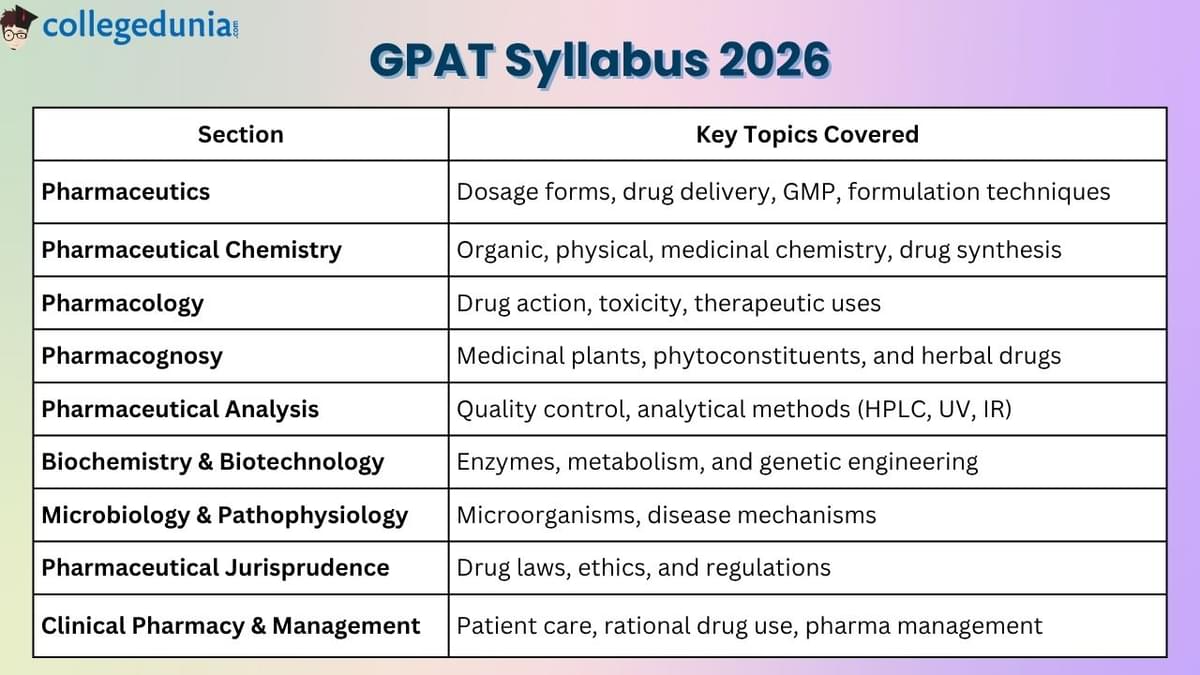
The GPAT Syllabus has been released by NBEMS along with the information bulletin on the official website. The GPAT syllabus is based on the B.Pharm format, including 4 main subjects: pharmaceutical chemistry, pharmaceutics, pharmacology, and pharmacognosy, carrying 60% of the total weightage.
- The GPAT pharmaceutical chemistry syllabus will include organic, physical, and inorganic chemistry, along with some topics related to drugs and synthesis.
- The GPAT Pharmaceutics syllabus includes dosage forms, pharmaceutical technology, GMP, and novel drug delivery systems
- The GPAT Pharmacology syllabus includes the drug mechanisms, therapeutic actions, and adverse effects.
- Whereas the GPAT pharmacognosy syllabus will focus on medicinal plants, phytoconstituents, and natural drug derivatives.
The GPAT Exam will include 125 MCQs, with a total of 500 marks in a CBT mode to be done in a duration of 3 hours. Each correct answer will carry +4 marks, and a -1 mark will be deducted for an incorrect answer.
As per the previous year's analysis, the GPAT Exam is expected to be of a moderate difficulty level, including conceptual clarity and application-based questions.
Also Read

Key Summary
In this Article, we have discussed about GPAT Syllabus 2026, including the Changes, Exam Pattern, and Chapter-wise topics.
- The GPAT 2026 Syllabus is expected to be released in February 2026, and the GPAT Exam will be held in the fourth week of May 2026.
- The GPAT Syllabus will include 4 major subjects: pharmaceutical chemistry, pharmaceutics, pharmacology, and pharmacognosy.
- All the major 4 sections carry more than 60% of the weightage in the GPAT Exam.
- As per the latest update, there are no changes in the GPAT 2026 Exam.
- What is the GPAT Syllabus 2026?
- Has the GPAT Syllabus Changed for 2026?
- GPAT Syllabus 2026: Section-Wise
- How to Cover the GPAT 2026 Syllabus Smartly?
- GPAT 2026: Most Frequently Asked Topics You Should Revise
- GPAT Exam Pattern 2026
- GPAT 2025 Question Paper with Solutions PDFs
- GPAT 2024 Question Paper with Solutions PDFs
- FAQs for GPAT Syllabus 2026
What is the GPAT Syllabus 2026?
The GPAT Syllabus 2026 will include the topics that should be prepared by the candidates for GPAT, which will be NBEMS in Medical sciences.
The GPAT Syllabus is based on the B.Phaem format set by AICTE, which covers pharmaceutical science along with allied and applied subjects.
| Particulars | Details |
|---|---|
| Exam Conducting Body | National Board of Examinations in Medical Sciences (NBEMS) |
| Level of Exam | Postgraduate (based on B.Pharm syllabus) |
| Primary Reference | AICTE-prescribed Bachelor of Pharmacy curriculum |
| Total Questions | 125 MCQs |
| Total Marks | 500 |
| Core Subjects | Pharmaceutics, Pharmaceutical Chemistry, Pharmacology, Pharmacognosy |
| Allied Subjects | Pharmaceutical Analysis, Biochemistry, Biotechnology, Microbiology, Pathophysiology |
| Other Areas | Human Anatomy & Physiology, Pharmaceutical Jurisprudence, Management, Clinical Pharmacy |
| Difficulty Level | Moderate to High |
| Exam Mode | Computer-Based Test (CBT) |
Also Read
GPAT Exam PatternQues. Who is Conducting GPAT 2026?
Ans. The GPAT 2026 is conducted by NBEMS, which was earlier conducted by NTA and has now been shifted to NBEMS.
The NBEMS has released the official notification, syllabus, and exam dates on its official website, natboard.edu.in.
| Exam Conducting Authority | Details |
|---|---|
| Exam Name | Graduate Pharmacy Aptitude Test (GPAT) 2026 |
| Conducting Body | National Board of Examinations in Medical Sciences (NBEMS) |
| Official Website | www.natboard.edu.in |
| Mode of Examination | Computer-Based Test (CBT) |
| Expected Exam Date | May 2026 (Tentative) |
| Purpose | Admission to M.Pharm and related postgraduate pharmacy programs |
Ques. Who is eligible for GPAT 2026?
Ans. To appear in GOAT 2026, you should hold or have the final year of a bachelor’s degree in pharmacy (B.Pharm). Candidates from equivalent pharmacy programs are also eligible, but B.Tech graduates are not eligible.
| Eligibility Criteria | Details |
|---|---|
| Educational Qualification | Bachelor’s degree in Pharmacy (B.Pharm) or equivalent from a recognized university |
| Final Year Students | Eligible to apply, provided degree completion before admission |
| Ineligible Courses | B.Tech in Pharmaceutical & Fine Chemical Technology not accepted |
| Age Limit | No age restriction |
| Nationality | Must be an Indian citizen |
| Minimum Marks (General Trend) | No fixed cutoff for eligibility; merit is based on exam performance |
Has the GPAT Syllabus Changed for 2026?
As per the current update, the GPAT Syllabus will follow the AICTE-based B.Pharm format.
The GPAT 2026 Syllabus has not been released officially by NBEMS, but according to the last few years, there have been a few changes in the weightage of the topics.
GPAT 2026 Syllabus Change
| Aspect | Status (2026) | Remarks |
|---|---|---|
| Core Subject Areas | Unchanged | Pharmaceutics, Pharmaceutical Chemistry, Pharmacology, and Pharmacognosy remain central. |
| Allied Subjects | Unchanged | Includes Analysis, Jurisprudence, Biotechnology, Microbiology, and Pathophysiology. |
| Exam Pattern | Same | 125 MCQs, 500 Marks, 3 Hours, +4/–1 Marking Scheme. |
| Weightage Trends | Minor Shift | Higher focus on Pharmaceutics, NDDS, and Biotech applications. |
| New Additions | None Officially | No new subjects announced by NBEMS as of November 2025. |
GPAT Syllabus 2026: Section-Wise
The GPAT Syllabus 2026 covers all the major topics of B.Pharm and is divided into core and allied subjects. The GPAT Main sections: Pharmaceutics, Pharmaceutical Chemistry, Pharmacology, and Pharmacognosy carry the highest weightage of around 60 to 65%.
GPAT Syllabus for Pharmaceutics
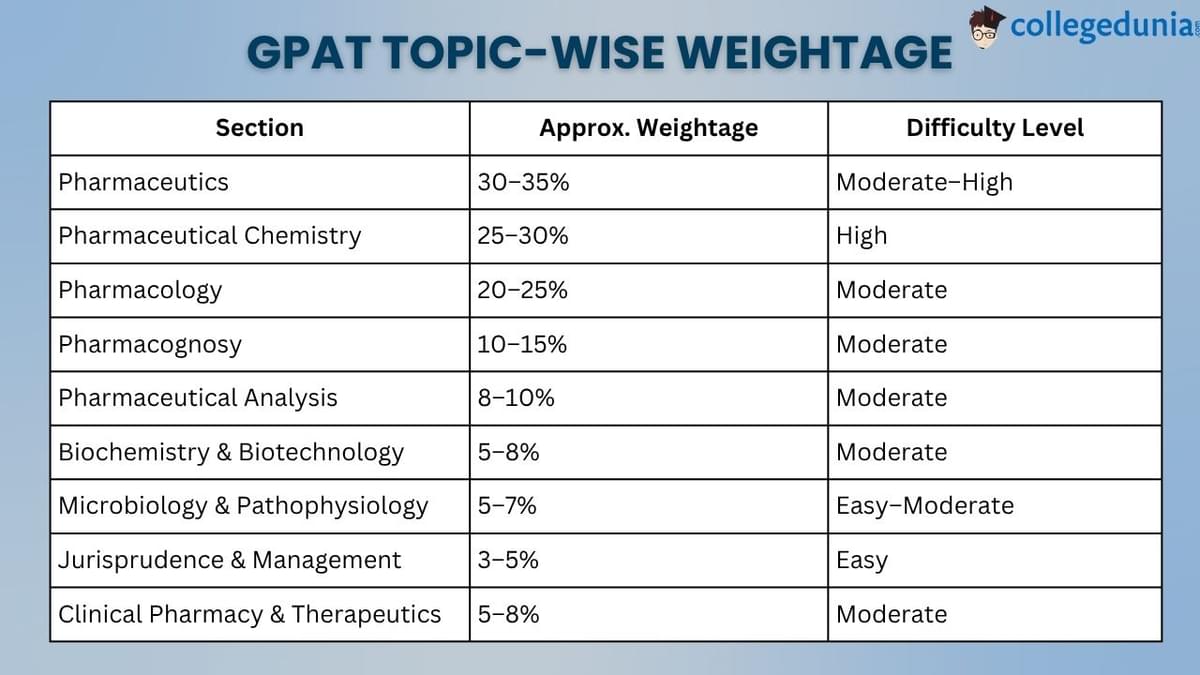
- The Pharmaceutics carries the weightage of 30 to 35%, around 40 questions in the GPAT Exam 2026.
- The Pharmaceutics includes the coverage of formulation, processing, and evaluation of pharmaceutical dosage forms.
- The Major focus is on conceptual and numerical questions. The NDDS and pharmacokinetics are the most commonly asked about since GPAT 2023.
| Topics | Sub-topics |
|---|---|
| Dispensing & Formulation | Prescription handling, incompatibilities, and compounding methods |
| Dosage Forms | Tablets, capsules, injectables, emulsions, suspensions, aerosols |
| Pharmaceutical Technology | Granulation, sterilisation, tablet coating, packaging, stability studies |
| Novel Drug Delivery Systems (NDDS) | Liposomes, nanoparticles, transdermal systems, controlled release forms |
| Biopharmaceutics & Pharmacokinetics | ADME, bioavailability, bioequivalence, compartment models |
| GMP & Quality Control | Validation, documentation, and quality assurance protocols |
GPAT Pharmaceutics Expected Weightage for 2026
- Emphasis Will Be on Dosage Forms: Pharmaceutics will continue to revolve around topics including dosage forms, additives, and delivery systems (~3%).
- Extensive Coverage Will Continue: Industrial and technological improvements will involve novel medication delivery technologies (~2-3%), prolonged action pharmaceuticals, and plant structure.
- Regulatory and Quality Aspects Will Remain Important: GMP, validation, and packaging materials (~3%) will prioritise adherence to regulations in the manufacturing of pharmaceuticals.
- Specialised Topics Will Be Moderately Important: Aerosols, cosmetics, and ophthalmic preparations (~1-2%) will continue to be specialised but significant topics.
| Key Topics | Expected Weightage |
|---|---|
| Pharmacy Profession & Introduction to Pharmaceuticals | ~2% |
| Dosage Forms and Drug Delivery Systems | ~3% |
| Pharmaceutical Plant Layout and Design | ~2% |
| Dosage Form Additives and Necessities | ~3% |
| Powders and Capsules | ~2% |
| Tablets: Formulation, Coating, and Troubleshooting | ~3% |
| Parenterals and Sterile Products | ~3% |
| Suspensions and Emulsions | ~2% |
| Suppositories, Semisolids, and Liquids | ~2% |
| Pharmaceutical Aerosols | ~2% |
| Ophthalmic Preparations | ~1% |
| Preformulation and Stability Studies | ~2% |
| Prolonged Action Pharmaceuticals | ~2% |
| Novel Drug Delivery Systems | ~2% |
| GMP, Validation, and Packaging Materials | ~3% |
| Cosmetics and Pilot Plant Scale-Up Techniques | ~2% |
GPAT Syllabus for Pharmaceutical Chemistry
- In GPAT, pharmaceutical chemistry carries the weightage of around 25 to 30%, including 30 to 35 questions.
- The GPAT Pharmaceutical chemistry covers the organic, physical and medical chemistry, which focuses on drug design, synthesis, and mechanisms.
- In this section, around 50% of the questions are asked from medical chemistry.
| Topics | Sub-topics |
|---|---|
| Organic Chemistry | Reaction mechanisms, isomerism, aromatic substitutions, and reagents |
| Physical Chemistry | Thermodynamics, kinetics, solutions, phase equilibria |
| Medicinal Chemistry | SAR, prodrugs, receptor theory, enzyme inhibition |
| Inorganic Pharmaceutical Chemistry | Radiopharmaceuticals, essential trace elements, and antidotes |
| Computer-Aided Drug Design (CADD) | QSAR, molecular docking, pharmacophore modelling |
GPAT Pharmaceutical Chemistry Expected Weightage for 2026
- Consistent Weighting for Core Topics: The relevance of topics like pharmaceutical inorganic chemistry, antibiotics, and antimicrobial drugs (~3%) in GPAT can be seen by their consistent weightage.
- Equitable Attention to Therapeutic Classes: Adrenergic Substances, Steroids, and Neurological Agents (~2% each) receive equal attention, emphasising their constant applicability in examinations.
- Emphasis on Emerging Topics: Advances in drug design and personalised treatment are reflected in specialised fields such as QSAR and Combinatorial Chemistry (~1%).
| Key Topics | Expected Weightage |
|---|---|
| Pharmaceutical Inorganic Chemistry: Impurities, limit tests, monographs, isotopes, dentifrices, anticaries agents. | ~3% |
| Antimicrobial Drugs: Antimalarials, antifungal agents, antivirals, antibacterial sulpha drugs. | ~3% |
| Antibiotics: Penicillins, cephalosporins, beta-lactam antibiotics, macrolides, tetracyclines. | ~3% |
| Therapeutic Classes of Drugs: Anaesthetics, antiseptics, anticoagulants, coagulants, laxatives, anti-diarrheal agents. | ~2% |
| Steroids: Corticosteroids, sex steroids, anabolic steroids, anti-inflammatory steroids. | ~2% |
| Adrenergic and Cholinergic Drugs: Agonists, antagonists, neurotransmitter functions. | ~2% |
| Neurological and Neuromuscular Agents: Antiepileptics, neuroleptics, anti-Parkinson’s agents. | ~2% |
| Anti-Hypertensives and Cardiovascular Drugs: Hypertensive agents, diuretics, anti-anginals. | ~2% |
| QSAR and Drug Design: Quantitative structure-activity relationship, Hansch analysis, substituent constants. | ~1% |
| Asymmetric Synthesis: Chirality, enantioselectivity, asymmetric synthesis examples like captopril. | ~1% |
| Combinatorial Chemistry: Solid-phase synthesis, linkers, mix and split methods. | ~1% |
GPAT Syllabus for Pharmacology
- The GPAT Pharmacology section carries the weightage of around 20 to 25%, including around 25 questions.
- It includes drug action, therapeutic application and side effects, emphasising the mechanism-based understanding.
| Topics | Sub-topics |
|---|---|
| General Pharmacology | Pharmacokinetics, drug receptors, dose-response curves |
| Systemic Pharmacology | Autonomic, CNS, cardiovascular, endocrine, renal drugs |
| Chemotherapy | Antibiotics, antivirals, antifungals, anticancer agents |
| Toxicology | Adverse effects, poisoning, and antidotes |
| Clinical Pharmacology | Pharmacovigilance, rational drug use, clinical trials |
GPAT Pharmacology Expected Weightage for 2026
- General Pharmacology Will Dominate: Topics like pharmacodynamics, pharmacokinetics, and drug development will need a lot of focus, as they make up just about 5% of the total weightage.
- The Endocrine and Neurohumoral Systems Will Be Important: Pharmacology of the Endocrine System (~4%) and Neurohumoral Transmission (~4%) will continue to be key areas.
- High Weightage for Cardiovascular Pharmacology and CNS: Both fields are projected to account for around 5%, highlighting their importance in pharmaceutical mechanisms and therapy.
- Chemotherapy Will Take the Lead: Due to their greater weight, topics including antibiotics, tuberculosis, and AIDS (~6%) will require more attention.
- Moderate Emphasis on Specialised Topics: Topics such as GI Pharmacology, Autacoids, and the Respiratory System (~3% each) will remain pertinent but need well-rounded preparation.
| Key Topics | Expected Weightage |
|---|---|
| General Pharmacology (Pharmacodynamics, Pharmacokinetics, Adverse Drug Reactions, Drug Development) | ~5% |
| Neurohumoral Transmission (Autonomic and CNS) | ~4% |
| Pharmacology of the Peripheral Nervous System | ~3% |
| Pharmacology of the Central Nervous System | ~5% |
| Pharmacology of the Cardiovascular System | ~5% |
| Drugs Acting on the Urinary System | ~2% |
| Drugs Acting on the Respiratory System | ~3% |
| Pharmacology of the Endocrine System | ~4% |
| Chemotherapy (Antibiotics, Tuberculosis, AIDS, and Malignancy) | ~6% |
| Autacoids and Their Antagonists | ~3% |
| Drugs Acting on the Gastrointestinal Tract | ~3% |
| Chronopharmacology | ~1% |
| Immunopharmacology | ~2% |
| Vitamins & Minerals | ~2% |
| Principles of Toxicology | ~2% |
GPAT Syllabus for Pharmacognosy
- The GPAT Pharmacognosy weightage includes 10 to 15% weightage, including 12 to 15 questions.
- This Section focuses on natural drugs and plant-based constituents with therapeutic applications.
| Topics | Sub-topics |
|---|---|
| Plant Constituents | Alkaloids, glycosides, terpenoids, tannins |
| Plant Morphology & Taxonomy | Identification, microscopy, and adulteration tests |
| Extraction & Isolation | Solvent extraction, chromatography, standardisation |
| Herbal Formulations | Evaluation methods, WHO guidelines, phytoconstituent standardisation |
| Marine & Animal Products | Drugs derived from marine sources and animal origin |
GPAT Pharmacognosy Expected Weightage for 2026
- Phytoconstituents and Volatile Oils Are Key: Topics like Alkaloids, Carbohydrates, and Volatile Oils (~4% each) will need focused preparation.
- Core Areas Stay Important: Subjects like Biogenetic Pathways, Glycosides, and Quality Control (~3% each) will remain essential for understanding basics.
- Practical Topics Get Moderate Focus: Areas like Extraction, Pharmaceutical Aids, and Herbal Formulations (~2% each) will help in practical applications.
- Small but Important Topics: Topics like Adulteration, Herbal Cosmetics, and Patents (~1% each) will still require attention for niche knowledge.
| Key Topics | Expected Weightage |
|---|---|
| Introductory Pharmacognosy | ~3% |
| Classification of Crude Drugs | ~2% |
| Factors Influencing Quality of Crude Drugs | ~3% |
| Techniques in Microscopy | ~2% |
| Phytoconstituents (Carbohydrates, Proteins, Alkaloids, etc.) | ~4% |
| Principles of Plant Classification | ~3% |
| Pharmaceutical Aids (Starches, Gums, Oils) | ~2% |
| Animal Products | ~2% |
| Plant Products (Bitters, Sweeteners, etc.) | ~2% |
| Toxic Drugs | ~1% |
| Enzymes (Sources, Preparation, Uses) | ~2% |
| Natural Pesticides | ~1% |
| Adulteration and Evaluation of Crude Drugs | ~2% |
| Quantitative Microscopy | ~1% |
| Biogenetic Pathways (TCA Cycle, Shikimic Acid Pathway, etc.) | ~3% |
| Carbohydrates and Lipids | ~2% |
| Tannins | ~1% |
| Volatile Oils | ~4% |
| Resinous Drugs | ~3% |
| Glycosides | ~3% |
| Alkaloids | ~4% |
| Extraction and Isolation Techniques | ~2% |
| Phytopharmaceuticals | ~3% |
| Quality Control and Standardisation of Herbal Drugs | ~3% |
| Herbal Formulations | ~2% |
| Worldwide Trade of Crude Drugs | ~1% |
| Herbal Cosmetics | ~1% |
| Traditional Herbal Drugs | ~2% |
| Plant-Based Industries and Research Institutes in India | ~1% |
| Patents (Herbal and Natural Products) | ~1% |
| Ayurvedic System of Medicine | ~3% |
| Homoeopathic System of Medicine | ~2% |
GPAT Syllabus for Pharmaceutical Analysis
- In GPAT, Pharmaceutical covers around 8 to 10% weightage, including 10 questions.
- This section covers qualitative and quantitative analysis techniques for the evaluation of drugs and quality assurance.
- The Instrumental methods, like HPLC and UV, carry 70% weightage in this section, and also include topics related to Pharmaceutics.
| Topics | Sub-topics |
|---|---|
| Classical Analysis | Titrations, gravimetric, volumetric methods |
| Instrumental Analysis | UV, IR, NMR, Mass spectrometry |
| Chromatography | HPLC, GC, TLC, and electrophoresis |
| Quality Control & Validation | Calibration, SOPs, ICH Q-series guidelines |
GPAT Pharmaceutical Analysis Expected Weightage for 2026
- Spectroscopy and Chromatography Will Stand out: UV-Vis, IR, NMR, and HPLC will all need in-depth attention, with each topic receiving about 4% of the overall weightage.
- Constant Attention to Basic Techniques: For preparation, subjects such as Acid-Base Titrations, Oxidation-Reduction Titrations, and Miscellaneous Analytical Methods (~2% each) will continue to be crucial.
- Specialised techniques, Such as Flame Photometry, Atomic Absorption Spectrometry, and Complexometric Titrations, are moderately important for practical understanding (~2% each).
- Niche Topics Will Need Less Work: Compared to high-weightage topics, subjects like gravimetry, nephelometry, and instrument calibration (~1% each) will be relevant but require less preparation
| Key Topics | Expected Weightage |
|---|---|
| Importance of Quality Control in Pharmacy | ~1% |
| Acid-Base Titrations | ~2% |
| Non-Aqueous Titrations | ~1% |
| Oxidation-Reduction Titrations | ~2% |
| Precipitation Titrations | ~1% |
| Complexometric Titrations | ~2% |
| Gravimetry | ~1% |
| Extraction Techniques | ~1% |
| Potentiometry | ~1% |
| Miscellaneous Methods of Analysis (Diazotisation, Kjeldahl, Karl Fisher, etc.) | ~2% |
| Spectroscopy (UV-Vis, IR, NMR, Mass Spectrometry) | ~4% |
| Flame Photometry and Atomic Absorption Spectrometry | ~2% |
| Chromatography (TLC, HPTLC, HPLC, GC) | ~4% |
| Polarography | ~1% |
| Nephelometry and Turbidimetry | ~1% |
| Statistical Treatment of Experimental Data | ~1% |
| Calibration of Instruments | ~1% |
GPAT Syllabus for Biochemistry & Biotechnology
- The GPAT Syllabus for Biochemistry & Biotechnology carries a weightage of around 5 to 8%, including around 8 to 10 questions.
- The GPAT Syllabus will test the candidate’s understanding of biological processes, enzymes, and molecular-level drug mechanisms.
| Topics | Sub-topics |
|---|---|
| Biochemistry | Enzymes, metabolism (carbs, proteins, fats), vitamins, bioenergetics |
| Biotechnology | Genetic engineering, fermentation, vaccine production, and monoclonal antibodies |
GPAT Biochemistry Expected Weightage
- Topics Concerning Metabolism Will Dominate: Carbohydrates, proteins, and lipids (around 2% each) will require an in-depth study of biochemical processes and metabolism.
- Equitable Representation of Biochemical Processes: Vitamins, Enzymes, and Biological Oxidations (about 2% each) will remain essential for preparation.
- Moderate Focus on Molecular Biology: Nucleic acids and transcription and translation (~2%) will continue to be important.
- Specialised Subjects Will Need Little Work: Less preparation will be needed for topics like Cell Structure, Functions, and Hereditary Diseases (~1% each), but they will still be relevant.
| Key Topics | Expected Weightage |
|---|---|
| Cell Structure and Functions | ~1% |
| Carbohydrates: Types, Functions, Metabolism (Glycogenesis, Glycogenolysis, HMP Shunt, etc.) | ~2% |
| Proteins: Types, Functions, Digestion, Urea Cycle | ~2% |
| Lipids: Types, Digestion, Beta-Oxidation, Cholesterol Biosynthesis, Ketone Bodies | ~2% |
| Vitamins: Classification, Biochemical Role, Deficiency Symptoms | ~2% |
| Biological Oxidation and Reductions: ETC, Oxidative Phosphorylation | ~2% |
| Enzymes: Classification, Kinetics, Michaelis-Menten Equation, Inhibition | ~2% |
| Nucleic Acids: Types, DNA/RNA Structure, Central Dogma, Transcription, Translation | ~2% |
| Hereditary Diseases | ~1% |
GPAT Biotechnology Expected Weightage for 2025
- Recombinant DNA Technology Shall Dominate: Topics like restriction enzymes, cloning, and DNA vectors will need careful preparation, as they will account for about 3% of the total weight.
- Essential Techniques Will Remain Relevant: Fields such as Fermentation Technology, Animal Cell Culture, and Plant Cell Culture (~2% each) will maintain consistent coverage.
- Moderate Emphasis on Molecular Methods: To fully understand advanced applications, topics like PCR, Gene Transfer Techniques, and Human Gene Therapy (~2% each) will continue to be crucial.
- Practical Applications Will Attract Attention: Due to their practical applications, industrial microbiology, somatic hybridisation, and germplasm conservation (~2%) will continue to be important.
| Key Topics | Expected Weightage |
|---|---|
| Plant Cell and Tissue Culture: Cell structure, somatic hybridisation, secondary metabolite production | ~2% |
| Gene Transfer Techniques: Methods, applications, and germplasm conservation | ~2% |
| Animal Cell Culture: Media, cell lines, cloning, transgenic animals | ~2% |
| Fermentation Technology and Industrial Microbiology: Fermenter design, monitoring, product recovery | ~2% |
| Recombinant DNA Technology: Restriction enzymes, cloning, DNA vectors, expression systems | ~3% |
| PCR and Its Applications: Methodology and Uses | ~2% |
| Human Gene Therapy: Concept, drug delivery systems, and applications | ~2% |
GPAT Syllabus for Microbiology & Pathophysiology
- The GPAT includes 5 to 7% weightage, asking around 6 to 8 questions.
- The GPAT Syllabus will focus on microbial control, infection, and disease mechanisms relevant to drug therapy.
- The GPAT Syllabus regularly focuses on sterilisation & immune response.
| Topics | Sub-topics |
|---|---|
| Microbiology | Sterilisation, culture media, microbial identification |
| Immunology | Antigens, antibodies, and immune response mechanisms |
| Pathophysiology | Inflammation, cardiovascular, renal, and metabolic disorders |
GPAT Syllabus for Pharmaceutical Jurisprudence & Management
- It will have around 3 to 5% weightage, including 4 to 6 questions, in which the DPCO & IPR Sections are most repetitive.
- It will test candidates' knowledge of pharma laws, ethics, and management practices in the pharmaceutical industry.
| Topics | Sub-topics |
|---|---|
| Pharma Laws & Regulations | Drugs & Cosmetics Act, Pharmacy Act, DPCO |
| Ethics & IPR | Patent filing, trademarks, and the drug approval process |
| Management Principles | HR, marketing, inventory, quality management |
GPAT Syllabus for Clinical Pharmacy & Therapeutics
- It will carry around 5 to 8% weightage, by asking around 6 to 8 questions.
- The Clinical Pharmacy & Therapeutics will focus on patient care, clinical applications, and therapeutic decision-making.
| Topics | Sub-topics |
|---|---|
| Clinical Pharmacy | Prescription audit, ADRs, therapeutic monitoring |
| Therapeutics | Management of cardiovascular, metabolic, and infectious diseases |
| Pharmacoeconomics | Cost-benefit and cost-effectiveness analysis |
Ques. How Many Sections Are in the GPAT Exam?
Ans. The GPAT Exam comprises 1 paper divided into multiple subject sections, all based on the B.Pharm Syllabus. This section will test candidate’s conceptual clarity and application skills across core and allied pharmacy subjects.
| Section Name | Subjects Included | Approx. Weightage |
|---|---|---|
| Core Subjects | Pharmaceutics, Pharmaceutical Chemistry, Pharmacology, Pharmacognosy | 80% |
| Allied Subjects | Pharmaceutical Analysis, Biotechnology, Microbiology, Jurisprudence | 20% |
| Total Sections | 2 (Core + Allied) | 125 Questions / 500 Marks |
Ques. Can I Crack the GPAT in 1 Month?
Ans. You can crack the GPAT Exam in 1 month, with a focused and revision-based strategy, for candidates who have already studied B.Pharm properly. For cracking the exam, you should do daily planning, mock tests and topic-wise prioritisation.
| Strategy Component | Plan of Action |
|---|---|
| Syllabus Prioritization | Focus on Pharmaceutics & Chemistry (~60% weightage) |
| Daily Study Hours | 6–8 hours/day |
| Revision Cycles | 3 full revisions in 4 weeks |
| Mock Tests | 2–3 full-length tests per week |
| Target Score Range | 140–160+ for a strong percentile |
Ques. What Are the Qualifying Marks for GPAT 2026?
Ans. The GPAT Qualifying marks are the same as last year and will vary by category. You should meet the minimum cutoff marks, to qualify for admission into M.Pharms programs or receive AICTE Scholarships.
| Category | Expected Qualifying Marks (2026) | Expected Percentile Range |
|---|---|---|
| General (UR) | 145–155 | 90–95%ile |
| OBC-NCL | 120–130 | 80–85%ile |
| SC / ST | 90–100 | 65–70%ile |
| EWS / PwD | 100–110 | 70–75%ile |
Ques. What is a Good Rank in GPAT?
Ans. A Good GPAT Rank will depend upon your admission goals. To get admission in top M.Pharm colleges and NIPERs, your rank should be under 300. By ranks upto 1000 you can still get a seat in reputed pharmacy colleges in india.
| Rank Range | Performance Category | Expected College Tier |
|---|---|---|
| 1 – 100 | Excellent | Top NIPERs & IITs |
| 101 – 300 | Very Good | Prominent Govt. & Central Universities |
| 301 – 700 | Good | Top Private Pharmacy Colleges |
| 701 – 1000 | Average | Regional Institutes |
| Above 1000 | Qualifying | Eligible for scholarships & backup options |
How to Cover the GPAT 2026 Syllabus Smartly?
If you are preparing for GPAT 2026, apart from covering all the topics, you should strategically complete the syllabus, as per the weightage and previous year analysis.
The Pharmaceutics and Pharmaceutical Chemistry will include 60 to 65% weightage in the total marks. By focusing on high-weightage topics, revising properly and doing MCQ Practice can increase your score.
Smart GPAT 2026 Syllabus Coverage Strategy
- By doing daily mock-test practice, you can cover 25 to 30 MCQs per subject, which will improve your accuracy by more than 15 to 20%.
- By practising the NCERT and basic pharmacy books from Lachman, Foye, and K.D. Tripathi, you can cover more than 80% questions asked directly from B.Pharm-level concepts.
| Study Focus Area | Coverage Strategy | Expected Weightage / Impact |
|---|---|---|
| Pharmaceutics | Give priority to NDDS, Biopharmaceutics, and Physical Pharmaceutics; revise GMP and formulation design. | 30–32% of paper |
| Pharmaceutical Chemistry | Emphasise Organic & Medicinal Chemistry, synthesis mechanisms, and structure–activity relationships (SAR). | 28–30% of paper |
| Pharmacology | Focus on CNS, CVS, Autonomic Nervous System, and mechanism-based drug questions. | 18–20% |
| Pharmacognosy | Revise alkaloids, glycosides, and identification tests of crude drugs. | 10–12% |
| Allied & Applied Subjects | Cover Analytical Chemistry, Jurisprudence, and Biotechnology; practice applied questions. | 8–10% |
Also Read
GPAT Important BooksQues. How to Crack GPAT 2026 Without Coaching?
Ans. A lot of toppers in GPAT have cleared the exam without any formal coaching, by following a proper study plan, smart preparation selection and consistent mock pracitce. You should properly understand the weightage of the exam, focus on conceptual clarity and give the mock tests in exam based conditions.
| Strategy Area | Approach | Key Insights |
|---|---|---|
| Syllabus Coverage | Follow official GPAT syllabus and prioritize high-weightage subjects | 70% questions come from Pharmaceutics, Pharmacology & Pharmaceutical Chemistry |
| Study Material | Use standard books (e.g., KD Tripathi, Lachman, C.V.S. Subrahmanyam) | 80% toppers rely on 2–3 core books for conceptual prep |
| Mock Tests | Attempt at least 20–25 mocks before exam | Candidates with 15+ mocks show 25% higher accuracy |
| Time Management | Allocate 6–8 hours daily with topic rotation | 3-hour focused slots yield better retention |
| Revision | Reserve final 15 days for revision & PYQs | 65% repeat questions are concept-based, not direct repeats |
Ques. Which Subject is Most Important for GPAT 2026?
Ans. All the subjects are important, but as per previous year analysis, majority of the questions are asked from Pharmacology, Pharmaceutics, and Pharmaceutical Chemistry.
These section cover around 70% of the total marks, which makes them most scoring sections.
| Subject | Approx. Weightage | Key Focus Areas |
|---|---|---|
| Pharmacology | 30–35 Questions | Autonomic Nervous System, CNS Drugs, Chemotherapy |
| Pharmaceutics | 25–30 Questions | Dosage Forms, Biopharmaceutics, Novel Drug Delivery |
| Pharmaceutical Chemistry | 25–28 Questions | Medicinal Chemistry, Organic Chemistry, Drug Design |
| Pharmacognosy | 10–12 Questions | Alkaloids, Glycosides, Volatile Oils |
| Other Subjects (Biochem, Microbiology, etc.) | 5–8 Questions | Enzymes, Immunology, Industrial Microbiology |
GPAT 2026: Most Frequently Asked Topics You Should Revise
As per the previous year's analysis of GPAT, some topics are asked repetitively in all sections, which include the major high-weightage topics. The Most Repetitive topics include NDDS, Pharmacokinetics, Medicinal Chemistry, and Biopharmaceutics, which are asked every year.
Most Repeated GPAT Topics (Based on Past 5-Year Trend)
| Subject | Frequently Asked Topics | Approx. Question Frequency |
|---|---|---|
| Pharmaceutics | NDDS, Biopharmaceutics, Physical Pharmaceutics, Preformulation Studies, GMP | 12–14 questions/year |
| Pharmaceutical Chemistry | SAR, Drug Synthesis, Heterocyclic Compounds, Spectroscopy, Antimicrobial Agents | 10–12 questions/year |
| Pharmacology | Autonomic Nervous System, CNS Drugs, Toxicology, Mechanism of Action | 8–10 questions/year |
| Pharmacognosy | Alkaloids, Glycosides, Terpenoids, Plant Identification Tests | 5–7 questions/year |
| Pharmaceutical Analysis | HPLC, UV/IR Spectroscopy, Titrimetry, Quality Control | 4–6 questions/year |
| Biotechnology & Microbiology | Recombinant DNA, Fermentation, Vaccines, Microbial Assays | 3–5 questions/year |
Ques. What Type of Questions Are Asked in GPAT 2026?
Ans. The GPAT Questions are conceptual, application-based MCQs, which will test the candidate’s understanding of core pharmacy subjects. The GPAT Questions often include theoretical knowledge along with pharmaceutical scenarios.
- More then 70–75% of GPAT questions are from Pharmaceutics, Pharmacology & Chemistry.
- Around 60% of questions are moderate difficulty, where as 25% are tricky application-based.
| Question Type | Description | Weightage |
|---|---|---|
| Conceptual MCQs | Direct questions from fundamental pharmacy topics | 40% |
| Application-Based | Case studies or drug mechanism questions | 30% |
| Numerical/Calculation-Based | Questions from Biopharmaceutics, Physical Pharmacy | 15% |
| Analytical & Assertion-Reason | Logical and reasoning-based concept checks | 15% |
Ques. What is the Highest Score in GPAT?
Ans. The GPAT Highest score are different every year, according to the difficulty level. Recently, the highest score got a score between 320–355 marks out of 500.
| Year | Highest Marks | Percentile | Candidate Rank |
|---|---|---|---|
| 2024 | 347 | 100 | AIR 1 |
| 2023 | 355 | 100 | AIR 1 |
| 2022 | 341 | 100 | AIR 1 |
Ques. Is the GPAT Exam Hard or Easy?
Ans. The GPAT Exam is considered as moderate to difficulty level, it focuses more on conceptual understanding than the rote learning.
| Parameter | Level | Remarks |
|---|---|---|
| Difficulty Level (Overall) | Moderate | Balanced between conceptual & numerical |
| Pharmacology & Pharmaceutics | Moderate–Hard | Concept-heavy questions dominate |
| Pharmaceutical Chemistry | Moderate | Requires formula & structure recall |
| Pharmacognosy & Others | Easy–Moderate | Mostly direct questions |
Ques. What is a Good Score in GPAT 2026?
Ans. A Good GPAT Score depends upon the college you are targeting. Majorly, score above 200 to 250 marks to get admission in the reputed institute, whereas by 300+ marks you will get top percentile.
| Category | Good Score Range (out of 500) | Approx. Percentile | Admission Scope |
|---|---|---|---|
| Excellent | 300–350+ | 99–100 | Top NIPERs, ICT Mumbai |
| Very Good | 250–299 | 95–98 | Top Pharmacy Colleges |
| Good | 200–249 | 85–94 | Decent State Universities |
| Average | 150–199 | 70–84 | Private Colleges |
GPAT Exam Pattern 2026
The GPAT 2026 Exam pattern is similar to the previous year; it will test your understanding of core B.Pharm subjects through MCQs.
The GPAT Exam will be held in a CBT Mode and will include negative marking for incorrect answers.
| Section | No. of Questions (Approx.) | Marks | Weightage (%) | Key Focus Areas |
|---|---|---|---|---|
| Pharmaceutics | 35–38 | 140–152 | 30% | NDDS, Biopharmaceutics, Physical Pharmaceutics, GMP |
| Pharmaceutical Chemistry | 32–35 | 128–140 | 28% | Medicinal Chemistry, SAR, Organic Chemistry, Drug Synthesis |
| Pharmacology | 22–25 | 88–100 | 20% | Mechanism of Action, Toxicology, CNS & ANS Drugs |
| Pharmacognosy | 12–15 | 48–60 | 12% | Alkaloids, Glycosides, Phytochemistry |
| Pharmaceutical Analysis & Allied Subjects | 10–12 | 40–48 | 10% | HPLC, Spectroscopy, Biotech, Jurisprudence |
GPAT 2025 Question Paper with Solutions PDFs
| Exam Date | Question Paper PDF | Solution PDF |
|---|---|---|
| GATE 2025 25 May Question Paper PDF (Shift 1) | Download PDF | Download PDF |
| GATE 2025 25 May Question Paper PDF (Shift 2) | Download PDF | Download PDF |
GPAT 2024 Question Paper with Solutions PDFs
| Exam Date | Question Paper PDF | Answer Key PDF | Solution PDF |
|---|---|---|---|
| June 8, 2024 | Download PDF | Download PDF | Download PDF |
Also Read
GPAT Previous-Year Question PaperFAQs for GPAT Syllabus 2026
Ques. How Many Total Marks Are in GPAT?
Ans. The GPAT Exam is of 500 marks, including 125 MCQs, each answer of 4 marks each, and 1 marks will be deducted for incorrect answer.
| Parameter | Details |
|---|---|
| Total Questions | 125 |
| Total Marks | 500 |
| Marks per Question | +4 |
| Negative Marking | -1 per wrong answer |
| Duration | 3 hours |
Ques. What is the Highest Score in GPAT?
Ans. The High score in GPAT Changes every year, but majorly it is between 340 to 355 marks out of 500. The topper candidate generally scores over 100 percentile.
| Year | Topper’s Marks | Percentile | Rank |
|---|---|---|---|
| 2024 | 347 | 100 | AIR 1 |
| 2023 | 355 | 100 | AIR 1 |
| 2022 | 341 | 100 | AIR 1 |
Ques. Which Book is Best for GPAT Preparation?
Ans. While Selecting the best books for GPAT, you should understand concepts in depth and align their preparation as per the official syllabus.
Below are some of the most recommended books for GPAT 2026.
| Subject | Recommended Book | Author/Publisher |
|---|---|---|
| Pharmaceutics | Pharmaceutics Vol. 1 & 2 | Lachman, Lieberman |
| Pharmaceutical Chemistry | Organic & Inorganic Chemistry | Morrison & Boyd |
| Pharmacology | Essentials of Medical Pharmacology | K.D. Tripathi |
| Pharmacognosy | Textbook of Pharmacognosy | Trease & Evans |
| General Preparation | GPAT: A Companion | Pearson / Arihant Experts |
Ques. Which Subjects Carry Maximum Weightage in GPAT?
Ans. In GPAT, Pharmaceutics and Pharmaceutical Chemistry are most high-weightage topics, which together covers more than 60% of total marks in GPAT.
| Subject | Approx. Weightage | Key Focus Areas |
|---|---|---|
| Pharmaceutics | 30–35% | Drug delivery, dosage forms |
| Pharmaceutical Chemistry | 25–30% | Medicinal & organic chemistry |
| Pharmacology | 20–25% | Drug mechanisms & interactions |
| Pharmacognosy & Others | 10–15% | Natural drugs, analysis, biotech |
Ques. Is There Negative Marking in GPAT?
Ans. Yes, negative marking is there in GPAT Exam.
| Response Type | Marks Awarded |
|---|---|
| Correct Answer | +4 |
| Incorrect Answer | -1 |
| Unanswered | 0 |
Ques. How Many Hours Should I Devote Daily to Finish the GPAT Syllabus?
Ans. With a preparation of around 4-6 hours per day for 4-6 months, you can complete your GPAT Syllabus in an effective manner.
| Preparation Phase | Suggested Study Hours | Focus Area |
|---|---|---|
| Concept Building (Months 1–2) | 3–4 hrs/day | Core concepts & notes |
| Practice Phase (Months 3–4) | 5–6 hrs/day | PYQs, MCQs & numericals |
| Revision Phase (Last 1–2 months) | 6+ hrs/day | Full-length mocks & weak topics |
Ques. Where Can I Download the GPAT Official Syllabus PDF?
Ans. You can download official GPAT Syllabus from NBEMS on its official website, along with information bulletin.
| Source | Link |
|---|---|
| Official Website | https://natboard.edu.in |
| Information Brochure Section | GPAT 2026 Exam > Syllabus PDF |
| Alternative Reference | AICTE GPAT Archive (for last year’s syllabus) |
Cut-offs
The GPAT 2025 Cutoff has been released by NBEMS along with the result today, on 25th June 2025. Candidates can view the cutoff percentile and results on the official website, natboard.edu.in.
Candidates who will meet the qualifying cutoff will be eligible to apply for the AICTE-approved M.Pharm programs in India.
- The GPAT 2025 Cutoff is expected to differ across different categories. For the General category candidates, it is expected to be around 148, for OBC Candidates, it is expected to be 120, for SC Candidates, it is expected to be 94, for ST Candidates, it is expected to be around 75, and for EWS, it is expected to be around 122.
- Apart from the qualifying cutoff, each institute participating in GPAT will release its institute-based cutoff according to the GPAT Scores for M.Pharm Seat Allotment. The GPAT Cutoff will vary according to the number of candidates appearing, the difficulty level, seat availability and category of the candidate.
The Seat Matrix for the admissions in M.Pharm by the GPAT will include the central institutes, state pharmacy colleges and private universities. The Top institutes will offer less than 100 seats per specialisation.
Candidates who will meet the qualifying cutoff should download their GPAT 2025 Scorecard and can start applying to the individual colleges.
Also Check: GPAT 2025 Result
GPAT 2025 Category-wise Cutoff
The GPAT 2025 Cutoff has been released along with the result on 25th June,2025. The GPAT 2025 cutoff will be released in the percentile form for each reservation criterion; these percentiles will serve as a minimum qualifying mark for M.Pharm Admissions.
- The General Category candidates require more than 96 percentile, which is around 150 marks for the qualification.
- The EWS and OBC Candidates are expected to be around the 90th percentile marks.
- The SC/ST Cutoff will have a low percentile of around 75 to 54, as it has the benefits of the reserved category.
- Candidates who will score above 150 can expect ranks under Top 100, which is enough for NIPERs and some top M.Pharm Colleges.
GPAT 2025 Category-Wise Cutoff (Percentile & Expected Marks)
| Category | Qualifying Percentile | Expected Cutoff Marks (Out of 500) |
|---|---|---|
| General (UR) | 96.15414 | 148 – 150 |
| EWS | 90.7069 | 120 – 130 |
| OBC | 90.09176 | 120 – 128 |
| SC | 75.4353 | 90 – 100 |
| ST | 54.17503 | 75 – 85 |
| UR-PwD | 55.1562 | 80 |
| EWS-PwD | 46.32063 | 65 |
| OBC-PwD | 49.70896 | 70 |
| SC-PwD | 45.53011 | 60 |
| ST-PwD | 52.27117 | 65 |
GPAT Cutoff for NIPER
For getting admission in NIPERs based on the GPAT Score after the entrance exam and interview conducted by the NIPER. Qualifying GPAT is mandatory to be eligible for the NIPER JEE. Each NIPER will have its own seperate merit-based seat matrix and cutoffs for admission.
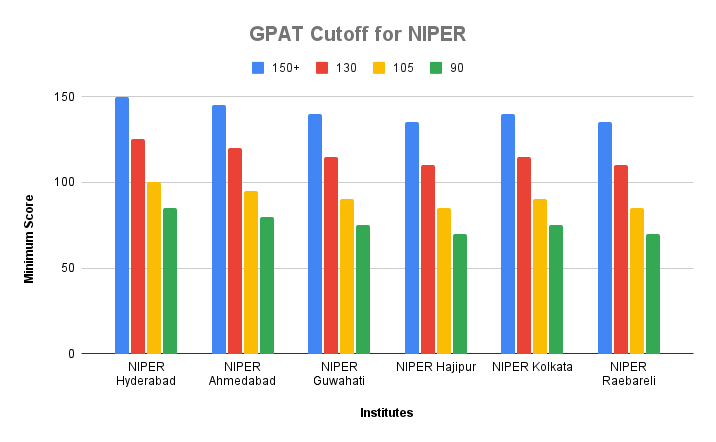
- NIPER Mohali and Hyderabad are the most competitive, for which scores of 145–150+ are needed for General category candidates.
- There is a difference in marks of 15–20 for UR and OBC cutoffs and 30–40 for SC/ST candidates, which indicates the impact of seat reservation.
- Institutes such as Hajipur and Raebareli are suitable for candidates with GPAT scores in the 130 or less range, particularly for reserved categories.
GPAT Cutoff for NIPER
| Institute | Minimum GPAT Score (General) | OBC | SC | ST |
|---|---|---|---|---|
| NIPER Mohali | 150+ | 130 | 105 | 90 |
| NIPER Hyderabad | 145–150 | 125 | 100 | 85 |
| NIPER Ahmedabad | 140–145 | 120 | 95 | 80 |
| NIPER Guwahati | 135–140 | 115 | 90 | 75 |
| NIPER Hajipur | 130–135 | 110 | 85 | 70 |
| NIPER Kolkata | 135–140 | 115 | 90 | 75 |
| NIPER Raebareli | 130–135 | 110 | 85 | 70 |
GPAT 2025 Expected Cutoff
The general category has the highest cutoff of 96.15414. There is a higher competition level in this category than other reserved categories due to the larger number of candidates.
The Reserved categories have a slightly lower percentile than the General category. The OBC category candidates should aim for 90 percentile to make sure they secure admission in the top colleges.
| Category | Cutoff Percentile |
|---|---|
| UR | 96.15414 |
| UR-PwBD | 55.1562 |
| EWS | 90.7069 |
| EWS-PwBD | 46.32063 |
| OBC | 90.09176 |
| OBC-PwBD | 49.70896 |
| SC | 75.4353 |
| SC-PwBD | 45.53011 |
| ST | 54.17503 |
| ST-PwBD | 52.27117 |
What is the qualifying marks for GPAT 2025?
The minimum qualifying marks required for the GPAT 2025 exam varies for different categories. Tabulated below is the minimum qualifying marks required for GPAT 2025 exam:
| Category | Qualifying Marks (Out of 500) |
|---|---|
| General (UR) | 163 |
| EWS | 104 |
| OBC | 131 |
| SC | 103 |
| ST | 76 |
| UR-PwD | 55 |
| EWS-PwD | 46 |
| OBC-PwD | 49 |
| SC-PwD | 45 |
| ST-PwD | 52 |
GPAT 2025 Marks vs Rank
Top Scorers: Candidates scoring 300+ in the GPAT 2025 exam achieve a rank in the range of 1 - 10. These candidates can get admission in the top institutes such as NIPERS..
Mid Tier Scorers: Candidates scoring between 209 - 170 marks are considered as average scorers. Their rank ranges from 381 - 1700 and they can aim for colleges such as Birla Institute of Technology or Jamia Hamdard.
| Marks Range | Estimated Rank Range |
|---|---|
| 300+ | Top 10 |
| 290 – 270 | 11 – 25 |
| 269 – 250 | 26 – 70 |
| 249 – 230 | 71 – 180 |
| 229 – 210 | 181 – 380 |
| 209 – 190 | 381 – 810 |
| 189 – 170 | 811 – 1700 |
| 169 – 150 | 1701 – 3000 |
| 149 – 130 | 3001 – 5500 |
| 129 – 110 | 5501 – 9650 |
| 109 – 90 | 9651 – 16000 |
| 89 – 70 | 16001 – 25000 |
| 69 – 50 | 25001 – 34700 |
| 49 – 30 | 34701 – 42900 |
| Below 30 | 42901 and above |

How to calculate GPAT 2025 percentile?
The GPAT 2025 percentile is calculated using the following formula:

N = Total number of appearing candidates
R= Your rank in the exam
For Example:
Your rank is 850.
Total number of appearing candidates is 60,000

Your GPAT percentile will be 98.58.
What is a good score in GPAT 2025?
A score of 220+ is considered a good score in GPAT 2025. The candidates scoring 220+ achieve a rank in the range of 180 - 380. These candidates can get admission in the top state and private universities such as:
| College Name | Location | Type | Approx. Seats |
|---|---|---|---|
| Jamia Hamdard University | New Delhi | Public | 140 |
| Institute of Chemical Technology (ICT) | Mumbai, Maharashtra | Public | 150 |
| Panjab University | Chandigarh | Public | 112 |
| Jadavpur University | Kolkata, West Bengal | Public | 116 |
| Delhi Institute of Pharmaceutical Sciences and Research (DIPSAR) | New Delhi | Public | Varies |
| Birla Institute of Technology (BIT Mesra) | Ranchi, Jharkhand | Public | 143 |
| Manipal College of Pharmaceutical Sciences | Manipal, Karnataka | Private | Varies |
| Nirma University | Ahmedabad, Gujarat | Private | Varies |
| Maharaja Sayajirao University of Baroda | Vadodara, Gujarat | Public | Varies |
| Andhra University | Visakhapatnam, Andhra Pradesh | Public | Varies |
What is a safe score in GPAT 2025?
A score above 180 is considered a safe score in the GPAT 2025 exam. The candidate achieved a rank in the range of 811 - 1700. These candidates can aim for colleges such as:
| State | College Name | Specializations | Cutoff Rank (Approx.) | GPAT Score (Approx.) |
|---|---|---|---|---|
| Maharashtra | Government College of Pharmacy, Amravati | Pharmaceutical Quality Assurance | 1003 | 97.86 |
| Channabasweshwar Pharmacy College, Latur | Pharmaceutics | 2253 | 90.57 | |
| Aditya Pharmacy College, Beed | Pharmaceutical Quality Assurance, Pharmacognosy | 2543 | 76.1 | |
| Srinath College of Pharmacy, Aurangabad | Pharmaceutical Quality Assurance | 1587 | 90.98 | |
| Karnataka | KLE University College of Pharmacy, Belagavi | Pharmaceutics, Pharmaceutical Chemistry | 194 | 98.89 |
| Madhya Pradesh | Rishiraj College of Pharmaceutical Sciences, Bhopal | Pharmaceutics, Pharmaceutical Chemistry | 1200 | 85.5 |
| Uttar Pradesh | Institute of Pharmaceutical Sciences, Dr. Ram Manohar Lohia Avadh University, Faizabad | Pharmaceutics, Pharmacology | 1500 | 80.0 |
| Gujarat | L M College of Pharmacy, Ahmedabad | Pharmaceutics, Pharmaceutical Chemistry | 800 | 90.0 |
GPAT 2025 Participating Institutes
Approximately 800 AICTE approved institutes across India accept GPAT scores including government and private colleges. Around 39,890 seats are available for admission in M.Pharm programs across all institutes.
Top Government Colleges accepting GPAT Scores
| College Name | Location |
|---|---|
| National Institute of Pharmaceutical Education and Research (NIPER) | Mohali, Punjab |
| Jamia Hamdard | New Delhi |
| Institute of Chemical Technology (ICT) | Mumbai, Maharashtra |
| Jadavpur University | Kolkata, West Bengal |
| Panjab University | Chandigarh |
| Delhi Institute of Pharmaceutical Sciences and Research (DIPSAR) | New Delhi |
| Andhra University | Visakhapatnam, Andhra Pradesh |
| Maharaja Sayajirao University of Baroda | Vadodara, Gujarat |
| University Institute of Pharmaceutical Sciences | Chandigarh |
Top Private Colleges accepting GPAT Scores
| College Name | Location |
|---|---|
| Manipal College of Pharmaceutical Sciences | Manipal, Karnataka |
| JSS College of Pharmacy | Ooty, Tamil Nadu |
| JSS College of Pharmacy | Mysuru, Karnataka |
| Nirma University | Ahmedabad, Gujarat |
| Birla Institute of Technology | Mesra, Jharkhand |
| Bombay College of Pharmacy | Mumbai, Maharashtra |
| Amrita School of Pharmacy | Kochi, Kerala |
| Poona College of Pharmacy, Bharati Vidyapeeth University | Pune, Maharashtra |
| Sri Ramachandra University | Chennai, Tamil Nadu |
| Al-Ameen College of Pharmacy | Bangalore, Karnataka |
GPAT Previous Years Cut off
GPAT is taken up by thousands of students every year for admission to several Pharmaceutical degree courses at the postgraduate level. Though the GPAT 2025 question paper pattern is not hard, but the exam is competitive. Last year's GPAT highest mark was 401 which means that the GPAT 2024 cutoff was higher than from the previous year.
GPAT Cutoff 2024
| Category | GPAT 2024 Cut off Percentile |
|---|---|
| UR | 96.15414 |
| UR-PwBD | 55.1562 |
| EWS | 90.7069 |
| EWS-PwBD | 46.32063 |
| OBC | 90.09176 |
| OBC-PwBD | 49.70896 |
| SC | 75.4353 |
| SC-PwBD | 45.53011 |
| ST | 54.17503 |
| ST-PwBD | 52.27117 |
GPAT 2023 Cut Off
| Category | GPAT Cut Off Marks |
|---|---|
| General | 96.18 |
| Other Backward Classes | 90.57 |
| Scheduled Caste | 77.10 |
| Scheduled Tribe | 57.74 |
| Economically Weaker Section | 90.16 |
GPAT 2022 Cut off
| Category | Cutoff | Number of Candidates |
|---|---|---|
| Unreserved (General) | 148 | 14265 |
| Economically Weaker Section | 122 | 6008 |
| Other Backward Class (OBC-NCL) | 120 | 23104 |
| Scheduled Caste (SC) | 94 | 5420 |
| Scheduled Tribe (ST) | 75 | 1478 |
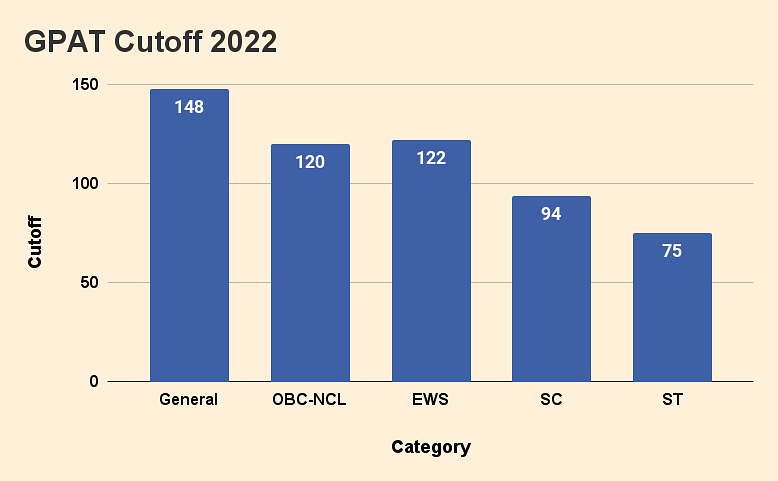
GPAT 2021 Cut Off
| Category | GPAT Cut Off 2021 |
|---|---|
| General | 359-186 |
| OBC-NCL | 185-152 |
| SC | 185-114 |
| ST | 183-87 |
| EWS | 185-155 |
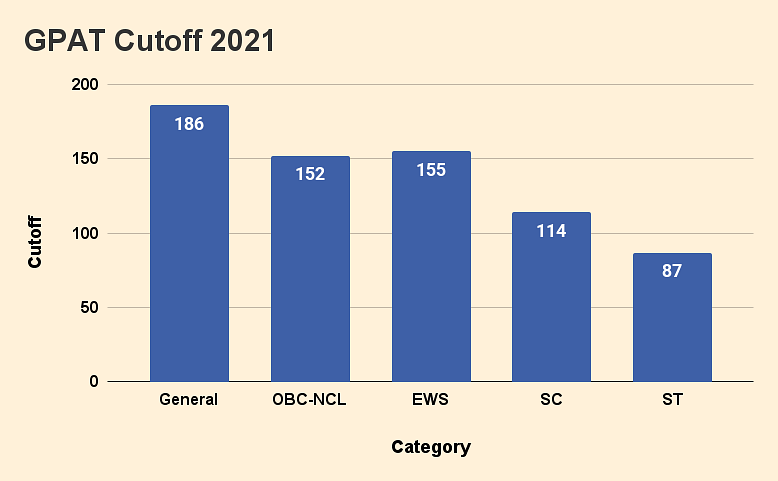
GPAT 2020 CutOff
| Category | GPAT 2020 Cut Off Marks | Total number of candidates | Increase in cutoff |
|---|---|---|---|
| General | 163 | 1974 | 22 |
| OBC-NCL | 131 | 1350 | 14 |
| SC | 103 | 727 | 8 |
| ST | 76 | 373 | 2 |
| EWS | 104 | 489 | - |
GPAT Cut Off 2019
| Category | GPAT 2019 Cut Off Marks | Total number of candidates |
|---|---|---|
| General | 141 | 1592 |
| OBC-NCL | 117 | 1103 |
| SC | 95 | 626 |
| ST | 74 | 313 |
Frequently Asked Questions
Question 1. Is the GPAT score valid for three years?
Answer- Yes, the GPAT score is valid for three years. If you have taken the GPAT exam and received a score, it can be used for admission in M.Pharm programs for up to 3 years from the date the scores were issued.
Question 2. How many students get qualified in the GPAT?
Answer- Approximately 10% of the total appearing candidates qualify in the GPAT exam, according to previous year data.
Question 3. Does BITS accept GPAT scores?
Answer- Yes, BITS accepts GPAT scores for admission into M.Pharm programs. Other premier institutes that accept GPAT scores include:
| Institute Name | Location | Program Highlights |
|---|---|---|
| National Institute of Pharmaceutical Education and Research (NIPER) | Mohali, Hyderabad, Ahmedabad, Hajipur, Guwahati, Kolkata, Raebareli | Central government-run premier institutions for M.Pharm, MS (Pharm), MBA (Pharm), and Ph.D programs. GPAT is a mandatory qualification for NIPER JEE. |
| Jamia Hamdard University | New Delhi | Top private university offering M.Pharm with specializations. GPAT-qualified candidates are preferred and receive scholarships. |
| BITS Pilani – Department of Pharmacy | Pilani, Rajasthan | Offers M.Pharm and M.Pharm+MBA. GPAT-qualified students may get fellowships. |
| Institute of Chemical Technology (ICT) | Mumbai | Highly ranked for Pharmacy and Chemical Sciences. GPAT is accepted for M.Pharm admissions. |
| Manipal College of Pharmaceutical Sciences (MCOPS) | Manipal, Karnataka | One of India's top-ranked private pharmacy colleges. GPAT-qualified students may get fee concessions. |
Question 4. Is 80 percentile good in GPAT 2025?
Answer- An 80 percentile is considered an average percentile in the GPAT exam. Candidates achieving this percentile may get admission in M.Pharm programs, but securing seats in top universities is less likely.
| College Name | Location | Remarks |
|---|---|---|
| ISF College of Pharmacy | Moga, Punjab | Accepts GPAT scores; known for good infrastructure and faculty. |
| Bombay College of Pharmacy (BCP) | Mumbai, Maharashtra | Prestigious institution; admissions based on GPAT scores. |
| Dr. D.Y. Patil College of Pharmacy, Akurdi | Pune, Maharashtra | Offers M.Pharm programs; GPAT percentile around 80 may be competitive. |
| BK Mody Government Pharmacy College | Rajkot, Gujarat | Government institution; accepts GPAT scores for admissions. |
| Sultan-ul-Uloom College of Pharmacy | Hyderabad, Telangana | Offers M.Pharm programs; GPAT scores considered for admissions. |
| VES College of Pharmacy (VESCOP) | Mumbai, Maharashtra | Accepts GPAT scores; known for good placements and infrastructure. |
Question 5. What is a good GPAT rank?
Answer- A rank within the top 1000 is considered a good rank for GPAT. Candidates achieving this rank can secure admission to top institutes like:
| Institute Name | Location | Remarks |
|---|---|---|
| Jamia Hamdard University | New Delhi | Offers M.Pharm programs; competitive admissions. |
| Birla Institute of Technology (BIT Mesra) | Ranchi, Jharkhand | Accepts GPAT scores for M.Pharm admissions. |
| Poona College of Pharmacy | Pune, Maharashtra | Recognized for quality education; accepts GPAT scores. |
| Institute of Pharmacy, Nirma University | Ahmedabad, Gujarat | Offers M.Pharm programs; GPAT-qualified candidates are preferred. |
| Panjab University – University Institute of Pharmaceutical Sciences (UIPS) | Chandigarh | Highly ranked public institution accepting GPAT scores for M.Pharm. |
| Delhi Institute of Pharmaceutical Sciences and Research (DIPSAR) | Delhi | Government institute under University of Delhi; GPAT-based admissions for M.Pharm. |
| ISF College of Pharmacy | Moga, Punjab | Recognized for research and innovation; accepts GPAT scores. |
| Bombay College of Pharmacy | Mumbai, Maharashtra | Offers M.Pharm programs; GPAT-qualified candidates are preferred. |
| Maharshi Dayanand University | Rohtak, Haryana | Offers M.Pharm programs; GPAT-qualified candidates are preferred. |
| Banasthali Vidyapith | Rajasthan | Women's university offering M.Pharm; GPAT-qualified candidates are preferred. |
Results
GPAT result 2026 will be made available on the official website by NBEMS, likely on 24 June 2026. Aspirants can download result for GPAT 2026 on the official website at natboard.edu.in.
NBEMS releases GPAT result in the form of GPAT merit list PDF, in which the GPAT rank, GPAT score, and other information of candidates are mentioned. GPAT score cards are also released by NBEMS, and you can download the score cards for GPAT 2026 using NBEMS login credentials.
In 2026, around 50,000 candidates are expected to appear for GPAT 2026. Last year, 47,140 candidates appeared and only 4714 candidates passed the GPAT examination, which is 10% of the total appeared candidates. Aspirants are declared qualified based on GPAT qualifying criteria.
- To qualify GPAT 2026, if you belong to general/EWS category, you must score a minimum of 50th percentile score. However, reserved category candidates are required to score a minimum of 45th percentile score.
- You must also be in the to 10 percent of the total appeared candidates to pass the GPAT exam in order of the GPAT merit 2026, as per applicable reservation policies.
Based on the GPAT qualifying criteria, GPAT cutoffs are determined. For general category candidates, the qualifying cutoff is around 216 marks out of 500, and for EWS, it is 172 marks. For SC and ST category candidates, the GPAT qualifying cutoff is 119 and 85, respectively. If you belong to OBC category, you must score at least 168 marks to pass GPAT exam.
Related Articles:
Key Summary
- NBEMS will release GPAT result 2026 on the official website natboard.edu.in likely on 24 June 2026.
- Result for GPAT will be published in the form of GPAT merit list PDF.
- Students will also be able to download the GPAT score card using NBEMS login credentials.
- To pass the GPAT 2026 exam, students must score at least 50th percentile (45th percentile for SC/ST/OBC/PWD).
- Candidates must also be in the top 10% of total GPAT appeared students in order of merit.
- GPAT 2026: Expected Result Date
- GPAT Result 2026
- GPAT Result 2026: Score Card
- GPAT Tie Breaking Policy
- GPAT Result 2026: Merit List
- GPAT Result 2026: Cutoff
- GPAT Result 2026: Statistics
- GPAT Result 2026: Counselling
- GPAT Result 2026: Colleges Accepting GPAT Scores
- GPAT Result 2026 FAQs
- What is the tie-breaking policy in GPAT?
GPAT 2026: Expected Result Date
Last year, GPAT exam was conducted on 25 May 2025, and the GPAT result was declared on 25 June 2025. Based on these dates, GPAT 2026 is likely to be conducted on 24 May 2026, and the GPAT result 2026 date is expected to be declared on 24 June 2026.
| GPAT Dates 2026 (Tentative) | GPAT Dates 2025 | GPAT Events |
|---|---|---|
| 24 May 2026 | 25 May 2025 | GPAT Exam Date |
| 24 June 2026 | 25 June 2025 | GPAT Result Date |
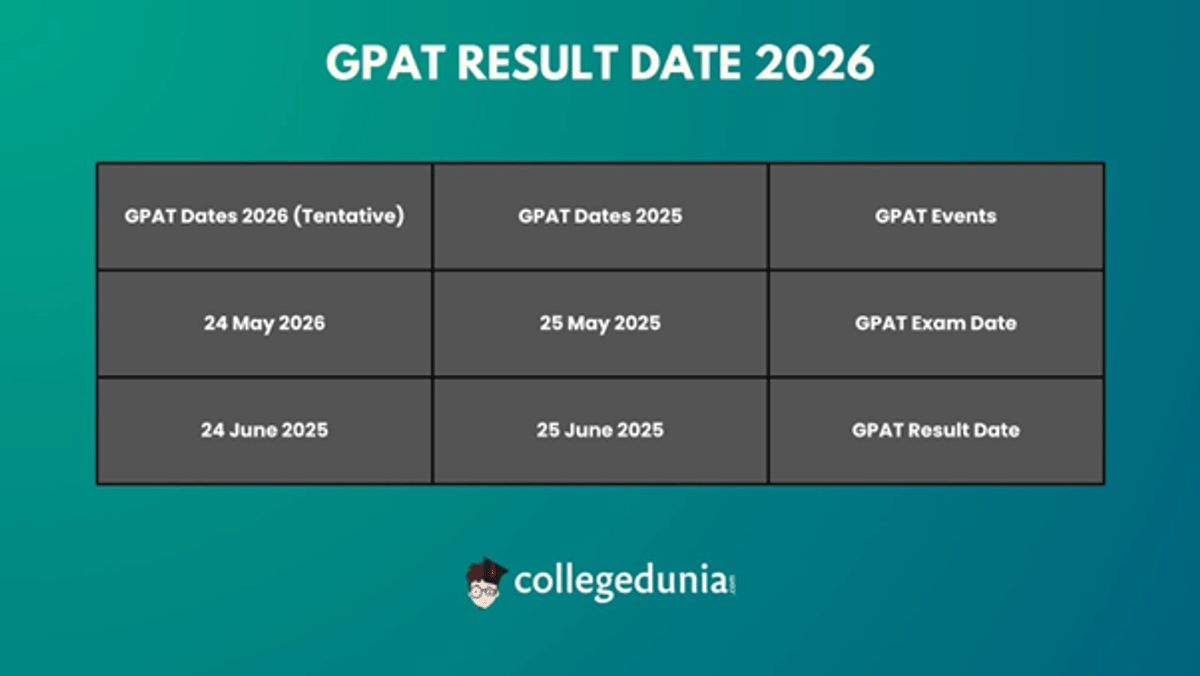
Also Read:
GPAT Result 2026
NBEMS will release the GPAT 2026 result on the official website at nbe.edu.in. The result for GPAT 2026 will be released in the form of a PDF. GPAT result PDF 2026 is likely to be released on the official website on 24 June 2026, around 1 month after conducting the GPAT 2026 examination.
- NBEMS will publish the GPAT result 2026 based on the GPAT final answer key 2026.
- No grievance will be accepted after the release of the result for GPAT 2026.
- No re-evaluation or rechecking, or re-totaling will be allowed.
- NBEMS will publish the results for GPAT 2026 and GPAT scores of candidates; however, the post-result events will not be conducted by NBEMS.
- GPAT result 2026 will be valid for admissions to M. Pharma and PhD courses for 3 years.
GPAT Result 2026: Score Card
GPAT score cards will be available for download on the official website at natboard.edu.in. After the score cards for GPAT 2026 are released, aspirants can download GPAT Score Cards 2026 PDF using NBEMS login credentials. Aspirants can use GPAT 2026 score cards for 3 years for admission to M. Pharma and PhD courses.
The Details mentioned in the GPAT Scorecard are:
- Name of the candidate
- Roll number of the candidate
- Application ID
- Candidate’s Category
- Total marks scored by the candidate
- The Percentile secured by the candidates
- The AIR among all the GPAT Aspirants
- Qualifying status of the candidate
GPAT Sample Scorecard
Ques. What is mentioned in the GPAT scorecard?
Ans. In your scorecard some details like application ID, roll number, your name, parents’ names, and DOB are mentioned. Apart from these, it also includes the number of correct & incorrect responses, category, score, and rank.
Ques. What does rank mean in GPAT?
Ans. Rank refers to the overall merit position of the candidate amongst all the candidates who have appeared in GPAT-2025. Your rank is mentioned in your scorecard.
Ques. What is the highest score in GPAT?
Ans. In GPAT, the highest score was 315 last year. Students can score a maximum of 500 in GPAT exam 2026.
GPAT Tie Breaking Policy
If two or more candidates obtain the same score in GPAT 2026, ranks for such candidates will be determined based on the following criteria.
- Candidate with lessee number of negative answers will be placed at a better merit position.
- Older candidates will get a better rank in GPAT merit list.
GPAT Result 2026: Merit List
GPAT merit list 2026 PDF will be published by NBEMS on the official website. Merit list PDF for GPAT will include details like Rank, GPAT score out of 500, Qualification status, and other details of candidates.
- GPAT 2026 rank will represent the overall merit position of the candidate among all candidates who appeared for the exam.
- There will be no category-wise/state-wise GPAT merit list published by NBEMS.
GPAT Result 2026: Cutoff
GPAT cutoff 2026 is the minimum marks required by candidates to qualify GPAT 2026 exam for admission to M.Pharm and PhD courses. The cutoff for GPAT 2026 is determined based on the GPAT minimum qualifying criteria as mentioned in the table below.
| Category | GPAT Minimum Qualifying Criteria |
|---|---|
| General/EWS | 50th percentile |
| OBC/SC/ST | 45th percentile |
| PWD | 45th percentile |
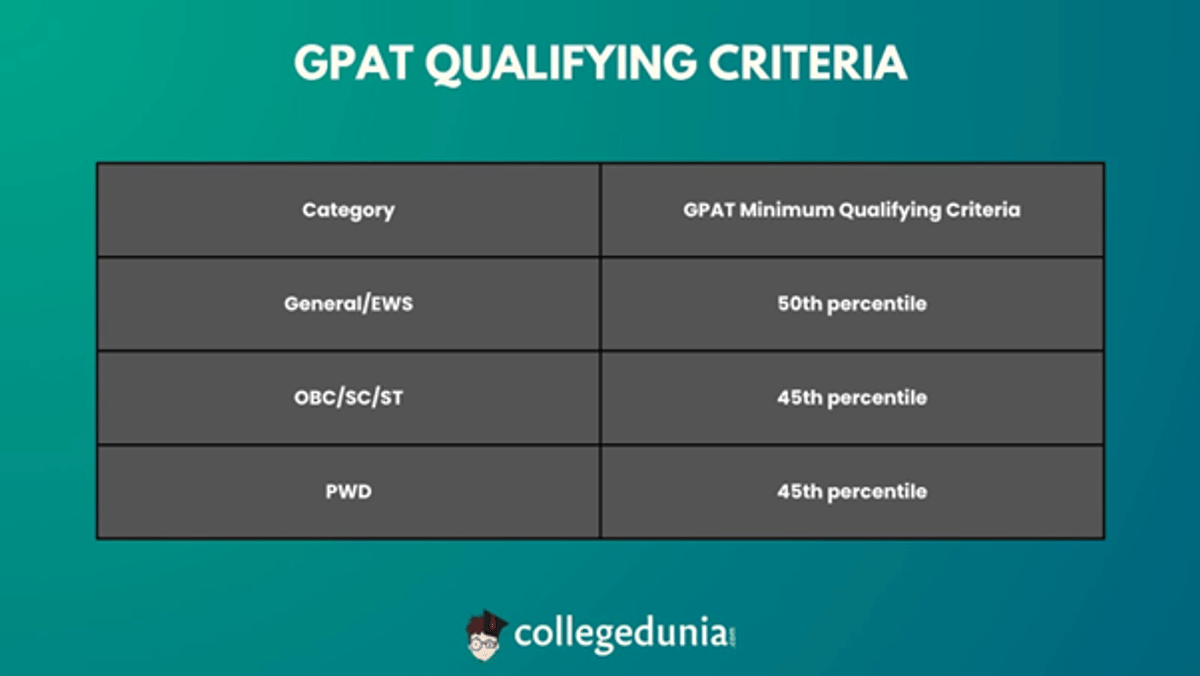
To qualify GPAT 2026 exam:
- Students must score more than the GPAT minimum qualifying percentile in the examination.
- Candidates must fall within 10% of the total number of appeared candidates.
Category Wise GPAT Cutoff
Based on the last year’s GPAT cutoff, General category candidates required 216 marks/96.2390225 percentile, and the minimum required GPAT rank was 1820.
- For EWS candidates, the GPAT cutoff was 172 marks.
- OBC candidates required 168 marks to qualify GPAT exam for admission to MPharm courses.
- SC and ST candidates required a minimum of 119 and 85 marks, respectively.
| Category | Cut-off Percentile | Cut-off Score | Cut-off GPAT 2025 Rank |
|---|---|---|---|
| UR | 96.2390225 | 216 | 1820 |
| UR-PwBD | 63.1199355 | 95 | 17766 |
| EWS | 90.9465021 | 172 | 4328 |
| EWS-PwBD | 48.3369395 | 77 | 24371 |
| OBC | 90.2231556 | 168 | 4648 |
| OBC-PwBD | 45.1996097 | 74 | 26009 |
| SC | 76.4456323 | 119 | 11127 |
| SC-PwBD | 45.1996097 | 74 | 26145 |
| ST | 55.457978 | 85 | 21027 |
| ST-PwBD | 51.1433541 | 80 | 23431 |
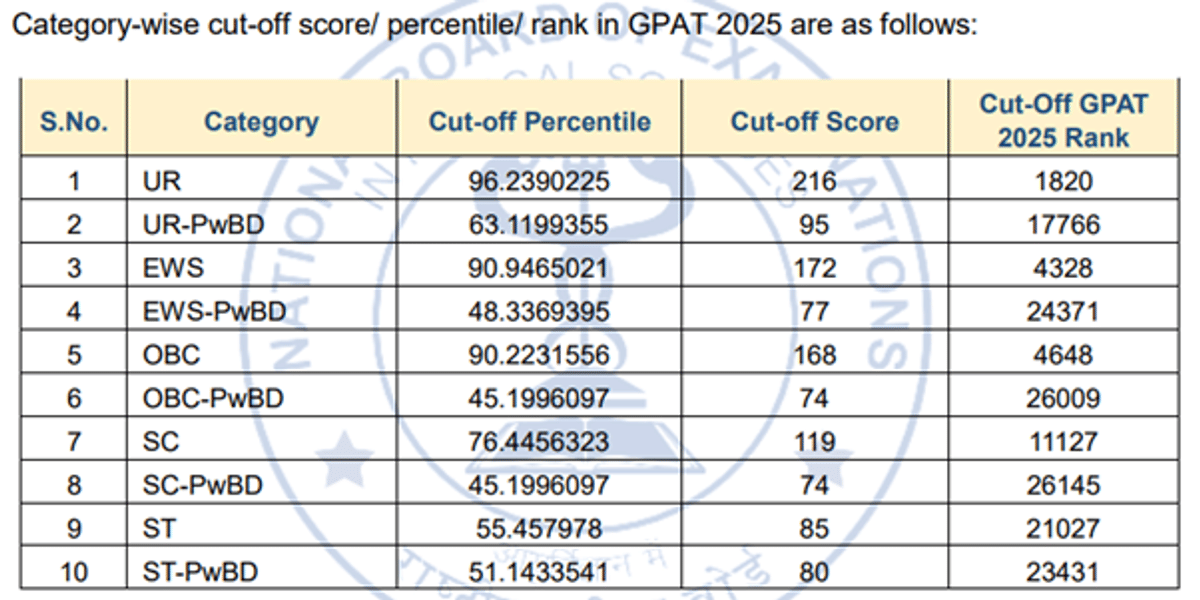
Source: @natboard.edu.in
Also Read:
Ques. What can be the expected cutoff of GPAT 2025?
Ans. You must clear the cutoff of participating colleges to participate in the counselling process. The cutoff will be different for different institutions and categories. A table is presented below where the expected GPAT cutoff for 2026 is mentioned. It will help you to predict the expected cutoff of 2025.
| Category | Cut Off score 2026 |
|---|---|
| General | 216 |
| OBC | 168 |
| SC | 119 |
| ST | 85 |
| EWS | 172 |
Ques. How many students qualified for the GPAT exam last year?
Ans. As per the last years’ GPAT result statistics, a total of 47142 candidates appeared for GPAT exam. Out of these, 10% qualified i.e., 4714 were declared qualified for GPAT examination.
GPAT Result 2026: Marks vs Rank
| GPAT Marks | GPAT Rank 2026 (Expected) |
|---|---|
| >300 | 1-10 |
| 299-280 | 11-20 |
| 279-260 | 21-40 |
| 259-240 | 41-120 |
| 239-220 | 121-260 |
| 219-200 | 261-580 |
| 199-180 | 581-1250 |
| 179-160 | 1251-2250 |
| 159-140 | 2251-4200 |
| 139-120 | 4201-7300 |
| 119-100 | 7301-12650 |
| 99-80 | 12651-20250 |
| 79-60 | 20251-29900 |
| 50-40 | 29901-39150 |
| 30-25 | 39151-44250 |
| 24-10 | 44251-46600 |
| <10 | >46601 |
GPAT Result 2026: Statistics
NBE releases GPAT result statistics on the official website after the release of GPAT result. The statistics are released based on the GPAT qualifying percentile and number of appeared candidates. Last year’s GPAT result statistics are mentioned in the table below.
- In GPAT exam last year, a total of 4714 candidates qualified. Out of these, 628 were from general category, and 811 were from the Gen-EWS category.
- 2003 candidates were from OBC NCL category, 776 from SC, and 360 from ST.
- A total of 136 candidates across different categories from PwD sub-category qualified GPAT.
| Category | Number of Qualified Candidates | |||
|---|---|---|---|---|
| General | EWS | Non-PwBD | PwBD | Total |
| NO | 628 | 34 | 662 | |
| YES | 811 | 17 | 828 | |
| OBC-NCL (Central List) | -- | 2003 | 71 | 2074 |
| SC | -- | 776 | 13 | 789 |
| ST | -- | 360 | 1 | 361 |
| Total | 4578 | 136 | 4714 | |
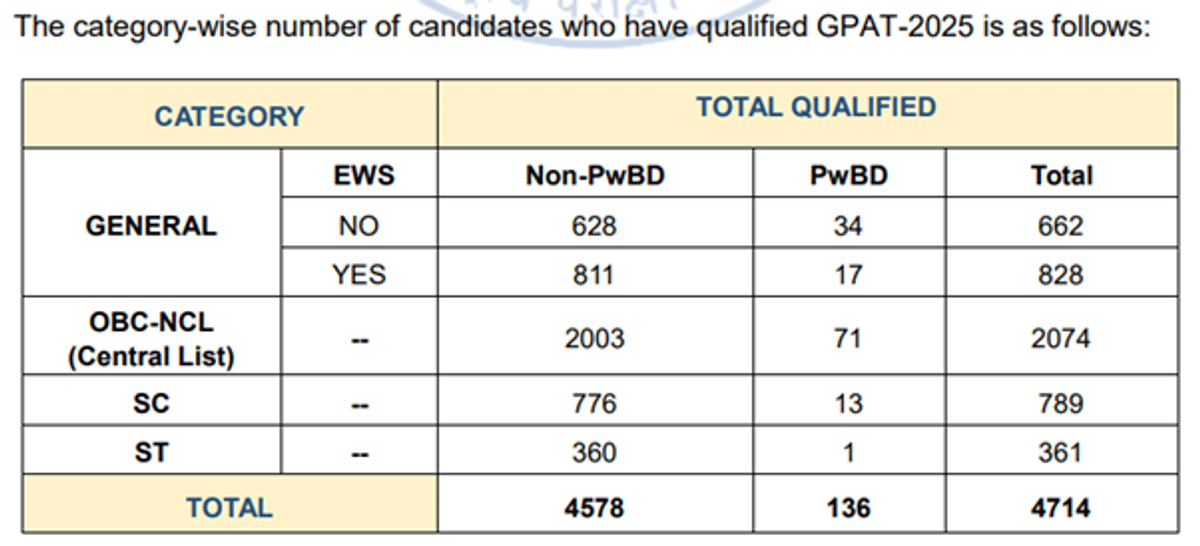
Source: @natboard.edu.in
Also Read:
Ques. How many students appeared for GPAT last year?
Ans. Last year’s GPAT result statistics reveal that a total of 47142 candidates appeared for GPAT 2025 examination.
GPAT Result 2026: Counselling
NBEMS is not responsible for conducting the GPAT counselling. However, after the GPAT results are published, the colleges accepting GPAT scores will conduct the counselling process for admission to M.Pharm/PhD courses. Students must meet the minimum scores required for each participating college to be eligible for admission to MPharm programs.
GPAT Result 2026: Reservation Criteria
Admission to colleges based on GPAT scores will be based on GPAT reservation criteria as listed below.
| Category | Reservation |
|---|---|
| SC | 15% |
| ST | 7.5% |
| OBC-NCL | 27% |
| Gen-EWS | 10% |
| PWD | 5% in each category |
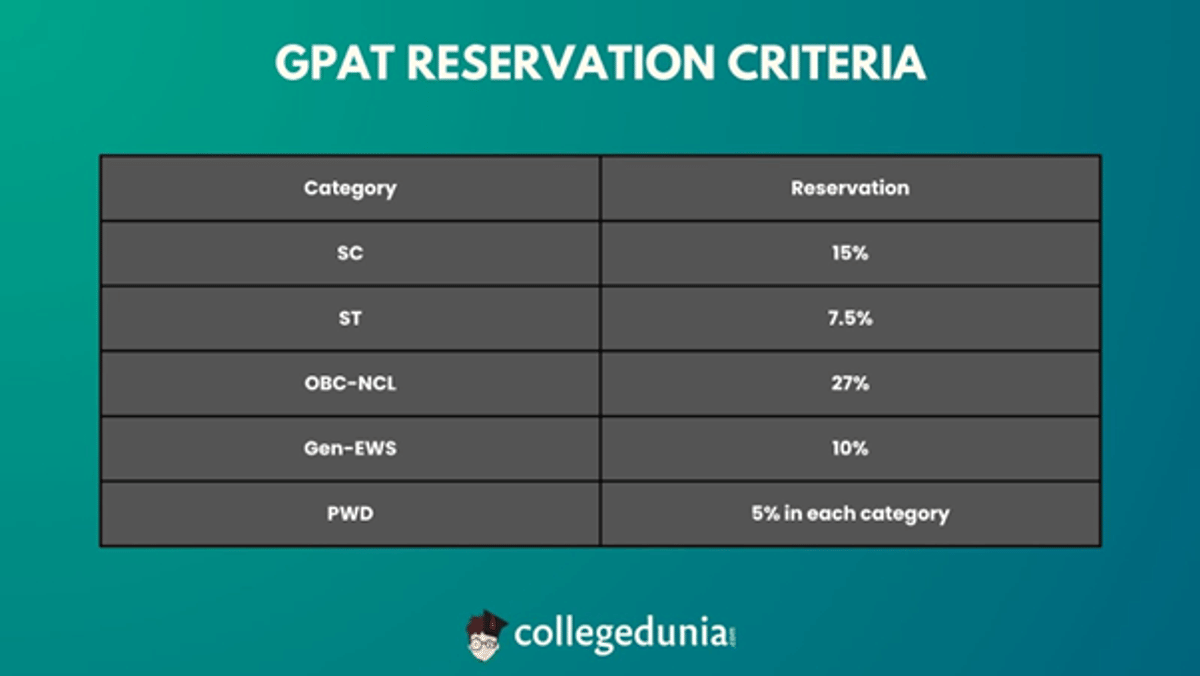
Also Read:
Ques. What GPAT rank is required for admission at BITS Pilani or Hyderabad for an M.Pharm in Pharmaceutics?
Ans. For admission to the MPharm program in Pharmaceutics at BITS Pilani or BITS Hyderabad through the GPAT exam, you need to rank around 600 or above. Ranking above 600 may not give you the direct admission to the M. Pharm courses in BITS.
GPAT Result 2026: Colleges Accepting GPAT Scores
Students can check beow the top colleges accepting GPAT results and scores.
| Jamia Hamdard University |
|---|
| Panjab University |
| Institute of Chemical Technology |
| Birla Institute of Technology |
| Poona College of Pharmacy |
| Institute of Pharmacy, Nirma University |
| ISF College of Pharmacy |
| Bombay College of Pharmacy |
| Delhi institute of Pharmaceutical Sciences and Research |
| Maharshi Dayanand University |
Also Read:
Ques. What do I need to do for M.Pharm admission in colleges?
Ans. For admission in M.Pharm courses you need to participate in counselling organised by different participating universities. You need to register for the counselling online. After uploading required documents and choice filling you need to pay the registration fees. Seats will be allotted to you based on your merit, availability of seats and choices. After getting a seat you need to report to the allotted institution with required documents and admission fees.
GPAT Result 2026 FAQs
Ques. What is the tie-breaking policy in GPAT?
Ans. If two or more candidates get equal marks then it will be considered a tie. To decide the final result some points are considered by the authority.
- Marks in Pharmaceutics
- Marks in Pharmaceutics
- Having fewer negative responses
- Candidates older in age
Ques. What can I do with a good GPAT score?
Ans. A good GPAT score can help you in admission to top pharmacy colleges like National Institutes of Pharmaceutical Education and Research (NIPERs), Jamia Hamdard, and Manipal College of Pharmaceutical Sciences. You can get scholarships and fellowship from different government and private colleges. GOOd score can give you better career opportunities.
Ques. I have cleared the GPAT exam this year but want to get admission to M.Pharm after one year. Can I do that?
Ans. Yes, you can take admission to M. Pharm after one year. The scorecard is valid for three years. Therefore, you must be admitted within the specified time otherwise you have to appear for the exam again for admission in M. Pharm.
Ques. The qualifying status is not mentioned in the result so how do I know if we are qualified or not?
Ans. As the qualifying status is not mentioned in the result you need to check the qualifying marks set by the authority to know whether you are qualified or not. You can also rely on the qualifying marks of past year’s.
Ques. My GPAT rank is 2070. Can I get admission in any good colleges with this rank?
Ans. Yes, you can get admissions in some colleges in India but it is advised to start preparing for the NIPER JEE exam. It will give you better career opportunities.
Ques. How to check GPAT result 2026?
Ans. To check GPAT result 2026, students can log on to the official website at natboard.edu.in. On the official website, go to results tab and the GPAT result PDF will be displayed on the screen. Students can also get GPAT result 2026 PDF download from the NBEMS notifications section.
Get Expert Guidance
Join 10,000+ students on their dream path
Registration Success!
Our senior counselor will contact you within 24 hours to guide you through the process.