
Jharkhand Combined Entrance Competitive Examination
Imported from Collegedunia.
Overview
The Jharkhand Combined Entrance Competitive Examination (JCECE) 2026 will be conducted by the Jharkhand Combined Entrance Competitive Examination Board (JCECEB) for engineering admission, B.Sc. Agriculture, B.Sc. Nursing and other undergraduate courses in Jharkhand.
- JCECE has released the Provisional List of Candidates recommended through the 4th (last) round of online counselling for admission to 1st-year B.Ed., M.Ed., and B.P.Ed. courses.
- A formal announcement is expected shortly, and the online registration is likely to open in March 2026, and the exam is expected to be in May or June 2026.
- There will be 150 multiple-choice questions (MCQs) for 150 marks in the paper to be completed in 2 hours with no negative marking.
- The syllabus is for 11th and 12th classes (JAC or equivalent), which assess the conceptual understanding and problem-solving abilities of students.
In general, JCECE 2026 is the essential admission test at the state level for candidates willing to join the top-notch colleges in Jharkhand.
Related Links:
Key Summary
We have covered in detail the JCECE 2026 exam schedule, registration process, pattern, syllabus, and preparation.
- It is anticipated that online registration will be open from March 2026, and the exam will take place in May 2026.
- There will be 150 multiple-choice questions (1 mark each) with no negative marking to be attempted within 2 hours.
- The topics will be according to the Class 11 & 12 (JAC or equivalent) Physics, Chemistry, Mathematics, and Biology stream-wise subjects.
- What is JCECE 2026?
- JCECE 2026 Expected Dates
- JCECE Registration Statistics (2025–2022)
- JCECE 2026 Registration Fees
- JCECE 2026 Eligibility
- JCECE 2026 Exam Pattern
- JCECE 2026: Expected Category-Wise Cutoff Trends
- JCECE Syllabus 2026
- JCECE Difficulty Level 2026
- JCECE Topic-Wise Weightage
- How can I download the previous year's question paper for the JCECE 225 exam?
- JCECE 2026 Preparation Tips
- JCECE Overview 2026 FAQS
What is JCECE 2026?
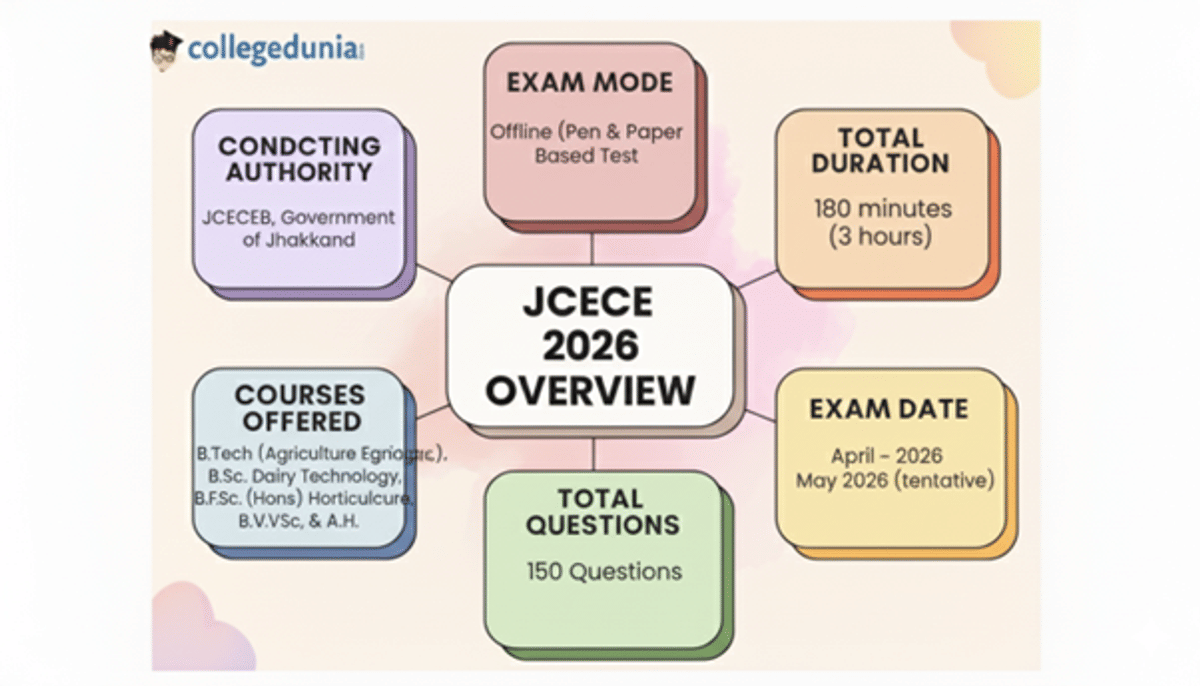
JCECE 2026 (Jharkhand Combined Entrance Competitive Examination) is a state-level entrance exam that is held by the Jharkhand Combined Entrance Competitive Examination Board (JCECEB).
It is a test for admission to the first-degree programs in Engineering, Agriculture, Forestry, Veterinary, and other such fields at the universities and colleges across Jharkhand.
| Particulars | Details (Tentative for 2026) |
|---|---|
| Exam Name | Jharkhand Combined Entrance Competitive Examination (JCECE) |
| Conducting Authority | Jharkhand Combined Entrance Competitive Examination Board (JCECEB) |
| Courses Offered | B.Tech (Engineering), B.Sc (Agriculture, Forestry), B.V.Sc & A.H, and related UG programs |
| Exam Date | May 2026 (Tentative) |
| Question Type | Multiple-Choice Questions (MCQs) |
| Total Questions | 150 Questions |
| Total Marks | 150 Marks |
| Duration | 2 Hours (120 Minutes) |
| Marking Scheme | +1 for each correct answer; No negative marking |
| Syllabus | Based on Class 11 & 12 syllabus (Jharkhand Academic Council or equivalent boards) |
| Expected Result Date | June 2026 (Tentative) |
| Official Website | jceceb.jharkhand.gov.in |
Ques. Is B.Ed. 2 years or 4 years in 2026?
Ans. The B.Ed. program is available in two different formats, a 2-year and a 4-year integrated one, along with the 2026 National Education Policy 2020.
- The 2-year B.Ed. is for those holding a bachelor's degree in any area of study, the 4-year Integrated B.Ed. is a program for combining regular undergraduate study with teacher education for students after Class 12.
- The admission to the program is through an entrance exam either by the universities or state-level boards.
Ques. What are the new rules for B.Ed. in 2026?
Ans. The B.Ed. 2026 new regulations are in line with the National Education Policy (NEP) 2020 and are focused on integrated teacher training and competency-based education.
- Course structure: The 4-year Integrated B.Ed. is going to be the normal teaching qualification for schools.
- Eligibility: At least 50% of the marks in Class 12 or graduation, as the case may be, are required.
- Curriculum update: The curriculum includes skill-based learning, digital literacy, classroom exposure, and multidisciplinary pedagogy.
Also Check:
JCECE 2026 Expected Dates
- With the release of the official notification for JCECE 2026, the Jharkhand Combined Entrance Competitive Examination Board (JCECEB) is going to make it clear.
- The online application process will probably start in March 2026, and the exam will be conducted in May 2026.
- All the mentioned dates are only assumed, and the final schedule will be confirmed through the official notification on the JCECEB website.
| Event | Expected Date (Tentative) |
|---|---|
| Notification Release | March 2026 |
| Registration Window | March – April 2026 |
| Admit Card Release | April 2026 |
| JCECE 2026 Exam | May 2026 |
| Provisional Answer Key | June 2026 |
| Result Declaration | June 2026 |
| Counselling & Seat Allotment | July 2026 |
Also check:
Ques. How many attempts for JCECE 2026?
Ans. The JCECE 2026 does not have a set cap on how many times you can try. The exam is held yearly by the Jharkhand Combined Entrance Competitive Examination Board (JCECEB), and applicants may take it any year in which they satisfy the requirements.
| Criteria | Details |
|---|---|
| Number of Attempts | Unlimited (can appear every year while eligible) |
| Eligibility Condition | Must have passed or be appearing in Class 12 with required subjects (PCM/PCB) from a recognised board |
| Age Limit | No upper age limit for Engineering; age criteria apply for Agriculture & Veterinary as per course norms |
| Mode of Exam | Computer-Based Test (CBT) |
| Conducting Body | Jharkhand Combined Entrance Competitive Examination Board (JCECEB) |
Ques. When to apply for JCECE 2026?
Ans. The JCECE 2026 registration is expected to begin in March 2026 and continue till April 2026 on the official website - jceceb.jharkhand.gov.in
| Event | Tentative Dates (2026) | Description |
|---|---|---|
| Release of Notification | March 2026 | Official brochure and exam details released by JCECEB |
| Start of Online Registration | March 2026 | The application form is made available on the official website |
| Last Date to Apply (without late fee) | April 2026 (First Week) | Complete form submission and fee payment before the deadline |
| Application Correction Window | April 2026 (Mid-Week) | Edit or correct mistakes in the submitted application form |
| Admit Card Release | April 2026 | Downloadable from the official portal using login credentials |
| Exam Date | May 2026 (Tentative) | CBT was conducted at various centres across Jharkhand for the PCM/PCB streams |
JCECE Registration Statistics (2025–2022)
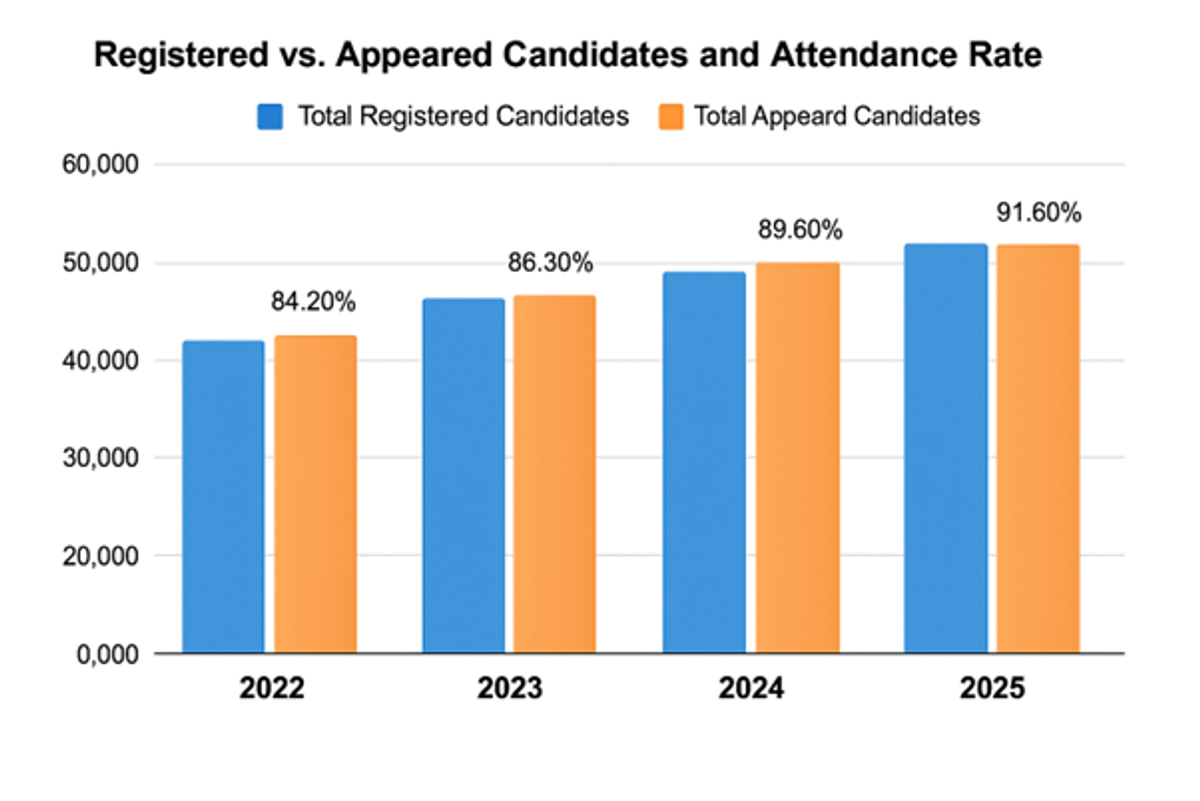
The Jharkhand Combined Entrance Competitive Examination Board (JCECEB) communicates yearly figures concerning the candidates who register and take the JCECE exam in different streams like Engineering, Agriculture, Forestry, and Veterinary Sciences.
- Registrations have gradually gone up during the last several years, which is a good indication of the students' inclination to take up undergraduate professional courses in Jharkhand.
- The rate of those present has also been continuously more than 85%, thus showing a great involvement of the candidates and the trustworthiness of the test.
| Year | Total Registered Candidates | Total Appeared Candidates | Attendance Rate |
|---|---|---|---|
| 2022 | 38,000 | 32,000 | 84.20% |
| 2023 | 41,500 | 35,800 | 86.30% |
| 2024 | 46,000 | 41,200 | 89.60% |
| 2025 | 50,000 | 45,800 | 91.60% |
JCECE 2026 Registration Fees
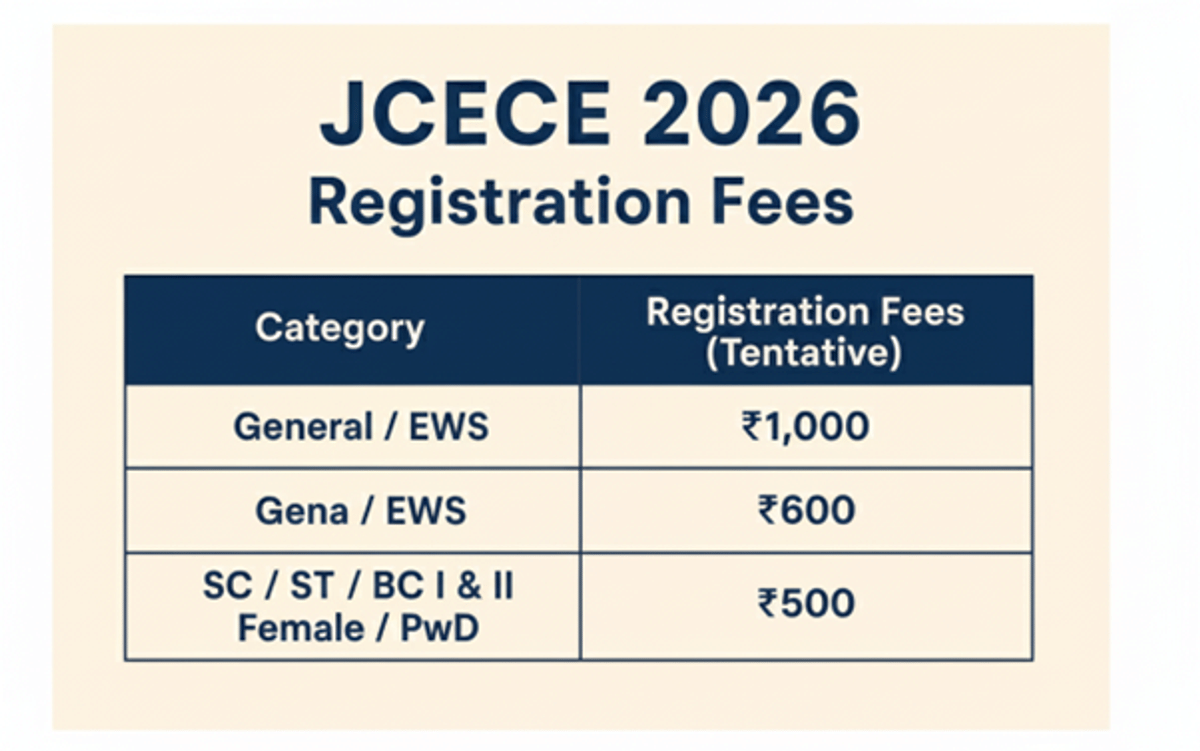
The JCECE 2026 application fee details will be announced in the official notification released by the Jharkhand Combined Entrance Competitive Examination Board (JCECEB) on its website — jceceb.jharkhand.gov.in .
Based on previous years’ trends, the registration fee varies by category and subject group (PCM/PCB). The expected fee structure is as follows:
Ques. How many colleges can we select in the JCECE 2026 Counselling?
Ans. During the JCECE 2026 Counselling, candidates can select multiple colleges and courses while filling out the choice filling form. Opting for a higher number of preferences increases the chances of securing a seat based on rank and previous cutoffs.
| Criteria | Details |
|---|---|
| Minimum Choices | At least 1 college/course must be selected |
| Maximum Choices | Unlimited options can be filled in order of preference |
| Recommendation | Fill 25–50 preferences across colleges and streams to improve admission chances |
| Editing Window | Choices can be edited or rearranged before final submission |
| Seat Allotment Basis | Based on JCECE rank, category, preferences, and seat availability |
Ques. How many counselling rounds are in JCECE 2026?
Ans. The JCECE 2026 Counselling will be held in multiple rounds to allocate seats in Engineering, Agriculture, Forestry, and Veterinary programs. Candidates can accept, upgrade, or float their allotted seats in each round.
| Round | Type | Description |
|---|---|---|
| Round 1 | Regular | Initial seat allotment based on rank and choices |
| Round 2 | Regular | Option to upgrade or confirm previously allotted seats |
| Round 3 | Final Regular | Last centralized counselling round for JCECE candidates |
| Institute-Level Round (ILR) | Offline / College Level | Conducted by institutes for filling remaining vacant seats |
JCECE 2026 Eligibility
- The JCECE Eligibility Criteria 2026 is the decision of the Jharkhand Combined Entrance Competitive Examination Board (JCECEB).
- Such standards guarantee that admissions to the first year of the various B.Tech. (Agriculture Engineering) B.Sc. Agriculture, B.Sc. Forestry, B.V.Sc. & A.H., and other allied courses through the competitive examination are open only to qualified candidates.
- The first requirement for a candidate varies depending on the future course of study.
- Aspirants are advised to verify their academic qualifications, the group of subjects and the age limit before filing their application forms.
| Criteria | Details |
|---|---|
| Nationality | Only Indian citizens and Jharkhand domicile candidates are eligible. |
| Educational Qualification (for UG Courses) | Must have passed Class 12 or equivalent from a recognised board. |
| Subjects Required | For B.Tech (Agri Engg): Physics, Chemistry, Mathematics required. For B.Sc. Agri/Forestry: Physics, Chemistry, Biology/Mathematics required. For B.V.Sc. & A.H.: Physics, Chemistry, Biology compulsory. |
| Minimum Marks | At least 50% aggregate in qualifying subjects (45% for SC/ST candidates). |
| Age Limit | For B.Sc. Agri/Forestry – Minimum 17 years and maximum 22 years as on 1st July 2026. For B.V.Sc. & A.H. – 17 years minimum; upper age as per VCI norms. For B.Tech Agri Engg. – No specific age limit mentioned. |
| Domicile Requirement | Must possess a valid Jharkhand domicile certificate issued by a competent authority. |
Also Read:
JCECE 2026 Exam Pattern
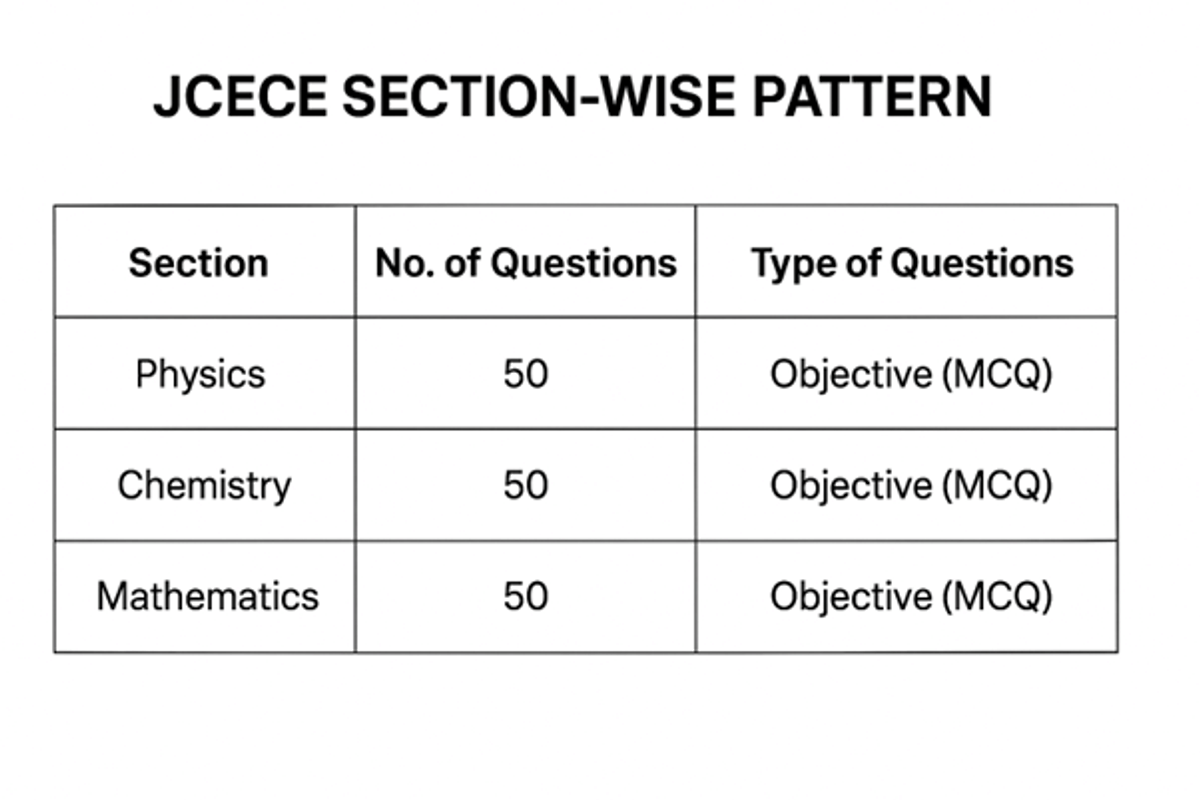
The JCECE 2026 Test will be held in offline (OMR-based) mode for admission to various UG Agriculture, Forestry, and Veterinary programs in Jharkhand.
The question pattern changes concerning the student's field of study, whether it is PCB, PCM, or PCMB.
| Parameter | Details |
|---|---|
| Exam Mode | Offline (Pen and Paper Based) |
| Question Type | Multiple Choice Questions (MCQs) |
| Total Questions | 150 (PCM/PCB), 200 (PCMB) |
| Total Marks | 150 marks (PCM/PCB), 200 marks (PCMB) |
| Duration | 3 hours |
| Marking Scheme | +1 for each correct answer, −0.25 for each incorrect answer |
| Language | English & Hindi |
Read more:
Ques. What is the purpose of the JCECE Exam?
Ans. The JCECE Exam is conducted to shortlist eligible candidates for admission to various undergraduate programs in Agriculture, Forestry, and Veterinary Sciences in the participating institutions of Jharkhand.
| Purpose | Description |
|---|---|
| Admission Basis | Merit list based on JCECE Exam score |
| Target Group | Candidates from Jharkhand seeking admission in UG professional programs |
| Admission Type | State Quota Seats in Agriculture, Forestry, and Veterinary Colleges |
JCECE 2026: Expected Category-Wise Cutoff Trends
JCECE 2026 category-wise cutoff will reflect various factors, including the number of applicants, difficulty level of the exam, the number of seats available, reservation norms, and last year's cutoff data.
JCECE candidates willing to study PH (Agriculture) or BVSc (Veterinary) in government colleges should raise their category-wise rank targets to a higher level.
- Rinda Priya Birsa Agricultural University (BAU), Ranchi, is the top college from where candidates need to obtain a rank in the district's top 500 (Agriculture and Veterinary courses).
- Polytechnic and constituent institutes under the Jharkhand universities, i.e., mid-tier colleges, can get a rank between 5,000 and 8,000, depending on category and stream wor,k which will be enough for admission purposes.
- The closing ranks for reserved categories have been relatively higher because of the relaxation in cutoff criteria.
| Category | Course | Expected Closing Rank |
|---|---|---|
| General (UR) | B.Sc (Hons) Agriculture | 150 – 600 |
| B.V.Sc & A.H | 100 – 450 | |
| B.Tech (Agricultural Engineering) | 500 – 1,200 | |
| OBC (Non-Creamy Layer) | B.Sc (Hons) Agriculture | 600 – 1,000 |
| B.V.Sc & A.H | 400 – 800 | |
| B.Tech (Agricultural Engineering) | 1,000 – 1,800 | |
| EWS | B.Sc (Hons) Agriculture | 700 – 1,200 |
| B.V.Sc & A.H | 500 – 900 | |
| B.Tech (Agricultural Engineering) | 1,200 – 2,000 | |
| SC | B.Sc (Hons) Agriculture | 1,200 – 2,000 |
| B.V.Sc & A.H | 1,000 – 1,800 | |
| B.Tech (Agricultural Engineering) | 1,800 – 2,800 | |
| ST | B.Sc (Hons) Agriculture | 2,000 – 3,000 |
| B.V.Sc & A.H | 1,800 – 2,800 | |
| B.Tech (Agricultural Engineering) | 2,500 – 3,500 | |
| PwD | B.Sc (Hons) Agriculture | 2,500 – 3,500 |
| B.V.Sc & A.H | 2,000 – 3,000 | |
| B.Tech (Agricultural Engineering) | 3,000 – 4,000 |
Read more:
JCECE Syllabus 2026
The JCECE 2026 Syllabus is grounded on the NCERT Class 11 and Class 12 syllabus that is followed by CBSE. The subjects included are three major ones - Physics, Chemistry, and Mathematics/Biology (based on the stream chosen, i.e. PCM, PCB, or PCMB).
The content of the syllabus is to assess the students’ grasp of the concepts, their logical thinking, and their ability to find solutions to problems in scientific subjects that are the basis for the courses of Agriculture, Forestry, and Veterinary field.
| Subject | Key Topics / Units |
|---|---|
| Physics | Physical World & Measurement; Kinematics; Laws of Motion; Work, Energy & Power; Thermodynamics; Properties of Matter; Gravitation; Electrostatics; Current Electricity; Magnetic Effects of Current & Magnetism; Electromagnetic Induction & Alternating Currents; Optics; Dual Nature of Matter; Atoms & Nuclei; Electronic Devices. |
| Chemistry | Some Basic Concepts of Chemistry; Structure of Atom; Classification of Elements & Periodicity; Chemical Bonding & Molecular Structure; States of Matter; Thermodynamics; Equilibrium; Redox Reactions; Hydrogen; s-, p-, d-, and f-Block Elements; Coordination Compounds; Haloalkanes & Haloarenes; Alcohols, Phenols & Ethers; Aldehydes, Ketones & Carboxylic Acids; Biomolecules; Polymers; Chemistry in Everyday Life. |
| Mathematics | Sets, Relations & Functions; Complex Numbers & Quadratic Equations; Matrices & Determinants; Permutations & Combinations; Binomial Theorem; Sequence & Series; Straight Lines & Conic Sections; Limits, Continuity & Differentiability; Integral Calculus; Differential Equations; Vectors & 3D Geometry; Probability; Trigonometry; Mathematical Reasoning. |
| Biology | Diversity of Living Organisms; Structural Organisation in Animals & Plants; Cell Structure & Function; Plant Physiology; Human Physiology; Reproduction; Genetics & Evolution; Biology in Human Welfare; Biotechnology & Its Applications; Ecology & Environment. |
Check:
JCECE Difficulty Level 2026
The JCECE 2026 Exam will likely be of average difficulty as per the trend of the last year and the expert analysis. The majority of questions are from the NCERT, but a few conceptual and application-level questions might be included, particularly in Physics and Mathematics.
| Subject | Difficulty Level | Previous Year Analysis |
|---|---|---|
| Physics | Moderate to Difficult | Physics includes numerical and conceptual questions; topics like Current Electricity and Magnetism are often tricky. |
| Chemistry | Easy to Moderate | Chemistry is largely NCERT-based; questions from Organic Chemistry and Coordination Compounds are frequent. |
| Mathematics | Difficult | Mathematics is the toughest with lengthy problems, particularly from Calculus and 3D Geometry. |
| Biology | Easy to Moderate | Biology is comparatively easier with most questions directly from NCERT. |
JCECE Topic-Wise Weightage
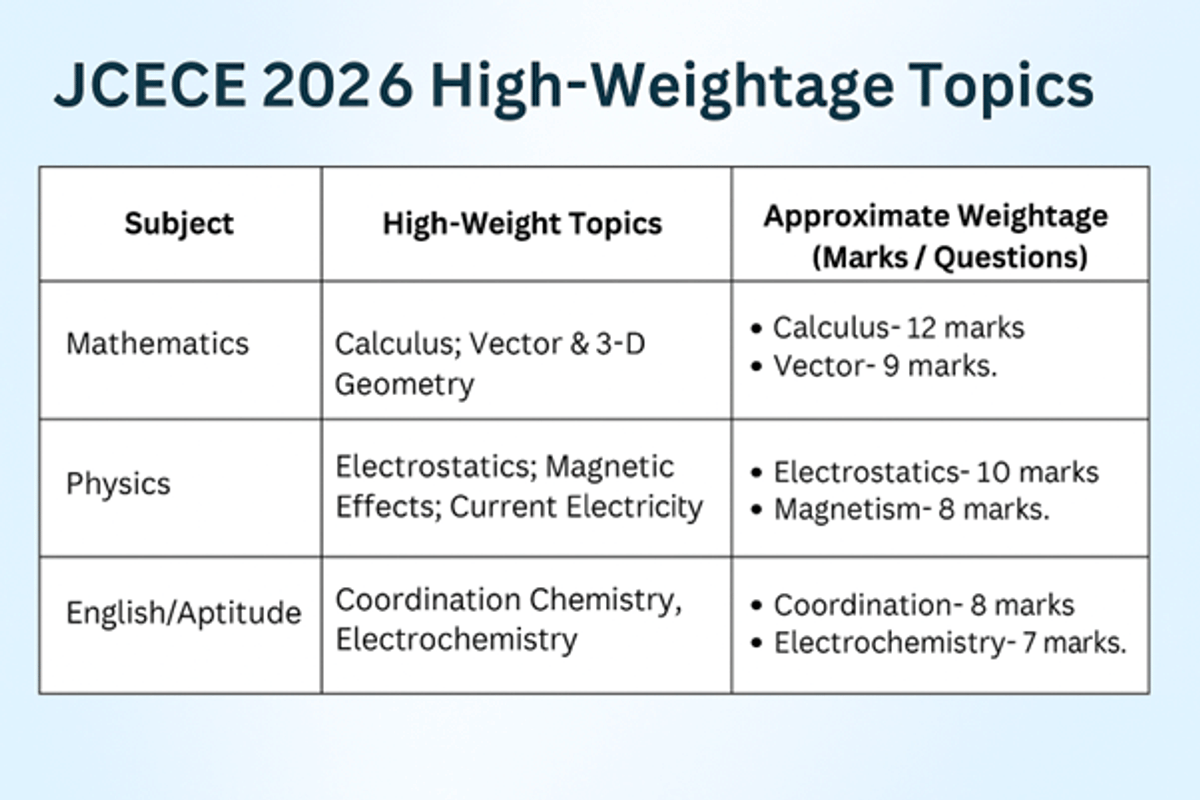
The topic-wise weightage is an important tool for candidates to plan their preparation more efficiently and concentrate on the areas that will bring them the most marks.
- Physics: The chapters - Electrostatics, Current Electricity and Magnetic Effects of Current have been given the most weightage.
- Chemistry: The most frequently asked questions are from Organic Chemistry, Coordination Compounds and Thermodynamics.
- Mathematics: Calculus, Vectors and Coordinate Geometry are the topics that have been given the most weightage.
- Biology: The chapters Genetics, Human Physiology and Ecology have been weighted the most.
Also Read:
Ques. Can I get Agriculture in JCECE with 70 marks?
Ans. As per the trends for the last year, a score of approximately 70 marks in JCECE is regarded as average, and the contenders can expect a moderate probability of admission in Agriculture or Forestry degree courses, which is further influenced by factors such as category, availability of seats and cutoff trends.
| Marks ~70 | Admission Chances |
|---|---|
| Top Courses (Veterinary Science) | Low chance |
| Agriculture / Forestry | Moderate chance |
| Lower Preference Courses | Higher chance of selection |
How can I download the previous year's question paper for the JCECE 225 exam?
Previous years’ questions have an important role in your preparation, as practising PYQs can help you understand the question pattern, and you can prepare accordingly.
Previous Years’ Question Paper
| Year | Subject | Question Paper PDF |
|---|---|---|
| 2,023 | ENGG Physics | Download PDF |
| 2,022 | Chemistry | Download PDF |
| 2,019 | Chemistry (Set 1) | Download PDF |
| 2,018 | Physics & Chemistry Set 1 | Download PDF |
| 2018 | Physics & Chemistry Set 2 | Download PDF |
| 2018 | Physics & Chemistry Set 3 | Download PDF |
| 2018 | Physics & Chemistry Set 4 | Download PDF |
| 2018 | Mathematics | Download PDF |
| 2018 | Mathematics | Download PDF |
| 2018 | Mathematics | Download PDF |
| 2018 | Mathematics | Download PDF |
| 2018 | Biology | Download PDF |
| 2018 | Biology | Download PDF |
| 2018 | Biology | Download PDF |
| 2018 | Biology | Download PDF |
JCECE 2026 Preparation Tips
- A target-oriented combination of exercises and a thoughtful plan would help a JCECE 2026 you prepare effectively for the exam which is a tri-stream (PCB, PCM, or PCMB) test.
- As the test is also in an offline (OMR-based) format, those taking the exam need to work on accuracy, time management, and conceptual clarity.
- Approximately 75–80% of the questions are from the concepts of classes 11 and 12 and are of moderate to high level; therefore, understanding these concepts in depth is very important.
| Focus Area | Strategy |
|---|---|
| Core Subjects | Focus on high-weightage NCERT Class 11 & 12 topics. For PCM: Mechanics, Thermodynamics, Electrostatics, Kinetics, Organic Chemistry, Calculus, Coordinate Geometry. For PCB: Physiology, Genetics, Ecology, Organic Chemistry. Spend 70–75% of study time here. |
| Fundamental Concepts | Strengthen basics—key formulas, laws, and NCERT diagrams. Focus on Laws of Motion, Gravitation, Mole Concept, Atomic Structure, and Cell Biology. Use 20–25% of study time for clarity. |
| Mock Tests | Take 2–3 mocks weekly, daily in the last 45 days. Review errors, track progress, and practice OMR marking. |
| Time Management | Allocate 1 hour each for Physics, Chemistry, and Biology/Maths. Maintain balance across subjects. |
| Previous Papers | Solve past 5–10 years’ papers to understand recurring topics and exam trends. |
| Revision Notes | Prepare concise notes with formulas, reactions, and key facts for last-minute review. |
| Accuracy | Attempt only well-prepared questions. Avoid guesswork to prevent negative marking. |
Ques. Can I crack JCECE without coaching?
Ans. Consistent self-study is definitely enough to pass JCECE in a good manner without any coaching. The test is Figured from the Class 11 & 12 NCERT books so focus on comprehension instead of rote learning.
- Keep yourself engaged with 2-3 hours of study daily for 5-6 months.
- Follow the NCERTs, reference books, and online resources like YouTube lectures and PDFs.
- Try mock tests and previous year papers as much as possible to get comfortable with the test timing and increase your speed.
Ques. How many months of preparation are sufficient for JCECE?
Ans. Around 6–8 months of structured preparation is ideal.
- First 4–5 months → Complete syllabus and clear concepts.
- Last 2–3 months → Focus on mock tests, revision, and formula retention.
Ques. Which is more important revision or covering new topics?
Ans. Revision is more critical in the final phase of preparation.
- Revisit short notes, formulas, derivations, and diagrams.
- Avoid adding entirely new topics close to the exam.
- Spend the final week entirely on revision and practicing previous papers for maximum recall and confidence.
JCECE Overview 2026 FAQS
Ques.What is the criteria for JCECE 2025?
Ans. JCECE 2025 age limit, domicile, and educational qualifications make up the eligibility criteria for the exam.
- Education: The applicants should have passed their 12th from a recognized board with Physics, Chemistry, and Mathematics/Biology as the main subjects.
- Residency: The applicants must be permanent residents of Jharkhand to be considered eligible.
- Age: There is no age limit for the Engineering course; however, for Agriculture and Veterinary courses, the age of the candidates should be between 17 and 22 years as of December 31, 2025.
Ques.What is the difference between JCECE and JCECEB?
Ans. The Jharkhand Combined Entrance Competitive Examination (JCECE) is the exam, while JCECEB is the board that conducts it.
| Category | JCECE | JCECEB |
|---|---|---|
| Full Form | Jharkhand Combined Entrance Competitive Examination | Jharkhand Combined Entrance Competitive Examination Board |
| Function | Entrance test for admission to Engineering, Agriculture, and B.Sc. programs | Governing body organizing various entrance exams in Jharkhand |
| Role | Student-level examination | Administrative and regulatory authority |
Ques.What is the syllabus for JCECE B.Sc Nursing 2026?
Ans. The JCECE B.Sc Nursing 2026 syllabus is derived from the Class 11 and 12 PCB (Physics, Chemistry, Biology) syllabus of CBSE/State Board.
- Physics subject matter: Motion, Optics, Current Electricity, and Thermodynamics.
- Chemistry subject matter: Organic Chemistry, Biomolecules, and Coordination Compounds.
- Biology subject matter: Human Anatomy, Plant Physiology, Genetics, Ecology, and Biotechnology.
Ques. What is the BCECE entrance exam 2026?
Ans. The BCECE (Bihar Combined Entrance Competitive Examination) 2026 is a state-level entrance test to secure seats in the first year of B.E./B.Tech., B.Pharmacy, and B.Sc. (Agriculture) courses in Bihar.
- Organizing body: Bihar Combined Entrance Competitive Examination Board (BCECEB).
- Test pattern: The exam consisted of two parts - Physics & Chemistry (combined) and Mathematics/Biology.
- Requirement: Candidates should have completed their higher secondary education with the scientifically relevant subjects from a duly recognized board or university.
Ques. How many seats are there in BCECE 2026?
Ans. BCECE 2026 is anticipated to provide approximately 3,000–4,000 seats in different government and private colleges in Bihar.
- Engineering seats: roughly 2,500+ spread over different participating institutes.
- Pharmacy & Agriculture: about 1,000 seats together in both streams.
- Seat allotment: BCECEB will carry out the counselling and seat allocation through an online mode only after considering the rank and preferences of the candidates.
Ques. What is the B.Ed. salary in 2026?
Ans. The average B.Ed. graduate salary in 2026 ranges from ₹3.5 LPA to ₹6.5 LPA, depending on the institution and location.
| Type of Institution | Average Monthly Salary (₹) | Key Factors Affecting Pay |
|---|---|---|
| Government Schools | ₹40,000 – ₹70,000 | Based on pay scale, grade, and seniority |
| Private Institutions | ₹25,000 – ₹50,000 | Depends on school reputation and location |
| Career Growth | ₹70,000+ (with experience) | Increases with teaching experience, post-graduate qualifications, and administrative roles |
Ques. Which subject is best for B.Ed. in 2026?
Ans. The best B.Ed. subject in 2026 depends on your previous stream and teaching interests.
| Stream | Recommended B.Ed. Subject | Teaching Focus |
|---|---|---|
| Science | Mathematics, Physics, Chemistry, Biology | Secondary & Senior Secondary |
| Arts | English, History, Geography, Political Science | Middle & High School |
| Commerce | Economics, Accountancy, Business Studies | Senior Secondary |
| Language | English, Hindi, Sanskrit | Language & Literature Teaching |
Eligibility
The JCECEB has set some eligibility criteria for different categories and courses. JEE Main course is mandatory for B. Tech aspirants. Apart from that qualification, age and subject criteria are also there. The minimum and maximum age criteria are 17 and 22 respectively depending on course. You must have qualified for a 10+2 exam from a recognized board/university and this is applicable for every category or course.
| Table of Contents |
What is the eligibility criteria of the JCECE 2025 exam?
Eligibility criteria are different for different courses and categories. You can check the detailed eligibility criteria course and category-wise below.
For B.Tech (Agriculture Engineering)/ B.Tech. (Dairy Technology)
- Qualification: 10+2/Intermediate with Physics, Chemistry and Mathematics from a recognised Board/University.
- Subject: You are required to have Physics, Chemistry and Mathematics as compulsory subjects.
- Age limit: The minimum and maximum ages are 17 and 22 as of July 1, 2025, for general students. SC/ST/OBC category candidates will be given a 5-year relaxation of minimum age.
- Physical Fitness: You will have to undergo a medical checkup by the board and only if you are medically fit will be eligible.
- Domicile: You must be a permanent/local resident of Jharkhand according to the domicile by the Raj Bhasa, Government of Jharkhand. You need to show a valid Local Resident Certificate at the time of JCECE counselling.
B.Sc. (Hons.) Agriculture/ B.Sc. (Hons.) Forestry
- Qualification: Intermediate in Science (10+2) or its equivalent examination with Physics, Chemistry, Biology or Physics, Chemistry and Mathematics from a recognised Board/University.
- Subject: You are required to have Physics, Chemistry and Biology/ Mathematics as compulsory subjects.
- Age limit: The minimum and maximum ages are 17 and 22 as of July 1, 2025, for general students. SC/ST/OBC category candidates will be given a 5-year relaxation of minimum age.
- Physical Fitness: You will have to undergo a medical checkup by the board and only if you are medically fit will be eligible.
- Domicile: You must be a permanent/local resident of Jharkhand according to the domicile by the Raj Bhasa, Government of Jharkhand. You need to show a valid Local Resident Certificate at the time of JCECE counselling.
B.Sc. (Hons.) in Horticulture
- Qualification: Intermediate in Science (10+2) or its equivalent examination with PCB, PCM, PCMB, PC Forestry or Inter (Agriculture) as core subjects from a recognized board or university.
- Subject: You are required to have Physics, Chemistry and Biology/ Mathematics as compulsory subjects.
- Age limit: The minimum and maximum ages are 17 and 22 as of July 1, 2025, for general students. SC/ST/OBC category candidates will be given a 5-year relaxation of minimum age.
- Physical Fitness: You will have to undergo a medical checkup by the board and only if you are medically fit will be eligible.
- Domicile: You must be a permanent/local resident of Jharkhand according to the domicile by the Raj Bhasa, Government of Jharkhand. You need to show a valid Local Resident Certificate at the time of JCECE counselling.
For B.V.Sc. and A.H (Animal Husbandry)
- Qualification: Intermediate in Science (10+2) or its equivalent examination with Physics, Chemistry, Biology and English as core courses from a recognized Board/University. If you belong to the general category, you shall have to qualify each subject with 50% marks in the aggregate. SC/ST or other special category of students need to have qualified with 47.5% in the aggregate.
- Subject: You are required to have Physics, Chemistry, Biology and English as compulsory subjects.
- Age limit: The minimum and maximum ages are 17 and 25 as of December 31, 2025, for general students. SC/ST/OBC category candidates will be given a 5-year relaxation of minimum age.
- Physical Fitness: You will have to undergo a medical checkup by the board and only if you are medically fit will be eligible.
- Domicile: You must be a permanent/local resident of Jharkhand according to the domicile by the Raj Bhasa, Government of Jharkhand. You need to show a valid Local Resident Certificate at the time of JCECE counselling.
B.F.Sc (Bachelor of Fisheries Science)
- Qualification: Higher Secondary/10+2/Intermediate in Science (10+2) or its equivalent examination with PCMB/ PCB/ Inter (Agriculture) as core subjects from a recognized board or university.
- Subject: You are required to have Physics, Chemistry, Biology and English as compulsory subjects.
- Age limit: The minimum and maximum ages are 17 and 22 as of July 1, 2025, for general students. SC/ST/OBC category candidates will be given a 5-year relaxation of minimum age.
- Physical Fitness: You will have to undergo a medical checkup by the board and only if you are medically fit will be eligible.
- Domicile: You must be a permanent/local resident of Jharkhand according to the domicile by the Raj Bhasa, Government of Jharkhand. You need to show a valid Local Resident Certificate at the time of JCECE counselling.
How do I know if I am eligible for the tuition fee waiver scheme or not?
The tuition waiver scheme is only provided to candidates in the Engineering Institutes. It is applicable on 55 seats in every approved institute as per the provisions of the All India Council for Technical Education, New Delhi. If your annual family income is below INR 4.5 lac, then you are eligible for the scheme. To avail your seat you need to submit an income certificate issued by the Sub-Divisional Officer (Civil) and Dy. Commissioner of Jharkhand at the time of counselling. The seat will be given to you based on your merit and choice.
What eligibility do I need to avail reservation?
To avail the reservation you should have procured a proper Local Resident Certificate issued by the authority assigned by Government of Jharkhand.
JCECE Reservation Based on Caste
- This criterion is followed in accordance with the latest Reservation Policy of Jharkhand Government by various Government and Private Institutes.
- You need to show your Caste Certificate in the proper format (available on Act & Circular column on the official website) issued by the competent authority i.e. Sub-Divisional Officer (Civil) or Dy. Commissioner of Jharkhand State.
- The Caste Certificate will be considered invalid if it is issued by any other authority and you will be deemed to the general category.
The percentage reservation of seats by different castes for the Engineering Course is provided below.
| Category | Reservation (%) |
|---|---|
| Scheduled Castes (SC) | 10 |
| Scheduled Tribes (ST) | 26 |
| Other Backward Classes (OBC) | 14 |
I am 50% disabled. Am I eligible for reservation in JCECE?
To avail a reservation seat you must be at least 40% disabled in the following.
- Blindness and low vision
- Deaf and hard of hearing
- Locomotor Disability including cerebral palsy, leprosy cured, dwarfism, acid attack victims and muscular dystrophy
- Autism, intellectual disability, specific learning disability and mental illness
- Multiple disabilities from amongst persons under clauses
- (a) to (d) including deaf-blindness.Documents required at the time of counselling:
- In that case you need to provide a full-size photograph, Certificate of Disability issued by Civil Orthopedics Doctor of the District Hospital/ Civil Surgeon of Jharkhand state at the time of counselling.
What is the eligibility criteria I need to fulfil to get a Local Resident Certificate?
The Local Resident Certificate is mandatory for you to appear in the JCECE 2025 exam. Your birthplace should be Jharkhand and you have to fulfil the following requirements to get the certificate.
- Either you or your parents need to be a resident of Jharkhand for a minimum of 15 years.
- One of your parents should be working as a Government official under the Government of Jharkhand OR working under the Government of India as the Government official but transferred to Jharkhand for servicing.
- You or your parents must own a property or run a business authorised by the Government of Jharkhand.
- Other than the above-mentioned eligibility, the following criteria are also considered.
- You must have qualified seven years of your schooling from any school in Jharkhand.
- You must have cleared the following examinations from any educational institution of the state of Jharkhand.
- For admissions in graduation based level in any recognized university, you must have passed his/her qualifying exam.
- For admissions in any university or intermediate board exam (I.SC.), 10+2 or any other equivalent qualifying examination then scores of class 8th are considered.
- In other conditions, class 4th scores are considered.
- The wife of a resident of Jharkhand will also be considered a resident of Jharkhand. So the resident certificate of the spouse is also applicable in this case.
- You shall be considered a local resident of Jharkhand if your father or mother is a Defence Personnel along with the citizen of Jharkhand but he/she has not been posted in Jharkhand for service. It is not necessary for you to academically qualify from an institution of Jharkhand. This shall only be applicable for Defence Service Personnel.
- Also, the wife and children of the All-India Service officials shall also be marked as the citizens of Jharkhand.
- The children of Ex-Defence Servicemen will be exempted from submitting the Local Resident Certificate at the time of JCECE 2024 Counselling.
- The resident certificate is not required for the Kashmiri Migrants.
Frequently Asked Questions
Ques. I belong to the SC category and want to apply for a B.Sc (Hons) in Agriculture. What qualification is required for that?
Ans. You must have qualified intermediate in Science (10+2) or its equivalent examination with Physics, Chemistry, Biology or Physics, Chemistry and Mathematics from a recognised Board/University.
Ques. I will complete my 23 years in December 2024. Am I eligible for the JCECE 2025 exam?
Ans. No, you are not eligible for the exam if you belong to the general category as the maximum age is 22 as of July 1, 2025, for general students. SC/ST/OBC category candidates will be given a 5-year relaxation of minimum age.
Application Process
While filling the application form, the candidate has to select the group of examination as per their choice of PCM, PCB & PCMB. Candidates should fill one form, more than one application form will be rejected. Check JCECE 2024 Eligibility
- Registration fee will be submitted using different online payment gateways such as debit card/ credit card/ net banking/ UPI payment.
- Application fees to apply for JCECE 2024 is INR 900 for the general/ EWS/ OBC category and INR 450 for SC/ST/ Female candidates for PCM/PCB group which could be paid through Debit/ Credit card/ Net banking.
- Candidates should ensure that that all the details entered while filling the application form are correct as no options can be changed at a later stage. Successfully registered will be able to download admit card from the official site JCECE jceceb.jharkhand.gov.in. Check JCECE Admit Card
JCECE Application Form 2024 Highlights
| Exam Name | JCECE (Jharkhand Combined Entrance Competitive Examination) |
| Conducting Authority | J.C.E.C.E.B (Jharkhand Combined Entrance Competitive Examination Board) |
| Official website | jceceb.jharkhand.gov.in |
| Mode of Registration | Online |
| Mode of fee payment | Online |
JCECE Application Form 2024 Dates
Candidates can check the schedule of the exam here:
| Event | Dates |
|---|---|
| Availability of Online Application form | Mar 1, 2024 (Open) |
| Last Date to Fill JCECE Application Form | April 1, 2024 |
| JCECE 2024 Exam Date | April 28, 2024 |
JCECE Application Form 2024: Subject Groups
Candidates should select the subject group of examinations as per their course tabulated below:
| Courses | Subject Groups |
|---|---|
| B.Sc. (Hons) Agriculture/ B.Sc. (Hons) Forestry/ B.Sc. (Hons) Horticulture/ B.Tech (Agriculture Engineering) B.Tech (Dairy Technology) | PCM |
| B.Sc. (Hons) Agriculture/ B.Sc. (Hons) Forestry/ B.Sc. (Hons) Horticulture/B.V.Sc. & A.H. /B.F.Sc. (Bachelor of Fisheries Science) | PCB |
| B.Sc. (Hons) Agriculture/ B.Sc. (Hons) Forestry/ B.Sc. (Hons) Horticulture/B.V.Sc. & A.H. /B.F.Sc. (Bachelor of Fisheries Science)/ B.Tech (Agriculture Engineering) B.Tech (Dairy Technology) | PCMB |
How to Fill JCECE Application Form 2024?
Candidates can apply for JCECE 2024 through online mode only. Below, we have mentioned the complete steps to fill JCECE Application form 2024 through online mode.
Stage 1 – JCECE 2024 Registration
- Visit the official website.
- Click on the button “New Registration”.
- Fill all the required details in the registration form like Candidate’s Name, Father’s Name, Gender, Category, Date of Birth, E-mail ID, Mobile number and landline with STD code.
- After completing these, you will get a registration number along with the password for the login process.
Stage 2 – Filling JCECE Application Form 2024
- Login to the official website with the registration number and date of birth.
- The application form will open on the screen.
- Fill in details like- Personal details, Candidate's Name, Father's Name, Mother's Name, Date of Birth, Gender, Parent Domicile, Category, Persons with Disability (PwD), Servicemen Quota, Residential Eligibility, Annual Family Income, Nationality, Aadhaar No
- Course and Exam City options- Course applied for and choice of exam city
- Educational Details- Qualification, Stream, Passing year and marks
- Communication Details- Address, Email Address, Locality, Mobile number
- The submitted information in the application form of JCECE 2024 will reflect on the screen. Candidates have to read the filled application form, sign the declaration and click on "Final Submit". After successfully submitting the form, candidates’ JCECE application number 2024 will be reflected on screen.
Also Check: JCECE Exam Pattern
Stage 3 - Uploading the Scanned Images
At the next stage, candidates have to upload the scanned/digital copies of their photograph, signature, and thumb impression as per the dimensions are given below.
| File | Size | Dimensions |
|---|---|---|
| Photograph | 4 KB to 100 KB | 3.5 cmX4.5 cm |
| Signature | 1 KB to 30 KB | 3.5 cmX1.5 cm |
| Thumb Impression | 1 KB to 30 KB | 3.5 cmX1.5 cm |
Stage 4 - Fee Payment
- The fee payment can be done online (debit/credit card).
- If paying through debit/credit card, be ready with the card details, fill the card details in the payment gateway and make payment.
- Candidates are advised to take a printout of the fee payment proof for security purposes.
- Candidates note down the application fee once paid will not be refunded under any circumstances.
Stage 5 – JCECE Application form submission
- The last stage of the application procedure of JCECE 2024 is the final submission.
- Before submission, candidates must cross-verify all the details entered by them in the application form and then submit the form.
- They must also take a couple of printouts of the submitted application form of JCECE 2024 for their reference.
JCECE Application Fee 2024
| Course | Category | Fee |
|---|---|---|
| PCM/PCB Group | General/ BC-I/ BC-II | INR 900 |
| SC/ST | INR 450 | |
| PCMB Group | General/ BC-I/ BC-II | INR 1,000 |
| SC/ST | INR 500 |
Important Instructions for JCECE Application Form 2024
While filling JCECE Application Form 2024, candidates should keep a note of the following points
- Candidates can fill JCECE Application Form 2024 online mode only on the official website of JCECEB.
- Applicants must ensure that their name, parent's name in the application form is identical to the details mentioned in Class 10th/I.Sc./ 10+2 or the equivalent qualifying examination. No changes in the application form will be entertained later
- Candidates are not required to send a hard copy of the application form. However, a printout of the confirmation page must be taken as a reference at the time of the counseling and admission process.
- Email Id and Mobile Number provided at the time of JCECE Application Form 2024 must be active at all times as all future communication related to the exam will be provided through these details,
JCECE Application Form 2024 FAQs
Ques. What is the last date to fill the application form for JCECE 2024?
Ans. JCECE Application Form 2024 has been released on Mar 1, 2024. Candidates can register till April 28, 2024.
Ques. What is the educational criteria for B.Sc. (Hons) Agriculture?Ans: Candidates who wish to appear in JCECE 2024 in order to take admission in B.Sc.(Hons) Agriculture, candidates should have passed Intermediate in Science (10+2) or its equivalent examination with either the subject group of Physics, Chemistry, Biology or Physics, Chemistry and Mathematics from a recognized Board.
Ques. Can I fill more than one JCECE 2024 application form?
Ans: Candidates can fill only one JCECE 2024 application form. More than one form will be rejected.
Ques. Is it necessary to have the domicile of Jharkhand state in order to apply for JCECE 2024?
Ans: Yes, in order to apply for JCECE 2024, the candidate should be an Indian citizen and a Local/Permanent Resident of Jharkhand. Candidates would be required to produce an original Permanent/Local Resident Certificate at the time of admission issued by the competent authority.
Ques. If I enter some wrong entries in my JCECE 2024 application form. Can I correct it?
Ans: No, you cannot make any corrections in the JCECE 2024 application form. Fill in all the details carefully because no changes will be permitted after submission of the application form.
Ques. I am a resident of Jharkhand but I passed Class XII from West Bengal. Am I eligible for JCECE 2024?
Ans: Yes, you can apply for JCECE 2024. You must be a local or permanent resident of Jharkhand to apply for the exam. If in case you don’t possess a domicile of Jharkhand then you can also apply on the basis of your parents’ domicile. However, such candidates must also ensure that they fulfill the minimum educational requirements based on the course.
Exam Pattern
The exam pattern of the JCECE 2025 exam will be released by the JCECE Board on the official website along with the exam notification. The exam will be conducted in April 2025. It follows an offline mode of examination but the registration form must be filled online. The medium of the exam will be Hindi and English. You can choose your preferred medium at the time of registration. The question paper will consist of questions from NCERT class 12 CBSE Science syllabus. There will be three subject groups namely PCB, PCM and PCMB. Exam time will be allocated according to the subject groups.
You are advised to check the detailed exam pattern discussed in this article to provide you with in-depth knowledge.
If I want to appear for the JCECE 2025 exam for B.Sc (Hons) in Forestry then what subject group do I need to choose?
The subject groups are different from different courses. If you want to go for a B.Sc (Hons) in Forestry then you will be under the PCB group. Different groups for different subjects are mentioned below for your convenience.
- PCB Group (Physics, Chemistry, Biology) – For admission to B.Sc. (Hons) Agriculture, B.Sc (Hons) Forestry, B.V.Sc and A.H, B.H.M.S., B.F.Sc (Bachelor of Fisheries Science)
- PCM Group (Physics, Chemistry, Mathematics) – For admission to B.Sc. (Hons) Agriculture, B.Sc (Hons) Forestry, B.Tech (Dairy Technology, Agriculture Engineering)
- PCMB Group (Physics, Chemistry, Mathematics, Biology) – For admission to B.Sc. (Hons) Agriculture, B.Sc (Hons) Forestry, B.V.Sc and A.H, B.H.M.S., B.Tech (Dairy Technology), B.F.Sc (Bachelor of Fisheries Science)
How many questions will be asked in the JCECE 2025 exam?
In the examination you will be asked 150 questions if you belong to the PCB and PCM group. The number of questions will be 200 in the case of the PCMB group. Four sections will be there such as Physics, Chemistry, Mathematics and Biology. A total of 50 questions will be asked from each section.
How much time will I get to complete my exam?
The PCB and PCM group will get 3 hours to complete 150 Multiple Choice Questions (MCQ). The PCMB group will get 4 hours as they will be given 200 MCQs. No sectional time limit will be there in the exam so you can choose sections as per your preferences.
Is there any extra time given to reserved candidates in the JCECE 2025 exam?
The exam duration is fixed for all the categories. No extra time will be given to the reserved category candidates. Therefore, you need to practise well to boost your speed and accuracy.
Is there any negative marking in the JCECE 2025 exam?
A total of 50 questions will be asked from each section and each question will carry 1 mark. You will be awarded with +1 mark for each correct response. the -0.25 mark will be deducted for each incorrect response. No mark will be added or deducted for unattempted questions. More than one answer indicated against a question will be considered as an incorrect response and will be counted as negative marks.
What chapters are included in the JCECE 2025 exam?
The exam focuses on the NCERT Science syllabus of class 12 CBSE board. Subject-wise chapters are mentioned below for your convenience.
Mathematics
- Relations and Functions
- Algebra
- Calculus
- Vectors and Three-Dimensional Geometry
- Linear Programming
- Probability
Physics
- Electrostatics
- Current Electricity
- Magnetic Effect of Current & Magnetism
- Electromagnetic Induction & Alternating Current
- Electromagnetic Waves
- Optics
- Dual Nature of Matter
- Atom & Nuclei
- Electronic Devices
- Communication Systems
Biology
- Diversity in Living World
- Structural Organisation in Animals and Plants
- Cell Structure and Function
- Plant Physiology
- Human Physiology
- Reproduction
- Genetics and Evolution
- Biology and Human Welfare
- Biotechnology and Its Applications
- Ecology and environment
Chemistry
- Solid State
- Solutions
- Electrochemistry
- Chemical Kinetics
- Surface Chemistry
- General Principles and Processes of Isolation of Elements
- "p"-Block Elements
- "d" and "f" Block Elements
- Coordination Compounds
- Haloalkanes and Haloarenes
- Alcohols, Phenols and Ethers
- Aldehydes, Ketones and Carboxylic Acids
- Organic compounds containing Nitrogen
- Biomolecules
- Polymers
- Chemistry in Everyday life
Is the JCECE exam difficult to crack?
The difficulty level of the exam is moderate. With a proper dedication, hard work and time management you can crack the exam. At least 5-6 months is required to be prepared for this exam.
Will there be any changes in exam pattern in 2025?
Over the years nothing much has changed in the exam pattern. Therefore, it is expected that there will be no such changes in the exam pattern in 2025. If the authority makes any changes in the exam pattern they will update it on the official website. You are advised to visit the official website frequently for the latest updates.
Frequently Asked Questions
Ques: I have completed my 12th exam with Physics, Chemistry and Mathematics as compulsory subjects. May I apply for B.Tech (Dairy Technology)?
Ans: No, you cannot apply for a B.Tech (Dairy Technology) course as you must have qualified for your 12th exam with Biology along with Physics, Chemistry and Mathematics.
Ques: Is there any sectional time limit for the JCECE exam?
Ans: No, there is no sectional time limit in the exam so you can choose the sections according to your convenience. You have to finish 150 or 200 questions within 3 or 4 hours respectively.
Syllabus
The syllabus of the JCECE 2025 exam primarily focuses on the class 12 CBSE Science syllabus. The exam will be conducted for three subject groups namely, PCB, PCM and PCMB. The entire syllabus consists of Physics, Mathematics, Chemistry and Biology. The exam will take place in April 2025, so aspiring candidates must start their preparation from now. The subject groups are different from different courses.
- PCB Group (Physics, Chemistry, Biology) – For admission to B.Sc. (Hons) Agriculture, B.Sc (Hons) Forestry, B.V.Sc and A.H, B.H.M.S., B.F.Sc (Bachelor of Fisheries Science)
- PCM Group (Physics, Chemistry, Mathematics) – For admission to B.Sc. (Hons) Agriculture, B.Sc (Hons) Forestry, B.Tech (Dairy Technology, Agriculture Engineering)
- PCMB Group (Physics, Chemistry, Mathematics, Biology) – For admission to B.Sc. (Hons) Agriculture, B.Sc (Hons) Forestry, B.V.Sc and A.H, B.H.M.S., B.Tech (Dairy Technology), B.F.Sc (Bachelor of Fisheries Science)
| Table of Contents |
What is the JCECE 2025 exam syllabus?
The JCECE exam completely focuses on the NCERT syllabus of class 12 so you are advised to study NCERT books thoroughly to understand the syllabus and for better preparation. The syllabus for each subject is given below for your convenience.
Mathematics Syllabus
A total of 50 Multiple Choice Questions will be asked from Mathematics and each question carries 1 mark.
| Units | Chapters |
|---|---|
| Relations and Functions | Relations and Functions Inverse Trigonometric Functions |
| Algebra | Matrices Determinants |
| Calculus | Continuity and Differentiability Applications of Derivatives Integrals Applications of the Integrals Differential Equations |
| Vectors and Three-Dimensional Geometry | Vectors Three - dimensional Geometry |
| Linear Programming | Linear Programming |
| Probability | Probability |
Biology Syllabus
A total of 50 Multiple Choice Questions will be asked from Biology and each question carries 1 mark.
- Diversity in Living World
- Structural Organisation in Animals and Plants
- Cell Structure and Function
- Plant Physiology
- Human Physiology
- Reproduction
- Genetics and Evolution
- Biology and Human Welfare
- Biotechnology and Its Applications
- Ecology and environment
Physics syllabus
A total of 50 Multiple Choice Questions will be asked from Physics and each question carries 1 mark.
| Units | Chapters |
|---|---|
| Electrostatics | Chapter 1: Electric Charges and Fields Chapter 2: Electrostatic Potential and Capacitance |
| Current Electricity | Chapter 3: Current Electricity |
| Magnetic Effect of Current & Magnetism | Chapter 4: Moving Charges and Magnetism Chapter 5: Magnetism and Matter |
| Electromagnetic Induction & Alternating Current | Chapter 6: Electromagnetic Induction Chapter 7: Alternating Current |
| Electromagnetic Waves | Chapter 8: Electromagnetic Waves |
| Optics | Chapter 9: Ray Optics and Optical Instruments Chapter 10: Wave Optics |
| Dual Nature of Matter | Chapter 11: Dual Nature of Radiation and Matter |
| Atom & Nuclei | Chapter 12: Atoms Chapter 13: Nuclei |
| Electronic Devices | Chapter 14: Semiconductor Electronics: Materials, Devices and Simple Circuits |
| Communication Systems | Chapter 15: Communication Systems |
Chemistry Syllabus
A total of 50 Multiple Choice Questions will be asked from Chemistry and each question carries 1 mark.
| Units | Topics |
|---|---|
| Solid State | - |
| Solutions | - |
| Electrochemistry | - |
| Chemical Kinetics | - |
| Surface Chemistry | - |
| General Principles and Processes of Isolation of Elements | - |
| "p"-Block Elements | Group 15 Elements Group 16 Elements Group 17 Elements Group 18 Elements |
| "d" and "f" Block Elements | Lanthanide Actinoids |
| Coordination Compounds | - |
| Haloalkanes and Haloarenes | Haloalkanes Haloarenes |
| Alcohols, Phenols and Ethers | Alcohols, Phenols, Ethers |
| Aldehydes, Ketones and Carboxylic Acids | Aldehydes and Ketones Carboxylic Acids |
| Organic compounds containing Nitrogen | Amines, Cyanides and Isocyanides Diazonium salts |
| Biomolecules | Carbohydrates Proteins Vitamins Nucleic Acids |
| Polymers | - |
| Chemistry in Everyday life | Chemicals in medicines Chemicals in food Cleansing agents |
How will the questions be distributed in the JCECE 2025 exam paper?
A total of 150 and 200 MCQs will be asked depending on the subject groups. Each MCQ carries 1 mark and the total marks will be 150 for PCB & PCM groups and 200 for PCMB groups. Subject-wise asked questions are mentioned below in tabular form for your reference.
| Subject | Number of Questions (MCQs) |
|---|---|
| PCB (Physics, Chemistry, Biology) | Physics = 50 Chemistry = 50 Biology = 50 |
| PCM (Physics, Chemistry, Mathematics) | Physics = 50 Chemistry = 50 Mathematics = 50 |
| PCMB (Physics, Chemistry, Mathematics, Biology) | Physics = 50 Chemistry = 50 Mathematics = 50 Biology = 50 |
What are the important topics in the JCECE 2025 exam syllabus?
The questions will be asked from almost every chapter from each subject. Therefore, you should not skip any chapter but here are some important topics given below which can help you to understand where you have to put extra effort.
Mathematics: Hyperbola, Parabola, 3D Geometry, Matrices Determinants, Area under Curve, Calculus, Quadratic Equation, Complex Number, Probability
Chemistry: Biomolecules, Chemical Bonding, S, P, D, F-Block Elements, Coordination Compounds, Chemical Kinetics, Solutions, Alcohols, Phenols and Ethers
Physics: Modern Physics, Thermal Physics, Ray Optics, Rotational Motion, Kinematics, Alternating Current and Wave Optics. Formula-based questions are more important.
Biology: PGR, Human Health and Disease, Cell, Biological Classification, Reproduction, The Living World
How can I prepare for the JCECE 2025 exam?
You will be asked 150 or 200 questions depending on your subject group and 3hr or 4 hrs will be given to you respectively. To complete the exam within time you should practise questions daily with a time limit. It can help you to measure your progress in speed and accuracy. All the subjects are equally important as an equal number of questions are asked of each subject. Therefore, you need to focus on every subject equally. While preparing for Mathematics you can focus more on 3D Geometry, Matrices Determinants, Area under Curve, Calculus, Quadratic Equations, Complex Numbers, Probability, Hyperbola and Parabola. In Physics you must study formula-based questions as based on the past years’ trends it can be observed that these types of questions are asked repeatedly.
You can study PGR, Human Health and Disease, Cell, Biological Classification and Reproduction more in Biology. You need to prepare Living World-related questions such as national park, dates and scientific names. Biomolecules, Chemical Bonding, S, P, D, and F-Block Elements are the most important topics in Chemistry so practising questions from these chapters can give you good marks. Questions are asked from above mentioned topics repeatedly so you must focus on these topics more. You can solve previous years’ questions and MCQs to know the question pattern. Daily practice of question papers can increase your speed and accuracy.
What books are recommended for the JCECE 2025 exam preparation?
To be prepared for the exam you have to read the NCERT textbooks for each subject. Some other books are also recommended below for your reference.
| Books | Author |
|---|---|
| Problems in General Physics | I E Irodov |
| Concept of Physics ( Set of 2 Volumes) | H C Verma |
| General Aptitude: Quantitative Aptitude and Reasoning | GKP |
| General Aptitude Theory and Practice | Ajay Kumar |
| 16 years solved papers JCECE Engineering Entrance | Arihant |
For previous year’s questions you can refer to these books.
| Subject | Book Name | Author |
|---|---|---|
| Physics | 14 year solved papers & 5 mock tests | Arihant Experts |
| Chemistry | 14 Years’ Solved Papers & 5 Mock Tests JCECE Medical | Arihant Experts |
| General | JCECE Engineering Jharkhand Combined Entrance Competitive Exam: 11 Years’ Solved Papers & 5 Mock Tests | Arihant Experts |
| Biology | 13 Years’ Solved Papers & 5 Mock Tests JCECE Medical | Arihant Experts |
What will be the topic-wise weightage in the JCECE 2025 exam?
JCECEB does not release topic-wise weightage but based on previous years’ trends a list of topics with weightage is provided below for your better understanding. The number of questions may differ in the exam.
Chemistry
| Topics | Number of Questions |
|---|---|
| P, S, D, F block | 5-6 questions |
| Chemical Bonding | 4-5 questions |
| Hydrocarbon, Halogen, Derivatives | 1-2 questions |
| Complex Compound | 2-3 questions |
| Electro Chemistry | 1-2 questions |
| Reaction Mechanism | 4-5 questions |
| Equilibrium( acid based) | 3-4 questions |
| Thermodynamics | 1-2 questions |
| Chemical Kinetics | 4-5 questions |
| Atomic Structure | 1-2 questions |
| Solutions | 2-3 questions |
| biomolecules | 4-7 questions |
| Mole Concepts | 4-5 questions |
| Nitrogen Compound | 1-2 questions |
| Polymers | 1-2 questions |
| Surface Chemistry | 1-2 questions |
| States of Matter | 1-2 questions |
Physics
| Topics | Number of Questions |
|---|---|
| Modern Physics | 4-5 questions |
| Thermal Physics | 4-5 questions |
| Magnetism | 2-3 questions |
| Current Electricity | 2-3 questions |
| Semiconductor | 2-3 questions |
| Ray Optics | 5-6 questions |
| Rotational Motion | 4-5 questions |
| Gravitation | 1-2 questions |
| Kinematics | 5-8 questions |
| Fluid Mechanics | 2-3 questions |
| Alternating Current | 4-5 questions |
| Wave Motion | 1-2 questions |
| Wave Optics | 4-5 questions |
Biology
| Topics | Number of Questions |
|---|---|
| Biotech and Genetics | 8-10 questions |
| Ecology | 8-10 questions |
| Plant Diversity | 8-10 questions |
| Plant Physiology | 8-10 questions |
| Cell Cycle & Cell Division | 10-12 questions |
| Animal Reproduction | 4-5 questions |
| Reproduction of Plant | 6-8 questions |
| Plant Morphology | 3-4 questions |
| Animal Diversity | 4-5 questions |
| Evolution | 3-4 questions |
| Endocrine | 3-5 questions |
| Respiratory | 2-3 questions |
| Human Health and Disease | 5-7 questions |
Mathematics
| Topics | Number of Questions |
|---|---|
| Sets | 1-2 questions |
| Probability | 1-2 questions |
| Complex Number | 3-4 questions |
| Binomial Theorem | 3-4 questions |
| Derivatives | 1-2 questions |
| Continuity and Differentiability | 2-3 questions |
| Height and Distance, Equation, Integration | 3-4 questions |
| Quadratic Equation | 1-2 questions |
| Area under Curves | 4-5 questions |
| Target and Normal | 2-3 questions |
| Maxima and Minima | 3-5 questions |
| Vector | 3-4 questions |
| Hyperbola | 4-5 questions |
| Parabola | 7-8 questions |
| 3D Geometry | 4-5 questions |
| Straight Lines | 2-3 questions |
| Determinants | 4-5 questions |
| Trigonometry Equation | 2-3 questions |
How can I download the previous year's question paper for the JCECE 225 exam?
Previous years’ questions have an important role in your preparation as practising PYQs can help you understand the question pattern and you can prepare accordingly.
Previous Years’ Question Paper
| Year | Subject | Question Paper PDF |
|---|---|---|
| 2023 | ENGG Physics | Download PDF |
| 2022 | Chemistry | Download PDF |
| 2019 | Chemistry (Set 1) | Download PDF |
| 2018 | Physics & Chemistry Set 1 | Download PDF |
| 2018 | Physics & Chemistry Set 2 | Download PDF |
| 2018 | Physics & Chemistry Set 3 | Download PDF |
| 2018 | Physics & Chemistry Set 4 | Download PDF |
| 2018 | Mathematics | Download PDF |
| 2018 | Mathematics | Download PDF |
| 2018 | Mathematics | Download PDF |
| 2018 | Mathematics | Download PDF |
| 2018 | Biology | Download PDF |
| 2018 | Biology | Download PDF |
| 2018 | Biology | Download PDF |
| 2018 | Biology | Download PDF |
Frequently Asked Questions
Ques: How much time do I need to cover the entire JCECE exam syllabus?
Ans: You will need at least 5-6 months to be prepared for the exam. Sufficient time is needed to crack this exam as you need to give at least two revisions of the whole learning.
Ques: What will be the difficulty level of the JCECE 2025 exam?
Ans: The difficulty level of this exam is moderate. Therefore, you must take time and prepare hard for this exam. Previous years’ question papers can help you in this matter.
Cut-offs
The expected JCECE Cutoff 2025 varies from 40-90 marks depending on the candidate's category. The cutoff is basically the minimum qualifying marks candidates need to score for admission to various courses in Jharkhand's colleges.
- For General candidates, it is expected that the JCECE Cutoff 2025 will be around 85-90 marks.
- For reserved categories like SC/ST/OBC etc, the JCECE Cutoff 2025 is expected to be in the range of 40-80 marks.
The cutoff is determined based on factors like the number of applicants, seat availability, and the difficulty level of the exam.
The Jharkhand Combined Entrance Competitive Examination Board (JCECEB) conducts the Jharkhand Combined Entrance Competitive Examination (JCECE) exam and counselling process. After each round of counselling, the JCECE will announce the JCECE cutoff 2025 on their official website jceceb.jharkhand.gov.in.
Also Read:
JCECE 2025 Expected Cutoff - Category-Wise
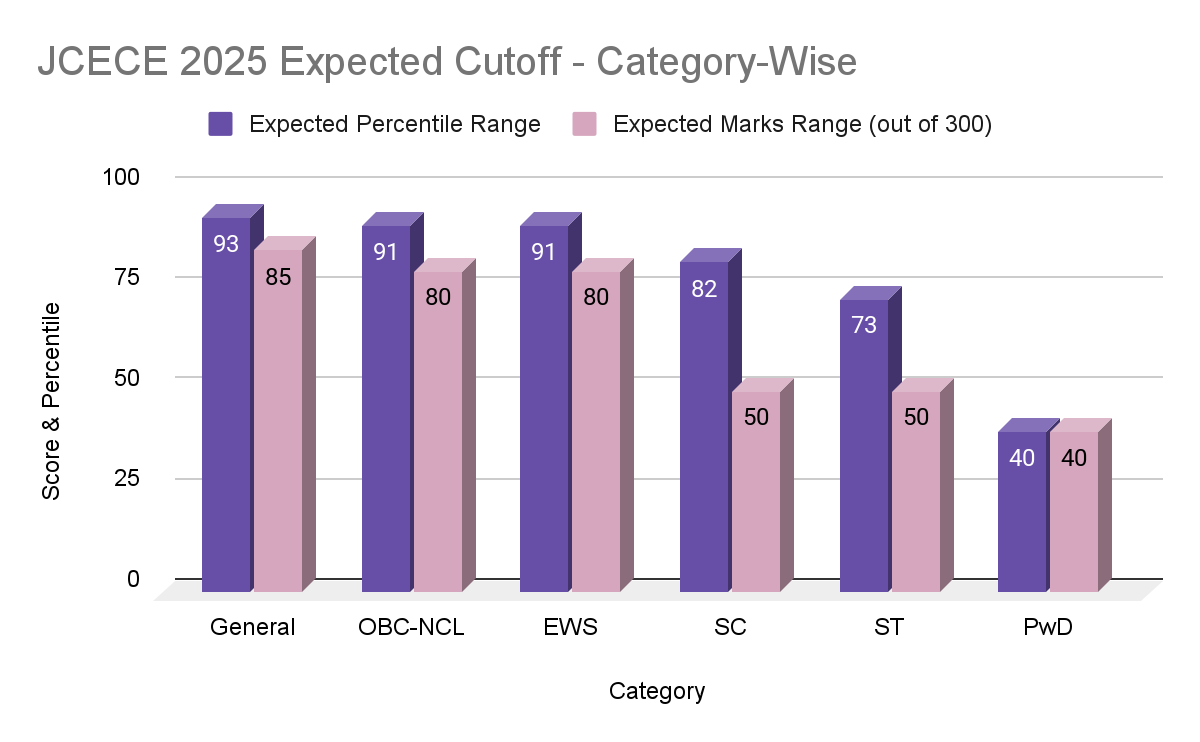
The JCECE (Jharkhand Combined Entrance Competitive Examination) 2025 expected cutoff helps the candidates in analysing the minimum marks and percentile required for admission into engineering and similar courses for different categories.
- For the General category candidates, the expected percentile range will be 93-95%, with an expected score of 85-90 out of JCECE total marks of 300.
- For the OBC-NCL category, the expected percentile is between 91-93%, and marks will be between 80-85. Candidates belonging to this category must target 80+ marks to secure a seat at good branches of engineering.
- The EWS category has an identical cutoff pattern to OBC-NL, with an expected percentile of 91-93% and a marks range of 80-85. A minimum of 80 marks is required under this category to secure a seat at preferred colleges.
- For the SC category, the range should be 82-86% with 50-65 marks estimated. So, a score of about 60+ marks would be enough for favorable opportunities in engineering admission under this reservation.
- ST category has a slightly lower cut-off range with an expected percentile in between 73-80%, and marks 50-65, as in the case of SC.
- For the PwD category, the expected percentile is significantly low at 40-45%, with marks estimated to be around 40-45. This indicates the candidates must attempt to score a minimum of 45 marks to guarantee their chances during counselling.
| Category | Expected Percentile Range | Expected Marks Range (out of 300) |
|---|---|---|
| General | 93 - 95% | 85 - 90 marks |
| OBC-NCL | 91 - 93% | 80 - 85 marks |
| EWS | 91 - 93% | 80 - 85 marks |
| SC | 82 - 86% | 50 - 65 marks |
| ST | 73 - 80% | 50 - 65 marks |
| PwD | 40 - 45% | 40 - 45 marks |
JCECE 2024 Cutoff- Category-Wise
The below table shows the Round 1 cutoff of different branches for the 2024 years. Percentile is the approximate estimates based on official score and rank distribution.
| Category | Engineering (B.Tech)Marks / Percentile | Agriculture & AlliedMarks / Percentile | Veterinary (B.V.Sc & A.H)Marks / Percentile |
|---|---|---|---|
| General (UR) | 80 – 85 / 90 – 93% | 195+ / 95% | 72 – 80 / 88 – 91% |
| OBC | 75 – 80 / 88 – 91% | 192+ / 93% | 70 – 75 / 86 – 89% |
| EWS | 75 – 80 / 88 – 91% | 192+ / 93% | 70 – 75 / 86 – 89% |
| SC | 50 – 65 / 82 – 86% | 180+ / 90% | 60 – 70 / 80 – 85% |
| ST | 50 – 65 / 73 – 80% | 180+ (SC/ST same cutoff) | 55 – 65 / 75 – 82% |
| PwD | 40 – 50 / 40 – 50% | 180+ (SC/ST same cutoff) | 180+ (SC/ST same cutoff) |
Below mention PDF link provides the JCECE 2024 exam result:
| Jharkhand Combined Entrance Competitive Examination (For Agriculture & Other Allied Courses) - 2024 Result (PCMB) | Download PDF |
| Jharkhand Combined Entrance Competitive Examination (For Agriculture & Other Allied Courses) - 2024 Result (PCM) | Download PDF |
| Jharkhand Combined Entrance Competitive Examination (For Agriculture & Other Allied Courses) - 2024 Result (PCB) | Download PDF |
JCECE Marks vs Rank (2025 Expected)
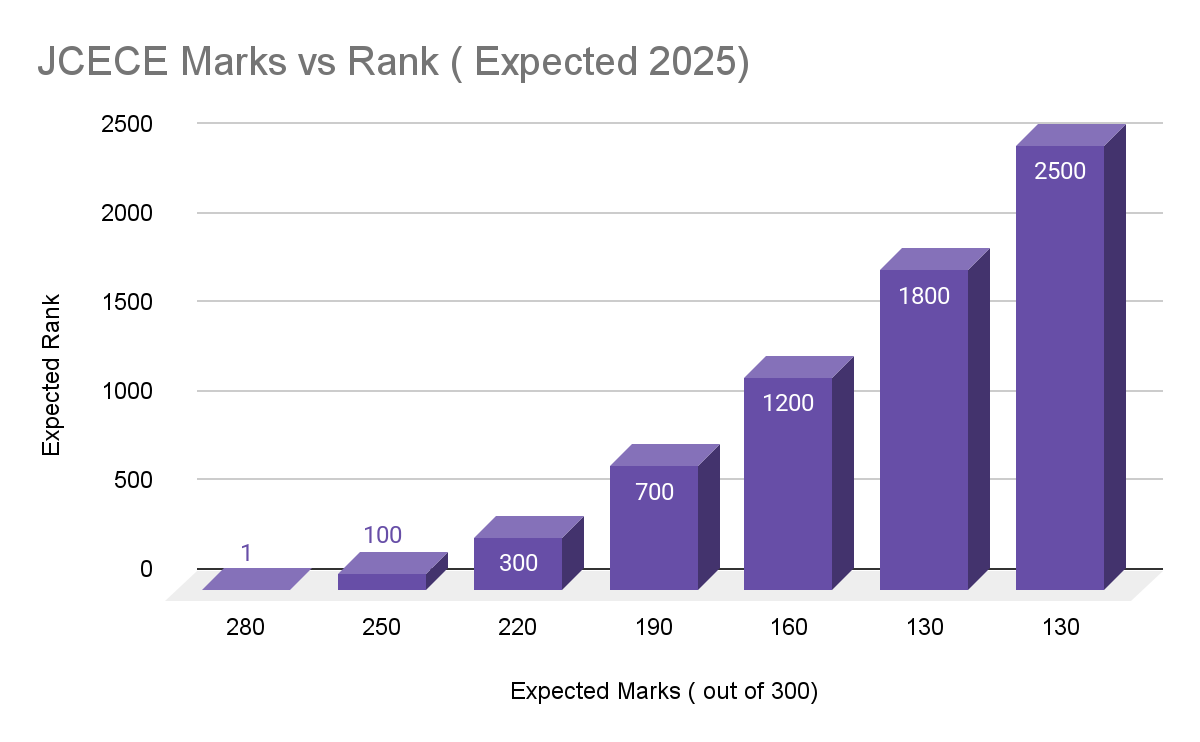
The below table shows the expected JCECE marks vs rank based on past year trends, difficulty level of the paper, and number of candidates appeared for the exam. It will help the candidates in estimating their rank and admission chances based on their score out of JCECE total marks of 300 in JCECE 2025 exam.
- Those with 280-300 marks will probably be among top rankers and can easily secure admission in top courses such as CSE or ECE at BIT Sindri.
- 250-279 marks also provide a high possibility of top B.Tech branches in top government colleges. Those who have 220-249 marks can target core branches such as Civil or Mechanical.
- 190-219 scores fit in mid-level colleges and less competitive departments. A score of 160-189 provides access to less government college preferences, but options might be restricted.
- 130-159 scorers might have to consider private colleges or lower-demand programmes. Scores less than 130 provide very slim possibilities, and such applicants must consider reappearing or alternatives.
| Marks (Out of 300) | Expected Rank Range | Admission Chances |
|---|---|---|
| 280 - 300 | 1 - 100 | Top rankers - Easily eligible for top branches (CSE/ECE) in BIT Sindri and top state colleges |
| 250 - 279 | 101 - 300 | Excellent chance for B.Tech CSE, ECE, EE in top govt. colleges |
| 220 - 249 | 301 - 700 | Good chance for core branches like Civil, Mechanical |
| 190 - 219 | 701 - 1200 | Safe for mid-tier colleges with moderate branches |
| 160 - 189 | 1201 - 1800 | Limited options in lesser-known govt. colleges, backups |
| 130 - 159 | 1801 - 2500 | Backup private colleges or less preferred branches |
| Below 130 | 2500+ | Low chance - Retake or consider alternate options |
JCECE 2025 Expected Cutoff by Course/Stream (General Category)
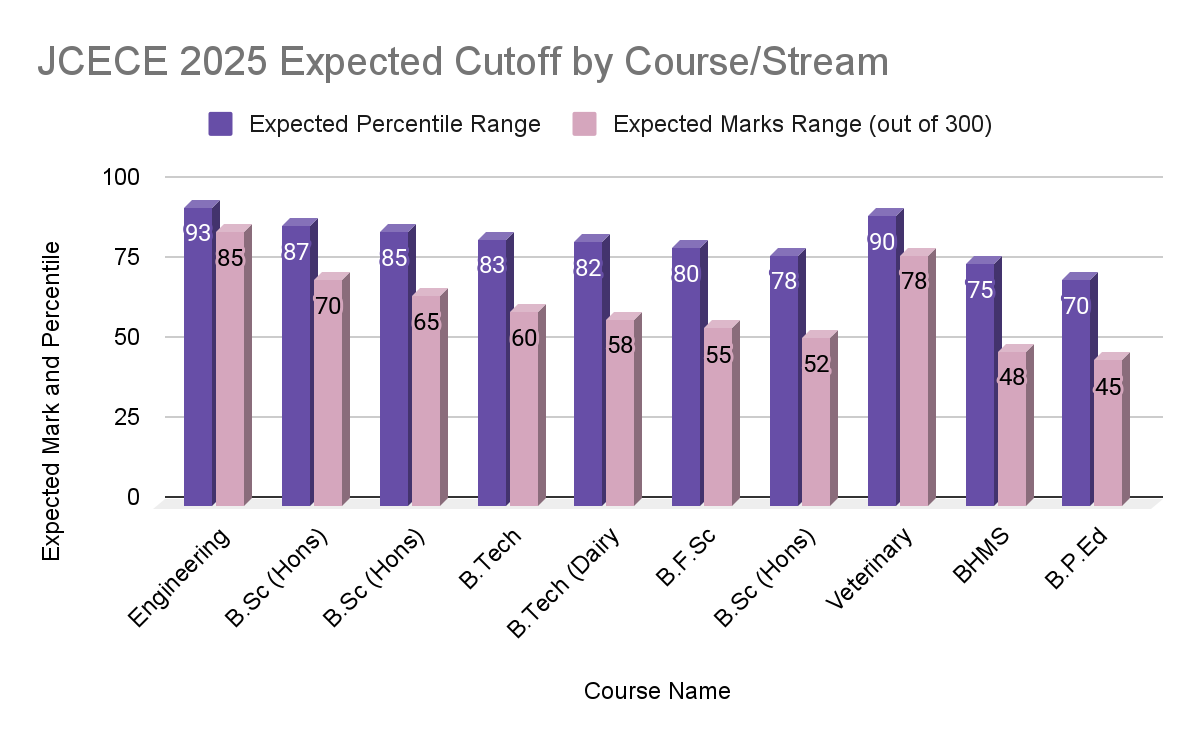
JCECE 2025 exam is a most important exam for candidates looking to gain admission in engineering, medicine, agriculture, and allied disciplines of Jharkhand. JCECE Cutoffs are course-specific and range higher for highly competitive programs like B.Tech and Veterinary Science. Knowing expected cutoffs allows candidates to have precise score goals.
- For Engineering (B.Tech), the expected percentile range is 93-95%, and the estimated cutoff score is 85-90 out of 300. Candidates must target marks of 100+ so that they may get a seat in government engineering colleges.
- For B.Sc (Hons) Agriculture, the expected percentile range is 87-90%, with 70-80 marks as the expected cutoff. It is still a good option among candidates of science stream, and top agriculture colleges in Jharkhand experience steady demand.
- For the case of B.Sc (Hons) Forestry, there is an expected cutoff of 85-88% with marks ranging between 65-75. The demand for this course is medium, and hence it is moderately easy to get into in comparison to agriculture or engineering courses.
- The B.Tech (Agriculture Engineering) stream should see a cutoff of 83-86%, with scores ranging from 60-70 marks. The institute-wise variation is not huge, but as a general rule, this stream is less competitive than pure engineering streams.
- For B.Tech (Dairy Technology), the cut-off is marginally lower, 82-85% percentile with 58-68 marks. It has moderate interest and fewer applications, so it can be a good option for candidates.
- The B.F.Sc (Fisheries Science) stream has a probable percentile of 80-84%, and the candidates require approximately 55-65 marks. While there are a limited number of seats, the demand is moderate, so this course is feasible for average-mark candidates.
- For B.Sc (Hons) Horticulture, the expected cutoff is as in the case of fisheries and agriculture courses, that is, between 78-83% with a score ranging from 52-64 marks. It has moderate popularity, especially among the rural or agri-based candidates.
- Veterinary Science (B.V.Sc & A.H) is one of the most popular non-engineering courses in JCECE. The expected percentile is 90-93%, and 78-85 marks are required.
- The BHMS course has a comparatively lower cut-off, ranging around 75-80% percentile with 48-60 marks.
Finally, B.P.Ed (Bachelor of Physical Education) has the least cutoff, which is between 70-78% percentile and 45-55 marks are expected.
| Stream / Course | Expected Percentile Range | Expected Marks Range (out of 300) | Remarks |
|---|---|---|---|
| Engineering (B.Tech) | 93 - 95% | 85 - 90 marks | Highly competitive, especially for CSE, ECE |
| B.Sc (Hons) Agriculture | 87 - 90% | 70 - 80 marks | Competitive but lower than Engineering |
| B.Sc (Hons) Forestry | 85 - 88% | 65 - 75 marks | Moderate demand |
| B.Tech (Agriculture Engineering) | 83 - 86% | 60 - 70 marks | Varies by institute |
| B.Tech (Dairy Technology) | 82 - 85% | 58 - 68 marks | Slightly lower competition |
| B.F.Sc (Fisheries Science) | 80 - 84% | 55 - 65 marks | Limited seats, moderate interest |
| B.Sc (Hons) Horticulture | 78 - 83% | 52 - 64 marks | Similar to Agriculture cutoff |
| Veterinary Science (B.V.Sc & A.H) | 90 - 93% | 78 - 85 marks | Limited seats; high cutoff |
| BHMS (Homeopathy) | 75 - 80% | 48 - 60 marks | Relatively easier cutoff |
| B.P.Ed (Bachelor of Physical Education) | 70 - 78% | 45 - 55 marks | Lower competition; includes physical test round |
Expected JCECE 2025 BIT Sindri Cutoff for General Category (Round-wise)
The cutoff ranks expected for BIT Sindri 2025 shows growing competition for the top engineering courses in Jharkhand. Cutoffs may differ between rounds, and the highest popular courses. A stream-wise distribution is as follows:
- For Computer Science & Engineering (CSE), the closing rank of Round 1 is likely to be in the range between 400-500, which might increase up to 700 by Round 3. This indicates very high demand, and only candidates ranking high will get admitted in early rounds.
- Cyber Security, one of the CSE specializations, is expected to have a cutoff of 600-800 in Round 1 and can go up to 1,200 in Round 3. It's still a high-demanding, new course, with increasing choice among technologically inclined candidates.
- Information Technology (IT) will close down at approximately 500-650 in Round 1 and up to 1,000 in Round 3, showing its popularity just after core CSE courses.
- Electronics & Communication Engineering (ECE) is likely to close between 550-700 in the first round, and up to 1,000 in Round 3, indicating it is a much favored branch, particularly for electronics and circuit-oriented candidates.
- Electrical Engineering should close in the range of 600-750 in the first round and at about 1,050 in Round 3. It remains one of the core strong branches with steady demand.
- Mechanical Engineering has a higher first-round closing range of 700-900, going up to 1,300 by Round 3. Though popular, its demand is lower now than that of IT and ECE.
- Civil Engineering should close around 850-1,100 in the first round and could go up to 1,500 by subsequent rounds.
- Chemical Engineering will likely close between 950-1,200 in Round 1 and at about 1,600 in Round 3. It's a niche stream with fewer candidates, giving more room for choice rounds.
- Branches such as Metallurgical, Production, and Mining Engineering are likely to close between 1,000-1,300 in Round 1 and go up to 1,700 by the third round. These are typically lower-demand streams, frequently selected as fall-back options by candidates having mid to low ranks.
| Branch | Round 1 (Expected Closing Rank) | Round 2 (Expected Closing Rank) | Round 3 (Expected Closing Rank) |
|---|---|---|---|
| Computer Science & Engineering (CSE) | 400 - 500 | 500 - 600 | 600 - 700 |
| Cyber Security (CSE specialization) | 600 - 800 | 800 - 1,000 | 1,000 - 1,200 |
| Information Technology (IT) | 500 - 650 | 650 - 800 | 800 - 1,000 |
| Electronics & Communication Engineering | 550 - 700 | 700 - 850 | 850 - 1,000 |
| Electrical Engineering | 600 - 750 | 750 - 900 | 900 - 1,050 |
| Mechanical Engineering | 700 - 900 | 900 - 1,100 | 1,100 - 1,300 |
| Civil Engineering | 850 - 1,100 | 1,100 - 1,300 | 1,300 - 1,500 |
| Chemical Engineering | 950 - 1,200 | 1,200 - 1,400 | 1,400 - 1,600 |
| Metallurgical, Production, Mining, etc. | 1,000 - 1,300 | 1,300 - 1,500 | 1,500 - 1,700 |
Also Read: BIT Sindri JCECE Cutoff 2025: Check Previous Year Category-wise Cutoff
JCECE 2025 Expected Cutoff (Category-Wise by Course)
The below table provides the expected JCECE cutoff 2025 marks and percentile for General, OBC, SC,ST and PwD categories candidates for different JCECE 2025 courses including B.Tech, Agriculture & Allied courses, and Veterinary science ( B.V.Sc & A.H).
Engineering ( B.Tech)
| Category | Expected Percentile | Expected Marks (out of 300) |
|---|---|---|
| General | 93 - 95% | 85 - 90 marks |
| OBC-NCL | 91 - 93% | 80 - 85 marks |
| EWS | 91 - 93% | 80 - 85 marks |
| SC | 82 - 86% | 50 - 65 marks |
| ST | 73 - 80% | 50 - 65 marks |
| PwD | 40 - 45% | 40 - 45 marks |
Agriculture & Allied Courses
| Category | Expected Percentile | Expected Marks (out of 300) |
|---|---|---|
| General | 87 - 90% | 70 - 80 marks |
| OBC-NCL | 84 - 87% | 65 - 75 marks |
| EWS | 84 - 87% | 65 - 75 marks |
| SC | 75 - 80% | 50 - 60 marks |
| ST | 70 - 78% | 45 - 58 marks |
| PwD | 40 - 45% | 40 - 45 marks |
Veterinary Sciences (B.V.Sc & A.H)
| Category | Expected Percentile | Expected Marks (out of 300) |
|---|---|---|
| General | 90 - 93% | 78 - 85 marks |
| OBC-NCL | 88 - 91% | 72 - 80 marks |
| EWS | 88 - 91% | 72 - 80 marks |
| SC | 80 - 85% | 60 - 70 marks |
| ST | 75 - 80% | 55 - 65 marks |
| PwD | 45 - 50% | 40 - 48 marks |
JCECE 2025 vs 2024 Cutoff Analysis (Expected vs Previous Year)
The JCECE 2025 vs 2024 Cutoff Analysis shows a general increasing trend in most streams, an indication of increasing competition and increasing interest among candidates.
- In the Engineering (B.Tech) stream, the cutoff increased from 80-85 marks (90-93%) in 2024 to an estimated 85-90 marks (93-95%) in 2025. This is due to the fact that there has been more applicants and awareness of state-level engineering seats.
- Similarly, the B.Sc (Hons) Agriculture cutoff suggests a rise from 65-75 marks (84-88%) to 70-80 marks (87-90%), possibly because of the National Education Policy (NEP), with increased focus again being laid upon agri-education.
- In Veterinary Sciences (B.V.Sc & A.H), there is a sharp rise due to fewer seats and higher demand, and the cutoff rises from 72-80 marks (88-91%) to 78-85 marks (90-93%).
- Allied streams like B.Tech Dairy Technology and Fisheries Science (B.F.Sc) also see mild rises, reflecting steady interest but not as competitive as compared to major branches.
- Forestry and Horticulture are the courses with a small increase in cutoff marks. Forestry increases from 60-70 marks (82-85%) to 65-75 marks (85-88%), whereas Horticulture increases from 50-60 marks (75-80%) to 52-64 marks (78-83%).
- The BHMS (Homeopathy) cutoff has also increased marginally from 45-55 marks (70-75%) to 48-60 marks (75-80%), showing a fresh penchant for alternative medicine courses.
Even B.P.Ed (Bachelor of Physical Education) shows a rise, from 42-50 marks (65-72%) to 45-55 marks (70-78%), possibly due to competitive tie-breakers in the physical round.
| Course / Stream | JCECE 2024 Cutoff (Percentile / Marks) | JCECE 2025 Expected Cutoff (Percentile / Marks) | Trend / Analysis |
|---|---|---|---|
| Engineering (B.Tech) | 90 - 93% / 80 - 85 marks | 93 - 95% / 85 - 90 marks | Slight increase due to more candidates & tighter competition |
| B.Sc (Hons) Agriculture | 84 - 88% / 65 - 75 marks | 87 - 90% / 70 - 80 marks | Moderate increase as agriculture interest grows post-NEP |
| B.V.Sc & A.H (Veterinary) | 88 - 91% / 72 - 80 marks | 90 - 93% / 78 - 85 marks | Higher demand, limited seats causes upward trend |
| B.Tech (Dairy Technology) | 80 - 83% / 55 - 65 marks | 82 - 85% / 58 - 68 marks | Moderate increase, stable demand |
| B.F.Sc (Fisheries Science) | 77 - 82% / 50 - 62 marks | 80 - 84% / 55 - 65 marks | Small increase due to diversification in options |
| B.Sc (Hons) Forestry | 82 - 85% / 60 - 70 marks | 85 - 88% / 65 - 75 marks | Moderate increase |
| B.Sc (Hons) Horticulture | 75 - 80% / 50 - 60 marks | 78 - 83% / 52 - 64 marks | Moderate growth trend |
| BHMS (Homeopathy) | 70 - 75% / 45 - 55 marks | 75 - 80% / 48 - 60 marks | Slight increase in preference |
| B.P.Ed (Physical Education) | 65 - 72% / 42 - 50 marks | 70 - 78% / 45 - 55 marks | Competitive due to physical test tie-breaker |
Also Read: BA College of Engineering and Technology Jamshedpur JCECE Cutoff 2025
JCECE Rank vs JEE Percentile (Expected Mapping 2025)
The JCECE Rank vs JEE Percentile expected for 2025 helps to provide good insights for candidates who want to compare their results in both the exams, particularly those looking at top engineering colleges in Jharkhand. Although JCECE and JEE Main are held at different levels, their scoring trends and selection competitiveness tend to overlap, particularly in the General category.
- Candidates who have scored a JCECE rank between 1-100 usually represent 98.5-99.7 percentile in JEE and those candidates can secure a seat for top courses such as CSE or ECE at BIT Sindri or top NITs.
- Ranks between 101-300 correspond to 96.5-98.5 percentile, which is appropriate for core courses in Tier-1 state colleges.
- 301-700 rank corresponds to the 94-96.5 percentile category, tending to get into mid-level branches in BIT Sindri or best state colleges. 701-1200, corresponding to 90-94 percentile, is quite acceptable for Electrical, Mechanical, or Civil Engineering in top state colleges.
- Candidates who are in the rank range of 1201-2000 (85-90 percentile) could find admission in private colleges or less competitive government seats, although branch selection could be restricted.
- Finally, the candidates who have scored below the rank of 2000, and below the 85 percentile, might not be able to find top government seats which are easy to secure and they could explore alternative options.
| JCECE Rank | Approx. JEE Percentile (General Category) | Level of College Admission |
|---|---|---|
| 1 - 100 | 98.5 - 99.7 percentile | BIT Sindri CSE/ECE, top-tier NITs |
| 101 - 300 | 96.5 - 98.5 percentile | BIT Sindri other core branches, Tier-1 state colleges |
| 301 - 700 | 94 - 96.5 percentile | Mid-range branches in BIT Sindri, top state colleges |
| 701 - 1200 | 90 - 94 percentile | Core branches in state colleges (EE/Mech/Civil) |
| 1201 - 2000 | 85 - 90 percentile | Private colleges in Jharkhand, less competitive govt. seats |
| 2001+ | Below 85 percentile | May struggle with top government seats |
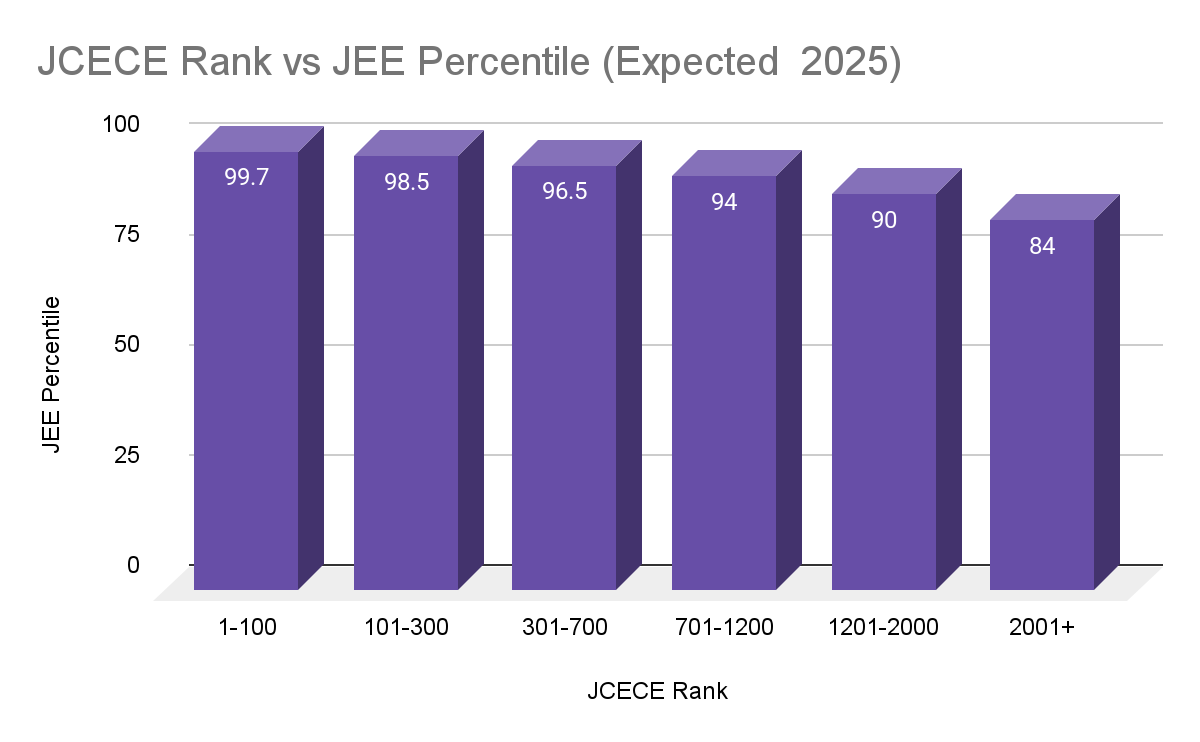
How to Check Your Round‑wise Cutoff?
If the candidates want to verify their round-wise cutoff for JCECE 2025,
- They need to visit the official JCECEB portal (jceceb.jharkhand.gov.in).
- Go to the "Examination" or "Counselling" tab and select the chosen course (e.g., B.Tech or B.V.Sc).
- Search for links labeled "Round 1 Cutoff," "Round 2 Cutoff," etc.
- Download the PDF and see category-wise and branch-wise closing ranks for each round.
- Compare your rank or marks with cutoffs mentioned to find out your chances.
Ensure to verify updates after every round, since cutoffs vary with seat availability, choice of candidates, and application withdrawal. Keep yourself updated to make your counselling decisions wisely.
Factors Affecting JCECE 2025 Cutoff
Below mentioned are some important factors that affect the JCECE 2025 Expected Cutoff of top universities and courses:
- Number of Candidates: If more candidates are appearing for JCECE, then there will be intense competition. If there will be a small change in candidates performance can increase the cut off as more number of candidates will have the same score.
- Difficulty Level of the Exam: The cutoffs decrease slightly if the JCECE 2025 paper is difficult as candidates will score less in the exam.
- Total Seats Available: The seats which are available in the top chosen universities is the deciding factor on cutoff scores. Suppose 100 candidates are applying for a college with 25 seats then it is obvious there will be an increase in cut off for that college.
- Previous Year Cutoff Trends: The main factor for affecting JCECE 2025 cutoff is that the top universities might determine the current cutoff based on data of JCECE 2024.
FAQS
Ques. What is the cutoff of bit sindri?
Ans. The cutoff is branch-specific; for CSE, typically 1-500 of JCECE ranks. JoSAA rounds are also acceptable with JEE Main cutoffs.
Ques. What is the cutoff of Jharkhand Polytechnic?
Ans. The cutoff is 80-100 marks for top government colleges. It keeps changing every year based on availability and difficulty level of the exam.
Ques. Who is eligible for JCECE?
Ans. The candidates are required to be residents of Jharkhand, pass Class 12 with PCM/PCB, and have required age and subject criteria which must be relevant to the course.
Ques. Does Bit Sindri accept JEE Mains?
Ans. Yes, BIT Sindri accepts JEE Main scores via JoSAA/CSAB counselling for B.Tech admissions in addition to JCECE for state quota seats.
Related Links:
Results
JCECE Result 2023: JCECEB, Ranchi will the answer key for JCECE 2023 Agriculture and Allied courses tentatively in June 2023, after the completion of exam. Candidates who took the test can visit the official website to download JCECE 2023 answer key or click the direct link given below. JCECEB 2023 Result will be announced very soon after the evaluation of answer sheets. The board will prepare the combined and category-wise merit list on the basis of marks secured by the candidate. To check the result, candidates have to select the course for which they are forward to check the result. After that, candidates have to enter their JCECE 2023 Roll number and then click on “Search”.
- The result will be declared in the form of Common Merit List (CML) along with the list of qualified candidates.
- Candidates will be called for the interview on the basis of results.
Rechecking of OMR Response Sheet
- There is NO provision of re-checking of the OMR Response Sheet if demanded by the candidate.
- No communication regarding rechecking of the answer book will be entertained by the board.
| Table of Contents |
JCECE 2023 Result Highlights
| JCECE Result Date | July 2023 (tentative) |
| Website | jceceb.jharkhand.gov.in |
| Result Declaration Body | JCECE Board |
| Revaluation of Answer Sheets | Not Permitted |
| JCECE Counselling begins from | July 2023 (tentative) |
JCECE 2023 Answer Key
JCECE 2023 Answer Key will be released for Agriculture and Allied courses tentatively by the end of June 2023. Candidates can download the answer key from jceceb.jharkhand.gov.in. Click on the below link to download the answer key:
| Direct Link for JCECE 2023 Answer Key – Soon |
How to check JCECE 2023 Result?
Candidates can check the steps given below to download the JCECE 2023 result.
- Visit the official website i.e. jceceb.jharkhand.gov.in
- After click on the link, you will be redirected to result page on board website.
- Go to the ‘Result Column’ and select your exam.
- Enter the roll number and click on ‘Search’ button.

- The result will display on your computer screen.
- Download your result and click on the print button.
- Keep extra printouts of result for further process.
The result will also be available in pdf format under “Downloads” column at the website, where state rank, roll number, name, category, scores and remarks of the candidate would be provided. Press Ctrl+F and put your roll number to check JCECE Result.
Contact Details

JCECE 2023 Merit List
JCECEB will release 2 merit lists: category-wise merit list and combined merit list, for the admission process. Based on marks obtained and merit secured in JCECE, candidates will be called for counselling for the allotment of seats.
Inter-se-merit or Tie Breaker
There are often cases where two or more than candidates have secured the same score. In such a situation the JCECE Board determines a sequence of preference for Inter-se-merit of such candidates which are mentioned below. Inter-se merit for the courses offered by JCECE board are mentioned below:

JCECE Counselling 2023
- The counselling will be conducted through online mode by the JCECE Board.
- Candidates will be called for the counselling based on their merit rank.
- The information related to the vacant seats in various participating institutions course-wise will be displayed on the official website after the declaration of result.
- Candidates also have to pay the interview fee according to their category. The fee can be paid through Bank Challan which can be downloaded from the official website.
- JCECE 2023 interview procedure will be conducted on given below address:
Science & Technology Campus, Sirkha Toli,
Namkum-Tupudana Road Namkum,
Ranchi (Jharkhand)–834010