
Kerala Engineering Agricultural Medical Entrance Examination
Imported from Collegedunia.
Overview
The KEAM registration 2026 has started on January 5, 2026 and will be available till 31st January, 2026. The official KEAM 2026 notification on KEAM Exam dates is expected to be announced probably in February 2026.
- The last date to upload Class X Certificate, Date of Birth and Nativity Proof is 06-02-2026, 05:00 PM
- The last date to upload other required certificates / documents is 07-02-2026, 05:00 PM
- The KEAM 2026 exam is expected to be in April 2026
The test is conducted by the CEE ( Commissioner for Entrance Examinations) for admission to B.Tech and B.Pharm courses, Department of Higher Education, Govt. of Kerala, through a single window system. Candidates with valid NATA JEE scores are eligible for admission in Architecture and Medical programs under the centralised allotment system managed by CEE.
More than 165 colleges in Kerala, whether government, government-controlled, or private institutions with self-financing programs, take KEAM scores for admission into engineering and pharmacy courses. Each year, almost 80,000 to 1.2 lakh candidates register for KEAM for admission purposes in engineering, pharmacy, architecture, and allied professional courses in Kerala. Candidates must check the official KEAM website for the latest notifications.
Related Links:

- What is the KEAM Exam?
- KEAM 2026 Exam Dates (Tentative)
- KEAM Reappearance Trends (2025–2020)
- KEAM 2026 Registration Fees
- KEAM Eligibility Criteria 2026
- KEAM Exam Pattern 2026
6.1 KEAM 2026 Marking Scheme Overview
- KEAM Previous Year Questions
- What is KEAM Syllabus 2026?
- KEAM Mock Test 2026
- KEAM 2025 cutoff CSE (Expected)
10.1 KEAM 2025 cutoff ECE (Expected)
- KEAM Exam 2026 Overview FAQs
Key Summary
- This KEAM is an entrance examination for undergrad courses in engineering, architecture, and pharmacy in Kerala.
- The Commissioner for Entrance Examinations (CEE), Kerala, conducts this annually.
- KEAM 2026 would be conducted in the last week of April with the opening of applications in February and with the last date coming by early March.
- The exam is done on a computer for engineering and pharmacy, covering Physics, Chemistry and Mathematics, while architecture admissions rely on NATA.
- Every year, over 35,000 seats belonging to government and private colleges in Kerala are filled up via KEAM.
What is the KEAM Exam?
- KEAM is an examination conducted by the Commissioner for Entrance Examinations (CEE), Kerala, at the state level, for undergraduate professional degree programs.
- These include courses for engineering, architecture, pharmacy, and medical- MBBS/ BDS.
- The exam gives admission to various government and private colleges across the state of Kerala.
KEAM Exam 2026 Highlights
| Particulars | Details |
|---|---|
| Full Form | Kerala Engineering, Architecture, and Medical (KEAM) |
| Conducting Body | Commissioner for Entrance Examinations (CEE), Kerala |
| Exam Level | State-level |
| Courses Covered | MBBS, BDS, Ayurveda, Homoeopathy, Siddha, Unani, Veterinary Science |
| Application Dates | 3rd week of February – 2nd week of March 2026 (Tentative) |
| Exam Date | 4th week of April 2026 (Tentative) |
| Admit Card Release | 2nd week of April 2026 (Tentative) |
| Result Declaration | 2nd week of May 2026 (Tentative) |
| Engineering Rank List | June 2026 (Tentative) |
| Counseling Start | June 2026 (Tentative) |
| Mode | Computer-Based Test (CBT) |
| Subjects | Physics, Chemistry, Biology |
| Duration | 90 minutes per paper |
| Eligibility | Passed HSC with PCB, minimum 50% aggregate, and age ≥17 years by 31 Dec 2026 |
KEAM 2026 Exam Dates (Tentative)
The official schedule for KEAM 2026 is not available yet. Tentative dates are given for reference:
| Expected Date | Event |
|---|---|
| January 5th, 2026 | Application Start |
| February 6th, 2026 | Application Deadline |
| 7th February, 2026 | Document Submission Deadline |
| Early April 2026 | Correction Window |
| Mid-April 2026 | Admit Card Release |
| Fourth Week of April 2026 | Exam Date |
| Late April – Early May 2026 | Answer Key Release |
| Second Week of May 2026 | Results Announcement |
| Second Week of June 2026 | Rank List Release |
| June – July 2026 | Counselling Begins |
Ques. When should I apply for KEAM 2026?
Ans. Registration for KEAM 2026 has started on 5th january 2026. Candidates can submit their registration before the tentative deadline of 31st january 2026.
Ques. Is KEAM tougher than JEE?
Ans. JEE is considered challenging as it tests not only conceptual understanding but also critical thinking abilities, whereas KEAM holds more of the formula-based questions with speed and accuracy. An instantly recognised competition of India's toughest exams is JEE Advanced, where the applicant demands the ability to solve problems and to deal effectively with stress.
Ques. How Many Candidates Have Registered for KEAM? (2025–2023)
Ans. The KEAM registration data shows a variation in the number of candidates over the years.
- In 2023, around 1,78,000 students registered, which dropped by approximately 36% to 1,13,447 in 2024.
- For 2025, the total registrations go again to 1,43,866, marking an increase of about 27% compared to the previous year.
| Year | Registered Candidates |
|---|---|
| 2025 | 97,759 (Engineering) + 46,107 (Pharmacy) = 1,43,866 |
| 2024 | 1,13,447 |
| 2023 | 1,78,000 |
Ques. How many students will write KEAM 2025?
Ans. The KEAM 2025 exam was attended by 86,549 candidates in the Engineering test out of which 76,230 qualified, while the final rank list for engineering had 67,505 candidates with submitted Plus Two marks. For the Pharmacy examination, 33,304 candidates came from Kerala, with 111 being outside the State.
Statistics of KEAM 2025 Engineering Examination
- Total Candidates Appeared: 86,549
- Candidate Qualified: 76,230
- Candidates in Rank List: 67,505
Statistics of KEAM 2025 Pharmacy Examination
- Candidates from Kerala: 33,304
- Candidates Outside Kerala: 111
Ques. Is 20,000 a good rank in KEAM?
Ans. A rank of 20,000 in KEAM is average. Such a rank may give you admission in numerous colleges and courses which are popular in general, outside the top government institutes, depending upon your stream or category. As this is not considered a very good rank, there are still good options available, especially private colleges and certain branches of engineering.
Read More:
KEAM Reappearance Trends (2025–2020)
| Year | Total Applicants | Engineering Appearances | Engineering Qualified (Rank List) | Pharmacy Appearances | Pharmacy Qualified (Rank List) | Approx. Qualification Rate (Engg.) | Key Trends / Notes |
|---|---|---|---|---|---|---|---|
| 2020 | 79,200 (combined) | 71,742 | 56,599 | 50,000 (est.) | 44,390 | 79% | COVID reduced appearances; high qualification rate; repeaters low (~15%). |
| 2021 | 1,05,000 (combined) | 73,977 | 47,629 | 60,889 | 48,556 | 64% | Post-COVID recovery; tougher paper; reattempts increased (~20%); 51% female qualifiers. |
| 2022 | 1,02,066 | 77,005 | 50,858 | 25,000 (est.) | 35,000 (est.) | 66% | Peak appearances; difficult math section; repeaters (~22%); female participation 48%. |
| 2023 | ~95,000 (est.) | 80,999 | 49,671 | 30,000 (est.) | 28,000 (est.) | 61% | Continued growth; 19% of top 100 were repeaters; Ernakulam led top ranks. |
| 2024 | 1,10,000+ | 79,044 | 52,500 | ~35,000 (est.) | ~30,000 (est.) | 66% | CBT shift; easier paper increased qualifiers; 25% top ranks were repeaters; normalization affected ~5%. |
| 2025 | ~1,30,000 | 86,549 | 76,230 | 33,425 | 27,841 | 88% | Record appearances; 50:50 normalization; ~20% repeaters; pharmacy female dominance (65%). |
Ques. How many students appeared for KEAM engineering 2025?
Ans. In KEAM 2025, 86,549 students appeared for the engineering entrance exam. Out of these, 76,230 qualified, and the rank list was prepared for 67,505 candidates who submitted their Plus Two marks on time.
Key Figures:
- Total Applicants: 86,549
- Qualified Candidates: 76,230
- Candidates in Rank List: 67,505
Ques. How is the KEAM rank calculated in 2025?
Ans. The rank list for KEAM 2025 will be prepared with weighting factors of 50:50 between normalised scores of the entrance examination and the marks scored in Physics, Chemistry, and Mathematics in the 12th class Board Examination. After normalisation, entrance examination scores are combined with board marks to generate the final rank list.
KEAM 2026 Registration Fees
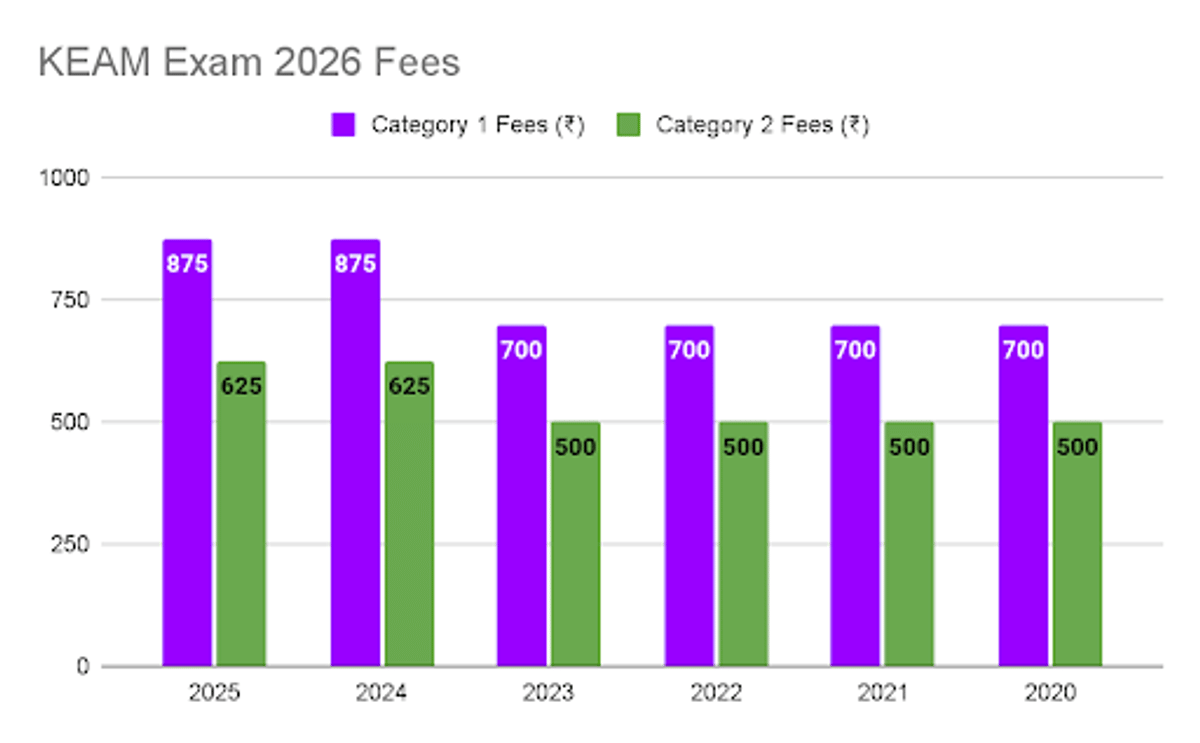
- For the period from 2020 to 2025, the gradual increase observed for the KEAM application fees ranged from ₹700 for general candidates to ₹875.
- An increase was also observed in the fees for Architecture, Medical, and allied courses. Simultaneous application in both groups is costly, with a maximum fees of ₹1,300 in 2025 for candidates taking all the streams.
| Year | Category 1 Fees (₹) | Category 2 Fees (₹) |
|---|---|---|
| 2025 | 875 / 375 / Nil | 625 / 250 / Nil |
| 2024 | 875 / 375 / Nil | 625 / 250 / Nil |
| 2023 | 700 / 300 / Nil | 500 / 200 / Nil |
| 2022 | 700 / 300 / Nil | 500 / 200 / Nil |
| 2021 | 700 / 300 / Nil | 500 / 200 / Nil |
| 2020 | 700 / 300 / Nil | 500 / 200 / Nil |
Source: KEAM Official PDF
Ques. What is the registration fee for KEAM?
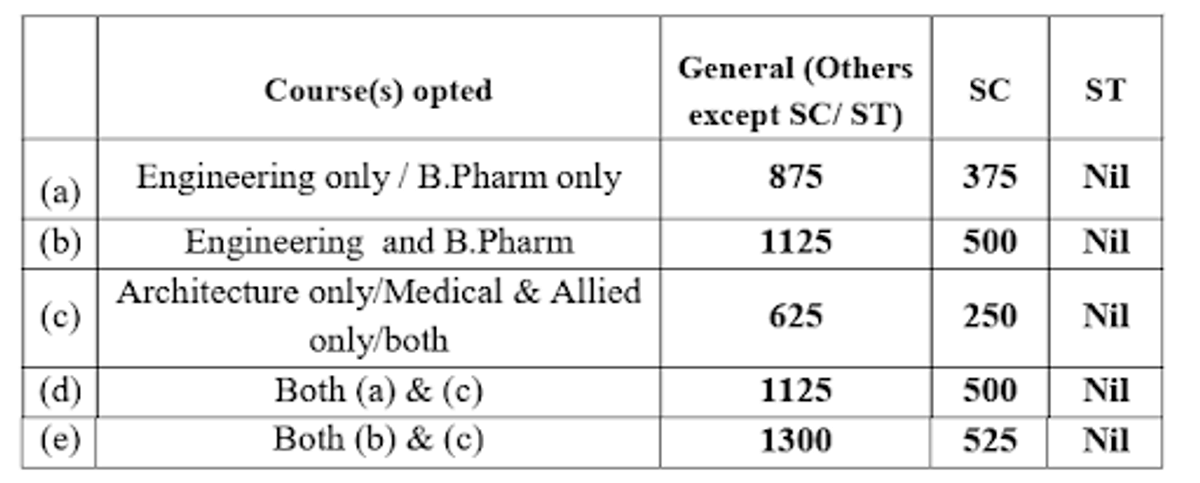
Ans. For KEAM 2026, candidates applying for General are required to pay ₹875 and for an SC candidate application fee is ₹375 for Engineering/B.Pharm or both. Candidates would have to pay ₹625 for General and ₹250 for SC if applying for medicine, allied courses, or architecture. Applicants applying to both streams (Engineering/B.Pharm and Medicine/Architecture) shall pay a fee of ₹1,125 for General and ₹500 for SC.
Ques. Is the KEAM option registration fee refundable?
Ans. For KEAM option registration fees, a refund can be processed only in the absence of an allotment. If an allotment is allotted and the applicant does not take admission, the fee shall be non-refundable as a penalty. Candidates eligible for a refund shall provide their bank account details for refund processing through the KEAM Candidate Portal hosted on the Kerala government website.
KEAM Eligibility Criteria 2026
- For KEAM 2026, candidates must have passed Class 12 or an equivalent examination with at least 45% marks.
- Physics and Mathematics are mandatory, and Chemistry is required for engineering courses.
- Indian citizens, whether from Kerala or other states, are eligible to apply. Candidates must be at least 17 years old by December 31 of the admission year, with no upper age limit.
These are the eligibility criteria for the various courses for your reference.
| Course Category | Specific Courses | Eligibility Criteria |
|---|---|---|
| Engineering | All BTech courses, including Agri. Engg., Food Technology, Dairy Technology (KAU, KVASU, KUFOS) | Passed 10+2 with Physics & Mathematics; Chemistry optional. Minimum 45% aggregate in these subjects. |
| Pharmacy | BPharm | Passed 10+2 with English, Physics, Chemistry, Mathematics/Biology optional. |
| Architecture | BArch | Passed 10+2 with Physics, Chemistry & Mathematics, ≥50% aggregate, or 10+3 Diploma with Mathematics, ≥50% aggregate. |
| Medical & Allied | MBBS, BDS | Passed 10+2 with Physics, Chemistry, Biology/Biotech & English; ≥50% in PCB combined. |
Ques. Who is eligible for KEAM 2026?
Ans. In the case of the KEAM 2026, candidates must be 17 years of age on or before December 31 of the admission year and must have passed Class 12 with at least 45% marks in Physics and Mathematics (Chemistry is considered the optional subject for engineering). Applicants could be Keralite or non-Keralite Indian citizens with no upper age limit.
Ques. How many attempts for KEAM?
Ans. There is no limit on the number of attempts in KEAM. Candidates appearing for the examination a maximum of times, they satisfy the basic eligibility criteria of having attained a minimum of 17 years of age and passing the 10+2 examinations.
KEAM Exam 2026 Reservation Policy
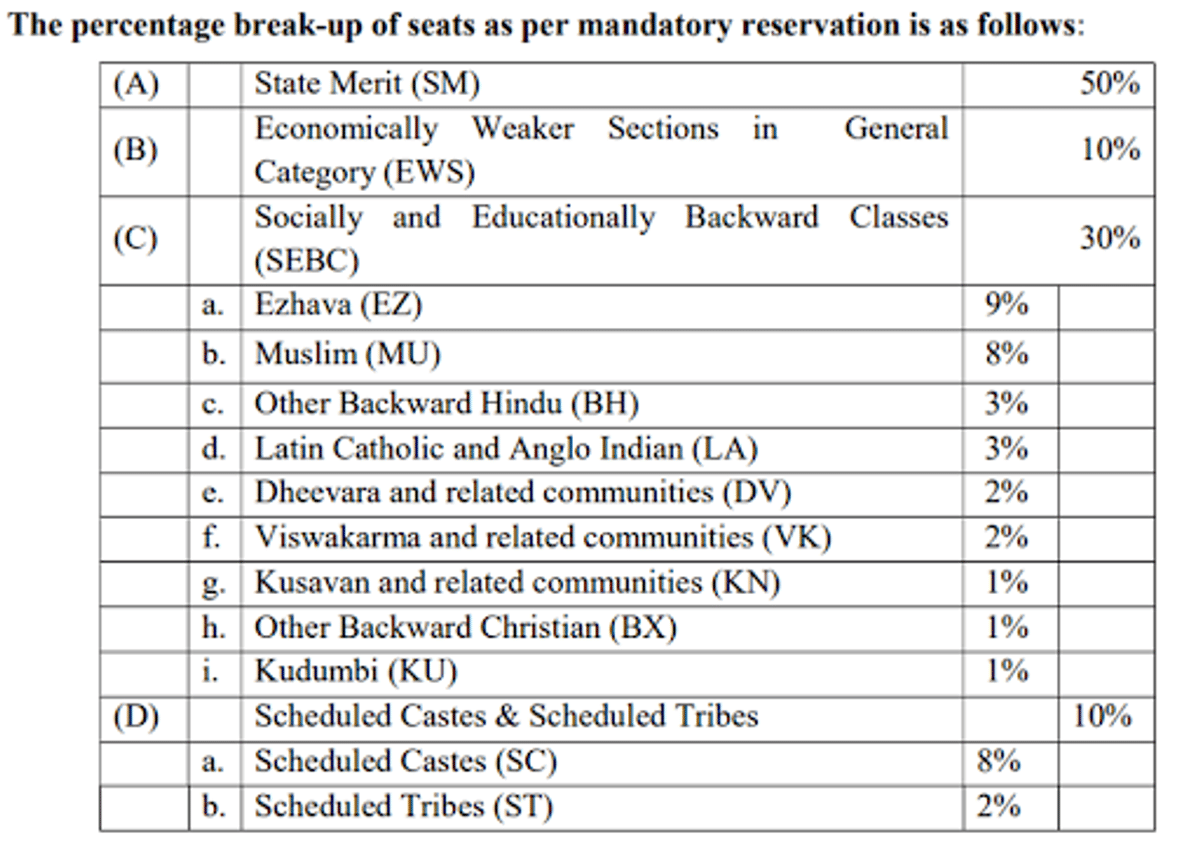
| Category | Reservation % |
|---|---|
| State Merit | 50% |
| Economically Weaker Sections (EWS) in the General Category | 10% |
| Socially and Educationally Backward Classes (SEBC) | 30% |
| Scheduled Castes (SC) | 8% |
| Scheduled Tribes (ST) | 2% |
Source: KEAM Official PDF
Ques. Is there a reservation in KEAM?
Ans. Yes. There are reservations in the KEAM (Kerala Engineering, Architecture, and Medical) entrance examination as are given for Socially and Educationally Backward Classes (SEBC), Scheduled Castes (SC), Scheduled Tribes (ST), Economically Weaker Sections (EWS), and minority community quotas. Candidates who claim the said reservations have to attach the original supporting document, like a Community Certificate, while applying online.
Ques. How many government seats are there in KEAM?
Ans. The total government seats in KEAM change every year, depending on courses and the seat matrix published by the Kerala Commissioner for Entrance Examinations (CEE). For exact numbers, candidates should check the official 2025 seat matrix of KEAM or the latest CEE release for the current academic year.
KEAM Exam Pattern 2026
| Particulars | Details |
|---|---|
| Exam Subjects | Physics, Chemistry, Mathematics |
| Exam Duration | Engineering: 180 minutes, Pharmacy: 90 minutes |
| Question Type | Multiple Choice Questions (MCQs) |
| Total Questions | Engineering: 150 questions (Physics: 45, Chemistry: 30, Mathematics: 75)Pharmacy: 75 questions (Physics: 45, Chemistry: 30) |
| Marking Scheme | +4 marks for correct answer-1 mark for incorrect answer |
| Total Marks | Engineering: 600 marks, Pharmacy: 400 marks |
KEAM 2026 Marking Scheme Overview
| Criteria | Details |
|---|---|
| Correct Answer | +4 marks for each correct response |
| Incorrect Answer | -1 mark for each wrong response |
| Unanswered Question | 0 marks (no penalty) |
| Total Marks | Engineering: 600 marks,Pharmacy: 400 marks |
Check: KEAM Exam Pattern
Ques. How is KEAM mark calculated?
Ans. The KEAM ranking system follows a 50:50 weightage method, where equal importance is given to the normalised scores of the KEAM entrance exam and the normalised marks obtained in the Plus Two (Class 12) subjects, Physics, Chemistry, and Mathematics. The total index score is calculated out of 600 marks, with 300 marks from the entrance test and 300 marks from the qualifying examination. Scores are standardised and rounded to four decimal places to ensure fairness and precision in the final ranking process.
KEAM Previous Year Questions
| Question Paper | Download PDF | Solution PDF |
|---|---|---|
| KEAM 2025 Question Paper (April 29) | Download Pdf | Check Solutions |
| KEAM 2025 Question Paper (April 28) | Download Pdf | Check Solutions |
| KEAM 2025 Question Paper (April 27) | Download Pdf | Check Solutions |
| KEAM 2025 Question Paper (April 26) | Download Pdf | Check Solutions |
| KEAM 2025 Question Paper (April 25) | Download Pdf | Check Solutions |
| KEAM 2025 Question Paper (April 24 Session 2) | Download Pdf | Check Solutions |
| KEAM 2025 Question Paper (April 24 Session 1) | Download Pdf | Check Solution |
| KEAM 2025 Question Paper (April 23) | Download Pdf | Check Solution |
What is KEAM Syllabus 2026?
The KEAM Syllabus 2026 has not yet been officially released by the Commissioner for Entrance Examinations (CEE) Kerala on their official website.
- Once the KEAM Syllabus 2026 is released, you can download the KEAM 2026 syllabus PDF at https://cee.kerala.gov.in/cee/.
- The KEAM syllabus 2026 includes topics from three subjects: mathematics. physics and chemistry.
| KEAM Physics Syllabus | Check Here |
|---|---|
| KEAM Chemistry Syllabus | Check Here |
| KEAM Mathematics Syllabus | Check Here |
Check: KEAM Syllabus: Check and Download KEAM Syllabus for Mathematics, Physics and Chemistry
Ques. What is the pattern of the KEAM exam 2026?
Ans. As per the probable pattern, the KEAM 2026 exam will feature a single computer-based test with questions classified as multiple-choice. The engineering paper will include 150 MCQs, 75 in Mathematics, 45 in Physics, and 30 in Chemistry, and will be completed in 180 minutes. Candidates will get 4 marks for every correct answer, 1 mark before being deducted for every wrong one, and none if left unanswered.
| Details | PDF Download |
|---|---|
| KEAM Syllabus 2024 | Download KEAM 2024 Syllabus PDF |
| Old syllabus not be followed from 2024 onwards | Download OLD KEAM Syllabus PDF |
KEAM Mock Test 2026
Check: KEAM Preparation Tips
Ques. Is 400-600 a good score in KEAM?
Ans. Typically, a score between 400 and 600 is said to be good, with candidates generally ranked between 20,000 and 5,000. Depending on the branch and category, such scores may admit students to fine government and private engineering colleges. A score above 450, out of 600, would be good, while one above 550 would be excellent with ranks within 1,000 to 5,000.
Ques. KEAM Cutoff 2026 (Expected)
Ans. The KEAM 2026 cutoff is yet to be unveiled. The cutoffs will be announced post the seat allotment rounds by the Commissioner for Entrance Examinations (CEE) Kerala. However, candidates can get a rough idea regarding its expected cutoff by analysing the trends of previous years.
KEAM 2025 cutoff CSE (Expected)
| College | General | EWS | OBC (SEBC) | SC | ST |
|---|---|---|---|---|---|
| College of Engineering, Thiruvananthapuram (CET) | ≤ 300 | ≤ 450 | ≤ 600 | ≤ 2,500 | ≤ 5,000 |
| Government Engineering College, Thrissur | ≤ 550 | ≤ 750 | ≤ 950 | ≤ 3,000 | ≤ 5,500 |
| Govt. Model Engineering College, Kochi (MEC) | ≤ 1,000 | ≤ 1,200 | ≤ 1,500 | ≤ 3,200 | ≤ 5,800 |
| TKM College of Engineering, Kollam | ≤ 1,100 | ≤ 1,300 | ≤ 1,600 | ≤ 3,500 | ≤ 6,000 |
KEAM 2025 cutoff ECE (Expected)
| College | General | EWS | OBC (SEBC) | SC | ST |
|---|---|---|---|---|---|
| CET, Thiruvananthapuram | ≤ 800 | ≤ 1,100 | ≤ 1,400 | ≤ 3,500 | ≤ 6,000 |
| GEC Thrissur | ≤ 1,200 | ≤ 1,500 | ≤ 1,900 | ≤ 4,000 | ≤ 6,500 |
| TKM College of Engineering | ≤ 2,000 | ≤ 2,400 | ≤ 2,800 | ≤ 4,500 | ≤ 7,000 |
| MEC, Kochi | ≤ 1,500 | ≤ 1,800 | ≤ 2,000 | ≤ 4,000 | ≤ 6,500 |
Check: KEAM Cutoff
Ques. How many students qualified for KEAM 2025?
Ans. From the 86,549 students who appeared for KEAM 2025, 76,230 students qualified, and 67,505 were included in the final engineering rank list.
KEAM Exam 2026 Overview FAQs
Ques. What is the normalised score in KEAM?
Ans. Normalisation of scores in KEAM refers to the process of scaling scores obtained in the entrance examination and accounting for differences in difficulty across various days/ shifts so that candidates' scores are comparable and thus are ranked fairly. This score is then merged with the qualifying examination marks to prepare the final rank list.
Ques. How many times is KEAM conducted in a year?
Ans.KEAM is an annual entrance examination held by the Commissioner of Entrance Examinations, Kerala, for admission into professional courses, including Engineering and Pharmacy. The examination is generally held in April, and the dates are given every year. This is an examination held once a year for eligible candidates.
Ques. Was KEAM 2025 tough?
Ans.The exam had varying difficulty levels. Forthe Engineering paper, it was easier to moderate, especially if the candidate had gone through the NCERT syllabus, whereas many found Mathematics to be a bit difficult. The Pharmacy test was generally perceived by candidates to be easier, as per reports in April 2025.
Ques. How to crack KEAM easily?
- The most important thing is to have a keen knowledge of the KEAM syllabus and exam pattern.
- Prepare a timetable and go about it by heart.
- Manage time well for answering the questions and be accurate.
- Refer to the study materials and books
- Create notes for yourself.
- Revise the subject matter frequently.
Ques. How many attempts for KEAM?
Ans.Candidates can take the KEAM (Kerala Engineering Architecture Medical Entrance) exam an unlimited number of times. Candidates are free to take the exam as many times as they desire, subject to certain simple rules such as being 17 years old or more and having passed the 10+2 examinations.
Ques. How many marks are required to clear the KEAM?
Ans. To qualify for the KEAM Rank List and be eligible for admission, candidates must obtain a minimum of 10 marks in each of Paper 1 and Paper 2 of the engineering entrance examination, which is also applicable to engineering and medical entrance examinations.
Ques. How much rank is required for B Pharmacy in KEAM?
Ans. The rank for KEAM B Pharm varies from college to college, so much. So that a top government college like Government Medical College, Kozhikode, would expect ranks below 2,500 from General Category candidates, while the private colleges might go for something in excess of 8,000 ranks. The final cutoff rank depends on the particular institution, the number of seats available, and the category (General, OBC, etc.).
Ques. Is NCERT enough for KEAM?
Ans.No, NCERT alone is generally not enough. While it serves as an important foundation that covers basic concepts, candidates should go an extra mile and prepare from state board textbooks, previous year question papers of KEAM, KEAM sample papers, and mock tests to understand the design of the question and work on speed and accuracy.
Ques. Which all courses come under KEAM?
Ans. There are a number of courses that fall under KEAM, not just Engineering and Pharmacy. The other courses are in the fields of Medical and Medical Allied, namely all B.Tech courses, B.Pharm, MBBS, BDS, BAMS, BUMS, BSMS, BHMS, and B.Sc. Nursing. The examinations provide access to professional courses at the undergraduate level and some postgraduate programs in these disciplines in Kerala.
Ques. Are KEAM Fees refundable?
Ans. KEAM fees can be refunded based on your situation, particularly if you do not get allotment or if the rules of the college provide for a refund after cancellation. Generally, you should fill out an online application for a refund through the Candidate Portal of CEE Kerala, giving your bank details for the credit of the refund.
Eligibility
KEAM 2025 Eligibility Criteria is decided by CEE, Kerala for candidates seeking admission to Engineering and Pharmacy programs in the state. As per KEAM Exam Pattern, the minimum academic qualification required to appear for KEAM 2025 is passing or appearing in Class XII or Higher Secondary examination with minimum 50% marks. Candidates are required to appear for both the papers i.e. Paper 1 (Physics and Chemistry) and Paper 2 (Mathematics). KEAM 2025 eligibility certificates and documents can be uploaded up to 15.03.2025, 5.00 PM.
- The KEAM 2025 exam has been scheduled from April 24, 2025 to April 28, 2025 in a single shift on all the days. Check KEAM 2025 Exam Dates
- Only Indian citizens are eligible for admission to professional courses. OCI/PIO cardholders are treated as Indian citizens for admission but do not qualify for reservations.
- Candidates are categorized into Keralite, Non-Keralite Category I (NK I), and Non-Keralite Category II (NK II) based on their nativity.
- Keralite candidates, including children of All India Service (AIS) officers in Kerala cadre, are eligible for reservations and fee concessions.
Candidate should complete 17 years of age on December 31, 2025 and must have passed HSC exam of Kerala or its equivalent with 50% marks in Mathematics or Biology. Additionally, candidates from the socially backward category will have 5% relaxation. For more details, read the official PDF: KEAM Online 2025 Notification.
KEAM Eligibility Criteria Highlight
KEAM 2025 Eligibility Criteria Highlights
Category-wise Eligibility
- Keralite: Candidates must provide proof of Kerala origin through valid documents like SSLC certificate, passport, or birth certificate.
- Non-Keralite Category I (NK I): Candidates who studied in Kerala and are children of Central/State government employees posted in Kerala are included in this category.
- Non-Keralite Category II (NK II): Candidates who do not fall into the above categories can apply for Government/Management quota seats in Engineering, Architecture, Siddha, and Unani courses in private institutions but are not eligible for Government medical seats.
Academic Qualification
- MBBS/BDS: Minimum 50% in Physics, Chemistry, and Biology/Biotechnology at the Higher Secondary level.
- BAMS/BHMS: Minimum 50% in Physics, Chemistry, and Biology. BHMS does not accept Biology/Biotechnology as an additional subject.
- BSMS: Minimum 50% in Physics, Chemistry, and Biology, with Tamil as a language at the 10th or 12th level or studied during the first year.
KEAM Exam Dates 2025
| Particulars | Dates |
|---|---|
| KEAM 2025 Application Form Start Date | 20 February 2025 |
| KEAM 2025 Application Form Last Date | 10 March 2025 |
| KEAM 2025 Admit Card Date | March 2025 |
| KEAM 2025 Exam Date | April 24, 2025 – April 28, 2025 |
KEAM 2025 Detailed Eligibility Criteria
KEAM is a single-tier entrance exam conducted in Kerala for admission to Architecture, Engineering, and Medical courses. The candidates can also seek admission to allied courses like B.Sc. (Hons.), Veterinary and Fishery. Candidates must fill KEAM Application form or required entrance form according to the course they choose to apply for.
Applicants should have completed 17 years of age as on December 31, 2025. There is no relaxation for minimum age and there is no upper limit for the exam.
Qualification for Medical/Allied Courses
The academic qualification needed for engineering and medical/allied courses are different. The minimum academic qualification required for admission to any course is passing class XII or higher secondary examination with science subjects. Candidates appearing for the exam can also apply for KEAM 2025. The academic qualifications needed for several medical/allied courses will be different.
MBBS, BDS, BSMS
- Candidates have to pass higher secondary examination of “Board of Higher secondary education, Kerala” with 50% marks in Biology/Biotechnology, Physics and Chemistry put together.
- Candidates need to secure 50% marks in Biology separately.
- In the absence of Biology, Biotechnology will be considered as a relevant subject
- Only NEET qualifiers for the same academic sessions are eligible to apply for the exam.
BAMS/ BHMS
- Candidates have to pass higher secondary examination of “Board of Higher secondary education, Kerala” with 50% marks in Biology/Biotechnology, Physics and Chemistry put together.
- Candidates need to secure 50% marks in Biology separately.
- In the absence of Biology, Biotechnology will not be considered as a subject.
- Only NEET qualifiers for the same academic sessions are eligible to apply for the exam.
BUMS
- Candidates who are seeking admissions in main Kamil-E-Tib-O-Jarahat (Bachelor of Unani Medicine and Surgery- BUMS) have to pass higher secondary examination of “Board of Higher secondary education, Kerala” with 50% marks in Biology/Biotechnology, Physics and Chemistry put together.
- Also, candidates need to secure 50% marks in Biology separately.
- Candidates should have to pass 10th standard with Urdu or Arabic or Persian language as a subject or should have cleared Urdu entrance examination conducted by Kerala Government.
- Only NEET qualifiers for the same academic sessions are eligible to apply for the exam.
B.Sc. (Hons.)Agri., B.Sc. (Hons.)Forestry, BF Sc. courses
- Candidates have to pass higher secondary examination of “Board of Higher secondary education, Kerala” with 50% marks in Biology/Biotechnology, Physics and Chemistry put together.
- Also, candidates need to secure 50% marks in Biology separately.
- In the absence of Biology, Biotechnology will not be considered as a subject
BVSc. & AH course
- Candidates have to pass higher secondary examination of Board of Higher secondary education, Kerala with 50% marks in Biology, Physics, Chemistry and English put together
B.Sc. Degree Holders
- Candidates have to pass B.Sc. degree (Three-year course) with Physics/ Chemistry/Zoology/Botany or Biotechnology as main, and 2 of the above-given subjects as subsidiaries.
- Candidates need to secure a minimum of 50% aggregate marks in main and subsidiaries together.
- Also, they have to qualify the higher secondary education with Physics, Chemistry and Biology as main subjects.
Qualification for Engineering courses
Candidates who want to get into Engineering courses have to fulfill the criteria given below.
- Candidates have to pass higher secondary examination of Board of Higher secondary education, Kerala with 50% marks in Mathematics, Physics and Chemistry put together.
- Also, candidates need to secure 50% marks in Mathematics separately.
- Candidates who have passed the higher secondary examination from the Board of Higher secondary education, Kerala with 45% marks in Mathematics, Physics and Chemistry put together are eligible for admissions under management quota.
- In case a candidate has not studied Chemistry, then the marks obtained by the candidate in Computer Science will be considered.
- In case a candidate has not studied Chemistry and Computer Science, then the marks obtained by the candidate in Biotechnology will be considered.
- In case a candidate has not studied Chemistry, Computer Science and Biotechnology, then the marks obtained by the candidate in Biology will be considered.
Qualification for Architectural courses
Candidates who want to get into Architectural courses have to fulfill the criteria given below.
- Candidates have to qualify for the higher secondary examination or any other equivalent examination.
- Also, those candidates who have qualified a 10+3 diploma in any stream with Mathematics as one of the subjects can also apply for KEAM 2025.
- Along with the above-given eligibility criteria, candidates need to qualify NATA 2025 examination with minimum eligibility marks so as to be considered for Architectural courses.
Qualification for Pharmacy Courses
The admissions to Pharmacy Courses are done based on the mark obtained by the candidate in the Physics & Chemistry Paper and the rank list prepared based on that. All candidates who want to join Pharmacy courses based on their rank in KEAM entrance examination have to fulfil the following criteria.
- Candidates should be Indian citizens.
- Candidates have to pass the higher secondary examination with 50% marks in Biology/ Mathematics separately and Biology/ Mathematics, Physics and Chemistry put together.
Relaxation in marks
- Candidates belonging to socially and economically backward classes have a relaxation of 5% marks in the qualifying examination.
- They only need 45% marks in Mathematics/ Biology and 45% marks in Mathematics/ Biology, Physics and Chemistry put together.
KEAM Eligibility on the Basis of Nativity
All the candidates who want to appear for KEAM 2025 should be of Indian nationality. Person of Indian Origin (PIO)/ Overseas Citizen of India (OCI) can also be treated as Indian Citizens. But they can’t be considered for reservations. Candidates who want to take admissions to professional courses will be categorized as Keralite, Non- Keralite Category I (NK I) and Non- Keralite Category II (NK II).
Keralite
- Those candidates who are of a Kerala Origin are considered to be a Keralite.
- Also, the children of all Indian Service (AIS) Officers (Non- Keralite) allotted to the Kerala Cadre are also considered as Kerala Origin. But they won’t be eligible for any kind of reservation.
- In order to show that the candidates are of Kerala Origin, they have to produce a certificate showing their father or mother was born in Kerala.
Eligibility for Non-Keralite I
The candidate who is not of Kerala origin but fulfils the following criteria will be categorized into Non-Keralite category I (NK I ).
- Those candidates who have undergone qualifying course in Kerala and who is a son/daughter of a Non-Keralite person belonging to some government sector or in Defence sector posted in Kerala.
- Those candidates who have undergone qualifying course in Kerala and who is a son/daughter of a Non-Keralite person is serving or served the government of Kerala for a minimum period of 2 years.
- A candidate who is not of Kerala origin but is a resident of the state of Kerala for a duration of 5 years within the period of 12 years of study.
- A candidate who is not of Kerala origin but has undergone his/her studies in Kerala from Standard 8th to 12th.
NOTE: Non-Keralite Category I candidates will not be considered for any kind of reservation or any kind of fees concession.
Eligibility for Non-Keralite II
- Those candidates who didn’t come under the category of Keralite or in Non-Keralite category- I can be considered as Non-Keralite category-II. Such candidates are eligible for taking admission in government or self-financing Engineering colleges in Kerala. They can either take a government seat or management seat for admission.
- But Non-Keralite category-II will only be considered in government seats in government-controlled self-financing colleges only when the candidates of Keralite category and the candidates of Non- Keralite category I are not available for admission.
- “Non- Keralite category II” is not eligible for special or communal reservations and also fee concessions.
Documents to prove Nativity for KEAM 2025
Candidates have to submit the printed copy of the Application form during their KEAM Counselling. They have to submit the documents which confirm the candidate's nativity if they apply under the Keralite or Non- Keralite category. The list of documents required to prove the nativity of the candidate is given below:
Documents Required for Keralite Category
In order to prove that the candidate is a Keralite, they have to submit any one of the below-given documents along with the printout of the application itself.
- True copy of SSLC certificate showing place of birth in Kerala.
- True copy of SSLC certificate of either of the parents showing place of birth in Kerala.
- True copy of the Passport of the candidate or either of his/her parents showing place of birth in Kerala.
- Birth Certificate of the candidate showing place of birth in Kerala.
- Certificate from Village Officer/Tehsildar showing place of birth in Kerala.
- Certificate from competent authority showing either of the parents is an All India Service Officer.
Documents Required for Non-Keralite Category I (NK I)
In order to prove that the candidate belongs to Non-Keralite Category I (NK I), they have to submit any one of the below-given documents along with the print out of the application itself.
- Certificate from the Head of Organisation where the parents of the candidate is/are working, and a Certificate from the Head of the Institution where the candidate is studying.
- Certificate from the Village Officer showing that the candidate is a resident of Kerala for a period of 5 years.
- Certificate from the Head of the Institution showing that the candidate has undergone schooling from VIII to XII.
Documents Required for Non-Keralite Category II (NK II)
They have to bring a “Certificate of Completion of Qualifying examination” to prove the nativity, and also a copy of their Passport.
KEAM 2025 Eligibility FAQs
Ques. I am a Non-Keralite candidate. Can I apply for KEAM 2025?
Ans. Yes. Non-Keralite candidates are also eligible to apply for KEAM 2025. Non Keralites are divided into 2 categories i.e NK I & II. Non-Keralite Category I candidates will not be considered for any kind of reservation or any kind of fees concession. Non- Keralite category II is also not eligible for special or communal reservations and also fee concessions.
Ques. What is the age limit for KEAM 2025?
Ans. To apply for KEAM 2025, Applicants should have completed 17 years of age as on December 31, 2025. There is no relaxation for minimum age and there is no upper limit for the exam.
Ques. What are the minimum marks required to apply for KEAM 2025?
Ans. For engineering courses in KEAM 2025, 50% marks in Mathematics, Physics and Chemistry put together. Also, candidates need to secure 50% marks in Mathematics separately. For admission in Medical and architecture courses, candidates should have passed NEET and NATA respectively. Any changes in minimum marks for KEAM 2025 will be updated here.
Ques. Will there be any relaxation in marks in KEAM 2025 for students of backward classes?
Ans. Yes. Candidates from the socially backward category will have 5% relaxation for KEAM 2025 eligibility.
Ques. How much do I need to score in maths in my higher secondary exams in order to be eligible for engineering courses through KEAM 2025?
Ans. Candidates need to score at least 50% in mathematics in their higher secondary exams in order to be eligible for engineering courses through KEAM 2025.
Ques. What are the required academic qualifications for MBBS through KEAM 2025?
Ans. The following academic requirements need to be met for admission to MBBS courses through KEAM 2025
- Candidates have to pass higher secondary examination of “Board of Higher secondary education, Kerala” with 50% marks in Biology/Biotechnology, Physics and Chemistry put together.
- Candidates need to secure 50% marks in Biology separately.
- In the absence of Biology, Biotechnology will be considered as a relevant subject
- Only NEET qualifiers for the same academic sessions are eligible to apply for the exam.
Ques. Are people residing outside India eligible for KEAM 2025?
Ans. Persons of Indian Origin (PIO)/ Overseas Citizen of India (OCI) are eligible for KEAM 2025 along with other Indian nationals.
Ques. What are the documents required to prove KEAM 2025 eligibility under the Keralite category?
Ans. Candidates applying for KEAM 2025 through the Keralite eligibility category need to provide the following documents
- True copy of SSLC certificate showing place of birth in Kerala.
- True copy of SSLC certificate of either of the parents showing place of birth in Kerala.
- True copy of the Passport of the candidate or either of his/her parents showing place of birth in Kerala.
- Birth Certificate of the candidate showing place of birth in Kerala.
- Certificate from Village Officer/Tehsildar showing place of birth in Kerala.
- Certificate from competent authority showing either of the parents is an All India Service Officer.
Application Process
CEE Kerala has opened the KEAM 2026 registration on the official website cee.kerala.gov.in. The application form was released on January 5th, 2026. The last date to register is extended till February 6th, 2026.
The last date to upload the Class X Certificate, Date of Birth, and Nativity Proof is 07-02-2026, 05:00 PM, and to upload other required certificates/documents is 07-02-2026, 05:00 PM
- In case there is any difference in your name, photo, and signature with your actual details, you can send an email to ceekinfo.cee@kerala.gov.in.
- Candidates opting for Dubai as the designated KEAM exam center must pay an additional fee of INR 15,000 along with the application fees.
- Post-completion of the application form correction, you can download your KEAM 2026 admit cards in April 2026.
| Table of Contents |
KEAM Registration 2026 Key Dates
The KEAM registration form will be available for students on the official website of cee.kerala.gov.in. Candidates can check the expected KEAM exam dates for 2026 registration.
| Dates | Events |
|---|---|
| January 5, 2026 (Started) | KEAM Registration 2026 Starting Date |
| February 6, 2026 | KEAM 2026 Registration Last Date |
| March 15, 2026 (3 PM) (Tentative) | Last Date for Fee Payment |
| March 2026 (Tentative) | Deadlines for Submitting Documents |
| March 2026 (Tentative) | KEAM Application Form Correction Window Availability |
| April 2026 (Tentative) | KEAM Admit Card 2026 Release Date |
| April 24 to 28, 2026 (Tentative) | KEAM 2026 Exam Date |
KEAM 2026 Application Form Correction Process
Candidates can make changes in respective application forms via KEAM application correction window, in case any mistakes are made. Candidates can navigate the correction window at the KEAM official website. Students will get one single chance to make corrections by logging in with the respective application number and password before the deadline. Process of correction of KEAM 2026 application form are as follows:
- Visit the official website, i.e., cee.kerala.gov.in, and click on the application form correction details
- Login with your KEAM Application Number, and Password and enter the security captcha code
- Check for defects on your name, photograph, signature, and class 10th certificate by clicking on “Memo details” provided in your profile page
- Upload correct documents of aforementioned fields, preview, and hit on ‘Submit’ option by May 18, 2026 (till 3 PM)
What Details Can be Edited in KEAM Application Form 2026?
List of details that can be edited in the application form for KEAM registration 2026 are as follows:
- Your name
- Uploaded photograph
- Uploaded signature
- Your Class 10th Certificate
KEAM Registration 2026 Process
Candidates can visit the KEAM 2026 candidate portal to complete the registration process. Procedure for choosing KEAM exam centers is also done while filling out the application form.
Step 1: Registration
KEAM registration 2026 is a one-time process. Candidates will receive a computer-generated application number post-completion of the entire process. Candidates must remember and keep their respective KEAM 2026 login credentials for future use. A strong password is required to create for KEAM registration. Students are also required to re-enter the created password for confirmation:
- Characters must be of a maximum of 8 characters long
- Character must contain alphabet letters (A-Z or a-z)
- The character must contain a numerical number (0-9)
- A special character like [!@#$%^&*] must be included
Step 2: Fill KEAM Application Form for 2026 Registration
Candidates are required to fill in the necessary information required by the Office of the Commissioner for Entrance Examinations. Applicants must minutely read the KEAM prospectus 2026 before filling out the application form. Any type of discrepancies will lead to the cancellation of KEAM application form
Candidates must preview the details of the application after completing the process by clicking on the ‘Save & Preview’ button. Students have to click the ‘Save & Finalize’ button after confirming the given information, and no modification can be made after this.
Step 3: KEAM Application Fee
Candidates are required to pay the non-refundable KEAM application fee via online or e-challan mode. Candidates choosing Dubai as KEAM exam center, are required to pay an additional fee of INR 12,000. KEAM registration fee for General and reserved category candidates for different courses is tabulated below:
| Options | Course Names | General Category (INR) | SC Category (INR) | ST Category (INR) |
|---|---|---|---|---|
| A | Engineering only/ B. Pharm. only/both | INR 875 | INR 375 | Nil |
| B | Architecture only/Medical & Allied only/both | INR 625 | INR 250 | Nil |
| C | Both A and B | INR 1125 | INR 500 | Nil |
Step 4: Upload Images and Certificates
Candidates in this step are required to upload a recently dated passport-size photograph in JPEG format. Students are also required to upload scanned copies of signature, certificates, and documents for KEAM registration 2026. In case, more than one document is required to be uploaded, candidates can compile all those in a single PDF file.
| Items | Format | Dimensions | Size |
|---|---|---|---|
| Photograph | JPEG | 150 pixels and 200 pixels height | 10-30 KB |
| Signature | JPEG | 150 pixels and 100 pixels height | 10-30 KB |
| Left Thumb Impression | JPEG | 150 pixels and 100 pixels height | 10-30 KB |
Step 5: Print KEAM Application Form Acknowledgement Page
Candidates, after completing all four steps, are required to take a print-out of the KEAM application form acknowledgement page. The acknowledgment page can be used for future reference.
Documents Required for KEAM Registration 2026
Students are required to upload the given-below documents for KEAM registration 2026:
- Nativity certificate proof
- Secondary School Leaving Certificate (SSLC) or equivalent
- Date of birth certificate, in case it has not been mentioned in SSLC
- Course certificate for following types of students-
- Final year Plus-two students having Sanskrit as second language.
- Final year VHSE (Livestock Management), HSE (Dairy Farmer Entrepreneur course), HSE (Small Poultry Farmer course) and Final year VHSE (Agri.)course/ HSE (as per NSQF Agri.) students.
- Candidates passed the above Plus-two/VHSE course are required to upload qualifying examination marks
- Non-creamy layer certificate for community reservation claims (for SEBC/OEC candidates)
- Community certificate for SC/ST category candidates.
- Special reservation certificate (if applicable)
- Certificate of inter-caste marriage (if applicable)
- EWS certificate (if applicable)
- Mark sheets of B.Sc. degree and Higher Secondary Examination or equivalent. Students intended to take admission to Medical courses require marks in Physics, Chemistry, and Biology as optional subjects.
People Also Ask
Ques. Does KEAM require 12th marks?
Ans.Yes, Candidates must pass 12th standard examination or equivalent with 50% aggregate in Physics, Chemistry, and Biology/Biotechnology. Candidates are also required to obtain 50% equally in Biology/Biotechnology.
Ques. Is Caste Certificate required for KEAM registration?
Ans. Students with claims like NRI, Minority, etc., can upload respective caste certificate for KEAM registration 2026
Ques. Is Income Certificate required for KEAM registration?
Ans.Candidates are required to submit income certificate along with KEAM application form for registration.
KEAM Registration Form Rejection Reasons
Few rejection reasons for KEAM registration form, which candidates can avoid, are as follows:
- Uploaded images exceeding the prescribed image size
- Photo attached to the printout of KEAM registration form does not match with that of uploaded one.
- Attached photo is not attested by the institution head or Government Gazetted Officer.
- Perplexed form of uploaded signature and thumb impression
- The nativity certificate not furnished along with the printout
- Failure to pay application fees and additional fees can lead to rejection of KEAM registration form
- Candidates submitting KEAM registration form and necessary supporting documents after the deadline.
KEAM 2026 Application Form Status
Candidates can check the status respective KEAM 2026 application form by following below-mentioned steps:
- Going to the official website of cee.kerala.gov.in
- Clicking on “KEAM 2026 Candidate Login” section
- Put correct application number and password received after completing KEAM registration
- Enter the access code or captcha as displayed in the right-hand box
- Click on the login button

How to Reset KEAM 2026 Application Form Password?
Candidates in order to reset the application form password for KEAM registration 2026 must follow the below-mentioned procedures:
- Visiting official website of KEAM, i.e., cee.kerala.gov.in
- Choose “Forgot Password” option
- Candidates will be redirected to a new window to log in with respective application number, and date of birth
- Click on OTP Delivery Method by SMS
- Enter the access code or captcha as displayed and click on submit button
- Candidates must create a new password and remember it or note it down somewhere.
- Submit the KEAM application form after resetting the password.

How to Recover KEAM 2026 Application Form Number?
Students must check given below details to reset the application form number for KEAM registration 2026:
- Navigate to the official website of cee.kerala.gov.in
- Click on “Forgot Application Number”
- Log in with respective names and mobile number.
- Enter the captcha as displayed on the screen on the right-hand side

KEAM Exam Centers and Codes
List of all cities having KEAM exam centers and their respective codes are tabulated below:
| Name of the Cities | Center Codes |
|---|---|
| Alappuzha | ALP |
| Kollam | KLM |
| Thiruvananthapuram | TVM |
| Thodupuzha | TDP |
| Pathanamthitta | PTA |
| Ernakulam | EKM |
| Kottayam | KTM |
| Kattappana | KPN |
| Thrissur | TCR |
| Palakkad | PKD |
| Kozhikode | KKD |
| Malappuram | MLP |
| Kannur | KNR |
| Kasaragod | KSD |
| New Delhi | DLH |
| Mumbai | MUM |
| Wayanad | WYD |
| Dubai | DUB |
Documents Required at KEAM Exam Center 2026
A list of mandatory documents candidate are required to carry at KEAM exam centers are as follows:
- KEAM 2026 admit card
- Clipboard or Cardboard
- Black or Blue Colored Ballpoint Pen
- Any one of the following Photo ID proof:
- Pan Card
- Voter ID Card
- Driving License
- Passport
- Blank Passbook and a Photograph
Frequently Asked Questions
Ques. When KEAM registration will start?
Ans. KEAM registration process for 2026 academic year started on March 27, 2026 and ended on April 19, 2026.
Ques. How many times KEAM exam is conducted in a year??
Ans. KEAM is a state-level examination, and is conducted once a year.
Ques. What is the last date of option registration for KEAM 2026?
Ans. KEAM registration deadline has been extended from April 17 to 19, 2026.
Ques. Does KEAM consider 12th marks?
Ans. Yes, candidates’ 12th standard marks are considered for KEAM examination.
Ques. How to apply for KEAM allotment?
Ans. Process for KEAM allotment are as follows:
- Online KEAM Option Registrations
- College and Course Choosing
- Filter Options
- Click on Trial KEAM Seat Allotment
- Final KEAM Allotment List
- Payment of Fee for Seat Acceptance
- Reporting at the College that has been Allocated
- Review Details and Taking Print Out of Choices
Ques. Is KEAM 2026 online or offline?
Ans. KEAM 2026 will be conducted via offline mode.
Ques. Is KEAM government or private?
Ans. KEAM is conducted offline by Office of the Commissioner of Entrance Exams run by the Government of Kerala.
Ques. How to register for KEAM 2026 exam?
Ans. The process to register for KEAM 2026 entrance exam is detailed below:
- Registration
- Application Form Filling Out
- Paying the Application Fee
- Upload Required Documents and Images
- Print Application Acknowledgement Page.
Exam Pattern
KEAM Exam Pattern 2024 will be released by CEE Kerala on their official website with their brochure. KEAM Exam Pattern 2024 includes the marking scheme, mode of the exam, and duration of KEAM Exam 2024.
- Candidates seeking admission at engineering colleges in the state of Kerala need to appear for two papers which form a part of KEAM 2024.
- It is mandatory for candidates to understand the exam syllabus. The KEAM syllabus usually consists of topics taught in Class XI and Class XII. Download KEAM Practice Papers
KEAM Exam Pattern Highlights
| Particulars | Details |
|---|---|
| Mode of Exam | Offline (pen and paper-based) |
| Number of Papers | Paper 1: Physics & Chemistry Paper 2: Mathematics or Biology |
| Type of Question | Objective Type |
| Medium of Exam | English |
| Total Number of questions | Paper 1: 120 questions Paper 2: 120 questions |
| Number of options per question | 5 |
| Marks are awarded for each correct answer | 4 marks |
| Marks are awarded for each incorrect answer | 1 marks |
| KEAM total marks for Pharmacy | 480 marks |
| KEAM total marks for Engineering | 480 marks |
| Duration of KEAM exam 2024 | 2 hours 30 minutes |
| Official Website | cee.kerala.gov.in |
KEAM 2024 Question Paper Details
- Engineering Entrance Examination:
| Paper | Subject | Versions |
|---|---|---|
| Paper I | Physics & Chemistry | A1, A2, A3 & A4. |
| Paper II | Mathematics | B1, B2, B3 & B4. |
- The question papers for KEAM 2024 will be given in the form of a question booklet.
- The question booklet version will be printed on the top left margin of the facing sheet of the question booklet.
- If the Roll Number ends in an odd number, then the candidate should get a KEAM question booklet 2024 marked A1/B1/A3/B3.
- If the Roll Number ends in an even number, then the candidate should get a question booklet marked A2/B2/A4/B4.
- Candidates must ensure the version code matches with the admit card.
- In the KEAM exam 20204 the question booklet serial number is printed on the top right margin of the facing sheet.
- Candidate must write his/her name and roll number in the space provided in the Question booklet.
- The question booklet will be sealed in the middle of the right margin.
KEAM Total Marks for Engineering 2024
| Paper | Subject | No. of question | Mark per question | Marks | Time Allotted |
|---|---|---|---|---|---|
| Paper I | Physics | 60 | +4 -1 | 480 | 150 minutes |
| Chemistry | 60 | +4 -1 | |||
| Paper II | Mathematics | 120 | +4 -1 | 150 minutes |
KEAM 2024 Total Marks for Pharmacy/ Agriculture
| Paper | Subject | No of question | Mark per question | Marks | Time Allotted |
|---|---|---|---|---|---|
| Paper I | Physics | 60 | +4 -1 | 480 | 150 minutes |
Chemistry | 60 | +4 -1 | |||
| Paper II | Biology | 120 | +4 -1 | 150 minutes |
KEAM Syllabus 2024
| Subject | PDF Download |
|---|---|
| Physics | TBA |
| Mathematics | TBA |
| Chemistry | TBA |
| Biology | TBA |
Check the detailed KEAM Syllabus
KEAM Physics Syllabus 2024
KEAM Physics syllabus 2024 will be released soon by KEAM. Candidates should check the official portal of CEE Keralacee.kerala.gov.in. No changes in the Physics syllabus are expected by CEE Kerala for the KEAM Physics Syllabus.
- Physical World and Measurement
- Kinematics
- Laws of Motion
- Motion of System of particles and rigid body
- Work, Energy, and Power
- Gravitation
- Properties of Bulk Matter
- Thermodynamics
- Behaviour of Perfect Gas and Kinetic Theory
- Oscillation and Waves
- Electrostatics
- Current Electricity
- Magnetic effects of current and Magnetism
- Electromagnetic Induction and Normal Current
- Optics
- Dual Nature of Matter and Radiation
- Atom and Nuclei
- Electronic devices
- Communication system
KEAM Preparation Books for Physics 2024
| Name of the books | Author |
|---|---|
| NCERT Physics book for class 11&12 | NCERT |
| Concept of Physics Volume 1&2 | H.C Verma |
| Problems in Physics | A.A Pinsky |
| Objective Physics | Arihant Publication |
KEAM Chemistry Syllabus 2024
- Some Basic Concepts of Chemistry
- Structure of Atom
- Classification of Element and Periodicity Properties
- Chemical Bonding and Molecular Structure
- State of Matter: Solid, Liquid, Gas
- Thermodynamics
- Equilibrium
- Redox Reaction and Electrochemistry
- Solutions
- Chemical Kinetics
- Surface Chemistry
- Hydrogen and S-Block Elements
- P- Block Elements
- d and f Block Elements
- Coordinate Compounds
- General Process and Principles of Isolation of Elements
- Organic Chemistry Some Basic Principles and Techniques
- Hydrocarbons
- Haloalkalenes &Haloarenes
- Alcohol, Phenol, and Ether
- Aldehydes, Ketones, and Carboxylic Acids
- Organic Compounds containing Nitrogen
- Biomolecules
- Polymers
- Chemistry In Everyday Life
- Environmental Chemistry
Check Detailed KEAM Chemistry Syllabus
KEAM Preparation Books for Chemistry 2024
| Name of the books | Author |
|---|---|
| NCERT book for class 11&12 | NCERT |
| Modern A B C Chemistry | S.P Jauhar |
| Organic & Inorganic Chemistry | O.P Tandon |
| Problems in Physical Chemistry | Narendra Avasth |
KEAM Mathematics Syllabus 2024
- Sets, Relations and Functions
- Complex Numbers
- Sequences and Series
- Permutations and Combinations
- Binomial Theorem
- Mathematical Induction
- Matrices and Determinants
- Linear Inequalities
- Mathematical Reasoning
- Lines and Family lines
- Conic sections
- Vectors
- 3D Geometry
- Statistics and probability
- Calculus
KEAM Preparation Books for Mathematics 2024
| Name of the books | Author |
|---|---|
| NCERT book for class 11&12 | NCERT |
| The Elements of Coordinate Geometry | S. L. Loney |
| Higher Algebra | Hall & Knight |
| PLane Trigonometry | S. L. Loney |
KEAM Biology Syllabus 2024
KEAM Biology syllabus 2024 is for the students who are preparing for the KEAM Medical Entrance test
- Diversity in the living world
- Biology in human welfare
- Biodiversity and conservation
- Physiology of animals
- Reproduction and development in animals
- Structural organization of the body
- Animal kingdom
- Genetics
- Origin and evolution of life
- Biotechnology
- Ecology and environment
- Plant kingdom
- Reproduction, growth and development
- Physiology of plants
- Cell and cell division
Check Detailed KEAM Mathematics Syllabus
KEAM Preparation Books for Biology 2024
| Name of the books | Author |
|---|---|
| NCERT book for class 11&12 | NCERT |
| Handbook of Biology | – |
| Disha Objective NCERT Xtract | Disha Expert |
| Biology Book | Arihant Publication |
KEAM Marking Scheme 2024
KEAM Marking Scheme is given below to help to know the students about the detail marking scheme of KEAM 2024
| Particulars | Marking Scheme |
|---|---|
| Correct Answer | +4 |
| Incorrect Answer | -1 |
| Not Answered | 0 |
KEAM Exam Schedule 2024
| Paper | Subject | Date of Exam | Time |
|---|---|---|---|
| Paper I | Physics & Chemistry | To be announced | 10 am to 12:30 pm |
| Paper II | Mathematics | To be announced | 10 am to 12:30 pm |
Frequently Asked Questions
Ques. What is the passing mark for KEAM?
Ans. The general category candidate must obtain a minimum of 50% out of full marks. The reserved category must obtain a minimum score of 40% out of full marks in KEAM exam 2024.
Ques. What is the total marks for Pharmacy in KEAM 2024?
Ans. The total marks for KEAM Pharmacy 2024 is 480 marks. Candidates who are preparing for Pharmacy have to sit for Physics, Chemistry, and Mathematics or Biology. The exam will conducted on the same day as the Engineering Paper.
Ques. How many exams are there in KEAM?
Ans. KEAM 2024 has only one exam but there are two papers in KEAM. Paper I for Physics and Chemistry. Paper II is for Mathematics. The weightage of KEAM exam 2024 is 5:3:2. That is Physics carries a higher weightage than the other two subjects. KEAM exam 2024 is a multiple-choice question paper with each question carrying five options.
Ques. Can I write KEAM without Maths?
Ans. If the candidate is preparing for Pharmacy/ Agriculture then only they can skip the Mathematics. They must focus on Physics, Chemistry, and Biology.
Ques. What are the total marks for KEAM 2024?
Ans. KEAM 2024 has two papers, Paper I and Paper II. The mark for each paper is 480. Students who preparing for Engineering have to give Physics, Chemistry and Mathematics. Students who preparing for Pharmacy have to give Physics, Chemistry and Biology.
Syllabus
The KEAM 2026 syllabus will be made available on CEE's official website, cee.kerala.gov.in. In the meantime, you can use the KEAM exam syllabus from the previous year to get ready until CEE releases the KEAM syllabus 2026 PDF.
- The KEAM syllabus comprises all three subjects: Physics, Chemistry & Mathematics, and primarily focuses on classes 11 and 12, but is not completely based on NCERT.
- In the KEAM syllabus 2026, mathematics has more weightage than physics and chemistry. The ratio of mathematics, physics, and chemistry weightage is 5:3:2.
- KEAM 2026 will be held in computer-based test mode, and there will be one paper instead of two.
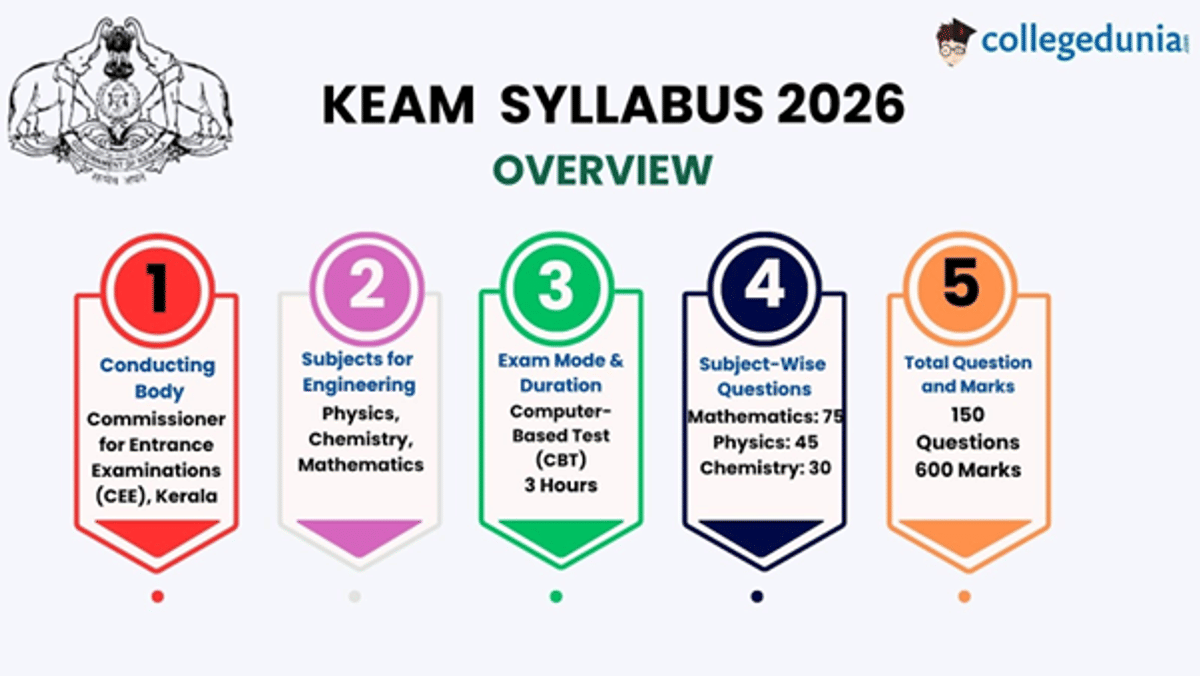
The KEAM 2026 entrance exam for engineering courses will consist of 150 questions, with Mathematics having 75 questions, Physics having 45 questions, and Chemistry having 30 questions, with a duration of 180 minutes. Check KEAM Exam Pattern
Quick Links:

Key Summary
In this article, we discussed the KEAM syllabus for 2026, including syllabi for Physics, Chemistry, Mathematics, weightage, important topics, and best books.
- The KEAM syllabus comprises all three subjects: Physics, Chemistry & Mathematics, and primarily focuses on classes 11 and 12, but is not completely based on NCERT.
- In the KEAM syllabus 2026, mathematics has more weightage than physics and chemistry. The ratio of mathematics, physics, and chemistry weightage is 5:3:2.
- KEAM 2026 will be held in computer-based test mode, and there will be one paper instead of two.
- The KEAM 2026 entrance exam for engineering courses will consist of 150 questions, with Mathematics having 75 questions, Physics having 45 questions, and Chemistry having 30 questions, with a duration of 180 minutes.
What is the KEAM Syllabus 2026?
The KEAM syllabus 2026 comprises all three subjects: Physics, Chemistry & Mathematics, and primarily focuses on classes 11 and 12, but is not completely based on NCERT.
- Syllabus Weightage: Mathematics has more weightage than physics and chemistry. The ratio of mathematics, physics, and chemistry weightage is 5:3:2.
- Exam Mode: Computer-based test mode, and there will be one paper instead of two.
- Number of Questions: Engineering courses will consist of 150 questions, with Mathematics having 75 questions, Physics having 45 questions, and Chemistry having 30 questions, with a duration of 180 minutes.
KEAM Syllabus 2026: Overview
| Particulars | Details |
|---|---|
| Exam Name | Kerala Engineering Architecture Medical (KEAM) |
| Conducting Body | Commissioner for Entrance Examinations (CEE), Kerala |
| Exam Level | State-Level Entrance Exam |
| Exam Mode | Computer-Based Test (CBT) |
| Subjects for Engineering | Physics, Chemistry, Mathematics |
| Syllabus Base | Based on Class 11 & 12 topics (not fully NCERT-based) |
| Paper Pattern (2026) | Single Paper (earlier 2 papers) |
| Total Questions | 150 Questions |
| Subject-wise Questions | Mathematics – 75Physics – 45Chemistry – 30 |
| Marks Distribution Ratio | Mathematics : Physics : Chemistry = 5 : 3 : 2 |
| Total Marks | 600 Marks (4 marks per question) |
| Negative Marking | -1 mark for each incorrect answer |
| Duration | 180 Minutes (3 Hours) |
| Exam Language | English |
| Exam Frequency | Once a Year |
| Official Website | cee.kerala.gov.in |
Also Check:
Ques. What subjects are included in the KEAM 2026 syllabus?
Ans. The subjects included in the KEAM 2026 syllabus are physics, chemistry, and mathematics:
| Subject | Based On | Level/Focus |
|---|---|---|
| Physics | Class 11 & 12 syllabus | Conceptual understanding and numerical application |
| Chemistry | Class 11 & 12 syllabus | Basic concepts, reactions, and problem-solving |
| Mathematics | Class 11 & 12 syllabus | High-weightage; focuses on problem-solving and speed |
Ques. Which subject has the highest weightage in KEAM 2026?
Ans. The subjects that have the highest weightage in KEAM 2026 are given below:
| Subject | Weightage Ratio | Importance Level | Preparation Tip |
|---|---|---|---|
| Mathematics | 5 | (Highest) | Focus more on Maths; practice problem-solving and speed regularly. |
| Physics | 3 | (Moderate) | Strengthen concepts and numerical accuracy. |
| Chemistry | 2 | (Lower) | Revise formulas, reactions, and theory from NCERT. |
Subject-Wise KEAM Syllabus 2026
The KEAM syllabus comprises all three subjects: Physics, Chemistry & Mathematics, and primarily focuses on classes 11 and 12, but is not completely based on NCERT. The subject-wise KEAM syllabus 2026 is given below:
KEAM Physics Syllabus 2026
Mechanics and Electrodynamics dominate the Physics syllabus, while Modern Physics, Optics, and Thermal topics offer easy scoring.
KEAM Syllabus 2026 Physics, as per the modification, is given below:
| Unit | Topics Covered |
|---|---|
| 1. Physical World & Measurement |
|
| 2. Kinematics |
|
| 3. Laws of Motion |
|
| 4. Work, Energy & Power |
|
| 5. System of Particles & Rigid Body |
|
| 6. Gravitation |
|
| 7. Properties of Bulk Matter |
|
| 8. Thermodynamics |
|
| 9. Kinetic Theory of Gases |
|
| 10. Oscillations & Waves |
|
| 11. Electrostatics |
|
| 12. Current Electricity |
|
| 13. Magnetism & Magnetic Effects of Current |
|
| 14. EMI & AC |
|
| 15. Electromagnetic Waves |
|
| 16. Optics |
|
| 17. Dual Nature of Matter & Radiation |
|
| 18. Atoms & Nuclei |
|
| 19. Electronic Devices |
|
| 20. Communication Systems |
|
KEAM Chemistry Syllabus 2026
Physical Chemistry forms the foundation with a strong numerical focus, Inorganic covers periodicity and compounds, while Organic Chemistry tests mechanisms, reactions, and applications, all equally important for KEAM Chemistry.
KEAM Syllabus 2026 Chemistry, as per the modification, is given below:
| Unit | Topics Covered |
|---|---|
| 1. Basic Concepts of Chemistry |
|
| 2. Structure of an Atom |
|
| 3. Classification & Periodicity |
|
| 4. Chemical Bonding |
|
| 5. States of Matter |
|
| 6. Thermodynamics |
|
| 7. Equilibrium |
|
| 8. Redox & Electrochemistry |
|
| 9. Solutions |
|
| 10. Chemical Kinetics |
|
| 11. Surface Chemistry |
|
| 12. Hydrogen & s-block Elements |
|
| 13. p-block Elements |
|
| 14. d & f-block Elements |
|
| 15. Coordination Compounds |
|
| 16. Isolation of Elements |
|
| 17. Basic Organic Chemistry |
|
| 18. Hydrocarbons |
|
| 19. Haloalkanes & Haloarenes |
|
| 20. Alcohols, Phenols & Ethers |
|
| 21. Aldehydes, Ketones & Acids |
|
| 22. Organic Nitrogen Compounds |
|
| 23. Biomolecules |
|
| 24. Polymers |
|
| 25. Chemistry in Everyday Life |
|
| 26. Environmental Chemistry |
|
KEAM Mathematics Syllabus 2026
Calculus and Algebra hold the maximum weightage in KEAM Mathematics, followed by Geometry and Probability.
KEAM Syllabus 2026 Math, as per the modification, is given below:
| Unit | Topics Covered |
|---|---|
| Unit 1: Algebra |
|
| Unit 2: Trigonometry |
|
| Unit 3: Geometry |
|
| Unit 4: Statistics & Probability |
|
| Unit 5: Calculus & Linear Programming |
|
KEAM Syllabus 2026 Important Topics
The table below shows the important topics for the KEAM syllabus for physics, chemistry, and mathematics:
| Subject | Important Topics |
|---|---|
| Physics |
|
| Chemistry |
|
| Mathematics |
|
Best Books for KEAM Exam 2026
| Subject | Book Name | Publication / Author |
|---|---|---|
| Mathematics | Mathematics XI & XII | R. D. Sharma |
| Problems in Calculus in One Variable | I. A. Maron | |
| Chemistry | Organic Chemistry | O. P. Tandon |
| Numerical Chemistry | P. Bahadur | |
| Physics | Concepts of Physics Vol. I & II | H. C. Verma |
| Objective Physics Vol. I & II | Arihant Publications |
KEAM Syllabus 2026 PDF Download
Ques. Is there any change in the KEAM 2026 syllabus or exam pattern?
Ans. Yes, KEAM 2026 will be conducted in Computer-Based Test (CBT) mode with one combined paper instead of two.
| Exam Feature | Details (KEAM 2026) |
|---|---|
| Exam Mode | Computer-Based Test (CBT) |
| Number of Papers | One combined paper (instead of two) |
| Total Questions | 150 |
| Subject-wise Distribution | Mathematics – 75Physics – 45Chemistry – 30 |
| Exam Duration | 180 minutes (3 hours) |
Ques. Is the KEAM syllabus similar to the NCERT syllabus?
Ans. The KEAM syllabus is inspired by NCERT, but not identical. While the basic structure follows NCERT topics, a few units may be added, modified, or removed.
| Source | Description | Tip |
|---|---|---|
| NCERT | Base syllabus for Physics, Chemistry & Maths (Class 11 & 12). | Start with NCERT for fundamentals. |
| Kerala SCERT | Some topics differ or are added. | Cross-check with SCERT for full coverage. |
| Overall | KEAM is NCERT-inspired but not identical. | Study from both the NCERT & SCERT books. |
Ques. Is NCERT enough for KEAM 2026?
Ans. No, NCERT textbooks are not enough to score well in KEAM, though it is considered a good foundation for preparing for the KEAM exam. However, you should also use other recommended books and study materials to improve your preparation.
KEAM Syllabus 2026: Chapter-Wise Weightage
In the KEAM syllabus 2026, mathematics has more weightage than physics and chemistry. The ratio of mathematics, physics, and chemistry weightage is 5:3:2.
The KEAM chapter-wise weightage 2026 for physics, chemistry, and mathematics is given below:
KEAM Mathematics Syllabus Weightage 2026
- Calculus and Algebra carry the highest weightage; mastering these ensures strong overall performance.
- Coordinate Geometry and Vectors are key scoring topics.
- Trigonometry and Probability offer moderate weightage and are concept-based.
| Chapter | Approx. Weightage (%) |
|---|---|
| Calculus | 20–25% |
| Algebra | 15–20% |
| Coordinate Geometry | 15–18% |
| Vector & 3D Geometry | 10–12% |
| Probability & Statistics | 8–10% |
| Trigonometry | 5–7% |
| Sets, Relations & Functions | 5–6% |
| Mathematical Reasoning | 3–4% |
| Binomial Theorem | 3–4% |
| Linear Programming | 2–3% |
KEAM Physics Syllabus Weightage 2026
- Mechanics dominates the paper; focus on concepts and problem-solving.
- Thermodynamics, Electricity, and Magnetism are medium-weight, high-return areas.
- Optics and Modern Physics are quick-revision, formula-based scoring units
| Chapter | Approx. Weightage (%) |
|---|---|
| Mechanics | 20–25% |
| Thermodynamics & Heat | 10–12% |
| Current Electricity | 8–10% |
| Electrostatics | 8–10% |
| Magnetism & EMI | 8–10% |
| Optics | 8–9% |
| Modern Physics | 7–8% |
| Oscillations & Waves | 6–8% |
| Units, Dimensions & Errors | 3–4% |
| Communication Systems | 2–3% |
KEAM Chemistry Syllabus Weightage 2026
- Physical Chemistry has the highest share — numerical practice is crucial.
- Organic Chemistry emphasizes reaction mechanisms and named reactions.
- Inorganic Chemistry requires conceptual clarity, especially in Chemical Bonding and Periodic Table trends.
| Chapter | Approx. Weightage (%) |
|---|---|
| Physical Chemistry | 35–40% |
| Organic Chemistry | 30–35% |
| Inorganic Chemistry | 25–30% |
| Chemical Bonding | 10–12% |
| Periodic Table | 5–6% |
| Surface Chemistry | 4–5% |
| Biomolecules & Polymers | 3–4% |
| Environmental Chemistry | 2–3% |
KEAM Exam Pattern 2026
The KEAM 2026 exam pattern for engineering courses will consist of 150 questions, with Mathematics having 75 questions, Physics having 45 questions, and Chemistry having 30 questions, with a duration of 180 minutes.
| Particulars | Details |
|---|---|
| Mode | Online (CBT) |
| Papers | Paper I – Physics & ChemistryPaper II – Mathematics |
| Total Questions | 150 |
| Marks | 4 marks/question, –1 for wrong answer |
| Duration | 3 hours per paper |
| Level | Class 11 & 12 syllabus (Kerala/NCERT) |
KEAM 2025 Question Paper with Solution PDF
The table below has the KEAM 2025 question paper with solution PDF for your reference:
| Question Paper | Download PDF | Solution PDF |
|---|---|---|
| KEAM 2025 Question Paper (April 29) | Download Pdf | Check Solutions |
| KEAM 2025 Question Paper (April 28) | Download Pdf | Check Solutions |
| KEAM 2025 Question Paper (April 27) | Download Pdf | Check Solutions |
| KEAM 2025 Question Paper (April 26) | Download Pdf | Check Solutions |
| KEAM 2025 Question Paper (April 25) | Download Pdf | Check Solutions |
| KEAM 2025 Question Paper (April 24 Session 2) | Download Pdf | Check Solutions |
| KEAM 2025 Question Paper (April 24 Session 1) | Download Pdf | Check Solution |
| KEAM 2025 Question Paper (April 23) | Download Pdf | Check Solution |
Check More:
KEAM Exam 2026 Preparation Tips
Some of the effective exam preparation tips for those who are appearing for the KEAM Exam 2026 are given below:
| Focus Area | Daily Study Hours | Preparation Tips |
|---|---|---|
| Mathematics | 3–4 hrs |
|
| Physics | 2–3 hrs |
|
| Chemistry | 2 hrs |
|
| Mock Tests & Revision | 1–2 hrs |
|
| Total Study Time | 7–9 hrs/day |
|
KEAM Syllabus 2026 FAQs
Ques. Has KEAM registration for 2026 started?
Ans. The conducting body, the Commissioner for Entrance Examinations (CEE) Kerala, will open the online application form for KEAM 2026.
| Event | Status / Tentative Date (2026) |
|---|---|
| Official Notification Release | Early February 2026 (Expected) |
| Online Registration Start Date | Second week of February 2026 (Tentative) |
| Last Date to Submit Application | Early March 2026 (Tentative) |
| Application Correction Window | Mid-March 2026 (Expected) |
| Current Status (as of Nov 2025) | Registration has not yet started |
Ques. Has the KEAM 2026 syllabus been released?
Ans. The KEAM 2026 syllabus has not yet been released officially.
| Year | Syllabus Status | Key Points / Updates |
|---|---|---|
| 2026 | To be Released |
|
Ques. Which syllabus is best for KEAM?
Ans. Follow the latest official syllabus by CEE Kerala. Use the KEAM 2025 syllabus — it’s the newest and updated.
- The KEAM Syllabus is based on Class 11 & 12 (NCERT/SCERT Kerala).
- The KEAM 2026 syllabus has not been released yet, likely similar to 2025.
Ques. Is KEAM tougher than NEET?
Ans. NEET is generally tougher due to national competition, a larger syllabus, and concept depth.
| Aspect | KEAM | NEET |
|---|---|---|
| Level | State-level (Kerala) | National-level |
| Subjects | Physics, Chemistry, Maths | Physics, Chemistry, Biology |
| Difficulty | Moderate; Maths lengthy, Physics tricky | Tough, high conceptual depth |
| Competition | Lower (state-level) | Very high (nationwide) |
| Pattern | 150 Qs (PCM) in 180 min | 180 Qs in 3 hrs |
| Prep Focus | Speed, accuracy, formula-based | Deep understanding, large syllabus |
Ques. What are the courses that KEAM 2026 offers?
Ans. The courses offered are given below:
| Category | Courses Offered (KEAM 2026) |
|---|---|
| Engineering | B.Tech (all major branches) |
| Architecture | B.Arch |
| Pharmacy | B.Pharm |
| Medical & Allied (via NEET) | MBBS, BDS, BAMS, BHMS, BSMS, BUMS |
| Agriculture & Forestry | B.Sc (Hons) Agriculture, Forestry, Biotechnology |
| Veterinary & Fisheries | BVSc & AH, BFSc |
Cut-offs
The KEAM Cutoff is the minimum score required for admission to engineering, architecture, pharmacy, and medical programs in Kerala. The cutoff will be released by the office of the Commissioner of Entrance Exam (CEE) after each round of KEAM seat allotment 2025.
It is expected that the students who secure a rank under 300 can get admission to CSE at the College of Engineering, Thiruvananthapuram. Last year, the closing rank for CSE in KEAM reached 271.
Those with a rank around 550 got CSE at the government Engineering College Thrissur, while a rank of 1,100 was required for TKM College of Engineering, Kollam. Candidates up to the rank of 2,000 achieved CSE in institutes like Rajiv Gandhi Institute of Technology, Kittayam.
For branches like Civil, Mechanical, Electrical, students with ranks between 2,000 and 8,000 secured seats in mid-tier colleges. Last year, Mechanical Engineering at CET closed at 3426, and Civil Engineering at 5,587.
- For B.Pharma, the cutoff rank was high; government colleges accept a rank up to 15,000-20,000, depending upon the category.
- In Architecture, admissions are based on NATA scores, top colleges require a rank under 3,000 for admissions.
KEAM Previous Year’s Cutoff
The CEE has released the official KEAM cutoffs from 2024 to 2022, the candidates can check the official KEAM previous year’s cutoff below.
KEAM Engineering Cutoff Ranks
| Year | Phase 1 Ranks | Phase 2 Ranks |
|---|---|---|
| KEAM Cutoff Ranks 2025 | Check Here | Check Here |
| KEAM Cutoff Ranks 2024 | Check Here | Check Here |
| KEAM Cutoff Ranks 2023 | Check Here | - |
| KEAM Cutoff Ranks 2022 | Check Here | Check Here |
KEAM Medical (MBBS, BDS) Cutoff Ranks
| Year | Phase 1 Ranks | Phase 2 Ranks | Phase 3 Ranks |
|---|---|---|---|
| KEAM Cutoff Ranks 2025 | Check Here | Check Here | Check Here |
| KEAM Cutoff Ranks 2024 | Check Here | Check Here | Check Here |
| KEAM Cutoff Ranks 2023 | Check Here | Check Here | Check Here |
| KEAM Cutoff Ranks 2022 | - | Check Here | - |
KEAM Medical (AYUSH) Cutoff Ranks
| Year | Phase 1 Ranks | Phase 2 Ranks | Phase 3 Ranks |
|---|---|---|---|
| KEAM Cutoff Ranks 2025 | Check Here | Check Here | Check Here |
| KEAM Cutoff Ranks 2024 | Check Here | Check Here | Check Here |
| KEAM Cutoff Ranks 2023 | - | Check Here | Check Here |
| KEAM Cutoff Ranks 2022 | Check Here | Check Here | - |
Also Check:
KEAM Cutoff 2026 (Expected)
The KEAM 2026 cutoff will be released by the Commissioner for Entrance Examination (CEE) after each round of the allotment process. The cutoff is announced separately for each course, college, category, and the closing rank of the college.
- The cutoff rank for B.Pharma, General category can go up to 15,000-20,000, and for SC/ST up to 30,000 or more in self-financing colleges.
- In Architecture (B.Arch), admission depends on NATA score and KEAM rank. The closing rank can range around 3,000 for the General Category, and 7,000-10,000 for reserved categories.
KEAM 2026 Expected Cutoff for Computer Science Engineering (CSE)
| College | General | EWS | OBC (SEBC) | SC | ST |
|---|---|---|---|---|---|
| College of Engineering, Thiruvananthapuram (CET) | ≤ 300 | ≤ 450 | ≤ 600 | ≤ 2,500 | ≤ 5,000 |
| Government Engineering College, Thrissur | ≤ 550 | ≤ 750 | ≤ 950 | ≤ 3,000 | ≤ 5,500 |
| Govt. Model Engineering College, Kochi (MEC) | ≤ 1,000 | ≤ 1,200 | ≤ 1,500 | ≤ 3,200 | ≤ 5,800 |
| TKM College of Engineering, Kollam | ≤ 1,100 | ≤ 1,300 | ≤ 1,600 | ≤ 3,500 | ≤ 6,000 |
KEAM 2026 Expected Cutoff for Electronics & Communication Engineering (ECE)
| College | General | EWS | OBC (SEBC) | SC | ST |
|---|---|---|---|---|---|
| CET, Thiruvananthapuram | ≤ 800 | ≤ 1,100 | ≤ 1,400 | ≤ 3,500 | ≤ 6,000 |
| GEC Thrissur | ≤ 1,200 | ≤ 1,500 | ≤ 1,900 | ≤ 4,000 | ≤ 6,500 |
| TKM College of Engineering | ≤ 2,000 | ≤ 2,400 | ≤ 2,800 | ≤ 4,500 | ≤ 7,000 |
| MEC, Kochi | ≤ 1,500 | ≤ 1,800 | ≤ 2,000 | ≤ 4,000 | ≤ 6,500 |
KEAM 2026 Expected Cutoff for Electrical & Electronics Engineering (EEE)
| College | General | EWS | OBC (SEBC) | SC | ST |
|---|---|---|---|---|---|
| CET, Thiruvananthapuram | ≤ 1,800 | ≤ 2,200 | ≤ 2,800 | ≤ 4,500 | ≤ 7,000 |
| GEC Thrissur | ≤ 2,500 | ≤ 3,000 | ≤ 3,500 | ≤ 5,500 | ≤ 8,500 |
| TKM College of Engineering | ≤ 3,200 | ≤ 3,700 | ≤ 4,200 | ≤ 6,000 | ≤ 9,000 |
KEAM 2026 Expected Cutoff for B.Pharma
| College | General | EWS | OBC (SEBC) | SC | ST |
|---|---|---|---|---|---|
| Government Medical College, Kozhikode | ≤ 2,500 | ≤ 3,000 | ≤ 3,500 | ≤ 6,500 | ≤ 9,000 |
| Government Medical College, Thiruvananthapuram | ≤ 2,800 | ≤ 3,200 | ≤ 3,800 | ≤ 6,800 | ≤ 9,500 |
| Government Medical College, Kottayam | ≤ 3,200 | ≤ 3,600 | ≤ 4,000 | ≤ 7,000 | ≤ 10,000 |
| Private Self-financing Pharmacy Colleges | ≤ 8,000 | ≤ 9,000 | ≤ 10,000 | ≤ 15,000 | ≤ 20,000 |
KEAM Marks vs Rank (Expected)
The KEAM Marks vs Rank analysis is important for the students to understand their ranks according to their marks scored in the KEAM exam. The KEAM exam is conducted for Engineering and Pharmacy courses. The total marks for Engineering are 600, while for Pharmacy, it is 300. The KEAM Marks vs Rank for Engineering and B.Pharma is given below in detail:
Expected KEAM 2026 Marks vs Rank (Engineering)
| Marks (out of 600) | Expected Rank Range |
|---|---|
| 500+ | 1 – 5,000 |
| 400+ | 5,001 – 20,000 |
| 300+ | 20,001 – 50,000 |
| 250+ | Above 50,000 |
Expected KEAM 2026 Marks vs Rank (Pharmacy)
| Marks (out of 600) | Expected Rank Range |
|---|---|
| 450+ | 1 – 5,000 |
| 390+ | 5,001 – 15,000 |
| 280+ | 15,001 – 30,000 |
| Below 250 | Above 30,000 |
KEAM College-wise Cutoff 2026 (Expected)
The KEAM Cutoff for top colleges like CET (College of Engineering, Thiruvananthapuram), College of Engineering Thrissur is high for engineering students. Last year, the closing cutoff rank was 271 for CSE, and for ECE, the cutoff rank was 256 for EE.
You can check the college-wise cutoff for KEAM from the table below:
KEAM Cutoff for College of Engineering, Thiruvananthapuram (CET)
| Branch | Expected Closing Rank |
|---|---|
| Computer Science & Engineering (CSE) | 350 – 400 |
| Electronics & Communication Engineering (ECE) | 600 – 700 |
| Electrical & Electronics Engineering (EEE) | 1,100 – 1,300 |
| Mechanical Engineering | 2,500 – 3,000 |
| Civil Engineering | 3,500 – 4,000 |
KEAM Cutoff for Government Engineering College, Thrissur (GEC Thrissur)
| Branch | Expected Closing Rank |
|---|---|
| Computer Science & Engineering (CSE) | 700 – 800 |
| Electronics & Communication Engineering (ECE) | 1,200 – 1,400 |
| Electrical & Electronics Engineering (EEE) | 2,000 – 2,300 |
| Mechanical Engineering | 4,500 – 5,000 |
| Civil Engineering | 5,500 – 6,000 |
KEAM Cutoff for TKM College of Engineering, Kollam
| Branch | Expected Closing Rank |
|---|---|
| Computer Science & Engineering (CSE) | 1,000 – 1,200 |
| Electronics & Communication Engineering (ECE) | 1,800 – 2,000 |
| Electrical & Electronics Engineering (EEE) | 3,000 – 3,500 |
| Mechanical Engineering | 6,000 – 6,500 |
| Civil Engineering | 7,000 – 7,500 |
KEAM Cutoff for Government Model Engineering College (MEC), Kochi
| Branch | Expected Closing Rank |
|---|---|
| Computer Science & Engineering (CSE) | 1,200 – 1,400 |
| Electronics & Communication Engineering (ECE) | 2,500 – 2,800 |
| Electrical & Electronics Engineering (EEE) | 3,500 – 4,000 |
| Mechanical Engineering | 8,000 – 9,000 |
KEAM Cutoff for MA College of Engineering, Kothamangalam
| Branch | Expected Closing Rank |
|---|---|
| Computer Science & Engineering (CSE) | 1,500 – 1,700 |
| Electronics & Communication Engineering (ECE) | 2,800 – 3,000 |
| Electrical & Electronics Engineering (EEE) | 4,000 – 4,500 |
| Mechanical Engineering | 9,000 – 10,000 |
KEAM Cutoff for CET Trivandrum
| Branch | Expected Closing Rank |
|---|---|
| Computer Science & Engineering (CSE) | 350 – 400 |
| Electronics & Communication Engineering (ECE) | 600 – 700 |
| Electrical & Electronics Engineering (EEE) | 1,100 – 1,300 |
| Mechanical Engineering | 2,500 – 3,000 |
| Civil Engineering | 3,500 – 4,000 |
KEAM Cutoff 2025
The KEAM 2025 cutoff is released by the Commissioner for Entrance Examination (CEE) after each round of the allotment process. The cutoff is announced separately for each course, college, category, and the closing rank of the college.
KEAM 2025 Cutoff for Computer Science Engineering (CSE)
| Institute | General Cutoff Rank | SC Cutoff Rank | ST Cutoff Rank |
|---|---|---|---|
| TVE- College of Engineering, Thiruvananthapuram | 571 | 15188 | 19997 |
| TCR- Government Engineering College, Thrissur | 1087 | 16514 | 15092 |
| MDL- Model Engineering College, Ernakulam | 1673 | 20706 | 47022 |
| TKM- T K M College of Engineering, Kollam | 2279 | 22379 | 0 |
| MAC- Mar Athanasius College of Engineering, Kothamangalam | 3182 | 24430 | 63785 |
| KTE- Government Rajiv Gandhi Institute of Technology, Kottayam | 4547 | 27993 | 67088 |
| KNR- Government College of Engineering, Kannur | 4742 | 32484 | 51051 |
| NSS- N S S College of Engineering, Palakkad | 4823 | 31854 | 67143 |
| PKD- Government Engineering College, Palakkad | 4926 | 34486 | 48001 |
| RET- Rajagiri School of Engineering and Technology, Ernakulam | 5741 | 49274 | 0 |
KEAM 2025 Cutoff for Electrical & Electronics Engineering (EEE)
| Institute | General Cutoff Rank | SC Cutoff Rank | ST Cutoff Rank |
|---|---|---|---|
| TVE- College of Engineering, Thiruvananthapuram | 2153 | 17841 | 62817 |
| TCR- Government Engineering College, Thrissur | 3800 | 29844 | 66054 |
| TKM- T K M College of Engineering, Kollam | 6008 | 48031 | 61974 |
| MDL- Model Engineering College, Ernakulam | 6226 | 58852 | 0 |
| TRV- Government Engineering College Barton Hill, Thiruvananthapuram | 8409 | 48515 | 0 |
| MAC- Mar Athanasius College of Engineering, Kothamangalam | 8926 | 63417 | 29421 |
| KNR- Government College of Engineering, Kannur | 9357 | 67239 | 0 |
| KTE- Government Rajiv Gandhi Institute of Technology, Kottayam | 9471 | 66664 | 61226 |
| NSS- N S S College of Engineering, Palakkad | 9618 | 62913 | 27530 |
| PKD- Government Engineering College, Palakkad | 9906 | 67041 | 0 |
KEAM 2025 Cutoff for Civil Engineering (CE)
| Institute | General Cutoff Rank | SC Cutoff Rank | ST Cutoff Rank |
|---|---|---|---|
| TVE- College of Engineering, Thiruvananthapuram | 6642 | 35949 | 66768 |
| TCR- Government Engineering College, Thrissur | 11476 | 32946 | 64574 |
| TKM- T K M College of Engineering, Kollam | 11941 | 48715 | 63399 |
| KNR- Government College of Engineering, Kannur | 14921 | 47357 | 48823 |
| TRV- Government Engineering College Barton Hill, Thiruvananthapuram | 15312 | 44289 | 0 |
| KKE- Government Engineering College, Kozhikkode | 16518 | 54753 | 62040 |
| MAC- Mar Athanasius College of Engineering, Kothamangalam | 16719 | 65844 | 64219 |
| NSS- N S S College of Engineering, Palakkad | 16780 | 57042 | 60625 |
| KTE- Government Rajiv Gandhi Institute of Technology, Kottayam | 17268 | 50261 | 64736 |
| PKD- Government Engineering College, Palakkad | 19181 | 52161 | 65266 |
KEAM 2025 Cutoff for Applied Electronics and Instrumentation
| Institute | General Cutoff Rank | SC Cutoff Rank |
|---|---|---|
| KKE- Government Engineering College, Kozhikkode | 15332 | 62776 |
| RET- Rajagiri School of Engineering and Technology, Ernakulam | 22139 | 64859 |
| TVE- College of Engineering, Thiruvananthapuram | 2237 | 34707 |
KEAM Cutoff for College of Engineering, Thiruvananthapuram (CET)
| Branch | General - rank | SC - rank | ST - rank |
|---|---|---|---|
| Civil Engineering | 6642 | 35949 | 66768 |
| Computer Science and Engineering | 571 | 15188 | 19997 |
| Electrical and Electronics engineering | 2153 | 17841 | 62817 |
| Applied Electronics and Instrumentation | 2237 | 34707 | 0 |
| Electronics and Communication Engineering | 840 | 13077 | 47926 |
| Electrical and Computer Engineering | 1966 | 50182 | 0 |
| Industrial Engineering | 8619 | 58656 | 0 |
| Mechanical Engineering | 2974 | 23190 | 65544 |
KEAM Cutoff for Government Engineering College, Thrissur (GEC Thrissur)
| Branch | General - rank | SC - rank | ST - rank |
|---|---|---|---|
| Computer Science and Engineering | 1087 | 16514 | 15092 |
| Civil Engineering | 11476 | 32946 | 64574 |
| Electrical and Electronics engineering | 3800 | 29844 | 66054 |
| Cyber Physical Systems | 8955 | 60339 | 0 |
| Chemical Engineering | 8267 | 59724 | 54854 |
| Electronics and Communication Engineering | 2042 | 17223 | 60927 |
| Mechanical Engineering | 5750 | 32290 | 63921 |
| Production Engineering | 15454 | 65996 | 0 |
KEAM Passing Marks
The KEAM passing marks are important for eligibility for rank lists, KEAM counselling, and seat allotment.
What are the KEAM passing marks?
As there are no fixed passing marks in KEAM, candidates have to meet a criterion to be considered as passing. The criteria are as follows:
- The candidates must score at least 10 marks in each paper (Paper 1: Physics & Chemistry, Paper 2: Mathematics) to be considered for the rank list.
- If you score less than 10 marks in any paper, your result will not be included in the engineering rank list. The SC/ ST candidates are exempted from this marking scheme.
- If you meet the minimum mark criteria, your Class 12 PCM marks will affect whether you are in the rank list or not.
What are the qualifying marks for the KEAM ?
The Qualifying marks for KEAM are as follows:
| Candidate Category | Minimum Marks per Paper (Expected) | Rank List Eligibility |
|---|---|---|
| General/OBC | 10 marks each in Paper I & II | Yes, if the criteria are met |
| SC/ST | No minimum required | Yes |
| PwD | Same as category criteria | Yes |
KEAM Good Score
A good score in the KEAM exam depends on your branch and category. For Engineering branches, a higher score is required for admission to courses like CSE, ECE, and EE. While for Pharmacy the score requirement is low.
What is a Good Score in KEAM 2025?
The Engineering paper in the KEAM exam carries 600 marks (Physics + Chemistry + Mathematics). An approximate good score for the top course in Engineering can range as follows:
- CSE in CET/Thrissur/MEC: 480+
- ECE in CET/Thrissur/MEC: 450+
- EEE in TKM, GEC: 420+
- Mechanical/Civil in Tier-1 Govt. Colleges: 380+
The good score for B.Pharma can range as follows:
- For top colleges: 400+
- For good self-financing colleges: 350+
- Minimum for admission: 280–300+
| Score Range (Out of 600) | What It Means |
|---|---|
| 500+ | Excellent – Top 5,000 rank possible |
| 450 – 499 | Eligible for top Govt. colleges (like CET) |
| 400 – 449 | Good – May get top branches in second-tier colleges |
| 300 – 399 | Average – Entry into private colleges |
| Below 300 | May struggle for core branches in reputed colleges |
What is a Safe Score in KEAM 2025?
A safe score in KEAM 2025 can range 480-520+ for CET, 420-460 for government colleges of Kerala, 400-450 for TKM/MCEC. You can check the safe score for KEAM 205 from the table below:
| College Type | Safe Score Range |
|---|---|
| CET Trivandrum (CSE) | 480 – 520+ |
| Govt. Colleges (ECE/EEE/ME) | 420 – 460+ |
| TKM/MEC (Top Private-Aided) | 400 – 450+ |
| Private Self-Financed (CSE) | 350 – 400+ |
| General Entry (any stream) | 300+ |
Is 300 a Good Score in KEAM?
A score of 300 in KEAM (out of 600) is considered a moderate score. This score may not guarantee admission to top government colleges or highly sought-after branches like CSE, but it still offers admission chances in:
- Private self-financing colleges for branches like ECE, Mechanical, or even CSE in later rounds.
- Government colleges for reserved categories, especially in lower-demand branches.
- It can also lead to better ranks if your Class 12 PCM marks are strong, as the final rank considers 50% KEAM + 50% board marks.
Colleges You Can Expect with 300 Marks in KEAM (Expected 2025)
| College Name | Possible Branches | Admission Type |
|---|---|---|
| Rajagiri School of Engineering, Kochi | ECE, Mechanical, Civil, possibly CSE (last rounds) | Private Self-Financing |
| Mar Athanasius College of Engg., Kothamangalam | Mechanical, EEE, Civil | Govt.-Aided (Reserved chance) |
| SCMS School of Engineering, Kochi | CSE, ECE, IT (available in later rounds) | Private Self-Financing |
| Federal Institute of Science & Tech. (FISAT) | EEE, ECE, CE (maybe CSE in later rounds) | Private Self-Financing |
| Sree Chitra Thirunal College of Engineering | Civil, ECE, Production (reserved category) | Govt. (Reserved Categories) |
| Adi Shankara Institute, Kalady | CSE, ECE, ME, IT | Private Self-Financing |
| Christ College of Engineering, Irinjalakuda | ME, EEE, ECE | Private Self-Financing |
| Government Engineering College, Wayanad | Civil, EEE (if reserved) | Govt. (Reserved only) |
Is 200 a Good Score in KEAM?
A score of 200 out of 600 in KEAM is considered below average for students in the General category. With this score, it is dififcult to get admission in government engineering colleges for core branches.
- You may get admission in self-financing private colleges, in non-core or less in-demand branches.
- Reserved category students (SC/ST/OBC) may still get into government colleges, but in low-demand branches.
List of Colleges You Can Expect with 200 Marks in KEAM (Expected 2025)
| College Name | Possible Branches | Admission Type |
|---|---|---|
| Viswajyothi College of Engineering, Vazhakulam | Civil, EEE, Production | Private Self-Financing |
| Christ College of Engineering, Irinjalakuda | ECE, ME, Instrumentation (last rounds) | Private Self-Financing |
| Sree Narayana Gurukulam College, Kolenchery | Mechanical, Civil | Private Self-Financing |
| Mangalam College of Engineering, Kottayam | EEE, Civil, ECE | Private Self-Financing |
| MES College of Engineering, Kuttippuram | Civil, Production (Reserved only) | Govt.-Aided (Reserved) |
| Government Engineering College, Idukki | Civil, Mechanical (reserved only) | Govt. (SC/ST Categories) |
| Toc H Institute of Science & Tech, Kochi | EEE, CE (Limited availability) | Private Self-Financing |
| Ilahia College of Engineering & Tech | Mechanical, Civil | Private Self-Financing |
Results
CEE Kerela has released the revised KEAM Rank List 2025 for Engineering on July 10, 2025. Earlier, the Pharmacy rank list was out on July 1, 2025. Candidates can check the rank list on the official website – cee.kerala.gov.in in the ‘Result’ tab. The rank list for KEAM 2025 is released separately, after verifying Class 12 marks submitted by candidates.
Out of 76227 candidates qualified in the KEAM Engineering, 67505 candidates had submitted their Plus 2 marks.
- KEAM topper 2025 in Engineering is now Joshua Jaсob Thomas with a score of 588.5773, followed by Hari Kishan Baiju, Emil Iype Sacharia, Adl Zayaan and Adhvaith Ayinippilly Sandeер with the same marks (588.5773/600). The female topper is Ananya Rajeev with 588.5773 out 600.
- For B.Pharm, KEAM topper 2025 is Anakha Anil with 290 marks out of 300. She was also the female topper, followed by Hrishikesh R Shenoy and Fathimathu Zahra with 290 marks.
KEAM 2025 Rank List
| Engineering | Pharmacy |
|---|---|
| Result Highlights | Result Highlights |
| Toppers List | Toppers List |
KEAM 2025 Rank List: Engineering Statistics
| Category | Female Candidates | Male Candidates | Transgender | Total Candidates |
|---|---|---|---|---|
| Appeared for the Examination | 41,895 | 44,654 | 0 | 86,549 |
| Qualified in the Examination | 38,049 | 38,181 | 0 | 76,230 |
| Included in the Rank List | 33,555 | 33,950 | 0 | 67,505 |
KEAM 2025 Rank List: Pharmacy Statistics
| Category | Female Candidates | Male Candidates | Transgender Candidates | Total Candidates |
|---|---|---|---|---|
| Appeared for the Examination | 25,257 | 8,168 | 0 | 33,425 |
| Included in the Rank List | 21,606 | 6,235 | 0 | 27,841 |
CEE Kerala has released the KEAM Results 2025 on 14 May 2025 on the official website along with the KEAM scorecard. The KEAM Results include candidates' details, the score obtained by the candidate, and the qualifying marks.
The KEAM 2025 Answer key has been released, the objection window remains open until May 3, 2025.
- In KEAM 2025, around 1.2 lakh candidates appeared for around 59,000 engineering seats in 5,000 government colleges, 2,000 aided colleges, and 52,000 in autonomous and private colleges.
- As per the previous year, for KEAM 2025, cutoffs below 5,000 get into top government colleges, and ranks up to 55,000 might get into private self-financing institutes.
KEAM 2025 Admission will follow a 50:50 weightage of KEAM entrance scores and normalised Class 12 marks.
In KEAM 2024, approximately 79,044 candidates appeared for the exam, of which the top scorer achieved the 99.97th percentile, showing high competition for top colleges.

KEAM Result Date 2025
The KEAM Result will be declared by CEE Kerala in the form of a scorecard on or before 10th May 2025 on the official website. Candidates are supposed to stay updated on the official website for any latest updates.
| Event | Date |
|---|---|
| Release of KEAM 2025 Answer Key | April 30, 2025 |
| Last Date to Raise Objections | May 3, 2025 |
| KEAM Result Date 2025 | May 14, 2025 |
| Submission of Class 12 Marks | June 12, 2025 |
| KEAM 2025 Rank List Publication Date | Pharmacy: July 1, 2025 Engineering: July 10, 2025 (revised) |
Check the latest updates related to KEAM 2025:
KEAM Result 2025 PDF
The KEAM Result 2025 will be released in 2 phases by the CEE Kerala:
- Scorecard: It is published on May 14, 2025, and this will show the candidate's KEAM result.
- Rank List: It was published on July 1, 2025 after a delay it will include the combined score based on KEAM marks and Class 12 marks (50:50).
The candidates can download their 2025 KEAM Result PDF from the official website: cee.kerala.gov.in. Candidates have to log in by entering their application number and password to check the KEAM Result.
How can I check my KEAM result?
To check the KEAM result, candidates can follow the following steps:

KEAM 2025 Score Card
The KEAM result 2025 will be released in the form of a scorecard, showing the candidate's performance in the entrance exam.
The KEAM Scorecard will only include the marks scored by a candidate in the KEAM 2025 Exam, not the final rank, It will be announced later after considering the class 12 marks.
The Details Mentioned in the KEAM Scorecard are:
- Candidate's Name
- Roll Number & Application Number
- Category of the candidate
- Marks Obtained in Paper I (Physics & Chemistry)
- Marks Obtained in Paper II (Mathematics)
- Total Marks in KEAM Entrance Exam
- Qualifying Status
- Signature and Seal of CEE
KEAM 2025 Answer Key
The CEE Kerala has released the KEAM 2025 Answer key on the official website, before the announcement of the KEAM Result 2025.
The KEAM Provisional answer key can be used by candidates to check their expected marks and score before the announcement of KEAM results.
The objection window remains open until May 3, 2025, during which candidates can raise objections against any errors in the answer key.
How are KEAM marks calculated in 2025?
The KEAM 2025 marks are calculated based on 2 components: the entrance exam score and the normalised marks in Physics, Chemistry, and Mathematics in the Class 12 board exams.
The 2 scores are added in a 50:50 proportion to make the final rank list, which will be released along with the KEAM Result.
Entrance Exam Score Calculation
- The KEAM Engineering examination has Paper I (Physics & Chemistry) and Paper II (Mathematics).
- Each paper has 120 marks, making the total 240 marks.
Scoring Pattern:
- +4 marks for each correct response
- -1 mark for each wrong answer
- 0 marks for unattempted questions
Formula for calculating Exam Score:
KEAM Entrance Score = (No. of Correct Answers × 4) - (No. of Incorrect Answers × 1)
Normalisation of Class 12 Marks
- Marks in Physics, Chemistry, and Mathematics are normalised across various boards by a standard formula given by CEE Kerala.
- Marks in Mathematics, Physics, and Chemistry alone are taken into account (or Computer Science/Biology in place of Chemistry if applicable).
Formula for Normalising Class 12th Marks:
Normalised Marks = (Board Marks / Total Marks) × 300
Final KEAM 2025 Rank Calculation
Formula:
Final KEAM Score = [(Entrance Marks / 240) × 300 + Normalized Class 12 Marks] / 2
| Component | Weightage | Maximum Marks |
|---|---|---|
| KEAM Entrance Exam | 50% | 240 |
| Normalised Class 12 PCM Marks | 50% | 300 |
| Final Score (Scaled to 600) | Combined | 600 |
How to check the KEAM Answer Key 2025?
The CEE Kerala has released the KEAM 2025 answer key on the official website, Candidates can download the provisional answer key of Paper I and II to estimate their scores before announcing the KEAM result 2025. If candidates have any objections, they can file them till 3rd May, 2025.
KEAM 2025 Marks Vs Rank
The KEAM 2025 marks vs rank correlation helps candidates in estimating their potential rank before the announcement of the KEAM result 2025. This is different every year based on the difficulty level and the candidate's performance.
- In KEAM 2024, candidates with scores above 550 got ranks in the top 300, guaranteeing admission to top government engineering colleges such as CET Trivandrum and GEC Thrissur.
- A range of 450–500 generally puts candidates among the top 5,000, usually securing them positions in sought-after branches such as CSE, ECE in premier private colleges.
- Their position to rank 55,000 in 2024 allowed them to gain admission to aided and self-financing engineering colleges under the state quota.
- Based on previous KEAM result trends, a 10–15 mark difference can result in a rank difference of several thousand, especially in the mid-score ranges (300–400).
| Final Score (Out of 600) | Expected Rank Range |
|---|---|
| 550 – 600 | 1 – 500 |
| 500 – 549 | 501 – 2,000 |
| 450 – 499 | 2,001 – 5,000 |
| 400 – 449 | 5,001 – 8,000 |
| 350 – 399 | 8,001 – 12,000 |
| 300 – 349 | 12,001 – 17,000 |
| 250 – 299 | 17,001 – 25,000 |
| 200 – 249 | 25,001 – 35,000 |
| 150 – 199 | 35,001 – 45,000 |
| 100 – 149 | 45,001 – 60,000+ |
Is 17k a good rank in KEAM?
A 17,000 rank in KEAM will help you in getting admission in private or self-financing engineering colleges in Kerala, but it won't generally be enough for top government colleges.
You can still be allotted branches like Mechanical, Civil, or ECE in mid-tier institutions based on your category and seat availability.
KEAM 2025 Expected Cut-off
The KEAM 2025 cutoff is the minimum rank needed to join various engineering colleges in Kerala. The cutoffs are college-wise, branch-wise, and category-wise, and are trend-based from KEAM 2024.
- CET Trivandrum CSE will likely close below Rank 800 (General), and that will be the most competitive branch in KEAM 2025.
- GEC Thrissur and TKM Kollam CSE branches are expected to have closing ranks ranging from 1,200 to 2,000.
- ECE and Mechanical streams in top colleges will have slightly increased closing ranks, typically up to 3,500–4,000 (General).
- Reserved category students (SC/ST/OBC) can qualify for top branches with ranks between 5,000 and 15,000+, depending on the college.
- Core disciplines such as Civil and Mechanical are still available up to 5,000–7,000 (General) in Tier-1 colleges because of lesser demand.
KEAM 2025 Expected Cut-off for Top Government Engineering Colleges
| College Name | Branch | General | OBC | SC | ST |
|---|---|---|---|---|---|
| CET Trivandrum (College of Engineering) | CSE | 700 – 800 | 1,200 | 6,000 | 10,000 |
| ECE | 1,000 – 1,300 | 1,800 | 7,000 | 12,000 | |
| ME | 2,500 – 3,000 | 4,000 | 9,000 | 15,000 | |
| GEC Thrissur (Govt. Engg. College) | CSE | 1,200 – 1,500 | 2,200 | 7,000 | 11,000 |
| ECE | 2,000 | 3,000 | 8,500 | 13,000 | |
| TKM College of Engineering, Kollam | CSE | 2,000 | 3,500 | 10,000 | 14,000 |
| ME | 3,500 | 5,000 | 12,000 | 18,000 | |
| Govt. Engg. College, Barton Hill | CSE | 1,500 – 2,000 | 2,800 | 9,000 | 13,500 |
| Govt. Engg. College, Kozhikode | CSE | 2,500 | 3,800 | 10,500 | 15,500 |
Is 700 a good score in KEAM?
Yes, a score of 700 in KEAM 2025 is quite good, particularly with the total score of the exam being 960 marks.
As per the previous year trends, a score of 700+ would usually rank a candidate among the top 1,000, which is good enough to get Computer Science or ECE in top government engineering colleges such as CET Trivandrum, GEC Thrissur, or TKM College.
This Score also provides a good rank in the KEAM result, when combined with the class 12th board percentage
| KEAM Score | Expected Rank | Admission Possibility |
|---|---|---|
| 700 | Under 1,000 | Excellent chance in the top government. colleges (CSE, ECE) |
| 650–699 | 1,000 – 3,000 | Good chance in the top branches of the government. colleges |
| 600–649 | 3,000 – 6,000 | Decent options in core branches (ME, EE, CE) |
KEAM 2025 Seat Matrix
The KEAM 2025 seat matrix shows the availability of seats in different government, aided, private self-financing, and autonomous engineering colleges of Kerala.
KEAM 2025 Expected Seat Matrix – Category & College Type Wise
| Type of Institution | Number of Colleges | Total Seats (Approx.) |
|---|---|---|
| Government Engineering Colleges | 9 | 4,000 |
| Aided Engineering Colleges | 3 | 1,200 |
| Government-Controlled Self-Financing Colleges (IHRD, LBS) | 11 | 3,500 |
| Private Self-Financing Colleges | 110+ | 48,000 |
| Autonomous Colleges | 2 | 1,000 |
| Total | 135+ | 58,000 – 59,000 |
KEAM 2025 Counselling
Once the KEAM result 2025 is announced, eligible candidates will become entitled to attend the CAP by CEE Kerala for admission to B.Tech courses in government, aided, and private engineering colleges of the state.
The online counselling process will commence shortly after the announcement of the KEAM rank list (tentatively on June 10, 2025).
KEAM 2025 Counselling Process
| Stage | Details |
|---|---|
| 1. Rank List Publication | It is based on a 50:50 weightage of KEAM Marks and a normalised score of class 12. |
| 2. Registration | Candidates are supposed to fill out and lock the college/branch preference via cee.kerala.gov.in. |
| 3. Trial Allotment | This is a mock round which will help the candidates to modify choices before the final seat allotment. |
| 4. First Allotment | Seats will be allotted on the basis of merit rank, preferences, and reservation category. |
| 5. Fee Payment | Candidates allotted a seat must pay the admission fee online. |
| 6. Reporting & Document Upload | Upload the required documents for verification and confirm the seat. |
| 7. Further Rounds | Multiple allotment rounds conducted for remaining or sliding seats. |
Colleges Accepting KEAM 2025 Result
The KEAM Result will be accepted by more than 135 engineering colleges in Kerala, such as government, aided, government-controlled self-financing, private self-financing, and autonomous colleges.
Top Colleges Accepting KEAM 2025
| College Name | Type of Institute | Popular Branches | Approx. Seat Intake |
|---|---|---|---|
| College of Engineering, Trivandrum (CET) | Government | CSE, ECE, ME | 800+ |
| Govt. Engineering College, Thrissur | CSE, ECE, EE, CE | 750+ | |
| TKM College of Engineering, Kollam | Government-Aided | CSE, ME, ECE | 600+ |
| Govt. Model Engineering College, Kochi | Govt. Controlled (IHRD) | CSE, IT, ECE | 540 |
| Govt. Engineering College, Barton Hill | Government | ECE, EE, CE | 360 |
| NSS College of Engineering, Palakkad | Aided | ME, CE, ECE | 600 |
| Rajiv Gandhi Institute of Technology, Kottayam | Government | CSE, ME, ECE | 600+ |
| Saintgits College of Engineering, Kottayam | Private Self-Financing (with CAP seats) | CSE, ME, ECE, AI | 720 |
| Amal Jyothi College of Engineering, Kanjirapally | Private SF | CSE, ECE, AI | 900+ |
| Mar Athanasius College of Engineering, Kothamangalam | Government-Aided | CSE, ME, CE | 600+ |