
Medical College Admission Test
Imported from Collegedunia.
Overview
The MCAT (Medical College Admission Test) is a computer-based multiple-choice exam required for admission to medical schools in the United States and Canada. Created and managed by the Association of American Medical Colleges (AAMC), the MCAT helps medical schools evaluate and compare applicants fairly. You can register for the MCAT anytime during the year. Medical schools consider your MCAT score along with your academic record and other documents when making admission decisions. Official MCAT scores are released about 30 to 35 days after the test. The registration fee for the MCAT exam is $345.
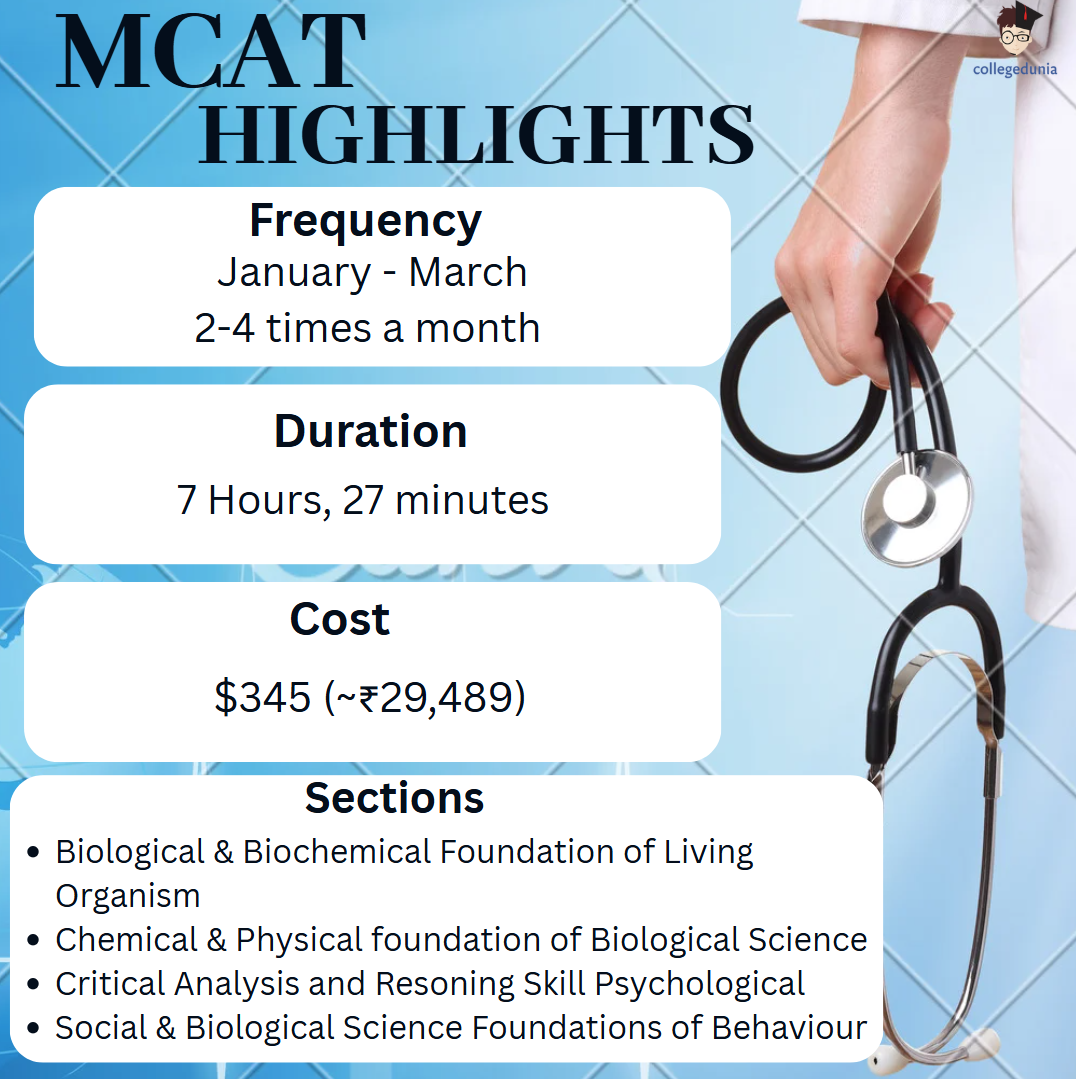
Note: In India, MCAT examination is not conducted. If you want to take the exam must go to a neighboring nation or the United States.
MCAT Eligibility
Candidates must intend to apply to a health professions school to meet the only necessary eligibility requirement for taking MCAT test. Furthermore, to be admitted as an overseas student, one must be enrolled in or hold an MBBS degree. MCAT examination for Indian students must obtain ‘special permission' if they do not intend to apply to a health professions school or are already enrolled in medical courses other than MBBS. To obtain special permission, email mcat@aamc.org, explicitly stating the purpose for taking the exam. Following that, MCAT examination office will analyze and review the request and respond within five working days. Prospective candidates should keep in mind the applicable MCAT registration deadlines.
MCAT Registration 2025
MCAT exam is given several times a year, from January through March and again in September, at hundreds of test centers in the United States, Canada, and worldwide. Check the availability of test dates and locations, then fill out the form on the official website and apply for the exam.
MCAT Registration Process
MCAT is given in international test centers and can be registered on the official website students-residents.aamc.org. To register for this exam, follow the instructions outlined below.
- By creating an account, candidates can create a candidate's AAMC ID and password.
- Enter contact, background, and education information as needed.
- Choose a test date and location.
- Sign the Examinee contract.
- Schedule MCAT examination according to the candidate's availability.
MCAT Registration Fees
Take a glance at the table below to see MCAT Fees 2025. Taxes and other charges may be applied at the relevant rates.
| Registration Process | Registration Fees |
|---|---|
| Standard Registration | $345 |
| Fee Assistance Program Registration | $140 |
Fee Assistance Program Fees
Candidates to get fee assistance must register for the Medical College Admission Test at the following Rescheduling and Cancellations (in USD) charges:
| Standard Change Fees | Date or Test Center Reschedule Fee | Cancellation Refund |
|---|---|---|
| 60 or more days before exam | $50 | $170 |
| 30-59 days before exam | $100 | $170 |
| 10-29 days before exam | $200 | $0 |
| Fee Assistance Program Change Fees | Date or Test Center Reschedule Fees | Cancellation Refund |
|---|---|---|
| 60 or more days before exam | $20 | $70 |
| 30-59 days before exam | $40 | $70 |
| 10-29 days before exam | $90 | $0 |
MCAT Exam with Accommodations
Medical College Admission Test Exam with Accommodations is a unique opportunity provided by AAMC to those with disabilities. If a student has a handicap or medical condition that necessitates a change in the regular test method, they can apply for MCAT examination with accommodations. However, because the complete procedure takes at least 60 days, candidates must submit the candidate's application as soon as possible for the candidate's selected date.
Scheduling MCAT Test
MCAT examination is available in the United States and Canada, as well as in a few major cities across the world. Unfortunately, it is not available in India, and students must fly to their nearest venue to take the exam. Here is a selection of international destinations to consider, including Thailand and Singapore, which are both nearby.
| Australia | France | China |
|---|---|---|
| Germany | Israel | Lebanon |
| Japan | Singapore | Taiwan |
| United Kingdom | Thailand | South Africa |
| Qatar | – | Hong Kong |
MCAT Exam Dates 2025
There are 3 to 4 MCAT exam dates available every month. Here is the 2025 Testing Calendar for candidates looking to book their slot:
| Test Date | 60 Day Deadline | 30 Day Deadline | 10 Day Deadline | Score Release Date |
|---|---|---|---|---|
| January 10 | Nov. 11, 2024 | Dec. 11, 2024 | Dec. 31, 2024 | Feb. 11 |
| April 25 | Feb. 24 | March 26 | April 15 | May 28 |
| April 26 | Feb. 25 | March 27 | April 16 | May 28 |
| May 3 | March 4 | April 3 | April 23 | June 3 |
| May 9 | March 10 | April 9 | April 29 | June 10 |
| May 10 | March 11 | April 10 | April 30 | June 10 |
| May 15 | March 16 | April 15 | May 5 | June 17 |
| May 23 | March 24 | April 23 | May 13 | June 24 |
| May 31 | April 1 | May 1 | May 21 | July 1 |
| June 13 | April 14 | May 14 | June 3 | July 15 |
| June 14 | April 15 | May 15 | June 4 | July 15 |
| June 27 | April 28 | May 28 | June 17 | July 29 |
| June 28 | April 29 | May 29 | June 18 | July 29 |
| July 12 | May 13 | June 12 | July 2 | Aug. 12 |
| July 25 | May 26 | June 25 | July 15 | Aug. 26 |
| August 1 | June 2 | July 2 | July 22 | Sept. 3 |
| August 16 | June 17 | July 17 | Aug. 6 | Sept. 16 |
| August 22 | June 23 | July 23 | Aug. 12 | Sept. 23 |
| August 23 | June 24 | July 24 | Aug. 13 | Sept. 23 |
| September 4 | July 6 | Aug. 5 | Aug. 25 | Oct. 7 |
| September 5 | July 7 | Aug. 6 | Aug. 26 | Oct. 7 |
| September 12 | July 14 | Aug. 13 | Sept. 2 | Oct. 14 |
| September 13 | July 15 | Aug. 14 | Sept. 3 | Oct. 14 |
MCAT Exam Pattern
MCAT test format comprises 230 multiple-choice questions that must be answered in 7.5 hours. It assesses the applicant's general grasp of not only fundamental biology and chemistry, as well as behavior-related ideas, but also their critical thinking and problem-solving abilities. In addition to the testing elements of MCAT exam pattern, a typical exam day might include other responsibilities. The following paragraphs provide more information on the topics covered in each question.
| Section | Questions [MCQ] | Time Allotted |
|---|---|---|
| Test-day Certification | – | 4 minutes |
| Chemical and Physical Foundations of Biological Systems | 44 [passage-related]15 [non-passage-related] | 95 minutes |
| Break [optional] | – | 10 minutes |
| Critical Analysis and Reasoning Skills | 53 [passage-related] | 90 minutes |
| Mid-Exam Break [optional] | 30 minutes | |
| Biological and Biochemical Foundations of Living Systems | 44 [passage-related]15 [non-passage-related] | 95 minutes |
| Break [optional] | 10 minutes | |
| Psychological, Social, and Biological Foundations of Behavior | 44 [passage-related]15 [non-passage-related] | 95 minutes |
| Void Question | – | 3 minutes |
| Satisfaction Survey [optional] | – | 5 minutes |
| Total-Content Time | – | 6 hours and 15 minutes |
| Total “Seated” Time* | – | Approx. 7 hours & 30 minutes |
MCAT Syllabus
The current MCAT test pattern covers a wide range of topics that assess one's intellectual grasp of medicine. A more detailed description, as described on the official MCAT website, is provided below.
| Section | Topics/Skills Tested |
|---|---|
| Chemical and Physical Foundations of Biological Systems | A preliminary level biology, inorganic chemistry and organic chemistry fundamentals. Biochemistry concepts at the level in the first semester of biochemistry courses at most universities. Topics of cellular and molecular biology at the level studied in many colleges and universities in introductory biology sequences and 1st-semester of biochemistry courses. Foundational research methods and statistics concepts as described by many baccalaureate faculty to be important for success in introductory science courses. Individual scientific inquiry and reasoning, research methods, and data-based and statistics skills as applied to the natural sciences |
| Critical Analysis and Reasoning Skills | Analysis, critical reasoning and comprehension skills through critical thinking tasks in passages. Topics of philosophy, ethics, population health, studies of diverse cultures, along with diverse social sciences and humanities disciplines. |
| Biological and Biochemical Foundations of Living Systems | A preliminary level biology, inorganic chemistry and organic chemistry fundamentals. Biochemistry concepts at the level taught in the first semester of biochemistry courses at most universities. Topics of cellular and molecular biology at the level studied in many colleges and universities in introductory biology sequences and 1st-semester of biochemistry courses. Foundational research methods and statistics concepts as described by many baccalaureate faculty to be important for success in introductory science courses. Individual scientific inquiry and reasoning, research methods, and data-based and statistics skills as applied to the natural sciences. |
| Psychological, Social, and Biological Foundations of Behavior | Fundamental topics of psychology, sociology and biology that form a base for to study of behavioral and sociocultural components of health in medical school. Concepts taught at many institutions in 1st-semester psychology and sociology courses. Concepts of biology relating to mental processes and behavior are taught in introductory biology at many colleges and universities. Foundational research methods and statistics concepts as described by many baccalaureate faculty to be important for success in introductory science courses. Skills of scientific inquiry and reasoning, research methods, and data-based and statistics skills as applied to the natural sciences. |
MCAT Scores
MCAT examination has a scoring structure that includes individual section grading as well as total rating. Here are a few examples of points that shed light on MCAT scoring pattern.
- The raw score is calculated by adding all right answers to the four multiple-choice questions.
- There will be no negative marking.
- The section scores are combined to yield a total score ranging from 472 to 528.
- A percentile rank is also supplied based on overall scores, indicating the percentage of applicants scoring higher or lower than the concerned candidate.
MCAT vs NEET
MCAT and NEET are both competitive exams for medical school admission. However, if candidates intend to take any of these examinations, candidates must first comprehend the distinction between the two competitive exams:
| Comparison | NEET | MCAT |
|---|---|---|
| No. of Applicants | Approx 15 lakh students | Approx 85,000 |
| Required for | MBBS in India | MD in US/ Canada/ Australia |
| Eligibility | Class 12th | Bachelor’s degree |
| Difficulty Level | Tough | Moderate |
MCAT Preparation
Preparing for MCAT examination is a difficult task. Students from all around the country take the exam, and getting good grades is something that everyone strives for. So, here are some pointers to help candidates study for MCAT test:
- First and foremost, acquire all exam-related information, from the curriculum to the exam date.
- Take a full-length practice exam to assess a candidate's present understanding. The AAMC provides students with FREE MCAT sample papers that include comments and correct answers in each subject.
- Candidates can also prepare by purchasing practice papers from AAMC.
- MCAT test flash cards help candidates to memorize the difficult sections.
- Gather all the exam resources candidates will need from the official website.
- Begin by preparing the candidate's weak points, but allow time to develop the candidate's already powerful notions.
- Use flashcards, group study, or other methods to help candidates prepare successfully.
- Every week, practice sample papers to measure a candidate's readiness.
- Take a full-length practice test a few days before the exam to identify the candidate's strengths and shortcomings.
- Only work on the weak spots that are not too long and do not put too much strain on the candidate's thinking.
MCAT Preparation Resources
AAMC provides various resources to help students prepare for MCAT. Some of MCAT prep books 2024-2025 are free, while others are quite affordable:
- Free Sample Test by AAMC
- Sample Question Guide
- Free Khan Academy MCAT prep videos
- Free tips for preparation by MCAT
- Roadmap to MCAT Examination Content
MCAT Exam-Day Essentials
candidates must remember to carry the following items to candidate's Medical College Admission Test exam.
- Eyeglasses-subject to visual and physical inspection by test administrators
- MCAT Accepted ID
- Earplugs provided at the test center [personal earplugs are not permitted]
- Storage Key [provided at the test center]
- Noteboard Booklet [provided at the test center]
- Fine-point marker [provided at the test center]
MCAT Practice Test
MCAT sample papers are essential since they simulate the actual exam, allowing candidates to become comfortable with the format and content. They aid in the identification of strengths and shortcomings, allowing for more concentrated study. Furthermore, practice exams increase time management skills while also increasing confidence and readiness for MCAT, a critical step in medical school admissions.
MCAT (Medical College Admission Test) is a standardized exam used for medical school admissions in the United States and Canada. It evaluates applicants' understanding of natural, behavioral, and social sciences. The exam assesses critical thinking, problem-solving abilities, and knowledge of medical ideas. MCAT scores are important in medical school applications.
FAQs
Ques: What is the MCAT exam?
Ans: MCAT (Medical College Admission Test) is a standardized test used in the United States and Canada to assess applicants' readiness for medical school. It evaluates problem-solving, critical thinking, and knowledge of natural, behavioral, and social science concepts and principles.
Ques: When should I take the MCAT exam?
Ans: It is recommended to take MCAT exam when candidates have completed the relevant coursework, usually after candidate's sophomore or junior year of college. This allows candidates to have a strong foundation in the subjects tested on the MCAT.
Ques: Who is eligible for the MCAT exam?
Ans: Candidates who completed or are pursuing an MBBS degree and want to attend a health professional school can take MCAT. Allopathic, Osteopathic, Podiatric, and Veterinary Medicine are some of the best programs you can apply through MCAT.
Ques: Is MCAT for MBBS or MD?
Ans: Aspirants who have pursued and completed an MBBS degree, and want to attend healthcare professional schools can take MCAT.
Ques: How is the MCAT exam scored?
Ans: Each of the four MCAT sections is scored from a low of 118 to a high of 132, with a midpoint of 125. The total MCAT score ranges from 472 to 528, which is the sum of the scores from the four sections.
Ques: How long are MCAT scores valid?
Ans: MCAT scores are valid for three years. For example, if candidates take the exam in 2021, the scores will be valid for medical school applications until 2024.
Ques: Is the MCAT the hardest?
Ans: The difficulty level of MCAT depends on your academic background and preparation time. MCAT exam format consists of 230 multiple-choice questions, and you will be allocated 7.5 hours.
Ques: Can I give MCAT after 12 in India?
Ans: You cannot take MCAT after class 12. MCAT exam is designed for medical professionals who wish to pursue higher education in their respective fields. Check the eligibility criteria in detail from the official website before applying.
Ques: What is a perfect MCAT score?
Ans: MCAT total score ranges on a scale between 472 to 528, and the perfect score depends on the organizations you are applying for. On average, achieving 500+ in MCAT is considered a perfect score.
Ques: What is MCAT Syllabus?
Ans: MCAT syllabus is designed for healthcare professionals and consists of 4 sections: Chemical and Physical Foundations of Biological Systems, Critical Analysis and Reasoning, Biological and Biochemical Foundations of Living Systems, and Psychological, Social, and Biological Foundations of Behavior.
Application Process
MCAT Registration is done by creating an AAMC account and then log in to the registration system on the official website. MCAT test registration process is designed for medical professionals to work in US, Canada, Australia, and the Caribbean Islands. You need to complete the MCAT registration through online mode only. The AAMC organizes MCAT exam multiple times each year.

You need an AAMC ID and an associated username and password to register for the exam. The total seated time for the exam is about 7 hours and 30 minutes. MCAT registration price for standard registration is $345 (29,489 INR). To register for MCAT Assistance Program, you need to pay a fee is $140(11,653 INR). Candidates who are not from Canada, or US Territories will be charged an extra International fee of $120 (9,998 INR) in addition to the initial MCAT registration price.
You will get a 10-day deadline to schedule, reschedule, or cancel a reservation and edit MCAT registration information such as name, address, consents, etc. MCAT exam is computer-based and has four sections. Every section of MCAT exam pattern includes some field test questions relevant to their respective areas. MCAT exam registration for March-June 2025 test dates is open. You can register for MCAT test up to three times a year, four times in two consecutive years, and a maximum of seven times in your lifetime.
MCAT Registration Process
MCAT registration process requires meeting important deadlines. Register for MCAT allows students to select a test date. When creating the account, some official documents required for MCAT registration. Be sure to use the legal name exactly as it appears on the AAMC ID. Candidates need to verify their identity on test day.
Step 1 - Create a login account.

Step 2 - Submit personal details

Step 3 - Answer initial questions like “which best describes you?”
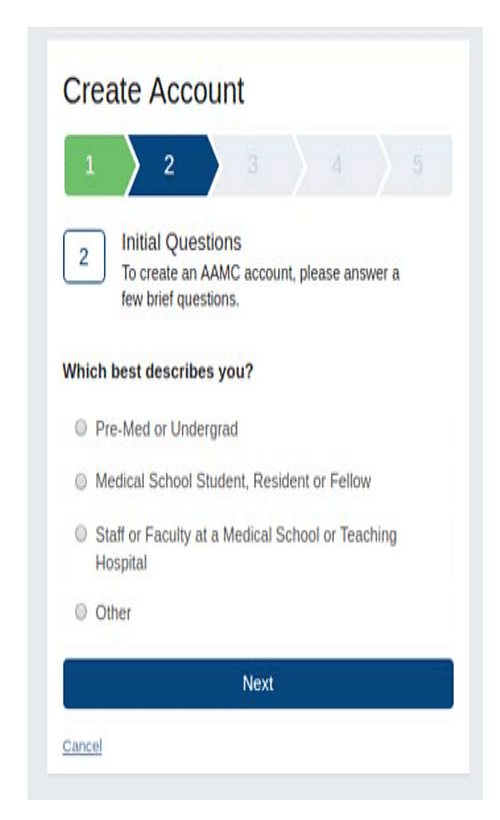
Step 4 - Give relevant answer to the additional questions

Step 5 - Fill in basic details like date of birth, country etc.

Step 6 - Give address information

Step 7 - Create a username, and password and submit the application form.

Step 8 - The next step is payment. According to the AAMC, the standard MCAT registration fee is $345, though late fees apply if deadlines are missed. Payment is made online during the registration process using a credit or debit card.
Step 9 - After completing the registration and payment, students will receive a confirmation email from the AAMC regarding MCAT dates and registration. This email contains the student’s admission ticket and exam instructions.
2025 MCAT Calendar and Scheduling Deadlines
AAMC has released the dates for MCAT registration 2024 on the official website. The MCAT calendar provides testing dates from January through September for medical school applicants preparing for the exam. MCAT registration deadline for January 2024 and March 2024 will open on October 24 and 25, depending on the test center location. Students are required to schedule MCAT registration date 2024 before the 10-day deadline, which is the last date to schedule, reschedule, or cancel the registration. This calendar gives students a timeline to register for the MCAT and understand the deadlines.
There are 3 to 4 MCAT exam dates available every month. Here is the 2025 Testing Calendar for candidates looking to book their slot:
| Test Date | 60 Day Deadline | 30 Day Deadline | 10 Day Deadline | Score Release Date |
|---|---|---|---|---|
| January 10 | Nov. 11, 2024 | Dec. 11, 2024 | Dec. 31, 2024 | Feb. 11 |
| April 25 | Feb. 24 | March 26 | April 15 | May 28 |
| April 26 | Feb. 25 | March 27 | April 16 | May 28 |
| May 3 | March 4 | April 3 | April 23 | June 3 |
| May 9 | March 10 | April 9 | April 29 | June 10 |
| May 10 | March 11 | April 10 | April 30 | June 10 |
| May 15 | March 16 | April 15 | May 5 | June 17 |
| May 23 | March 24 | April 23 | May 13 | June 24 |
| May 31 | April 1 | May 1 | May 21 | July 1 |
| June 13 | April 14 | May 14 | June 3 | July 15 |
| June 14 | April 15 | May 15 | June 4 | July 15 |
| June 27 | April 28 | May 28 | June 17 | July 29 |
| June 28 | April 29 | May 29 | June 18 | July 29 |
| July 12 | May 13 | June 12 | July 2 | Aug. 12 |
| July 25 | May 26 | June 25 | July 15 | Aug. 26 |
| August 1 | June 2 | July 2 | July 22 | Sept. 3 |
| August 16 | June 17 | July 17 | Aug. 6 | Sept. 16 |
| August 22 | June 23 | July 23 | Aug. 12 | Sept. 23 |
| August 23 | June 24 | July 24 | Aug. 13 | Sept. 23 |
| September 4 | July 6 | Aug. 5 | Aug. 25 | Oct. 7 |
| September 5 | July 7 | Aug. 6 | Aug. 26 | Oct. 7 |
| September 12 | July 14 | Aug. 13 | Sept. 2 | Oct. 14 |
| September 13 | July 15 | Aug. 14 | Sept. 3 | Oct. 14 |
MCAT Rescheduling and Cancellation Process
Candidates can reschedule or cancel the examination dates through the AAMC account on the official website. The AAMC charges fees for rescheduling MCAT registration dates within the provided deadlines. Knowing this deadline for MCAT registration and fees is important for students to plan and schedule the exam. Having an idea about the deadlines helps avoid expensive last-minute changes. If a candidate cancels the exam within the provided deadlines, they will receive a refund amount. The additional $120(INR 9,988) International MCAT booking fee is non-refundable on registration cancellation.
| Standard Exam Rescheduling Fee and Cancellation Refund | ||
|---|---|---|
| Deadline | Rescheduling Fee | Cancellation Refund |
| 60 or more days before the exam | $50 | $170 |
| 30–59 days before the exam | $100 | $170 |
| 10–29 days before the exam | $200 | $0 |
| Assistance Program Rescheduling Fee and Cancellation Refund | ||
|---|---|---|
| Deadline | Rescheduling Fee | Cancellation Refund |
| 60 or more days before the exam | $20 | $70 |
| 30–59 days before the exam | $40 | $70 |
| 10–29 days before the exam | $80 | $0 |
Meeting all registration deadlines for the MCAT is important for students to avoid charges. Candidates can apply for MCAT accommodations application from the official website. Students must have a clear idea about the MCAT deadlines, registration fees, cancellation, and rescheduling charges.
FAQs
Ques: When can I register for the MCAT?
Ans: MCAT registration typically opens in January for the following testing year. You can find the specific registration dates and deadlines on the AAMC website
Ques: How many times can I take the MCAT?
Ans: You can take the MCAT up to three times in a single testing year, four times in two consecutive years, and a maximum of seven times in your lifetime.
Ques: What ID will I need on test day?
Ans: You will need to bring a government-issued photo ID that matches the name on your AAMC registration exactly.
Ques: How do I choose a test date and center?
Ans: You can select your preferred test date and center during the registration process. Testing centers and availability will be displayed while completing MCAT registration process.
Ques: Can I reschedule my MCAT exam?
Ans: You can reschedule MCAT exam for a different date within the same testing year. However, you need to pay a rescheduling fee.
Ques - When does MCAT registration open?
Ans - MCAT Registration portal opens on October 9, 2023.
Ques - How to register for MCAT test
Ans - Create an AAMC account on the official website. This account allows students to register for the MCAT, view available test dates, and manage their application.
Ques - What is MCAT registration fee waiver?
Ans - The waiver is a type of Application, where the applicant will not be charged an application fee based on special accommodation or meeting certain citizenship, and family income.
Ques - Who is eligible for MCAT exam?
Ans - Candidates who are planning to pursue careers in Allopathic, Osteopathic, Podiatric, and Veterinary can appear for the MCAT test.
Ques - Is MCAT hard for Indian students?
Ans - Medical Aspirants consider MCAT as one of the most challenging entrance exams.
Ques - Can Indian students clear MCAT?
With expert guidance and proper preparations, Indian students can clear MCAT exam.
Ques - Can I give MCAT without MBBS in India?
Ans - Candidates must hold or be enrolled in an MBBS degree to take MCAT exam.
Ques - Is MCAT required in USA?
Ans - Most of the medical schools in the United States and several in Canada require MCAT scores.
Ques - Is MCAT all multiple choice?
Ans - MCAT exam completely has multiple choice questions.
Ques - What is the syllabus of MCAT?
Ans - MCAT exam 4 sections, 3 of which test the candidate’s scientific understanding, and 1 tests critical thinking and reasoning abilities.
Exam Pattern
MCAT exam pattern is designed to test your understanding of scientific concepts and includes 4 sections. The biochemical, physical, psychological, and critical analysis and reasoning skills are the four sections of MCAT paper pattern. You will be allocated 7 hours and 30 minutes to answer and complete the questions of MCAT exam pattern. The format of MCAT paper pattern conducts a computer-based exam that examines a medical college student's critical thinking, problem-solving, and knowledge of scientific concepts and principles.

The format of MCAT paper pattern conducts a computer-based exam that examines a medical college student's critical thinking, problem-solving, and knowledge of scientific concepts and principles. The biochemical, physical, and psychological, 3 sections consist of 59 questions each. You will be allocated 95 minutes each for these 3 sections. The critical analysis, and reasoning skills section of MCAT question pattern includes 53 questions. You will get 90 minutes to complete the critical analysis, and reasoning skills section. You can refer to the AAMC official website to check the syllabus, MCAT exam dates, and test centers.
The biochemical, physical, and psychological MCAT question paper pattern uses a combination of passage‐based and discrete questions. The critical reasoning section includes all passage-based questions. Having a better understanding of MCAT exam pattern is very important to achieve a good score. The total score of MCAT syllabus 2025 ranges on a scale of 472 to 528. The 4 sections of MCAT paper pattern are scored on a scale of 118 to 132. You can get updated and customized handbooks, and sample papers of MCAT test patterns from the AAMC official website, or you can join courses from other reputed study resources.
- Test Format
1.1 Exam Time - Exam Syllabus
2.1 Chemical & Physical Foundations of Biological Systems Section
2.2 Biological & Biochemical Foundations of Living Systems Section
2.3 Psychological, Social, and Biological Foundations of Behavior section
2.4 Critical Analysis & Reasoning Skills section - Preparation Tips
- FAQs
MCAT Test Format
MCAT test format covers the four exam sections of various scientific disciplines. MCAT question paper pattern contains only multiple-choice questions. MCAT exam Registration is conducted 30 times a year. The physical, psychological, and biological foundation sections consist of 59 questions. The Critical Analysis and Reasoning Skills section of the current MCAT format consists of 53 questions and has 9 passages.
| Test Section | Question Pattern |
|---|---|
| Chemical and Physical Foundations of Biological Systems | 59 questions consisting of:
|
| Biological and Biochemical Foundations of Living Systems | 59 questions consisting of:
|
| Psychological, Social, and Biological Foundations of Behavior | 59 questions consisting of:
|
| Critical Analysis and Reasoning Skills | 53 questions consisting of:
|
MCAT Exam Time
The total seated time allowed for MCAT exam format is 7 hours 30 minutes, including breaks. MCAT exam layout has 230 questions, including discrete questions, and passage-based questions. MCAT exam breakdown helps students practice time management for the exam format. Students must follow and practice the MCAT exam structure to ace the exam preparation.
| Section | Number of Questions | Time Allotted |
|---|---|---|
| Test-day certification | 4 minutes | |
| Tutorial (optional) | 10 minutes | |
| Chemical and Physical Foundations of Biological Systems | 59 | 95 minutes |
| Break (optional) | 10 minutes | |
| Critical Analysis and Reasoning Skills | 53 | 90 minutes |
| Mid-exam break (optional) | 30 minutes | |
| Biological and Biochemical Foundations of Living Systems | 59 | 95 minutes |
| Break (optional) | 10 minutes | |
| Psychological, Social, and Biological Foundations of Behavior | 59 | 95 minutes |
| Void question | 3 minutes | |
| End-of-day survey (optional) | 5 minutes | |
| Total content time | 6 hours and 15 minutes | |
| Total “seated” time | About 7 hours and 30 minutes | |
MCAT Exam Syllabus
MCAT exam syllabus contains four sections, that evaluate the student’s medical knowledge. MCAT question paper pattern required to demonstrate scientific inquiry and reasoning, research methods, and statistics skills as applied to the natural sciences. MCAT exam syllabus for Indian students is the same as the globally standardized, with no country-specific variations. Students must have good knowledge of basic research methods and statistics concepts to understand MCAT test layout.
Chemical and Physical Foundations of Biological Systems Section
The Chemical and Physical Foundations section format of MCAT exam evaluates student’s understanding of basic chemical and physical principles. This section examines comprehension of physical, and biochemical tissue, organ, and organ system functions and knowledge of principles governing human body processes.
This section is designed to evaluate candidates on:
- Introductory-level biology, organic and inorganic chemistry, and physics concepts.
- Molecular biology topics of introductory biology sequences.
- Basic research methods and statistics concepts
Biological and Biochemical Foundations of Living Systems Section
The Biological and Biochemical Foundations section of the MCAT test pattern evaluates a student's ability to combine knowledge of biological and biochemical concepts. Students are required to scientific inquiry and reasoning skills to solve problems related to living organism processes.
This section is designed to evaluate candidates on:
- Introductory-level biology, inorganic chemistry, and organic chemistry concepts.
- Biochemistry concepts.
- Cellular and molecular biology topics.
Psychological, Social, and Biological Foundations of Behavior section
This section of MCAT exam layout emphasizes concepts that a doctor must know in order to serve an increasingly diverse population. It evaluates knowledge of concepts needed for physicians, including the impact of behaviors on health and dealing with human, and social issues.
This section is designed to evaluate candidates on:
- Psychology, sociology, and biology concepts.
- Behavioral and sociocultural determinants of health.
- Biology concepts that relate to mental processes and behavior.
Critical Analysis and Reasoning Skills section
The Critical Analysis and Reasoning Skills section of the MCAT pattern is similar to many of the verbal reasoning tests. This section is relatively short and consists of between 500 and 600 words, but they are complex.
This section is designed to evaluate candidates on:
- Comprehension, analysis, and reasoning skills by asking to critically analyze the information provided in passages.
- Include content from ethics, philosophy, studies of diverse cultures, population health, and a wide range of social sciences and humanities disciplines.
- Provide all the information students need to answer questions in the passages and questions themselves.
MCAT Preparation Tips
MCAT is one of the most important exams for medical college admission. Proper preparation is necessary to get the desired score. Candidates can check the valuable tips from previous MCAT takers on how to best prepare for the exam on the official AAMC website. Some of the key tips include:
- Start preparing early, create a long-term study schedule, and plan and adjust it as needed.
- Use free online resources and buy essential paid materials for effective preparation.
- Do not stress about what others say and focus on preparation abilities.
- Read books to improve critical analysis skills.
- Find a study method that works, rather than following what others recommend.
- Take continuous full-length practice tests and focus on official AAMC materials for realistic practice.
- Practice time management by executing the long exam duration.
- Take breaks during preparation to avoid burnout.
- Discuss topics with professors, and mentors if you have questions.
- Avoid distractions while studying or taking practice tests.
MCAT is a computer-based test consisting of four sections with multiple-choice questions, and you will face in total of 230 questions. You must understand MCAT paper pattern, exam timelines, and syllabus to best prepare for admission to their desired medical college. MCAT exam pattern evaluates a candidate's scientific knowledge and ability.
FAQs
Ques: What is the format of the MCAT exam?
Ans: MCAT is a computer-based test consisting of four sections with multiple-choice questions. You will face in total of 230 questions.
Ques: How long is the MCAT exam?
Ans: The total test duration is 7 hours and 30 minutes, with a testing time of 6 hours and 15 minutes. There are two optional breaks during the exam.
Ques: How many questions are on the MCAT exam?
Ans: There are a total of 230 multiple-choice questions across the four sections. The biochemical, physical, and psychological, 3 sections consist of 59 questions each, and the critical analysis section includes 53 questions.
Ques: How many sections are there on the MCAT exam?
Ans: There are four sections on the MCAT exam. Biological and biochemical foundations of living systems, psychological, social, and biological foundations of behavior, chemical and physical foundations of biological systems, and critical analysis and reasoning skills are the four sections of the exam.
Ques: What types of questions are on the MCAT exam?
Ans: MCAT exam consists of multiple-choice questions. The biochemical, physical, and psychological MCAT question paper pattern uses a combination of passage‐based and discrete questions. The critical reasoning section includes all passage-based questions.
Ques - What are the 7 MCAT subjects?
Ans - General Chemistry, Organic Chemistry, General Biology, Biochemistry, Physics, Psychology, and Sociology.
Ques - What is MCAT exam syllabus?
Ans - The four sections in the MCAT syllabus are - Chemical and physical foundations of biological systems. Biological and biochemical foundations of living systems. Psychological, social, and biological foundations of behavior. Critical analysis and reasoning skills.
Ques - What is the highest MCAT score?
Ans - 528 is the highest MCAT score.
Ques - Who is eligible for the MCAT exam?
Ans - Students from U.S. and Canada with a UG degree are eligible for the MCAT exam. International candidates pursuing or completed MBBS can take MCAT.
Ques - Can I give MCAT from India?
Ans - MCAT does not have test centers in India, Students are required to fly to neighboring countries or USA to take the MCAT exam.
Ques - How can I prepare for MCAT in India?
Ans - Prepare a long-term term plan for study, and follow the proper timetable that stretches over 4–6 months.
Ques - Can I self study MCAT?
Ans - There are many free study materials, and practice tests available for student’s preparation. Candidates can visit the official AAMC website for more resources.
Ques - What is the lowest passing MCAT score?
Ans - 472 is the lowest passing MCAT score.
Ques - Is the MCAT exam online or offline?
Ans - MCAT registration mode is online, and the exam mode is computer-based.
Ques - Do I bring my laptop to MCAT?
Ans - Touching an electronic device while exam is a violation of MCAT policies.