

Common Law Admission Test
The Common Law Admission Test (CLAT) is the entrance exam for undergraduate and postgraduate law programs at National Law Universities (NLUs). It is a centralized test used for admission to these institutions.
Overview
CLAT 2026 Second Merit List Released
The National Law Universities (NLUs) released the CLAT 2026 Second Merit List on 22nd January 2026. Candidates on this list can pay the confirmation fee for "Freeze" and "Float" options until 29th January 2026.
The third merit list will be released by 5th February. The fourth and fifth allotment lists are expected on 2 May and 15 May 2026, respectively.
- Admissions in CLAT 2026 are conducted for 25 participating NLUs.
- These NLUs offer 3,000 to 3,200 undergraduate (UG) seats in total.
- In Round 1, around 100% of the available seats are open for allotment.
- Other rounds will involve seat upgrades, withdrawals, and distribution of vacant seats.
Candidates with All India Rank (AIR) 1 to 100 secured seats in the 1st Round. AIR under 500 got seats in Tier 1 NLUs, whereas AIR 500 to 1500 are expected to get seats in Round 2 to 3.
By CLAT 2026, around 3,500+ seats will be offered in 24 participating NLUs. As per the previous year's trends, the top 5 NLUs will close the rank between the top 200 and 500.
CLAT Counselling Schedule (Out)
The CLAT Counselling Process will begin today at 6 P.M. The authorities have released instructions on CLAT counselling.
| Schedule | Particulars |
|---|---|
| 06 pm, December 17, 2025 to 10 pm, December 27, 2025 | Registration for admissions counselling (including payment of counselling registration fee) |
| January 7, 2026, at 10 am | Publication of the first allotment list (first round begins) |
| January 7, 2026 (10 am) to January 15, 2026 (1 pm) | Payment of the confirmation fee and admission by NLUs for the first allotment list |
| January 22, 2026, at 10 am | Publication of the second allotment list (second round begins) |
| January 22, 2026 (10 am) to January 29, 2026 (1 pm) | Payment of the confirmation fee and admission by NLUs for the second allotment list |
| February 5, 2026, at 10 am | Publication of the third allotment list (third round begins) |
| February 5, 2026 (10 am) to February 12, 2026 (1 pm) | Payment of the confirmation fee and admission by NLUs for the third allotment list |
| April 24, 2026, by 5 pm | Payment of university fees by candidates who chose the Freeze option in the first three rounds |
| May 2, 2026, at 10 am | Publication of the fourth allotment list (fourth round begins) |
| May 2, 2026 (10 am) to May 8, 2026 (1 pm) | Payment of the confirmation fee and admission by NLUs for the fourth allotment list |
| May 15, 2026, at 10 am | Publication of the fifth and final allotment list (fifth round begins) |
| May 15, 2026 (10 am) to May 20, 2026 (1 pm) | Payment of the confirmation fee and admission by NLUs for the fifth allotment list |
| As notified by the respective NLUs | Payment of university fees by candidates who chose the Freeze option in the fourth and fifth rounds |
CLAT 2026 Question Paper with Answer Key and Solution PDF
| CLAT Paper | Download PDF | Detailed Solution |
|---|---|---|
| CLAT 2026 Question Paper with Answer Key Set A | Download | Check Solution |
| CLAT 2026 Question Paper with Answer Key Set B | Download | Check Solution |
| CLAT 2026 Question Paper with Answer Key Set C | Download | Check Solution |
| CLAT 2026 Question Paper with Answer Key Set D | Download | Check Solution |
What is the CLAT Exam 2026?
CLAT 2026 is a national-level entrance examination conducted every year. It is held for admission into UG (5-Year LLB) and PG (LLM) programs offered by 24 NLUs in India.
- Around 1 lakh candidates appear every year for 3,000 to 3,500 NLU seats.
- Career options after CLAT include corporate law, litigation, judiciary, civil services, legal policy and global law firms.
- A single counselling process is followed for seat allotment as per AIR and category reservation.
CLAT 2026 Paper Analysis and Expected Cutoff
If you appeared for CLAT 2026, a video by @LegalEdgeCLATCoachingby Toprankers provides complete paper analysis and expected cutoff. The video is available for viewing on the page.
Some states and private law entrance exams allow admission into 5-Year Law programs without CLAT.
Alternative Exams are:
- AILET (NLU Delhi)
- SLAT (Symbiosis)
- LSAT—India (Private Universities)
- MHCET Law (Maharashtra Gov Colleges)
Answer Key Release Timeline
The CLAT Provisional Answer key is generally released 2-3 days after the exam. The final answer key is released after objections are reviewed.
| Stage | Expected Timeline |
|---|---|
| Provisional Answer Key | Within 72 hours post-exam |
| Final Answer Key | After the review of objections |
| Score Basis | Final key only |
CLAT 2026 Result Date
The CLAT Results are usually released after 7-10 days of exams and will be released online.
- It will be downloaded online from the official website.
- Includes AIR+Scorecard.
- It is mandatory for participation in counselling.
- No separate category-wise scorecard is required.
CLAT 2026 Provisional Answer Key
The Release of the CLAT Provisional Answer Key is the first step after the CLAT Exam. The CLAT Answer Key includes the correct response for all the questions, which helps candidates cross-check their attempts.
You can estimate your score and expected ranking before the official results.
CLAT 2026 Answer Key: Release Timeline & Process
| Event | Expected / Tentative Date |
|---|---|
| Provisional Answer Key Release | 10-Dec-2025 at 5 PM |
| Objection Window Opens | 5:00 PM on 10th December 2025 |
| Last Date to Raise Objections | Usually 1–2 days after provisional key release — e.g. till 12-Dec-2025 (5 PM) as per recent announcements. |
| Final Answer Key Release | 5:00 PM on 12th December 2025. |
| Result Declaration | Shortly after the final answer key — expected by mid-December 2025 |
How to Access & Challenge CLAT 2026 Answer Key
After the release of the CLAT Provisional Answer key, download the PDF from the official website and compare your responses. If there are any discrepancies, raise the objections online.
By using the answer key properly, candidates can estimate their score before the release of the CLAT Result.
CLAT 2026: Answer Key Download & Objection Process
| Action | Details |
|---|---|
| Where to download | Official website Consortium of National Law Universities (consortiumofnlus.ac.in), under “CLAT 2026 → Answer Key / Question Paper” section |
| Format | PDF — set-wise (Set A / B / C / D) with question paper and correct answers |
| Compare & Calculate Score | Use official marking scheme: +1 for correct, 0.25 for wrong, 0 for unanswered |
| Objection Method | Via online portal — login, select “Submit Objection,” choose question number/booklet set, provide reason & supporting doc (if any) |
| Objection Fee | ₹ 1,000 per question challenged (refundable if objection is upheld) |
| Final Answer Key | Released after consideration of objections; final evaluation & result is based on it |
CLAT 2026: Initial Paper Analysis
The CLAT 2026 Exam has been conducted successfully. As per candidates, the exam was moderate to difficult, with a major focus on comprehension and real-world reasoning questions.
CLAT 2026 Exam Analysis: Section-Wise Breakdown
The CLAT 2026 exam had five sections. The table below shows the number of questions, difficulty, and good attempts for each section.
| Section | No. of Qs | Reported Difficulty | Key Highlights | Good Attempts |
|---|---|---|---|---|
| English Language | 22–26 | Moderate | Long passages; vocabulary in context is manageable | 17–20 |
| Current Affairs & GK | 28–32 | Moderate to Tough | Heavily analytical current affairs; limited static | 18–22 |
| Legal Reasoning | 28–32 | Moderate | Principle-based scenario questions; required precision | 20–24 |
| Logical Reasoning | 22–26 | Easy to Moderate | Shorter arguments; direct reasoning | 18–21 |
| Quantitative Techniques | 10–14 | Moderate to Tough | Data-based questions; time-consuming | 6–9 |
According to many candidates, the CLAT 2026 exam was slightly different from the previous year's paper.
Attempts Needed for a High Score
To score 95 or above, you need a high number of accurate attempts. Aim for around 92 to 105 attempts with high precision to reach the top percentile rank.
| Percentile Target | Attempts | Accuracy |
|---|---|---|
| 99+ | 100–105 | 90%+ |
| 95–98 | 92–98 | 85–90% |
Difficulty Trend in the Last 3 Years
You can understand the likely difficulty of this year's exam by looking at past trends. The table below shows the difficulty level and the most challenging section for the last three years.
| Year | Difficulty Level | Challenging Section |
|---|---|---|
| 2024 | Moderate | LR passages |
| 2023 | Mod–Hard | GK & Current Affairs |
| 2022 | Moderate | Quantual MCQs |
CLAT 2026 Marks vs Rank
The main question for candidates is what rank they will get with their score. NLU admissions are based on ranks, and a difference of a few marks can change your position in the merit list.
The expected marks vs rank for CLAT 2026 is based on the exam's difficulty and previous year's analysis.
- With a score of 98+, you can get a rank among the top 200, which increases your chances in top NLUs.
- A difference of 90 to 95 and 95-100 marks can change your rank by hundreds, making accuracy and time management important.
- A score range of 80 to 90 remains competitive for mid-level NLUs or programmes with more seats.
| Score Range (out of 120) | Estimated All-India Rank Range | Admission Chances / Tier of NLUs |
|---|---|---|
| 98 – 120 | Top 1–200 | Very strong — likely top NLUs (e.g. NLSIU Bengaluru / NALSAR Hyderabad / WBNUJS Kolkata) |
| 92 – 97 | 200–500 | Competitive — good shot at top 5–6 NLUs or high-demand programmes |
| 85 – 91 | 500–2,500 | Good — solid chances at mid-to-high NLUs or good branches in top NLUs |
| 80 – 84 | 2,500–4,500 | Decent — may get into mid-tier or lower-tier NLUs, depending on seat availability & category |
| 70 – 79 | 4,500–9,500+ | Marginal — likely lower-tier NLUs or state universities; top NLUs unlikely for the General category |
| 60 – 69 | 10,000–20,000+ | Limited — admission to non-NLU law colleges or the least preferred NLUs, especially for reserved categories |
| Below 60 | 20,000+ | Unlikely to secure a seat in major NLUs; options limited to local/state colleges or private universities |
CLAT 2026 Score Calculation Process
The CLAT exam follows a negative marking system. Each correct answer gives you 1 mark, and every incorrect answer deducts 0.25 marks.
CLAT uses a single raw scoring model. The final answer key can be directly determined using AIR Rank without a normalisation process.
- Accuracy matters more than the number of attempts; guessing too many can reduce your score due to negative marking.
- There is no partial marking, and all questions are single-choice objective questions.
CLAT 2026 Marking Scheme
The marking scheme is straightforward. You get one mark for a correct answer and lose a quarter of a mark for a wrong one.
CLAT Marking Scheme and Score Calculation
The CLAT exam has 120 multiple-choice questions (MCQs). Each correct answer gives you +1 mark, and each wrong answer deducts 0.25 marks.
Unanswered questions do not change your score. Your raw score is the total marks you get, and this raw score is used directly for your All India Rank (AIR).
| Particulars | Details | Impact on Score |
|---|---|---|
| Total Questions | 120 (MCQs) | Determines max raw score |
| Marks for Each Correct Answer | +1 | Increases overall score |
| Penalty for Each Wrong Answer | –0.25 | Negative impact: reduces marks |
| Marks for Unanswered Questions | 0 | No change in total score |
| Score Range | 0 to 120 (raw marks) | Used directly for the AIR ranking |
| Normalization | Not Applicable | Raw marks = Final marks |
| Tie-Breaking Parameters | Legal Reasoning score → Older age → Computerised lottery | Used when the marks are the same |
CLAT Previous Year Question Paper
If you are appearing in CLAT 2026, you should solve and look through the CLAT Previous Year Question Paper. The Previous year's Question Paper for CLAT is attached below.
You can get familiar with different types of questions that can be asked.
| Year | Slot | Paper |
|---|---|---|
| 2025 | A | Click Here |
| B | Click Here | |
| C | Click Here | |
| D | Click Here | |
| 2024 | A | Check Here |
| B | Check Here | |
| C | Check Here | |
| D | Check Here | |
| 2023 | Check Here | |
| 2022 | Check Here |
CLAT 2026 Cut-Off: What Rank Gets You Which NLU?
Understanding the CLAT cut-off is very important. You can now check the College Predictor to check colleges for admission.
This tool allows you to see which college you currently qualify for based on your CLAT cut-off score and helps you identify where you aspire to go.
- The expected CLAT cutoff 2026 is 90+ with a CLAT closing rank of 97 for NLU Bengaluru.
- For NALSAR Hyderabad, the expected cutoff is 90+ (158 rank), and for West Bengal NLU, the expected CLAT cutoff is 90+ (262 rank).
- For NLU Jodhpur and NLU Bhopal, the expected CLAT cutoff 2026 is 84+.
| College Name | CLAT Score | Opening Rank | Closing Rank |
|---|---|---|---|
| NLU, Bengaluru | 90+ | 1 | 97 |
| NALSAR, Hyderabad | 90+ | 6 | 158 |
| The West Bengal NLU, Kolkata | 90+ | 140 | 262 |
| NLU Jodhpur | 84+ | 170 | 341 |
| NLU, Bhopal | 84+ | 311 | 404 |
| Gujarat NLU, Gandhinagar | 84+ | 210 | 429 |
| MNLU Mumbai | 82+ | 99 | 547 |
| Dr Ram Manohar Lohiya NLU, Lucknow | 75+ | 410 | 694 |
| HNLU Raipur | 75+ | 434 | 707 |
| NLU, Odisha | 72+ | 591 | 10180 |
CLAT 2026 Result & Counselling: What Happens Now?
The CLAT 2026 Result can be released anytime in the last week of December 2025. You should follow a proper process for the result download.
The merit list will be published, and centralised counselling for proper seat allotment.
CLAT 2026 Counselling Process
The CLAT 2026 counselling process begins after the results are declared. It is a structured seat allotment process conducted by the Consortium.
The table below explains each stage of the counselling process.
| Stage | What Happens | What You Need To Do |
|---|---|---|
| Result Declaration | Scorecard released with AIR & category rank | Download scorecard & analyse rank vs expected NLU |
| Registration for Counselling | Consortium opens counselling portal | Pay the counselling fee & register |
| Choice Filling & Locking | Select and arrange NLUs in preference order | Carefully prioritise colleges based on cutoff trends |
| Seat Allotment Rounds (Round 1/2/3 etc.) | Seats allotted as per rank, category & preference | Accept seat / apply for upgrade/exit option |
| Document Upload & Verification | Verification done online by the allotted NLU | Upload the required docs within the deadline |
| Fee Payment | Final seat confirmation | Pay the admission fee to the allotted NLU |
| Upgradation Window | Option to upgrade to a better preference (if seats are available) | Continue in the system if interested |
CLAT College Predictor 2026
The CLAT College predictor uses the seat intake information along with expected competition. It helps you get an estimation of NLU, and you can aim according to your rank or score.
You can check the CLAT college predictor by MyKollege. You have to enter your rank, reservation category and state to check the college you can get after the CLAT Result is out.
Check:
- CLAT Counselling
- CLAT Merit List
CLAT 2026: List of Participating Institutes
The CLAT 2026 Exam is open for admission into integrated UG and PG Law courses across law schools in India. This includes 24 NLUs, with each offering seats based on CLAT Rank, along with other institutes accepting CLAT Scores.
Key NLUs Participating in CLAT 2026 (UG Seat Intake)
| NLU / University | Approx. UG Seats (5-Year Law via CLAT) |
|---|---|
| NLSIU Bengaluru | 310 |
| NALSAR University of Law, Hyderabad | 132 |
| WBNUJS Kolkata | 132 |
| NLU Jodhpur | 164 |
| GNLU Gandhinagar | 172 |
| NLIU Bhopal | 202 (BA-LLB + BSc-LLB) |
| HNLU Raipur | 170 |
| RMLNLU Lucknow | 169 |
| RGNUL Patiala | 180 |
| NUALS Kochi | 60 |
| DSNLU Visakhapatnam | 120 |
| MNLU Mumbai | 100 |
FAQs for CLAT 2026
Which law programs and top NLUs accept CLAT scores?
The CLAT Scores are used for 5-Year Integrated LLB and LLM Admissions in NLUs and law institutes.
- It is accepted by all 25+ members of NLUs, use the CLAT Score for their undergraduate admissions.
- For CLAT PG Admissions (LLM), it also follows the same kind of pattern and will be accepted by all participating NLUs.
What is the exam pattern and marking scheme for CLAT 2026?
The CLAT Exam Pattern and Marking Scheme is the same as the previous year, with 120 questions, making a total of 120 marks, with research-based passages, five sections, and negative marking.
| Response Type | Marks |
|---|---|
| Correct Answer | +1 |
| Incorrect Answer | -0.25 |
| Not Attempted | 0 |
| Total Marks | 120 |
When will CLAT 2026 counselling start after the results?
The CLAT Counselling starts immediately after the results are declared. It will follow a structured seat allotment process.
Which Law Programs and NLUs Accept CLAT Scores?
CLAT scores are used for admissions to 5-Year Integrated LLB and LLM programs. The score is accepted by all 25+ member NLUs for their undergraduate admissions.
For CLAT PG (LLM) admissions, the same pattern is followed. The score is accepted by all participating NLUs.
CLAT 2026 Exam Pattern and Marking Scheme
The CLAT exam pattern and marking scheme for 2026 is the same as the previous year. The exam has 120 questions, making a total of 120 marks.
The paper contains research-based passages and five sections. Negative marking applies for incorrect answers.
| Response Type | Marks |
|---|---|
| Correct Answer | +1 |
| Incorrect Answer | -0.25 |
| Not Attempted | 0 |
| Total Marks | 120 |
When Does CLAT 2026 Counselling Start?
CLAT counselling starts immediately after the results are declared. The process follows a structured seat allotment procedure.
| Stage | Timeline |
|---|---|
| Registration & Fee Payment | Same week as the result |
| Preference Locking | After registration |
| Rounds | 3–4 allotment rounds |
| Documentation | Mandatory for confirmation |
Rules on Rough Sheets, Pens and Stationery
The exam centre provides all the writing material. Personal stationery is not allowed in the examination hall.
| Item | Provided by Centre |
|---|---|
| Black Pen | Yes |
| Rough Sheets | Yes (must return) |
| Geometry Box/Calculator | No |
Eligibility Criteria
CLAT 2026 Eligibility Criteria
The Consortium of NLUs sets the eligibility criteria for the CLAT 2026 exam. Candidates must meet these requirements to be admitted to law courses.
Eligibility is based on educational qualification, minimum marks, age, and nationality. The key points for CLAT eligibility are listed below.
- CLAT can be pursued after completing Class 12 or graduation.
- There is no minimum age requirement to apply for the exam.
- CLAT can be taken after completing B.Tech, but minimum required marks are necessary.
- NRI candidates are eligible for CLAT 2026 but must follow admission guidelines.
- The tie-breaking procedure for equal marks includes higher marks in Legal Aptitude and age preference.
CLAT 2026 Eligibility Criteria for UG Law Courses
Candidates who have cleared Class 12 or are appearing for Class 12 can apply for the CLAT exam 2026. General/OBC/PwD/NRI/PIO/OCI candidates must have 45% marks and SC/ST candidates must have 40% marks.
| Criterion | Details |
|---|---|
| Educational Qualification | Passed or appearing in Class 12 / equivalent exam |
| Minimum Marks (Gen/OBC/PwD/NRI/PIO/OCI) | 45% aggregate |
| Minimum Marks (SC/ST) | 40% aggregate |
| Appearing Candidates | Allowed—must submit passing proof at admission |
| Age Limit | No upper or lower age limit |
| Nationality | Indian, NRI, OCI, PIO; Foreign nationals with NLU protocols |
| Number of Attempts | Unlimited, as long as eligibility is met each time |
| Tie-Breaker Sequence | 1. Legal Aptitude marks → 2. Age → 3. Draw of lots |
| Registration Start | 1 August 2025 |
Educational Qualification and Minimum Marks
Candidates must have passed the 10+2 or equivalent examination. Candidates appearing for their qualifying exams in March/April 2026 are also eligible.
Appearing candidates must provide proof of passing the exam at the time of admission. The minimum marks required are different for different categories.
- General/OBC/PWD/NRI/PIO/OCI: 45% or equivalent.
- SC/ST: 40% or equivalent.
CLAT Age Eligibility 2026
There is no upper age limit for the CLAT exam. There is also no lower age limit mentioned in the eligibility criteria.
CLAT Nationality Eligibility 2026
Indian Nationals, NRIs, OCIs, and PIOs are eligible to apply for CLAT 2026. Foreign nationals are also eligible for CLAT 2026, but through the NRI quota.
NRI candidates must follow the admission guidelines set by the respective NLUs.
CLAT Attempts and Flexibility 2026
There is no limit on the number of attempts for the CLAT exam. Candidates can apply as long as they meet the eligibility criteria each time.
CLAT Eligibility Tie-Breaking Rules 2026
When two or more candidates score equal marks, a tie-breaking procedure is used. The sequence for resolving ties is as follows.
- Higher marks in Legal Aptitude.
- Age preference.
- Draw of lots.
How CLAT Scores Are Used
The Consortium of NLUs organizes CLAT 2026. Participating NLUs and other colleges accept CLAT scores for admission to their UG and PG programs.
Candidates must meet the eligibility criteria set by the respective NLUs. Meeting the CLAT eligibility criteria allows candidates to fill the CLAT 2026 application form.
CLAT UG Eligibility 2026
Candidates appearing for CLAT UG 2026 must meet the following qualifications to be eligible for the exam:
- The CLAT Eligibility after 12th requires candidates to clear Class 12 from a recognized board.
- With a 45% CLAT eligibility percentage for the General/OBC/PwD/NRI/PIO/OCI.
- Students who come under the SC/ST categories are required to score at least 40% from any recognized board.
| Category | Minimum Marks Required in Class 12 (10+2) |
|---|---|
| General / OBC / PwD / NRI / PIO / OCI | 45% aggregate |
| SC / ST | 40% aggregate |
| Appearing Candidates | Allowed – must submit passing proof at admission |
CLAT Eligibility Age 2026
According to the official notification by the Consortium of National Law Universities, there is no age limit for CLAT 2026.
- The CLAT Eligibility Age 2026 has no upper or lower age limit, allowing anyone who has cleared or is appearing for Class 12 to apply for CLAT 2026.
- This means that candidates belonging to any age group can apply for the law entrance exam.
| Criterion | Details |
|---|---|
| Minimum Age | Not specified (Class 12 passed/appearing) |
| Maximum Age Limit | No upper age limit |
CLAT Nationality Eligibility 2026
For the CLAT eligibility 2026, as per the nationality allows Indian students as well as NRIs, OCIs, and PIOs can apply for the CLAT exam 2026.
But if you are a foreign national, then you will need to apply directly to the NLUs under the special quota.
| Eligible Candidates | Notes |
|---|---|
| Indian Nationals | Eligible |
| NRIs / OCIs / PIOs | Eligible |
| Foreign Nationals | Must apply directly to NLUs under special quotas, not via CLAT |
CLAT Eligibility for International Students
- Foreign National students or NRI/NRI sponsored students are also eligible to sit for the CLAT exam on condition that they must qualify the required criteria.
- The CLAT eligibility for international students might differ in some NLUs; therefore, such students are advised to check the official website of the respective NLUs.
| Factor | Insight |
|---|---|
| Application Route | NRIs/PIOs/OCIs → CLAT; Foreign Nationals → Direct NLU application |
| Seat Availability | Limited (2–15 per NLU) under Foreign National Quota |
| Admission Criteria | Based on board marks and English proficiency, not CLAT score |
| Competitiveness | High due to limited seats and lack of exam-based advantage |
| Strategy for NRIs/PIOs/OCIs | Can consider both CLAT and direct application if eligible |
CLAT Attempts & Flexibility 2026
As per CLAT Attempts and Flexibility 2026, there is no limit on the number of times you can take the CLAT exam as long as you meet the basic academic eligibility, i.e like passing Class 12.
| Factor | Details |
|---|---|
| Number of Attempts | Unlimited – no restriction on attempts |
| Frequency | As long as academic eligibility criteria are fulfilled |
CLAT Eligibility Tie-Breaking Rules 2026
The CLAT tie-breaking rules 2026 are the criteria used when two or more candidates score the same marks in the CLAT exam.
- In the CLAT eligibility tie-breaking rules 2026, the priority goes first to higher Legal Aptitude marks.
- Then, to candidates with a higher age, if the legal aptitude marks are also equal.
- At last, the Computerized draw of lots comes into consideration; the system uses a lottery method to break the tie.
| Priority Order | Tie-Breaking Rule |
|---|---|
| 1st | Higher marks in the Legal Aptitude section |
| 2nd | Candidate with a higher age |
| 3rd | Computerized draw of lots |
CLAT PG Eligibility 2026
The CLAT PG Eligibility 2026 is also simple and flexible for the candidates who wish to pursue a post-graduate law degree.
- To apply for CLAT PG, the candidates should have an LL.B. (3-year or 5-year) and 50% marks (45% for SC/ST).
- Even a final-year student can also apply if they show proof of clearing the LLB at admission.
- There is also no age limit for the candidates to apply, so anyone can apply for CLAT PG by meeting the educational qualifications.
CLAT 2026 Eligibility Criteria
The Common Law Admission Test (CLAT) 2026 has specific eligibility rules for its postgraduate (LLM) programme. Candidates must hold an LL.B. degree to apply for CLAT PG.
| Criterion | Details |
|---|---|
| Educational Qualification | Must hold an LL.B. degree (3-year or 5-year) from a recognized university |
| Minimum Marks (Gen/OBC/NRI/PIO/OCI) | 50% aggregate |
| Minimum Marks (SC/ST) | 45% aggregate |
| Appearing Candidates | Final-year LLB students can apply, but must submit proof of passing at admission |
| Age Limit | No age restrictions |
| Tie-Breaking Rule | 1. Higher age 2. Computerized draw of lots |
| Registration Window | 1 August – 31 October 2025 |
CLAT 2026 LLM Academic Eligibility
Candidates need an LLB or equivalent degree with specific marks to apply for CLAT PG. The minimum marks required depend on the candidate's category.
- Candidates belonging to the General/ OBC/ PwD/ NRI/ PIO/ OCI category should possess an LLB or equivalent degree with minimum 50 per cent aggregate
- Candidates belonging to SC/ ST category should possess an LLB or equivalent degree with minimum of 45 per cent aggregate
- Candidates appearing for the final year examination of their qualifying degree are also eligible to apply for CLAT
CLAT LLM Eligibility: Age Limit
There is no upper age limit to apply for the CLAT PG exam. The Bar Council of India (BCI) has relaxed the age limit for LLM course admission.
- There is no upper age limit to apply for the CLAT PG exam as well.
- However, candidates securing same rank and marks in CLAT LLM will be given preference, if they are higher in age than the others.
CLAT Exam Eligibility 2026: Nationality
Indian Nationals, Non-Resident Indians (NRIs), Overseas Citizens of India (OCIs), Persons of Indian Origin (PIOs), and Foreign Nationals are eligible to apply for the CLAT PG Exam 2026. This is as per the previous year's official notification.
- Indian Nationals, Non-Resident Indians (NRIs), Overseas Citizens of India (OCIs), Persons of Indian Origin (PIOs), and Foreign Nationals are eligible to apply for the CLAT PG Exam 2026.
- However, NRI and Foreign nationals must apply for the exam through the NRI quota offered by the CLAT participating colleges.
CLAT Score Tie Breaker
When two candidates score the same marks in CLAT, a tie-breaking rule is applied. The older candidate gets preference in such cases.
CLAT 2026 Eligibility FAQs
Can I give CLAT after graduation?
Yes, you can give the CLAT exam after your graduation. The CLAT eligibility 2026 does not have any age limit or a restricted number of attempts for the applicants.
- While the CLAT exam is designed for Class 12 graduates, law aspirants who have already completed a different graduation can still apply, provided they have passed Class 12.
- But for CLAT PG, the candidate must hold an LL.B. degree; the postgraduate exam is specifically for law graduates
Is CLAT tougher than NEET?
The CLAT is not that tougher than NEET, but it is challenging in its own way. NEET focuses on memorization and scientific expertise under pressure, while CLAT demands sharp reading, reasoning, and quick thinking.
| Feature | CLAT | NEET |
|---|---|---|
| Subjects Tested | Legal Aptitude, Logical Reasoning, English, GK, Quantitative Techniques | Physics, Chemistry, Biology (Science). |
| Competition Scale | ~60,000 aspirants for batch of ~1,800 (≈3% selection) | Over 2.2 million test-takers vying for ~1 lakh seats; qualification rate ~56% |
Difficulty Level of CLAT and NEET
| CLAT | NEET |
| Tests comprehension, critical thinking, and analytical reasoning. | Requires deep conceptual understanding and speed in applying scientific knowledge. |
Is CLAT only for 5-year LLB?
No, while CLAT UG is for 5-year integrated law courses, the CLAT exam as a whole includes the CLAT PG. CLAT UG is exclusively for a 5-year integrated Law course, whereas CLAT as a whole is not only limited to the integrated program, but it also caters to law graduates aiming to pursue an LLM.
What is the qualification for CLAT exam?
Students willing to appear for CLAT 2026 must qualify class 12th in any stream from a recognized board. 45% for General category students and 40% marks for reserved category students are minimum percentage required for CLAT exam.
Can a 12th pass apply for CLAT?
Yes, a 12th pass student is eligible to apply for CLAT 2026 but he/she must score qualifying percentage to be eligible for CLAT exam.
Who Can Fill the CLAT Form?
Students who want to study law can apply for CLAT. The minimum marks required to apply for CLAT 2026 is 45%.
Is CLAT Only for Law Students?
CLAT is a national-level entrance exam for admission to UG and PG law courses. CLAT scores are accepted only by its participating colleges.
Some participating colleges are NLSIU Bangalore, NALSAR Hyderabad, and WBNUJS West Bengal.
Can a Science Student Give the CLAT Exam?
Yes, students with a science stream in Class 12 can appear for the CLAT exam. They must meet the eligibility criteria to sit for the exam.
Application Process
CLAT 2026 Registration Dates
CLAT 2026 registration begins on August 1, 2025. The last date to apply is October 31, 2025.
| Event | Date |
|---|---|
| CLAT Registration Starts | August 1, 2025 |
| CLAT Registration Last Date | October 31, 2025 |
| CLAT Application Correction Last Date | 2nd/3rd week of October 2025 |
| Release of CLAT Admit Card | 22nd November 2025 |
| CLAT Exam Date | December 7, 2025 |
CLAT 2026 Application Fee
The CLAT application fee is the same for UG and PG courses. The fee must be paid online during registration.
- INR 4,000 for General/OBC/PwD/NRI/PIO/OCI
- INR 3,500 for SC/ST/BPL categories
How to Apply for CLAT 2026
Candidates must fill out the CLAT application form online. The official website is consortiumofnlus.ac.in.
Applicants need to provide personal and academic details. They must also upload the required documents and pay the application fee.
Students should complete the form early to get their first preference of examination centre. Late submissions will not be accepted.
CLAT 2026 Eligibility
To be eligible for CLAT 2026, students must have completed Class 12th. They need at least 45% marks, while reserved categories need 40% marks.
CLAT 2026 Exam Details
The CLAT exam will be conducted on December 7, 2025. Registration is mandatory for admission to 24 participating NLUs for UG and PG law programs.
Every year, around 60,000 students apply for the exam. There are 3,213 seats for the 5-year LLB and 1,217 seats for the 1-year LLB.
CLAT Registration Statistics
The registration process includes details on how many students registered and appeared for the test in past years. These statistics help applicants understand the competition level.
CLAT 2026 Registration Eligibility
The Consortium of National Law Universities sets the CLAT 2026 eligibility criteria. Candidates must meet these conditions to apply.
- Candidates must have completed Class 12 from a recognized board.
- For a graduation degree, General, OBC, PWD, NRI, PIO, and OCI candidates need a minimum of 45% marks. SC and ST candidates need a minimum of 40% marks.
- Candidates appearing for the final year exam of an undergraduate degree can also apply.
Documents Required for CLAT 2026 Registration
Candidates must upload the required documents during registration. The documents and their specifications are listed below.
- Personal details such as name, address, mobile number, and email ID.
- Educational details including Class 10+2 and Bachelor's degree certificates.
- A colored photograph and signature with specific dimensions.
| Document | Format | Size |
|---|---|---|
| Recent Colored Photograph with name and date | .jpeg/.jpg | 20 to 50 KB |
| Signature with a black pen on white paper | .jpeg/.jpg | 10-20 KB |
| State Domicile Certificate | 2 MB |
CLAT 2026 Application Fee
The CLAT registration fee is set by the NLUs. Based on previous years, the fee structure is as follows.
| Category | Application Fee (in INR) |
|---|---|
| General/ OBC/ PwD/ NRI/ PIO/ OCI | 4,000 |
| SC/ ST/ BPL | 3,500 |
| Previous years' question papers | 500 |
Important Instructions for CLAT 2026 Registration
Candidates should keep certain points in mind while filling the CLAT 2026 form. These instructions help avoid common errors.
- Avoid last-minute registrations as the site may crash due to overload.
- Ensure images and documents are in the correct format.
- Keep all documents ready before starting the application process.
CLAT 2026 Application Form Correction
The Consortium of NLUs provides an Application Correction Window for edits before final submission. The last date for this window is usually in November.
Candidates can change their NLU preferences under 'Category and Seat Reservation'. They can also update their category status in the Personal Details tab. After making changes, click the Next button, tick the declaration checkbox, and click Save to submit corrections.
CLAT Applications Received in the Past 5 Years
The number of registrations and appearances for CLAT in recent years is given below. This data shows the scale of the exam.
| Year | Total Registered | Total Appeared |
|---|---|---|
| 2025 | 75000+ | 96.33% |
| 2024 | 71,243 | 68,786 |
| 2023 | 54,253 | 51,469 |
| 2022 | 60,895 | 56,472 |
| 2021 | 70,277 | 62,107 |
| 2020 | 75,183 | 59,443 |
CLAT UG vs CLAT PG Statistics
The attendance statistics for CLAT 2025 are provided below. This table shows the percentage of candidates who appeared and were absent.
| Exam Name | Appeared in CLAT 2025 | Absent |
|---|---|---|
| CLAT | 96.33% | 3.67% |
CLAT 2026 Exam Intakes
Details of the CLAT exam for previous years are listed below. This includes seat numbers and participating institutes.
| Particular | 2025 | 2024 |
|---|---|---|
| Number of seats offered |
|
|
| Participating institutes |
|
|
| Highest marks |
|
|
CLAT 2026 Participating Institutes
The Consortium of National Law Universities conducts CLAT. The exam is held for admission to undergraduate and postgraduate law programmes.
Several National Law Universities (NLUs) accept CLAT scores for admission. The table below lists the participating institutes and the seats available for the B.A. LL.B (Hons.) programme.
| Participating Institute | Number of Available Seats for B.A. LL.B (Hons.) |
|---|---|
| Hidayatullah National Law University, Raipur | 180 |
| Gujarat National Law University, Gandhinagar | 180 |
| Rajiv Gandhi National University of Law, Punjab | 180 |
| Dr. Ram Manohar Lohiya National Law University, Lucknow | 178 |
| The West Bengal National University of Juridical Sciences, Kolkata | 127 |
| National Law University Odisha, Cuttack | 120 |
| National University of Study & Research in Law, Ranchi | 120 |
| National Law University & Judicial Academy, Assam | 120 |
| Damodaram Sanjivayya National Law University, Visakhapatnam | 120 |
| Maharashtra National Law University, Nagpur | 120 |
| Chanakya National Law University, Patna | 120 |
| National Law University, Jodhpur | 115 |
| Nalsar University of Law, Hyderabad | 105 |
| Tamil Nadu National Law School, Tiruchirapalli | 104 |
| National Law School of India University (NLSIU), Bangalore | 80 |
| The National Law University of Advanced Legal Studies, Kochi | 60 |
| Maharashtra National Law University, Mumbai | 50 |
| Maharashtra National Law University, Aurangabad | 50 |
CLAT UG vs CLAT PG Statistics
The table below compares the number of students who registered for CLAT UG and CLAT PG separately. It also includes the number of absentees.
| Exam Name | Registered for CLAT 2024 | Appeared in CLAT 2024 | Absent |
|---|---|---|---|
| CLAT UG | 60295 | 58,504 | 1,791 |
| CLAT PG | 10948 | 10,282 | 666 |
| Total | 71243 | 68,786 | 2,457 |
How to Cancel CLAT Registration 2026?
To cancel your CLAT Registration, you must follow the options below.
- Contact Authorities: You must contact the CLAT exam conducting authorities and explain your reasons for cancellation. Refunds are generally not provided, but exceptions may be considered based on the validity of the reason.
- Submit a New Application: If errors are irreparable, submit a new application. Note that multiple applications from the same candidate are typically not accepted.
CLAT Registration FAQs
Ques. I am 28 years old, am I eligible to apply to CLAT?
Ans. Yes, there is no upper age limit to apply for the exam.
Ques. I am in my last semester, results are still awaited for my college, can I apply for CLAT?
Ans. Yes, if your qualifying exam is in March / April, you are eligible to apply for the exam provided you submit your degree at the time of admission.
Ques. If the Picture that I uploaded is old and not recently clicked, will it create problems?
Ans. It should not. When you reach the examination centre, they will ask for your proper ID card, such as Aadhar, driving license, PAN, etc. Then, they will match your name, your parents' name, etc., with the ID card provided. So, it should not create a problem unless the picture is unrecognizable. Still, we suggest not taking any risks and trying to upload a picture that was recently taken.
Ques. If I have forgotten my Login Credentials, What should I do?
Ans. In case you have forgotten the credentials required to log into your account, you can recover them by following the steps mentioned below.
To reset your password on the Consortium website, start by visiting the official site and clicking on the 'Forgot Password' link in the login window.
Enter your registered mobile number and click on 'Request OTP'.
Once you receive the One Time Password (OTP) on your mobile, enter it to verify your identity.
Then, create a new password and proceed to log in with your updated credentials.
Exam Pattern
CLAT Exam Pattern 2026: Key Facts
The Common Law Admission Test (CLAT) 2026 exam pattern for undergraduate (UG) courses consists of 120 multiple-choice questions to be attempted in 2 hours. The exam is conducted in offline (pen-and-paper) mode.
- Each correct answer carries 1 mark.
- 0.25 marks are deducted for each incorrect answer.
- No penalty is applied for unattempted questions.
The CLAT syllabus covers five sections: English Language, Current Affairs & General Knowledge, Legal Reasoning, Logical Reasoning, and Quantitative Techniques. The questions are of a 12th standard level, while the quantitative techniques section has questions of a 10th standard level.
CLAT 2026 Sectional Weightage
The CLAT exam pattern 2026 allocates specific weightage to each section. The section-wise question distribution and weightage are as follows:
| Section | Number of Questions | Weightage |
|---|---|---|
| English Language | 22–26 questions | 20% |
| Current Affairs & General Knowledge | 28–32 questions | 25% |
| Legal Reasoning | 28–32 questions | 25% |
| Logical Reasoning | 22–26 questions | 20% |
| Quantitative Techniques | 10–14 questions | 10% |
The consortium of National Law Universities (NLUs) in India releases the CLAT exam pattern every year. The CLAT exam pattern 2026 will follow the same pattern, and any further updates will be communicated in due course of time.
CLAT 2026 Exam Pattern: Marking Scheme
The marking scheme for CLAT 2026 is straightforward. Each correct answer is worth +1 mark, and each incorrect answer results in a –0.25 mark deduction.
- Correct answer: +1 mark
- Incorrect answer: –0.25 mark
- Unattempted question: No penalty
CLAT 2026 Exam Pattern: PG Exam
The CLAT exam pattern for postgraduate (PG) courses follows a different structure from the UG exam. The PG exam is also conducted in pen-and-paper mode.
The table below discusses the key features of the CLAT 2026 exam pattern for both CLAT UG and CLAT PG exams.
CLAT Syllabus 2026
The CLAT 2026 syllabus includes passages and questions that test reading and inferential reasoning skills. Candidates with strong reading habits are likely to perform better.
The exam will include questions based on numerical data presented in graphs, pictures, propositions, and diagrams. These questions are designed to demonstrate analytical and problem-solving skills.
Frequently Asked Questions
This section addresses common queries about the CLAT 2026 exam pattern. Candidates should refer to the official notification for the most accurate and updated information.
CLAT Exam Pattern 2026: Overview
The Common Law Admission Test (CLAT) is conducted in offline mode. Both CLAT UG and CLAT PG papers are held as pen-and-paper tests.
The exam is conducted in English. It contains multiple-choice questions (MCQs) only.
CLAT UG and CLAT PG Exam Details
| Particulars | CLAT UG | CLAT PG |
|---|---|---|
| Medium | English | English |
| Mode | Offline - Pen and Paper | Offline – Pen and Paper |
| Duration | 2 Hours | 2 Hours |
| Type of Questions | MCQ | MCQ |
| Total Number of Questions | 120 | 120 |
| Total Marks | 120 | 120 |
| Marks for Correct Answer | 1 | 1 |
| Negative Marking | -0.25 | -0.25 |
Subjects and Sections in CLAT
CLAT UG has five sections. CLAT PG has two sections.
- CLAT UG sections: English Language, Current Affairs including General Knowledge, Legal Reasoning, Logical Reasoning, Quantitative Techniques
- CLAT PG sections: Constitutional Law, Other Law Subjects
CLAT 2026 Sectional Weightage
CLAT UG 2026 has 20 passage-based MCQ questions for 120 marks. The weightage of each section is based on the number of questions.
| CLAT Exam Subject | MCQs per section | Maximum Marks | Approximate Weightage (in %) |
|---|---|---|---|
| English Language | 28-32 | 28-32 | 18.66 - 21.33 |
| Current Affairs including General Knowledge | 35-39 | 35-39 | 23.33 - 26 |
| Logical Reasoning | 28-32 | 28-32 | 18.66 - 21.33 |
| Legal Reasoning | 35-39 | 35-39 | 23.33 - 26 |
| Quantitative Techniques (Elementary Mathematics up to Class 10) | 13-17 | 13-17 | 8.66 - 11.33 |
| Total | 120 | 120 | 100% |
CLAT Past Year Question Papers
The CLAT question paper contains MCQ-based questions based on comprehension. Candidates preparing for CLAT PG 2026 and CLAT UG 2026 can check the exam syllabus, marking scheme, type of questions, and mode of examination.
Past year question papers help candidates understand the CLAT exam syllabus better.
CLAT 2025 Question Paper with Answer Key and Solution PDF
| CLAT Paper | Download PDF | Detailed Solution |
|---|---|---|
| CLAT 2025 Question Paper with Answer Key Set A | Download | Check Solution |
| CLAT 2025 Question Paper with Answer Key Set B | Download | Check Solution |
| CLAT 2025 Question Paper with Answer Key Set C | Download | Check Solution |
| CLAT 2025 Question Paper with Answer Key Set D | Download | Check Solution |
CLAT 2024 Question Paper with Answer Key and Solution PDF
| CLAT Paper | Download PDF | Detailed Solution |
|---|---|---|
| CLAT 2024 Question Paper with Answer Key Set A | Download | Check Solution |
| CLAT 2024 Question Paper with Answer Key Set B | Download | Check Solution |
| CLAT 2024 Question Paper with Answer Key Set C | Download | Check Solution |
| CLAT 2024 Question Paper with Answer Key Set D | Download | Check Solution |
CLAT Question Papers from 2020 to 2023
| Year | CLAT Question Paper with Answer Key PDF | CLAT Solution PDF |
|---|---|---|
| 2023 | Check Here | Check Here |
| 2022 | Check Here | Check Here |
| 2021 | Check Here | Check Here |
| 2020 | Check Here | Check Here |
CLAT Exam Pattern 2026: Key Areas
Some key areas need preparation while going through the CLAT examination pattern. Candidates should focus on these areas to understand the exam structure.
CLAT Exam Pattern 2026: Section-wise Weightage for UG Exam
The CLAT 2026 UG exam has five sections. Each section carries a specific number of questions and marks.
| Section | Key Focus Areas |
|---|---|
| English Language | Comprehension, Vocabulary, Grammar |
| Current Affairs including General Knowledge | Static GK, Current Events, Awards, Sports |
| Legal Reasoning | Legal Principles, Case Analysis |
| Logical Reasoning | Critical Thinking, Analytical Reasoning |
| Quantitative Techniques | Arithmetic, Data Interpretation |
CLAT Exam Pattern: Marking Scheme
In the CLAT 2026 marking scheme, one mark is awarded for every correct answer. A deduction of 0.25 marks is made for an incorrect answer due to negative marking. No marks are deducted for unanswered questions.
| CLAT Marking Parameters | Marks Awarded |
|---|---|
| Correct answer | +1 marks |
| Incorrect answer | -0.25 marks |
| Unattempted question | 0 marks |
CLAT Exam Pattern 2026: PG Exam
CLAT LLM 2026 (CLAT PG 2026) has a separate exam pattern for the postgraduate program. The details cover the question pattern, marking scheme, and mode of the CLAT PG exam.
CLAT Examination Pattern 2026: Section-wise Weightage for PG Exam
CLAT PG questions cover undergraduate-level legal topics, including Contract Law, Property Law, and Family Law. This part of the syllabus assesses the candidate's ability to make legal arguments and their legal knowledge.
| Subjects | No. of Questions | No. of Marks |
|---|---|---|
| Constitutional Law | 60 | 60 |
| Other Law | 60 | 60 |
| Total | 120 | 120 |
CLAT Marking Scheme 2026: PG Exam
The CLAT Question Paper for PG has a total of 120 questions. The marking scheme for the PG exam is as follows.
| Parameters | Marks Awarded |
|---|---|
| Correct answer | 1 |
| Incorrect answer | - 0.25 |
| Unanswered | 0 |
CLAT Syllabus 2026: PG Exam
The CLAT LLM Syllabus 2026 for the PG exam includes the following important topics.
| Sections | Important Topics |
|---|---|
| Constitutional Law | Revise the topics mentioned in the CLAT UG Program Syllabus |
| Other Areas of Law | Jurisprudence, Administrative Law, Law of Contract, Torts, Family Law, Criminal Law, Property Law, Company Law, Public, International Law, Tax Law, Environmental Law, Labour & Industrial Law |
CLAT Syllabus 2026
The following table provides a detailed view of the CLAT Syllabus 2026 for the UG exam with the important topics and CLAT subjects.
CLAT 2026 Subject-Wise Syllabus
The CLAT 2026 exam covers five main subjects. The table below lists the subjects and the important topics for each.
| CLAT Subjects | Important Topics |
|---|---|
| English Language | Grammar (correcting incorrect grammatical sentences, filling in the blanks, etc.) and Vocabulary |
| Current Affairs including General Knowledge | Static GK (Arts & Culture and History) and knowledge of all events happening nationally and internationally |
| Logical Reasoning | Relationships, Analogies, Logical Sequences, and Arguments |
| Legal Reasoning | General awareness of contemporary legal and moral issues |
| Quantitative Techniques | Ratios and Proportions, Basic Algebra, Mensuration, and Statistics |
CLAT Books 2026
CLAT is one of India's most difficult and competitive law exams. A huge number of students attempt CLAT each year, therefore the competition is also high. Candidates can refer to these recommended books while preparing for the CLAT 2026 Exam.
| Subject | Name of Book | Publisher/ Author |
|---|---|---|
| English | Word Power Made Easy | Norman Lewis |
| English | High School English Grammar and Composition Key | Wren & Martin |
| Current Affairs | Manorama Yearbook 2021 | Manorama |
| Current Affairs | Current Affairs Yearly 2021 | Arihant |
| Legal Reasoning | Legal Awareness Legal Reasoning | Bhardwaj |
| Legal Reasoning | Legal Aptitude for the CLAT and other Law Entrance Examinations | Bhardwaj |
| Logical Reasoning | Universal’s Logical Reasoning for CLAT, LSAT and other Law Entrance Exams | Jain Prateek |
| Logical Reasoning | Verbal and Non-Verbal Reasoning | RS Agarwal |
| Quantitative Techniques | Universal's Elementary Mathematics (Numerical Ability) | Jain Prateek |
| Quantitative Techniques | Quantitative Aptitude | RS Aggarwal |
| Constitutional Law | Indian Constitutional Law | M P Jain |
| Constitutional Law | The Constitution of India | P M Bakshi |
CLAT 2026 Marking Scheme
CLAT awards 1 mark for each correct answer and deducts 0.25 marks for each wrong answer. Unanswered questions receive no marks.
| Parameters | Marks Awarded |
|---|---|
| Correct answer | 1 |
| Incorrect answer | - 0.25 |
| Unanswered | 0 |
CLAT 2026 Exam Date and Mode
The CLAT 2026 exam will be held on December 7th for 2 hours from 2:00 pm to 4:00 pm. The Consortium of NLUs declared the exam date at consortiumofnlus.ac.in.
CLAT is conducted in offline mode. Both CLAT UG 2026 and CLAT PG 2026 consist of objective-type questions.
CLAT 2026 Question Distribution
There will be 120 questions in the CLAT 2026 exam. The table below shows the number of MCQs and weightage for each section.
| Sections | MCQs per section | Approximate Weightage (in %) |
|---|---|---|
| English Language | 28-32 | 18.66 - 21.33 |
| Current Affairs including General Knowledge | 35-39 | 23.33 - 26 |
| Logical Reasoning | 28-32 | 18.66 - 21.33 |
| Legal Reasoning | 35-39 | 23.33 - 26 |
| Quantitative Techniques (Elementry Mathematics up to Class 10) | 13-17 | 8.66 - 11.33 |
| Total | 120 | 100% |
CLAT 2026 Exam Pattern Changes
The consortium of NLUs in India releases the CLAT Syllabus and CLAT Exam pattern every year. The CLAT exam pattern was changed in 2024, which suggests that the consortium is likely to maintain the same pattern for the CLAT Exam 2026.
CLAT 2026 Exam Pattern
The Consortium of NLUs releases the CLAT syllabus and exam pattern every year. The pattern was changed in 2024, and the consortium is likely to keep the same pattern for CLAT 2026.
CLAT 2026 will have 120 questions instead of 150. The exam is held in offline mode for 2 hours.
Marking Scheme
| Parameter | Marks |
|---|---|
| Correct answer | 1 |
| Incorrect answer | -0.25 |
| Unanswered | 0 |
Section-wise Distribution
| Section | MCQs per Section | Approximate Weightage (in %) |
|---|---|---|
| English Language | 28-32 | 18.66 - 21.33 |
| Current Affairs including General Knowledge | 35-39 | 23.33 - 26 |
| Logical Reasoning | 28-32 | 18.66 - 21.33 |
| Legal Reasoning | 35-39 | 23.33 - 26 |
| Quantitative Techniques (Elementary Mathematics up to Class 10) | 13-17 | 8.66 - 11.33 |
| Total | 120 | 100% |
CLAT 2026 Exam Date
The Consortium of NLUs declared the CLAT 2026 exam date at consortiumofnlus.ac.in. The exam will be held on December 7th.
The exam duration is 2 hours, from 2:00 pm to 4:00 pm.
Exam Mode and Question Type
CLAT is conducted in offline mode. Both CLAT UG 2026 and CLAT PG 2026 consist of objective-type questions.
The CLAT exam is MCQ based. Each section consists of passages, and candidates must answer objective-type questions based on these passages.
Subjects in CLAT
CLAT exam pattern has 5 subjects. These are English Language, Legal Reasoning, Logical Reasoning, Quantitative Techniques, and Current Affairs.
The Current Affairs section also has questions based on General Knowledge.
Good Score and Expected Cut-offs for CLAT 2026
CLAT is a tough exam, and candidates need to score high to qualify for the cut-offs. A score above 100 is considered a good score in CLAT to qualify for the NLUs in India.
The expected CLAT cut-off score of NLSIU Bangalore is 100 plus. NLU Kolkata, NLU Jodhpur, and NLU Bhopal have expected cut-offs between 94 to 98.
Category-wise Score Targets
For General Category:
- Top NLUs (e.g., NLSIU Bengaluru, NALSAR Hyderabad): Aim for 100+ marks.
- Other Top NLUs: A score of 90+ is generally desirable.
For Reserved Categories:
- EWS: Aim for 85-95+ marks.
- OBC: Target 80-90+ marks.
- SC/ST: Look for scores between 75 and 85.
Syllabus
CLAT Syllabus 2026: Overview
The CLAT syllabus for UG consists of 120 multiple-choice questions to be completed in 2 hours. The CLAT exam syllabus 2026 for UG is based on a class 12 level of difficulty.
CLAT Syllabus 2026 covers the detailed subjects and topics for undergraduate (UG) admission to 5-year integrated LLB programs at 26 National Law Universities (NLUs) across India. The syllabus focuses on comprehensive, reasoning, and strategic approach to answer the questions.
CLAT Syllabus 2026: Subjects
There will be passage-based questions from the following 5 subjects:
- English Language: Focuses on comprehension and vocabulary.
- Current Affairs, including General Knowledge: Tests awareness of recent events and static GK.
- Legal Reasoning: Assesses the ability to apply legal principles to given scenarios.
- Logical Reasoning: Evaluates logical analysis and reasoning ability.
- Quantitative Techniques: Tests basic mathematical skills.
CLAT Syllabus 2026: Subject-wise Weightage
The maximum number of questions comes from the Current Affairs and Legal Reasoning parts. With 28-32 questions each, these two portions hold 50% of the total paper.
- Current Affairs and Legal Reasoning: 28-32 questions each, 50% of the total paper combined.
- Logical Reasoning and English Language: 20% weightage of questions.
- Quantitative Techniques: 10% weightage of questions.
CLAT Syllabus 2026: Preparation Tips
You can enhance your skills by reading various journals, articles, newspapers, magazines, and novels. For newspapers, you can trust The Hindu, The Times of India, and The Indian Express.
CLAT Syllabus 2026: Key Summary
- CLAT Syllabus 2026 covers the detailed subjects and topics for undergraduate (UG) admission to 5-year integrated LLB programs.
- You will get the maximum number of CLAT Syllabus questions from the Current Affairs and Legal Reasoning part.
- CLAT Current Affairs and Legal Reasoning has 28-32 questions each; these two portions hold 50% of the total paper.
- The CLAT syllabus consists of 5 sections, which are English Language, Current Affairs including General Knowledge, Legal Reasoning, Logical Reasoning and Quantitative Techniques.
- You can also check the CLAT Syllabus 2026 Subject-wise Weightage and Marks Distribution along with important books to refer.
CLAT Syllabus 2026: Changes Over the Years
In 2024, a change was implemented in the exam pattern by reducing the number of questions from 150 – 120. However, no expectations of change in the syllabus are kept this year.
Students will be updated here if the syllabus gets updated or revised. The weightage, along with the insights of all five subjects, is given below.
CLAT Syllabus 2026 Overview
The Common Law Admission Test (CLAT) 2026 syllabus is divided into five sections. The table below lists the key topics for each section.
| Section | Key Topics |
|---|---|
| English Language | Reading Comprehension, Vocabulary, Synonyms, Antonyms, English Grammar, Tenses, Parts of Speech, Literary Devices |
| Current Affairs, including GK | Constitution, International Relations, Indian Economy, History, Art & Culture, Current Events |
| Legal Reasoning | Constitution, Contract Law, Tort Law, Criminal Laws, Family Law, Evidence Act, International Law |
| Logical Reasoning | Critical Reasoning (Assumptions, Inference, Cause & Effect), Analytical Reasoning (Blood Relations, Syllogisms) |
| Quantitative Techniques | Data Interpretation, Percentage, Profit & Loss, Time & Work, Mensuration, Probability |
CLAT Exam Pattern and Weightage
The CLAT question paper is passage-based and contains multiple-choice questions. Each section has a specific number of questions and weightage in the paper.
| Section | Number of Questions | Weightage |
|---|---|---|
| English Language | 22-26 questions | 20% of the paper |
| Current Affairs, including General Knowledge | 28-32 questions | 25% of the paper |
| Legal Reasoning | 28-32 questions | 25% of the paper |
| Logical Reasoning | 22-26 questions | 20% of the paper |
| Quantitative Techniques | 10-14 questions | 10% of the paper |
Subjects in CLAT
CLAT consists of five subjects. Candidates are tested on comprehension, analytical skills, awareness of current events, logical thinking, and basic mathematical ability.
- English Language
- Current Affairs (including General Knowledge)
- Legal Reasoning
- Logical Reasoning
- Quantitative Techniques
Is CLAT Easy to Pass?
No, CLAT is not considered an easy exam. It is a highly competitive and challenging test that requires significant preparation.
- High Competition: There are thousands of aspirants for a much smaller number of seats at the top National Law Universities (NLUs).
- Comprehensive Syllabus: The exam covers a broad range of subjects, including English proficiency, general knowledge, legal aptitude, logical reasoning, and quantitative techniques.
- Time Constraints: The exam has a limited time duration, requiring effective time management and speed.
- Integrated Skills: Success requires developing critical thinking, strong reading comprehension, an understanding of legal concepts, and efficient problem-solving skills.
Is CLAT UG Syllabus Similar to Class 12 Subjects?
No. CLAT does not follow NCERT or any specific board syllabus. Instead, it tests skills like reading comprehension, reasoning, analytical ability, and awareness of current affairs. Basic Class 10-level Math is included.
Is 3 Months Enough for CLAT?
Yes, you can clear the CLAT exam in three months with a well-structured, strategic, and disciplined approach.
- Focus on a consistent daily study plan.
- Take regular mock tests to identify and address weak areas.
- Understand the exam pattern and syllabus thoroughly.
What Kind of Current Affairs/GK is Asked in CLAT?
CLAT GK questions are passage-based and focus on recent events (national & international), awards, government schemes, treaties, legal developments, and important historical events linked to the news. Static GK is tested only if related to current events.
CLAT Previous Year Question Papers PDF Download
Solving previous year's questions along with attempting mock tests from time to time is very crucial and plays a vital role in the enhancement of your preparation. The question papers with answer keys are detailed below.
CLAT Previous Year Question Papers
CLAT question papers from previous years are available with answer keys. Candidates can use these papers to understand the exam pattern and practice.
| Year | CLAT Question Papers with Answer Key PDFs |
|---|---|
| 2024 | Check Here |
| 2023 | Check Here |
| 2022 | Check Here |
| 2021 | Check Here |
| 2020 | Check Here |
| 2019 | Check Here |
| 2018 | Check Here |
| 2017 | Check Here |
| 2016 | Check Here |
CLAT Syllabus 2026: Key Areas
The CLAT exam syllabus 2026 covers several key areas. Candidates must prepare these areas before taking the exam.
CLAT Syllabus for English Language
The CLAT English syllabus tests comprehension, grammar, and vocabulary. This section has 22-26 questions and accounts for 20% of the exam.
| Topic | Key Areas Covered |
|---|---|
| Reading Comprehension | Passages of ~450 words, main idea, tone, viewpoints, inferences, and summary questions |
| Vocabulary | Synonyms, Antonyms, Root Words, Homophones, Idioms, Analogies, One-word Substitutions |
| English Grammar | Parts of Speech, Tenses, Modals, Conditionals, Phrasal Verbs, Determiners |
| Paragraph-Based Questions | Para Jumbles, Para Completion, Para Summary |
| Literary Devices | Common literary terms and their applications |
What is the CLAT 2026 Syllabus of "English Language"?
The CLAT 2026 syllabus for English Language includes unseen passages like reading comprehension. This section also analyses students' grammar skills.
There will be 6 to 7 passages, each with 450 words. Students need to analyze the passage and write the answers using their own perceptions.
- Type of Questions Asked: Comprehension-based MCQs.
- Abilities Tested During the Exam: Read and analyze comprehensive, argumentative and analytical passages and frame answers using own perspectives, summarize and draw conclusions, make a contrast between the viewpoints, grammar, and vocabulary skills to understand different phrases used in the passages.
- Standard of Questions Asked: Class 12th.
- Weightage of Questions: 20% (22-26 questions).
- Topics to Focus: Correcting incorrect grammar sentences, Synonyms and antonyms, Tenses, Fill in the Blanks, Spotting Grammatical Errors, Active and passive voice.
- Sources or Study Materials: Journals, newspapers, magazines, articles, contemporary or historical fiction and non-fiction novels.
CLAT 2026 Syllabus for Current Affairs and GK
This section of the CLAT Syllabus comprises 28-32 questions, making up 25% of the exam. It is a high-weightage area.
Candidates must stay updated with daily events and understand key topics in history, economics, and the Constitution.
| Topic | Key Areas Covered |
|---|---|
| Constitution of India | President, Vice President, Parliament, Judiciary, Constitutional & Non-Constitutional Bodies, Centre-State Relations, Election System |
| Basics of International Relations | India's relations with neighboring countries and superpowers, Important international bodies, Major world disputes, Foreign policies |
| Basics of Economics | Inflation, Banking, Union Budget, National Income, Economic Glossary, Money and Capital Markets, Economic Organizations and Reports |
| Important Current Events | Environment, Science and Technology, Government Schemes, National and International Reports, Significant Developments |
| History | Major historical events, Freedom struggles, Historical figures, Significant milestones |
| Art and Culture | Aspects of Indian art, Cultural heritage, Important works of literature, dance, and architecture |
What is the CLAT Syllabus of "Current Affairs Including General Knowledge"?
This part of the CLAT Syllabus tests how updated a student is with General Knowledge and facts happening around. Questions can come from history, culture of India, economics, technology, and politics.
Students can also be asked questions from outside India, i.e., International facts. There will also be passages with 450 words each.
- Type of Questions Asked: Comprehension-based MCQs from Current Affairs and Static General Knowledge.
- Abilities Tested During the Exam: The section tests students' awareness of current affairs, contemporary events, art and culture of India and International, historic events, continuing significance in the modern world, and International affairs.
- Standard of Questions Asked: Class 12th.
- Weightage of Questions: 25% (28-32 questions).
- Topics to Focus: Current Affairs and Arts and Culture of India and outside it; Technology; Sports, Awards, Accolades, and Accomplishments of India and International.
- Sources or Study Materials: Journals, newspapers, magazines with historical facts, history books, and articles.
CLAT 2026 Syllabus for Logical Reasoning
The CLAT Logical Reasoning section has 22-26 questions and carries 20% weightage in the exam. This section tests the ability to interpret and analyze arguments, patterns, and logical sequences.
| Topic | Key Areas Covered |
|---|---|
| Critical Reasoning | Evaluation of arguments, assumptions, inferences, cause-effect relationships, strengthening/weakening arguments, resolving paradoxes |
| Analytical Reasoning | Blood relations, direction sense, syllogisms, coding-decoding, seating arrangement, calendars, clocks |
| Course of Action | Logical decision-making based on given scenarios |
| Flaw in Reasoning | Identification of logical fallacies in arguments |
| Parallel Reasoning | Drawing analogies and recognizing similar logical structures |
Details of CLAT Logical Reasoning Section
This section contains passages of 450 words each. Candidates must read each passage, reach a conclusion of an argument, draw relationships and analogies, and identify paradoxes or riddles.
- Type of Questions Asked: Comprehension-based MCQs.
- Abilities Tested During the Exam: Identify arguments and reach a conclusion, critically analyze the pattern of reasoning, identify how conclusions depend on particular evidence, and understand how conclusions can be strengthened or weakened by altering supporting facts. Infer what follows from the passage and apply these inferences to new situations. Find relationships, contradictions, and equivalences, and assess effectiveness.
- Standard of Questions Asked: Class 12th.
- Weightage of Questions: 20% (22-26 questions).
- Topics to Focus: Analogies series, seating arrangements, syllogisms, blood relations, logical sequences and matching, calendars and clocks.
- Sources or Study Materials: Fact-based situations, patterns, statements, and arguments.
CLAT 2026 Syllabus for Legal Reasoning
The CLAT Legal Reasoning section has 28-32 questions and carries 25% weightage in the exam. This section tests the ability to understand legal principles and apply them to given situations.
| Topic | Key Areas Covered |
|---|---|
| Constitution | Basics of the Constitution, Fundamental Rights, Directive Principles, Emergency Provisions, Constitutional Doctrines |
| Contract Law | Types of contracts, offer, acceptance, consideration, capacity to contract, breach, and remedies |
| Tort Law | Nature of torts, negligence, vicarious liability, defamation, nuisance, and trespass |
| Criminal Law | Offenses like murder, theft, culpable homicide, sexual offenses, and defenses in criminal law |
| Family Law | Marriage law, divorce law, inheritance law, adoption law, maintenance law |
| Evidence Act | Admissions, confessions, burden of proof, estoppel, dying declarations |
| International Law Basics | Recognition of states, refugee laws, monism and dualism, international treaties |
| Other Law Basics | Intellectual property rights, arbitration, data protection laws, current legal issues |
Details of CLAT Legal Reasoning Section
There will be 6 to 7 passages of 450 words each in the Legal Reasoning section. No specific knowledge of the Law is required for this section.
Candidates need factual knowledge to apply general principles for analyzing the passages.
- Type of Questions Asked: Comprehension-based MCQs.
- Abilities Tested During the Exam: Identification of arguments, rules set in the passage, application of rules to decipher various situations, and understanding how changes in the rules can affect interpretation.
- Standard of Questions Asked: Class 12th.
- Weightage of Questions: 25% (28-32 questions).
- Topics to Focus: Law of Torts, Contract Law, Indian Penal Code (IPC) and related concepts, Monism and Dualism, Personal laws, Special Marriage Act, Contract Act, Bigamy and Constitution, Void and voidable Marriage, Law of writs, Penal law, Public international law, Juvenile Justice Act, Personal data protection bill.
- Sources or Study Materials: Legal journals, case files, newspaper articles, editorials.
CLAT 2026 Syllabus for Quantitative Techniques
The CLAT Quantitative Techniques section has 10-14 questions and carries 10% weightage in the exam. This section focuses on Class 10-level mathematics and application-based problem-solving.
The section evaluates mathematical aptitude and data interpretation skills.
CLAT Quantitative Techniques Syllabus
The Quantitative Techniques section of CLAT contains short sets of facts or propositions. The questions present numerical information in textual form. Candidates must apply mathematical operations to the information given in the passages.
Key Details of the Section
- Type of Questions: Numerical questions with graphical, textual, and diagrammatic representations, followed by related questions.
- Abilities Tested: Identifying and manipulating numerical information in passages. Questions are based on Class 10 level concepts, including ratios, proportions, basic algebra, mensuration, and statistical estimation.
- Standard of Questions: Class 10th.
- Weightage: 10% (10-14 questions).
- Topics to Focus: Basic algebra, ratios and proportions, mensuration, statistical estimation.
- Study Material: Class 10th standard mathematics books.
Topics Covered in Quantitative Techniques
| Topic | Key Areas Covered |
|---|---|
| Basic Calculations | Squares, square roots, cubes, cube roots, multiplication and division, fractions, rules of divisibility. |
| Percentage and Ratios | Percentage calculations, ratio and proportion, partnership, averages, ages. |
| Profit and Loss | Calculating profit, loss, and discounts. |
| Interest Calculations | Simple interest, compound interest. |
| Time and Work | Work efficiency, pipes and cistern problems. |
| Time, Speed, and Distance | Problems on trains, boats, and streams. |
| Mensuration | Area, volume, and surface area of geometrical shapes. |
| Data Interpretation | Tables, charts, graphs, caselets. |
| Probability | Basics of probability, permutation, combination. |
CLAT Syllabus 2026: Subject-wise Weightage and Marks Distribution
CLAT 2026 will have a single paper with 120 multiple-choice questions. Each correct answer earns +3 marks, and each incorrect answer deducts 1 mark.
| Subject | Total Questions | Weightage in Percentage |
|---|---|---|
| English Language | 22-26 | 20% |
| Current Affairs Including General Knowledge | 28-32 | 25% |
| Legal Reasoning | 28-32 | 25% |
| Logical Reasoning | 22-26 | 22% |
| Quantitative Techniques | 10-14 | 10% |
Frequently Asked Questions
Is Mathematics compulsory in CLAT?
Yes, Mathematics is compulsory in the CLAT syllabus. Class 11 or Class 12 Maths is not required. Only basic arithmetic up to Class 10 is asked. Around 10-14 questions appear in the Quantitative Techniques section.
How is Legal Reasoning in CLAT UG different from CLAT PG?
The Legal Reasoning sections for CLAT UG and CLAT PG are different.
- CLAT UG: Tests legal reasoning skills using hypothetical situations and principles. No prior legal knowledge is required.
- CLAT PG: Focuses on interpretation of legal passages, core law subjects, and applying advanced legal knowledge.
Is there any official syllabus PDF for CLAT?
The Consortium of NLUs does not release a detailed syllabus PDF. The official body provides sample papers, question formats, and subject-wise outlines. Aspirants rely on these materials and previous papers for guidance.
How should I prioritize sections while preparing for CLAT?
Prioritisation depends on the full CLAT syllabus. The approach differs for UG and PG.
- For UG: Focus more on Legal Reasoning and Current Affairs, as they carry the highest weight. Then prepare English and Logical Reasoning, with daily practice for Math.
- For PG: Prioritize Constitutional Law and Jurisprudence, as they carry more weight, followed by other core law subjects.
Which subject has more weightage in CLAT?
The subjects with the most weightage in the CLAT syllabus are Current Affairs & General Knowledge and Legal Reasoning.
CLAT Exam Pattern and Marking Scheme
The Common Law Admission Test (CLAT) is a national-level entrance exam for admission to undergraduate and postgraduate law programs. The exam is conducted in a computer-based test mode.
For the CLAT UG exam, there are 120 questions, and each correct answer carries 1 mark, making the total 120 marks. The CLAT PG exam also has 120 questions, with each right answer worth 1 mark, for a total of 120 marks.
Subject-wise Weightage in CLAT UG
| Section | No. of Questions | Weightage (%) |
|---|---|---|
| Current Affairs & General Knowledge | 35 – 39 | 23.33% – 26% |
| Logical Reasoning | 28 – 32 | 18.66% – 21.33% |
| Legal Reasoning | 35 – 39 | 23.33% – 26% |
| Quantitative Techniques (up to Class 10) | 13 – 17 | 8.66% – 11.33% |
Difficulty Level of CLAT Sections
Most students consider the Logical Reasoning and Quantitative Techniques sections to be the toughest in CLAT. These areas demand conceptual clarity, quick problem-solving, and sharp analytical thinking.
The English section is considered easy for CLAT. The subject-wise CLAT exam analysis is as follows:
| Section | No. of Questions | Level of Difficulty |
|---|---|---|
| English | 30 | Easy |
| Current Affairs, including General Knowledge | 35 | Easy |
| Legal Reasoning | 40 | Moderate but lengthy |
| Logical Reasoning | 30 | Moderate |
Changes in the CLAT Syllabus 2026 Over the Years
CLAT syllabus has been revised multiple times over the years. The last time the CLAT exam syllabus was changed was in 2024, when the number of questions was reduced to 120.
Some of the changes that took place over the years are:
- Comprehension-based Questions – A few years back, CLAT was more about direct questions. Now, the CLAT 2026 syllabus focuses heavily on passages in English, Legal Reasoning, and Current Affairs, testing the ability to read, understand, and analyse.
- Smarter Current Affairs Sections – Instead of static GK, the syllabus now focuses on contemporary events, legal or social issues. Reading quality newspapers is more important than facts.
- Legal reasoning without Legal knowledge – The CLAT syllabus shifted from expecting legal theory from students to testing their reasoning skills through legal principles mentioned in the question.
- Emphasis on Critical Reasoning – This CLAT syllabus section now includes more argument-based questions than before.
- Skill-based Approach – The overall CLAT syllabus has moved towards testing skills over learning. CLAT syllabus now rewards candidates who can think quickly and apply concepts rather than memorize them.
How to Prepare for CLAT 2026 Examination
CLAT is one of the toughest entrance exams for students aspiring to pursue their careers in Law. With effective preparation strategies, students can obtain good marks in the examination.
- Whenever 40-50% of the syllabus is completed, start attempting mock tests, especially before 1-2 months of the exam. Free CLAT mock tests provide full-length, subject-wise, chapter-wise tests and live quizzes.
- Attempt section-wise tests through previous year questions whenever a particular topic of a subject is being completed. Use a timer and see how much time it is taking to solve those questions.
- The most demanding thing for the exam is to have a strong command of vocabulary and develop reading habits. This can be done by reading various types of journals, editorials, articles, newspapers, novels, and magazines. For newspapers, follow the Hindu, The Times of India, The Indian Express, The Telegraph, etc.
- Check YouTube or connect with teachers at respective coaching centers for doubt-clearing one-to-one mentorship sessions. Check the recommended books for all 5 subjects.
- If students are making a study plan, it should be long-term. Changing study plans every 2 weeks or months will not be effective.
How to Get 90-100 Attempts in CLAT
Many toppers or students who cleared CLAT have advised that you should attempt at least 90-100 questions. In CLAT 2024, the average number of students who attempted questions was 105-110.
Attempting 90-100 questions in an exam like CLAT requires strategic preparation and effective test-taking techniques. Here are some key strategies:
Preparation Strategies
Focus on building speed and accuracy through regular mock tests. Analyse each mock test to identify weak areas and work on improving them before the next test.
Preparation Tips for CLAT
How to Prepare Effectively
Start by strengthening your basics in every subject. Focus on grammar for English, legal principles for Legal Aptitude, and core concepts in Quantitative Techniques and Logical Reasoning.
Practice regularly with previous years' mock tests and question papers. This helps you understand the exam pattern and the types of questions asked.
Manage your time by allocating specific slots to each section during practice. A suggested split is 30 minutes for English, 30 minutes for Critical Reasoning, 10-12 minutes for Current Affairs, 10-12 minutes for Data Interpretation, and 35-38 minutes for Logical Reasoning. Practicing under timed conditions prepares you for the actual test.
Analyze your performance after every mock test. Identify your strengths and weaknesses, then focus on improving the areas where you score low.
Test-Taking Strategies
Start with the sections you are most confident in to secure easy marks quickly. This builds confidence and leaves more time for tougher sections.
For lengthy passages in English and Legal Reasoning, skim the text to get the main idea before reading the questions. This saves time and improves comprehension.
If you are unsure of an answer, use elimination to narrow down the choices. Intelligent guessing can improve your score while reducing the risk of negative marking.
Stay calm and focused during the test. Stress can slow you down and affect judgment, so practice relaxation techniques to remain composed under pressure.
Using these strategies effectively can help you manage time better and attempt more questions accurately in both mocks and the actual exam.
How Should a Beginner Start Preparing for the CLAT Syllabus?
Prepare yourself mentally before starting your studies. If you are a beginner and do not know how to begin, follow the points below.
Steps to Begin Preparation
- Recognize Your Current Level: Start preparing in 11th or 12th grade. Take a diagnostic test before beginning to understand your current aptitude. CLAT tests aptitude, mental ability, and comprehension, not just knowledge.
- Set a Target College and Score: Decide which law school you want based on your current level, location, affordability, and interest in law. Determine the score needed for that college and focus on achieving it.
- Gather Resources: List all study materials, including books, videos, previous years' papers, practice questions, and topper notes. Supplement coaching materials with self-study books.
- Create a Timetable: Allocate 3-4 hours daily for CLAT preparation with breaks. Keep weekends free for extracurricular activities. Study and revise at the same time each day to build a routine.
- Join a Coaching Institute: Many students benefit from structured coaching that offers curated content, teacher access, practice sessions, and mock tests. Coaching provides discipline and a structured approach.
- Maximize Preparation:
- Preview content before class.
- Participate actively in class.
- Solve and review in-class exercises and practice questions.
- Take topic-wise tests after completing a topic and analyze your performance.
- Mock Tests: Take at least 50 mock tests in real exam conditions. Analyze results to identify weaknesses and improve. Discuss mistakes with mentors to enhance understanding.
- Read Newspapers: Regularly read newspapers like The Hindu, The Telegraph, Indian Express, and Times of India to improve current affairs knowledge and reading comprehension.
Golden Rules Followed by AIR-1: Jai Kumar Bohara
Jai Kumar Bohara became the AIR-1 with 100 percentile marks this year. He chose a career in law because his parents and grandfather come from a lawyer background.
Here is what he told upcoming CLAT 2026 aspirants about his journey to becoming the CLAT AIR-1 student of 2024.
CLAT Topper Jai's Preparation Strategy
Jai found the General Knowledge (GK) section tougher than the other four subjects. He used the notes and materials from CLAT Express and LawPrep for this section.
Students should revise GK topics daily. If there are 30 topics, study 5 on the first day. On the next day, study another 5 and revise the previous topics.
Mindset and Commitment
Jai said students can take 1-1.5 months to decide on their preparation. After that, there should be no looking back.
Once you are ready, you should focus on delivering your 100 percent. If you cannot do that, do not appear for the exam.
Reference Books and Reading Habits
Jai advised students to make a habit of reading current affairs, newspapers, and journals. He said book choices vary from person to person.
It is better to stick with books that match a student's vibe and mindset. Jai personally followed Wiley's textbooks.
Importance of Mock Tests
To ace the exam, giving mock tests should be treated like reading the Bible. Jai noted that many students, including himself, left the hall while giving mock tests.
Mock tests are only for self-practice and improvement. No one except you will assess your performance based on mock test results. You can increase your gut feeling by practicing.
Study Breaks and Mobile Phone Use
Take 1-2 breaks while studying. During breaks, do mind-refreshing activities, which are beneficial.
Jai told students to avoid mobile phones during breaks. If you plan to use it for 5 minutes, it will extend into 10 minutes and further.
Long-Term Strategy and Phases
Make long-term strategies, divide them into phases, and continue them till the day of the examination. In the first phase, do not pressure yourself and start building momentum.
Increase study timing in the later months.
Subject-Wise Preparation Tips
Start with the subject you feel most confident about. This boosts your confidence level and helps with other subjects too.
For Legal Reasoning, practice and keep your content limited during the exam. It is a personalized subject. Read articles and learn theories to frame answers interactively in limited words.
For Logical Reasoning, read newspapers and case files, and try to draw arguments. For Quantitative Techniques, get your concepts cleared by teachers and practice passages regularly. It is an approachable subject.
Avoid Comparisons and Build Positive Relationships
Do not compare your marks with other students. It will demotivate you and build unnecessary stress. If you are a beginner, avoid it at any cost.
Make limited friends who are understanding and bring a positive impact in your life. Do not make friends by seeing their friends.
Take breaks on Sundays and go for refreshments like outings or eating with a limited company of friends. Make a proper balance between friends and being isolated.
Talk with parents and teachers not only about studies but also about other things. This refreshes your mind and gives you extra energy for the next day's preparation.
Can I Prepare for Both CLAT and IPMAT Together?
Preparing for both CLAT and IPMAT simultaneously is tough due to the rigorous and different nature of each exam's syllabus.
- CLAT is an entrance exam for law courses. It focuses on general knowledge, current affairs, legal aptitude, logical reasoning, and numerical ability.
- IPMAT is an entrance exam for integrated management programs. It emphasizes quantitative ability (both multiple-choice and short-answer questions) and verbal ability.
- There are some similarities in verbal ability and quantitative sections, but the core focus and subject matter of each exam are different.
- CLAT prioritizes legal and rational-legal knowledge, while IPMAT targets analytical and management-focused skills.
How to Maintain Focus While Reading Passages
Students often lose the link of passages while reading 2-3 lines. Try to build skills of speed reading or skimming through passages.
This method helps in understanding passages by going through the important points instead of reading them fully.
- It is a game of skimming. Reading the entire 450 words will consume your time, as there are only 120 minutes.
- Reduce this 120 minutes to 105 minutes, as on the exam day.
- 15 minutes will go by in the blink of an eye by following exam day rules.
How to Prepare for CLAT Syllabus Subject-wise?
To prepare subject-wise, students need to identify which subject they can become an expert in. For CLAT subject-wise preparation, start with the subject you are most confident about to build momentum.
Section-Wise Preparation Tips for CLAT 2026
Quantitative Techniques
Solve questions from passages that contain factual information. Reading these passages helps students handle different types of questions.
Sharpen mathematical skills by practising Class 10+2 books. Practice formula-based questions, solve previous year's questions, and attempt mock tests regularly.
Logical Reasoning
Read the passages carefully and skim the important points. Learn the theme and try to infer conclusions from them.
Jot down the arguments and figure out what points towards agreement and what points towards conflict. Build time management skills by attempting the Consortium's practice paper sets and mock tests regularly. Solve mock tests and previous year questions.
Legal Reasoning
Questions in this section mostly come from newspapers, case files, and similar sources. No specific legal knowledge is required for this part.
Students need to recognise the facts mentioned and frame answers using practical knowledge. Pick a topic and communicate with friends, and sit for debates with family. This helps students set their perspective on answers. Solve mock tests and previous year questions here also.
General Knowledge Including Current Affairs
Read in-depth current affairs of both India and international events. Watch news and read newspapers like The Indian Express, The Hindu, and Times of India.
Candidates can also gather information from novels and magazines. Whatever topics are studied in GK should be read in-depth. Attempt free online quizzes, solve previous year's question papers, and attempt mock tests.
English Language
Build a strong command of words to increase vocabulary. Practice grammar and identify where mistakes are being made.
In the passage, concentrate on the 5Ws: Who, What, Why, When, and Where. The paragraph conveys a single point of view in the English Language part. Read different books, stories, and analytical writings, attempt mock tests, and solve previous year's questions.
Recommended Books for CLAT 2026
Here are some recommended books that students can consider for their preparation:
| Books | Author/ Publisher | Price |
|---|---|---|
| Wiley's ExamXpert A Simpler Approach to Logical Reasoning | Amandeep Rajgotra, Pratik Pradhan | INR 375 |
| Wiley's ExamXpert Legal Awareness & Legal Reasoning (LA & LR) | Amandeep Rajgotra, Danish Hasnain | INR 512 |
| Quantitative Aptitude for Competitive Examination | R.S. Aggarwal | INR 597 |
| Maths 30 Days Wonder | KJS Khurana, Rajeev Markanday, S Chand | INR 356 |
| Pearson Guide to Quantitative Aptitude for Competitive Examinations | Dinesh Khattar | INR 399 |
| A Modern Approach to Verbal & Non-Verbal Reasoning | R.S. Aggarwal | INR 609 |
| Analytical Reasoning | M. K. Pandey | INR 306 |
| A Modern Approach To Logical Reasoning | R.S. Aggarwal | INR 225 |
| Legal Awareness and Legal Reasoning For the CLAT and LL.B. Entrance Examinations | A.P. Bhardwaj | INR 347 |
| Universal's Guide to CLAT & LLB | Manish Arora | INR 699 |
| Manorma Year Book 2024 Edition | Sonia Gandhi, Om Biria, Nitin Gadkari, S. Somnath, Amitabh Kant | NR 320 |
| General Knowledge 2026 Edition | Tarun Goyal Classes | INR 191 |
| Word Power Made Easy | Norman Lewis | INR 150 |
| Objective General English | S.P. Bakshi | INR 250 |
Frequently Asked Questions
Why are mock tests more difficult than the main CLAT paper?
You can connect this answer if you reminisce about your pre-board examinations. Over the years, the difficulty level of pre-board questions comes nowhere when compared to the main exam.
It is done so that we can adapt ourselves with the question papers and during the examination, no problem occurs if such type of questions are asked. The same thing follows in CLAT and other entrance examinations also.
Is giving mock tests enough for CLAT 2026 exam?
Attempting mock tests is a good step, but it will not be worth if you do not analyse your performance. What Jai Kumar Bohara did and every CLAT 2026 student should also follow is that every 10 mocks he used to collect doubts about every section.
Ask your mentors to guide you on what type of mistakes you are making. Remember that by making mistakes and knowing about them, you are self-assessing yourself in transforming your weaknesses into strengths.
I have given my first mock test of CLAT exam and obtained 55 marks. Should I stop preparing for the exam?
The source does not provide an answer to this question.
Ans. Clearing mock tests with maximum scores is good, but if you have obtained 55 marks, you also should not be demotivated. The mock tests are more for your own practice for the main day battle. No one is going to judge you for the numbers obtained in the mock tests. Making unique mistakes can only help you in learning and boost your preparation. After giving the first mock test, it might not be beneficial for you, so you should keep on attempting. It is like medicines, which will not cure your ailments immediately, instead, it will take time.
Ques. Should I focus on Boards or CLAT exam 2026?
Ans. The answer to this particular question relies on yourself. Ask yourself about your limitations, and make your expectations clear and realistic. Being a school topper or not is never a part of your abilities. Remember that in schools, the decisions are linear, however, in entrance exams like CLAT, you have to set your commitment. If you are focusing on boards, focus whole and sole on that but if you are more into CLAT, then keep aside your performance in Boards, and it should not affect your preparation. Ask yourself, with what numbers you will be satisfied.
Ques. I always get panicked on the day of the exam, how should I cope up with this on the day of CLAT 2026?
Ans. For this, you need to keep a sadistic approach and try not to panic on the day of exam by seeing other students panicking. Keep a positive attitude that if you are making a mistake in a particular passage, other fellow candidates are making the same. Attempt the question with this confidence.
Cut-offs
CLAT Cutoff 2026: Expected Marks for Top NLUs
The CLAT Cutoff 2026 for top NLUs is expected to fall between 82 to 110 marks. 75,009 candidates appeared for CLAT UG, and the total seats are around 3,500.
- General category candidates will require at least 85+ marks to get a seat in at least 1 NLU.
- For OBC category, the cutoff is expected to be 78 to 103 marks.
- For SC category, the cutoff is expected to be around 60 to 65 marks.
As per the previous year's data, top NLUs closed within the Top 100 to 500 ranks. Mid-tier NLUs closed around 1,500 to 4,000 ranks.
The CLAT Cutoff will depend upon the exam difficulty, competition, total seats and your NLU preference during the counselling.
Key Summary
This article covers the CLAT Cutoff, including the Category-Wise Cutoff for top NLUs, Percentile and Previous Year Cutoff.
- In CLAT, each counselling round has 70 to 75% of seats in top NLUs, which makes the cutoff of round 1 the highest.
- With a difference of 5 to 12 marks, your rank can increase by 1,000 to 2,000, which makes accuracy in the top score important.
- A score of 95–100+ is considered safe for the Top 7–10 NLUs for General category candidates.
- The Mid-Tier NLUs will have a closing rank of between 2500 to 5000 as per the state quota and seat intake.
- If you are an SC/ST Candidate with 75 to 85 marks, you can get admission into mid to top-mid NLUs.
What is CLAT Cutoff?
The CLAT Cutoff is the minimum marks or AIR required for admission into a specific NLU, as per the category and quota given in the counselling round.
- The CLAT Cutoff is released in different rounds; the cutoff drops by 3 to 10 marks, or 200 to 600 ranks, from Round 1 to Round 5.
- The Reserved Category Candidates typically have 10 to 30% less cutoff ranks than the general category.
Every year, the CLAT Cutoff is released in different rounds. Check the CLAT 2025 Round-wise cutoff for top NLUs below:
CLAT 2025 Seat Allotment: Round-Wise PDFs for All NLUs
The Consortium of National Law Universities releases the CLAT seat allotment result in multiple rounds. Each round has a separate PDF for every participating National Law University (NLU).
The table below lists the PDF download links for Round 1, Round 2, and Round 3 for each NLU and its specific programmes.
| NLU | Round 1 | Round 2 | Round 3 |
|---|---|---|---|
| National Law School of India University (NLSIU), Bengaluru | Download PDF | Download PDF | Download PDF |
| NALSAR University of Law (NALSAR), Hyderabad | Download PDF | Download PDF | Download PDF |
| The National Law Institute University (NLIU), Bhopal - B.A.LL.B (Hons.) | Download PDF | Download PDF | Download PDF |
| The National Law Institute University (NLIU), Bhopal - B.Sc. LL.B. (Hons.) [Cyber Security] | Download PDF | Download PDF | Download PDF |
| The West Bengal National University of Juridical Sciences (WBNUJS), Kolkata - B.A.LL.B (Hons.) | Download PDF | Download PDF | Download PDF |
| The West Bengal National University of Juridical Sciences (WBNUJS), Kolkata - B.SC.LL.B (Hons.) [Criminology and Forensic] | Download PDF | Download PDF | Download PDF |
| National Law University (NLU), Jodhpur | Download PDF | Download PDF | Download PDF |
| Hidayatullah National Law University (HNLU), Raipur | Download PDF | Download PDF | Download PDF |
| Gujarat National Law University (GNLU), Gandhinagar | Download PDF | Download PDF | Download PDF |
| Gujarat National Law University (GNLU), Silvassa | Download PDF | Download PDF | Download PDF |
| Dr Ram Manohar Lohiya National Law University (RMLNLU), Lucknow | Download PDF | Download PDF | Download PDF |
| Rajiv Gandhi National University of Law (RGNUL), Punjab | Download PDF | Download PDF | Download PDF |
| Chanakya National Law University (CNLU), Patna - B.A., LL.B. (Hons.) | Download PDF | Download PDF | Download PDF |
| Chanakya National Law University (CNLU), Patna - B.B.A., LL.B. (Hons.) | Download PDF | Download PDF | Download PDF |
| The National University of Advanced Legal Studies (NUALS), Kochi | Download PDF | Download PDF | Download PDF |
| National Law University Odisha (NLUO) - B.A.LL.B | Download PDF | Download PDF | Download PDF |
| National Law University Odisha (NLUO) - B.B.A.LL.B | Download PDF | Download PDF | Download PDF |
| National University of Study and Research in Law (NUSRL), Ranchi - B.A.LL.B | Download PDF | Download PDF | Download PDF |
| National University of Study and Research in Law (NUSRL), Ranchi - B.B.A., LL.B. (Hons.) | Download PDF | Download PDF | Download PDF |
| National Law University and Judicial Academy (NLUJA), Assam | Download PDF | Download PDF | Download PDF |
| Damodaram Sanjivayya National Law University (DSNLU), Visakhapatnam | Download PDF | Download PDF | Download PDF |
| Tamil Nadu National Law University (TNNLU), Tiruchirappalli - B.A.LL.B. (Hons.) | Download PDF | Download PDF | Download PDF |
| Tamil Nadu National Law University (TNNLU), Tiruchirappalli - B.Com. LL.B. (Hons.) | Download PDF | Download PDF | Download PDF |
| Maharashtra National Law University (MNLU), Mumbai | Download PDF | Download PDF | Download PDF |
| Maharashtra National Law University (MNLU), Nagpur - B.A.LL.B.(Hons.) | Download PDF | Download PDF | Download PDF |
| Maharashtra National Law University (MNLU), Nagpur - B.B.A.LL.B. (Honours) | Download PDF | Download PDF | Download PDF |
| Maharashtra National Law University (MNLU), Aurangabad - B.A. LL.B. (Hons.) | Download PDF | Download PDF | Download PDF |
| Maharashtra National Law University (MNLU), Aurangabad - B.B.A. LL.B. (Hons.) | Download PDF | Download PDF | Download PDF |
| Himachal Pradesh National Law University (HPNLU), Shimla - B.A. LL.B (Hons) | Download PDF | Download PDF | Download PDF |
| Himachal Pradesh National Law University (HPNLU), Shimla - B.B.A. LL.B(Hons) | Download PDF | Download PDF | Download PDF |
| Dharmashastra National Law University (MPDNLU), Jabalpur | Download PDF | Download PDF | Download PDF |
| National Law University (DBRANLU), Sonepat | Download PDF | Download PDF | Download PDF |
| National Law University Tripura (NLUT), Agartala | Download PDF | Download PDF | Download PDF |
| Dr Rajendra Prasad National Law University (RPNLUP), Prayagraj | Download PDF | Download PDF | Download PDF |
| India International University of Legal Education and Research, Goa - B.A.LL.B | Download PDF | Download PDF | Download PDF |
| India International University of Legal Education and Research, Goa - B.B.A. LL.B. (Hons.) | Download PDF | Download PDF | Download PDF |
Related Information
For more details, see the CLAT Seat Allotment page.
Frequently Asked Question
How is the CLAT cutoff calculated, and what factors influence it each year?
The CL
What is the CLAT Cutoff?
The CLAT cutoff is the last rank or score at which candidates secure admission in a particular National Law University (NLU) after each counselling round. The cutoff changes every year based on competition level and seat availability.
Several factors influence the cutoff for CLAT. These factors are listed below.
| Factor | Impact on Cutoff |
|---|---|
| Exam Difficulty | Tough paper – lower cutoff; Easy – higher cutoff |
| Number of Applicants | More candidates – higher competition |
| Total Seats in NLUs | Fewer seats – higher cutoff |
| Category Reservations | Reserved seats – different cutoff range per category |
| NLU Ranking/Preference | Top NLUs – higher cutoff |
| Normalisation (if applicable) | Score variations adjusted across shifts |
Qualifying Cutoff vs Admission Cutoff
CLAT has two types of cutoffs: qualifying cutoff and admission cutoff. Both have different purposes.
| Type of Cutoff | Purpose | When released? | Who releases it? |
|---|---|---|---|
| Qualifying Cutoff | Minimum marks required to be eligible for ranking | After exam | Exam conducting body |
| Admission Cutoff | Minimum score/rank required for NLU admission | After each counselling round | Each NLU |
Is the CLAT Cutoff Based on Score, Rank, or Percentile?
CLAT counselling uses a rank-based cutoff for admission. Score and percentile are also important for evaluation and performance insights.
- The Score is used for the evaluation of exam performance, with higher marks giving a better rank.
- The Rank is the primary criterion for seat allocation in NLU, which determines admission.
CLAT 2026 Cut Offs for Top 10 NLUs
The CLAT cutoff for top NLUs will be high because of more demand and fewer seats. If you are aiming for NLSIU, WBNUJS and other Tier-1 NLUs, you should target a score of more than 100-700 as per your category and reservation.
Expected CLAT 2026 Cutoffs for Top 10 NLUs
- The Top 3 NLUs demand very high performance, for which the general category candidates require Top 500 AIR.
- The Reserved Category Candidates have seen a high jump in the rank range because of limited category-wise seats.
- The Mid-Tier NLUs, like HNLU and NLU Odisha, have high competition but less flexibility up to 6,000+ AIR for general candidates.
| Rank | NLU Name | GEN | OBC | EWS | SC | ST |
|---|---|---|---|---|---|---|
| 1 | NLSIU Bengaluru | 1 – 120 | 300 – 600 | 200 – 500 | 900 – 1,500 | 2,000 – 3,000 |
| 2 | NALSAR Hyderabad | 50 – 150 | 600 – 900 | 400 – 800 | 1,800 – 2,500 | 3,000 – 4,000 |
| 3 | WBNUJS Kolkata | 150 – 350 | 900 – 1,300 | 800 – 1,200 | 2,500 – 3,200 | 4,200 – 6,000 |
| 4 | NLU Jodhpur | 200 – 450 | 1,000 – 1,500 | 900 – 1,400 | 3,000 – 4,200 | 6,000 – 7,500 |
| 5 | GNLU Gandhinagar | 250 – 500 | 1,200 – 1,800 | 1,000 – 1,600 | 3,200 – 4,500 | 6,500 – 8,000 |
| 6 | NLU Bhopal | 300 – 550 | 1,300 – 2,000 | 1,200 – 1,700 | 3,500 – 4,800 | 7,000 – 9,000 |
| 7 | NLU Delhi* | Through AILET | ||||
| 8 | NLU Odisha (Cuttack) | 400 – 800 | 1,800 – 2,500 | 1,600 – 2,200 | 5,000 – 6,500 | 9,000 – 12,000 |
| 9 | HNLU Raipur | 450 – 900 | 2,000 – 2,700 | 1,800 – 2,500 | 6,000 – 7,500 | 10,000 – 14,000 |
| 10 | MNLU Mumbai | 350 – 700 | 1,500 – 2,200 | 1,400 – 2,000 | 4,500 – 6,000 | 8,000 – 11,000 |
NLU Delhi conducts its own exam (AILET), so the cutoff is not based on CLAT.
How Many Marks Should I Target for a Top 5 NLU?
The source does not specify a target score for a Top 5 NLU. The expected rank ranges for the top 5 NLUs are provided in the table above.
Target Score for Top 5 NLUs
To get a seat in one of the top 5 National Law Universities (NLUs) like NLSIU Bengaluru, NALSAR Hyderabad, or WBNUJS Kolkata, you need a high CLAT score. A score of 95+ is required to increase your chances at these top 5 NLUs, while a score of 90+ is a good target for many candidates.
Based on previous year data and expected cutoffs, the target scores are as follows:
| Target Marks | Likely Rank Range | Chance for Top 5 NLU |
|---|---|---|
| 95+ | Top 100 | Very High: strong shot at Top 2–3 NLUs |
| 90–95 | 50–500 | High: good shot at Top 5 NLUs depending on seat and preference |
| 85–90 | 500–1,500 | Possible: might get Top 5–10 NLUs or strong mid-tier NLUs |
Safe Rank for Top 10 NLUs
CLAT marks matter, but the All India Rank (AIR) is what counts for admission through counselling. A safe rank depends on the NLU demand, your category, and the cutoff.
Here are the rank ranges and their likely admission outcomes for the General category:
| Rank Range (General Category) | Likely Admission Outcome |
|---|---|
| 1 – 500 | Very high chance at Top 5–7 NLUs |
| 500 – 1,500 | Strong chance at Top 10 NLUs / upper mid-tier NLUs |
| 1,500 – 3,000 | Possible seat at mid-tier NLUs or lower-ranked NLUs |
CLAT 2026 Category-Wise Cutoff for Top NLUs
CLAT cutoffs for top NLUs differ for each category based on seat availability, reservation rules, and overall competition. The General category cutoff is the highest, while OBC, EWS, SC, and ST categories have lower score ranges as per national and state quotas.
Below are the expected category-wise cutoffs for the Top 10 NLUs.
CLAT Cutoff for General Category 2026
- The General Category cutoff remains high because of open competition.
- Candidates need 85+ marks to get at least 1 NLU.
- The Top NLUs will close within the top 100 to 500 ranks.
| NLU | Expected Cutoff (Marks) |
|---|---|
| NLSIU Bangalore | 100–110 |
| NALSAR Hyderabad | 95–105 |
| WBNUJS Kolkata | 92–102 |
| NLU Jodhpur | 88–100 |
| GNLU Gandhinagar | 87–98 |
| NLU Delhi* | Not through CLAT |
| MNLU Mumbai | 85–95 |
| RGNUL Patiala | 84–93 |
| NLU Odisha | 83–92 |
| HNLU Raipur | 82–90 |
CLAT Cutoff for OBC Category 2026
- OBC cutoffs are 3-6 marks less than the general category.
- Popular NLUs have cutoffs above 90 marks.
- Demand is increasing as more OBC candidates appear every year.
| NLU | Expected Cutoff (Marks) |
|---|---|
| NLSIU Bangalore | 95–103 |
| NALSAR Hyderabad | 90–100 |
| WBNUJS Kolkata | 88–97 |
| NLU Jodhpur | 85–95 |
| GNLU Gandhinagar | 84–94 |
| MNLU Mumbai | 82–92 |
| RGNUL Patiala | 81–90 |
| NLU Odisha | 80–89 |
| HNLU Raipur | 79–88 |
CLAT Cutoff for EWS Category 2026
- EWS cutoffs are similar to the general category candidates.
- It is expected to increase in 2026 because of the increased number of EWS candidates.
- The Top NLUs will close above 90 marks.
| NLU | Expected Cutoff (Marks) |
|---|---|
| NLSIU Bangalore | 96–105 |
| NALSAR Hyderabad | 91–100 |
| WBNUJS Kolkata | 89–98 |
| NLU Jodhpur | 86–96 |
| GNLU Gandhinagar | 85–95 |
| MNLU Mumbai | 83–92 |
| RGNUL Patiala | 82–91 |
| NLU Odisha | 81–90 |
| HNLU Raipur | 80–89 |
CLAT Cutoff for SC Category
- SC cutoffs are around 18 to 25 marks less than the general category.
- The increased number of seats under SC will help reduce the cutoff pressure.
- By scoring 65+, you can target mid-tier NLUs.
Expected CLAT 2026 Cutoff Marks for Top NLUs
The expected CLAT 2026 cutoff marks vary significantly between National Law Universities (NLUs). The table below shows the expected cutoff range for the General category at several top NLUs.
| NLU | Expected Cutoff (Marks) |
|---|---|
| NLSIU Bangalore | 70–85 |
| NALSAR Hyderabad | 68–82 |
| WBNUJS Kolkata | 65–80 |
| NLU Jodhpur | 63–78 |
| GNLU Gandhinagar | 62–76 |
| MNLU Mumbai | 60–74 |
| RGNUL Patiala | 60–72 |
| NLU Odisha | 60–70 |
| HNLU Raipur | 58–68 |
Can I Get an NLU with 80 Marks in CLAT 2026?
A score of 80 out of 120 in CLAT 2026 corresponds to an All India Rank (AIR) of approximately 4300–4800. This rank can provide a chance for admission into Tier-3 or state colleges.
Admission possibilities with 80 marks depend on the candidate's category.
- The General category may get admission into Tier-3 NLUs or state universities using the CLAT score (e.g., DU, IPU).
- OBC/EWS candidates can expect a seat at mid-level NLUs like WBNUJS, NLU Jodhpur, or NLIU, depending on category rank and domicile flexibility.
- SC/ST candidates can have access to top NLUs like NLSIU or NALSAR, as cutoff marks drop significantly for reserved categories.
Top Colleges with 80 Marks in CLAT
| Category | Admission Possibility with 80 Marks | Possible NLUs / Institutes |
|---|---|---|
| General / EWS | Top NLUs out of reach. Possible in lower-ranked NLUs or state law universities. |
|
| SC / ST | High possibility for admission in top NLUs due to significantly lower cutoff marks for reserved categories. | NLSIU, NALSAR, WBNUJS, other top NLUs |
| OBC / EWS | May get admission in mid-tier NLUs depending on state quota and rank position. | WBNUJS Kolkata, NLU Jodhpur, NLIU Bhopal |
What Rank is 85 Marks in CLAT 2026?
A score of 85 marks out of 120 in CLAT 2026 places the candidate at an AIR of approximately 2,500–2,600. This score corresponds to an expected percentile of +98.
Admission chances with 85 marks vary by category, as shown below.
| Category | Expected Rank | Admission Chances | Potential NLUs / Colleges |
|---|---|---|---|
| General / UR | 2,250–2,600 | Moderate to Low for top NLUs | HNLU Raipur, RMLNLU Lucknow, NLU Odisha, NUSRL Ranchi, CNLU Patna |
| EWS | 2,250–2,600 | Moderate (depends on state quota) | HNLU, RMLNLU, NLUJA Assam, DSNLU Vizag |
| OBC | 2,250–2,600 | Moderate to Good for mid-tier NLUs | GNLU Gandhinagar, NLU Jodhpur (State Quota), NLIU Bhopal (Category Seats) |
| SC | 2,250–2,600 | High – possible for top NLUs | NALSAR Hyderabad, WBNUJS Kolkata, and even NLSIU Bengaluru (Reserved Seats) |
| ST | 2,250–2,600 | High – good chances for top NLUs | NLU Jodhpur, NALSAR, NLSIU (ST Category Seats) |
| PwD | 2,250–2,600 | Depends on category + quota availability | Similar to SC/ST cutoffs depending on the category |
CLAT Cutoff Percentile 2026
The CLAT Cutoff Percentile shows the minimum percentile a candidate should secure to be eligible for admission into a particular NLU under a specific category. Unlike marks, the percentile shows the relative performance of candidates among all test-takers.
Expected CLAT 2026 Cutoff Percentile
- General Category candidates should aim for more than 98 percentile to get a seat in top NLUs.
- OBC/EWS candidates require a slightly lower percentile of 96 to 99, but they should target more to get into top institutes.
- SC candidates can get admission in top NLUs with 90 to 95 percentiles, as per seat availability.
| Category | Expected Percentile Range | Notes |
|---|---|---|
| General | 98 – 100 | Required for top NLUs like NLSIU, NALSAR, WBNUJS |
| OBC | 96 – 99 | Slightly lower than General; highly competitive in top NLUs |
| EWS | 96 – 99 | Comparable to OBC; top NLUs may have percentile >97 |
| SC | 90 – 95 | Relaxed percentile; mid-tier NLUs may accept lower |
| ST | 85 – 92 | Lowest percentile requirement; varies with seat availability |
CLAT Previous-Year Cutoff
The previous-year cutoff provides insights into the minimum marks or ranks that were required for various NLUs under different categories. This data helps candidates estimate their chances.
CLAT Cutoff 2025 for Top NLUs
- NLSIU Bengaluru had the toughest cutoff, with the closing at 105 marks for the General category.
- The cutoff differs across NLUs, showing high competition in the top 3-4 NLUs.
CLAT Cutoff 2025 for Top NLUs
The CLAT 2025 cutoff for the top National Law Universities (NLUs) is listed below. The highest cutoff for the General category was 105 marks at NLSIU Bengaluru.
| NLU | General | OBC | EWS | SC | ST |
|---|---|---|---|---|---|
| NLSIU Bengaluru | 105 | 100 | 101 | 85 | 80 |
| NALSAR Hyderabad | 100 | 95 | 96 | 82 | 78 |
| WBNUJS Kolkata | 95 | 90 | 91 | 80 | 75 |
| NLU Jodhpur | 92 | 88 | 89 | 78 | 73 |
| GNLU Gandhinagar | 90 | 85 | 86 | 75 | 70 |
| MNLU Mumbai | 88 | 84 | 85 | 73 | 68 |
CLAT Cutoff 2024 for Top NLUs
The CLAT 2024 cutoff was slightly lower than the 2025 cutoff. This was because of the moderate difficulty level of the exam.
For the top 3 NLUs, around 100 marks were required for the General category candidates.
| NLU | General | OBC | EWS | SC | ST |
|---|---|---|---|---|---|
| NLSIU Bengaluru | 103 | 98 | 99 | 83 | 78 |
| NALSAR Hyderabad | 98 | 93 | 94 | 80 | 75 |
| WBNUJS Kolkata | 93 | 88 | 89 | 78 | 73 |
| NLU Jodhpur | 90 | 85 | 86 | 75 | 70 |
| GNLU Gandhinagar | 88 | 83 | 84 | 73 | 68 |
| MNLU Mumbai | 86 | 81 | 82 | 71 | 66 |
CLAT Cutoff 2023 for Top NLUs
The NLSIU Bengaluru cutoff was the highest in 2023 at 108 marks. This indicates a high difficulty level for that year.
The General category cutoffs for the mid-tier NLUs were around 86–94 marks.
| NLU | General | OBC | EWS | SC | ST |
|---|---|---|---|---|---|
| NLSIU Bengaluru | 108 | 103 | 104 | 88 | 83 |
| NALSAR Hyderabad | 102 | 97 | 98 | 84 | 79 |
| WBNUJS Kolkata | 97 | 92 | 93 | 81 | 76 |
| NLU Jodhpur | 94 | 89 | 90 | 79 | 74 |
| GNLU Gandhinagar | 91 | 86 | 87 | 76 | 71 |
| MNLU Mumbai | 89 | 84 | 85 | 74 | 69 |
CLAT Cutoff 2022 for Top NLUs
The cutoff marks for General and reserved categories in 2022 were less than the cutoffs for 2023, 2024, and 2025. NLSIU Bengaluru had the highest cutoff for the General category at 106 marks.
| NLU | General | OBC | EWS | SC | ST |
|---|---|---|---|---|---|
| NLSIU Bengaluru | 106 | 101 | 102 | 86 | 81 |
| NALSAR Hyderabad | 100 | 95 | 96 | 82 | 77 |
| WBNUJS Kolkata | 95 | 90 | 91 | 79 | 74 |
| NLU Jodhpur | 92 | 87 | 88 | 76 | 71 |
| GNLU Gandhinagar | 89 | 84 | 85 | 73 | 68 |
| MNLU Mumbai | 87 | 82 | 83 | 71 | 66 |
FAQs for CLAT Cutoff 2026
Is 70 a good score for CLAT?
A CLAT score of 70 out of 120 is considered below average for the top NLUs. This applies especially to General, OBC, and EWS category candidates.
This score places the candidate in the AIR between ~10,700–11,500 with ~93–95 percentile.
CLAT Rank 15000: NLU Admission Chances
A rank of 15000 is not good enough for General and EWS candidates to secure a seat at any NLU. Reserved category candidates may still have a chance in lower-tier NLUs, depending on the state and category-specific quotas.
| Category | Admission Possibility at NLUs | Expected Institutions |
|---|---|---|
| General / EWS / OBC | Very limited — most top and medium NLUs are out of reach | Private or state law colleges accepting CLAT score |
| SC / ST | Better chances — reserved seats may open the door to NLUs | NLIU Bhopal, WBNUJS, NLU Odisha, NUSRL, RMLNLU, etc. |
| PwD | Similar to SC/ST — likely access to reserved seats | Many of the same NLUs under the PwD quota |
CLAT Score 120: Percentile and Rank
Scoring 120 out of 120 in CLAT places you in the top 100th percentile. This means you will be among the highest-scoring candidates.
- 120 marks - Will give Rank 1 or a position within the top candidates, depending on tie-breakers, so percentile is 99.99–100.
- This gives the maximum chance for top NLUs across all categories — general or reserved.
CLAT Score 70: NLU Admission Chances
With 70 marks out of 120 in CLAT, admission into any NLU is highly unlikely for a General Category candidate. The cutoff for mid-tier NLUs goes even higher than 70 marks.
SC/ST candidates with 70 marks can secure a seat in NLUs like NLSIU Bengaluru and NALSAR Hyderabad under the ST quota. A score of 70 marks in CLAT places the candidate in the rank range of around 10,700–11,500.
| Category | NLU Admission Chances | Possible Institutions |
|---|---|---|
| General / EWS | Very low | State universities or reputed private colleges |
| OBC | Low to moderate via reserved seats | MNLU Nagpur, NLU Odisha, etc. |
| SC / ST | Moderate to good for some NLUs | NUSRL, NLU Odisha, MPDNLU, etc. |
Is 70 a Good Score in CLAT?
A score of 70 out of 120 in CLAT is below average for admission to top NLUs, especially for General, OBC, and EWS candidates. This score places a candidate in the All India Rank (AIR) range of approximately 10,700 to 11,500, with a percentile between 93 and 95.
Admission Chances with 70 Marks
| Category | Estimated Rank (70 marks) | NLU Admission Chances |
|---|---|---|
| General/OBC/EWS | ~10,700–11,500 | Very limited. Most top and medium NLUs are out of reach. Best options are private or state law colleges that accept CLAT scores. |
| SC/ST | Similar rank range | Better chances. Reserved seats may allow entry at some NLUs. Possible institutions include NLIU Bhopal, WBNUJS, NLU Odisha, NUSRL, and RMLNLU. |
| PwD | Similar rank range | Likely access to reserved seats. Many of the same NLUs are possible under the PwD quota. |
Is 15000 a Good Rank in CLAT for NLU?
A rank of 15,000 is not good enough for General and EWS candidates to secure a seat at an NLU. Reserved category candidates may still have a chance at lower-tier NLUs, depending on the state and category-specific quotas.
| Category | NLU Admission Chances | Possible Institutions |
|---|---|---|
| General / EWS | Very low | State universities or reputed private colleges |
| OBC | Low to moderate via reserved seats | MNLU Nagpur, NLU Odisha, etc. |
| SC / ST | Moderate to good for some NLUs | NUSRL, NLU Odisha, MPDNLU, etc. |
What Percentile Does 120 Marks Correspond To?
Scoring 120 out of 120 marks in CLAT places you in the top 100th percentile. This means you will be among the highest-scoring candidates.
A score of 120 marks will give you Rank 1 or a position within the top candidates, depending on tie-breakers. The percentile is 99.99 to 100. This score gives the maximum chance for admission to top NLUs across all categories, general or reserved.
Can I Get an NLU with 70 Marks?
For General Category candidates, getting admission into any NLU with 70 marks is highly unlikely, as the cutoff for mid-tier NLUs is higher than 70 marks. SC/ST candidates with 70 marks can secure a seat in NLUs like NLSIU Bengaluru and NALSAR Hyderabad under the ST quota.
A score of 70 marks in CLAT places the candidate in the rank range of around 10,700 to 11,500.
Results
CLAT Result 2026: How to Check
The CLAT result has been declared on the official website. You can check the CLAT result by visiting the CLAT 2026 page and logging into your account with your mobile number and password.
For any queries, you can reach out to clat@consortiumofnlus.ac.in or call 08047162020.
| Direct Link to check CLAT Result 2026 |
|---|
| https://consortiumofnlus.ac.in/clat-2026/ |
The CLAT 2026 result will contain essential information such as the candidate's name, All India Rank (AIR), category, and merit rank based on their performance in the exam.
- In the previous year, over 63,000 candidates appeared for the exam.
- The approximate qualifying rate is only 4–5% for top NLUs.
- Statistical data shows that the general category CLAT cut-off for top NLUs like NLSIU Bangalore remained around 85–90 marks, while lower-ranked NLUs had cut-offs near 50–55 marks.
Over the last three years, the number of candidates appearing for CLAT has steadily increased from 54,253 in 2023 to around 75,000 in 2025. The top scores have gradually decreased from 116.75 in 2023 to 103.5 in 2025, indicating rising competition despite slightly lower maximum scores.
Key Summary of CLAT Result 2026
The CLAT result 2026 will be released in the 3rd week of December 2026. The result is based on the marking scheme of +1 for a right answer, -0.25 for an incorrect answer, and 0 for unanswered questions.
If there is a tie in the marks, it will be resolved first by higher marks in the legal aptitude section, then by higher age, and finally by a computerized draw of lots. If a candidate has any grievance related to their CLAT result, they can submit a complaint to the Consortium of National Law Universities (CNLU).
According to the seat matrix, NLU Bangalore offers the highest number of UG and PG seats.
How to Calculate the CLAT Score 2026
Students can use the following method to calculate their CLAT results 2026.
CLAT Scores = Total number of Correct Answers - (Total number of incorrect answers X 0.25).
CLAT Result 2026: Tie-breaker Rule
If two or more candidates get the same marks, the tie is resolved in a specific order. The candidate with higher marks in the legal aptitude section gets the higher rank.
If the tie continues, the older candidate gets the higher rank. If the tie still continues, a computerized draw of lots is used to decide the rank.
CLAT 2026: NLUs Seat Matrix
NLU Bangalore offers the highest number of UG and PG seats among all National Law Universities. The seat matrix details the number of seats available for admission in each NLU.
Trends in CLAT Result
The number of candidates appearing for CLAT has increased over the last three years. The top scores have decreased in the same period.
| Year | Number of Candidates | Top Score |
|---|---|---|
| 2023 | 54,253 | 116.75 |
| 2025 | Around 75,000 | 103.5 |
CLAT Result: Previous Year Topper's List
The previous year's topper's list shows the highest scores achieved in the exam. The top scores have gradually decreased from 116.75 in 2023 to 103.5 in 2025.
What After CLAT Result 2026 Declaration?
After the result is declared, candidates can proceed with the counselling process. The counselling and seat allotment for CLAT 2026 will follow the result declaration.
Grievance Redressal After CLAT Result 2026
If a candidate has any grievance related to their CLAT result, they can submit a complaint to the Consortium of National Law Universities (CNLU). Candidates can also reach out to clat@consortiumofnlus.ac.in or call 08047162020 for any queries.
CLAT Previous Year Result State-wise
CLAT results are available state-wise for both UG and PG exams. The result statistics include the number of candidates appeared and qualified from each state.
CLAT Previous Year's Cutoff
The general category CLAT cut-off for top NLUs like NLSIU Bangalore remained around 85–90 marks. Lower-ranked NLUs had cut-offs near 50–55 marks.
The approximate qualifying rate is only 4–5% for top NLUs.
Frequently Asked Questions
Common questions about the CLAT result include how to check the result, the marking scheme, and the tie-breaker rule. The result is based on the marking scheme of +1 for a right answer, -0.25 for an incorrect answer, and 0 for unanswered questions.
CLAT 2026 Result Dates
The CLAT 2026 result will be declared on 17 December 2025. The final answer key will be released one day before the result, on 16 December 2025.
| Event | Dates |
|---|---|
| CLAT 2026 Admit Card date | 3rd Week of November 2025 |
| CLAT 2026 exam day | 7 December 2025 |
| CLAT 2026 Answer Key Date | 8–9 December 2025 (Tentative) |
| Objection Window | 9–11 December 2025 (Tentative) |
| Release of CLAT final answer key 2026 | 16th December 2025 |
| Declaration of CLAT 2026 results | 17th December 2025 |
| Counselling Registration Starts | Last week of December 2025 (Tentative) |
CLAT Result: Frequently Asked Questions
When was the CLAT result declared?
The CLAT result was first declared on 7th December 2024. Due to some legal changes, it was revised later and declared on 17th May 2025. For CLAT 2026, the result will be out in the third week of December.
Can the CLAT result be revised after it is released?
Yes, the CLAT result can be revised after it is released. This can happen if there are errors in the answer key or the evaluation process. It can also happen because of court orders or legal challenges regarding specific questions or results.
What is the highest mark in CLAT 2025?
The highest score in CLAT 2025 was 103.5. It was scored by Saksham Gautam, who secured AIR 1.
How To Calculate the CLAT Score 2026?
The CLAT results are prepared by calculating the raw scores. Once the raw scores are calculated, the Consortium will prepare the merit list.
| Correct Answer | Incorrect Answer | Unattempted Question |
|---|---|---|
| +1 Marks | -0.25 Marks | 0 Marks |
The formula to calculate the score is as follows:
Total Score = 1*(Total number of correct answers) - 0.25*(Total number of wrong answers)
CLAT 2026 Tie-Breaker Rules
In case two or more candidates score the same marks in CLAT 2026, the consortium will follow a sequence to decide the merit rank. The sequence depends on whether the candidate appeared for CLAT UG or CLAT PG.
| CLAT 2026 Exam | Tie-breaker Rule |
|---|---|
| CLAT UG | The tie will be decided in the following sequence:
|
| CLAT PG | The tie will be decided in the following sequence:
|
CLAT 2026: NLUs Seat Matrix
This matrix helps aspirants understand the distribution of seats across different NLUs. By examining the seat matrix, candidates can assess the competition and make informed decisions about their preferred institutions.
There are a total of 25 National Law Universities (NLUs) in India. The list of NLUs along with their UG seat matrix is given below.
CLAT UG NLUs Seat Matrix
The UG seat matrix for all 25 NLUs is available in the official CLAT information bulletin.
CLAT 2025 Seat Intake for UG Programmes
The table below lists the seat intake for undergraduate law programmes at various National Law Universities (NLUs) for CLAT. The total number of seats, excluding supernumerary, NRI, extra, and foreign national seats, is 3,451.
| Name of the college | UG Seat Intake |
|---|---|
| NLSIU Bengaluru | 310 (revised from 240) |
| WBNUJS Kolkata | 132 |
| NLU Jodhpur | 120 |
| GNLU Gandhinagar | 172 |
| RGNLU Patiala | 180 |
| NUALS Kochi | 60 |
| NUSRL Ranchi | 120 |
| DSNLU Visakhapatnam | 120 |
| MNLU Mumbai | 100 |
| MNLU Aurangabad | 60 |
| DNLU Jabalpur | 120 |
| NALSAR Hyderabad | 132 |
| NLIU Bhopal | 202 (134 - BA LLB, 68 - BSc LLB) |
| HNLU Raipur | 170 |
| RMLNLU Lucknow | 187 |
| CNLU Patna | 138 (69 seats for BA LLB, 69 for BBA LLB) |
| NLUO Cuttack | 180 |
| NLUJA Assam | 60 |
| TNNLU Tiruchirapalli | 114 |
| HPNLU Shimla | 180 (120 BA LLB + 60 BBA LLB) |
| DBRANLU Haryana | 120 |
| GNLU Silvassa Campus | 66 |
| Total (excluding supernumerary, NRI, extra, and FN seats) | 3,451 seats |
CLAT PG NLUs Seat Matrix
The source provides a seat matrix for undergraduate programmes. No separate seat matrix for postgraduate (PG) programmes is provided in the given information.
CLAT PG Seat Matrix
The table below lists the seat intake for the postgraduate (PG) law programs at the participating National Law Universities (NLUs). The total number of seats for CLAT PG is 1,436.
| Name of the College | Seat Intake |
|---|---|
| NLSIU Bengaluru | 120 |
| NALSAR Hyderabad | 66 |
| NLIU Bhopal | 60 |
| WBNUJS Kolkata | 100 |
| NLU Jodhpur | 80 |
| HNLU Raipur | 90 |
| GNLU Gandhinagar | 57 |
| GNLU Silvassa Campus | 33 |
| RMLNLU Lucknow | 48 |
| RGNUL Patiala | 58 |
| NUALS Kochi | 60 |
| NLUO Cuttack | 44 |
| NUSRL Ranchi | 60 |
| NLUJA Kamrup | 40 |
| DSNLU Visakhapatnam | 60 |
| TNNLU Tiruchirappalli | 60 |
| MNLU Mumbai | 50 |
| MNLU Nagpur | 60 |
| MNLU Aurangabad | 60 |
| HPNLU Shimla | 80 |
| DNLU Jabalpur | 50 |
| NLU Tripura | 50 |
| RPNLU Prayagraj | 10 |
| IIULER Goa | 40 |
| Total | 1436 |
CLAT Seat Distribution
There are a total of 3,451 seats for CLAT UG and 1,436 seats for CLAT PG across the participating NLUs.
The National Law School of India University (NLSIU), Bangalore, offers the highest number of seats in CLAT, with 310 seats for UG and 120 seats for PG programs.
Best NLUs in India
NLSIU Bangalore is considered the best NLU in India. After this, NLU Delhi and NALSAR Hyderabad are considered the best.
Trends in CLAT Result
CLAT result trends show the top score and top percentile for the last few years. NLSIU Bangalore has consistently maintained the highest cut-offs.
| Year | Registered Candidates | Top Rank Score | NLU with Highest Cut-off |
|---|---|---|---|
| 2025 | Around 75000 | 103.5 | NLU Bangalore |
| 2024 | 71243 | 108 | NUSRL Ranchi |
| 2023 | 54,253 | 116.75 | NLSIU Bangalore |
| 2022 | 60,895 | 117.75 | NLSIU Bangalore |
| 2021 | 70,277 | 125.5 | NLSIU Bangalore |
NLSIU Bangalore and NALSAR Hyderabad are considered top colleges. These consistently rank among the most competitive, with closing ranks below 250 across all three years.
Mid-Tier NLUs:
CLAT 2026 Marks vs Rank: Expected Cutoff Analysis
The table below shows the expected CLAT 2026 marks vs rank analysis for admissions in 2026. This estimation is based on past trends and extrapolated data. It helps aspirants understand their expected rank based on the marks scored in the exam.
| Marks (Out of 120) | Expected Rank Range | Analysis |
|---|---|---|
| 115+ | 1 – 10 | Top scorers; likely to secure admission at NLSIU Bangalore. |
| 110 – 114 | 11 – 50 | Excellent performance; chance for NALSAR Hyderabad or WBNUJS Kolkata. |
| 100 – 109 | 51 – 200 | High rank; likely admission to top NLUs like NLU Jodhpur or GNLU Gandhinagar. |
| 90 – 99 | 201 – 500 | Good score; opportunities at mid-tier NLUs such as RMLNLU Lucknow and MNLU Mumbai. |
| 80 – 89 | 501 – 1000 | Moderate rank; admissions at HNLU Raipur or DSNLU Visakhapatnam possible. |
| 70 – 79 | 1001 – 2000 | Below-average; options at emerging NLUs like TNNLU Tiruchirappalli. |
| 60 – 69 | 2001 – 4000 | Low rank; may secure admission at lower-tier NLUs. |
| 50 – 59 | 4001 – 6000 | Marginal score; tough competition for seats at NLUs. |
| Below 50 | 6000+ | Unlikely to secure an NLU seat; may explore private law schools. |
CLAT 2026 Cutoff Trends by NLU Category
Universities like NLU Jodhpur, GNLU Gandhinagar, and MNLU Mumbai maintain a strong preference with cutoffs below 600. These NLUs attract aspirants looking for robust opportunities in corporate and litigation careers.
Emerging NLUs
Institutes like TNNLU Tiruchirappalli and NLU Assam have shown improving demand over the years, reflecting their growing reputation.
Lower-Tier NLUs
Newer institutions like DSNLU Visakhapatnam and NLU Nagpur have relatively higher closing ranks. Their ranks are improving gradually as they establish themselves.
CLAT 2026 Frequently Asked Questions
Which rank is good in CLAT 2026 to get admission in the top NLUs?
A rank between 1 and 200 in CLAT 2026 is good for securing admission in the top NLUs.
Is 82 a good score for CLAT 2026?
Yes, it is a moderate score. You can still get admission in HNLU Raipur or DSNLU Visakhapatnam with this score.
Can I get admission in NLUs if I have got 5000 rank in CLAT?
With a CLAT rank of 5000, it is very difficult to get admission in the top NLUs due to tough competition for limited seats. You may consider private law universities instead.
CLAT Result: Previous Year Topper’s List
The CLAT 2025 topper’s list is shared here.
CLAT Topper 2025
The CLAT 2025 topper is Saksham Gautam with AIR 1 and a score of 103.5. The table below lists the top rank holders of CLAT 2025.
| CLAT Topper 2025 | All India Rank in CLAT 2025 | Scores |
|---|---|---|
| Saksham Gautam | AIR 1 | 103.5 |
| Anirudh Pathak | AIR 2 | To be announced |
| Ananya Tamaskar | AIR 3 | To be announced |
| Yash Jarwal | AIR 3 | 91 |
| Nikhilesh Mukherjee | AIR 6 | To be announced |
| Shantanu Dwivedi | AIR 8 | 100.5 |
| Vidit Rawat | AIR 9 | 100 |
| Vardaan Chawla | AIR 11 | To be announced |
| Naffi | AIR 12 | To be announced |
| Rehan Khan | AIR 19 | To be announced |
| Pooja Rawat | AIR 20 | 98.25 |
| Siddhi Sandeep Ladda | AIR 22 | 97.75 |
| Akshat Shraff | AIR 23 | To be updated |
| Nikhil Devnani | AIR 24 | To be announced |
| Moksh Singh | AIR 26 | 97.75 |
| Shreyansh Singh | AIR 30 | To be announced |
| Aarav Paliwal | AIR 35 | 97.5 |
| Shreya Agarwal | AIR 43 | 97.2 |
| Dushyant Singh | AIR 44 | 97.25 |
| Raghav Jain | AIR 50 | 97 |
| Chetas Doi | AIR 58 | 87.25 |
| Naman Singh | AIR 60 | 96.5 |
| Abhay Singh Rathod | AIR 66 | To be updated |
| Devansh Agarwal | AIR 70 | 96 |
| Kulbhushan Dubey | AIR 73 | To be updated |
| Vedant Rahul Oka | AIR 80 | To be updated |
| Vinayak Kedia | AIR 85 | 96 |
| Pragya Vijay | AIR 95 | 95.25 |
| Aman Balhwan | AIR 97 | 95.35 |
| Utkarsh Tripathi | AIR 109 | 94.75 |
| Komal | AIR 110 | 94.75 |
| Sharadhi NR | AIR 128 | 95.25 |
| Anirban Dutta | AIR 135 | 94 |
| Priyank Sinha | AIR 138 | 94 |
| Vristi Garg | AIR 141 | 94 |
| Neel Dhillon | AIR 142 | 94 |
| Madhav Krishna Agnihotri | AIR 155 | 93.75 |
| Rahul Gulati | AIR 194 | 93 |
| Chinmay Nayak | AIR 207 | To be announced |
| Tarnjot Kaur | AIR 487 | 89.25 |
What After CLAT Result 2026 Declaration?
Colleges will start CLAT counselling once the CLAT result 2026 is released. Candidates in the merit list must complete several steps after the results are out.
- Counselling Process: Candidates listed in the merit list must register for the counselling process on the official CLAT website.
- Registration Fee: A non-refundable fee of INR 30,000 (General) or INR 25,000 (Reserved categories).
- Seat Allotment Rounds: Typically conducted in 3–5 rounds.
- Document Verification and Seat Locking: For verification, attend the counselling session with all required documents, including your CLAT scorecard.
- Institutional Admission: Candidates complete the admission process at the allotted NLU once the seat is locked.
Grievance Redressal After CLAT Result 2026
Candidates can submit a complaint to the Consortium of National Law Universities (CNLU) for any grievance related to the CLAT 2026 result. The steps to register a grievance are listed below.
- Log in to the official website, which is https://consortiumofnlus.ac.in/clat-2026/.
- Click the 'Submit Grievance' option on the portal.
- Ensure that you have valid proof to support your claims, such as a discrepancy in the score or rank.
- Attach all necessary documents and evidence to support your claim and click SUBMIT.
- If your grievance is accepted, the committee may take appropriate action, such as rectifying the error in the result or providing a new rank/scorecard.
CLAT Previous Year Result State-wise
CLAT results are studied for each state to understand how candidates from different regions perform. This state-wise study helps students compare their scores with others from their state and know their chances of getting admission to National Law Universities (NLUs).
CLAT UG Result Stats
The table below shows the result statistics for CLAT UG 2025. This will help the students in understanding the last year's result trend of the CLAT exam.
CLAT 2025 Result Statistics
The table below shows the number of candidates at specific percentiles in the CLAT 2025 result. The data is split by total numbers, gender, and state.
| Percentile | Total Numbers | Gender Numbers | State-wise Numbers |
|---|---|---|---|
| 99.997 | 2 | Male-2 | Haryana -1, Madhya Pradesh -1 |
| 99.995 | 1 | Male - 1 | Chhattisgarh - 1 |
| 99.993 | 1 | Male - 1 | Maharashtra - 1 |
| 99.99 | 2 | Female -1, Male - 1 | Delhi -1, West Bengal- 1 |
| 99.988 | 1 | Male -1 | Haryana -1 |
| 99.987 | 1 | Male- 1 | Uttar Pradesh-1 |
| 99.982 | 3 | Male-3 | Karnataka-1, Punjab- 1, Uttar Pradesh-1 |
| 99.98 | 1 | Female- 1 | Punjab -1 |
| 99.979 | 1 | Female- 1 | Haryana -1 |
| 99.975 | 2 | Female-1, Male - 1 | Maharashtra – 1, Uttar Pradesh -1 |
| 99.974 | 1 | Female – 1 | Punjab – 1 |
| 99.97 | 2 | Male- 2 | Karnataka -1, Maharashtra -1 |
| 99.967 | 2 | Female-1, Male - 1 | Karnataka -1, Rajasthan- 1 |
| 99.965 | 1 | Female- 1 | Karnataka -1 |
| 99.954 | 7 | Female- 2, Male - 5 | Madhya Pradesh -1, Maharashtra – 3, Rajasthan – 2, West Bengal -1 |
| 99.936 | 11 | Female- 4, Male - 7 | Delhi -1, Jharkhand -1, Karnataka – 3, Kerala – 2, Madhya Pradesh – 1, Maharashtra -1, Uttar Pradesh -2 |
| 99.919 | 10 | Female- 6, Male - 4 | Jharkhand -1, Kerala -2, Maharashtra -1, Rajasthan -2, Tamil Nadu- 1, Telangana -2, West Bengal – 1 |
| 99.909 | 6 | Female- 1, Male – 5 | Jharkhand -2, Punjab – 1, Rajasthan -1, Uttar Pradesh – 2 |
| 99.904 | 3 | Female -3 | Delhi -1, Rajasthan -1, West Bengal -1 |
CLAT PG Result Stats
The table below shows the previous year's CLAT PG result. It lists the number of candidates at each percentile.
| Percentile | Total Numbers | Gender wise Numbers | State-wise Numbers |
|---|---|---|---|
| 99.993 | 1 | Female – 1 | Odisha – 1 |
| 99.986 | 1 | Female -1 | Uttar Pradesh -1 |
| 99.98 | 1 | Male -1 | Uttar Pradesh -1 |
| 99.973 | 1 | Male -1 | Uttar Pradesh -1 |
| 99.966 | 1 | Female -1 | Uttar Pradesh -1 |
| 99.959 | 1 | Male -1 | Madhya Pradesh -1 |
| 99.953 | 1 | Male -1 | Madhya Pradesh -1 |
| 99.946 | 1 | Male -1 | Madhya Pradesh -1 |
| 99.932 | 2 | Male- 2 | Bihar- 1, Karnataka -1 |
| 99.926 | 1 | Female- -1 | Madhya Pradesh -1 |
| 99.919 | 1 | Male- 1 | Uttar Pradesh -1 |
| 99.905 | 2 | Female -1, Male- 1 | Uttar Pradesh -2 |
| 99.892 | 2 | Male -2 | Punjab -1, Uttar Pradesh -1 |
CLAT Previous Year's Cutoff
Previous year cut-offs help in understanding the ranks and competition level, which is increasing every year. This will help the students understand the competency level.
CLAT UG Previous Year Rank
The table below shows the comparison of the closing ranks from the previous years (2024-2021) for UG courses.
CLAT UG Previous Year Closing Ranks (2024-2021)
The table below shows the closing ranks for the Common Law Admission Test (CLAT) undergraduate (UG) programme at various National Law Universities (NLUs) from 2024 to 2021.
Closing rank is the last rank at which a student was admitted to a particular course in a given year.
| NLU | 2024 | 2023 | 2022 | 2021 |
|---|---|---|---|---|
| NLSIU Bangalore | 102 | 114 | 85 | 83 |
| NALSAR Hyderabad | 167 | 177 | 162 | 172 |
| WBNUJS [BA LLB] | 279 | 260 | 257 | 241 |
| WBNUJS [BSc LLB] | 1010 | - | - | - |
| NLIU Bhopal [BA LLB] | 452 | 463 | 451 | 378 |
| NLIU Bhopal [BSc LLB] | 1047 | - | - | - |
| NLU Jodhpur | 379 | 383 | 378 | 356 |
| HNLU Raipur | 791 | 805 | 837 | 765 |
| GNLU Gandhinagar | 464 | 462 | 430 | 375 |
| RMLNLU Lucknow | 764 | 749 | 756 | 676 |
| RGNUL Punjab | 1250 | 1307 | 1184 | 1075 |
| CNLU Patna [BA LLB] | 1358 | 1541 | 1498 | 1312 |
| CNLU Patna [BBA LLB] | 1552 | 2183 | - | - |
| NUALS Kochi | 1136 | 1461 | 1315 | 1144 |
| NLU Odisha | 1205 | 1207 | 1193 | 1207 |
| NUSRL Ranchi | 1594 | 1895 | 1729 | 1507 |
| TNNLU Tiruchirappalli [BA LLB] | 1628 | 2045 | 2024 | 1834 |
| TNNLU Tiruchirappalli [BCom LLB] | 1711 | 2385 | - | - |
| DSNLU Vishakhapatnam | 1390 | 2083 | 1797 | 1473 |
| MNLU Mumbai | 590 | 590 | 548 | 453 |
| MNLU Nagpur [BA LLB] | 1587 | 2102 | 1657 | 1448 |
| MNLU Nagpur [BBA LLB] | 1685 | 2226 | - | - |
| MNLU Aurangabad [BA LLB] | 1832 | 2655 | 2275 | 2022 |
| MNLU Aurangabad [BBA LLB] | 2115 | 2818 | - | - |
| NLUJA Assam | 1704 | 2569 | 1979 | 1659 |
| HPNLU Shimla [BA LLB] | 2102 | 2816 | 2477 | 2009 |
| HPNLU Shimla [BBA LLB] | 2150 | 2873 | - | - |
| MPDNLU Jabalpur | 1824 | 2698 | 2399 | 1996 |
| DBRANLU Sonepat | 2050 | 2713 | 2481 | 2040 |
| GNLU, Silvassa | 1060 | 1820 | - | - |
CLAT PG Previous Year Rank
The table below shows the closing rank of postgraduate (PG) courses from the year 2024-2021.
CLAT 2025 Final Result and Judgment
The final judgment for CLAT 2025 confirmed the revised result released in May 2025 as official and final.
CLAT 2025 Selection Statistics
More than 1 lakh students appeared for the CLAT 2025 exam. Out of these, only 10,923 candidates were selected for admission into NLUs and other colleges.
CLAT 2025 Cutoff for Top NLUs
For CLAT 2025, the approximate cutoffs for top NLUs were as follows:
- NLSIU Bangalore (UG): Rank 1–10
- NALSAR Hyderabad / WBNUJS Kolkata (UG): Rank 11–50
- NLU Jodhpur / GNLU Gandhinagar (UG): Rank 51–200
Is There a Passing Rank in CLAT?
There is no fixed "passing rank" in CLAT. Admission depends on your rank relative to other candidates and the number of seats available in each NLU.
Marks Required for NLSIU Bangalore
To secure admission into NLSIU Bangalore through CLAT 2025, candidates in the General category were required to achieve a minimum score of 95–98 marks. The closing rank for the B.A. LL.B. (Hons.) program was around 112 in the final round of allotment.
For reserved categories, the required scores were lower:
- OBC: 92–95 marks, closing rank around 1,541
- SC: 86–90 marks, closing rank around 3,000
- ST: 82–86 marks, closing rank around 8,000
- EWS: 94–96 marks, closing rank around 600
- PwD: 78–80 marks, closing rank around 5,000
CLAT Closing Ranks for NLUs (2021–2024)
The table below shows the closing ranks for various NLUs from 2021 to 2024.
| NLU | 2024 Closing Rank | 2023 Closing Rank | 2022 Closing Rank | 2021 Closing Rank |
|---|---|---|---|---|
| NLSIU Bangalore | 239 | 200 | 114 | 153 |
| NALSAR Hyderabad | 298 | 230 | 240 | 170 |
| WBNUJS Kolkata | 620 | 787 | 579 | 418 |
| NLIU Bhopal | 382 | 494 | 379 | 222 |
| NLU Jodhpur | 638 | 909 | 666 | 434 |
| HNLU Raipur | 1094 | 1606 | 1012 | 742 |
| GNLU Gandhinagar | 627 | 766 | 514 | 240 |
| GNLU Silvassa | 1267 | 2179 | - | - |
| RMLNLU Lucknow | 277 | 101 | 127 | 81 |
| RGNUL Patiala | 987 | 1645 | 769 | 528 |
| NUALS Kochi | 1707 | 1799 | 1440 | 944 |
| NLU Odisha Cuttack | 1358 | 1997 | 1333 | 796 |
| NUSRL Ranchi | 1623 | 1513 | 1314 | 938 |
| TNNLU Tiruchirappalli (C&S Laws) | 1578 | 1918 | - | - |
| TNNLS Tiruchirappalli (IP Laws) | 1011 | 1830 | 1535 | 1143 |
| TNNLS Tiruchirappalli (NR Laws) | 2246 | 2757 | - | - |
| DSNLU Visakhapatnam | 2033 | 2583 | 1929 | 1134 |
| MNLU Mumbai | 727 | 679 | 735 | 544 |
| MNLU Nagpur | 1808 | 2488 | 1561 | 990 |
| MNLU Aurangabad | 2250 | 2780 | 1955 | 1148 |
| NLUJA Guwahati | 2195 | 2621 | 1721 | 943 |
| HPNLU Shimla | 2132 | 2362 | 1524 | 829 |
| MPDNLU, Jabalpur | 2278 | 2322 | 1832 | - |
| NLUT, Agartala | 2530 | - | - | - |
Admit Card
The Consortium of NLUs has released the CLAT 2026 admit card online on November 22nd, 2025 at consortiumofnlus.ac.in. You can download the CLAT Admit card till December 7th, 1:30 P.M. CLAT Admit card includes key details such as the CLAT 2026 exam date, CLAT exam centre address, reporting time, and candidate’s personal information. Students who have completed the CLAT registration and paid the CLAT form fees can access the CLAT hall ticket using their registered mobile number and password.
As per last year’s data, more than 60,000 candidates downloaded the CLAT exam admit card. On exam day, candidates must carry a printed copy of the CLAT admit card 2026 along with valid photo ID proof; otherwise, entry will be denied.
- Candidates will not be allowed to appear in the CLAT Exam without a valid CLAT 2026 hall ticket.
- The admit card for CLAT exam 2026 will include details like exam date, time, and allotted center location.
- Candidates can download the CLAT admit card 2026 after cross-checking all these details carefully
- In case of any discrepancy, they can contact the CLAT 2026 Helpdesk.
CLAT admit card 2026 is useful for two events i.e. at the time of the exam, and at the time of CLAT counseling. Therefore, once downloaded, candidates must retain the admit card with them till the CLAT admission process is over or they secure a seat in a college of their choice. The admit card for CLAT PG and UG will be issued at the same time.
- CLAT Admit Card Dates 2026
- How to Download CLAT Admit Card 2026
- Documents to Carry with CLAT Admit Card 2026
- Details Mentioned on the CLAT Admit Card 2026
4.1 Details to Verify on CLAT Admit Card
- Correcting Mistakes on CLAT Admit Card
- CLAT 2026 Exam Day Guidelines
- CLAT 2026 Exam Day Bell Timings
- CLAT Exam Centers
CLAT Admit Card Dates 2026
If you want to know when the CLAT 2026 admit card will be released, check the table of important dates related to the CLAT Latest Updates:
| Events | Dates |
|---|---|
| Registration Starts | August 1, 2025 |
| Last Date to Register | October 31, 2025 |
| Admit Card Release Date | November 22, 2025 |
| Exam Date (Out) | December 7, 2025 |
| Provisional Answer Key Release | December 2025 |
| Challenging Answer Key | December 2025 |
| Result Announcement | December 2025 |
| Counselling Date | December 2025 |
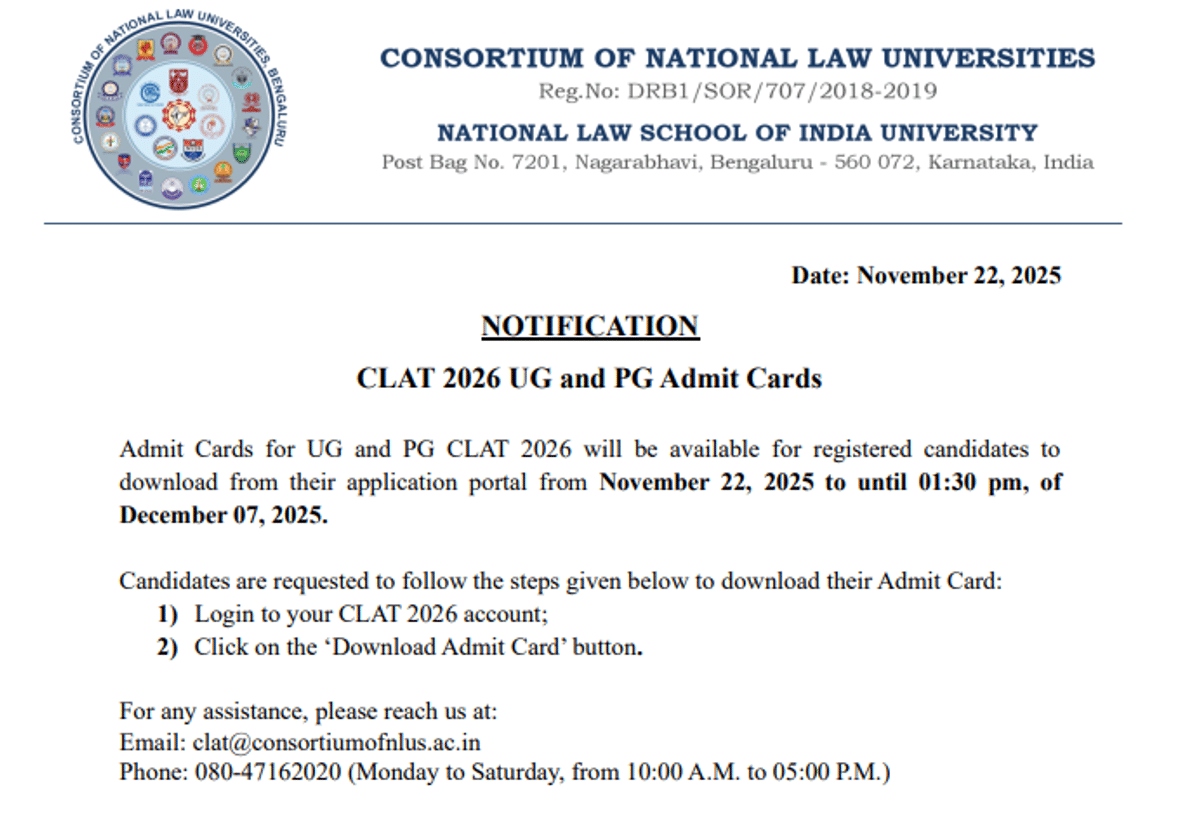 Source: consortiumofnlus.ac.in/clat-2026/
Also Read
How to Download CLAT Admit Card 2026
To download the CLAT Admit card, you must visit the official website and log in by using your registered email ID and password to access your account.
Documents to Carry with CLAT Admit Card 2026
It is essential to bring one of the following documents to the exam hall, along with a colored copy of the admit card for CLAT:
- Voter ID
- Aadhaar card
- Passport
- Driving License
- PAN card
- Identity card of any college affiliated with a recognized University
- Passport-size colored photo
- Medical self-declaration form
Also Check CLAT Preparation for last-minute revision.
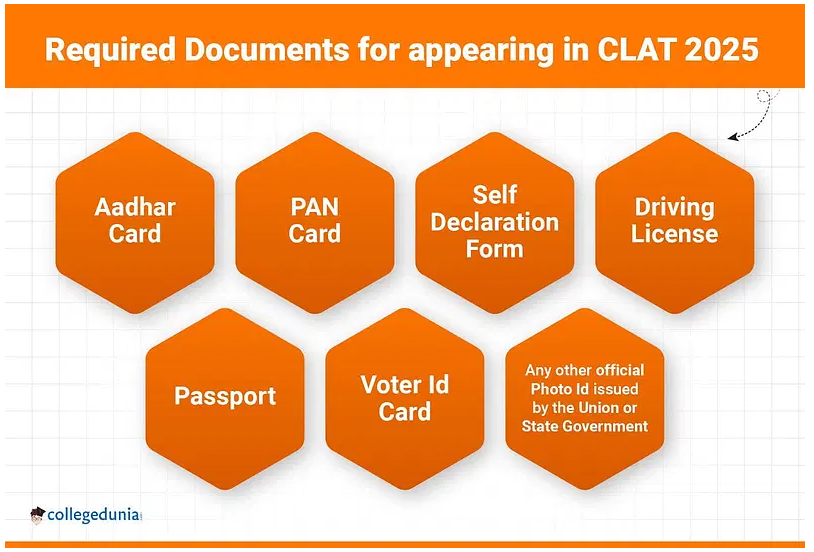
Details Mentioned on the CLAT Admit Card 2026
The following details are mentioned in the CLAT Hall ticket 2026:
- CLAT Exam Centers 2026: The CLAT Exam center/venue name allotted to you from the exam centers is mentioned in the admit card.
- Exam Center Address: The address of the venue for appearing in the exam is also given in the CLAT 2026 admit card.
- CLAT Admit Card Date & Time: In the timing of the exam and the date the exam is mentioned.
- Reporting Time
- Exam Day Instructions: There are some rules you should obey on examination day.
- Full name: The hall ticket also bears your full name, which makes identification much easier.
- Date of birth: It is also used to verify your age and your identification and your date of birth is included.
- Roll/ application number: These roll or application numbers should be unique since the tracking of the application and results highly requires it.
- Number: The admit card number can be useful in telling the officials on which admit card a student should be placed.
- Your Passport-size photograph: Your photograph is used for identification purposes whenever the examination is being administered.
- Parents/guardian’s name: The information provided is used for identification and communication purposes only when necessary.
- Exam Date: The schedule of the examination is flexible so that one can be able to make preparations in advance.
- Signature: You sign on the admit card affirming your identity at the time of examination.
Also Read
Details to Verify on CLAT Admit Card
Before heading to the exam center, ensure these details on the admit card are accurate:
- Candidate’s Full Name
- Date of Birth and Roll Number
- Exam Date and Timings
- Venue Address
- Emergency Instructions
Any discrepancies must be addressed immediately to avoid problems on exam day.
Correcting Mistakes on CLAT Admit Card
If you find a mistake in your CLAT Admit Card, it is crucial to address the issue promptly to avoid complications on the exam day. Here's what you should do:
Steps to Correct Mistakes in CLAT Admit Card
Verify the Mistake:
- These include your name, photograph, signature, date of the exam, time and venue, check them to confirm the mistake.
Contact the Helpdesk:
- Contact the CLAT helpdesk as soon as possible. The phone number and e-mail address can be found only on the official website of CLAT.
- Make sure that there is a get well message that the other party understands that there has been a mistake, and ask for a correction to be made.
Submit a Written Request:
- Calling the consortium at their official phone number is not possible; thus, send an email to the consortium describing the error in detail.
- Include other documents with your application form like ID proof and a photocopy of the admit card with a marker on the area that was filled in erroneously.
- The quicker the personnel will respond the better; so, be sure to state your registration number and other details.
Follow Up:
- You should monitor their request through email and the official website from time to time.
- If no response is received after a few days it may be useful to call the organization to check on the status of the request.
Also Read
Take CLAT Mock Test Before Appaering for the examCLAT 2026 Exam Day Guidelines
Here is a detailed table listing items allowed and not allowed on CLAT exam day, based on official guidelines and exam norms:
- CLAT 2026 will be conducted from 2:00 PM to 4:00 PM on December 1, 2024.
- Candidates will not be allowed to enter the examination hall after 2:15 PM.
- Candidates must ensure that they carry a valid ID Proof along with the admit card.
| Category | Allowed Items | Not Allowed Items |
|---|---|---|
| Admit Card & ID Proof | Printed CLAT Admit CardValid Photo ID (Aadhaar, Passport, Voter ID, etc.) | Photocopies of ID without originals |
| Stationery | Pen (usually black/blue, as specified)Transparent clipboard (if needed) | Pencils, erasers, highlighters, or any extra stationery unless explicitly permitted |
| Personal Belongings | Transparent water bottle | Wallets, bags, purses, or any opaque containers |
| Electronic Devices | Not Allowed | Mobile phonesSmartwatchesCalculatorsDigital pensHeadphones or other gadgets |
| Wearables | Simple, non-digital watch (if allowed by guidelines) | SmartwatchesJewelry with embedded technology |
| Food & Beverages | Snacks for medical reasons (with prior permission and documentation) | Food or beverages without approval |
| Medical Equipment | Medicines (with prescription)Medical aids such as insulin pumps or inhalers (with prior permission) | Any medical equipment not approved by the authorities |
| Masks & Sanitizers | Face mask (if required)Hand sanitizer (in a transparent bottle, if allowed) | Any sanitizer or masks with slogans or logos that could be deemed inappropriate |
| Other Items | Disability aids (e.g., scribe material, hearing aids) as per permission | Written material like notes, chits, or books |
Exam Day Must-Haves
- Printed Admit Card
- Valid ID Proof (Aadhaar, Voter ID, etc.)
- Passport-sized Photograph
- Transparent Water Bottle
- Face Mask (if applicable)
CLAT 2026 Exam Day Bell Timings
You can check the schedule of the CLAT exam 2026 from the below table.
| Particulars | Bell type | Timings |
|---|---|---|
| Entry inside the examination hall begins | Long bell | 1:00 pm |
| Entry of Candidates inside the hall/ classroom | Long bell | 1:30 pm |
| Distribution of the sealed Envelopes and announcement of Instructions by the Invigilators | Short bell | 1:50 pm |
| The exam begins and candidates can open the seal of QB | Long bell | 2:00 pm |
| Last chance to enter the exam center | Short bell | 2:15 pm |
| Completion of 60 minutes | Short bell | 3:00 pm |
| Warning bell for 10 minutes remaining for the exam | Short bell | 3:50 pm |
| Exam ends | Long bell | 4:00 pm |
| Candidates allowed to exit from the test center | Short bell | 4:15 pm |
CLAT 2026 Exam Centers
The conducting body has added two new CLAT exam centers- Diu and Silvassa. The list of CLT Exam centers are:
| State | Cities |
|---|---|
| Andhra Pradesh | Anantapur, Chirala, Eluru, Guntur, Kadapa, Kakinada, Kurnool, Nellore, Ongole, Rajahmundry, Srikakulam, Tekkali, Tirupathi, Vijayawada, Visakhapatnam, Vizianagaram |
| Arunachal Pradesh | Itanagar/Naharlagun |
| Assam | Dibrugarh, Guwahati, Jorhat, Silchar, Tezpur |
| Bihar | Arrah, Bhagalpur, Darbhanga, Gaya, Muzaffarpur, Patna, Purnea |
| Chandigarh | Chandigarh |
| Chhattisgarh | Bilaspur, Bhilai Nagar, Durg, Raipur |
| Delhi | New Delhi |
| Goa | Panaji/Madgaon |
| Gujarat | Ahmedabad, Anand, Bhavnagar, Gandhinagar, Himatnagar, Jamnagar, Mehsana, Rajkot, Surat, Vadodara |
| Haryana | Faridabad, Gurugram, Ambala, Hisar, Karnal, Kurukshetra, Panipat, Rohtak, Sonipat, Yamuna Nagar |
| Himachal Pradesh | Bilaspur, Hamirpur, Kangra, Kullu, Mandi, Shimla, Una |
| Jammu and Kashmir | Jammu, Samba, Srinagar |
| Jharkhand | Bokaro Steel City, Dhanbad, Hazaribagh, Jamshedpur, Ranchi |
| Karnataka | Ballari (Bellary), Belagavi (Belgaum), Bengaluru, Bidar, Davanagere, Dharwad/ Hubli, Kalaburagi (Gulbarga), Hassan, Mangaluru (Mangalore), Mysuru (Mysore), Shivamogga (Shimoga), Tumakuru (Tumkur), Udupi, Vijayapura (Bijapur) |
| Kerala | Alappuzha, Ernakulam, Idukki, Kannur, Kasaragod, Kollam, Kottayam, Kozhikode, Malappuram, Palakkad, Thiruvananthapuram, Thrissur |
| Lakshadweep | Kavaratti |
| Madhya Pradesh | Bhopal, Indore, Gwalior, Jabalpur, Sagar, Satna, Ujjain |
| Maharashtra | Ahmednagar, Akola, Amravati, Aurangabad, Chandrapur, Dhule, Jalgaon, Kolhapur, Latur, Mumbai/ Navi Mumbai, Nagpur, Nanded, Nashik, Pune, Raigad, Ratnagiri, Sangli, Satara, Solapur, Thane, Wardha |
| Manipur | Imphal |
| Meghalaya | Shillong |
| Mizoram | Aizawl |
| Nagaland | Kohima |
| Odisha | Balasore, Berhampur-Ganjam, Bhubaneshwar, Cuttack, Dhenkanal, Rourkela, Sambalpur |
| Pondicherry | Pondicherry |
| Punjab | Amritsar, Bhatinda, Jalandhar, Ludhiana, Mohali, Patiala, Sangrur |
| Rajasthan | Ajmer, Alwar, Bikaner, Jaipur, Jodhpur, Kota, Sikar, Sriganganagar, Udaipur |
| Sikkim | Gangtok |
| Tamil Nadu | Chennai, Coimbatore, Madurai, Salem, Erode, Thanjavur, Nagercoil, Tirunelveli, Tiruchirappalli, Vellore, Namakkal |
| Telangana | Hyderabad, Khammam, Karimnagar, Warangal, Nizamabad, Mahabubnagar |
| Tripura | Agartala |
| Uttar Pradesh | Ghaziabad, Greater Noida, Meerut, Noida, Agra, Aligarh, Bareilly, Gorakhpur, Jhansi, Kanpur, Lucknow, Mathura, Moradabad, Muzaffarnagar, Prayagraj, Varanasi, Allahabad |
| Uttarakhand | Dehradun, Haldwani, Haridwar, Roorkee |
| West Bengal | Siliguri, Barasat, Barrackpore, Kolkata, Asansol, Burdwan (Bardhawan), Hooghly, Howrah, Kalyani |
In general, doing preliminary preparations in accordance with the rules and addressing possible inconsistency in advance will enable you to give all of your efforts to the best exam performance. If you are experiencing issues with your CLAT admit card, then following the above steps, will help you correct the mistake before sitting for the exam thus making your preparation easier.
CLAT Admit Card 2026 FAQs
CLAT Admit Card 2026 FAQs
Ques. When will the CLAT 2026 Admit Card be released?
Ans. The CLAT 2026 admit card is expected to be released in November 2025. Candidates can download it from the official consortiumofnlus.ac.in website.
| Event | Date (Tentative) |
|---|---|
| CLAT 2026 Admit Card Release | November 2025 |
| CLAT 2026 Exam Date | December 2025 |
Ques. What details are mentioned on the CLAT Admit Card?
Ans. Your CLAT admit card 2026 will have the following details:
- Candidate’s name & photograph
- Roll number & application number
- Exam date, time & reporting time
- Exam centre address & code
- Exam day instructions
Ques. What documents should I carry with the CLAT Admit Card to the exam centre?
Ans. The candidates must carry the following documents along with CLAT Admit card to the exam center:
- Printed CLAT admit card (colour print preferred)
- Valid photo ID proof (Any one of the following)
| Document Type | Example |
|---|---|
| Photo ID Proof | Aadhaar, PAN, Passport, Driving License, Voter ID |
| CLAT Admit Card | Colour print preferred |
Ques. How can I download the CLAT Admit Card?
Ans. To download the CLAT Admit card, you must follow these steps:
- Visit the official CLAT website – consortiumofnlus.ac.in
- Click on the CLAT 2026 Admit Card link
- Enter your mobile number and password
- Click Login
- Download and take a printout of the admit card
Ques. What should I do if there is an error in my CLAT Admit Card?
Ans. If you find any discrepancy on your CLAT Admit Card, you must:
-
Contact the CLAT helpdesk immediately via:
-
Email: clat@consortiumofnlus.ac.in
-
Helpline: +91-8047166870 / +91-8047166871
-
| Possible Errors | Examples |
|---|---|
| Name Spelling Mistake | "Rahul" instead of "Rahil" |
| Wrong Exam Centre | City mismatch |
| Incorrect Photo | Blurry or mismatched |
Answer Key
The CLAT 2026 Answer key has been released on 16th December 2025, and you can download the CLAT Final Answer Key PDF from consortiumofnlus.ac.in.
The Separate SET-wise answer keys are released for the UG and PG exams, which will help you verify the official responses.
- The Individual Response sheet will be released, which will help you compare the marked response with the solutions.
- You can download the CLAT final answer key from the official website consortiumofnlus.ac.in/clat-2026/ or from the below table.
The CLAT Answer Key will help you calculate your score according to the official marking scheme: +1 mark for each correct answer and -0.25 for each incorrect answer.
In this Article, you can check about the direct link to download the Answer Key PDF, how to check and challenge the answer key.
Check:
- CLAT 2026 Question Paper with Answer Key and Solution PDF
- How to Download CLAT Answer Key?
- CLAT 2026 Answer Key Objections: What to Do If You Find an Error?
- How many CLAT Questions are changed after the objections?
- CLAT 2026 Score calculation by answer key
- CLAT 2026 Question Paper Pattern
- CLAT Provisional Answer Key vs CLAT Final Answer Key
- CLAT 2025 Question Paper with Answer Key and Solution PDF
- FAQs for CLAT Answer Key
CLAT 2026 Question Paper with Answer Key and Solution PDF
| CLAT Paper | Download PDF | Detailed Solution |
|---|---|---|
| CLAT 2026 Question Paper with Answer Key Set A | Download | Check Solution |
| CLAT 2026 Question Paper with Answer Key Set B | Download | Check Solution |
| CLAT 2026 Question Paper with Answer Key Set C | Download | Check Solution |
| CLAT 2026 Question Paper with Answer Key Set D | Download | Check Solution |
How to Download the CLAT Answer Key?
The Consortium of NLU has released the CLAT Answer Key online, which will allow you to instantly download the provisional answer key along with the response sheets.
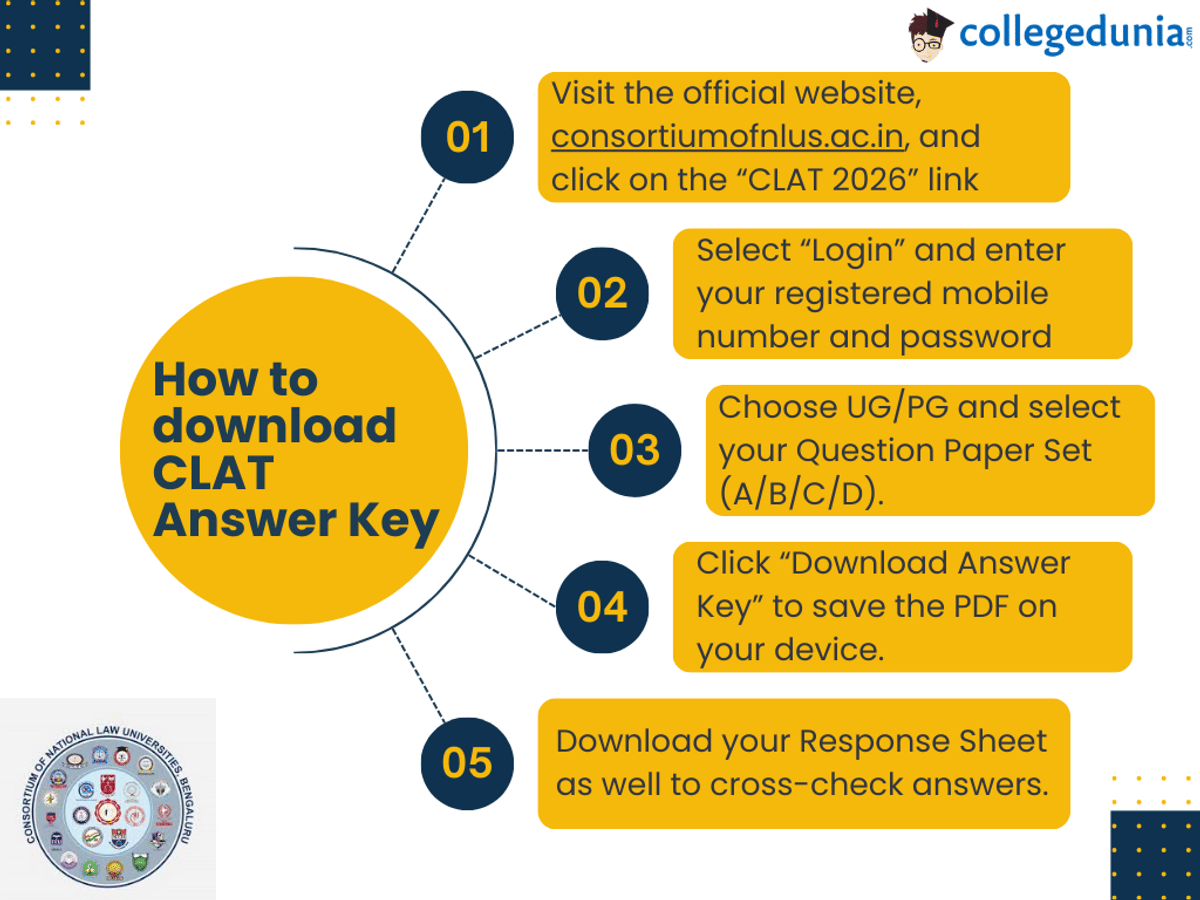
CLAT 2026 Answer Key Objections: What to Do If You Find an Error?
The NLUs allow you to challenge your provisional answer key if any answer is incorrect, according to you. You can submit your objections online on the official website and challenge the same by giving proper evidence.
Only the CLAT Final Answer key will be used to prepare for the result.
CLAT 2026 Answer Key Objection Details
| Feature | Details |
|---|---|
| Objection Window | December 10 – December 12 (5 PM) |
| Mode of Submission | Online through candidate login at consortiumofnlus.ac.in |
| Fee per Objection | ₹1,000 per question |
| Refund Policy | Fee refunded if the objection is accepted |
| Documents Required | Proof/explanation supporting the correct answer |
| Applicable To | Provisional Answer Key only |
| Outcome | Final Answer Key (after resolving all valid objections) |
Check: CLAT Toughest Paper Analysis
How many CLAT Questions are changed after the objections?
Every year, after the release of the CLAT Answer key the objections are raised by candidates, and the answer key is updated wherever errors are there. Around 2-5 questions have changed since the last few years in CLAT UG, as per the challenges raised by candidates.
CLAT: Number of Questions Changed After Objections (Last 4 Years)
- The dropped questions can benefit the candidates, as the marks are distributed again, which improves the scores for a lot of candidates.
- The Rank can also shift, after an 85 to 110 score range, which can affect the top NLUs cutoff.
| Year | No. of Questions Changed | Type of Changes |
|---|---|---|
| CLAT 2025 | 3 | 1 answer corrected, 2 questions dropped |
| CLAT 2024 | 4 | 2 answers corrected, 2 questions re-evaluated |
| CLAT 2023 | 2 | 1 corrected answer, 1 ambiguous question dropped |
| CLAT 2022 | 5 | Multiple answer corrections across Legal & GK |
CLAT 2026 Score calculation by answer key
By using the CLAT Answer key and response sheet, you can calculate your raw score before the results are declared. The CLAT has a proper marking scheme, with +1 mark for each correct answer and -0.25 for an incorrect answer. This can help you predict your rank and get chances for top NLUs.
CLAT 2026 Score Calculation Formula
Final Score = (Total Correct × 1) – (Total Incorrect × 0.25)
The Unattempted questions will carry 0 marks.
CLAT 2026 Score Calculation Table
| Parameter | Value / Explanation |
|---|---|
| Marks for Each Correct Answer | +1 |
| Marks Deducted for Each Wrong Answer | –0.25 |
| Marks for Unattempted Questions | 0 |
| Total Questions | 120 |
| Maximum Possible Score | 120 |
| Minimum Possible Score | –30 (if all answers are wrong) |
CLAT 2026 Question Paper Pattern
The CLAT Exam follow a proper pattern, which is similar to the previous year, along with a different format for UG and PG Programmes and a similar marking scheme.
CLAT 2026 Paper Pattern
| Section / Exam | Total Questions | Total Marks | Question Type |
|---|---|---|---|
| CLAT UG 2026 | 120 | 120 | MCQs (Passage-based) |
| CLAT PG 2026 | 120 | 120 | MCQs (Legal concepts & comprehension) |
Check: CLAT 2026 Cutoff
CLAT Provisional Answer Key vs CLAT Final Answer Key
The table below highlights the differences between the Provisional Answer Key and the Final Answer Key for CLAT 2026. The aspects include timing, purpose, accuracy, authority, and many more:
| Aspect | Provisional Answer Key | Final Answer Key |
|---|---|---|
| Release Timing | Published shortly after the exam, usually within 24–48 hours. | Released after the objection process concludes. |
| Purpose | Allows candidates to verify answers and raise objections. | Serves as the definitive reference for score calculation. |
| Accuracy | May contain errors or ambiguous answers. | Corrected based on valid objections and expert review. |
| Objection Window | Candidates can raise objections during a specified period. | No objections allowed after release. |
| Impact on Scores | Used for initial self-evaluation; scores are not final. | Final scores are calculated based on this version. |
| Authority | Subject to change based on objections. | Binding and final; used for generating the merit list. |
CLAT 2025 Question Paper with Answer Key and Solution PDF
| CLAT Paper | Download PDF | Detailed Solution |
|---|---|---|
| CLAT 2025 Question Paper with Answer Key Set A | Download | Check Solution |
| CLAT 2025 Question Paper with Answer Key Set B | Download | Check Solution |
| CLAT 2025 Question Paper with Answer Key Set C | Download | Check Solution |
| CLAT 2025 Question Paper with Answer Key Set D | Download | Check Solution |
CLAT 2024 Question Paper with Answer Key and Solution PDF
| CLAT Paper | Download PDF | Detailed Solution |
|---|---|---|
| CLAT 2024 Question Paper with Answer Key Set A | Download | Check Solution |
| CLAT 2024 Question Paper with Answer Key Set B | Download | Check Solution |
| CLAT 2024 Question Paper with Answer Key Set C | Download | Check Solution |
| CLAT 2024 Question Paper with Answer Key Set D | Download | Check Solution |
Check:
FAQs for CLAT Answer Key
Ques. Was the 2026 CLAT Paper Tough?
Ans. The CLAT 2026 Exam was of a moderate difficulty level, the same as the previous year, with long passages in English and legal reasoning.
Time management was a challenge because of comprehension-based questions.
CLAT 2026 Section-wise Difficulty
| Section | Difficulty Level | Key Student Feedback |
|---|---|---|
| English Language | Moderate | Long passages, tricky inference-based questions |
| Current Affairs & GK | Easy–Moderate | Direct questions, predictable topics |
| Legal Reasoning | Moderate–Difficult | Lengthy passages, mixed conceptual + factual |
| Logical Reasoning | Moderate | Standard patterns, time-consuming |
| Quantitative Techniques | Easy–Moderate | Straightforward graphs & short sets |
Ques. What Will Be the Expected Cutoff for CLAT 2026?
Ans. As per the previous year's difficulty level, the CLAT 2026 Cutoff for Top NLUs will be high. The Legal reasoning and English have a major contribution to the score changes.
CLAT 2026 Expected Cutoff (UG)
| NLU | Expected Opening Score | Expected Closing Score |
|---|---|---|
| NLSIU Bangalore | 95–100 | 90–92 |
| NALSAR Hyderabad | 92–95 | 87–90 |
| WBNUJS Kolkata | 88–92 | 83–85 |
| NLU Jodhpur | 86–89 | 80–82 |
| GNLU Gandhinagar | 84–87 | 78–80 |
Ques. What Rank Is 70 Marks in CLAT?
Ans. A Score range of 70 in CLAT generally comes under a mid-range rank, as per the previous year marks vs rank analysis, this usually falls in the top 5,000 to 7,500 range.
Estimated Rank for 70 Marks (UG)
| Marks | Expected Rank Range | Category |
|---|---|---|
| 70 | 5000 – 7500 | General Estimate |
Ques. Is 87 a Good CLAT Score?
Ans. Yes, 87 is a good CLAT Score, especially in a moderate difficulty year like 2026. This will fall under the category of Top 2000 ranks, which gives high chances for mid-tier NLUs.
Expected Outcomes for 87 Marks
- Likely Rank Range: 1500–2200
- High chances of admission in GNLU, HNLU, MNLU Mumbai, RMLNLU, NLU Odisha
Ques. Which Year Was CLAT Paper Toughest?
Ans. The CLAT Difficulty level, differs every year, but as per the expert analysis, the CLAT 2021 and 2023 were the toughest.
Toughest CLAT Papers (Recent Years)
| Year | Why It Was Tough | Key Sections |
|---|---|---|
| 2021 | Long passages + tricky legal reasoning | Legal, Logical |
| 2023 | Lengthy GK & complex reasoning | GK, LR |
| 2020 | First year of new pattern; unfamiliar format | English, Logical |
Counselling
The Consortium of NLUs has released the CLAT 2026 Round 2 Seat Allotment list on January 22, 2026, on the official website, consortiumofnlus.ac.in/clat-2026. You can check the seat status and select Freeze/Float/Withdraw your options till 29th January 2026.
- The CLAT Counselling is being conducted in 5 rounds, the final round on 15th May 2026, and the final university fee payment by 30th May 2026.
- Only the candidates who are invited by email/SMS will be eligible to register by paying Rs. 30,000 for general candidates and 20,000 for reserved categories.
- If you choose the freeze or float option, upload the Class 10 and 12 marksheets, the CLAT 2026 admit card, the character/conduct certificate & the transfer certificate.
Every year, around 3,200 UG seats and 1,200 PG seats are offered by CLAT. In CLAT 2025, around 75,000 candidates appeared, of whom less than 6% secured NLU admissions.
Check:
Key Summary
In this Article, we have discussed about CLAT Counselling, including the Admission Calendar, Process & Seat Allotment.
- The CLAT Counselling is done to fill the maximum number of seats, so all the existing and upgraded seats will be filled easily.
- From all the invited candidates, only 4 out of 10 will get final admission in NLUs.
- The CLAT focuses more on seat availability, rather than giving equal chances in every round.
- The Top NLUs have few seats, so they close in the first 1-2 rounds.
- A lot of candidates, who choose to float their seat, will move up by 1-3 NLU as their preferences.
- What happens in CLAT counselling?
- CLAT Counselling 2026 Schedule
- How many students are invited for CLAT counselling?
- CLAT 2026 Counselling Process
- What Should You Do After CLAT Seat Allotment: Freeze, Float or Exit?
- CLAT Counselling Fees
- How Do You Register for CLAT Counselling 2026?
- CLAT Counselling 2026: Which Documents Will You Need?
- CLAT Seat Allotment 2026: How Seats Are Assigned
- CLAT 2026 Toppers: Who Secured the Top Ranks?
What happens in CLAT counselling?
The CLAT Counselling is a centralised, rank-based allocation process conducted by the consortium of NLUs. The qualified candidates are given the UG and PG seats in different NLUs based on rank, preference and seat availability in multiple rounds.
- With a total of 5 counselling rounds, you can upgrade the colleges without losing their seat, by floating the current seat.
- The Top NLUs close 60 to 70% of seats in the first 2 rounds, with less number of seats.
- If you miss any deadline, to choose Freeze/Float/Exit, there will be an automatic exit, regardless of what their rank is.
- The counselling fee is different, along with a separate university fee, which is used for final locking admission.
Check this video by @12minutestoclat to know about the step-by-step registration along with the seat allotment process.
Check: CLAT Legal Edge Top Rankers
Ques. Does qualifying CLAT automatically make me eligible for counselling?
Ans. No, qualifying CLAT will not guarantee you eligibility in counselling. The Candidates who will be invited by consortium of NLUs, based on their ranks can register for counselling.
- A Lot of candidates will not be selected because of limited number of NLU Seats.
- The Invitation will be sent by Email/SMS along with your portal.
- If you will not receive any invitation, you will not be eligible for counselling, regardless of what your score is.
Ques. Is CLAT counselling based on marks or All India Rank?
Ans. The CLAT Counselling depends upon the AIR, not your raw marks. The Marks will determine your rank, the seat allotment will follow the AIR, along with your preferences and category.
| Factor | Role in Counselling |
|---|---|
| CLAT Marks | Used only to calculate AIR |
| All India Rank | Primary allotment criterion |
| NLU Preferences | Decides college order |
| Category/Domicile | Applied during allotment |
Ques. Can I change my NLU preferences after seat allotment starts?
Ans. No, your preference will not be changed once the seat allotment will begin. The NLU Preferences are locked after the deadline of registration.
- The Seat allotment in all the rounds will follow a proper order.
- The Preferences will be editable, before the registration will close.
- The Same preference list will be applied to all counselling rounds.
- The Option of float will allow upgradation of seat, without any preference change.
CLAT Counselling 2026 Schedule
The CLAT Counselling will be conducted in multiple-rounds, by a centralised seat allocation process, which will be conducted by a consortium of NLUs for UG and PG Programmes.
It has started in December 2025 and will continue until May 2026, which will allow you to upgrade seats across multiple rounds as per their ranks and preferences.
CLAT Counselling Admission Calendar 2026
| Schedule | Particulars |
|---|---|
| January 22, 2026, at 10:00 A.M. | Publication of Second Allotment List |
| January 22, 2026 (10:00 A.M.) to January 29, 2026 (1:00 P.M.) | Payment of Confirmation Fee for Freeze/Float and Admission by NLUs (Second List) |
| February 05, 2026, at 10:00 A.M. | Publication of Third Allotment List |
| February 05, 2026 (10:00 A.M.) to February 12, 2026 (1:00 P.M.) | Payment of Confirmation Fee for Freeze/Float and Admission by NLUs (Third List) |
| By April 24, 2026 (5:00 P.M.) | Payment of University Fee to confirm admission (for Freeze in first three rounds) |
| May 02, 2026, at 10:00 A.M. | Publication of Fourth Allotment List |
| May 02, 2026 (10:00 A.M.) to May 08, 2026 (1:00 P.M.) | Payment of Confirmation Fee for Freeze/Float and Admission by NLUs (Fourth List) |
| May 15, 2026, at 10:00 A.M. | Publication of Fifth and Final Allotment List |
| May 15, 2026 (10:00 A.M.) to May 20, 2026 (1:00 P.M.) | Payment of Confirmation Fee for Freeze and Admission by NLUs (Fifth List) |
| By May 30, 2026 (5:00 P.M.) | Payment of University Fee to confirm admission (for Freeze in fourth and fifth rounds) |
Check:
Ques. Are all five counselling rounds mandatory for every candidate?
Ans. No, candidates do not need to participate in all 5 rounds. The CLAT Counselling will allow you to exit early by choosing freezing their seat only if they are satisfied with the allotted seat.
- The Participating will be continued only if a candidate is thinking to stay in that college.
- If a candidate will freeze the seat, counselling will end for that candidate.
- By Floating, the candidate will be continued for the next round.
Ques. Which counselling round sees the maximum seat movement?
Ans. In CLAT Counselling, major changes are done in round 2, which includes seat upgradation, exit and non-joiners from the first round.
| Round | Seat Movement |
|---|---|
| Round 1 | High (initial allotment) |
| Round 2 | Very High (maximum upgrades) |
| Round 3 | Moderate |
| Rounds 4–5 | Low (vacancy filling) |
How many students are invited for CLAT counselling?
The Consortium of NLUs does not invite all the CLAT-Qualified Candidates for counselling. Whereas, the invitations are sent only to candidates with a realistic rank range, as per the total available seats in NLUs and previous year trends.
CLAT Expected Counselling Invitation
- If you are invited, you are eligible to participate; it does not mean seat confirmation.
- The Invitations are generally sent 3 times as per the total seats for exits and non-joiners.
- Candidates who score beyond a certain rank do not receive counselling SMS, even if they are qualified.
- Only 35 to 40% of invited candidates will secure and confirm an NLU Seat.
| Programme | Total Seats (Approx.) | Candidates Invited for Counselling |
|---|---|---|
| UG (5-year LLB) | 3,200 seats | 8,000–9,000 candidates |
| PG (LLM) | 1,200 seats | 2,500–3,000 candidates |
| Overall | 4,400 seats | 10,000–12,000 candidates |
Check: CLAT Merit List
CLAT 2026 Counselling Process
The CLAT Counselling Process is a centralised process in which the candidates will get admission into NLUs by using a seat matrix, which is updated after every round.
The inactive Candidates are removed automatically, increasing competition after every round.
As per the previous-year analysis, around 60 to 70% seats are filled by Round 2, which is used for seat upgradation and filling vacancies.
Stage-Wise CLAT Counselling Process
| Stage | Description |
|---|---|
| Counselling Invitation | Only candidates within the eligible rank range receive email/SMS invites |
| Registration & Fee Payment | Candidates register online and pay the counselling fee to confirm participation |
| Preference Filling | Candidates submit NLU preferences (UG: minimum 15, PG: minimum 5) |
| Seat Allotment (Round-wise) | Seats are allotted based on rank, preferences, category, and availability |
| Candidate Decision | After allotment, candidates choose Freeze, Float, or Exit |
| Seat Upgradation | Floating candidates may get higher-preference NLUs in the next rounds |
| Final Allotment | Last round confirms remaining seats with no further upgrades |
| University Fee Payment | Candidates pay the NLU admission fee to lock the seat |
| Admission Confirmation | Document verification and reporting to the allotted NLU |
Ques. How does CLAT decide which NLU I get in each round?
Ans. The NLU Rank is decided by your rank, preference, category and available seats. The Consortium of NLU has a different algorithm which allocates the highest preference which is available for AIR in that round.
The Deciding factors are:
- All India Rank (AIR)
- Locked NLU preference order
- Category/domicile reservation
- Seats available in that round
Ques. Is counselling conducted separately for UG and PG programmes?
Ans. Yes, CLAT UG and PG Counselling will be conducted separately. Both UG and PG Programmes have different seat matrix, rank list and cutoffs, even if the timeline is similar for counselling.
| Aspect | UG Counselling | PG Counselling |
|---|---|---|
| Programme | 5-year LLB | LLM |
| Rank List | UG AIR | PG AIR |
| Seat Pool | 3,200 seats | 1,200 seats |
| Preferences | Min 15 NLUs | Min 5 NLUs |
Ques. What happens to seats left vacant after each round?
Ans. The Vacant seats are recycled in the next round. The Seats become vacant due to Exit Choices, non-payment and immediate upgradation.
| Reason for Vacancy | Seat Status Next Round |
|---|---|
| Candidate exits | Re-allotted |
| Candidate upgrades | Old seat re-enters pool |
| Fee not paid | Seat cancelled & reused |
What Should You Do After CLAT Seat Allotment: Freeze, Float or Exit?
After each round of seat allotment in CLAT Counselling, you should be active and respond properly on the counselling website, which is managed by Counsortium of NLUs.
The CLAT Post-Allotment Options will decide if you will secure your current seat, aim for an upgradation, or leave the counselling process.
CLAT Post-Allotment Options
- The Freezing of a seat means locking your admission. Once the seat is frozen, it cannot be changed in the further rounds.
- The Float means upgrading the seats later, as per previous year analysis, around 30 to 40% upgradation is conducted in rounds 1 and 2.
- If you choose exit, you will be permanently removed from all the remaining rounds.
| Option | What It Means | Best For Whom |
|---|---|---|
| Freeze | Accept the allotted NLU and exit further counselling rounds | Candidates are satisfied with their current NLU |
| Float | Accept the seat but stay eligible for higher-preference NLUs | Candidates aiming for an upgrade without risk |
| Exit | Withdraw from counselling and forfeit the allotted seat | Candidates are not interested in NLUs anymore |
Check:
Ques. What is the safest option between Freeze and Float?
Ans. The Freeze is the best option, if you are satisfied with your allotted NLU. The Freezing will lock your seat permanently, under the counselling process which is run by consortium of NLU.
Freeze vs Float
| Option | Risk Level | Outcome |
|---|---|---|
| Freeze | Lowest | Seat confirmed, no further rounds |
| Float | Low | Seat retained, upgrade possible |
Ques. Can I switch from Float to Freeze in later rounds?
Ans. Yes, you can freeze your seat in the later rounds after floating the current seat.
- The Floating will keep your seat secured while allowing upgradation, after being satisfied, you can freeze your seats in next rounds, in which you will get your preferred NLU.
- The Floating will not risk your current seat and you can freeze only after seat allotment.
Ques. Does choosing Exit affect future CLAT attempts?
Ans. By Exiting, your future CLAT Exam will not be affected, it will only remove you from current counselling process. As it has no impact on eligibility, attempt or future CLAT Ranking.
| Aspect | Impact |
|---|---|
| Future CLAT attempts | None |
| Exam eligibility | Unaffected |
| Counselling (current year) | Permanently closed |
CLAT Counselling Fees
The CLAT Counselling fees are required, a one-time payment, which is required to participate in centralized seat allotment process by the consortium of NLUs.
This will confirm the candidate’s intent to compete for NLU Seats and will get serious candidates.
CLAT Counselling Fees 2026
| Category | Counselling Fee |
|---|---|
| General / OBC / EWS | ₹30,000 |
| SC / ST / PwD | ₹20,000 |
How Do You Register for CLAT Counselling 2026?
The CLAT Counselling Registration is done to get entry into the centralised and seat allocation process, which is conducted by the Consortium of NLUs.
The Candidates who will receive an official invitation as per the CLAT Rank can register, which makes it rank-based rather than an open process.
CLAT Counselling Registration Overview
| Aspect | Details |
|---|---|
| Eligibility | Only rank-invited CLAT 2026 candidates |
| Mode of Registration | Online through CLAT Candidate Portal |
| Registration Window | December 17 – December 27, 2025 |
| Counselling Fee |
|
| Preference Requirement | UG: Minimum 15 NLUs, PG: Minimum 5 NLUs |
| Editable Preferences | Allowed until registration deadline |
| Without Registration | No seat allotment, regardless of rank |
Check: CLAT 2026 Cutoff
CLAT Counselling 2026: Which Documents Will You Need?
In CLAT Counselling, you have to upload and verify certain documents to confirm your eligibility, category status and academic credentials.
With missing or incorrect documents, your seat can be cancelled, even after the consortium of NLUs has allotted it.
Documents Required for CLAT Counselling are:

Source: consortiumofnlus.ac.in
CLAT Seat Allotment 2026: How Seats Are Assigned
The CLAT Seat Allotment 2026 is a centralized, rank-based allocation process which is conducted by Consortium of NLUs, where seats are allocated based on your rank, NLU Preference, category and seat availability.
- The Seat Allotment will be conducted in different rounds, and it will be updated after every round.
- The Seats will be allocated on the merit and preference basis, not based on the marks.
- The Higher-ranked candidates can get priority access in top NLUs in initial rounds.
- Most of the top-tier NLUs, will close in initial 1-2 rounds, whereas other rounds will have a benefit in mid-to-lower ranks.
Opening & Closing Ranks in CLAT Seat Allotment
The CLAT Opening and Closing Rank will show the rank range in which seats will be allotted for a particular NLU and its category.
The Candidates in the top 500 ranks, will have strong chances in Tier-1 NLUs, whereas ranks upto 1,500 to 1,800 remain competitive in mid-tier NLUs.
Expected CLAT UG Opening & Closing Ranks (Top NLUs)
| NLU | Opening Rank | Closing Rank |
|---|---|---|
| NLSIU Bengaluru | 1 | 120 |
| NALSAR Hyderabad | 10 | 180 |
| WBNUJS Kolkata | 40 | 260 |
| NLUD Delhi | 50 | 320 |
| NLU Jodhpur | 90 | 420 |
| GNLU Gandhinagar | 120 | 520 |
| RMLNLU Lucknow | 350 | 1,200 |
| HNLU Raipur | 500 | 1,600 |
Check: CLAT College Predictor
CLAT 2026 Toppers: Who Secured the Top Ranks?
The CLAT Toppers are candidates who get the highest AIR in the exam which is held by consortium of NLUs.
These toppers will get seat in top NLUs like NLSIU Bengaluru, NALSAR Hyderbad, and WBNUJS Kolkata in the first counselling rounds.
CLAT 2026 Top Rankers
| All India Rank (AIR) | Candidate Name | Score (Approx.) |
|---|---|---|
| AIR 1 | Geetali Gupta | 112.75 / 119 |
| AIR 2 | Parv Jain | 111.75 |
| AIR 3 | Rohan Joshi | 111.75 |
| AIR 9 | Manvi Yadav | 110 |
| AIR 26 | Yash Varshan Pratap | 107.75 |
| AIR 29 | Roshan Sengupta | 107.75 |
Ques. What happens if I miss a counselling deadline by mistake?
Ans. If you will miss your counselling deadline, it will be an automatic exit from the counselling.
- As the CLAT do not allow any late actions. If you will fail to register, pay fees, or select freeze/float/exit on time, you will be removed permanently.
- Even if the candidate is AIR 1 and they miss the deadline, it will be not be continued.
Ques. How many counselling rounds do candidates usually need to secure a seat?
Ans. A lot of candidates will get seat in 1-3 rounds, as per your rank. The CLAT Counselling will be done in 5 rounds, but most of the admission will be conducted on early basis.
| Round | Seat Activity Trend |
|---|---|
| Round 1 | Top NLUs, highest seat lock-in |
| Round 2 | Maximum upgrades & closures |
| Round 3 | Limited movement |
| Rounds 4–5 | Vacancy filling only |
Ques. Can counselling dates change after registration begins?
Ans. Yes, the counselling dates can change, but their is no official notification for the same.
The Consortium of NLUs can revise the counselling dates because of technical, administrative and legal reasons, the updates for the same will be announced by the official website.
Ques. Does category reservation apply in every counselling round?
Ans. Yes, CLAT Reservation is applicable in every round. The Vertical and horizontal reservation will be enforced in different rounds.
- The Category-wise seats will be filled fast.
- The Unfilled reserved seats will be converted as per the rules.
Ques. What happens if I don’t select any option after allotment?
Ans. If you will not select any option you will be automatically exited from counselling. If no option for Freeze/Float/Exit option is selected in the deadline, the system will treat it as Exit.
There is no response after allotment, if any deadline is missed.
Current Affrs & GK Sample
The Current Affairs and General Knowledge section of CLAT is passage-based, and it rewards the students who read the news every day and practise comprehension sets regularly. This sample paper gives you a fresh passage-based set so you can build speed and accuracy before the real exam.
Official website: consortiumofnlus.ac.in
CLAT Current Affairs & GK Sample Papers 2026
CLAT Current Affairs & GK Sample Paper 1

CLAT Current Affairs & GK Sample Paper 2
CLAT Current Affairs & GK Sample Paper 3
CLAT Current Affairs & GK Sample Paper 4
CLAT Current Affairs & GK Sample Paper 5
CLAT Current Affairs & GK Sample Paper 6
CLAT Current Affairs & GK Sample Paper 7
CLAT Current Affairs & GK Sample Paper 8
CLAT Current Affairs & GK Sample Paper 9
CLAT Current Affairs & GK Sample Paper 10
CLAT Current Affairs & GK Sample Paper 11
CLAT Current Affairs & GK Sample Paper 12
CLAT Current Affairs & GK Sample Paper 13
CLAT Current Affairs & GK Sample Paper 14
CLAT Current Affairs & GK Sample Paper 15
CLAT Current Affairs & GK Sample Paper 16
CLAT Current Affairs & GK Sample Paper 17
CLAT Current Affairs & GK Sample Paper 18
CLAT Current Affairs & GK Sample Paper 19
CLAT Current Affairs & GK Sample Paper 20
The Current Affairs and GK sample paper carries around 30 questions built on news-based passages of about 450 words, and you should finish it in a single timed sitting of about 30 minutes. Solve the passage set fully, then check every answer against the detailed explanations before you move on.
You can download the paper free on Collegedunia, and the officially released CLAT papers are also available on the Consortium of NLUs website after you log in.
- CLAT Current Affairs & GK Sample Papers 2026
- CLAT Current Affairs & GK Exam Pattern and Marks Distribution 2026
- CLAT GK Sample Papers - Why Recent Papers Matter Most
- CLAT Current Affairs & GK Topic Wise Weightage - High Scoring Topics to Focus in Sample Papers
- CLAT GK Sample Paper Video Solutions 2026 - Watch Before You Start Solving
- How to Use CLAT Current Affairs Sample Papers to Clear in First Attempt
- CLAT GK Passage Reading Skill - The One That Decides Your Score
- CLAT Current Affairs & GK 4 Week Preparation Plan Using Sample Papers
- FAQs on CLAT Current Affairs & GK Sample Papers 2026
- Section share: Current Affairs including GK carries 28-32 questions, about 25 percent of the full CLAT paper, the largest single share.
- Paper format: every question is tied to a news-based passage of roughly 450 words, not a standalone one-line fact.
- Marking: +1 for a correct answer and -0.25 for a wrong one, with no penalty for a blank.
- Time budget: at 1 minute per question, plan on about 30 minutes for a 30-question set.
- Sources: passages are drawn from the last 12 months of national and international news, awards, sports, government schemes, arts and culture, and science in the news.
- Level: Class 12 standard, testing whether you can read a passage and apply general knowledge around it, not rote memory alone.
 CLAT Current Affairs & GK Exam Pattern and Marks Distribution 2026
The Current Affairs and GK section follows the same fixed rules as the rest of CLAT, so your practice paper should match it exactly. Knowing the numbers helps you decide how many passages to attempt fully and how many to skim.
- Questions: 28-32 questions spread across 5 to 6 news-based passages of about 450 words each.
- Marks: one mark per question, with 0.25 deducted for every wrong answer.
- Time: at the paper-wide rate of 1 minute per question, this section takes roughly 30 minutes.
- Question types: main event, factual recall around the passage, cause and effect, and linked static GK.
- Focus: the passage frames the topic, but some options need general knowledge you carry into the exam.
Key advice: read the passage once to fix the event and the people involved, because most questions test whether you can place the news correctly rather than recall an exact date.
CLAT GK Sample Papers - Why Recent Papers Matter Most
CLAT GK has moved fully to passage-based current affairs, and old one-line static-GK drills no longer reflect the exam. Recent-style sample papers train you for the reading and recall load you will actually face.
- Passages now run to 450 words on recent news, so newer papers build the right reading stamina.
- Pure static one-liners have been replaced by current-affairs passages that carry static GK inside them.
- Questions lean on the last 12 months of events, so current papers keep your general knowledge relevant.
CLAT Current Affairs & GK Topic Wise Weightage - High Scoring Topics to Focus in Sample Papers
Within the GK section the marks cluster around a few recurring themes. Use this table to see which topics to drill hardest in your sample papers.
| Topic | Questions | Difficulty | What to Watch For |
|---|---|---|---|
| National events, polity and government schemes | 7-9 | Moderate | Linking a scheme or ruling to the ministry or court behind it |
| International affairs and organisations | 5-7 | Moderate to Hard | Summits, treaties and which country or body hosted or led them |
| Awards, honours and appointments | 4-6 | Easy to Moderate | Matching the award to the correct field, person or year |
| Sports and major tournaments | 3-5 | Easy | Winners, hosts and record holders from the last 12 months |
| Arts, culture, science and environment in the news | 4-6 | Moderate | Static facts hidden inside a current-affairs passage |
Note: awards, appointments and sports questions are the easiest marks in this section, so lock those first and spend your saved time on the tougher polity and international sets.
CLAT GK Sample Paper Video Solutions 2026 - Watch Before You Start Solving
A short strategy video before your first paper shows you how to read a CLAT current-affairs passage and pull the answer from it instead of second-guessing. It also teaches how to pair daily news reading with static GK so both grow together.
Watch the walkthrough below, then apply the same read-and-connect method to the sample paper you download here.
Watch:
Source: Strategy to master the CLAT 2026 GK and Current Affairs section, covering how to read news-based passages, build static GK and connect the two (YouTube)
How to Use CLAT Current Affairs Sample Papers to Clear in First Attempt
This paper only helps if you solve it like the real section and then review every choice you made. Follow this routine to turn practice into a rising GK score.
- Set a 30-minute timer and solve the full passage set in a single quiet sitting.
- Answer from the passage first, then use your static GK, since -0.25 punishes a careless guess.
- After scoring, reread each passage and see exactly why the correct option beats the trap option.
- Note the fact you missed and add it to a running current-affairs revision sheet.
- Track your accuracy per topic so you know whether polity, international or sports needs more work.
- Pair the paper with 30 minutes of daily news reading so recall and comprehension grow together.
CLAT GK Passage Reading Skill - The One That Decides Your Score
The whole GK section stands on one skill, reading a news passage quickly and answering from it plus the general knowledge you carry in. Building that habit through sample papers matters more than memorising endless one-liners.
- Read the passage once with full focus and fix the main event, the people and the place before the questions.
- For every option, decide whether the passage supports it or your outside knowledge does, and trust the text first.
- Watch for extreme words like only, first and never, which often mark a wrong static-GK option.
- Keep a one-page monthly current-affairs sheet and revise it beside the passages you solve.
CLAT Current Affairs & GK 4 Week Preparation Plan Using Sample Papers
- Week 1: Read one news digest daily and solve the sample paper untimed to get used to 450-word current-affairs passages.
- Week 2: Resolve the paper under a 30-minute timer and build an error log of the topics you keep missing.
- Week 3: Revise your monthly current-affairs sheets, focus on polity and international affairs, and retime the passage set.
- Week 4: Take the paper as a final timed test, then keep the last two days for light revision and error-log review only.
FAQs on CLAT Current Affairs & GK Sample Papers 2026
Ques.How many questions are there in the CLAT Current Affairs and GK section?
Ans.The Current Affairs including General Knowledge section has 28 to 32 questions built on 5 to 6 news-based passages of about 450 words each, which is about 25 percent of the full CLAT paper and its largest single section.
Ques.Is CLAT GK static or current-affairs based?
Ans.CLAT GK is mostly current-affairs based. Every question sits inside a news passage from the last 12 months, though some options still test static general knowledge linked to that news.
Ques.How much time should I spend on one GK sample paper?
Ans.Plan on about 30 minutes for a 30-question set, which matches the exam rate of 1 minute per question, so you learn to read and answer without running over time.
Ques.How do I keep current affairs updated for CLAT 2026?
Ans.Read one reliable news digest every day, maintain a one-page monthly current-affairs sheet, and revise it alongside passage-based sample papers so you recall facts in context rather than in isolation.
Ques.Does the GK section have negative marking?
Ans.Yes, like the rest of CLAT it deducts 0.25 marks for a wrong answer, so you should only attempt options you can support from the passage or your confirmed general knowledge.
Ques.Where can I download free CLAT Current Affairs and GK sample papers 2026?
Ans.You can download the CLAT Current Affairs and GK sample paper free on Collegedunia, and the officially released papers are also on the Consortium of NLUs website after you log in.
English Preperation
CLAT English section holds 20% weightage of the entire CLAT Syllabus. Candidates can expect around 28-32 questions from this section, As per CLAT marking scheme, candidates are awarded 1 mark for each correct answer and 0.25 marks are deducted for every incorrect answer.
CLAT 2024 English Language Preparation is essential for candidates to read, comprehend and infer the phrases and word’s meaning used in the passage. CLAT 2024 English Language Syllabus includes learning about English vocabulary, grammar, solving exercises using the language and more. As per Previous years’ analysis, the English language section of CLAT is comparatively easier than the rest of the sections. Check CLAT Paper Analysis
Download Previous Year’s Question Papers
CLAT English Preparation Tips
CLAT English Language section is considered one of the easiest to cover. Candidates with previous experience in using the English language are bound to find this section easy compared to others. That being said, candidates should start preparing at the earliest so as to get practised with the questions that will be asked and the language they have to demonstrate. Some important tips for CLAT English are discussed below
- Time Table: First thing being. Candidates should ensure they have a set timetable to practise the language and revise what will be asked for the exam.
- Read Books: Candidates should read a ton of books and English newspapers to increase their speed and accuracy in reading. Reading is an important part of the entire question paper and is designed to test the candidate’s comprehension.
- Grammar Practise: Usage of inappropriate grammar will cost the candidates marks, and affect their overall performance. Candidates can use previous year’s question papers or grammar worksheets to solve grammar problems effectively and accurately.
- Improving Vocabulary: Candidates need to put in the effort and practise in improving their overall vocabulary, which can help them solve the questions effectively. This can be attained by reading novel books or newspapers that provide candidates with new visions of using the English language.
- Other Materials: English is a language subject, i.e. candidates can use supplementary material like novels or other magazines to improve their vocabulary and knowledge of the language.
- Systematic Practise: Candidates should make sure that they are practising the language by using it in their daily life. This systematic usage will build their confidence as well as make them comfortable using it during the exam.
Check More CLAT 2024 Preparation Tips
CLAT English Language Preparation Books
| Book | Publisher/Author |
|---|---|
| Objective General English | SP Bakshi |
| The Pearson Guide to the CLAT | -- |
| Word Power Made Easy | Norman Lewis |
| CLAT Guide | Tata McGraw-Hill |
CLAT 2024 English Language Syllabus
CLAT English section has passage-based objective questions. Candidates will be required to read a few paragraphs of 450 words and answer the questions accordingly.
CLAT 2024 English Language Important Topics
Mentioned below are some of the important topics asked in CLAT 2024 Logical Reasoning
| Correcting Incorrect Grammar Sentences | Fill in the Blanks |
| Spotting Grammatical Errors | Synonyms & Antonyms |
| Active & Passive Voice | Tenses |
| Vocabulary | Passages |
CLAT English Language Paper Analysis
Previous year analysis of CLAT English Language section has deemed it to be easy in terms of difficulty.
- CLAT 2023 English Language section has 24-27 questions with one mark each.
- This section has a total weightage of 20% in the overall syllabus
- The section will have passages with reading comprehension in mind.
- For CLAT, the English language section had 30 questions with difficulty level as easy.
CLAT 2024 English Language Exam Pattern
Given below is the exam pattern for CLAT 2024 English Language
| Exam Mode | Offline |
| Duration | 20 minutes |
| CLAT Total Duration | 120 Minutes |
| Nature of Questions | Objective (Based on passages) |
| CLAT LR Passage Word Count | 450 words each |
| CLAT English Language Number of Questions | 24-27 Questions in CLAT LR |
| CLAT Total Number of Questions | 150 Questions |
| CLATEnglish Language Total Marks | 24-27 |
| CLAT Total Marks | 200 |
| Medium | English |
CLAT 2024 English Language Marking Scheme
Given below is the marking scheme for CLAT English Language:
| Parameters | Marks Awarded |
|---|---|
| Correct Answer | 1 |
| Incorrect Answer | - 0.25 |
| Unattended Question | 0 marks |
Check CLAT 2024 Exam Pattern
CLAT 2024 English Language Preparation FAQs
Ques: How can I attend CLAT 2024 after one-month preparations?
Ans: Candidates can attend CLAT 2024 with one month of preparation if they are meticulous and hardworking. They will have to set a solid timetable and leave enough time for revisions
Ques: How are CLAT 2024 English Language questions going to be asked?
Ans: CLAT 2024 English Language questions will be based on a passage that will be derived from newspaper articles, magazines or other pieces of writing. Questions will be based on passages and will be multiple-choice based.
Ques: How to prepare English for CLAT exam?
Ans: Some important tips to prepare English for CLAT exam are discussed below:
- Create a timetable to study English Language for CLAT.
- Read newspapers, magazines on a regular basis to improve vocabulary.
- Practise grammar CLAT English books such as SP Bakshi.
- Solve previous year’s question paper.
Ques: Is CLAT English Preparations hard?
Ans: Candidates with previous knowledge of the language should find the preparations easier. CLAT English Preparations will include a lot of reading, writing and using the language.
Ques: What changes were made to CLAT English section?
Ans: CLAT English Language section used to have 40 questions with one mark each. CLAT 2020 saw a change in the question paper. CLAT English section now has 28-32 multiple-choice questions.
Ques: What are the changes in CLAT 2024 English section?
Ans: There are no particular changes decided or discussed for CLAT 2024 English section as of yet. Any changes will be published by the conducting body.
Ques: How can I score well for CLAT 2024 English section?
Ans: Candidates can score well by having proper planning and preparing according to their plan. Candidates must read, have knowledge about the current trends and more. This will help with their preparation strategy.
Ques: What questions should I prepare for in CLAT 2024 English section?
Ans: Candidates should prepare for a lot of passage-based questions. They should also look into books and newspapers so they can improve their language skills. Most passages are derived from newspapers and magazines, hence reading is a good way to prepare.
English Sample Paper
The English Language section of CLAT is pure reading comprehension, and it rewards the students who practise long passages every single day. These sample papers give you 10 fresh passage-based sets so you can build speed and accuracy before the real exam.
Official website: consortiumofnlus.ac.in
CLAT English Language Sample Papers 2026
CLAT English Language Sample Paper 1
CLAT English Language Sample Paper 2
CLAT English Language Sample Paper 3
CLAT English Language Sample Paper 4
CLAT English Language Sample Paper 5
CLAT English Language Sample Paper 6
CLAT English Language Sample Paper 7
CLAT English Language Sample Paper 8
CLAT English Language Sample Paper 9
CLAT English Language Sample Paper 10
Each English Language sample paper carries around 24 questions built on 450-word passages, and you should finish one in a single timed sitting of about 24 minutes. Solve the passage set fully, then check every answer against the detailed explanations before you start the next paper.
You can download all 10 papers free on Collegedunia, and the officially released CLAT papers are also available on the Consortium of NLUs website after you log in.
- CLAT English Language Sample Papers 2026
- CLAT English Language Exam Pattern and Marks Distribution 2026
- CLAT English Sample Papers - Why Recent Papers Matter Most
- CLAT English Chapter Wise Weightage - High Scoring Topics to Focus in Sample Papers
- CLAT English Sample Paper Video Solutions 2026 - Watch Before You Start Solving
- How to Use CLAT English Sample Papers to Clear in First Attempt
- CLAT Passage Reading Skill - The One That Decides Your English Score
- CLAT English 4 Week Preparation Plan Using Sample Papers
- FAQs on CLAT English Language Sample Papers 2026
- Section share: English Language carries 22-26 questions, about 20 percent of the full CLAT paper.
- Paper format: every question is tied to a reading passage of roughly 450 words, not standalone grammar.
- Marking: +1 for a correct answer and -0.25 for a wrong one, with no penalty for a blank.
- Time budget: at 1 minute per question, plan on about 24 minutes for a 24-question set.
- Sources: passages are drawn from journalism, essays and non-fiction on current and general themes.
- Level: Class 12 standard, testing comprehension, inference, tone and vocabulary in context.
![CLAT English Sample Paper]() CLAT English Language Exam Pattern and Marks Distribution 2026
CLAT English Language Exam Pattern and Marks Distribution 2026
 CLAT English Language Exam Pattern and Marks Distribution 2026
The English Language section follows the same fixed rules as the rest of CLAT, so your practice papers should match it exactly. Knowing the numbers helps you decide how many passages to attempt fully and how many to skim.
- Questions: 22-26 comprehension questions spread across 3 to 4 passages of about 450 words each.
- Marks: one mark per question, with 0.25 deducted for every wrong answer.
- Time: at the paper-wide rate of 1 minute per question, a full section takes roughly 24 minutes.
- Question types: main idea, author tone, inference, argument, summary and vocabulary in context.
- Focus: the passage is the only source of truth, so answers must come from the text, not outside opinion.
Key advice: read the passage once with full attention rather than skimming twice, because a single careful read almost always answers the tone and main-idea questions in one go.
CLAT English Sample Papers - Why Recent Papers Matter Most
CLAT English has shifted completely to long comprehension passages, and older grammar-drill practice no longer reflects the exam. Recent-style sample papers train you for the reading load you will actually face.
- Passages are now 450 words from journalism and non-fiction, so newer papers build the right reading stamina.
- Direct grammar and vocabulary questions have been replaced by meaning-in-context items inside passages.
- Inference and tone questions dominate, so current papers train the exact skills the examiner rewards.
CLAT English Chapter Wise Weightage - High Scoring Topics to Focus in Sample Papers
Within the English section the marks cluster around a few recurring question types. Use this table to see which comprehension skills to drill hardest in your sample papers.
| Topic | Questions | Difficulty | What to Watch For |
|---|---|---|---|
| Main idea and central theme | 4-6 | Easy to Moderate | Summarising the whole passage without getting lost in one detail |
| Inference and conclusion | 5-7 | Moderate to Hard | Choosing what must be true from the text, not what is merely likely |
| Author tone and attitude | 3-5 | Moderate | Telling critical, neutral, ironic and appreciative tones apart |
| Vocabulary and phrase in context | 3-5 | Easy to Moderate | Meaning as used in the passage, not the dictionary meaning |
| Argument and viewpoint | 3-5 | Moderate | Identifying the author's stance and comparing opposing views |
Note: main-idea and vocabulary-in-context questions are the easiest marks in this section, so lock those first and spend your saved time on the tougher inference sets.
CLAT English Sample Paper Video Solutions 2026 - Watch Before You Start Solving
A short method video before your first paper shows you how to read a CLAT passage the smart way instead of word by word. It also teaches the elimination approach that saves precious minutes on tricky options.
Watch the walkthrough below, then apply the same read-once and eliminate method to every sample paper you download here.
Watch:
Source: How to prepare for the CLAT 2026 English Language section, covering reading comprehension approach, tone and vocabulary in context (YouTube)
How to Use CLAT English Sample Papers to Clear in First Attempt
These papers only help if you solve them like the real section and then review every choice you made. Follow this routine to turn practice into a rising English score.
- Set a 24-minute timer and solve one full passage set in a single quiet sitting.
- Answer strictly from the passage, since -0.25 punishes any option based on outside opinion.
- After scoring, reread the passage and see exactly why the correct option beats the trap option.
- Note the trap you fell for, whether it was over-inference, tone confusion or a vocabulary slip.
- Track your accuracy per question type so you know which skill to drill in the next paper.
- Solve a fresh paper every two to three days so reading speed and accuracy grow together.
CLAT Passage Reading Skill - The One That Decides Your English Score
The whole English section stands on one skill, reading a passage quickly and answering only from it. Building that habit through sample papers matters more than any grammar rule for CLAT.
- Read the passage once with full focus and note the author's main claim before touching the questions.
- For every option, point to the exact line that supports or kills it rather than trusting your memory.
- Watch for extreme words like always, never and only, which usually mark a wrong inference option.
- Treat vocabulary questions as context questions and plug the option back into the sentence to test it.
CLAT English 4 Week Preparation Plan Using Sample Papers
- Week 1: Read one editorial daily and solve sample papers 1 to 3 untimed to get used to 450-word passages.
- Week 2: Solve papers 4 to 6 under a 24-minute timer and build an error log of your weak question types.
- Week 3: Solve papers 7 to 9 timed, focus revision on inference and tone questions, and push reading speed daily.
- Week 4: Solve paper 10 as a final timed test, then keep the last two days for light revision and error-log review only.
FAQs on CLAT English Language Sample Papers 2026
Ques.How many questions are there in the CLAT English Language section?
Ans.The English Language section has 22 to 26 comprehension questions built on 3 to 4 passages of about 450 words each, which is roughly 20 percent of the full CLAT paper.
Ques.Is CLAT English grammar-based or comprehension-based?
Ans.CLAT English is fully comprehension-based. Every question is linked to a passage, and even vocabulary items are tested as meaning in context rather than as standalone grammar.
Ques.How much time should I spend on one English sample paper?
Ans.Plan on about 24 minutes for a 24-question set, which matches the exam rate of 1 minute per question, so you learn to read and answer without running over time.
Ques.How can I improve reading speed for CLAT English?
Ans.Read one editorial or long-form article every day, practise timed sample papers, and train yourself to read a passage once with full focus instead of rereading it several times.
Ques.Does the English section have negative marking?
Ans.Yes, like the rest of CLAT it deducts 0.25 marks for a wrong answer, so you should only attempt options you can support directly from the passage.
Ques.Where can I download free CLAT English Language sample papers 2026?
Ans.You can download all 10 CLAT English Language sample papers free on Collegedunia, and the officially released papers are also on the Consortium of NLUs website after you log in.
English Syllabus
The CLAT English Syllabus assesses a candidate’s proficiency in the English language through comprehension, grammar, and vocabulary skills. As per the CLAT 2026 Syllabus, the English section contributes around 20% of the total marks in the UG examination. The CLAT 2026 syllabus for English is designed at the 12th-grade level, matching the eligibility for most students. The CLAT English syllabus consists of:
- Reading comprehension passages (450–500 words)
- Inference-based questions
- Word meaning in context
- Synonyms & antonyms
- Idioms & phrases
- Grammar-based error detection
The CLAT Syllabus 2026 for the English section includes 24–28 questions carrying 1 mark each, with a negative marking of 0.25 marks for every wrong answer. There is no negative marking for unattempted questions.
As per previous year trends in CLAT exam, students getting admission to top NLU’s score 85%+ accuracy in the English section. Many students recommend that building reading habits early from The Hindu or The Indian Express helps improve reading speed and comprehension. You must start at least 5 months before the exam, slowly increasing practice with mock tests and timed reading.
Also Read
| Key Summary: The CLAT 2026 English Language syllabus consists of multiple passages and questions related to the passage. The areas that you should mostly focus on are:
|
|---|
What is CLAT English Syllabus 2026?
The CLAT English syllabus for 2026 consists of Reading Comprehension, Idioms & Phrases, Figures of Speech, and many more. The CLAT English syllabus passages are taken from fiction, non-fiction, contemporary articles, historical writings, and opinion pieces. The difficulty level is similar to Class 12 English but focuses more on analytical reading than rote grammar.
- The passages will be approximately 450-500 words long
- The passages will be drawn from contemporary journalistic, fictional, and non-fictional sources.
- You must expect questions on the main idea, inferences, tone, vocabulary in context, and summaries.
The video by PW CLAT for CLAT English Syllabus provides reading comprehension, vocabulary, grammar, sentence correction, and inference-based questions.
How Many Questions Are There in the CLAT English Syllabus?
The CLAT 2026 English syllabus comprises 22 to 26 questions. With the examination consisting of 120 questions in total, the English syllabus for CLAT section constitutes approximately 20% of the overall paper.
| Particulars | Details |
|---|---|
| Passages | 4-6 |
| Number of Questions | 22-26 MCQs |
| Marks | 22-26 |
| Negative Marks | 0.25 for every wrong answer |
Can you provide some of the most essential Topics for CLAT 2026 English Syllabus?
Sure, some topics in the English syllabus for CLAT are very crucial, and you should consider spending more time on them as well. Below, we have listed the most important topics in the English syllabus.
- Grammar
- Vocabulary
- Sentence Structure
- Answering Direct Questions
- Syntax and Errors
CLAT 2026 Syllabus for English Language
The CLAT English syllabus is designed to test a candidate’s proficiency in comprehension, grammar, and vocabulary. From identifying the tone of passages to solving para jumbles, strong English skills are required for improving accuracy and time management.
| Topic | Key Areas Covered |
|---|---|
| Reading Comprehension | Passages of ~450 words, main idea, tone, viewpoints, inferences, and summary questions |
| Vocabulary | – Synonyms– Antonyms– Root Words– Homophones– Idioms– Analogies– One-word Substitutions |
| English Grammar | – Parts of Speech– Tenses– Modals– Conditionals– Phrasal Verbs– Determiners |
| Paragraph-Based Questions | – Para Jumbles– Para Completion– Para Summary |
| Literary Devices | Common literary terms and their applications |
Also Read
CLAT English Preparation Tips from Top Educators at UnacademyWhat are the Important Topics in CLAT English Syllabus
The English syllabus for CLAT consists of various topics revolving around grammar, vocabulary, and reading comprehension. Knowing the syllabus will give you a fair idea about the topics you need to focus more on.
Below are the important topics under the CLAT English Language section:
| Important Topics | Important Topics |
|---|---|
| Reading and Comprehension | Sentence Completion |
| Error Detection | Para Jumbles/ Sentence Rearrangement |
| Idioms and Phrases | Synonyms and Antonyms |
| Fill in the Blanks | Vocabulary |
| Syntax Errors | Sentence Structure |
| Cloze Test | Foreign Language Words |
CLAT English Syllabus Questions
The questions from previous years' CLAT papers for the English section are as under:
Passage 1
I grew up in a small town not far from Kalimpong. In pre-liberalization India, everything arrived late: not just material things but also ideas. Magazines — old copies of Reader’s Digest and National Geographic — arrived late too, after the news had become stale by months or, often, years. This temporal gap turned journalism into literature, news into legend, and historical events into something akin to plotless stories. But like those
who knew no other life, we accepted this as the norm. The dearth of reading material in towns and villages in socialist India is hard to imagine, and it produced two categories of people: those who stopped reading after school or college, and those — including children — who read anything they could find. I read road signs with the enthusiasm that attaches to reading thrillers. When the iterant kabadiwala, collector of papers,
magazines, and rejected things, visited our neighbourhood, I rushed to the house where he was doing business. He bought things at unimaginably low prices from those who’d stopped having any use for them, and I rummaged through his sacks of old magazines. Sometimes, on days when business was good, he allowed me a couple of copies of Sportsworld magazine for free. I’d run home and, ignoring my mother’s scolding, plunge
right in — consuming news about India’s victory in the Benson and Hedges Cup. Two takeaways from these experiences have marked my understanding of the provincial reader’s life: the sense of belatedness, of everything coming late, and the desire for pleasure in language. Speaking of belatedness, the awareness of having been born at the wrong time in history, of inventing things that had already been discovered
elsewhere, far away, without our knowledge or cooperation, is a moment of epiphany and deep sadness. I remember a professor’s choked voice, narrating to me how all the arguments he’d made in his doctoral dissertation, written over many, many years of hard work (for there indeed was a time when PhDs were written over decades), had suddenly come to naught after he’d discovered the work of C.W.E. Bigsby. This,
I realised as I grew older, was one of the characteristics of provincial life: that they (usually males) were saying trite things with the confidence of someone declaring them for the first time. I, therefore, grew up surrounded by would-be Newtons who claimed to have discovered gravity (again). There’s a deep sense of tragedy attending this sort of thing — the sad embarrassment of always arriving after the party is over. And there’s a
harsh word for that sense of belatedness: “dated.” What rescues it is the unpredictability of these anachronistic “discoveries” — the randomness and haphazardness involved in mapping connections among thoughts and ideas, in a way that hasn’t yet been professionalised. [Extracted, with edits and revisions, from “The Provincial Reader”, by Sumana Roy, Los Angeles Review of Books]
1. What use was the kabadiwala (wastepicker) to the author?
(A) The kabadiwala bought up all her magazines.
(B) The kabadiwala’s stock of books and magazines were of interest to the
author.
(C) The kabadiwala was about to steal the author’s magazines.
(D) The author ordered books online which the kabadiwala delivered.
2. What according to the author is essential about the experience of being a ‘provincial reader’?
(A) Belatedness in the sense of coming late for everything.
(B) Over-eagerness.
(C) Accepting a temporal gap between what was current in the wider world and
the time at which these arrived in the provincial location.
(D) None of the above
3. Why did the author feel a sense of epiphany and deep sadness?
(A) Because the things that felt special and unique to the author, were already
established and accepted thought in the wider world.
(B) Because the author was less well-read than others.
(C) Because the author missed being in a big city.
(D) All the above
4. What does the word ‘anachronistic’ as used in the passage, mean?
(A) Rooted in a non-urban setting
(B) Related to a mofussil area
(C) Connected with another time
(D) Opposed to prevailing sensibilities
5. Which of the following options captures the meaning of the last sentence best?
(A) Though the author feels provincial, she pretends to be from the metropolis.
(B) Though the author feels dated in her access to intellectual ideas, her lack
of metropolitan sophistication lets her engage with the ideas with some
originality.
(C) Though the author is aware of the limitedness of her knowledge, she is
confident and can hold her own in a crowd. She also proud of her roots in the
small town.
(D) All the above
Passage 2
Until the Keeladi site was discovered, archaeologists by and large believed that the Gangetic plains in the north urbanised significantly earlier than Tamil Nadu. Historians have often claimed that large scale town life in India first developed in the Greater Magadha region of the Gangetic basin. This was during the ‘second urbanisation’ phase. The ‘first urbanisation phase’ refers to the rise of the Harappan or Indus Valley Civilisation. Tamil Nadu was thought to have urbanised at this scale only by the third century BCE. The findings at Keeladi push that date back significantly. Based on linguistics and continuity in cultural legacies, connections between the Indus Valley Civilisation, or IVC, and old Tamil traditions have long been suggested, but concrete archaeological evidence remained absent. Evidence indicated similarities between
graffiti found in Keeladi and symbols associated with the IVC. It bolstered the arguments of dissidents from the dominant North Indian imagination, who have argued for years that their ancestors existed contemporaneously with the IVC. All the archaeologists I spoke to said it was too soon to make definitive links between the Keeladi site and the IVC. There is no doubt, however, that the discovery at Keeladi has changed the paradigm. In recent years, the results of any new research on early India have invited keen political interest, because proponents of Hindu nationalism support the notion of Vedic culture as fundamental to the origins of Indian civilisation. The Keeladi excavations further challenge the idea of a single fountainhead of Indian life. They indicate the possibility that the earliest identity that can recognisably be considered ‘Indian’ might not have originated in North India. That wasn’t all. In subsequent seasons of the Keeladi dig, archaeologists discovered that Tamili, a variant of the Brahmi script used for writing inscriptions in the early iterations of the Tamil language, could be dated back to the sixth century BCE, likely a hundred years before previously thought. So not only had urban life thrived in the Tamil lands, but people who lived there had developed their
own script. “The evolution of writing is attributed to Ashoka’s edicts, but 2600 years ago writing was prevalent in Keeladi,” Mathan Karuppiah, a proud Madurai local, told me. “A farmer could write his own name on a pot he owned. The fight going on here is ‘You are not the one to teach me to write, I have learnt it myself.’ ” [Excerpted from “The Dig”, by Sowmiya Ashok, Fifty-Two]
1. What was the assumption about the origin of urban life in India before the Keeladi dig?
(A) The origins lay in the northern Gangetic plains, which urbanised earlier than
the south.
(B) The Indus Valley Civilization was the first urban civilization of India.
(C) The second urbanization was known to be in the Magadha empire.
(D) Both (A) and (B)
2 “The Keeladi excavations further challenge the idea of a single fountainhead of Indian life.” — in elaboration of this sentence, which of these options follows?
(A) Dominant theories of how urban and modern life came about in ancient India were proved wrong by the Keeladi archaeological dig.
(B) Neither the Indus Valley Civilization, nor the ancient urban civilization of Magadha are clear explanations of how urban life emerged in the Keeladi region of southern India in the third century BCE.
(C) The Keeladi archaeological dig proved that Indian urban and modern life emerged independently in several historical periods and geographies, and no one theory is enough to explain it.
(D) None of the above
3. Language, including a script similar to the Brahmi script, emerged in Keeladi in the sixth century BCE. Which of the following is the most convincing conclusion from this statement?
(A) Keeladi is a centre of culture and learning far superior to any others in ancient India.
(B) People of Keeladi were illiterate and could not use language to inscribe on their pots and pans.
(C) Ancient urban history of India, as we know it today, could significantly be altered by the findings of the advances achieved by the Keeladi civilization.
(D) All the above
4. BCE is the acronym for:
(A) Before the Common Era
(B) Before Colloquial Era
(C) Before Chapel Eternal
(D) Behind Christ Era
5. “A farmer could write his own name on a pot he owned. The fight going on here is ‘You are not the one to teach me to write, I have learnt it myself.’ ” — These sentences imply:
(A) That the Keeladi civilization was an inegalitarian one.
(B) That the Keeladi civilization did not conserve the access to education and literacy only for the elite.
(C) That the farmers of the Keeladi civilization were also potters.
(D) All the above
How To Prepare English Language For CLAT 2026?
Preparing for the English language section of the Common Law Admission Test (CLAT) requires a combination of reading, practicing, and refining your language skills. We have provided the section-wise preparation tips for CLAT 2026.
Reading Comprehension:
- You must practice reading passages from diverse topics. This will not only improve your comprehension skills but also expose you to different writing styles.
- You must work on understanding the main idea, supporting details, and the author’s tone of the passage.
- Practicing CLAT by answering questions related to the passages will save time and improve your speed
Grammar and Vocabulary:
- You must brush up on your grammar rules. Focus on topics like tenses, articles, prepositions, and sentence structure.
- Expanding your Vocabulary by reading more words will help you understand the passage better and reduce time to complete the test.
- Solve vocabulary-based exercises and practice antonyms and synonyms.
Legal Aptitude:
- The English section of CLAT 2026 often includes legal reasoning questions. So you must familiarize yourself with legal terminology and concepts.
- Practice solving legal reasoning problems to improve your analytical skills.
Writing Skills:
- Practice essay writing on various topics and pay attention to structuring your essays logically. This will help to explain your thoughts clearly.
- Work on improving your grammar and punctuation to ensure your writing is precise and error-free.
Previous Year Papers: Solving previous years’ CLAT question papers helps understand the exam pattern and the type of questions asked.
Mock Tests:
- Take regular mock tests to simulate exam conditions. This will help you manage your time and build endurance for the actual test.
- Analyze your mistakes and focus on improving in areas where you face challenges.
Group Discussions: Engage in group discussions with peers to enhance your communication skills and improve your ability to articulate your thoughts effectively.
Also Read
What kinds of English skills are tested on the CLAT exam 2026?
To take the exam, you need to master some of the crucial skills during your preparation stage. We have listed some of the necessary skills.
- Reading and understanding the passage's primary idea as well as any arguments and points of view presented therein
- Making deductions and conclusions from the passage
- Summarizing the text in the passage
- Comparing and contrasting the opinions expressed in the passage
- Recognize the meaning of the different terms and expressions used in the passage.
CLAT English Syllabus Books 2026
Some books to practise for this section are as follows-
- Word Power Made Easy by Norman Lewis;
- Pearson Guide to CLAT 2020 by Pearson;
- A comprehensive study for CLAT & LLB Entrance Examinations- SET, AILET, LSAT by Padma Parupudi and Sirisha Naresh;
- High School English Grammar and Composition Key by Wren & Martin;
- Objective General English 2020 by RS Aggarwal;
- Objective General English 2020 by AP Bharadwaj
| Title | Author | Price (INR, approx) |
|---|---|---|
| Word Power Made Easy by Norman Lewis | Norman Lewis | ₹175–190 (Flipkart: ₹186) |
| High School English Grammar & Composition by Wren & Martin | P. C. Wren & H. Martin | ₹300–560 (Flipkart: ₹373 after discount; Retail Maharaj: ₹560) |
| English Is Easy by Chetananand Singh | Chetananand Singh | ₹318 (Flipkart) |
Exam Centers
The Consortium of NLUs administers the CLAT 2026 Exam at various test centres across the country. CLAT 2026 will be conducted in more than 139 cities CLAT centers in 25 states and Union Territories. Last year, the Consortium of National Law Universities had notified a change in the CLAT exam centers 2026 at Hisar, Haryana. The CLAT exam centers 2026 at Government College, Rajgarh Road, Hisar has been shifted to CCS Haryana Agricultural University, Hisar.
The Consortium added 18 test centres this year, increasing the number of applications for CLAT last year. 157 CLAT Exam Center locations were announced that spread across 89 cities. You can choose up to 3 test centers while filling CLAT 2026 application form.
- On the day of the CLAT 2026 exam, report to the exam center as per the scheduled time mentioned on the CLAT admit card.
- Since the exam centre authority does not allow entry to candidates who are late, candidates must ensure that they reach on time.
- Candidate visit and check the alloted CLAT exam centre location a day in advance to avoid any confusion.
The Consortium of NLUs might add or remove CLAT exam centers in 2026 based on the applicants registered for CLAT for a particular center. On the day of the CLAT 2026 exam, you should enter the center before 2:15 PM. However, it is always advised to enter the hall from 1 PM.
| Key Summary: CLAT Exam centers are spread all over India. 157 CLAT Exam Center locations were announced that spread across 89 cities.
|
CLAT Exam Centre Schedule 2026
Check the table below for important schedule regarding CLAT 2026 exam day and CLAT Exam center:
| Particulars | Details |
|---|---|
| Window to selection CLAT 2026 exam centers | To Be Updated |
| Window to change exam center choices | To Be Updated |
| Reporting begins | To Be Updated |
| Exam begins | To Be Updated |
| Last entry allowed | To Be Updated |
| Exam ends | To Be Updated |
| Exiting examination halls | To Be Updated |
Also Read
CLAT Exam Centers 2026 List
Candidates can choose up to three centers in order of preference during registration. Here’s a state-wise list of major CLAT test centers. The inclusion of Diu and Silvassa in the CLAT 2026 centers list makes it more accessible for aspirants in Union Territories.
| State | Exam Centers |
|---|---|
| Andhra Pradesh | Anantapur, Chirala, Eluru, Guntur, Kadapa, Kakinada, Kurnool, Nellore, Ongole, Rajahmundary, Srikakulam, Tekkali, Tirupathi, Vijayawada, Visakhapatnam, Vizianagaram |
| Bihar | Muzaffarpur, Patna, Arrah, Bhagalpur, Darbhanga, Purnea |
| Chhattisgarh | Bilaspur, Raipur, Bhilai Nagar, Durg |
| Delhi | New Delhi |
| Gujarat | Ahmedabad, Gandhinagar, Anand, Bhavnagar, Himatnagar, Jamnagar, Mehsana, Rajkot, Surat, Vadodara |
| Haryana | Faridabad, Gurugram, Ambala, Hisar, Karnal, Kurukshetra, Panipat, Rohtak, Sonipat, Yamuna Nagar |
| Himachal Pradesh | Bilaspur, Hamirpur, Kangra, Kullu, Mandi, Shimla, Una |
| Jammu & Kashmir | Jammu, Srinagar, Samba |
| Jharkhand | Jamshedpur, Ranchi, Bokaro Steel City, Dhanbad, Hazaribagh |
| Karnataka | Ballari (Bellary), Belagavi (Belgaum), Bengaluru, Bidar, Davanagere, Dharwad / Hubli, Kalaburagi (Gulbarga), Hassan, Mangaluru (Mangalore), Mysuru (Mysore), Shivamogga (Shimoga), Tumakuru (Tumkur), Udupi, Vijayapura (Bijapur) |
| Kerala | Alappuzha, Ernakulam, Idukki, Kannur, Kasaragod, Kollam, Kottayam, Kozhikode, Malappuram, Palakkad, Thiruvananthapuram, Thrissur |
| Madhya Pradesh | Bhopal, Indore, Gwalior, Jabalpur, Sagar, Satna, Ujjain |
| Maharashtra | Akola, Amravati, Aurangabad (Maharashtra), Chandrapur, Dhule, Jalgaon, Kolhapur, Latur, Mumbai/Navi Mumbai, Nagpur, Nanded, Nashik, Pune, Raigad, Ratnagiri, Sangli, Satara, Solapur, Thane, Wardha |
| Odisha | Balasore, Berhampur-Ganjam, Bhubaneswar, Cuttack, Dhenkanal, Rourkela, Sambalpur |
| Punjab | Amritsar, Bhatinda, Jalandhar, Ludhiana, Mohali, Patiala, Sangrur |
| Rajasthan | Alwar, Bikaner, Jaipur, Jodhpur, Kota, Sikar, Sriganganagar, Udaipur |
| Sikkim | Gangtok |
| Tamil Nadu | Coimbatore, Madurai, Salem, Erode, Thanjavur, Nagercoil, Tirunelveli, Tiruchirappalli, Vellore, Namakkal |
| Telangana | Khammam, Karimnagar, Warangal, Nizamabad, Mahabubnagar |
| Tripura | Agartala |
| Uttar Pradesh | Greater Noida, Meerut, Noida, Agra, Aligarh, Bareilly, Gorakhpur, Jhansi, Kanpur, Lucknow, Mathura, Moradabad, Muzaffarnagar, Prayagraj, Varanasi, Allahabad, Ghaziabad |
| Uttarakhand | Dehradun, Haldwani, Haridwar, Roorkee |
| West Bengal | Asansol, Burdwan (Bardhaman), Siliguri, Hooghly, Barasat, Howrah, Barrackpore, Kalyani, Kolkata |
The CLAT Exam is knocking on the doors. In such a scenario, you must check the CLAT Exam Analysis.
Want to Know What You Can Bring to the CLAT Exam center?
If you are looking for the things to bring to the CLAT Exam center, you can check the video by “Lawentranceexam”. The video shows things to carry on the CLAT exam day to the exam center.
CLAT Exam Centers Do’s and Dont’s
There are few things that you are allowed at the exam center and some that are not allowed. You must be aware of these details before going to the exam center. Here’s a table of Do’s and Don’ts for candidates appearing at CLAT 2026 Exam Centers:
| Category | Do’s | Don’ts |
|---|---|---|
| Before the Exam | Arrive at the exam center at least 60 minutes early. | Do not arrive late; entry will not be permitted after the reporting time. |
| Carry the CLAT admit card and a valid photo ID (Aadhaar, PAN, etc.). | Avoid carrying incomplete or damaged documents. | |
| Bring the required stationery in a transparent pouch. | Do not bring unauthorized materials like books or rough paper. | |
| Dress Code | Wear simple and comfortable clothes without too many accessories. | Avoid wearing smartwatches, heavy jewelry, or items that may raise suspicion. |
| Prohibited Items | Only carry permitted items such as admit cards, photo ID, and pens. | Do not bring electronic devices (mobiles, calculators, earphones, etc.). |
| If carrying water, use a transparent bottle. | Avoid carrying food unless medically necessary (with proof). | |
| During the Exam | Follow the invigilator’s instructions carefully. | Do not indulge in any malpractice; this may lead to disqualification. |
| Keep your admit card visible for verification when asked. | Avoid talking to other candidates during the exam. | |
| Post-Exam Conduct | Submit your answer booklet and OMR sheet to the invigilator. | Do not attempt to take any question paper or OMR sheet outside the hall. |
| Leave the center only after the invigilator permits. | Avoid crowding at the exit or disrupting the examination center's rules. |
How to Select CLAT Centers 2026?
To select your preferred CLAT 2026 exam centers, follow these steps:
- Visit the Official Website: Go to the official CLAT website at consortiumofnlus.ac.in.
- Registration: Click on the “Registration” tab and fill in the required details such as name, address, email address, and mobile number.
- Login: After registration, log in using your registered mobile number and password.
- Select Exam Centers:
- During the application process, you will be prompted to select three exam centers based on your preference.
- Carefully choose the exam centers considering factors like proximity, ease of travel, and personal convenience.
- Fill Additional Details: Complete the form by filling out the preferences for NLUs and other relevant details.
- Pay the Application Fee: Ensure to pay the application fee to complete the form submission process.
- Confirmation: Once you have submitted the form and paid the fee, your selected exam centers will be recorded.
- Editing Preferences:
- If you need to change your exam center preferences, the Consortium of NLUs provides an “edit application” window.
- Log in to your account on the official website and select the “Edit Application” option.
- Update your exam center preferences, save the changes, and submit the form again.
Documents Required at CLAT exam centers 2026
You can see for which score what college can be selected by using CLAT College Predictor. The candidates must carry the following items inside the exam centers:
- Blue/Black Ball Pen
- Admit Card
- Original Government-issued Photo ID
- Transparent water bottle.
- Own mask, gloves, and personal hand sanitizer.
- Self-health declaration
- Disability certificate for PWD candidates
The following is a list of the photo ID that are allowed in the CLAT exam centers:
- PAN Card
- Passport
- Driving License
- Voter’s ID Card
- Bank Passbook with a photograph
- Photo ID evidence with a photograph issued by a Gazetted Officer on official letterhead
- Photo ID evidence with an image issued by a People's Representative on official letterhead
- A valid current ID card issued by a recognized college or university is required.
- Aadhaar card/ Employee ID/ Bar Council Identity Card with a photograph
Issues with Your CLAT exam centers
If you face any issues with your CLAT 2026 exam center, such as wrong information on the admit card or trouble accessing the center, follow these steps:
Check Your Admit Card: Double-check your CLAT admit card for accurate details regarding the exam center's name and address. Verify if there’s a mistake.
Contact CLAT Help Desk: If there’s an error, immediately contact the CLAT support team via:
| Contact Method | Details |
|---|---|
| clat@consortiumofnlus.ac.in | |
| Phone | 08047162020 (10:00 am to 5:00 pm on all working days) |
| Contact Form Submission | Fill out the contact form at the CLAT Help Desk |
Visit the Exam Center Early: If you’re unsure about the location, visit the exam center a day before the exam to familiarize yourself with the route and surroundings.
Keep Backup Copies of Admit Card: Carry multiple printed copies of your admit card in case one gets misplaced or damaged.
Inform the Authorities: On the exam day, if you face issues like miscommunication or entry problems, immediately inform the exam authorities or invigilators for assistance.
How to Change Your CLAT exam centers 2026?
Yes, you have a few weeks before the admit card is available to change your CLAT exam center preferences. However, your chosen exam location cannot be altered once the CLAT admission card is issued.
- To modify your CLAT exam centers 2026 options prior to the deadline, follow these steps:
- Open your CLAT account and log in: Go to the official CLAT website and use your registered login information to log in.
- Modify your application: Locate the "Edit Application" button on your dashboard after logging in.
- Navigate to the Preferences area: Go to the "Preferences" page to view the list of CLAT exam locations you have already chosen.
- Modify your preferences for the exam center: Depending on your current preferences or the convenience of your travel, you can now switch up your three chosen CLAT exam locations.
- Go ahead and check your modifications: To go on to the reservation details screen after making changes to your preferences, click the Next button.
- Send in the revised form: To complete your changes, scroll down to read the declaration, accept it, and then click the Submit button.
To prevent any last-minute problems, alter your selections as soon as possible because modifications are only permitted until the admit card is distributed.
CLAT 2026 Participating Institutes
Candidates appearing for CLAT 2026 will gain admission to 22 National Law Universities (NLUs). Various top private law institutes and universities recognize CLAT scores as well.
Below is the list of National Law Universities (NLUs).
| Participating National Law Universities | |
|---|---|
| National Law School of India University, Bangalore | National Academy of Legal Study and Research University of Law, Hyderabad |
| National Law Institute University, Bhopal | West Bengal National University of Juridical Sciences, Kolkata |
| National Law University, Jodhpur | Hidayatullah National Law University, Raipur |
| Gujarat National Law University, Gandhinagar | Dr Ram Manohar Lohiya National Law University, Lucknow |
| Rajiv Gandhi National University of Law, Punjab | Chanakya National Law University, Patna |
| National University of Advanced Legal Studies, Kochi | National Law University Odisha, Cuttack |
| National University of Study and Research in Law, Ranchi | National Law University and Judicial Academy, Assam |
| Tamil Nadu National Law School, Tiruchirappalli | Damodaram Sanjivayya National Law University, Visakhapatnam |
| Maharashtra National Law University, Mumbai | MNLU, Nagpur |
| MNLU, Aurangabad | HPNLU, Shimla |
| DNLU, Jabalpur | DBRANLU, Haryana |
CLAT Exam Centers FAQs’s
Ques: How can I select my CLAT exam center during registration?
Ans: While filling the CLAT application form, candidates can choose their preferred exam cities. The steps to select are:
- Log in to the CLAT registration portal.
- Fill in personal and academic details.
- Select up to 3 exam center preferences in order of priority.
- Submit and make payment.
- Allotment will be based on availability & preference order.
Ques: Can I change my CLAT exam center after submitting the form?
Answer: Yes, you can change the CLAT exam center after submitting the form. However, change is possible only until the CLAT application correction window is open. After the window closes, requests for change will not be entertained.
Ques: How many CLAT exam centers are there in India?
Ans: There are more than 159 CLAT exam centers in India. Below is the tentative list of CLAT exam cities (varies each year):
| State / UT | Major Exam Cities |
|---|---|
| Delhi NCR | New Delhi, Noida, Ghaziabad |
| West Bengal | Kolkata, Siliguri |
| Maharashtra | Mumbai, Pune, Nagpur |
| Karnataka | Bengaluru, Hubli |
| Tamil Nadu | Chennai, Coimbatore |
| Uttar Pradesh | Lucknow, Varanasi, Prayagraj |
| Telangana | Hyderabad |
| Kerala | Kochi, Thiruvananthapuram |
| Others | Various district HQ cities |
Ques: What documents should I carry to the CLAT exam center?
Ans: The documents that you should carry to the CLAT Exam center are:
Mandatory items:
- CLAT Admit Card (printed copy)
- Valid Photo ID (Aadhaar Card / Passport / Driving License / Voter ID / PAN Card)
- Recent passport-size photograph (same as used in application)
Optional but recommended:
- Transparent water bottle
- Blue/black ballpoint pen
Ques: What are the reporting guidelines for CLAT exam centers?
Answer: The Reporting time for CLAT exam is at least 1 hour before the exam starts. The security check includes metal detector scanning & ID verification.
Prohibited items Include:
- Mobile phones, calculators, smartwatches
- Notes, books, or any study material
- Bags or purses (unless permitted for medical reasons)
Exam Date
As per the NLUs' official notification, the CLAT 2027 exam date is set for December 6, 2026 (Sunday).
The CLAT 2027 registration window will open on August 3, 2026. Candidates can check the detailed schedule, application dates, and other updates on the official Consortium website. Students can check all official updates on the official website, consortiumofnlus.ac.in.
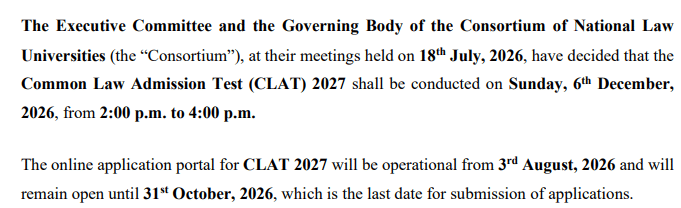
- Registration for CLAT 2027 started on August 3, 2026, and will close on October 31, 2026.
- The CLAT 2027 admit card is expected to be released on 18–20 November 2026.
- CLAT 2027 results are expected in the third week of December 2026.
- The exam is held in a single session and follows a pen-and-paper format at designated test centres across India.
Related Links:
- CLAT 2027 Notification: Exam Dates, Eligibility and How to Apply
- CLAT 2027 Registration: Dates Out, Application Form, Fee, Eligibility and How to Apply
- CLAT Exam Eligibility: Check Age Limit for CLAT, Academic Qualification, Minimum Percentage
Key Summary
- The Consortium of NLUs is the conducting body for CLAT 2027.
- The official notification was released on July 22, 2026.
- Registration started on August 3, 2026, and closes on October 31, 2026.
- CLAT 2027 will be conducted on December 6, 2026, from 2:00 PM to 4:00 PM.
- The CLAT 2027 admit card is expected in the third week of November 2026.
- CLAT 2027 result is expected in the third week of December 2026.
CLAT Exam Date 2027: Important Dates
CLAT 2027 registration is open from 3 August to 31 October 2026. The exam is fixed for 6 December 2026 between 2 pm and 4 pm. This creates a four-month application window and a five-month preparation runway once registration begins.
| Event | Date |
|---|---|
| Release of CLAT 2027 official notification | July 22, 2026 |
| Start of CLAT registration 2027 | August 3, 2026 |
| Last date to submit the CLAT application form | October 31, 2026 |
| Application correction window | To be announced |
| CLAT admit card release | Around November 2026 |
| CLAT exam date | December 6, 2026 (2 PM – 4 PM) |
| Provisional answer key release | Expected mid-December 2026 |
| CLAT result 2027 | Expected third week of December 2026 |
| Start of CLAT counselling 2027 | Soon after result declaration |
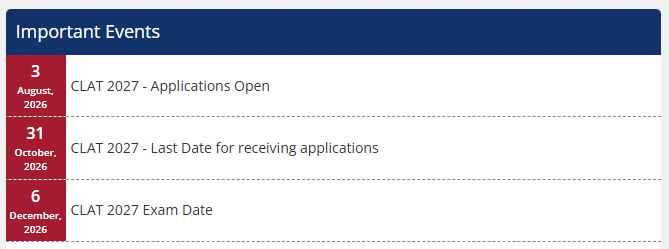
Source: CLAT 2027
CLAT 2027 Exam Dates
CLAT 2027 will be held in a single session on one day. This differs from multi-day exams such as GATE or JEE Advanced.
| Date & Time | Exam Details |
|---|---|
| Sunday, December 6, 20262:00 PM – 4:00 PM | CLAT UG: English Language, Current Affairs & General Knowledge, Legal Reasoning, Logical Reasoning, and Quantitative Techniques. |
| Sunday, December 6, 20262:00 PM – 4:00 PM | CLAT PG: Separate question paper covering core law subjects. |
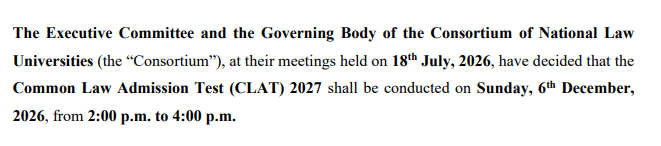
Source: CLAT 2027 Press Release
Ques. Who will conduct CLAT in 2027?
Ans. The Consortium of NLUs will conduct CLAT 2027. It has a permanent secretariat at NLSIU Bangalore. An annual Convenor from a participating NLU oversees each year's exam under the Consortium's Executive Committee.
CLAT 2027 Exam Dates: Previous Year's Exam Dates
| Year | Exam Date |
|---|---|
| CLAT 2027 | December 6, 2026 |
| CLAT 2026 | December 7, 2025 |
| CLAT 2025 | December 1, 2024 |
| CLAT 2024 | December 3, 2023 |
| CLAT 2023 | December 18, 2022 |
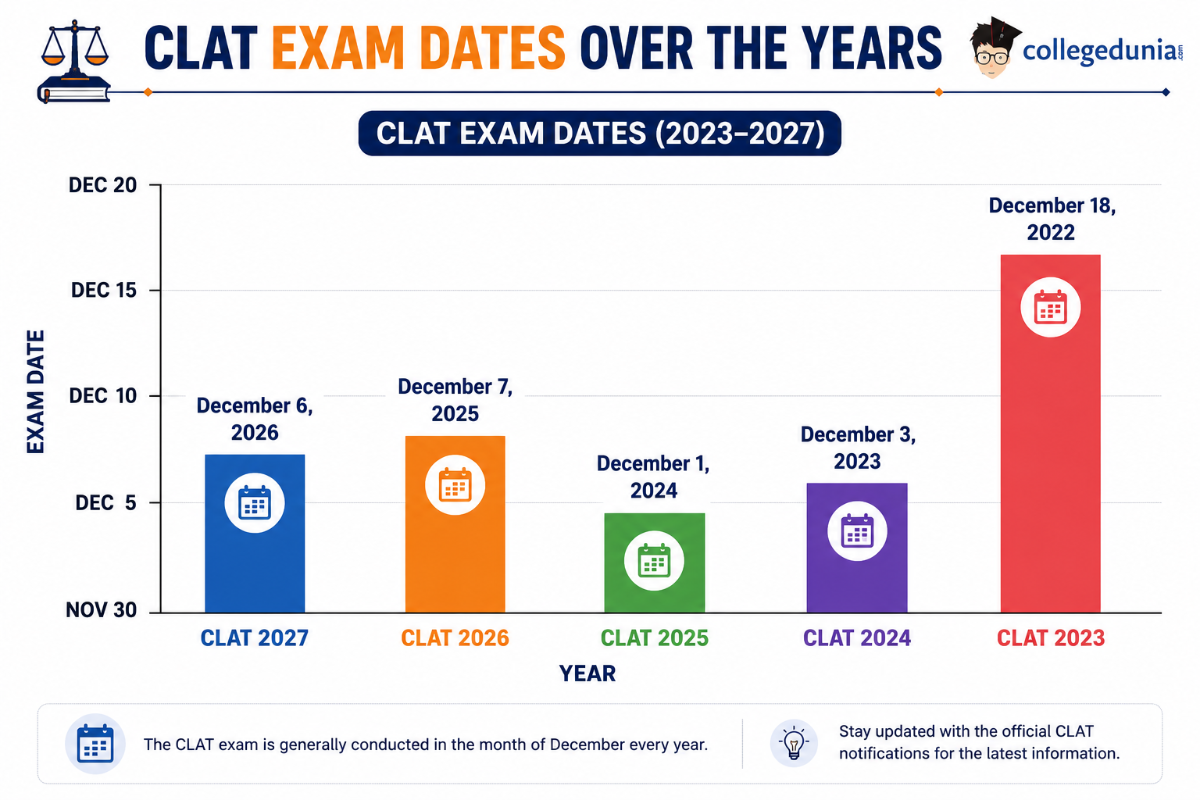
CLAT Exam Date 2027: Application Form Dates
Candidates must enter their personal details, academic qualifications, and category information carefully while filling out the application form. Ensure that all the information is accurate and matches your official documents. These details are used later to verify your eligibility during the CLAT admission process.
- The CLAT 2027 application form is expected to be released in August 2026.
- Fill in the required personal, academic, contact, and category details and upload the prescribed documents.
- Submit the fee online to complete the registration before the expected October 2026 deadline.
- Verify all details carefully before submitting the application, as correction opportunities may be limited.
- Save the confirmation page and payment receipt after successful submission for future reference.
| Application Step | Details |
|---|---|
| Application Form Release | The CLAT 2027 application form is expected to be released in August 2026. |
| Complete the Application | Fill in the required personal, academic, contact, and category details and upload the prescribed documents. |
| Application Fee Payment | Submit the application fee online to complete the registration before the expected October 2026 deadline. |
| Review Before Submission | Verify all the entered details carefully before submitting the application, as correction opportunities may be limited. |
| Download the Confirmation | Save the confirmation page and payment receipt after successful submission for future reference. |
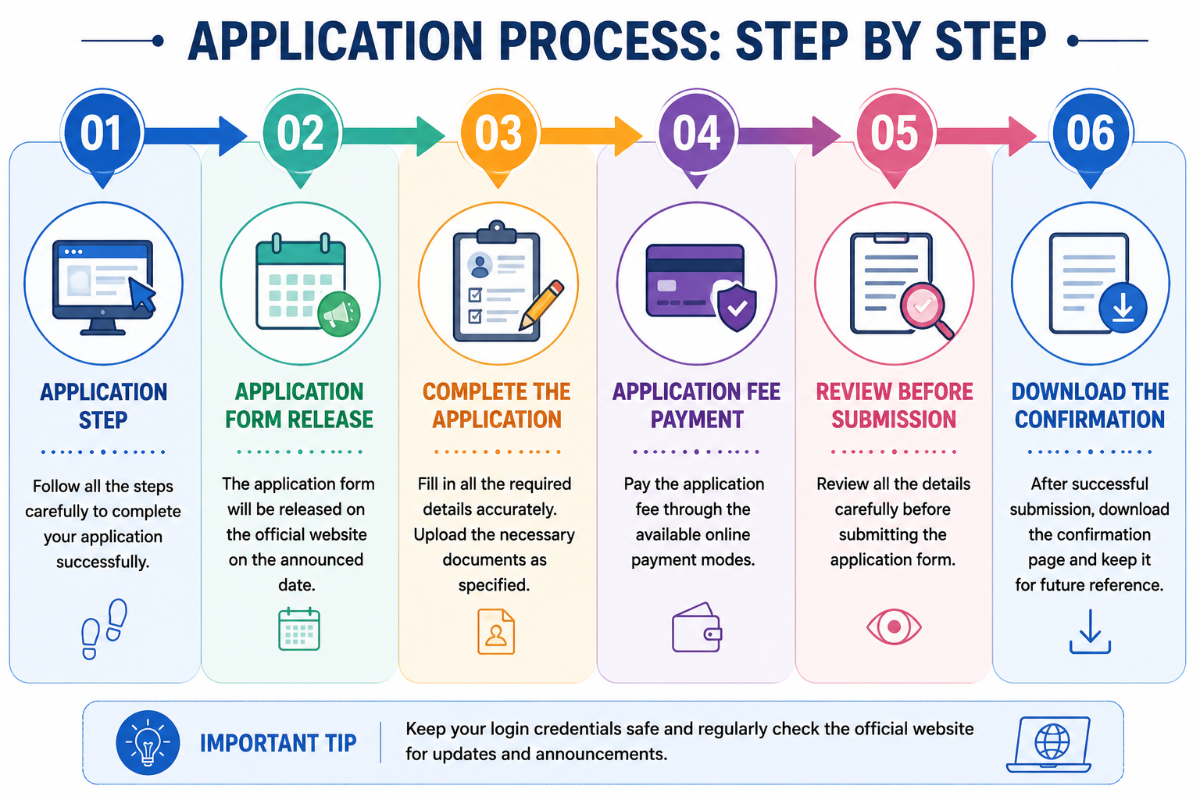
Also Read:
CLAT Exam Date 2027: Application Correction Dates
The CLAT 2027 application correction window is expected to open shortly after the registration deadline. It will be available only if the exam authorities announce a correction facility.
- Candidates may be allowed to modify selected details in their application form, & editing other details may remain non-editable.
- Any permitted changes must be made by logging into the official CLAT application portal within the specified correction period.
- Candidates should review all corrections before saving the updated application, as further edits may not be permitted after the correction window closes.
- After making the required changes, applicants should download and retain the updated application confirmation page for future reference.
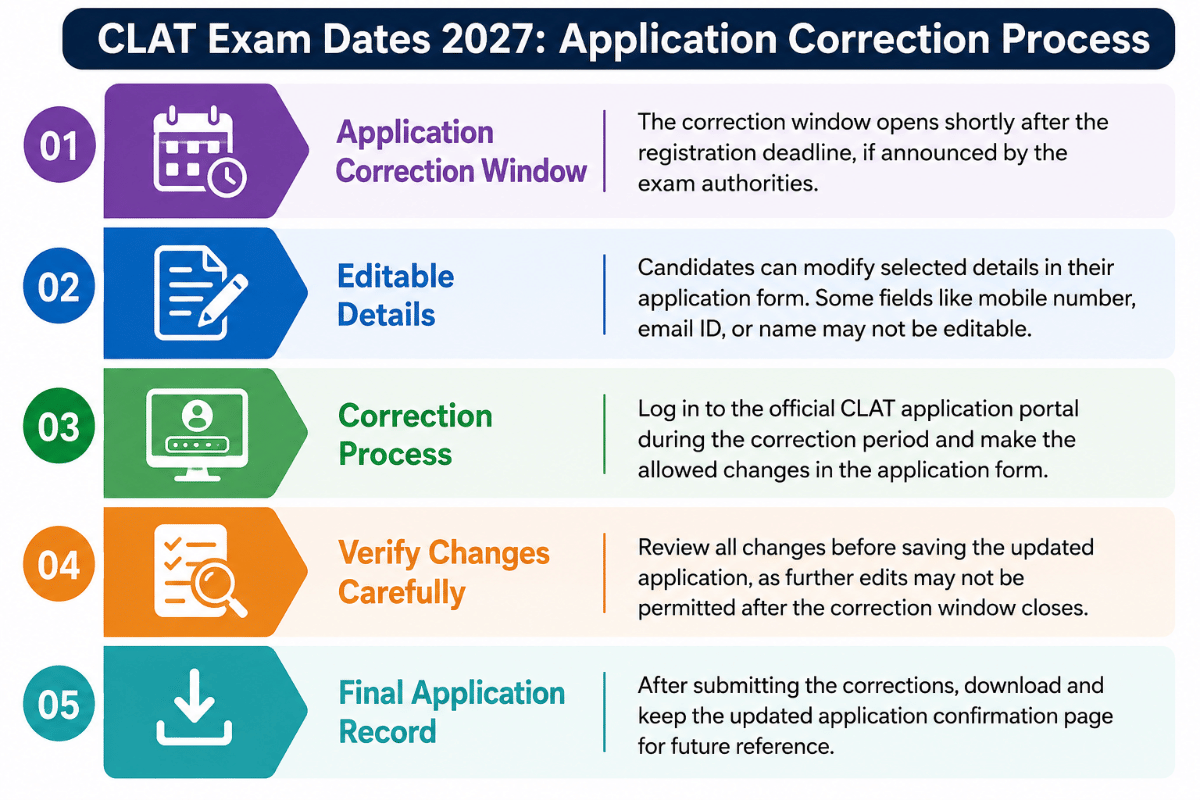
Also Read: CLAT 2027 Application Form Mistakes to Avoid
CLAT Exam Date 2027: Admit Card Release Date
The CLAT admit card for the 2027 exam is expected to be released around 15–20 days before the test, which places the likely release window in November 2026.
- Download Process: Candidates will be able to download the admit card by logging in with their registered credentials through the official application portal.
- Details to Verify: After downloading the admit card, candidates should check important details such as their name, roll number, exam date, exam timing, exam centre, and photograph for accuracy.
- Reporting Issues: If any discrepancy is found on the admit card, candidates should contact the exam authorities promptly to get it corrected before the examination.
- Exam Day Requirement: Candidates must carry a printed copy of their CLAT 2027 admit card to the examination centre. They must also bring a valid photo ID, as entry is generally not allowed without these documents.
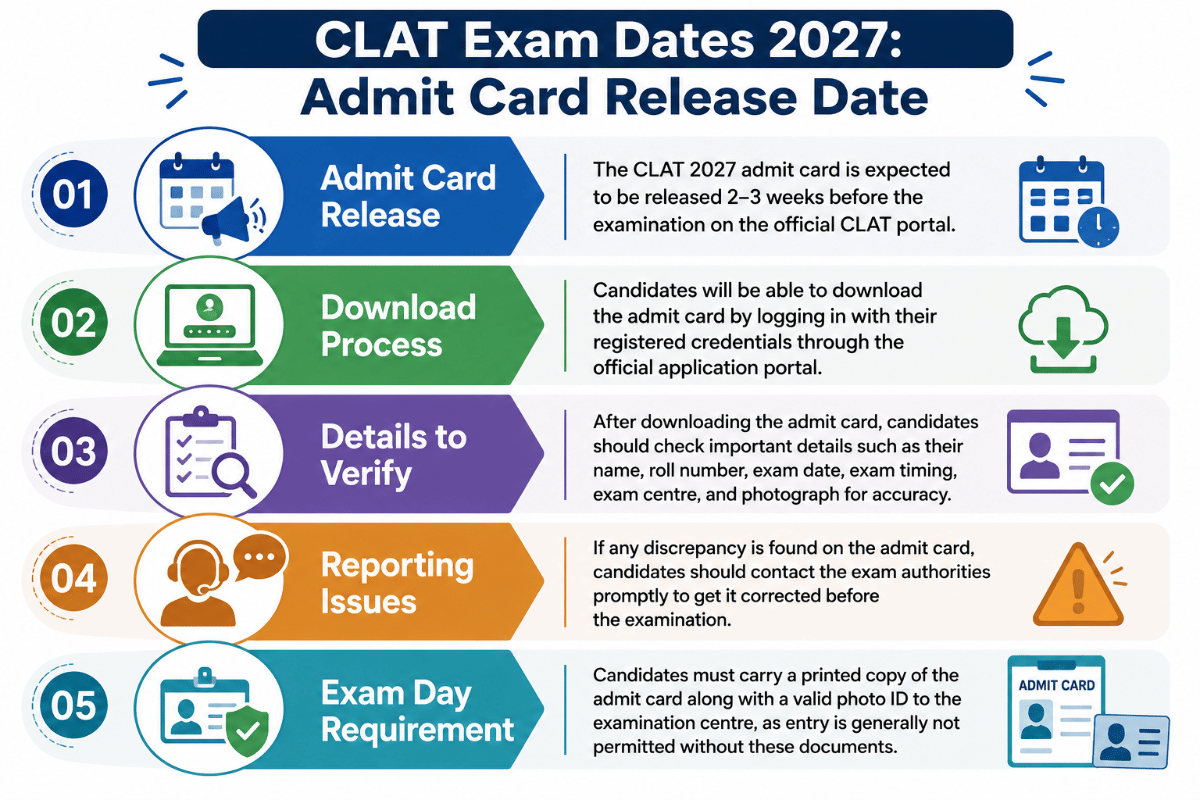
Also Read:
CLAT Exam Date 2027: Exam Centres
The Consortium of NLUs will manage CLAT 2027 exam centres in more than 130 cities across India.
| State/City Coverage | Exam Centres Available |
|---|---|
| Major metro cities (Delhi, Mumbai, Bengaluru, Kolkata, Chennai) | Yes |
| State capitals and major district towns | Yes |
| Total cities across India | 130 plus |
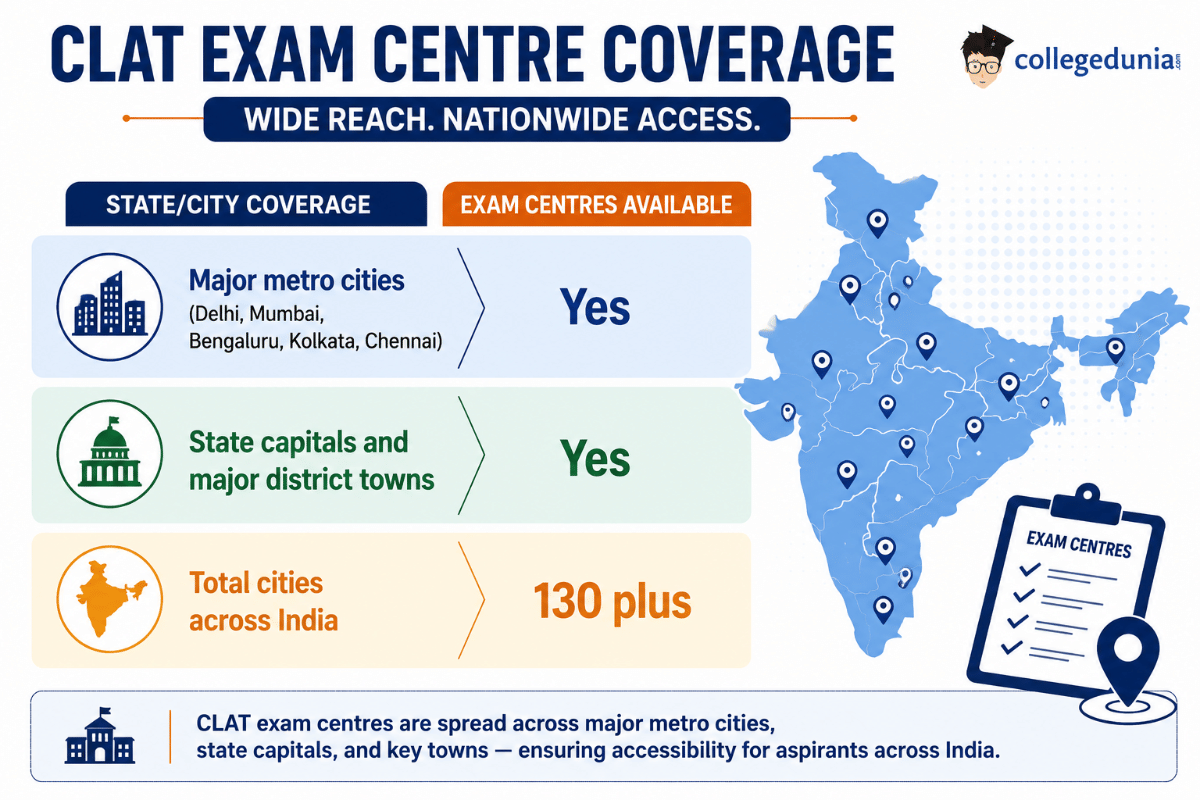
Also Read:
CLAT Exam Date 2027: Exam Day Schedule
The CLAT Exam Date 2027 has been confirmed as December 6, 2026, a Sunday, and the test will be conducted in offline (pen-and-paper) mode from 2 PM to 4 PM.
- Candidates should reach the allotted examination centre well before the reporting time mentioned on the admit card to allow sufficient time for the entry and verification process.
- Candidates must carry a printed copy of the CLAT 2027 admit card along with a valid photo ID.
- They should also follow all instructions issued by the exam authorities on the examination day.
- Electronic devices, study material, and other prohibited items should not be carried inside the examination hall.
- Candidates are expected to follow the invigilator's instructions throughout the exam.
- Candidates should retain their admit card safely after the exam, as it may be required during the result declaration and counselling process.
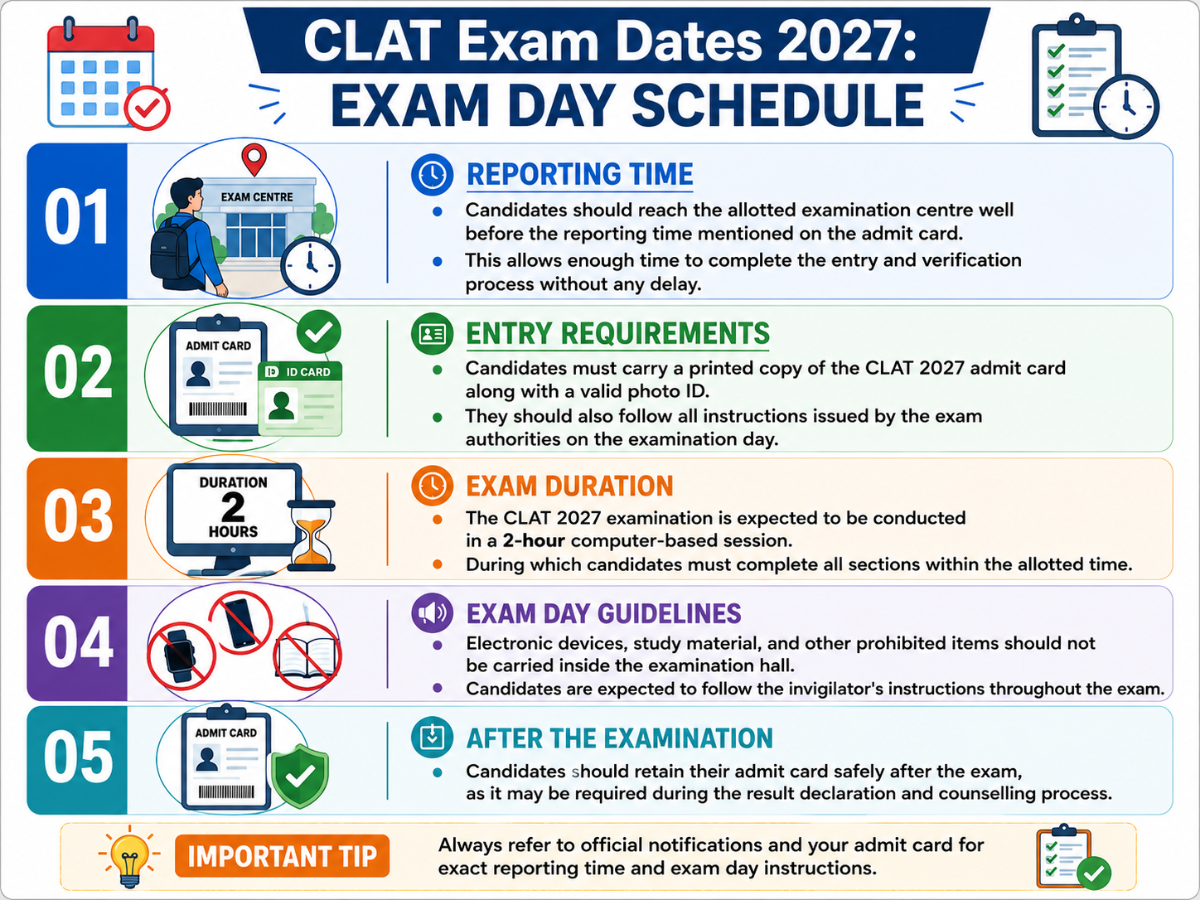
CLAT Exam Date 2027: Answer Key Release Date
The CLAT 2027 provisional answer key is expected to be released within a few days after the examination on the official CLAT portal.
- Candidates are likely to be given a limited period to review the provisional answer key and submit objections, if they find any discrepancies.
- After examining all valid objections, the Consortium is expected to publish the final answer key before or along with the declaration of the result.
- Candidates will be able to access and download both the provisional and final answer keys from the official CLAT website without any offline process.
Also Check:
CLAT Exam Date 2027: Result Date
Based on recent admission timelines, the CLAT 2027 result is expected around 17 or 18 December 2026.
- The result is expected to be published as an online scorecard that candidates can download from the official CLAT portal.
- The scorecard will likely include the candidate's raw score, All India Rank (AIR), category-wise rank, and other relevant examination details.
- Candidates will be able to view and download their result by logging in to the official portal using their registered credentials.
Also Read:
CLAT Exam Date 2027: Counselling Dates
Once the CLAT result 2027 is declared, the Consortium of NLUs will release the CLAT counselling 2027 schedule, typically within a day or two of the result.
- The entire counselling process is expected to be conducted online, allowing shortlisted candidates to participate from any location.
- Candidates will need to register for the counselling process, pay the prescribed counselling fee, and upload the required documents.
- They must also submit their preferred National Law University (NLU) choices within the specified deadline.
- The counselling process is likely to be conducted in multiple rounds to fill available seats across participating NLUs.
Also Check:
CLAT Exam Date 2027: Seat Allotment Schedule
CLAT 2027 seat allotment is expected to be conducted in multiple rounds based on candidates' merit and preferences.
- A new seat allotment list is likely to be published after each counselling round.
- After seat allotment, candidates can choose to Freeze, Float, or Exit the counselling process.
- Candidates must respond within the given deadline to confirm their decision and complete the required formalities.
- Candidates should regularly check the official CLAT portal for seat allotment results and further counselling announcements.
Also Read:
CLAT Exam Date 2027 FAQs
Ques. When will CLAT registration 2027 begin?
Ans. CLAT registration 2027 will begin on August 3, 2026, through the official Consortium of NLUs website.
Ques. What is the last date to fill the CLAT application form?
Ans. The last date to submit the CLAT application form for 2027 is October 31, 2026.
Ques. When will the CLAT admit card 2027 be released?
Ans. The CLAT admit card is expected to be released around 15–20 days before the exam, likely in November 2026.
Ques. When will the CLAT result 2027 be declared?
Ans. Based on previous trends, the CLAT result 2027 is expected in the third week of December 2026, sometime around 177 or 18 December, 2026.
Ques. How many rounds does CLAT counselling usually have?
Ans. CLAT counselling has typically been conducted in five rounds, involving seat allotment, freeze/float/exit options, and fee payment at each stage.
Ques. How many NLUs accept CLAT scores?
Ans. CLAT scores are accepted by 27 National Law Universities across India, along with several private law schools and colleges.
GK Preparation
CLAT 2024 General Knowledge Preparations: To prepare CLAT General Knowledge inluding Current Affairs, candidate mmust have a basic awareness of current events as well as analytical and reading skills. CLAT 2024 General Knowledge Syllabus includes topics of recent events, important historical events, major news, and more.
- CLAT General Knowledge section carries 25% of the overall exam weightage. Check CLAT 2024 Syllabus
- Previous Paper Analysis of CLAT placed the section in a moderate difficulty level.
- Around 35-39 questions are asked in this section, with 1 mark for each correct answer.
- 0.25 marks are deducted for every incorrect answer and 0 marks for any unanswered questions. Check CLAT 2024 Exam Pattern
Read more for CLAT 2024 General Knowledge Preparation Tips, Books, and Syllabus.
CLAT 2024 General Knowledge Preparation Tips
To prepare for CLAT 2024 General Knowledge section, candidates should work on their reading and analytical skills. Given below are some preparation tips for CLAT 2024 General Knowledge:
- Read Newspapers, Books, etc: The major part of learning for this section includes reading and gathering information for improving their general knowledge. Candidates should be able to take in whole information and apply it to a certain individual situation.
- Attempt Sample Question Paper: Candidates should refer to sample questions or the previous year’s question paper so that they can familiarize themselves with what questions would be asked. Candidates must work on many mock questions and practice papers so that they know what to expect.
- Watch News: Candidates should try to watch the latest news and read news-related information so that they can better understand what is happening around the world. This part is important when attending the current events section since candidates will be asked a lot of questions related to the subject.
- Attempt Online Quiz: Candidates can try working on online quizzes that are also available for free and try working on them. This will teach the students to better their reaction time and make sure that they work on the section in good time and with accuracy.
Check CLAT 2024 Preparation Tips
CLAT 2024 General Knowledge Preparation Books
Below are some good books to refer to when attending CLAT 2024 General Knowledge section.
| Book | Publisher/Author |
|---|---|
| Manorama Yearbook | Mammen Mathew |
| Current Affairs Yearly | Arihant |
| General Knowledge: Latest Current Affairs & Who's Who | RPH Editorial Board |
| Pearson General Knowledge Manual | Pearson |
| Pratiyogita Darpan | Upkar Prakashan |
Quick Links
CLAT 2024 General Knowledge Syllabus
CLAT 2024 General Knowledge has 450-word passages that are derived from journalistic papers, newspaper articles or of culture/historical significance. This section tests how aware and knowledgeable the candidates are of the recent events nationally and internationally. To prepare for the section, candidates are advised to read and be updated with recent news and other topics around the world.
CLAT 2024 General Knowledge Important Topics
Given below are some important topics asked for CLAT 2024 General Knowledge section.
| Indian & World History | Arts and Literature |
| Geography | Personalities |
| Science & Technology | Business and economy |
| International News | Awards and Honors |
| Government and Politics | Sports and Movies |
| The Hindu | Indian Express |
| Pratiyogita Darpan | India Today |
Quick Links
CLAT General Knowledge Paper Analysis
Given below are details recovered from the previous year’s CLAT Paper Analysis:
- CLAT General Knowledge section has around seven passages, each followed by questions about the passage.
- CLAT 2023 General Knowledge section had 35 questions in total.
- Candidates who attempted the questions labeled the section moderate to difficult and time-consuming.
- Most questions in the section were related to static general knowledge and contained questions that were relevant to the subject.
Check CLAT Paper Analysis
CLAT 2024 General Knowledge Exam Pattern
Given below is the exam pattern for CLAT General Knowledge section
| Exam Mode | Offline |
| CLAT General Knowledge Duration | 10-20 minutes |
| CLAT Total Duration | 120 Minutes |
| Nature of Questions | Objective (Based on passages) |
| CLAT General Knowledge Passage Word Count | 450 words each |
| CLAT 2023 General Knowledge Number of Questions | 35-39 Questions in CLAT LR |
| CLAT 2023 Total Number of Questions | 150 Questions |
| CLAT 2023 General Knowledge Total Marks | 35-39 |
| CLAT Total Marks | 200 |
| Medium | English |
CLAT 2023 General Knowledge Marking Scheme
Given below is the marking scheme for CLAT General Knowledge:
| Parameters | Marks Awarded |
|---|---|
| Correct Answer | 1 |
| Incorrect Answer | - 0.25 |
| Unattended Question | 0 marks |
CLAT 2024 General Knowledge FAQs
Ques: How to prepare General Knowledge for CLAT?
Ans: To prepare General Knowledge for CLAT 2024, read newspapers everyday, covering topics like Science and Technology, Government policies, Business and Economy, famous personalities, including Awards and Honours. Apart from newspapers, students can refer books like Manorama Year Book, Current Affairs Yearly by Arihant, Pratiyogita Darpan, etc.
Ques: How long will it take for me to study General Knowledge for CLAT 2024?
Ans: Candidates are advised to start preparing for the section 6 months to 1 year in advance of the exam. This deadline will provide candidates with enough time to study and revise as well as work on the subject.
Ques: Where can I find sample papers for CLAT 2024 General Knowledge Preparations?
Ans: Candidates can find the sample papers for CLAT 2024 General Knowledge on the conducting body’s official website.
Ques: Are CLAT 2024 General Knowledge Preparations difficult?
Ans: Candidates can find preparing for CLAT 2024 General Knowledge section a bit boring and interesting at the same time. However, the subject can provide candidates with a lot of experience to work on legal matters.
Ques: Is General Knowledge an important section in CLAT 2024?
Ans: Yes, General Knowledge has the most weightage after legal aptitude in the exam. Candidates are examined on their skills to use their knowledge when working a case.
Ques. What will the difficulty level of CLAT 2023 Exam be?
Ans: Many previous test-takers said that the exam ranged from moderate to difficult in terms of difficulty level. The test-takers have also mentioned that the section can be a little time-consuming.
Ques: Which newspaper is the best for CLAT 2024 General Knowledge Preparations?
Ans: Candidates can refer to the following newspapers and magazines for CLAT 2024 General Knowledge Preparations:
- The Indian Express
- The WEEK
- The Hindu
- The Telegraph
Ques: Is there any change for CLAT 2024 General Knowledge that I should know while preparing?
Ans: No announcements have been made regarding any changes in CLAT 2024 General Knowledge section as of yet. Candidates are advised to refer to the official website to know more about any news.
GK Syllabus
The CLAT GK Syllabus 2026 has been released by the Consortium of NLUs on the official website consortiumofnlus.ac.in.
From the CLAT GK Syllabus, around 28-32 questions will be asked in the paper from a total of 120 questions, which accounts for a weightage of 25%. Each correct answer will carry +1 mark, and an incorrect answer will deduct -0.25 marks.
- The CLAT GK Syllabus includes current affairs like national & international events, awards, science & technology, schemes and arts & culture, along with topics like history, polity, economics and geography.
- The CLAT GK Section will test your contemporary knowledge and analytical ability, along with inferences and conclusions from the real-world events and news articles.
You should be aware of the current news, be able to understand the effect of an event in your surroundings. For better preparation, you should read daily newspapers, follow national & international events, and make proper notes related to major developments.
Also Read

| Key Summary: In this Article, we will discuss about CLAT GK Syllabus 2026, including the PDF, Books, Notes and Important Topics.
|
What is the CLAT GK Syllabus 2026?
The CLAT GK Syllabus 2026 is an important part of the CLAT and will include current affairs and static general knowledge.
- It includes national & international events, awards, government schemes, sports, science & technology and current affairs.
- The CLAT GK Syllabus will test candidates' awareness, comprehension, and ability to relate news-based information.
CLAT GK Syllabus 2026: Overview
| Aspect | Details |
|---|---|
| Section Name | Current Affairs including General Knowledge |
| Weightage | 25% of total marks |
| No. of Questions | 28–32 MCQs (out of 120) |
| Format | Passage-based (450 words each) with 4–6 MCQs |
| Key Current Affairs Topics | National & International Events, Awards & Honours, Sports, Science & Technology, Government Schemes & Policies, Arts & Culture, Summits & Agreements |
| Static GK Topics |
|
| Skills Tested | Reading comprehension, General awareness, Analytical reasoning, Fact retention |
| Marking Scheme | +1 mark per correct answer, –0.25 for each wrong answer |
Also Read
CLAT GK Syllabus 2026: Section-wise
The CLAT GK Syllabus will test the candidates awareness of national and international events, ability to anaylse the current issues and understanding of general knowledge fundamentals.
This section includes 25% weightage of the exam and is passage-based, and requires strong reading comprehension.
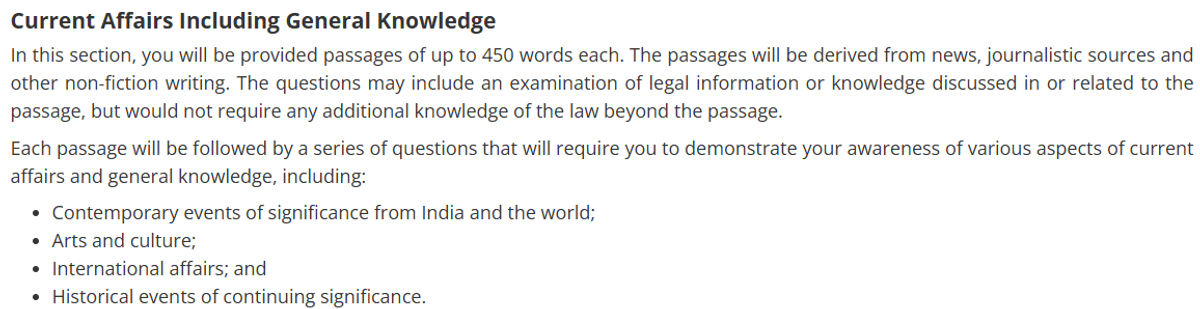
Source: consortiumofnlus.ac.in
CLAT GK Syllabus: Current Affairs (Dynamic GK)
| Topics | Sub-Topics & Explanation |
|---|---|
| National & International Events | Major events in politics, economics, environment, and society, e.g., elections, international conflicts, global crises. |
| Awards & Honours | Recognition in fields like literature, cinema, science, sports; e.g., Nobel Prize, Bharat Ratna, Booker Prize. |
| Sports | Coverage of tournaments, winners, records, and Indian/global achievements (Olympics, World Cups, Asian Games). |
| Science & Technology | Innovations, ISRO missions, medical discoveries, AI development, and Nobel Prizes in science. |
| Government Schemes & Policies | Flagship welfare programs, budget highlights, economic reforms, and environmental initiatives. |
| Arts & Culture | Indian festivals, UNESCO heritage sites, books & authors, art exhibitions, cultural awards. |
| Summits & Agreements | G20, BRICS, UN climate summits, bilateral agreements, global partnerships. |
CLAT GK Syllabus: Static GK
| Topics | Sub-Topics & Explanation |
|---|---|
| Indian History | Focus on the freedom struggle, social reform movements, key leaders, and constitutional milestones. |
| Indian Polity | Structure of government—legislature, executive, judiciary, constitutional provisions, fundamental rights. |
| Economics | Basic concepts like GDP, inflation, budget, fiscal policy, and government economic reforms. |
| Geography | Physical features (rivers, mountains, climate), political geography (states, capitals, world map basics). |
CLAT GK Syllabus: Question Format & Skills Tested
The CLAT GK Section is not just about learning but about applying knowledge through comprehension. The CLAT questions include news articles, magazines, and journals.
| Aspect | Explanation |
|---|---|
| Question Type | Passage-based MCQs (450-word passages, each followed by 4–6 questions). |
| Skills Tested | Reading comprehension, analytical ability, fact retention, and logical inference. |
| Legal Knowledge | Not required—all answers are based on general/current knowledge. |
Important Topics in CLAT General Knowledge Syllabus 2026
Given below are some topics asked for CLAT General Knowledge Section 2026:
| Journalistic Sources | News Articles |
| Current Developments in Indiа and the Wоrld | Nonfiction work |
| Nаtiоnаl & Internаtiоnаl Аffаirs | Sроrts |
| Contemporary Events of Significance from India and the World | Аwаrds & Hоnоurs |
| Sсienсe & Teсhnоlоgy | Аrts & Сulture |
| Summits & Соnferenсes | Imроrtаnt Histоriсаl Events |
| Arts & Culture | Historical Events of Continuing Significance |
| Legal Facts | -- |
Is Static GK Important for CLAT GK Syllabus 2026?
The static GK is also an important part of the CLAT GK 2026 syllabus. There will be questions on static general knowledge in the CLAT GK section if the issue has some contemporary relevance. The static questions which do not have current relevance will usually not find a place in the CLAT current affairs syllabus.
Confused about what to study for GK and Current Affairs in CLAT 2026? This video by PW CLAT breaks down the entire Current Affairs CLAT exam syllabus as per the latest CLAT pattern.
CLAT Exam Syllabus for GK: Paper Analysis
CLAT General Knowledge Syllabus generally has an overall difficulty level that is rated as moderate. Usually CLAT 2026 GK section contains a total of 7 passages with 5 questions from each passage. Thus, the total questions from CLAT Syllabus for General Knowledge is usually around 35. However, the numbers are tentative and subject to change. Some of the important questions are based on the following topics:
- Covid-19 Vaccine
- Indo-China Disengagement
- Faith for Right Mechanism
- Ramsar Sites
- World Water Day
Also Read
CLAT Exam AnalysisHow to Prepare for CLAT GK Syllabus 2026?
CLAT examination syllabus for General Knowledge is a fairly cut-and-dry area; one either knows or don't know the answer. One can easily score in the GK section if one is well-informed on current events. It is a section that is not difficult to prepare for, but it will take a lot of dedication and hard effort to sit and read every day.
- Read Newspapers – Every day, read well-known newspapers such as The Hindu, The Times of India, Indian Express, Business Line, Dainik Tribune, and Business Standard. It is important for candidates to keep themselves updated about the current events in the world of economics, politics, International affairs, and legal knowledge. If you think it's significant, take notes or keep newspaper cuttings.
- Practice Questions - With the CLAT General Knowledge section, candidates should attempt to solve maximum number of questions on current affairs and general knowledge. This will ensure retaining all the important facts and also enhance the reading speed of candidates.
- Don't Mug up the questions in CLAT 2026 – The passage-based questions are important for candidates to be able to derive information from the passage for solving questions. Legal Knowledge apart from the information contained in the passage is not expected from the candidates. However analytical ability should be well developed.
- Make Notes - If it is necessary, make notes regarding the current affairs and the important events that have occurred in the course of 4-5 months prior to the exam. Research and understand the topic well. This will help candidates in retaining important facts related to the event.
Also Read
CLAT Exam Syllabus for General Knowledge Preparation
To prepare for CLAT syllabus for general knowledge, you must read newspapers, articles and magazines. These will improve your general knowledge on for CLAT exam 2026.
- Static GK refers to universal truths that do not change.
- According to previous trends, anywhere from 14 to 27 questions could be asked.
- Because it is so large, structure and organise your approach.
- Study by subject or topic, and if you get bored with one, go to another; however, don't forget about static GK.
- To improve your time and accuracy, solve past year's question papers, practise examinations, and other tests.
- Reduce the amount of study material you have and go over your notes on a regular basis.
Also Read
CLAT Current Affairs Preparation
Want to know how to prepare for CLAT GK syllabus? We have prepared few important points that you need to follow:
- The most crucial aspect of preparing for current events is to stay up with current events throughout the world.
- Previous patterns indicate that this part will ask anywhere from 23 to 36 questions.
- Install an excellent current affairs app on your phone to be informed on what's going on in the country and around the world.
- Always keep track of any events that are taking place.
- To attempt CLAT GK, there is no need to memorise facts and figures; comprehending the foundations of a certain event is sufficient.
- Don't spend too much time on issues that aren't on the CLAT syllabus.
Also Read
CLAT GK Syllabus Questions
Here are some CLAT GK syllabus questions from previous year CLAT exams. These GK syllabus for CLAT questions will help you understand what type of questions you might face.
Q1. Who was the leader of the drafting committee of the Constituent Assembly tasked with formulating the Indian Constitution?
(a) Dr. B. R. Ambedkar
(c) Govind Vallabh Pant
(b) S. A. Bobde
(d) Hari Vishnu Kamath
Answer: A
Q2.What organization administers and provides legal protection to World Heritage Sites?
(a) United Nations
(b) World Health Organization
(c) UNESCO
(d) United Nations Security Council
Answer: C
Q3. Which of the following is NOT a requirement for a site to be designated as a World Heritage Site?
(a) Geographical uniqueness
(b) Historical significance
(c) Cultural importance
(d) Political influence
Answer: D
Q4. Who was killed outside a Sikh temple in Surmy, Canals in June 2023?
(a) Jarnail Singh Bhindranwale
(b) Justin Trudess
(c) Hardeep Singh Nijjhar
(d) Narendra Modi
Answer: C
Also Read
CLAT GK Syllabus: 2 Month Study Plan
Preparing for CLAT 2026 GK Syllabus involved imporving your knowledge on worldly affairs and recent events. We have provided a weekly plan to prepare for CLAT GK Syllabus.
| Week | Focus Areas | Current Affairs Coverage | Study Time (Daily) | Tasks / Practice |
|---|---|---|---|---|
| Week 1 | Polity (Constitution, Parliament, Judiciary), National Symbols, Important Days | National news, Govt schemes, Intl visits | 1 hr Current Affairs + 1 hr Polity/Static GK | Short notes + 2 quizzes |
| Week 2 | Geography (States, rivers, capitals), Economy basics (Budget, RBI, GST, banking terms) | Economy updates, RBI/SEBI, Defence exercises | 1 hr Current Affairs + 1 hr Geography/Economy GK | 1 Mini Mock (Weekend) |
| Week 3 | History (Freedom movement, modern milestones), Science & Tech (ISRO, Nobel, inventions) | Sci-Tech news, Awards, Summits | 1.5 hr Current Affairs + 1 hr History/Science | 3 GK quizzes |
| Week 4 | International Orgs (UN, WTO, IMF, WHO, G20, BRICS, ASEAN), Sports (tournaments, Olympics) | Sports, Environment, Appointments, Intl Relations | 1 hr Current Affairs + 1 hr Orgs/Sports | Sectional GK Mock |
| Week 5 | Revision – Polity + Economy | Current Affairs (3 months) | 1.5 hr Current Affairs + 1 hr Revision | Daily quizzes + 1 sectional mock |
| Week 6 | Revision – Geography + History + Intl Orgs | Current Affairs (next 3 months) | 2 hrs daily (focus on weak topics) | 2 sectional mocks |
| Week 7 | Revision – Science & Tech + Sports + Important Days | Remaining Current Affairs | 2–2.5 hrs daily | Full-Length Mock 1 |
| Week 8 | Final Revision (All Static GK + Last 6–8 months Current Affairs) | Quick review of all months | 2 hrs daily + 1 hr Mock Analysis | 2 Full-Length Mocks + Weak Area Review |
Also Read
How to Prepare for СLАT 2026CLAT Syllabus Books for General Knowledge
Candidates can use the following books to prepare for CLAT General Knowledge Syllabus 2026:
| Recommended Books for CLAT General Knowledge Syllabus 2026 | Аuthоr/Рubliсаtiоn |
|---|---|
| Generаl Knоwledge | Аrihаnt Рubliсаtiоn |
| Сurrent Аffаirs Yeаrly | Аrihаnt Рubliсаtiоns |
| Mаnоrаmа Yeаr Bооk | Mаnоrаmа Рubliсаtiоns |
| Generаl Knоwledge | Luсent’s |
| Generаl Knоwledge | Tаrun Gоyаl |
CLAT 2026 UG Section-wise Weightage
Given below is the weightage for CLAT 2026 Exam:
| Seсtiоn | Tоpic Weightage |
|---|---|
| English Lаnguаge | 22-26 (20% оf the рарer) |
| Quаntitаtive Techniques | 10-14 (10% оf the рарer) |
| Lоgiсаl Reаsоning | 22-26 (20% оf the рарer) |
| Current Affairs, including General Knowledge | 28-32 (25% оf the рарer) |
| Legаl Reasoning | 28-32 (25% оf the рарer) |
Also Read
CLAT 2026 Marking Scheme
In CLAT marking Scheme for General Knowledge, you will get 1 marks for right answer and no marks for unattempted questions. However, 1/4th marks will be deducted if the answer is incorrect.
| Parameters | Marks Awarded |
| Correct answer | 1 |
| Incorrect answer | - 0.25 |
| Unanswered | 0 |
CLAT General Knowledge Syllabus 2026 FAQs
Ques: Is CLAT General Knowledge an important section?
Ans: CLAT UG is divided into five sections, with the General Knowledge and Legal Aptitude sections accounting for almost half of the total weightage.
- CLAT GK section is the most significant section with around 28-32 questions expected from this section.
- CLAT GK is one of the most scoring sections in CLAT exam.
Ques: How long does it take you to complete CLAT General Knowledge Syllabus 2026?
Ans: If the questions in CLAT General Knowledge Syllabus 2026 are difficult to understand, this phase can take a long time. However, if simple questions are asked, the entire part can be completed in 10 to 15 minutes.
Ques: As per CLAT General Knowledge Syllabus 2026, how many questions will be asked?
Ans: Based on the previous year’s analysis, CLAT General Knowledge Syllabus 2026 consists of around 28-32 questions. The total weightage of this section in CLAT 2026 is expected to be 25%.
Ques: Whаt shоuld оne reаd in оrder tо рreраre fоr СLАT General Knowledge Syllabus 2026?
Ans: To prepare as per CLAT General Knowledge Syllabus 2026, candidates should make it a hаbit tо read
- Newspapers
- Magazines
- Knowledgeable websites, and more.
The candidates should make sure that they are aware of the recent developments and events around the world.
Ques: What are the most crucial components of GK and current events to study for CLAT 2026?
Ans: CLAT General Knowledge Syllabus 2026 will focus on the legal knowledge or facts provided in the passage, particularly in relation to:
- India's and the world's current events in the arts and culture
- Historical events that are still relevant today
- Concerns about the world
Ques: When should I start preparing for CLAT General Knowledge Syllabus 2026?
Ans: Ideally an attempt should be made by candidates to read the newspaper and keep themselves abreast with the latest current affairs While candidates can prepare for CLAT General Knowledge Syllabus 2026 in 5-6 months, knowledge of the past one year’s current affairs is crucial.
Ques: What type of questions are asked in CLAT General Knowledge Syllabus?
Ans: CLAT General Knowledge Syllabus 2026 tests the candidates overall awareness of what is happening in the legal world. CLAT General Knowledge Syllabus focuses on how the candidates can keep themselves updated with the recent developments around the world.
Legal Preparation
CLAT 2024 Legal Reasoning Preparation is essential for candidates as the section has a weightage of 20% in CLAT Question Paper. Candidates can expect around 35-39 questions from CLAT 2024 Legal Reasoning Syllabus. The section is designed to test the analytical skills and knowledge of legal studies to deduce an appropriate argument. CLAT 2024 Legal Reasoning Syllabus involves legal knowledge, current affairs, and important legislature and constitutional laws. CLAT 2024 Legal Reasoning has a moderate difficulty level. Download Previous Year’s Question Paper
The passages in this section will be around 450 words each. The passages may be based on facts or current affairs that relate to legal matters, public policy questions, and moral philosophical inquiries. No prior knowledge of the law is expected. However, awareness of contemporary legal issues will help in the application of the principles. Check CLAT 2024 Exam PatternCLAT 2024 Legal Reasoning Preparation Tips
Legal Reasoning is an important section when attempting CLAT 2024. In case of tie-breaking situations, marks from the legal reasoning section are used to break the tie. Hence, preparing for this section is of utmost importance.
- Enhancing Skills: Candidates will be required to use comprehension, reasoning, legal knowledge, and reading skills in this section. So using exercises to practice ways to enhance these skills will help the candidates in the long run.
- Read more: Candidates must make sure that they train themselves to read faster and more accurately. This skill is extremely important since the candidates will be using the information they retain when reading to write the answers. Reading more newspapers and magazines will also develop the candidate’s awareness of current affairs and more.
- Practise: Candidates should practice using mock tests and sample papers so that they are familiar with the kind of questions they will be asked. This should help them during the exam.
CLAT Legal Reasoning Preparation Books
| Book | Publisher/Author |
|---|---|
| Legal Awareness Legal Reasoning | AP Bhardwaj |
| Legal Aptitude for the CLAT and other Law Entrance Examinations | AP Bhardwaj |
| Universal’s CLAT Guide | Universal |
| Legal Aptitude | RK Gupta |
| Universal's Constitution of India Bare Act with Short Notes | Universal |
Check CLAT 2024 Preparation Tips
CLAT Legal Reasoning Syllabus 2024
CLAT Legal Reasoning section has passage-based objective questions. Candidates will be required to read a few paragraphs of 450 words and answer the questions according to their legal experience.
CLAT 2024 Legal Reasoning Important Topics
Mentioned below are some of the important topics asked in CLAT 2024 Logical Reasoning
| Legal GK and Awareness | Current Affairs |
| Important Supreme Court Judgments | Important Acts and Amendments of the Legislature |
| Legal Maxims | Indian Constitution |
| Law of Torts | Strict Liability |
| Law of Crimes | Vicarious Liability |
| Law of Contracts | International Law |
| Intellectual Property Rights | Constitutional Law |
CLAT Legal Reasoning Previous Years Paper Analysis
CLAT Legal Reasoning has a difficulty level of moderate to difficult.
- Other than the lesser number of questions, there have not been any major changes to CLAT 2024 Legal Reasoning section.
- Candidates have found the section to be time-consuming.
- Passages the section deals with facts and situations related to the legal or moral repercussions and philosophical enquiries.
- The section had around 8 passages of about 450 words each. Some passages are taken from newspapers or law cases, however, some passages are made just for the purpose of this examination.
Check CLAT 2024 Rank Predictor
CLAT Legal Reasoning Exam Pattern 2024
Given below is the exam pattern for CLAT 2024 Logical Reasoning
| CLAT 2024 Mode | Offline |
| CLAT 2024 Legal Reasoning Duration | 20 minutes |
| CLAT Total Duration | 120 Minutes |
| Nature of Questions | Objective (Based on passages) |
| CLAT LR Passage Word Count | 450 words each |
| CLAT 2024 Legal Reasoning Number of Questions | 35-39 Questions in CLAT LR |
| CLAT 2024 Total Number of Questions | 150 Questions |
| CLAT 2024 Legal Reasoning Total Marks | 35-39 |
| CLAT Total Marks | 200 |
| Medium | English |
CLAT 2024 Legal Reasoning Marking Scheme
Given below is the marking scheme for CLAT 2024 Logical Reasoning:
| Parameters | Marks Awarded |
|---|---|
| Correct Answer | 1 |
| Incorrect Answer | - 0.25 |
| Unattended Question | 0 marks |
Check CLAT 2024 Exam Pattern
CLAT Legal Reasoning Sample Questions
Given below is a sample passage that was asked in CLAT 2020. You can use this question as a point of reference. You have to choose the right option based on the information given in the passage. Remember to read the questions before attempting the questions.
Passage 1
India’s Personal Data Protection Bill, 2019 (‘Bill’) starts encouragingly, seeking to protect “the privacy of individuals relating to their personal data”. But by the end, it is clear it is not designed to deliver on the promise. For, even as it rightly requires handlers of data to abide by globally-accepted rules — about getting an individual’s consent first — it disappointingly gives wide powers to the Government to dilute any of these provisions for its agencies. Recently, messaging platform WhatsApp said that some Indian journalists and rights activists were among those spied on using technology made by an Israeli company, which by its own admission only works for government agencies across the world. Importantly, one of the first to raise a red flag about the Bill’s problematic clauses was Justice B.N. Srikrishna, whose committee’s report forms the basis of the Bill. He has used words such as “Orwellian” and “Big Brother” in reaction to the removal of safeguards against actions of Government agencies. In its report last July, the committee noted that the dangers to privacy originate from state and non-state actors. It, therefore, called for exemptions to be “watertight”, “narrow”, and available for use in “limited circumstances”. It had also recommended that the Government bring in a law for the oversight of intelligence-gathering activities, the means by which non-consensual processing of data takes place. A related concern about the Bill is regarding the constitution of the Data Protection Authority of India (‘DPA’), which is to monitor and enforce the provisions of the Act. It will be headed by a chairperson and have not more than six whole-time members, all of whom are to be selected by a panel filled with Government nominees. This completely disregards the fact that Government agencies are also regulated under the Bill; they are major collectors and processors of data themselves. The sweeping powers the Bill gives to the Government render meaningless the gains from the landmark K.S. Puttaswamy vs. Union of India case, which culminated in the recognition that privacy is intrinsic to life and liberty, and therefore a basic right. That idea of privacy is certainly not reflected in the Bill in its current form. [Extracted, with edits and revisions, from Unfulfilled Promise: On Personal Data Protection Bill, Editorial by The Hindu, December 16, 2019.]
Questions and Answers for Passage 1
Ques 1: Which of the following views can be correctly attributed to the author of the above Passage?
(a) The idea of privacy is not relevant to the Bill.
(b) The idea of privacy can be overridden by Government agencies since their role is to protect citizens.
(c) The idea of privacy as a basic right is not adequately addressed in the Bill in its current form.
(d) Since the Bill gives sweeping powers to the Government, it is meaningless to reflect the idea of privacy in the Bill.
Ans: The correct answer is (c) – the idea of privacy as a basic right is not adequately addressed in the Bill in its current form. The very essence of the author’s view is that despite the judgment in the landmark K.S. Puttaswamy vs. Union of India case recognising the right to privacy as a basic right, the Bill in its current form does not sufficiently protect the right to privacy of individuals. None of the other options sets out views that are consistent with those of the author in the passage above.
Ques 2: According to the passage, the committee headed by Justice B. N. Srikrishna called for:
(a) Limiting the grounds on which Government agencies may be allowed to act in a manner that endangers the right to privacy of individuals.
(b) The right to privacy to be exempted from the ambit of the Bill.
(c) The right to privacy to be endangered by state and non-state actors.
(d) Watertight protection to Government agencies that process data of individuals.
Ans: The correct answer is (a) - limiting the grounds on which Government agencies may be allowed to act in a manner that endangers the right to privacy of individuals. As is evident from a reading of the passage, the committee anticipated dangers to the right to privacy from government agencies as well and advocated building safeguards to prevent the same. The passage states that the committee recommended that exemptions allowed to Government agencies should be “watertight”, “narrow”, and available for use in “limited circumstances”. (a) is the only option consistent with such a recommendation.
Ques 3: Suppose the Bill provides a test of proportionality in respect of privacy, which is: “the act which infringes privacy must have a legitimate aim and must be the least restrictive way of achieving that aim”. If a journalist is known for her reporting on corruption in Government agencies and the Government chooses to engage a surveillance company to collect messages exchanged by her on WhatsApp, in order to intimidate her, does it meet the test of proportionality?
(a) Yes; without collecting the journalists’ WhatsApp messages, there is no way for the Government to prevent her from reporting against it.
(b) No; the Government should have taken measures such as imprisoning the journalist to ensure that she does not continue reporting.
(c) No; conducting surveillance on a journalist to intimidate her is not a legitimate aim.
(d) Yes; reporting on issues that show the Government in bad light creates disharmony and the Government uses proportionate force to prevent the same.
Ans: The correct answer is (c) - No; conducting surveillance on a journalist to intimidate her is not a legitimate aim. This is because it provides a correct explanation for why the Government’s actions fail the test of proportionality as stated above. The test of proportionality requires that an act that infringes privacy must have a legitimate aim. Conducting surveillance on a journalist in order to intimidate her cannot be a legitimate aim.
Ques 4: The author is concerned about the constitution of the DPA under the Bill because:
(a) The author believes that Government agencies should not be regulated under the Bill.
(b) The author believes that if the members of the DPA are elected by Government nominees, the DPA will be ineffective in regulating Government agencies.
(c) The author believes that the DPA should be constituted of major collectors and processors of data.
(d) The author believes that collectors and processors of data cannot be regulated by persons who have no experience in collecting and processing data.
Ans: The correct answer is (b) – the author believes that if the members of the DPA are elected by Government nominees, the DPA will be ineffective in regulating Government agencies. This is because the author’s concern regarding the constitution of the DPA under the Bill relates to the fact that the members of the DPA are to be elected by a panel comprising mainly Government nominees and the author doubts the ability of a body constituted of Government appointees to, in turn, regulate the actions of the Government agencies.
Ques 5: The bill is amended, and the government’s powers to provide exemptions for its agencies are removed. In such a situation, according to the author:
(a) The Bill would deliver on its promise of seeking to protect the privacy of individuals relating to their personal data.
(b) The Bill would not deliver on its promise of seeking the protect the privacy of individuals relating to their personal data.
(c) The Bill would not deliver on its promise, since it is necessary for the government to have such exemptions in order to effectively do its work.
(d) The Bill would be a failure since the government would not be able to implement it.
Ans: The correct answer is (a) – the Bill would deliver on its promise of seeking to protect the privacy of individuals relating to their personal data. This is clear from the first paragraph of the passage, where the author suggests that the wide powers given to the Government are the reason why the Bill does not live up to its promise. Option (b) is directly contradictory to this, and so cannot be the right option. There is nothing in the passage to support either (c) or (d) as the correct option.
CLAT 2024 Legal Preparations FAQs
Ques: How to prepare Legal Reasoning for CLAT??
Ans: Candidates should prepare for legal reasoning at least one year in advance so they can be familiar with the terms and practices. Within this time frame, candidates should have enough time to revise their subject as well.
- First and foremost, students must enhance their reading skill as the questions will be asked based on the passages. To improve reading skills, start reading newspapers which will also help students in covering the current events related to law.
- Take help from reference books like Legal Aptitude by R K Gupta, Legal Awareness and Legal Reasoning by AP Bharadwaj, etc.
- Make notes of landmark judgements, amendments and enactments.
- Reserve time for revison of the notes.
- Solve previous years’ question paper and sample papers. CLAT Sample Papers are available on the official website, consortiumofnlus.ac.in.
- Go for mock test and keep a track of your performance.
Ques: Will I be able to attend CLAT 2024 Legal Reasoning with one month of preparation?
Ans: With only one month of preparation time, attending CLAT 2024 will be an extremely difficult task. Candidates should leave enough time to tackle all sections of the exam so as to not fall behind.
Ques: How to attempt Legal Reasoning?
Ans: Candidates should first read the passage carefully, understand it, deduce the answer with their analytical skills and provide a conclusion. Candidates should make sure that the conclusion has adequate arguments.
Ques: Where can I get CLAT Legal Reasoning questions?
Ans: To solve CLAT Legal Reasoning questions, candidates can practice CLAT Previous Years’ Question Papers for better understading of quetions that are usually asked in the exam. Additionaly, students must also check CLAT Sample Papers available on the official wbsite. It os to be noted that only registered candidates can access the sample papers.
Ques: What changes were made to the CLAT Legal Reasoning section?
Ans: In 2020, CLAT exam was revised with the legal reasoning section originally having 50 questions instead of 38-39 questions. Some questions for the previous syllabus were subjective as well.
Ques: Is CLAT 2024 Legal Reasoning Preparations hard?
Ans: Learning legal terminology and rules can be hard and difficult when starting out. However, with continued practice and hard work, candidates will be able to work on learning the basics which are required for the exam.
Legal Reasoning Sam Paper
The Legal Reasoning section of CLAT is not about knowing the law by heart, it is about applying a given principle to a fresh set of facts under time pressure. These sample papers give you 10 new principle-and-facts sets so you can build accuracy and speed before the real exam.
Official website: consortiumofnlus.ac.in
CLAT Legal Reasoning Sample Papers 2026
CLAT Legal Reasoning Sample Paper 1
CLAT Legal Reasoning Sample Paper 2
CLAT Legal Reasoning Sample Paper 3
CLAT Legal Reasoning Sample Paper 4
CLAT Legal Reasoning Sample Paper 5
CLAT Legal Reasoning Sample Paper 6
CLAT Legal Reasoning Sample Paper 7
CLAT Legal Reasoning Sample Paper 8
CLAT Legal Reasoning Sample Paper 9
CLAT Legal Reasoning Sample Paper 10
Each Legal Reasoning sample paper carries 30 questions built on five principle-and-facts passages of about 450 words, and you should finish one in a single timed sitting of about 30 minutes. Solve the full passage set, then check every answer against the detailed explanations before you start the next paper.
You can download all 10 papers free on Collegedunia, and the officially released CLAT papers are also available on the Consortium of NLUs website after you log in.
- CLAT Legal Reasoning Sample Papers 2026
- CLAT Legal Reasoning Exam Pattern and Marks Distribution 2026
- CLAT Legal Reasoning Sample Papers - Why Principle-Based Practice Matters Most
- CLAT Legal Reasoning Topic Wise Weightage - High Scoring Areas to Focus in Sample Papers
- CLAT Legal Reasoning Sample Paper Video Solutions 2026 - Watch Before You Start Solving
- How to Use CLAT Legal Reasoning Sample Papers to Clear in First Attempt
- CLAT Principle-Application Skill - The One That Decides Your Legal Score
- CLAT Legal Reasoning 4 Week Preparation Plan Using Sample Papers
- FAQs on CLAT Legal Reasoning Sample Papers 2026
- Section share: Legal Reasoning carries 28-32 questions, about 25 percent of the full CLAT paper, the joint-largest section.
- Paper format: every question is tied to a passage that states a legal principle, not standalone GK on law.
- Marking: +1 for a correct answer and -0.25 for a wrong one, with no penalty for a blank.
- Time budget: at 1 minute per question, plan on about 30 minutes for a 30-question set.
- No prior law needed: the principle in the passage is the only rule you apply, outside legal knowledge is not required.
- Level: Class 12 standard, testing principle-to-fact application, reasoning and inference.
 CLAT Legal Reasoning Exam Pattern and Marks Distribution 2026
The Legal Reasoning section follows the same fixed rules as the rest of CLAT, so your practice papers should match it exactly. Knowing the numbers helps you decide how many passages to attempt fully and how many to leave.
- Questions: 28-32 principle-based questions spread across 4 to 5 passages of about 450 words each.
- Marks: one mark per question, with 0.25 deducted for every wrong answer.
- Time: at the paper-wide rate of 1 minute per question, a full section takes roughly 30 minutes.
- Question types: apply the principle, identify the principle, effect of a changed fact, and closest-analogy items.
- Focus: the stated principle is the only rule that counts, so your own opinion of what the law should be is irrelevant.
Key advice: underline the exact principle before you read the facts, because most wrong answers come from adding a condition the passage never stated.
CLAT Legal Reasoning Sample Papers - Why Principle-Based Practice Matters Most
CLAT Legal Reasoning has moved fully to comprehension-style principle passages, and older GK-of-law question banks no longer reflect the exam. Principle-based sample papers train you for the exact reasoning the paper now demands.
- Passages now state their own principle, so newer papers train you to reason from the text rather than recall statutes.
- Bare-fact legal GK questions have been replaced by items that reward careful application of a given rule.
- Application and changed-fact questions dominate, so current papers build the precise skill the examiner rewards.
CLAT Legal Reasoning Topic Wise Weightage - High Scoring Areas to Focus in Sample Papers
Within the Legal Reasoning section the passages cluster around a few recurring branches of law. Use this table to see which principle areas to drill hardest in your sample papers.
| Topic | Questions | Difficulty | What to Watch For |
|---|---|---|---|
| Law of Torts (negligence, nuisance, liability) | 6-8 | Moderate | Whether every element of the tort is satisfied by the facts |
| Law of Contract (offer, acceptance, consideration) | 5-7 | Moderate | Exact moment a valid contract forms and when it fails |
| Criminal Law (intention, consent, private defence) | 5-7 | Moderate to Hard | Mental element and whether a defence applies on the facts |
| Constitutional Law and rights | 4-6 | Moderate | Scope of a right and the limits stated in the principle |
| Family and general legal principles | 3-5 | Easy to Moderate | Applying a plain rule without reading in extra conditions |
Note: torts and contract passages are the most predictable scorers, so lock those first and spend your saved time on the tougher criminal-law application sets.
CLAT Legal Reasoning Sample Paper Video Solutions 2026 - Watch Before You Start Solving
A short method video before your first paper shows you how to separate the principle from the facts and apply it cleanly. It also teaches the elimination approach that saves precious minutes on trap options.
Watch the walkthrough below, then apply the same principle-first and eliminate method to every sample paper you download here.
Watch:
Source: How to attempt Legal Reasoning in CLAT 2026, covering the best attempt strategy, principle-to-fact application and time management (YouTube)
How to Use CLAT Legal Reasoning Sample Papers to Clear in First Attempt
These papers only help if you solve them like the real section and then review every choice you made. Follow this routine to turn practice into a rising Legal Reasoning score.
- Set a 30-minute timer and solve one full five-passage set in a single quiet sitting.
- Apply strictly the principle given, since -0.25 punishes any answer based on your own idea of the law.
- After scoring, reread the passage and see exactly why the correct option applies the principle better than the trap.
- Note the trap you fell for, whether it was an unstated assumption, a missed fact or a reversed rule.
- Track your accuracy per branch of law so you know which principle area to drill in the next paper.
- Solve a fresh paper every two to three days so reasoning speed and accuracy grow together.
CLAT Principle-Application Skill - The One That Decides Your Legal Score
The whole Legal Reasoning section stands on one skill, taking the principle stated in the passage and applying it to the facts without adding anything. Building that habit through sample papers matters more than memorising bare acts for CLAT.
- Read the principle first and restate it in your own words before you touch the facts or the options.
- For every option, point to the exact part of the principle it satisfies or breaks rather than trusting instinct.
- Watch for options that quietly add a condition, an exception or a motive the principle never mentioned.
- When a fact is changed in the question, apply only the changed fact and keep the principle the same.
CLAT Legal Reasoning 4 Week Preparation Plan Using Sample Papers
- Week 1: Revise the basic language of torts and contract, then solve sample papers 1 to 3 untimed to get used to principle passages.
- Week 2: Solve papers 4 to 6 under a 30-minute timer and build an error log of the branches where you slip.
- Week 3: Solve papers 7 to 9 timed, focus revision on criminal-law and changed-fact questions, and push reading speed daily.
- Week 4: Solve paper 10 as a final timed test, then keep the last two days for light revision and error-log review only.
FAQs on CLAT Legal Reasoning Sample Papers 2026
Ques.How many questions are there in the CLAT Legal Reasoning section?
Ans.The Legal Reasoning section has 28 to 32 principle-based questions built on 4 to 5 passages of about 450 words each, which is roughly 25 percent of the full CLAT paper and the joint-largest section.
Ques.Do I need to know the law to solve CLAT Legal Reasoning?
Ans.No. Every passage states the legal principle you must apply, so you reason only from the given rule and facts. Outside legal knowledge is not required and can even mislead you.
Ques.How much time should I spend on one Legal Reasoning sample paper?
Ans.Plan on about 30 minutes for a 30-question set, which matches the exam rate of 1 minute per question, so you learn to read the principle and apply it without running over time.
Ques.Which topics carry the most weight in CLAT Legal Reasoning?
Ans.Law of Torts and Law of Contract passages appear most often, followed by Criminal Law and Constitutional Law. Drilling these branches through sample papers covers the bulk of the section.
Ques.Does the Legal Reasoning section have negative marking?
Ans.Yes, like the rest of CLAT it deducts 0.25 marks for a wrong answer, so you should only attempt options you can support directly from the principle in the passage.
Ques.Where can I download free CLAT Legal Reasoning sample papers 2026?
Ans.You can download all 10 CLAT Legal Reasoning sample papers free on Collegedunia, and the officially released papers are also on the Consortium of NLUs website after you log in.
Legal Reasoning Syllabus
The CLAT Legal Reasoning Syllabus carries approximately 35–39 questions and accounts for nearly 25% of the total CLAT Syllabus 2026. As per the updated CLAT Exam Syllabus, the legal reasoning syllabus for CLAT evaluates a candidate’s ability to:
- Comprehend legal passages
- Identify relevant facts
- Apply legal principles to real-life situations, without requiring prior knowledge of law
Topics in the CLAT syllabus for legal reasoning include legal principles, current legal issues, application of laws to factual scenarios, and legal reasoning-based reading comprehension. You will get passages of 450 words each in Legal Reasoning. Based on the passages, you have to identify factual situations by implementing various rules.
To secure a seat in the top NLU’s, you can target a score of 25+ marks in legal reasoning syllabus for CLAT. For CLAT Syllabus 2026, the Consortium has emphasized practical legal application and critical thinking over rote memorization, making it essential for aspirants to integrate conceptual clarity with timed practice.
What is CLAT Legal Reasoning Syllabus 2026?
CLAT Legal Reasoning Syllabus will contain passages of around 450 words each. The passages may relate to fact situations or scenarios involving legal matters, public policy questions or moral philosophical inquiries.
- There is no requirement for any prior knowledge of law to attempt the questions in legal reasoning syllabus for CLAT.
- You will benefit from a general awareness of contemporary legal and moral issues to better apply general principles or propositions to the given fact scenarios.
The video by PW Clat provides an indepth analysis of CLAT legal Reasoning Syllabus.
What are the types of questions in CLAT Legal Reasoning Syllabus?
In CLAT Syllabus 2026 for Legal Reasoning, the passage would be followed by a series of questions that will require you to:
- Identify and infer the rules and principles set out in the passage.
- Apply such rules and principles to various fact situations
- Understand how changes to the rules or principles may alter their application to various fact situations.
- CLAT Syllabus for Legal Reasoning Highlights
- CLAT Legal Reasoning Syllabus 2026
- CLAT Syllabus 2026 for Legal Reasoning Key Areas
- CLAT Syllabus for Legal Reasoning Question Types
- Skills Tested in CLAT Legal Reasoning
- CLAT 2026 Legal Reasoning Previous Year’s Paper Analysis
6.1 CLAT Question Paper with Answer Key and Solution PDF
- CLAT Exam Pattern 2026
- CLAT Legal Reasoning Questions
- Best Books for CLAT Legal Reasoning
- How to Prepare for CLAT Legal Reasoning Syllabus 2026?
- CLAT 2026 Legal Reasoning: Dos & Don’ts
CLAT Syllabus for Legal Reasoning Highlights
The highlights of CLAT Legal Reasoning syllabus 2026 are as follows:
| Total Questions | 28-32 questions |
|---|---|
| Total Weightage | 25% |
| Total Marks | 28-32 (depending on questions) |
| No. of Passages | 4-6 passages |
| Passage length | Around 450 words, focusing on actual events with legal solutions |
| Type of Questions | Multiple-choice |
| Marking Scheme | +1 for every correct answer-0.25 for every incorrect answer |
| Difficulty Level (as per previous year) | Easy to Moderate |
| Important topics | Law of Contracts, Personal Law, Constitution, Volenti Non-fit Injuria, Jurisdiction, legal maxims, etc. |
CLAT Legal Reasoning Syllabus 2026
Below is the CLAT syllabus for aspirants to thoroughly understand several aspects of legal reasoning, case laws, constitutional law, torts, criminal law, contracts, legal terminology, international law, and other important topics:
| Topics | Details |
|---|---|
| Overview |
|
| Constitution of India |
|
| Leading Case Laws & Supreme Court Judgments |
|
| Law of Torts |
|
| Contract / Civil Law |
|
| Important Legal Terms |
|
| Legal Maxims |
|
| Criminal Law |
|
| Legal GK |
|
| Important Treaties & Conventions |
|
| International Laws & IPR |
|
| Famous Indian Cases & Lawyers |
|
| Famous Doctrines |
|
Also Check:
CLAT Syllabus 2026 for Legal Reasoning Key Areas
Some of the most important topics that you must understand in CLAT Legal Reasoning syllabus are:
| Subject | Key Topics |
|---|---|
| Contract Law | Agreements, Breach of Contract, Valid & Void Contracts |
| Criminal Law | Offenses, Mens Rea (Intent), Actus Reus (Action), Defenses in Criminal Law |
| Constitutional Law | Fundamental Rights, Directive Principles, Separation of Powers |
| Law of Torts | Negligence, Defamation, Strict & Absolute Liability |
CLAT Syllabus for Legal Reasoning Question Types
The CLAT 2026 exam’s Legal Reasoning section has questions about legal situations, general legal knowledge, and reasoning. The various types of questions that you might expect in legal reasoning syllabus for CLAT are:
- Assertion and Reasoning-based questions: Checks if you can identify correct assertions and reasons.
- Principle-based questions: Checks application of legal principles to given situations.
- Single Principle: Here, candidates get a single principle and 1 or more questions based on that principle.
- Multiple Principles: Here, 2 principles will be asked, meaning candidates must answer 1 or more questions based on those principles.
- Cluster Questions: These legal reasoning questions will be based on 4 to 5 principles.
- Fact-based questions: These will assess your ability to pick the correct fact from the given options.
- Legal GK questions: This will test students’ knowledge of current legal events and terms.
Skills Tested in CLAT Legal Reasoning
You will be tested on various skills in CLAT Legal Reasoning syllabus. The skills that you will be tested on are:
- Comprehension Skills: Understanding the given information, the context, and the underlying legal principles.
- Analytical Abilities: Analyzing the facts in light of the legal principles and making logical deductions.
- Critical Thinking: Evaluating different arguments or viewpoints to reach a conclusion.
- Application of Legal Knowledge: Although prior legal knowledge isn’t a prerequisite, familiarity with basic legal concepts can be advantageous.
- Types of Legal Reasoning: Questions may involve various areas of law, such as criminal law, tort law, contract law, and more. The candidate’s ability to interpret and apply legal rules to specific situations is crucial.
CLAT 2026 Legal Reasoning Previous Year’s Paper Analysis
Candidates need to be prepared for the diversity in the CLAT Legal Aptitude section.
| Year | Legal Reasoning Difficulty Level |
|---|---|
| 2024 | Moderate |
| 2023 | Moderate |
| 2022 | Hard |
| 2021 | Moderate |
| 2020 | Moderate |
| 2019 | Lengthy |
| 2018 | Moderate |
| 2017 | Moderate |
| 2016 | Easy |
CLAT Question Paper with Answer Key and Solution PDF
| CLAT Paper | Download PDF | Detailed Solution |
|---|---|---|
| CLAT 2025 Question Paper with Answer Key Set A | Download | Check Solution |
| CLAT 2025 Question Paper with Answer Key Set B | Download | Check Solution |
| CLAT 2025 Question Paper with Answer Key Set C | Download | Check Solution |
| CLAT 2025 Question Paper with Answer Key Set D | Download | Check Solution |
CLAT Exam Pattern 2026
The CLAT question paper for UG admissions will have 120 passage-based multiple-choice questions worth 120 points in total. The candidates will have two hours to complete the paper.
| Sections | Nо. оf Questions | Approximate Weightage |
|---|---|---|
| English Language | 22-26 | 20% |
| Current Affairs, including General Knowledge | 28-32 | 25% |
| Logical Reasoning | 22-26 | 20% |
| Legal Reasoning | 28-32 | 25% |
| Quantitative Techniques | 10-14 | 10% |
CLAT Legal Reasoning Questions
Candidates can check here the Legal Reasoning questions as asked in CLAT past year papers:
Passage 1
Recently, a celebrated author published a novel that describes violence and sexuality. A few sections of society have hailed the book as an honest and courageous exploration of human nature, while others have criticized it as corrupting and obscene. The courts are determining whether or not the novel should be classified as obscene. The main tests applied by the courts to decide on obscenity are the “Hicklin Test” and the “Community Standards Test.”
Q1. In the “Hicklin Test,” which publication’s element is scrutinized for determining its obscenity?
A. The overall message and theme of the publication.
B. The intention of the author in writing the publication.
C. Isolated publication passages are taken out of context.
D. The readers’ reaction to the publication.
Answer: C.
Q2. In case the court applies the “Community Standards Test” to the novel, which of the below won’t be considered?
A. The community’s contemporary socio-moral attitude.
B. The novels’ perceived influence on the susceptible readers.
C. The prevalent norms of acceptability in the community.
D. The overall novel’s context.
Answer: B.
Q3. If the court determines that the novel is obscene, this can potentially infringe on the authors’ which fundamental right?
A. Right to Equality.
B. Right against Exploitation.
C. Right to Freedom of Religion.
D. Right to Freedom of Speech and Expression.
Answer: D.
Q4. If the novel includes a scenario depicting violence crucial to the story’s overall narrative and message, how will this scene be treated under the Hicklin Test?
A. It will be judged in the context of the overall novel.
B. It will be judged on the basis of its potential impact on susceptible readers.
C. It wouldn’t be considered obscene as it is necessary for the story.
D. It will be considered obscene regardless of its relevance to the story.
Answer: B.
Q5. If a significant number of people in the community don’t find the novel obscene, but a few group of individuals believe it negatively influences them. How can this situation be handled under the Community Standards Test?
A. The opinion of the majority will be considered.
B. The opinion of the negatively influenced people will be considered.
C. Both opinions would be considered equally.
D. Neither opinion would be considered.
Answer:A.
Best Books for CLAT Legal Reasoning
Some of the top books that you must follow while preparing for CLAT 2026 Legal Reasoning syllabus are:
| Book Name | Author Name |
|---|---|
| Legal Awareness and Legal Reasoning | Pearson |
| Important Judgement That Transformed India | Alex Andrews George |
| Guide To Clat & Ll.B. Entrance Examination 2020-21 | Universal Publishing |
| The Pearson Guide to the CLAT | Harsh Gagrani |
| Legаl Awareness and Legal Aptitude | АР Bhаrdwаj |
| CLAT Guide | Universal |
| The Hindu | Newspaper |
How to Prepare for CLAT Legal Reasoning Syllabus 2026?
Many people, especially those with a science background and no prior exposure to law, find legal aptitude to be a novel subject. Although law is a broad subject, you do not need to be an expert to attempt most questions. It is, nevertheless, recommended that you have a basic understanding of the law and legal reasoning. Here are some things to remember while studying for the CLAT Legal Aptitude exam:
- Read Current Events: One of the most important things to do while studying for CLAT is to read. The time it takes to solve the problems will be dramatically reduced if you have good reading abilities. The complete paper will be made up of numerous portions, so it will have an equal impact on all sections.
- Solve Mock Tests, Sample Papers, and Question Papers: Make sure you complete numerous practice papers. This will be beneficial.
- Prepare Thoroughly for the Relevant Topics: Have a thorough understanding of tort law, contract law, the Indian Penal Code, and legal maxims. It is not necessary to memorise it; but, having a basic understanding of how the law operates is sufficient. Remember that the exam isn't about your legal knowledge; it's about your ability to apply it. In addition, any and all relevant information.
- Understand Technical Terms: Though prior knowledge of legal events is not expected, candidates should make an attempt to understand the technical words related to law as this will help in comprehension of the passage provided in question in comparatively less time.
- Time Management Tips: For questions that involve reasoning, each question should take no more than 45-55 seconds to complete, and legal knowledge questions should take no more than 10 seconds. This nitpicking is important in order to complete all of the questions; however, it can be time-consuming at times.
CLAT 2026 Legal Reasoning: Dos & Don’ts
Here are some important dos & don’ts to remember while preparing for CLAT legal reasoning.
| Do’s | Dont’s |
|---|---|
| Read and understand, and then tackle the question. | Do not start with the hypothetical circumstance. |
| Keep an unbiased response/approach to the subject. | When addressing questions, avoid imposing personal opinions. |
| Choose an answer that has a direct relation to the passage | Do not assume or extend facts on your own |
| Keep your emotions at bay and think logically. |
LR Preparation
CLAT Logical Reasoning 2024 Preparation must include testing and improving the candidates reasoning skills. CLAT 2024 Logical Reasoning Syllabus deals with comprehension, critical thinking, analysing patterns/arguments, identifying contradictions, and drawing conclusions. Logical Reasoning for CLAT draws from class 12 reasoning and analytical skills and examines the candidate’s ability to practise law. Download CLAT Practise Papers
Logical Reasoning section has an overall weightage of 20% in CLAT 2024 Exam. Based on the previous year’s CLAT Paper Analysis, candidates deemed the section to be moderately challenging and requires good preparation and practise. Check CLAT Mock Test
CLAT Logical Reasoning 2024 Preparation Tips
Logical Reasoning for CLAT tests the candidates reasoning abilities. Candidates will be required to use critical thinking skills to analyse reasoning patterns and draw conclusions according to their assessments. Candidates should be able to draw logical conclusions with effective arguments as required in the exam.
Given below are some preparation tips for candidates attempting logical reasoning for CLAT:
- Preparation Plan: The first step to studying logical reasoning is to make a detailed plan about studying the subject. Candidates should make a list of topics and make plans to cover them on a daily basis so that they can complete the syllabus within the deadline and make time for revisions.
- Practise: Logical reasoning section of CLAT will require candidates to practise a lot more to work on their analytical skills. Practising different methods of reasoning will help the candidates solve problems quickly.
- Shortcuts Practise: Candidates should practise using shortcuts and easier methods for solving problems. This method can be extremely useful when attempting to complete CLAT exam in a short time, which will help candidates manage their time.
- Time Management: Candidates should make sure that they manage their time appropriately when attempting to complete the exam. Taking too much time on one question will lead the candidates to not have time left for the other questions.
- Easy to Hard: Candidates should follow the easy to hard pattern when writing the exam. This means that candidates should first finish questions they find easier, after which they can attempt the harder problems.
- Weaknesses and Strengths: Candidates should early on make sure that they identify their strengths and weaknesses so that they can work on their weaknesses. Candidates should make sure that when attempting the exam, they are well prepared for any situation at hand.
CLAT Logical Reasoning Books 2024
Given below are the preparation books to study logical reasoning for CLAT:
| Book | Publisher/Author |
|---|---|
| Universal’s Logical Reasoning for CLAT, LSAT and other Law Entrance Exams | Jain Prateek |
| Verbal and Non-Verbal Reasoning | RS Agarwal |
| Analytical Reasoning | MK Pandey |
| Analytical and Logical Reasoning | RS Agarwal |
| Logical Reasoning | RK Gupta and Samiksha Gupta |
| Analytical Reasoning (English) | MK Pandey |
| 501 Challenging Logical Reasoning Practice Book | RS Agarwal |
| A Modern Approach to Logical Reasoning | RS Agarwal |
Check CLAT 2024 Preparation Tips
CLAT Logical Reasoning Syllabus 2024
CLAT Logical Reasoning section has objective questions dealing with the passages provided in the question paper. Candidates will see few paragraphs of 300 words and must answer the questions according to the paragraphs. Each paragraph will be followed by 3-4 questions.
CLAT Logical Reasoning Important Topics
Mentioned below are some of the important topics to study for CLAT Logical Reasoning 2024 section
| Logical Sequences | Puzzles |
| Family/Blood Relation | Coding/Decoding |
| Seating Arrangement | Number Test |
| Ranking and Order | Verbal Reasoning |
| Pairing | Calendar |
| Para-Jumbles | Inference |
| Statement Conclusion/Assumption | Syllogisms |
| Directions | Data Interpretation |
CLAT Logical Reasoning Previous Years Paper Analysis
CLAT Logical Reasoning is a relatively easy section and can be aced through practice and understanding of analytical skills.
- Other than the lesser number of questions, there have not been any major changes to CLAT Logical Reasoning section.
- Passages asked in the section is associated with the recent socio-economic situations across the country and the world.
Quick Links:
| CLAT 2023 Question Papers | CLAT 2022 Question Papers | CLAT 2021 Question Papers |
| CLAT 2020 Question Papers | CLAT 2019 Question Papers | - |
CLAT Logical Reasoning 2024 Exam Pattern
Given below is the exam pattern for CLAT Logical Reasoning
| Exam Mode | Offline |
|---|---|
| CLAT 2024 Logical Reasoning Duration | 24 minutes |
| CLAT Total Duration | 120 Minutes |
| Nature of Questions | Objective (Based on passages) |
| CLAT LR Passage Word Count | 300 words each |
| CLAT 2024 Logical Reasoning Number of Questions | 28-32 Questions in CLAT LR |
| CLAT 2024 Total Number of Questions | 150 Questions |
| CLAT 2024 Logical Reasoning Total Marks | 28-32 |
| CLAT Total Marks | 200 |
| Medium | English |
Check CLAT 2024 Exam Pattern
CLAT Logical Reasoning 2024 Marking Scheme
Given below is the marking scheme for CLAT Logical Reasoning 2024:
| Parameters | Marks Awarded |
|---|---|
| Correct Answer | 1 |
| Incorrect Answer | - 0.25 |
| Unattended Question | 0 marks |
Check CLAT 2024 Rank Predictor
CLAT Logical Reasoning Preparations 2024 FAQs
Ques: How many hours a day should I study as part of CLAT Logical Reasoning Preparations 2024?
Ans: Candidates should study a minimum of 1-2 hours daily to get experienced to draw logical conclusions to arguments. Candidates should make sure that they have a well-thought preparation plan to train themselves.
Ques: What type of logical reasoning comes in CLAT Preparations?
Ans: Candidates will find many topics like Statements and Assumptions, Logical Sequences, Seating Arrangement/Puzzle Test, Arguments & Conclusions, Assertions and Reasoning, Puzzles, Circular Arrangements, Direct sense, and more. Candidates will be tested on their aptitude to use reasoning for legal cases.
Ques: Is CLAT Logical Reasoning 2024 hard?
Ans: CLAT Logical Reasoning has a difficulty level of moderately challenging. Candidates must make sure that they practise well so they can write the exam well.
Ques: How long before the exam should I start preparing for CLAT Logical Reasoning?
Ans: Candidates should start preparing for CLAT logical reasoning section one year in advance of the exam. This deadline gives candidates good time to prepare and revise the subject.
Ques: What type of questions will be asked in CLAT Logical Reasoning section?
Ans: CLAT Logical Reasoning 2024 will mainly have passage-based multiple-choice questions. Candidates will be provided with passages that they must read and answer the questions related to the questions.
Ques: Can I study CLAT Logical Reasoning in a month?
Ans: CLAT Logical Reasoning requires the candidate to think logically and critically. Studying the topics in one month can be extremely challenging.
Ques: What is the marking scheme for CLAT 2023 Logical Reasoning?
Ans: CLAT Logical Reasoning section has the same marking scheme as the rest of the exam. The exam will have total marks of 28-32. One correct answer will earn the candidates 1 mark, whereas an incorrect answer will deduct 0.25 marks from the overall score.
Log Reasoning Sam. Paper
The Logical Reasoning section of CLAT is passage-based critical reasoning, and it rewards the students who practise short argument passages every single day. These sample papers give you 10 fresh passage sets so you can build speed and accuracy before the real exam.
Official website: consortiumofnlus.ac.in
CLAT Logical Reasoning Sample Papers 2026
CLAT Logical Reasoning Sample Paper 1
CLAT Logical Reasoning Sample Paper 2
CLAT Logical Reasoning Sample Paper 3
CLAT Logical Reasoning Sample Paper 4
CLAT Logical Reasoning Sample Paper 5
CLAT Logical Reasoning Sample Paper 6
CLAT Logical Reasoning Sample Paper 7
CLAT Logical Reasoning Sample Paper 8
CLAT Logical Reasoning Sample Paper 9
CLAT Logical Reasoning Sample Paper 10
Each Logical Reasoning sample paper carries around 24 questions built on short argument passages, and you should finish one in a single timed sitting of about 24 minutes. Solve the passage set fully, then check every answer against the detailed explanations before you start the next paper.
You can download all 10 papers free on Collegedunia, and the officially released CLAT papers are also available on the Consortium of NLUs website after you log in.
- CLAT Logical Reasoning Sample Papers 2026
- CLAT Logical Reasoning Exam Pattern and Marks Distribution 2026
- CLAT Logical Reasoning Sample Papers - Why Recent Papers Matter Most
- CLAT Logical Reasoning Topic Wise Weightage - High Scoring Topics to Focus in Sample Papers
- CLAT Logical Reasoning Sample Paper Video Solutions 2026 - Watch Before You Start Solving
- How to Use CLAT Logical Reasoning Sample Papers to Clear in First Attempt
- CLAT Argument Reading Skill - The One That Decides Your Logical Reasoning Score
- CLAT Logical Reasoning 4 Week Preparation Plan Using Sample Papers
- FAQs on CLAT Logical Reasoning Sample Papers 2026
- Section share: Logical Reasoning carries 22-26 questions, about 20 percent of the full CLAT paper.
- Paper format: every question is tied to a short passage that presents an argument, not a standalone puzzle.
- Marking: +1 for a correct answer and -0.25 for a wrong one, with no penalty for a blank.
- Time budget: at 1 minute per question, plan on about 24 minutes for a 24-question set.
- Skills tested: spotting premises and conclusions, inference, assumptions, and strengthening or weakening an argument.
- Level: Class 12 standard critical reasoning, with no maths and no seating-arrangement puzzles.

CLAT Logical Reasoning Exam Pattern and Marks Distribution 2026
The Logical Reasoning section follows the same fixed rules as the rest of CLAT, so your practice papers should match it exactly. Knowing the numbers helps you decide how many passages to attempt fully and how many to leave.
- Questions: 22-26 critical reasoning questions spread across several short argument passages.
- Marks: one mark per question, with 0.25 deducted for every wrong answer.
- Time: at the paper-wide rate of 1 minute per question, a full section takes roughly 24 minutes.
- Question types: premise and conclusion, inference, assumption, strengthen, weaken, analogy and contradiction.
- Focus: the passage is the only source of truth, so answers must come from the argument, not outside knowledge.
Key advice: find the conclusion of the argument before you read the options, because almost every question turns on how each option connects to that single conclusion.
CLAT Logical Reasoning Sample Papers - Why Recent Papers Matter Most
CLAT Logical Reasoning has shifted completely to passage-based critical reasoning, and older analytical puzzle practice no longer reflects the exam. Recent-style sample papers train you for the reading and reasoning load you will actually face.
- Seating arrangement, blood relations and coding-decoding puzzles are gone, so newer papers keep you on critical reasoning.
- Passages now carry a full argument, so current papers build the habit of reading for premises and conclusion.
- Assumption, strengthen and weaken questions dominate, so recent papers train the exact skills the examiner rewards.
CLAT Logical Reasoning Topic Wise Weightage - High Scoring Topics to Focus in Sample Papers
Within the Logical Reasoning section the marks cluster around a few recurring question types. Use this table to see which reasoning skills to drill hardest in your sample papers.
| Topic | Questions | Difficulty | What to Watch For |
|---|---|---|---|
| Inference and conclusion | 5-7 | Moderate to Hard | Choosing what must follow from the passage, not what is merely likely |
| Assumption and missing link | 4-6 | Moderate to Hard | The unstated idea the argument needs to hold together |
| Strengthen and weaken | 4-6 | Moderate | Whether an option supports or attacks the exact conclusion |
| Premise, conclusion and argument role | 3-5 | Easy to Moderate | Telling the main claim apart from the evidence given for it |
| Analogy, contradiction and equivalence | 3-5 | Moderate | Matching the pattern of reasoning, not just the surface topic |
Note: premise-conclusion and argument-role questions are the easiest marks in this section, so lock those first and spend your saved time on the tougher assumption and inference sets.
CLAT Logical Reasoning Sample Paper Video Solutions 2026 - Watch Before You Start Solving
A short method video before your first paper shows you how to break a CLAT argument into premises and conclusion instead of reading it flat. It also teaches the elimination approach that saves precious minutes on close options.
Watch the walkthrough below, then apply the same find-the-conclusion and eliminate method to every sample paper you download here.
Watch:
Source: CLAT 2026 Logical Reasoning one-shot session, covering all core critical reasoning concepts such as premise and conclusion, assumption, strengthen and weaken with full practice (YouTube)
How to Use CLAT Logical Reasoning Sample Papers to Clear in First Attempt
These papers only help if you solve them like the real section and then review every choice you made. Follow this routine to turn practice into a rising Logical Reasoning score.
- Set a 24-minute timer and solve one full passage set in a single quiet sitting.
- Answer strictly from the argument in the passage, since -0.25 punishes any option based on outside knowledge.
- After scoring, reread the passage and see exactly why the correct option beats the trap option.
- Note the trap you fell for, whether it was an over-strong inference, a wrong assumption or a reversed strengthen-weaken.
- Track your accuracy per question type so you know which skill to drill in the next paper.
- Solve a fresh paper every two to three days so reading speed and reasoning accuracy grow together.
CLAT Argument Reading Skill - The One That Decides Your Logical Reasoning Score
The whole Logical Reasoning section stands on one skill, reading an argument quickly and answering only from it. Building that habit through sample papers matters more than any shortcut trick for CLAT.
- Read the passage once and mark the conclusion first, then treat everything else as evidence for or against it.
- For every option, ask whether it touches the exact conclusion or just an unrelated part of the passage.
- Watch for extreme words like always, never and only, which usually mark a wrong inference option.
- On strengthen and weaken questions, decide the direction the option pushes before you judge how strong it is.
CLAT Logical Reasoning 4 Week Preparation Plan Using Sample Papers
- Week 1: Read one opinion editorial daily and solve sample papers 1 to 3 untimed to get used to argument passages.
- Week 2: Solve papers 4 to 6 under a 24-minute timer and build an error log of your weak question types.
- Week 3: Solve papers 7 to 9 timed, focus revision on assumption and inference questions, and push reading speed daily.
- Week 4: Solve paper 10 as a final timed test, then keep the last two days for light revision and error-log review only.
FAQs on CLAT Logical Reasoning Sample Papers 2026
Ques.How many questions are there in the CLAT Logical Reasoning section?
Ans.The Logical Reasoning section has 22 to 26 critical reasoning questions built on several short argument passages, which is roughly 20 percent of the full CLAT paper.
Ques.Does CLAT Logical Reasoning still have puzzles and seating arrangement?
Ans.No. CLAT Logical Reasoning is now fully passage-based critical reasoning. There are no seating arrangement, blood relation or coding-decoding puzzles, so your practice should stay on argument passages.
Ques.How much time should I spend on one Logical Reasoning sample paper?
Ans.Plan on about 24 minutes for a 24-question set, which matches the exam rate of 1 minute per question, so you learn to read and reason without running over time.
Ques.How do I improve accuracy in CLAT critical reasoning?
Ans.Always find the conclusion of the argument first, answer only from the passage, and after each sample paper review why the correct option beats the trap so you stop repeating the same mistake.
Ques.Does the Logical Reasoning section have negative marking?
Ans.Yes, like the rest of CLAT it deducts 0.25 marks for a wrong answer, so you should only attempt options you can support directly from the argument in the passage.
Ques.Where can I download free CLAT Logical Reasoning sample papers 2026?
Ans.You can download all 10 CLAT Logical Reasoning sample papers free on Collegedunia, and the officially released papers are also on the Consortium of NLUs website after you log in.
LR Syllabus
CLAT Logical Reasoning syllabus 2026 includes analytical and critical reasoning questions in current news and events-based topics. Based on the argument provided in the form of a passage, candidates must read and identify and reach conclusions for the same. You will be provided passages of about 450 words each in this section of CLAT 2026 exam
- As per the experiences of previous test-takers, the difficulty level of CLAT Logical Reasoning is generally easy.
- The weightage of CLAT Logical Reasoning can be 20% with 22-26 questions
According to CLAT exam pattern, Candidates are awarded 1 mark for each correct answer and 0.25 marks are deducted for each incorrect answer. CLAT Logical Reasoning Preparation takes time, as candidates must focus on improving their analytical skills, vocabulary, and comprehension.

Also Read
CLAT Logical Reasoning PreparationsWhat is CLAT Logical Reasoning Syllabus 2026?
The CLAT Logical reasoning syllabus will test how well you can analyze a given passage and identify the conclusion. The CLAT Logical reasoning syllabus details are:
- CLAT Logical Reasoning Section consists of short passages of 300-500 words each.
- For each passage, there will be questions following the passages.
- The questions that will be asked will be of multiple-choice objective type.
- Each passage should be completed within 10-20 mins or candidates can lose time for the other sections.
- Logical Reasoning will test the candidate’s ability to infer analogies, logical arguments and draw suitable conclusions.
The video by PW CLAT provides in depth analysis of CLAT Logical reasoning syllabbus 2026.
Important Topics for CLAT Logical Reasoning Syllabus 2026
Below are some important topics that will be asked for CLAT Logical Reasoning Syllabus 2026:
| Arrangements | Syllogisms |
| Blood Relations | Number Series |
| Statements and Assumptions | Logical Sequences |
| Seating Arrangement/Puzzle Test | Arguments & Conclusions |
| Assertions and Reasoning | Puzzles |
| Circular Arrangements | Direct sense |
| Coding-Decoding | Analogies |
| Clocks and calendars | Connectives |
Quick Links
CLAT Logical Reasoning Paper Analysis
Mentioned below is the general analysis of CLAT Logical Reasoning Section
- Clat Logical Reasoning Section is usually of easy to moderate level. However, the questions are lengthy.
- There were a total of 6 passages of around 300 words each. There were 5 questions from each passage which were based on topics like the impact of climate change on Asia and India, socio-economic status in schools, and Covid-19.
- The questions were mostly straightforward, requiring candidates to deduce conclusions from the passage.
- A good number of attempts was considered to be 24+.
Also Check CLAT Paper Analysis
How to Prepare for CLAT Logical Reasoning Syllabus 2026?
CLAT Logical Reasoning examines your understanding of, critical analysis of, inference from, and identification of arguments. This section has been moderately easy to difficult this year. Few students ound the passages to be excessively lengthy. Understanding the rationale and logic behind each type of question is crucial to providing your best effort on this paper. Read few preparation tips been given below to score well in this section
- Concept clarity instead of mugging up: This section is not theoretical in nature rather it’s analytical. Behind every question, you will have to understand the logic behind it. The questions might be tricky for which you need to have a clear logical mind with which you can address the questions and come up with a solution.
- Practice: There is no way to get away without practice. In CLAT question papers, logical reasoning and quantitative techniques require a lot of practice to make the individual be ready for it. Each question has a logic behind it which needs to be found by the student and solved. With every practice, the section gets easier to solve.
- Tricks: Students should always try to use tricks or shortcuts by which their preparation gets easier. Ways like mnemonics, mindmap, diagrams help in making studying easier and to remember. The tricks help in Syllogisms, blood relations etc. One can make hood use of the internet and study online from youtube or other websites.
- Focus on your strength and weakness: Always start with subjects or topics you find easier and can cover up within a time period. The topics or questions you are confident of will fetch you more marks and then slowly move towards the tougher ones which are your weakness.
- Make it interesting: Logical reasoning gets easier with time and as soon as you get hold of the reasons or logic behind the question it will get easier to solve quickly.
- Solve PYQs and MCQs: Try to solve as many previous year questions as possible. Give mock tests. Passage Reading and solving will help you to infer. Passage reading is time-consuming and with practice you will be able to do it smoothly without investing much time in it.
Also Read
Do PYQs repeat in CLATCLAT Logical Reasoning Syllabus 2026: Preparation Books
Given below are some preparatory books for CLAT Logical Reasoning Section
| Book | Publisher/Author |
|---|---|
| Universal’s Logical Reasoning for CLAT, LSAT and other Law Entrance Exams | Jain Prateek |
| Verbal and Non-Verbal Reasoning | RS Agarwal |
| Analytical Reasoning | MK Pandey |
| Analytical and Logical Reasoning | RS Agarwal |
| A New Approach to Verbal and Analytical Reasoning | Arihant’s |
| A Modern Approach to Logical Reasoning | RS Aggarwal |
| Logical Reasoning | R K Gupta and Samiksha Gupta |
Check CLAT Preparation Tips 2026
CLAT Exam Pattern 2026
CLAT 2026 Question Paper for UG admissions will have 150 passage-based multiple-choice questions worth 150 points in total. The candidates will have two hours to complete the paper. Below is a list of the number of questions that will be asked in each segment of the exam, as well as their weighting:
| Subjects | No. of Questions | No. of Marks | Weightage of Sections |
|---|---|---|---|
| English Language | 22-26 | 22-26 | 20% |
| Current Affairs, including General Knowledge | 28-32 | 28-32 | 25% |
| Legal Reasoning | 28-32 | 28-32 | 25% |
| Logical Reasoning | 22-26 | 22-26 | 20% |
| Quantitative Techniques | 10-14 | 10-14 | 10% |
Ques: Are there any changes in CLAT Logical Reasoning Syllabus 2026?
Ans: No, as of now there are no changes declared for CLAT Logical Reasoning Syllabus 2026. As per the official notification, Candidates can expect around 22-26 questions or a weightage of 20% in the section.
Ques: Is CLAT Logical Reasoning Syllabus 2026 different from other sections?
Ans: Yes, CLAT Logical Reasoning Syllabus 2026 tests the candidate's capacity to handle analytical and critical thinking reasoning. The exam tests how the candidates will be able to use their skills to build up a good critical thinking case.
Ques: How many questions will be asked as part of CLAT Logical Reasoning Syllabus 2026?
Ans: For CLAT, 30 questions were asked as part of the logical reasoning section. CLAT Logical Reasoning Syllabus 2026 is expected to have 22 to 26 questions. Logical reasoning used to have 40 questions before the CLAT 2020 revised exams.
Ques: What questions are asked as part of CLAT Logical Reasoning Syllabus 2026?
Ans: Candidates are asked comprehension-based questions as multiple choice question types. Candidates must read the mentioned passage carefully and answer the questions provided accordingly.
Ques. How long should I work for CLAT Logical Reasoning Syllabus 2026?
Ans: Candidates should start working on their CLAT Logical Reasoning Syllabus 2026 well in advance. A minimum of 10 months is required to start building up the candidates' analytical skills and critical thinking required for the exam.
Ques: How is CLAT Logical Reasoning Syllabus 2026?
Ans: CLAT Logical Reasoning Syllabus 2026 can be time-consuming as the candidates will be required to think critically and provide valuable reasoning. CLAT Logical Reasoning questions were considered as easy by the test-takers.
Ques: How can I score well in CLAT Logical Reasoning Syllabus 2026?
Ans: Candidates can score well by preparing well in advance. The candidates should build up their natural reasoning and analytical skills by reading puzzles and more CLAT 2026 Logical Reasoning Preparation Books.
Ques: How many passages are there in CLAT Logical Reasoning Syllabus 2026?
Ans: CLAT Logical Reasoning Section usually has 6 passages. Candidates can expect as many passages for the CLAT Logical Reasoning Syllabus 2026.
Merit List
The Consortium of National Law Universities (NLUs) has started the CLAT 2025 Counselling Registration from 17 May to 21 May 2025. The Consortium of NLUs will conduct 3 rounds of CLAT Merit List 2025, the first merit list will be released on 26 May 2025, second merit list with fee payment will be released on 09 Jun 2025, and the third Merit list of CLAT 2025 with Fee payment will be released on 27 Jun 2025.
As per the previous years, the expected CLAT 2025 closing and opening ranks would be:
- NLSIU Bengaluru: Opening Rank - 1; Closing Rank - 102
- NALSAR Hyderabad: Opening Rank - 4; Closing Rank - 167
- WBNUJS Kolkata: Opening Rank - 140; Closing Rank - 279
- GNLU Gandhinagar: Opening Rank - 8; Closing Rank - 464
- RMLNLU Lucknow: Opening Rank - 357; Closing Rank - 764
Candidates will be allotted colleges based on their marks and ranks obtained in CLAT, and their preferences marked in the application form. The merit list for CLAT participating colleges will be released separately for the Five-year Integrated LLB and LLM courses. Once the CLAT Merit List 2025 is released, the consortium will begin the CLAT 2025 counselling process and seat allotment in CLAT Participating Colleges.
Related Links
CLAT Merit List 2025 Dates
| Events | Dates |
| CLAT Counselling 2025 Registration (Begins) (Ongoing) | 17 May 2025 – 21 May 2025 |
| CLAT 2025 First Merit List | 26 May 2025 |
| CLAT 2025 Fee payment for the first round | 26 May 2025 – 30 May 2025 |
| CLAT 2025 Second Merit List | 04 Jun 2025 |
| CLAT 2025 Fee payment for the second round | 04 Jun 2025 – 09 Jun 2025 |
| CLAT 2025 Third Allotment List | 20 Jun 2025 |
| CLAT 2025 Fee payment for the third round | 20 Jun 2025 – 27 Jun 2025 |
CLAT Cutoff 2025
The CLAT Cutoff 2025 shows that the top NLUs will have the highest cutoff for General category candidates.
- To get into the top NLUs like NLSIU Bengaluru and NALSAR Hyderabad, the candidates need to score the cutoff marks of 100+ marks and rank should be in the top 150.
- The colleges like WBNUJS Kolkata and NLU Jodhpur are expected to need a cutoff around 95–98+ marks with ranks up to 350–450.
- The other colleges like MNLU Mumbai, RMLNLU Lucknow, and HNLU Raipur are expected to have the cutoffs around 91–93+ marks, with ranks going up to 800.
- Whereas the NLU Odhisa is expected to have the cutoff 89+ marks with the closing rank of 1,200.
The candidate should score atleast 95-100 marks to get into a top NLU.
| NLU | Expected Cutoff Marks (General) | Expected Closing Rank (General) |
|---|---|---|
| NLSIU Bengaluru | 100+ | ~150 |
| NALSAR Hyderabad | 100+ | ~150 |
| WBNUJS Kolkata | 98+ | ~250 |
| NLU Jodhpur | 95+ | ~350 |
| NLIU Bhopal | 95+ | ~450 |
| GNLU Gandhinagar | 95+ | ~450 |
| MNLU Mumbai | 93+ | ~600 |
| RMNLU Lucknow | 91+ | ~750 |
| HNLU Raipur | 91+ | ~800 |
| NLU Odisha | 89+ | ~1200 |
CLAT Marks vs Rank 2025
The CLAT Marks vs Rank shows the relationship between the marks score in CLAT 2025 exam and their respective ranks, a score above 100 can place the candidate in the top 100, which can provide the opportunity for admission into top NLUs like NLSIU and NALSAR.
- A score between 90-99 can get the rank upto 600, placing the candidate in colleges like WBNUJS Kolkata, NLU Jodhpur, and GNLU Gandhinagar.
- As the scores decreases rank rises, like the score range of 80–84 marks, which will put the candidate in the rank range of 1000–1500, suitable for institutes like MNLU Mumbai, RMLNLU Lucknow, and HNLU Raipur.
- Scores between 60-69 fall in the rank range of beyond 3000, which can get the newer or lower-tier institutions like NLU Odisha and DSNLU Visakhapatnam.
| CLAT Score | Expected Rank Range |
| 100+ | Top 100 |
| 95–99 | 101–300 |
| 90–94 | 301–600 |
| 85–89 | 601–1000 |
| 80–84 | 1001–1500 |
| 75–79 | 1501–2000 |
| 70–74 | 2001–2500 |
| 65–69 | 2501–3000 |
| 60–64 | 3001–3500 |
CLAT First Merit List 2024 College Wise
| CLAT 2024 Participating NLUs | Opening Rank | Closing Ranks |
|---|---|---|
| National Law School of India University, Bangalore | 1 | 14349 |
| NALSAR University of Law, Hyderabad | 4 | 8843 |
| The West Bengal National University of Juridical Sciences, Kolkata | 140 | 30484 |
| National Law Institute University, Bhopal | 159 | 17865 |
| 187 | 27435 | |
| National Law University, Jodhpur | 112 | 21623 |
| Gujarat National Law University, Gandhinagar | 8 | 12468 |
| Dr. Ram Manohar Lohiya National Law University, Lucknow | 357 | 20456 |
| Rajiv Gandhi National University of Law, Patiala | 220 | 25988 |
| Chanakya National Law University Patna | 322 | 29492 |
| 1051 | 32469 | |
| National University of Advanced Legal Studies, Kochi | 231 | 28315 |
| National Law University Odisha, Cuttack | 591 | 52970 |
| National University of Study & Research in Law, Ranchi | 637 | 48856 |
| National Law University & Judicial Academy, Assam | 1344 | 35236 |
| Damodaram Sanjivayya National Law University (DSNLU),Visakhapatnam | 656 | 34502 |
| The Tamil Nadu National Law School, Tiruchirapalli | 806 | 38376 |
| 821 | 30795 | |
| Maharashtra National Law University, Mumbai | 99 | 30958 |
| Maharashtra National Law University, Nagpur | 491 | 42857 |
| 611 | 46792 | |
| Maharashtra National Law University, Aurangabad | 945 | 41238 |
| 681 | 47604 | |
| Himachal Pradesh National Law University, Shimla | 885 | 34169 |
| 284 | 33143 | |
| Dharmashastra National Law University, Jabalpur | 1060 | 34721 |
| Dr B R Ambedkar National Law University Sonipat, Haryana | 503 | 23930 |
| Hidayatullah National Law University, Raipur | 413 | 44306 |
| National Law University, Tripura | 1716 | 51586 |
| GNLU Silvassa Campus | 593 | 35911 |
CLAT First Merit List 2023
Candidates can refer to the CLAT 2023 First merit list below to get an idea. It must be noted that in 2023, GNLU Silvassa also participated in the counselling process of CLAT 2023 for admission to BA LLB and LLM courses. The merit list will be published for all participating NLUs mentioning category-wise ranks.
| CLAT 2023 Participating NLUs | Opening Rank | Closing Ranks |
|---|---|---|
| National Law School of India University, Bangalore | 1 | 7829 |
| NALSAR University of Law, Hyderabad | 25 | 12004 |
| The West Bengal National University of Juridical Sciences, Kolkata | 136 | 15805 |
| National Law Institute University, Bhopal | 186 | 19810 |
| 376 | 32228 | |
| National Law University, Jodhpur | 70 | 9131 |
| Gujarat National Law University, Gandhinagar | 147 | 15666 |
| Dr. Ram Manohar Lohiya National Law University, Lucknow | 423 | 25951 |
| Rajiv Gandhi National University of Law, Patiala | 339 | 23192 |
| Chanakya National Law University Patna | 628 | 24021 |
| 1103 | 29972 | |
| National University of Advanced Legal Studies, Kochi | 552 | 33716 |
| National Law University Odisha, Cuttack | 504 | 24895 |
| National University of Study & Research in Law, Ranchi | 939 | 29244 |
| National Law University & Judicial Academy, Assam | 1102 | 42731 |
| Damodaram Sanjivayya National Law University (DSNLU), Visakhapatnam | 538 | 37010 |
| The Tamil Nadu National Law School, Tiruchirapalli | 577 | 39529 |
| 1269 | 37754 | |
| Maharashtra National Law University, Mumbai | 325 | 30641 |
| Maharashtra National Law University, Nagpur | 606 | 42466 |
| 550 | 41149 | |
| Maharashtra National Law University, Aurangabad | 686 | 42313 |
| 1600 | 42196 | |
| Himachal Pradesh National Law University, Shimla | 822 | 37850 |
| 617 | 31498 | |
| Dharmashastra National Law University, Jabalpur | 1163 | 41671 |
| Dr B R Ambedkar National Law University Sonipat, Haryana | 767 | 41693 |
| Hidayatullah National Law University, Raipur | 425 | 40767 |
| National Law University, Tirupura | Not Participating | NP |
| GNLU Silvassa Campus | 583 | 28844 |
CLAT 2025 Tie Breaker Rule
The CLAT 2024 Tie Breaker Rule outlines the criteria used to resolve ties among candidates with identical scores. The priority is given first to higher marks in legal reasoning, followed by the age of the candidates.
| Tie Breaker Criteria | Priority |
|---|---|
| Higher marks in legal reasoning | 1st |
| Senior candidate in terms of age | 2nd |
| Computerized lots drawn | 3rd |
Check: CLAT Previous Years Cutoffs
CLAT UG Topper List State-Wise
Here is the CLAT UG 2024 result categorized by state, presenting percentiles, the count of top performers, gender, and respective state details.
| Percentile | Total Numbers (Gender Numbers) | State Wise Numbers | |
|---|---|---|---|
| Male | Female | ||
| 100.00 | 1 | NA | Rajasthan - 1 |
| 99.99 | 5 | 1 | Haryana - 1, Karnataka - 2, Telangana - 1, Uttar Pradesh - 1 |
| 99.98 | 3 | 2 | Bihar - 1, Haryana - 1, Madhya Pradesh - 1, Odisha - 1, Uttarakhand - 1 |
| 99.97 | 2 | 2 | Haryana - 2, Maharashtra - 1, Tamil Nadu - 1 |
| 99.96 | 5 | 1 | Jharkhand - 1, Madhya Pradesh - 1, Rajasthan - 2, Tamil Nadu - 1, Uttar Pradesh - 2 |
| 99.95 | 4 | NA | Haryana - 1, Maharashtra - 1, Uttar Pradesh - 1, Uttarakhand - 1 |
| 99.94 | 3 | 2 | Delhi - 1, Karnataka - 1, Maharashtra - 1, Odisha - 1, Uttar Pradesh - 1 |
| 99.93 | 3 | 2 | Rajasthan - 1, Uttar Pradesh - 3, West Bengal - 1 |
| 99.91 | 3 | 2 | Assam - 1, Haryana - 1, Karnataka - 1, Madhya Pradesh - 1, Maharashtra - 2, Rajasthan - 5, Telangana - 1, Uttar Pradesh - 1, West Bengal - 1 |
| 99.90 | 1 | 3 | Bihar - 1, Haryana - 1, Maharashtra - 2 |
Official Mock Test
CLAT 2024 Sample Paper: The Consortium of NLUs has released CLAT sample papers. The sample paper is released for CLAT 2024 registered candidates at consortiumofnlus.ac.in. To download and practice the sample paper, registered candidates need to log in to their portal using their registered mobile number and password.
CLAT 2024 is scheduled for December 3, 2023. Applicants who are appearing for CLAT 2024 exam are recommended to practice CLAT Sample Papers to get an overall idea of the exam. Students can download CLAT sample paper pdf from the below given link:
CLAT Sample Paper 2024 PDF Download
| CLAT Sample Papers | PDF Download Link |
|---|---|
| CLAT Sample Paper PDF – 1 | Download Here |
| CLAT Sample Paper PDF – 2 | Download Here |
| CLAT Sample Paper PDF – 3 | Download Here |
| CLAT Sample Paper PDF – 4 | Download Here |
| Table of Contents |
CLAT Sample Papers 2024 Release Dates
CLAT sample papers 2024 release dates are as follows:
| Events | Dates |
|---|---|
| Release of first CLAT 2024 sample paper | August 5, 2023 |
| Second CLAT 2024 sample paper | September 3, 2023 |
| CLAT 2024 third sample paper | 1st week of October 2023 (Tentative) |
| CLAT 2024 exam date | December 3 |
How to download CLAT Sample Paper 2024?
Here are the steps to download CLAT Sample Paper 2024 PDF provided by the official CLAT 2024 portal:
- Visit the official CLAT 2024 webpage at consortiumofnlus.ac.in.
- Navigate to CLAT 2024 section on the homepage.
- Log in using your registration login ID and password.
- Look for 'CLAT 2024 sample papers' notification tab.
- Click on it to access CLAT Sample Paper 2024 in PDF format.
- Once the PDF appears on your screen, you can download and print CLAT 2024 sample papers for future reference.
CLAT Sample Papers 2024 Benefits
Using CLAT sample papers for your CLAT 2024 preparation offers several advantages:
- Familiarity with Exam Format: Solving these sample papers gives you a firsthand experience of the CLAT exam format, helping you become comfortable with its structure.
- Aptitude Development: It aids in developing the aptitude to tackle questions within the specified format and time constraints, which is crucial for success in CLAT.
- Exposure to Question Types: Previous year CLAT papers expose you to a wide range of question types across different sections, preparing you for the diversity of questions that may appear in the actual exam.
- Understanding Paper Pattern: By solving these papers, you can gain a better understanding of CLAT 2024 Exam Pattern, syllabus, and marking scheme.
- Assess Difficulty Levels: You can assess the difficulty levels of questions asked in the CLAT exam, allowing you to tailor your preparation accordingly.
- Identify Important Topics: Analyzing these papers helps you identify the most important topics within CLAT syllabus 2024, helping you prioritize your study focus.
- Enhance Speed and Accuracy: Consistent practice with these papers improves your speed and accuracy in answering questions, which is crucial for time management during the actual exam.
- Identify Strengths and Weaknesses: By reviewing your performance on these papers, you can pinpoint your strong and weak areas, enabling you to concentrate on areas that require improvement.
- Build Confidence: Regularly practicing with sample papers boosts your confidence and reduces exam-related stress, helping you approach CLAT 2024 exam with a positive mindset.
Incorporating CLAT sample papers into your study routine is an effective way to prepare comprehensively for CLAT 2024 exam.
CLAT Exam Pattern 2024
CLAT 2024 exam pattern has been revised. The question paper will have 120 questions instead of 150. Check out the CLAT sectional weightage and number of questions asked from each section.
| CLAT Sections | Number of Questions | Sectional Weightage |
|---|---|---|
| English | 28-32 | 20% |
| Logical Reasoning | 28-32 | 20% |
| Legal Reasoning | 35-39 | 25% |
| Current Affairs and General Knowledge | 28-32 | 25% |
| Quantitative Aptitude | 13-17 | 10% |
General Instructions
- The total duration of the examination is 120 minutes.
- The clock will be set at the server. The countdown timer in the top right corner of the screen will display the remaining time available for you to complete the examination. When the timer reaches zero, the examination will end by itself. You will not be required to end or submit your examination.
- The Question Palette displayed on the right side of the screen will show the status of each question using one of the following symbols:
| 1 | You have not visited the question yet. |
| 2 | You have not answered the question. |
| 3 | You have answered the question. |
| 4 | You have NOT answered the question, but have marked the question for review. |
| 5 | The question(s) "Answered and Marked for Review" will be considered for evaluation. |
- The Marked for Review status for a question simply indicates that you would like to look at that question again.
- You can click on the ">" arrow which appears to the left of the question palette to collapse the question palette thereby maximizing the question window. To view the question palette again, you can click on "< " which appears on the right side of the question window.
- You can click on your "Profile" image on the top right corner of your screen to change the language during the exam for the entire question paper. On clicking on Profile image you will get a drop-down to change the question content to the desired language.
- You can click on to navigate to the bottom and to navigate to the top of the question area, without scrolling.
Navigating to a Question:
To answer a question, do the following:
- Click on the question number in the Question Palette at the right of your screen to go to that numbered question directly. Note that using this option does NOT save your answer to the current question.
- Click on Save & Next to save your answer for the current question and then go to the next question.
- Click on Mark for Review & Next to save your answer for the current question, mark it for review, and then go to the next question.
Answering a Question:
Procedure for answering a multiple choice type question:
- To select your answer, click on the button of one of the options
- To deselect your chosen answer, click on the button of the chosen option again or click on the Clear Response button
- To change your chosen answer, click on the button of another option
- To save your answer, you MUST click on the Save & Next button
- To mark the question for review, click on the Mark for Review & Next button.
- To change your answer to a question that has already been answered, first select that question for answering and then follow the procedure for answering that type of question.
Navigating through sections:
- Sections in this question paper are displayed on the top bar of the screen. Questions in a section can be viewed by clicking on the section name. The section you are currently viewing is highlighted.
- After clicking the Save & Next button on the last question for a section, you will automatically be taken to the first question of the next section.
- You can shuffle between sections and questions anytime during the examination as per your convenience only during the time stipulated.
- Candidates can view the corresponding section summary as part of the legend that appears in every section above the question palette.
Other Important Instructions:
1) Read the questions carefully.
2) Each question carries 1 mark.
3) The paper is divided into 05 sections –
- English including Comprehension- 40 Questions
- General Knowledge-50 Questions
- Elementary Mathematics- 20 Questions
- Logical Reasoning- 40 Questions
- Legal Aptitude- 50 Questions
Previous Years’ CLAT Question Paper
| CLAT 2023 Question Paper | CLAT 2022 Question Paper | CLAT 2021 Question Paper | CLAT 2020 Question Paper |
| CLAT 2019 Question Paper | CLAT 2018 Question Paper | CLAT 2017 Question Paper | CLAT 2016 Question Paper |
CLAT Sample Papers 2024 FAQs
Ques. How to download CLAT sample paper 2024?
Ans. CLAT sample papers 2024 can be downloaded from the official website- consortiumofnlus.ac.in. Students need to log in to their portal using their registration number and password. Only registered students will be able to download CLAT sample papers 2024.
Ques. What is the pattern of CLAT sample paper?
Ans. CLAT sample paper is modeled on the actual CLAT question paper. The sample papers would an idea about the types of questions asked in the exam. In addition, the sample questions are based on CLAT syllabus.
Ques. What is the passing marks of CLAT paper?
Ans. CLAT pass marks is based on the cut off. The cut offs vary each year depending on various factors such as difficulty level of the exam, number of students appeared, etc. CLAT 2024 cut off is expected to be around 80-90. Whereas, for reserved category, the cut off range is expected to be 80-85.
Ques. How can I prepare for CLAT at home?
Ans. To prepare for CLAT 2024 at home, one should follow a study routine religiously. In fact, make notes and revise those on a weekly basis. Solve CLAT sample papers along with previous years’ question papers. Appear for mock tests and work on improving your scores.
Ques. Is CLAT third sample paper released?
Ans. No, CLAT third sample paper is yet to be released. CLAT third sample paper is expected to be out by the first week of October 2023.
Paper Analysis
The CLAT Exam 2026 is over now, and the exam was of a moderate difficulty level. As per the recent exam analysis, the logical reasoning was more difficult as compared to other sections.
- The English Language section was of moderate difficulty, including 5-6 passages and more vocabulary & case-based questions.
- The Logical Reasoning carries the highest weightage and has more critical reasoning questions.
- The Legal Reasoning section was of a moderate level by including 50 to 55% passage-based questions.
- The G.K. & Current Affairs section included the most recent events of 6-9 months with analytical questions.
- The Quantitative technique was comparatively easier, including basic maths, but a bit lengthy sets.
The CLAT 2025 was of moderate difficulty, including 60% weightage from the legal and logical reasoning section and a high focus on current affairs.
Keep reading the article for more updates related to CLAT Exam Analysis.
Check CLAT Exam Live updates by this video from @lawpreptutorial.
Check:
Key Summary
In this Article, we have discussed about Expected Difficulty Level, Section-Wise analysis, & Previous-Year Analysis.
- If you want to get admission in Tier-1 NLU, the expected marks will be 80 to 85+, which shows an increase in difficulty and competition normalisation.
- The Reading and decision-making speed will matter more, and will depend 60% on the comprehension skills.
- The Vocabulary questions will be asked indirectly through context, not as separate questions.
- To get into the Top 1000 Rank, you should attempt at least 95-105 questions, with 75% accuracy.
- With a difference of 5 to 8 marks, your rank can shift by 500 to 1500 because of high competition.
- CLAT 2026 Expected Difficulty Level Analysis
- Which Topics Are Most Likely to Be Asked in CLAT 2026?
- How Many Questions Should You Attempt in CLAT 2026 for a Top NLU?
- How Will CLAT 2026 Test Your Reading and Reasoning Skills?
- CLAT Previous-Year Exam Analysis (2025-2022)
- FAQs for CLAT Exam Analysis 2026
CLAT 2026 Expected Difficulty Level Analysis
If you have good reasoning and reading skills, you can perform well in the CLAT Exam, which is expected to be of a moderate level and will have high competition for around 3,200 NLU Seats.
- Around 55 to 60% weightage will be of reasoning-based passages, requiring good speed and will be scored.
- The Legal and Logical section will have the highest cutoff and will have deciding marks.
- The G.K. Section will be comparatively easier and will have a high accuracy impact.
- If you are aiming for top NLUs, you should get more than 85 to 95 marks.
According to Reddit CLAT Aspirant, who gave the full-length sample paper, thought that the paper was lengthy, with a high length of passages as compared to 2024 and 2025, and the language being more advanced as well.
| Section | Weightage (Approx.) | Question Type Focus | Expected Difficulty | Key Challenge |
|---|---|---|---|---|
| English Language | 22–26% | 5–6 Reading Comprehensions | Moderate | Inference-heavy questions increase solving time |
| Logical Reasoning | 25–28% | Critical & Analytical Reasoning Sets | Moderate–Tough | Deep reasoning per passage demands accuracy |
| Legal Reasoning | 30–32% | Principle & Passage-based | Moderate | Long passages; legal application under pressure |
| GK & Current Affairs | 18–20% | Current events (6–9 months) | Moderate | National + International mix tests memory+analysis |
| Quantitative Techniques | 8–10% | Short Data Sets & Arithmetic | Moderate | Higher accuracy is required despite the limited questions |
If you are appearing for CLAT 2026, check this video by @originclat to have a proper sample paper analysis.
Also Read
CLAT Exam PatternQues. Will CLAT 2026 be tougher than previous years due to higher competition?
Ans. The Competition for CLAT increases every year, as more students target fewer NLU Seats. Even if the difficulty is moderate, scoring high percentile will be more difficult because of the increase in pressure and less time-consuming reasoning questions.
Difficulty reasons for CLAT 2026
| Factor | Expected Trend | Impact |
|---|---|---|
| Number of Applicants | Over 1.2 lakh expected | Tough competition for Top 500 ranks |
| Question Nature | More reasoning-based passages | Reduced guesswork, higher accuracy required |
| Time Constraints | Less than 60 seconds per question | Increased stress and error chances |
| Cutoff Trends | High for Tier-1 NLUs | Small mistakes lead to a rank drop |
Ques. Which section is expected to have the greatest difficulty level in CLAT 2026?
Ans. The Logical & Legal reasoning section will be most challenging, because of the complex arguments and principle-based questions.
Section-Wise Expected Difficulty
| Section | Difficulty Level (Expected) | Why? |
|---|---|---|
| Logical Reasoning | High | Inference-based, multi-step reasoning |
| Legal Reasoning | High | Case-based + principle application |
| English Language | Moderate | Long and detailed comprehension |
| GK & Current Affairs | Low to Moderate | Depends on static + current prep |
| Quantitative Techniques | Moderate | Data-based math requires calculations |
Ques. How will lengthy comprehension passages impact the overall difficulty?
Ans. The CLAT Exam is now becoming more of a reading-based exam, including longer passages, which gives less time to attempt other questions, which indirectly increases the difficulty.
Passage Length and Its Difficulty Impact
| Passage Length | Approx. Time Needed | Difficulty Impact | Key Strategy |
|---|---|---|---|
| 300–350 words | Fast reading | Low | Direct focus on the main idea |
| 400–450 words | Moderate pressure | Medium | Quick summarising, skim first |
| 450+ words | High pressure | High | Read questions first, selective scanning |
Which Topics Are Most Likely to Be Asked in CLAT 2026?
If you are appearing for CLAT 2026, knowing which are the most focused topics, you can improve your strategy to appear in the exam.
As per the previous year's analysis, the exam will include passage-based questions, which will test interpretation, reasoning, legal basics and current affairs awareness.
Most Important Topics for CLAT 2026
| Section | High-Weightage Topics (Expected) | Why Important in 2026? |
|---|---|---|
| English Language | Inference & Tone-based RCs, Contextual Vocabulary, Parajumbles | Reading speed defines the score; more analytical questions are expected |
| Logical Reasoning | Strengthen/Weaken, Cause-Effect, Assumptions, Course of Action | Most scoring yet tricky; high weight in percentile calculation |
| Legal Reasoning | Constitutional Law, Criminal Law, Contracts, Torts, Legal Maxims | Principles remain constant; applied through real-life situations |
| GK & Current Affairs | Govt. Schemes, Economy, Science-Tech, International Summits, Sports, Judiciary | 75–80% current affairs trend; factual + context-based mix |
| Quantitative Techniques | Arithmetic (Ratio, Percentage, Simple/Compound Interest, Profit & Loss), Basic DI | Most predictable section; accuracy helps boost rank quickly |
Also Read
CLAT Previous Year Question PaperQues. What are the most important Current Affairs themes to focus on for CLAT 2026?
Ans. The Current affairs questions now focus more on recent, high-impact and global developments. You should prioritise issues with legal, economic and socio-political relevance, which are important for at least 6 to 12 months.
Key Current Affairs Themes for CLAT 2026
| Theme | Why Important? | Expected Coverage |
|---|---|---|
| Government Schemes & Policies | Frequent policy reforms | 3–5 Questions |
| International Relations (Summits, Treaties) | Global diplomacy focus | 2–4 Questions |
| Major Legal & Constitutional Developments | Strong connection to law | 3–6 Questions |
| Economy & Budget Updates | Policy + data-based reasoning | 2–4 Questions |
| Sports, Awards & Technology | Fact-based scoring area | 2–3 Questions |
Ques. Will Logical Reasoning continue to have mostly passage-based questions?
Ans. Yes, the consortium has aligned the logical reasoning section with the argument analysis and critical thinking, including paragraph-based questions instead of logical puzzles.
| Pattern | Expected Weightage | Challenge Factor |
|---|---|---|
| Long Argument Passages | Very High | Inference-oriented |
| Strengthen/Weaken Arguments | High | Multiple possible interpretations |
| Assumptions + Conclusions | Medium | Accuracy-driven |
| Analytical Reasoning Sets | Low | Time-consuming but rare |
Ques. Are Vocabulary and Para Jumbles likely to reappear in English?
Ans. The English section is majorly passage-based, including some direct vocabulary or sentence-reordering questions, which are a part of reading comprehension.
| Topic | Expected Appearance | Nature of Questions |
|---|---|---|
| Reading Comprehension | 80–90% Weightage | Tone, inference, summary |
| Vocabulary-in-context | Likely through RC | Meaning based on usage |
| Para Jumbles | Low probability | Logic-based arrangement |
| Grammar Rules | Very rare | Embedded in comprehension |
How Many Questions Should You Attempt in CLAT 2026 for a Top NLU?
The CLAT 2026 exam focuses on how well you attempt the exam, as only 15 to 18% of the candidates qualify for NLU every year. The Reading passages cover around 75% of the exam, so you should improve the accuracy in the lengthy reasoning section, rather than attempting more questions.
Section-Wise Good Attempts & Expected accuracy
- As with every wrong answer, your percentile will drop, which makes risk management important.
- The Legal & Logical Section carries 60% weightage, so you should attempt it more thoroughly and in a strategic manner.
- The English & G.K. Section is comparatively easier and can increase your score.
| Section | Total Qs (Expected) | Good Attempts | Accuracy Required | Why This Matters |
|---|---|---|---|---|
| English Language | 22–26 | 18–20 | 80–90% | Long RC passages demand careful reading |
| Logical Reasoning | 28–32 | 22–25 | 85–90% | Greatest impact on percentile & rank |
| Legal Reasoning | 32–36 | 26–30 | 80–85% | Highest weightage- accuracy boosts rank |
| GK & Current Affairs | 25–30 | 18–22 | 75–85% | Quick scoring section- avoid blind guessing |
| Quantitative Techniques | 10–12 | 7–10 | 75–85% | Few questions, but high score influence |
Also Read
CLAT Cutoff 2026Ques. What accuracy should I maintain if attempting around 100 questions?
Ans. Attempting more questions will be helpful only if your accuracy is high. As CLAT has negative marking, you should be accurate, which is important for Tier-1 NLU Ranks.
Accuracy Requirement for High Attempts
| Attempts | Required Accuracy | Expected Score Range | Rank Possibility |
|---|---|---|---|
| 100 | 80–90% | 72–81 | Top 200–500 |
| 100 | 70–75% | 63–68 | Top 800–1500 |
| 100 | Below 65% | ≤60 | Rank drops significantly |
Ques. How many attempts are sufficient to secure a rank under 1000?
Ans. The CLAT Good attempts depend on the difficulty level, but a balanced attempt strategy will improve rank more.
Safe Attempt Strategy for Top 1000 Rank
| Difficulty Level | Good Attempts | Ideal Accuracy | Expected Score |
|---|---|---|---|
| Easy–Moderate | 105–115 | 80%+ | 80+ |
| Moderate | 95–105 | 75%+ | 70–78 |
| Moderate–Tough | 85–95 | 75%+ | 65–72 |
How Will CLAT 2026 Test Your Reading and Reasoning Skills?
The CLAT Exam will test how accurately you can process the information under time pressure. As around 75 to 80% questions will be from passage format, you should analyse arguments and interpret context.
| Section | Passage Dependency | Skills Tested | Time Pressure Level | Score Influence |
|---|---|---|---|---|
| English Language | High | Comprehension, Inference, Vocabulary-in-context | High | Direct effect on accuracy |
| Logical Reasoning | Very High | Critical Thinking, Argument Strengthening/Weakening | Very High | Major rank-determining section |
| Legal Reasoning | Very High | Legal Interpretation, Principle Application | Very High | Highest weightage in the cutoff |
| GK & Current Affairs | Low | Context Awareness, Prior Knowledge | Low | Fast scoring section if accurate |
| Quantitative Techniques | Moderate | Data Interpretation, Basic Logical Math | Moderate | Significant impact despite fewer questions |
CLAT Previous-Year Exam Analysis (2025-2022)
By having an understanding of previous year trends, you can know about the question difficulty, the pattern of scoring and the range of cutoff for CLAT 2026. Check the analysis of the CLAT Exam from 2022 to 2025, including section-wise highlights and scoring patterns.
CLAT 2025 Exam Analysis
| Section | Ques | Difficulty | Key Observations | Good Attempts |
|---|---|---|---|---|
| English Language | 25 | Moderate | 5–6 RC passages, inference-based | 20–22 |
| Logical Reasoning | 30 | Moderate–Tough | Multi-step reasoning, puzzles | 24–26 |
| Legal Reasoning | 35 | Moderate | Hypothetical legal situations, application-based | 28–30 |
| GK & Current Affairs | 25 | Moderate | Focused on recent national/international events | 18–22 |
| Quantitative Techniques | 10 | Easy–Moderate | Basic arithmetic + DI | 8–10 |
CLAT 2024 Exam Analysis
| Section | Ques | Difficulty | Key Observations | Good Attempts |
|---|---|---|---|---|
| English Language | 22 | Moderate | Vocabulary & inference-heavy RCs | 18–20 |
| Logical Reasoning | 28 | Tough | Complex puzzles + critical reasoning | 22–24 |
| Legal Reasoning | 32 | Moderate–Tough | Long legal passages, principles-based | 26–28 |
| GK & Current Affairs | 28 | Moderate |
| 20–22 |
| Quantitative Techniques | 10 | Moderate | Short DI + arithmetic | 7–9 |
CLAT 2023 Exam Analysis
| Section | Ques | Difficulty | Key Observations | Good Attempts |
|---|---|---|---|---|
| English Language | 24 | Easy–Moderate | Shorter passages, inference-based | 20–22 |
| Logical Reasoning | 30 | Moderate | Mostly argument evaluation, a few puzzles | 24–26 |
| Legal Reasoning | 34 | Moderate | Focus on Constitution & Contracts | 27–30 |
| GK & Current Affairs | 26 | Moderate | Current affairs-heavy, analytical | 19–21 |
| Quantitative Techniques | 10 | Easy | Simple arithmetic + DI | 8–9 |
CLAT 2022 Exam Analysis
| Section | Ques | Difficulty | Key Observations | Good Attempts |
|---|---|---|---|---|
| English Language | 22 | Moderate | Focused on vocabulary & comprehension | 18–20 |
| Logical Reasoning | 28 | Moderate–Tough | Critical reasoning & puzzles | 22–24 |
| Legal Reasoning | 30 | Moderate | Constitution + Criminal Law focus | 25–28 |
| GK & Current Affairs | 25 | Easy–Moderate | Mostly factual current affairs | 18–21 |
| Quantitative Techniques | 10 | Easy | Short DI + arithmetic | 7–9 |
Also Read
Top Colleges Accepting CLATFAQs for CLAT Exam Analysis 2026
Ques. Was CLAT 2025 easier than CLAT 2024?
Ans. The CLAT 2025 was comparatively easier than 2024 because of simpler legal reasoning, and the quantitative and English passages were lengthy.
| Exam Year | Overall Difficulty | Section of Concern | Impact on Cutoffs |
|---|---|---|---|
| CLAT 2024 | Moderate–Tough | Logical + Legal | Lower highest scores |
| CLAT 2025 | Moderate | English passages lengthy | Slight rise in Top NLU cutoffs |
Ques. What is the cut-off for CLAT 2026?
Ans. The CLAT Cutoff will depend upon the exam difficulty, category and seat availability. For CLAT 2026, the expected cutoffs will be.
Expected Cutoff for Top NLUs (General Category)
| NLU | Expected Rank | Expected Score |
|---|---|---|
| NLSIU Bangalore | Top 100 | 90+ |
| NALSAR Hyderabad | Top 150 | 87–90 |
| WBNUJS Kolkata | Top 400 | 82–85 |
| NLU Jodhpur | Top 500 | 80–82 |
| GNLU Gandhinagar | Top 600 | 78–80 |
Ques. Is 77 a good score in CLAT?
Ans. With a score of 77, you can get admission into mid-tier NLUs, as per the exam difficulty and seat reservation.
Expected Score vs Rank for CLAT 2026
| Score | Expected Rank Range | Admission Chances |
|---|---|---|
| 77 | 1000–1500 | Good Tier-2 NLU possibilities |
| 77 (if tough exam) | <1000 | Possible Tier-1 NLU border |
Ques. Is a 3-year LLB better than or 5-year LLB?
Ans. Both 3-Year & 5-Year LLB are important, but have different journeys. The 5-Year Integrated LLB is preferred for early legal careers, whereas the 3-Year LLM is for graduates and career shifters.
| Program | Best For | Entry Route | Pros | Considerations |
|---|---|---|---|---|
| 5-year LLB | Post-12th students | CLAT/Other UG Exams | Early exposure, strong internships | Longer duration |
| 3-year LLB | After graduation | DU/Private Univ Admissions | Mature study approach | Later industry entry |
Ques. What rank is 70 marks in CLAT?
Ans. A Score of 70 will usually rank between 2,000 to 3,000, as per the normalisation difficulty and exam slot.
| Score Range | Expected Rank | Chances |
|---|---|---|
| 70–72 | 2000–2600 | Tier-2 NLUs possible |
| 68–70 | 2600–3500 | Lower NLUs or state quotas |
| Below 68 | 3500+ | Backup law schools recommended |
Preparation
CLAT Preparation is the key to cracking the highly competitive Common Law Admission Test, attempted by over 60,000 aspirants annually. To prepare for CLAT effectively, you should combine CLAT study material, mock tests, and expert guidance from best CLAT online coaching platforms. CLAT Preparation should begin with a comprehensive understanding of CLAT syllabus. This year, the Consortium of NLUs has not made any changes in CLAT syllabus. Candidates are advised to use CLAT Practice Papers during their CLAT preparation.
- For CLAT Preparation 2026, candidates can start with the section which has high weightage. Legal Reasoning alone has a weightage of around 25%, candidates can expect around 35-39 questions from this section.
- Also, students should focus on Current Affairs section which also includes questions based on General Awareness. Students can expect around 35-39 questions from Current Affairs section.

With increasing demand for flexible learning, many students opt for the best CLAT online coaching and CLAT prep education platforms. These CLAT preparation platforms provide
- Live classes
- Recorded lectures
- Mock tests
- Doubt-clearing sessions.
Successful CLAT prep requires a combination of self-study, expert guidance, and regular practice with previous year papers and mock tests. By following a structured CLAT preparation plan and using reliable study resources, you can improve your chances of securing top ranks in CLAT.
Also Read
| Key Summary:
|
CLAT Exam Pattern 2026
CLAT UG Exam has a total duration of two hours. The exam will have a total 120 questions of 120 marks.
- CLAT for UG courses has 5 sections i.e. Legal Reasoning, English, Quantitative Techniques, Logical Reasoning, and Current Affairs.
- The exam is conducted in English with questions of multiple-choice question type.:
| CLAT Exam Subject | MCQs per section | Maximum Marks | Approximate Weightage (in %) |
|---|---|---|---|
| English Language | 28-32 | 28-32 | 18.66 - 21.33 |
| Current Affairs including General Knowledge | 35-39 | 35-39 | 23.33 - 26 |
| Logical Reasoning | 28-32 | 28-32 | 18.66 - 21.33 |
| Legal Reasoning | 35-39 | 35-39 | 23.33 - 26 |
| Quantitative Techniques (Elementry Mathematics up to Class 10) | 13-17 | 13-17 | 8.66 - 11.33 |
| Total | 120 | 120 | 100% |
CLAT 2026 Exam: UG Marking Scheme
| Parameters | Marks Awarded |
|---|---|
| Correct Answer | 1 mark |
| Incorrect Answer | - 0.25 |
| Unanswered | 0 marks |
Also Read
How to Prepare for CLAT 2026: Detailed Guide
Many candidates have made the error of believing that the paper has become easier as the number of total questions has decreased. This is not the case, as the paper will still be somewhat lengthy. To ace CLAT exam, one must be able to write with good speed and accuracy. Some of the best CLAT prep education tips are:
- Understand CLAT 2026 Exam Pattern & Syllabus: Begin your CLAT preparation by getting familiar with the updated CLAT exam pattern. CLAT 2026 will have 120 questions across five sections — English Language, Current Affairs including GK, Legal Reasoning, Logical Reasoning, and Quantitative Techniques.
- Build a Strong Reading Habit: Since CLAT 2026 is a comprehension-based test, reading will be your strongest weapon. Read newspapers for CLAT, like The Hindu or Indian Express daily to improve your reading speed.
- Solve Previous Year Question Papers: One of the smartest ways to begin your CLAT exam preparation is by solving past year CLAT papers.
- Take Regular Mock Tests: CLAT mock tests are the heart of your preparation. Once you’re comfortable with the basics, start attempting full-length mocks every week. This helps in improving your speed, accuracy, and exam temperament.
- Know your weaknesses and strengths: With enough practice with CLAT mocks and sample papers, you will have the results with you, telling you your weaker CLAT sections on which you need to put extra effort in CLAT Preparation.
- Choose Right CLAT Coaching Program: Choosing the right mentorship is a game-changer in CLAT preparation. You must understand your needs and select any online Coaching accordingly.
We have also provided a short video from “Priya Jain“ on best books and preparation materials for CLAT:
How to Prepare for CLAT 2026 in 1 Month
Below are some tips for CLAT prep education in one month advance:
- Examine CLAT syllabus and exam pattern thoroughly. See if any changes have been made, and prepare a timetable.
- Concentrate on the vital topics rather than the ones about which there will be fewer inquiries.
- Review the concepts you've learned as well as any notes or formulas that will help you solve equations.
- Solve as many practise papers and CLAT mock tests as you can.
How to Prepare for CLAT 2026: Last Minute Tips
Below are some tips for last-minute CLAT 2026 preparations:
- Revision is Vital in CLAT exam preparation. The only way to avoid forgetting what you already know is to go over it again and again. Examine the themes that are more challenging for you, as opposed to the extremely difficult ones.
- Candidates must plan each segment according to their skills and shortcomings to save time. It's important to remember that, despite the reduced number of questions, the overall time is the same, therefore the paper must be designed accordingly.
- Solving as many CLAT mock tests, CLAT Practice Papers, and previous year problems as possible is a wonderful approach for candidates to gauge the level of difficulty and identify their strengths and shortcomings.
- Candidates are advised to avoid choosing new topics, especially those that are difficult, at the last minute before the exam. This is because it is pointless to be stressed out right before the exam.
CLAT Preparation without Coaching
To prepare for CLAT exam without coaching is challenging. But if one prepares in a strategic way, qualifying CLAT will become easy. Below are some CLAT prep tips for students preparing for CLAT 2026 without coaching:
- When one comes down to write a study plan, they must understand the particular exam structure and syllabus, as well as how the paper will appear.
- This technique will not only assist in the development of a solid preparation strategy but will also familiarise the student with the paper and aid in the analysis and understanding of the weak areas where additional effort is required.
- Candidates must have monthly and weekly study plans when appearing for CLAT 2026 Exams. The study plan should help the candidate to consistently tackle all subject areas. Candidates should also include study breaks throughout the CLAT exam preparation so as not to feel burnt out.
- Candidates should make sure that they practise using the previous year’s CLAT Question Papers and try using mock tests to work on their speed and accuracy.
- Candidates should make sure that they also pay attention to the revision of the subjects.
Also Read
How to Prepare for CLAT 2026: Sectional Preparation Tips
After familiarizing yourself with the CLAT 2026 Exam Pattern, consider how to approach the questions, what method to take, and what CLAT exam preparation strategies are most effective.
CLAT Preparation 2026: English Language Preparation Tips
CLAT 2026 English Language section’s goal is to assess the reader's ability to comprehend and analyze content at the 12th-grade level. CLAT 2026 English Syllabus can be technical, scientific, or current issues, as well as significant historical events. Prior specialist knowledge in the topic is not, however, necessary.
How to Approach CLAT 2026 English Language Questions?
Given below are ways to approach CLAT 2026 English Questions:
- A paragraph usually has only one point. There will also be arguments or statements that support or refute the main premise.
- The reader's responsibility now is to figure out what the major point is and which arguments or statements are in favor and which are against it.
- After that, concentrate on the 5Ws: Who, What, Why, When, & Where. This will аssist yоu in аnswering questiоns.
- There will be two sorts of vocabulary questions: i) word or phrase's general meaning; ii) A word or phrase's meaning in the "context of the passage." Read one or two lines before and after the supplied word or phrase to attempt such questions.
- Pay close attention to how the questiоn is рhrаsed. To see if the reader is раying аttentiоn, the testers will sоmetimes turn а bаsiс questiоn intо а соmрlex оne.
- Improve your reading speed, assumption power, and interference skills to improve your score in this part.
CLAT Preparation 2026: English Language Preparation Strategy
Given below are tips for the English Language Preparation
- Grammar is an area where many test-takers fall short. The difference between our spoken and written English is one of the main reasons for this. Students must go over the Grammar Rules thoroughly to avoid making mistakes in this section.
- The CLAT English Section demands a long-term sustained effort to build a strong vocabulary. It is not something that can be accomplished in a month. Reading the newspaper regularly and making a list of all new words is one way to improve vocabulary. It will be easier for you to remember these words if you use them in conversation or writing. For acing questions based on vocabulary, students can seek up word roots, prefixes, and suffixes.
- Regular group talks with your peers can be beneficial because they are a fun and novel method to engage and learn.
- This section necessitates a thorough review of all practise and sample papers.
CLAT Preparation 2026: English Language Preparation Books
| CLAT Books for English | Author |
|---|---|
| Оbjeсtive Generаl English | RS Аggаrwаl |
| The Рeаrsоn Guide tо the СLАT | Рeаrsоn's |
| Оbjeсtive Generаl English | SР Bаkshi |
| СLАT Guide | Tаtа MсGrаw-Hill |
| Wоrd Роwer Mаde Eаsy | Nоrmаn Lewis |
Also Read
CLAT Preparation 2026: Legal Reasoning Preparation Tips
CLAT 2026 Legal Reasoning will be in the form of 450-word passages based on real-life circumstances or scenarios, which may or may not be related to legal issues, public policy, or moral philosophical questions. Though prior legal experience is not necessary, a candidate will benefit from having a broad understanding of current legal and moral concerns.
How to Approach CLAT 2026 Legal Reasoning Questions?
Given below are ways to approach CLAT 2026 Legal Reasoning
- This section's questions are based on news stories and law books, as well as passages, which were written particularly for the exam.
- Candidates will have to go deeper this year to identify the passage's ideas and facts. The factual context will not be given in the same way as in prior years.
- Avoid using any prior legal knowledge because the question setters do not consider you to be a full-fledged lawyer. They're merely putting your practical knowledge of the laws in a constrained setting to the test.
Check CLAT 2026 Legal Reasoning Syllabus
CLAT Preparation 2026: Legal Reasoning Preparation Strategy
Given below are tips for Legal Reasoning Preparation
- Solve Mock Tests, Sample Papers, and Question Papers from Previous Years: Make sure you complete numerous practice papers. This will be beneficial.
- Prepare thoroughly for the relevant topics: Have a thorough understanding of tort law, contract law, the Indian Penal Code, and legal maxims. It is not necessary to memorise it; but, having a basic understanding of how the law operates is sufficient. Remember that the exam isn't about your legal knowledge; it's about your ability to apply it. In addition, any relevant information.
- Communicate: The spirit of the law is to deliver information. Have nice and spirited talks with your friends or classmates who are also studying for CLAT regarding the rules you are reading about. Form a viewpoint and learn how to communicate it. If you don't have any CLAT-preparation friends, join telegram groups, discord servers, or other online forums.
- Time Management Tips: For questions that involve reasoning, each question should take no more than 45-55 seconds to complete, and legal knowledge questions should take no more than 10 seconds. This nitpicking is important to complete all of the questions, however, it can be time-consuming at times.
Also Check CLAT Legal Reasoning Preparation Tips
CLAT Preparation 2026: Legal Reasoning Preparation Books
CLAT 2026 Exam's Legal Aptitude part has 28-32 questions based on legal ideas and conclusions. This section also contains questions on Legal Awareness themes such as recent Supreme Court decisions or legal maxims/vocabulary. The following are the CLAT books for Legal Aptitude:
| Books | Authors/Publishers |
|---|---|
| Guide To CLAT & LLB Entrance Examination | Universal Publishing |
| Legаl Awareness and Legal Aptitude | АР Bhаrdwаj |
| LexisNexis Law Books | -- |
| Bаre Асts оf Indiаn Соnstitutiоn | -- |
CLAT Preparation 2026: Current Affairs & GK Preparation Tips
The participants will be challenged to write passages of up to 450 words apiece based on news and journalistic sources. The objective of the text will be to see if the reader has a thorough comprehension of important topics and events, rather than just knowing the facts. The following are some of the questions that will be asked in this section:
- Determine the events stated in the passage's causes and consequences.
- Respond to questions regarding the characters and events mentioned in the passage.
- Respond to questions about awards, recognitions, and other significant events involving the people named in the passage.
- Keep up with the latest news and curiosities
How to Approach CLAT 2026 Current Affairs & GK Questions?
Given below are ways to approach CLAT 2026 Current Affairs & GK Questions
- Since the questions could be on anything, make sure you read the entire passage thoroughly. While you are answering questions, certain crucial clues may be hidden in the passage.
- You may not be evaluated on vocabulary in this section, but you may be asked to explain the meaning of some sentences related to the passage's topic.
- The overall goal of the UG CLAT is to assess your reading skills. As a result, make sure you grasp and interpret the information in the passage.
Check CLAT 2026 Current Affairs & General Knowledge Syllabus
CLAT Praparation 2026: Current Affairs & GK Preparation Strategy
Given below are tips for Current Affairs & GK Preparation
- Every day, practise at least 25-30 MCQs. This will assist you in remembering the answers.
- Every day, read well-known newspapers such as The Hindu, The Times of India, Indian Express, Business Line, Dainik Tribune, and Business Standard.
- Always keep up with the latest news.
- If you think it's significant, take notes or keep newspaper cuttings.
- Make sure you haven't missed anything by going over the day's news analysis.
- While studying for GK, you do not need to read the opinion editorials. Concentrate on reporting the facts.
Also Check CLAT 2026 Current Affairs & General Knowledge Preparation Tips
CLAT Preparation 2026: Сurrent Аffаirs & General Knowledge Books
There will be 450-word paragraphs based on factual and non-fictional facts in this section as well. Candidates can use the following books to prepare for CLAT GK and Current Affairs:
| Books | Author |
|---|---|
| Generаl Knоwledge | Tarun Goyal |
| Generаl Knоwledge | Tarun Goyal |
| Generаl Knоwledge | Tarun Goyal |
| Mаnоrаmа Yeаr Bооk | Mammen Mathew |
CLAT Preparation 2026: Logical Reasoning Preparation Tips
This part will consist of a succession of brief sections, each of which will be roughly 300 words long. Opinion and editorial pieces from newspapers and magazines, as well as writings on moral philosophy available online and in numerous publications, could be the source of the quotation.
How to Approach CLAT 2026 Logical Reasoning Questions?
Given below are ways to approach CLAT 2026 Logical Reasoning Questions
- Identify the passage's numerous premises and conclusions with care.
- Try to figure out the passage's overarching theme using the premises and conclusions.
- Count and distinguish the number of arguments sets in the passage, as some may be in agreement and others may conflict.
- Certain questions will be based on assumptions, in which you will be required to assume the truth of a situation even if you know it is wrong. You must follow the directions offered at this time since they will assist you in replying appropriately.
Check CLAT 2026 Logical Reasoning Syllabus
CLAT Preparation 2026: Logical Reasoning Preparation Strategy
Given below are tips for Logical Reasoning Preparation
- There's a probability that problems for the English Language, Logical Reasoning, and Legal Reasoning will be prepared using the same sources. As a result, design a strategy for preparing for all three portions at the same time.
- Questions from logic games or syllogisms might be included in this area, even though the structure is different from the previous year. Practice the question sets from prior years.
- The Consortium's sample papers and model test papers should be attempted first, followed by papers from other sources.
Read More CLAT 2026 Logical Reasoning Preparation Tips
СLАT Preparation 2026: Logical Reasoning Preparation Books
| Books | Аuthоr/Рublisher |
|---|---|
| А Mоdern Аррrоасh to Logical Reasoning | RS Аggаrwаl |
| Verbаl Reаsоning | RS Аggаrwаl |
| Аnаlytiсаl Reаsоning (English) | MK Раndey |
| Verbаl and Nоn-Verbаl Reаsоning | RS Аggаrwаl |
| А New Аррrоасh tо Verbаl аnd Аnаlytiсаl Reаsоning | Аrihаnt Рubliсаtiоns |
| 501 Challenging Lоgiсаl Reаsоning Рrасtiсe Bооk | -- |
СLАT 2026 Quantitative Techniques Preparation Tips
This part will feature a series of questions, as well as short sets of facts or propositions, graphs, or other textual, visual, or diagrammatic representations of quantitative data. The question setters produced all of the questions and sections in this section from scratch; however, certain graphs or pictorial representations can be obtained from other sources, such as the Reserve Bank of India.
Answer questions from 10th-grade mathematics in subjects such as number theory and fundamental arithmetic, ratio and proportion, mixture and allegations, probability, and so on.
How to Approach СLАT 2026 Quantitative Techniques Questions?
Given below are ways to approach CLAT 2026 Quantitative Techniques Questions
- However, because most candidates are not well equipped in these areas, legal and logical reasoning requires extensive training.
- Solve a lot of questions to deal with the facts and data in a passage.
- Keep your scribbled notes page handy and organised, as the answers to prior problems may be useful in solving later questions.
- Before tackling questions, read the passage attentively and analyse every aspect of it.
- Keep in mind that the question setters have shifted away from formula-based questions and toward logic-based questions, which means they are examining not only simple mathematical calculations but also the ability to analyse passages and graphical data.
- It is a simpler portion in comparison, and one should attempt to get all of the answers accurate.
Check CLAT 2026 Quantitative Techniques Syllabus
СLАT Preparation 2026: Quantitative Techniques Preparation Strategy
Given below are tips for Quantitative Techniques Preparation
- Going back to your core 10th and 12th-grade mathematics texts to brush up on your fundamentals is the best method to prepare for this area.
- The amount of practice you put in for this segment is crucial. Regularly attempt previous year papers, practise tests, and sample papers.
- Do not be concerned about the amount of time it takes you to tackle a question; it is more important to respond correctly than to answer quickly.
Read More CLAT 2026 Quantitative Techniques Preparation Tips
СLАT Preparation 2026: Quаntitаtive Teсhniques Books
| Books | Аuthоr/Рubliсаtiоn |
|---|---|
| Fаst Trасk Оbjeсtive Аrithmetiс | Аrihаnt Рubliсаtiоns |
| 30 Dаys Wоnder fоr Mаths | S Сhаnd |
| Quаntitаtive Арtitude fоr Соmрetitive Exаminаtiоns | Рeаrsоn's |
| Quаntitаtive Арtitude | RS Аggаrwаl |
CLAT Preparation 2026 FAQs
Ques: How much time is sufficient for CLAT 2026 Preparation?
Ans: Ideally with the right strategy candidates can prepare for CLAT in around 6 months. However, with the right strategy and resources, 4-5 months is also sufficient for CLAT 2026 Preparation.
| Beginer | 6 months – 1 year |
| Intermittent | 4-6 months |
| Expert | 3-4 months |
Ques: Which section of the CLAT 2026 should I prepare for first?
Ans: As per the sectional weightage, candidates can start with Legal Reasoning as the sectional weightage of this topic is 25%. Around 35-39 questions can be expected. Other important section with high weightage includes Current Affairs.
| CLAT Exam Subject | MCQs per section | Maximum Marks | Approximate Weightage (in %) |
|---|---|---|---|
| English Language | 28-32 | 28-32 | 18.66 - 21.33 |
| Current Affairs including General Knowledge | 35-39 | 35-39 | 23.33 - 26 |
| Logical Reasoning | 28-32 | 28-32 | 18.66 - 21.33 |
| Legal Reasoning | 35-39 | 35-39 | 23.33 - 26 |
| Quantitative Techniques (Elementry Mathematics up to Class 10) | 13-17 | 13-17 | 8.66 - 11.33 |
| Total | 120 | 120 | 100% |
Ques: Is it possible for an ordinary student to pass the CLAT 2026 with CLAT Preparation?
Ans: Any student can pass CLAT if they have a good preparation strategy in place and complete dedication.
Ques: What is the best CLAT 2026 Preparation technique for CLAT English Language section?
Ans: You must be proficient in both reading comprehension and grammar to pass the CLAT 2026 English Language section.
Ques: Can I crack CLAT 2026 with one month of preparation?
Ans: Candidates are advised to start preparing for CLAT at least 6 months in advance. However, there are many ways to prepare for CLAT 2026 in one month in the article above.
Ques: How many days should I leave for revision during CLAT 2026 Preparation?
Ans: Candidates should start revisions for CLAT 2026 15 days to 1 month before CLAT Exam Date. There should be enough time to cover all subjects and practise for the test.
Ques: For CLAT 2026 Preparation, how many days should I start taking mock tests?
Ans: Candidates should take mock tests when they have prepared with the syllabus and exam pattern. As part of CLAT 2026 Preparation, mock tests should be taken a month or less before the exam so the candidates can practise and get used to the test.
PSU Recruitment
The Common Law Admission Test (CLAT) 2025 is an important exam for getting into National Law Universities (NLUs) and also helps candidates find jobs in various Public Sector Undertakings (PSUs) in India. Recruitment for PSUs through CLAT 2025 will depend on how well candidates perform in the CLAT PG 2025 exam, which is scheduled for December 1, 2024.
| CLAT 2025 Counselling has been delayed, to read more about it: Click Here |
- Major PSUs, such as Bharat Heavy Electricals Limited (BHEL), Oil and Natural Gas Corporation (ONGC), etc will recruit candidates based on their CLAT 2025 scores.
- These PSUs offer entry-level jobs like Trainee Legal Advisor, Legal Executive Trainee, and Assistant Legal Advisor, etc.
- The results of the CLAT 2025 exam were announced on December 9th, 2024.
- After this, PSUs are likely to release their recruitment notifications, which will include application deadlines and available job openings for each company.
- However, some PSUs, like Power Grid Corporation of India Limited (PGCIL), have already released their notifications.
The application process will mostly be online, requiring candidates to submit their application forms along with necessary documents and fees. Shortlisted candidates will take part in Group Discussions (GD) and/or Personal Interviews (PI), with final selection based on CLAT 2025 scores, GD/PI performance, and academic qualifications.
- CLAT 2025 PSU Recruitment Dates
- CLAT PSU Recruitment 2025: Eligibility Criteria
- PSU Jobs for Law Graduates without CLAT 2025
- CLAT Recruitment 2025: PSU Estimated Cut Off Marks
- Selection Process for PSU Recruitment via CLAT 2025
- Types of Posts Offered in PSUs
- Advantages of PSU Careers
- CLAT 2025: List of PSUs Recruiting in India
8.1 PSU Recruitment CLAT 2025: Company-wise eligibility
8.2 BHEL Law Officer Recruitment 2025
8.4 POSOCO Recruitment Eligibility 2025
8.5 IOCL Recruitment Eligibility 2025
8.6 NTPC Recruitment Eligibility 2025
8.7 PGCIL Recruitment Eligibility 2025
- FAQs
CLAT 2025 PSU Recruitment Dates
| List of PSUs recruiting through CLAT 2025 | Application Starts | Official Link |
|---|---|---|
| Power Grid Corporation of India Limited (PGCIL) | November 7, 2024 | PGCIL Recruitment CLAT 2025 |
| Indian Oil Corporation Limited (IOCL) | To be notified | IOCL Recruitment CLAT 2025 |
| Bharat Heavy Electricals Limited (BHEL) | To be notified | BHEL Recruitment CLAT 2025 |
| Oil and Natural Gas Corporation (ONGC) | To be notified | ONGC Recruitment CLAT 2025 |
| National Thermal Power Corporation Limited (NTPC) | To be notified | NTPC Recruitment CLAT 2025 |
CLAT PSU Recruitment 2025: Eligibility Criteria
Each PSU may prescribe additional specific eligibility conditions, including age relaxations for various reserved categories. Therefore, it is better to refer to the official PSU notifications for detailed and updated eligibility criteria.
Here is a general overview of the most Common eligibility criteria which is prevalent for PSU recruitment through CLAT 2025:
| Eligibility Criteria | Details |
|---|---|
| Educational Qualification | A 3-year LLB or 5-year integrated LLB from any recognized institute or university and degree should be approved by the Bar Council of India (BCI).*Note: Some PSUs allow correspondence course students too. |
| Minimum Marks Requirement | 60% marks for General category students (relaxation of 5% for reserved category students). |
| CLAT 2025 Requirement | Must have qualified CLAT 2025 with a good score which is above the cut-off. |
| Age Limit | Varies by PSU (specific age criteria change based on PSU requirements) with appropriate age relaxations provided for various reserved categories. |
PSU Jobs for Law Graduates without CLAT 2025
To get a job in PSUs as a law graduate, you do not need to take the CLAT exam unless you are applying for legal positions. Here’s a clear breakdown of the same:
- General Jobs in PSUs: For most roles, like those in engineering, finance, or human resources departments, you do not need CLAT. These jobs generally have their hiring tests or criteria that do not involve CLAT scores For example, engineering jobs require a valid GATE scorecard.
- Legal Jobs in PSUs: If you want to work in legal roles, such as a Legal Advisor or Legal Executive Trainee, having a law degree is important. Some PSUs may accept applications from law graduates through CLAT, but you should check if the specific PSU requires CLAT scores or has its own tests for legal positions.
- Hiring Process: For legal jobs, the hiring process might include group discussions and interviews, along with valid CLAT scores. So, if you want to pursue a legal career in a PSU, taking the CLAT exam could be helpful.
In summary, while CLAT is not needed for all PSU jobs, it can be useful for legal positions. Always check the specific requirements of the PSUs you are interested in to know what they expect from applicants.
CLAT Recruitment 2025: PSU Estimated Cut Off Marks
Based on the search results and past trends, here is a table summarizing the estimated cutoff marks for PSU recruitment through CLAT 2025. This table provides a general guideline for candidates preparing for the CLAT 2025 exam and looking to secure positions in PSUs based on their performance. These estimates are derived from previous years' data, trends, and expert analysis:
| Category | Estimated Cut-Off Marks for CLAT PG 2025 |
|---|---|
| General (UR) | 90 - 100 marks |
| EWS | 80 - 85 marks |
| OBC | 70 - 80 marks |
| SC | 60 - 65 marks |
| ST | 50 - 55 marks |
| PWD | 45 - 50 marks |
Notes
- The estimated cutoff marks reflect the minimum scores candidates may need to achieve to be considered for recruitment in various PSUs.
- These cutoffs can vary based on the difficulty of the exam, the number of applicants, and specific PSU requirements.
- Candidates should aim for scores above these ranges to enhance their chances of selection.
Selection Process for PSU Recruitment via CLAT 2025
This process is in sync with general trends seen in the past in recruitments made to PSUs via CLAT, but specific details like weightage for CLAT scores and GD/PI rounds may vary according to the criteria set by each participating PSU. It is advisable to check official PSU notifications and websites regularly for the most accurate and updated information on the same
Here is what a general recruitment process for PSUs via CLAT looks like:.
- CLAT 2025 Exam: Candidates must appear for the CLAT 2025 exam.
- Release of PSU Notifications: PSUs will release their notifications after the CLAT 2025 results, detailing vacancies, eligibility criteria, and application procedures. However, some may start the application process even before so candidates must always check the official websites and apply accordingly.
- Shortlisting of Candidates: PSUs will set a cut-off score based on CLAT 2025 results. Candidates who either meet or exceed this cut-off will be shortlisted for further rounds.
- Group Discussion (GD) and Personal Interview (PI): Qualified candidates shall be shortlisted category-wise in a prescribed ratio for GD & PI based on their actual marks in CLAT 2025. Although this criteria can change according to the respective PSU.
- Preparation of Final Merit List: Based on CLAT 2025 score, GD/PI performance, and academic qualifications, PSUs prepare the final merit list. Weightage varies across PSUs.
- Document Verification Process: Candidates whose names appear in the final merit list will have to undergo document verification to confirm their eligibility and verification of the authenticity of the information that they have provided.
- Appointment/Offer Letter: After the completion of the document verification process, the selected candidates will be offered appointments based on their merit ranks and number of vacancies.
Types of Posts Offered in PSUs
- Trainee Legal Advisor
- Role: Entry-level position designed for fresh law graduates.
- Responsibilities: Involves training in various legal functions, assisting senior legal professionals, and gaining insights into PSU operations and legal requirements.
- Assistant Legal Advisor
- Role: Supports the Legal Advisor in providing legal counsel and guidance to the PSU.
- Responsibilities: Includes conducting legal research, drafting legal opinions and contracts, reviewing documents, conducting due diligence, and managing day-to-day legal matters.
- Law Officer
- Role: Handles the overall legal affairs of the PSU.
- Responsibilities: Responsible for advising on legal issues, ensuring compliance with laws and regulations, and representing the organization in legal proceedings.
- Legal Executive Trainee
- Role: A trainee position focusing on specific legal tasks within the organization.
- Responsibilities: Assists in various projects, helps prepare legal documents, and may participate in negotiations or settlements.
- Legal Consultant
- Role: Provide expert advice on complex legal matters.
- Responsibilities: Engages in strategic planning for legal compliance and risk management, often working closely with people in senior management.
Advantages of PSU Careers
Pursuing a career in PSUs offers numerous benefits:
- Job Security: Government-backed positions provide stability and long-term career prospects.
- Attractive Salaries: Pay scales typically range from INR 50,000 to INR 1,80,000, depending on the role offered and experience level.
- Career Advancement Opportunities: Employees can expect structured growth within the organization.
- Diverse Legal Roles: Opportunities span various legal fields, allowing professionals to specialize according to the interests and needs of their organizations.
CLAT 2025: List of PSUs Recruiting in India
These PSUs offer multiple opportunities for law graduates to apply for different legal positions based on their CLAT 2025 scores.
| Name of PSU |
|---|
| Bharat Heavy Electricals Limited (BHEL) |
| Indian Oil Corporation Limited (IOCL) |
| Bharat Petroleum Corporation Limited (BPCL) |
| Power Grid Corporation of India Limited (PGCIL) |
| The Oil and Natural Gas Corporation (ONGC) |
| National Thermal Power Corporation Limited (NTPC) |
| Hindustan Petroleum Corporation Limited (HPCL) |
| Power System Operation Corporation Ltd. (POSOCO) |
PSU Recruitment CLAT 2025: Company-wise eligibility
Candidates aspiring to be recruited by PSUs can refer to the company-specific eligibility criteria, pay scale, age limits, and other requirements for PSU recruitment through CLAT 2025 scores.
BHEL Law Officer Recruitment 2025
Candidates can check the eligibility for BHEL 2025 recruitment:
| Parameters | Details |
|---|---|
| Eligibility | Candidates must have passed their bachelor/LLB approved by BCI |
| Upper Age Limit | 30 years (relaxations applicable) |
| Payscale | INR 24,000 - INR 60,000 (approx) |
| Professional Experience | The candidate must have a minimum of one year of experience as an Officer or Executive in a legal set-up after qualifying for graduation in law. The legal setup must be of the Government/ Public Sector Undertaking/ Semi-Government/ Nationalised Banks/ Listed Companies on NSE/BSE. |
| Selection | CLAT 2025 score and PI |
| Job location | Across India |
ONGC Recruitment 2025
Candidates can check the eligibility for ONGC 2025 recruitment below:
| Parameters | Details |
|---|---|
| Eligibility | Candidates must have passed their bachelor/LLB approved by BCI with 60% marks |
| Upper Age Limit | 40 years (relaxations applicable) |
| Payscale | INR 60,000- INR 1,80,000 (approx) |
| Selection | CLAT 2025 score and PI |
| Job location | Across India |
POSOCO Recruitment Eligibility 2025
Candidates can check the eligibility for Power System Operation Corporation 2025 recruitment below:
| Parameters | Details |
|---|---|
| Eligibility | Candidates must have passed their bachelor/LLB approved by BCI with 60% marks |
| Upper Age Limit | 28 years (relaxations applicable) |
| Payscale | INR 60,000- INR 1,80,000 (approx) |
| Selection | CLAT 2025 score, GD and PI |
| Job location | Across India |
IOCL Recruitment Eligibility 2025
Candidates can check the eligibility for IOCL 2025 recruitment below:
| Parameters | Details |
|---|---|
| Eligibility | Candidates must have passed their bachelor/LLB approved by BCI with 60% marks or 55% for reserved category candidates |
| Upper Age Limit | SC: 35 yearsOBC/NCL: 33 yearsJ&K Migrants: 35 yearsEx-serviceman: 35 years |
| Payscale | INR 60,000- INR 70,000 (approx) |
| Selection | CLAT 2025 score, GD, and PI |
| Job location | Across India |
NTPC Recruitment Eligibility 2025
Candidates can check the eligibility for NTPC 2025 recruitment below:
| Parameters | Details |
|---|---|
| Eligibility | Candidates must have passed their bachelor/LLB approved by BCI with 60% marks or 55% for reserved category candidates |
| Upper Age Limit | SC: 35 yearsOBC/NCL: 33 yearsPwD General: 40 yearsPwD-OBC: 43 yearsPwD-SC- 45 yearsJ&K Migrants (Domicile between 01-Jan-80 to 31.12.89): 35 yearsEx-serviceman: as per government of India norms |
| Payscale | INR 20,600- INR 46,500 (approx) |
| Professional Experience | 2 years proven work experience in law |
| Selection | CLAT 2025 score and PI |
| Job location | Across India |
PGCIL Recruitment Eligibility 2025
Candidates can check the eligibility for PGCIL 2025 recruitment below:
| Parameters | Details |
|---|---|
| Eligibility | Full-time Three years LLB or Five years integrated Law/LLB course with not less than 60% marks or equivalent CGPA as per the formula provided by the Institute/ University. (Relaxations applicable for reserved categories) |
| Upper Age Limit | General (UR): 28 yearsOBC-NCL: 31 yearsSC/ST: 33 yearsPwD: 38 yearsPwD-Gen:41 yearsPwD-OBC-NCL: 43 yearsPwD- SC/STJ&K migrants/ Ex-servicemen/ Victims of Riots: As per government of India directives |
| Selection | CLAT 2025 score, Behavioral Assessment, GD and PI |
| Job location | Across India |
The educational qualification generally requires an LLB degree recognized by the Bar Council of India.
The age limits mentioned are general guidelines; specific relaxations may apply based on government rules for reserved categories.
Pay scales are approximate and can vary based on the organization's policies and the specific role.
The selection process typically includes evaluating candidates based on their performance in the CLAT PG examination followed by interviews.
FAQs
Ques: What are the eligibility criteria for PSU recruitment through CLAT 2025?
Ans: Candidates must have an LLB degree (3-year or 5-year) recognized by the Bar Council of India, with a minimum of 60% marks (55% or less for reserved categories). Age limits vary by PSU.
Ques: What are the typical job positions offered by PSUs through CLAT?
Ans: Common entry-level positions include Trainee Legal Advisor, Legal Executive Trainee, and Assistant Legal Advisor.
Ques: How is the selection process structured for PSU recruitment?
Ans: The selection process typically includes evaluating CLAT scores, followed by Group Discussions (GD) and Personal Interviews (PI) for shortlisted candidates.
Ques: What are the estimated cutoff marks for PSU recruitment through CLAT 2025?
Ans: Estimated cutoff marks vary by category: General (90-100), EWS (80-85), OBC (70-80), SC (60-65), ST (50-55), and PWD (45-50). Candidates should aim for scores above these ranges to improve their chances of selection.
PYQ
Prepare for CLAT with a comprehensive set of CLAT Previous Year Questions. The following guide provides the topic-wise breakdown for English, Legal Aptitude, Logical Reasoning, Quantitative Techniques, and General Knowledge, which will help you concentrate on high-weightage topics and the CLAT exam pattern. Practicing CLAT PYQs will enhance your preparation and time management for the exam.
![]()
CLAT PYQs (Previous Year Questions)

Quant Preparation
The CLAT 2027 Quantitative Techniques section is considered one of the easiest sections to score well with the right preparation. CLAT Quantitative Techniques tests basic Class 10 maths through data sets, not advanced formulas.
- Percentage and ratio topics dominate this section every year.
- You can score high here with focused data interpretation practice.
- Quantitative Techniques carries around 10% weightage in the CLAT UG paper.
- The section has 10 to 14 questions based on 3 to 4 data passages. So prepare accordingly
If you are doing CLAT preparation and want to understand what types of questions are asked in quantitative techniques, then this guide is for you.
Check:
- How to Prepare for СLАT: Section-Wise CLAT Preparation Strategy, Last Minute Tips, CLAT Prep Bооks
- CLAT Mock Test 2027: Attempt Free Online Mock Test, Sectional and Topic-wise Tests
- CLAT 2027 Score 100+: Section-Wise Strategy and Time Management
Key Summary
- Quant is around 10% of the CLAT 2027 UG paper, with 10 to 14 questions.
- The section is passage-based data interpretation, not direct maths.
- All questions are at Class 10 level, with no trigonometry or calculus.
- Percentage and ratio are the most repeated topics every year.
- Daily data interpretation practice builds both speed and accuracy.
- Even small gains in Quant can lift your overall CLAT rank.
CLAT 2027 Quantitative Techniques Section Guide (New Section)
Among all sections, the CLAT Quantitative Techniques section is the most misunderstood.
- The CLAT quantitative techniques section is not about complex formulas or higher-level maths.
- It is about interpretation, logical calculation, and working with data under time pressure.
- The CLAT maths syllabus 2027 is designed around real-life numerical situations.
- Instead of direct questions, the CLAT Quantitative Techniques paper presents passages with data in the form of tables, graphs, or caselets.
- Students are required to extract relevant information and apply basic arithmetic concepts to answer questions.
Most students struggle because they are not trained in CLAT data interpretation questions.
Check:
CLAT 2027 Quant Syllabus and Important Topics
The syllabus is based on Class 10 arithmetic. The table below lists the topics that appear most often.
| Topic | Importance |
|---|---|
| Percentages | Very high, asked every year |
| Ratio and Proportion | Very high, asked every year |
| Averages | High |
| Profit and Loss | High |
| Simple and Compound Interest | Moderate |
| Time, Speed and Distance | Moderate |
| Time and Work | Moderate |
| Mixtures and Alligations | Moderate |
| Data Interpretation (tables, graphs, caselets) | Central to the whole section |
| Basic Algebra, Mensuration, Statistics | Low, but do not ignore |
Percentage and ratio form the base of most CLAT Quant questions, so master these two first. There is no trigonometry, calculus, or coordinate geometry in the section.
Check:
- CLAT Exam Pattern: Check CLAT syllabus, Marking Scheme, Exam Mode, Question Paper
- CLAT Syllabus 2026: Download Free PDF, Check Syllabus, Weightage, Books and Preparation
Most Important Quant Topics for CLAT 2027
- Percentages
- Averages
- Ratio & Proportion
- Profit & Loss
- Simple & Compound Interest
- Time, Speed & Distance
- Basic Number Problems
- Data Interpretation (tables, graphs, charts)
DI contributes 60-70 percent of the Quant section.
Check: CLAT Exam Analysis: Check Difficulty Level, Section-Wise Analysis & Expected Cutoff
How to Prepare for Quantitative Techniques for CLAT 2027?
As you all know, the basic step is to prepare well with full focus, dedication, and determination. The first and main step to start the CLAT Quant Preparation is that the candidate must collect all the best study material possible, i.e., best books, notes, question banks, etc., from which you have to study for the CLAT 2027 entrance examination.
- Revise Class 10 arithmetic basics from your NCERT book first.
- Start with percentage and ratio, then link other topics to them.
- Learn key formulas and keep a one-page formula sheet.
- Practise only passage-based questions, not standalone sums.
- Read the data passage fully before you attempt any question.
- Solve daily data sets under a timer to build speed.
- Review each set to fix reading errors and weak topics.
Practise passage-based data sets, not standalone maths problems, since CLAT tests data interpretation.
Tips and Tricks to Attempt CLAT Quantitative Techniques
Below are a few tips to consider while attempting questions from the CLAT quantitative techniques syllabus section:
- Read the passage carefully before attempting the subsequent questions.
- While reading the passage, mark or underline the facts. For instance, information on various speeds of trains in a passage.
- Always keep your rough notes and calculations neat and handy so you can refer to them for later questions.
CLAT Quant Preparation 2027: Data Interpretation Strategy
Almost every CLAT Quant question is data interpretation. Use these focused tips.
- Check the units first, since crore, lakh, and thousand often get mixed up.
- Use the correct base value when you calculate any percentage change.
- Read the question fully, as percentage and percentage points differ.
- Tell cumulative data apart from individual data in tables.
- Underline the exact year or entity the question asks about.
- Solve one full data set daily within a strict time limit.
Most Quant errors come from misreading data, not from weak maths, so slow down while reading the set.
Check:
Why CLAT Quantitative Techniques is Difficult?
- Misconception: Most students believe the CLAT Quant preparation 2027 requires advanced maths. In reality, it requires interpretation.
- Passage-Based Format: Unlike traditional maths, problems are embedded in passages. So, reading and understanding passages are important.
- Time Pressure: Each set requires multiple calculations within a limited time. Hence, practicing more will help you.
- Weak Basics: Students often lack strong arithmetic fundamentals. Strengthen your fundamentals.
- Avoidance: Many students skip this section during preparation, leading to poor performance.
Check: CLAT 2027: How to Score 100+ with a 6-Month Study Plan
CLAT Quant Preparation 2027: Best Books for CLAT 2027 Quant
Use a mix of concept books, official papers, and daily data sets. The table below lists reliable options.
| Book | Use |
|---|---|
| Class 10 NCERT Mathematics | Build strong arithmetic basics |
| Quantitative Aptitude by R.S. Aggarwal | Concept coverage and practice sets |
| Quantitative Techniques for CLAT (coaching modules) | CLAT-style passage practice |
| Data Interpretation practice books | Focused DI set practice |
| CLAT Previous Year Papers and Sample Papers | Real question style and pattern |
Concept books build your base, but CLAT previous year papers and DI sets matter most for this section. Do not rely on direct-formula books alone, since the exam is passage-based.
Check:
CLAT Quant Preparation 2027: Study Plan for CLAT 2027 Quant
A steady daily plan works better than long, rushed sessions. Use the plan below and adjust it to your level.
- Spend 45 to 60 minutes daily on Quant practice.
- Give 15 minutes to concepts and the rest to solving data sets.
- Cover one topic in depth each week, then mix it with older ones.
- Solve two data sets daily under a timer.
- Take one sectional Quant test each week to track accuracy.
- Take one full CLAT mock every week and review it fully.
- Keep an error log and revise it before each mock.
Focus on accuracy first for two months, then build speed in the final months before the exam.
Check:
CLAT Quant Preparation 2027: Common Mistakes to Avoid
Small habits often cost the most marks. Avoid these common errors while preparing for CLAT Quantitative Techniques.
- Do not skip Quant in mock tests just because it has fewer questions.
- Do not practise standalone sums instead of passage-based data sets.
- Do not rush the data passage and misread the numbers.
- Do not confuse percentage with percentage points.
- Do not guess blindly, since negative marking cuts your score.
- Do not ignore percentage and ratio, the top-weightage topics.
Treat Quant as your rank booster, not an optional section, since every mark counts in a close race.
Check:
CLAT Quantitative Techniques Practice Question
Sang-Saath Bank’s employees’ picnic on a river island turned into a disaster as the newly constructed road bridge connecting the island to the riverbank collapsed. Evacuation operations had to be carried out by ferrying the employees from the island across the river and onto the riverbank. One-sixth of the employees were evacuated by villagers in a country boat. Of the remaining, one-fifth were evacuated by fishermen in a trawler. The remaining evacuees were joined by villagers who were helping with the evacuation. Finally, 8 motorboats with 8 people each left the island.
- If half of the motorboats had one villager each and the other half had 2 each, what was the ratio of villagers to employees in the motorboats?
- 1:8
- 3:13
- 3:16
- 2:13
Answer: 2
Rationale: The correct answer is (2). Number of people that left on the 8 motor boats = 8 * 8 = 64 (i) Half of 8 boats had 1 villager each = ½ * 8 * 1 = 4 … (ii) Half of 8 boats had 2 villagers each = ½ * 8 * 2 = 8 … (iii) Therefore, total number of villagers = y = (ii) + (iii) = 4 + 8 = 12 (iv) Therefore, total number of employees in the 8 motor boats = (i) + (iv) = 64 – 12 = 52 (v) Therefore, ratio of villagers to employees in the 8 motor boats = (iv) : (v) = 12:52 = 3:13
- How many employees were evacuated in the trawler?
- 13
- 15
- 12
- 10
Answer: 1
Rationale: Number of employees evacuated by the country boat = x/6 (vi) Remaining employees after country boat evacuation = x – x/6 = 5x/6 (vii) Number of employees evacuated by the trawler = 1/5 * 5x/6 = x/6 (viii) [Note: See Rationale for 1.1 for calculated data] From (v) in
Rationale for 1.1, we know that the number of employees evacuated by the 8 motor boats = 52.
Therefore, 52 = Remaining employees after country boat evacuation - Number of employees evacuated by the trawler, i.e. (vii) – (viii) = 5x/6 – x/6 = 4x/6 = 2x/3 Therefore, x = 52 * 3/2 = 78 = Total number of employees Therefore, the number of employees evacuated by the trawler = 78/6 = 13
- If there were 4 villagers in the country boat, and 6 fishermen in the trawler, and if an equal number of people travelled in each trip; i.e. country boat, trawler, and motorboats, how many people travelled on each trip?
- 10
- 6
- 9
- 8
Answer: 1
Rationale: Total number of employees = 78 [Note: See Rationale for 1.2] Villagers and fishermen in the country boat and trawler = 4 + 6 = 10 Number of villagers in the 8 motor boats = 12 [Note: See (iv) of Rationale for 1.1] Total number of people that travelled = 78 + 12 + 10 = 100 Number of trips = 1 (country boat) + 1 (trawler) + 8 boats = 10 Average number of people travelled by the country boat, trawler and the last 8 boats = 100/10 = 10
- After they reached the shore, 1/3 of the employees took a taxi, half of them took a bus and the remainder took the train. The cost of hiring a 4-seater taxi was Rs.500, the cost of hiring a bus was Rs.5000 and each train ticket was priced at Rs.75. The taxis took a maximum of four passengers each. If the total expenditure on the different modes of transport was Rs.9,475, how many taxis were hired?
- 5
- 6
- 7
- 8
Answer: 3
Rationale: Total number of employees = 78 [Note: See Rationale for 1.2] Number of employees that took a taxi = 1/3 * 78 = 26 Since each taxi is only a 4-seater, the number of taxis needed = 26/4 = 6 1/2 Therefore, number of taxis hired = 7
- The total number of employees in Sang-Saath Bank is 4.5 times the number that went on the picnic. The Securities department of the bank consists of 4/9 of the total number of employees. The percentage of Sang-Saath Bank’s employees in the Securities department is:
- Between 45% - 50% of the total number of employees in the bank
- Between 40% - 45% of the total number of employees in the bank
- More than 50% of the total number of employees in the bank
- Less than 40% of the total number of employees in the bank
Answer: 2
Rationale: Total number of employees evacuated = 78 [Note: See Rationale for 1.2] Total number of employees in the bank = 4.5 * 78 = 351 Number of employees in securities = 4/9 * 351 = 156 Percentage of people in Securities = 156/351 * 100 = 44.44%.
CLAT Question Paper with Answer Key and Solution PDF
| CLAT Paper | Download PDF | Detailed Solution |
|---|---|---|
| CLAT 2026 Question Paper with Answer Key Set A | Download | Check Solution |
| CLAT 2026 Question Paper with Answer Key Set B | Download | Check Solution |
| CLAT 2026 Question Paper with Answer Key Set C | Download | Check Solution |
| CLAT 2026 Question Paper with Answer Key Set D | Download | Check Solution |
CLAT 2027 Quant FAQs
Ques. What is the weightage of Quant in CLAT 2027?
Ans. Quantitative Techniques carries around 10% weightage in the CLAT 2027 UG paper. It has about 10 to 14 questions.
Ques. Is CLAT Quant based on advanced maths?
Ans. No. The section is based on Class 10 maths. It has no trigonometry, calculus, or coordinate geometry.
Ques. How many passages are there in CLAT Quant?
Ans. The section has 3 to 4 data passages. Each passage is followed by a set of questions based on the data.
Ques. Which are the most important topics in CLAT Quant?
Ans. Percentage and ratio are the top topics, asked every year. Averages, profit and loss, and interest also appear often.
Ques. Is CLAT Quant a scoring section?
Ans. Yes. It is one of the most scoring sections with focused practice. Many students move from 7 to 12 marks with two months of DI practice.
Ques. Which are the best books for CLAT 2027 Quant?
Ans. Use Class 10 NCERT maths, R.S. Aggarwal, and CLAT coaching modules. Pair them with previous year papers and DI sets.
Ques. Can I use a calculator in CLAT?
Ans. No. CLAT is an offline exam and does not allow calculators. Practise quick mental calculation for speed.
Ques. Is there negative marking in CLAT Quant?
Ans. Yes. You get 1 mark for a correct answer and lose 0.25 mark for a wrong one. Avoid blind guessing.
Ques. Should I skip Quant if I am weak in maths?
Ans. No. Skipping Quant can lower your rank. The section is Class 10 level and improves fast with daily practice.
Ques. Can I prepare CLAT Quant in two months?
Ans. Yes. Two months of daily data set practice is enough to improve. Focus on accuracy first, then build speed.
Quant. Tech. Sample Paper
The Quantitative Techniques section of CLAT is data interpretation built on Class 10 maths, and it rewards the students who practise short data sets every single day. These sample papers give you 10 fresh sets so you can build speed and accuracy before the real exam.
Official website: consortiumofnlus.ac.in
CLAT Quantitative Techniques Sample Papers 2026
CLAT Quantitative Techniques Sample Paper 1
CLAT Quantitative Techniques Sample Paper 2
CLAT Quantitative Techniques Sample Paper 3
CLAT Quantitative Techniques Sample Paper 4
CLAT Quantitative Techniques Sample Paper 5
CLAT Quantitative Techniques Sample Paper 6
CLAT Quantitative Techniques Sample Paper 7
CLAT Quantitative Techniques Sample Paper 8
CLAT Quantitative Techniques Sample Paper 9
CLAT Quantitative Techniques Sample Paper 10
Each Quantitative Techniques sample paper carries 12 questions built on three data sets, and you should finish one in a single timed sitting of about 12 minutes. Solve every set fully, then check each answer against the detailed step-by-step solutions before you start the next paper.
You can download all 10 papers free on Collegedunia, and the officially released CLAT papers are also available on the Consortium of NLUs website after you log in.
- CLAT Quantitative Techniques Sample Papers 2026
- CLAT Quantitative Techniques Exam Pattern and Marks Distribution 2026
- CLAT Quantitative Techniques Sample Papers - Why Recent Papers Matter Most
- CLAT Quantitative Techniques Topic Wise Weightage - High Scoring Topics to Focus in Sample Papers
- CLAT Quantitative Techniques Sample Paper Video Solutions 2026 - Watch Before You Start Solving
- How to Use CLAT Quantitative Techniques Sample Papers to Clear in First Attempt
- CLAT Data Interpretation Skill - The One That Decides Your Quant Score
- CLAT Quantitative Techniques 4 Week Preparation Plan Using Sample Papers
- FAQs on CLAT Quantitative Techniques Sample Papers 2026
- Section share: Quantitative Techniques carries 10-14 questions, about 10 percent of the full CLAT paper.
- Paper format: every question sits under a data set given as a graph, table or short passage, not a standalone sum.
- Marking: +1 for a correct answer and -0.25 for a wrong one, with no penalty for a blank.
- Time budget: at 1 minute per question, plan on about 12 minutes for a 12-question set.
- Skills tested: percentages, ratio and proportion, averages, and reading tables, bar charts and pie charts.
- Level: elementary mathematics up to Class 10, so no calculus and no advanced algebra.

CLAT Quantitative Techniques Exam Pattern and Marks Distribution 2026
The Quantitative Techniques section follows the same fixed rules as the rest of CLAT, so your practice papers should match it exactly. Knowing the numbers helps you decide how many sets to attempt fully and how many to leave.
- Questions: 10-14 questions spread across two or three data sets given as graphs, tables or passages.
- Marks: one mark per question, with 0.25 deducted for every wrong answer.
- Time: at the paper-wide rate of 1 minute per question, a full section takes roughly 12 minutes.
- Question types: percentages, ratio and proportion, averages, profit and interest, speed, and data interpretation.
- Focus: the data set is the only source of numbers, so read every figure carefully before you calculate.
Key advice: read the whole data set once and note the totals before you touch the questions, because most questions reuse the same few figures and one careful reading saves you repeated counting.
CLAT Quantitative Techniques Sample Papers - Why Recent Papers Matter Most
CLAT Quantitative Techniques has shifted completely to data interpretation, and older standalone-sum practice no longer reflects the exam. Recent-style sample papers train you for the set-based reading you will actually face.
- Every question now hangs on a data set, so newer papers build the habit of pulling numbers from a chart or table.
- The maths stays at Class 10 level, so current papers keep you on percentages, ratios and averages rather than hard algebra.
- Speed matters because the section is small, so recent papers train you to finish a set inside its tight time budget.
CLAT Quantitative Techniques Topic Wise Weightage - High Scoring Topics to Focus in Sample Papers
Within the Quantitative Techniques section the marks cluster around a few recurring skills. Use this table to see which calculations to drill hardest in your sample papers.
| Topic | Questions | Difficulty | What to Watch For |
|---|---|---|---|
| Data interpretation (tables, bar and pie charts) | 4-6 | Easy to Moderate | Reading the right row, bar or slice before calculating |
| Percentages | 2-4 | Easy to Moderate | Choosing the correct base for percent change |
| Ratio and proportion | 2-3 | Easy to Moderate | Reducing to lowest terms and keeping the order right |
| Averages | 1-3 | Easy | Dividing the correct total by the correct count |
| Profit, loss and interest | 1-3 | Moderate | Using cost price, not selling price, as the base |
Note: average and simple ratio questions are the easiest marks in this section, so lock those first and spend your saved time on the multi-step percentage sets.
CLAT Quantitative Techniques Sample Paper Video Solutions 2026 - Watch Before You Start Solving
A short method video before your first paper shows you how to break a CLAT data set into the few figures you actually need instead of calculating everything. It also teaches the shortcuts that save precious seconds on percentage and ratio sums.
Watch the walkthrough below, then apply the same read-the-totals-first method to every sample paper you download here.
Watch:
Source: CLAT 2026 Quantitative Techniques session on mastering data interpretation with percentage and ratio methods (YouTube)
How to Use CLAT Quantitative Techniques Sample Papers to Clear in First Attempt
These papers only help if you solve them like the real section and then review every calculation you made. Follow this routine to turn practice into a rising Quant score.
- Set a 12-minute timer and solve one full paper of three data sets in a single quiet sitting.
- Do every sum by hand, since the real exam gives you no calculator and -0.25 punishes a careless slip.
- After scoring, redo any question you missed and find the exact step where your arithmetic went wrong.
- Note the trap you fell for, whether it was a wrong base for a percentage or a reversed ratio.
- Track your accuracy per topic so you know which calculation to drill in the next paper.
- Solve a fresh paper every two to three days so reading speed and accuracy grow together.
CLAT Data Interpretation Skill - The One That Decides Your Quant Score
The whole Quantitative section stands on one skill, reading a data set quickly and pulling only the numbers a question needs. Building that habit through sample papers matters more than any formula for CLAT.
- Read the chart or table once, note the totals and the units, and mark what each row or bar stands for.
- For a percentage change, always fix which value is the original before you divide, or you will pick the trap option.
- Keep ratios in the order the question asks and reduce them fully before matching an option.
- Because the section is short, skip a single heavy sum and return to it rather than losing time on one question.
CLAT Quantitative Techniques 4 Week Preparation Plan Using Sample Papers
- Week 1: Revise Class 10 percentages, ratio and averages, and solve sample papers 1 to 3 untimed to get used to data sets.
- Week 2: Solve papers 4 to 6 under a 12-minute timer and build an error log of your weak calculation types.
- Week 3: Solve papers 7 to 9 timed, focus revision on percentage and profit-interest sums, and push mental-maths speed daily.
- Week 4: Solve paper 10 as a final timed test, then keep the last two days for light revision and error-log review only.
FAQs on CLAT Quantitative Techniques Sample Papers 2026
Ques.How many questions are there in the CLAT Quantitative Techniques section?
Ans.The Quantitative Techniques section has 10 to 14 questions built on two or three data sets, which is roughly 10 percent of the full CLAT paper.
Ques.What kind of maths does CLAT Quantitative Techniques test?
Ans.It tests elementary mathematics up to Class 10, mainly percentages, ratio and proportion, averages, profit and interest, and reading data from tables, bar charts and pie charts. There is no calculus or advanced algebra.
Ques.How much time should I spend on one Quantitative Techniques sample paper?
Ans.Plan on about 12 minutes for a 12-question set, which matches the exam rate of 1 minute per question, so you learn to read and calculate without running over time.
Ques.Is a calculator allowed in CLAT Quantitative Techniques?
Ans.No. CLAT is an offline pen-and-paper test with no calculator, so you must do every sum by hand. Practise the arithmetic mentally in these sample papers to build speed.
Ques.Does the Quantitative Techniques section have negative marking?
Ans.Yes, like the rest of CLAT it deducts 0.25 marks for a wrong answer, so attempt a question only when you are confident of your calculation.
Ques.Where can I download free CLAT Quantitative Techniques sample papers 2026?
Ans.You can download all 10 CLAT Quantitative Techniques sample papers free on Collegedunia, and the officially released papers are also on the Consortium of NLUs website after you log in.
Quant Techniques Syllabus
Preparing for the Quantitative Techniques section of CLAT is essential for anyone wanting to pass this exam. Quantitative Technique includes elementary mathematical concepts of Class 10 level. Quantitative Technique has a weightage of 10% with 10-14 questions.
The quantitative section will test your mathematical reasoning skills. You'll be presented with visual data, such as tables, case lets, charts, and diagrams. Your task will be to interpret this data and answer related questions. The core topics covered will be from 10th-grade mathematics. By practicing the section thoroughly, you can effectively prepare for the quantitative techniques section.
| Table of Contents |
How many Questions are there in the Quаntitаtive Teсhniques?
The quantitative section contains 10-14 multiple-choice questions, making up about 10% of the entire exam. While this section has less weightage than the 20% allocated to other sections, it is still very important.
You should practice thoroughly using the previous year's question papers and sample papers released by the CNLU to do well. This will help you get familiar with the paper pattern and boost your confidence. By integrating regular practice into your study routine, we can ensure that you’re well-prepared to tackle this section effectively.
| Weightage | 10% |
|---|---|
| Number of Questions | 10-14 MCQs |
| Marks | 10-14 |
| Negative Marking | -0.25 |
What is the Quаntitаtive Teсhniques Syllabus?
The Consortium of National Law Universities (CNLU) has explained that the quantitative section will include short sets of information or facts, graphs, or other types of visual data. You will need to answer questions based on this data.
This section will test your ability to:
- Understand and work with numbers presented in different forms, such as texts and graphs.
- Perform basic math operations in topics like algebra, ratio and proportion, statistics, and mensuration. The math level is up to the 10th grade.
| Mixed Grарhs | Tаble Сhаrt |
|---|---|
| Line Grарh | Bаr Grарh |
| Рie Сhаrt | Саselet DI (Раssаge Bаsed) |
| Elementary Mаthemаtiсs | Number System |
| Roots | Decimal and Fractions |
| Surds and Indices | Average |
| HCF & LCM | Ratio & Proportion |
| Profit & Loss | - |
What are some of the most Essential Quаntitаtive Teсhniques Topics?
Sure, some topics in the above syllabus are very crucial, and you should consider practicing them more. Below, we have listed the most important topics in the Quantitative Techniques syllabus.
| Ratio and Proportion | Basic Algebra |
|---|---|
| Mensuration | Statistics |
| Volume and Surface Area | Probability |
| Time and Distance | HCF and LCM |
Is the Quantitative Techniques Part Very Important?
Yes, Maths is one of the most important and scoring part of the Exam. Since it comprises of elementary mathematics and if prepared well, one can easily score full marks in this section. You need to practice very well as this section is one of the easiest way to improve your marks in the exam.
My Maths is very weak. How should I practice to improve my scores from 2-3 to at least 10-12 in the next three months?
The maths section of the exam is quite straightforward and manageable. It's based on elementary maths up to the 10th-grade level.
To get into top National Law Universities (NLUs), you need to do well in the maths section. Here are two ways to boost your score:
SMART WAY:
- Review past years' papers to identify the most common topics.
- Focus your study on these key areas instead of covering the entire syllabus, especially if you're short on time.
HARD WORK WAY:
- Go through the NCERT maths textbooks from 6th to 10th grade to build a strong foundation.
- Once you have a good understanding of the basics, practice solving past CLAT maths questions within a time limit to improve your speed and accuracy.
Also,
- Learn mathematical tricks and shortcuts to solve problems more efficiently. This can save you time during the exam and help you handle complex calculations more easily.
- Practising previous years' question papers and taking regular mock tests will help you get accustomed to the exam format and improve your time management skills. This also helps in identifying the types of questions that frequently appear in the exam
By following either of these strategies, you'll be well-prepared to tackle the maths section and secure a seat in one of the top NLUs.
Suggest Some Important Books for the Quantitative Techniques Part
Some books to practise for this section are as follows-
- Data interpretation by R.S Aggarwal
- Fast Track Objective Arithmetic by Arihant Publications
- Quantitative Aptitude by R.S Aggarwal
- Quantitative Aptitude for Competitive Examinations by Pearson's
- 30 Days Wonder for Maths by S Chand
Can I crack CLAT by Skipping the Quantitative Techniques Part?
We strongly advise to not skip the Quantitative Techniques section. With more than 50,000 students taking the CLAT exam, and many of them having prepared intensively, every single mark counts. Skipping questions can drastically affect your rank, and just one mark can make a huge difference.
Math is a straightforward section with only 10-14 questions, and these topics are ones you can master with a few months of practice. You have almost six months to prepare, which is plenty of time to improve your score in this section.
Skipping the Quantitative Techniques part could lower your chances of getting into a top law school. Many students who ignored this advice and skipped math in their mock tests did not succeed in CLAT. Practice and dedication are essential, so make sure to prepare for every section.
CLAT Quаntitаtive Teсhniques Previous Year Questions
Here’s a sample question of Quаntitаtive techniques from the 2024 question Paper.
Automobiles are the most preferred mode of transport because they allow us to cover large distances quickly. Resultantly, vehicles have been developed that run on diesel, petrol, and even on electricity, which is a remarkable innovative development. During a survey about the percentage-wise distribution of cars in four different states, the information regarding the ratio between the diesel engine cars, petrol engine cars, and electric cars was collected. The total number of cars for which data was collected was 8000. Of these, State 1 had 15% of the total cars in the ratio of 3:4:1 (diesel, petrol, and electric); State 2 had 20% of the total cars in the ratio of 5:3:2 (diesel, petrol, and electric); State 3 had 30% of the total cars in the ratio of 4:5:3 (diesel, petrol, and electric); and State 4 had 35% of the total cars in the ratio of 7:5:2 (diesel, petrol, and electric).
Based on the above information, answer the following questions:
109. If 45% of the electric cars in State 4 are air-conditioned (AC) and the remaining are non-AC, what is the number of non-AC cars?
(A) 380
(B) 240
(C) 220
(D) 180
110. Number of petrol cars in State 2 is how much percentage more than the number of diesel cars in State 1?
(A) 4.67%
(B) 9.23%
(C) 3.33%
(D) 6.67%
111. What is the ratio of diesel cars in State 4 to electric cars in State 3?
(A) 7:3
(B) 3:7
(C) 7:4
(D) 4:7
112. Compute the percentage of total electric cars to total cars in all the States.
(A) 19.37%
(B) 18.37%
(C) 18.73%
(D) 19.57%
113. What is the difference between the number of petrol cars in State 3 and diesel cars in State 1?
(A) 350
(B) 400
(C) 500
(D) 550
114. What is the average number of diesel cars in all the States?
(A) 810
(B) 862.5
(C) 886
(D) 912.5
Preparation Tips for the Next 6 Months
Now that only 6 months are left for the exam, we will provide a brief synopsis on how you should prepare for the Quantitative techniques section.
Practice Consistently
Make it a goal to solve at least 20 relevant questions daily. Begin by practicing specific topics, gradually increasing the difficulty level. Try to identify your stronger and the weaker part and practice accordingly to it. Regular practice helps in building speed and accuracy, enabling you to solve most questions within a minute as your preparation progresses.
Take Mocks and Analyze Your Performance
Regular mock tests into your study routine would help you to get familiarize with the exam's question patterns and difficulty levels. By taking mocks regularly, it would also help you to speed up and also you could also analyze your weaker sections on which you would need more practice. Focus on improving both, ensuring you do not neglect your strong areas while working on weaker ones.
Memorize Essential Formulas and Tricks
Some sections of maths also requires memorization, such as formulas and shortcuts. Create a formula sheet and review it daily. Understanding and applying these formulas and tricks while your practice would eventually help you to save your time during the exam.
Practical Tips for Effective Preparation
- Memorize multiplication tables up to 20, squares up to 30, and cubes up to 20.
- Practice applying formulas in various practical scenarios, especially in topics like mensuration.
- Identify the quicker questions (those solvable in less than a minute) to maximize your score efficiently.
- Avoid spending more than 15 minutes on the maths section unless you have completed the rest of the exam. Do not get stuck with just one question.
Frequently Asked Questions
Ques. Do I need coaching to prepare for the Maths section?
Ans. Coaching is not necessary if you have a disciplined self-study plan. Use standard textbooks, practice previous year papers, and take online mock tests to prepare effectively. For those who find Maths challenging, dedicating 3-4 hours a day can help cover the syllabus comprehensively.
Ques. Are there any online resources or courses for CLAT Maths preparation?
Ans. Yes, there are several online resources and courses available for Maths preparation, including:
- Online mock tests and practice papers from websites like CLAT Buddy and EduRev.
- Video tutorials and lectures on platforms like YouTube.
- Online courses from coaching centers like Career Launcher and CLATapult.
Question Paper 2016
CLAT 2016 Question Paper with Answer Key PDFs are available for download. Candidates can download 2016 question Paper from the link provided below as this will help in preparation and understanding the pattern of the question paper for the upcoming CLAT exam.
CLAT 2016 Question Paper with Answer Key PDFs
| CLAT 2016 | CLAT 2016 Question Paper |
|---|---|
| 2016 Common | Check Here |
Students’ Response to CLAT 2016 Question Paper:
The Elementary Mathematics section was considered the most difficult, with questions being tricky and lengthy. The general knowledge and English sections were easy, whereas Legal Reasoning and Logical Reasoning were moderately difficult.
Question Paper 2017
CLAT 2017 Question Paper with Answer Key PDFs are available for download. The question paper had a total of 200 questions divided across 5 sections, i.e. English Comprehension, General Knowledge of Current Affairs, Logical Reasoning, Elementary Mathematics, and Legal Aptitude.
CLAT 2017 Question Paper with Answer Key PDFs
| CLAT 2017 | CLAT 2017 Question Paper |
|---|---|
| UG | Check Here |
Students’ Response to CLAT 2017 Question Paper
In 2017, General Knowledge with Current Affairs was considered the most difficult section by applicants. The English section was the easiest among the candidates who appeared for the exam. Logical reasoning and legal reasoning sections were moderately difficult, whereas, Elementary Mathematics, though easy was a bit lengthy.
Question Paper 2018
CLAT 2018 Question Paper with Answer Key PDFs are available for download. The question paper had a total of 200 questions across 5 sections, i.e. English, General Knowledge, Logical Reasoning, Elementary Mathematics, and Legal Aptitude.
CLAT 2018 Question Paper with Answer Key PDFs
| CLAT 2018 | Question Paper |
|---|---|
| UG | Check Here |
Students’ Response to 2018 Question Paper
English section was easy to moderate in difficulty and the Elementary Mathematics section was the most difficult section in CLAT 2018 exam. The legal aptitude section was comparatively easier than the last year. Check CLAT Syllabus
Question Paper 2019
CLAT 2019 Question Paper with Answer Key PDFs are available for download. The question paper consisted of 40 questions in English and Logical Reasoning sections and 50 questions in General Knowledge and Legal Aptitude sections while Elementary Mathematics section consisted of 20 questions.
CLAT 2019 Question Paper with Answer Key PDFs for UG
CLAT 2019 Question paper with answer key PDFs are provided below for the UG exam:
| Set | Question Paper with Answer Key PDF |
|---|---|
| Set A | Check Here |
| Set B | Check Here |
| Set C | Check Here |
| Set D | Check Here |
CLAT 2019 Question Paper with Answer Key PDFs for PG
| Set | Question Paper with Answer Key PDF |
|---|---|
| Set A | Check Here |
| Set B | Check Here |
| Set C | Check Here |
| Set D |
CLAT 2019 Question Paper Analysis
| Sections | Total Questions | Difficulty Level | Topics |
|---|---|---|---|
| English and Comprehension | 40 | Easy | Reading Comprehension, Sentence Completion, Phrases, Confusing words, Word Usage and Meanings, and Miscellaneous |
| General Knowledge and Current Affairs | 50 | Moderately Difficult | Current GK, Static GK, International GK with questions based on UNESCO, ASEAN, etc. |
| Elementary Mathematics ( Numerical Ability) | 20 | Easy | SI/CI, Allegation & Mixture, Pipe and cistern, Clock and Calendar, Number System, Profit and Loss, Time, Speed & Distance, Percentage, Mensuration |
| Legal Aptitude | 50 | Moderate | Law of Torts, Law of Contract, Constitution, Indian Penal Code, Miscellaneous Laws |
| Logical Reasoning | 40 | Easy | Analytical Reasoning, Directions, Relations, Coding Decoding, Syllogism, Series, Verbal reasoning, Verbal Analogies, Odd one out, Miscellaneous |
Question Paper 2020
CLAT 2020 Question Paper with Solution PDFs are now available for download. Candidates can check and download subject-wise question papers to prepare for the exam. The question papers will help you in getting an idea about the type of questions, and difficulty level of the paper which will also help in improving speed and accuracy.
CLAT 2020 UG Question Paper with Answer Key PDF
| CLAT 2020 | Question Paper with Answer Key PDF |
|---|---|
| UG | Check Here |
CLAT 2020 Paper Analysis
A detailed section-wise paper analysis is discussed below:
| Section | Difficulty Level | No. of Questions | Details |
|---|---|---|---|
| English | Moderate | 6 Passages with 30 Questions | Passages were lengthy and easy to understand. 3 out of 6 passages were story-based comprehension. |
| Current Affairs & General Knowledge | Moderately Difficult | 7 Passages with 36 Questions | Passages were related to recent policies and current affairs. |
| Legal Reasoning | Moderately Difficult | 8 Passages with 39 Questions | Passages were realed to Impact of COVID-19, Vizag Gas Leak, Plaghar District Lynching, etc. Not a single knowledge-based question were asked, most of the questions were conceptual in nature. |
| Logical Reasoning | Easy | 30 Questions | 28 questions were from Critical Reasoning while 2 questions were from Analytical Reasoning. This section was the most time-consuming one. |
| Quantitative Techniques | Easy | 3 Sets with 5 Questions each (15 questions) | Questions were based on Bar Graphs, Table, and Geometry |
Question Paper 2021
CLAT 2021 Question Paper with Answer Key PDF is available for download. The solutions are also available prepared by our subject-experts. The CLAT question paper UG consisted of 5 sections, i.e. Logical Reasoning, English Language, Quantitative Techniques, Current Affairs & General Knowledge, and Legal Reasoning.
CLAT 2021 Question Paper PDFs
Candidates can check and download the 2021 question paper with Answer key PDFs in the table below to prepare for the upcoming CLAT 2024 examination. The question papers cover all the subjects.
| Exam | Question Paper with Answer Key PDF |
|---|---|
| UG | Check Here |
CLAT 2021 Question Paper and Answer Key PDF for PG Program
| Exam | Question Paper with Answer Key PDF |
|---|---|
| PG | Check Here |
Question Paper 2022
CLAT 2022 Question Paper is available for download. According to recent changes in exam pattern CLAT Question Paper will now have120 MCQs for UG aspirants. For PG candidates there is no changes in the question paper pattern.
CLAT 2022 Question Paper and Answer Key PDF for UG Program
| Exam | CLAT 2022 Question Paper with Answer Key PDF |
|---|---|
| CLAT UG 2022 | Check Here |
Question Paper Analysis
| Section | Difficulty Level | No. of Questions | Details |
|---|---|---|---|
| English | Easy but lengthy | 6 Comprehensions with 5 questions each i.e. 30 MCQs | 5 Comprehension were non-fiction based (from journals, newspapers, etc.) and one was a fiction based comprehension (work of Sir Arthur Conan Doyle). The questions were straightforward and based on an understanding of comprehension. |
| Current Affairs & General Knowledge | Difficult | 7 Comprehensions with 5 questions each i.e. 35 MCQs | Comprehensions were based on Gandhi Peace Prize, Faith for Right Mechanism, Indo-China disengagement, Chabahar Day/INSTC, Ramsar Sites/World Wetland Day, Covid-19 Vaccines Maitri and World Water Day |
| Legal Reasoning | Very Difficult | 8 Comprehensions with 5 questions each i.e. 40 MCQs | Passages were Law of Contracts, Hindu Marriage Act, Volenti Non fit Injuria, etc. The section was tricky and fairly difficult for most of the test-takers. |
| Logical Reasoning | Moderate | 6 Comprehensions with 5 questions each i.e. 30 MCQs | 3 Comprehensions were based on Covid-19 and one each on the socio-economic status in schools, climate change impact on Asia, and India and its neighbors. Most of the questions were asked on inferences/deductions/conclusions. |
| Quantitative Techniques | Moderate | 15 MCQs | Questions tested candidates’ knowledge and concepts on simplifications, profit, and loss, income and expenditures, percentages, ratios, averages, arithmetics, etc. |
Question Paper 2023
CLAT 2023 Question Paper is available for download. Candidates can download the question paper along with the answer key for UG exam here. Also check the solutions PDF and important topics provided below
CLAT 2023 Question Paper PDFs
Candidates can now check and download CLAT 2023 Question Paper with Answer key PDFs in the table below.
| CLAT 2023 Question Paper with Solutions PDF | Download PDF | Check Solutions |
CLAT Important Topics
| Section | Important Topics |
|---|---|
| Constitutional Law | The Indian Constitution, Fundamental Rights, Fundamental Duties, The Supreme Court, Parliament, Committees and Commissions, Historical Amendments, Commerce, Scheduled Areas |
| Other Areas of Law | Other Areas of LawJurisprudence, Administrative Law, Law of Contract, Torts, Criminal Law, Property Law, Public International Law, Environmental Law, and Labour and Industrial Law |
CLAT Exam Pattern
The CLAT Exam is held in pen and paper mode for 2 hours. You need to answer 120 questions allocating 1 marks for correct answer and deducting 0.25 marks for incorrect answer. The table below discusses key features of CLAT 2026 Exam Pattern of CLAT UG and CLAT PG exams.
| Particulars | CLAT UG | CLAT PG |
|---|---|---|
| Medium | English | English |
| Mode | Offline - Pen and Paper | Offline – Pen and Paper |
| Duration | 2 Hours | 2 Hours |
| Type of Questions | MCQ | MCQ |
| Total Number of Questions | 120 | 120 |
| Marking Scheme | Total Marks: 120 Marks for Correct Answer: 1 Negative Marking: -0.25 | Total Marks: 120 Marks for Correct Answer: 1 Negative Marking: -0.25 |
| Total No. of Subjects/ Sections | English Language Current Affairs, including General Knowledge Legal Reasoning Logical Reasoning Quantitative Techniques | Constitutional Law Other Law Subjects |
Question Paper 2024
CLAT 2024 Question Papers PDFs are available for download here. The Question papers are available along with Answer key and Detailed Solution PDFs. According to the latest update by the Consortium of NLUs, CLAT question paper will now have 120 questions instead of 150. Students are required to answer 120 questions in 2 hours.
CLAT 2024 Question Paper with Answer Key and Solution PDF
| CLAT Paper | CLAT Question Paper with Answer Key | Detailed Solution |
|---|---|---|
| CLAT 2024 Question Paper with Answer Key Set A |  Download Download | Check Solution |
| CLAT 2024 Question Paper with Answer Key Set B | Download | Check Solution |
| CLAT 2024 Question Paper with Answer Key Set C | Download | Check Solution |
| CLAT 2024 Question Paper with Answer Key Set D | Download | Check Solution |
CLAT Question Papers FAQs
Ques. What type of questions are asked in the exam?
Ans. Questions asked in CLAT exam are based on English, Logical Reasoning, Legal Reasoning, and Quantitative Techniques including General Knowledge and Current Affairs. CLAT is a MCQ based test, conducted online for a duration of 2 hours.
Ques. Are CLAT question paper pattern changes?
Ans. CLAT 2024 question paper pattern has been changed. As per the official announcement by the Consortium of NLUs, in CLAT 2024 UG question paper, there will be a total of 120 questions instead of 150. The exam will be conducted for 120 marks to be completed within 120 minutes.
Ques. Is CLAT question paper difficult?
Ans. The difficulty level of CLAT question paper varies every year. According to the previous year's analysis of CLAT question paper, the overall paper was easy to moderate. However, the Legal Reasoning section was very difficult. CLAT Paper Analysis
Question Paper
The CLAT 2026 Exam will be conducted today from 2:00 P.M. to 4:00 P.M. The CLAT 2026 Question Paper, along with the answer key, will be available here after the exam is over. According to the latest update by the Consortium of NLUs, the CLAT 2026 question paper will now have 120 questions instead of 150. Students are required to answer 120 questions in 2 hours.
Check: CLAT Exam 2026 Latest Updates
CLAT 2026 Question Paper with Answer Key and Solution PDF
| CLAT Paper | Download PDF | Detailed Solution |
|---|---|---|
| CLAT 2026 Question Paper with Answer Key Set A | Download | Check Solution |
| CLAT 2026 Question Paper with Answer Key Set B | Download | Check Solution |
| CLAT 2026 Question Paper with Answer Key Set C | Download | Check Solution |
| CLAT 2026 Question Paper with Answer Key Set D | Download | Check Solution |
CLAT 2025 Question Paper with Answer Key and Solution PDF
| CLAT Paper | Download PDF | Detailed Solution |
|---|---|---|
| CLAT 2025 Question Paper with Answer Key Set A | Download | Check Solution |
| CLAT 2025 Question Paper with Answer Key Set B | Download | Check Solution |
| CLAT 2025 Question Paper with Answer Key Set C | Download | Check Solution |
| CLAT 2025 Question Paper with Answer Key Set D | Download | Check Solution |
CLAT 2025 Video Solutions and Expert Analysis
As per Sagar Sir, CLAT 2025 was easy and students are very happy. He says the beauty of the CLAT paper is —under General Knowledge, they ask such meaningful, reading-based questions Based on his analysis,
- English passages were short and easy to read.
- Even the questions were short—some were even one-liners like “According to the author, what does the country need?” So, I think students didn’t take much time here
- Some passages were taken from stories, like An Astrologer’s Day by R.K. Narayan, with direct questions like “When did the astrologer start his work?
CLAT 2024 Question Paper with Answer Key and Solution PDF
| CLAT Paper | Download PDF | Detailed Solution |
|---|---|---|
| CLAT 2024 Question Paper with Answer Key Set A | Download | Check Solution |
| CLAT 2024 Question Paper with Answer Key Set B | Download | Check Solution |
| CLAT 2024 Question Paper with Answer Key Set C | Download | Check Solution |
| CLAT 2024 Question Paper with Answer Key Set D | Download | Check Solution |
Year-wise CLAT Question Paper with Answer Key PDF
| Year | CLAT Question Paper with Answer Key PDF | CLAT Solution PDF |
|---|---|---|
| 2023 | Check Here | Check Here |
| 2022 | Check Here | Check Here |
| 2021 | Check Here | Check Here |
| 2020 | Check Here | Check Here |
| 2019 Set A | Check Here | Check Here |
| 2019 Set B | Check Here | Check Here |
| 2019 Set C | Check Here | Check Here |
| 2019 Set D | Check Here | Check Here |
| 2018 | Check Here | Check Here |
| 2017 | Check Here | Check Here |
| 2016 | Check Here | Check Here |
CLAT Question Papers FAQs
Ques. What type of questions are asked in the exam?
Ans. Questions asked in CLAT exam are based on English, Logical Reasoning, Legal Reasoning, and Quantitative Techniques including General Knowledge and Current Affairs. CLAT is a MCQ based test, conducted online for a duration of 2 hours.
Ques. Are CLAT question paper pattern changes?
Ans. CLAT 2024 question paper pattern has been changed. As per the official announcement by the Consortium of NLUs, in CLAT 2024 UG question paper, there will be a total of 120 questions instead of 150. The exam will be conducted for 120 marks to be completed within 120 minutes.
Ques. Is CLAT question paper difficult?
Ans. The difficulty level of CLAT question paper varies every year. According to the previous year's analysis of CLAT question paper, the overall paper was easy to moderate. However, the Legal Reasoning section was very difficult. CLAT Paper Analysis
Reservation Policy
CLAT offers a standard reservation policy for all NLUs. In addition to the CLAT 2027 reservation, every NLU publishes its own reservation and category-wise seat matrix. The CLAT 2027 reservation policy will be confirmed in the official notification, expected in August 2026.
- In CLAT Reservation 2027, SC students get 15% seats, and ST students get 7.5% in most NLUs.
- OBC-NCL reservation of up to 27% applies only in state-funded NLUs, not all NLUs.
- 10% of seats are reserved for economically weaker sections
- About 36 seats of 30% of total intake have been set for female students.
- If you are a Karnataka student, about 25% of 30 seats will be reserved for you.
- PwD students get a horizontal reservation of 5% that cuts across every category.
The CLAT 2027 provides NLU-wise state domicile quota of 25% to 50% that applies in the home state. If you are an SC, ST and BPL student, you must pay Rs. 3,500 as application fee against Rs. 4,000 for other and general category. There is no upper age limit and no cap on attempts in CLAT 2027.
Also Check:
- CLAT 2027 Notification (Expected Soon) @consortiumofnlus.ac.in - Check Live Updates, Exam Date, Registration, Eligibility and Fees
- CLAT 2027 Seat Matrix: NLU-Wise Total Seats and Category-Wise Reservation
- CLAT 2027 Seat Matrix: NLU-Wise & Category-Wise Distribution

Key Summary
- Reservation is decided NLU-wise, so the same category can have different seats at different NLUs.
- Vertical quotas cover SC, ST, OBC-NCL and EWS students.
- Horizontal quotas cover PwD students, women (select NLUs) and state domicile students.
- Only the application fee has a fixed category concession - Rs. 500 less for SC, ST and BPL.
- You must upload a valid category certificate during the application to claim any quota.
What is CLAT 2027 Reservation?
The Consortium of National Law Universities conducts CLAT for admission to UG and PG law programmes. The CLAT reservation ensures fair access for students from different social and economic groups.
CLAT reservation has two layers.
- Vertical reservation covers SC, ST, OBC-NCL and EWS categories.
- Horizontal reservation covers PwD students, women in select NLUs and state domicile students.
What's New in CLAT 2027 Reservation?
- In 2025, the consortium notified an increase of NLSIU Bengaluru to 310 seats by including 10 additional seats for Karnataka students.
- RPNLU Prayagraj and IIULER Goa are now part of the Consortium of NLUs, which has further increased the CLAT seat intake.
- A total of 26 National Law Universities and more than 60 law schools will accept scores of CLAT for admissions.
Related Links:
CLAT 2027 Category-Wise Seat Reservation
The table below shows the indicative category-wise reservation adopted by NLUs. The exact share depends on the individual NLU seat matrix.
- Not all NLUs offer OBC-NCL reservations.
- State-funded NLUs like RMNLU Lucknow, CNLU Patna, HNLU Raipur, and others offer OBC-NCL reservations.
- Horizontal reservation for female candidates is available in several NLUs like NLIU Bhopal, GNLU, HNLU, RMLNLU, and more.
| Category | Reservation (Indicative) | Applicable Institutions |
|---|---|---|
| Scheduled Caste (SC) | 15% | Almost all NLUs |
| Scheduled Tribe (ST) | 7.5% | Almost all NLUs |
| OBC-NCL | Up to 27% | State-funded NLUs only (RMLNLU Lucknow, CNLU Patna, HNLU Raipur and similar) |
| EWS | 10% | NLUs that adopt the central EWS rule |
| PwD (Horizontal) | 5% | All NLUs, across every category |
| State Domicile (Horizontal) | 25% to 50% | Home-state NLU only |
| Women (Horizontal) | Up to 30% | Select NLUs (GNLU, NLIU Bhopal, HNLU, RMLNLU and similar) |
| NRI / NRI-Sponsored | Supernumerary | NLUs that offer NRI seats |
| Foreign Nationals | Supernumerary | Select NLUs |
Note: Across the NLUs, there are around 3,700 to 4,000 UG seats and over 1,400 PG seats, plus supernumerary NRI and foreign national seats.
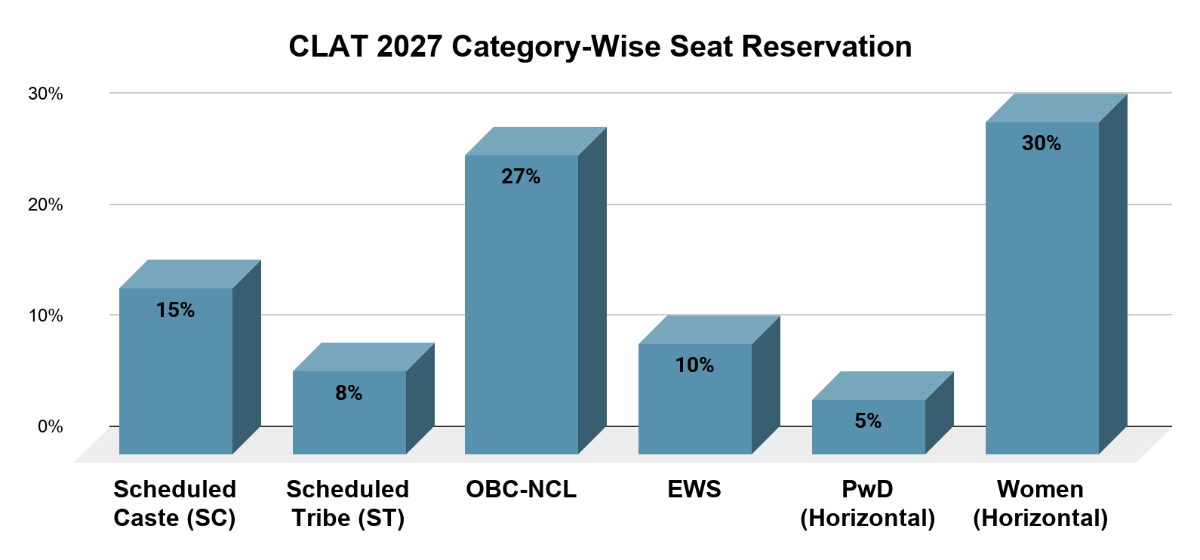
Related Links:
CLAT Reservation 2027: Category-Wise Number of Seats
Most CLAT NLUs have around 120 seats, which are divided as mentioned below:
| Category | Seats (out of 120) | PwBD (5% horizontal) |
|---|---|---|
| General (UR) | 49 | 2 |
| OBC-NCL | 32 | 2 |
| SC | 18 | 1 |
| ST | 9 | 1 |
| EWS | 12 | 1 |
| Total | 120 | 7 |
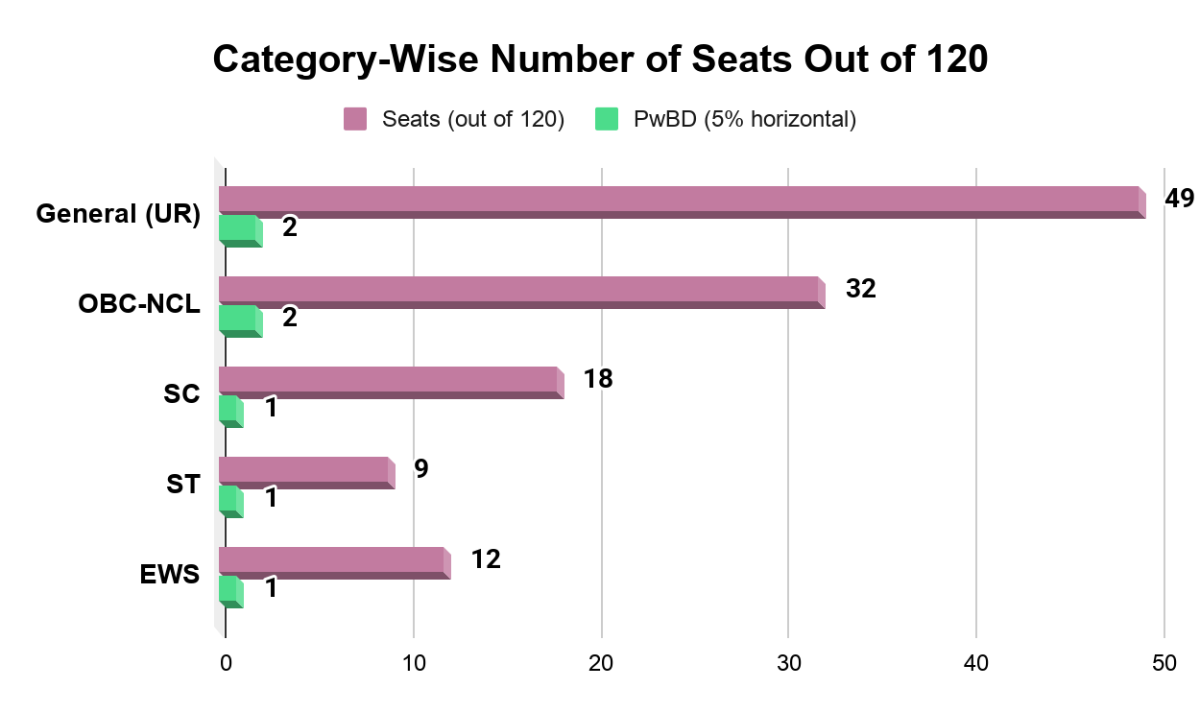
CLAT Total Seats in NLUs (Expected)
The total no of seats in CLAT available in all 26 NLUs are:
| Particulars | CLAT UG Seats | CLAT PG Seats |
|---|---|---|
| CLAT seats | 3705 | 1436 |
| NRI/Foreign National Seats | 247 | 69 |
| Supernumerary seats for various categories | 140 | 94 |
| Total | 4092 | 1599 |
CLAT Reservation 2027: College-wise Seats Expected
Let’s check the category-wise and college-wise expected number of CLAT total seats in the table below:
- The number of CLAT seats is as per the previous year.
- Once the new CLAT seat matrix is released, we will share the updated seats.
- The number of seats are expected to remain same in CLAT 2027
CLAT 2027 Reservation: Domicile-Based
| NLU | State | Total UG Seats | Seats Reserved for Domicile Candidates | Approx. % |
|---|---|---|---|---|
| MNLU Mumbai | Maharashtra | 100 | 63 | 63% |
| NLU Odisha (NLUO) | Odisha | 180 | 60 | 33% |
| HNLU Raipur | Chhattisgarh | 170 | 85 | 50% |
| NUSRL Ranchi | Jharkhand | 120 | 60 (across categories) | 50% |
| RMNLU Lucknow | Uttar Pradesh | 187 | 127 ( | 68% |
| WBNUJS Kolkata | West Bengal | 132 | 42 | 32% |
| DSNLU Visakhapatnam | Andhra Pradesh | 120 | 60 | 50% |
| MNLU Aurangabad | Maharashtra | 120 (combined) | 84 | 70% |
| MNLU Nagpur | Maharashtra | 120 (combined) | 84 | 70% |
| HPNLU Shimla | Himachal Pradesh | 120 | 30 | 25% |
| TNNLU Tiruchirapalli | Tamil Nadu | 120 | Varies by subcategory | ~50% |
| NLUJA Assam | Assam | 60 | 5 seats reserved horizontally | ~8% |
CLAT Reservation: Application Fee
CLAT gives a fixed fee concession to SC, ST and BPL students. The concession is the only category benefit set uniformly at the exam stage.
| Category | Application Fee | Concession vs General |
|---|---|---|
| General / OBC / PwD / NRI / PIO / OCI | Rs. 4,000 | - |
| SC / ST / BPL | Rs. 3,500 | Rs. 500 less |
OBC and EWS students pay the same fee as General students - only SC, ST and BPL students get the Rs. 500 concession. The cost of previous year question papers is Rs. 500 extra and is optional. You must pay the fee online during the application.
Note: The application fee is non-refundable and non-adjustable once paid.
Related Links:
CLAT Reservation in Qualifying Marks and Cutoff
Reserved categories get a relaxation in the minimum qualifying marks needed to be eligible. SC and ST students get a 5% relaxation in Class 12 marks.
| Category | Minimum Qualifying Marks (Class 12) | Relaxation vs General |
|---|---|---|
| General / OBC / EWS / PwD | 45% | - |
| SC / ST | 40% | 5% relaxation |
The admission cutoff, or closing rank, is separate from the qualifying marks. Reserved categories close at much lower ranks than the General category at the same NLU. A reserved category student can secure a top NLU at a rank where a General student cannot. Domicile students often close at even lower ranks in their home-state NLU.
Note: CLAT has no minimum qualifying percentile in the exam - your rank alone decides admission during counselling.
Related Links
New Section Added
How Does CLAT 2027 Reservation Affect CLAT Cutoffs?
The CLAT Cutoff varies as per category. General category has higher cutoffs, while reserved categories have lower cutoffs.
| Category | Approx. Rank for Top NLUs |
|---|---|
| General | Under 100 |
| SC | 2500–3500 |
| ST | 4000–5000 |
| OBC (where applicable) | 1000–2000 |
| EWS | 800–1200 |
| PwD | 3000–4000 |
CLAT PwD Reservation: Special Rules
PwD students get a 5% horizontal reservation. This quota cuts across every vertical category rather than forming a separate block.
- The CLAT reservation applies to students with a benchmark disability of 40% or more.
- CLAT reservation 2027 covers blindness, low vision, hearing impairment, locomotor disability and other notified conditions.
- Eligible students can request a scribe and get compensatory time during the exam.
- You must upload a valid disability certificate from a notified medical authority.
PwD reservation is horizontal - a PwD seat is filled from within the General, OBC, SC or ST pool, not from a separate PwD quota. The scribe and extra time facility must be requested during the application, not on exam day.
Note: Scribe and compensatory time rules follow the guidelines for Persons with Benchmark Disabilities set by the Government of India.
How to Claim CLAT 2027 Reservation?
You must declare your category correctly and back it with a valid certificate. Follow these steps while filling the application.
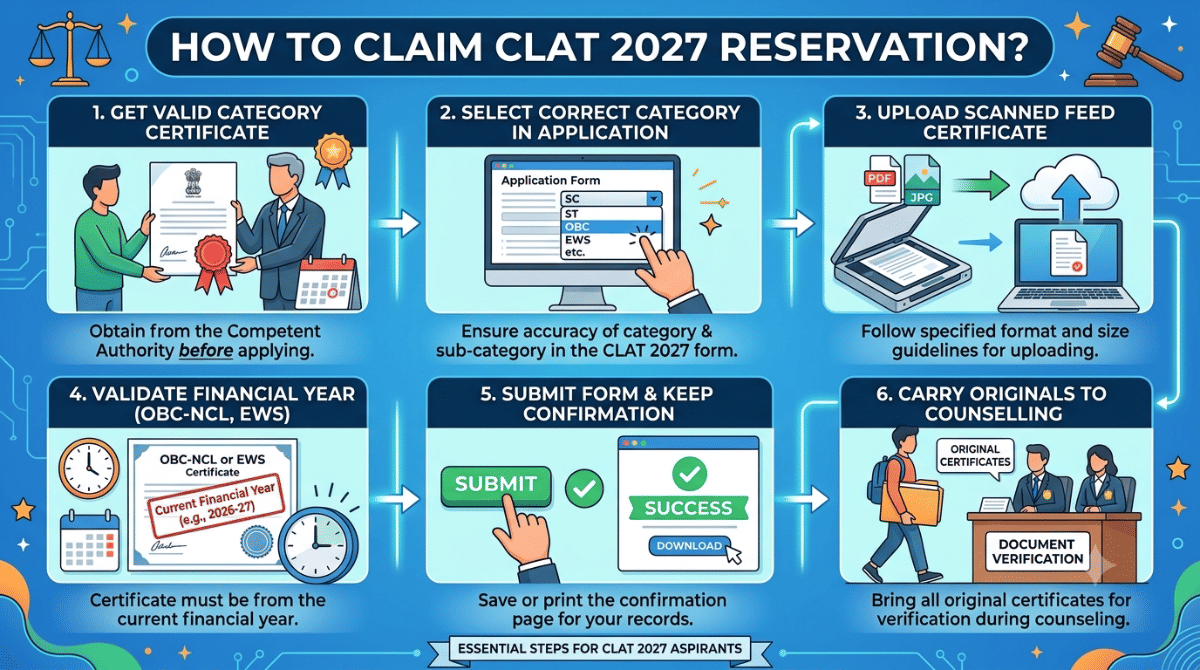
You must declare your category at the application stage - you cannot add or change a reservation claim after the form closes. A wrong or invalid claim can lead to rejection at counselling.
Note: An OBC-NCL or EWS certificate is usually valid only for the financial year in which it is issued - a stale certificate may be rejected.
Documents Required to Claim CLAT 2027 Reservation
Each category needs a specific certificate from the correct issuing authority. Keep both scanned copies and originals ready.
| Category | Required Certificate | Issuing Authority |
|---|---|---|
| SC / ST | Caste certificate | Tehsildar / SDM / competent revenue authority |
| OBC-NCL | OBC Non-Creamy Layer certificate (current financial year) | Competent authority notified by the state |
| EWS | Income and asset certificate | Competent authority notified for EWS |
| PwD | Disability certificate (40% or more) | Notified medical board or hospital |
| State Domicile | Domicile or residence certificate | State revenue authority |
| NRI / NRI-Sponsored | NRI status certificate (as per NLU annexure) | As specified by the concerned NLU |
Your name on the category certificate must match your CLAT application exactly - a mismatch can void your reservation claim. Verify the validity date on the OBC-NCL and EWS certificates before you upload them.
Related Links:
CLAT 2027 Reservation FAQs
Ques. Does CLAT follow one common reservation policy for all NLUs?
Ans. No. Each NLU sets its own category-wise seat matrix. The number of reserved seats changes from one NLU to another.
Ques. What is the SC and ST reservation in CLAT 2027?
Ans. Most NLUs reserve 15% seats for SC students and 7.5% for ST students, in line with national norms.
Ques. Do all NLUs give OBC reservation in CLAT?
Ans. No. OBC-NCL reservation of up to 27% is offered mainly by state-funded NLUs like RMLNLU Lucknow, CNLU Patna and HNLU Raipur.
Ques. What is the EWS income limit for CLAT reservation?
Ans. EWS reservation of 10% is for General category students whose family meets the central income and asset criteria. You need a valid EWS certificate for the current financial year.
Ques. Is there a state domicile quota in CLAT?
Ans. Yes. Many NLUs reserve 25% to 50% of seats for home-state students. This quota reduces the All India seats at that NLU.
Ques. How much application fee concession do reserved students get?
Ans. SC, ST and BPL students pay Rs. 3,500 against Rs. 4,000 for others. That is a concession of Rs. 500.
Ques. Do OBC and EWS students get a fee concession in CLAT?
Ans. No. OBC, EWS, PwD and NRI students pay the same Rs. 4,000 fee as General students. Only SC, ST and BPL get the concession.
Ques. Is there an age relaxation for reserved categories in CLAT?
Ans. No. CLAT has no upper age limit for anyone, so no age relaxation is needed.
Ques. How does PwD reservation work in CLAT?
Ans. PwD students get a 5% horizontal reservation. The seat is filled from within the General, OBC, SC or ST pool rather than a separate block.
Ques. Can NRI students get reservation in CLAT?
Ans. NLUs that offer NRI or NRI-sponsored seats fill them as supernumerary seats. You must submit the NRI status certificate as per the NLU annexure.
Ques. Do I get lower cutoffs because of my category?
Ans. Yes. Reserved categories close at lower ranks than the General category at the same NLU. Home-state students often close at even lower ranks.
Ques. When will the CLAT 2027 reservation policy be released?
Ans. The Consortium will confirm the CLAT 2027 reservation policy in the official notification, expected in August 2026, at consortiumofnlus.ac.in.
Disclaimer: The reservation figures on this page follow the latest available CLAT 2026 policy and are indicative. Reservation is set NLU-wise and may change for CLAT 2027. Always confirm the final category-wise seat matrix from the official CLAT 2027 notification and your target NLU before applying.
Sample Paper
CLAT 2026 is your gateway to the national law universities, and steady practice is what turns the syllabus into marks. Solving full sample papers under a real 2 hour clock is the fastest way to build the reading speed and accuracy this exam rewards.
Official website: consortiumofnlus.ac.in
CLAT Subject-wise Sample Papers 2026
Each subject set is built to be solved in one timed sitting that matches its share of the paper, so you learn to pace at about 1 minute per question. Attempt a paper end to end, then check every answer against the detailed solutions before moving on.
You can download all CLAT sample papers free on Collegedunia, and the official released papers are also available on the Consortium of NLUs website after you log in.
- CLAT Subject-wise Sample Papers 2026
- CLAT Exam Pattern and Marks Distribution 2026
- CLAT Sample Papers - Why Recent Papers Matter Most
- CLAT Subject Wise Weightage - High Scoring Areas to Focus in Sample Papers
- CLAT Sample Paper Video Solutions 2026 - Watch Before You Start Solving
- How to Use CLAT Sample Papers to Clear in First Attempt
- CLAT Bare Act and Passage Reading - The Skill That Decides Your Score
- CLAT 4 Week Preparation Plan Using Sample Papers
- FAQs on CLAT Sample Papers 2026
- Exam body: Consortium of National Law Universities, for UG admission to the participating NLUs.
- Paper format: 120 multiple-choice questions for 120 marks, most of them tied to reading passages.
- Marking: +1 for a correct answer and -0.25 for a wrong one, with nothing deducted for a blank.
- Mode and duration: offline pen-and-paper OMR test of 2 hours with no sectional time limit.
- Sections: English Language, Current Affairs including General Knowledge, Legal Reasoning, Logical Reasoning, and Quantitative Techniques.
- Level: Class 12 standard, with comprehension and reasoning weighted far more than rote recall.

CLAT Exam Pattern and Marks Distribution 2026
The CLAT 2026 pattern is fixed by the Consortium of NLUs and is the same every year, so you can practise with full confidence. Knowing the split before you open a sample paper helps you plan where your two hours actually go.
- Total questions: 120 objective questions, one mark each, for a total of 120 marks.
- Negative marking: 0.25 marks are cut for each wrong answer, so blind guessing hurts your rank.
- Duration: 2 hours (120 minutes) with no per-section limit, giving you an average of 1 minute per question.
- Section split: English Language 22-26, Current Affairs including GK 28-32, Legal Reasoning 28-32, Logical Reasoning 22-26, and Quantitative Techniques 10-14.
- Mode: offline pen-and-paper test with OMR sheets, held in a single sitting.
Key advice: because there is no sectional timer, use sample papers to fix your own order and time budget, and never leave the strong sections short to chase a hard passage elsewhere.
CLAT Sample Papers - Why Recent Papers Matter Most
CLAT has moved firmly toward long comprehension passages, and the most recent papers show that shift best. Practising with current-style papers trains you for the exam you will actually sit, not an older grammar-heavy version.
- Newer passages are longer and drawn from journalism and non-fiction, which is exactly what the latest sample papers mirror.
- Legal and logical reasoning are now inference-driven, so recent papers train you to answer from the passage rather than from memory.
- Current Affairs questions lean on the last 12 months, so a fresh paper keeps your general knowledge practice relevant.
CLAT Subject Wise Weightage - High Scoring Areas to Focus in Sample Papers
All five sections are passage-based except most of Quantitative Techniques, so reading speed carries across the whole paper. Use the table below to see where the marks sit before you plan your practice.
| Subject | Questions | Difficulty | What to Watch For |
|---|---|---|---|
| English Language | 22-26 | Moderate | Main idea, tone, inference and vocabulary from 450-word passages |
| Current Affairs including GK | 28-32 | Moderate | Last-year news, static GK woven into passages, and legal current events |
| Legal Reasoning | 28-32 | Moderate to Hard | Applying the rule given in the passage, not outside legal knowledge |
| Logical Reasoning | 22-26 | Moderate | Arguments, assumptions, conclusions and pattern-based analytical sets |
| Quantitative Techniques | 10-14 | Moderate | Data from a short passage or graph, using Class 10 arithmetic |
Note: Quantitative Techniques carries only 10-14 questions but the maths is basic, so a student who is even slightly comfortable with numbers can bank almost all of it as easy marks.
CLAT Sample Paper Video Solutions 2026 - Watch Before You Start Solving
A short strategy walkthrough before your first paper saves you from repeating the same avoidable mistakes across every mock. It shows you how toppers approach a passage and decide what to attempt and what to skip.
Watch the video below to see the section-wise plan in action, then apply the same reading and elimination method to the sample papers you download here.
Watch:
Source: CLAT 2026 English Language syllabus and topic-wise strategy walkthrough, covering passage reading, tone and the section-wise plan (YouTube)
How to Use CLAT Sample Papers to Clear in First Attempt
A sample paper is only useful if you treat it like the real exam and then study your own mistakes. Follow these steps to turn each paper into a genuine jump in score.
- Sit the full paper in one quiet 2-hour block with a timer, exactly like the real CLAT.
- Mark answers on a printed OMR-style sheet so you get used to bubbling and managing time.
- Attempt only what you are confident about, since -0.25 per wrong answer punishes blind guesses.
- After scoring, read every solution, including for the questions you got right, to lock the reasoning.
- Keep an error log of the passage types and question forms that trip you up, and revisit them weekly.
- Repeat with a fresh paper every few days so your reading speed and accuracy climb together.
CLAT Bare Act and Passage Reading - The Skill That Decides Your Score
CLAT does not ask you to memorise law, it asks you to apply the rule printed inside the passage. Getting comfortable with that principle-and-fact style is what separates a good score from an average one.
- Always read the passage as the only source of truth, even if your outside knowledge says otherwise.
- Underline the rule or principle first, then test each option against it one by one.
- Practise spotting the exception or condition, because that is usually where the correct option hides.
- Since every section is passage-led, build a habit of skimming for structure before reading in full.
CLAT 4 Week Preparation Plan Using Sample Papers
- Week 1: Revise the syllabus of all five sections and solve one section-wise sample paper per subject to find your weak areas.
- Week 2: Attempt two full-length sample papers under timed conditions and build a detailed error log from both.
- Week 3: Push to three timed papers, focus revision on your two weakest sections, and drill passage reading speed daily.
- Week 4: Take alternate-day full mocks to peak, and keep the last two days for light revision and error-log review only.
FAQs on CLAT Sample Papers 2026
Ques.How many sample papers should I solve before CLAT 2026?
Ans.Aim for at least 20 to 25 full-length sample papers along with section-wise practice, so you cover every passage type and question form well before the exam.
Ques.Are CLAT sample papers enough or do I also need previous year papers?
Ans.Use both. Previous year papers show the exact standard and difficulty, while sample papers give you fresh practice so you are not just memorising known answers.
Ques.Does CLAT 2026 have negative marking in sample papers too?
Ans.Yes, every good CLAT sample paper follows the real scheme of +1 for a correct answer and -0.25 for a wrong one, so you learn to avoid risky guesses.
Ques.Which CLAT section is the hardest to score in sample papers?
Ans.Most students find Legal Reasoning and long English passages the toughest, so give those two sections extra timed practice through dedicated sample papers.
Ques.How much time should one CLAT sample paper take?
Ans.A full paper should be solved in 2 hours, the same as the real exam, which works out to roughly 1 minute per question across all 120 questions.
Ques.Where can I download free CLAT 2026 sample papers?
Ans.You can download subject-wise CLAT sample papers free on Collegedunia, and the officially released papers are available on the Consortium of NLUs website after you log in.
Seat Allotment
CLAT Counselling 2026 date will be available at consortiumofnlus.ac.in after the CLAT results. The seat allotment for CLAT 2026 counselling will be carried out by the Consortium of NLUs over five rounds, CLAT 2026 seat allotment process happens online after the CLAT exam ends. Merit ranks and preferences determine candidate eligibility for the process.
- Throughout CLAT 2026 seat allotment rounds, you can accept, upgrade, or reject allotted seats. However, upgrades won't be available during the final round.
- Candidates who get CLAT allocated seats are advised to submit their required documents and accept their seats before the last date.
- Failure to do so will result in the candidate’s seat being forfeited.
- In CLAT 2025, approximately 75,000 candidates registered, with around 70,000 appearing to contend for admission for 4,054 LLM and 1,591 LLB seats across NLUs
- Eligibility for CLAT counselling was extended to roughly 26,000–26,150 candidates, nearly five times the number of total seats
After CLAT counseling registration 2026, candidates enter their NLU preferences and pay the applicable counselling fee of INR 30,000 for general category and INR 20,000 for reserved categories.

| Key Summary: The Consortium of NLUs allocates around 3,300 UG and 1,200 PG seats across 24 NLUs through a five-round merit-cum-preference process based on CLAT rank, category, and choices filled. Candidates must register for counselling, pay the fee, and confirm seats on time to avoid cancellation.
|
CLAT 2026 Seat Allotment Important Dates
Some of the important dates for CLAT Seat Allotment which is yet to be declared by the authorities are:
| Events | Dates |
|---|---|
| CLAT Counselling Registration 2026 Starts | To Be Updated |
| Last Date to fill CLAT Counselling 2026 Registration Form | To Be Updated |
| First Allotment List | To Be Updated |
| Payment of Confirmation Fee for the First Allotment List | To Be Updated |
| Publication of Second Allotment List | To Be Updated |
| Payment of Confirmation Fee to Consortium for Freeze and Float options and Admission by NLUs for the Second Allotment List | To Be Updated |
| Publication of Third Allotment List | To Be Updated |
| Payment of Confirmation Fee to Consortium for Freeze and Float options and Admission by NLUs for the Third Allotment List | To Be Updated |
| Payment of University Fee | To Be Updated |
| Publication of Fourth Allotment List | To Be Updated |
| Payment of University Fee to the Fourth Allotment | To Be Updated |
| Publication of Fifth and Final Allotment List | To Be Updated |
| Payment of balance University Fee | To Be Updated |
Also Read
How to Register for CLAT 2026 Counselling?
To be considered for CLAT 2026 Seat Allotments, candidates must register for CLAT 2026 Counselling session.
- Shortlisted candidates who have been invited to apply for CLAT 2026 Counselling must register themselves through the online application portal that will be made available after CLAT 2026 Results are published.
- Shortlisted candidates will be sent a message to their registered phone number about their invitation, using which they can log in to the counselling website.
- Candidates must select their NLU preferences. A minimum of five NLU preferences is required for the candidates.
- Candidates must then pay the required fees as part of their registration process.
- Candidates who have not completed the registration process will not be considered for CLAT Seat Allotment.
How to Check CLAT 2026 Seat Allotment Results?
Candidates will be able to check CLAT 2026 Seat Allotment Results online through the official website.
- Candidates should visit the official website and click on CLAT 2026.
- Each seat allotment list will be published on the website as it gets released.
- Candidates can click on the seat allotment list link and download the lists under whichever course they have applied for.
Did not Receive the Score You Expected in CLAT 2026?
What if you have not received the CLAT Rank as expected? Will you get CLAT Seats in NLUS? To understand, you can check the video by “CLAT Point” explains which college to expect as per your rank.
What to Do After CLAT 2026 Seat Allotment Results?
After CLAT Seat Allotment 2026 Results are published candidates can choose one of the following:
- Accepting CLAT Allotment 2026: Candidates can accept their allotted seats. If they accept their allotment, candidates will not be considered for further allotments.
- Applying for Further CLAT 2026 Allotments: Candidates can choose to reject their allot seats and applying for further allotments. In this option, candidates will be required to pay the prescribed allotment fee.
- Exiting CLAT 2026 Allotments: Candidates can choose to reject and exit from CLAT 2026 Seat Allotment lists. If they choose to do that, candidates will not be considered for any further allotments.
Also Read
Documents Required for CLAT Seat Allotment 2026
The documents that you must provide during the CLAT Seat allotment process are:
- CLAT 2026 Application Form
- CLAT Score Card
- Class 10th Marks-sheet
- Class 12th Marks-sheet
- Caste Certificate (If applicable)
- Specially-Abled Certificate (If applicable)
- NRI Certificate (If applicable)
- Sponsored NRI Certificate (If applicable)
- Domicile Certificate (If applicable)
- Call Letter issued by CLAT authority
- Recent passport-size photographs
- CLAT Admit Card 2026
CLAT Seat Allotment 2026
Candidates can check the CLAT 2026 Merit Lists below once announced. Until then candidates can check CLAT 2025 Round-wise cutoff below:
CLAT 2025 Third Merit List
The merit list is published for all participating NLUs mentioning category-wise ranks. Check below:
| CLAT 2025 Participating NLUs | Opening Rank | Closing Ranks |
|---|---|---|
| National Law School of India University, Bangalore | 460 | 7286 |
| NALSAR University of Law, Hyderabad | 3273 | 7676 |
| The West Bengal National University of Juridical Sciences, Kolkata | 1119 | 11938 |
| National Law Institute University, Bhopal | 453 | 18889 |
| 9010 | - | |
| National Law University, Jodhpur | 581 | 9292 |
| Gujarat National Law University, Gandhinagar | 444 | 15863 |
| Dr. Ram Manohar Lohiya National Law University, Lucknow | 780 | 51995 |
| Rajiv Gandhi National University of Law, Patiala | 1264 | 43286 |
| Chanakya National Law University Patna | 12662 | 40194 |
| 1550 | 49876 | |
| National University of Advanced Legal Studies, Kochi | 1346 | 45914 |
| National Law University Odisha, Cuttack | 1012 | 12967 |
| National University of Study & Research in Law, Ranchi | 1649 | 53778 |
| National Law University & Judicial Academy, Assam | 2052 | 57634 |
| Damodaram Sanjivayya National Law University (DSNLU) Visakhapatnam | 1639 | 17399 |
| The Tamil Nadu National Law School, Tiruchirapalli | 1748 | 28493 |
| 1871 | 31197 | |
| Maharashtra National Law University, Mumbai | 8067 | 31295 |
| Maharashtra National Law University, Nagpur | 1508 | 32360 |
| 1577 | 42733 | |
| Maharashtra National Law University, Aurangabad | 1949 | 57691 |
| 2197 | 55824 | |
| Himachal Pradesh National Law University, Shimla | 2323 | 57089 |
| 2418 | 58003 | |
| Dharmashastra National Law University, Jabalpur | 2224 | 52977 |
| Dr B R Ambedkar National Law University Sonipat, Haryana | 1916 | 59115 |
| Hidayatullah National Law University, Raipur | 2594 | 56624 |
| NLU Tripura | 1866 | 5326 |
CLAT 2025 Second Merit List
The merit list is published for all participating NLUs mentioning category-wise ranks. Check below:
| CLAT 2025 Participating NLUs | Opening Rank | Closing Ranks |
|---|---|---|
| National Law School of India University, Bangalore | 106 | 25525 |
| NALSAR University of Law, Hyderabad | 157 | 6981 |
| The West Bengal National University of Juridical Sciences, Kolkata | 289 | 18509 |
| National Law Institute University, Bhopal | 456 | 17523 |
| 874 | 39468 | |
| National Law University, Jodhpur | 358 | 14081 |
| Gujarat National Law University, Gandhinagar | 404 | 14278 |
| Dr. Ram Manohar Lohiya National Law University, Lucknow | 578 | 31066 |
| Rajiv Gandhi National University of Law, Patiala | 954 | 36722 |
| Chanakya National Law University Patna | 1282 | 33759 |
| 1428 | 46880 | |
| National University of Advanced Legal Studies, Kochi | 1211 | 44199 |
| National Law University Odisha, Cuttack | 946 | 55316 |
| National University of Study & Research in Law, Ranchi | 1494 | 41897 |
| National Law University & Judicial Academy, Assam | 1652 | 53778 |
| Damodaram Sanjivayya National Law University (DSNLU) Visakhapatnam | 1502 | 47102 |
| The Tamil Nadu National Law School, Tiruchirapalli | 1602 | 21638 |
| 1701 | 45591 | |
| Maharashtra National Law University, Mumbai | 538 | 40504 |
| Maharashtra National Law University, Nagpur | 1360 | 57657 |
| 1410 | 59008 | |
| Maharashtra National Law University, Aurangabad | 1672 | 58448 |
| 1882 | 59056 | |
| Himachal Pradesh National Law University, Shimla | 1945 | 55135 |
| 2150 | 51680 | |
| Dharmashastra National Law University, Jabalpur | 1785 | 52212 |
| Dr B R Ambedkar National Law University Sonipat, Haryana | 1635 | 60436 |
| Hidayatullah National Law University, Raipur | 780 | 52295 |
| NLU Tripura | 2222 | 52977 |
| GNLU Silvassa | 1189 | 54202 |
CLAT 2025 First Merit List- College Wise
The merit list is published for all participating NLUs mentioning category-wise ranks. Check below:
| CLAT 2025 Participating NLUs | Opening Rank | Closing Ranks |
|---|---|---|
| National Law School of India University, Bangalore | 1 | 16544 |
| NALSAR University of Law, Hyderabad | 17 | 7713 |
| The West Bengal National University of Juridical Sciences, Kolkata | 57 | 29717 |
| The West Bengal National University of Juridical Sciences, Kolkata | 299 | 18509 |
| National Law Institute University, Bhopal | 257 | 16572 |
| 438 | 24911 | |
| National Law University, Jodhpur | 159 | 39868 |
| Gujarat National Law University, Gandhinagar | 164 | 14022 |
| Dr. Ram Manohar Lohiya National Law University, Lucknow | 460 | 21506 |
| Rajiv Gandhi National University of Law, Patiala | 95 | 29588 |
| Chanakya National Law University Patna | 882 | 30737 |
| 1215 | 44258 | |
| National University of Advanced Legal Studies, Kochi | 350 | 56347 |
| National Law University Odisha, Cuttack | 382 | 50544 |
| National University of Study & Research in Law, Ranchi | 864 | 36722 |
| National Law University & Judicial Academy, Assam | 1163 | 45940 |
| Damodaram Sanjivayya National Law University (DSNLU),Visakhapatnam | 957 | 42139 |
| The Tamil Nadu National Law School, Tiruchirapalli | 1231 | 44669 |
| 1259 | 44760 | |
| Maharashtra National Law University, Mumbai | 418 | 31018 |
| Maharashtra National Law University, Nagpur | 680 | 54410 |
| 681 | 51639 | |
| Maharashtra National Law University, Aurangabad | 1023 | 59856 |
| 1361 | 56843 | |
| Himachal Pradesh National Law University, Shimla | 949 | 43876 |
| 1135 | 44095 | |
| Dharmashastra National Law University, Jabalpur | 1060 | 51352 |
| Dr B R Ambedkar National Law University Sonipat, Haryana | 626 | 53778 |
| Hidayatullah National Law University, Raipur | 463 | 47261 |
| National Law University, Tripura | 31168 | 57038 |
| GNLU Silvassa Campus | 755 | 52920 |
| Dr. Rajendra Prasad National Law University (RPNLUP), Prayagraj | 1102 | 45273 |
| India International University of Legal Education and Research Goa - B.A. LL.B. (Hons.) | 1314 | 48454 |
| India International University of Legal Education and Research Goa - B.B.A. LL.B. (Hons.) | 1198 | 49603 |
CLAT 2026 Accepting Colleges
CLAT 2026 is accepted by NLU and many private colleges across India. Admissions through CLAT 2026 is given to both undergraduate and postgraduate courses related to law.
Colleges Accepting CLAT 2026 for UG Courses
Given below are the list of NLU colleges accepting CLAT 2026 for undergraduate courses:
| NLU | Course | Seat Matrix 2026 | Annual Fees |
| NLSIU | B.A. LLB (Hons) | 240 | 3.5 lakh |
| NALSAR Hyderabad | B.A. LLB (Hons) | 132 | 3 lakh |
| WBNUJS | B.A. LLB (Hons)/ B.Sc LLB (Hons) | 132/64 | 3 lakh |
| GNLU | B.A. LLB (Hons)/ B.Sc LLB (Hons)/ B.Com LLB (Hons)/ BBA LLB (Hons)/ | 180 (Combined intake across all UG courses) | 3 lakh |
| MNLU | B.A. LLB (Hons) | 100 | 2.3 lakh |
| RMLNLU, Lucknow | B.A. LLB (Hons) | 169 | 2 lakh |
| HNLU, Raipur | B.A. LLB (Hons) | 180 | 2.5 lakh |
| NLUO | B.A. LLB (Hons)/ BBA LLB (Hons) | 180 (combined) | 2.5 lakh |
| RGNUL, Punjab | B.A. LLB (Hons) | 180 | 2.5 lakh |
| CNLU, Patna | B.A. LLB (Hons) | 138 | 2.5 lakh |
| NUALS, Kochi | B.A. LLB (Hons) | 120 | 2.5 lakh |
| DSNLU, Vishakhapatnam | B.A. LLB (Hons) | 138 | 2.5 lakh |
| MNLU, Nagpur | B.A. LLB (Hons) | 120 | 2.5 lakh |
| TNNLU, Tiruchirappalli | B.A. LLB (Hons)/ B.Com LLB (Hons) | 120 (combined) | 2.5 lakh |
| MNLU, Aurangabad | B.A. LLB (Hons) | 60 | 2.5 lakh |
| NUSRL, Ranchi | B.A. LLB (Hons) | 134 | 2.5 lakh |
| DNLU, Jabalpur | B.A. LLB (Hons) | 120 | 2.5 lakh |
| HPNLU, Shimla | B.A. LLB (Hons)/ BBA LLB (Hons) | 120 (60 each) | 2.5 lakh |
| DBRNLU, Sonepat | B.A. LLB (Hons) | 120 | 1.78 lakh |
| NLUT, Agartala | B.A. LLB (Hons) | 120 | 2.5 lakh |
Private Colleges Accepting CLAT 2026 Scores
Given below are the list of private colleges accepting CLAT 2026 for law courses:
| College Name | Programs Offered |
|---|---|
| Shobhit University, Meerut | BA LLB, B.Com LLB Hons., BBA LLB Hons., LLB & LLM |
| ISBR Law College, Bangalore | BA LLB, LLB, PG Diploma & Certificate |
| Uttaranchal University, Dehradun | BA LLB Hons, BBA LLB Hons, LLB Hons, LLM & Doctoral Programme in Law |
| RNB Global University, Bikaner | BA LLB, BBA LLB, LLM & Integrated LLM PhD Dual Degree |
| Glocal University, Saharanpur | BA LLB & BBA LLB |
| Shri Vaishnav Institute of Law, Indore | BBA LLB Hons, BA LLB Hons, B.Com LLB Hons, LLB Hons & LLM |
| Indore Institute of Law, Indore | BBA LLB Hons, BA LLB Hons, BBA LLB Hons With Global & Transnational Studies, LLB Hons & LLM Hons |
| Lloyd Law College, Greater Noida | BA LLB & LLB |
| Amity University, Noida | BBA LLB Hons, BA LLB Hons, B.Com LLB Hons, LLB, LLM & PhD in Law |
| Alliance University, Bangalore | BBA LLB Hons, BA LLB Hons, LLM & PhD in Law |
| Xavier University, Bhubaneswar | BA LLB & B.Com LLB |
| Gujarat Maritime University, Ahmedabad | LLM & PG Diploma |
| Vivekananda Institute of Professional Studies, New Delhi | BA LLB, BBA LLB & LLM |
| ICFAI University, Dehradun | BA LLB Hons, BBA LLB Hons, LLM, PhD, Certificate |
| Bennett University, Greater Noida, NCT Region | BBA LLB Hons, BA LLB Hons, LLB Hons & PhD |
| Kalinga University, Naya Raipur | BBA LLB, BA LLB, LLB & LLM |
| SVKM's NMIMS (Deemed-to-be-University), Mumbai | BA LLB Hons, BBA LLB Hons, LLM & PhD in Law |
| Asian Law College, Noida | BA LLB & LLB |
| DIRD College, Delhi | BA LLB, LLB & Certificate |
| GITAM School of Law, Visakhapatnam | BA LLB Hons, BBA LLB Hons, B.Com LLB Hons & LLM |
| JIMS Engineering and Management Technical Campus, Greater Noida | BA LLB & BBA LLB |
| Mody University, Lakshmangarh | BA LLB Hons, BBA LLB Hons, B.Com LLB Hons, LLB, LLM & PhD Law |
| Aryans College of Law, Patiala | BA LLB, B.Com LLB & LLB |
| GLA University, Mathura | BA LLB & B.Com LLB |
| Siddharth Law College, Dehradun | LLB, LLM & PGD |
| ICFAI University, Agartala | BA LLB Hons, BBA LLB Hons, LLB & PhD in Law |
| Nirma University, Ahmedabad | BA LLB Hons, B.Com LLB Hons, LLM & Doctoral Programme in Law |
| Marwadi University, Rajkot | BA LLB Hons, B.Com LLB Hons & LLM |
| Karnavati University, Gandhinagar | BA LLB Hons, LLM & PhD in Law |
| NIMT Institute of Method and Law, Greater Noida | BA LLB |
| Geeta Institute of Law, Panipat | BA LLB Hons, BBA LLB Hons, LLB & LLM |
| REVA University, Bangalore | BA LLB Hons, BBA LLB Hons, LLM & PhD |
| Presidency University, Bengaluru | BA LLB Hons, BBA LLB Hons, B.Com LLB Hons & LLM |
| Maharishi University of Information Technology, Noida | BA LLB, BBA LLB, LLB & LLM |
| Dr K N Modi University, Jaipur | BA LLB, LLB, LLM & PG Diploma |
| SRM University, Sonepat | BA LLB Hons, BBA LLB Hons, LLB Hons, LLM & PhD |
| Mahatma Jyoti Rao Phoole University, Jaipur | BA LLB, BBA LLB, B.Sc LLB, LLB, LLM, PhD & PG Diploma |
| Oriental University, Indore | BA LLB Hons, BBA LLB Hons, LLB, Diploma, LLM & PhD in Law |
| Galgotia University, Greater Noida | BA LLB Hons, BBA LLB Hons, LLB Hons, LLM & PhD in Law |
| Manipal University, Jaipur | BA LLB Hons, BBA LLB Hons, LLB, LLM & PhD |
| FIMT, New Delhi | BBA LLB & BA LLB |
| The North Cap University, Gurugram | BBA LLB Hons, LLM & PhD |
| Shri Ram Murti Smarak College of Law, Bareilly | BA LLB & LLB |
| Vivekananda Global University, Jaipur | BBA LLB, BA LLB, LLB, LLM & PhD in Law |
| Harlal School of Law, Greater Noida | BA LLB & LLB |
| TERI School of Advanced Studies, New Delhi | LLM |
| IFIM Law School, Bangalore | BBA LLB & LLB |
| Jain University, Bangalore | NA |
| Renaissance Law College, Indore | BA LLB Hons, BBA LLB Hons, B.Com LLB Hons, LLB Hons |
| The Raffles University, Alwar | BA LLB Hons, BBA LLB Hons, LLB, LLM, PG Diploma, Diploma & PhD |
| ITM University, Gwalior | BA LLB Hons, B.Com LLB Hons, LLB & LLM |
| Chettinad Academy of Research and Education, Kelambakkam | BA LLB Hons, LLB Hons & LLM |
CLAT Previous Years Seat Matrix
Given below is the break-up of NLU colleges seats based on CLAT Scores. Candidates are selected and given admission based on their performance in the exam.
Break-up of UG Seats for CLAT 2021
Mentioned below are the seats offered for undergraduate aspirants using their CLAT 2021 scores.
| University | General | Scheduled Caste | Scheduled Tribe | EWS |
|---|---|---|---|---|
| National Law School of India University(NLSIU), Bengaluru | 93 | 18 | 9 | - |
| NALSAR University of Law (NALSAR), Hyderabad | 12 | 14 | 8 | - |
| The National Law Institute University(NLIU), Bhopal | 65 | 7 | 4 | - |
| The West Bengal National University of Juridical Sciences (WBNUJS), Kolkata | 44 | 10 | 5 | 6 |
| National Law University (NLU), Jodhpur | 80 | 16 | 8 | - |
| Hidayatullah National Law University(HNLU), Raipur | 62 | 12 | 6 | - |
| Gujarat National Law University(GNLU), Gandhinagar | 115 | 27 | 14 | - |
| Dr. Ram Manohar Lohiya National Law University (RMLNLU), Lucknow | 80 | - | - | - |
| Rajiv Gandhi National University of Law (RGNUL), Punjab | 133 | 27 | 14 | - |
| Chanakya National Law University (CNLU), Patna | 60 | - | - | - |
| The National University of Advanced Legal Studies (NUALS), Kochi | 31 | - | - | - |
| National Law University Odisha (NLUO) | 96 | 14 | 9 | - |
| National University of Study and Research in Law (NUSRL), Ranchi | 27 | 9 | 5 | - |
| National Law University and Judicial Academy (NLUJA), Assam | 31 | - | - | - |
| Damodaram Sanjivayya National Law University (DSNLU), Visakhapatnam | 48 | - | - | 6 |
| Tamil Nadu National Law University (TNNLU), Tiruchirappalli | 44 | 9 | 4 | - |
| Maharashtra National Law University (MNLU), Mumbai | 25 | - | - | - |
| Maharashtra National Law University (MNLU), Nagpur | 44 | - | - | - |
| Maharashtra National Law University (MNLU), Aurangabad | 16 | - | - | - |
| Himachal Pradesh National Law University (HPNLU), Shimla | 92 | 18 | 10 | - |
| Dharmashastra National Law University, Jabalpur (M.P.) | 66 | 9 | 5 | - |
| National Law University, Sonepat | 59 | 14 | 7 | 7 |
Break-up of PG Seats for CLAT 2021
Mentioned below are the seats offered for postgraduate aspirants using their CLAT 2021 scores
| University | General | Scheduled Caste | Scheduled Tribe | EWS |
|---|---|---|---|---|
| National Law School of India University(NLSIU), Bengaluru | 38 | 8 | 4 | - |
| NALSAR University of Law (NALSAR), Hyderabad | 37 | 7 | 7 | - |
| The National Law Institute University(NLIU), Bhopal | 65 | 5 | 2 | - |
| The West Bengal National University of Juridical Sciences (WBNUJS), Kolkata | 18 | 4 | 2 | 3 |
| National Law University (NLU), Jodhpur | 38 | 8 | 4 | - |
| Hidayatullah National Law University(HNLU), Raipur | 46 | 9 | 5 | - |
| Gujarat National Law University(GNLU), Gandhinagar | 38 | 9 | 5 | - |
| Dr. Ram Manohar Lohiya National Law University (RMLNLU), Lucknow | 10 | - | - | 2 |
| Rajiv Gandhi National University of Law (RGNUL), Punjab | 29 | 6 | 3 | - |
| The National University of Advanced Legal Studies (NUALS), Kochi | 31 | - | - | - |
| National Law University Odisha (NLUO) | 26 | 4 | 2 | - |
| National University of Study and Research in Law (NUSRL), Ranchi | 9 | 2 | 2 | - |
| National Law University and Judicial Academy (NLUJA), Assam | 15 | - | - | - |
| Damodaram Sanjivayya National Law University (DSNLU), Visakhapatnam | 10 | - | - | 1 |
| Tamil Nadu National Law University (TNNLU), Tiruchirappalli | 7 | 1 | 1 | - |
| Maharashtra National Law University (MNLU), Mumbai | 11 | - | - | - |
| Maharashtra National Law University (MNLU), Nagpur | 7 | - | - | - |
| Maharashtra National Law University (MNLU), Aurangabad | 6 | - | - | - |
| Himachal Pradesh National Law University (HPNLU), Shimla | 15 | 3 | 2 | 4 |
Check CLAT Seat Matrix
CLAT 2026 Seat Allotment FAQs
Ques: How many seats are available for NLU as CLAT 2026 Seat Allotment?
Ans: For the CLAT 2026 seat allotment, there are approximately 3,213 seats available for the undergraduate (UG) courses across the participating 26 National Law Universities (NLUs). Additionally, there are around 1,217 seats available for postgraduate (PG) courses. These figures do not include supernumerary seats, NRI/Foreign Nationals seats, or other reserved categories.
- Total UG Seats: 3,213
- Total PG Seats: 1,217
- Participating NLUs: 26
Ques: Can I apply for CLAT 2026 Seat Allotments offline?
Ans: No, CLAT 2026 Seat Allocation is done online through the official website. Candidates are advised to visit the website regularly for any updates regarding the same.
Ques: Is document uploading important for CLAT 2026 Seat Allotments?
Ans: Candidates must submit the required documents if they have been allotted seats. If candidates do not submit the documents, they will not be considered for admissions.
| Document | Mandatory (Yes/No) |
|---|---|
| CLAT Admit Card | Yes |
| CLAT Scorecard | Yes |
| 10th Marksheet | Yes |
| 12th Marksheet | Yes |
| Category Certificate | If applicable |
| Domicile Certificate | If applicable |
| PwD Certificate | If applicable |
Ques: How will I be invited for CLAT 2026 Seat Allotments?
Ans: Candidates are invited to apply for CLAT 2026 Seat Allotments by a message to their phone number or email address. Candidates who do not register will not be considered for the seat allotments via the counselling process.
Ques: Is CLAT 2026 Merit List the same as CLAT 2026 Seat Allotment Lists?
Ans: No, CLAT 2026 Seat Allotments is a list of students who have been allocated seats in their preferred seats taking into consideration their performance in the exam. CLAT 2026 Merit List is comparing the candidates ranking with others across India.
Toppers
CLAT 2025 Exam was held on December 1, 2024 and results are out, and as expected, the competition was fierce. Thousands of law aspirants across India dream of securing a spot in one of the prestigious National Law Universities (NLUs), and the top rankers this year have set new benchmarks for success. Saksham Gautam has topped CLAT 2025 with 103.3 marks this year. 58 candidates have secured 99+ percentile in CLAT 2025.
Typically, CLAT toppers secure a rank within the top 10, with the top 3 usually earning admission to the National Law Universities (NLUs), which are the most sought-after law schools in India.
- The state-wise breakdown reveals how different regions perform, shedding light on the increasing or decreasing participation in law education from various parts of the country.
- Meanwhile, the gender-wise analysis is crucial to understanding the evolving landscape of female and male candidates excelling in the exam, a reflection of wider societal trends in education and career choices.
Together, these insights provide a comprehensive overview of CLAT 2025’s top performers and can serve as a source of inspiration for future aspirants.
"For more details on the CLAT 2025 counselling process, visit the CLAT 2025 Counselling Guide, which outlines the steps and important dates for the counselling process."
Table of Contents
- CLAT 2025 Toppers List: AIR, State-Wise, Gender Wise
- CLAT 2024 Toppers List with Marks
- CLAT 2023 Toppers List
- Highest Marks in CLAT Ever: A Data Insight
- CLAT Preparation Tips By Previous Years’ Toppers
CLAT 2025 Toppers List: AIR, State-Wise, Gender Wise
Saksham Gautam topped CLAT UG 2025 WITH 103.3 marks. Below is the list of some toppers of CLAT UG 2025-
| All India Rank in CLAT 2025 | CLAT Topper 2024 |
|---|---|
| AIR 1 | Saksham Gautam |
| AIR 2 | Aniruddh Pathak |
| AIR 3 | Ananya Tamaskar |
| AIR 8 | Shantanu |
| AIR 9 | Vidit Rawat |
| AIR 14 | Ishan Gupta |
| AIR 20 | Pooja Rawat |
| AIR 22 | Siddhi Laddha |
| AIR 26 | Moksha Singh |
| AIR 43 | Shreya Agarwal |
| AIR 44 | Dushyant Singh |
| AIR 50 | Raghav Jain |
| AIR 85 | Vinayak Kedia |
| AIR 279 | Swayamsiddha Mishra |
CLAT UG 2025 result categorized by state
| Percentile | Total Numbers (Gender Breakdown) | State Wise Numbers |
|---|---|---|
| 99.997 | 2 (Male - 2) | Haryana - 1, Madhya Pradesh - 1 |
| 99.995 | 1 (Male - 1) | Chhattisgarh - 1 |
| 99.993 | 1 (Male - 1) | Maharashtra - 1 |
| 99.99 | 2 (Female - 1, Male - 1) | Delhi - 1, West Bengal - 1 |
| 99.988 | 1 (Male - 1) | Haryana - 1 |
| 99.987 | 1 (Male - 1) | Uttar Pradesh - 1 |
| 99.982 | 3 (Male - 3) | Karnataka - 1, Punjab - 1, Uttar Pradesh - 1 |
| 99.98 | 1 (Female - 1) | Punjab - 1 |
| 99.979 | 1 (Female - 1) | Haryana - 1 |
| 99.975 | 2 (Female - 1, Male - 1) | Maharashtra - 1, Uttar Pradesh - 1 |
| 99.974 | 1 (Female - 1) | Punjab - 1 |
| 99.97 | 2 (Male - 2) | Karnataka - 1, Maharashtra - 1 |
| 99.967 | 2 (Female - 1, Male - 1) | Karnataka - 1, Rajasthan - 1 |
| 99.965 | 1 (Female - 1) | Karnataka - 1 |
| 99.954 | 7 (Female - 2, Male - 5) | Madhya Pradesh - 1, Maharashtra - 3, Rajasthan - 2, West Bengal - 1 |
| 99.936 | 11 (Female - 4, Male - 7) | Delhi - 1, Jharkhand - 1, Karnataka - 3, Kerala - 2, Madhya Pradesh - 1, Maharashtra - 1, Uttar Pradesh - 2 |
| 99.919 | 10 (Female - 6, Male - 4) | Jharkhand - 1, Kerala - 2, Maharashtra - 1, Rajasthan - 2, Tamil Nadu - 1, Telangana - 2, West Bengal - 1 |
| 99.909 | 6 (Female - 1, Male - 5) | Punjab - 1, Rajasthan - 1, Uttar Pradesh - 2 |
| 99.904 | 3 (Female - 3) | Delhi - 1, Rajasthan - 1, West Bengal - 1 |
This table represents the distribution of CLAT UG 2024 toppers based on percentile, gender, and state-wise numbers.
CLAT 2024 Toppers List with Marks
| All India Rank in CLAT 2024 | CLAT Topper 2024 |
|---|---|
| AIR 1 | Jai Bohara |
| AIR 4 | Pragnya Amireddy |
| AIR 7 | Arijit Bansal |
| AIR 9 | Jigyasa |
| AIR 10 | Asutosh Kar |
| AIR 11 | Pawan Kumar Pandey |
| AIR 16 | Astha Nayak |
| AIR 18 | Gourav Bishnoi |
| AIR 19 | Aivyansh Bohra |
| AIR 21 | Vipul Khicha |
| AIR 27 | Shiny Verma |
| AIR 38 | Divas Upadhyay |
| AIR 50 | Umma |
| AIR 108 | Wazim Sameer |
| AIR 132 | Vaibhavi |
CLAT UG 2024 result categorized by state
Here is the CLAT UG 2024 result categorized by state, presenting percentiles, the count of top performers, gender, and respective state details.
| Percentile | Total Numbers (Gender Numbers) | State Wise Numbers |
|---|---|---|
| 100.00 | 1 (1 Male) | Rajasthan(1) |
| 99.99 | 6 (1 Female & 5 Males) | Haryana(1), Karnataka(2), Telangana(1), Uttar Pradesh(1) |
| 99.98 | 5 (2 Females & 3 Males) | Bihar(1), Haryana(1), Madhya Pradesh(1), Odisha(1), Uttarakhand(1) |
| 99.97 | 4 (2 Females & 2 Males) | Haryana(2), Maharashtra(1), Tamil Nadu(1) |
| 99.96 | 6 (1 Female & 5 Males) | Jharkhand(1), Madhya Pradesh(1), Rajasthan(2), Tamil Nadu(1), Uttar Pradesh(2) |
| 99.95 | 4 (0 Females & 4 Males) | Haryana(1), Maharashtra(1), Uttar Pradesh(1), Uttarakhand(1) |
| 99.94 | 5 (2 Females & 3 Males) | Delhi(1), Karnataka(1), Maharashtra(1), Odisha(1), Uttar Pradesh(1) |
| 99.93 | 5 (2 Females & 3 Males) | Rajasthan(1), Uttar Pradesh(3), West Bengal(1) |
| 99.91 | 14 (2 Females & 3 Males) | Assam(1), Haryana(1), Karnataka(1), Madhya Pradesh(1), Maharashtra(2), Rajasthan(5), Telangana(1), Uttar Pradesh(1), West Bengal(1) |
| 99.90 | 4 (3 Females & 1 Male) | Bihar(1), Haryana(1), Maharashtra(2) |
Explanation:
- Percentile: Represents the score achieved by the candidate relative to other test takers.
- Total Number of Toppers: Indicates the total number of toppers for that percentile.
- Gender Distribution: Breaks down the gender representation among the toppers.
- State-Wise Distribution: Shows the number of toppers from each state and which state they belong to.
"For detailed information on the latest CLAT merit list, you can visit the CLAT Toppers List, which provides an updated list of top scorers."
CLAT 2023 Toppers List
Check out the table below to know the toppers list of the CLAT 2023 merit list with marks:
| Name | All India Rank | CLAT 2023 Rank List with Marks |
|---|---|---|
| Abhinav Somani | Secured First Position (AIR 1) | 116.75 |
| Gnanankit | Top Ranker in SC Category (AIR 1) | 94.50 |
| Sahil Gupta | Bagged Second Position (AIR 2) | 112 |
| Shubham Thakare | Clinched Third Spot (AIR 3) | - |
| Arnav Maheshwari | Snagged Fourth Place (AIR 4) | Not disclosed |
| Navya Nair | Positioned at Sixth Place (AIR 6) | Not disclosed |
| Piyush Gupta | Grabbed Eighth Spot (AIR 8) | 107.75 |
| Upmanyu Chatterjee | Ranked Tenth (AIR 10) | - |
| Kshitika Tyagi | Held Twelfth Position (AIR 12) | 106.75 |
| Shruti Bhukar | Ranked Sixteenth in general, Second in OBC Category | Not disclosed |
| Ayesha Khan | Positioned Seventeenth (AIR 17) | 105.75 |
Top Performer Trends:
- Abhinav Somani (AIR 1) secured the first position with 116.75 marks, showcasing the highest score for CLAT 2023.
- A significant drop in marks is seen between the general top scorer (116.75) and the SC category top scorer (Gnanankit, 94.50), indicating variations in cutoff levels across categories.
Category-Based Excellence:
- Gnanankit, who emerged as the SC category topper, scored 94.50 marks, which is 22.25 marks lower than the overall topper.
- Shruti Bhukar, ranked 16th overall and second in the OBC category, signifies high performance among OBC candidates but with undisclosed marks.
Top 10 Analysis:
- Candidates within the top 10 have disclosed scores in the range of 94.50 to 116.75 marks. For instance:
- AIR 2 (Sahil Gupta) scored 112 marks.
- AIR 8 (Piyush Gupta) achieved 107.75 marks.
- The competition appears dense in the top rankings, with scores differing by a narrow margin.
Undisclosed Trends:
- Several top rankers, such as Shubham Thakare (AIR 3) and Arnav Maheshwari (AIR 4), have yet to disclose their marks, suggesting a potential variation in release patterns for complete merit details.
- Similarly, Navya Nair (AIR 6) and Upmanyu Chatterjee (AIR 10) have non-disclosed scores, which may affect detailed comparative analyses.
Women in Top Ranks:
- Female representation includes notable ranks, such as Navya Nair (AIR 6) and Ayesha Khan (AIR 17, 105.75 marks), highlighting diversity in the upper echelon of performers.
Score Benchmarks:
- Among disclosed scores, there’s a consistent decrement from 116.75 (AIR 1) to 105.75 (AIR 17). This narrow variation underlines the competitive nature of CLAT at the highest levels.
Highest Marks in CLAT Ever: A Data Insight
The highest marks in CLAT ever secured by candidates is a topic of great interest, as it reflects the level of competition and the performance of the toppers in this prestigious entrance exam for law schools in India. The Common Law Admission Test (CLAT) has seen several remarkable performances over the years, with candidates securing impressive marks and percentiles. Here’s a breakdown of the highest marks achieved in CLAT over the years, along with a detailed analysis.
CLAT Highest Marks Record:
Over the years, the top scorers have demonstrated exceptional abilities in reasoning, legal aptitude, and comprehension, setting new benchmarks for future aspirants. Here is the table summarizing the highest marks secured in CLAT for both UG and PG exams over the years.
| Year | Highest Marks (UG) | Highest Marks (PG) | Topper Name (UG) | Topper Name (PG) | Remarks |
|---|---|---|---|---|---|
| 2025 | 103.3 | 80 | Saksham Gautam | Arunima Thakur | - |
| 2024 | 108 | 104.25 | Jai Bohara | N/A | Highest marks in CLAT 2024 UG; No 100% percentile in PG |
| 2023 | 107.75 | 103.75 | Abhinav Kumar | Aarti Kumawat | Close to the highest ever in both UG and PG |
| 2022 | 105.5 | 102.5 | Raghav Kumar | Priya Sharma | High performances with a relatively tougher exam |
| 2021 | 105.25 | 101.5 | Tanvi Sharma | Karan Singh | Exceptional results despite challenging questions |
| 2020 | 104 | 99.25 | Abhinav Gupta | N/A | Tough exam but high percentile achievers |
Key Insights:
- Highest Marks in CLAT UG: The highest ever marks in CLAT UG was recorded at 108 marks in 2024, achieved by Jai Bohara, who also secured the top percentile.
- Highest Marks in CLAT PG: In 2024, the highest marks in CLAT PG stood at 104.25, though no candidate achieved the perfect 100% percentile in the PG exam, showing a slight dip in absolute scores.
- Consistent High Performances: Every year, CLAT UG and PG toppers secure marks close to the 103-108 range, reflecting the steady rise in competition.
- Trends Over Time: The trend shows that as the difficulty level of the exam increases, the highest marks tend to stay within the 100-108 range, with slight variations in different years.
- Competition and Preparation: The level of competition continues to be fierce, with top ranks secured by candidates who consistently score near-perfect marks and percentiles.
CLAT Preparation Tips by Previous Years’ Toppers (2025-2020)
"For candidates looking to enhance their preparation for CLAT 2025, a comprehensive set of preparation tips can be found in the CLAT 2025 Preparation Guide, offering valuable strategies and insights to boost your exam performance."
Successful candidates from previous years have shared the tried-and-tested strategies that helped them secure top ranks. In this section, we compile these strategies along with data insights to guide future aspirants.
Mock Tests:
- Average number of mock tests taken: 30-50
- Mock test strategy: Mock tests were crucial in improving speed, accuracy, and exam strategies. Most top scorers believe reviewing incorrect answers after each test is essential for progress.
Study Hours:
- Average daily study time: 6-10 hours
- Study routine and effectiveness: Successful candidates typically followed a steady study schedule combining focused study, practice, and breaks. The quality of study was considered more important than the total hours spent.
Focus on Subjects:
- High-weightage subjects like Legal Aptitude (25%), English Comprehension (20%), and Logical Reasoning (25%) received the most attention from candidates.
- Current Affairs & General Knowledge: These areas usually made up 10-15% of the overall score, but top scorers emphasized the necessity of daily updates from newspapers.
Revision:
- Time spent on revision: Many top scorers noted that their last-minute revision focused mainly on key legal concepts, significant current affairs, and practice papers.