
No colleges match “”. Press Enter to search anyway.

Joint Entrance Exam Main

Joint Entrance Examination for B.Tech/B.Arch admissions in NITs, IIITs, and CFTIs.

Stream: Engineering Level: UG Mode: Online (CBT) Exam Date: Jan 24, 2026 46 sections with data

Overview

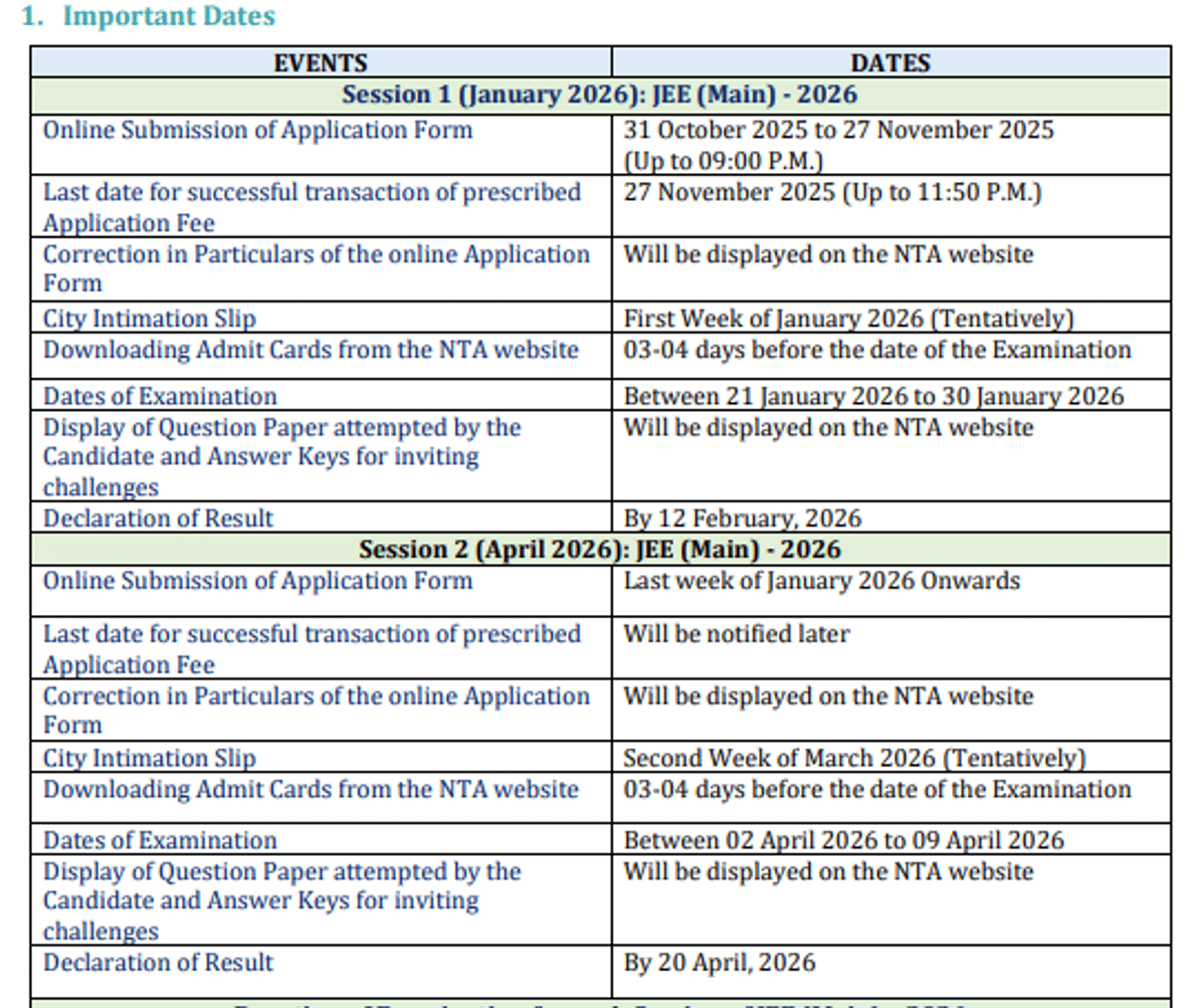
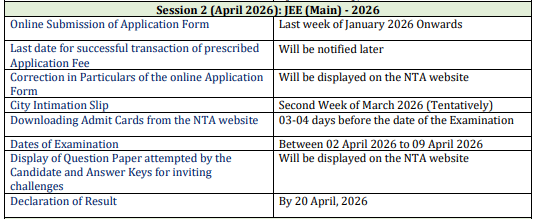
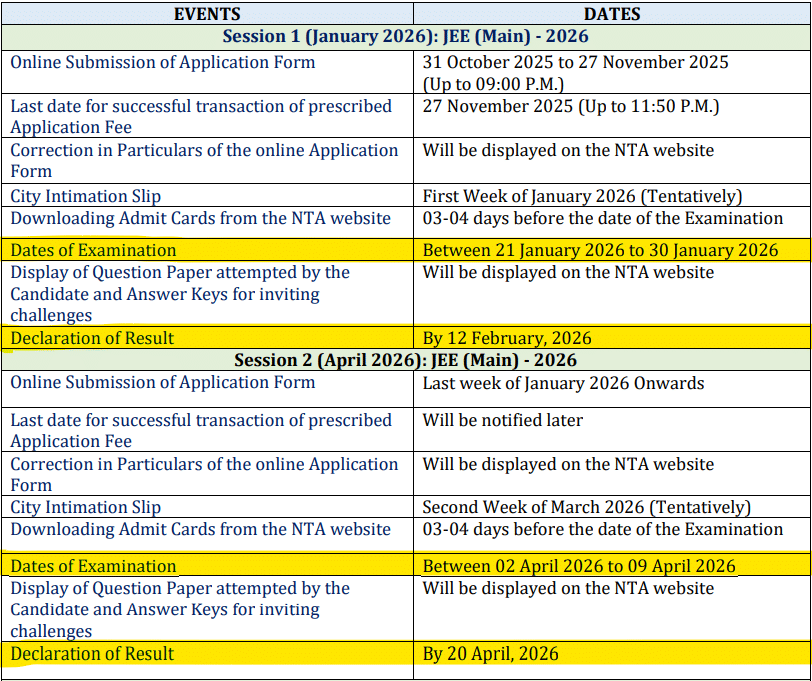
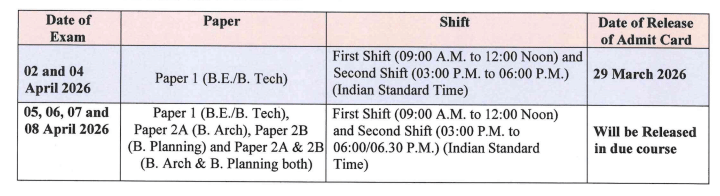
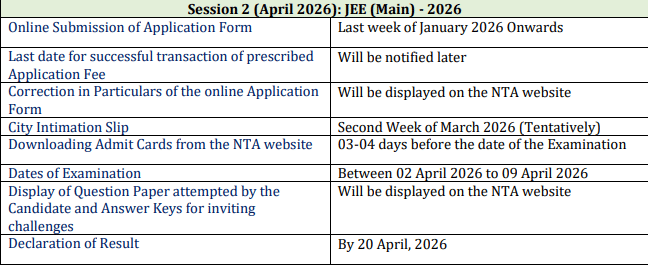
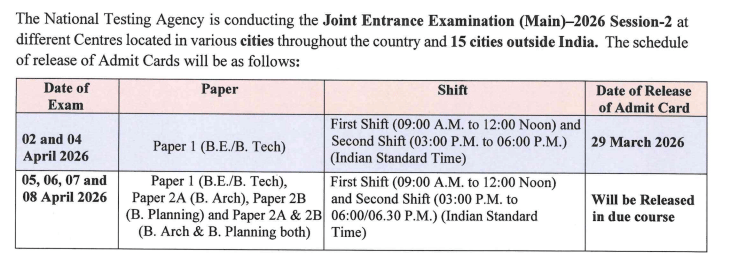
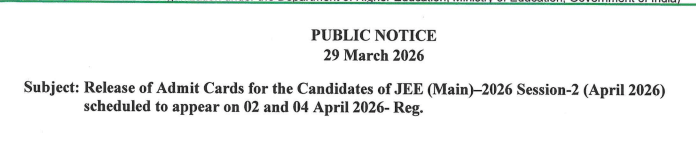
The JEE Main 2026 Session 2 Registration is over now, and city intimation slip is expected to be released in second week of March on the official website, jeemain.nta.nic.in. The JEE Main 2026 Session 2 Exams will be held from April 2 to April 9, 2026, and the admit cards will be released 3 to 4 days before the exam.

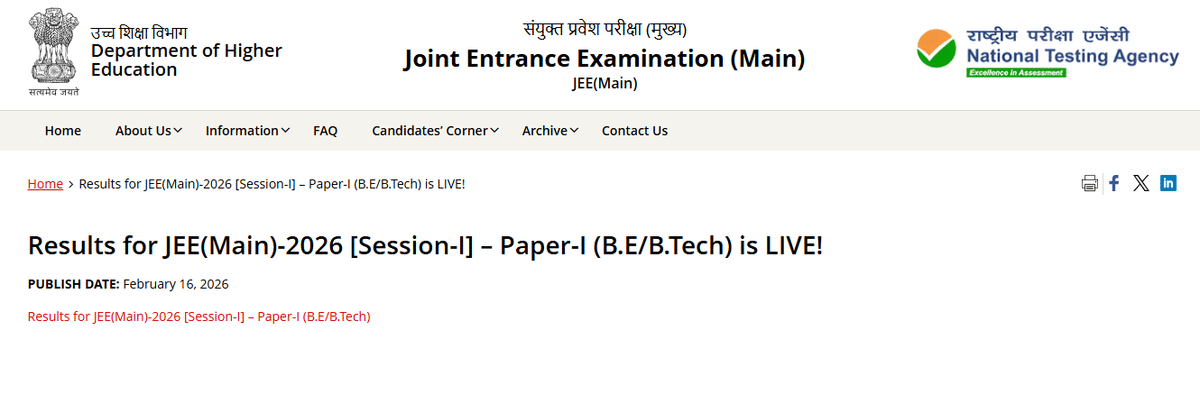
The JEE Main 2026 Session 1 Results for Paper 1 (B.E./B.Tech) have been released on 16th February 2026, and for Paper 2 (B.Arch/B.Planning) on 24th February 2026. The JEE Main Session 1 Results include NTA Score (percentile), Category Rank, and subject-wise percentile scores. You can download your scorecard by logging in using your application number and password, and the best of 2 sessions will be considered for the final ranking.

With an improvement of around 20-25 marks in session 2, you can boost your percentile, as it is a second opportunity to improve your rank and secure a better college.

Related Links:

  • Download JEE Main 2026 Question Papers Pdf
  • Practice JEE Main 2026 Sectional Test for Free
  • Predict your rank using MyKollege’s JEE Main College Predictor
JEE Main 2026

Key Summary

In this Article, we have discussed about JEE Main 2026, including the Result, Final Answer Key, Cutoff, College Predictor and Session 2 Registration.

  • As per various coaching institutes, there are around 8-9 dropped questions, for which candidates will be given full marks if attempted.
  • For the general category candidate, around 91-94, whereas for OBC/EWS, the percentile will be around 78 to 88.
  • Around 75% board marks are mandatory for IIT/NIT Admissions by JoSAA despite qualification in JEE Main.
  • In case of a tie, the Maths percentile, then Physics percentile, and age is used for rank tie-breaking.
  • If you score below 90 percentile, you can get a seat through state counselling, private universities, and GFTIs using JEE Main scores.
  • After JoSAA rounds, CSAB special rounds fill vacant NIT+ seats, giving another admission opportunity for candidates with ranks up to 40,000–80,000+.

JEE Main 2026 Important Dates

The JEE Main final answer key is out, and the JEE Main 2026 Result has been released. Registration for session 2 is ongoing. You should know the important dates related to the results, session 2 exams & counselling.

Event Date
Final Answer Key 16th Feb 2026
Session 1 Result 16th Feb, 2026 (Out)
Session 2 Registration Last Date Feb 25, 2026 (9 PM)
Session 2 Exam Dates Apr 2 – Apr 9, 2026
Session 2 Admit Card 3–4 days before the exam
Final Rank & AIR Release After Session 2
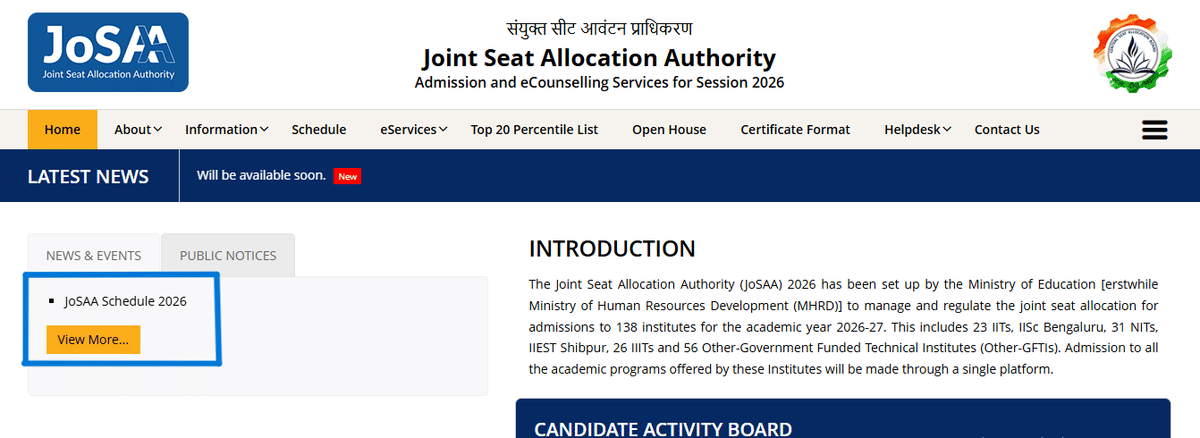
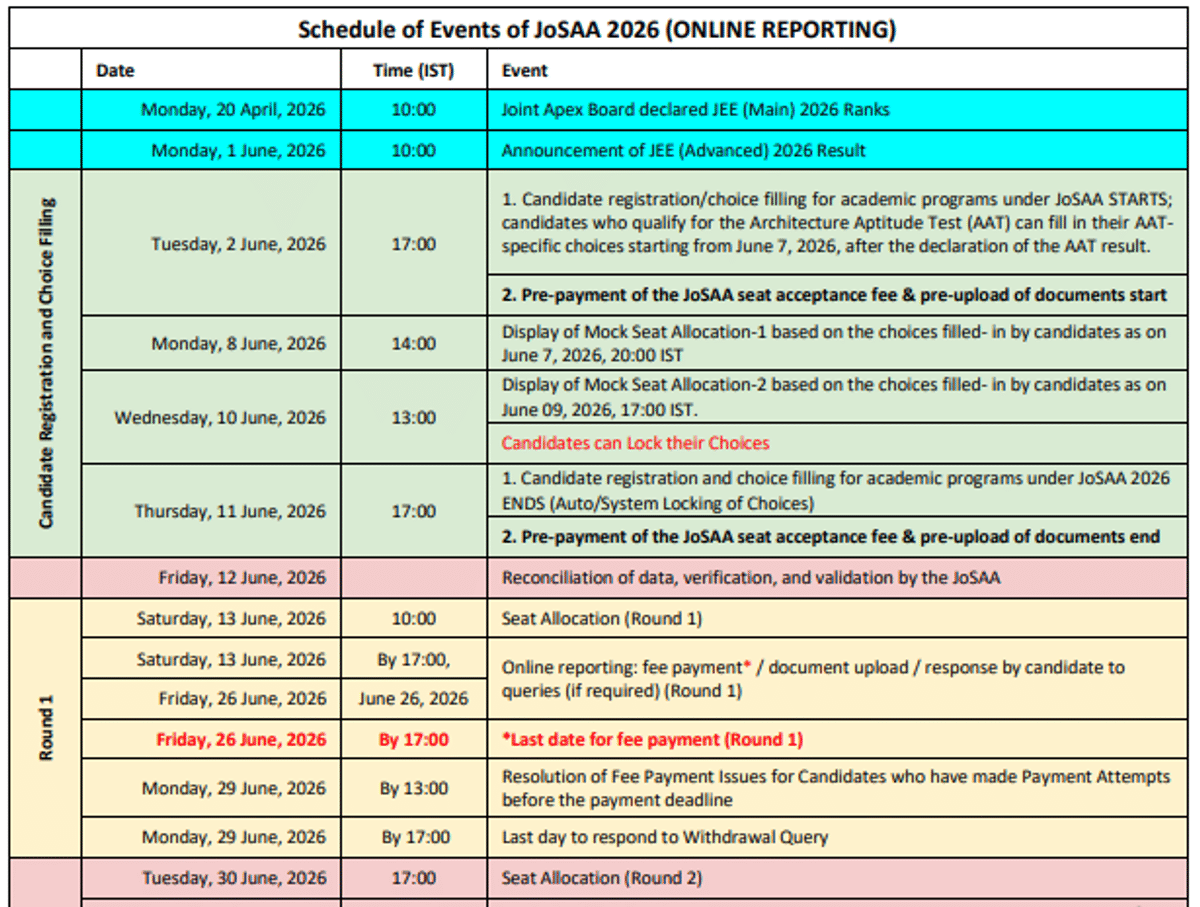
JoSAA Counselling Begins June 2026 (expected)
JEE Main 2026

Source: JEE Main Information Bulletin

Check: Important Dates for JEE Main 2026

JEE Main Paper 2 Result

The JEE Main Paper 2 Result is out for the candidates who appeared in B.Arch and B.Planning. The JEE Main Scorecard will include the Normalised percentile score, subject-wise & overall score.

Particulars Details
Exam Name JEE Main 2026 – Paper 2A (B.Arch) & Paper 2B (B.Planning)
Session 1 Exam Dates January 29, 2026
Provisional Answer Key Release February 19, 2026
Final Answer Key 23rd February 2026 (OUT)
Result Date (Session 1) 24th February 2026 (OUT)
Result Mode Online (Scorecard PDF Download)
Login Credentials Required Application Number + Date of Birth/Password
Normalization Process Percentile calculated shift-wise to ensure fairness
Admission Through NITs, IIITs, GFTIs, and other participating institutes
Score Validity Valid for Academic Session 2026–27

JEE Main Result Login

The Candidates can check their JEE Main 2026 result on the official website after clicking on the “JEE Main Result 2026 Session-1.
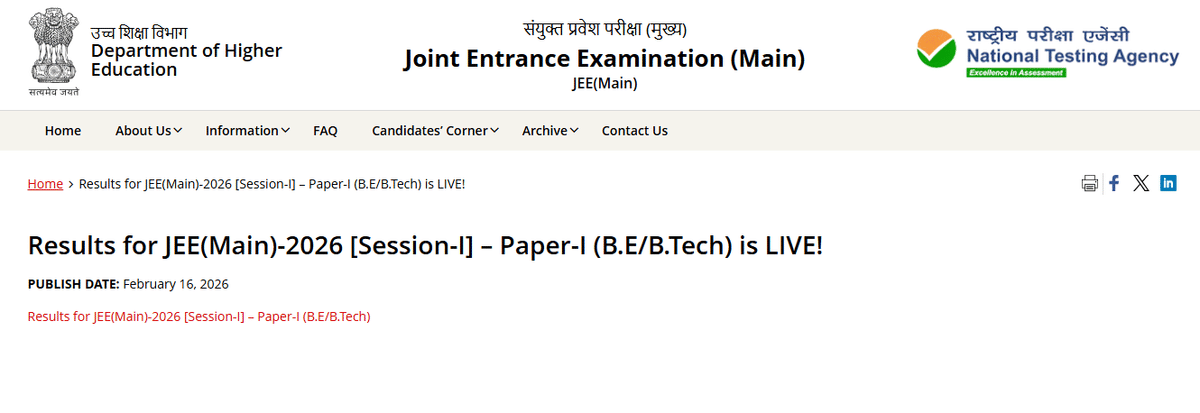
JEE Main Result

Source: JEE Main Results 

JEE Main Topper List

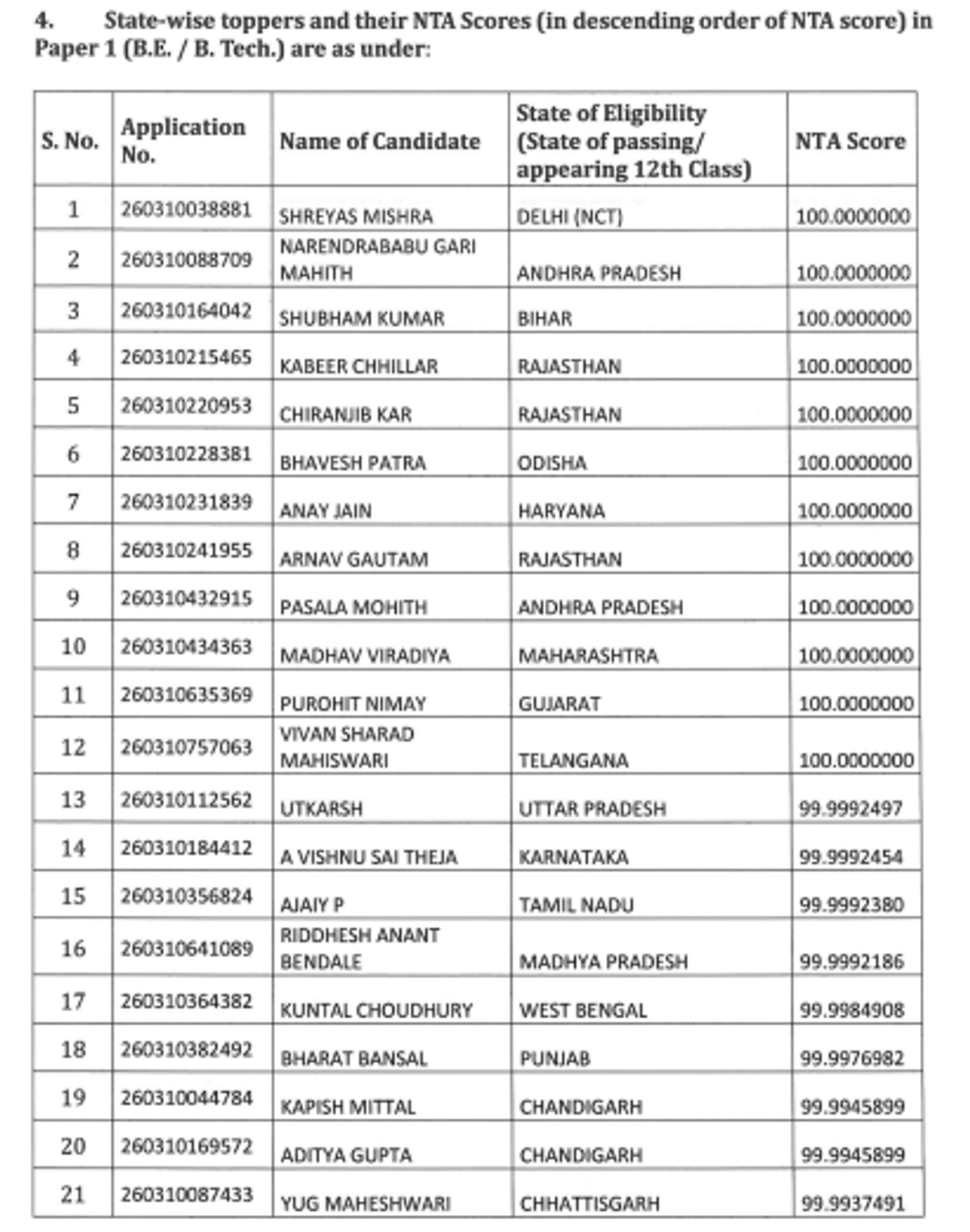
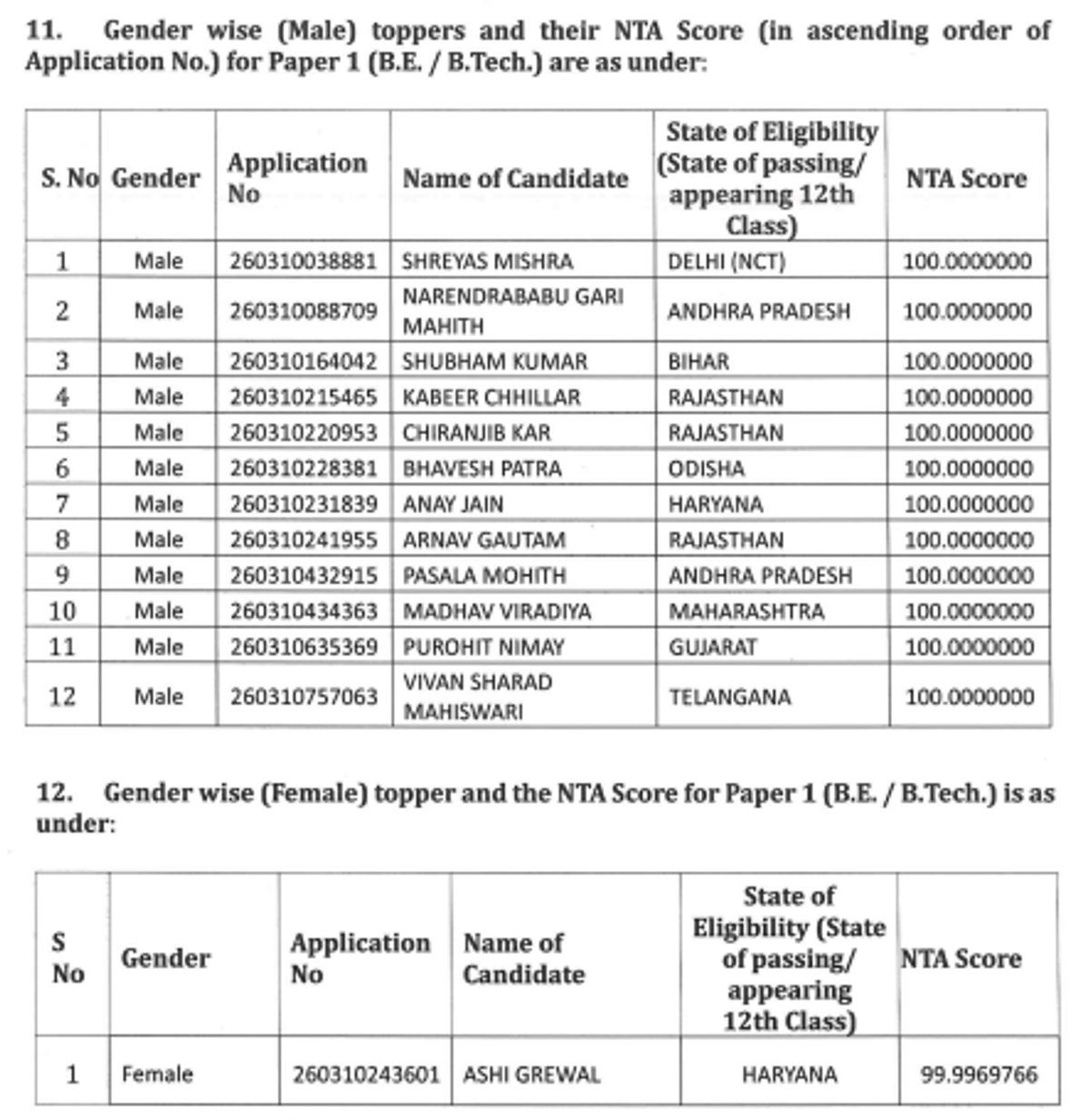
In the JEE Main Result Press Release, NTA has released the list of the total number of candidates registered & appeared in the exam, along with the state-wise toppers, gender-wise toppers & category-wise toppers. 

JEE Main Overall Toppers 2026
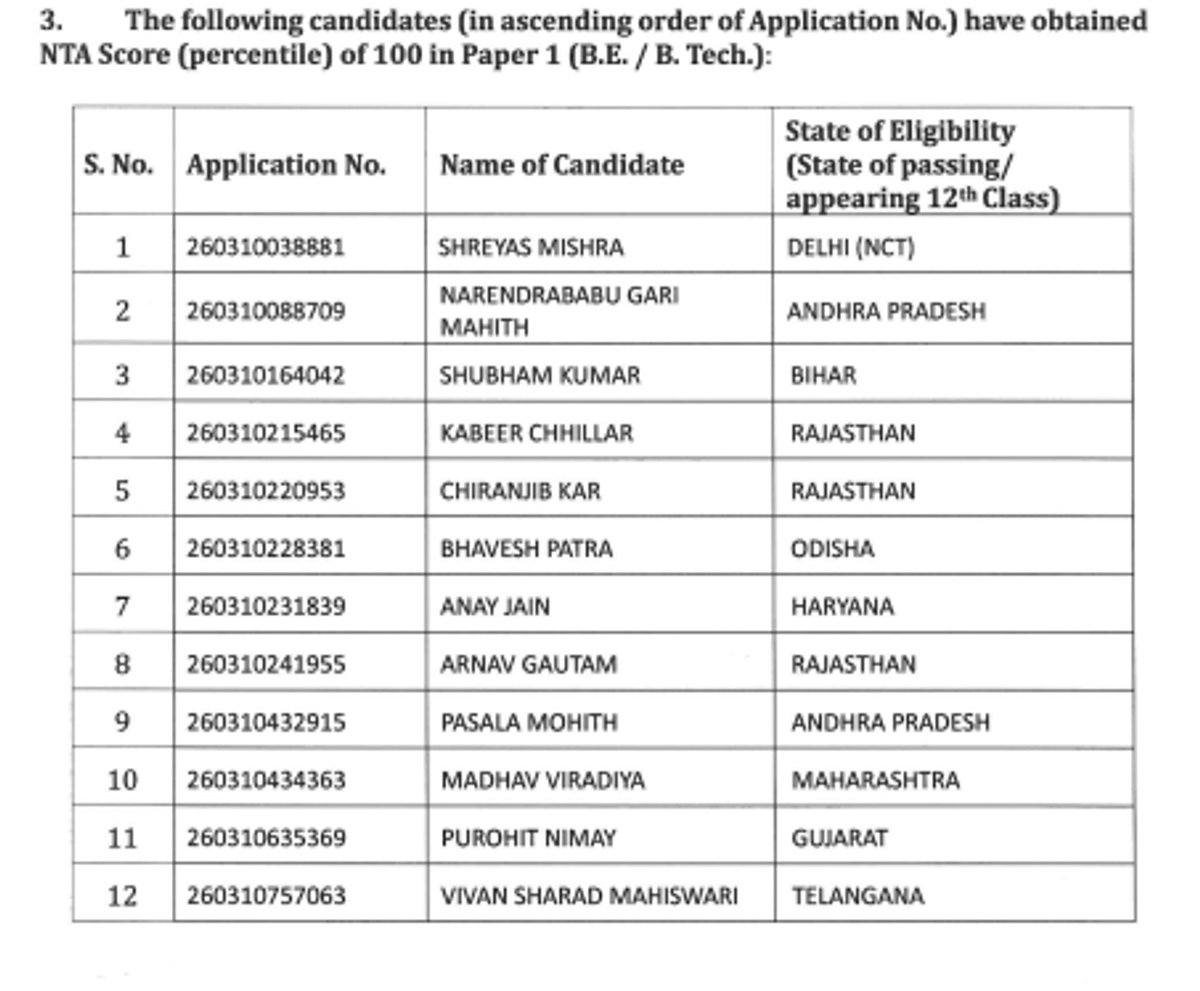
JEE MAIN TOPPERS

JEE Main State-Wise Toppers

JEE Main State-wise toppers

JEE Main Gender-Wise Toppers

JEE Main Gender-wsie toppers

Source: JEE Main Result Release PDF

JEE Main Result: Next Steps Based on Percentile

  • The Best Percentile, from both sessions 1 & 2, will be used for the final ranking.
  • The AIR and JEE Advanced eligibility will be released only after the Session 2 results.
  • You can apply to different entrance exams to increase the admission options.
  • Along with JEE Main preparation, also maintain 75% in boards.
  • If you have scored above 95 percentile, you should shift towards the Advanced level practice.
  • If your score is below 90%, then you should treat your april attempt as the main scoring chance.
Percentile Range What It Means Recommended Focus
95%ile & above Strong position for top NITs/IITs
  • Start JEE Advanced preparation
  • Maintain Mains practice for Session 2 improvement
90–95%ile Borderline for top branches Focus on the April attempt to boost the percentile; then decide on Advanced
Below 90%ile Needs major improvement
  • Target Session 2 + other exams like BITSAT, COMEDK, state CETs
  • Aim for the best college options

How to Download JEE Main Result 2026?

The JEE Main Result 2026 will be released online on the official website, jeemain.nta.nic.in. You can download the JEE Main Session 1 Scorecard by using the Application Number & password.

You can check this video by @MyKollege to know how to download the JEE Main Result in a step-by-step way.

Check:

  • How to Check JEE Main Result without Application Number
  • JEE Main Result Login Issues
  • JEE Main Scorecard Download

Ques. How can I download the JEE Main 2026 scorecard from the official website?

Ans. The JEE Main Scorecard 2026 will be released online on the official website, jeemain.nta.nic.in.

You can log in by using the NTA website and download the PDF scorecard for counselling and admission use.

Step Action
1 Visit jeemain.nta.nic.in
2 Click on “JEE Main 2026 Result”
3 Enter login credentials
4 Download scorecard PDF

Ques. What login details are required to check the JEE Main 2026 result?

Ans. To check the JEE Main Result, you will require the application number and password.

  • These will be the same as those created during the registration process, along with a security pin.
  • The result will include Candidate details, application number, Subject-wise percentile, Overall percentile, Raw scores, Exam session and paper.

How to Download the JEE Main Final Answer Key & Calculate Your Final Raw Score?

The JEE Main Final Answer key will be released along with the session 1 result, which will be used to calculate the final raw scores and percentiles.

  • You can download the answer key PDF and match it with the response sheet to calculate the final marks before the results are declared.
  • To download the JEE Main Final Answer key, no login is required, as it will be released in PDF Form on the homepage of jeemain.nta.nic.in.

How to Calculate JEE Main 2026 Raw Score?

You can calculate the JEE Main Raw Score with the help of the final answer key by simply using the marking scheme.

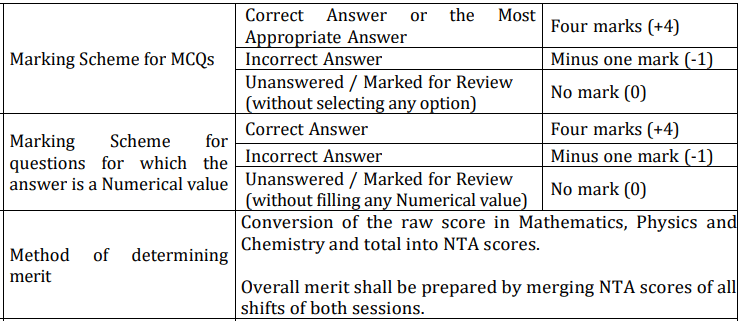
As per the marking scheme, +4 marks will be given to each correct answer, and -1 mark will be deducted for each incorrect answer.

Formula for Raw Score:

Raw Score = (Correct Answers × 4) – (Incorrect Answers × 1)

For Eg:

Parameter Example Value
Total Correct Answers 55
Total Incorrect Answers 10
Marks from Correct Answers 55 × 4 = 220
Negative Marks 10 × 1 = 10
Final Raw Score 220 – 10 = 210

After the raw score is calculated, NTA will normalise it to generate the final percentile score, which determines the final rank & eligibility for JEE Advanced & Counselling.
JEE Main 2026

Also Check: JEE Main Percentile, NTA Score & Category-Wise AIR

JEE Main Percentile Calculation

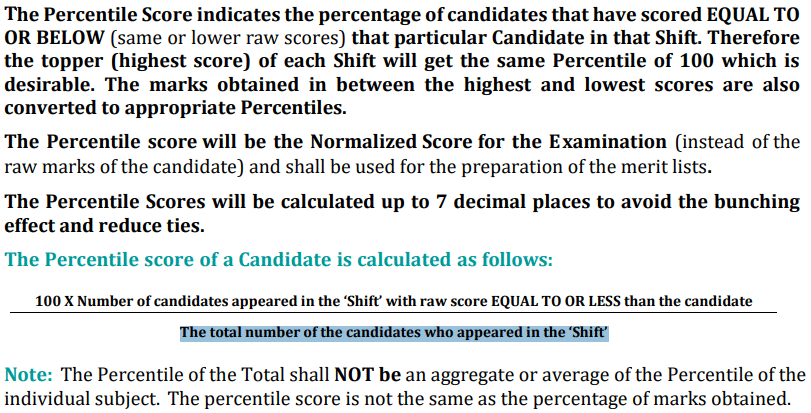
The NTA will use the normalisation method to convert raw scores into percentiles across shifts. The Percentile will show the percentage of candidates who scored equal to or below a candidate in that session.

JEE Main Percentile Formula:

Percentile = (Number of candidates with score ≤ yours ÷ Total candidates in session) × 100

For Example:

Candidate Raw Score Candidates Below Total Candidates in Shift Percentile
232 92,000 95,000 (92,000/95,000)×100 = 96.84
180 70,000 95,000 73.68
120 40,000 95,000 42.10

Ques. What is a safe score in JEE Main 2026 for NITs and IIITs admission?

Ans. In JEE Main, the Safe Score depends on the category and branch preference. For general candidates, a 170 -220+ score is considered competitive for top NITs/IIITs options.

Score Range Admission Chances
220+ Top NIT CSE
180–220 Good NIT/IIIT
140–180 Decent NIT
120–140 Lower NIT/GFTI

Ques. What is the expected JEE Advanced 2026 cutoff percentile?

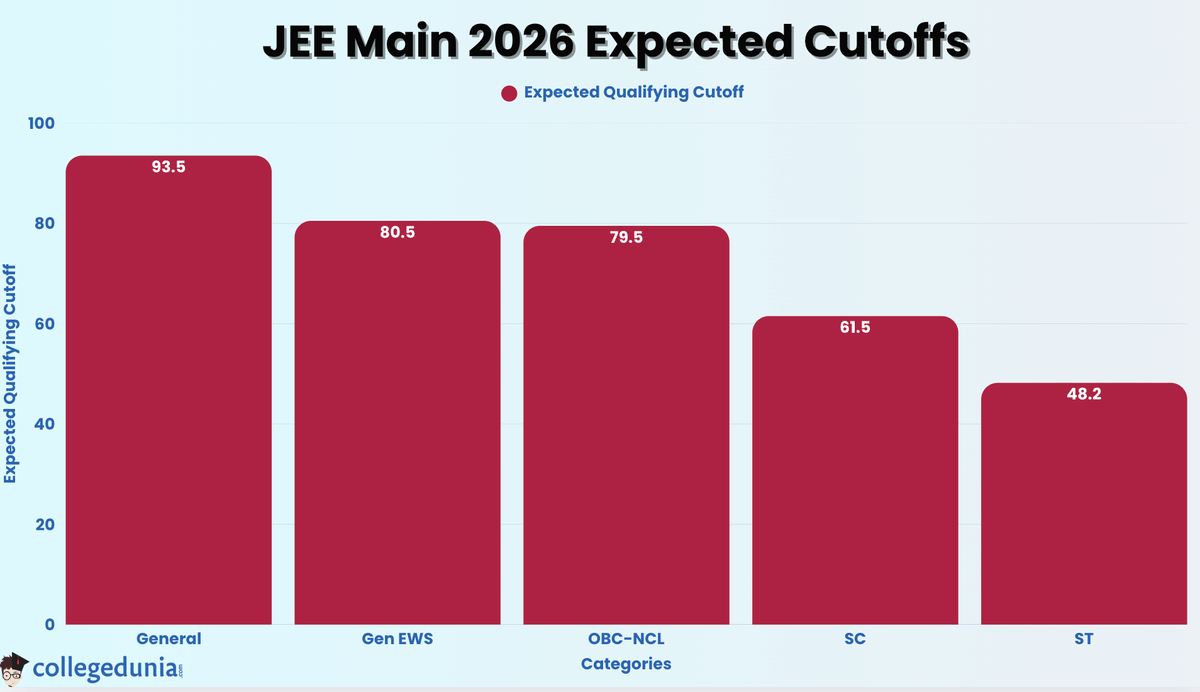
Ans. The JEE Advanced Qualifying cutoff is expected to be around the 93–95 percentile for the General category, based on recent trends and participation levels.

Category Expected Percentile Cutoff
General 93–95
OBC/EWS 90–93
SC 60–75
ST 50–65

Check:

200 Marks In JEE Main Percentile 120 marks in JEE Main percentile
250 marks in JEE Main percentile 150 Marks in JEE Main Percentile
180 Marks in JEE Main Percentile 220 Marks in JEE Main Percentile
50 Marks in JEE Main Percentile 190 Marks in JEE Main Percentile
70 Marks in JEE Main Percentile 40 Marks in JEE Main Percentile
30 Marks in JEE Main Percentile 10 Marks in JEE Main Percentile

What After JEE Main 2026 Result?

After the declaration of JEE Main 2026 Session 1 Result, you can check your percentile, have rank expectations and chances of admission.

The Next step will include appearing for session 2, checking for JEE Advanced Eligibility, and preparing for JoSAA Counselling for NITs, IIITs and GFTIs.

Next Steps After the JEE Main Result

  • After both sessions are conducted, the best percentile will be used for the Final AIR and Counselling.
  • The candidates who are above the required cutoff can register for JEE Advanced 2026.
  • If you are targeting NIT/IIIT branches, consider giving the session 2 exam for improvement.
  • Start shortlisting colleges based on expected rank and previous cutoffs.
Step Timeline What to Do
Check Scorecard & Percentile Immediately after the result Download and verify details
Decide on Session 2 Attempt Feb 2026 Reappear for score improvement if needed
Session 2 Registration Last Date Feb 25, 2026 Apply on the NTA portal
JEE Advanced Eligibility Check After Session 2 Top 2.5 lakh candidates qualify
Final AIR Release After Session 2 results Based on the best percentile
JoSAA Counselling Registration June 2026 (expected) Choice filling for colleges
Seat Allotment Rounds June–July 2026 Accept/upgrade/freeze seat

Ques. When will JoSAA counselling for JEE Main 2026 start?

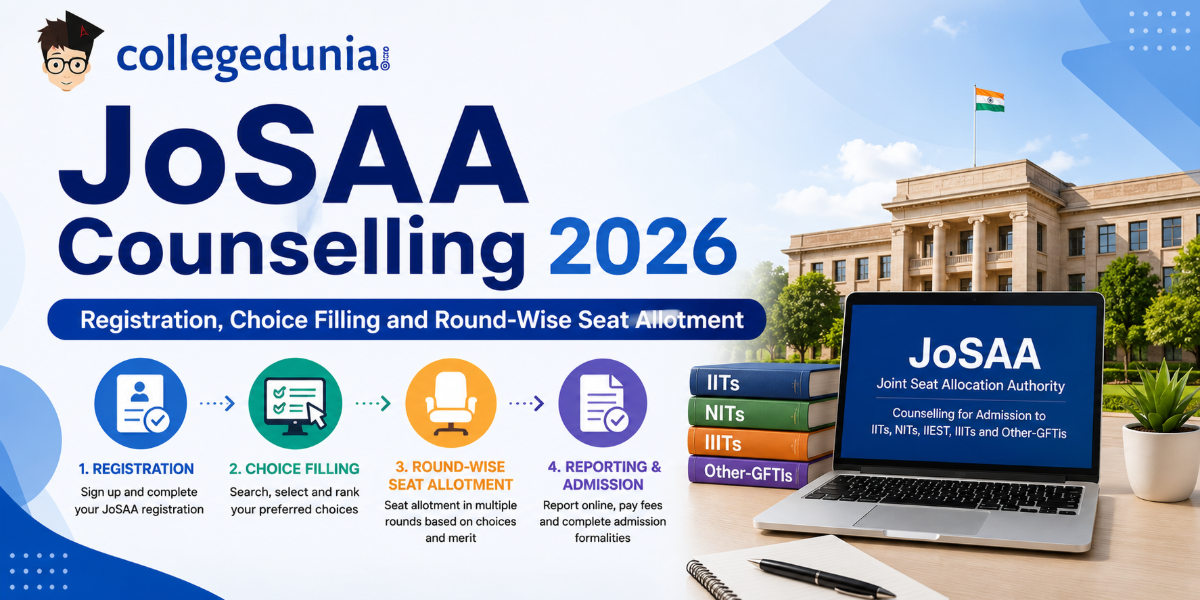
Ans. The JoSAA Counselling is expected to start in June 2026, after the session 2 results and the release of the final rank. This will include registration, choice filling, and seat allotment rounds.

Stage Expected Timeline
Registration June 2026
Choice Filling June 2026
Seat Allotment June–July 2026

Ques. Can I improve my percentile by appearing in JEE Main Session 2?

Ans. Yes, if not satisfied with the session 1 score, you can appear in session 2 to improve your percentile.

The NTA will consider the best percentile of both sessions for the final ranking, without any disadvantage for multiple attempts.

JEE Main College Predictor

The JEE Main College Predictor will help the candidates check which college and branch they can get according to their expected percentiles and rank.

Top Colleges Accepting JEE Main Scores

Institute Category College Name Admission Mode
NIT NIT Tiruchirappalli (NIT Trichy) JoSAA Counselling
NIT Surathkal
NIT Warangal
NIT Calicut
IIIT IIIT Hyderabad Institute Counselling
IIIT Allahabad JoSAA Counselling
IIIT Bangalore Institute Counselling
GFTI IIEST Shibpur JoSAA / CSAB
BIT Mesra
PEC Chandigarh
Delhi Govt College DTU Delhi JAC Delhi
NSUT Delhi JAC Delhi
State University Jadavpur University State Counselling
Private (JEE Main Based) LNMIIT Jaipur Institute Counselling
JEE Main 2026

Check:  List of colleges accepting more than 90 percentile

JEE Main 2026 Session 2 Registration Process

The NTA has released the JEE Main 2026 Application form for Session 2 for candidates who want to improve their percentile and have missed Session1 for better college options.

As NTA will consider the best score out of both sessions, session 2 is highly important for candidates.

Particulars Details
Registration Mode Online
Official Website jeemain.nta.nic.in
Registration Window Feb 1 – Feb 25, 2026 (up to 9:00 PM)
Form Correction Window Last week of February 2026
Eligible Candidates Appeared in Session 1 or for new applicants
Number of Attempts Allowed 2 (Session 1 & Session 2)
Score Considered Best of two sessions

How to apply for JEE Main 2026 Session 2?

To apply for JEE Main 2026 Session 2, you have to follow a few simple steps, including registration, documents & fees submission.

Check this video by @MyKollege to know about the step-by-step process of JEE Main Session 2 Registration.

Check:  JEE Main 2026 Session 2 Registration Started

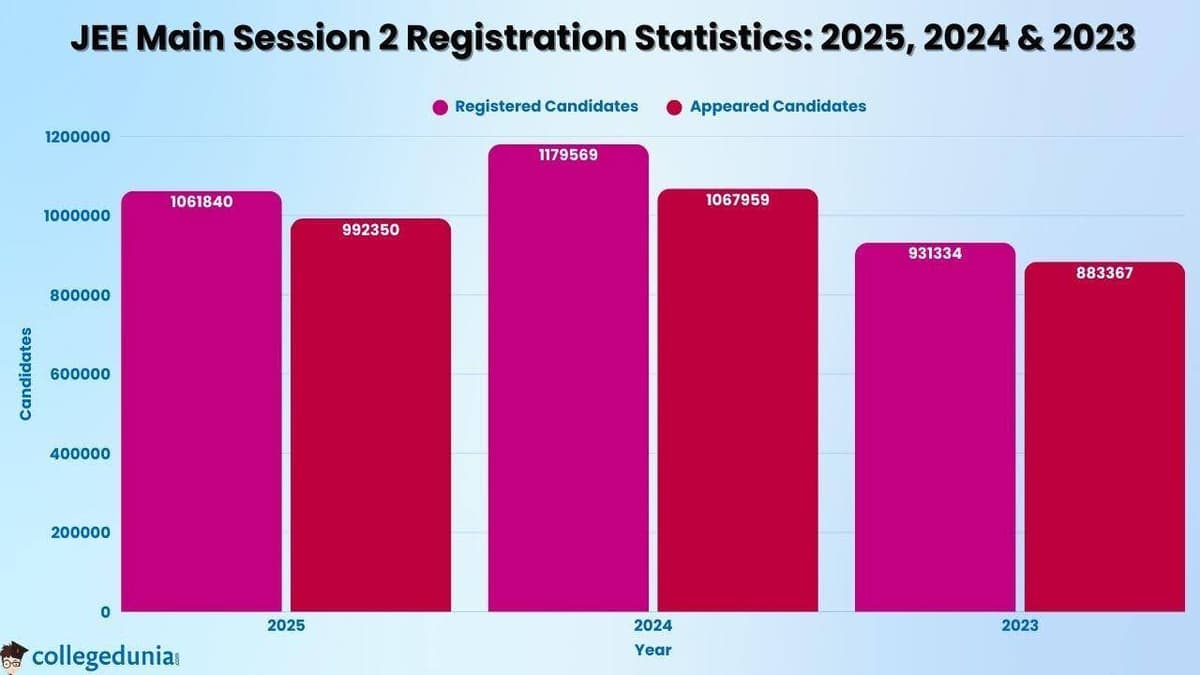
How Many Candidates Registered for JEE Main Session 2?

Every year, a large number of candidates appear for JEE Main Session 2 after Session 1, to improve their score or because they have missed the first attempt.

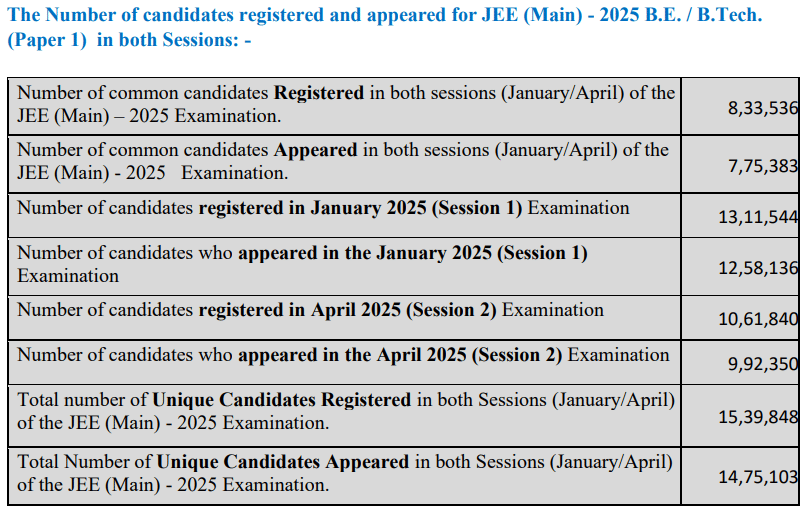
Check year-wise registration statistics for candidates appearing in session 2 & session 1, as per the official data from NTA and exam statistics:

  • In Years 2024 & 2025, the candidates registered in session 2 are the same as those in session 1, showing a high interest in the improvement session.
  • In 2023, the registration for session 2 was more than for session 1.
  • As the NTA chooses the best scores out of 2 sessions for ranking, the candidates choose to sit in both sessions to increase their score.
Year Session 1 Registered Candidates Session 2 Registered Candidates % Increase from Session 1 to Session 2
2025 13,11,544 10,61,840 81% of Session 1
2024 12,21,624 11,79,569 97% of Session 1
2023 8,60,064 9,31,334 108% of Session 1
2022 8,72,970 6,22,034 71% of Session 1

Check: How many students appeared for JEE Main 2026?

JEE Main 2026 Shift-Wise Marks vs Percentile Analysis

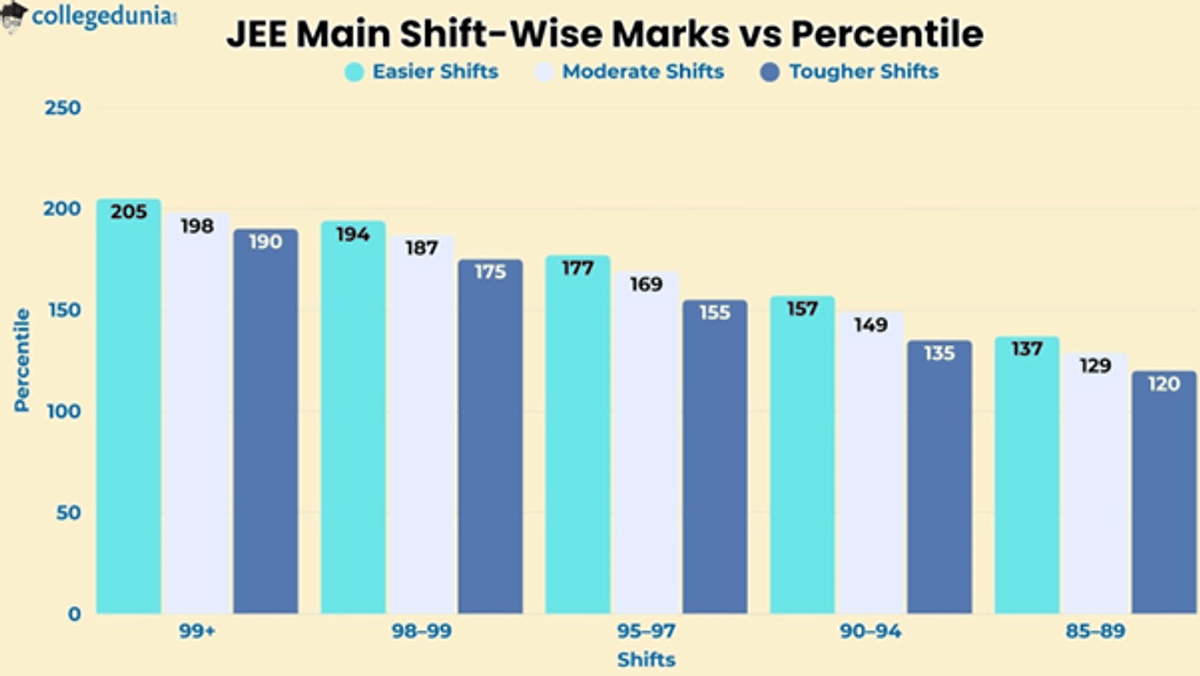
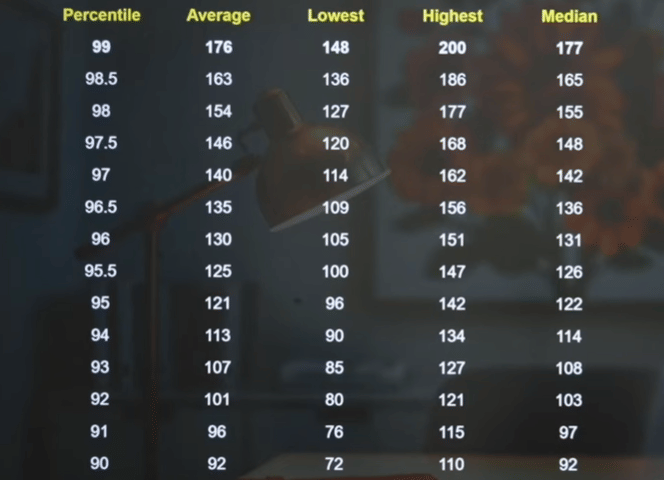
The JEE Main Percentile will be calculated by using the shift-wise normalisation, so the raw marks will differ for each day as per the shift.The JEE Main Percentile will be your relative performance as per the overall session’s performance, depending on the shift-wise difficulty.

Check an expected range of Marks vs percentile, the actual percentiles will depend on shift-wise performance and score distribution.

JEE Main Overall Shift-Wise Marks vs Percentile (Expected)

  • The JEE Main Marks vs Percentile will differ as per the candidate’s shift, but the normalisation will ensure rank fairness in the shifts.
  • With a difference of 5-10 marks, your result percentile can still be the same.
  • Maths is the most-time consuming, which also shows fewer marks for the same percentile.
  • Inan easier shift, the marks will be higher for the same percentile, because of a better average performance.
Percentile Range Easier Shifts (High Scoring) Moderate Shifts Tougher Shifts (Time-Consuming)
99+ 195–205 188–198 180–190
98–99 178–194 170–187 162–175
95–97 158–177 150–169 142–155
90–94 138–157 130–149 122–135
85–89 122–137 115–129 108–120

Also Read:

  • JEE Main 2026 Marks vs Percentile vs Rank (Expected)
  • JEE Main 2025 Marks Vs Percentile April Shift
  • JEE Main 2024 Marks Vs Percentile Shift Wise

JEE Main 2026 Safe Score for NITs/IIITs

As more than 13 lakh candidates appeared in JEE Main Session 1, the competition for NITs and IIITs is expected to be high in 2026.

A “Safe Score” depends upon the branch preference, category, and college tier, but data trends from recent years suggest that scoring 170–220+ significantly improves chances for top branches and institutes.

JEE Main Category-Wise Safe Score Estimate

Category Safe Score for Top NITs/IIITs Safe Score for Decent NIT/IIIT Expected Percentile Range
General (UR) 200 – 230+ 140 – 180 96 – 99.5
EWS 190 – 220 130 – 170 95 – 99
OBC-NCL 180 – 210 120 – 160 94 – 98.5
SC 120 – 150 90 – 120 80 – 94
ST 90 – 120 70 – 100 70 – 90
PwD 70 – 100 50 – 80 60 – 85
JEE Main 2026

Also Check:

  • Safe Score for JEE Main 2026 for the General Category
  • Safe Score for JEE Main 2026 for the ST Category
  • Safe Score for JEE Main 2026 for the PwD Category
  • Safe Score for JEE Main 2026 for the OBC Category

JEE Advanced 2026 Eligibility

The Eligibility of JEE Advanced will be completed after both JEE Main Sessions. The Top 2.5 lakh candidates of all the categories in JEE Main 2026 will be eligible to appear for JEE Advanced admission into IITs.

JEE Advanced Eligibility Criteria

  • The JEE Advanced eligibility is based on the best percentile of both JEE Main Sessions.
  • Around 2.5 Lakh candidate qualify for the exam every year, out of which only 1.6 to 1.8 lakh candidates actually appear.
  • For the general category, a 95+ percentile is usually safe for qualification for JEE Advanced.
Criteria Requirement
JEE Main Qualification Among the top 2.5 lakh candidates (all categories combined)
Cutoff Percentile (General – expected) 93–95 percentile
Cutoff Percentile (OBC/EWS – expected) 90–93 percentile
Cutoff Percentile (SC/ST – expected) 50–75 percentile
Attempts Allowed Maximum 2 attempts in consecutive years
Class 12 Requirement Passed in 2025 or appearing in 2026
Age Limit Born on/after Oct 1, 2001 (relaxation for reserved categories)

Check: JEE Main vs JEE Advanced

JEE Main Seat Matrix 2026 (Expected)

The JEE Main seat matrix 2026 is expected to provide around 42,000-43,000 seats across the NITs, IIITs, and GFTIs, increased to 60,000 with IITs included.

  • NITs lead with 24,500–25,000 seats, followed by 9,800–10,000 in IIITs and 11,000 in GFTIs, with a steady 3–4% yearly increase driven by new courses and female supernumerary seats.
  • The General category candidates will have the largest share of seats, while EWS will have around 7-8%, and the PwD category will have the horizontal reservation.

JEE Main Institute-Wise Seat Matrix (Expected)

Institute Type Number of Institutes Approx B.Tech Seats
NITs 31 24,000
IIITs 26 10,000
GFTIs 40+ 11,000
Total Seats 43,000- 45,000

IIT seats (~17,000), which are filled through JEE Advanced, are not included here.

Also Check:  JEE Main Seat Matrix 2026

JEE Main 2026 Reservation Criteria

In JEE Main, the Seat allocation by JoSAA will follow the Government of India policies. These reservations will apply across NITs, IIITs and Most GFTIs, with additional home-state quotas in NITs.

JEE Main Category-Wise Reservation

Category Reservation Percentage
EWS 10%
OBC-NCL 27%
SC 15%
ST 7.5%
PwD (within each category) 5%
Female Supernumerary Seats 20% (in select institutes)
Home State Quota (NITs) 50% seats

Also Check:

JEE Main Counselling 2026

The JEE Main Counselling for NITs, IIITs and GFTIs will be conducted by JoSAA after the release of the final AIR after Session 2.

The JEE Main Counselling process is completely online and includes registration, choice filling, multiple seat allotment rounds, and final admission confirmation.

Stage Timeline (Expected) Detailed Explanation
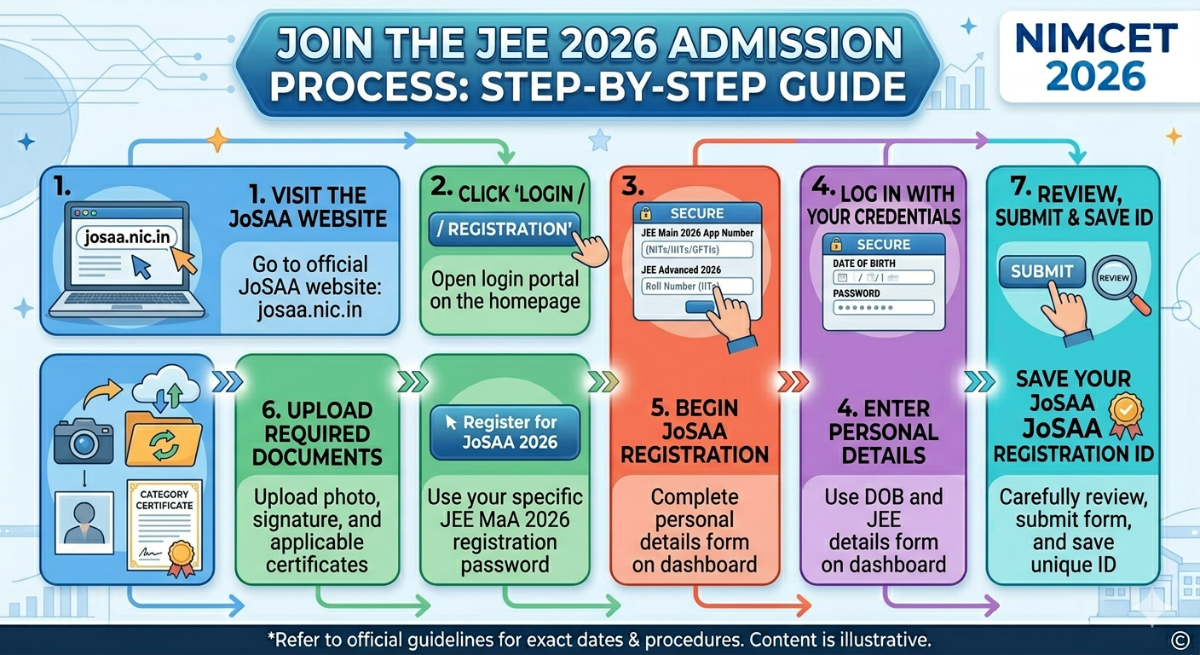
JoSAA Registration June 2026 Candidates log in using JEE Main credentials and complete counselling registration. Only registered candidates can participate in seat allotment.
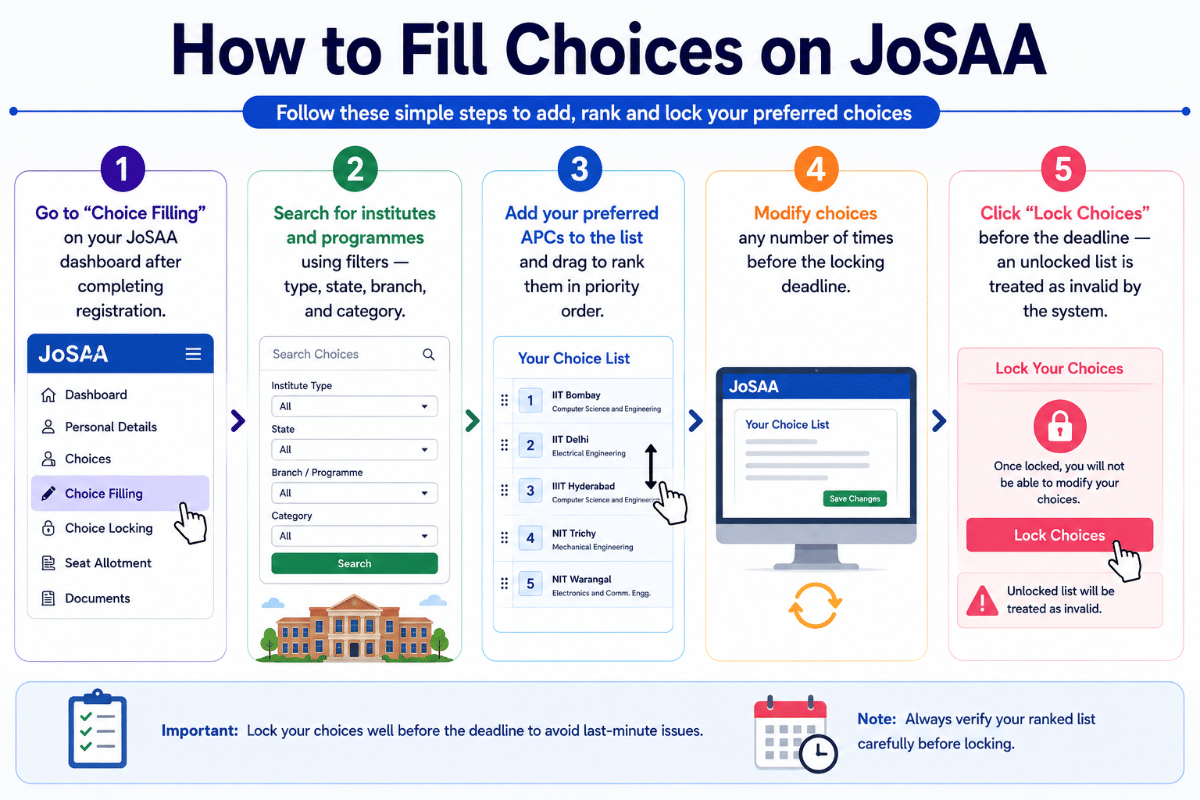
Choice Filling June 2026 Fill and arrange NIT/IIIT/GFTI branches in order of preference. More choices increase the chances of allotment. Lock choice before the deadline.
Mock Allotment Rounds June 2026 JoSAA releases 1–2 mock allotments. The candidates should understand the possible seat outcomes and modifies choices accordingly.
Round 1 Seat Allocation June 2026 First official allotment based on AIR, category, and preferences. Candidates must choose Freeze/Float/Slide and pay the seat acceptance fee.
Document Upload & Verification After allotment Upload the required documents online for verification. Failure to verify can lead to seat cancellation.
Subsequent Rounds (2–6) June–July 2026 Candidates can upgrade seat using the Float/Slide options. Cutoffs drop slightly in later rounds.
Final Seat Allotment July 2026 The last round confirms the final institute and branch. No further upgrades after this stage.
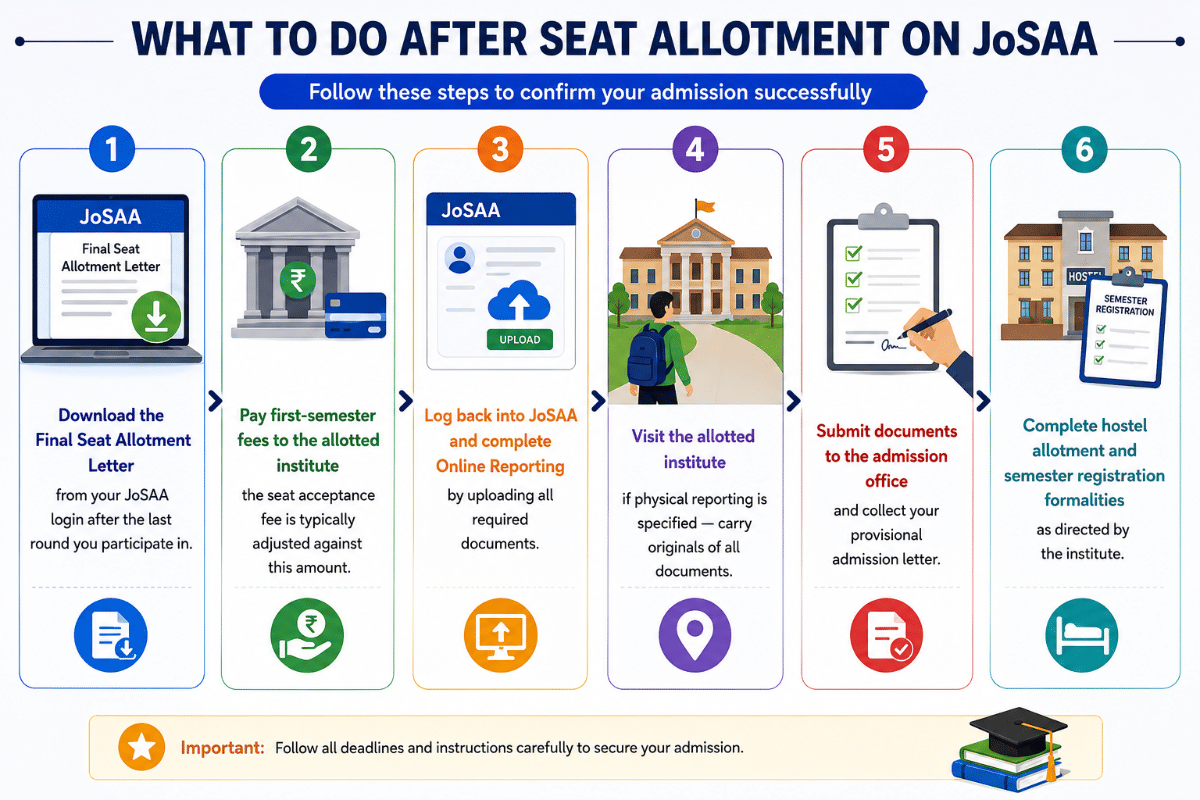
Reporting to the Institute July–Aug 2026 Candidates report to the allotted institute (online/offline) and complete admission formalities.

Also Check: JEE Main Counselling 2026

FAQs for JEE Main 2026

Ques. When will the JEE Main 2026 Session 1 result be declared?

Ans. The JEE Main 2026 Session 1 result is officially expected to be released on 12th Feb 2026; it can also be released on the evening of 11th Feb as well, along with the final answer key.

Event Date (Expected)
Final Answer Key Feb 11–12, 2026
Session 1 Result By Feb 12, 2026
Scorecard Download Same day as the result

Ques. When will the JEE Main 2026 final answer key be released?

Ans. The JEE Main Final Answer key is expected to be released before the Session 1 Result. On the basis of the final answer key, the result will be released.

JEE Main Answer Key Timeline

Stage Status
Provisional Key Released
Objection Window Closed
Final Key Before result
Result After the final key

Ques. How can I calculate my JEE Main 2026 raw score using the answer key?

Ans. To calculate your score, you can match your responses with the final answer key and use the marking scheme to estimate your raw marks before normalisation.

JEE Main Score calculation Formula:

Raw Score = (Correct × 4) – (Incorrect × 1)

Ques. How many candidates appeared for JEE Main 2026 Session 1?

Ans. Around 13.5 lakh candidates registered for JEE Main Session 1, from which 13,00,368 candidates appeared.

The attendance rate of 96%, showing high competition in the exam.

Ques. What are the total seats available through JEE Main 2026 counselling?

Ans. The total JEE Main Scores used for Admission in NITs, IIITs, and GFTIs are around 45,000 B.Tech Seats.

Institute Type Seats
NITs 24,000
IIITs 9,000
GFTIs 11, 000
Total 45, 000

Ques. What should I do after the JEE Main 2026 result is declared?

Ans. After the JEE Main Session 1 result is declared, you can analyse percentile, predict rank, and plan next steps like Session 2 attempt or counselling preparation.

Next Steps after result declaration are:

Step Action
Download scorecard Check percentile
Decide Session 2 Improve score if needed
Track AIR release After Session 2
Prepare for JoSAA Shortlist colleges

Eligibility Criteria

  • Qualification: Passed in 2025 or appearing in 2026
  • JEE Advanced Eligibility: Among the top 2.5 lakh candidates (all categories combined)
  • Age Limit: Born on/after Oct 1, 2001 (relaxation for reserved categories)

Application Process

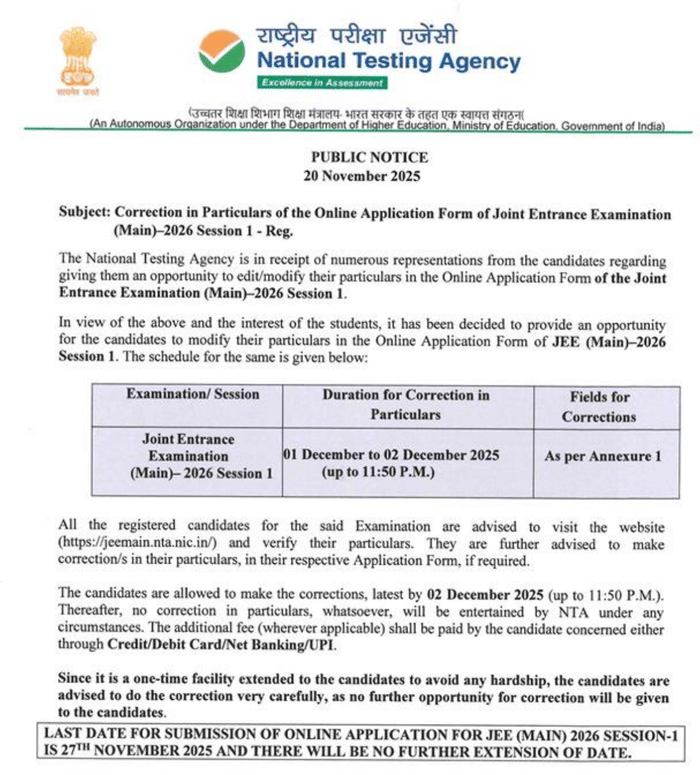
The JEE Main 2026 Session 2 Registration has concluded on 25th February 2026. The Form Correction Window for JEE Main Session 2 has started on 27th February and will continue till 28th February 2026,  (up to 11:50 PM) on the official website, jeemain.nta.nic.in. 

You can log in by using your Application Number and Password to have access to the JEE Main Session 2 Form Correction Window. 

  • This is an one time opportunity for candidates to submit their changes; the forms will be frozen, and no further changes will be allowed. 
  • In the correction window, you cannot change your mobile number, email address, or permanent/present address. 
  • The JEE Main Form correction window is free for some changes, but for category change, more additional papers and for change of the exam city, fees will be charged.

In JEE Main 2026 Session 1,  13,55,293 Canddiates registered, and from which 13,04,653 candidates appeared, with an attendance rate of 96.26%. The Registration is expected to be higher in session 2 as well. 

Check:

  • How many students appeared for JEE Main 2026?
  • JEE Main 2026: 14.5 Lakh Students for 58,000 Seats

JEE Main Registration Session 2

Key Summary

In this Article, we have discussed about JEE Main Registration for Session 2, including the Expected Dates, Documents Required & Fees.

  • The JEE Main Session 2 can be a strategic second attempt for the candidates, as around 40 to 45% toppers use Session 2 to improve their percentile.
  • The Rejections in JEE Main Session 2 can be because of category, Pwd or paper selection issues.
  • The JEE Main Session 2 also aligns with board exams and other entrances; the major metro city slots are filled more easily.
  • In JEE Main Session 2, more than 80% candidates score 95+ percentile.
  • In 2026, NTA implemented major changes such as live photo capture, Aadhaar-based e-KYC, mandatory scanned ID proof, APAAR ID entry, and introduced 33 new exam cities.
  • JEE Main Registration is mandatory for admission into 31 NITs, 25 IIITs, 28 GFTIs, and other state/private engineering institutes

JEE Main 2026 Registration Dates

The JEE Main Session 2 Registration is a shorter and more competitive admission cycle, as it is a final opportunity for candidates to improve their scores before the final rank calculation and JoSAA Counselling. The NTA is expected to open the session 2 registration on 1st february 2026. 

JEE Main 2026 Session 2 Registration Dates

Event Date
Session 2 Registration Start 1st February 2026
Last Date to Apply 25th February 2026 
Application Correction Window February–March 2026
City Intimation Slip Release March 2026
Admit Card Release 3–5 days before the exam
JEE Main Session 2 Exam Dates April 2–9, 2026
JEE Main 2026 Registration Dates

Source: JEE Main Information Brochure

Ques. Is there a separate registration timeline for fresh candidates and Session 1 applicants?

Ans. In JEE Main, there is no separate registration window for fresh candidates and Session 1 candidates in JEE Main Session 2.

JEE Main Registration Timeline (Session 2)

Candidate Type Registration Method Timeline
Fresh candidates New registration Same Session 2 window
Session 1 candidates Log in with existing credentials

Ques. How long is the application correction window for Session 2?

Ans. The Correction window for JEE Main Session 2 will open for 2-3 days after the registration window closes.

JEE Main Session 2 Correction Window

Aspect Details
Mode Online only
Duration 2–3 days
Opens After Session 2 registration closes
Extension Not extended

Ques. Is NTA providing a centre near the permanent address?

Ans. Yes, NTA prioritises centres near your permanent address.

  • For JEE Main 2026, centres are allotted based on your Aadhaar-linked permanent address or present address.
  • You can select up to 4 preferred cities during the application form, but they must be in the same state as your address.

Check:

  • JEE Main 2026 Important Dates
  • JEE MAIN Exam Day Guidelines

JEE Main 2026 Session 2 Registration Process

The JEE Main Session 2 Registration is mainly for the repeat candidates, as a large number of candidates appear for this session to improve their January scores.

  • The JEE Main Registration process is completely online, where NTA uses a single candidate process to apply for both sessions.
  • For the Session 2 Registrations, the session 1 candidates can log in using their existing credentials and new candidates must do a fresh registration.
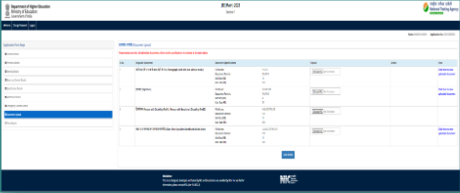
  • The Candidates have to upload a live photograph along with a scanned signature as per the NTA Guidelines.

How to Apply for JEE Main 2026?

To know about the complete registration process for JEE Main, you can watch this video by @MyKollege for the full step-by-step registration process of JEE Main Session 2.

Check:

  • JEE Main Reservation
  • Can I wear Jeans at theJEE Main Exam Centre

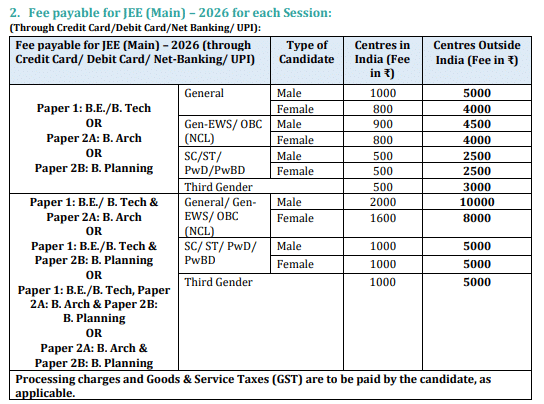
JEE Main 2026 Session 2 Registration Fees

The JEE Main Application fee for session 2 should be paid separately for the candidates who have already appeared in session 1. As per the analysis, more than 60% session 2 candidates are repeat candidates, and the delayed fee payment is the top reason for the incomplete application process.

JEE Main 2026 Session 2 Application Fee (Expected)

Category Application Fee (₹)
General (Male) 1000
General (Female) 800
OBC-NCL / EWS 800
SC / ST / PwD 500
Transgender 500
JEE Main 2026 Session 2 Registration Fees

Source: JEE Main Information Brochure

Ques. What is the step-by-step process to register for JEE Main Session 2?

Ans. The JEE Main Session 2 Registration Process is completely online, and the profile is maintained by NTA. The Candidates have to complete all the steps for registration, which are:

  • Visit the official website jeemain.nta.nic.in and click on JEE Main Session 2 Registration.
  • Log in if you are a session 1 candidate and complete the new registration, if a new candidate.
  • Fill in the personal, academic and contact details & upload a live photograph along with the signature.
  • Select your paper type, city preference & pay the application fee online.

Ques. Can Session 1 candidates use their existing credentials for Session 2 registration?

Ans. Yes, candidates who have appeared in JEE Main Session 1 can use their existing application number and password to apply for Session 2. They are not required to register again.

JEE Main Session 1 vs Session 2 Login Process

Candidate Type Login Requirement
Session 1 appeared to be for candidates Use existing credentials
Fresh candidates New registration required

Ques. I passed Class 12 in 2023—am I eligible for JEE Main 2026? NTA says 2024/2025/appearing 2026 only. As a two-year dropper, can I still apply, or is this my last chance?

Ans. No, you are not eligible for JEE Main 2026, as NTA requires passing Class 12 (or equivalent) in 2024, 2025, or appearing in 2026; 2023 passers are excluded.

As a two-year dropper (2023 pass, now 2025), this aligns with the 3 attempts, but it is limiting the passing year rule.

  • This is your last chance, but due to the year passing, you are not eligible.
  • Your options are: Reappear for Class 12 in 2026to qualify as “appearing”, or you can consider state exams like BITSAT, VITEEE for engineering.

JEE Main Registration Statistics: Session 1 & Session 2

To understand the competition level of JEE Main, you should know about the JEE Main Session 1 vs Session 2 registration statistics.

As per the previous year's statistics, in april session, major registered candidates are repeat candidates who have already appeared in session 1 to improve their percentiles.

JEE Main Registration & Appearance Statistics (Session 1 vs Session 2)

  • In JEE Main Session-1, January, around 15 to 25% higher registrations are expected there as compared to Session 2.
  • The JEE Main Session 2 is more competitive, as 60 to 65% of the candidates are repeaters, making a high percentile jump.
  • As per the attendance rate, 90% of the registered candidates appear for the exam.
Year Session Registered Candidates Appeared Candidates
2026 (Expected) Session 1 (Jan) 14,50,000 13,80,000
Session 2 (Apr) 11,50,000 11,00,000
2025 Session 1 (Jan) 13,78,000 13,00,273
Session 2 (Apr) 10,61,840 9,92,350
2024 Session 1 (Jan) 12,21,624 11,70,048
Session 2 (Apr) 11,79,569 10,67,959
2023 Session 1 (Jan) 8,60,064 8,23,967
Session 2 (Apr) 9,31,334 8,83,367
JEE Main Registration & Appearance Statistics (Session 1 vs Session 2)

Check: JEE Main vs JEE Advanced

Ques. What is the average attendance rate for Session 2 compared to Session 1?

Ans. The JEE Main Session 2 can be less than Session1, but it remains high. The January session sees more registrations due to fresh attempts, but in april session, more serious and prepared candidates appear for the exam.

JEE Main Average Attendance Trend

Session Registered Candidates Appeared Candidates Attendance Rate
Session 1 (Jan) Higher Slightly higher 93–95%
Session 2 (Apr) Lower Lower 90–93%

Ques. Is the competition tougher in Session 2 compared to Session 1?

Ans. Yes, Session 2 is generally considered tougher as per the percentile, even if the difficulty is the same. This is a larger number of repeated and better-prepared candidates.

JEE Main Session 1 vs Session 2

Factor Session 1 Session 2
Fresh candidates Higher Lower
Repeat candidates Lower Much higher
Percentile jump difficulty Moderate High
Score vs percentile tightness Relatively flexible More compressed

JEE Main 2026 Registration Major Changes

The Major changes in JEE Main 2026 Registrations are:

  • Aadhaar e-KYC: Auto-fetches personal details from UIDAI; applicants must match Aadhaar with school records; users reported form lock issues and city allotment tied to Aadhaar address.
  • Live Photo Capture: Mandatory browser-based live photo during registration; applicants should use a device with a working camera; introduced as an anti-fraud feature.
  • Scanned ID Upload: Compulsory upload of scanned Aadhaar/passport/ID; applicants must scan in advance; tied to e-KYC glitches as reported by students.
  • Mandatory UDID for PwD: PwD candidates must upload UDID + updated medical certificate; applicants should prepare documents early; UDID portal downtime caused panic.
  • Class 11 Registration Number: Required to avoid board verification clashes; applicants should obtain it from school beforehand; user complaints forced schools to share IDs.
  • Updated Fee Structure: New fee slab, for male ₹1000, female ₹800, OBC/EWS male ₹900, SC/ST/PwD ₹500; applicants must ensure correct category proof; certificate update reminders trending.
  • More Test Cities Added: 33 new cities added; applicants can choose 4 preferences, but may be reassigned; widely praised for better accessibility.
  • New Form Sections: Added APAAR ID and additional disability details; applicants must fill in carefully, as the correction window may not allow edits; overlaps with UDID issues discussed online.

Check: how many students will appear for JEE Main 2026?

Who Can Apply for JEE Main Session 2?

The JEE Main Eligibility Criteria for Session 2 is the same as Session 1, but the april attempt is mainly for the repeat candidates and those looking for score improvement.

The NTA allows the eligible candidates to appear in both sessions of the same year; the best percentile will be considered for ranking.

JEE Main 2026 Session 2: Eligibility Criteria

Eligibility Parameter Requirement for Session 2
Age Limit No age limit for appearing in JEE Main
Class 12 Passing Year Passed/appearing in 2024, 2025, or 2026
Qualifying Exam Class 12 or equivalent from a recognised board
Mandatory Subjects (B.E./B.Tech) Physics & Mathematics + one of Chemistry / Biology / Biotechnology / Technical Vocational
Mandatory Subjects (B.Arch) Physics, Chemistry & Mathematics
Mandatory Subjects (B.Planning) Mathematics
Number of Attempts 3 consecutive years maximum
Sessions Allowed per Year Up to 2 sessions (Jan & Apr)
Minimum Class 12 Percentage Not required for registration
75% Criteria Applicable only at the JoSAA admission stage, not during registration
Nationality Indian, NRI, OCI, PIO & Foreign nationals

Also, Check: JEE Main Eligibility

Ques. Can candidates who missed Session 1 directly apply for Session 2?

Ans. The Candidates who did not appear or register for Session1 can directly apply for JEE Main Session 2.

The NTA offers different opportunities for candidates in the form of a separate application, which allows fresh registration in JEE Main Session 2.

Aspect Session 2 Rule
Missed Session 1 Can apply directly
New registration allowed Yes
Same application portal jeemain.nta.ac.in
Credentials required Fresh registration details
Attempts counted Session 2 counted as a separate attempt

Ques. Are there any age limits for Session 2 registration?

Ans. No, there is no upper age limit to appear for JEE Main Session 2. The NTA does not have any age restrictions for either session.

Criteria Session 2 Requirement
Minimum age Not specified
Maximum age No upper limit
Year of passing Class 12 As per current eligibility rules
Attempts allowed Up to 3 consecutive years

What All Do You Need Before Filling JEE Main Session 2 Form?

To complete the JEE Main Registration Process, candidates have to upload the required documents.

  • The NTA follows strict upload and verification rules, along with minor issues like blurred images and incorrect certificates.
  • The Candidates from session 1 are not required to upload the documents again unless there is a correction in the same.

Documents Required for JEE Main 2026 Session 2 Registration

Document Purpose Key Specifications / Notes
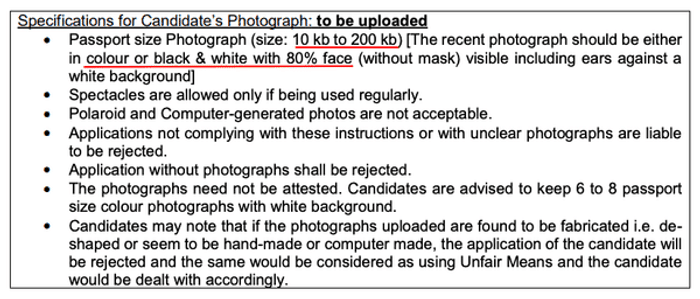
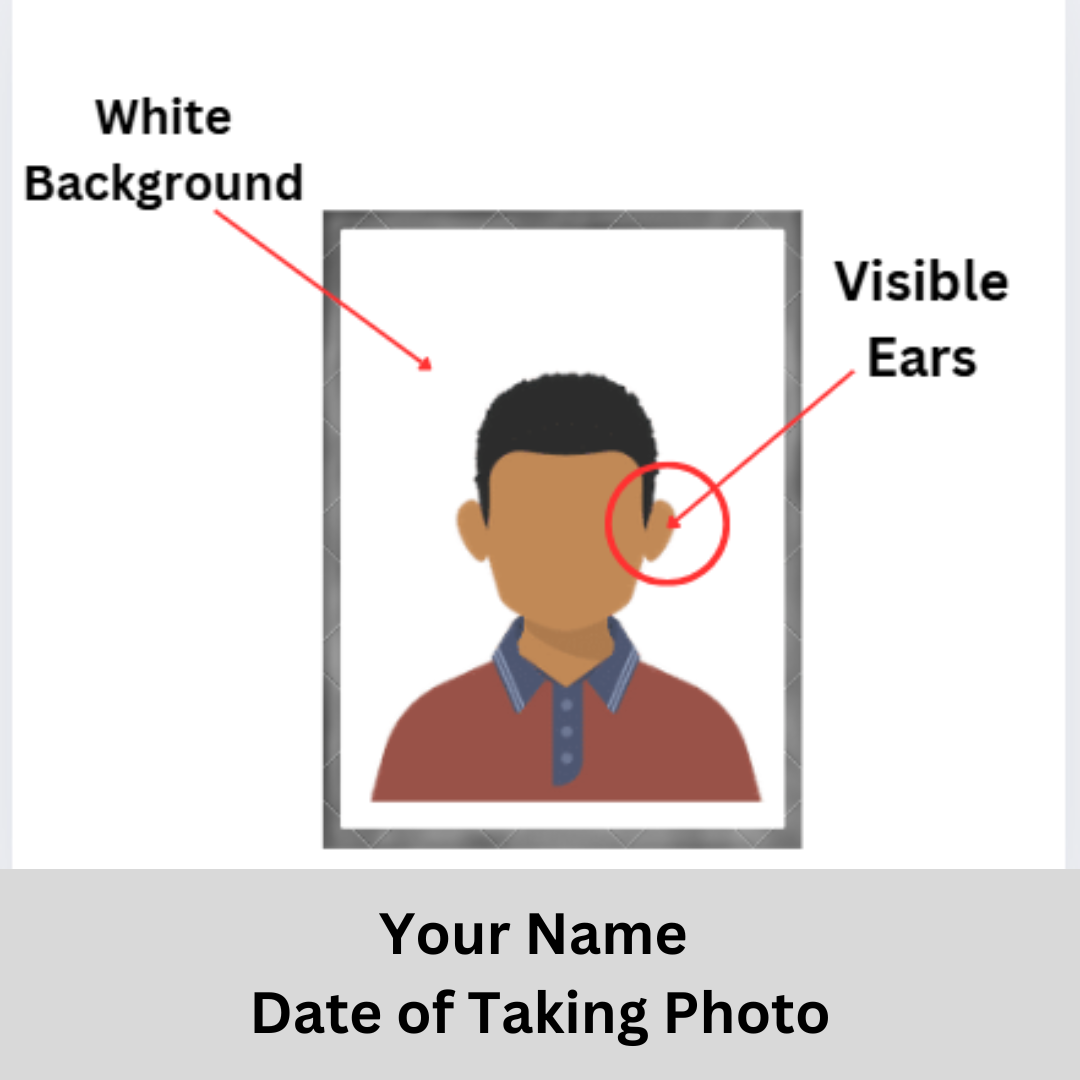
Passport-size Photograph Identity verification Recent, clear, preferably white background; live photo upload required
Signature Application authentication Scanned signature in black/blue ink on white paper
Class 10 Marksheet / Certificate Date of birth verification Must match the details entered in the application
Class 12 Marksheet / Certificate Academic eligibility Required if already passed; appearing candidates can skip upload
Category Certificate (if applicable) Reservation benefits SC/ST/OBC-NCL/EWS certificate in the prescribed format
PwD Certificate (if applicable) Disability reservation Issued by a competent medical authority
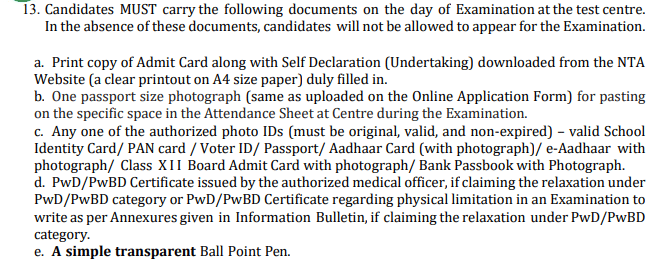
Photo ID Proof Identity confirmation Aadhaar Card, Passport, Voter ID, or PAN Card
Active Mobile Number & Email ID Official communication Used for OTP, login, and NTA alerts

Check: JEE MAIN Photo-size guidelines

JEE Main Registration: Application Form Correction Window

The JEE Main Registration Correction window for session 2 will be provided once by the candidates to allow them to edit the specific details they have submitted in the application form.

CUET Session 2 Correction Window

Particulars Details
Who Can Use It Candidates who successfully submitted the CUET application form
Correction Window Mode Online only (no offline requests accepted)
When It Opens Usually, after the registration window closes
Duration 2–3 days (short, non-extendable)
Official Website cuet.nta.nic.in
Fee for Corrections Applicable only ifthe category/subject change increases the fee

Fields That Can Usually Be Corrected

Editable Fields Remarks
Candidate Name Minor spelling corrections allowed
Category / Sub-category Fee difference may apply
Gender Editable
Date of Birth Must match the Class 10 certificate
Exam City Preferences Allowed before final allotment
Subject / Test Paper Selection Editable within eligibility rules
Photograph & Signature Re-upload permitted if rejected

Check: JEE Main Form correction window

JEE Main Admit Card vs City Slip: What Comes First for JEE Main Session 2 & Why It Matters?

For the JEE Main Session 2, NTA will release 2 separate documents before the exam: the city intimation slip and the admit card. The Purpose of both documents is different, and they are released separately.

JEE Main 2026 Session 2: City Intimation Slip & Admit Card

Aspect City Intimation Slip Admit Card
Purpose Informs the allotted exam city Confirms exam centre, date, shift & roll number
Release Timeline Around 7–10 days before the exam 3–5 days before the exam
Contains Centre Address? No Yes
Mandatory on Exam Day? No Yes (compulsory)
Official Website jeemain.nta.nic.in
Download Requirement Log in with the application number & DOB

Check:

  • JEE Main Admit Card
  • JEE MAIN City Intimation Slip

FAQs for JEE Main Registration 2026

Ques. Which payment modes are accepted for the Session 2 application fee?

Ans. The JEE Main Session 2 Application fee should be paid online.

  • The NTA does not accept offline payment or cash transactions.
  • The NTA accepts the UPI, Debit card, credit card and net banking for payment.

Ques. During registration, should names be written in all caps as per the 10th marksheet? How to avoid rejection?

Ans. Enter exactly as in your Class 10 marksheet – match spelling, order, capitalisation. If it’s all in caps (e.g., ROHAN), use all caps; if title case (e.g., Rohan), then use that.

The NTA verifies against the uploaded Class 10 certificate—no specific "all caps" rule, but discrepancies lead to rejection.

Ques. Do I have to register again for Athe pril session if I registered for Jan but didn't appear?

Ans. Yes, you must apply separately for session 2 of JEE Main, as the sessions are independent; your session 1 registration does not auto-enrol you in session 2.

Ques. What is the right time to register for JEE Mains? Does registration time affect shift/date?

Ans. Register ASAP – now is ideal (open till Nov 27, 2025, for Session 1).

  • Session 1 Window: Oct 31 – Nov 27, 2025 (form by 9 PM; fee by 11:50 PM IST).
  • Why early? Avoids last-minute glitches (e.g., Aadhaar/photo issues), gives time for corrections (late Nov), and ensures eligibility. No advantage to delaying.

Ques. How many repeat candidates appear in Session 2 every year?

Ans. Around 60% of the candidates in Session 2 are repeaters, who have already appeared in January and are attempting to improve their percentile.

Repeat Candidate Share in Session 2

Year Trend Repeat Candidates in Session 2
Average share 60–65%
Fresh candidates 35–40%

Exam Pattern

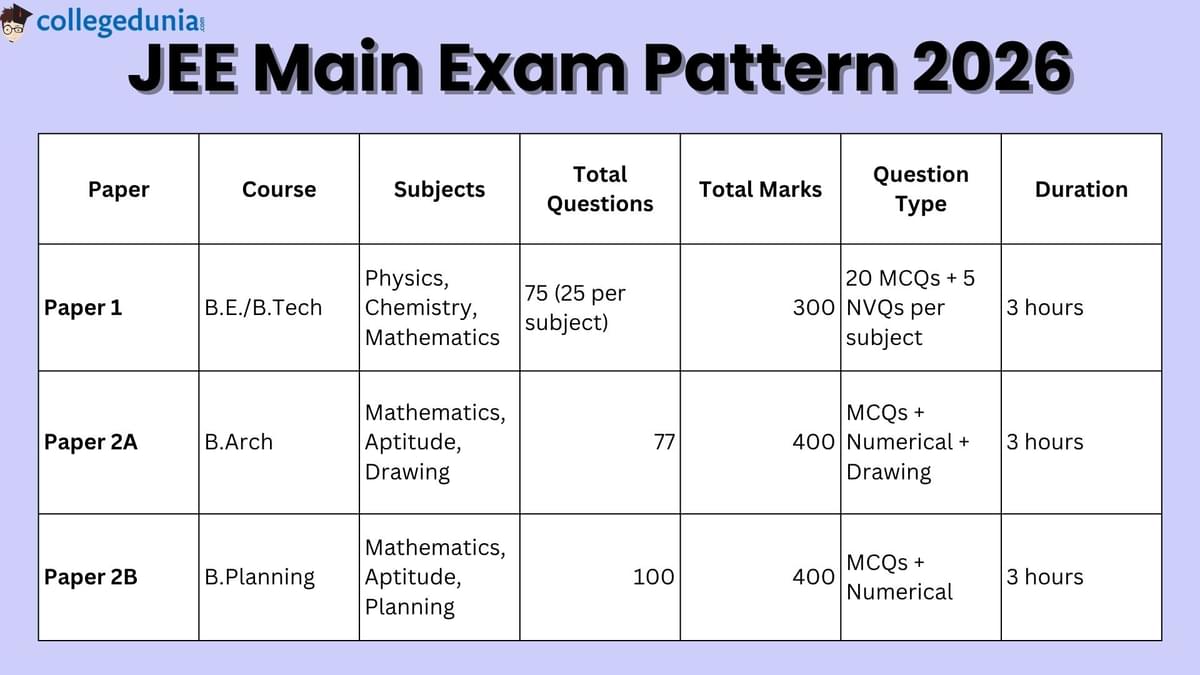
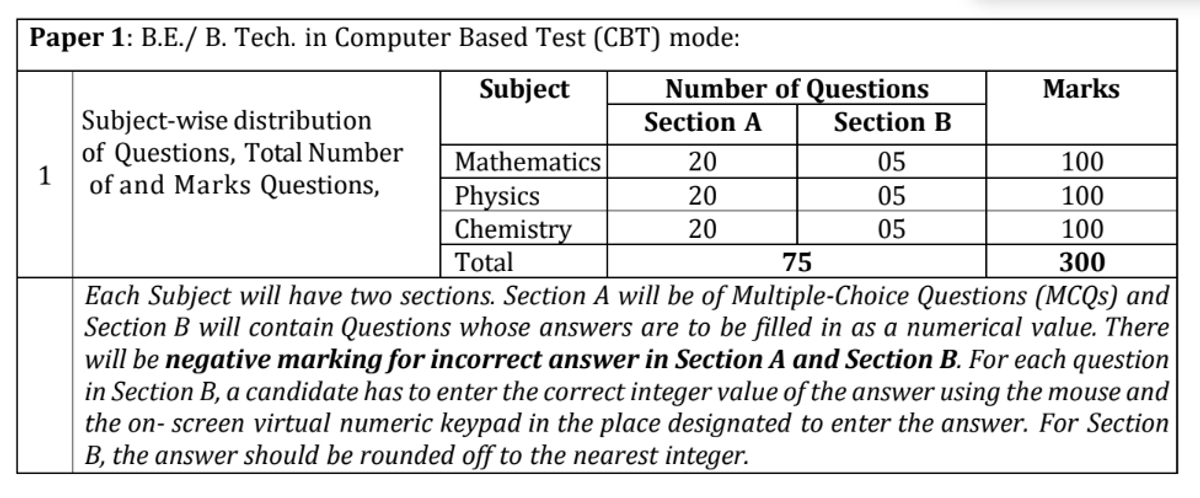
The JEE Main 2026 Exam Pattern has been released on the official website along with the information brochure. The JEE Main Exam Pattern 2026 is the same as the previous year, including 75 questions, 25 in each subject Physics, Chemistry and Mathematics for Paper 1 (B.E./B.Tech).

  • JEE Main Exam Pattern for BE/BTech- 25 questions will be asked from each section, including Physics, Chemistry, and Mathematics. 20 questions will be MCQs, and 5 questions will be numerical value-based from each section.
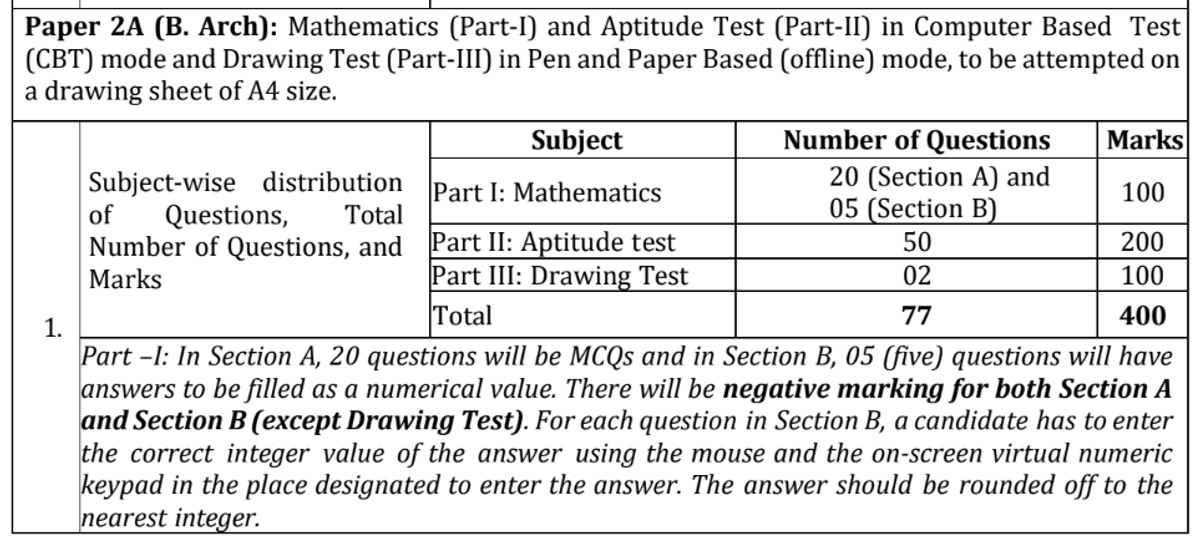
  • JEE Main Exam Pattern for BArch- A total of 77 questions will be asked in JEE Main BArch (Paper 2A). 25 Questions will be from Mathematics, 50 questions from Aptitude, and 2 questions from drawing.
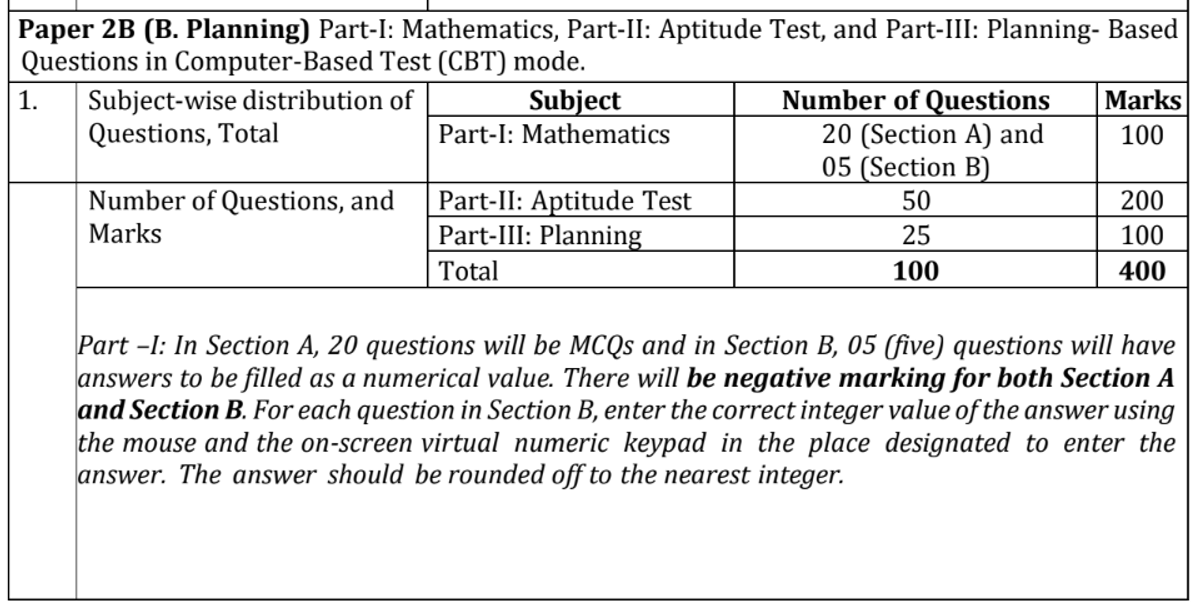
  • JEE Main Exam Pattern for BPlan- A total of 100 questions will be asked in JEE Main BPlan (Paper 2B). 25 questions will be from Mathematics, 50 questions from Aptitude Test, and 25 from Planning.
  • According to the JEE Main Exam Pattern for Paper 1, each subject will include 20 MCQs and 5 NVQs, ensuring a balanced exam across all subjects.
Download JEE Main Exam Pattern PDF 2026

The NTA has revised the JEE Main Exam Pattern for Section B. In Section B, Numerical value-based questions have been reduced from 10 to 5, and all 5 questions are compulsory.

The JEE Main Difficulty level is expected to be the same as the NCERT, which will focus on conceptual clarity and application concepts, rather than rote learning.

Also Read

  • JEE Main Syllabus 2026
  • Is a calculator allowed in JEE Main 2026?

What is the JEE Main Exam Pattern 2026?

The JEE Main Exam Pattern will follow the same structure as the previous year. The JEE Main will include Paper 1 for B.E./ B.Tech. and Paper 2A/2B for B.Arch and B.Planning.

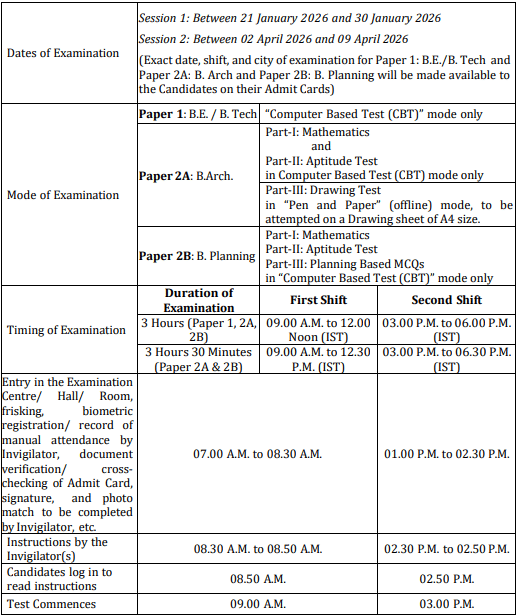
  • The JEE Main Exam will be held in a CBT Mode for a duration of 3 hours.
  • Each subject will have the same weightage, with negative marking in both MCQs and NVQs.

JEE Main Exam Pattern: Overview

Particulars Details
Exam Name Joint Entrance Examination (JEE) Main 2026
Conducting Body National Testing Agency (NTA)
Exam Mode Online (Computer-Based Test) – Drawing in Paper 2A: Pen-Paper
Papers Paper 1 (B.E./B.Tech), Paper 2A (B.Arch), Paper 2B (B.Planning)
Medium of Exam 13 languages: English, Hindi, Gujarati, Bengali, Tamil, Telugu, Kannada, Marathi, Malayalam, Odia, Punjabi, Assamese, Urdu
Duration 3 hours (180 minutes) – 3.5 hours for combined papers
Type of Questions Multiple Choice Questions (MCQs) + Numerical Value Questions
Total Marks
  • Paper 1: 300 marks
  • Paper 2A: 400 marks
  • Paper 2B: 400 marks
Subjects
  • Paper 1: Physics, Chemistry, Mathematics
  • Paper 2A: Mathematics, Aptitude, Drawing
  • Paper 2B: Mathematics, Aptitude, Planning
Marking Scheme +4 for correct answer & -1 for incorrect MCQ and Numerical Value-based Questions
Total Questions
  • Paper 1: 75 Questions
  • Paper 2A: 77 Questions
  • Paper 2B: 100 Questions
Eligibility Passed or appearing in Class 12 with Physics, Chemistry, and Mathematics
Exam Frequency Twice a year (Session 1: January, Session 2: April)
JEE Main Pattern

Ques. Is JEE Main 2026 Going to Be Tough?

Ans. The JEE Main Difficulty level is expected to be moderate to difficult, the same as the previous year.

As per the expert analysis, Physics includes conceptual and numerical questions, whereas Maths remains lengthy.

Year Overall Difficulty Physics Chemistry Mathematics Key Observation
2024 Moderate Moderate Easy-Moderate Lengthy NCERT-based Chemistry dominated
2025 Moderate to Difficult Moderate Moderate Difficult High weightage to Calculus & Mechanics
2026 (Expected) Moderate to Slightly High Conceptual Balanced Lengthy More application-based questions are likely

Ques. Which IIT Made JEE Main 2026 Paper?

Ans. Unlike JEE Advanced, JEE Main is conducted by NTA, not by IIT. However, the JEE Main Exam is created by experienced educators and subject experts who follow the NTA Pattern.

Exam Conducting Body Paper Prepared By Mode of Exam Notable Change
JEE Main 2026 National Testing Agency (NTA) Expert panel of educators Computer-Based Test (CBT) Increased focus on analytical reasoning
JEE Advanced 2026 IIT Madras IIT Faculty CBT Conceptual & multi-step reasoning focus

Also Read

  • Best books to prepare for JEE Main 2026
  • Easy Chapters in JEE Main Syllabus
JEE Main Exam Pattern

Key Summary

In this Article, we have discussed about JEE Main Exam Pattern 2026, including the Latest updates, Marking Scheme, Weightage, & Syllabus.

  • Changes in JEE Main 2026 Exam Pattern: The JEE Main 2026 exam pattern is expected to follow the same pattern as 2025, returning to the pre-pandemic in CBT mode.
  • The NVQ questions will have negative marking of -1 for each incorrect answer. Paper 1 (B.Tech): 75 questions (25 each in PCM), 300 marks. +4 for correct, −1 for wrong MCQs and NAVs both.
  • Paper 2A (B.Arch): 77 questions (Maths, Aptitude, Drawing), 400 marks.
  • The drawing section (100 marks) has no negative marking. Paper 2B (B.Plan): 100 questions (Maths, Aptitude, Planning), 400 marks. No drawing section. +4/−1 marking for all.
  • Marking Scheme: The NVQ will also have a negative marking of -1 mark for each wrong answer.
  • JEE Main Syllabus: The JEE Main 2026 syllabus will align with the NCERT Class 11-12 curriculum, with no additions or deletions from the 2025 syllabus.

Table of Contents

What Has Changed in the JEE Main 2026 Exam Pattern?

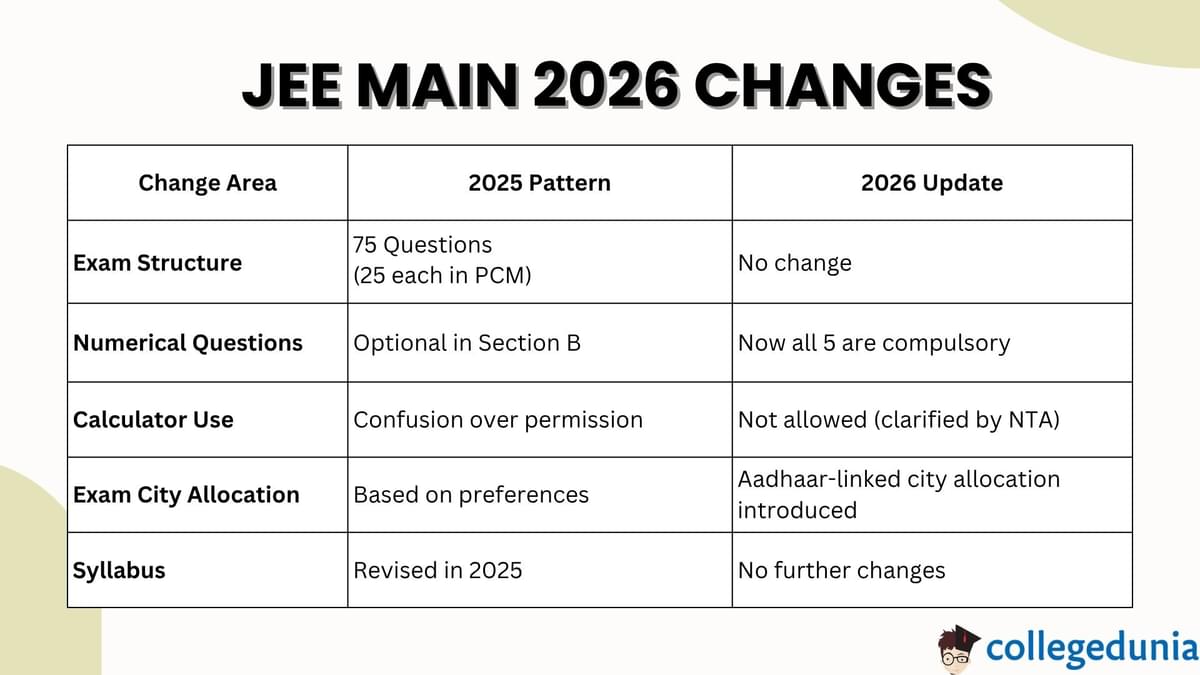
If you are going to appear in JEE Main 2026, you should know that there are no major changes in the JEE Main Exam Pattern. As per the NTA official notification, the structure is the same as the previous year.

As per the Reddit user, there are no expected changes in the syllabus and the exam pattern of JEE Main.

JEE Main Exam Pattern: Then vs Now

  • If you are appearing for JEE Main 2026, you can follow the same mock test format according to the previous year, as the exam will have 75 Total questions of 300 marks and to be completed in a duration of 3 hours.
  • As there were some confusing regarding the use of calculators, NTA has now clarified that no type of calculator will be used in a CBT Mode.
  • The JEE Main Exam cities will be linked as per your Aadhar address, which will reduce random allotments and help you with a centre nearer to your home.
Feature / Change Area JEE Main 2025 JEE Main 2026 Impact
Overall Structure 3 Subjects (Physics, Chemistry, Mathematics); 75 questions total Same structure followed No change — Paper 1 pattern remains stable since 2021
Numerical Value Questions (NVQs) Section B had 10 questions, any 5 to attempt All 5 are now compulsory and with no choice Follows a balanced pattern in all subjects
Calculator Usage Confusion existed due to an NTA typo Not allowed (officially clarified) Ensures equal conditions for all test-takers
Exam Mode Fully Computer-Based except Drawing Test (Paper 2A) Same for 2026 No change — continues hybrid mode for B.Arch
Exam City Allotment Based on city preferences Linked to Aadhaar-based address verification Helps reduce city allocation errors and fraud
Syllabus Revised in 2025 (based on NCERT 2023) No further revision in 2026 Maintains consistency for ongoing aspirants
Marking Scheme
  • +4 / -1 (MCQs)
  • +4 / 0 (NVQs)
Same No change; negative marking continues for MCQs
JEE Main Changes

Ques. Is 75% Criteria Removed from JEE Main 2026?

Ans. No, the 75% criteria has not removed from JEE Mains 2026. It is still applicable for admission into NITs, IIITs and GFTIs, still not mandatory to appear in the exam.

You should score 75% marks (65% for SC/ST) in Class 12 or should be in top 20 percentile of the respective board.

Criteria Type General/OBC SC/ST Applicable For Status in 2026
Minimum Marks in Class 12 75% 65% Admission to NITs, IIITs, GFTIs Applicable
Top 20 Percentile Rule Valid alternative Valid alternative All Categories Accepted
Requirement to Appear in JEE No No All Candidates Not mandatory

Ques. What Are the Most Weightage Chapters for JEE Main 2026?

Ans. In JEE Mains, most weightage chapter are same as 2025, in which Calculus, Thermodynamics, and Coordination Compounds are of high importance.

  • Around 60 to 65% questions are directly NCERT Based.
  • Consistent practice of Numerical and Application-type questions are also important.
Subject High Weightage Chapters Avg. No. of Questions Weightage (%)
Physics Laws of Motion, Current Electricity, Modern Physics 7–8 25–27%
Chemistry Thermodynamics, Organic Reactions, Coordination Compounds 9–10 30–32%
Mathematics Calculus, Coordinate Geometry, Vectors & 3D 10–12 35–38%

Ques.Is Scoring 150 in JEE Main Easy?

Ans. The Score of 150 marks in JEE Mains can be achieved with strong concepts and regular mock test practice.

As per previous year analysis, with 150 marks you can get around 92 to 94 percentile, and can get admission in decent NITs and GFTIs.

Score Range Expected Percentile Difficulty Level Admission Possibility
180+ 98–99+ High Top NITs (CSE/EEE)
150–170 92–94 Moderate Mid-tier NITs, IIITs
120–140 85–88 Easy-Moderate State-level GFTIs, Private Colleges

JEE Main Exam Pattern 2026: Paper-wise

The JEE Main Exam is conducted for 3 Subjects: Paper 1 (B.E./B.Tech), Paper 2A (B.Arch), and Paper 2B (B.Planning). Each paper will follow a pattern according to the course type.

The JEE Main Paper 1 will test candidates in physics, chemistry and mathematics, whereas Paper 2A and 2B will include architectural and planning skills.

JEE Main Paper 1 (B.E./B.Tech) Exam Pattern 2026

  • In JEE Main, around 60 to 65% questions are based on NCERT, which makes conceptual clarity important.
  • The Physics & Mathematics are of moderate to difficult level, whereas Chemistry is more conceptual and scoring.
Section Number of Questions Questions to be Attempted Marks per Question Total Marks
Physics 25 (20 MCQs + 5 Numerical) 25 4 100
Chemistry 25 (20 MCQs + 5 Numerical) 25 4 100
Mathematics 25 (20 MCQs + 5 Numerical) 25 4 100
Total 90 75 300
JEE Main Paper 1 Pattern

Source: jeemain.nta.nic.in

JEE Main Paper 2A (B.Arch) Exam Pattern 2026

  • In JEE Main Paper 2A, the aptitude test carries the highest weightage of around 50% and will test spatial ability and visualisation.
  • In the drawing section, creativity, clarity, and proportion will influence the final score.
  • The Mathematics will be based on Class 11 & 12 NCERT, focusing on geometry and 3D visualisation.
Section Number of Questions Type of Questions Marks per Question Total Marks
Mathematics 25 (20 MCQs + 5 Numerical) Objective & Numerical 4 120
Aptitude Test 50 Objective 4 200
Drawing Test 2 Descriptive 50 100
Total 77 400
JEE Main Paper 2A Pattern

Source: jeemain.nta.nic.in

JEE Main Paper 2B (B.Planning) Exam Pattern 2026

  • In JEE Main, the B.Planning will focus on urban planning, general awareness, and the reasoning section.
  • The Aptitude section is of moderate difficulty level and includes the highest weightage of 200 marks.
Section Number of Questions Type of Questions Marks per Question Total Marks
Mathematics 25 (20 MCQs + 5 Numerical) Objective & Numerical 4 120
Aptitude Test 50 Objective 4 200
Planning-Based Questions 25 Objective 4 100
Total 100 400
JEE Main Paper 2B Pattern

Source: jeemain.nta.nic.in

Ques. How Many Questions Are There in Each Subject of Paper 1?

Ans. In JEE Mains Paper 1, each subject: Physics, Chemistry, and Mathematics includes 25 questions, which makes a total of 75 questions.

  • In each, 20 questions are of MCQs, and 5 are of NVQs.
  • Every question will carry +4 marks and will have a total of 300 marks.
Subject Type of Questions Total Questions Marks per Question Total Marks
Physics 20 MCQs + 5 NVQs 25 4 100
Chemistry 20 MCQs + 5 NVQs 25 4 100
Mathematics 20 MCQs + 5 NVQs 25 4 100
Total 75 300

Ques. Are All Questions Compulsory in JEE Main Paper 1?

Ans. Yes, in JEE Main 2026, every question in each section is compulsory. Earlier, the candidates had internal choices in Numerical-type questions, but according to latest pattern, all 5 NVA questions should be attempted.

Section Question Type Choice Available Status (2026)
Section A MCQs No Compulsory
Section B Numerical Value Questions No Compulsory

Ques. How Is Section A Different from Section B in Each Subject?

Ans. The Section A, focuses on MCQs while testing the conceptual understanding, whereas Section B will include NVQs, which will test the problem-solving and calculation-skills.

Section Type No. of Questions Marking Scheme Negative Marking Skill Tested
Section A MCQs 20 +4 / -1 Yes Conceptual Understanding
Section B NVQs 5 +4 / 0 No Calculation Accuracy

Ques. Can I Skip Numerical-Type Questions in Section B?

Ans. If you are not aware about the answer you can skip them, but it is not advised as all 5 questions are compulsory and have a contribution in total marks.

Section Can You Skip? Negative Marking Marks Lost if Skipped Suggested Strategy
Section B (NVQs) No -1 20 marks per subject Attempt all; no penalty for wrong answers

Ques. How Much Time Should I Spend per Section to Complete the Paper on Time?

Ans. You have 3 hours around 180 minutes to complete the entire article, so management of time is important. You should systematically divide your time among all 3 subjects.

Subject Ideal Time (Minutes) Recommended Strategy Key Focus Area
Physics 55–60 Attempt conceptual MCQs first, then NVQs Speed + Accuracy
Chemistry 50–55 Solve theoretical questions quickly Formula Recall
Mathematics 60–65 Prioritize easy and medium-level problems Logical Flow
Total 180 mins Include 5–10 mins for review Overall Balance

JEE Main Subject-Wise Exam Pattern

JEE Main Physics Pattern
JEE Main Chemistry Pattern
JEE Main Mathematics Pattern

JEE Main Total Questions

JEE Main total questions are different for different papers, like JEE Main Paper 1 BE/BTech, JEE Main Paper 2A BArch, and JEE Main Paper 2B BPlan.

  • As per the JEE Main exam pattern for each paper, JEE Main Paper 1 BE/B.Tech. The total questions is 75.
  • However, for JEE Main Paper 2A, BArch has a total of 77 questions, and JEE Main Paper 2B has a total of 100 questions.
JEE Main Paper Total Questions Total Marks Time Allotted
Paper 1 BE/BTech 75 300 3 hours
Paper 2A BArch 77 400 3.5 hours
Paper 2B BPlan 100 400 3 hours

JEE Main Total Marks 2026

The JEE Main 2026 total marks vary across the different papers, as per the specific requirements.

  • Paper 1 (B.Tech) will be of a total of 300 marks, including 75 questions across Physics, Chemistry, and Mathematics, with 4 marks awarded for each correct answer and -1 will be deducted for each incorrect answer.
  • Paper 2A (B.Arch) will be of 400 marks, with 77 questions, including a drawing section for 100 marks, which will be evaluated separately.
  • Paper 2B (B.Plan) will also be of 400 marks, consisting of 100 MCQs across the Maths(100), Aptitude(200), and Planning(100).
Paper Total Questions Total Marks Question Types
Paper 1 (B.Tech) 75 300 MCQs + Numerical-value questions
Paper 2A (B.Arch) 77 400 MCQs, Numerical (Math/Aptitude), Drawing
Paper 2B (B.Plan) 100 400 MCQs including the Planning section

Also Read

  • Is JEE Mains tough?
  • Strategy to crack JEE Main 2026

Ques. Which Subject Carries the Highest Weightage in JEE Main Paper 1?

Ans. In JEE Main Paper 1, Mathematics carries highest weightage, as it often decides the percentile difference among the candidates. Each subject Physics, chemistry & mathematics are of 100 marks each, but in maths questions are more time-consuming and concept-based.

Subject Total Questions Total Marks Level of Difficulty Effective Impact on Rank
Physics 25 100 Moderate Medium
Chemistry 25 100 Easy–Moderate High (Scoring)
Mathematics 25 100 Moderate–Tough Very High

Ques. What Sections Are Included in the JEE Main B.Arch Paper?

Ans. In JEE Main Paper 2A, 3 sections are included: Mathematics, Aptitude, and Drawing. The JEE Main Exam includes both analytical and and creative skills, unlike Paper 1, which is objective-based.

Section Mode of Exam Total Questions Marks Skill Tested
Mathematics Computer-Based 25 100 Quantitative Aptitude
Aptitude Computer-Based 50 200 Spatial & Visual Reasoning
Drawing Pen-and-Paper 2 100 Creativity & Design Skills
Total Mixed Mode 77 400

Ques. How Many Questions Are Asked in the Drawing Section?

Ans. In the drawing section of JEE Main Paper 2A, 2 descriptive questions will be included carrying 50 marks, for a total of 100 marks. You should attempt all of them on manual basis in the exam.

Number of Questions Marks per Question Total Marks Medium of Attempt
2 50 100 Pen and Paper

Ques. How Much Time Is Allotted for the Drawing Section?

Ans. In JEE Main Paper 2A, the drawing section includes a total of 60 minutes, in 3 hours.

This section will be conducted after CBT Portion, under the supervision of invigilators.

Section Duration Mode Total Marks Ideal Time per Question
Drawing 1 hour Offline 100 30 minutes

Ques. What Type of Questions Are Asked in the Aptitude Section?

Ans. In JEE Main Aptitude Section, B.Arch and B.Planning are included having spatial reasoning, visualization and analytical ability. It includes 50 objective based question of 4 marks each.

Topic Area Type of Question Avg. No. of Questions Weightage (%)
3D Visualization Spatial reasoning & shapes 10–12 25%
Mental Ability Analytical & logical thinking 10–15 30%
Architecture Awareness Historical monuments, design basics 10 20%
Direction & Perspective 2D/3D observation 10–12 25%

What Is the JEE Main 2026 Marking Scheme, Normalisation & Tie-Breaker Process?

The JEE Main Marking Scheme is the same as the previous year. In JEE Main Paper 1 (Physics, Chemistry, and Mathematics), each carries equal weightage, which makes a total of 300 marks.

The JEE Main Exam includes both Multiple Choice Questions (MCQs) and Numerical Value Questions (NVQs), with different marking rules for each.

Aspect Rule
MCQ Correct +4 marks
MCQ Incorrect −1 mark
Numerical Correct +4 marks
Numerically Incorrect 0 (No negative marking)
Unanswered 0 marks
Normalization Percentile-based across multiple sessions (raw marks converted to NTA score)
Tie-Breaker (Paper 1)
  • Higher NTA score in Mathematics
  • Higher NTA score in Physics
  • Higher NTA score in Chemistry
  • Older candidates are given priority

How to Use the JEE Main Exam Pattern for Smart Preparation ?

By Understanding the JEE Main Exam Pattern, you will not only know the marks and questions, its about strategic preparation as well.

The Smart candiates will use the pattern to plan their time, prioritize topics and balance accuracy along with speed.

Using Exam Pattern for Smarter JEE Main Preparation

Strategy Area Data-Based Insight Smart Preparation Tip
Weightage per Subject Each subject (Physics, Chemistry, Math) = 100 marks Allocate equal study hours; don’t over-focus on one subject.
Question Type Mix 60 MCQs + 15 Numerical Questions Practice MCQs for accuracy and NVQs for conceptual clarity.
Negative Marking Impact 1 wrong MCQ = loss of 5 marks (4 + 1 penalty) Attempt only those MCQs you’re 70–80% sure about.
Time Management 180 minutes = 2.4 min per question (approx.) Divide time: 60 min per subject + 15 min buffer for review.
Numerical Section No negative marking Attempt all numerical questions, without any risk of marks deduction.
Exam Simulation 2 shifts × 3 hrs each (in CBT mode) Practice full-length online mocks to improve screen speed.
Consistency Factor 75 total questions (fixed format since 2021) Use previous year papers to analyze recurring question patterns.

JEE Main 2026 Syllabus: What Should You Focus On?

If you are focusing on JEE Main Syllabus 2026, you should now that no major changes are there in JEE Main Syllabus.

  • The NTA has kept the JEE Main Syllabus same as 2025, including the revised format for NCERT Class 11 & 12.
  • The JEE Main Syllabus will test your understanding for fundamental concepts of Physics, chemistry and mathematics for paper-1, and Aptitude, Drawing, and Planning topics for Paper 2A and 2B.

You can check the JEE Main official syllabus from the link given below:

Also Read

  • JEE Main Physics Syllabus
  • JEE Main Chemistry Syllabus
  • JEE Main Mathematics Syllabus

Ques. Which Paper Should I Choose — B.Arch or B.Planning?

Ans. Your choice will depend upon your career interest, B.Arch for architecture and design, B.Planning for city and regional planning. Both requires different skills and focuses on exam pattern.

Course Core Focus Key Sections Skill Type Suitable For
B.Arch (Paper 2A) Architecture & Design Math, Aptitude, Drawing Creative + Analytical Students with drawing skills
B.Planning (Paper 2B) Urban & City Planning Math, Aptitude, Planning Analytical + Logical Students with planning interest

Ques. Can I Appear for Both Paper 1 and Paper 2 in the Same Session?

Ans. Yes, you can appear in both paper 1 (B.E./B.Tech) and paper 2 (B.Arch/B.Planning) in the same sessions.

Whereas, you have to select this option, while filling the JEE Main Application form 2026 and pay the required fees.

Paper Combination Permitted in Same Session Additional Fee Required Total Duration
Paper 1 + Paper 2A Yes Yes 3 hrs (CBT) + 1 hr (Drawing)
Paper 1 + Paper 2B Yes Yes 3 hrs (Combined CBT)
Paper 2A + 2B Yes Yes 3 hrs each (Same Day/Slot)

How Is the Difficulty Level Different Across Paper 1, 2A, and 2B?

Ans. The JEE Main difficulty level will different for each 3 papers due to their focus areas as technical creative and analytical skills. The JEE Main Paper 1 (B.E./B.Tech) is more conceptual based, whereas Paper 2A and 2B requires visual and spatial understanding.

Paper Course Main Skill Tested Difficulty Level Ideal Preparation Focus
Paper 1 B.E./B.Tech Conceptual problem-solving Moderate–High NCERT + Practice PYQs
Paper 2A B.Arch Creativity & Drawing Moderate Sketching + Aptitude
Paper 2B B.Planning Analytical reasoning Easy–Moderate Logical + Quantitative Ability

JEE Main Previous Year Question Papers

Here are the JEE Main previous years' question papers in PDF to download. The candidates can assess the pre- and post-pandemic pattern of the JEE Main exam.

Year Question Paper PDF
2023 JEE Main 2023 Question Paper PDF
2022 JEE Main 2022 Question Paper PDF
2021 JEE Main 2021 Question Paper PDF
2020 JEE Main 2020 Question Paper PDF
2019 JEE Main 2019 Question Paper PDF
2018 JEE Main 2018 Question Paper PDF
2017 JEE Main 2017 Question Paper PDF
2016 JEE Main 2016 Question Paper PDF

JEE Main 2025 Session 1 Question Papers with Solution PDF

JEE Main 2025 Exam Date JEE Main 2025 Question Paper JEE Main 2025 Solution PDF
JEE Main 2025 Jan 22 Shift 1 Question Paper Download PDF Check Solutions
JEE Main 2025 Jan 22 Shift 2 Question Paper Download PDF Check Solutions
JEE Main 2025 Jan 23 Shift 1 Question Paper Download PDF Check Solutions
JEE Main 2025 Jan 23 Shift 2 Question Paper Download PDF Check Solutions
JEE Main 2025 Jan 24 Shift 1 Question Paper Download PDF Check Solutions
JEE Main 2025 Jan 24 Shift 2 Question Paper Download PDF Check Solutions
JEE Main 2025 Jan 28 Shift 1 Question Paper Download PDF Check Solutions
JEE Main 2025 Jan 28 Shift 2 Question Paper Download PDF Check Solutions
JEE Main 2025 Jan 29 Shift 1 Question Paper Download PDF Check Solutions
JEE Main 2025 Jan 29 Shift 2 Question Paper Download PDF Check Solutions
JEE Main 2025 Jan 30 Shift 1 B.Arch Question Paper Download PDF Check Solutions

JEE Main 2025 Session 2 Question Papers with Solution PDF

JEE Main 2025 Paper/ Subject JEE Main 2025 Question Paper JEE Main 2025 Solution PDF
JEE Main 2025 April 2 Shift 1 Question Paper Download PDF Check Solutions
JEE Main 2025 April 2 Shift 2 Question Paper Download PDF Check Solutions
JEE Main 2025 April 3 Shift 1 Question Paper Download PDF Check Solutions
JEE Main 2025 April 3 Shift 2 Question Paper Download PDF Check Solutions
JEE Main 2025 April 4 Shift 1 Question Paper Download PDF Check Solutions
JEE Main 2025 April 4 Shift 2 Question Paper Download PDF Check Solutions
JEE Main 2025 April 7 Shift 1 Question Paper Download PDF Check Solutions
JEE Main 2025 April 7 Shift 2 Question Paper Download PDF Check Solutions
JEE Main 2025 April 8 Shift 2 Question Paper Download PDF Check Solutions
JEE Main 2025 April 9 B.Arch Question Paper Download PDF Check Solutions
JEE Main 2025 April 9 B.Planning Question Paper Download PDF Check Solutions
JEE Main 2025 April 9 B.Arch & B.Planning Question Paper Download PDF Check Solutions

Also Read

JEE Main Previous Year Question Paper

JEE Main PYQs- Download Most Asked JEE Main PYPs

Organic Chemistry JEE Main PYQs Inorganic Chemistry JEE Main PYQs
Vectors JEE Main PYQs Kinematics JEE Main PYQs
Isomerism JEE Main PYQs Laws of Motion JEE Main PYQs
Mole Concept JEE Main PYQs Quadratic Equations JEE Main PYQs
Electric Charges and Fields JEE Main PYQs Work, Power and Energy JEE Main PYQs
Electron Displacement Effects JEE Main PYQs D and F Block Elements JEE Main PYQs
Thermodynamics JEE Main PYQs Electrochemistry CBSE Class 12 PYQs
Center of Mass JEE Main PYQs Units, Dimensions and Measurments JEE Main PYQs

JEE Main Exam Pattern Previous Years Analysis (2025-2022)

The JEE Main Exam pattern from 2026 to 2020 shows a significant change throughout the years.

  • In JEE Main 2020, the NVQ-type questions were introduced, where candidates had the option to attempt 5 questions out of 10 NVQs with no negative marking.
  • JEE Main 2021 - 2024 followed the same pattern as 2020 (post-pandemic pattern).
  • However, in JEE Main 2025, the NTA removed Section B, where all 5 NVQs were compulsory to attempt, with negative marking introduced for them, aligning with the MCQ marking scheme (+4 for correct, -1 for wrong).
  • The JEE Main 2026 is expected to follow the same exam pattern as JEE Main 2025, with 75 questions from Physics, Chemistry, and Mathematics (PCM), including 20 MCQs and 5 compulsory NVQs, all marked +4 / -1.
Year Total Marks Total Questions Subjects MCQs/NVQs Marking Scheme
2026 (Expected) 300 75 (25 × 3) PCM 20 MCQs + 5 NVQs (5 compulsory) +4 / –1 for all questions
2025 300 75 (25 × 3) PCM 20 MCQs + 5 NVQs (no choice, all 5 mandatory) +4 / –1 for both MCQs & NVQs
2024 300 90 (30 × 3) PCM 20 MCQs + 10 NVQs (attempt 5) +4 / –1 (MCQ only); NVQs: no negative marking
2023 300 90 (30 × 3) PCM 20 MCQs + 10 NVQs (attempt 5) +4 / –1 (MCQ only); NVQs: no negative marking
2022 300 90 (30 × 3) PCM 20 MCQs + 10 NVQs (attempt 5) +4 / –1 (MCQ only); NVQs: no negative marking
2021 300 90 (30 × 3) PCM 20 MCQs + 10 NVQs (attempt 5) +4 / –1 (MCQ only); NVQs: no negative marking
2020 300 75 (25 × 3) PCM 20 MCQs + 5 NVQs (optional: 5 out of 10) +4 / –1 (MCQ only); NVQs: no negative marking

JEE Main Exam Pattern FAQs

Ques. Is JEE Mains of 300 or 360 marks?

Ans. For JEE Main (B.E/B.Tech), the total marks are 300 marks, consisting of 75 questions (25 each in Physics, Chemistry, Mathematics), with each question worth 4 marks, and a deduction of 1 mark for each incorrect answer

Exam/Component Total Marks Qs per Subject Marking Scheme
JEE Main – Paper 1 300 25 (20 MCQs + 5 NVQs) +4 / –1
JEE Main – Paper 2A / 2B 400 77 (Arch), 100 (Planning) +4 / –1 (except Drawing)
JEE Advanced (2 papers) 360 Subjective, Tougher

Ques. What is the pass mark in JEE Main?

Ans. In JEE Main, there are no fixed “pass marks” in terms of percentage or marks to take the JEE Main exam, but the candidates need a qualifying cutoff percentile for the JEE Main Counselling and for JEE Advanced.

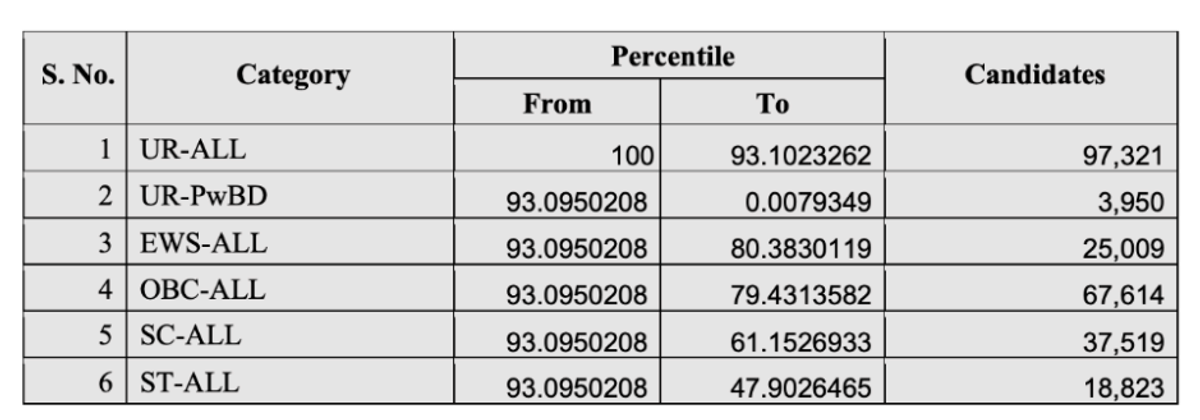
JEE Main 2025 Qualifying Cut-Off (for JEE Advanced eligibility)

Category Cut-Off Percentile
General (UR) 93.1023
Gen-EWS 80.3830
OBC‑NCL 79.4314
SC 61.1527
ST 47.9026
UR‑PwD ~0.0079

Ques. How much marks is 75 in JEE Mains?

Ans. According to the JEE Main 2020 marks vs percentile, scoring 75 out of 300 marks is expected to get a percentile ranging between 84 and 91, based on the difficulty of shift and the normalization process.

Percentile Around 75 Marks:

  • Range: ~84.6 to 91.8 percentile
  • Typical percentile estimate: ~87 to 90 percentile

75 marks in JEE Main are relatively below average, placing students ahead of roughly 75-90% of candidates but not competitive for top institutes like IITs, NITs, or IIITs.

Top Colleges with 75 Marks in JEE Main

College Name Location Type Courses Offered Expected Cutoff (Percentile)
Maharishi Markandeshwar University Ambala, Haryana Private CSE, ECE, Civil, Mech 70–85
SAGE University Indore, MP Private CSE, IT, Civil 70–80
Arya College of Engineering Jaipur, Rajasthan Private ECE, CSE, Mech, Civil 70–80
Symbiosis Institute of Technology Indore, MP Private CSE, IT, ECE 75–85
GITAM (Deemed to be University) Visakhapatnam/Hyderabad Private B.Tech (all major branches) 75–85
Quantum University Roorkee, Uttarakhand Private CSE, ECE, Mech 70–80
NIT Hamirpur (Home State Quota only) Himachal Pradesh Government Bio-Tech, Material Science ~90+ (Rank ~1 Lakh)
NIT Meghalaya (HS/ST quota possibilities) Shillong, Meghalaya Government EEE, Civil (HS quota) ~88–90+
NIT Goa (HS quota) Goa Government Mechanical, Mining ~88–91+

Ques. Is JEE Mains of 300 marks?

Ans. Maximum marks are different for each paper of JEE Main 2026. For BE/BTech paper, the maximum marks are 300. For JEE Main BArch, the total marks are 308, and for JEE Main B.Planning, the total marks are 400.

JEE Main Paper JEE Main Total Questions Marks for Each Question JEE Main Total Marks
BE/BTech (Paper 1) 75 4 300
BArch (Paper 2A) 77 4 308
BPlan (Paper 2B) 100 4 400

Ques. Are there 75 questions in the JEE Mains?

Ans. Yes, for the JEE Main BE/BTech paper, the total number of questions is 75. However, for papers like BArch and BPlan, the total questions asked in JEE Main 2026 is 77 and 100, respectively.

JEE Main Paper JEE Main Total Questions
BE/BTech (Paper 1) 75
BArch (Paper 2A) 77
BPlan (Paper 2B) 100

Ques. What is paper 1 and paper 2 in JEE Mains?

Ans. Paper 1 and Paper 2 indicate different papers for different courses. Paper 1 in JEE Main 2026 is conducted for BE/B.Tech programs offered by various participating institutes. However, Paper 2 is divided into two papers, including Paper 2A and Paper 2B with Paper 2A for BArch courses and Paper 2B for B Plan programs.

JEE Main Papers JEE Main Courses
JEE Main Paper 1 BE/BTech
JEE Main Paper 2A BArch
JEE Main Paper 2B BPlan

Ques. What is the paper pattern of JEE Mains?

Ans. NTA releases the JEE Main paper pattern on the official website at jeemain.nta.nic.in. As per the JEE Main exam pattern published by NTA, there will be a total of 75 marks in JEE Main Paper 1 BE/B.Tech, 77 questions in JEE Main Paper 2 A BArch, and 100 questions in Paper 2 B B Planning.

  • JEE Main exam pattern for Paper 1 BE/BTech indicates the exam to be conducted for a total of 300 marks, with 100 marks (25 questions) each from Physics, Chemistry, and Mathematics.
  • JEE Main exam pattern for Paper 2 BArch indicates the exam to be conducted for a total of 400 marks, with 25 questions from Mathematics, 50 questions from Aptitude, and 2 questions from Drawing.
  • JEE Main exam pattern for Paper 1 BPlan indicates the exam to be conducted for a total of 400 marks with 25 questions from Mathematics, 50 questions from Aptitude, and 25 questions from Planning.
  • For each MCQ and Numerical Value-Based question, 4 marks will be awarded, and -1 mark will be deducted for each incorrect answer.
  • Drawing questions asked in JEE Main Paper 2A BArch will carry a total of 100 marks, with 50 marks in each question.

Ques. Is JEE Mains paper hard?

Ans. Yes, JEE Main paper is considered among the difficult examinations conducted across the country. JEE Main qu

Syllabus

JEE Main Previous Year Question Paper including JEE Main last year paper are provided in the article below. You can free download pdf along with solutions and tricks.
JEE Main 2026 Question Paper Available

JEE Main 2026 Question Paper with Solution PDF (Session 2)

JEE Main 2026 Session 2 Question Paper PDF Solution PDF
JEE Main April 2 Shift 1 Download Pdf View Solutions
JEE Main April 2 Shift 2 Download Pdf View Solutions
JEE Main April 4 Shift 1 Download Pdf View Solutions
JEE Main April 4 Shift 2 Download Pdf View Solutions
JEE Main April 5 Shift 1 Download Pdf View Solutions
JEE Main April 5 Shift 2 Download Pdf View Solutions
JEE Main April 6 Shift 1 Download Pdf View Solutions
JEE Main April 6 Shift 2 Download Pdf View Solutions
JEE Main April 8 Shift 2 Download Pdf View Solutions
JEE Main 2026 B.Arch Download Pdf View Solutions
JEE Main 2026 B.Planning Download Pdf View Solutions
JEE Main 2026 B.Arch and B.Planning Download Pdf View Solutions

JEE Main 2026 Question Paper (Available)

JEE Main 2026 Question Paper Question Paper Solution PDF
JEE Main 2026 Question Paper (21 Jan Shift 1) Download PDF Check Solutions
JEE Main 2026 Question Paper (21 Jan Shift 2) Download PDF Check Solutions
JEE Main 2026 Question Paper (22 Jan Shift 1) Download PDF Check Solutions
JEE Main 2026 Question Paper (22 Jan Shift 2) Download PDF Check Solutions
JEE Main 2026 Question Paper (23 Jan Shift 1) Download PDF Check Solutions
JEE Main 2026 Question Paper (23 Jan Shift 2) Download PDF Check Solutions
JEE Main 2026 Question Paper (24 Jan Shift 1) Download PDF Check Solutions
JEE Main 2026 Question Paper (24 Jan Shift 2) Download PDF Check Solutions
JEE Main 2026 Question Paper (28 Jan Shift 1) Download PDF Check Solutions
JEE Main 2026 Question Paper (28 Jan Shift 2) Download PDF Check Solutions

JEE Main 2025 Question Paper (Session 1)

JEE Main 2025 Question Paper Question Paper Solution PDF
JEE Main 2025 Question Paper (22 Jan Shift 1) Download PDF Check Solutions
JEE Main 2025 Question Paper (22 Jan Shift 2) Download PDF Check Solutions
JEE Main 2025 Question Paper (23 Jan Shift 1) Download PDF Check Solutions
JEE Main 2025 Question Paper (23 Jan Shift 2) Download PDF Check Solutions
JEE Main 2025 Question Paper (24 Jan Shift 1) Download PDF Check Solutions
JEE Main 2025 Question Paper (24 Jan Shift 2) Download PDF Check Solutions
JEE Main 2025 Question Paper (28 Jan Shift 1) Download PDF Check Solutions
JEE Main 2025 Question Paper (28 Jan Shift 2) Download PDF Check Solutions
JEE Main 2025 Question Paper (29 Jan Shift 1) Download PDF Check Solutions
JEE Main 2025 Question Paper (29 Jan Shift 2) Download PDF Check Solutions

JEE Main 2025 Question Paper (Session 2)

JEE Main 2025 Question Paper Question Paper Solution PDF
JEE Main 2025 Question Paper (2 April Shift 1) Download PDF Check Solutions
JEE Main 2025 Question Paper (2 April Shift 2) Download PDF Check Solutions
JEE Main 2025 Question Paper (3 April Shift 1) Download PDF Check Solutions
JEE Main 2025 Question Paper (3 April Shift 2) Download PDF Check Solutions
JEE Main 2025 Question Paper (4 April Shift 1) Download PDF Check Solutions
JEE Main 2025 Question Paper (4 April Shift 2) Download PDF Check Solutions
JEE Main 2025 Question Paper (7 April Shift 1) Download PDF Check Solutions
JEE Main 2025 Question Paper (7 April Shift 2) Download PDF Check Solutions
JEE Main 2025 Question Paper (8 April Shift 2) Download PDF Check Solutions
JEE Main 2025 Question Paper (2 April Shift 1) Download PDF Check Solutions
JEE Main 2025 Question Paper (2 April Shift 2) Download PDF Check Solutions
JEE Main 2025 Question Paper (3 April Shift 1) Download PDF Check Solutions
JEE Main 2025 Question Paper (3 April Shift 2) Download PDF Check Solutions
JEE Main 2025 Question Paper (4 April Shift 1) Download PDF Check Solutions
JEE Main 2025 Question Paper (4 April Shift 2) Download PDF Check Solutions
JEE Main 2025 Question Paper (7 April Shift 1) Download PDF Check Solutions
JEE Main 2025 Question Paper (7 April Shift 2) Download PDF Check Solutions
JEE Main 2025 Question Paper (8 April Shift 2) Download PDF Check Solutions

JEE Main 2024 Question Paper (Session 1)

JEE Main 2024 Question Paper Question Paper Solution PDF
JEE Main 2024 Question Paper (27 Jan Shift 1) Download PDF Check Solutions
JEE Main 2024 Question Paper (27 Jan Shift 2) Download PDF Check Solutions
JEE Main 2024 Question Paper (29 Jan Shift 1) Download PDF Check Solutions
JEE Main 2024 Question Paper (29 Jan Shift 2) Download PDF Check Solutions
JEE Main 2024 Question Paper (30 Jan Shift 1) Download PDF Check Solutions
JEE Main 2024 Question Paper (30 Jan Shift 2) Download PDF Check Solutions
JEE Main 2024 Question Paper (31 Jan Shift 1) Download PDF Check Solutions
JEE Main 2024 Question Paper (31 Jan Shift 2) Download PDF Check Solutions
JEE Main 2024 Question Paper (1 Feb Shift 1) Download PDF Check Solutions
JEE Main 2024 Question Paper (1 Feb Shift 2) Download PDF Check Solutions

JEE Main 2024 Question Paper (Session 2)

JEE Main 2024 Question Paper Question Paper Solution PDF
JEE Main 2024 Question Paper (4 April Shift 1) Download PDF Check Solutions
JEE Main 2024 Question Paper (4 April Shift 2) Download PDF Check Solutions
JEE Main 2024 Question Paper (5 April Shift 1) Download PDF Check Solutions
JEE Main 2024 Question Paper (5 April Shift 2) Download PDF Check Solutions
JEE Main 2024 Question Paper (6 April Shift 1) Download PDF Check Solutions
JEE Main 2024 Question Paper (6 April Shift 2) Download PDF Check Solutions
JEE Main 2024 Question Paper (8 April Shift 1) Download PDF Check Solutions
JEE Main 2024 Question Paper (8 April Shift 2) Download PDF Check Solutions
JEE Main 2024 Question Paper (9 April Shift 1) Download PDF Check Solutions
JEE Main 2024 Question Paper (9 April Shift 2) Download PDF Check Solutions

JEE Main 2023 Question Paper (Session 1)

JEE Main 2023 Question Paper Question Paper Solution PDF
JEE Main 2023 Question Paper (24 Jan Shift 1) Download PDF Check Solutions
JEE Main 2023 Question Paper (24 Jan Shift 2) Download PDF Check Solutions
JEE Main 2023 Question Paper (25 Jan Shift 1) Download PDF Check Solutions
JEE Main 2023 Question Paper (25 Jan Shift 2) Download PDF Check Solutions
JEE Main 2023 Question Paper (29 Jan Shift 1)

Cut-offs

The JEE Main cutoff for 2026 will be released by the National Testing Agency (NTA), expectedly by April 2026, along with the JEE Main session 2 results.- jeemain.nta.nic.in

The JEE Main cutoff is the minimum percentile required to qualify for JEE Advanced and to be eligible for IITs, NITs, IIITs, and GFTIs via JoSSA Counselling.

  • With over 13 lakh candidates appearing for the JEE Main 2026 session 1, competition has increased compared to the previous years when participation was around 12 lakh, as a result, the cutoff is expected to remain high.
  • For JEE Main 2026, the expected cutoff percentile for the General category is likely to be between 93 to 95 percentile.
  • For the EWS and OBC categories, candidates can expect the cutoff to fall in the range of 80 to 82 percentile.
  • SC and ST category candidates can expect the cutoff to be around 60-63 and 47-50, respectively.

JEE Main 2025 Cutoff as released by NTA Officially.

JEE Main 2025 Cutoff as released by NTA Officially.

Related Links:

  • JEE Main 2026 Rank vs Percentile Predictor
  • JEE Main 2026 Category-wise Cutoff
  • JEE Main College-List Rank Wise
  • List of Colleges Accepting Scores Between 75 to 90 percentile in JEE Main 2026

There are 15 lakh+ seats for B.Tech in different institutes, 24000+ in NITs , 9000+ in IIITs and 10000+ in GFTIs.

JEE Main 2026 Expected Cutoff

Source: Indian Express

Also Check:

  • Toughest Shift of JEE Main 2026
  • JEE Main Result Live Updates

FAQs:

Ques. How many marks are needed for under 10,000 rank in 2026?

Ans. For under 10,000 rank in JEE Main 2026, candidates need to score marks above 195 out of 300. For rank under 5000,candidates need to score between 200-230 out of 300.

Ques. Is the JEE Main 2026 cutoff higher than 2025?

Ans. In JEE Main 2026 paper level was moderate ,similar to that of 2025, but due to higher number of candidates as compared to previous years, cutoff is expected to increase slightly.

What is the JEE Main 2026 cutoff?

The JEE Main Cutoff will be calculated by using normalised percentile, not the raw marks, for balancing the difficulty among various shifts.

  • In JEE Main Qualifying cutoff & Admission cutoff will be different.
  • The qualifying percentile will be used for eligibility for JEE Advanced, whereas the JoSAA Closing ranks will decide the actual admission cutoff.

JoSSA Opening and Closing Ranks

Rounds IITs NITs IIITs GFTIs
Round 1 View PDF View PDF View PDF View PDF
Round 2 View PDF View PDF View PDF View PDF
Round 3 View PDF View PDF View PDF View PDF
Round 4 View PDF View PDF View PDF View PDF
Round 5 View PDF View PDF View PDF View PDF
Round 6 View PDF View PDF View PDF View PDF

*Above PDFs are directly taken from JoSSA’s official website, josaa.nic.in .

FAQs:

Ques. What is a good score in JEE Mains 2026?

Ans. A good JEE Main score is generally above 200 out of 300, with these marks you can expect your percentile between 98 to 99.9 and make easy entry to Top NITs,IIITs and GFTIs.For candidates with lower percentile than 95 there are plenty of options of GFTIs and State Government Colleges.

Ques.Can I get NIT at 95 percentile?

Ans. Yes, with 95 percentile in JEE Mains , you can get into Mid-tier and Newer NITs via JoSSA Counselling. For top branches you can target GFTIs and State Government Colleges with this percentile.

Ques. Is JEE Main 2026 Harder than 2025?

Ans. In 2025,JEE Main exam was moderate,leading to a general qualifying cutoff to 93.1.In the year 2026 session 1, JEE Main exam was of moderate difficulty but number of candidates are expected to be high so expected cutoff will be around 93.5 to 95 percentile.

Also Check:

Safe Score for JEE Main 2026 for the General Category
Safe Score for JEE Main 2026 for the OBC Category
Safe Score for JEE Main 2026 for the ST Category
Safe Score for JEE Main 2026 for the PwD Category

JEE Main Cutoff 2026 category-wise for Top Colleges:

As per previous year analysis,the qualifying cutoff is expected to be high due to high competition as more than 14 lakh candidates are expected to appear in JEE Main 2026 session 1 & session 2 combined.

Using JoSSA counselling officially released data of previous years and @WeWonAcademy ,we have concluded that,

General Cutoff for JEE Main 2026 for Top Colleges

  • The CS and IT branches of Top NITs and IIITs are expected to have a closing rank around 1500 to 5000, which requires a percentile between 99 and 99.7.
  • For ECE and Electrical branches, the expected closing rank lies around 5000 to 28000,which requires a percentile between 96 and 98.8.
  • For Civil,Mechanical and other core branches,the expected closing rank lies around 15000 to 70000,which requires a percentile between 92 and 96.8.
  • Overall a percentile between 92 and 99.8 is a safe score for Top NITs and IIITs.
Branch Expected Closing Rank Expected Percentile
CSE 500-8000 98.8-99.9
IT/AI/CSE Specializations 2000-12000 98.0-99.5
ECE 5000-18000 97.0-98.8
Electrical 8000-28000 96.0-97.8
Mechanical 15000-45000 94.5-96.8
Civil/Other lower branches 30000-70000 92.0-95.4

OBC Cutoff for JEE Main 2026 for Top Colleges

  • For CSE , OBC candidates can expect a closing rank between 4,000 and 18,000, which requires around 97 to 99th percentile.
  • IT/AI and ECE Branches can extend up to 25 to 40k ranks, giving high admission chances for candidates scoring in the 94th to 98th percentile.
  • With the reservation benefits, the admission chances can increase, but still, for top branches 95+ percentile is required.
Branch Expected Closing Rank Expected Percentile
CSE 2000-15000 97.5-99.3
IT/AI/CSE Specializations 5000-20000 96.5-98.5
ECE 10000-35000 95-97.5
Electrical 18000-45000 93.5-96.0
Mechanical 30000-70000 91.0-94.0
Civil/Other lower branches 50000-110000 88.0-92.0

EWS Cutoff for JEE Main 2026 for Top Colleges

  • For CS and IT branches in top NITs and IIITs,the closing ranks will be around 1500 to 15000, which requires a percentile above 97.0.
  • Closing Ranks for lower branches can go up to 85000, which requires a percentile between 89 and 93.
Branch Expected Closing Rank Expected Percentile
CSE 1500-10000 98.5.5-99.6
IT/AI/CSE Specializations 3000-15000 97.5-99
ECE 7000-25000 96-98.5
Electrical 12000-35000 94.5-97.0
Mechanical 20000-55000 92.0-95.5
Civil/Other lower branches 35000-85000 89.0-93.0

SC Cutoff for JEE Main 2026 for Top Colleges

  • For top branches, SC candidates can expect closing ranks up to 90000,which requires a percentile between 89 and 97.
  • For lower branches,closing ranks can exceed up to 250000,which requires a percentile above 75.
Branch Expected Closing Rank Expected Percentile
CSE 10000-45000 94.0-97.0
IT/AI/CSE Specializations 20000-60000 92.0-95.0
ECE 35000-90000 89.0-93.0
Electrical 60000-120000 85.0-90.0
Mechanical 80000-160000 82.0-88.0
Civil/Other lower branches 120000-250000 75.0-85.0

ST Cutoff for JEE Main 2026 for Top Colleges

  • For top branches, candidates need a rank between 25000 and 150000, which suggests the percentile between 80 and 95.
  • For Civil and other core branches closing ranks can extend up to 500,000, making possibility for candidates with 70-80 percentile.
Branch Expected Closing Rank Expected Percentile
CSE 25000-80000 90.0-95.0
IT/AI/CSE Specializations 40000-100000 88.0-92.0
ECE 70000-150000 80.0-88.0
Electrical 100000-200000 75.0-85.0
Mechanical 150000-250000 70.0-80.0
Civil/Other lower branches 200000+ 60.0-75.0

FAQs:

Ques. Are GFTIs(Government-Funded Technical Institutions) easier to get than NITs and IIITs?

Ans. Yes, GFTIs are easier to get than NITs and IIITs because of their low cutoffs.Candidates with percentile above 90 can target top GFTIs for best choice.

Ques. Which is the best among NIT,IIIT and GFTI?

Ans. Among NIT,IIIT and GFTIs, NITs hold the top position due to its amazing placements and reputation.IIITs are best for candidates targeting IT/AI based careers,as they are more learning oriented.

Check:

  • JEE Main 2026 Scorecard Explained
  • JEE Main Seat Matrix

JEE Main Cutoff for Top NITs,IIITs and GFTIs

The JEE Main Cutoff for NITs,IIITs and GFTIs varies institute to institute depending on the seats available and number of candidates appearing for the exam.

The JEE Main Closing Ranks will represent the rank at which the candidates will be admitted last for each category,course and round.

JEE Main 2026 Expected Cutoff for NITs

  • JEE Main Cutoff for NITs are high due to Limited Seats and High Demand.
  • Candidates can take advantage of up to 40% in closing ranks with Home State Quota.

The table shows the JEE Main 2025 Last Round Closing Cutoff for Computer Science and Engineering across Categories at the top NITs.

Institute General(Closing Rank) OBC(Closing Rank) SC(Closing Rank) ST(Closing Rank)
NIT Jalandhar 16325 8919 3454 3795
NIT Jaipur 6013 1922 1369 358
NIT Bhopal 11415 4437 2905 1330
NIT Allahabad 6562 2599 1132 1280
NIT Agartala 75417 - 8718 10738
NIT Arunachal Pradesh 78084 35124 26592 18929
NIT Calicut 8428 2881 4674 655
NIT Delhi 10165 7180 2093 1301
NIT Durgapur 11587 7980 1562 2230
NIT Goa 16198 12567 - 1475

Source: JoSSA Official Website

JEE Main 2025 Cutoff

JEE Main 2026 Expected Cutoff for IIITs

  • The IIITs are preferred by the candidate mostly for Software and AIML-based careers.
  • Seat intake in IIITs are comparatively low which increases its cutoff.
  • With the increasing demand for IT Jobs,cutoffs for IIITs are increasing.

The table below shows the JEE Main 2025 Last Round Closing Cutoff for Computer Science and Engineering across Categories at top IIITs.

Institute General(Closing Rank) OBC(Closing Rank) SC(Closing Rank) ST(Closing Rank)
IIITM Gwalior 9527 3413 2092 933
IIIT Nagpur 29123 11280 7431 3785
IIIT Pune 21029 8439 5646 3128
IIIT Ranchi 38063 14896 9351 4536
IIIT Chittoor 26387 10575 7536 3530
IIIT Kota 27400 11048 7467 3310
IIIT Bhagalpur 44476 16641 10415 5187
IIIT Bhopal 27095 11401 7875 3928
IIIT Guwahati 22739 8583 5708 2799
IIIT Manipur 58080 19787 11300 5495

Source: JoSSA Counselling

JEE Main 2025 Cutoff CSE

JEE Main 2026 Expected Cutoff for GFTIs

  • The GFTIs are more accessible than the NITs and IIITs. The Cutoff can vary as per the location, branch and its reputation.
  • GFTIs are a great option for candidates looking for government-recognised institutions with lower cutoffs than NITs/IIITs.
Top GFTIs Expected Percentile Required (CSE,General)
BIT Mesra 97.5 - 98.5
PEC Chandigarh 97.0 - 98.0
IIEST Shibpur 96.5 - 97.5
Assam University 94.0 - 96.0

FAQs:

Ques. How does competition affect the JEE Main cutoff?

Ans. Higher competition leads to higher cutoff in JEE Mains.For JEE Mains 2026,expected number of candidates are between 14 lakh to 15 lakh, which is higher as compared to previous years.

Ques. How many candidates appeared in JEE Main 2026?

Ans. A total of 13,04,653 candidates appeared for JEE Main Session 1 out of 13,55,293 registered candidates ,as per NTA Official Release. This makes JEE Main 2026 session 1 appearance one of the Highest ever.

You can check the JEE Main Cutoffs for NITs, IIITs and GFTIs, in the tables given below:

JEE Main Cutoff for NITs

NIT Trichy JEE Main Cut off NIT Jaipur JEE Main Cut off
NIT Surathkal JEE Main Cut off NIT Silchar JEE Main Cut off
NIT Rourkela JEE Main Cut off NIT Nagpur JEE Main Cut off
NIT Warangal JEE Main Cut off NIT DurgapurJEE Main Cut off
NIT Calicut JEE Main Cut off NIT Jalandhar JEE Main Cut off

JEE Main Cutoff for IIITs

IIITDM Kancheepuram JEE Main Cut off IIIT Gwalior JEE Main Cut off
IIIT Nagpur JEE Main Cut off IIIT Allahabad JEE Main Cut off
IIIT Pune JEE Main Cut off IIIT Dharwad JEE Main Cut off
IIIT Vadodara JEE Main Cut off IIIT Bhagalpur JEE Main Cut off
IIIT Guwahati JEE Main Cut off IIIT Jabalpur JEE Main Cut off

JEE Main Cutoff for GFTIs

Assam University, Silchar JEE Main Cut Off School of Engineering, Tezpur University JEE Main Cut Off
BIT, Mesra JEE Main Cut Off SPA Bhopal JEE Main Cut Off
Gurukula Kangri, Haridwar JEE Main Cut Off SLIET JEE Main Cut Off
SPA, New Delhi JEE Main Cut Off SPA Vijaywada JEE Main Cut Off
School of Engineering, Tezpur University JEE Main Cut Off Mizoram University JEE Main Cut Off

Also, Check:

  • JEE Main colleges for ranks below 50,000
  • List of Colleges for 50,000 to 75,000 rank in JEE Main

Previous Year JEE Main Cutoff Trends

The Previous years JEE Main Qualifying cutoff will show the change in the competition level since the last few years.

  • The General category cutoff has increased from 88.41 in 2022 to 93 in 2024, which shows high participation and better performance.
  • Since 2024, the cutoff has been stable for all categories.
Year General OBC EWS SC ST PwD
2025 93.10 80.06 79.43 60.09 46.70 0.001
2024 93.24 81.33 79.67 60.09 46.70 0.001
2023 90.78 75.62 73.61 51.98 37.23 0.001
2022 88.41 63.11 67.01 43.08 26.77 0.001

Source: jeemain.nta.nic.in

JEE Main 2026 Marks vs Percentile

The relation between JEE Main Marks and Percentile will help candidates understand their rank. As JEE Main exam is held in different shifts, NTA uses normalisation to determine candidate’s percentile.

  • JEE Main Ranks are based on percentile not raw marks in the exam.
  • Candidates are expected to have different percentiles on the same marks due to varied difficulty in different shifts.
Marks Range (Out of 300) Expected Percentile Range Performance Band
285-300 99.9-100 Top Ranker (AIR <100)
260-284 99.7-99.9 Top 1000 candidates
240-259 99.3-99.69 Excellent
220-239 98.8-99.29 Very Strong
200-219 98.0-98.79 Strong
180-199 96.5-97.99 Above average
160-179 94.0-96.49 Competitive
140-159 91.0-93.99 Average
120-139 87.0-90.99 Below average
100-119 80.0-86.99 Low
Below 100 Below 80 Needs improvement

FAQs:

Ques. JEE Main 2026 Marks vs Rank?

Ans. As per previous years data by NTA,Marks above 200 is expected to give rank under 5000, marks between 190-200, can rank between 5000-12000,marks in range of 170-180 can get rank around 15000 to 25000 and candidates with marks near 150 out of 300 can expect rank of around 40000.

Ques. Marks required for 99 percentile in JEE Main 2026?

Ans. For 99 percentile, candidates need to score 190+ marks out of 300 in JEE Main 2026, though it slightly varies with shifts and normalisation,as per previous years data by NTA,200+ marks is a safe score for 99 percentile irrespective of shifts.

JEE Main 2026 Shift-wise Marks vs Percentile vs Rank

After analysing the difficulty level of each shift in JEE Main 2026 session 1, and @DivineJEE youtube video , we have concluded that the marks required for 99+ percentile is highest in 21 Jan Shift 1 , marks this shift as easiest ,whereas least in 21 Jan Shift 2, makes this shift most difficult among all shifts in session 1.

Percentile 21 Jan Shift 1 21 Jan Shift 2 22 Jan Shift 1 22 Jan Shift 2 23 Jan Shift 1
99.50+ 200 190 193 200 198
99.00-99.49 190 175 177 185 183
98.00-98.99 172 154 158 165 162
97.00-97.99 155 138 142 148 145
96.00-96.99 142 125 128 133 131
95.00-95.99 132 114 117 120 119
94.00-94.99 124 105 107 110 109
93.00-93.99 115 98 99 102 102
92.00-92.99 108 93 93 96 96
91.00-91.99 103 88 89 92 93
90.00-90.99 99 85 86 90 89

Also, Check:

250 Marks In JEE Main Percentile 240 Marks In JEE Main Percentile
220 Marks In JEE Main Percentile 210 Marks In JEE Main Percentile
200 Marks In JEE Main Percentile 190 Marks In JEE Main Percentile
180 Marks In JEE Main Percentile 170 Marks In JEE Main Percentile
160 Marks In JEE Main Percentile 150 Marks In JEE Main Percentile
120 Marks In JEE Main Percentile 100 Marks In JEE Main Percentile
70 Marks In JEE Main Percentile 50 Marks In JEE Main Percentile
40 Marks In JEE Main Percentile 30 Marks In JEE Main Percentile
20 Marks In JEE Main Percentile 10 Marks In JEE Main Percentile

Related Articles:

  • JEE Main 2026 Shift-wise Rank vs Marks
  • Minimum marks required in JEE Main for NITs

FAQs

Ques. What is the Expected JEE Main 2026 cutoff for NIT admission forGeneral category?

Ans. For admissions into NITs , General category candidates should target at least 96.5+ percentile as the admission cutoffs are expected to increase due to high demands of NITs and low seat intake.

Ques. What is the JEE Main cutoff 2026 for PwD category UR-PwD?

Ans. For PwD candidates, in 2025 JEE Main cutoff was as low as 0.007 percentile . A total of 3950 PwD candidates qualified for JEE Advanced in 2025.

Ques. Has the JEE Main cutoff increased in 2026 compared to 2025 for General?

Ans. JEE Main 2026 Cutoffs are not released officially yet, but the cutoff is expected to be high as compared to previous years due to higher number of applicants. For general category , candidates can expect the qualifying cutoff to be around 93-95 percentile.

Results

The JEE Main 2026 Session 1 Result for paper 1 has been released on 16th February 2026, on the official website, jeemain.nta.nic.inThe JEE Main Result has been released in the form of a Scorecard PDF Form as per the revised marks and normalisation.

To check the result, you should log in by using the Application Number and password to download the scorecard PDF.

Along with the JEE Main Result, the NTA has also released the topper list, which includes the state-wise toppers, gender-wise toppers & list of candidates registered and appeared in the exam. 

  • According to the topper list, 12 candidates scored a perfect 100th percentile in the JEE Main 2026 Session 1 B.E./B.Tech Exam.
  • The SHREYAS MISHRA from Delhi, NARENDRABABU GARI MAHITH from Andhra Pradesh & SHUBHAM KUMAR from Bihar are the top scorers for JEE Main 2026. 
  • The JEE Main Scorecard will include the overall and subject-wise NTA Percentiles, total marks, and qualifying status for JoSAA Counselling & Admissions.
  • The Result will include the percentile scores, whereas the AIR and category ranks will be released after session 2.
jee main result

Source: JEE Main Official Website

The Top 2.5 lakh candidates of different categories will qualify for JEE Advanced 2026.

Around 13,00,368 candidates appeared for JEE Main 2026 Session 1, with an attendance rate of 96.24%, competing for 45,000+ seats in NITs, IIITs and GFTIs by JoSAA counselling.

Check:

  • JEE Main Result Live Updates
  • JEE Main Result Login Issues
  • JEE Main Expected Cutoff Category-Wise

Key Summary

In this Article, we have discussed the JEE Main Result 2026, including the Scorecard & AIR.

  • You will not get the JEE Main score card dispatched; you can download it only from the official website.
  • No revaluation/rechecking of JEE Main 2026 results is allowed.
  • All India Rank will be declared after conducting JEE Main 2026 Session 2.
  • For NITs, IIITs, CFTIs, and SFIs, only the All India Rank will be considered for admissions.

What is JEE Main Result 2026?

The JEE Main Result is the official performance record, which is issued by NTA, for calculating candidates' scores across different shifts, by using a percentile-based normalisation formula.

The JEE Main Result has been released on 16th February 2026, in the form of a scorecard, which is used not only for NIT, IIIT and GFTI admissions but also by several state and private universities that accept JEE Main scores for BTech admissions.

Particular Details
Exam name JEE Main 2026
Conducting body National Testing Agency (NTA)
Result mode Online scorecard
Session 1 result date By Feb 16, 2026 (Out)
Final combined result April 2026
Details in the result Subject-wise percentile, overall percentile, and qualifying status
AIR availability After Session 2 only
Login credentials Application number + DOB/Password
Official website jeemain.nta.nic.in
Used for JEE Advanced eligibility & JoSAA admissions

JEE Main Result 2026 Date

The JEE Main Result 2026 will be released by 12th February, including the subject-wise and overall percentile scores.

Event Date (Expected) Details
Final Answer Key Release 16th Feb 2026 (Out) Available on jeemain.nta.nic.in
Session 1 Result Declaration Feb 16, 2026 (OUT) Scorecard with subject-wise & overall percentiles
Session 2 Registration Till Feb 25, 2026 Candidates can register for an improvement attempt
Session 2 Exam Apr 2–9, 2026 Exam for candidates seeking better scores
Final Combined Result Apr 20, 2026 Includes AIR, category-wise cut-offs & JEE Advanced eligibility

Source: JEE Main Information Bulletin

JEE Main Result Dates 2026

Ques. How long after the exam is the JEE Main answer key released?

Ans. The provisional answer key for the JEE Main exam is released approximately 3–4 days after the exam, followed by a 2–3 day objection window. The final answer key is then published shortly before the JEE Main result declaration.

Ques. How to check the JEE Main result if I forgot my password?

Ans. In case you forgot your password for JEE Main 2026, you can retrieve the password and check your result. You can follow the steps listed below to retrieve your password.

  • On the login page, click on the “Forgot Password” link.
  • Select one of the options available to reset your password.
  • Reset your password and go to the login page again.
  • Enter and submit your credentials, and the result will be displayed on the screen.

How to Check JEE Main Result 2026

As the JEE Main result is released, you can check your JEE Main result at jeemain.nta.nic.in. You can follow the steps listed below to check the JEE Main result 2026.

  • Visit the official JEE Main 2026 website.
  • On the official website, click on the JEE Main result link.
  • A login page will open, and you must enter Application Number, Password, and Security Pin.
  • Once you click on the Login tab, the JEE Main result will be displayed on the screen.
  • You can take a printout of the JEE Main result for future reference.

JEE Main Result 2026: Score Card

NTA releases JEE Main result in the form of JEE Main scorecard. You can use the JEE Main scorecard document for admission to various NITs, IIITs, and GFTIs. Details mentioned on JEE Main scorecard are listed below.

  • JEE Main scorecard includes your personal details, such as candidate name, application/roll number, state of eligibility, category, and nationality.
  • It includes your JEE Main subject-wise scores and the total scores for Session 1 and Session 2.
  • It also mentions your JEE Main rank based on your scores.
JEE Main Scorecard

Ques. How many candidates appeared in JEE Main 2026 Session 1?

Ans. In JEE Main 2026 Session 1, the highest number of candidates appeared and registered for Session 1. With the help of the number of candidates who appeared, you can have an estimation of the competition level and percentile-to-rank trends for admissions.

Particular Data (Approx.)
Candidates registered (Session 1) 13.5 lakh
Candidates appeared 13,00,368
Attendance rate 96.26%
Seats via JoSAA (NIT+IIIT+GFTI) 45,000+

Ques. How to check category-wise cutoff in JEE Main 2026 results?

Ans. The JEE Main Category-wise cutoff will determine the eligibility for JEE Advanced 2026 and this will vary each year as per the difficulty level and candidate’s performance. It is released along with the final combined result after Session 2 on the EE Main 2026 result PDF/notice.

JEE Main Expected Cutoff (Advanced Eligibility)

Category Expected Percentile
General 90–93
OBC-NCL 73–82
EWS 70–78
SC 45–55
ST 40–50

Ques. Can I use my JEE Main score card 2026 for admission in next academic year?

Ans. No, JEE Main score cards are valid only for admission in same academic session. You can not use JEE Main scorecard for admission to the next academic session.

JEE Main Result 2026: Score Calculation

JEE Main 2026 raw scores are calculated based on the JEE Main exam pattern. JEE Main raw score is converted into percentile scores after applying normalization.

  • After calculating raw scores, normalization is applied to ensure fairness across various JEE Main shifts.
  • After the normalization process, JEE Main percentile scores are calculated based on which the JEE Main rank is decided.

JEE Main Raw Score Calculation

JEE Main raw score is calculated based on JEE Main marking scheme as discussed below.

  • For each correct answer, you will get 4 marks.
  • For each incorrect answer, you will get -1 mark deducted from your overall score.
  • No negative marking is applicable for unattempted questions.
JEE Main Raw Score Calculation

Source:@jeemain.nta.nic.in

Subject-wise JEE Main score calculation is mentioned in the table below.

Section Total Questions Marks per Question Negative Marking Maximum Marks
Physics 25 +4 –1 100
Chemistry 25 +4 –1 100
Mathematics 25 +4 –1 100
Total 75 +4 –1 300

Source:@jeemain.nta.nic.in

JEE Main Normalization and Percentile Calculation

NTA conducts JEE Main 2026 in different shifts of varying difficulty levels. Due to this, some candidates may end up attempting a relatively tougher set of questions as compared to other shifts. Such candidates are likely to get lower marks than other candidates.

  • To ensure fairness across shifts of varying difficulty levels, a normalization procedure based on the percentile score will be applied.
  • Raw score is converted into a percentile score ranging from 100 to 0, indicating Shift-wise relative performance of candidates.
  • It indicates the percentage of candidates scoring scored EQUAL TO OR BELOW a particular candidate in that shift.

JEE Main 2026 percentile score is calculated using the following formula.

Percentile = 100 x M/N

Where

  • “M” is Number of candidates appeared in the ‘Shift’ with a raw score EQUAL TO OR LESS than the candidate.
  • “N" is the total number of candidates who appeared in the ‘Shift’.
JEE Main Normalization and Percentile Calculation

Source:@jeemain.nta.nic.in

Also Check: Calculate Your Scores using Free MyKollege JEE Main Score Calculator

Ques. Will JEE Main 2026 results show subject-wise percentiles?

Ans. Yes, JEE Main Scorecard will include the candidate’s performance across all subjects.

  • This will help the candidate to identify their strengths and if they want to attempt Session 2 for improvement.
  • Overall percentile is calculated from subject percentiles. The Colleges consider overall percentile/rank, not individual subjects.

Ques. Will JEE Main 2026 results include All India Rank (AIR) or only percentile?

Ans. The JEE Main Session 1 Result includes the percentile scores, the final rank will be released after both the sessions will be conducted. This will ensure fairness by considering the best attempt.

JEE Main Rank availability

Result stage Rank details
Session 1 result Percentile only
Final result (April) AIR + category rank
JEE Advanced eligibility After final result

JEE Main Result Statistics

JEE Main percentile scores depend on the number of candidates appearing for each shift of the examination. Result statistics for JEE Main 2026 are yet to be released. However, you can check JEE Main statistics from the table below.

Particulars Number of Candidates (2026) Number of Candidates (2025)
Total Number of Candidates Qualified To be Updated 2,50,236
Number of Candidates Registered in Session 1 To be Updated 13,11,544
Number of Candidates Appeared in Session 1 To be Updated 12,58,136
Number of Candidates Registered in Session 2 To be Updated 10,61,840
Number of Candidates Appeared in Session 2 To be Updated 9,92,350
Number of Unique Registered Candidates To be Updated 15,39,848
Number of Unique Appeared Candidates To be Updated 14,75,103
JEE Main Result Statistics

Check Here:Number of Students to Appear for JEE Main 2026

JEE Main Result 2026: Marks vs Percentile

“MathonGo” on youtube shared JEE Main marks vs percentile based on an analysis of past years marks vs percentile.

  • 99 percentile score is likely to translate to around 148 to 200 marks.
  • If you score between 127 and 177, your JEE Main percentile score is likely to be 98.
  • 120 marks in JEE Main 2026 are likely to translate to around 97.5 percentile.
  • 93 and 95 percentile scores in JEE Main 2026 are likely to be around 85-127 and 96-142 marks.
JEE Main Result 2026: Marks vs Percentile

What is the expected safe score for 99 percentile in JEE Main?

“Vedantu JEE Made Ejee” tutor Harsh Sir shared an analysis for expected JEE Main safe score for 99 percentile. He performed his analysis considering the total number of candidates as 1444572.

As per Harsh Sir, this year, number of candidates is likely to be 1.5 lakh more than last year. He said, “higher number of candidates means the JEE Main cutoff will rise as the number of seats is fixed (around 2,50,000).”

Year Marks for 99 Percentile (2026) Marks for 99 Percentile (2025) Marks for 99 Percentile (2024) Marks for 99 Percentile (2023)
Overall 160-210 148-200 156-235 155-189
Physics 60-85 64-89 71-87 70-89
Chemistry 70-80 62-76 58-85 46-70
Mathematics 45-60 39-54 35-75 33-55

You can go through the table below to check the expected JEE Main safe score for various categories.

Category JEE Main Safe Score 2026
General Check Here
OBC Check Here
ST Check Here
PwD Check Here

Also Read:

  • What is 240 Marks in JEE Mains Percentile?
  • 250 marks in jee mains percentile
  • 120 marks in jee mains percentile

Ques. What is the exact time for JEE Main Session 1 Result 2026 on Feb 12?

Ans. For JEE Main Result, NTA has confirmed the result date of 12th feb 2026, but the exact time is not released. Candidates should track the official website throughout the day.

Event Time (Tentative)
Final answer key Before result
Result release date Feb 12, 2026
Expected time window Anytime on result day
Scorecard download After link activation

Ques. What are the expected toppers’ marks and percentiles in JEE Main 2026?

Ans. The Score of JEE Main Toppers will show the exam difficulty and help estimate percentile-to-marks trends. In last few years, multiple candidates score a perfect percentile.

Percentile Expected Marks
100 percentile 285–300
99.9 percentile 260–280
99.5 percentile 230–250
99 percentile 200–220

JEE Main Result 2026: Cutoff

JEE Main cutoff 2026 is released by NTA on the official website. Once released, you can check the JEE Main qualifying cutoff 2026 for each category and the total number of candidates who qualified the examination.

JEE Main Cutoff for NITs, and other participating institutes will be released by JoSAA after each round of counselling. “RankBoost - Shubham Kumar” has prepared an analysis of JEE Main 2026 category-wise cutoff on YouTube as discussed below.

  • This year, JEE Main qualifying cutoff 2026 is likely to range from 94-100 for the general category.
  • For EWS and OBC categories, JEE Main qualifying cutoff is likely to range from 81.5-90 and 80-85 percentile respectively.
  • SC candidates can expect 61.5-70 percentile to be the JEE Main qualifying cutoff 2026
  • For ST Candidates, the expected JEE Main cutoff 2026 is 48-65.
Category JEE Main Cutoff 2026
General 94-100
EWS 81.5-90
OBC 80-85
SC 61.5-70
ST 48-65

JEE Main Cutoff 2026 for NITs, IIITs, and GFTIs

You can go through the table below to check the JEE Main 2026 cutoff for NITs, IIITs and GFTIs.

Institute Type JEE Main Cutoff 2026
NITs Check Cutoff Here
IIITs Check Cutoff Here
GFTIs Check Cutoff Here

Check: 

  • JoSAA Opening and Closing Ranks for NITs, IIITs, and GFTIs
  • Detailed Category wise and College Wise JEE Main Cutoff 2026
  • List of Colleges Accepting 90 Percentile in JEE Main
  • Minimum Marks Required for Top NITs in JEE Main

JEE Main Result 2026 FAQs

Ques. What is the tie-breaking rule for JEE 2025?

Ans. In JEE Main 2025, if two or more candidates achieve the same overall JEE Main 2025 score, the tie-breaking policy will prioritize the candidates based on their performance in subjects like maths, physics, chemistry, followed by the accuracy rate.

  • In JEE Main 2025, the NTA removed the Age and number of applications criteria as a tie breaker.

Ques. How many candidates appear for JEE Main 2026?

Ans. Number of JEE Main appeared candidates is yet to be released by NTA. However, it is around 1400000 as per Harsh Sir- Vedantu Tutor.

Ques. What was the last year JEE Main qualifying percentile?

Ans. As per the JEE Main statistics released by NTA, last year JEE Main qualifying marks for general category were 93.1023 percentile. For EWS and OBC, the qualifying percentile were 80.38 and 79.43 percentile respectively.

Ques. What is a safe score for JEE Main 2026?

Ans. A safe score in JEE Main 2026 is considered to be in the range of 170 - 180 marks, placing candidates in the 20,000 - 30,000 rank range with an 85 - 90 percentile. Candidates can apply to the following institutes with this score:

Institute Popular Branches Previous Closing Rank (Approx.)
NIT Agartala Computer Science and Engineering, Electronics 22,000 - 25,000
NIT Arunachal Pradesh Civil Engineering, Mechanical Engineering 24,000 - 28,000
NIT Mizoram Electrical Engineering, Computer Science 26,000 - 30,000
NIT Nagaland Electronics and Communication, Civil Engineering 23,000 - 27,000
NIT Patna Mechanical Engineering, Electrical Engineering 21,000 - 25,000
IIIT Allahabad Information Technology, Electronics 18,000 - 22,000
GFTI BIT Mesra Mechanical Engineering, Civil Engineering 23,000 - 27,000

form-correction

The National Testing Agency (NTA) will open the JEE Main correction window for session 1 on December 1 till December 2 (11:50 PM). If you want to make corrections in your JEE Main application forms, you can do so by logging in with your application number and password at the official website — jeemain.nta.nic.in.

  • You are NOT be allowed to change your mobile number, e-mail address, permanent and present address, emergency contact details, or photograph.
  • Those with defective photographs are required to make the required changes through JEE Main login- Check JEE Main Photosize guidelines

JEE Main correction window will be allowed only for certain details, such as exam city, medium, education qualification, etc.

This year, the authority is allowing applicants to edit their identity details (if Aadhaar was not chosen) and the State Code of Eligibility. An additional fee is to be paid by candidates during JEE Main form correction 2026. The additional fee (wherever required) can be paid through Credit/Debit Card/Net Banking/UPI. The JEE Main examination is scheduled to take place from April 1 to April 8, 2026.

JEE Main Form Correction

Source: jeemain.nta.nic.in/

JEE Main 2026 Form Correction Dates

JEE Main in 2026 will also be held in two phases, and the correction window will also open twice. The first JEE Main session will be held from January 21 to 30, 2026. The next JEE Main session will be held between April 2 and 9, 2026.

Event Dates
JEE Main 2026 Form Correction Window (Session 1) December 1–2, 2025
JEE Main 2026 Form Correction Window (Session 2) February 27–28, 2026 (tentative)
Event Dates
JEE Main 2026 Form Correction Window (Session 1) December 1–2, 2025
JEE Main 2026 Form Correction Window (Session 2) February 27–28, 2026 (tentative)

Related Links

What Details Cannot be corrected in the JEE Main Correction Window?

JEE Main Form Correction Details that cannot be corrected by the candidates during the JEE Main form correction window include:

  • Mobile Number
  • Email Address
  • Permanent Address
  • Correspondence Address
  • Emergency Contact Details
  • Session
  • Photograph

Also Read:

Ques: Can I change my category from general to EWS in JEE Main during counselling?

Ans: No, you cannot change your category from General to EWS during JoSAA counselling; this change must be made during the JEE Main correction window for a later session, provided you have a valid EWS certificate. You must obtain and upload the required EWS certificate during the designated correction window to change your category before the counseling process begins.

Ques: Can I edit my father’s or mother’s occupation and income details in the correction window?

Ans: Yes, NTA generally allows changes to parental occupation, income range, or qualification details. These corrections help ensure accurate documentation for data verification. But you must verify that the updated information matches supporting documents to avoid issues later during counselling.

Ques: What if I make a mistake again after the correction window closes?

Ans: Once the correction window closes, no further changes can be made. Your form will be accepted as it is. So review everything before submitting corrections.

What Details CAN be corrected in the JEE Main 2026 Form?

Details that can be corrected in JEE Main Form Correction have been categorised by NTA in different types.

S.No Actions Fields
1. Candidates shall NOT be allowed to change: – Mobile Number- Email Address- Address (Permanent and Present)- Emergency Contact Details- Session- Photograph of candidate
2. Candidate shall be allowed to change any one of the fields: – Candidate Name or– Father Name or– Mother Name
3. Candidates shall be allowed to change all the fields: – Class 10 / equivalent details- Class 12 / equivalent details
4. Candidates shall be allowed to change examination cities based on their Permanent and Present addresses – Examination City Selection- Medium of the Examination
5. Candidates shall be allowed to change all the fields: – Date of Birth- Gender- Category- Sub-category / PwD- Signature
6. Candidate shall be allowed to add the field: – Paper

JEE Main form correction

Source: jeemain.nta.nic.in/

Already Registered for JEE? Check the Details can be Edited

NTA has specified details that can be corrected during the form correction process for students who also registered during the session 1 JEE Main registration process. You can check the specified details in the section below.

Particular Details
Existing candidates i.e. students who already registered and applied for both Session 1 and Session 2 during the JEE Main 2026 Session 1 registration period Candidates are allowed to edit or modify the following:
  • Course (Paper)
  • Medium of Question Paper
  • State Code of Eligibility
  • Examination Cities as per the available options.
  • Educational qualification details (Class 10 and Class 12)
  • Category
  • Fee Payment (If applicable)
Note: Correction in these fields will be applicable only after payment of an additional fee, if any.
Existing candidates i.e. students who registered and applied for Session 1 but did not apply for Session 2 Candidates are allowed to edit or modify the following:
  • Course (Paper)
  • Medium of Question Paper
  • State Code of Eligibility
  • Examination Cities as per the available options.
  • Educational qualification details (Class 10 and Class 12)
  • Category
  • Fee Payment (If applicable)
Note: Correction in these fields will be applicable only after payment of an additional fee, if any.

Ques: Can I change the exam paper from B.E./B.Tech to B.Arch or B.Plan?

Ans: Yes. You can modify your exam paper choice (B.Tech, B.Arch, B.Plan or combinations). You must pay additional fees if you add more papers.

Ques: How do I know if my correction in the JEE Main form is successfully submitted?

Ans: After submitting corrections, you must download the updated confirmation page. If the changes reflect correctly on the confirmation page and no payment is pending, your correction is considered successful. Keep a screenshot of the final confirmation page for safety.

Ques: What if I uploaded the wrong category certificate before the correction window?

Ans: You can upload the correct or updated category certificate during the form correction period. If the certificate was invalid, outdated, or missing, replace it with a valid version. If not corrected in time, NTA may treat you as an unreserved category candidate during result processing.

JEE Main Form Correction Fee

The JEE Main application correction fee is applicable for certain modifications. Candidates seeking specific changes are advised to note the following scenarios that require an extra charge:

Scenario Required Action
Changing Category Pay an extra fee if changing from a reserved group (SC, ST, Girls, PwD) to a general category (General or OBC-NCL).
Opting for Multiple Papers Pay an extra fee for any additional papers you decide to appear for (e.g., adding B.Arch or B.Planning).
Changing Exam City Preference Pay an additional fee if changing your preferred exam city to one outside of India (a foreign city).

Also Check: NTA Announces New Rule for JEE Main 2026; Mandates CBSE Class 11 Registration Number

JEE Main 2026 Application Form Status

  • To access the form status (or recheck the form), log in using the application number and password.
  • After that, click on the Status tab.
  • The status of JEE Main Application Form 2026 will be mentioned.

Any of the following messages will be displayed on the user’s window:

  • Received – If the application form is successfully submitted
  • Unsuccessful – If the application form is Incomplete/Rejected/Not Submitted
  • Remove Image Discrepancy

Also Check: JEE Main 2026 Category Certificate Format for SC/ST, OBC-NCL, EWS and PwD Guidelines

JEE Main 2026 Form Correction- Photo-size Guidelines

JEE Main 2026 Form Correction- Photo-size Guidelines

Also Check: Mode of Preparation in JEE Main Form 2026

Most Common Mistakes Students Make in JEE Main Correction Window

Mistake How to Fix in the Correction Window Risk if Not Corrected
Blurry/white background photo Upload new photo The application may be rejected
Signature with capital letters or on a blank Upload new running-hand signature Application rejected
Wrong category (filled General instead of OBC/EWS) Change category Lose the reservation benefit
Selected the wrong paper (wanted B.Arch but chose only Paper-1) Add Paper 2A/2B Cannot appear for B.Arch/B.Planning
Wrong exam medium (filled in Hindi instead of English) Change language The question paper is in the wrong language
Typo in the Class 12 roll number or passing year Correct education details Admit card/result issues

JEE Main Correction Window: Safe vs Risky Changes

Based on the student experience from 2023 to 2025, we have provided a table with Safe vs Risky changes or mistakes made.

Change Type Safe? Student Advice
Changing exam center preferences Very Safe 99% students do this, no issues
Uploading a new photo/signature Safe Do it on Day 1, the server is fast
Changing category (with valid cert.) Safe NTA accepts later during counselling
Changing from General to SC/ST Safe You get a refund after the result
Changing from SC/ST to General Risky Have to pay a huge fee, no refund if you change your mind again
Changing gender Risky Only if Aadhaar mismatch; else the application may get flagged

Ideal Timeline to Make JEE Main Application Form Corrections

Day of Correction Window Best Time to Login What to Do
Day 1 (Evening) 7 PM – 11 PM Upload new photo & signature (server fast)
Day 2 (Morning) 9 AM – 12 PM Change centre, paper, category, education details
Day 2 (Afternoon) 2 PM – 5 PM Double-check everything, take a screenshot
Last Day (before 11:50 PM) Before 9 PM Only if an emergency; avoid last-minute payment issues

If you have any queries about JEE Main 2026, you can send an email at ntanationaltestingagency@gmail.com. If a candidate is facing issues in JEE Main 2026 Form Correction, they can ask their doubts via email by mentioning the following details:

  • Name of Candidate
  • Registration ID/Application Number
  • Mistakes made in the Application Form

FAQs related to JEE Main 2026 Form Correction

Ques. Can I correct my online application form for JEE Main 2026?

Ans. Yes, you can make changes to certain details in your online application form of JEE Main 2026. You can check the details that can be changed and that cannot be changed during the JEE Main correction window.

Ques. Can I add more Paper (Paper 1 or Paper 2A or Paper 2B) during JEE Main form correction?

Ans. Yes, you can add more papers during JEE Main 2026 form correction. Along with the addition of the paper you must pay the additional registration fee too for the addition of the paper.

Ques. Is there any fee for JEE Main application form correction?

Ans. NTA may require additional fee payment from candidates who make specific changes to their JEE Main applications. These changes include

  • altering the category from SC/ST/Girls/PwD to General/OBC NCL, or
  • opting for Paper 2 in addition to or instead of Paper 1.

In such cases, candidates must pay the difference between the initial application fee and the revised fee. Since the application fee for reserved categories is lower than the fee for General category students, reserved category candidates may need to pay an additional amount. For other changes in JEE Main application form, no additional fee will be charged.

reservation

JEE Main 2026 reservation criteria have been prescribed in the JEE Main information bulletin 2026 available on the official website at jeemain.nta.nic.in. Reservation criteria for JEE Main are prescribed in accordance with the rules prescribed by the Government of India.

  • Out of the total seats in JEE Main 2026, around 59.5% seats are reserved for categories like OBC, SC, ST, and PWD.
  • Around 40.5% of seats in JEE Main 2026 are available for candidates belonging to the general category.
  • JEE Main reservation criteria reserves 10% seats for EWS, 27% for OBC-NCL, 15% for SC and 7.5% for ST category.
  • JEE Main reservation criteria 2026 apply to seats in NITs, IIITs, and other participating universities and colleges.

Related Articles

JEE MAin Reservation 2026

Key Summary

  • JEE Main reservation has been fixed by NTA as per Government of India Norms with no changes as of November 2025.
  • JEE Main reservation criteria are followed by JoSAA while allocating seats to candidates.
  • Reserved candidates also have access to open seats. EWS candidates can compete for a total of 50% seats, OBC for 67%, SC for 55%, and ST candidates for 48% seats.
  • Apart from lower JEE Main cutoffs, reserved category candidates are also eligible to avail benefits like lower application fee, relaxation in JEE Main eligibility, etc.

JEE Main Reservation 2026: Category Wise

JEE Main reservation is different for different categories as mentioned in the table below.

Category Reservation % Key Notes from Users
GEN-EWS 10% For economically weaker sections (family income < ₹8 lakh); requires valid certificate. Users note it's "not caste-based" but often underutilized due to documentation hurdles.
OBC-NCL 27% Non-creamy layer only; central list required. Cutoffs are lower by ~10-15% compared to General.
SC 15% Includes sub-categorisation; Reddit threads clarify that no seats transfer to General if unfilled.
ST 7.5% Highest cutoff relaxation; X posts highlight "65% Class 12 eligibility vs. 75% for General."
PwD 5% Horizontal quota across categories; >40% disability needed. Benefits include fee waivers and scribe access.
General 50.5% (open) No quota, but anyone can compete here; users complain of "highest competition" despite population share.

JEE Main Reservation for EWS Candidates

For Gen-EWS candidates, the JEE Main reservation percentage is 10% in each course. Only candidates belonging to general category who satisfy the conditions prescribed in OM No. 20013/01/2018-BC-II dated 17 January 2019, issued by the Ministry of Social Justice and Empowerment are eligible for the reservation.

Category Reservation (%)
Gen-EWS (Economically Weaker Section) 10%

JEE Main Reservation for OBC Candidates

Among the reserved categories, OBC-NCL has the highest reservation percentage. JEE Main reservation percentage for OBC candidates is 27%. Students must fulfil the conditions below in order to be considered for the OBC-NCL reservation.

  • As an OBC candidate, you must be listed in the current updated central list of OBCs (http://www.ncbc.ac.in).
  • If you are covered in the state list of OBC candidates but NOT covered in the central list, you are NOT eligible for OBC-NCL reservation.
  • If you belong to Creamy Layer of OBC category, you are not eligible for OBC reservation and you will be treated as general candidate.
Category Reservation
OBC-NCL (Other Backward Classes- Non Creamy Layer) 27%

JEE Main Reservation for SC Candidates

Students belonging to SC category have 15% reserved seats in JEE Main 2026. Such candidates must provide valid category certificate from concerned authority.

Category Reservation
SC (Scheduled Caste) 15%

JEE Main Reservation for ST Candidates

Students belonging to SC category have 15% reserved seats in JEE Main 2026. Such candidates must provide valid category certificate from concerned authority.

Category Reservation
ST (Scheduled Tribe) 15%

JEE Main Reservation for PwD Candidates

Government of India has also prescribed reservation for PwD candidates also. As per the JEE Main information bulletin, 5% seats are reserved for PwD candidates with 40% or more disability from each category. Categories considered for PwD reservation in JEE Main include:

  • Blindness and low vision
  • Deaf and hard of hearing
  • Locomotor disabilities including cerebral palsy, leprosy, dwarfism, acid attack victims, and muscular dystrophy.
  • Autism, intellectual disability, specific learning disability, and mental illness.
  • Multiple disabilities.
  • Other specified disabilities

PwD candidates must provide certificate proving their disability from multi member authority including:

  • Chief Medical officer/Civil Surgeon /Chief District Medical Officer, Chairperson
  • Orthopaedic/PMR specialist
  • Neurologist, if available*
  • Clinical Psychologist/Rehabilitation Psychologist/ Psychiatrist/Special Educator
  • Occupational therapist, if available*
  • Any other expert based on the condition of the candidate as may be nominated by the Chairperson.
Category Reservation
PwD (Person with Disabilities) 5%
JEE Main Reservation 2026

Source: @jeemain.nta.nic.in

JEE Main Reservation 2026: Facility of Scribe/Reader/Lab Assistant

  • The facility of Scribe/Reader/Lab Assistant should be allowed to any person with benchmark disability and has limitations in writing including that of speed, if wanted by him/her.
  • In case of persons with benchmark disabilities in the category of blindness, Locomotor disability (both arm affected-BA) and cerebral palsy, the facility of scribe/reader/lab assistant shall be given, if so desired by the person.
  • In case of other category of persons with benchmark disabilities, the provision of scribe/reader/lab assistant can be allowed on production of a certificate to the effect that the person concerned has physical limitation 5 to write, and scribe is essential to write examination on his behalf, from the Chief Medical Officer/Civil Surgeon/Medical Superintendent of a Government health care institution.
  • The order further allows the candidate to opt for their own scribe/reader provided the qualification of the scribe is one step below the qualification of the candidate taking the examination.
  • The candidate with bench-mark disabilities opting for their own scribe/reader should submit details of their own scribe.
  • Twenty minutes per hour compensatory time as per duration of examination will also be allowed to the candidates who are availing the facility of scribe/reader/lab assistant.
  • Candidates are advised to look for the details regarding the reservation policy at the time of admission.

JEE Main Reservation for Female Candidates

Many institutes participating in JEE Main 2026 offer reservation for female candidates to promote gender diversity. Reservation to female candidates in JEE Main is offered in order to empower and encourage more female candidates to pursue engineering courses. For female candidates, around 5% seats are reserved in each course.

Category Reservation
Female Candidate 5%

Ques. Whatis the JEE Main seat access across categories?

Ans. seat access is different from that of JEE Main reservation percentage. Candidates belonging to general category have access to only 40% seats. However, students belonging to SC category have access to 15% reserved seats as well as 40.5% open seats.

Similarly, otherreserved categories have access to respective reserved seats percentage as well as the 40.5% open seats. The open category seats are shared by each and every candidate irrespective of their category.

Category Access to Seats Reality Notes
General (GC) 40.5% (open only) Competes with all on open seats; no reserved access
SC 56% (40% open + 15% reserved) Population ~15%; double opportunity vs. GC
ST 48% (40% open + 7.5% reserved) Population ~7.5%; exclusive reserved seats

JEE Main State Government Reservation Policy

For institutions run by state governments, reservation criteria prescribed by respective state governments will be applicable.

Quota Eligibility
Home State Quota Candidates of JEE Main who have passed class XII from a particular state and have cleared the examination will come under home state quota. These candidates will get preference in admission to the institutes of that state as compared to those who are from other states.
Other State Quota This comprises JEE Main candidates who are applying from other states and union territories, apart from the home state.

Notes:

  • For admission to NITs, IIITs, and CFTIs, the benefits of reservation will be given only to classes/castesThis comprises JEE Main candidates who are applying from other states and union territories, apart from the home state.This comprises JEE Main candidates who are applying from other states and union territories, apart from the home state./tribes which are in respective central List published by the Government of India from time to time.
  • Only those castes, and tribes will be eligible for reservation benefits that are mentioned in respective central list of corresponding states published by Government of India (websites: http://socialjustice.nic.in and https://ncst.nic.in).

JEE Main Reservation Criteria in NITs

In NITs, seats are reserved for Home State candidates and Other Setate candidates. 50% seats are reserved for each HS and OS candidates.

Institute Type HS Reservation OS Reservation
NITs 50% 50%

The above reservation criteria applies to all NITs except for NIT Warangal and NIT Goa.

JEE Main Reservation for NIT Warangal and NIT Goa

Candidates can check the JEE Main Reservation Criteria for their home state and other state quotas of NIT Warangal and NIT Goa in the table below

Name of the NIT Quota Eligible candidates
NIT Warangal Home State Quota Candidates belonging to Telangana claim reservation under this quota
Other States Quota Candidates belonging to other states and those belonging to Andhra Pradesh, both can apply for admission under this quota
Andhra Pradesh Quota Candidates belonging to the state of Andhra Pradesh can apply for admission under this quota.
NIT Goa Home State Quota Candidates belonging to Goa have 40% reservation of seats. In case of further vacancy of seats, 10% of seats are filled by candidates from Daman & Diu, Dadar & Nagar Haveli, and Lakshadweep
Other States Quota Candidates of Goa, Daman & Diu, Dadar & Nagar Haveli, and Lakshadweep can apply for admission

How to Claim JEE Main Reservation?

To claim the JEE Main reservation, you must follow the steps listed below and fulfil the formalities prescribed.

  • You must mention your category while filling out the JEE Main application form. However, at this stage, you will not be required to provide any proof for your category.
  • While participating in the JEE Main counselling 2026, you will be required to provide proof of your category using category/caste certificate.
  • If you are unable to prove your category, you will be considered for admission under general category.

JEE Main Reservation 2026: Documents Required

SC, ST, OBC, PwD and GEN- EWS candidates are required to produce original certificates issued by the competent authority at the time of Seat Allocation Process as well as at the time of admission.

Authorities empowered to issue SC/ST Certificate are:

S.No Scheduled Castes
i) District Magistrate/ Additional District Magistrate/ Collector/ Deputy Commissioner/ Additional Deputy Commissioner/ Deputy Collector/ I Class Stipendiary Magistrate/ City Magistrate/ Sub- Divisional Magistrate/ Executive Magistrate/ Extra Assistant Commissioner( not below the rank of I Class Stipendiary Magistrate)
ii) Chief Presidency Magistrate/ Additional Chief Presidency Magistrate/ Presidency Magistrate
iii) Revenue Officer not below the rank of Tehsildar
iv) Sub- Divisional Officer of the area where the candidate and/or his family normally resides.
v) Administrator/ Secretary to Administrator/ Development Officer Lakshadweep Islands.(Circulated vide No. 2/223/79- SWL/4337 dated 8.6.96)
vi) M.L.A. of the concerned constituency (Circulated vide No. 1/19/94- RCI/6045 dated 15.7.94)

Authorities empowered to issue certificates for backward classes are:

S. No. Backward Classes
i) Sub- Divisional Officer (C)
ii) Executive Magistrate
iii) Tehsildar
iv) Naib Tehsildar
v) Block Officer
vi) District Revenue Officer (Circulated vid No. 2/223/79-SWL/4337 dated 8.6.90)
vii) M.L.A. of the concerned constituency (Circulated vide No. 1/19/94- RCI/6045 dated 15.7.94)

JEE Main Reservation 2026: Certificate Expiry

Category certificates have different validity periods. For candidates belonging to OBC-NCL and EWS category, their category certificates are valid for 1 year. However, certificates of candidates belonging to SC/ST and PwD categories are valid for the lifetime.

Certificate Type Validity Period Tip from Users
OBC-NCL 1 year (from issue date) Renew before April 2026 for counseling.
SC/ST Lifetime State vs. Central: Use Central for JEE.
EWS FY 2025-26 Income proof < ₹8L; apply via state portal.
PwD Lifetime (UDID card) >40% benchmark disability required.

JEE Main Reservation 2026: Category Wise Cutoff Gaps

JEE Main cutoff is different for different categories, with general category having the highest cutoff 93.1023262 percentile last year. It is because the number of applicants are higher in UR category than any other category. ST candidates have the lowest cutoff of 47.9026465 percentile last year.

Category JEE Main Cutoff
UR 93.1023262
EWS 80.3830119
OBC 79.4313582
SC 61.1526933
ST 47.9026465

Also Check: JEE Main Cutoff

JEE Main Reservation 2026: Other Benefits

Candidates belonging to reserved categories are also eligible to avail fee concession on JEE Main application fee and relaxation in JEE Main eligibility criteria as mentioned below.

JEE Main Application Fee Benefits for Reserved Candidates

For general candidates, the JEE Main application fee is INR 1,000 for 1 paper and INR 2,000 for 2 papers. For reserved categories, it is lower then general category candidates as mentioned in the table below.

Papers Category JEE Main Fee (In India) JEE Main Fee (Outside India)

Paper 1: B.E./B. Tech

OR

Paper 2A: B. Arch

OR

Paper 2B: B. Planning

General Female/ Gen-EWS Female/ OBC NCL Female 800 4000
Gen-EWS/ OBC (NCL) Male 900 4500
SC/ ST/ PwD/ PwBD/ Third Gender 500 2500

Paper 1: B.E./ B. Tech & Paper 2A: B. Arch

OR

Paper 1: B.E./B. Tech & Paper 2B: B. Planning

OR

Paper 1: B.E./B. Tech, Paper 2A: B. Arch & Paper 2B: B. Planning

OR

Paper 2A: B. Arch & Paper 2B: B. Planning

General/ Gen-EWS/ OBC (NCL) Female 1600 8000
SC/ ST/ PwD/ PwBD/ Third Gender 1000 5000

Check Here: JEE Main Login

JEE Main Eligibility Relaxation for Reserved Candidates

For reserved candidates, the JEE Main eligibility criteria is different from the general candidates. Students belonging to general candidates musat have secured a minimum of 75% for admission to participating institutes. However, reserved candidates require only 65% for admission based on JEE Main scores.

Category Minimum Marks Required
General 75%
Reserved 65%

Check Detailed JEE Main Eligibility Criteria

JEE Main Reservation FAQs

Ques. Does JEE Main reservation affect CRL or category rank?

Ans. No, JEE Main reservation does not affect the common rank list. JEE Main reservations are only applied during the JoSAA seat allocation.

Ques. How JEE Main cutoff for ST and General candidates differ due to reservation?

Ans. Cutoffs for general category candidates are generally higher than that of any other category candidates. For ST candidates, with 7.5% reserved seats, JEE Main cutoff is 20-30% lower than that of general category candidates. In 2025, the JEE Main cutoff for ST category was around 46 percentile while as for general candidates, it was around 93 percentile. This cutoff gap is due to more applicants in general category.

Ques. Do category certificates get rejected in JEE Main?

Ans. Yes, students must upload valid category certificates to avail benefits in JEE Main 2026. In case of mismatch in the name of candidate on reservation certificate, the category certificate will be rejected.

attempts

JEE Main 2026 is more than an exam it is the first step towards joining the prestigious engineering institutes of India. In JEE Main 2026, candidates can appear for the exam twice a year. The first session will occur in January 2026 and the second in April 2026.

Understanding the main components of JEE Main 2026 Attempts and how they affect engineering admissions is essential for success. Below is a detailed breakdown of the most important elements:

  • Conducting body: The National Testing Agency (NTA) continues to conduct the exam allowing candidates to appear in both sessions and choose the best scores for final ranking.
  • Eligibility Criteria: The 75% admissions requirement for JEE Main 2026 has been removed as it can directly affect the student's qualifications for the exam.
  • Affiliated Institutions: More than 30 NITs, 25 IITs, and many GFTIs accept JEE main scores making it one of the largest gateways to quality engineering education in India.

In JEE MAIN candidates can attempt 6 times in 3 consecutive years and candidates who will appear for Class 12 or who have passed in the last 2 years are eligible to appear in JEE Main.

Latest Updates for JEE MAIN 2026:

JEE Main 2026 Attempts

JEE Main 2026 provides candidates with many opportunities to boost their scores, providing flexibility to improve efficiency in the endeavor. The National Testing Agency (NTA) has set out specific attempt criteria to ensure that all qualified applicants have a fair chance. These attempts are designed to help students learn from their mistakes and work toward better results.

How many Attempts are allowed in JEE Main 2026?

For JEE Main 2026, candidates must appear for the exam twice in January (Session 1) and once in April (Session 2). This flexibility helps students improve their scores and perform better in future attempts.

Parameter Details
Number of Attempts Per Year 2 (January and April sessions)
Total Attempts Allowed 6 (over three consecutive years)
Eligible Year of Class 12 Candidates who passed Class 12 in 2023, 2024, or appearing in 2026 can attempt.

Comparison of JEE Main 2026 Session 1 vs Session 2

Two sessions of JEE Main 2026 give candidates flexibility to improve their scores. Both sessions were conducted in computer-based testing (CBT) mode, with similar procedures but different timings. Below is a quick comparison:

Aspect Session 1: January 2026 Session 2: April 2026
Purpose The first opportunity to appear for the exam. A second chance to improve January scores.
Mode of Examination Computer-Based Test (CBT) Computer-Based Test (CBT)
Application Period October–November 2024 January–February 2026
Admit Card Availability 3 days before the exam 3 days before the exam
Exam Dates 22nd–29th January 2026 1st–8th April 2026
Result Declaration Early February 2026 Mid-April 2026
Answer Key and Challenges Released post-exam for objections Released post-exam for objections

Also Check:

Advantages of 2 Attempts for JEE Main 2026

The double attempt system for JEE Main 2026 offers a unique advantage to students. It gives you the flexibility to improve your scores and increase your chances of getting a good rank. Having applicants take the exam in January and April gives them a great opportunity to research and focus on their weaknesses as well as their strengths.

Below is a comparison between the advantages of both the attempts of JEE Main:

Aspect First Attempt (January) Second Attempt (April)
Opportunity to Improve Scores 60-70% of candidates typically score lower due to lack of revision or nervousness. 80-90% of candidates improve by 5-15% due to better preparation and strategic revision.
Strategic Revision Opportunity The initial attempt identifies gaps, leading to an improvement rate of 10-15% for those revising effectively. Focused revision leads to improvement rates of 15-20% in weak areas such as specific topics in Physics, Math, or Chemistry.
Impact on Ranking and JEE Advanced Qualification Initial performance determines whether a candidate can qualify for JEE Advanced. 40-50% of students improve their rank by 500-2000 positions between the two attempts, helping them qualify for JEE Advanced or gain admission to better colleges.
Expected Number of Candidates Approximately 9-10 lakh candidates are expected in January 2026. Approximately 8-9 lakh candidates are expected in April 2026.

JEE Main Attempt Trends Past 3-Year Analysis (2024-2022)

The JEE Main exam is one of the most competitive exams in India And understanding its past trends can help test takers evaluate their preparation strategies. NTA is conducting JEE Main from 2020 onwards, giving students two opportunities to improve their scores.

Let's look at data from the past three years to analyze its trends:

  • Applicants: Approximately 10-12 Lakh people apply for the exam every year, with a slight increase in participation from 2024 to 2022.
  • Session Dates: The January session is generally held in the first month of the year and the April session in the second quarter.
  • Number of Attempts: Two attempts are made every year (January and April) to improve applicants' scores.
Year Session 1 (January) Session 2 (April) Total Candidates Appeared Exam Dates Total Attempts
2024 22nd Jan - 29th Jan 1st Apr - 8th Apr Approx. 10-12 Lakh January: 22-29 Jan, April: 1-8 Apr 2
2023 24th Jan - 31st Jan 6th Apr - 12th Apr Approx. 10-11 Lakh January: 24-31 Jan, April: 6-12 Apr 2
2022 16th Mar - 21st Mar 24th May - 29th May Approx. 9-10 Lakh March: 16-21 Mar, May: 24-29 May 2

Category-Wise: Attempts and Past Year Analysis for JEE Main (2024-2022)

The number of tries by category and data from the previous year depending on the number of applicants from each category are broken down below:

  • Consistency in Participation: During the past three years, the percentage share of candidates within all categories remains constant, but the General category still holds a large share, at around 53-55%.
  • OBC (NCL): OBC (NCL) remained a consistent percentage at around 27-28% of total candidates.
  • SC/ST and PwD Categories: The participation rates for the SC/ST (15%) and PwD (1%) categories are stable.
  • EWS Candidates: The EWS category has consistently maintained a 4% representation in the applicant pool.
Category Total Attempts Allowed 2024 (Candidates Appeared) 2023 (Candidates Appeared) 2022 (Candidates Appeared)
General 2 Attempts 6,05,000 (53%) 5,90,000 (55%) 6,10,000 (54%)
OBC (NCL) 2 Attempts 3,10,000 (27%) 2,95,000 (28%) 3,00,000 (27%)
SC/ST 2 Attempts 1,60,000 (15%) 1,50,000 (14%) 1,55,000 (15%)
PwD 2 Attempts 12,000 (1%) 11,000 (1%) 13,000 (1%)
EWS 2 Attempts 45,000 (4%) 42,000 (4%) 44,000 (4%)

Good Score for JEE Main 2026

The concept of a "good score" in JEE Main 2026 varies depending on a person's goals, the difficulty level of the exam, and the specific institution to which they wish to apply. A good score is usually the qualifying score for applicants to JEE Advanced (for IITs ) or top NITs, IIITs, or other engineering colleges.

  • 200+ (Excellent): Candidates in this category tend to be in the top 1-2% of all JEE Main applicants, making them eligible for admission to prestigious IITs and top NITs.
  • 150-199 (Good to Excellent): Students who score high in this range generally are in the top 10-15% and are eligible for admission to NITs, IITs, and some of the top private engineering colleges.
  • 130-149 (Above Average): Applicants with scores between 130-149 may be in the top 25-30% and are expected to gain admission into mid-tier engineering colleges and some NITs.
  • 100-129 points (average): These applicants rank in the top 40-50% and may gain admission to a tier 3 college or private engineering institute.
  • Less than 100 (needs improvement): Applicants in this range fall into the lower 50% and are unlikely to gain admission to a top college.
Score Range Performance Level Percentage of Correct Answers Possible College/Institutions
200+ Excellent 80% and above IITs, Top NITs, IIITs
150-199 Good to Very Good 60-79% NITs, IIITs, Other Reputed Engineering Colleges
130-149 Above Average 52-59% Tier 2 Engineering Colleges, Some NITs
100-129 Average 40-51% Tier 3 Colleges, Private Engineering Colleges
Below 100 Needs Improvement Below 40% Limited Options

Is Scoring 150 Easy in the January Attempt for JEE Main 2026?

Many candidates can score 150+ marks to appear for JEE Main 2026 in January. But it depends on factors such as your level of preparation, Understanding of the curriculum Exam strategy, etc.

Here is a summary of the main factors that go into getting more than 150 exam points.:

Factor Explanation
Sectional Performance for 150+ To score 150+, aim for 40-45 marks in Physics, 50-55 in Chemistry, and 50-55 in Mathematics. Focus on each subject's key areas.
Difficulty Level of Questions 30-35% of the questions are easy, helping you score quickly. 40-50% are medium difficulty, requiring in-depth preparation. The rest are difficult, testing your advanced understanding.
Time Management Allocate 1 hour per section for Physics, Chemistry, and Mathematics. Proper time distribution is essential to manage all sections efficiently.

Eligibility Criteria for JEE Main 2026

The eligibility criteria for JEE Main 2026 ensures that candidates have the right education, age, and qualifications to sit the exam. Applicants need to meet these requirements to avoid disqualification or problems during the admissions process. A detailed explanation of the eligibility conditions is below:

Eligibility Criterion Details
Nationality Indian nationals, OCI (Overseas Citizens of India), and PIO (Persons of Indian Origin) are eligible.
Age Limit Candidates should be born on or after 1st October 2000. Relaxation of 5 years for SC/ST/PwD candidates (born on or after 1st October 1995).
Educational Qualification Candidates must have passed or are appearing for the Class 12 exam or its equivalent from a recognized board.
Qualifying Subjects Candidates must have studied Physics, Chemistry, and Mathematics in their Class 12 (or equivalent) to be eligible.
Number of Attempts A candidate can attempt JEE Main up to 6 times over three consecutive years.
Minimum Percentage No minimum percentage is required to appear for JEE Main, but candidates must fulfill the eligibility criteria for specific institutes.
Year of Appearance Candidates appearing for Class 12 exams in 2026 or who have passed the Class 12 exam in 2023 or 2024 are eligible.

Affiliated Colleges of JEE Main 2026

JEE Main serves as the gateway to India's most prestigious engineering institutes. The exam is the means of admission to National Institutes of Technology (NITs), Indian Institutes of Technology (IIITs), and other government-funded technical institutes (GFTIs) besides these. Many private engineering colleges in the state also accept JEE Main scores for admission to undergraduate courses.

Below is a detailed overview of the organizations involved in JEE Main:

Category of Institution Number of Institutes Key Features
National Institutes of Technology (NITs) 31 Premier engineering institutions offering diverse courses; admissions are based on JEE Main ranks.
Indian Institutes of Information Technology (IIITs) 26 Known for IT and computer science courses, these institutes focus on technology-oriented education.
Government-Funded Technical Institutions (GFTIs) 28 Includes top institutions like BIT Mesra, Assam University, and others funded by the government.
State Engineering Colleges Varies by state Many state-run colleges, such as in Haryana and Madhya Pradesh, accept JEE Main scores for admission.
Private Engineering Colleges 100+ Leading private institutions like Shiv Nadar University and UPES Dehradun also use JEE Main scores.

Validity of JEE Main Score

The validity of the JEE main score determines how long the score will remain useful for admission to an undergraduate engineering program. This is an important part that applicants need to understand as it will affect the timeline for applying to institutions like NITs, IITs, and other participating colleges.

Aspect Details
Validity Period The score is valid for one year from the exam date (i.e., for the 2026-2026 academic year).
JEE Advanced Eligibility The score is valid for JEE Advanced 2026, but only for the same academic year.
Multiple Attempts Candidates can use their best scores from both the January and April sessions.
Admission to Institutes The score is valid for admissions to NITs, IITs, IIITs, and other participating colleges during the 2026-2026 academic year.
Expiry of Score The score is invalid for future years and cannot be used for admission beyond the 2026-2026 academic year.

How to Improve Your JEE Main Score in the Last Few Months?

As the JEE Main exam approaches, many students may feel like time is running out but with a focused approach, Strategic revision, and efficient time management you can still improve your score. In the past few months, Candidates should focus on strengthening their weak points, Improving exam management strategies, and maximizing the impact of the correction.

One-Month JEE Main Preparation Timetable

Week Key Focus
Week 1 Revise key concepts (Physics, Chemistry, Math)
Daily revision of formulas and theorems
Begin strengthening problem-solving skills
Week 2 Take mock tests regularly to assess time management
Practice solving within time limits
Focus on high-weightage topics (Mechanics, Organic Chemistry, Algebra)
Week 3 Continue strengthening problem-solving (Calculus, complex Chemistry reactions)
Take more mock tests and review performance
Revise formulas under timed conditions
Week 4 Final revision of all key topics and formulas
Prioritize health (sleep, nutrition, stress management)
Final mock tests with a focused review of weak areas

exam-day-instructions

The National Testing Agency (NTA) prescribe certain general guidelines to be followed by candidates appearing for the JEE Main session 2 2026.

These guidelines ensure a fair and transparent examination process to uphold the integrity of the institution.

  • JEE Main 2026 is a highly secure computer-based test which follows strict protocols, such as the requirement that candidates should reach the exam centre at least 2 hours before the exam time.
  • Some items have been restricted to avoid malpractices and cheating, such as electronic devices, watches, Jewellery and calculators, etc.
  • Diabetic candidates get some relaxation in the restricted items, as they can carry transparent water bottles, simple fruits and sugar/glucose tablets.

In 2025, biometric mismatches or Aadhar linkage issues caused entry problems for hundreds of candidates, creating stress and anxiety. Many candidates faced issues during entry because of unavailability of the signed self-declaration.

With 96.26% attendance in the 2026 JEE Main session 1, nearly ~10 lakh candidates are expected to appear in JEE Main 2026 session 2.

Related Articles:

JEE Main 2026 Session 2 Exam Day Guidelines

Key Summary

  • NTA has clarified that no virtual/on-screen calculator will be available, as the use of calculators is not permitted in any form.
  • A rough sheet will be provided for calculations and writing work.
  • Post-restroom frisking is mandatory for all to prevent hidden notes/devices.
  • Candidates must undergo fingerprint and photo biometrics before attempting the paper.
  • NTA will not be responsible for any kind of loss of items left outside the exam hall. Candidates should avoid carrying valuable items with them to the examination centre.

What are the JEE Main 2026 Session 2 Exam Day Guidelines?

The JEE Main Exam Day Guidelines are released by NTA for the proper conduct of the JEE Main Exam, including the document verification, security check, and exit procedure.

The Exam Day guidelines will ensure proper and fair conduct of the exam at all exam centres.

JEE Main 2026 Session 2 Exam Day Guidelines: Highlights

Guideline Category What Candidates Must Follow
Reporting Time Reach the exam centre as per the reporting time mentioned on the admit card; late entry after the gate closing is not allowed
Mandatory Documents Printed JEE Main 2026 admit card, original photo ID proof, passport-size photograph (matching application)
Biometric Verification Fingerprint and facial authentication is compulsory before entry into the exam hall
Dress Code Light clothing without metal parts; no belts, jewellery, watches, caps; prefer open sandals or slippers
Allowed Items Admit card, ID proof, photograph, transparent pen and rough sheets are provided at the center.
Restricted Items Mobile phones, smartwatches, calculators, bags, wallets, books, and personal stationery
Special Provisions Diabetic candidates may carry sugar tablets/fruits; Paper 2 candidates can bring approved drawing tools
During the Exam Sit only at the allotted seat, follow the invigilator's instructions, and maintain silence and discipline
Exit Rules Candidates are not allowed to leave the exam hall before the exam concludes

JEE Main 2026 Exam Dates

The NTA has released the JEE Main 2026 Session 2 Exam dates. The NTA has also released the JEE Main Admit Card and city intimation slips for candidates.

Event Date
Admit Card Release (Session 2) 29 March, 2026 (Out)
JEE Main 2026 Exam – Paper 1 (B.E./B.Tech) 02, 04, 05, 06, and 8th April 2026
JEE Main 2026 Exam – Paper 2 (B.Arch/B.Planning) 7th April, 2026
City Intimation Slip Release 21 March 2026 (Out)
Result Declaration (Expected) By 20 April, 2026

Also Check: JEE Main Session 2 Exam Dates 2026

JEE Main 2026: Exam Timings

NTA will be conducting the JEE Main 2026 session 2 at different centres located in various cities throughout the country and 15 cities outside India.

The exam timings for session 2 are given below:

Exam date Paper Shift timings
02 and 04 April 2026 Paper 1 (B.E./B. Tech) First Shift (09:00 A.M. to 12:00 Noon) Second Shift (03:00 P.M. to 06:00 P.M.)
05, 06, 07, and 08 April 2026 Paper 1 (B.E./B. Tech)Paper 2A (B. Arch)Paper 2B (B. Planning) Paper 2A & 2B Both First Shift (09:00 A.M. to 12:00 Noon) Second Shift (03:00 P.M. to 06:00/06.30 P.M.)
JEE Main 2026: Exam Timings

Source: JEE Main Official Notice

Detailed Schedule of the Examination

Detailed Schedule of the Examination

Source: JEE Main Information Bulletin 2026

Note: A compensatory time of 20 minutes for a one-hour examination will be given to those PwD/PwBD candidates who are eligible for scribe.

JEE Main 2026: General Instructions

The general guidelines or instructions released by the NTA in the official information bulletin for JEE Main 2026 are given below:

  • Students are advised to report to the exam centre well on time i.e 02 hours before the commencement of the exam.
  • If the candidates do not report before the closing time for any reason, they will not be permitted to appear in the examination.
  • The candidates must show the admit card for admission into the examination hall.
  • For any query regarding the computer-based test, the candidates may contact the helpline numbers given above.
  • Those candidates who are unable to appear on the scheduled date/shift for any reason will not be provided any opportunity for a re-test.
  • Candidates shall appear at their own cost at the examination centre.
  • Under no circumstances should the choice of cities for the centre and shift provided in the admit card be changed.
  • Candidates are advised to update their details on the Aadhar card for verification at the exam centre.
  • Sikh candidates are permitted to wear their religious articles, i.e., Kara and Kirpan.

Will rough worksheets be provided during the exam?

Yes, all calculations/writing work is to be done only in the Rough Sheet provided at the Test Centre in the Examination Room/Hall, and on the completion of the test, candidates must hand over the Rough Sheets to the Invigilator on duty in the Room/Hall.

JEE Main 2026: Documents Required on Exam Day

Candidates must carry the following documents on the exam day at the test centre. Without these documents, candidates will not be allowed to appear for the examination.

  • A hard copy of the admit card
  • Self-declaration (Undertaking) downloaded from the NTA website, duly filled in.
  • One passport-sized photograph (same as uploaded in the application form).
  • Any one of the authorized photo IDs.
  • PwD/PwBD certificate (if applicable)
  • A simple transparent ball-point pen.
JEE Main 2026: Documents Required on Exam Day

Source: JEE Main Information Bulletin 2026

Also Check: JEE Main 2026 Session 2 Exam Centres

JEE Main 2026: Dress Code

NTA does not prescribe a specific dress code for the JEE Main. However, to ensure a fair and transparent exam process, it prescribes certain general guidelines. Given below are the guidelines to be followed by the students regarding the JEE Main dress code 2026:

  • Candidates should wear light and comfortable clothing that does not have large buttons, badges, or thick fabrics.
  • Half-sleeve shirts or T-shirts are recommended to ensure a smooth check during entry.
  • Sleeveless or transparent clothing is not allowed.
  • Full-Sleeve T-Shirts/Shirts: If worn, they should be thin and lightweight.
  • Avoid Shoes: Wear simple sandals or slippers without thick soles. Shoes with large heels, platforms, or belts should be avoided.
  • Jewelry and Accessories: No jewelry or metallic accessories (such as rings, necklaces, bracelets, earrings, etc.) are allowed inside the examination hall.
  • Watches: Electronic watches, smartwatches, and any other electronic devices are strictly prohibited.
  • Caps/Hats: Candidates should not wear caps or hats during the examination.
  • Face Masks: Candidates are required to wear face masks as per safety protocols.

JEE Main 2026: Admit Card Instructions

The e-admit card will be issued to the candidates through the NTA website jeemain.nta.nic.in, subject to fulfillment of the eligibility criteria and receipt of the application fee.

The candidate will have to appear in the exam on the date and shift/time allotted to them on their admit card.

In case a candidate is unable to download his/her admit card from the website, or in case of any discrepancy in the candidate's particulars, the candidate may approach the NTA Helpline:

Helpline Number 01169227700, 011-40759000
Email ID jeemain-nta@gov.in
  • The admit card will not be sent by post.
  • In no case will the duplicate admit card be issued at the exam centre for JEE Main 2026.
  • The candidate must not mutilate or change any entry made in the admit card. Any intentional act of tampering with the admit card will be considered as UFM.
  • No admit card will be issued to candidates whose applications are found to be incomplete or who do not fulfill the eligibility criteria.
  • The mere issue of the admit card shall not necessarily mean acceptance of the eligibility for the exam.
  • Candidates who do not possess a valid admit card and photo ID shall not be permitted to take the examination under any circumstances.
  • Candidates are requested to retain both soft and hard copies of the admit card as the same will not be available after 31 July 2026.
JEE Main 2026: Admit Card Instructions

Source: JEE Main Official Notice

JEE Main 2026: Prohibited and Allowed Items

NTA has released the list of prohibited and allowed items along with the JEE Main official information bulletin 2026. The list of prohibited and allowed items is given below:

Allowed Items Prohibited Items
Admit card Instruments
Valid Photo ID Geometry or Pencil box
Passport-sized photo Handbag
Simple transparent ball-point pen Purse
Any kind of Paper/Stationery/ Textual material (printed or written material)
Eatables and Water (loose or packed)
Mobile Phone/ Earphone/ Microphone/ Pager
Calculator
Any metallic item or electronic gadgets/ devices
Camera and Tape Recorder
Electronic Watches with calculator facilities

JEE Main 2026: Exam Hall Instructions

NTA has released certain exam hall instructions that the candidates should follow after entering the exam hall:

  • Candidates should take their seats immediately after entering the Examination Hall.
  • A seat indicating Roll Number will be allotted to each candidate. Candidates should find and sit in their allocated seats only.
  • In case a candidate ventures to change his/her seat and does not sit on the allotted seat, the act will be considered as UFM, and he/she may face cancellation of candidature or debarment as per the relevant clause of UFM.
  • The candidate should ensure that the Question Paper available on the computer is as per the subject opted for by the candidate. In case the subject of the question paper is other than the opted subject, the candidate should inform the invigilator.

JEE Main 2026:Unfair Means Practices

As per the official information bulletin published by NTA for JEE Main 2026, Unfair means practices refer to any activity that allows a candidate to gain an unfair advantage over other candidates.

It refers to actions by a candidate that violate Examination rules and compromise the integrity, fairness, or confidentiality of the Exam.

Unfair Means Practices

Owning any prohibited item or article, including stationery, communication devices, eatables, ornaments, or any material related to the examination.

Using someone else to write the examination (impersonation) or preparing material for copying.

Breaching examination rules or failing to follow any directions issued by NTA in connection with the JEE (Main) - 2026 examination.

Assisting or receiving assistance from others, directly or indirectly, during the examination.

Communicating or attempting to communicate with anyone other than the Examination Staff during the exam.

Threatening examination officials or other candidates.

Using or attempting to use any undesirable method during the examination.

Manipulation or fabrication of online or physical documents like Admit Card, Self-Declaration, scorecard, certificates, etc.

Forcefully entering or exiting the Examination Centre/Hall.

Using or attempting to use any electronic device after entering the Examination Centre.

Affixing/uploading incorrect or morphed photographs/signatures on the Application Form/Admit Card.

Creating obstacles that interfere with the smooth and fair conduct of the examination.

Not attempting the question paper for long intervals.

Trying to hack the system, possession/use of USBs, cheating through screen recording, logging in with another person’s credentials or fake ID, etc.

Passing the rough paper with scribbling.

Fidgeting, looking around, or behaving suspiciously.

In possession of bits of paper or unauthorized written material.

Producing/uploading a manipulated Disability Certificate/ Medical Certificate or Documents.

Any other actions declared as Unfair Means by NTA.

Candidates with more than one Application Number or multiple SCORE CARDS will be treated as UFM, even if found at a later stage.

Any offence is punishable under the Public Examinations (Prevention of Unfair Means) Act, 2024.

During the examination process, if a candidate indulges in any of the above practices, he/she will be booked under the UFM. A committee will be constituted to review all UFM cases.

The candidate may be debarred for up to 3 years in the future and shall also be liable for criminal action and /or any other action as deemed fit by NTA.

The result of JEE Main 2026 of the candidates who indulge in Unfair Means Practices will be cancelled and will not be declared.

JEE Main 2026: FAQs

Ques. If I reach 10 minutes late due to a traffic jam, will I be allowed to enter the exam centre?

Ans. No, you will not be allowed to enter the exam centre as NTA has strict rules without any kind of relaxation given to anyone under any circumstances.

Ques. Can girls wear Hijab/patka/turban/Kara during the exam?

Ans. Yes, religious attires are permitted after thorough checking during the entry. Hence, these candidates should report 30 minutes early for sensitive frisking and to avoid any delays.

Ques. Do kara and kirpan allowed for sikh candidates?

Ans. Yes, NTA has specifically mentioned in the official brochure that kara and kirpan are allowed for sikh candidates.

Ques. Can I carry a black pen to the exam hall?

Ans. No, only a simple and transparent ball-point pen is allowed in the JEE Main 2026.

Ques. If I finish early, can I leave the examination hall before 3 hours?

Ans. No, every candidate must stay in the exam hall as leaving the exam hall is strictly prohibited.

Ques. What happens if my biometric fingerprint doesn’t match at the exam centre?

Ans. Usually, the candidates will be allowed provisional entry with later verification. However, in rare cases, it is to be reported to NTA for investigation.

notification

NTA JEE Main 2026 Notification PDF is released along with the exam dates, latest exam pattern, application form date, and other details. JEE Main  Application Form will be released along with the official notification. The JEE Main 2026 notification is expected to be released in the first week of November 2025 by the National Testing Agency (NTA). 

JEE Main 2026 will be conducted twice in months of January and April. JEE Main 2025 exam date for session 1 was January 22 to January 31, 2025 and JEE Main 2025 exam date session 2 was April 1 to April 8, 2025. 

  • The first session of JEE Main 2026 is expected to be held in the last week of January 2026. 
  • The second session of JEE Main 2026 is expected to be held in early April 2026. 
JEE Main 2026 notification

Also Read

JEE Main Notification PDF

JEE Main 2026 Notification PDF

JEE Main 2026 Notification PDF is released along with all the important details related to JEE Main exam such as the exam date, application form, release date, syllabus PDF, information brochure, number of test centers, reservation criteria, etc. JEE Main Notification PDF also mentioned the helpline numbers and the link to the official JEE Main website- jeemain.nta.nic.in

You can check the JEE Main 2025 Information Bulletin here.

Also Check:

JEE Main Notification Date

JEE Main 2026 Notification Date

NTA had released the notification for JEE Main 2025 on the official website on 28 October 2024. The JEE Main 2026 notification is yet to be released. Students can visit the official website of NTA JEE Main to check the notification. For reference, we have listed the last five year trends in JEE Main notification date below- 

Year JEE Notification Date
2026 To Be Updated
2025 October 28, 2024
2024 December 15, 2023
2023 December 15, 2022
2022 March 1, 2022
2021 December 16, 2020
2020 August 27, 2019
2019 August 23, 2018

Quick Links:  

Details Mentioned in JEE Main Notification 2026 PDF

JEE Main 2026 Notification PDF includes details on JEE Main attempts, registration date, exam dates, exam pattern, medium of paper, mode of exam, number of questions asked, helpline number, email and the official website.

Events Particulars
Name of the Exam Joint Entrance Examination (Main)
Conducting Body JEE Apex Board (JAB) on behalf of NTA
Number of Papers Three (B.E/B.Tech, B. Arch and B. Planning)
JEE Main Registration Mode Online
Number of Attempts Twice (January and April)
Type of Exam Computed-Based Test (Pen and paper-based for Drawing section in B.Arch)
Exam Duration 3 hours (3.5 hours for both –B.Arch and B. Planning)
Medium of Paper English, Hindi, Assamese, Bengali, Gujarati, Kannada, Malayalam, Marathi, Odia, Punjabi, Tamil, Telugu, and Urdu
Number of Sections in Question Paper Two- Section A (MCQs) and Section B (Numerical-based Questions)
Total Marks B.E/B.Tech –300; B.Arch –400; B. Planning- 400
Course Offered B.Tech/B.E.; B.Arch; B.Planning
JEE Main 2024 Official Website jeemain.nta.nic.in
Helpline Number 011-40759000/ 011-69227700
Email jeemain@nta.ac.in

Also Check:

JEE Main Mock Test Series

JEE Main Official Website

JEE Main 2026 Official Website

JEE Main 2026 Official Website is jeemain.nta.nic.in. All the latest updates are released on JEE official website jeemain.nta.nic.in. Additionally, NTA also releases the updates regarding JEE Main on their own website- nta.ac.in. Candidates can refer to any one of the mentioned JEE Main 2026 Official Website for the correct and latest updates.

JEE Main 2026 Notification: Changes Introduced

Along with the JEE Main Notification PDF, NTA is going to announce the changes in JEE Main exam this year.

  • No new changes are expected to JEE Main Syllabus 2026 PDF this year. The syllabus is going to be based on topics from NCERT Class 11th and 12th for Physics, Chemistry and Mathematics.
  • The number of questions and sections are also expected to remain unchanged. Candidates will be provided internal choice in Section B of JEE Main Question Paper. Candidates need to answer any five questions from each subject.
  • Last year, NTA had made changes to JEE Main Marking Scheme. Now, both MCQs and numerical-based questions in JEE Main have a negative marking. 1 mark is deducted for each incorrect answer in JEE Main.
  • Number of exam centres in JEE Main had also increased last year. JEE Main was conducted in 501 cities in India and 25 cities abroad. A similar pattern can be expected this year as well.
Top JEE Main Colleges

Top JEE Main Colleges

JEE Main scores are accepted at top colleges such as NITs, IIITs, IIEST, and other GFTIs. JEE Main is also accepted as a qualifying exam for JEE Advanced providing admission to IITs. Candidates are required to clear both JEE Main and Advanced to apply for B.Tech admission at IITs. Tabulated below are some of the top JEE Main Colleges for Engineering.

Other Colleges Accepting JEE Main 2026 Scores

Some of the top IITs accepting JEE Main scores are:

Top 10 NITs as per NIRF Ranking

Some of the top NITs accepting JEE Main scores are:

Other Colleges Accepting JEE Main Score

Frequently Asked Questions

JEE Main Notification 2025 FAQs

Ques. Is JEE Main 2026 Notification released?

Ans. No, JEE Main 2026 Notification has not been released yet. Last yeaqr, the JEE main notification was released on October 28, 2024. Candidates can check the JEE Main Notification PDF on the official website- jeemain.nta.nic.in.

Ques. How can I download JEE Main Notification PDF?

Ans. JEE Main Notification PDF can be downloaded from the official website- jeemain.nta.nic.in. Once released, the same will also be updated in the article above. Candidates will be able to use the direct link in the article to download JEE Main Notification PDF.

Ques. Will JEE Main be held in January?

Ans. JEE Main 2026 Exam Dates are yet to be announced. NTA is going to release JEE Main 2026 exam date along with the notification PDF. The expected dates for JEE Main 2026 first attempt is January. So candidates can expect the exam to be held in mid-January 2026.

Ques. Who will conduct JEE Main 2026?

Ans. JEE Main 2026 is going to be conducted by JAB (JEE Apex Board) on behalf of NTA. NTA, the conducting body since 2019, is now responsible for providing administrative and logistic support for the conduct of the exam. JAB is now responsible for the formulation of policies, rules and guidelines.

Ques. How many times will JEE Mains be conducted in 2026?

Ans. JEE Main 2026 will be conducted twice. The expected dates for JEE Main 2026 are in January and April 2026.


jee-main-vs-advanced

Difference between JEE Main & JEE Advanced- Candidates preparing for B.E./B.Tech admissions in India often question the difference between JEE Main and JEE Advanced. Although closely connected with each other, there are a number of differences between the two national-level entrances offering admission to top engineering colleges in India. JEE Main is conducted for admission to NITs, IIITs and GFTIs. JEE Main is also the qualifying exam for JEE Advanced. On the other hand, JEE Advanced is conducted for admission to IITs. 

  • JEE Main is conducted by NTA (National Testing Agency). The exam is conducted twice a year.
  • JEE Advanced is conducted by one of seven participating IITs (Roorkee, Kharagpur, Delhi, Kanpur, Bombay, Hyderabad, and Guwahati) on a rotational basis. The exam is conducted once a year.
  • JEE Main 2025 first session is to be held in January and the second session in April 2024 while JEE Advanced will be conducted in June.
difference between jee main & jee advanced

Also Read

JEE Main vs JEE Advanced Highlights

Difference Between JEE Main and JEE Advanced Highlights

The major difference between JEE Main and Advance are shared below. The table showing the JEE Main and JEE Advanced difference will help you understand how both exams differ. 

Particulars JEE Main 2025 JEE Advanced 2025
Number of Attempts 3 (Attempting two sessions of the same year is counted as 1) 2
Candidates Appeared (2025) 1,475,103 180,422
Mode of Language 13 languages (English, Hindi, Assamese, Bengali, Gujarati, Kannada, Marathi, Malayalam, Odia, Punjabi, Tamil, Telugu, Urdu) 2 languages (English and Hindi)
Eligibility Qualified class 12th from a recognized boards Ranked among top 2,50,000 JEE Main rank holders
Number of Papers 3 2
Topics Covered Physics: Electronic Devices, EM Waves and Communication Systems;
Chemistry: Biomolecules and Chemistry in Everyday Life;
Mathematics: Sets, Relations and Functions, Statistics and Probability, Trigonometry and Mathematical Reasoning
Physics: Blackbody radiation, Kirchoff’s law, Newton’s law of cooling, Absorptive and Emissive powers, Wien's Displacement Law, Stefan’s Law;
Chemistry: Biomolecules and Chemistry in Everyday Life;
Mathematics: Algebra, Vectors, Differential Calculus, Integral Calculus, 
Official Website jeemain.nta.nic.in jeeadv.ac.in
JEE Main Mock Test Series

JEE Main vs JEE Advanced Eligibility

Also Read

Still have Doubts on JEE Main Vs JEE Advanced?

If you still have doubts on which exam you must take or which one is the correct for you, you must check the video. The video explains the difference between JEE Main & JEE Advanced. The video talks about:

  • Number of students apperaing for both exams
  • Colleges accepting JEE Main and JEE Advanced
  • Who are allowed to take the test

Difference Between JEE Main and JEE Advanced Eligibility Criteria

Anyone who qualifies the eligibility criteria can apply for JEE Main exam. However, only the top 2,50,000 JEE Main candidates are eligible to apply for JEE Advanced. Read more on JEE Main vs JEE Advanced Eligibility Criteria in the section below-

JEE Main Eligibility Criteria

  • JEE Main is the basic examination that has to be given by the students to seek admission in top engineering colleges- NITs, IIITs, GFTIs.
  • The students need to clear the following JEE Main 2025 Eligibility Criteria to apply for the exam-
Particulars JEE Main Eligibility
Qualifying exam Passed class 12 or qualifying exam in 2023, 2024 or 2025
Number of attempts Students can participate in the JEE Main examination for 3 consecutive years
Mandatory Subjects Should have passed the qualifying examination with
  1. B.Tech/ B.E
    • Physics
    • Mathematics
    • Any one of the following (Biology, Biotechnology, Chemistry, Technical Vocational Subject),
  2. B.Arch
    • Mathematics
    • Physics
    • Chemistry
  3. B.Plan
    • Mathematics
Age Limit No age limit

JEE Advanced Eligibility Criteria

  • To appear for JEE Advanced, the candidates have to clear JEE Main.
  • Authorities have also relaxed JEE Advanced 2025 eligibility criteria as one-time measures due to COVID-19. Candidates can check the details listed below-
Eligibility Particulars Details
Qualifying exam Passed class 12 examination in 2023, 2024 or 2025
Number of attempts Students can participate in the JEE Main examination for only 2 consecutive years 
Age Limit The students of the General category should be born on or after October 1, 1997. Relaxation is provided to candidates of SC/ST/PwD of 5 years

JEE Main vs JEE Advanced Attempts

JEE Main vs JEE Advanced Number of Attempts

  • The maximum number of attempts each student can make for JEE Main and JEE Advanced is different.  
  • Candidates can appear for JEE Main thrice. Attempting the two sessions of the same year is counted as one. Check JEE Main 2025 Attempts
  • On the other hand, candidates can appear for JEE Advanced only twice in consecutive years. 

Must Read at MyKollege-


JEE Main vs JEE Advanced Pattern

JEE Advanced and Main Difference in Exam Pattern

JEE Main Exam Pattern is fixed. NTA releases the latest exam pattern each year along with the official notification. Meanwhile, JEE Advanced Exam Pattern is not fixed. The conducted IIT changes the type of questions asked each year. Read more on difference between JEE Main and JEE Advanced Exam Pattern below.

JEE Main Exam Pattern

  • JEE Main is held in 3 different papers for B.E./B.Tech, B.Arch and B.Planning. Candidates appear for
    • Paper 1 for B.E./B.Tech,
    • Paper 2A for B.Arch admission or 
    • Paper 2 B for B.Planning admission.
  • JEE Main Exam Pattern had been revised last year with the introduction of internal choice among numerical-type questions.  
Specifications JEE Main Exam Pattern for Paper 1 (B.E./B.Tech) JEE Main Exam Pattern for Paper 2A (B.Arch) JEE Main Exam Pattern for Paper 2B (B. Planning)
Exam Mode CBT Mathematics and Aptitude- CBT Mode,
Drawing- Pen and paper mode
CBT
Subjects Physics, Chemistry and Mathematics Aptitude Test, Mathematics and Drawing Mathematics, Aptitude Test, and Planning Based Objective Type
Total Questions Asked 30 Questions (20 MCQs + 10 NAT) in each section 82 (Mathematics- 30; Aptitude- 50; Drawing- 2) 105 (Mathematics- 30; Aptitude- 50; Planning- 25)
Total Questions to be Answered 25 Questions (20 MCQs + 5 NAT) in each section 77 (Mathematics- 25; Aptitude- 50; Drawing- 2) 100 (Mathematics- 25; Aptitude- 50; Planning- 25)
Type of Questions Mathematics- 20 MCQs + 10 NAT;
Physics- 20 MCQs + 10 NAT
Chemistry- 20 MCQs + 10 NAT
Mathematics- 20 MCQs + 10 NAT;
Aptitude- 50 MCQs;
Drawing- 2 questions
Mathematics- 20 MCQs + 10 NAT;
Aptitude- 50 MCQs;
​Planning-based questions- MCQs
Medium of Exam English, Hindi, Assamese, Bengali, Gujarati, Kannada, Marathi, Malayalam, Odia, Punjabi, Tamil, Telugu, Urdu English, Hindi, Assamese, Bengali, Gujarati, Kannada, Marathi, Malayalam, Odia, Punjabi, Tamil, Telugu, Urdu English, Hindi, Assamese, Bengali, Gujarati, Kannada, Marathi, Malayalam, Odia, Punjabi, Tamil, Telugu, Urdu
Duration of Exam 3 Hours 3.5 Hours 3.5 Hours
Total Marks 300 400 400
Marking Scheme For MCQs: +4 for each correct response; -1 for each incorrect response; Unattempted questions will not be marked.
For Non-MCQs: +4 for each correct response, no negative marking for incorrect answers or unattempted questions.
For MCQs: +4 for each correct response; -1 for each incorrect response; Unattempted questions will not be marked.
For Non-MCQs: +4 for each correct response, no negative marking for incorrect answers or unattempted questions.
For Drawing Test: 2 questions of 100 marks
For MCQs: +4 for each correct response; -1 for each incorrect response; Unattempted questions will not be marked.
For Non-MCQs: +4 for each correct response, no negative marking for incorrect answers or unattempted questions.
Details JEE Main B.E./B.Tech Pattern- Check Here JEE Main B.Arch Pattern- Check Here JEE Main B.Planning Pattern- Check Here

JEE Advanced Exam Pattern

  • JEE Advanced is held in two different papers- Paper 1 and Paper 2. Candidates must qualify both papers to qualify JEE Advanced.
  • For B.Arch admission at IITs, candidates must also qualify AAT paper after JEE Advanced. 
Specifications JEE Advanced Pattern for Paper 1 JEE Advanced Pattern for Paper 2 JEE Advanced Pattern for AAT
Exam Mode CBT CBT Offline
Subjects Physics;
Chemistry;
​Mathematics
Physics;
Chemistry;
Mathematics
Freehand Drawing; 
Geometrical Drawing;
Three Dimensional Perception;
Imagination and Aesthetic Sensitivity;
Architectural Awareness
Type of Questions MCQ (Multiple Choice Questions) Numerical type Questions MCQs, Numerical type, Sketching and Drawing, etc.
Medium of Exam English and Hindi English and Hindi English
Duration of Exam 3 Hours 3 Hours 3 hours
Details JEE Advanced Pattern- Check Here JEE Advanced AAT Pattern- Check Here
JEE Main vs JEE Advanced Syllabus

JEE Main and JEE Advanced Difference in Syllabus

Although both exams are conducted for B.E./B.Tech admission, there are difference between JEE Main and JEE Advanced syllabus. JEE Main Syllabus is based on Class 11th and 12th syllabus however candidates are required to study a few more topic for JEE Advanced. Read more on JEE Main vs JEE Advanced Syllabus in the section below.

JEE Main Syllabus

  • JEE Main Syllabus comprises the syllabus of CBSE class 11 and 12. 
    • JEE Main Syllabus for Paper 1 (B.E./B.Tech) covers topics from Physics, Chemistry, and Mathematics.
    • JEE Main Syllabus for Paper 2A (B.Arch) covers topics from Aptitude, Drawing, and Mathematics.
    • JEE Main Syllabus for Paper 2B (B.Plan) covers topics of Mathematics, Aptitude and Planning
  • Topics like Electronic Devices, Electromagnetic Waves and Communication Systems are included in JEE Main Physics but are not asked in JEE Advanced.

JEE Advanced Syllabus

  • JEE Advanced Syllabus is usually lesser as compared to the syllabus for JEE Main. However, there are a few extra topics apart from the class 11th and 12th syllabus in JEE Advanced.
  • For e.g. JEE main does not include some of the topics of JEE Advanced like Thermal Physics, Electrochemistry, etc. Check JEE Advanced 2025 Syllabus
  • However, authorities have released a revised JEE Advanced 2024 Syllabus. The new syllabus includes topics from JEE Main that were not earlier included. Check JEE Advanced 2025 Syllabus

JEE Main vs JEE Advanced Difficulty

JEE Main vs JEE Advanced Difficulty

JEE Main and JEE Advanced are two national-level engineering entrance exams. Although the level of difficulty of any paper depends on each students’ preparation, when comparing the two, JEE Advanced is considered tougher than JEE Main. Read more on difference between JEE Main and  JEE Advanced to actually understand the details. 

JEE Main Difficulty Level

  • JEE Main is considered to be easier than JEE Advanced as it only examines the candidates based on class 11th and 12th syllabus.
  • The questions asked in JEE Main are usually direct formula-based and easier in nature when compared to JEE Advanced.
  • JEE Main usually tests only the speed of the candidate with 75 questions asked in the exam.  

JEE Advanced Difficulty Level

  • JEE Advanced is considered to be more difficult than JEE Main because it included other topics than the ones from class 11th and 12th.
  • JEE Advanced questions are concept-based, requiring in-dept knowledge of the topic.
  • The questions are also framed using two or three concepts in one.
  • JEE Advanced tests the speed as well as the problem-solving skills of the applicants. 

Quick Links:


Frequently Asked Questions

JEE Main vs JEE Advanced FAQs

Ques. How many times can a candidate appear in JEE Main examination?

Ans. Candidates can appear for JEE Main for 3 consecutive years. As per the revised pattern, JEE Main is conducted two  times a year and appearing in both the session in the same year is considered as one attempt.


Ques. Which syllabus should the candidate focus on JEE Mains or JEE Advanced?

Ans. The candidate must know that JEE Main is the qualifying examination for JEE Advanced. And only top 250000 rank holders are eligible to participate in JEE Advanced. Therefore, there a candidate is required to focus on both JEE Main and JEE Advanced Syllabus. 


Ques. Is JEE Main easier than JEE Advanced?

Ans. Although the difficulty level of the exam differs on basis of the candidates’ preparation, however, while comparing the two, JEE Main is considered easier as the exam tests the candidate only on the basis of class 11th and 12th syllabus. JEE Advanced on the other hand also includes topics that are not a part of JEE Main. The questions in JEE Advanced are also are more complex with two or more concepts used in a single question increasing the difficulty level. 


Ques. Is JEE Main necessary for JEE Advanced?

Ans. Yes. To be eligible to appear for JEE Advanced, it is mandatory for a candidate to appear for JEE Main exam first. Only the top 250000 rank holders in JEE Main are eligible for JEE Advanced. 


Ques. Which is first JEE Main or JEE Advanced?

Ans. JEE Main is conducted first followed by JEE Advanced. Candidates must qualify JEE Main first to be eligible to apply for JEE Advanced.


Ques. How many candidates take JEE Advanced?

Ans. Top 250000 rank holders in JEE Main are eligible to apply for JEE Advanced. In 2021, 141699 candidates had appeared for JEE Advanced Paper 1 and 2 while 41862 had qualified the exam for B.Tech admission to IITs.


photo-size-and-signature-guidelines

Registration for JEE Main 2026 is open on the official website. Aspirants can register for JEE Main 2026 on the official website at jeemain.nta.nic.in. Registration for JEE Main 2026 will be open till 27 November 2026. To register for JEE Main 2026, students must upload their documents as per the revised JEE Main document specifications.

NTA has officially released the JEE Main 2026 photo and signature size guidelines on their website. Specifications for uploading JEE Main documents have been revised. Candidates applying for JEE Main 2026 must upload their Photograph and signature as per the revised requirements set by the National Testing Agency (NTA).

  • Photograph: Recent passport-sized, colored photo with 80% face (without mask) visible, including ears, against a white background. It must be in JPG/JPEG format, named ‘Photograph’, and sized between 10 KB to 200 KB.
  • Signature: Clear signature on white paper in JPG/JPEG format, named ‘Signature’, with a file size between 10 KB to 100 KB.

“NTA has begun JEE Main 2026 Session 1 registration from October 31, 2025, and will accept JEE Main 2026 applications till November 27, 2025.”

Check Latest Updates related to JEE MAINS 2026:

JEE Main 2026 Photo-size and Signature Guidelines- Highlights

Ensuring proper compliance with photo and signature guidelines is an important step in the JEE Main 2026 application process. The National Testing Agency (NTA) has clear requirements regarding file size, format, and legibility to avoid application rejection. Below is a brief overview of the main requirements:

Document Specifications File Size Format
Photograph Recent, colored, 80% face (without mask) visible, ears shown, white background 10 KB – 200 KB JPG/JPEG
Signature Clear signature on white paper 10 KB – 100 KB JPG/JPEG

JEE Main 2026 Registration Process and Documents Required

 Registration Process

The JEE Main 2026 registration process includes the following steps:

  • Create an Account: Visit the official website of JEE MAIN and create a login by providing a valid email address and mobile number.
  • Fill out the application form: select personal details, Educational Qualifications and set up examination centers
  • Upload Documents: Upload an updated passport-size photograph, signature, and other required documents such as Grade 10 and 12 mark sheet, grade certificate (if applicable), and identity proof.
  • Payment of Application Fee: Online Payment Method (Debit card/Credit card Pure Bank) is required to pay a registration fee.
  • Submit and Confirm: Review details and submit the application. Download the confirmation page for future reference.

Documents Required for JEE Main 2026 Registration

Documents required for registration

During JEE Main 2026 registration, you will be required to provide certain documents for identity verification and other purposes. Below is an overview of the required documents and specific requirements.

List of Documents Required for JEE Main 2026 Registration

Document Description Document Size
Photograph A recent passport-sized color photograph that meets the specified size and clarity. 10-200 KB
Signature A scanned image of your signature in the prescribed size and format. 10-100 KB
Class 10th Marksheet To verify your date of birth and educational qualifications. 50-300 KB
Class 12th Marksheet or Hall Ticket If you have passed or are appearing for Class 12th in 2026, upload your mark sheet or hall ticket. 50-300 KB
Valid ID Proof A government-issued ID proof (Aadhaar card, passport, voter ID, etc.) for identity verification. 10-200 KB
Category Certificate If applicable, upload the SC/ST/OBC-NCL category certificate for availing of reserved category benefits. 50-300 KB
PWD Certificate If you belong to the Persons with Disabilities category, a PWD certificate is required. 50-300 KB

Photo Specifications for JEE Main 2026

The photograph is one of the important documents required during JEE Main 2026 registration. The National Testing Agency (NTA) has set specific requirements for the photograph to ensure that it meets the examination standards. Here is the detailed analysis of JEE Main 2026 photo specifications:

JEE MAIN Photo Guidelines
  • Recent Photo: The photo must be recent (taken within the past 6 months) to reflect the applicant's current appearance.
  • Size and Dimensions: The photograph should have a specific shape and size in a passport-sized format.
  • Background: The background must be light or white to be visible.
  • Facial visibility: Faces should be visible. without shadows or obstacles such as glasses or hats (except for medical reasons)
  • File Format and Size: To ensure quality and compatibility, images must be in JPEG format with a specified file size range.
Parameter Requirement
Type Recent passport-sized color photograph
Size 10 KB to 200 KB
Dimensions 3.5 cm (width) x 4.5 cm (height)
Background White or light-colored background
Face Visibility Your face should be clear, with no shadows
File Format JPEG

Do's and Don'ts While Uploading a Photograph for JEE Main 2026

While uploading your photo for JEE Main 2026 registration, specific guidelines need to be followed to ensure that your photo is accepted without any issues. Below is a brief analysis of what should and shouldn't be included in your photograph:

Do's Don'ts
Use a recent photograph (within 6 months). Selfies are not allowed.
Ensure good lighting with no shadows on the face. Avoid overexposed or blurry photos.
Use a plain white or light-colored background. Dark or distracting backgrounds should be avoided.
Make sure your face is visible, with no obstructions. Do not wear glasses, hats, or any other accessories that obscure the face (unless for medical reasons).
Upload the photograph with the correct dimensions (3.5 cm x 4.5 cm) and file size (10 KB to 200 KB). Avoid digitally altered or heavily retouched photographs.

Signature Specifications for JEE 2026

A signature is an important document that must be uploaded during the JEE Main 2026 registration process. The National Testing Agency (NTA) has drafted clear guidelines to ensure that signatures meet the required standards. Below is a comprehensive analysis of JEE Main 2026 signature specifications.

Signature guidelines

  • Scanned Signature: The signature must be a scanned image of the applicant's handwritten signature.
  • Size and Dimensions: Images must meet specified size and dimensions criteria.
  • File Format: Signatures must be uploaded in the specified file format.
  • Legibility: The signature should be visible and legible to avoid disclaimers.
  • Background: Signatures should be in black ink pen on white paper with no cluttered background.
Parameter Requirement
Type Handwritten signature using black ink
Size 10 KB to 100 KB
Dimensions 3.5 cm (width) x 1.5 cm (height)
Background White sheet (no patterns or designs)
File Format JPEG
Legibility Clear, continuous signature without any overwriting or alterations

Do's and Don'ts While Uploading a Signature for JEE Main 2026

Uploading signatures for JEE Main 2026 registration requires attention to ensure that the prescribed guidelines are followed. Below is an analysis of what applicants should and should not do while uploading their signatures.

Do's Don'ts
Ensure the signature is clear and legible. Do not upload a digital signature or altered signature.
Use black ink on a white sheet. Avoid overwriting or corrections to the signature.
Follow the correct dimensions (3.5 cm x 1.5 cm). Do not use a signature with any background designs.
Upload a high-quality scan of the signature. Avoid using ink colors other than black.
Ensure the file size is between 10 KB to 100 KB. The signature should be consistent with your official documents.

Procedure for Uploading Photograph and Signature for JEE Main 2026

Uploading the photograph and signature is an essential part of the JEE Main 2026 registration process. Here's a brief overview of the procedure:

  • Prepare documents: Make sure your photo and signature meet the size, format, and legibility requirements before uploading.
  • Access the registration portal: Create an account on the official JEE website and log in to receive the application form.
  • Complete the application Process: Fill out all required personal and academic testing center details on the application.
  • Upload Picture and Signature: Upload picture and signature using the browse option. Make sure the correct requirements are met.
  • Review and Submit: Double-check the correctness of the upload and submit the application after confirmation.

Common Mistakes to Avoid While Uploading Photo and Signature for JEE Main 2026

Uploading a photo and signature for JEE Main 2026 may seem like a simple task. However, applicants often make mistakes that lead to application rejection. It is necessary to strictly follow the guidelines to avoid any delays or problems in the registration process. Below is an analysis of common mistakes that applicants should avoid:

Mistake Explanation
Incorrect Dimensions Uploading photographs or signatures that do not meet the required size or dimension specifications (3.5 cm x 4.5 cm for the photo and 3.5 cm x 1.5 cm for the signature).
Poor Quality or Blurry Images Uploading photos or signatures that are blurry, overexposed, pixelated, or unclear, makes them difficult to verify.
Wrong File Format Uploading files in incorrect formats (e.g., PNG or TIFF) instead of the required JPEG format.
Incorrect File Size The photo and signature file sizes should fall within the specified range. Uploading files that are too large (over 200 KB for photo, over 100 KB for signature) or too small (under 10 KB for signature) can result in rejection.
Not Following Background Guidelines A photo with a dark or busy background, or a signature made on a colored or patterned background, can cause issues during verification. Both should have a plain white or light-colored background.
Altered Photos or Signatures Uploading digitally altered or modified photos, or signatures that have been altered (e.g., using digital tools to change the appearance), violates the guidelines. The photo should be natural, and the signature should be handwritten.

JEE Main 2026 Photo-Size and Signature Correction

If you accidentally uploaded an incorrect photograph or signature during the JEE Main 2026 registration process, the National Testing Agency (NTA) will offer a correction window. This allows applicants to correct any errors related to photos or signatures before final submission. These errors need to be corrected early to avoid complications later on.

  • Correction window: NTA provides editing facilities to correct errors in photographs or signatures before final submission.
  • Only certain changes are allowed: Only photos and signatures can be changed. Other details cannot be changed
  • Re-upload correct documents: Upload a valid photo and signature that meets all requirements.
  • Follow the guidelines: Please refer to the official guidelines to ensure that your photo and signature are correct.
  • Timely Editing: Edit within the specified editing window.
  • No changes after final submission: Once the application has been submitted No further changes can be made.

Process to Correct Photo Size and Signature:

Process Description
Login to the JEE Main Portal Visit the official JEE Main portal and log in using your credentials to access your application.
Select the Correction Option Locate the option to modify/upload a photograph and signature during the correction window.
Upload the Correct Documents Re-upload the correct photo and signature according to the required size, file format, and specifications.
Verify and Submit Double-check the uploaded documents to ensure they meet the guidelines, and submit the corrected application.

Adhering to the JEE Main 2026 photo and signature upload guidelines is crucial for a smooth registration process. Ensuring the correct dimensions, file size, and clarity will prevent errors and ensure timely submission.

exam-dates

The JEE Main 2026 Exam Session 2 will be held on 2, 4, 5, 6, 7, and 8 April 2026, by NTA for admission into NITs, IIITs and other top engineering colleges, and also to become eligible for JEE Advanced 2026.

  • The JEE Main 2026 Application process for Session 2 was started on February 1 and lasted till February 25 on the official website, jeemain.nta.nic.in.
  • The JEE Mains form correction window was opened for 2 days i.e. 27 and 28 February, to edit the JEE Main session 2 application form.
  • The JEE Main City intimation slip for session 2 has been released on March 21 for candidates to check the city of their exam centre.

The JEE Main session 2 admit cards have been released on March 29th for the papers scheduled on April 2 and April 4, 2026. Candidates can download their admit card using their application number and password.

Around 10 lakh candidates are expected to appear for the JEE Main session 2. In the January session, 13,55,293 candidates registered and 13,04,653 candidates appeared with an attendance rate of 96.26%.

Related Articles:

JEE Main Session 2 Exam Dates

Key Summary

  • JEE Main is conducted twice in a year, i.e. January session and April session.
  • JEE Main session 1 has been concluded in January, with its results released on February 16.
  • JEE Main session 2 will begin on April 02, 2026 and will last till April 08, 2026.
  • JEE Main session 2 answer key is expected to be released around 1 week before the final result.
  • As per the NTA guidelines, the JEE Main session 2 result will be released by 20th April.
  • JoSAA counselling to facilitate admissions to the NIT+ system is expected to start in June 2026.

JEE Main Exam Dates 2026

The JEE Main Exam Schedule 2026 has been officially released by NTA. The JEE Main 2026 session 1 has concluded between 21 to 30th January 2026.

JEE Main session 2 will start on 2nd April and will last till 8th April 2026. The exam will be conducted in two shifts, i.e. First and Second.

Below is the detailed schedule of JEE Main 2026 Session 1 and Session 2 as per the latest NTA notification:

JEE (Main) - 2026 Session 2 (April)
Event Date
Online Submission of Application Form 1 Feb to 25 Feb (Closed)
Registration Re-Open 12 to 13 March
Last date for successful transaction of the prescribed Application Fee February 25
Re-open window-up to 13 March
Correction in Particulars of the Online Application Form 27-28 February (Closed)
City Intimation Slip 21 March (Out)
Downloading Admit Cards from the NTA website 29 March (Out)
Dates of Examination 2, 4, 5, 6, 7, and 8 April
Display of Question Paper & Answer Keys for inviting challenges 1 week before the final result
Declaration of Result By 20 April 2026
JEE Main Exam Dates 2026

Source: JEE Main Official Information Bulletin

JEE Main Exam Date and Time 2026

NTA has released the JEE Main 2026 exam date and timings on its official website, jeemain.nta.nic.in.

The JEE Main exam is conducted in 2 sessions every year:

  • JEE Main 2026 Session 2: scheduled from 2nd to 8th April 2026.

The JEE Main session 1 has been concluded in January 2026. 13,04,653 candidates appeared for the exam in this session.

What is the timing of the JEE Mains exam?

The JEE Main 2026 Session 2 Paper 1 will be conducted across 5 days with 2 shifts each day, whereas the JEE Main 2026 Session 2 Paper 2 is scheduled for 7 April, most probably in a single shift.

Exam date Paper Shift timings
02 and 04 April 2026 Paper 1 (B.E./B. Tech) First Shift (09:00 A.M. to 12:00 Noon) Second Shift (03:00 P.M. to 06:00 P.M.)
05, 06, 07, and 08 April 2026 Paper 1 (B.E./B. Tech)Paper 2A (B. Arch)Paper 2B (B. Planning) Paper 2A & 2B Both First Shift (09:00 A.M. to 12:00 Noon) Second Shift (03:00 P.M. to 06:00/06.30 P.M.)

If a candidate chooses B. Arch & B. Planning (Both), the total duration of the paper would be 3 hours and 30 minutes. And the shift timing will be as follows:

  • First Shift - 9 AM to 12:30 PM
  • Second Shift - 3 PM to 6:30 PM
What is the timing of the JEE Mains exam

Source: jeemain.nta.nic.in

JEE Main 2026 Session 2 Reporting Time

The NTA has scheduled a strict and well-structured timeline that candidates must follow.

  • Entry closes well before the exam begins, highlighting the importance of reaching early to avoid last-minute issues.
  • The 20-minute window given for instructions and login ensures students can settle down calmly and understand the exam interface before starting.
Session Morning Shift Afternoon Shift
Entry to the examination centre 7.30 AM to 8.30 AM 02.00 PM to 2.30 PM
Instructions by the invigilator(s) 8.30 AM to 8.50 AM 2.30 PM to 2.50 PM
Candidates log in to read instructions 8.50 AM 2.50 PM
Test commences 9.00 AM 3.00 PM

Is JEE Mains conducted twice a year?

Yes, JEE Main is conducted twice a year, generally in January and April, to provide flexibility for the candidates. The aspirants get two opportunities per year to attempt the JEE Main exam.

The candidates can appear for the JEE Main exam up to 6 times over 3 consecutive years (2 attempts per year across 3 years after class 12)

This helped in increasing the participation for the JEE Main exam, as in JEE Main session 1 2026, 13,04,653 candidates appeared, as compared to approximately 12,58,136 students who appeared in JEE Main Session 1 in 2025.

JEE Main 2026 Registration Dates

The JEE Main session 2 registration has concluded on February 25, 2026. NTA had opened the registration for 2 days from March 12-13, which has also been closed.

  • The last to pay the application fee was also 25 February, but reopened for 2 days same as the application window.
  • The JEE Main application form submissions typically close by 9:00 PM, and fee payments by 11:50 PM.
  • The JEE Main form correction window was provided for 2 days i.e. February 27-28.

JEE Main Session 2 (April 2026) Registration

Event Date
Registration started February 1
Registration Last date February 25
Re-open (12-13 March)
Fee Payment Last Date February 25
Re-open (12-13 March)
Correction Window 27-28 February
JEE Main Session 2 (April 2026) Registration


Source:
JEE Main Official Public Notice

JEE Main City Intimation Slip 2026

The JEE Main city intimation slip provides information about the exam city allotted to each candidate, while the exact address of the exam centre and seat details are provided in the admit card.

The JEE Main session 2 city intimation slip has been released on 21st March, 2026. Candidates can download it using their login credentials.

Event Dates
Session 1 Session 2
Exam Dates Jan 21 – Jan 29, 2026 April 2 – April 8, 2026
City Intimation Slip 8 January 2026 21 March 2026


JEE Main City Intimation Slip 2026

Source: JEE Main Official Public Notice

Also Read: JEE Main 2026 City Intimation Slip

JEE Main Admit Card 2026

The NTA has released the JEE Main session 2 admit card for the papers scheduled for April 2 and April 4 on its official website, jeemain.nta.nic.in. The JEE Main admit card for other dates, i.e. April 5-8, will be released by NTA in due course.

This document provides information like the candidate’s name, roll number, exam day, shift timings, and address of the exam centre.

Event Dates
Session 1 Session 2
Exam Dates Jan 21 – Jan 29, 2026 April 2 – April 8, 2026
Admit Card 17 January 2026 29 March 2026


JEE Main Session 2 (April 2026) Registration

Source: JEE Main Official Public Notice

Also check: JEE Main session 2 Admit Card

JEE Main Answer Key 2026

The NTA will release the JEE Main session 2 answer key around 1 week before the session results on the official website - jeemain.nta.nic.in.

The candidate will be provided a chance to challenge any errors in the answer key for 2-3 days, and objections can be raised by paying ₹200 per question (refunded if accepted), followed by the release of the final JEE Main Answer key.

Event Session 1 Session 2 (Expected)
Provisional Answer Key Release 4 February 1 Week before the final result
Objection Window 4-6 February 1 Week before the final result
Final Answer Key 16 February By 20th April
Objection Fee ₹200/question ₹200/question

Also Check: JEE Main 2026 Answer Key

JEE Main Result Dates 2026

JEE Main session 2 result will be declared by April 20th based on the NTA guidelines. NTA has released the JEE Main session 1 result on February 16 for paper 1 (B.E. / B. Tech.) on its official website, jeemain.nta.nic.in.

  • JEE Main session 1 Paper 2A and 2B result was declared on February 24, 2026.
Event Session 1 Session 2
Paper 1 Result 16 February By 20th April
Paper 2A Result 24 February By 20th April
Paper 2B Result 24 February By 20th April

Also Read

JEE Main Results 2026

The candidates can check their JEE Main 2026 Result on the official website - jeemain.nta.nic.in, by entering their Application No. and Date of Birth/Password

If the candidate has appeared in both sessions, then the best of the two JEE Main sessions will be considered.

Parameter Details
Result Mode Online only
Official Website jeemain.nta.nic.in
Login Credentials Needed Application No. and Date of Birth/Password
Rank Basis Best of two sessions (if appeared in both)
Details in Scorecard Subject-wise percentile + Overall percentile + AIR
Use of Result JoSAA Counselling, NITs, IIITs, GFTIs, and eligibility for JEE Advanced
Result Processing Time (Avg) 12–15 days after the exam

JEE Main 2026 Counselling Schedule (JoSAA)

The JoSAA Counselling 2026 is expected to start on 3rd June 2026 after the release of JEE Advanced results, following the JEE Main 2025 pattern.

  • The JoSAA Counselling is divided into 6 rounds of seat allotment, with round 6 only for the IITs.
  • The Mock Allotments are expected to start from 9 and 11 June 2026, where Round 1 of seat allotment helps students in refining their choices early.
  • Each allotment round has around a 4–5 day reporting window for fee payment and document upload.
  • The Choice Filling window will start from 3 to 12 June 2026.
  • The CSAB special rounds for NIT+ seats will follow in August for the vacant seats.
Event Tentative Timeline (2026) Insights from 2025
JEE Main & Advanced Results Declared Feb 16 (Session 1 result), April (Session 2 result) 2025: JEE Advanced result on June 2; Session 2 result ~April 18
JoSAA Registration & Choice Filling Opens June 3, 2026 (from 5 PM IST) Identical to 2025 start date; registration ran June 3–12, 2025
Choice Filling Closes June 12, 2026 (by 5 PM) Mock seat allotments held within window (June 9, June 11 in 2025)
Mock Allotment Round 1 About June 9, 2026 Mock‑1 June 9, 2025
Mock Allotment Round 2 About June 11, 2026 Mock‑2 June 11, 2025
Final Seat Allotment – Round 1 ~June 14, 2026 (10 AM IST) First seat allotment on June 14, 2025
Round 1 Fee Payment & Reporting June 14–18, 2026 Reporting period June 14–18, 2025
Round 2 Seat Allotment ~June 21, 2026 June 21, 2025
Round 2 Reporting & Fee Payment June 21–25, 2026 June 21–25, 2025
Round 3 Seat Allotment ~June 28, 2026 June 28, 2025
Round 3 Reporting & Fee Payment June 28 – July 2, 2026 June 28 – July 2, 2025
Round 4 Seat Allotment ~July 4, 2026 July 4, 2025
Round 4 Reporting & Fee Payment July 4–8, 2026 July 4–8, 2025
Round 5 Seat Allotment ~July 10, 2026 July 10, 2025
Round 5 Reporting & Fee Payment July 10–14, 2026 July 10–14, 2025
Final Round for IITs (Round 6) ~July 16, 2026 Final round on July 16, 2025
Round 6 Reporting & Fee Payment July 16–21, 2026 July 16–21, 2025
Withdrawal Window & Partial Admission Fee (NIT+ only) July 23–27, 2026 Partial acceptance window July 23–27, 2025

Also Read:

FAQs

Ques. The JEE Main April 2026 exam dates were revised recently. What is the final confirmed schedule for Session 2?

Ans. NTA has revised the JEE Main session 2 schedule as the exam was earlier scheduled for April 2 -9, but now the dates have been changed to April 2-8.

Ques. I have a clash with my Class 12 board practicals or another entrance exam on one of the April dates. Will NTA change my exam date?

Ans. No, NTA has made it clear that it will not change the JEE Main session 2 exam dates due to any clash with other national or state exams.

FAQs

Source: JEE Main 2026 Official FAQs

Ques. How many days before the exam should I reach my allotted city, and what should I check in the JEE Main city slip?

Ans. Candidates should reach the examination city at least one day before the exam date to avoid last-minute travel issues. Candidates should verify the exam city, date and exam shift mentioned in the city slip as well as in the JEE Main session 2 admit card.

Ques. Has NTA announced the JEE Main session 2 admit card issue date for the paper scheduled on April 5-8?

Ans. No, NTA has not announced a specific date as of March 31, 2026, for the release of JEE Main session 2 admit cards for the paper scheduled between April 5 -8. However, JEE Main admit cards for the rest of the dates are expected to be released on April 2.

Ques. What is the date for the announcement of the JEE Main session 2 result?

Ans. As per the NTA guidelines, the JEE Main session 2 result will be released by 20th April. Candidates will be able to download their scorecards using their application number and password. You can download the JEE Main session 1 result from the official website.

josaa-counselling

The Round 5 cutoff and seat allotment results for the JoSAA 2026 admissions have been officially released by the Joint Seat Allocation Authority (JoSAA). The allotted colleges and opening and closing ranks can now be checked by candidates through the official portal at josaa.nic.in.

JOSSA Round 5

Source: josaa.nic.in

JoSAA 2026 Latest Updates

  • The Round 5 Seat Allotment Result and corresponding cutoff ranks were officially published on July 16, 2026.
  • Candidates who have been allocated seats must complete their Online Reporting, which involves document uploading and fee payment, by July 20, 2026.
  • The Resolution of Fee Payment Issues and the official conclusion of the Final Round for IIT Admissions are scheduled for July 21, 2026.
  • Round 5 closing ranks are traditionally the most relaxed across all five rounds, giving candidates who did not secure a preferred seat in earlier rounds a final opportunity for allotment.
  • Since Round 5 is the concluding round for IIT and IISc admissions, only the Freeze or Reject options are available to allotted candidates, as no further upgrade rounds follow.
  • Last year, the counselling cycle followed an earlier timeline, with the Round 5 Seat Allotment taking place on July 11, 2025.
  • Following the conclusion of IIT allocations, the Partial Admission Fee (PAF) payment for the NIT+ system is scheduled to be conducted from July 22 to July 24, 2026.

JoSAA 2026 Round 5 Important Dates

Event Date
JoSAA 2026 Round 5 Seat Allotment Result July 16, 2026
Online Reporting (Fee Payment & Document Upload) July 16 to 20, 2026
Last Date for Fee Payment July 20, 2026
Resolution of Fee Payment Issues July 21, 2026
Final Round of Seat Allocation for IITs Ends July 21, 2026
Payment of Partial Admission Fee (NIT+ System) July 22 to 24, 2026
JOssa Schedule

Source: josaa.nic.in

  • You can upgrade your seat in later rounds without losing your current allotment.
  • If you withdraw after paying the seat acceptance fee, a portion is deducted as a penalty.
  • Around 55,000+ seats across IITs, NITs, IIITs, and GFTIs are allotted through JoSAA each year.
  • Seat acceptance fee is Rs. 35,000 for General/OBC-NCL/EWS and Rs. 15,000 for SC/ST/PwD students.
JoSAA Counselling

Source: JoSAA Official Website

Related Links:

JoSAA Counselling 2026

JoSAA Counselling 2026 Overview

Parameter Details
Full Name Joint Seat Allocation Authority
Official Website josaa.nic.in
Conducting Body IITs and NTA jointly
Registration Start June 2, 2026 (5:00 PM)
Process End (Tentative) Late July 2026
Participating Institutes IITs, NITs, IIITs, IIEST Shibpur, GFTIs (~120+ institutes)
Exam Basis JEE Advanced 2026 (IITs) and JEE Main 2026 (NITs / IIITs / GFTIs)
Total Seats (Approx.) 55,000+ across all participating institutes
Number of Rounds 6 rounds + CSAB rounds for the remaining vacant seats
Mock Allotments 2 (released before Round 1)
Mode Fully online at josaa.nic.in

JoSAA Counselling 2026 Important Dates

The JoSAA 2026 schedule is aligned with the JEE Advanced 2026 result. The JoSAA Counselling dates have been released. Always verify the final schedule at josaa.nic.in.

Date Event
June 2 to 11 JoSAA counselling registration and choice filling
June 8 (Out) Display of Mock Seat Allocation-1
June 10 (Out) Display of Mock Seat Allocation-2 
June 13 (Out) Round 1 seat allotment
June 29 (Out) Round 1 ends
June 30 (Out) Round 2 seat allotment
July 5 (Out) Round 2 ends
July 6 (Out) Round 3 seat allotment
July 9 (Out) Round 3 ends
July 10 (Out) Round 4 seat allotment
July 15 (Out) Round 4 ends
July 16 (Out) Round 5 seat allotment—Final round for IIT/IISc
July 21 Round 5 ends—final round for IIT/IISc
July 16 to 24 Withdrawal and PAF payment only for the NIT+ System
JoSAA Counselling Dates

Source: JoSAA Official Website

JoSAA Counselling Eligibility 2026

There is no separate eligibility exam for JoSAA. You must hold a valid JEE Main or JEE Advanced 2026 rank and meet the Class 12 academic criteria set by each participating institute.

For IIT Admission — JEE Advanced 2026 rank required

Criteria Category Requirement Details
Exam Rank A valid JEE Advanced 2026 rank is mandatory.
Class 12 Marks (Option 1) Minimum 75% aggregate marks for General/OBC candidates (or 65% aggregate for SC/ST/PwD students).
Class 12 Marks (Option 2) Must be within the top 20th percentile of successful students in your respective board examination.
Mandatory Subjects Must include a minimum of 5 subjects:
  1. Physics
  1. Chemistry
  1. Mathematics
  1. One Language
  1. One Elective

For NIT / IIIT / IIEST / GFTI Admission — JEE Main 2026 rank required

  • Valid JEE Main 2026 rank is mandatory.
  • You must have passed Class 12 with at least 75% marks (65% for SC/ST/PwD).
  • Physics and Mathematics are compulsory Class 12 subjects.
  • Two-year rule applies: you must have passed Class 12 in 2025 or be appearing for the first time in 2026.
Category Min. Class 12 % for IITs Min. Class 12 % for NITs/IIITs/GFTIs
General / OBC-NCL / EWS 75% 75%
SC / ST / PwD 65% 65%

Note: Meeting the JEE rank requirement alone is not sufficient. You must also meet each institute's academic eligibility criteria to receive a seat.

How to Register for JoSAA Counselling 2026?

The JoSAA 2026 registration window opens on June 2, 2026, at 5:00 PM.

  • Late registrations are not accepted under any circumstances.
  • Registration and choice filling open simultaneously on the official website josaa.nic.in.
  • JoSAA registration is free. You pay the seat acceptance fee only after a seat is allotted to you.
How to Register for JoSAA Counselling 2026?

Also Check: CSAB SFTI 2026 Counselling Process: Registration, Seat Allotment & Important Dates

JoSAA Choice Filling Strategy 2026

Fill at least 15-20 choices to maximise your chances across all rounds. You can add hundreds of Academic Programme Code (APC) combinations in order of preference. Modify them unlimited times before locking.

How to Fill and Lock Choices?

How to Fill and Lock Choices?
Strategy Why It Matters
Add both dream and safe choices Increases your chance of getting a seat in Round 1 itself
Rank branch over college if your core interest is fixed Avoids branch dissatisfaction even after a seat upgrade
Include all institute types — IIT, NIT, IIIT, GFTI A wider net means a higher probability of allotment across rounds
Use Mock Allotment 1 and 2 to reorder your list Gives you real-time data on where you stand before Round 1
Never leave choices unlocked before the deadline An unlocked list is treated as invalid — you will not get a seat

JoSAA Round-Wise Seat Allotment 2026

JoSAA 2026 has 6 rounds of seat allotment. Each round follows the same cycle: allotment result > seat acceptance > fee payment > document upload. After Round 6, no further upgrades are possible through JoSAA — remaining vacant seats move to CSAB.

Round Allotment Date (Tentative) Action Required Options Available
Mock Allotment 1 ~June 8, 2026 Review and adjust choices No fee; modify choices freely
Mock Allotment 2 ~June 10, 2026 Final review; lock choices before deadline Last chance to modify before Round 1
Round 1 ~June 14, 2026 Accept seat, pay fee, upload docs Freeze / Float / Slide / Withdraw
Round 2 ~June 20, 2026 Accept upgraded or retain current seat Freeze / Float / Slide / Withdraw
Round 3 ~June 25, 2026 Accept, upgrade, or retain Freeze / Float / Slide
Round 4 ~July 1, 2026 Accept, upgrade, or retain Freeze / Float / Slide
Round 5 ~July 7, 2026 Accept, upgrade, or retain Freeze / Float / Slide
Round 6 ~July 14, 2026 Final — accept seat or exit JoSAA Freeze only (Withdraw exits JoSAA permanently)

Seat Acceptance Fee

  • Pay online via net banking, UPI, or debit/credit card through the JoSAA portal.
  • This fee is adjusted against your first-semester tuition fee at the allotted institute.
  • If you upgrade in a later round, you do not pay the fee again.
  • Non-payment within the deadline cancels your seat automatically — no exceptions.
Category Seat Acceptance Fee
General / OBC-NCL / EWS Rs. 35,000
SC / ST / PwD Rs. 15,000

Also Check: JEE Main Seat Matrix 2026: Check Expected Seat Intake for NITs, IIITs & GFTIs

Documents Required for JoSAA Counselling 2026

Keep scanned copies of all documents ready before registration begins. All documents must match exactly the details submitted during JEE registration — any mismatch can lead to seat cancellation.

Document Specification
Class 10 Marksheet For date of birth verification
Class 12 Marksheet Original marks in all subjects; both years if improvement attempted
JEE Main 2026 Rank Card Downloaded from jeemain.nta.nic.in
JEE Advanced 2026 Rank Card For IIT applicants only; downloaded from jeeadv.ac.in
Category Certificate (OBC-NCL / SC / ST) Issued by the competent authority, OBC-NCL must be a non-creamy layer
EWS Certificate Issued by the Revenue/Tehsil authority; income-based verification required
PwD Certificate From the specified medical authority as per JoSAA norms
Identity Proof Aadhaar card / Passport / Voter ID
Passport-Size Photographs Recent; white background; same as used during JEE application
Seat Acceptance Fee Payment Receipt Downloaded from JoSAA portal after online payment

JoSAA Reporting to Allotted College 2026

Failure to report within the deadline results in automatic seat cancellation — no extensions are granted. After your final round, complete these steps to secure admission.

JoSAA Reporting to Allotted College 2026

What to Choose among Upgrade, Freeze, or Withdraw:

JoSAA offers four options after each round: Freeze, Float, Slide, and Withdraw. Choosing correctly protects your seat while maximising your chances of a better allotment.

Option What It Means When to Choose
Freeze Accept your current seat and stop participating in further rounds You are fully satisfied with the allotted seat and branch
Float Retain your current seat but move to any better-ranked option across any institute in the next round You want any better option from your full preference list
Slide Retain your current seat but upgrade to a better branch within the same institute only You are happy with the institute but want a better branch
Withdraw Exit JoSAA counselling entirely You have secured admission elsewhere or do not want any JoSAA seat
What to Choose among Upgrade, Freeze, or Withdraw:

If you withdraw after accepting a seat, the seat acceptance fee is not fully refunded. A penalty amount is deducted before the refund is processed. Be certain before selecting Withdraw.

Also Check: List of Top Colleges in India Accepting JEE Main Based on 2026 Ranking

FAQs

Ques. Can I change my choices after locking them?

Ans: No. Once you lock your choices before the Round 1 allotment deadline, no changes are allowed. You can modify your list any number of times between the mock allotments and the locking deadline.

Ques. What is the difference between Float and Slide?

Ans: Float upgrades your seat to any better-ranked option across your full preference list, including a different institute. Slide upgrades are only available within the same institute to a better branch. Both retain your current seat until a better one is confirmed.

Ques. What happens to vacant seats after JoSAA Round 6?

Ans: Vacant seats at NITs, IIITs, IIEST, and GFTIs move to CSAB (Central Seat Allocation Board) counselling. IIT seats are not transferred to CSAB.

Ques. Can I withdraw from JoSAA and get a full refund?

Ans: No. If you withdraw after paying the seat acceptance fee, only a partial refund is processed. The withdrawal penalty amount is deducted before the refund.

Ques. Can I participate in both JoSAA and state counselling simultaneously?

Ans: Yes. You can participate in state-level counselling alongside JoSAA. However, withdraw from one before submitting final documents to the other to avoid seat cancellation in both.

Ques. What is CSAB and how is it different from JoSAA?

Ans: CSAB (Central Seat Allocation Board) fills vacant seats at NITs, IIITs, and GFTIs remaining after JoSAA Round 6. It is a separate process that runs after JoSAA concludes. IIT seats are never part of CSAB.

Ques. I qualified JEE Advanced. Can I still get an NIT through JoSAA?

Ans: Yes. JEE Advanced 2026 qualifiers automatically hold a valid JEE Main rank as well. You can use your JEE Main rank for NIT, IIIT, or GFTI admissions through the same JoSAA process.

Ques. Is physical reporting mandatory at all institutes after the final round?

Ans: Most reporting is completed online through the JoSAA portal. However, some institutes require physical reporting for original document verification. Check your allotted institute's specific reporting instructions after each round result.