


Overview
NMAT 2026 Additional Phase Dates
NMAT 2026 registration for the additional phase will start on 5th January 2026 and will remain open till 10th January 2026. The NMAT Exam 2026 will take place from January 13th to January 17th, 2026.
What is the NMAT 2026 Exam?
The NMAT Exam is a national-level MBA exam conducted by GMAC. The exam is held in Computer-Based Test (CBT) mode at test centres. The NMAT Score is accepted by institutes like NMIMS Mumbai, XIMB, KJ Somaiya, TAPMI and SDA Bocconi Asia Centre.
| Feature | Details |
|---|---|
| Exam Name | NMAT by GMAC 2026 |
| Conducting Body | Graduate Management Admission Council (GMAC) |
| Exam Level | National |
| Mode | Computer-Based Test (CBT) at Test Centres |
| Exam Dates (Additional phase) | January 13th to January 17th, 2026 |
| Registration Dates (Additional phase) | January 5th to January 10th, 2026 |
| Attempts Allowed | Maximum 3 (best score considered) |
| Exam Duration | 120 minutes (2 hours) |
| Total Questions | 108 (MCQs) |
| Sections | Language Skills, Quantitative Skills, Logical Reasoning |
| Marking Scheme | +3 for each correct answer, no negative marking |
| Score Range | 36 – 360 |
| Top Institutes Accepting | NMIMS Mumbai, XIMB, KJ Somaiya, TAPMI, SDA Bocconi Asia Centre |
NMAT 2026 Registration
The NMAT Registration includes creating an account, filling the application form, selecting 5 B-Schools, scheduling the exam and paying the exam fees.
NMAT Exam Pattern 2026
The NMAT Exam includes 108 Questions, divided into 3 sections: Language Skills, Quantitative Skills and Logical Reasoning. The total time duration is 120 Minutes.
NMAT Result and Cutoff
The NMAT Results will be released within 48 hours of the exam attempt. The NMAT Cutoff for top B-Schools are generally between 150 to 200 marks, according to the institute and program type.
Official Website
The NMAT Exam will be conducted in a CBT Mode. For the latest updates regarding scheduling, rescheduling and scores, visit the NMAT by GMAC Official website, mba.com/exams/nmat.
NMAT 2026 Additional Phase Schedule
GMAC has released the NMAT 2026 schedule for the additional phase. Registration for this phase closes on 10th January 2026.
The exam will be conducted from 13th January to 17th January 2026.
| Dates (2026) | Event |
|---|---|
| January 13th - January 17th, 2026 | NMAT 2026 Exam Window |
| January 5th - January 10th, 2026 | Retake Registration |
| January 5th - January 10th, 2026 | Retake Scheduling |
| Within 48 hours of the exam | Scorecard Release |
| January 10th, 2026 | Registration Last Date |
Changes in NMAT 2026
The NMAT exam structure is similar to the previous year, with changes only in dates and scheduling. The exam is held in Computer-Based Test (CBT) mode with 3 attempts allowed.
| Feature | NMAT 2024 | NMAT 2026 | Change |
|---|---|---|---|
| Registration Start | August 1, 2024 | August 1, 2026 | No change |
| Registration Last Date | October 12, 2024 | October 18, 2026 | Slightly later closure |
| Exam Window | Oct 10 – Dec 19, 2024 | Nov 5 – Dec 19, 2026 | Later start in 2026 |
| Mode of Exam | Computer-based (Test Centres) | Computer-based (Test Centres) | Same |
| Attempts Allowed | Max 3 | Max 3 | No change |
NMAT Frequency and Attempts
NMAT is conducted once a year. Candidates get 3 attempts within the exam window to improve their scores.
| Aspect | Details |
|---|---|
| Frequency | Once a year |
| Exam Window 2026 | November 5 – December 19, 2025 |
| Maximum Attempts | 3 (1 main attempt + 2 retakes) |
| Best Score Considered | Yes, the highest score across attempts |
| Mode | Computer-based at test centres |
NMAT 2026 Registration
Registration for NMAT is done online on the official website, mba.com/exams/nmat. Candidates must register, fill in academic and personal details, select B-schools, schedule the exam, and pay the fee.
The registration window for the additional phase is open from 5th January to 10th January, 2026.
NMAT Application Fees
The application fee includes registration, retake, and rescheduling charges.
| Particulars | Fee (₹) |
|---|---|
| Registration Fee | 3,000 |
| Retake Fee | 3,000 |
| Rescheduling Fee | 1,200 |
Fee Breakup by Process
Fees vary based on the process chosen. Taxes are added to each fee.
| Process | Fee (₹) |
|---|---|
| Registration Fee | ₹3,000 + taxes |
| Rescheduling Fee | ₹1,200 + taxes |
| Retake Fee | ₹3,000 + taxes (per retake) |
| Additional Score Report (per B-school beyond 5) | ₹300 + taxes |
Admission to NMIMS Without NMAT
NMIMS accepts only NMAT scores for admission to its MBA/PGDM programs. Other exams like CAT, XAT, or CMAT are not accepted for these programs.
| Aspect | Details |
|---|---|
| Admission Mode | Through NMAT only |
| Other Exams Accepted | Not applicable for MBA/PGDM |
| Applicable Campuses | Mumbai, Bengaluru, Hyderabad, Navi Mumbai, Indore |
| Programs | MBA Core, MBA HR, MBA Pharma, Business Analytics, etc. |
NMAT 2026 Eligibility Criteria
GMAC sets the eligibility criteria for NMAT, which are the same for all candidates. There is no age limit, and candidates can attempt the exam up to 3 times in the window.
The basic requirement is a bachelor’s degree with at least 50% marks from a recognised university.
NMAT Eligibility Criteria
NMAT is open to all Indian citizens and foreign candidates. A bachelor's degree in any discipline from a recognised university is required.
| Criteria | Details |
|---|---|
| Nationality | Open to all Indian Citizens and foreign candidates. |
| Educational Qualification | Bachelor's degree in any discipline from a top university. |
| Minimum Marks | 50% marks in graduation are required. |
| Final Year Students | Eligible to apply if they complete their graduation before admission. |
| Age Limit | No age restrictions. |
| Number of Attempts | Maximum 3 attempts within the exam window (best score considered). |
| Other Requirements | Candidates should meet the individual institute-wise eligibility to get admission. |
Check: NMAT Eligibility Criteria
Does SP Jain Accept NMAT?
No, SPJIMR does not accept NMAT scores. It considers CAT, XAT and GMAT scores for admission to MBA/PGDM courses.
| Institute | Exams Accepted for MBA/PGDM |
|---|---|
| SP Jain Institute of Management (SPJIMR), Mumbai | CAT, XAT, GMAT |
| NMAT Accepted? | No |
| NMIMS (Different Institute) | Yes, accepts NMAT only |
NMAT 2026 Scheduling for Additional Phase
The NMAT scheduling process lets candidates book their preferred exam date, time and centre on the official website. Scheduling is done after registration and payment are completed.
- Candidates can reschedule and retake the exam within the given time duration.
| Feature | Details |
|---|---|
| Scheduling Date | January 5 to January 10, 2026 |
| Mode of Scheduling | Online on the NMAT Official website. |
| Exam Window | January 13 to January 17, 2026 |
| Slot Booking | First-come and first-served basis |
| Options Available | Choose date, time, and test centre / Online proctored exam |
| Rescheduling Option | Yes, available by paying a fee (subject to slot availability) |
NMAT 2026: Rescheduling and Retake
NMAT allows candidates to reschedule their exam or retake it within the exam window. Candidates can appear around 3 times, and the best score is considered for admission.
| Feature | Details |
|---|---|
| Maximum Attempts | 3 (1 main attempt + 2 retakes) |
| Rescheduling Allowed | Yes, available before 72 hours of the scheduled exam |
| Rescheduling Fee | ₹1,200 + taxes |
| Retake Allowed | Up to 2 additional attempts within the same testing window |
| Retake Fee | ₹3,000 per retake |
| Process |
|
| Best Score Considered | Yes, GMAC considers the highest score across all attempts for admission |
Check: NMAT Scheduling
Does NMIMS Accept Retake NMAT Score?
Yes, NMIMS accepts the NMAT retake score, but only the best score among all three attempts is considered for admission. Candidates can retake the NMAT exam twice after the first attempt in the exam window, and NMIMS receives the highest score.
| Aspect | Details |
|---|---|
| Maximum Attempts | 3 (1 main + 2 retakes) |
| Score Considered | Best score among all attempts |
| Applicable for NMIMS? | Yes |
| Score Reporting | Sent directly to NMIMS from GMAC |
| Advantage | Improves chances of clearing NMIMS cutoff (230+) |
Which College Accepts NMAT Retake?
NMAT colleges accept NMAT scores for the retake as GMAC follows the best score policy. Major colleges accepting NMAT retake scores in 2026 are listed below.
NMAT Retake Score Acceptance by B-Schools
Most top B-schools accept NMAT retake scores. The table below lists the institutes and their retake score policies.
| Institute / B-School | Location | Retake Score Accepted? | Notes |
|---|---|---|---|
| NMIMS University (Mumbai, Bengaluru, Hyderabad, Navi Mumbai) | Multiple Cities | Yes | Only best score considered; NMIMS cutoff is highest (230+) |
| Xavier Institute of Management (XIMB) | Bhubaneswar | Yes | Accepts the best retake score |
| KJ Somaiya Institute of Management | Mumbai | Yes | Retake allowed, best score sent |
| SDA Bocconi Asia Centre | Mumbai | Yes | International B-school in India |
| IFMR GSB (Krea University) | Sri City | Yes | Considers retake score |
| Alliance School of Business | Bengaluru | Yes | Accepts best attempt |
| Jindal Global Business School (JGBS) | Sonipat | Yes | Flexible admission process |
| Athena School of Management | Mumbai | Yes | Accepts retakes |
| Bennett University | Greater Noida | Yes | Retake scores valid |
Courses Offered by NMAT 2026
The NMAT 2026 Exam is for admission to MBA/PGDM programs in Indian B-schools. Participating institutes accept NMAT scores for specialisations in finance, marketing, operations and HR.
| Institute / B-School | Programs Offered (MBA/PGDM Specialisations) |
|---|---|
| NMIMS Mumbai | MBA in Finance, Marketing, HR, Operations, IT & Business Analytics |
| XIMB Bhubaneswar | MBA in General Management, Finance, Marketing, HR, Operations |
| KJ Somaiya Institute | MBA / PGDM in Finance, Marketing, HR, Operations, Analytics |
| TAPMI Manipal | PGDM in Marketing, Finance, Operations, HR, Business Analytics |
| SDA Bocconi Asia Center | MBA / Executive MBA in General Management, Strategy, Finance, Marketing |
NMAT Exam Pattern 2026
The NMAT 2026 Exam is computer-based and held at allotted centres. It has 3 sections: Language Skills, Quantitative Skills and Logical Reasoning, with 108 questions in total.
NMAT vs CAT
NMAT is easier than CAT. It has a moderate difficulty level, no negative marking, and allows multiple attempts.
| Feature | NMAT | CAT |
|---|---|---|
| Difficulty Level | Moderate | High |
| Negative Marking | No | Yes (-1 per wrong answer) |
| Attempts Allowed | Up to 3 per year | 1 per year |
| Exam Mode | Computer-based (test centres) | Computer-based (test centres) |
| Competition Level | 70,000–80,000 candidates | 3+ lakh candidates |
NMAT 2026 Detailed Syllabus
The NMAT syllabus tests language, quantitative aptitude and logical reasoning skills. Each section covers core MBA topics, and knowing the subtopics helps with preparation and time management.
NMAT Syllabus: Language Skills
| Topics | Subtopics |
|---|---|
| Reading Comprehension | Passage-based questions, inference, main idea, tone |
| Para Jumbles / Paragraph Formation | Sentence rearrangement, logical flow |
| Sentence Completion | Fill in the blanks, vocabulary usage |
| Grammar / Error Spotting | Correct grammar, punctuation, sentence correction |
| Vocabulary / Analogies | Synonyms, Antonyms, Word analogies |
NMAT Syllabus: Quantitative Skills
NMAT 2026 Syllabus: Quantitative Skills
The Quantitative Skills section of the NMAT covers Arithmetic, Algebra, Number Properties, Probability, Permutations & Combinations, Data Interpretation, and Sequences & Series. The detailed topics are listed below.
| Topics | Subtopics |
|---|---|
| Arithmetic | Percentages, Profit & Loss, Time & Work, Time, Speed & Distance, Simple & Compound Interest |
| Algebra | Linear Equations, Quadratic Equations, Polynomials |
| Number Properties | Divisibility, LCM & HCF, Prime Numbers, Odd/Even Numbers |
| Probability & Permutations & Combinations | Basic probability, counting principles, arrangement problems |
| Data Interpretation (DI) | Tables, Graphs, Charts, Caselets |
| Sequences & Series | Arithmetic Progression (AP), Geometric Progression (GP) |
NMAT 2026 Syllabus: Logical Reasoning
The Logical Reasoning section of the NMAT covers Critical Reasoning, Analytical Puzzles, Series/Pattern Recognition, and Deductions/Syllogisms. The detailed topics are listed below.
| Topics | Subtopics |
|---|---|
| Critical Reasoning | Assumptions, Conclusions, Strengthen / Weaken Arguments |
| Analytical Puzzles | Arrangement, Scheduling, Circular, Matrix, Binary puzzles |
| Series / Pattern Recognition | Number series, Letter series, Coding-decoding |
| Deductions / Syllogisms | Logical deductions, Venn diagrams, Statement-conclusion |
NMAT 2026 Exam Pattern and Section Weightage
The NMAT has three sections: Language Skills, Quantitative Skills, and Logical Reasoning. Each section has 36 questions and is scored from 12 to 120. The section order can be chosen by the candidate.
The topic-wise weightage for each section is given below. These are the expected number of questions per topic.
Quantitative Skills Weightage
Total Questions: 36, Time Allotted: 52 minutes.
| Topics | Expected Number of Questions |
|---|---|
| Modern Math | 7 questions |
| Algebra | 3 questions |
| Arithmetic | 8 questions |
| Numbers | 2 questions |
| Data Interpretation | 12 questions |
| Data Sufficiency | 4 questions |
Logical Reasoning Weightage
Total Questions: 36, Time Allotted: 40 minutes.
| Topics | Expected Number of Questions |
|---|---|
| Sequential Output | 8-10 questions |
| Syllogisms | 3-4 questions |
| Ranking | 1-2 questions |
| Venn Diagram | 2-3 questions |
| Grouping | 4-5 questions |
| Statement, Assumption and Conclusion | 2-3 questions |
| Critical Reasoning | 4-5 questions |
| Puzzle | 2-3 questions |
| Course of Action | 4-5 questions |
| Arguments | 2-3 questions |
Language Skills Weightage
Total Questions: 36, Time Allotted: 28 minutes.
| Topics | Expected Number of Questions |
|---|---|
| Reading Comprehension Passages (3-4 sets) | 12-14 questions |
| Error Detection | 4-5 questions |
| Para Jumbles | 4-5 questions |
| Fill in the Blanks (Grammar Usage & Vocabulary) | 5-6 questions |
| Analogies | 5-6 questions |
How to Manage Time in NMAT 2026
Time management is important for scoring well in the NMAT 2026 exam. Each section is timed separately, so the strategy must be focused.
Choose the Right Section Order
- Start with the strongest section. This helps build momentum and confidence.
- Attempt the weakest section next. After building confidence, move to the toughest section.
- End with a comfortable section. This gives a positive end and ensures a balanced performance.
Smart Time Handling During the Exam
- Keep an eye on the timer. Each section has its own time limit.
- Do not stick to tough questions. Skip them and come back later if time allows.
- Use the 15-second rule. If a question is not understood within 15 seconds, move on.
- Improve calculation speed. Brush up on multiplication tables, squares, cubes, and common fractions.
Practice With a Purpose
- Practice with a clear goal for each study session.
Preparation Tips for NMAT
Regular mock tests are essential for NMAT preparation. Practice both full-length and sectional mocks to get familiar with the exam format, timing, and pressure.
- Review performance after each mock and analyse the results. Identify which sections or question types need more work and adjust the preparation accordingly.
- Balance speed with accuracy. Do not rush through questions. Focus on getting answers right while still moving quickly.
- Prepare all sections equally. Even if strong in one area, do not ignore the others. All three sections matter equally.
- Use mental math and elimination. Practice doing quick calculations in the head. Also, use elimination strategies to narrow down answer options and save time.
NMAT vs CAT vs XAT vs SNAP
Understanding the different entrance exams is important to choose which one fits the academic and career goals. Here is a detailed comparison between NMAT, CAT, XAT and SNAP.
Pros and Cons of Each Exam
| Exam | Pros | Cons |
|---|---|---|
| NMAT |
|
|
| CAT |
|
|
| XAT |
|
|
| SNAP |
|
|
NMAT vs CAT vs XAT vs SNAP: Overview
- NMAT is conducted by GMAC and accepted by colleges such as NMIMS and K J Somaiya. These colleges cost about 22-25 lakh per program and mainly focus on finance and marketing.
- CAT is conducted by IIMs and accepted by IIMs and most B schools in India. New IIMs cost around 17 lakhs per programme, while old IIMs have fees around 25-26 lakhs.
- XLRI conducts the XAT exam, accepted by top tier MBA colleges such as XLRI and XIMB. The primary focus of the courses is human resource management and business management. Their PGDM and MBA courses cost around 30-32 lakhs.
- SNAP exam is for MBA programs in Symbiosis Institutes. The programmes cost around 20-25 lakhs.
Here is a detailed comparison between the exams and the colleges, focusing on cost and the primary focus of courses offered.
| Exam | Conducted by | Top colleges | College fees | Primary focus |
|---|---|---|---|---|
| NMAT | GMAC | NMIMS, KJ Somaiya | 22 lakh - 25 lakh | Finance, Marketing, Corporate exposure |
| CAT | IIMs | IIMs, FMS, SPJIMR, etc | 17 lakhs - 27 lakhs | General management, Consulting, Finance |
| XAT | XLRI | XLRI, XIMB, etc | 30 lakh - 32 lakh | Human resource Management, Business Management |
| SNAP | Symbiosis International | Symbiosis Institutes | 20 lakhs - 25 lakhs | Marketing, Operations, Entrepreneurship |
Books Recommended by Toppers For NMAT 2026
Books are a key resource for NMAT exam preparation. Here are some of the best books for NMAT 2026 recommended by toppers:
| Book Name | Author/Publication |
|---|---|
| NMAT by GMAC Official Guide | GMAC |
| Quantitative Aptitude for the CAT | Arun Sharma |
| Prepare for Data Interpretation for CAT | Arun Sharma |
| Logical Reasoning & Data Interpretation for the CAT | Nishit K. Sinha |
| How to Prepare for Logical Reasoning for CAT | Arun Sharma |
| Verbal Ability and Reading Comprehension for CAT | Arun Sharma and Meenakshi Upadhyay |
| Verbal Ability & Reading Comprehension | Ajay Singh |
Check:
- NMAT Books
- NMAT Preparation Tips
NMAT 2026 Cutoff
The NMAT Cutoff refers to the minimum score required by top B-Schools for shortlisting candidates.
NMAT 2026 Expected Cutoff (Top Colleges)
The NMAT score is accepted by many management institutes, and the cutoff varies by college and course. NMIMS Mumbai has the highest expected cutoff, while other universities accept lower scores.
- NMIMS Mumbai has the highest expected cutoff of 230+ marks.
- Other universities accept scores in the 200 to 210 range.
- SDA Bocconi and IFMR have flexible cutoffs and accept scores around 200+.
- Candidates can attempt the NMAT more than 3 times. Those aiming for top B-Schools should score above 230 marks in at least one attempt.
| Institute / B-School | Expected NMAT 2026 Cutoff (Score Range) |
|---|---|
| NMIMS Mumbai (MBA Core) | 230 – 235+ |
| NMIMS Bengaluru / Hyderabad | 210 – 220 |
| KJ Somaiya Institute of Management | 215 – 220 |
| Xavier Institute of Management, Bhubaneswar (XIMB) | 220 – 225 |
| SDA Bocconi Asia Center | 200 – 210 |
| Alliance University | 200 – 205 |
| IFMR Graduate School of Business | 200 – 210 |
| Jindal Global Business School | 195 – 200 |
NMAT Result 2026
The NMAT result is declared within 48 hours after the exam on the official NMAT website. Candidates can log in with their registered credentials to view their scaled score, percentile, and overall performance.
- The total score is calculated based on sections and ranges from 36 to 360 marks.
- The score is valid for the current admission year, from 2026 to 2026.
- Candidates can download the scorecard in PDF format from the NMAT official website.
Colleges Accepting NMAT 2026
The NMAT by GMAC score is accepted by more than 40 B-Schools in India and international universities in the Philippines, South Africa, and Nigeria. The table below lists major Indian colleges accepting NMAT 2026 scores.
| Institute / B-School | Location | Programs Offered (via NMAT) |
|---|---|---|
| NMIMS University (Mumbai, Bengaluru, Hyderabad, Navi Mumbai) | Multiple Cities | MBA, MBA HR, MBA Pharmaceutical, MBA in Business Analytics |
| Xavier University (XIMB) | Bhubaneswar | MBA in Business Management |
| KJ Somaiya Institute of Management | Mumbai | MBA, MBA Healthcare Management |
| SDA Bocconi Asia Centre | Mumbai | International Master in Business (IMB) |
| IFMR Graduate School of Business (Krea University) | Sri City | MBA |
| Alliance School of Business | Bengaluru | MBA |
| Jindal Global Business School (JGBS) | Sonipat | MBA |
| Athena School of Management | Mumbai | PGPM |
| Bennett University | Greater Noida | MBA |
NMAT 2026 Exam FAQs
Is there a negative marking in the NMAT exam?
No, there is no negative marking in the NMAT exam. Each correct answer is awarded +3 marks, and no marks are deducted for wrong answers.
Is an online screen calculator available for the NMAT exam?
No, an online screen calculator is not provided in the NMAT exam. Candidates must do calculations manually.
Do I need to apply separately for NMIMS after registering for NMAT?
Yes, candidates must register for NMIMS through the official NMIMS website after registering for NMAT. NMIMS will begin its own registration process on its official website.
What is the usual NMAT cutoff score for NMIMS Mumbai?
The cutoff for NMIMS changes every year. Usually, NMIMS requires a top score of 235+ due to high competition, which is a high bar compared to other colleges.
Eligibility Criteria
NMAT 2025 Eligibility Criteria
NMAT by GMAC is a national-level management entrance exam. Candidates must meet the eligibility criteria set by GMAC to apply for NMAT 2025. The basic requirement is a bachelor's degree in any discipline from a recognized university with a minimum of 50% marks.
Age Limit
There is no upper age limit to apply for NMAT 2025. GMAC has not set any age-based restrictions for applicants.
Educational Qualification
- Candidates must have a bachelor's degree (10+2+3/4) from a recognized university.
- A minimum of 50% marks in graduation is required.
- Final-year graduation students can also apply. Their admission will be provisional until they submit the final mark sheet and degree certificate at admission time.
Professional Work Experience
Work experience is not mandatory for NMAT. However, candidates with 2-3 years of prior work experience in a relevant field may be given preference during admission.
Number of Attempts
Candidates can take the NMAT 2025 exam 3 times in a year. This includes the first attempt, retakes, and no-shows. The best score out of the three attempts is used for the final percentile calculation.
Course-Wise NMAT Eligibility Criteria
NMAT scores are accepted by NMIMS University and 35+ other business schools in India. The scores are also accepted by 25 foreign universities in the Philippines, Nigeria, Morocco, and South Africa. Eligibility criteria for popular courses are given below.
| Course | Educational Qualification |
|---|---|
| NMIMS MBA (Mumbai Campus) |
|
| NMIMS MBA HR (Mumbai Campus) |
|
| NMIMS MBA Pharmaceutical Management (Mumbai Campus) |
|
NMAT Eligibility Criteria 2025
NMAT by GMAC is a national-level management entrance exam. The eligibility criteria decide who can apply for the exam and for admission to participating B-schools.
Who can apply for NMAT 2025
Candidates must hold a full-time Bachelor's degree (10+2+3/4) from a recognized university. A minimum aggregate of 50% marks in the first attempt is required.
- Final year students can apply, but admission is provisional until they submit the mark sheet and provisional certificate.
- Candidates from any discipline, including Arts, can apply.
- Professional degree holders such as CA, CS, and ICWA are eligible.
- Candidates awaiting their results can also apply.
Eligibility for NMIMS Programs
NMIMS is the main constituent of NMAT. The eligibility criteria for its different programs are listed below.
| Program | Eligibility Criteria |
|---|---|
| MBA (Bengaluru, Hyderabad, Indore) |
|
| MBA (Mumbai) |
|
| MBA (HR) |
|
| MBA (Pharma & Tech Management) |
|
| MBA (Business Analytics) |
|
| MBA (Digital Transformation) |
|
| MBA (Family Business Management) |
|
| MBA (Entrepreneurship) |
|
| MBA (Infrastructure Management) |
|
| MBA (International Trade) |
|
| MBA (Social Impact) |
|
| MBA (Strategic Digital Marketing) |
|
| MBA (Supply Chain Management) |
|
| MBA (Financial Markets) |
|
| MBA (Operations & Supply Chain) |
|
| MBA (Rural Management) |
|
| MBA (Business Design) |
|
| MBA (Law) |
|
| MBA (Decision Science & Analytics) |
|
| MBA (Human Resource Management) |
|
| MBA (Information Technology) |
|
| MBA (International Business) |
|
| MBA (Marketing) |
|
| MBA (Finance) |
|
| MBA (Operations) |
|
| MBA (Business Analytics) Bengaluru |
|
| MBA (Business Analytics) Hyderabad |
|
| MBA (Business Analytics) Indore |
|
Application Process
NMAT 2026 Additional Phase Registration Dates
NMAT 2026 registration for the additional phase will start on 5th January 2026 and close on 10th January 2026. The NMAT exam 2026 will be held from January 13th to January 17th, 2026.
The official website for NMAT registration is mba.com/exams/nmat. Candidates must register online by creating an account, filling in personal details, selecting college preferences, uploading documents, and paying the registration fee.
| NMAT Events | Start Date | End Date |
|---|---|---|
| Registration | 05-Jan-2026 | 10-Jan-2026 |
| Scheduling | 05-Jan-2026 | 10-Jan-2026 |
| NMAT exam dates | 13-Jan-2026 | 17-Jan-2026 |
| Release of NMAT unofficial scorecard | Immediately after submitting test responses | |
| Release of NMAT official scorecard | Within 48 hours of exam slot | |
The last date for NMAT 2026 registration is January 10, 2026. GMAC has fixed this date along with the start of the application process.
Eligibility Criteria
Candidates with 50% or more in their bachelor's degree can apply for the NMAT exam. The eligibility requirement applies to all applicants.
NMAT 2026 Registration Fees
The NMAT registration fee is INR 3000 plus taxes for all candidates, regardless of category. This fee allows a candidate to apply for 5 b-schools that accept NMAT scores for MBA admission.
To apply for more than 5 b-schools, an additional fee of INR 300 (plus taxes) per school is required. The retake exam fee and rescheduling fee are separate charges.
| Particulars | Application Fees (in INR) |
|---|---|
| Test Registration (regular fee) | 3000 + applicable taxes |
| Retake exam fee | 3000 + applicable taxes |
| Reschedule | 1200 + applicable taxes |
| Request for sending NMAT Scores to B-schools apart from the first five | 300 per B-school + applicable taxes |
How to Register for NMAT 2026
GMAC will release the NMAT application form 2026 for the additional phase on mba.com/exams/nmat. The application form will be available only on this website from 5th to 10th January 2026.
GMAC conducts the NMAT exam every year for admission to more than 50 b-schools across India. NMAT scores are also accepted for admissions abroad.
Steps to Create NMAT Login
The NMAT login window is active on mba.com. Creating a login account is the first step of NMAT registration 2026.
- Visit mba.com/exams/nmat
- Click on 'Register for NMAT by GMAC'
- Enter your name, email address, and a password to use for login.
- Agree to the terms and conditions and complete the CAPTCHA verification process.
- Click on 'Create Account'
After creating the account, the registered email address and password can be used for mba.com NMAT login to register for the exam.
NMAT Registration Statistics
Around 85000+ candidates register for the NMAT exam every year. Based on previous year statistics, more than 90000 candidates are expected to register for NMAT 2026.
| NMAT Exam Year | Number of Registrations |
|---|---|
| 2022 | 85000+ |
| 2021 | 85000+ |
| 2020 | 65000-70000 |
| 2019 | 80000+ |
| 2018 | 80000+ |
| 2017 | 88454 |
| 2016 | 82928 |
NMAT 2026 Registration Eligibility
Candidates must check the NMAT eligibility criteria before starting the registration process. The eligibility criteria for NMAT registration are listed below.
- Candidates must have completed a Bachelor's degree in any discipline from a recognized institute.
- A minimum of 50% in graduation is required to be eligible for NMAT registration 2026.
- There is no upper or lower age limit to register for NMAT.
NMAT Registration 2026 Documents Required
Certain documents and information are necessary to fill the NMAT application form. Candidates should keep the following documents ready before starting NMAT Registration 2026.
| Documents Required for NMAT Registration 2026 | Details |
|---|---|
| Personal Details | Name, Address, DOB, Category details |
| Academic Documents |
|
| Scanned Documents |
|
| Bank Details | Credit card, Debit card, or Net Banking details for payment of NMAT Application Form Fee |
| Contact Details | Valid email address and mobile phone number |
NMAT 2026 Registration Process
The steps to complete the NMAT 2026 registration process are given below.
- New Registration: Visit the NMAT official website and register by entering your name, valid email id, and phone number. The NMAT by GMAC ID and password will be sent to the registered email id to fill out the application form.
- Fill NMAT 2026 Application Form: Login using the NMAT by GMAC ID and password. Fill out the application form with personal, academic and work experience details, choice of courses to send scores, and ID proof details.
- Select the preferred b-schools: Choose 5 b-schools to send scores to. An extra fee of INR 400 has to be paid for every additional college after the first 5 choices.
- Upload Photograph: Upload a recent passport size photograph in JP/ JPEG format. The file size should not be more than 1 MB.
- Payment of NMAT application fee: Payment can be made online using Credit Card, Debit Card, Net Banking, VISA Card, Diners Club, UPI, or Mobile Wallets.
- Choose Exam Mode: Select the mode of taking the exam (test center or home-based remote proctored) as per preference. The option to schedule the NMAT exam at test centers is available only to Indian residents.
After paying the NMAT registration fee, the 'book NMAT exam' tab becomes active on the site. Candidates can then book their slots by selecting the test center, date and time of the exam.
How to Schedule NMAT 2026 Exam for 3 Attempts?
GMAC allows candidates to appear for the NMAT exam thrice (first attempt + 2 retakes). Candidates must register early to take the NMAT 2026 exam more than once to improve their scores.
NMAT 2026 Number of Attempts
The number of attempts allowed in NMAT 2026 depends on when the first attempt is scheduled.
| NMAT Scheduling for First Attempt | Possible Attempts |
|---|---|
| Before October 2026 | 3 |
| From October to November 2026 | 2 |
| After November 2026 | 1 |
There is no limit to the number of attempts in NMAT across different years. Candidates can appear for NMAT every year provided they meet the minimum eligibility criteria.
NMAT Login
NMAT login refers to the sign-in credentials generated at the time of registration. The NMAT login id and password are important throughout the exam process.
These credentials are used for filling out the application form, scheduling the exam, and downloading the admit card and scorecard.
How to Retrieve NMAT Login Password
Candidates who forget their NMAT login password can reset it by following these steps:
- Visit the official NMAT by GMAC website - mba.com/exams/nmat.
- Click on the 'Login' tab and then click on Forgot Password.
- Enter the registered Email ID to receive the link to reset the password.
- Open the link and enter the new password.
NMAT 2026 Application Form
GMAC released the NMAT 2026 application forms on August 1, 2026, on the official website. The application form is available until October 18, 2026.
GMAC does not provide any separate form correction facility to edit the details entered in the NMAT application form. Candidates should be careful while entering their personal, academic, and experience details.
NMAT 2026 Rescheduling
Candidates can choose the NMAT reschedule option 72 hours after the scheduled time and date of the test. Follow these steps to reschedule NMAT 2026:
- Log in to the NMAT 2026 registration account using the generated login credentials.
- Click on the "Schedule NMAT Exam" button.
- Select the date, venue, and time of taking the NMAT test.
- Pay the rescheduling fee using online payment methods.
- Click on the 'process' button.
Registration for NMAT Retake
Candidates can retake the NMAT 2026 exam twice. The guidelines for NMAT 2026 retake registration are:
- Enter the credentials generated for NMAT 2026 registration on the dashboard.
- Go to the 'retake exam section' for NMAT.
- Choose a new date and complete the registration process for NMAT 2026.
Registration for Test Takers with Disabilities
Candidates with disabilities can avail of accommodation and scribe facility for taking the NMAT 2026 exam. Such candidates need to provide a scanned copy of their disability certificate during NMAT registration.
The helpdesk for NMAT by GMAC 2026 will verify the application and update the status for accommodation. Pearson VUE will contact the applicants to provide accommodation at the test center location and required equipment.
Facilities provided to PwD candidates include:
- Extra time beyond 120 minutes for taking the NMAT exam.
- Scribe/Reader services for the exam day.
- Larger fonts in the exam testing system.
- Mobility assistance such as wheelchair facility and helper staff.
- Once the registration status is verified, the e-payment window gets activated for the payment of NMAT registration fees.
NMAT Registration for Additional Phase
NMAT registration for the additional phase will be open from January 5, 2026. Students need to visit the official website and register using a valid email id.
The NMAT registration last date is January 10, 2026.
NMAT 2026 Application Fee
The application fee for NMAT 2026 is INR 3000. This fee applies to both the main registration and the retake registration.
Candidates can pay the fee online via Master Card, Visa Card, Debit Card, American Express, or Net banking. Offline payment through demand draft is also accepted. GMAC accepts all kinds of payment methods, including mobile wallets.
NMAT 2026 Exam Dates
The testing window for NMAT by GMAC 2026 will be open from January 13 to January 17, 2026. These dates are for the additional phase of the exam.
The exam dates for the additional phase are announced on the official website.
How to Apply for NMAT 2026
The NMAT by GMAC Application Form is only available online on the official website, mba.com/exams/nmat. The registration window is active from August 1, 2026, to October 18, 2026.
Follow these steps to fill the NMAT form:
- Visit the NMAT official website and register using a valid email ID and other asked details.
- Complete the verification of your email and then proceed with the application form.
- Login to your NMAT portal and complete the application procedure by providing the necessary details.
- Upload all the required documents in the correct format and pay the fees.
- Download the NMAT form and save it for future purposes.
NMAT 2026 Additional Phase Registration
NMAT registration 2026 for the additional phase will start on January 5, 2026. GMAC has announced the NMAT registration last date to be January 10, 2026.
NMAT Rescheduling Fee
Candidates have to pay an additional fee of INR 1200 to reschedule the NMAT Additional Phase exam 2026. The option to reschedule can be opted for if candidates are unable to appear on the selected slot on a particular date due to personal reasons.
NMAT Retake Fee
Candidates can retake NMAT thrice in an academic cycle. An additional fee of INR 3000 is to be paid to retake the exam.
Aspirants can retake the test if they are not satisfied with their marks.
NMAT Application Status and Admit Card
Candidates can check the status of their application after successful submission on the official website of NMAT by GMAC. The Admit Card will be issued within 24 hours of successful registration.
Exam Pattern
NMAT Exam Pattern 2025
The NMAT exam pattern is released by GMAC on the official website. It includes the sections in the paper, the number of questions, the exam duration, and the marking scheme.
NMAT is a computer-based test conducted by GMAC. It contains multiple-choice questions (MCQs) from three sections: Quantitative Skills, Language Skills, and Logical Reasoning.
Key Details of NMAT Exam Pattern
There are 3 sections in the NMAT paper. Each section carries a weightage of 36 questions.
- Total number of questions asked in NMAT is 108.
- Students can score a maximum of 108 marks in each section.
- NMAT total marks are 324.
- Time allotted to solve the NMAT question paper is 2 hours (120 minutes).
NMAT Section-Wise Time Duration
The total time allotted to solve the NMAT question paper is 2 hours. The time is divided among the three sections.
| Section | Time Allotted |
|---|---|
| Language Skills | 28 minutes |
| Quantitative Skills | 52 minutes |
| Logical Reasoning | 40 minutes |
NMAT Marking Scheme
As per the NMAT exam pattern and marking scheme, each question in the NMAT question paper carries 3 marks. There is no negative marking for incorrect answers and unanswered questions.
- For each correct answer, 3 marks are awarded.
- Students can score a maximum of 324 marks in NMAT.
- Each section carries 108 marks.
What's Changed in NMAT Exam Pattern 2025?
As per the NMAT exam pattern 2025 and past years, there is no significant change in the NMAT exam structure. Like last year, 108 questions will be asked in the NMAT question paper across sections.
- Language Skills: 36 questions
- Quantitative Skills: 36 questions
- Logical Reasoning: 36 questions
The time limit of the NMAT exam is 120 minutes. The sectional time limits are 28 minutes for Language Skills, 40 minutes for Logical Reasoning, and 52 minutes for Quantitative Skills.
NMAT Exam Pattern 2025: Key Details
NMAT 2025 is a national-level, computer-based test with multiple-choice questions. The total exam duration is two hours.
- Each section carries 36 questions, and the total questions in NMAT is 108.
- Each section carries 108 marks, and the total marks in NMAT are 324.
- 3 marks are awarded for each correct answer, and no negative marking applies to incorrect answers.
| Particulars | NMAT 2025 Details |
|---|---|
| Level of NMAT 2025 exam | National |
| NMAT 2025 Exam Mode | Computer-Based Test, MCQ Type |
| NMAT Exam Time Duration | Two hours |
| NMAT Marking Scheme | No Negative Marking |
| Sections in NMAT exam | Quantitative Skills, Language Skills, Logical Reasoning |
| NMAT total questions | 108 questions |
| NMAT maximum marks | 324 marks |
| Language of the NMAT exam | English |
NMAT Exam Pattern: Section-Wise Weightage
NMAT has three sections: Language Skills, Quantitative Skills, and Logical Reasoning. Each section has 36 questions, all of which are MCQs.
| Section | Time Allotted | Number of Questions | Type of Questions | Important Topics |
|---|---|---|---|---|
| Language Skills | 28 minutes | 36 | MCQs | Fill in the blanks, Para Jumbles, Error Detection, Sentence Completion, Para Completion, RC Passages |
| Quantitative Skills | 52 minutes | 36 | MCQs | Mensuration, Arithmetic, Trigonometry, Algebra, Geometry, Data Interpretation (DI) |
| Logical Reasoning | 40 minutes | 36 | MCQs | Statements-Assumptions-Arguments, Critical Reasoning, Puzzles, Ranking, Seating Arrangement, Syllogisms, Blood Relations |
NMAT Exam Pattern: Sectional Time Limit
NMAT by GMAC has a sectional time limit. Candidates must complete each section within the given period.
| NMAT Sections | NMAT 2025 |
|---|---|
| Language Skills | 28 minutes |
| Logical Reasoning | 40 minutes |
| Quantitative Skills | 52 minutes |
| Total Duration | 120 minutes |
NMAT Exam Time Duration: Changes Over the Years
NMAT exam time duration changed in 2020. After that, there are no specific changes made to the duration of the exam.
| NMAT sections | NMAT 2022 | NMAT 2021/2020 | NMAT 2019 |
|---|---|---|---|
| Language Skills | 28 minutes | 28 minutes | 22 minutes |
| Logical Reasoning | 40 minutes | 40 minutes | 38 minutes |
| Quantitative Skills | 52 minutes | 52 minutes | 60 minutes |
| Total Duration | 120 minutes | 120 minutes | 120 minutes |
NMAT Marking Scheme
As per the NMAT exam pattern released by GMAC, the following points are considered as the NMAT marking scheme.
- Aspirants will be awarded 3 marks for each correct answer.
- There is no negative marking for incorrect answers.
- No marks will be awarded for unanswered questions.
| Section | No. of Questions | NMAT Marks per Question | Scaled Score Range |
|---|---|---|---|
| Logical Reasoning | 36 | 3 | 12-120 |
| Language Skills | 36 | 3 | 12-120 |
| Quantitative Skills | 36 | 3 | 12-120 |
| Total | 108 | - | 36-360 |
NMAT Exam Pattern Negative Marking
There is no negative marking in the NMAT exam. Incorrect answers do not lead to a deduction of marks.
As per the NMAT official website, there is no negative marking applicable for incorrect responses made by candidates in NMAT 2025.

Source: mba.com/exams/nmat
NMAT Exam Pattern- Total Marks
NMAT exam is conducted for 324 marks. Each section, Quantitative Skills, Language Skills, and Logical Reasoning, consists of 36 questions, each for 108 marks. Students must qualify both the sectional and overall cut-offs to be eligible for the WAT/PI round.
| NMAT Section | NMAT Marks |
|---|---|
| Logical Reasoning | 108 |
| Language Skills | 108 |
| Quantitative Skills | 108 |
| Total | 324 |
How to attempt NMAT exam 2025?
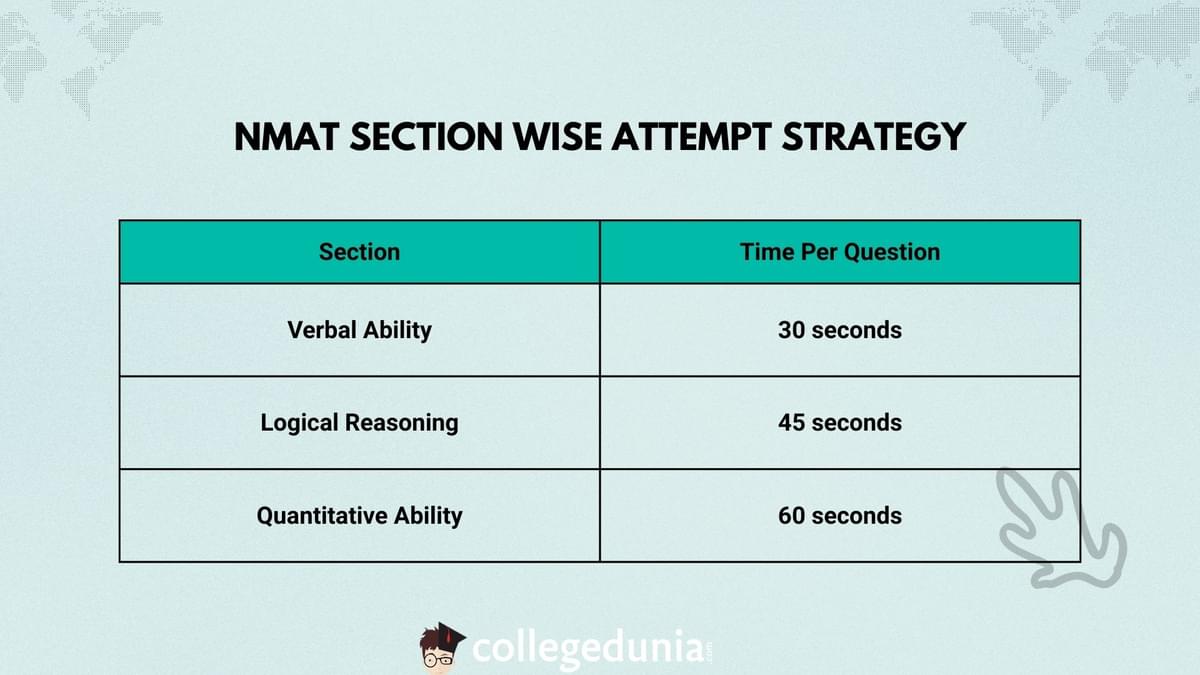
While attempting NMAT exam 2025, aspirants must not leave questions blank. Leaving blank questions will make candidates lose marks, not because of negative marking, but because of not attempting the question. As there is no negative marking in the NMAT exam, students must go through each question and try to attempt the question in the least possible time.
Students can use the section-wise strategy to attempt questions in each section as mentioned in the table below. The strategy is most truncated and tested by candidates who appeared for NMAT exam.
| Section | Time Per Question |
|---|---|
| Verbal Ability | 30 seconds |
| Logical Reasoning | 45 seconds |
| Quantitative Ability | 60 seconds |
In case of puzzle, RC set, or input-output set, for all those questions, around 4-5, students have 5 minutes to complete. In case you did not finish all 4 or 5 questions in 5 minutes, mark those for review and move on to the next questions, and go through all 108 questions.
NMAT Syllabus 2025
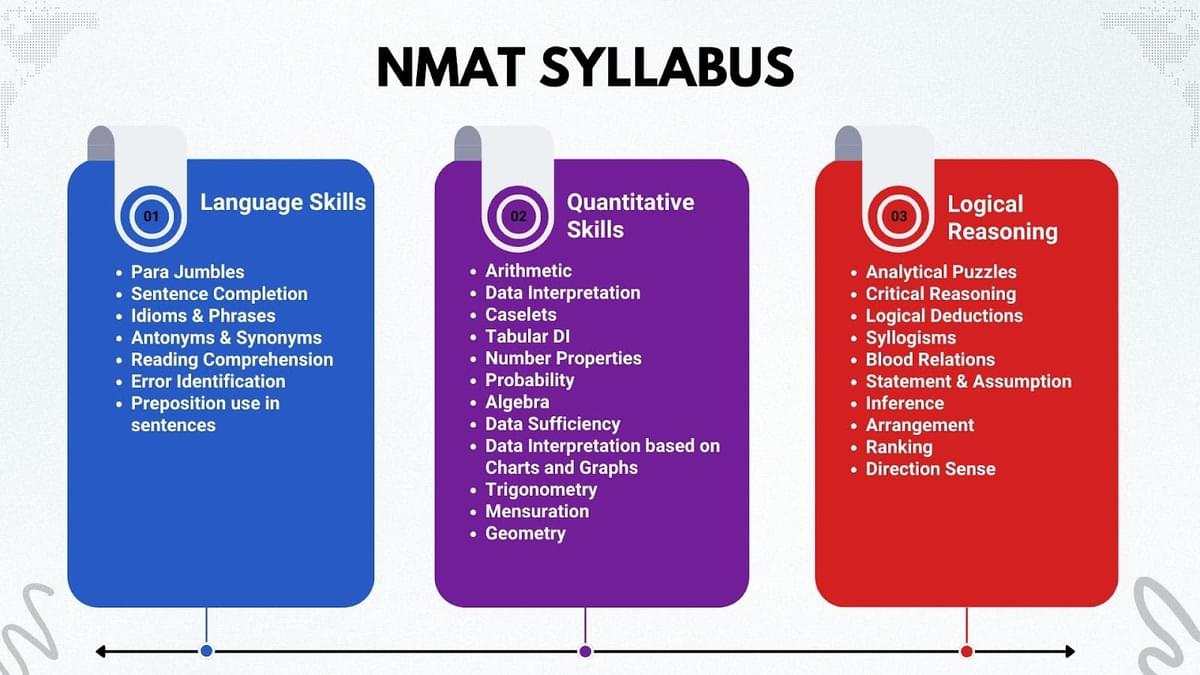
NMAT exam syllabus is divided into 3 sections, including Language Skills, Quantitative Skills, and Logical Reasoning. NMAT syllabus for each section is discussed in the table below.
| Section | Topics Covered |
|---|---|
| Language Skills | Para Jumbles, Sentence Completion, Idioms & Phrases, Antonyms & Synonyms, Reading Comprehension, Error Identification, Preposition use in sentences |
| Quantitative Skills | Arithmetic, Data Interpretation, Caselets, Tabular DI, Number Properties, Probability, Algebra, Data Sufficiency, Data Interpretation based on Charts and Graphs, Trigonometry, Mensuration, Geometry |
| Logical Reasoning | Analytical Puzzles, Critical Reasoning, Logical Deductions, Syllogisms, Blood Relations, Statement & Assumption, Inference, Arrangement, Ranking, Direction Sense |
Also Read
NMAT by GMAC Official Guide
The NMAT by GMAC official guide is available on the official website. Students can use this guide to prepare for the examination.
NMAT Books for Language Skills
The following books are recommended for the Language Skills section of NMAT. These books cover vocabulary, grammar, and reading comprehension.
| Book Name | Author/Publisher |
|---|---|
| Word Power Made Easy | Norman Lewis |
| High School English Grammar & Composition | Wren & Martin |
| Verbal Ability and Reading Comprehension for CAT | Arun Sharma and Meenakshi Upadhyay |
| Objective General English | S.P. Bakshi |
| 30 Days to More Powerful Vocabulary | Norman Lewis |
NMAT Books for Quantitative Skills
These books are suggested for the Quantitative Skills section. They cover arithmetic, algebra, and data interpretation.
| Book Name | Author/Publisher |
|---|---|
| Quantitative Aptitude for Competitive Examinations | R. S. Aggarwal |
| How to Prepare for Data Interpretation for CAT | Arun Sharma |
| Quantitative Aptitude for CAT | Arun Sharma |
| Quantitative Aptitude for CAT | Nishit K. Sinha |
| Hitbullseye’s MBA Math- 1 & 2 | Hitbullseye |
NMAT Books for Logical Reasoning
These books are recommended for the Logical Reasoning section. They cover both verbal and non-verbal reasoning topics.
| Book Name | Author/Publisher |
|---|---|
| A Modern Approach to Verbal & Non-Verbal Reasoning | R. S. Aggarwal |
| Analytical Reasoning | M.K. Pandey |
| Non-Verbal Reasoning | Arihant Publication |
| How to Crack Test of Reasoning | Arihant Experts |
NMAT Question Paper
Previous question papers are available for each subject. Solutions are also provided for download.
| Subject | Question Paper | Solutions |
|---|---|---|
| Quantitative | Download | Download |
| Language | Download | Download |
| Logical Reasoning | Download | Download |
NMAT Exam Pattern FAQs
What is the exam pattern of NMAT?
As per the NMAT exam pattern, questions will be based on three sections: Language Skills, Quantitative Skills, and Logical Reasoning. NMAT 2025 test-takers will be given 2 hours or 120 minutes to complete a total of 108 questions. NMAT total marks will be 324 with no negative marking. Each section will have 36 questions, each carrying 1 mark.
Is there any negative marking in NMAT?
No, according to the NMAT exam pattern by GMAC, candidates will be given 1 mark for each right response. No marks will be deducted for wrong answers.
How many attempts are there in NMAT?
GMAC permits students to take the NMAT exam thrice, with one attempt and two retakes. Candidates can schedule a retake with a 15-day interval from their last attempt. A retake fee must also be paid for each retake attempt.
NMAT Passing Marks and Cut Off
The passing marks depend on the NMAT cut off. Candidates need to qualify the cut off score to be eligible for the WAT/PI round.
The expected NMAT cut off ranges between 210-250.
NMAT Sectional Time Limit
Yes, there is a sectional time limit for NMAT 2025 exam. No extra time would be given to complete the test.
- Language Skills: 28 minutes
- Quantitative Skills: 52 minutes
- Logical Reasoning: 40 minutes
NMAT Total Marks and Questions
Total marks for NMAT 2025 is 324. The total number of questions to be answered is 108 within 120 minutes.
| Section | Questions | Marks |
|---|---|---|
| Language Skills | 36 | 108 |
| Quantitative Skills | 36 | 108 |
| Logical Reasoning | 36 | 108 |
NMAT Marks Per Question
As per NMAT exam pattern 2025, per question has 3 marks. NMAT question paper will have a total of 108 questions for 324 marks.
NMAT Difficulty Level
Difficulty level of NMAT exam is not fixed by the conducting authority. It can be approximated based on the NMAT paper analysis from previous years.
Previous years' NMAT question papers reveal that NMAT exam difficulty level is easy to moderate when compared to similar entrance exams like CAT, XAT, etc.
Skipping Questions in NMAT
Yes, students can skip questions in NMAT exam without any penalty. There is no negative marking in the examination.
Candidates are advised to not skip questions in NMAT. Students must go through all 108 questions asked in NMAT question paper.
NMAT Exam Pattern 2025
NMAT paper structure is released by GMAC on the official website at mba.com. As per the NMAT exam pattern, there will be 108 questions in NMAT question paper to be attempted in 120 minutes.
- Each section will carry 36 questions
- Sectional time: 28 minutes for language skills, 52 minutes for quantitative skills, and 40 minutes for logical reasoning
- Total marks in NMAT exam are 324
Questions to Attempt for 240 Score
As per the NMAT exam pattern 2025, each question of NMAT exam carries 3 marks. To score 240 marks in NMAT, students must attempt 80 questions in NMAT question paper 2025.
NMAT Exam Pattern 2025
NMAT 2025 has 108 questions in total, and the test duration is 120 minutes (2 hours). The total marks for the exam are 324, with no negative marking.
The paper is divided into three sections: Language Skills, Quantitative Skills, and Logical Reasoning. Each section has 36 questions, and each question carries 1 mark.
| Section | Number of Questions | Time Allotted |
|---|---|---|
| Language Skills | 36 | 28 minutes |
| Quantitative Skills | 36 | 52 minutes |
| Logical Reasoning | 36 | 40 minutes |
| Total | 108 | 120 minutes |
There is a sectional time limit for each part of the NMAT 2025 exam. No extra time is given to complete the test.
Marking Scheme and Negative Marking
There is no negative marking in NMAT. Candidates receive 1 mark for each correct response, and no marks are deducted for wrong answers.
Each question in the NMAT question paper carries 3 marks. The total of 108 questions adds up to 324 marks.
Number of Attempts
GMAC allows students to take the NMAT exam three times. This includes one main attempt and two retakes.
Candidates can schedule a retake after a 15-day interval from their last attempt. A retake fee must be paid for each retake attempt.
NMAT Cut Off and Passing Marks
There are no fixed passing marks for NMAT. Candidates need to qualify the NMAT cut off score to be eligible for the WAT/PI round.
The expected NMAT cut off ranges between 210 and 250.
Difficulty Level
The difficulty level of the NMAT exam is not fixed by the conducting authority. It can be approximated based on the NMAT paper analysis from previous years.
Previous years' NMAT question papers show that the difficulty level is easy to moderate when compared to similar entrance exams like CAT and XAT.
Skipping Questions
Students can skip questions in the NMAT exam without any penalty. Since there is no negative marking, candidates are advised to go through all 108 questions in the paper.
Score Calculation Example
To score 240 marks in NMAT, a student must attempt 80 questions. This is based on the 3 marks given for each question in the NMAT exam pattern 2025.
Syllabus
NMAT Syllabus 2025: Sections and Structure
The NMAT Syllabus has three sections: Language Skills, Quantitative Skills, and Logical Reasoning. Each section has 36 questions, making a total of 108 questions.
The exam is computer-based. It is conducted at test centers and in online-proctored mode.
NMAT Exam Pattern 2025
Each section has a fixed time limit. A section auto-submits when its timer runs out, and candidates cannot return to it.
| Section | Number of Questions | Duration (Minutes) | Type of Questions | Key Areas Covered |
|---|---|---|---|---|
| Language Skills | 36 | 28 | MCQ | Vocabulary, Grammar, Reading Comprehension |
| Quantitative Skills | 36 | 52 | MCQ | Arithmetic, Algebra, Geometry, Data Interpretation |
| Logical Reasoning | 36 | 40 | MCQ | Analytical, Verbal, and Critical Reasoning |
| Total | 108 | 120 |
NMAT Section-wise Topics
The NMAT syllabus PDF has detailed section-wise topics. The topics for each section are listed below.
Language Skills
- Reading Comprehension: Understanding and interpreting short and long passages.
- Grammar: Error identification, sentence correction, and prepositions.
- Vocabulary: Fill in the blanks, synonyms, antonyms, cloze tests, and analogies.
- Sentence Formation: Para jumbles and sentence completion.
Quantitative Skills
- Arithmetic: Percentages, profit and loss, time and work, simple and compound interest, ratio, averages.
- Algebra: Linear and quadratic equations, inequalities, sequences.
- Geometry and Mensuration: Lines, angles, triangles, circles, areas, volumes.
- Modern Math: Logarithms, permutations and combinations, probability.
- Data Interpretation: Graphs (line, bar, pie charts), tables, caselets.
Logical Reasoning
- Analytical and Critical Reasoning: Assumptions, arguments, inferences, puzzles.
- Arrangements: Linear and circular seating arrangements.
- Coding-Decoding: Letter and number-based coding.
- Series: Number and alphabet series.
- Other Topics: Syllogisms, blood relations, direction sense, input-output, decision-making, calendars.
NMAT 2025: Key Rules
All three sections are mandatory. Each section must be completed within its allotted time.
The total exam duration is 120 minutes (2 hours). The section order is flexible, and candidates can choose which section to start with before the test begins.
NMAT does not have official sectional cutoffs. Individual B-schools may set their own minimum scores for each section during admissions.
NMAT Exam Pattern
The NMAT 2025 exam has three sections: Language Skills, Quantitative Skills, and Logical Reasoning. The total test duration is 120 minutes.
| Section | Time Allotted | Can Choose Order? | Can Revisit After Finishing? | System Control |
|---|---|---|---|---|
| Language Skills | 28 minutes | Yes | No | Auto-lock after time ends |
| Quantitative Skills | 52 minutes | Yes | No | Auto-lock after time ends |
| Logical Reasoning | 40 minutes | Yes | No | Auto-lock after time ends |
| Total | 120 minutes |
Can I pause the timer or take breaks during NMAT?
No, the timer cannot be paused once the exam starts. There are no breaks during the 120-minute test duration.
Can I change the section order after starting the test?
No, the section order cannot be changed mid-test. The preferred order must be selected at the beginning of the exam.
Key Summary
- The NMAT 2025 exam is divided into three sections: Language Skills, Quantitative Skills, and Logical Reasoning.
- Each section has 36 questions, making a total of 108 questions to be completed in 120 minutes.
- There is no negative marking; each correct answer earns 3 marks, while unanswered or incorrect answers get 0.
- The total score ranges from 36 to 360, with each section scaled between 12 to 120.
- Candidates are allowed up to three attempts per testing cycle (1 main attempt and 2 retakes).
- The Language Skills section includes reading comprehension, grammar, and vocabulary-based questions.
- The Quantitative Skills section covers arithmetic, algebra, geometry, and data interpretation.
- The Logical Reasoning section features puzzles, critical reasoning, coding-decoding, and arrangements.
- For a strong performance, candidates should aim for a score of 240+ by focusing on accuracy and speed.
- Recommended study resources include the GMAC official guide and books by Norman Lewis, Arun Sharma, R.S. Aggarwal, and MK Pandey.
What is NMAT Syllabus?
The Syllabus of NMAT includes topics from Language Skills, Quantitative Skills and Logical Reasoning. The Language Skills section tests reading comprehension and grammar, the Quantitative Skills section covers arithmetic, geometry, and data interpretation, and the Logical Reasoning section includes critical reasoning, analytical puzzles and decision-making questions.
Syllabus for NMAT: Section-Wise Detailed Topics
NMAT is said to be the most candidate-friendly MBA exam as it offers to choose exam dates as per your convenience. Even if you have the opportunity to improve your score with 3 attempts in the testing cycle.
Syllabus for NMAT: Language Skills
You can refer to the Syllabus for NMAT to know more about the key topics of Language skills. The table below gives an insight into the key topics and the skills that you need to focus on while preparing for the NMAT exam 2025.
NMAT Syllabus: Language Skills Section
The Language Skills section of the NMAT syllabus tests verbal ability, grammar, and reading comprehension. It contains approximately 36 questions in total.
The section is divided into three sub-sections with the following question distribution:
| Sub-Section | Topics Covered | Question Count (Approx.) |
|---|---|---|
| Reading Comprehension | 3-4 passages (450-500 words each), Inference questions, Central idea, Tone and attitude, Specific details | 12 questions |
| Grammar & Vocabulary | Synonyms, Antonyms, Analogies, Fill in the blanks, Error identification, Sentence correction | 15 questions |
| Verbal Ability | Para jumbles, Sentence completion, Prepositions, Phrasal verbs, Idioms and phrases | 9 questions |
Key Topics in Language Skills
- Vocabulary: Antonyms, Synonyms, Analogies, Phrases, Clauses, Word meaning, and Idioms.
- Grammar: Parts of speech, Error identification, Tenses, and Sentence correction.
- Reading Comprehension: Para jumbles, Paragraph summary, and Jumbled sentences.
- Language Usage: Prepositions, fill-in-the-blanks, and choose the odd one out.
NMAT Syllabus: All Three Sections
The NMAT syllabus includes three core subjects: Language Skills, Quantitative Skills, and Logical Reasoning. Each section assesses specific aptitude abilities required for MBA and management entrance exams.
| Section | Key Areas Tested | Topics Covered | Objective |
|---|---|---|---|
| Language Skills | Verbal Ability, Grammar, Reading Comprehension | Synonyms & Antonyms, Fill in the Blanks, Para Jumbles, Sentence Correction, RC Passages, etc. | To test command over English and comprehension accuracy |
| Quantitative Skills | Numerical Ability, Arithmetic, Data Interpretation | Algebra, Percentage, Ratio & Proportion, Speed-Distance-Time, Profit & Loss, Geometry, Data Sufficiency, etc. | To evaluate numerical accuracy and logical use of numbers |
| Logical Reasoning | Analytical, Critical, and Verbal Reasoning | Series, Coding-Decoding, Puzzles, Syllogisms, Input-Output, Statement-Conclusion, Blood Relations, etc. | To assess problem-solving, reasoning, and pattern recognition |
Is the NMAT Syllabus Different Each Year?
No, the core three sections and topics in NMAT syllabus remain stable, as defined by GMAC. Minor shifts in emphasis may occur, but major additions are rare.
Official "What's on the NMAT syllabus" pages confirm continuity.
NMAT Syllabus vs CAT and SNAP
The NMAT syllabus is broadly similar to other MBA exams, but it is considered easier and more speed-oriented compared to CAT or SNAP.
- NMAT shares common aptitude areas with exams like CAT, XAT, and SNAP such as Quant, Verbal, and Reasoning.
- NMAT questions are moderate in difficulty and emphasize accuracy and time management over complex logic.
- Unlike CAT, NMAT offers equal weightage to all three sections and no negative marking.
- NMAT provides flexibility to choose the section order, a unique feature not available in most other MBA exams.
- The difficulty level is comparable to MAT or CMAT, but with a faster test pace.
NMAT vs Other MBA Exams Comparison
| Feature | NMAT | CAT | SNAP |
|---|---|---|---|
| Number of Sections | 3 (LS, QS, LR) | 3 (VARC, DILR, QA) | 3 (English, QA, LR) |
| Difficulty Level | Moderate | High | Moderate |
| Negative Marking | None | Yes (-1) | Yes (-0.25) |
| Sectional Flexibility | Yes | No | No |
| Total Duration | 120 min | 120 min | 60 min |
| Conducting Body | GMAC | IIMs | Symbiosis International University |
Sectional Weightage in NMAT Syllabus
All three sections of the NMAT syllabus carry equal weightage. Topic importance may vary based on past year trends and difficulty distribution.
- Each section — Language Skills, Quantitative Skills, and Logical Reasoning — contains 36 questions, contributing equally to the total score.
- Based on previous exam analyses, certain topics tend to appear more frequently:
- In Quantitative Skills, topics like Arithmetic, Algebra, and Data Interpretation carry higher question frequency.
- In Language Skills, Reading Comprehension and Grammar dominate the section.
- In Logical Reasoning, Analytical Puzzles and Critical Reasoning are most common.
- Balanced preparation across all topics ensures better performance, as no section can be skipped or compensated by another.
NMAT Exam Pattern
The NMAT has three sections with a total of 108 questions. Each section carries equal weightage of 33%.
| Section | Number of Questions | Marks Weightage | Commonly Asked Areas |
|---|---|---|---|
| Language Skills | 36 | 33% | RC, Grammar, Vocabulary |
| Quantitative Skills | 36 | 33% | Arithmetic, DI, Algebra |
| Logical Reasoning | 36 | 33% | Puzzles, Series, Critical Reasoning |
| Total | 108 | 100% |
NMAT Syllabus: Quantitative Skills Topics
The Quantitative Skills section covers five main categories. Candidates should check the weightage and difficulty level of each topic to plan their preparation.
| Category | Topics | Weightage | Difficulty Level |
|---|---|---|---|
| Arithmetic | Numbers, HCF & LCM, Percentages, Ratio & Proportion, Averages, Simple & Compound Interest, Time & Work, Time & Distance | 40-45% | Easy to Moderate |
| Algebra | Linear Equations, Quadratic Equations, Inequalities, Logarithms, Sequences & Series | 15-20% | Moderate |
| Geometry & Mensuration | Lines, Angles, Triangles, Circles, Quadrilaterals, 3D figures, Area & Volume | 20-25% | Moderate to Difficult |
| Modern Mathematics | Permutation & Combination, Probability, Coordinate Geometry, Set Theory | 15-20% | Moderate |
| Data Interpretation | Tables, Bar Charts, Line Graphs, Pie Charts, Caselets | 20-25% | Easy to Moderate |
An in-depth list of key topics is given below.
- Number Properties: Fractions, Basics of numbers, Decimals, Factors, Divisibility rules, and Multiples.
- Arithmetic: Discount, Profit & Loss, Partnership, and Mixtures & Alligations.
- Geometry: Similarity, Pythagoras' theorem, Congruence, and Coordinate geometry.
- Data Sufficiency: Arithmetic-based, Number-based, and Algebra-based questions.
NMAT Syllabus: Logical Reasoning Topics
The Logical Reasoning section covers critical reasoning, verbal reasoning, and analytical puzzles. The NMAT test pattern is a useful resource for understanding the important topics in this section.
| Category | Topics | Question Distribution |
|---|---|---|
| Critical Reasoning | Assumptions, Conclusions, Strengthen/Weaken arguments, Course of action | 8-10 questions |
| Analytical Puzzles | Linear arrangements, Circular arrangements, Blood relations, Coding-decoding | 12-15 questions |
| Verbal Reasoning | Syllogisms, Statement-conclusion, Statement-assumption, Decision making | 8-10 questions |
| Other Reasoning | Series, Calendars, Clocks, Input-output, Venn diagrams | 6-8 questions |
Key topics covered in this section are listed below.
- Puzzles: Circular arrangement, Linear arrangement, and Matrix-based puzzles.
- Coding-Decoding: Number coding, Letter coding, and Symbol-based coding.
- Critical Reasoning: Main point, Inference, strengthen, weaken, and Assumption.
- Syllogisms: Venn diagrams and three-statement problems.
- Blood Relations: Family tree and Generation-based problems.
Previous Year Topic Analysis
The table below shows the focus areas for each section in recent years. Use this along with the NMAT Syllabus for a detailed understanding of the exam.
| Year | Language Skills Focus | Quantitative Skills Focus | Logical Reasoning Focus |
|---|---|---|---|
| 2024 | RC passages on modern themes, Grammar basics | Arithmetic-heavy, DI sets | Critical reasoning, Puzzles |
| 2023 | Vocabulary emphasis, Paragraph formation | Geometry, Modern math | Arrangements, Coding |
| 2022 | Reading comprehension focus | Data interpretation | Verbal reasoning |
NMAT Exam Pattern 2025
The NMAT by GMAC exam has 108 questions in total. These questions are split equally across three sections, with 36 questions in each section.
The total exam duration is 2 hours, or 120 minutes. The exam is a computer-based test (CBT). Each section has its own time limit.
- Language Skills: 28 minutes
- Logical Reasoning: 40 minutes
- Quantitative Skills: 52 minutes
There is no negative marking in the NMAT. This makes it different from many other MBA entrance exams.
NMAT 2025 Exam Overview
The table below gives a quick overview of the NMAT exam pattern. Use this to plan your preparation.
| Component | Details |
|---|---|
| Total Questions | 108 (36 per section) |
| Total Duration | 120 minutes (2 hours) |
| Exam Mode | Computer-Based Test (CBT) |
| Question Type | Multiple Choice Questions (MCQs) |
| Number of Sections | 3 (Language Skills, Quantitative Skills, Logical Reasoning) |
| Attempts Allowed | 3 per year (1 main + 2 retakes) |
| Negative Marking | None |
| Score Range | 36-360 (Total), 12-120 (Per Section) |
| Section Order | Candidate's Choice |
How Many Sections, Questions, and Total Time Does NMAT 2025 Have?
NMAT 2025 has three sections, 108 questions in total, and a test duration of 120 minutes (2 hours).
- The NMAT by GMAC includes Language Skills, Quantitative Skills, and Logical Reasoning sections.
- Each section has 36 questions, bringing the total to 108 questions.
- The total exam time is 120 minutes, with separate timing for each section.
- The test is conducted in computer-based mode at centers or in online proctored mode from home.
- All questions are multiple-choice (MCQs) with no negative marking.
NMAT 2025 Exam Overview
| Parameter | Details |
|---|---|
| Number of Sections | 3 |
| Questions per Section | 36 |
| Total Questions | 108 |
| Total Time | 120 Minutes (2 Hours) |
| Mode of Exam | Computer-based / Online Proctored |
| Question Type | Multiple Choice (MCQ) |
Can I Choose the Order of Sections While Attempting the NMAT Exam?
Yes, NMAT allows candidates to choose the order of sections at the beginning of the test. This gives the flexibility to start with the strongest area.
- Candidates can decide the sequence of sections before the test begins.
- Once a section is completed, the candidate cannot return to it or change the order mid-test.
- The total time remains 120 minutes, regardless of the order chosen.
- This flexibility helps with time management and comfort level.
| Feature | Availability |
|---|---|
| Choose Section Order | Yes (at test start) |
| Change Order After Start | No |
| Revisit Completed Section | No |
| Total Time Limit | 120 Minutes |
Is NMAT an Adaptive Exam?
Yes, NMAT follows a computer-adaptive pattern. The difficulty level of questions adapts based on the candidate's responses.
- The online mode of NMAT uses an adaptive algorithm. Questions get tougher when answered correctly.
- Each section's score depends on both accuracy and question difficulty.
- The final scaled score (12-360) is based on performance across all sections.
- Adaptive testing helps GMAC maintain fairness and precision in scoring.
| Exam Mode | Adaptive Type | Scoring Range | Difficulty Adjustment |
|---|---|---|---|
| Computer-Based / Online | Yes | 12-360 (Scaled) | Based on previous responses |
NMAT Exam Pattern: Section-wise Time Distribution
The NMAT syllabus is incomplete without considering the section-wise time distribution. Each section has 36 questions, but the duration for each section varies.
The table below shows the time available per section. This helps in understanding how much time can be spent on each question.
| Section | Questions | Time Allotted |
|---|---|---|
| Language Skills | 36 | 28 minutes |
| Logical Reasoning | 36 | 40 minutes |
| Quantitative Skills | 36 | 52 minutes |
| Total | 108 | 120 minutes |
NMAT 2025 Exam Pattern: Section-wise Time Limit
Each section in NMAT 2025 has a fixed time limit. Language Skills has 28 minutes, Quantitative Skills has 52 minutes, and Logical Reasoning has 40 minutes.
- Each section is individually timed and must be finished within the allotted time.
- Once a section is finished or the time expires, candidates cannot go back or reattempt it.
- The system automatically locks the section after the time ends.
- Total exam duration is 28 + 52 + 40 = 120 minutes.
| Section | Number of Questions | Time Allotted (Minutes) |
|---|---|---|
| Language Skills | 36 | 28 |
| Quantitative Skills | 36 | 52 |
| Logical Reasoning | 36 | 40 |
| Total | 108 | 120 |
NMAT Total Marks and Marking Scheme
The NMAT total mark has a range of 36 to 360 marks. Each section has a scaled score range of 12 to 120.
There is no negative marking in the NMAT exam pattern. Candidates do not lose marks for incorrect or unattempted answers.
| Aspect | Details |
|---|---|
| Correct Answer | +3 marks |
| Wrong Answer | 0 marks (No negative marking) |
| Unattempted Question | 0 marks |
| Raw Score Calculation | Number of correct answers × 3 |
| Scaled Score | 12-120 per section |
| Percentile Calculation | Based on relative performance |
| Score Validity | Valid for 5 years |
How NMAT Scores are Computed
Each correct answer in NMAT 2025 earns 3 marks. Section scores are scaled to a range of 12-120, giving a total scaled score range of 36-360.
| Section | Raw Marks (if all correct) | Scaled Score Range |
|---|---|---|
| Language Skills | 36 × 3 = 108 | 12 - 120 |
| Quantitative Skills | 36 × 3 = 108 | 12 - 120 |
| Logical Reasoning | 36 × 3 = 108 | 12 - 120 |
| Total (Raw Max) | 324 | Scaled total: 36 - 360 |
Negative Marking in NMAT 2025
No, NMAT 2025 has no negative marking. Candidates earn marks for every correct answer, and no marks are deducted for wrong responses.
| Response Type | Marks Awarded | Negative Marking |
|---|---|---|
| Correct Answer | +3 Marks (Scaled Scoring) | No |
| Incorrect Answer | 0 | No |
| Unattempted | 0 | No |
Maximum Total Mark in NMAT
The maximum raw mark possible is 324. Due to scaling, the maximum reported score is 360.
- Raw maximum = 108 questions × 3 marks = 324.
- After scaling, the sections are scored in the range 12-120, giving a total 36-360.
- 360 is the highest possible scaled score.
NMAT Syllabus 2025: Section-wise Weightage
Each of the three sections in the NMAT exam carries equal weightage. Every section contributes 33.33% to the NMAT total marks.
| Section | Questions | Weightage | Score Range | Time Allocation | Preparation Priority |
|---|---|---|---|---|---|
| Language Skills | 36 | 33.33% | 12-120 | 28 minutes | High (Time constraint) |
| Quantitative Skills | 36 | 33.33% | 12-120 | 52 minutes | High (Maximum time) |
| Logical Reasoning | 36 | 33.33% | 12-120 | 40 minutes | High (Moderate time) |
| Total | 108 | 100% | 36-360 | 120 minutes | Equal Focus |
Knowing the weightage helps in planning preparation effectively. Candidates can also refer to the SNAP syllabus as an additional source for insights.
NMAT Question Types and Difficulty Level
The NMAT syllabus includes specific question types for each section. The difficulty level varies across sections.
| Section | Primary Question Types | Difficulty Level |
|---|---|---|
| Language Skills | Reading Comprehension, Grammar, Vocabulary, Para Formation | Moderate to High |
| Quantitative Skills | Arithmetic, Algebra, Geometry, Data Interpretation | Moderate |
| Logical Reasoning | Critical Reasoning, Puzzles, Arrangements, Coding-Decoding | Moderate |
NMAT Topic-wise Question Distribution
Each section has topics with different question weightage. High weightage topics carry 8-12 questions, medium weightage topics carry 4-7 questions, and low weightage topics carry 1-3 questions.
| Section | High Weightage Topics (8-12 questions) | Medium Weightage Topics (4-7 questions) | Low Weightage Topics (1-3 questions) |
|---|---|---|---|
| Language Skills | Reading Comprehension, Grammar basics | Vocabulary, Para formation | Error identification, Analogies |
| Quantitative Skills | Arithmetic, Data Interpretation | Algebra, Geometry | Modern Mathematics, Number theory |
| Logical Reasoning | Critical Reasoning, Arrangements | Puzzles, Coding-decoding | Series, Blood relations |
NMAT Scoring Range Analysis
The score range for each section is the same. Knowing the score range and NMAT percentile ranges helps in understanding which colleges accept NMAT scores and at what percentile.
| Section | No. of Questions | Approx. Weightage | Scaled Score Range |
|---|---|---|---|
| Language Skills | 36 | ~33.33% | 12-120 |
| Quantitative Skills | 36 | ~33.33% | 12-120 |
| Logical Reasoning | 36 | ~33.33% | 12-120 |
| Total | 108 | 100% | 36-360 |
Frequently Asked Questions
How much weightage does each section carry in NMAT 2025?
Each section in NMAT 2025 — Language Skills, Quantitative Skills, and Logical Reasoning — carries equal weightage, both in terms of the number of questions and scoring.
- There are 36 questions in each section, totaling 108 questions.
- Each section contributes one-third (≈33.33%) to the total score.
NMAT Score vs Percentile 2025
The table below shows the relationship between NMAT scores, percentiles, and the colleges that may be targeted at each level.
| Score Range | Percentile Range | Target Colleges | Preparation Level Required |
|---|---|---|---|
| 260+ | 95+ percentile | NMIMS Mumbai, Top campuses | Excellent preparation |
| 240-259 | 90-95 percentile | NMIMS other campuses, XIMB | Very good preparation |
| 220-239 | 85-90 percentile | Good B-schools | Good preparation |
| 200-219 | 75-85 percentile | Decent B-schools | Average preparation |
| Below 200 | Below 75 percentile | Lower-tier colleges | Needs improvement |
Target Score Strategy for NMAT
A strategic approach can help achieve the target score. The strategy for each section is different, so a flexible approach to NMAT preparation is needed.
| Section | Target Score for 260+ | Strategy | Time Management |
|---|---|---|---|
| Language Skills | 85-90 Percentile | Focus on RC speed, Grammar accuracy | 25-28 minutes |
| Quantitative Skills | 90-95 Percentile | Master arithmetic, Quick calculations | 50-52 minutes |
| Logical Reasoning | 85-90 Percentile | Pattern recognition, Critical reasoning | 38-40 minutes |
Tips for Improving NMAT Score
- For 240+ marks, focus on speed and attempt around 30-32 questions from each section.
- For 220+ marks, balance speed and accuracy while attempting 28-30 questions from every section.
- For 200+ marks, attempt easier questions initially and guess intelligently for challenging questions.
Best Books and Authors for NMAT Preparation
Candidates should know the top books and study materials to get the most from the NMAT Syllabus. The list below can be used while building an NMAT preparation strategy.
| Section | Author/Book | Publisher | Key Features |
|---|---|---|---|
| Complete NMAT Guide | GMAC Official Guide | Graduate Management Admission Council | 475+ questions, Official explanations |
| Language Skills | Norman Lewis - Word Power Made Easy | Goyal Publishers | Vocabulary building, Usage examples |
| Language Skills | Wren & Martin - English Grammar | S. Chand Publishing | Grammar fundamentals, Practice exercises |
| Quantitative Skills | R.S. Aggarwal - Quantitative Aptitude | S. Chand Publishing | Comprehensive coverage, Practice sets |
| Quantitative Skills | Arun Sharma - Quantitative Aptitude | McGraw Hill | CAT/NMAT focused, Detailed solutions |
| Logical Reasoning | MK Pandey - Analytical Reasoning | BSC Publishing | Puzzle techniques, Critical reasoning |
| Logical Reasoning | R.S. Aggarwal - Verbal & Non-Verbal Reasoning | S. Chand Publishing | Complete reasoning coverage |
2-3 Months NMAT Syllabus Preparation
There are 3-4 months (around 12-16 weeks) before NMAT 2025, which is scheduled for November-December. A detailed weekly task breakdown is provided below.
NMAT Syllabus Preparation Weekly Timeline
The weekly timeline covers the full preparation period. Each week has specific tasks for covering the syllabus and practising questions.
16-Week NMAT Preparation Plan
Strategic preparation is needed for the NMAT syllabus, which covers all sections. Candidates must prepare the NMAT syllabus thoroughly, understand the NMAT paper pattern, and practice regularly with quality materials. Both official GMAC resources and additional materials are required to achieve target scores and get into top institutes.
Week-by-Week Study Schedule
| Week | Focus Area | Weekly Tasks (using PDFs & Mocks) |
|---|---|---|
| Week 1 | Basics + Orientation | Download NMAT syllabus PDF, understand exam pattern. Revise Arithmetic basics (Percentages, Ratio, Averages). Start daily 1 RC passage. |
| Week 2 | Quant + Language | Cover Time & Work, SI/CI. Practice Grammar PDFs (error correction, sentence formation). Start Vocabulary builder PDF (20 words/day). |
| Week 3 | Quant + LR Basics | Learn Algebra (linear & quadratic equations). Begin Series (number & alphabet) and Coding-Decoding from LR PDFs. |
| Week 4 | Geometry + RC | Cover Geometry & Mensuration (Triangles, Circles, Volumes). Daily 2 RC passages + Cloze tests. Attempt 1 sectional mock. |
| Week 5 | Modern Math | Study Logarithms, P&C, Probability. Practice Para Jumbles & Sentence Completion from Language PDFs. |
| Week 6 | DI + Reasoning | Solve Data Interpretation (tables, bar, pie, line graphs). Practice Arrangements (linear & circular) and Syllogisms. |
| Week 7 | Critical Reasoning | Focus on Assumptions, Inferences, Arguments. Mix with Arithmetic revision. Attempt 1 full-length mock. |
| Week 8 | Mixed Practice | Revise Algebra + Geometry. Practice Vocabulary PDF (Synonyms, Antonyms). Solve puzzles & direction sense from LR PDFs. |
| Week 9 | Advanced DI + Speed | Solve Caselets, Complex DI sets. Revise Grammar PDFs. Start 2 mocks/week and analyze mistakes. |
| Week 10 | Mock Practice + Weak Areas | Identify weak sections. Revise Formula PDF for Quant. Continue RC + LR puzzle practice. Attempt 2 mocks/week. |
| Week 11 | Revision + Accuracy | Focus on high-weightage topics (Percentages, Algebra, RC, Critical Reasoning). Revise shortcut techniques PDF. |
| Week 12 | Pre-Exam Strategy | Daily 1 sectional mock. Alternate between Quant, LR, Language. Keep light Vocabulary & Grammar revision. |
| Week 13–14 | (If time) Final Push | Solve Previous Year NMAT papers PDF. Take 3 mocks/week. Focus only on weak areas. |
| Week 15–16 | (Just before exam) | Focus on speed, accuracy, time management. Revise notes & formula PDFs. Attempt only light practice & mocks. |
NMAT Syllabus FAQs
Is 250 a good score in NMAT?
Yes, 250 is a very good score in NMAT. It can translate to a high percentile for candidates.
- With the score, candidates can get into top colleges.
- Candidates have the chance of getting into the NMIMS campuses.
- However, candidates must remember that the cutoff for colleges varies.
Is the NMAT easy or difficult?
NMAT is considered to be moderately difficult. However, the view is mostly subjective.
- The difficulty level of NMAT depends on the preparation of candidates.
- Candidates must focus on thorough preparation.
- Developing a solid strategy is a must to effectively prepare for NMAT.
Can I clear NMAT in 3 months?
Yes, it is possible to clear NMAT in 3 months. But candidates require rigorous preparation for the exam.
- A well-planned preparation strategy must be followed.
- It is key to prioritise regular practice.
- Utilising diverse resources is a must while preparing for NMAT.
Is 140 a good score in NMAT?
No, a score of 140 in NMAT is generally considered to be a low score. It may not be adequate to get into top institutes.
- Candidates must aim for a higher score to get admission in the best business schools.
- They must leverage the available resources strategically.
- High emphasis must be placed on a well-planned preparation strategy to improve the score.
What is the 95 percentile in NMAT?
95 percentile in NMAT translates to a score that ranges between 210 and 215. It is a good score to get into top institutes.
- To showcase such performance, candidates must focus on proper preparation.
- The understanding of the NMAT syllabus is crucial.
- Candidates must leverage the available resources while preparing for NMAT.
Cut-offs
Expected NMAT Sectional Cutoffs 2025
Sectional cutoffs for NMAT 2025 are expected to fall in the 65-70 mark range, based on previous year analysis. The exact cutoff depends on the difficulty level of the exam.
The expected cutoff for NMIMS Mumbai is around 78 for Language Skills, 75 for Logical Reasoning, and 73 for Quantitative Skills. The overall expected cutoff for NMIMS Mumbai is 205-245.
NMIMS Bangalore is expected to have a sectional cutoff of 70-75. The NMIMS Hyderabad campus is likely to have a lower cutoff of 62 for each section.
Average Expected Cutoff by Section
| Section | Average Expected Cutoff (User Votes) | User Sentiment |
|---|---|---|
| Language Skills | 70-75 | "Most unpredictable section" |
| Logical Reasoning | 68-72 | "Toughest but consistent" |
| Quantitative Skills | 70-73 | "More calculative this year" |
| Overall Score | 205-225 | "NMIMS Mumbai likely higher" |
NMAT 2024 Cutoff Percentile PDFs
College-wise cutoff PDFs for different NMAT 2024 percentile ranges are available. Each PDF provides a detailed breakdown of cutoffs across the specified percentile range.
| NMAT Cutoff | Download PDF Link |
|---|---|
| NMAT 2024 Cutoff: 90+ Percentile | Download PDF |
| NMAT 2024 Cutoff: 80 - 90 Percentile | Download PDF |
| NMAT 2024 Cutoff: 70 - 80 Percentile | Download PDF |
| NMAT 2024 Cutoff: 60 - 70 Percentile | Download PDF |
Expected NMAT Sectional Cutoffs 2025 for NMIMS Mumbai
NMIMS Mumbai has only 600 available seats across programs, making the competition high. The expected overall cutoff for NMIMS campuses is 209.
The sectional cutoffs are 62 in Language Skills, Quantitative Techniques, and Logical Reasoning. The cutoff for MBA Pharmaceutical Management is relatively lower, with 50 marks across sections.
NMIMS Mumbai Sectional Cutoff 2025 by Program
| Program | Overall Cutoff | Language Skills | Logical Reasoning | Quantitative Skills |
|---|---|---|---|---|
| MBA Core | 209+ | 62 | 62 | 62 |
| MBA HR | 209+ | 62 | 62 | 62 |
| MBA Decision Science | 209+ | 62 | 62 | 62 |
| MBA Business Analytics | 209+ | 62 | 62 | 62 |
| MBA Digital Transformation | 209+ | 62 | 62 | 62 |
| MBA Pharmaceutical Management | 190+ | 50 | 50 | 50 |
Previous Year's NMAT Sectional Cutoff Marks for NMIMS Mumbai
Previous year cutoff marks for NMIMS Mumbai are used to estimate expected cutoffs for the current year. These figures help candidates understand the score required for admission.
NMAT Sectional Cutoff for NMIMS Mumbai
For NMAT 2024, the sectional cutoff has been reduced compared to recent years. The sectional cutoff for NMAT 2024 is around 62 - 65, and the overall cutoff marks are around 209.
For NMAT 2023, the sectional cutoff was at 76, 65 and 60 for language skills, quantitative skills and logical reasoning, respectively. The NMIMS cutoff for 2023 is in a similar range but higher than the previous years.
Here is the previous year's NMAT sectional cutoff data for NMIMS Mumbai:
| Year | LS Cutoff Marks | QS Cutoff Marks | LR Cutoff Marks | Overall Cutoff Marks |
|---|---|---|---|---|
| 2024 | 62 - 65 | 62 - 65 | 62 - 65 | 209 |
| 2023 | 76 | 65 | 60 | 235 |
| 2022 | 70 - 75 | 70 - 75 | 65 - 70 | 230+ |
| 2021 | 65 - 70 | 65 - 70 | 60 - 65 | 210 - 220 |
| 2020 | 60 - 65 | 60 - 65 | 55 - 60 | 200 - 210 |
Student Feedback on Cutoff Trends
Students have reported different experiences with the cutoffs over the years. The difficulty level of each section has influenced these changes.
| Year | Student Feedback | Reason |
|---|---|---|
| 2024 | "Cutoff dropped slightly" | Easy LR, moderate LS |
| 2023 | "Most competitive year" | High test-taker volume |
| 2022 | "Stabilised cutoffs" | Balanced difficulty |
| 2021 | "LR felt tough" | Section-level difficulty shift |
Top B-Schools Accepting NMAT: Sectional Cutoff Requirements
Over 40 business schools across India accept NMAT scores, each with varying cutoff requirements. For top institutes, general category candidates require the following scores:
- NMIMS Mumbai at 235-245
- NMIMS Bangalore at 220-224
- XIMB at 228+
- KJ Somaiya at 210-220
- TAPMI at 210+
- SDA Bocconi at 175+
Expected Sectional Cutoffs for Top B-Schools 2025
The expected cutoffs for the 2025 admission cycle vary by institute. Each school has its own overall score, sectional score, and percentile requirements.
| Institute | Overall Score | LS Sectional | LR Sectional | QS Sectional | Percentile |
|---|---|---|---|---|---|
| NMIMS Mumbai | 209+ | 62 | 62 | 62 | 90-95 |
| XIMB Bhubaneswar | 228+ | 70 | 68 | 70 | 90-92 |
| KJ Somaiya | 210-220 | 65 | 65 | 65 | 88-90 |
| TAPMI Manipal | 210-225 | 68 | 66 | 68 | 85-88 |
| SDA Bocconi | 175-200 | 55 | 55 | 55 | 75-80 |
| IFMR Chennai | 200-210 | 62 | 60 | 62 | 82-85 |
| IBS Hyderabad | 180-190 | 58 | 56 | 58 | 78-82 |
| Shiv Nadar University | 190-200 | 60 | 58 | 60 | 80-84 |
Mid-Tier B-Schools Sectional Requirements
Mid-tier business schools have lower cutoff requirements compared to the top institutes. The sectional cutoff is the same across all three sections for these schools.
| Institute | Overall Score | Sectional Cutoff (All Sections) | Expected Percentile |
|---|---|---|---|
| SOIL Institute of Management | 165-175 | 50-52 | 70-75 |
| Athena School of Management | 160-170 | 48-50 | 68-72 |
| ISBR Business School | 155-165 | 46-48 | 65-70 |
| Alliance University | 150-160 | 45-47 | 62-68 |
| VIT Business School | 145-155 | 43-45 | 60-65 |
| UPES Dehradun | 150-160 | 45-48 | 62-67 |
| Amrut Mody School of Management | 150-160 | 44-46 | 60-66 |
NMAT Section-Wise Performance Requirements
Each section of the NMAT requires specific skills and preparation. Knowing the target scores for each section helps in focused preparation.
Minimum Section Scores Required for Top Institutes
The table below lists the minimum section-wise and total scores needed for admission to top institutes accepting NMAT scores.
| Target Institute | LS Required | LR Required | QS Required | Total Required |
|---|---|---|---|---|
| NMIMS Mumbai | 62+ | 62+ | 62+ | 209+ |
| XIMB | 70+ | 68+ | 70+ | 228+ |
| TAPMI | 68+ | 66+ | 68+ | 220+ |
| KJ Somaiya | 65+ | 65+ | 65+ | 215+ |
| SDA Bocconi | 55+ | 55+ | 55+ | 180+ |
Safe vs Risky Score Combinations for NMIMS Mumbai
Some score combinations give a high chance of selection, while others may fail the sectional cutoff. The tables below show both types of combinations.
Safe Combinations (High Selection Probability)
| Scenario | LS Score | LR Score | QS Score | Overall | Selection Chance |
|---|---|---|---|---|---|
| Balanced Performer | 75 | 72 | 70 | 217 | Very High |
| LS Strong | 85 | 68 | 66 | 219 | Very High |
| LR Strong | 68 | 80 | 65 | 213 | High |
| QS Strong | 66 | 68 | 78 | 212 | High |
Risky Combinations (May Not Clear Sectional Cutoff)
| Scenario | LS Score | LR Score | QS Score | Overall | Issue |
|---|---|---|---|---|---|
| QS Weak | 90 | 85 | 58 | 233 | QS below the cutoff |
| LR Weak | 88 | 60 | 82 | 230 | LR below cutoff |
| LS Weak | 59 | 80 | 86 | 225 | LS below cutoff |
| Unbalanced | 95 | 55 | 80 | 230 | LR below cutoff |
Meeting the overall cutoff means nothing if sectional cutoffs are not cleared. A candidate with 230 overall but 60 in Quantitative Skills will be rejected if the sectional cutoff is 62.
Clearing sectional cutoffs is as important as securing a high overall score. NMIMS sets a common cutoff of 209 across all campuses with a sectional requirement of 62 in each section.
The NMAT 2025 exam runs until December 19, 2025. Use this time to plan preparation, work on sectional weaknesses, and reach target scores in all three sections.
Related News
- Is 200 a Good Score in NMAT?
- Is 220 a good score in NMAT?
- Is 250 a good score in NMAT?
Results
NMAT 2025 Result Release Date (Expected)
The NMAT 2025 result will be released soon after the exam on the official website, mba.com. The Graduate Management Admission Council (GMAC) releases the final NMAT 2025 scorecard within 48 hours of each exam attempt.
| Dates | Events |
|---|---|
| November 5 - December 19, 2025 | NMAT 2025 Exam Date |
| Expected within 48 hours of the exam | NMAT Result 2025 |
| February 2026 | NMAT 2025 Admission Process |
The exam window runs from November 5 to December 20, 2025. Results will be available between November 6 and December 21, 2025.
NMAT 2025 Scorecard Details
The NMAT 2025 scorecard contains the scaled score for every section and the overall score. GMAC will send an email notification once the results are available.
The information included in the NMAT 2025 scorecard is:
- Candidate's name and registration number
- Scaled scores for each section: Language Skills, Quantitative Skills, and Logical Reasoning
- Total scaled score
- Final percentile ranking
This information is used during the admission process and may be required during Group Discussion and Personal Interview (GDPI) rounds.
NMAT Scaled Score vs Percentile
The Scaled Score in NMAT 2025 ranges from 36 to 360. It is the sum of scores from Quantitative Skills, Language Skills, and Logical Reasoning.
- Each section contributes equally to the total score.
- Percentiles indicate the relative performance of a candidate compared to others.
NMAT 2025 Cut Offs
NMIMS and other colleges will soon release their NMAT 2025 Cut Offs. The NMAT cut off score for NMIMS Mumbai is expected to be above 230.
The NMAT cut off score for NMIMS Bengaluru is expected to be between 215-225.
NMAT 2025 Selection Process
The final NMAT Result 2025 will also be sent to the B-schools selected by candidates while filling out NMAT application forms. Candidates will be shortlisted for GD-PI rounds if they score above the overall and sectional cut-offs.
NMAT Score vs Percentile 2025
The table below shows the NMAT total score and the corresponding percentile for the 2024-25 testing cycle. The data is based on a sample size of 66,923 candidates.
The data was collected during the period from 5th November 2024 to 17th January 2025.
| Total Score | Percentile | Total Score | Percentile |
|---|---|---|---|
| 36 - 99 | 0 | 200 | 49 |
| 100 - 119 | 1 | 201 | 50 |
| 120 - 130 | 2 | 202 | 52 |
| 131 - 137 | 3 | 203 | 53 |
| 138 - 142 | 4 | 204 | 54 |
| 143 - 146 | 5 | 205 | 56 |
| 147 - 150 | 6 | 206 | 57 |
| 151 - 152 | 7 | 207 | 59 |
| 153 - 155 | 8 | 208 | 60 |
| 156 - 157 | 9 | 209 | 62 |
| 158 - 159 | 10 | 210 | 63 |
| 160 - 161 | 11 | 211 | 64 |
| 162 - 163 | 12 | 212 | 66 |
| 164 - 165 | 13 | 213 | 67 |
| 166 | 14 | 214 | 69 |
| 167 - 168 | 15 | 215 | 70 |
| 169 | 16 | 216 | 71 |
| 170 - 171 | 17 | 217 | 73 |
| 172 | 18 | 218 | 74 |
| 173 | 19 | 219 | 75 |
| 174 | 20 | 220 | 76 |
| 175 - 176 | 21 | 221 | 78 |
| 177 | 22 | 222 | 79 |
| 178 | 23 | 223 | 80 |
| 179 | 24 | 224 | 81 |
| 180 | 25 | 225 | 82 |
| 181 | 26 | 226 | 83 |
| 182 | 27 | 227 | 84 |
| 183 | 28 | 228 | 85 |
| 184 | 29 | 229 | 86 |
| 185 | 30 | 230 | 87 |
| 186 | 31 | 231 | 88 |
| 187 | 32 | 232 | 89 |
| 188 | 34 | 233 - 234 | 90 |
| 189 | 35 | 235 | 91 |
| 190 | 36 | 236 - 237 | 92 |
| 191 | 37 | 238 | 93 |
| 192 | 38 | 239 - 240 | 94 |
| 193 | 40 | 241 - 242 | 95 |
| 194 | 41 | 243 - 245 | 96 |
| 195 | 42 | 246 - 248 | 97 |
| 196 | 43 | 249 - 253 | 98 |
| 197 | 45 | 254 - 263 | 99 |
| 198 | 46 | 264 - 360 | 100 |
| 199 | 47 | - | - |
What is NMAT Scaled Score?
The NMAT Scaled Score is the converted score that represents a candidate's performance after adjusting for question difficulty across multiple test forms.
NMAT by GMAC is a computer-adaptive test, so no two candidates get the exact same set of questions. GMAC uses a statistical scaling process to ensure that scores are comparable across all test-takers.
Section Score Ranges
| Section | Section score range (scaled) |
|---|---|
| Language Skills (Verbal) | 12 - 120 |
| Quantitative Skills | 12 - 120 |
| Logical Reasoning | 12 - 120 |
| Total | 36 - 360 |
What is NMAT Percentile?
The NMAT Percentile indicates a candidate's relative performance compared to all other test-takers. It tells the percentage of candidates who scored lower in the NMAT exam.
For example, a candidate at the 95th percentile performed better than 95% of all NMAT candidates.
NMAT 2025 Participating Institutes
The NMAT exam 2025 is accepted by management schools across India and a few international institutions in countries like South Africa, Philippines, Hungary, Nigeria, and Morocco.
These colleges offer MBA, PGPM, and specialized management programs. Students can visit the official NMAT website at MBA.com for updates regarding participating institutes in NMAT.
NMAT Participating Institutes in India
Details about the specific institutes in India are available on the official NMAT website.
NMAT Participating Institutes
NMAT by GMAC is accepted by 56 business schools in India. The list below shows the institutes that accept NMAT scores for admission to their management programmes.
| S.No | Institution Name |
|---|---|
| 1 | SVKM's Narsee Monjee Institute of Management Studies |
| 2 | K J Somaiya Institute of Management |
| 3 | Indian School of Business (ISB) - Advance Management Programme in Business Analytics (AMPBA) |
| 4 | S.P. Jain Institute of Management & Research (SPJIMR) - Global Management Programme (GMP) |
| 5 | XIM University |
| 6 | Great Lakes Institute of Management - (PGPM) |
| 7 | T.A. Pai Management Institute (TAPMI), A Constituent Unit of MAHE, Manipal |
| 8 | SDA Bocconi Asia Center |
| 9 | University of Southampton, Delhi |
| 10 | ICFAI Business School |
| 11 | SOIL Institute of Management |
| 12 | FLAME University |
| 13 | ISBR Business School |
| 14 | Alliance University |
| 15 | BML Munjal University |
| 16 | S P Jain School of Global Management |
| 17 | IFMR Graduate School of Business |
| 18 | Jindal Global Business School |
| 19 | ITM Business School, Navi Mumbai |
| 20 | Amity University |
| 21 | VIT University |
| 22 | Shiv Nadar Institute of Management Studies |
| 23 | MIT World Peace University |
| 24 | Universal AI University |
| 25 | ATLAS – ISME School of Management and Entrepreneurship |
| 26 | SRM University |
| 27 | School of Petroleum Management (PDPU) |
| 28 | School of Business, Woxsen University |
| 29 | Thapar School of Management |
| 30 | Hyderabad Business School, GITAM University |
| 31 | Indus Business Academy (IBA), Bangalore |
| 32 | Bennett University |
| 33 | SRM University, Delhi - NCR, Sonepat |
| 34 | University of Petroleum & Energy Studies (UPES) |
| 35 | Mody University |
| 36 | Lovely Professional University |
| 37 | IILM University |
| 38 | IFIM College |
| 39 | Amrut Modi School of Management |
| 40 | Athena School of Management |
| 41 | Jagdish Sheth School of Management |
| 42 | GITAM Deemed to be University, Visakhapatnam |
| 43 | IIHMR University |
| 44 | BSE Institute Limited |
| 45 | Chitkara University |
| 46 | Sir Padampat Singhania University, Udaipur (SPSU) |
| 47 | Myra School of Business |
| 48 | Rishihood University |
| 49 | Ansal University, Gurgaon |
| 50 | International School of Management Excellence, Bangalore |
| 51 | Sparsh Global Business School |
| 52 | Altera Institute - PGPM |
| 53 | NICMAR University |
| 54 | Adani University - MBA (Infrastructure Management) |
| 55 | HSB - Hari Shankar Singhania School of Business |
| 56 | PES University |
Applicants should check each B-school's website for application details and ensure they meet the program's eligibility criteria before preparing for the test.
NMAT Result Previous Years' Trends
NMAT result scores for the highest percentiles have varied in past exams. From 2021 to 2023, the 99th percentile score dropped approximately from 240 to 232, but rose to 254-263 in 2024-25 according to analysis.
Percentiles remained fairly stable, though slight yearly fluctuations reflect normalization in the computer-adaptive test. NMIMS Mumbai cutoffs have remained steady around the 95-97th percentile (~245-248 marks). For NMAT 2025, candidates should aim for 240+ marks to stay within the 95th percentile.
| Year | Total Test Takers | 90th Percentile → Approx Score | 95th Percentile → Approx Score | 99th Percentile → Approx Score | Top B-school Cutoff (NMIMS Mumbai) |
|---|---|---|---|---|---|
| 2021 | ~63,000 | 205 | 220 | 240 | 235+ |
| 2022 | ~75,000 | 200 | 215 | 235 | 230+ |
| 2023 | ~66,923 | 198 | 212 | 232 | 228+ |
| 2024 | ~66,923 | 233-234 | 241-242 | 254-263 | 248+ |
NMAT Score Past Years' Trends
The score required for a given percentile has changed across years. The table above shows the approximate scores linked to the 90th, 95th and 99th percentiles for each year from 2021 to 2024.
NMAT Scaled Score and Percentile: Key Facts
The NMAT scaled score is a standardized score that adjusts for difficulty differences between exam sessions. Each section is scaled from 12 to 120, and the overall score ranges from 36 to 360.
Section-wise Scaled Score Range
| Section | No. of Questions | Scaled Score Range |
|---|---|---|
| Language Skills | 36 | 12 - 120 |
| Quantitative Skills | 36 | 12 - 120 |
| Logical Reasoning | 36 | 12 - 120 |
| Total | 108 | 36 - 360 |
Scaled scores ensure fair comparison among candidates who took different exam slots. Higher difficulty questions carry slightly more weight in scaling.
How Percentile is Calculated from Scaled Score
Percentile indicates the percentage of candidates who scored lower than a candidate. It is not linear, so small score differences at the top can lead to large percentile changes.
- Admission shortlists are often based on percentile rather than raw scores.
- Percentile is calculated based on the scaled score relative to all test-takers in the same exam window.
Indicative Scaled Score to Percentile Range
| Scaled Score (Approx.) | Percentile Range (Indicative) |
|---|---|
| 340 - 360 | 99+ |
| 310 - 339 | 95 - 98 |
| 280 - 309 | 85 - 94 |
| 250 - 279 | 70 - 84 |
| Below 250 | Below 70 |
Why Small Score Differences Affect Top Percentiles
Small differences in marks can have a big impact on percentile in NMAT. This happens for several reasons.
- Computer-adaptive test: NMAT adjusts question difficulty based on answers, so top scorers are clustered in a narrow score range.
- High-score compression: A 1-2 mark difference at the top can move a candidate several percentile points.
- Relative ranking matters: Percentile reflects performance relative to all candidates, not just raw score.
- Impact on admissions: Even minor score changes can influence shortlisting for top B-schools, making every mark critical.
How NMAT Scaled Score is Calculated
The NMAT scaled score is calculated through a specific process. Raw marks are converted into a 0-360 scaled score.
- Raw marks conversion: Raw marks are converted into a 0-360 scaled score.
- Normalization: Scaling ensures fairness across different test sessions and difficulty levels.
- Purpose: It allows accurate comparison of candidates regardless of the exam slot or question set.
- Admissions relevance: Colleges use the scaled score to evaluate performance and sometimes convert it into percentile for shortlisting.
NMAT Cut Off 2025
The NMAT by GMAC Cut Off 2025 will be released after the results, tentatively in the second week of January 2025. Candidates will be shortlisted by participating colleges based on their rank, percentile, and the institution-specific cut off.
Shortlisted candidates will be invited to the selection process, which includes Group Discussion (GD), Written Ability Test (WAT), and Personal Interview (PI) for admission to MBA/PGDM programs.
Previous Year NMAT Cut Off Trends
The table below shows the qualifying cut-offs for NMIMS campuses from previous years. Applicants may use this analysis to learn about the qualifying cut-offs for NMIMS Bengaluru/Hyderabad, Mumbai, and other campuses.
| NMIMS Campus | Year | QS Score | LS Score | LR Score | Overall Score |
|---|---|---|---|---|---|
| NMIMS Mumbai | 2022 | QS-76 | LS-60 | LR-65 | 235+ |
| NMIMS Mumbai | 2021 | QS-70-75 | LS-60-70 | LR-68-75 | 215-230 |
| NMIMS Mumbai | 2020 | QS-73+ | LS-85+ | LR-79+ | 212 |
| NMIMS Mumbai (MBA & MBA HR) | 2019 | QS-74 | LS-55 | LR-61 | 208 |
| NMIMS Mumbai Campus Program (MBA & MBA HR) | 2018 | QS- 65 | LS-57 | LR-60 | 209 |
| NMIMS other campuses PGDM Program | 2018 | QS-60 | LS-55 | LR-50 | 200 |
| NMIMS Other Campuses PGDM Program | 2017 | QS-60 | LS-50 | LR-50 | 190 |
| NMIMS Mumbai Campus Program (MBA & MBA HR) | 2017 | QS-65 | LS-60 | LR-60 | 210 |
| NMIMS Other Campuses PGDM Program | 2016 | QS-60 | LS-50 | LR-50 | 190 |
| NMIMS Mumbai Campus Program (MBA and MBA HR) | 2016 | QS-65 | LS-55 | LR-55 | 208 |
Expected NMAT Cutoff for Top MBA Colleges in 2025
The exact NMAT cutoffs for top MBA colleges change every year. The number of applicants and the difficulty of the exam affect the cutoffs.
| College | Expected NMAT Cutoff |
|---|---|
| NMIMS Mumbai | 209+ |
| K J Somaiya Institute of Management | 223-230+ |
| Xavier University Bhubaneswar (XUB) | 220+ |
| TAPMI Manipal | 220+ |
| SDA Bocconi Asia Center | None |
| SP Jain Institute of Management & Research (SPJIMR) | 80th percentile |
These cutoffs are only indicative. Candidates should verify them with the respective institutions.
Target Score for NMIMS in NMAT 2025
Candidates should aim for 245+ marks to be safe for NMIMS. This score aligns with a 95-97 percentile.
This gives a competitive chance for selection into top programs.
How the NMAT Cutoff is Determined
NMAT cutoffs are based on a combination of factors. These factors include candidate performance and the number of applicants.
- Candidate performance in NMAT
- Number of applicants and difficulty level of the exam
- Seat availability in each program and campus
- Past years’ trends and percentile distributions
NMAT Cutoffs Across NMIMS Campuses
Cutoffs differ by campus and program for NMIMS. Seat availability and applicant performance determine the variation.
- NMIMS Mumbai: 245-248 marks
- NMIMS Bangalore: ~224-228 marks
- NMIMS Hyderabad: ~206-212 marks
- NMIMS Indore: ~200-210 marks
How to Check NMAT Result 2025
NMAT Result 2025 will be released on the official website. Applicants must follow these steps to download the NMAT scorecard.
- Visit the official website.
- Enter the requested login information, which includes your Registration Number/ Email ID and Password.
- NMAT Result 2025 will appear on your screen.
- Candidates must print their scorecards and keep them safe until the admissions process is completed.
Details on the NMAT 2025 Scorecard
The NMAT 2025 Scorecard will contain the following details about the candidate:
| Detail 1 | Detail 2 |
|---|---|
| Name of the Candidate | Applicant’s Date of Birth |
| Applicant’s Father Name | Applicant’s Mother Name |
| Candidate’s Gender | Roll Number of the Candidate |
| Application Number of the Applicant | Category of the Applicant |
| Total Scores obtained by the Applicant | NMAT Percentile Score |
| Subject-wise Marks of NMAT | Scaled Score of NMAT |
NMAT 2025 Scorecard Availability
NMAT results are released within 48 hours after your exam attempt. The final scorecard is available a few days after the last exam slot.
| Date/Timeframe | Event |
|---|---|
| November 5 - December 19, 2025 | Exam Window |
| Within 48 hours of exam attempt | Result Release |
| Few days after last exam slot | Final Scorecard Availability |
- GMAC also sends an email notification when results are released.
- Make sure your registered email is correct to receive timely updates.
What is a Good NMAT Score
A score of 230-240 will get a 99+ percentile in NMAT. A score in the range of 200-230 is considered good for admission to NMIMS colleges.
How to Get NMAT Results
Visit the NMAT official website at mba.com/exams/nmat to obtain results. Log in with your registered email id and password.
Rounds After Shortlisting by NMAT Institutes
Shortlisted candidates participate in a written skill examination, group debate, and personal interview rounds. The concerned institute will notify candidates of the specific dates.
Deadline for Downloading the NMAT Scorecard
Yes, there is a deadline for downloading the scorecard. Candidates can download it from the official website for a defined period, likely the last week of March 2025.
NMAT Score Validity with a Backlog
NMAT scores remain valid if a candidate has a backlog in the final year of graduation. The scores stay accurate because candidates must clear their backlog before applying to participating institutes.
Some institutes may have their own preferences regarding backlogs. Candidates should check the eligibility rules of each institute before applying.
Admit Card
The GMAC is expected to release the NMAT Admit Card 2026 on Oct 28, 2026 (7 days before the examination). Only candidates who have successfully registered and scheduled their NMAT by GMAC exam will receive the admit card. You will get a confirmation email with the download link within 24 hours of scheduling your test.
- The NMAT 2026 exam is scheduled from November 5 to December 19, 2026.
- The registration window will be open from August 1 to October 10, 2026.
- The Admit Card contains details regarding the exam mode, test center, exam date, time, and candidate information.
- Candidates will be required to carry a valid ID proof along with the Admit Card to the exam center.
- In case of blurred or blank photographs on the admit card, contact the concerned authorities via email at nmatsupport@gmac.com.

Related Links:
- NMAT Exam Dates 2026: Check NMAT Registration Dates and Fees
-
NMAT Scheduling 2026: How to Book a Slot, Available Dates, and Rescheduling Policy
| Table of Contents |
NMAT 2026 Admit Card Details
Check the key highlights of the Admit Card from the table below:
| Particulars | Details |
|---|---|
| Mode of the Admit Card Download | Online |
| Admit Card Issuing Body | Graduate Management Admission Council (GMAC) |
| Duration of the Exam | 2 Hours |
| Official Website | mba.com/nmat |
| Contact number in case of an issue | email id: nmatsupport@gmac.com number: 7303719966 |
| Documents Needed | Govt-issued ID document |
| Details mentioned on the Admit Card | Candidate details, registration number, exam center name, exam time, exam center address |
NMAT Admit Card 2026 Important Dates
How to Download the NMAT Admit Card 2026?
To download the admit card for NMAT 2026, applicants must follow the steps below to obtain their Admit Card successfully:
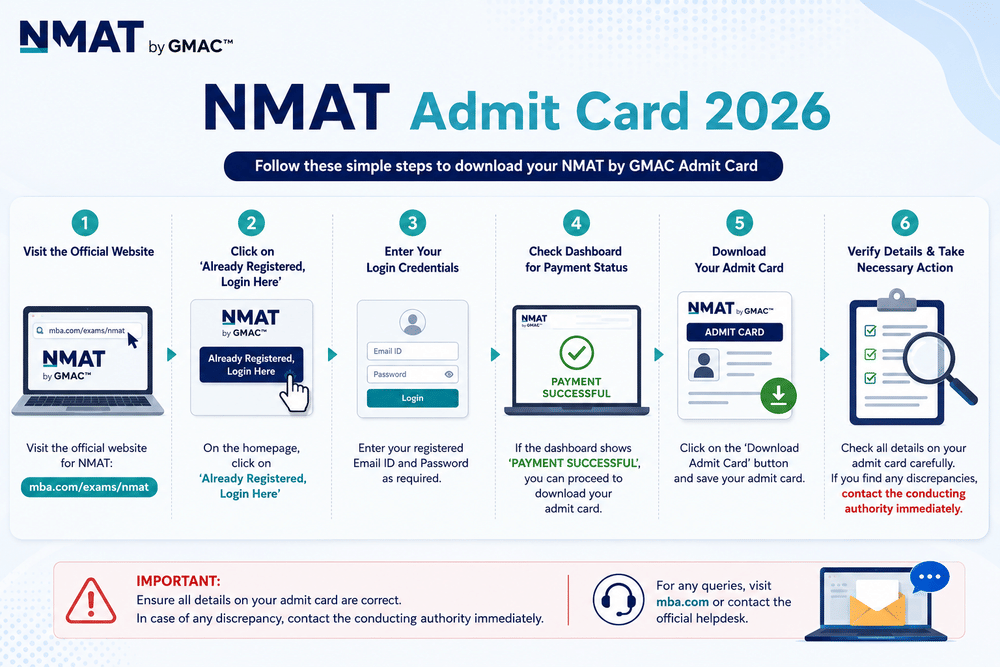
Common Problems Faced While Downloading the NMAT Admit Card
| Problems Encountered | What to Do |
|---|---|
| Server Not Responding | This problem usually occurs when there is too much traffic on the website. In such circumstances, it is best to wait and try downloading the admit card after an hour or so. |
| Slow Internet Connectivity | If your internet speed is too low, then it might be possible that downloading the admit card may either take a lot of time or not download. Make sure your internet is working fine before downloading your admit card. |
| Forgot login details | Candidates may likely forget their applicant login credentials. Firstly, candidates must make a copy of these details immediately after completing their registration to avoid such a problem. However, in case one forgets the details, one can contact the exam conducting authorities to get their details. |
NMAT Admit Card 2026: Reddit Discussion
Ques. Has anyone faced NMAT Admit Card showing wrong exam date (13 Dec 2025 booked but 14 Dec shown after download)?
Ans. Yes, many students faced this issue with the NMAT Admit Card. The date sometimes changes on the card even after booking. Contact GMAC support quickly with your booking proof.

Source: Reddit
NMAT Admit Card Sample

Details Mentioned on NMAT 2026 Admit Card
Details on the Admit Card serve as the identity proof of the applicants in the examination hall. Hence, applicants must be careful while filling out the following information-
| Name of the applicant | Date of the examination |
| Name of the applicant’s parent name | Time of the Examination |
| Registration number | Examination Venue |
| Date of Birth | Important Instructions |
| Gender | Reattempt details (if any) |
| Applicant’s photo | Category |
| Applicant’s Signature | Reporting Time |
Discrepancy in NMAT Admit Card 2026
- Email support: nmatsupport@gmac.in
- Helpline support: +91-7303719966 (Mon to Fri 10:00 to 07:00 IST)
NMAT Admit Card 2026: How to Retrieve Admit Card Login Password?
Candidates need their login details to download their Admit Card 2026 after completing the registration process. In case you forgot your login password, you can retrieve it using the option on the website. Given below are the steps to retrieve the login password for downloading the admit card:
- Visit the official website.
- Press the ‘Sign in’ tab and enter your registered email ID.
- Then, click on the ‘Forgot Password’ option.
- Follow the instructions given on the link sent on the id and create a new strong password.
- Then use the new password to download the admit card.
People Also Ask
Ques. Does GMAC send the NMAT Admit Card to the registered email of the candidate?
Ans. GMAC does not send the NMAT admit card to the registered email ID of the candidate, although it does send the direct link to download the same within 24 hours of registration. Candidates need to log in using their NMAT login ID and password to download their admit cards.
Ques. When will the NMAT 2025 Admit Card be out?
Ans. The NMAT 2025 Admit Card is released 24 hours after the completion and confirmation of NMAT by GMAC registration. It is available for download till the exam date.
Ques. Can I present the soft copy of the admit card on the day of the NMAT exam?
Ans. No, a soft copy of the admit card will not be accepted under any circumstances on the exam day. Candidates must present only the printout of the downloaded NMAT Admit Card.
Ques: Do I need to preserve my admit card till the admission process?
Ans: Yes, you need to preserve your NMAT admit card even after the conclusion of your exam as it will be required at the time of the admission process. The NMAT Admit Card is one of the documents that need to be presented during the counselling process for verification.
Ques. Will the NMAT Admit Card 2025 mention the reporting time?
Ans. Yes, your NMAT Admit Card 2025 will contain the reporting time for the exam day. NMAT exam reporting time will be 1-2 hours before the exam time. To avoid any last-minute hassles, it is advised to reach the exam center as per the reporting time.
NMAT Admit Card 2026: Online Proctored Exam (IBT Mode) Guidelines & System Requirements
As the NMAT exam is conducted in both IBT and CBT modes, candidates must be aware of the specific rules and guidelines for each mode of the examination. Mentioned below are the rules that need to be followed for taking the NMAT online proctored exam:
- Candidates must check their network and computer system readiness by using the Examity NMAT System Check.
- Candidates must ensure that they are alone in the room and that there is nothing on their desk or table.
- Use of dual monitors, phones, headphones, calculators, and other electronic items is not permitted during the exam.
- A continuous power supply is essential to take the exam. Candidates must make sure that their laptop/ PC is either fully charged or connected to a power source throughout the exam.
- Leaving the seat is not permitted, and the webcam, microphone, and speakers should be on at all times when the exam is being conducted.
- The candidate’s face should be clearly visible, hence he/ she must sit in a well-lit room.
- Ensure that all the applications running in the background are closed, and the pop-up blockers should be switched off.
- Candidates need to allow the proctor to have a 360° view of the room in which they take the exam.
- Only A4 blank sheets and pencils are allowed to be used during the exam, and the same need to be shown for verification before and after the exam.
NMAT Admit Card 2026: System & Network Requirements for NMAT Online Proctored Exam
| Particulars | Details |
|---|---|
| Operating System |
|
| Processor |
|
| RAM | Minimum 4 GB (8 GB recommended) |
| Recommended Browser | Chrome 30+ |
| Internet Speed |
|
| Webcam, Speakers, and Microphone | In-built or USB plug-in |
NMAT Admit Card 2026: Exam Day Guidelines for Test Centers
The NMAT Admit Card will also contain certain important instructions to be adhered to on the exam day. Here are some of the most important NMAT exam day guidelines:
- Candidate must not damage their NMAT Admit Card as any kind of alteration and mutilation will make the admit card invalid and hence lead to the cancellation of the candidature.
- Do not carry prohibited items like mobile phones, cameras, Bluetooth devices, digital watches, or any other papers/ documents except the admit card to the NMAT exam center.
- Carry at least 2 photocopies of the NMAT Admit Card to the examination hall along with a valid ID proof.
- All candidates are advised to reach the exam center strictly as per the reporting time mentioned on the admit card.
Also Check: NMAT 2026 Exam Day Guidelines
NMAT Admit Card 2026: Documents Required on NMAT Exam Day
Along with the issued NMAT by GMAC admit card, the applicants must also bring the following documents-
- Print out the confirmation mail sent to the applicant's registered email id
- NMAT by GMAC Admit Card 2025
- A photo and a signature ID (No photocopies are allowed; only the original document will be acceptable). Candidates can show one of the following as the photo and signature ID-
- Aadhar Card
- Voter ID Card
- Pan Card issued by the Govt of India
- Passport issued by the Govt of India
- Driving License
In case the applicant is appearing from International Centres, they must carry the following documents to the NMAT 2025 Exam Center-
- Print out the confirmation mail sent to the applicant’s registered email id
- NMAT by GMAC Admit Card
- Original valid passport which has not expired yet, and its photocopy

NMAT Admit Card 2026: Items Prohibited at NMAT Test Centers
Candidates must note that they must not carry the following materials to the test center, as these are strictly prohibited inside the NMAT exam hall.
| Pencil Box | Mobile phones and other devices like Bluetooth devices, headphones, etc. |
| Camera | Jewelry |
| Handbags/Purses/Wallets | Wristwatches |
| Any pre-written texts | Camera |
| Paper/Stationery items | Eatables of any kind |
NMAT Admit Card 2026: Exam Centres
Applicants are given a choice to select their preferred exam centers at the time of registration. NMAT by GMAC 2026 will be conducted in 76 exam centres spread across 73 cities in India.
| NMAT INDIAN EXAM CENTERS | ||||
|---|---|---|---|---|
| North | West | East | South | Central |
| Agra | Ajmer | Bhubaneswar | Bengaluru | Bhilai |
| Alwar | Aurangabad | Dhanbad | Chennai | Bhopal |
| Allahabad | Rajkot | Durgapur | Coimbatore | Indore |
| Bareilly | Ahmedabad | Guwahati | Kochi | Jabalpur |
| Chandigarh | Jaipur | Kolkata | Hyderabad | Raipur |
| Dehradun | Jalgaon | Jamshedpur | Manipal | Bilaspur |
| Faridabad | Jodhpur | Mumbai | Madurai | Gwalior |
| Ghaziabad | Kota | Patna | Mangalore | Ujjain |
| Gorakhpur | Kolhapur | Ranchi | Vizag | |
| Jammu | Mumbai | Rourkela | Mysore | |
| Jhansi | Nagpur | Siliguri | Tiruchirapalli | |
| Panipat | Nasik | Shillong | Thiruvananthapuram | |
| Delhi | Pune | Vijayawada | ||
| Gurugram | Surat | |||
| Greater Noida | Udaipur | |||
| Kanpur | Vadodara | |||
| Lucknow | ||||
| Ludhiana | ||||
| Varanasi | ||||
| Patiala | ||||
| Noida | ||||
NMAT Admit Card FAQs
Ques: If there is any discrepancy regarding the admit card, whom should I contact?
Ans: If there is any discrepancy in your NMAT by GMAC admit card, then you can contact the exam conducting authority at 7303719966 or nmatsupport@gmac.com.
Ques: What details are written on the NMAT Admit Card 2026?
Ans: NMAT Admit Card contains important details like the candidate’s name, application number, test center, test date & time, course, category, reporting time, and exam day instructions.
Ques: What are the photo ID proofs that a student must carry to the examination along with the NMAT Admit Card?
Ans: Candidates need to carry one original ID proof and a printout of the confirmation mail, which is sent to the candidate at their respective email ID, along with the admit card.
Ques. Can I download the NMAT 2026 Admit Card on the day of the exam?
Ans. Yes, you can download the NMAT Admit Card 2025 on the day of the exam. But to avoid any technical difficulties or problems, you should download it at least two to three days before the exam.
Ques. Will I get the hard copy of the NMAT Admit Card 2026 via post?
Ans. No hard copy of the NMAT Admit Card 2025 will be issued by the concerned exam conducting authority. All the candidates have to download their admit cards only via online mode.
Ques. Do I need to put my signature on the downloaded NMAT Admit Card?
Ans. No, you do not need to put any signature on the NMAT 2025 Admit Card. You will be asked to do the same in the presence of the invigilator at the exam hall.
Ques. Is it mandatory to bring the admit card for the GD and PI rounds?
Ans. Yes, all the candidates will have to mandatorily bring the downloaded NMAT Admit Card on the day of GD and PI, as it is a prerequisite for the NMAT selection process.
Ques. Do I need to affix any photograph on the Admit Card before appearing for the NMAT 2026 exam?
Ans. No, you do not need to affix any photograph on the NMAT Admit Card 2025 for the exam. You can carry your recent passport-size photograph along with the admit card and an ID on the day of the exam.
Ques. Who will be responsible for issuing the Admit Card for NMAT 2026?
Ans. NMAT Admit Card 2026 will be issued by the Graduate Management Admission Council (GMAC) as per the rules set by the authorities.
Books
Since GMAC has not announced an official syllabus, selecting the right NMAT Books 2026 is an important part of exam preparation. The Graduate Management Admission Council (GMAC) publishes the only official guide and practice exams at mba.com/exams/nmat.
- How to Prepare for Quantitative Aptitude for CAT by Arun Sharma and Quantitative Aptitude for Competitive Examinations by R.S. Aggarwal are useful for building NMAT concepts and speed.
- Word Power Made Easy by Norman Lewis and High School English Grammar & Composition by Wren & Martin help improve vocabulary, grammar, and reading skills.
- A Modern Approach to Logical Reasoning by R.S. Aggarwal and Analytical Reasoning by M.K. Pandey are good choices for practising reasoning questions.
- Along with these NMAT books, solve the Official NMAT by GMAC Practice Tests to get familiar with the actual exam pattern and improve time management.
Related Links:
- NMAT Syllabus 2026: Check Latest Section-Wise Key topics, Download Syllabus PDF, Books & Preparation Tips
- Best Books for NMAT 2026 Preparation: Language Skills, Quant, and Logical Reasoning
- NMAT 2026 Best Books for Preparation: Section-Wise Guide
Key Summary
- NMAT has no official syllabus, so books are chosen from past paper trends.
- The NMAT by GMAC Official Guide is the single most reliable book for the exam.
- Arun Sharma and R.S. Aggarwal's titles cover Quant and Logical Reasoning fully.
- Word Power Made Easy by Norman Lewis remains the top pick for vocabulary.
- Each section is scored on a 12 to 120 scale, with a total range of 36 to 360.
- Buy one book per section, then shift to mocks by early October 2026.
NMAT Books 2026 Overview
Since the NMAT by GMAC does not publish a fixed syllabus, the book list comes from the official guide and past exam patterns.
- Start with a concept-building book like “How to Prepare for Quantitative Aptitude for CAT” by Arun Sharma, then move on to practice questions and mock tests.
- Choose the latest edition of books such as “A Modern Approach to Logical Reasoning” by R.S. Aggarwal to practise updated question types and examples.
- Use one or two trusted NMAT books for each section instead of studying from too many sources.
- Revise important topics regularly and solve chapter-wise exercises to improve speed and accuracy.
Also Check: NMAT Exam Analysis 2026: Check Overall & Section-wise Difficulty Level Analysis
NMAT Books 2026: Section-Wise Best Books
The table below lists the most used NMAT books across all three sections. Pick one primary book per section and treat the rest as backup practice.
Best Books for NMAT 2026 (All Sections)
| Book Name | Author / Publisher | Why This Book |
|---|---|---|
| NMAT by GMAC Exam Official Guide | GMAC / Wiley | Only book with real past NMAT questions and detailed answer explanations covering all sections. |
Best Books for NMAT 2026 Quantitative & DI Skills
| Book Name | Author / Publisher | Why This Book |
|---|---|---|
| How to Prepare for Quantitative Aptitude for the CAT | Arun Sharma / McGraw-Hill | Level of Difficulty 1 and 2 questions closely match the NMAT exam. |
| Quantitative Aptitude for Competitive Examinations | R.S. Aggarwal / S. Chand | Ideal for arithmetic practice, concept building, and formula revision. |
| How to Prepare for Data Interpretation for the CAT | Arun Sharma / McGraw-Hill | Covers data interpretation caselets and data sufficiency questions asked in NMAT. |
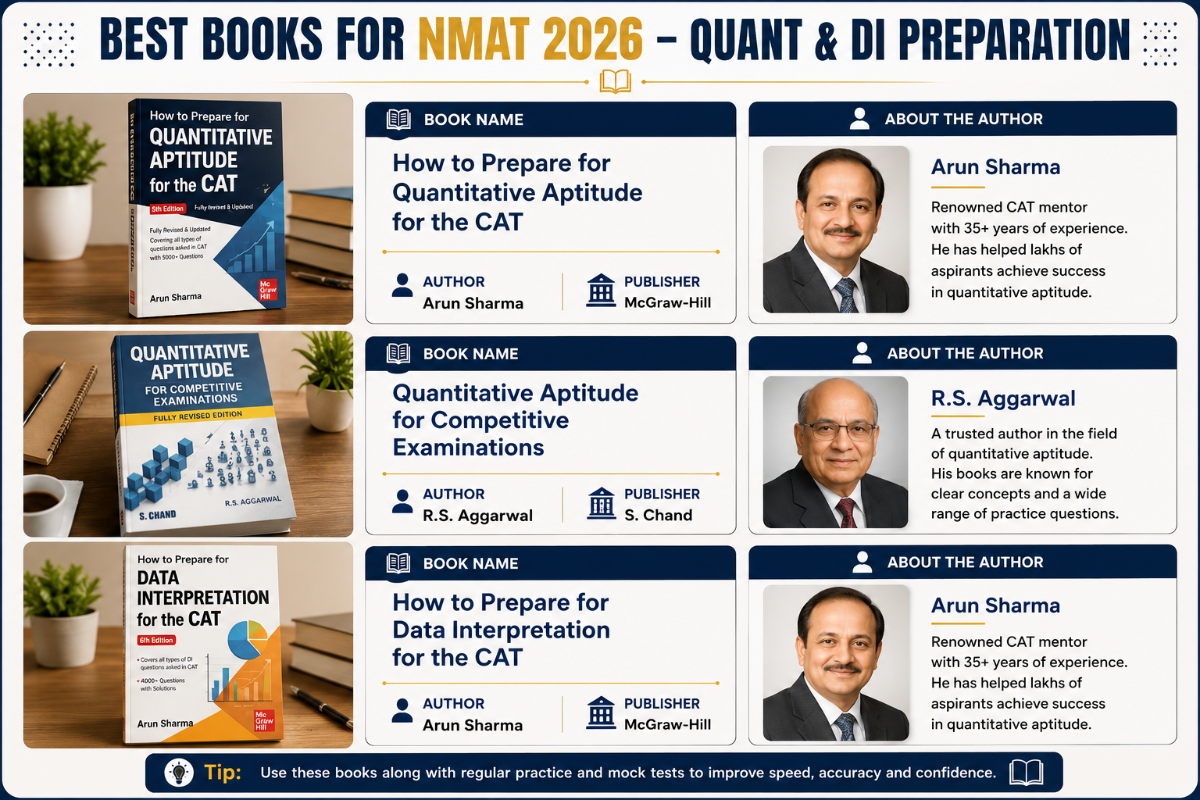
Best Books for NMAT 2026 Language Skills
| Book Name | Author / Publisher | Why This Book |
|---|---|---|
| Word Power Made Easy | Norman Lewis / Goyal Publishers | Improves vocabulary through synonyms, analogies, and word-building exercises. |
| Objective General English | S.P. Bakshi / Arihant | Comprehensive practice for grammar, error spotting, and sentence correction. |
Best Books for NMAT 2026 Logical Reasoning
| Book Name | Author / Publisher | Why This Book |
|---|---|---|
| A Modern Approach to Logical Reasoning | R.S. Aggarwal / S. Chand | Covers verbal reasoning and analytical reasoning concepts commonly tested in NMAT. |
| Logical Reasoning and Data Interpretation for the CAT | Nishit K Sinha / Pearson | Excellent resource for puzzles, seating arrangements, and critical reasoning practice. |
Also Check:
- NMAT 2026 Chapter-Wise Weightage: Most Important Topics in Language Skills, Quantitative Skills, and Logical Reasoning
- NMAT Mock Test 2026
- Best Books for NMAT 2026 Preparation: Language Skills, Quant, and Logical Reasoning
NMAT Books 2026: Best Books for NMAT Quantitative Skills 2026
Quantitative Skills has 36 questions in 52 minutes.
- That gives students roughly 86 seconds per question.
- The section mixes arithmetic, algebra, geometry, modern maths, data interpretation, and data sufficiency.
- Arithmetic alone accounts for the largest share of NMAT Quant questions, so it’s better to start from here.
| Book Name | Author | Best For |
|---|---|---|
| How to Prepare for Quantitative Aptitude for the CAT? | Arun Sharma | Concept building plus graded practice sets |
| Quantitative Aptitude for Competitive Examinations | R.S. Aggarwal | Arithmetic volume practice and speed |
| Quantum CAT | Sarvesh K Verma | Shortcut methods and time-saving techniques |
| How to Prepare for Data Interpretation for the CAT | Arun Sharma | DI sets, tables, and data sufficiency |
| Quantitative Aptitude for MBA Entrance Examinations | Abhijit Guha | Extra practice for algebra and modern maths |
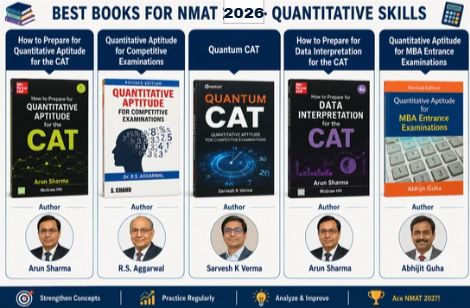
Topics to Prioritise in Quant Books
| Topic Category | Important Topics |
|---|---|
| Arithmetic | Number System, Percentage, Profit and Loss, Ratio and Proportion |
| Time & Work | Time, Speed and Distance, Time and Work, Averages, Mixtures and Alligations |
| Algebra | Simple and Compound Interest, Algebra, Linear Equations, Quadratic Equations |
| Geometry & Modern Maths | Geometry, Mensuration, Permutation and Combination, Probability |
| Data Interpretation & Logical Maths | Data Interpretation (DI), Data Sufficiency, Venn Diagrams, Logarithms |
Also Check:
NMAT Books 2026: Best Books for NMAT Language Skills 2026
Language Skills has 36 questions in only 28 minutes.
- This is the fastest section of the exam.
- Students get under 47 seconds per question, so their reading speed decides their score.
- Read one editorial and one long-form article every day alongside these books.
- No grammar book can build reading speed on its own.
The section covers reading comprehension, grammar, vocabulary, para jumbles, and sentence completion.
| Book Name | Author | Best For |
|---|---|---|
| Word Power Made Easy | Norman Lewis | Vocabulary, synonyms, antonyms, and analogies |
| Objective General English | S.P. Bakshi | Grammar rules, error spotting, and sentence correction |
| High School English Grammar and Composition | Wren and Martin | Fixing weak grammar fundamentals from scratch |
| How to Prepare for Verbal Ability and Reading Comprehension for the CAT | Arun Sharma and Meenakshi Upadhyay | RC passage practice and para jumbles |
| English Language Comprehension Skills | Sachchida Nand Jha | Additional RC and comprehension drills |
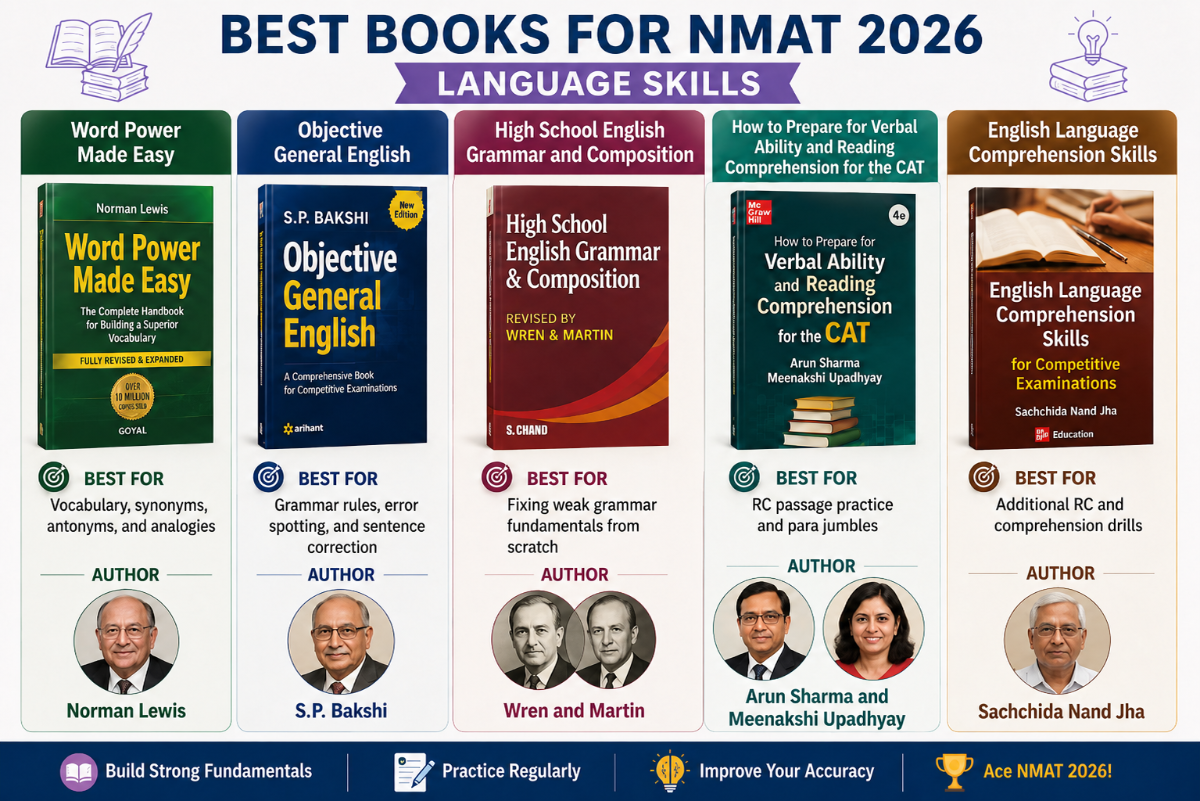
Also Check: NMAT Language Skills Sample Papers 2026: Last 5 Years PYQs PDF Download and Topic Wise Weightage
NMAT Books 2026: Best Books for NMAT Logical Reasoning 2026
Logical Reasoning gives you 36 questions in 40 minutes.
- The section splits into verbal reasoning and analytical reasoning.
- Verbal reasoning includes critical reasoning, statement and assumption, and course of action questions.
| Book Name | Author | Best For |
|---|---|---|
| A Modern Approach to Logical Reasoning | R.S. Aggarwal | Verbal and non-verbal reasoning basics |
| Logical Reasoning and Data Interpretation for the CAT | Nishit K Sinha | Arrangements, puzzles, and set-based questions |
| How to Prepare for Logical Reasoning for the CAT | Arun Sharma | Critical reasoning and structured practice sets |
| Analytical Reasoning | M.K. Pandey | Syllogisms, assumptions, and inference questions |
| Logical and Analytical Reasoning | Ashok Gupta | Mixed practice across both reasoning types |
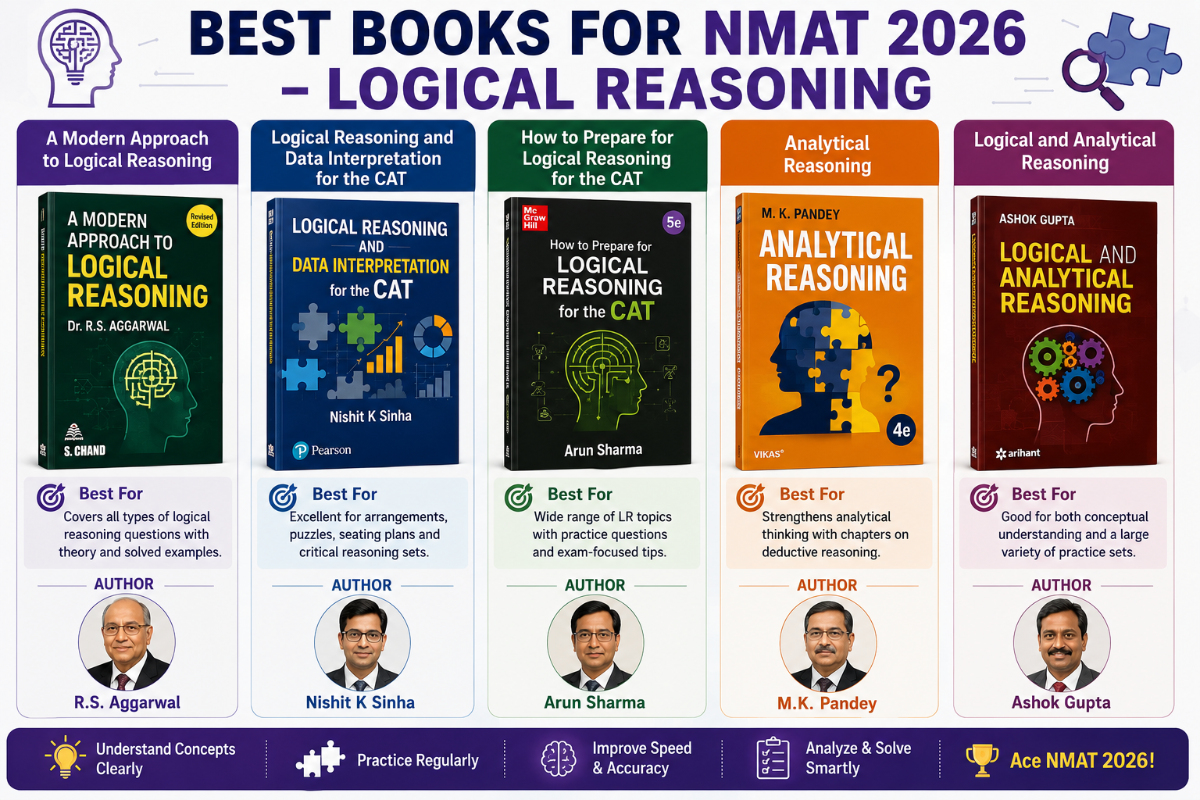
Topics to Prioritise in NMAT Logical Reasoning Books
| Topic Category | Important Topics |
|---|---|
| Arrangements & Puzzles | Linear and Circular Arrangements, Seating Arrangements, Matrix-based Puzzles |
| Analytical Reasoning | Blood Relations, Coding-Decoding, Number and Alphabet Series |
| Verbal Reasoning | Syllogisms, Statement and Conclusion, Statement and Assumption |
| Critical Reasoning | Critical Reasoning, Strong and Weak Arguments, Course of Action |
| Miscellaneous Reasoning | Input and Output, Calendars, Clocks, Direction Sense |
Also Check: NMAT Logical Reasoning Sample Papers 2026: Last 5 Years PYQs PDF Download and Topic Wise Weightage
NMAT Previous Year Papers
| Subject | Question Paper | Answer Key |
|---|---|---|
| Quantitative | Download | Download |
| Language | Download | Download |
| Logical Reasoning | Download | Download |
NMAT by GMAC Official Guide 2026
Among the top NMAT Books 2026, the NMAT by GMAC Exam Official Guide is the only book written by the body that conducts the exam.
It carries real questions from past NMAT papers with answer keys and explanations.
| Feature | Details |
|---|---|
| Published By | Graduate Management Admission Council (GMAC) |
| Past Exam Questions | 264 questions from past NMAT papers, including 173 new questions |
| Additional Practice | 475 extra questions with answer keys and explanations |
| Sections Covered | Language Skills, Quantitative Skills, Logical Reasoning |
| List Price | Around USD 19.99, subject to change |
| Where to Buy | mba.com and major online booksellers |
NMAT Books 2026: Can You Use CAT Books for NMAT 2026?
Yes, and most students do. CAT books cover every NMAT topic and more. The catch is the difficulty of calibration.
If you are already preparing for CAT, you do not need to buy a separate set of NMAT books. Add only the official guide and shift your practice to timed drills.
| Aspect | CAT | NMAT |
|---|---|---|
| Difficulty Level | High | Moderate |
| Negative Marking | Yes | No |
| Time Per Question | Around 100 seconds | Around 67 seconds |
| Question Type | Depth focused | Speed focused |
| Book Sets to Use | All difficulty levels | Level 1 and Level 2 only |
How to Choose the Right NMAT Books 2026?
One well-used book beats five half-read ones. Finish one book per section before you buy a second.
| What to Check | Why It Matters |
|---|---|
| Topic Coverage | Ensure the book covers all the topics asked in previous NMAT papers. |
| Difficulty Level | Choose books with questions that match the NMAT difficulty level instead of advanced-only problems. |
| Solved Explanations | Prefer books with detailed step-by-step solutions to understand concepts better. |
| Practice Questions | Look for chapter-wise exercises along with at least one full-length practice test. |
| Latest Edition | Buy the most recent edition available in 2026 to get updated content and practice questions. |
NMAT Mock Tests and Practice Material 2026
Books build concepts. Mocks build the timing sense that NMAT actually rewards.
- GMAC offers official practice exams built from past NMAT questions.
- Take at least eight full-length mocks before your first NMAT attempt.
- Students get three attempts in one cycle, so your first attempt can also work as a calibration run.
| Practice Material | Questions | Cost |
|---|---|---|
| Official Practice Exam 1 | 108 | Free with registration |
| Official Practice Exams 2 and 3 | 216 combined | Rs 1,099 plus taxes |
| NMAT Official Guide question bank | 739 total | Included with the book |
Check:
NMAT Books 2026: How to Use Them in a Study Plan?
With registration expected in early August and the exam window from November 5, you get roughly three months. Split your book work across three phases.
| Month / Phase | Main Focus | Recommended Books & How to Use | Weekly Activities | Goals & Tips |
|---|---|---|---|---|
| Month 1 (Foundation) | Build basics & understand exam | • Official Guide (start here) • Norman Lewis (Vocab) • R.S. Aggarwal (Quant + LR basics) • Wren & Martin (Grammar) | • 2–3 hrs per section daily • Topic-wise practice • 1 sectional test per week | Know your weak areas. Finish fundamentals |
| Month 2 (Core Concepts) | Complete syllabus & practice | • Arun Sharma (Quant & LR advanced) • S.P. Bakshi / Arun Sharma (Language) • Nishit K. Sinha (LR) | • Heavy topic-wise practice • 2 sectional tests/week • Maintain error notebook | Improve speed & accuracy |
| Month 3 (Intensive Practice) | Sectional tests & revision | • Official Guide past questions • All books for targeted practice | • 2–3 sectional tests/week • Full analysis of mistakes | Aim for 85%+ accuracy in sections |
| Month 4 (Final Revision & Mocks) | Full mocks & peak performance | • Official Mocks + Test Series • Quick revision from all books | • 2 Full Mocks per week • Light revision + rest | Target 240+ score, Finalize exam strategy |
NMAT Books 2026: Common Mistakes While Selecting NMAT Preparation Books
Choosing the right NMAT Books 2026 is just as important as creating a study plan. Many aspirants spend time on books that are either too difficult or do not cover the latest NMAT syllabus and question pattern.
Before buying NMAT Books 2026, avoid these common mistakes to make your preparation more focused and effective.
| Common Mistake | Why It's a Problem? | Solution |
|---|---|---|
| Buying Too Many Books | Causes confusion and incomplete preparation. | Use 1–2 books per section plus the Official NMAT Guide. |
| Ignoring Official NMAT Resources | Misses the actual exam pattern and question style. | Start with the NMAT by GMAC Official Guide. |
| Depending on One Book | One book cannot cover everything. | Combine books for concepts and practice. |
| Using Outdated Books | May not match the latest NMAT pattern. | Buy the latest 2025–2026 editions. |
| Relying Only on CAT Books | CAT books are often tougher than NMAT. | Use CAT books with NMAT-specific books and mocks. |
| Collecting Instead of Studying | Too many resources waste time. | Follow a fixed study plan with selected books. |
Expert Tips to Use NMAT Books 2026 Effectively
Choosing the right NMAT Books 2026 is only the first step—how you use them matters even more. Focus on mastering one book at a time, revise regularly, and pair your preparation with sectional mocks to improve speed, accuracy, and familiarity with the actual NMAT exam pattern.
| Tip | How to Apply |
|---|---|
| Follow the 3-Stage Approach | • Stage 1 (Learning): Read theory + solve basic examples. • Stage 2 (Practice): Solve medium to hard questions with a timer. • Stage 3 (Revision): Re-solve only marked difficult questions + maintain error log. |
| Don’t Just Read — Apply Immediately | After finishing a chapter, solve at least 50 questions from that topic on the same day. |
| Create Your Own Notes | • Formula sheet for Quant • Vocab notebook (Word + Root + Example) • LR shortcut techniques |
| Weekly Revision Rule | Every Sunday, revise one old chapter from each section using your notes and marked questions. |
| Mix Books with Mocks | Use books for concept building & topic-wise practice. Use Official Mocks + Test Series for exam-like simulation. |
| Track Your Progress | Maintain a simple tracker: • Topic → Questions Solved → Accuracy → Time Taken |
| Avoid the Common Trap | Don’t keep jumping between books. Finish one resource properly before starting another. |
You can also refer to this video for a clearer explanation
NMAT Books 2026: Quora Discussions
Ques. A candidate on Quora was asking, “Is the NMAT book sufficient to crack NMAT?”
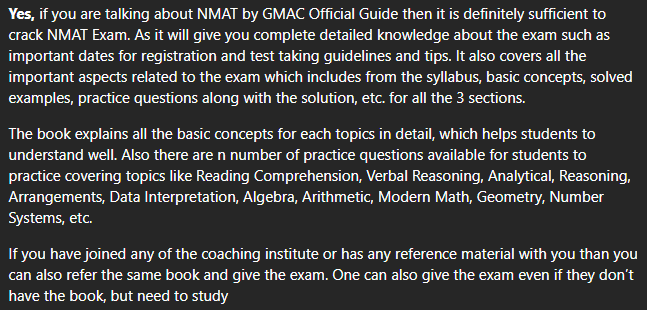
NMAT Books 2026 FAQs
Ques. Which is the best book for NMAT 2026?
Ans. The NMAT by GMAC Exam Official Guide is the best single book, because it carries real past NMAT questions with explanations. Pair it with one section book each for Quant, Language, and Logical Reasoning.
Ques. Is the NMAT Official Guide enough for the exam?
Ans. No, the official guide is a benchmark and practice resource, not a concept builder. Use a standard section book first if your basics are weak, then move to the guide.
Ques. Is 2 months enough for NMAT?
Ans. Yes, 2 months are enough for NMAT if you follow a structured study plan and prepare consistently for 2–3 hours daily. Focus on completing the syllabus, revising concepts, and taking regular mock tests to improve speed and accuracy.
Ques. What are the best books for NMAT Quantitative Skills?
Ans. How to Prepare for Quantitative Aptitude for the CAT by Arun Sharma, Quantitative Aptitude for Competitive Examinations by R.S. Aggarwal, and How to Prepare for Data Interpretation for the CAT by Arun Sharma.
Ques. What are the best books for NMAT Language Skills?
Ans. Word Power Made Easy by Norman Lewis for vocabulary and Objective General English by S.P. Bakshi for grammar. Wren and Martin help if your grammar base is weak.
Ques. What are the best books for NMAT Logical Reasoning?
Ans. A Modern Approach to Logical Reasoning by R.S. Aggarwal and Logical Reasoning and Data Interpretation for the CAT by Nishit K Sinha cover both verbal and analytical reasoning.
Ques. How many books do I need for NMAT 2026?
Ans. Three-section books plus the official guide are enough. Buying more books usually reduces the number you actually finish.
Ques. Does GMAC provide free NMAT practice material?
Ans. Yes. Official Practice Exam 1 with 108 questions is free once you register. Practice Exams 2 and 3 cost Rs 1,099 plus applicable taxes.
Ques. Can I clear NMAT in 1 month?
Ans. Yes, you can clear NMAT in 1 month if your basics are already strong and you study consistently every day. Prioritise high-weightage topics, practice sectional tests, and take full-length mocks to maximise your score.
Ques. When should I start reading NMAT books for the 2026 exam?
Ans. Start by August 2026. That gives you three clear months before the expected exam window opening on November 5, 2026.
Ques. Are coaching study materials better than NMAT books?
Ans. Coaching materials add structure and mock tests, but standard books cover the same topics. Students who self-study successfully usually combine one book per section with official practice exams.
Coaching Institutes
NMAT by GMAC is one of the management aptitude tests, conducted to select students for admission to India’s top B-Schools like NMIMS. The exam is conducted by GMAC (Graduate Management Admission Council). NMAT 2025 is to be conducted from November 5 to December 20, 2025. Check NMAT Exam Dates 2025.
- NMAT exam pattern is similar to GMAT, but is conducted differently. The exam will be conducted for a duration of 2 hours. The three sections in NMAT 2025 are - Quantitative Skills, Language Skills and Logical Reasoning. Check NMAT Exam Pattern 2025
- NMAT 2025 Question Paper will consist of a total of 108 MCQs with 36 questions in each section. Check NMAT Syllabus 2025
- To be eligible to appear for NMAT, candidates should have completed a Bachelor’s degree with at least 50% aggregate marks. Check Detailed NMAT Eligibility
- The test window for NMAT is 75 days a year, and a candidate can apply for a retake within this test window a maximum of three times.
Read this article to know more about NMAT online coaching centres and online preparations.
| Table of Contents |
NMAT Online Coaching Classes
Candidates preparing for NMAT exam can come across numerous NMAT online coaching centres as well as offline. These coaching centres are meant to provide assistance and help to aspiring candidates to crack the NMAT Exam. Here is what you can find at a good NMAT coaching centre.
- Expert assistance from experienced tutors and sessions like doubt-solving, revisions, etc.
- NMAT Books, study materials and previous year’s question papers to help the candidate familiarise themselves with the patterns and type of questions asked in NMAT.
- Guidance classes and guest sessions with previous year NMAT toppers for building confidence levels.
- Wise and well-organized working plans and study timetables to divide time and attention equally to all the topics in the NMAT Syllabus.
- Some of the online NMAT Coaching classes include- hitbullseye, time4education, careerlauncher, careeranna, CATKing.
NMAT Coaching Centres in Delhi
Delhi is the prime location for many things, and the case of the best coaching centres is no different. The capital city houses some of the best NMAT coaching centres with high success ratios. Here are the top 3 NMAT coaching centres in Delhi.
| Name of Coaching Centre | Address | Website | E-mail & Phone | Rating |
|---|---|---|---|---|
| Rocket Tutor | Okhla, New Delhi | www.rocket-tutor.com | support@rockettutor.com | 4/5 |
| Teachwell Pvt Ltd | DC Chowk, Sector-9, Rohini | www.teachwellpvtltd.com | teachwell@gmail.com 011-27860899 | 4.1/5 |
| TutorComp | Okhla, New Delhi | www.tutorcomp.com | info@tutorcomp.com | 4/5 |
Also Read:
NMAT Coaching Centres in Bengaluru
Bengaluru, the fastly growing tech hub of India, is also one of the hubs of higher education in South India. A few of the top NMAT coaching centres and their details are provided below.
| Name of Coaching Centre | Address | Website | E-mail & Phone | Rating |
|---|---|---|---|---|
| Giraffe Learning | Cunningham Road, Bengaluru | www.giraffe-learning.com | idea.worldwide2@gmail.com 8048070407 | 4/5 |
| IMS Learning Resources Pvt.Ltd | Koramangala, Bengaluru | www.imsindia.com | koramangala@imsindia.com 8043692602 | 3.9/5 |
| Competition Forum | 5th Block, Bengaluru | www.competitionforum.com | cfbengaluru@gmail.com 8043691687 | 3.5/5 |
NMAT Coaching Centres in Chennai
As Bangalore, Chennai is also one of the big cities housing many coaching centres including NMAT coaching centres. Many top and well-qualified instructors and institutes are available in Chennai and we’ve picked up a few of the best NMAT coaching centres in Chennai for you.
| Name of Coaching Centre | Address | Website | E-mail & Phone | Rating |
|---|---|---|---|---|
| Prime Education Providers | Anna Nagar, Chennai | www.vistamind.com | primeeducationproviders@gmail.com +91 44 46294299 | 4.5/5 |
| VPROV | Anna Nagar, Chennai | www.vprov.com | infochennai@vprov.com +91 44 46294288 | 4/5 |
| Career Launcher India | T.Nagar, Chennai | www.carrerlauncher.com | Chennai.cl@carrerlauncher.com +91 44 49852746 | 4/5 |
Must Read:
- NMAT Language Skills Preparation
- NMAT Logical Reasoning Preparation
- NMAT Quantitative Aptitude Preparation
NMAT Coaching Centres in Kolkata
Kolkata, the main city of eastern-most India and the centre for advanced facilities and opportunities for that side of India also has some of the best NMAT coaching centres. Check out these coaching classes to crack your NMAT exam.
| Name of Coaching Centre | Address | Website | E-Mail & Phone | Rating |
|---|---|---|---|---|
| Eduwest Institute | Salt Lake City, Kolkata | www.eduwest.in | eduwest.institute@gmail.com +91 33 33147395 | 4.3/5 |
| Erudite Coaching Center | Mansarovar Apartment, Camac Street | www.erudite.in | cat.sulekha@erudite.in +91 33 33254021 | 3.5/5 |
| Diksha Learning Services | Gariahat, Kolkata | www.consultdiksha.com | consultdiksha@gmail.com +91 33 30696015 | 4.2/5 |
Aspirants who are planning to appear for the NMAT exam are advised to find themselves a good and convenient NMAT coaching centre to prepare. Along with self-preparation for NMAT, having expert guidance can prove to be of great help for national-level competitive exams like NMAT.
As the country is hit by the pandemic, students can also opt for NMAT online coaching centres or classes to prepare rigorously in the safety of home. Another important benefit of opting for coaching centres is that you can get NMAT online preparations and study materials, curated by the experts of each subject. Choose your preparation and practice schedule wisely and have the best shot at cracking NMAT with flying colours.
Exam Centers
NMAT by GMAC 2026 Exam Centers list has been announced as part of the official NMAT 2026 notification released by GMAC. The exam is scheduled to be held across 79 test cities in India and in 4 international countries from November 5 to December 19, 2026. Unlike most national entrance exams, NMAT by GMAC does not allot a fixed exam center to candidates. After completing registration, each candidate self-schedules their preferred test city, date, and time slot through the NMAT candidate dashboard - slots are allocated on a first-come-first-served basis. All details related to the candidate’s NMAT exam center, venue, date, and time will be available on the NMAT Admit Card 2026, released seven days before the scheduled exam date.
| Direct Link to NMAT 2026 Test Center Scheduling (Soon) |
NMAT Exam Centers 2026
GMAC is going to conduct NMAT by GMAC 2026 across 79 cities in India as well as in 4 international countries. Candidates can choose their preferred test city, exam date, and time slot during the scheduling window through the NMAT candidate dashboard at mba.com/exams/nmat. Scheduling operates on a first-come-first-served basis; candidates who register early and schedule promptly are more likely to secure their preferred test city and date within the November 5 to December 19, 2026 exam window.
Tabulated below are confirmed NMAT 2026 exam center cities in India:
| 1 | Agra | 15 | Gurgaon | 29 | Mumbai |
| 2 | Ahmedabad | 16 | Guwahati | 30 | Mysuru |
| 3 | Amravati | 17 | Hyderabad | 31 | Nagpur |
| 4 | Aurangabad | 18 | Indore | 32 | Nashik |
| 5 | Bengaluru | 19 | Jaipur | 33 | Noida |
| 6 | Bhopal | 20 | Jammu | 34 | Patna |
| 7 | Bhubaneswar | 21 | Jamshedpur | 35 | Pune |
| 8 | Chandigarh | 22 | Kolhapur | 36 | Raipur |
| 9 | Chennai | 23 | Kolkata | 37 | Rajkot |
| 10 | Coimbatore | 24 | Kozhikode | 38 | Ranchi |
| 11 | Delhi | 25 | Lucknow | 39 | Surat |
| 12 | Ernakulam | 26 | Ludhiana | 40 | Vadodara |
| 13 | Faridabad | 27 | Madurai | 41 | Varanasi |
| 14 | Ghaziabad | 28 | Mangaluru | 42 | Visakhapatnam |
Note: The table above lists confirmed NMAT 2026 test cities. The complete list of all 79 cities is available on the official NMAT website. Slot availability at each city is subject to capacity and is offered on a first-come-first-served basis. GMAC and Pearson VUE reserve the right to add or modify test center locations.
NMAT 2026 International Exam Centers
NMAT by GMAC 2026 is also available in 4 countries outside India through authorised Pearson VUE test centers. International candidates can choose from the following locations during the scheduling window:
| S.No | Country | City |
| 1 | Bangladesh | Dhaka |
| 2 | Bhutan | Thimphu |
| 3 | Nepal | Kathmandu |
| 4 | Sri Lanka | Colombo |
NMAT 2026 Online Proctored Delivery
In addition to physical Pearson VUE test centers, NMAT by GMAC 2026 offers an Online Proctored delivery option as part of its 2026 notification. This mode allows eligible candidates to take the exam from home through a supervised online interface - without travelling to a physical test center. The online proctored mode is primarily available for candidates residing outside India (Rest of World). India-based candidates must appear at an authorised Pearson VUE test center within the 79 cities announced in the notification.
| Parameter | Online Proctored Mode Details |
| Test format | Same as test center delivery (3 sections: Language Skills, Quantitative Skills, Logical Reasoning) |
| Login requirement | Log in to the exam platform 30 minutes before scheduled exam time |
| Proctoring | Online, recorded, and audited for prohibited practices |
| Eligibility | Primarily for candidates residing outside India (Rest of World) |
| Technical requirement | Stable internet connection, functioning webcam, quiet private room |
Note: Candidates must check the official NMAT by GMAC website for the complete system requirements, test environment guidelines, and eligibility criteria before selecting the Online Proctored mode at the time of scheduling.
How to check NMAT Exam Center 2026 Allotted?
NMAT by GMAC 2026 does not follow the traditional center allotment model used by NTA or state CET conducting bodies. After completing registration, each candidate self-schedules their exam by choosing a preferred test city, date, and time slot through the NMAT candidate dashboard. Scheduling is on a first-come-first-served basis, and popular test cities tend to fill up quickly. Candidates are strongly advised to complete registration early and schedule their exam as soon as the scheduling window opens, to secure seats in their preferred city.
Once scheduling is complete, GMAC sends a confirmation email to the registered email address. The specific test center address within the chosen city is confirmed on the NMAT Admit Card 2026, which becomes available seven days before the scheduled exam date.
Steps to schedule and check the NMAT 2026 exam center are as follows:
- Step 1: Visit the official website of NMAT by GMAC.
- Step 2: Log in to the NMAT 2026 candidate dashboard using the registered email ID and password.
- Step 3: Click on the "Schedule Exam" tab visible on the dashboard.
- Step 4: Choose a preferred test city from the list of available NMAT 2026 exam center cities.
- Step 5: Select a preferred exam date and time slot based on real-time availability at the chosen city.
- Step 6: Confirm the booking. GMAC will send a confirmation email to the registered email address once scheduling is complete.
- Step 7: Download the NMAT Admit Card 2026 from the candidate dashboard seven days before the scheduled exam date to view the exact test center address, reporting time, and exam slot details.
Note: Candidates are required to appear for the NMAT 2026 test on the scheduled date and time at the chosen exam venue. Seats at preferred test cities are limited and offered on a first-come-first-served basis.
NMAT 2026 Exam Center Change: Is It Allowed?
NMAT by GMAC 2026 allows candidates to reschedule their exam after the initial scheduling. Rescheduling includes the option to change the test city, exam date, and time slot. However, rescheduling is subject to slot availability at the new preferred center and requires payment of a reschedule fee. Candidates cannot make changes after the rescheduling deadline announced by GMAC.
| Parameter | Details |
| Is center change allowed? | Yes, through the Reschedule option in the NMAT candidate dashboard |
| Reschedule fee | Applicable (check official NMAT website for current fee amount) |
| Availability at new center | Subject to available slots at the preferred new test city |
| Deadline for changes | Before the rescheduling window closes (as announced by GMAC) |
| After the deadline | No center or date changes are permitted |
Note: Candidates must choose their preferred NMAT test city carefully at the time of initial scheduling. Each rescheduling request attracts a fee, and availability at the new preferred center cannot be guaranteed.
NMAT 2026 Exam Day Instructions
Candidates must follow these instructions at the NMAT 2026 exam center on the day of the exam:
- Carry at least two printed copies of the NMAT Admit Card 2026 to the exam center. Entry will not be permitted without the admit card.
- Carry a valid government-issued photo ID proof - Passport, PAN Card, Voter ID, or Aadhaar Card. Candidates who do not produce a valid photo ID will not be allowed to appear for the exam.
- Carry a printout of the GMAC scheduling confirmation email as additional proof of registration and slot booking.
- Report to the NMAT exam center at least 45 minutes before the scheduled exam time. Arriving 90 minutes early is recommended to complete biometric registration and check-in formalities without any last-minute rush.
- If possible, visit the NMAT exam center one day before the exam to identify the exact location and route.
- Mobile phones, smartwatches, calculators, Bluetooth devices, and all electronic gadgets are strictly prohibited inside the exam hall. Deposit such items at the designated storage area at the center before entering.
- Parents, friends, and guardians are not permitted inside the NMAT exam center at any point during the exam.
- Rough sheets will be provided at the exam center. Do not bring external stationery or rough paper. All rough sheets must be submitted to the invigilator before leaving the hall.
- Do not sign the NMAT Admit Card before the invigilator instructs you to do so at the center.
- After the exam begins on screen, accept the Non-Disclosure Agreement (NDA) before proceeding. Choose the preferred section order at the start of the test - this choice cannot be changed once confirmed.
- All NMAT 2026 exam centers are under CCTV surveillance. Any malpractice or violation of exam rules will result in immediate disqualification.
NMAT Exam Center 2026 FAQs
Ques. In how many cities is NMAT 2026 being conducted?
Ans. NMAT by GMAC 2026 is being conducted across 79 cities in India and in 4 international countries - Bangladesh (Dhaka), Bhutan (Thimphu), Nepal (Kathmandu), and Sri Lanka (Colombo). The complete city list is available on the official NMAT website at mba.com/exams/nmat.
Ques. How is the NMAT 2026 exam center selected or allotted?
Ans. Unlike most national entrance exams, NMAT by GMAC does not allot exam centers to candidates. After completing registration, each candidate logs in to the NMAT candidate dashboard and uses the Schedule Exam feature to choose a preferred test city, date, and time slot. Scheduling is on a first-come-first-served basis, and seats at popular test cities tend to fill up quickly.
Ques. Can I change my NMAT 2026 exam center after scheduling?
Ans. Yes. NMAT by GMAC 2026 allows candidates to reschedule their exam, which includes a change of test city, date, or time slot. Rescheduling requires payment of a reschedule fee and is subject to slot availability at the preferred new center. Changes are not permitted after the rescheduling deadline announced by GMAC.
Ques. How do I find the exact address of my NMAT 2026 test center?
Ans. The exact address of the NMAT 2026 test center is available on the NMAT Admit Card 2026. Candidates can download the admit card from the NMAT candidate dashboard at mba.com seven days before the scheduled exam date. The admit card also carries the exam date, time slot, and reporting instructions.
Ques. Is the Online Proctored delivery option available for NMAT 2026?
Ans. Yes. NMAT by GMAC 2026 offers an Online Proctored delivery option for candidates residing outside India. Under this mode, candidates take the exam from home through a proctored, recorded, and audited online interface. Candidates must log in 30 minutes before the scheduled exam time. India-based candidates are required to appear at an authorised Pearson VUE test center.
Ques. What documents should I carry to the NMAT 2026 exam center?
Ans. Candidates must carry at least two printed copies of the NMAT Admit Card 2026, a valid government-issued photo ID (Passport, PAN Card, Voter ID, or Aadhaar Card), and a printout of the GMAC scheduling confirmation email. Entry to the exam hall will not be permitted without a valid admit card and photo ID.
Ques. How early should I report to the NMAT 2026 exam center?
Ans. Candidates must report to the NMAT 2026 exam center at least 45 minutes before the scheduled exam time. Arriving 90 minutes early is recommended to complete biometric registration and check-in formalities without a last-minute rush. Candidates who arrive late may not be permitted to take the exam.
Ques. Are electronic devices allowed inside the NMAT 2026 exam center?
Ans. No. Mobile phones, smartwatches, calculators, Bluetooth devices, pagers, and all other electronic gadgets are strictly prohibited inside the NMAT exam hall. Candidates must deposit these items at the designated storage area at the exam center before entering. Any candidate found with prohibited items inside the hall will be disqualified.
Exam Dates
The NMAT 2026 official exam schedule has been announced by GMAC on mba.com. GMAC has confirmed the NMAT 2026 registration window from August 1 to October 10, 2026, with the exam delivery period running from November 5 to December 19, 2026. Unlike most entrance exams with a fixed date, NMAT offers students the flexibility to self-schedule their preferred exam slot within this 45-day testing window, with up to three attempts permitted per testing cycle.
- Registration opens August 1, 2026 — students can register and schedule their preferred exam slot simultaneously from Day 1; early scheduling is strongly advised as preferred centre slots fill quickly.
- Exam window: November 5 – December 19, 2026 — a ~45-day computer-based testing period across GMAC-authorised test centres in India; up to 3 attempts are permitted in this testing cycle.
- No fixed single exam date — students choose their exam date and centre through the GMAC dashboard at the time of scheduling; different students appear on different dates within the window.
- Admit card on the dashboard — accessible within 24 hours of scheduling and formally released 7 days before the student’s selected exam date; no physical dispatch by GMAC.
- Score available within 48 hours of the exam; scaled score ranges from 36 to 360 with no negative marking across 108 questions in 120 minutes.
- No centralised counselling — students apply individually to NMIMS campuses and other participating B-schools using their NMAT 2026 score; each institute runs its own GD/WAT/PI shortlisting.
- NMIMS Mumbai rule — accepts only the first-attempt NMAT score; all other participating institutes consider the best score across all attempts.
For all the current updates, you should regularly visit the official website mba.com/exams/nmat, for official information regarding final dates and schedule.
Key Summary
In this Article, we have discussed about NMAT 2026 Important Dates, Event-wise Exam Schedule, and Year-wise Date Trends.
- NMAT 2026 registration opens August 1, 2026 and closes October 10, 2026; slot booking is available simultaneously from August 1 itself — register early for best centre and date options.
- The NMAT 2026 exam delivery window runs from November 5 to December 19, 2026 — students self-schedule their preferred date and centre from the GMAC booking dashboard.
- Students may attempt NMAT up to three times within the 2026 testing cycle; a minimum gap of 15 days is required between attempts; each retake requires a separate fee payment.
- NMAT 2026 scorecard is available within 48 hours of each attempt; there is no centralised counselling — students must apply directly to NMIMS, SPJIMR, XIM University, and other participating B-schools individually.
- NMAT has maintained a consistent Aug 1–Oct 10 registration window and Nov 5–Dec 19 exam window since 2024; the 2026 dates, now officially confirmed by GMAC, continue this stable pattern.
NMAT 2026 Exam Dates: From Registration to Result
GMAC has officially confirmed the NMAT 2026 schedule, with registration opening on August 1, 2026 and the exam delivery window spanning November 5 to December 19, 2026. This continues the pattern established in 2024 and 2025 — a 70-day registration window followed by a 45-day computer-based testing period during which students self-schedule their slot. With registration still 18 days away (as of July 14, 2026), students targeting NMIMS, SPJIMR, XIM University, or other NMAT-accepting B-schools should prepare their documents and verify eligibility now so they are ready to register and book a slot on Day 1.
Note: All dates on this page reflect the officially confirmed NMAT 2026 schedule as announced by GMAC. Dates for post-exam events (score release, B-school shortlisting) are estimated based on previous year patterns and GMAC’s standard timelines. Bookmark this page for live updates as the cycle progresses.
Check NMAT Exam Dates 2026
| Event | Updated Date / Timeline | Data Insight |
| Registration Begins | August 1, 2026 | Slot booking opens simultaneously on this date; registering on Day 1 secures the widest choice of dates and centres |
| Scheduling / Slot Booking Opens | August 1, 2026 | Students choose exam date, test centre, and time slot through the GMAC dashboard; early filers get first pick of preferred November slots |
| Registration Closes | October 10, 2026 | ~70-day registration window; identical closing date to 2024 and 2025 cycles |
| Scheduling / Slot Booking Closes | October 14, 2026 (Expected) | Historically 4 days after registration close; gives last-minute registrants time to finalise their exam slot |
| Late Registration Window (Expected) | October 11–17, 2026 (Expected) | Additional late fee applies; availability not guaranteed every year — confirm on official site after October 10 |
| Rescheduling Window (Expected) | August 1 – November 4, 2026 (Expected) | Reschedule at least 72 hours before your scheduled exam date; rescheduling fees typically apply after the free initial window |
| Exam Window Opens | November 5, 2026 | Officially confirmed by GMAC; computer-based test at GMAC-authorised centres across India and select international locations |
| Exam Window Closes | December 19, 2026 | ~45-day window; students targeting 3 attempts should schedule their first slot in early November to fit two retakes before December 19 |
| NMAT Score Report Available | Within 48 hours of each exam (Expected) | Scaled score 36–360 released on the GMAC dashboard individually per student; no single centralised result date |
| B-School GD/WAT/PI Shortlisting | January – March 2027 (Expected) | No centralised counselling; NMIMS, SPJIMR, XIM University, and others announce shortlists independently on their respective portals |
NMAT Previous Year Exam Dates 2021–2025
NMAT by GMAC has followed a remarkably stable schedule across the last five testing cycles. The data below confirms that GMAC has locked the registration opening to August 1 (since 2024) and the exam start to November 5 (since 2024), making the 2026 dates a predictable continuation of this pattern rather than a surprise announcement.
| Year | Registration Opens | Registration Closes | Exam Window | Testing Days (Approx.) |
|---|---|---|---|---|
| 2025 | August 1, 2025 | October 10, 2025 | November 5 – December 19, 2025 | ~45 days |
| 2024 | August 1, 2024 | October 10, 2024 | November 5 – December 20, 2024 | ~46 days |
| 2023 | August 1, 2023 | October 2023 | November – December 2023 | ~45 days |
| 2022 | August 2022 | October 2022 | October – December 2022 | ~50 days |
| 2021 | August 2021 | October 2021 | October – December 2021 | ~50 days |
The five-year data shows two clear shifts: GMAC trimmed the exam window from ~50 days (2021–2022) to a stable ~45 days (2023 onwards), and the exam start date moved from October into November. The registration opening has been fixed at August 1 since 2024 and the October 10 closing date has held across two consecutive cycles — both repeated identically in 2026. Students planning to take three attempts in NMAT 2026 should schedule their first slot no later than the second week of November to ensure at least 15 days between each retake before the December 19 window close.
Note: NMAT 2026 registration has not yet opened as of July 14, 2026. The registration and slot-booking window opens on August 1, 2026. Do not attempt to register or make payments on any third-party site claiming to accept NMAT 2026 applications before that date.
What are the NMAT 2026 Exam Dates?
NMAT by GMAC 2026 is a self-paced, multi-window management entrance exam for admission to MBA and equivalent programmes at NMIMS University campuses, SPJIMR, XIM University, ISB (CoPGP), Alliance University, SRM University, and several other participating B-schools. The sub-sections below walk through each event in the NMAT 2026 lifecycle in chronological order — from registration opening to institute-wise shortlisting rounds.
NMAT 2026 Registration Dates: August 1 – October 10, 2026
NMAT 2026 registration will open on August 1, 2026 and close on October 10, 2026 — a window of approximately 70 days. Registration is done entirely online through the GMAC candidate portal. Students must create or log in to a GMAC account, complete the application form, upload required documents, and pay the registration fee before the deadline to secure their place in the 2026 testing cycle.
- Registration Opens: August 1, 2026
- Registration Closes: October 10, 2026
- Registration Fee (Expected): Approximately ₹2,800 (+ applicable taxes) for the first attempt — based on the 2025 fee structure; verify on the official site when registration opens on August 1
- Official Portal: mba.com/exams/nmat
- Action Required: Register on or as close to August 1 as possible to access the full inventory of available exam dates and preferred test centres
Note: NMAT 2026 registration opens on August 1, 2026 — it has not opened yet as of today (July 14, 2026). Students should not register on any platform other than the official GMAC portal.
Ques. When does NMAT 2026 registration open and close?
Ans. NMAT 2026 registration opens on August 1, 2026 and closes on October 10, 2026 — a window of approximately 70 days. Slot booking opens simultaneously on August 1, so students can register and schedule their preferred exam date on the same day. Registering early gives students access to the widest range of available test dates and centres within the November 5 – December 19, 2026 exam window.
NMAT 2026 Scheduling and Slot Booking: August 1 – October 14, 2026 (Expected)
One of NMAT’s defining features is that students self-schedule their exam date, time, and test centre from the available inventory on the GMAC booking portal. Scheduling will open on August 1, 2026 alongside registration and is expected to close on approximately October 14, 2026 — four days after registration closes, consistent with the 2024 pattern. Students can select any available slot within the November 5 – December 19, 2026 testing window at the time of scheduling.
- Scheduling Opens: August 1, 2026
- Scheduling Closes: ~October 14, 2026 (Expected)
- How: Log in to the GMAC dashboard → select preferred exam date, time, and test centre from the booking calendar
- Rescheduling: Permitted up to 72 hours before the scheduled exam; rescheduling fees apply after the initial free-change window
- Action Required: Schedule your preferred exam date immediately after registering — early-November morning slots at metro test centres fill first
Ques. Can I choose my own exam date for NMAT 2026?
Ans. Yes. NMAT is unique among MBA entrance exams in allowing students to self-schedule their exam date, time, and test centre. Scheduling opens on August 1, 2026 and students can pick any available slot within the November 5 – December 19, 2026 exam window through the GMAC candidate portal. Early scheduling is strongly recommended — preferred dates (early November) and morning sessions fill quickly, especially at major city centres.
NMAT 2026 Late Registration Window: October 11–17, 2026 (Expected)
Based on the pattern from previous cycles, GMAC typically offers a short late registration window after the standard October 10 deadline. The late window is expected to run until approximately October 17, 2026 and requires payment of an additional late registration fee on top of the standard fee. This window is not guaranteed to be offered every year and must be confirmed on the official GMAC portal after October 10, 2026.
- Expected Late Registration Period: October 11–17, 2026
- Extra Fee: Additional late fee over and above the standard registration fee (exact amount to be confirmed by GMAC)
- Slot Availability: Limited — most preferred dates will have been booked by early registrants
- Action Required: Do not plan around the late window — complete registration before October 10 to avoid extra costs and to secure a wider choice of exam slots
NMAT 2026 Admit Card / Hall Ticket: November – December 2026 (Expected)
NMAT does not release a single admit card on a fixed date. Instead, the hall ticket is made available on each student’s individual GMAC dashboard within 24 hours of scheduling the exam, and is formally accessible 7 days before the student’s selected exam date. Students must download and print the admit card and carry it alongside a valid government-issued photo ID to the test centre on their exam day.
- Availability: Within 24 hours of scheduling (preview access); formally 7 days before the chosen exam date
- Access: GMAC candidate dashboard at mba.com — no physical dispatch or courier by GMAC
- Documents to Carry: Printed admit card + original valid government-issued photo ID (Aadhaar / Passport / Driving Licence / Voter ID)
- Action Required: Download your hall ticket as soon as it becomes available; verify all details (name, photo, centre address, exam date/time) and report any discrepancy to GMAC immediately before exam day
Note: Report to the NMAT 2026 test centre at least 30 minutes before your scheduled exam start time. GMAC test centres do not permit late entry — even if you hold a valid admit card, late arrivals will not be admitted under any circumstances.
Ques. When will the NMAT 2026 admit card be released?
Ans. NMAT 2026 does not have a single admit card release date. The hall ticket becomes available on the student’s GMAC dashboard within 24 hours of scheduling the exam, and is formally accessible 7 days before the student’s selected exam date. Students who schedule an early-November exam date can expect their hall ticket by late October 2026, while those with a December slot will receive it by mid-to-late November 2026. Always check the GMAC dashboard rather than waiting for an email or SMS notification.
NMAT 2026 Exam Date and Testing Window: November 5 – December 19, 2026
The NMAT 2026 exam will be conducted as a computer-based test (CBT) from November 5 to December 19, 2026 — a 45-day self-scheduling window at GMAC-authorised test centres across India and select international locations. The exam comprises 108 questions across three sections in a total duration of 120 minutes, with no negative marking, no section-wise time limits, and adaptive scaled scoring.
- Exam Window: November 5 – December 19, 2026 (officially confirmed)
- Mode: Computer-based test (CBT) at GMAC-authorised test centres; online proctored test availability to be confirmed by GMAC
- Duration: 120 minutes (2 hours) + 5-minute pre-exam on-screen tutorial
- Sections and Questions: Language Skills (36 Qs), Quantitative Skills (36 Qs), Logical Reasoning (36 Qs) — 108 total
- No Negative Marking: Incorrect answers carry zero penalty
- Scoring: Section-wise scaled score 12–120; total scaled score 36–360
- Attempts: Up to 3 per testing cycle (first attempt + 2 retakes); 15-day gap mandatory between attempts
NMAT 2026 Exam Day Schedule
NMAT is conducted in multiple slots across the day at GMAC test centres. The schedule below reflects the standard test-centre timeline from the 2025 cycle, expected to continue in 2026.
| Activity | Duration / Timing |
|---|---|
| Student reports to test centre | At least 30 minutes before scheduled exam start time |
| Identity verification and biometric registration | ~15 minutes before exam start |
| Pre-exam tutorial (on-screen instructions) | 5 minutes |
| NMAT 2026 exam — all three sections | 120 minutes (self-paced across Language Skills, Quantitative Skills, Logical Reasoning) |
| Exam ends / student dismissed | Immediately after the 120-minute timer expires |
| Unofficial section-wise score on screen | Visible at the end of the exam session |
| Official scorecard on GMAC dashboard | Within 48 hours of completing the exam |
Note: Personal items including mobile phones, bags, wristwatches, and all electronic devices are not permitted inside the NMAT 2026 test centre. GMAC test centres provide rough paper and pencils for use during the exam. Students are not permitted to leave the exam room during the test.
Ques. How long is the NMAT 2026 exam?
Ans. The NMAT 2026 exam is 120 minutes (2 hours) long, covering 108 questions across three sections — Language Skills, Quantitative Skills, and Logical Reasoning (36 questions each). There are no section-wise time limits; students can allocate the 120 minutes as they choose across sections. A 5-minute pre-exam tutorial precedes the actual test. The exam is conducted in a computer-based format at GMAC-authorised test centres.
NMAT 2026 Score Report and Result: Within 48 Hours of Each Exam
NMAT 2026 does not have a single centralised result date. GMAC releases each student’s official score report on their GMAC dashboard within 48 hours of completing each attempt. This is one of the fastest score turnarounds of any MBA entrance exam in India — students who appear in early November can receive their scores by mid-November, giving them time to assess performance, plan retakes if needed, and begin applying to B-schools well before the exam window closes.
- Score Availability: Within 48 hours of each attempt (per student, not on a centralised date)
- Score Range: 36–360 overall; 12–120 per section
- No Negative Marking: Only correct answers contribute to the score
- Best Score Policy: Most participating B-schools consider the best score across all attempts; NMIMS Mumbai accepts only the first-attempt score
- Score Validity: NMAT scores are valid for 5 years from the exam date
- Action Required: Students targeting NMIMS Mumbai must treat the first attempt as the definitive one — prepare accordingly and do not rely on a retake to improve that application
Ques. When will NMAT 2026 results be declared?
Ans. NMAT 2026 results are not declared on a single centralised date. The official scorecard is available on each student’s GMAC dashboard within 48 hours of completing their exam. Since students appear on individually chosen dates within November 5 – December 19, 2026, result availability varies accordingly. A student appearing on November 5 can expect their score by November 7; a student appearing on December 19 will receive their scorecard by December 21, 2026. Scores are valid for 5 years.
NMAT 2026 B-School Application and GD/WAT/PI: January – March 2027 (Expected)
NMAT by GMAC does not conduct centralised counselling or a common seat-allotment process. After receiving their NMAT 2026 score, students must apply individually to each participating B-school. Every institute sets its own NMAT cutoff, shortlists students for Group Discussion (GD), Written Ability Test (WAT), and Personal Interview (PI) rounds, and announces final merit lists independently through its own portal.
- NMIMS Mumbai NMAT Cutoff 2025 (Indicative for 2026): ~209 out of 360 (common cutoff across NMIMS campuses as of 2025)
- Top NMAT-Accepting B-Schools: NMIMS Mumbai, NMIMS Bengaluru, NMIMS Hyderabad, NMIMS Navi Mumbai, NMIMS Indore, SPJIMR Mumbai (PGPM), XIM University, ISB (CoPGP), Alliance University, SRM University, Amrita School of Business
- GD/WAT/PI Window (Expected): January – March 2027
- Application Process: Apply to each B-school separately through its own admissions portal using your NMAT 2026 score as one of the eligibility inputs
- Action Required: Research B-school application deadlines before the NMAT exam window opens; some institutes have early-deadline rounds that close before December 2026
Note: NMIMS University requires students to apply directly through the NMIMS admissions portal at nmims.edu — not through GMAC or any third-party platform. Completing NMAT registration on mba.com does NOT automatically apply you to NMIMS. Both steps — NMAT registration and NMIMS application — must be completed separately.
Ques. Is there centralised counselling for NMAT 2026?
Ans. No. NMAT by GMAC does not conduct centralised counselling or seat allotment. After receiving their NMAT 2026 score, students must apply to each participating B-school individually — NMIMS University campuses, SPJIMR, XIM University, ISB (CoPGP), and others each run their own selection process. GD/WAT/PI shortlisting and final merit lists are announced by each institute on their respective official websites, typically between January and March 2027.
Year-wise NMAT Exam Dates and Trends
NMAT by GMAC has established one of the most predictable exam schedules in the Indian MBA entrance space. The table below maps the registration window and exam delivery window for the past five cycles, charting a pattern that has crystallised sharply since 2024 and validates the reliability of the 2026 dates.
| Year | Registration Opens | Registration Closes | Exam Window | Testing Days (Approx.) |
|---|---|---|---|---|
| 2025 | August 1, 2025 | October 10, 2025 | November 5 – December 19, 2025 | ~45 days |
| 2024 | August 1, 2024 | October 10, 2024 | November 5 – December 20, 2024 | ~46 days |
| 2023 | August 1, 2023 | October 2023 | November – December 2023 | ~45 days |
| 2022 | August 2022 | October 2022 | October – December 2022 | ~50 days |
| 2021 | August 2021 | October 2021 | October – December 2021 | ~50 days |
Trend interpretation: Three patterns stand out across the five-year dataset. First, GMAC has progressively compressed the exam window from ~50 days (2021–2022) to a stable ~45 days (2023 onwards). Second, the exam start date migrated from October into November — with 2024 and 2025 both starting precisely on November 5, a date now confirmed again for 2026. Third, registration has been anchored to August 1 as the opening date for two consecutive cycles (2024, 2025) with 2026 repeating it exactly. For students who begin planning in July each year, these patterns mean NMAT prep can start with near-perfect schedule certainty — no waiting for an "expected notification" that may shift by weeks.
Ques. When does NMAT registration typically open each year?
Ans. NMAT registration opened on August 1 in 2024 and 2025, and is confirmed to open on August 1, 2026 for the current cycle. Prior to 2024, registration opened in the first two weeks of August. The pattern is now stable enough that students can reliably plan to begin the NMAT process on the first day of August each year. Registration has closed on October 10 in both 2024 and 2025, with 2026 matching that date exactly.
How Many Times Can You Appear for NMAT 2026?
NMAT by GMAC 2026 allows students to attempt the exam up to three times within the single testing cycle — one original attempt plus two retakes. This attempt policy is one of NMAT’s most strategically significant features and directly affects how students should plan their slot booking in August.
- Maximum Attempts: 3 per testing cycle (1 original + 2 retakes)
- Mandatory Gap: At least 15 calendar days must elapse between two consecutive NMAT attempts
- Score Policy (Most B-Schools): Best score across all attempts is sent to participating institutes
- NMIMS Mumbai Exception: Accepts only the first-attempt score — the first attempt is the only one that counts for NMIMS Mumbai shortlisting
- Retake Fee: Each retake requires a separate NMAT registration and fee payment on the GMAC portal
- Strategic Scheduling: Students targeting 3 attempts should book their first slot on or as close to November 5 as possible to leave room for two retakes before December 19
Note: The 15-day mandatory gap means: first attempt on November 5 → earliest retake on November 20 → earliest second retake on December 5. All three attempts can be completed before the December 19 window close, but only if the first slot is booked in the first week of November. Students who schedule their first attempt in late November will not have time for two retakes.
Ques. Can I retake NMAT 2026 if I am not satisfied with my score?
Ans. Yes. NMAT 2026 allows up to 3 attempts per testing cycle — the original attempt plus two retakes. A minimum gap of 15 calendar days is required between two consecutive attempts, and each retake requires separate registration and fee payment on the GMAC portal. Most participating B-schools (NMIMS campuses other than Mumbai, SPJIMR, XIM, ISB, etc.) consider the best score across all attempts. NMIMS Mumbai, however, uses only the first-attempt score — so students applying to NMIMS Mumbai should treat their first attempt as their definitive one.
- Maximum: 3 attempts per cycle (first attempt + 2 retakes)
- Mandatory 15-day gap between consecutive attempts
- Separate retake registration and fee required for each additional attempt
- Score sharing: best score sent to most B-schools; first score only sent to NMIMS Mumbai
Countdown to NMAT 2026 Exam Date
The table below shows the number of days remaining from today (July 14, 2026) to each key milestone in the NMAT 2026 cycle. Use this as a preparation and registration planning tool.
Source: https://www.mba.com/exams/nmat/about/important-dates-fees
| Milestone | Date | Days Remaining (from July 14, 2026) |
|---|---|---|
| Registration and Slot Booking Opens | August 1, 2026 | 18 days |
| Registration Closes | October 10, 2026 | 88 days |
| Scheduling / Slot Booking Closes (Expected) | October 14, 2026 | 92 days |
| Exam Window Opens | November 5, 2026 | 114 days |
| Exam Window Closes | December 19, 2026 | 158 days |
FAQs
Ques. When is the NMAT 2026 exam date?
Ans. NMAT 2026 will be conducted from November 5 to December 19, 2026 — a 45-day testing window during which students self-schedule their preferred exam date and test centre. Unlike most MBA entrance exams, there is no single exam date; different students appear on different dates within this window based on when they book their slot. Students may take the exam up to three times within this cycle, with a mandatory 15-day gap between attempts.
Ques. When will NMAT 2026 registration start?
Ans. NMAT 2026 registration will start on August 1, 2026 — 18 days from today (July 14, 2026). Registration closes on October 10, 2026, giving students a 70-day window to register. Slot booking opens simultaneously on August 1, so students can register and schedule their preferred exam date on the same day. Early registration is strongly recommended as preferred test centre slots, especially for early November dates, fill quickly.
Ques. How many times can I appear for NMAT 2026?
Ans. Students can appear for NMAT 2026 a maximum of three times in the testing cycle — one original attempt plus two retakes. A mandatory gap of at least 15 calendar days is required between consecutive attempts. Each retake requires separate registration and fee payment. Most B-schools consider the best score; NMIMS Mumbai uses only the first-attempt score.
Ques. What is the NMAT 2026 exam pattern?
Ans. NMAT 2026 will be a computer-based test with 108 questions in 120 minutes across three sections:
- Language Skills: 36 questions
- Quantitative Skills: 36 questions
- Logical Reasoning: 36 questions
There is no negative marking. No section-wise time limits apply — students allocate the 120 minutes freely. The exam uses adaptive scaled scoring with section scores of 12–120 each and a total score of 36–360.
Ques. When will the NMAT 2026 admit card be released?
Ans. NMAT 2026 does not have a single admit card release date. The hall ticket becomes available on the student’s GMAC dashboard within 24 hours of scheduling the exam and is formally accessible 7 days before the selected exam date. Students appearing in November 2026 can expect their hall ticket by late October; those with a December slot will receive it by late November or early December. Always download and print the admit card in advance and carry it with a valid photo ID on exam day.
Ques. When will NMAT 2026 results be declared?
Ans. NMAT 2026 results are not declared on a single date. The official scorecard is available on the student’s GMAC dashboard within 48 hours of completing each attempt. Since students appear on individually chosen dates within November 5 – December 19, 2026, result availability varies accordingly. A student appearing on November 5 can expect their score by November 7; a student appearing on December 19 will receive their scorecard by December 21, 2026. Scores are valid for 5 years.
Ques. Is there centralised counselling for NMAT 2026?
Ans. No. NMAT by GMAC does not conduct centralised counselling or seat allotment. After receiving their NMAT 2026 score, students must apply to each participating B-school individually. NMIMS University, SPJIMR, XIM University, ISB (CoPGP), and other institutes run their own GD/WAT/PI shortlisting and merit list processes, with results typically announced between January and March 2027. Students must track application deadlines for each B-school separately.
Ques. What is the NMAT cutoff for NMIMS Mumbai 2026?
Ans. NMIMS Mumbai has not announced an official NMAT 2026 cutoff yet. Based on the 2025 cycle, the NMIMS NMAT cutoff was approximately 209 out of 360 — applicable across NMIMS campuses. Additionally, NMIMS Mumbai accepts only the first-attempt NMAT score. Students targeting NMIMS Mumbai should aim to score 215+ in their first attempt to build a competitive buffer above the cutoff.
Ques. Where can I check the official NMAT 2026 exam dates?
Ans. The official NMAT 2026 exam dates are published by GMAC at mba.com/exams/nmat/about/important-dates-fees. This is the sole authoritative source for registration deadlines, exam window dates, and fee structures. Always verify any date found on coaching websites or prep portals against the official GMAC page before making scheduling decisions.
Ques. Has the NMAT 2026 exam date been postponed?
Ans. No. As of July 14, 2026, the officially confirmed NMAT 2026 exam window of November 5 – December 19, 2026 stands unchanged. GMAC announced the schedule in July 2026 and there are no reports of any postponement or revision. Students should proceed with preparation based on the confirmed dates and plan to register on August 1, 2026.
Ques. Are the NMAT 2026 dates confirmed or tentative?
Ans. The core NMAT 2026 dates — registration August 1 to October 10, 2026, and exam window November 5 to December 19, 2026 — are officially confirmed by GMAC. Dates for post-exam events such as B-school GD/WAT/PI rounds and final merit lists are estimated based on previous year patterns and may vary by institute. Students should verify post-exam timelines directly with each B-school’s admissions office.
Ques. What happens if I miss the NMAT 2026 registration deadline?
Ans. If you miss the October 10, 2026 registration deadline, a late registration window (expected October 11–17, 2026) may be available with an additional late fee — but this window is not guaranteed every cycle. Missing even the late window means you cannot appear for NMAT 2026. The next opportunity would be the NMAT 2027 cycle, with registration expected to open in August 2027. To avoid this risk entirely, register as early as possible after August 1, 2026.
GD & PI Preparation
NMAT selection processes (like for NMIMS) typically replace traditional NMAT GD PI with a unique Competency Assessment, AI Interview, and Personal Panel Interview. However Institutes such as TAPMI, KJ Somaiya, and XIMB continue to conduct GD/WAT/PI rounds as part of their admission process.
| Direct Link to NMIMS Stage 2 Registration and Slot Booking (Expected January 2027) |
- The evaluation parameters comprise 60% for the competency test, 15% for the personal interview, 15% for work experience, and 10% for the NMAT score.
- The AI interview runs 12-15 minutes and generates follow-up questions based on your own answers.
- A human panel member asks follow-up questions after the AI round ends.
- Competency Test and PI rounds are expected in late January to February 2027. Other colleges like TAPMI, KJ Somaiya and XIMB hold GD/WAT/PI rounds between February–March 2027.
Also Read:
- NMAT 2026: Registration (Aug-Oct), Exam Dates, Pattern, Cutoff, Top Colleges
- NMAT 2026 Expected to Be Tougher? Last Year Analysis & What to Expect
- List of Top Colleges in India Accepting NMAT Based on 2026 Ranking
Key Summary
- NMIMS has replaced GD with a Competency Test and AI-assisted PI, while other NMAT colleges continue with GD/WAT/PI rounds.
- NMIMS Competency Test carries the highest weightage (60%), making it the most important stage after clearing NMAT.
- Stage 2 rounds are expected from January to March 2027, with NMIMS conducting early interviews and other colleges following later.
- Strong PI preparation, current affairs knowledge, and mock practice are crucial for converting NMAT calls across top B-schools.
Expected NMAT 2026 Selection Timeline
Below is the timeline for the NMAT exam and the following selection rounds in stage 2:
| Stage | Expected Period |
|---|---|
| NMAT 2026 Exam Window | 5 November to 19 December 2026 |
| Separate NMIMS Application | October/November 2026 |
| NMIMS Shortlist Release | January 2027 |
| Stage 2 Registration and Slot Booking | January 2027 |
| Competency Test and Personal Interview | Late January to February 2027 |
| GD, WAT and PI at Other Colleges | February to March 2027 |
| Final Merit List | April 2027 |
Ques. Does work experience matter for NMAT college admissions?
Ans. Yes, NMIMS gives work experience 15 percent weightage. KJ Somaiya gives it 10 percent. Freshers still convert regularly, so this is an advantage rather than a requirement.
Check Out: NMAT 2026 Score 280: Top B-Schools and Admission Process
What's New in the NMIMS Selection Process?
| Change | Details |
|---|---|
| Group Discussion Removed | NMIMS no longer conducts a Group Discussion as part of the MBA admission process. |
| Competency Test Introduced | A 45-minute computer-based test evaluates Verbal, Mental Ability, Quantitative Aptitude, and Managerial Ability. |
| AI-Assisted Personal Interview | Candidates first complete an AI-based interview, followed by interaction with a human interview panel. |
| Higher Weightage for Competency Test | The Competency Test contributes 60% to the final composite score, making it the most important Stage 2 component. |
| NMAT Score Has Lower Weightage | Although NMAT is required for shortlisting, it contributes 10% to the final selection score. |
NMIMS Composite Score Weightage
The NMIMS Competency Test alone carries six times the weight of your NMAT score. But, students will only be eligible for this test if they qualify the NMAT exam.
Below is the expected weightage that each component will carry for NMIMS:
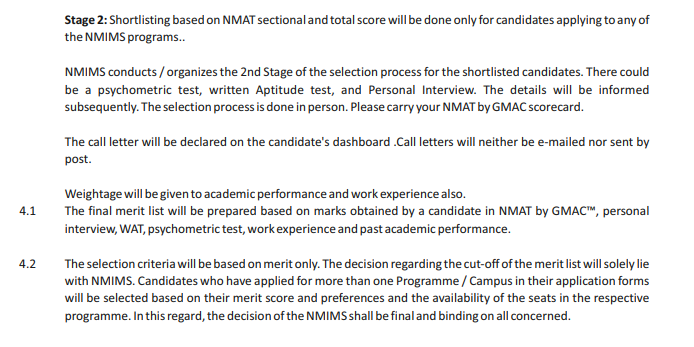
| Selection Parameter | Weightage |
|---|---|
| NMIMS Competency Test | 60 percent |
| Personal Interview | 15 percent |
| Work Experience | 15 percent |
| NMAT Score | 10 percent |
| Total | 100 percent |
Source: NMIMS Management Programs Admission Handout
Based on a Reddit thread, students discuss the chances of getting a GD PI call based on their score:
- The candidate scored 234 in NMAT with strong overall performance, especially in Language Skills (89) and decent QA/LR scores.
- QA section remains the main concern, as NMIMS Mumbai generally requires meeting sectional cutoffs, and past trends suggest a borderline chance.
- Previous cutoff trends indicate a possible call, but chances depend on whether NMIMS maintains similar sectional cutoffs or increases them.
Source: Reddit
Ques. What are common GD topics for NMAT colleges?
Ans. Topics usually cover business, economy, technology and social issues. Recent themes include artificial intelligence at work, sustainability and the gig economy. Case-based topics are also common at TAPMI and KJ Somaiya.
Related Link: NMAT 2026 Expected to Be Tougher? Last Year Analysis & What to Expect
NMIMS Competency Test Pattern 2026
The Competency Test is a computer-based test taken at the NMIMS Mumbai campus. It runs on the same day as the interview.
- The exam lasts just 45 minutes with 30 questions, making speed and accuracy equally important.
- Students get 90 seconds per question, which is generous compared to NMAT.
- Questions evaluate verbal, quantitative, logical, and managerial abilities, including scenario-based decision-making.
| Particulars | Details |
|---|---|
| Mode | Computer-based test at campus |
| Duration | 45 minutes |
| Total Questions | 30 |
| Sections | Verbal Ability, Mental Ability, Managerial Ability, Quantitative Aptitude |
| Question Type | Multiple choice, scenario and judgement based |
| Difficulty Level | Easy to Moderate |
| Weightage | 60 percent of composite score |
Ques. When will the NMAT 2026 shortlist be released?
Ans. The NMIMS shortlist is expected in January 2027. Stage 2 rounds are expected between late January and February 2027. The final merit list is expected in April 2027.
Also Check: Admission Story: Sakshi Chawla, NMIMS Mumbai, 227, NMAT
NMIMS Competency Test Preparation Tips
- Attempt the arrangement and puzzle questions first to lock in easy marks. Students report these as the most predictable scoring block.
- Practise critical reasoning daily, because this is the section students find demanding.
- Read one short business passage every day and note the main idea in one line.
- Revise inference, assumption and heading-based questions from your NMAT preparation material.
- Brush up on basic arithmetic, ratio and percentage, since Quant here stays elementary.
- Managerial ability questions ask what you would do in a workplace situation. Choose the ethical and practical option, not the dramatic one.
- Take at least five timed mocks so the 45-minute clock feels familiar.
Related Links
- NMAT 2026 Score 260: B-Schools, Cutoffs and Admission Chances
- NMAT 2026 Safe Score: Section-Wise Cutoffs for Top MBA Colleges
NMIMS AI Interview Questions 2026: How to Prepare
- NMIMS runs an AI-assisted interview instead of a traditional panel-only round.
- The AI interview runs for roughly 12 to 15 minutes and asks follow-up questions based on your answers.
- A human panel member then asks additional questions in the same cabin. The full reporting day takes around three hours.
What the NMIMS AI Interview Asks?
- Your background, education, and work profile
- Why you chose MBA and why now
- Situational and judgement-based business scenarios
- Opinion questions on current business topics such as generative AI
- Follow-ups drawn directly from something you said a minute earlier.
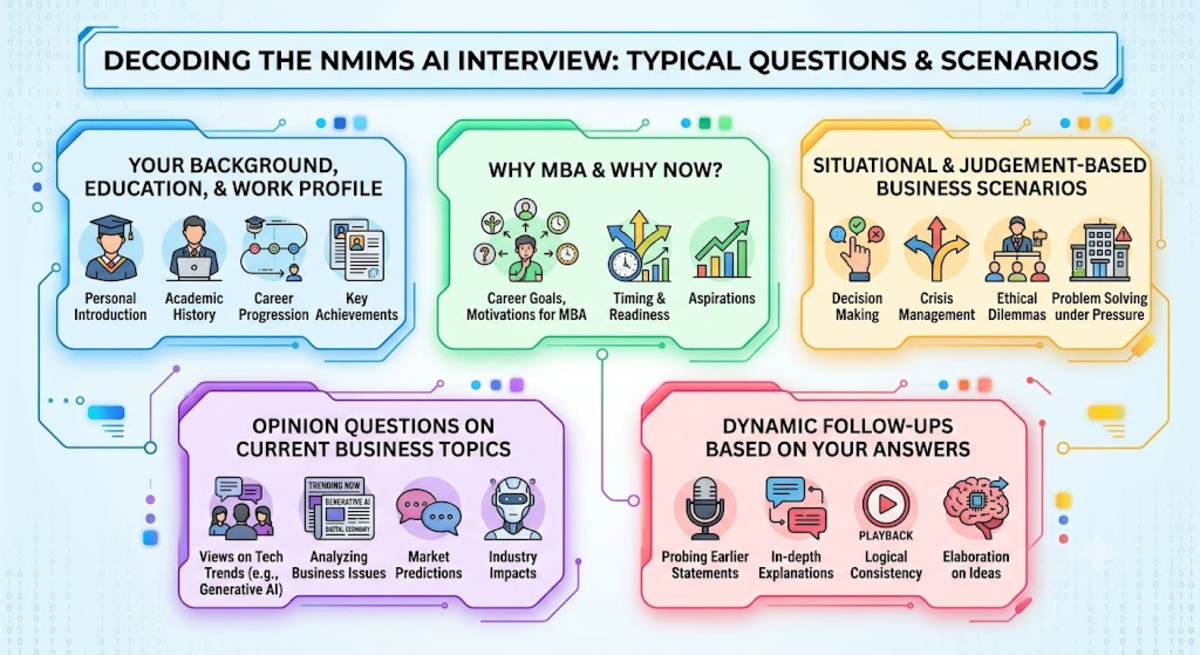
AI Interview Preparation Tips
- Speak in structured 45-60 second answers, because the bot moves on quickly. Long rambling answers get cut off.
- Look at the camera, not at the screen, and keep your pace steady.
- Avoid filler words, since the system reads clarity and fluency.
- Prepare a crisp introduction of about 60 seconds and rehearse it aloud.
- Expect one question you did not prepare for and answer it calmly. Students consistently report a surprise question.
- Keep three examples ready from your academics, work, and extracurriculars.
- Practise with a phone recording so you can hear your own pauses.
Do not treat the bot as a machine to game. Answer as you would to a human panel, and stay consistent with your application form.
Ques. How does the NMIMS AI interview work?
Ans. An AI system asks questions and generates follow-ups from your answers. It runs for roughly 12 to 15 minutes. A human panel member then asks additional questions in person.
Related Link: NMAT 2025 GD, PI, and WAT Tips To Crack NMIMS Selection Process
NMAT GD and WAT Preparation Tips for Other Colleges
NMIMS have dropped the GD, but several NMAT-accepting colleges still run it. Thus, students would still need to prepare for these separately:
- Most colleges schedule GD/WAT/PI rounds between February and March 2027, including TAPMI, KJ Somaiya, and XIMB.
- KJ Somaiya gives 30% weightage to the Personal Interview and 10% each to WAT and Problem Situation Analysis.
- TAPMI gives its GD, WAT and PI block a combined 50%.
| College | Second Stage Rounds | Expected Period |
|---|---|---|
| NMIMS Mumbai | Competency Test and AI-assisted PI | January to February 2027 |
| TAPMI Manipal | Group Discussion, WAT and PI | February to March 2027 |
| KJ Somaiya, Mumbai | WAT, Problem Situation Analysis and PI | February to March 2027 |
| XIM Bhubaneswar | Group Discussion and PI | February to March 2027 |
| SDA Bocconi Asia Center | Personal Interview | February to March 2027 |
NMIMS WAT and Case Discussion Tips
- Spend five minutes planning before you write a single line.
- Use a simple structure of introduction, two arguments, one counter and a conclusion.
- Target 200 to 300 words unless the instruction says otherwise.
- For a case discussion, state your assumptions before you state your solution.
- Panels reward a clear structure far more than an unusual opinion.
Ques. How should I prepare for the WAT round?
Ans. Plan for five minutes and write for the remaining time. Use a clear structure of introduction, arguments, counterpoint and conclusion. Aim for 200 to 300 words.
Related Article: NMAT Coaching: Online and Offline City Wise Best Coaching Centres
NMAT PI Questions 2026: Most Asked Interview Questions
The questions below come from NMIMS and other NMAT college interviews reported by students across recent cycles.
- Freshers are usually asked more academic and project-based questions, while candidates with work experience face more role-specific and leadership questions.
- Prepare answers that connect your academic background, work experience (if any), achievements, and career goals into one consistent story leading to your MBA aspirations.
| Category | Important PI Questions Discussed |
|---|---|
| Introduction & Profile |
|
| MBA Motivation |
|
| Goals |
|
| Strengths & Weaknesses |
|
| Academics / Resume | Questions from your graduation subjects, final-year project, work experience, company, competitors, and industry based on your resume. |
| Current Affairs & Business Awareness | Recent business news, Union Budget, international events, summits, sports events, economic developments. |
| Situational / Behavioral Questions |
|
| Hobbies & Interests |
|
| Stress Interview Questions | Interviewers may interrupt, cross-question continuously, or behave unexpectedly to test composure and presence of mind. |
| Opinion-Based Questions |
|
Source: YouTube
Ques. Can I convert NMIMS with a score close to the cutoff?
Ans. Yes, this happens every year. Since NMAT carries only 10 percent, a strong Competency Test performance can lift your composite score. Do not assume a borderline score rules you out.
Related Links: NMAT 2026 Safe Score for Top MBA Colleges: School-Wise Cutoffs and GD-PI Shortlist
NMAT GD PI Preparation Tips: 30-Day Plan
The shortlist arrives in January, and the slot follows within weeks. Use this plan from the day results are declared:
- Carry your original documents, NMAT scorecard and photo ID on the interview day. Reach the campus at least 45 minutes early, since check-in queues are long.
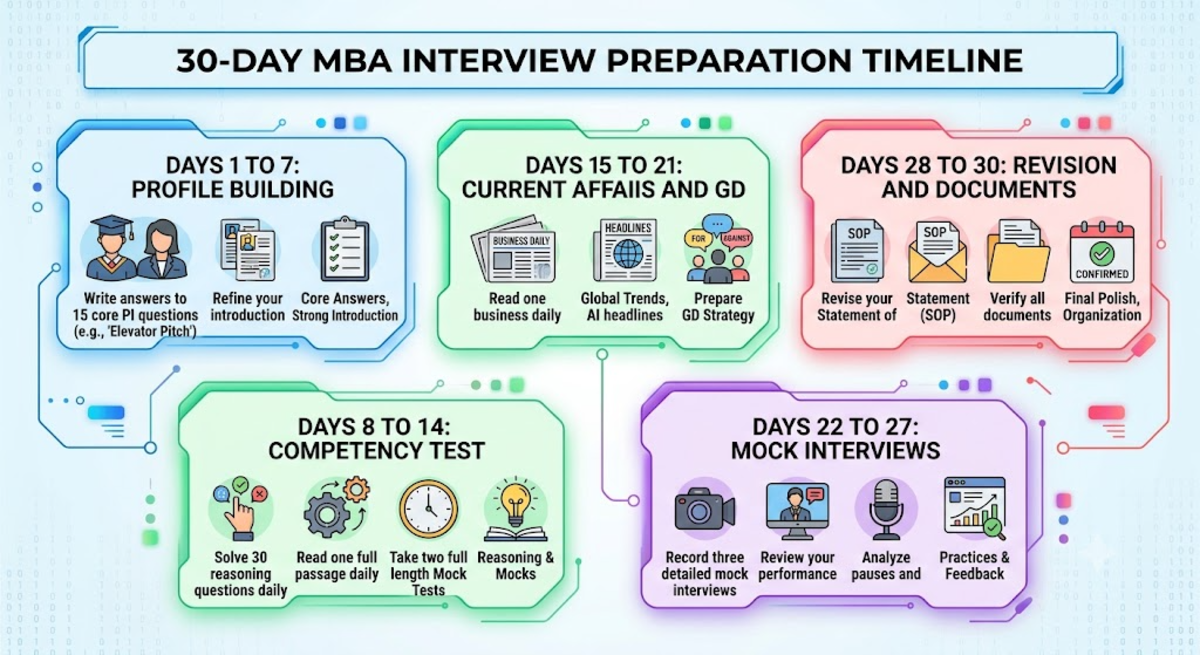
| Phase | Focus Area | Daily Action |
|---|---|---|
| Days 1 to 7 | Profile building | Write answers to 15 core PI questions and refine your introduction |
| Days 8 to 14 | Competency Test | Solve 30 reasoning questions and one passage daily, plus two mocks |
| Days 15 to 21 | Current affairs and GD | Read one business daily and prepare two topics with both sides |
| Days 22 to 27 | Mock interviews | Record three mock interviews and review your pauses and fillers |
| Days 28 to 30 | Revision and documents | Revise your SOP, verify documents and confirm your slot details |
Related Link: NMAT 2026 Last 30 Days Study Plan: Daily Schedule and Section-Wise Tips
NMAT GD PI Preparation 2026 FAQs
Ques. Does NMIMS still conduct a Group Discussion round?
Ans. No, NMIMS has removed the Group Discussion from its MBA selection process. It now conducts a Competency Test and an AI-assisted Personal Interview. Other NMAT colleges such as TAPMI and XIMB still hold GD rounds.
Ques. What is the weightage of the NMIMS Competency Test?
Ans. The Competency Test carries 60 percent weightage in the composite score. The Personal Interview and work experience carry 15 percent each. Your NMAT score carries only 10 percent.
Ques. What is the NMIMS Competency Test pattern?
Ans. It is a 45-minute computer-based test with 30 questions. The four sections are Verbal Ability, Mental Ability, Managerial Ability and Quantitative Aptitude. The difficulty level is easy to moderate.
Ques. How many mock interviews should I take?
Ans. Take at least three to five recorded mock interviews. Review them for filler words, pace and answer length. Practising aloud matters more than writing answers down.
Language Skills
NMAT by GMAC Syllabus 2026 covers three independently timed sections: Language Skills, Quantitative Skills, and Logical Reasoning. GMAC administers the exam through its official portal at mba.com/exams/nmat. GMAC does not publish a separate NMAT syllabus PDF — the topic framework is based on the official NMAT Test Prep resources, the NMAT Official Guide, and consistent question patterns from previous years. The NMAT 2026 registration cycle is expected to open in August 2026, with the exam window expected between November and December 2026.
- NMAT 2026 has 3 sections: Language Skills, Quantitative Skills, and Logical Reasoning.
- Each section has 36 questions, totalling 108 questions for the entire exam.
- The total duration is 120 minutes: Language Skills (28 min), Quantitative Skills (52 min), and Logical Reasoning (40 min).
- No negative marking applies — each correct answer earns +3 marks. The total scaled score ranges from 36 to 360.
- You can choose the order of sections at the start of the test. Once a section begins, its timer runs independently.
- NMAT 2026 registration is expected in August 2026. The exam window is expected between November 5 and December 19, 2026.
- Over 51 top B-schools accept NMAT scores, including NMIMS Mumbai, KJ Somaiya, TAPMI, XIM University, SPJIMR, and Great Lakes.
You can attempt NMAT up to three times per cycle — most colleges consider your best score, but NMIMS Mumbai accepts only your first attempt.
NMAT 2026 Syllabus: Access Official Resources
GMAC does not release a section-wise syllabus PDF for NMAT. Access the official test prep materials through the resources below. The NMAT by GMAC Official Guide is the single most authoritative resource for your 2026 preparation.
| Section | Official Resource |
|---|---|
| Language Skills | NMAT Official Guide — Language Skills Topics |
| Quantitative Skills | NMAT Official Guide — Quantitative Skills Topics |
| Logical Reasoning | NMAT Official Guide — Logical Reasoning Topics |
| Complete Test Prep | NMAT by GMAC Official Website — All Resources |
NMAT 2026 Syllabus: Overview
NMAT by GMAC is a computer-adaptive management entrance test. The Graduate Management Admission Council (GMAC) conducts it each year. Unlike most MBA entrance exams in India, NMAT has no officially prescribed syllabus PDF — its topic framework is based on GMAC’s Official Guide and consistent question patterns from previous years.
The exam tests three distinct skill areas. Each section has 36 questions and is timed independently. You choose section order at the start of the exam. Students must manage each section’s timer independently — unused time in one section does not carry over to the next.
| Feature | Details |
|---|---|
| Conducting Body | Graduate Management Admission Council (GMAC) |
| Official Website | mba.com/exams/nmat |
| Exam Type | Computer-Adaptive Test (difficulty adapts based on responses) |
| Sections | 3 — Language Skills, Quantitative Skills, Logical Reasoning |
| Total Questions | 108 (36 per section) |
| Total Duration | 120 minutes |
| Marking Scheme | +3 per correct answer; no negative marking |
| Score Range | 36–360 (scaled score) |
| Attempts Allowed | Up to 3 per cycle |
| Mode | Online — test centres in 70+ cities; online proctored option also available |
| Official Syllabus PDF | Not published separately — use NMAT Official Guide by GMAC |
Source: GMAC — NMAT Official Page
NMAT 2026 Important Dates
GMAC publishes the official NMAT 2026 schedule on its website. Dates below are expected based on the previous cycle. Confirm all dates from the official NMAT website before planning your preparation schedule. Bookmark mba.com/exams/nmat/about/important-dates-fees for real-time updates.
| Event | Expected Dates (2026 Cycle) | Status |
|---|---|---|
| Official Cycle Announcement | July–August 2026 | Upcoming |
| Registration Start | August 2026 (Expected) | Upcoming |
| Registration End | October 2026 (Expected) | Upcoming |
| Slot Booking / Scheduling | August–October 2026 (Expected) | Upcoming |
| Retake Registration Window | October–November 2026 (Expected) | Upcoming |
| Exam Window (1st, 2nd and 3rd Attempts) | November 5 – December 19, 2026 (Expected) | Upcoming |
| Score Preview (Unofficial — Immediate) | Immediately after each exam session | Upcoming |
| Official Scorecard Available | Within 48 hours of exam date | Upcoming |
| NMIMS Selection Process (GD-PI) | January–March 2027 (Expected) | Upcoming |
Note: The official NMAT 2026 registration dates have not been released as of July 2026. All dates above are indicative and based on the previous year’s cycle pattern. NMAT 2026 exam fees are expected to be INR 3,000 plus applicable taxes per attempt.
NMAT 2026 Syllabus for Language Skills
The Language Skills section tests English proficiency across reading, grammar, and vocabulary. It has 36 questions in 28 minutes — under 47 seconds per question. Language Skills is the most time-pressured section in NMAT relative to question count. Students who practise reading speed and vocabulary consistently score better here.
NMAT RC passages are shorter and more direct than those in CAT. Focus on grammar accuracy, vocabulary range, and para-arrangement logic to build your Language Skills score efficiently.
NMAT Language Skills: Topic-wise Breakdown
| Topic Area | Sub-topics Covered | Approx. Questions |
|---|---|---|
| Reading Comprehension | RC Sub-topics - Click Here Short RC passages (200–400 words), Inference-based questions, Main idea and title questions, Author’s tone and attitude, Specific detail retrieval, Paragraph summary questions, Fact vs. inference distinction | 8–10 |
| Para Jumbles (Para Forming) | Para Jumble Sub-topics - Click Here Sentence rearrangement to form a coherent paragraph, Identifying the opening sentence of a paragraph, Identifying the closing sentence, Odd sentence out from a given set of jumbled sentences | 6–8 |
| Sentence Correction & Error Identification | Grammar Sub-topics - Click Here Subject-verb agreement, Tense consistency, Preposition usage, Articles (a, an, the), Modifiers and dangling participles, Parallelism errors, Pronoun reference, Sentence completion with contextual and grammatical fit | 6–8 |
| Vocabulary | Vocabulary Sub-topics - Click Here Synonyms and antonyms, Word analogies (relationship pairs), Idioms and phrases, Word in context (meaning from usage), One-word substitution, Root-word and contextual meaning questions | 6–8 |
| Fill in the Blanks / Cloze Test | Cloze Test Sub-topics - Click Here Single-blank sentence completion, Double-blank fill in the blanks, Cloze passages with multiple blanks requiring contextual vocabulary, Grammar-based fill in the blanks (prepositions, connectors) | 4–6 |
NMAT 2026 Syllabus for Quantitative Skills
The Quantitative Skills section has 36 questions in 52 minutes — roughly 86 seconds per question. It is the least time-pressured of the three sections. Data Interpretation sets appear in clusters and carry significant weight within this section. Class 10–12 mathematics topics form the backbone; higher-level number theory is not tested in NMAT.
NMAT Quantitative Skills: Topic-wise Breakdown
| Topic Area | Sub-topics Covered | Approx. Questions |
|---|---|---|
| Arithmetic | Arithmetic Sub-topics - Click Here Percentages, Profit and Loss, Ratio and Proportion, Averages, Time-Speed-Distance, Time and Work, Simple Interest, Compound Interest, Mixtures and Alligations, LCM and HCF, Pipes and Cisterns | 8–10 |
| Data Interpretation | DI Sub-topics - Click Here Bar graphs (simple and stacked), Line graphs, Pie charts, Tables (single and multi-table sets), DI Caselets (text-based data sets), Mixed graph sets, Data Sufficiency (is the given data sufficient to answer the question?) | 8–10 |
| Number System | Number System Sub-topics - Click Here Properties of integers, Divisibility rules, Factors and multiples, Remainders, Unit digit problems, Surds and indices, Cyclicity of last digits | 3–5 |
| Algebra | Algebra Sub-topics - Click Here Linear equations, Quadratic equations, Simultaneous equations, Inequalities, Logarithms, Arithmetic Progressions (AP), Geometric Progressions (GP), Coordinate geometry basics, Functions | 4–6 |
| Geometry & Mensuration | Geometry Sub-topics - Click Here Lines and angles, Triangles (similarity, congruence, area formulas), Circles (chords, tangents, arcs, sectors), Quadrilaterals and polygons, Area and perimeter of 2D figures, Volume and surface area of cube, sphere, cylinder, and cone | 3–5 |
| Modern Math | Modern Math Sub-topics - Click Here Permutation and Combination, Probability (basic and conditional), Set Theory with Venn Diagrams, Binomial theorem basics | 3–5 |
NMAT 2026 Syllabus for Logical Reasoning
Logical Reasoning has 36 questions in 40 minutes. It covers two broad types: Analytical Reasoning (puzzle-based) and Critical Reasoning (argument-based). Analytical puzzles — seating arrangements, scheduling grids, and family trees — account for the largest share of questions in this section.
This section rewards students who practise structured elimination and diagram-based solving. Sort puzzles by complexity at the section start. Solve easier ones first to bank marks quickly.
NMAT Logical Reasoning: Topic-wise Breakdown
| Topic Area | Sub-topics Covered | Approx. Questions |
|---|---|---|
| Analytical Puzzles | Puzzle Sub-topics - Click Here Linear seating arrangement (single and double rows), Circular seating arrangement, Scheduling and timetabling puzzles, Grid-based arrangement, Multi-variable constraint puzzles, Floor-based arrangement, Month-date sequencing puzzles | 10–12 |
| Critical Reasoning | Critical Reasoning Sub-topics - Click Here Assumptions underlying a statement, Drawing conclusions from given premises, Inferences (what must/can/cannot be true), Strengthening or weakening an argument, Course of action questions, Statement-argument evaluation, Cause and effect identification | 8–10 |
| Deductions / Syllogisms | Syllogism Sub-topics - Click Here Statement-conclusion type (All/Some/No patterns), Venn diagram-based deductions, Two-statement and three-statement deductions, Negative statement and definite/possible conclusion handling | 4–6 |
| Coding-Decoding & Series | Coding Sub-topics - Click Here Letter-based coding, Number-based coding, Symbol-based logic, Alphanumeric series, Odd one out from a series, Input-output machine problems | 4–6 |
| Blood Relations & Direction Sense | Blood Relations Sub-topics - Click Here Multi-generational family tree problems, Coded blood relations (A is the brother of B’s mother), Combination of family tree with seating arrangement, Direction sense and distance calculation problems | 2–4 |
NMAT 2026 Section-Wise Weightage (Based on Trend Analysis)
GMAC does not publish official topic-wise weightage for NMAT. The table below is based on five-year question pattern analysis from official mock tests and test-taker feedback. Within Quantitative Skills, Data Interpretation and Arithmetic together account for roughly 45–55% of questions. Within Logical Reasoning, Analytical Puzzles alone form roughly 30% of total LR questions.
| Section | Questions | Time (Min) | Max Marks | Score Range | Highest-Frequency Topics |
|---|---|---|---|---|---|
| Language Skills | 36 | 28 | 108 | 12–120 | Reading Comprehension, Para Jumbles, Sentence Correction |
| Quantitative Skills | 36 | 52 | 108 | 12–120 | Data Interpretation, Arithmetic, Algebra |
| Logical Reasoning | 36 | 40 | 108 | 12–120 | Analytical Puzzles, Critical Reasoning, Syllogisms |
| Total | 108 | 120 | 324 (raw) | 36–360 (scaled) | — |
Note: The scaled score (36–360) is computed by GMAC’s adaptive algorithm. Raw marks convert to a scaled score. All three sections contribute equally to the total.
NMAT 2026 Topic-Wise Weightage Estimates (5-Year Average)
| Section | Topic | Approx. Questions (out of 36) | Priority |
|---|---|---|---|
| Language Skills | Reading Comprehension | 8–10 | High |
| Language Skills | Para Jumbles | 6–8 | High |
| Language Skills | Sentence Correction / Error Identification | 6–8 | High |
| Language Skills | Vocabulary (Synonyms, Antonyms, Analogies) | 6–8 | Medium |
| Language Skills | Fill in the Blanks / Cloze Test | 4–6 | Medium |
| Quantitative Skills | Data Interpretation | 8–10 | High |
| Quantitative Skills | Arithmetic | 8–10 | High |
| Quantitative Skills | Algebra | 4–6 | Medium |
| Quantitative Skills | Number System | 3–5 | Medium |
| Quantitative Skills | Modern Math (Permutation, Combination, Probability) | 3–5 | Medium |
| Quantitative Skills | Geometry & Mensuration | 3–5 | Low-Medium |
| Logical Reasoning | Analytical Puzzles | 10–12 | High |
| Logical Reasoning | Critical Reasoning | 8–10 | High |
| Logical Reasoning | Syllogisms / Deductions | 4–6 | Medium |
| Logical Reasoning | Coding-Decoding & Series | 4–6 | Medium |
| Logical Reasoning | Blood Relations & Direction Sense | 2–4 | Low-Medium |
NMAT 2026 Exam Pattern
NMAT 2026 follows a computer-adaptive format. Question difficulty adjusts in real time based on your responses. You cannot skip a question and return to it within the same section. Each section must be completed in full before the next one begins.
| Feature | Details |
|---|---|
| Exam Format | Computer-Adaptive Test (question difficulty adjusts per response) |
| Question Type | Multiple Choice Questions (MCQs) — 4 options per question |
| Section Order | Student’s choice at the start of each exam session |
| Marking Scheme | +3 for correct; 0 for incorrect or unattempted (no negative marking) |
| Score Reporting | Unofficial score preview immediately after exam; official scorecard within 48 hours |
| Score Validity | Valid for the current admissions cycle only |
| Number of Attempts | Up to 3 per cycle (separate retake registration and fee for each) |
| Best Score Policy | Most colleges consider the best score; NMIMS considers only the first attempt |
| Test Centres | 70+ cities in India; Online Proctored option available for international test-takers |
| Fee per Attempt | INR 3,000 + applicable taxes (expected; official fee announced with registration) |
Important: NMIMS Mumbai accepts only your first NMAT attempt score, not your best score. Plan your first attempt only after thorough preparation.
Best Books for NMAT 2026 Preparation
No single book covers NMAT exclusively. Use section-specific books alongside GMAC’s official guide. The NMAT by GMAC Official Guide is the most authoritative resource — it includes actual-format questions and familiarises you with the adaptive-test interface before the real exam.
| Section | Book Name | Author / Publisher | Why This Book |
|---|---|---|---|
| All Sections (Official) | NMAT by GMAC Official Guide | GMAC | Only resource with actual NMAT-format questions; covers all three sections; includes adaptive practice tests on the official platform |
| Language Skills | Word Power Made Easy | Norman Lewis | Comprehensive vocabulary builder; covers roots, analogies, and word usage — directly relevant to NMAT synonym, antonym, and analogy questions |
| Language Skills | How to Prepare for Verbal Ability and Reading Comprehension for CAT | Arun Sharma & Meenakshi Upadhyay / McGraw Hill | Strong RC passage practice with shorter formats; grammar-error exercises map directly onto NMAT sentence correction and error-identification questions |
| Quantitative Skills | Quantitative Aptitude for CAT | Arun Sharma / McGraw Hill | Covers arithmetic, algebra, and geometry in depth; tiered difficulty (LOD 1–3) helps target NMAT-level topics without over-preparation |
| Quantitative Skills | Quantitative Aptitude | R.S. Aggarwal / S. Chand | Extensive drill sets for arithmetic and number systems; builds calculation speed essential for NMAT’s 52-minute QS section |
| Quantitative Skills | How to Prepare for Data Interpretation for CAT | Arun Sharma / McGraw Hill | DI sets covering graphs, caselets, and data sufficiency — mirrors the DI-heavy sub-section in NMAT Quantitative Skills directly |
| Logical Reasoning | How to Prepare for Logical Reasoning for CAT | Arun Sharma / McGraw Hill | Seating arrangements, constraint puzzles, and critical reasoning — aligns closely with NMAT LR question types and difficulty level |
| Logical Reasoning | Logical and Analytical Reasoning | Ashok Gupta / Arihant | Strong coverage of blood relations, coding-decoding, and syllogisms; builds speed in shorter LR question types common in NMAT |
How to Access NMAT 2026 Syllabus and Official Resources
GMAC does not publish a standalone NMAT syllabus PDF. Follow these steps to access official test prep resources and topic information from the GMAC website.
- Visit the official NMAT page at mba.com/exams/nmat.
- Click on the "Prepare" or "Test Prep" tab in the page navigation.
- Select "NMAT Official Guide" to access or purchase the official study material.
- Under "About NMAT", click "Sections" or "How is the test structured" for the section-wise topic outline.
- After registration opens in August 2026, download the NMAT 2026 Information Bulletin for the complete official topic framework and marking scheme.
- Bookmark the page and return in August 2026 for the official cycle announcement and registration link.
Note: The NMAT 2026 Information Bulletin will be published after registration opens. Until then, use the 2025 bulletin as reference — the topic structure and section format are consistent across cycles.
Source: GMAC — NMAT Official Website
NMAT 2026 Preparation Strategy
A focused 3–4 month plan is enough for most students targeting a score of 210 and above. Attempt at least 15 full-length sectional mocks and 5–8 complete tests before your first official attempt. Build section-by-section first, then shift to integrated full-test practice.
Language Skills Preparation
- Read one editorial or essay daily. This builds comprehension speed for the 28-minute Language Skills window.
- Spend 20 minutes daily on Norman Lewis’ Word Power Made Easy for vocabulary. NMAT analogy and synonym questions reward consistent vocabulary practice directly.
- Practise para-jumble sets of 5–6 questions every day. Identify topic sentences and conclusion markers to rearrange paragraphs quickly.
- Revise subject-verb agreement, tense consistency, and preposition use. Test yourself with error-identification exercises regularly.
- Aim to read each RC passage in under 3 minutes. Use the remaining time for answer choice analysis only.
Quantitative Skills Preparation
- Prioritise Data Interpretation first. DI accounts for 8–10 of your 36 QS questions and rewards practice more than conceptual depth.
- Master five core arithmetic areas: percentages, ratios, time-work, profit-loss, and simple and compound interest. These appear in nearly every NMAT cycle.
- Practise Data Sufficiency questions as a separate drill. The "is this statement alone sufficient?" format confuses students who are unfamiliar with it.
- You have roughly 86 seconds per question in QS. Drill mental calculation techniques to reduce your average solution time.
- NMAT has no negative marking. If you cannot solve a question in 90 seconds, make your best guess and proceed.
Logical Reasoning Preparation
- Solve at least 2 seating arrangement puzzles daily. Linear and circular arrangements form the largest share of NMAT LR questions.
- Draw constraint diagrams for every puzzle — visual mapping eliminates errors faster than mental tracking.
- For Critical Reasoning, always identify the conclusion before evaluating the answer options. Misidentifying the conclusion is the most common student error here.
- Learn syllogism Venn-diagram shortcuts. Most NMAT syllogism questions can be solved in under 30 seconds with the right technique.
- At the start of the LR section, scan all puzzle sets briefly. Tackle fewer-constraint puzzles before five-variable sets to bank marks quickly.
Mock Tests and Final Revision
- Attempt one full NMAT mock per week for the first eight weeks. Increase to 2–3 mocks per week in the final month before your exam.
- Choose your section order in each mock based on your mental readiness that day — not a fixed sequence every time.
- Review every mock in full. Errors on easy questions hurt your adaptive scaled score more than skipping difficult ones.
- Use GMAC’s free official practice test on mba.com to experience the actual adaptive-test interface before the real exam.
NMAT Syllabus 2026 FAQs
Ques. Does NMAT 2026 have an official syllabus PDF?
Ans. No. GMAC does not publish a separate NMAT syllabus PDF. The topic framework is based on the NMAT Official Guide by GMAC and consistent question patterns from previous years. The NMAT 2026 Information Bulletin — which includes the official topic outline — will be available on mba.com after registration opens in August 2026.
Ques. How many sections are in NMAT 2026 and what is the time limit for each?
Ans. NMAT 2026 has three sections. Language Skills has 36 questions in 28 minutes. Quantitative Skills has 36 questions in 52 minutes. Logical Reasoning has 36 questions in 40 minutes. The total duration is 120 minutes. Sectional timers are independent — unused time cannot be transferred to another section.
Ques. Is the NMAT 2026 syllabus the same as last year?
Ans. Yes. The NMAT syllabus has remained consistent for several years. The three sections cover the same topic areas as in 2025. No additions or deletions have been announced for the 2026 cycle. You can use 2025 preparation resources safely for NMAT 2026.
Ques. Which section has the highest weightage in NMAT 2026?
Ans. All three sections carry equal weightage — 36 questions each, contributing equally to the total scaled score of 36–360. Language Skills is the most time-pressured (28 minutes for 36 questions). Quantitative Skills offers the most time per question (52 minutes for 36 questions). Within sections, Analytical Puzzles and Data Interpretation are the single highest-frequency sub-topics.
Ques. What are the most important topics in NMAT Language Skills 2026?
Ans. Reading Comprehension and Para Jumbles together account for roughly 14–18 of the 36 Language Skills questions. Sentence Correction and Vocabulary (synonyms, antonyms, analogies) follow in frequency. Focus your Language Skills preparation on RC speed and para-arrangement logic for the highest return on preparation time.
Ques. What are the most important topics in NMAT Quantitative Skills 2026?
Ans. Data Interpretation and Arithmetic are the highest-frequency topics. Together they account for roughly 16–20 of the 36 QS questions based on previous-year patterns. Data Sufficiency questions also appear regularly. Cover DI and Arithmetic first, then move to Algebra, Number System, and Modern Math.
Ques. What are the most important topics in NMAT Logical Reasoning 2026?
Ans. Analytical Puzzles (seating arrangements, scheduling grids, multi-variable constraints) account for roughly 10–12 of the 36 LR questions. Critical Reasoning is the second-highest area, with 8–10 questions. These two sub-types form roughly 50–60% of the Logical Reasoning section.
Ques. Is there negative marking in NMAT 2026?
Ans. No. NMAT 2026 has no negative marking. Each correct answer earns +3 marks. An incorrect or unattempted answer scores 0. This makes intelligent guessing a valid strategy for difficult questions. Never leave a question blank in NMAT — there is no penalty for attempting.
Ques. How many times can you attempt NMAT 2026?
Ans. You can attempt NMAT up to 3 times in the 2026 cycle. Each retake requires separate registration and a fee (INR 3,000 plus taxes per attempt, based on the previous cycle). Most colleges consider your best score across all attempts. NMIMS, however, considers only the score from your first attempt — regardless of how many retakes you take.
Ques. What is a good score in NMAT 2026?
Ans. A score of 209 and above meets the minimum cutoff for NMIMS Mumbai MBA programmes. Programs at KJ Somaiya, TAPMI, and XIM University typically expect 215–230 and above. A score above 220 out of 360 gives you a competitive position at most top NMAT-accepting colleges. NMIMS also requires a minimum sectional score of 60 out of 120 per section.
Ques. Which colleges accept NMAT 2026 scores for MBA admissions?
Ans. Over 51 management institutes in India accept NMAT scores for MBA admissions 2026–27. Top colleges include NMIMS Mumbai, KJ Somaiya Institute of Management, XIM University (XIMB), TAPMI, Great Lakes Institute of Management, SPJIMR, IFMR, ITM Business School, and SRM University. NMAT scores are also accepted by institutes in South Africa, the Philippines, Hungary, Nigeria, and Morocco.
Ques. How should I cover the full NMAT 2026 syllabus in 3 months?
Ans. Divide 3 months into three phases. Month 1: concept-building across all topics (one topic cluster per week per section). Month 2: topic-level practice sets and sectional mocks. Month 3: full-length mocks, weak-area revision, and 2–3 official NMAT practice tests from mba.com. Attempt at least 10 full mocks before your first official attempt. Prioritise DI, Arithmetic, Analytical Puzzles, and RC — these topics account for roughly 50–60% of total NMAT questions.
*The article might have information for the previous academic years, which will be updated soon subject to the notification issued by the University/College.
Lang Skills Sample Paper
The Language Skills section of NMAT has 36 questions and only 28 minutes, the tightest clock in the exam. These sample papers help you build the speed and accuracy it needs.
Official website: www.nmat.org
NMAT Language Skills Sample Papers 2026
NMAT Language Skills Sample Paper 1
 Download
 NMAT Language Skills Sample Paper 2
Download NMAT Language Skills Sample Paper 3
Download NMAT Language Skills Sample Paper 4
Download NMAT Language Skills Sample Paper 5
Download NMAT Language Skills Sample Paper 6
Download NMAT Language Skills Sample Paper 7
Download NMAT Language Skills Sample Paper 8
Download NMAT Language Skills Sample Paper 9
Download NMAT Language Skills Sample Paper 10
Download Each NMAT Language Skills sample paper has 36 questions to be solved in about 28 minutes, matching the tight pace of the real section. Solve one paper, mark your answers, and note the word meanings you missed.
You can download every NMAT Language Skills sample paper free on an external review site, and you can also check the latest pattern on the official site www.nmat.org before you begin.
- NMAT Language Skills Sample Papers 2026
- NMAT Language Skills Exam Pattern and Marks Distribution 2026
- NMAT Language Skills Sample Papers - Why Recent Papers Matter Most
- NMAT Language Skills Topic Wise Weightage - High Scoring Topics to Focus in Sample Papers
- NMAT Language Skills Sample Paper Video Solutions 2026 - Watch Before You Start Solving
- How to Use NMAT Language Skills Sample Papers to Clear in First Attempt
- NMAT Language Skills No Negative Marking and Speed Strategy
- NMAT Language Skills 4 Week Preparation Plan Using Sample Papers
- FAQs on NMAT Language Skills Sample Papers 2026
- Section: Language Skills, worth 36 questions in the NMAT paper.
- Paper format: all multiple-choice questions with four options each.
- Marking: +3 for every correct answer, with no negative marking, so attempt all 36.
- Time budget: 28 minutes for the section, about 47 seconds per question.
- What it tests: reading comprehension, vocabulary, grammar, para-jumbles and fill in the blanks.
- Preparation base: strong English grammar and word usage, no fixed board syllabus.
NMAT Language Skills Exam Pattern and Marks Distribution 2026
Language Skills is one of the three NMAT sections. It has the least time per question, so speed with accuracy decides your score here.
- Questions: 36 questions to be solved in 28 minutes.
- Question type: single-correct multiple-choice questions only.
- Marking: +3 for correct, no negative marking, 0 for unattempted.
- Pace: about 47 seconds per question, so keep vocabulary and grammar questions quick.
Key advice: answer the vocabulary and grammar questions first in seconds, then use the time saved for the reading comprehension passages.
NMAT Language Skills Sample Papers - Why Recent Papers Matter Most
NMAT Language Skills has settled into a steady mix of reading comprehension, vocabulary and grammar. Recent-format papers train you on exactly this mix and pace.
- Recent papers reflect the current share of quick vocabulary and grammar questions.
- They keep reading passages at the moderate length NMAT uses today.
- They help you fix a target of attempting all 36 questions within 28 minutes.
NMAT Language Skills Topic Wise Weightage - High Scoring Topics to Focus in Sample Papers
The table below shows the topics that usually appear in the 36-question Language Skills section and how hard each one tends to be.
| Topic | Questions | Difficulty | What to Watch For |
|---|---|---|---|
| Reading Comprehension | 12-14 | Moderate | The biggest block, so read the question before the passage. |
| Vocabulary (synonyms, antonyms, analogies) | 6-8 | Easy | Build a word list, as these are the fastest marks. |
| Grammar and Error Spotting | 6-8 | Easy to Moderate | Revise tenses, prepositions and subject-verb agreement. |
| Para-jumbles and Sentence Arrangement | 4-6 | Moderate | Find the opening sentence and logical links first. |
| Fill in the Blanks and Cloze | 4-6 | Moderate | Watch collocations and the right preposition. |
Note: vocabulary and grammar together give the quickest marks, so clear them fast to protect time for reading comprehension.
NMAT Language Skills Sample Paper Video Solutions 2026 - Watch Before You Start Solving
Watching solved Language Skills questions shows you the shortcuts for vocabulary and grammar that save the most time. This is helpful before your first timed paper.
Watch the walkthrough once, then attempt a sample paper the same day so the tricks stay fresh.
Watch:
Source: NMAT verbal ability and reading comprehension practice lecture covering vocabulary, grammar and passages (YouTube)
How to Use NMAT Language Skills Sample Papers to Clear in First Attempt
Use each Language Skills paper as a short, sharp timed drill. Follow these steps every time.
- Set a 28-minute timer and solve the full 36-question paper in one sitting.
- Answer every vocabulary and grammar question in the first pass.
- Attempt the reading comprehension passages next, reading the questions first.
- Since there is no negative marking, mark an answer for every question.
- Add every wrong word or rule to a running notes page and revise it weekly.
NMAT Language Skills No Negative Marking and Speed Strategy
Language Skills has no negative marking, so a wrong guess never costs you, but the tight 28-minute clock means you must not get stuck on one question.
- Attempt all 36 questions, since a guess can only add marks.
- Do not overthink vocabulary; your first instinct is often right.
- Skip a long reading question if it is eating time and return to it later.
- Keep the last minute to mark answers for any questions left blank.
NMAT Language Skills 4 Week Preparation Plan Using Sample Papers
- Week 1: Revise core grammar rules and start a daily word list, then solve two sample papers.
- Week 2: Practise sentence correction and fill in the blanks, and solve three papers under timer.
- Week 3: Focus on reading comprehension and para-jumbles, and solve three more papers.
- Week 4: Take the remaining papers every alternate day and review errors, keeping the last two days for light revision only.
FAQs on NMAT Language Skills Sample Papers 2026
Ques.How many questions are there in the NMAT Language Skills section?
Ans.The NMAT Language Skills section has 36 multiple-choice questions to be solved in 28 minutes, which is the tightest clock in the exam.
Ques.What topics does NMAT Language Skills cover?
Ans.It covers reading comprehension, vocabulary, grammar and error spotting, para-jumbles and fill in the blanks.
Ques.Is there negative marking in the NMAT Language Skills section?
Ans.No, there is no negative marking. You get +3 for every correct answer and lose nothing for a wrong one, so attempt all 36 questions.
Ques.Are these NMAT Language Skills sample papers free to download?
Ans.Yes, all 10 NMAT Language Skills sample papers on this page are free to download in PDF form with answer keys and solutions.
Ques.How can I score high in NMAT Language Skills quickly?
Ans.Build a strong vocabulary list and revise grammar rules, then attempt the easy word and grammar questions first to save time for reading comprehension.
Ques.How many Language Skills sample papers should I solve?
Ans.Solving all 10 papers on this page gives you enough practice to build the speed and accuracy the section needs.
VARC Preparation
NMAT 2026 Language Skills Preparation Tips focus on improving reading speed, vocabulary, grammar, and verbal reasoning.
The Language Skills section consists of 36 questions to be completed in 28 minutes, so candidates should prioritize Reading Comprehension, Grammar, and Vocabulary while maintaining both speed and accuracy.
- Start by building a strong foundation in grammar rules, vocabulary, and sentence structure. Develop a habit of reading newspapers, editorials, and magazines daily to improve reading speed and comprehension.
- Practice Reading Comprehension, grammar, vocabulary, para jumbles, and critical reasoning regularly through topic-wise practice
- NMAT 2026 Language Skills Preparation Tips recommend solving sectional quizzes regularly to improve speed and accuracy.
- Revise grammar rules, build vocabulary daily, and analyze mistakes on mock tests to improve accuracy.
- Attempt regular NMAT Language Skills Mock Tests to improve time management and assess your preparation.
- Practice NMAT Previous Year Questions (PYQs) and NMAT Sample Papers to understand the exam pattern and strengthen your Language Skills.
Related Links:
- NMAT Syllabus 2026: Section-wise Topics, Marking Scheme and PDF Download
- NMAT 2026 Question Paper (Available): Download NMAT Previous Year Papers PDFs with Solutions
- NMAT Exam Analysis: Check Overall & Section-wise Difficulty Level Analysis

NMAT 2026 Language Skills Preparation Tips: Topic-Wise Weightage
Language Skills in NMAT 2026 has 36 questions in 28 minutes, with Vocabulary, Grammar, and Reading Comprehension dominating the weightage.
NMAT 2026 Language Skills Preparation Tips recommend focusing on Synonyms-Antonyms, Fill in the Blanks, Para Jumbles, RC, & error spotting to maximize your score.
| Topic | Expected Questions | Priority Level | Recommended Daily Time |
|---|---|---|---|
| Reading Comprehension | 10 to 12 | High | 40-45 min |
| Error Identification and Sentence Correction | 6 to 8 | High | 25-30 Min |
| Fill in the Blanks and Sentence Completion | 5 to 6 | Medium | 20-25 Min |
| Para Forming and Jumbled Sentences | 4 to 5 | Medium | 15-20 Min |
| Word Analogies and Vocabulary | 4 to 5 | Medium | 20-25 Min |
| Prepositions and Grammar Rules | 3 to 4 | Low | 10-15 Min |
Also Check:
- NMAT 2026 Chapter-Wise Weightage: Most Important Topics in Language Skills, Quantitative Skills and Logical Reasoning
- NMAT 2026 Exam Pattern: 3 Sections, 108 Questions and Scaled Scoring
How to Start NMAT 2026 Language Skills Preparation?
The first step in preparing for NMAT 2026 Language Skills is to understand the exam pattern and complete the syllabus.
- This section tests your reading comprehension, vocabulary, grammar, and overall verbal ability.
- It covers Reading Comprehension, Vocabulary, Grammar, Para Jumbles, Fill in the Blanks, Sentence Correction, and Critical Reasoning.
| Step | Action | Resources/Tips |
|---|---|---|
| Understand the Pattern | Know the exam format: 36 questions in 28 minutes | Focus on speed — Vocabulary, Grammar & RC are high-weightage |
| Build Vocabulary | Learn 20–30 new words daily | Norman Lewis – Word Power Made Easy, flashcards, root words |
| Strengthen Grammar | Revise rules and practice error spotting | Wren & Martin, SP Bakshi books, daily sentence correction |
| Practice RC & Para Jumbles | Read 2–3 passages daily | The Hindu / Economic Times editorials, past NMAT papers |
| Take Diagnostic Mock | Attempt one full Language Skills mock | Analyze weak areas and create a topic-wise study plan |
| Daily Practice | Solve 50–70 questions daily | Official NMAT Guide + Arun Sharma Verbal book |
Preparation Tip: If you're short on time, prioritize Reading Comprehension, Grammar, and Vocabulary. These topics contribute the majority of questions in the Language Skills section and can significantly improve your overall score.
Also Check:
- Score 250+ in NMAT 2026: Preparation Strategy for Early Starters
- NMAT 2026 Preparation Strategy and Timetable for Beginners
NMAT 2026 Language Skill Preparation Tips: 4-month Study Plan
NMAT 2026 Language Skill Preparation Tips emphasize balancing accuracy with speed, as you have only 28 minutes to answer 36 questions in the Language Skills section.
- Dedicate 1.5–2 hours daily to Language Skills.
- Maintain a vocabulary notebook and error log.
| Month | Focus Areas | Weekly Targets | Key Resources |
|---|---|---|---|
| Month 1 | Build Foundation | Vocabulary (400–500 words) + Basic Grammar Rules | Word Power Made Easy (Norman Lewis), Wren & Martin, Daily 30 mins reading |
| Month 2 | Core Concepts & Practice | Error Spotting, Sentence Correction, Fill in the Blanks + 2 RC daily | SP Bakshi Objective English, Official NMAT Guide, The Hindu Editorials |
| Month 3 | Advanced Practice | Para Jumbles, Analogies, Critical Reasoning + Full Sectional Tests | Arun Sharma Verbal Ability, Past Year Papers, 3 sectionals/week |
| Month 4 | Revision & Mocks | Intensive Mocks + Weak Topic Revision | 4–5 Full Mocks per week, Error Log, Quick Revision Notes |
NMAT 2026 Language Skills Preparation Tips: Daily Study Routine
A 1–2 hour daily study routine is sufficient to cover the NMAT 2026 Language Skills Preparation Tips when followed consistently.
- Begin with grammar, vocabulary, and reading comprehension, followed by topic-wise practice to improve speed and accuracy.
- Dedicate time to RC passages, sectional quizzes, and mock tests, and analyze your mistakes regularly.
- This structured routine helps you strengthen your Language Skills and improve your overall performance before the exam.
| Time Slot | Activity | Duration | Focus Tips |
|---|---|---|---|
| Morning (30–45 mins) | Vocabulary Building | 30–45 mins | Learn 20–25 new words + roots/synonyms using Word Power Made Easy |
| Mid-day / Afternoon | Grammar Rules & Practice | 45 mins | Error Spotting, Sentence Correction, Fill in the Blanks |
| Evening | Reading Comprehension + Para Jumbles | 45–60 mins | Read 2–3 passages from newspapers + solve 1–2 Para Jumbles |
| Night (Revision) | Quick Revision + Mock Questions | 30 mins | Revise error log, flashcards, or solve 30 mixed questions |
How to Prepare for NMAT 2026 Language Skills in 4 Months While Working?
Following these NMAT 2026 Language Skills Preparation Tips consistently will significantly improve your accuracy and speed for the 36-question, 28-minute Language Skills section.
| Activity | Duration | Details & Resources |
|---|---|---|
| Vocabulary Building | 30 minutes | 20-25 new words, roots, synonyms-antonyms (Word Power Made Easy) |
| Grammar Practice | 45 minutes | Error spotting, sentence correction, fillers (Wren & Martin / SP Bakshi) |
| Reading Comprehension & Para Jumbles | 45 minutes | 2 RC passages + 10-15 Para Jumble questions (Newspapers + Official Guide) |
| Mixed Practice / Revision | 30 minutes | Quick revision of errors, flashcards, 30 mixed questions |
NMAT 2026 Language Skills Preparation Tips: Section-Wise Study Plan for NMAT Language Skills
This plan helps cover all major areas efficiently for the 36 questions in 28 minutes. NMAT 2026 Language Skills Preparation Tips emphasize that consistency and mock analysis are key to scoring well.
| Sub-Section | Weightage (Approx.) | Study Focus | Time Allocation (Daily/Weekly) | Recommended Resources |
|---|---|---|---|---|
| Vocabulary | High | Synonyms, Antonyms, Analogies, Idioms | 30 mins daily | Word Power Made Easy (Norman Lewis), Flashcards |
| Grammar | High | Error Spotting, Sentence Correction, Fill in the Blanks | 45 mins daily | Wren & Martin, SP Bakshi Objective English |
| Reading Comprehension | High | Passages, Inference, Main Idea | 45 mins daily (2 passages) | The Hindu / Editorials, Official NMAT Guide |
| Para Jumbles & Verbal Reasoning | Medium | Sentence Rearrangement, Critical Reasoning | 30 mins, 4–5 days a week | Arun Sharma Verbal Ability, Previous Papers |
| Revision & Mocks | - | Mixed Practice + Full Sectionals | 1 Full Mock every Sunday | NMAT Official Guide + Online Mocks |
NMAT 2026 Language Skills Preparation Tips: Mock Test
Aim to take at least 2-3 full-length mocks per week in the final two months, followed by thorough analysis of every mistake, focusing especially on RC, Grammar, & Vocab.
| NMAT Language Skills Mock Test | Download PDF |
|---|---|
| Mock Test 1 | Click here |
| Mock Test 2 | Click here |
| Mock Test 3 | Click here |
| Mock Test 4 | Click here |
| Mock Test 5 | Click here |
| Mock Test 6 | Click here |
| Mock Test 7 | Click here |
| Mock Test 8 | Click here |
| Mock Test 9 | Click here |
| Mock Test 10 | Click here |
Also Read:
- NMAT Mock Test Score vs Percentile Predictor 2026
- How to Analyse NMAT Mock Test for Score Improvement
- NMAT Mock Test vs Actual Exam: Difficulty Level and Pattern
NMAT 2026 Language Skills Preparation Tips: Sample Papers
Practicing sample papers and previous year questions is one of the most effective ways to understand the exact pattern and difficulty level of the Language Skills section.
| NMAT Language Skills Sample Paper 2026 | Download PDF |
|---|---|
| NMAT Language Skills Sample Paper 1 | Click here |
| NMAT Language Skills Sample Paper 2 | Click here |
| NMAT Language Skills Sample Paper 3 | Click here |
| NMAT Language Skills Sample Paper 4 | Click here |
| NMAT Language Skills Sample Paper 5 | Click here |
| NMAT Language Skills Sample Paper 6 | Click here |
| NMAT Language Skills Sample Paper 7 | Click here |
| NMAT Language Skills Sample Paper 8 | Click here |
| NMAT Language Skills Sample Paper 9 | Click here |
| NMAT Language Skills Sample Paper 10 | Click here |
Preparation Tips for NMAT 2026 Language Skills
To master NMAT 2026 Language Skills, balance strong vocabulary and grammar foundations with fast reading and comprehension skills.
The NMAT 2026 Language Skills Preparation Tips emphasize daily practice, error analysis, and timed mocks to maximize your score in 28 minutes.
| Preparation Tip | How to Implement |
|---|---|
| Read Daily | Read short passages from newspapers or editorials daily to improve reading speed and comprehension. |
| Revise Grammar Weekly | Review grammar rules regularly, especially subject-verb agreement, tenses, and sentence structure. |
| Build Vocabulary | Maintain a word list for analogies and revise it consistently instead of cramming before the exam. |
| Practice Error Detection | Solve error identification questions daily to develop pattern recognition skills. |
| Take Sectional Mocks | Attempt sectional mock tests within the 28-minute time limit to improve speed and time management. |
| Manage Time in RC | Skip difficult Reading Comprehension questions initially and return to them if time permits. |
NMAT Subject Wise Sample Papers 2026
| NMAT Language Skills Sample Paper |  Download PDF Download PDF |
Best Books to cover NMAT 2026 Language Skills Preparation Tips
NMAT 2026 Language Skills Preparation Tips recommend using the right resources. Study Norman Lewis for vocabulary, S.P. Bakshi and Wren & Martin for grammar, and Arun Sharma for Reading Comprehension and verbal reasoning.
| Book Title | Author | Best For | Why Recommended |
|---|---|---|---|
| Word Power Made Easy | Norman Lewis | Vocabulary Building (Synonyms, Antonyms, Roots) | Classic for learning words in context with exercises |
| Objective English | S.P. Bakshi | Grammar, Error Spotting & Sentence Correction | Comprehensive rules + plenty of practice questions |
| High School English Grammar & Composition | Wren & Martin | Grammar Fundamentals | Best for conceptual clarity on tenses, subject-verb agreement etc. |
| How to Prepare for Verbal Ability and Reading Comprehension for CAT | Arun Sharma & Meenakshi Upadhyay | RC, Para Jumbles & Verbal Reasoning | Excellent for speed reading and advanced practice |
| NMAT by GMAC Official Guide | GMAC | Official Pattern & Previous Year Questions | Must-have for authentic questions and exam familiarity |
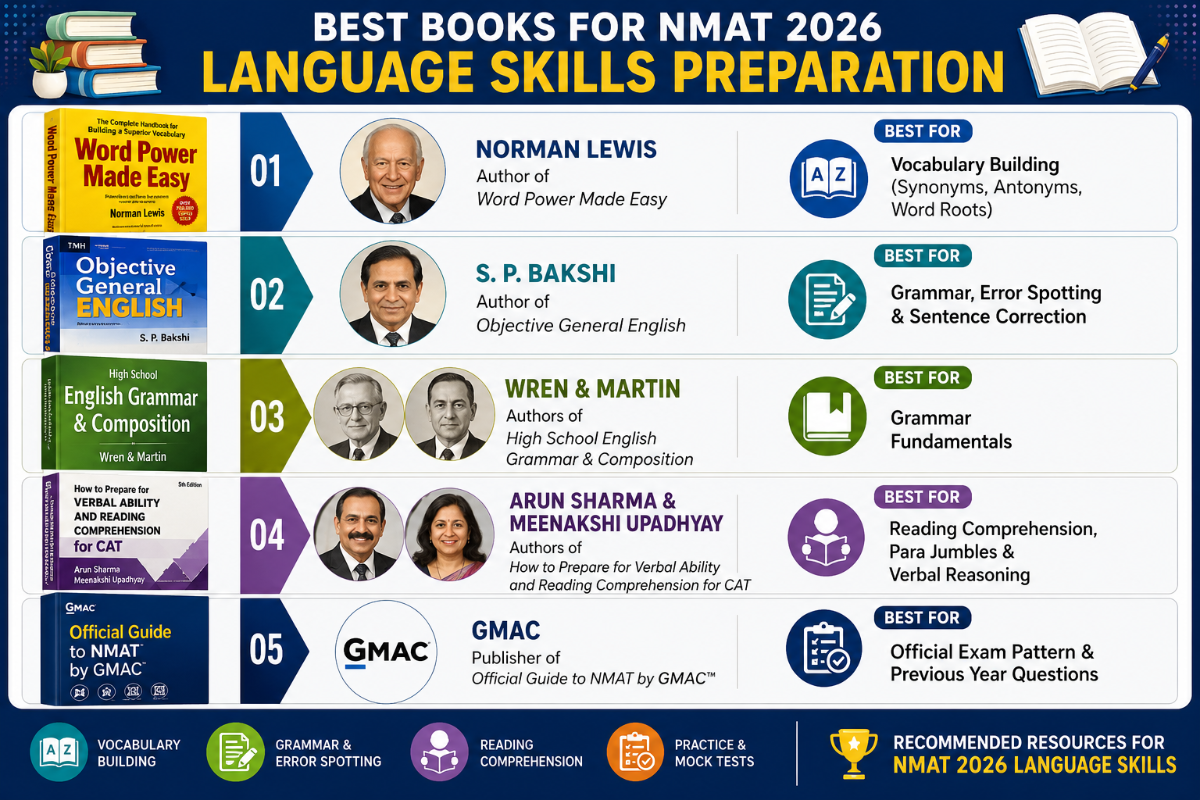
Also Check:
- NMAT 2026 Best Books for Preparation: Section-Wise Guide
- Best Books for NMAT 2026 Preparation: Language Skills, Quant and Logical Reasoning
- NMAT 2026 Best Books: Section-Wise Guide for Language Skills, Quantitative Skills and Logical Reasoning
Common Mistakes to Avoid in NMAT 2026 Language Skills Preparation Tips
NMAT 2026 Language Skill Preparation Tips highlight that students often lose marks due to poor time management and overthinking easy questions.
Avoid excessive time on tough RCs and maintain a regular error log for better speed and accuracy.
| Common Mistake | How to Avoid |
|---|---|
| Reading Too Slowly | Practice daily reading to improve speed and comprehension. |
| Ignoring Instructions | Always read instructions carefully before attempting each question. |
| Overthinking Answers | Trust your understanding and choose the best option without second-guessing. |
| Weak Vocabulary | Build and revise a word list regularly. Learn words in context. |
| Neglecting Grammar Rules | Revise grammar rules weekly and practice error detection questions. |
| Spending Too Much Time on One Question | If a question takes too long, move on and return to it if time permits. |
| Not Practicing Under Time Limit | Take sectional mock tests regularly within the 28-minute time limit. |
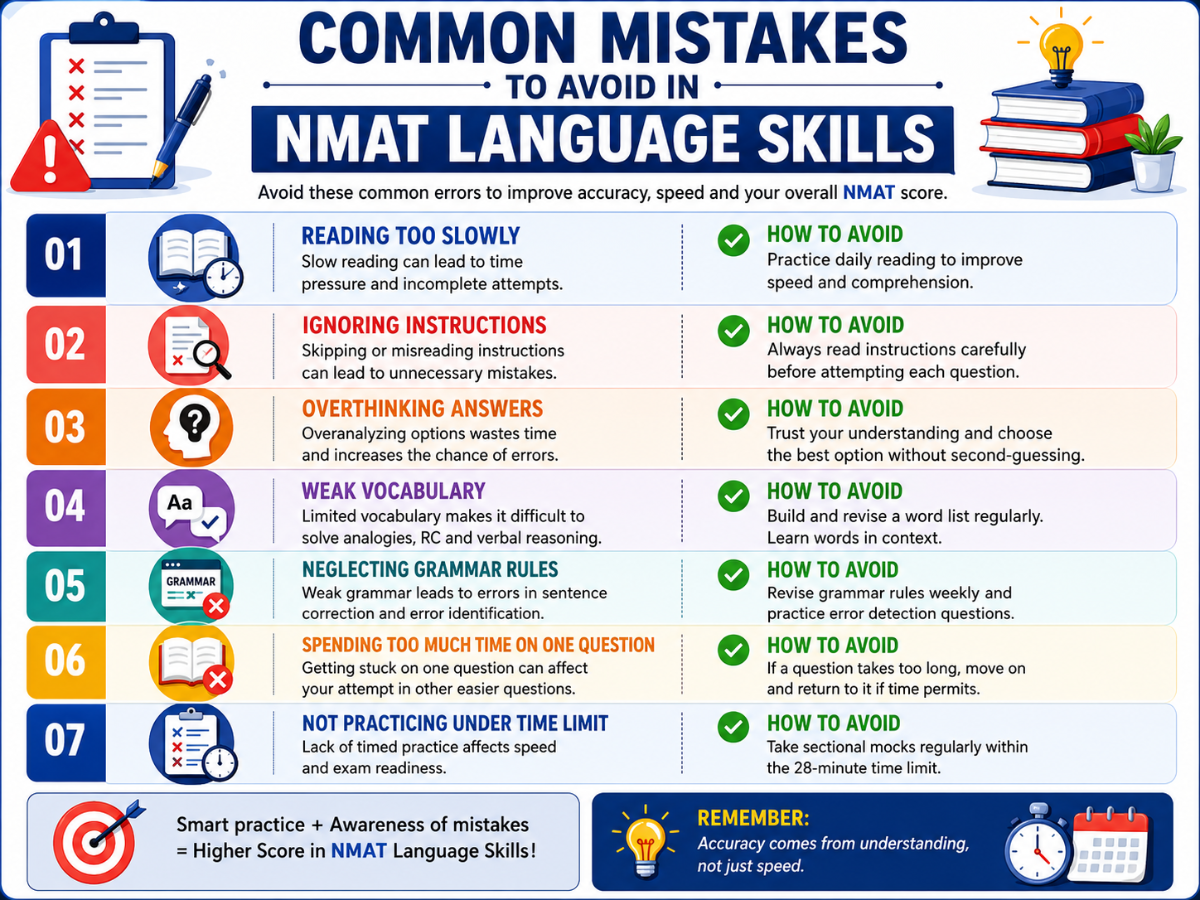
NMAT 2026 Language Skills Preparation Tips FAQs
Ques. How many questions are asked in NMAT Language Skills 2026?
Ans. NMAT Language Skills section has 36 questions to be solved in 28 minutes.
Ques. Is there negative marking in NMAT Language Skills?
Ans. No, NMAT has no negative marking. You get +3 marks for every correct answer.
Ques. What topics are most important in NMAT Language Skills?
Ans. Reading Comprehension and error identification carry the most questions, so you should prioritise these two topics.
Ques. How much time do you get per question in NMAT Language Skills?
Ans. With 36 questions in 28 minutes, you get less than 47 seconds per question on average.
Ques. What is the best way to build vocabulary for NMAT?
Ans. Build a word list gradually over weeks and revise it regularly instead of memorising large lists close to the exam.
Ques. Are 2 months enough to prepare for NMAT?
Ans. Yes, 2 months can be sufficient for NMAT preparation if you already have a decent base from CAT or other MBA exams and dedicate 4–6 hours daily with focused mocks and analysis. However, for beginners, it may be tough, but consistent smart study and prioritizing high-weightage topics are key to scoring well.
Ques. What are the best NMAT 2026 Language Skill Preparation Tips to score well?
Ans. The best NMAT 2026 Language Skill Preparation Tips include improving reading speed through daily RC practice, strengthening grammar and vocabulary, solving sectional quizzes regularly, and analyzing mock tests to enhance accuracy and time management for the 36-question, 28-minute section.
LR Preparation
As per the previous years' exam trends, around 50% of the questions from NMAT Logical Reasoning are from Verbal Reasoning. Check NMAT Exam Pattern 2025
- The difficulty level of Logical Reasoning is generally moderate. Similar to other sections - NMAT Quantitative Skills and NMAT Language Skills, there is no negative marking. 1 mark will be awarded for each correct answer.
- NMAT 2025 is to be conducted from Novemner 5 to December 20, 2025. Check NMAT Exam Dates 2025
- The majority of questions from Analytical Reasoning are from input/output, coding-decoding, blood relations and seating arrangement while statement-conclusion, strengthening and weakening arguments, statement-inference and statement assumption questions dominate the verbal reasoning section. Check detailed NMAT Paper Analysis
NMAT 2025 Logical Reasoning Syllabus
NMAT Logical Reasoning section shall consist of –
- Verbal Reasoning
- Non-verbal/Analytical Reasoning
Topic-wise distribution of logical reasoning section-
| Section Topic | Number of Questions |
|---|---|
| Arrangements, selections | 8-10 (2 to 3 sets) |
| Critical Reasoning | 5-6 |
| Family tree, Blood relations, Directions | 4-5 |
| Coding, Decoding, Input-Output | 3-4 |
| Statement Assumption Conclusion, course of action | 3-4 |
| Set Theory, Puzzles and visual reasoning | 7-8 |
Also Check NMAT Syllabus and Topic Wise Weightage
NMAT 2025 Preparation Strategy for Logical/Critical Reasoning
- For Critical Reasoning questions, candidates first need to comprehend the meaning of the term “inference” or what the question requires of them in order to attempt the same correctly.
- Try and identify the conclusion, the conclusion may not always come at the end of the text it may come somewhere in the middle, end or even the beginning.
- Read the content/sentences correctly and identify the clues or hint which logically follows one statement to the next.
- Always learn to ascertain what exactly the question asks and read the question first before going through the material on which it is based; you should not assume that you know what will be asked about an argument. For example- an argument may have some prominent flaws but you may not be asked to detect them but instead choose the argument which does not have a flaw in it.
- Read all the options carefully and repeatedly in case of confusion. Do not assume that a given choice is best suited as an answer without looking through all the options, as the options are at times deceptive resembling an answer but may not actually be the correct answer.
- Focus on the pictorial representation of data. Look through the patterns/designs carefully when it comes to solving puzzles, visuals etc.
- Improve your own prediction analysis with the help of practice questions, mocks and tutorials.
- Start timing yourself, and make sure to always practise Logical Reasoning with proper timing. Each time you practise with the time you will learn to pick up a pace and will accurately be able to solve all the questions within the limited time.
- Practise every day; as it will help you familiarise yourself with the type of questions that are expected to come in the examination.
- Pay special attention to words like “all”, “some”, and “none” when you come across facts in the question. Also be attentive to words like “only, “other than” and “unless” that specify facts and help candidates to draw conclusions.
- Try to eliminate the deceiving options and choose the one you would eventually arrive to- that should be the main goal when it comes to MCQs.
Must Read: NMAT Preparation Tips for All 3 Sections
NMAT 2025 Preparation Strategy Tips for Non-Verbal Reasoning
- Revise the topics you are confident with as those will help you achieve good marks.
- Visualize the problem in your head, make a mind map, and draw a rough diagram, table or arrangement to get a clear idea of the question.
- In Data Analysis questions, it is useful to try and eliminate the choices which do not seem like a possible answer to gradually arrive at the answer.
- Read the entire question properly with time as sometimes in a hurry you may miss out on the important hints the question offers.
- You should focus on one topic at a time as these are most conceptual and should be solved using a certain technique; even though there may seem to be an overlapping of topics the candidate should go through the topics one by one.
Download Free NMAT Mock Test Papers
NMAT 2025 Preparation Tips and Tricks
- As already mentioned above, there will be a total of 36 questions that need to be answered in 40 minutes, which almost comes down to one question per minute. Therefore, proper practice and time management is the key to success in this section.
- Leave any set or question that you don’t understand or cannot attempt in the first 30 seconds. There is no point in wasting time on only one set or one question. Especially in questions of pattern matching and number series where one gets the answer immediately or it doesn’t strike at all.
- An attempt of about 26 to 29 questions with 95% accuracy will be considered good. Candidates need to master critical/logical reasoning to obtain a high score. In previous years, the cut-off for the same ranged from 59 to 61.
- This section is mainly given so that the students learn to devise a strategy so as to attempt questions from all the sections as this is a scoring section.
- Time Management is extremely crucial as the NMAT is a speed-driven exam and therefore the candidates must place prime importance on managing their time effectively.
NMAT 2025 Logical Reasoning Books
The best books to refer to for your NMAT 2025 Logical Reasoning preparation are given below:
| Books | Author/Publication |
|---|---|
| Analytical Reasoning | M K Pandey |
| MBA (XAT, IIFT, NMAT by GMAC, SNAP, CMAT) | Gautam Puri |
| Modern Approach to Verbal and Non-Verbal Reasoning | R.S. Aggarwal |
| How to Prepare for Logical Reasoning for CAT | Arun Sharma |
| Logical Reasoning and Data Interpretation for CAT | Nishit K Sinha |
NMAT 2025 Logical Reasoning Expected Cut Off
Candidates can check the expected cut-off marks for NMAT 2025 Logical Reasoning section from the table below:
| College | Logical Reasoning Expected Cut Off |
|---|---|
| NMIMS Mumbai | 65 |
| NMIMS Bengaluru | 73 |
| NMIMS Indore | 50 |
| NMIMS Hyderabad | 55 |
| NMIMS Navi Mumbai | 67 |
NMAT 2025 Logical Reasoning FAQs
Ques: What is the difficulty level of NMAT Logical Reasoning?
Ans. As per the previous exam trends, the difficulty level of NMAT Logical Reasoning generally varies from moderate to difficult. The questions from Logical Reasoning comprise two main components- Verbal Reasoning and Analytical Reasoning.
Ques. Which topics majorly dominate NMAT 2025 Logical Reasoning question paper?
Ans. NMAT Logical Reasoning majorly comprises two main topics - Verbal Reasoning and Analytical Reasoning. The main topics of Verbal Reasoning include statement conclusion, strengthening and weakening arguments, statement inference, and statement assumption. Analytical Reasoning majorly consists of questions from input-output, coding-decoding, blood relations, and seating arrangements.
Ques. How many questions are required to be attempted in NMAT 2025 Logical Reasoning to qualify cut off?
Ans. Based on previous exam trends, attempting around 24-28 questions in NMAT Logical Reasoning can be considered a good attempt to secure the cut-off for participating institutes of NMIMS.
Ques. What is the sectional time limit for NMAT 2025 Logical Reasoning?
Ans. The time limit for each section - Logical Reasoning, Quantitative Skills, and Language Skills is specified. Candidates will be allotted 40 minutes to attempt the Logical Reasoning section.
Logical Reas Sample Paper
The Logical Reasoning section of NMAT has 36 questions and 40 minutes, mixing analytical puzzles with verbal reasoning. These sample papers help you build the speed and accuracy this section rewards.
Official website: www.nmat.org
NMAT Logical Reasoning Sample Papers 2026
NMAT Logical Reasoning Sample Paper 1
Download NMAT Logical Reasoning Sample Paper 2
Download NMAT Logical Reasoning Sample Paper 3
Download NMAT Logical Reasoning Sample Paper 4
Download NMAT Logical Reasoning Sample Paper 5
Download NMAT Logical Reasoning Sample Paper 6
Download NMAT Logical Reasoning Sample Paper 7
Download NMAT Logical Reasoning Sample Paper 8
Download NMAT Logical Reasoning Sample Paper 9
Download NMAT Logical Reasoning Sample Paper 10
Download Each NMAT Logical Reasoning sample paper has 36 questions to be solved in about 40 minutes, matching the pace of the real section. Solve one paper, mark your answers, and note the puzzle types that slowed you down.
You can download every NMAT Logical Reasoning sample paper free on an external review site, and you can also check the latest pattern on the official site www.nmat.org before you begin.
- NMAT Logical Reasoning Sample Papers 2026
- NMAT Logical Reasoning Exam Pattern and Marks Distribution 2026
- NMAT Logical Reasoning Sample Papers - Why Recent Papers Matter Most
- NMAT Logical Reasoning Topic Wise Weightage - High Scoring Topics to Focus in Sample Papers
- NMAT Logical Reasoning Sample Paper Video Solutions 2026 - Watch Before You Start Solving
- How to Use NMAT Logical Reasoning Sample Papers to Clear in First Attempt
- NMAT Logical Reasoning No Negative Marking and Speed Strategy
- NMAT Logical Reasoning 4 Week Preparation Plan Using Sample Papers
- FAQs on NMAT Logical Reasoning Sample Papers 2026
- Section: Logical Reasoning, worth 36 questions in the NMAT paper.
- Paper format: all multiple-choice questions with four options each.
- Marking: +3 for every correct answer, with no negative marking, so attempt all 36.
- Time budget: 40 minutes for the section, about 67 seconds per question.
- What it tests: coding-decoding, series, arrangements, blood relations, direction sense, syllogisms and verbal critical reasoning.
- Preparation base: clear reasoning method and quick diagram drawing, no fixed board syllabus.
NMAT Logical Reasoning Exam Pattern and Marks Distribution 2026
Logical Reasoning is one of the three NMAT sections. It blends analytical puzzles with verbal reasoning, so a clear method and quick diagrams decide your score here.
- Questions: 36 questions to be solved in 40 minutes.
- Question type: single-correct multiple-choice questions only.
- Marking: +3 for correct, no negative marking, 0 for unattempted.
- Pace: about 67 seconds per question, so keep coding and series questions quick.
Key advice: solve the quick coding, series and analogy questions first, then use the saved time for the longer arrangement puzzles and critical reasoning.
NMAT Logical Reasoning Sample Papers - Why Recent Papers Matter Most
NMAT Logical Reasoning has settled into a steady mix of analytical puzzles and verbal reasoning. Recent-format papers train you on exactly this mix and pace.
- Recent papers reflect the current share of quick coding and series questions.
- They keep the arrangement puzzles at the moderate length NMAT uses today.
- They help you fix a target of attempting all 36 questions within 40 minutes.
NMAT Logical Reasoning Topic Wise Weightage - High Scoring Topics to Focus in Sample Papers
The table below shows the topics that usually appear in the 36-question Logical Reasoning section and how hard each one tends to be.
| Topic | Questions | Difficulty | What to Watch For |
|---|---|---|---|
| Coding-Decoding and Series | 5-7 | Easy | These are the fastest marks, so drill letter and number patterns. |
| Arrangements and Puzzles (seating, floor, scheduling) | 5-7 | Moderate to Hard | Draw a clear diagram and fix the definite clues first. |
| Blood Relations and Direction Sense | 4-6 | Easy to Moderate | Sketch a family tree or direction map before answering. |
| Syllogisms | 4-6 | Moderate | Use Venn diagrams and test every possibility. |
| Critical Reasoning and Verbal Logic | 7-9 | Moderate | Separate the conclusion from the stated facts before judging. |
| Analogy, Odd One Out and Miscellaneous | 4-6 | Easy to Moderate | Name the relationship first, then match it. |
Note: coding, series and analogy give the quickest marks, so clear them fast to protect time for puzzles and critical reasoning.
NMAT Logical Reasoning Sample Paper Video Solutions 2026 - Watch Before You Start Solving
Watching solved Logical Reasoning questions shows you the shortcuts for coding, arrangements and syllogisms that save the most time. This is helpful before your first timed paper.
Watch the walkthrough once, then attempt a sample paper the same day so the tricks stay fresh.
Watch:
Source: NMAT logical reasoning practice lecture covering coding, arrangements, syllogisms and critical reasoning (YouTube)
How to Use NMAT Logical Reasoning Sample Papers to Clear in First Attempt
Use each Logical Reasoning paper as a short, sharp timed drill. Follow these steps every time.
- Set a 40-minute timer and solve the full 36-question paper in one sitting.
- Answer every coding, series and analogy question in the first pass.
- Attempt the arrangement puzzles next, drawing a clean diagram for each.
- Since there is no negative marking, mark an answer for every question.
- Add every slow puzzle type to a running notes page and revise it weekly.
NMAT Logical Reasoning No Negative Marking and Speed Strategy
Logical Reasoning has no negative marking, so a wrong guess never costs you, but the tight 40-minute clock means you must not get stuck on one long puzzle.
- Attempt all 36 questions, since a guess can only add marks.
- Do not sink time into one hard arrangement; move on and return later.
- Draw diagrams for seating, blood relation and direction questions to avoid slips.
- Keep the last minute to mark answers for any questions left blank.
NMAT Logical Reasoning 4 Week Preparation Plan Using Sample Papers
- Week 1: Revise coding-decoding, series and analogy, then solve two sample papers.
- Week 2: Practise seating arrangements and puzzles, and solve three papers under timer.
- Week 3: Focus on syllogisms, blood relations and critical reasoning, and solve three more papers.
- Week 4: Take the remaining papers every alternate day and review errors, keeping the last two days for light revision only.
FAQs on NMAT Logical Reasoning Sample Papers 2026
Ques.How many questions are there in the NMAT Logical Reasoning section?
Ans.The NMAT Logical Reasoning section has 36 multiple-choice questions to be solved in 40 minutes.
Ques.What topics does NMAT Logical Reasoning cover?
Ans.It covers coding-decoding, series, arrangements and puzzles, blood relations, direction sense, syllogisms and verbal critical reasoning.
Ques.Is there negative marking in the NMAT Logical Reasoning section?
Ans.No, there is no negative marking. You get +3 for every correct answer and lose nothing for a wrong one, so attempt all 36 questions.
Ques.Are these NMAT Logical Reasoning sample papers free to download?
Ans.Yes, all 10 NMAT Logical Reasoning sample papers on this page are free to download in PDF form with answer keys and solutions.
Ques.How can I score high in NMAT Logical Reasoning quickly?
Ans.Clear the quick coding, series and analogy questions first, draw diagrams for puzzles, and keep steady practice with timed sample papers.
Ques.How many Logical Reasoning sample papers should I solve?
Ans.Solving all 10 papers on this page gives you enough practice to build the speed and accuracy the section needs.
Logical Reasoning
NMAT by GMAC Syllabus 2026 covers three independently timed sections: Language Skills, Quantitative Skills, and Logical Reasoning. GMAC administers the exam through its official portal at mba.com/exams/nmat. GMAC does not publish a separate NMAT syllabus PDF — the topic framework is based on the official NMAT Test Prep resources, the NMAT Official Guide, and consistent question patterns from previous years. The NMAT 2026 registration cycle is expected to open in August 2026, with the exam window expected between November and December 2026.
- NMAT 2026 has 3 sections: Language Skills, Quantitative Skills, and Logical Reasoning.
- Each section has 36 questions, totalling 108 questions for the entire exam.
- The total duration is 120 minutes: Language Skills (28 min), Quantitative Skills (52 min), and Logical Reasoning (40 min).
- No negative marking applies — each correct answer earns +3 marks. The total scaled score ranges from 36 to 360.
- You can choose the order of sections at the start of the test. Once a section begins, its timer runs independently.
- NMAT 2026 registration is expected in August 2026. The exam window is expected between November 5 and December 19, 2026.
- Over 51 top B-schools accept NMAT scores, including NMIMS Mumbai, KJ Somaiya, TAPMI, XIM University, SPJIMR, and Great Lakes.
You can attempt NMAT up to three times per cycle — most colleges consider your best score, but NMIMS Mumbai accepts only your first attempt.
NMAT 2026 Syllabus: Access Official Resources
GMAC does not release a section-wise syllabus PDF for NMAT. Access the official test prep materials through the resources below. The NMAT by GMAC Official Guide is the single most authoritative resource for your 2026 preparation.
| Section | Official Resource |
|---|---|
| Language Skills | NMAT Official Guide — Language Skills Topics |
| Quantitative Skills | NMAT Official Guide — Quantitative Skills Topics |
| Logical Reasoning | NMAT Official Guide — Logical Reasoning Topics |
| Complete Test Prep | NMAT by GMAC Official Website — All Resources |
NMAT 2026 Syllabus: Overview
NMAT by GMAC is a computer-adaptive management entrance test. The Graduate Management Admission Council (GMAC) conducts it each year. Unlike most MBA entrance exams in India, NMAT has no officially prescribed syllabus PDF — its topic framework is based on GMAC’s Official Guide and consistent question patterns from previous years.
The exam tests three distinct skill areas. Each section has 36 questions and is timed independently. You choose section order at the start of the exam. Students must manage each section’s timer independently — unused time in one section does not carry over to the next.
| Feature | Details |
|---|---|
| Conducting Body | Graduate Management Admission Council (GMAC) |
| Official Website | mba.com/exams/nmat |
| Exam Type | Computer-Adaptive Test (difficulty adapts based on responses) |
| Sections | 3 — Language Skills, Quantitative Skills, Logical Reasoning |
| Total Questions | 108 (36 per section) |
| Total Duration | 120 minutes |
| Marking Scheme | +3 per correct answer; no negative marking |
| Score Range | 36–360 (scaled score) |
| Attempts Allowed | Up to 3 per cycle |
| Mode | Online — test centres in 70+ cities; online proctored option also available |
| Official Syllabus PDF | Not published separately — use NMAT Official Guide by GMAC |
Source: GMAC — NMAT Official Page
NMAT 2026 Important Dates
GMAC publishes the official NMAT 2026 schedule on its website. Dates below are expected based on the previous cycle. Confirm all dates from the official NMAT website before planning your preparation schedule. Bookmark mba.com/exams/nmat/about/important-dates-fees for real-time updates.
| Event | Expected Dates (2026 Cycle) | Status |
|---|---|---|
| Official Cycle Announcement | July–August 2026 | Upcoming |
| Registration Start | August 2026 (Expected) | Upcoming |
| Registration End | October 2026 (Expected) | Upcoming |
| Slot Booking / Scheduling | August–October 2026 (Expected) | Upcoming |
| Retake Registration Window | October–November 2026 (Expected) | Upcoming |
| Exam Window (1st, 2nd and 3rd attempts) | November 5 – December 19, 2026 (Expected) | Upcoming |
| Score Preview (Unofficial — immediate) | Immediately after exam | Upcoming |
| Official Scorecard Available | Within 48 hours of exam date | Upcoming |
| NMIMS Selection Process (GD-PI) | January–March 2027 (Expected) | Upcoming |
Note: The official NMAT 2026 registration dates have not been released as of July 2026. All dates above are indicative, based on the previous year’s pattern. NMAT 2026 exam fees are expected to be INR 3,000 plus applicable taxes per attempt.
NMAT 2026 Syllabus for Language Skills
The Language Skills section tests English proficiency across reading, grammar, and vocabulary. It has 36 questions in 28 minutes — under 47 seconds per question. Language Skills is the most time-pressured section in NMAT relative to question count. Students who practise reading speed and vocabulary consistently score better here.
NMAT RC passages are shorter and more direct than those in CAT. Focus on grammar accuracy, vocabulary range, and para-arrangement logic to build your LS score efficiently.
NMAT Language Skills: Topic-wise Breakdown
| Topic Area | Sub-topics Covered | Approx. Questions |
|---|---|---|
| Reading Comprehension | RC Sub-topics - Click Here Short RC passages (200–400 words), Inference-based questions, Main idea and title questions, Author’s tone and attitude, Specific detail retrieval, Paragraph summary, Fact vs. inference distinction | 8–10 |
| Para Jumbles (Para Forming) | Para Jumble Sub-topics - Click Here Sentence rearrangement to form a coherent paragraph, Identifying the opening sentence of a paragraph, Identifying the closing sentence, Odd sentence out from a given set of jumbled sentences | 6–8 |
| Sentence Correction & Error Identification | Grammar Sub-topics - Click Here Subject-verb agreement, Tense consistency, Preposition usage, Articles (a, an, the), Modifiers and dangling participles, Parallelism errors, Pronoun reference, Sentence completion with contextual and grammatical fit | 6–8 |
| Vocabulary | Vocabulary Sub-topics - Click Here Synonyms and antonyms, Word analogies (relationship pairs), Idioms and phrases, Word in context (meaning from usage), One-word substitution, Root-word and contextual meaning questions | 6–8 |
| Fill in the Blanks / Cloze Test | Cloze Test Sub-topics - Click Here Single-blank sentence completion, Double-blank fill in the blanks, Cloze passages with multiple blanks requiring contextual vocabulary, Grammar-based fill in the blanks (prepositions, connectors) | 4–6 |
NMAT 2026 Syllabus for Quantitative Skills
The Quantitative Skills section has 36 questions in 52 minutes — roughly 86 seconds per question. It is the least time-pressured of the three sections. Data Interpretation sets appear in clusters and carry significant weight within this section. Class 10–12 mathematics topics form the backbone; higher-level number theory is not tested in NMAT.
NMAT Quantitative Skills: Topic-wise Breakdown
| Topic Area | Sub-topics Covered | Approx. Questions |
|---|---|---|
| Arithmetic | Arithmetic Sub-topics - Click Here Percentages, Profit and Loss, Ratio and Proportion, Averages, Time-Speed-Distance, Time and Work, Simple Interest, Compound Interest, Mixtures and Alligations, LCM and HCF, Pipes and Cisterns | 8–10 |
| Data Interpretation | DI Sub-topics - Click Here Bar graphs (simple and stacked), Line graphs, Pie charts, Tables (single and multi-table sets), DI Caselets (text-based data), Mixed graph sets, Data Sufficiency (is the given data sufficient to answer?) | 8–10 |
| Number System | Number System Sub-topics - Click Here Properties of integers, Divisibility rules, Factors and multiples, Remainders, Unit digit problems, Surds and indices, Cyclicity | 3–5 |
| Algebra | Algebra Sub-topics - Click Here Linear equations, Quadratic equations, Simultaneous equations, Inequalities, Logarithms, Arithmetic Progressions (AP), Geometric Progressions (GP), Coordinate geometry basics, Functions | 4–6 |
| Geometry & Mensuration | Geometry Sub-topics - Click Here Lines and angles, Triangles (similarity, congruence, area formulas), Circles (chords, tangents, arcs, sectors), Quadrilaterals and polygons, Area and perimeter of 2D figures, Volume and surface area of cube, sphere, cylinder, and cone | 3–5 |
| Modern Math | Modern Math Sub-topics - Click Here Permutation and Combination, Probability (basic and conditional), Set Theory with Venn Diagrams, Binomial theorem basics | 3–5 |
NMAT 2026 Syllabus for Logical Reasoning
Logical Reasoning has 36 questions in 40 minutes. It covers two broad types: Analytical Reasoning (puzzle-based) and Critical Reasoning (argument-based). Analytical puzzles — seating arrangements, scheduling grids, and family trees — account for the largest share of questions in this section.
This section rewards students who practise structured elimination and diagram-based solving. Sort puzzles by complexity at the section start. Solve easier ones first to bank marks quickly.
NMAT Logical Reasoning: Topic-wise Breakdown
| Topic Area | Sub-topics Covered | Approx. Questions |
|---|---|---|
| Analytical Puzzles | Puzzle Sub-topics - Click Here Linear seating arrangement (single and double rows), Circular seating arrangement, Scheduling and timetabling puzzles, Grid-based arrangement, Multi-variable constraint puzzles, Floor-based arrangement, Month-date sequencing puzzles | 10–12 |
| Critical Reasoning | Critical Reasoning Sub-topics - Click Here Assumptions underlying a statement, Drawing conclusions from given premises, Inferences (what must/can/cannot be true), Strengthening or weakening an argument, Course of action questions, Statement-argument evaluation, Cause and effect identification | 8–10 |
| Deductions / Syllogisms | Syllogism Sub-topics - Click Here Statement-conclusion type (All/Some/No), Venn diagram-based deductions, Two-statement and three-statement deduction, Negative statement and definite/possible conclusion handling | 4–6 |
| Coding-Decoding & Series | Coding Sub-topics - Click Here Letter-based coding, Number-based coding, Symbol-based logic, Alphanumeric series, Odd one out from a series, Input-output machine problems | 4–6 |
| Blood Relations & Direction Sense | Blood Relations Sub-topics - Click Here Multi-generational family tree problems, Coded blood relations (A is the brother of B’s mother), Combination of family tree with seating arrangement, Direction sense and distance problems | 2–4 |
NMAT 2026 Section-Wise Weightage (Based on Trend Analysis)
GMAC does not publish official topic-wise weightage for NMAT. The table below is based on five-year question pattern analysis from official mock tests and test-taker feedback. Within Quantitative Skills, Data Interpretation and Arithmetic together account for roughly 45–55% of questions. Within Logical Reasoning, Analytical Puzzles alone account for roughly 30% of total questions.
| Section | Questions | Time (Min) | Max Marks | Score Range | Highest-Frequency Topics |
|---|---|---|---|---|---|
| Language Skills | 36 | 28 | 108 | 12–120 | Reading Comprehension, Para Jumbles, Sentence Correction |
| Quantitative Skills | 36 | 52 | 108 | 12–120 | Data Interpretation, Arithmetic, Algebra |
| Logical Reasoning | 36 | 40 | 108 | 12–120 | Analytical Puzzles, Critical Reasoning, Syllogisms |
| Total | 108 | 120 | 324 (raw) | 36–360 (scaled) | — |
Note: The scaled score (36–360) is computed by GMAC’s adaptive algorithm. Raw marks (max 324) convert to a scaled score. All three sections contribute equally to the total.
NMAT 2026 Topic-Wise Weightage Estimates (5-Year Average)
| Section | Topic | Approx. Questions (out of 36) | Priority |
|---|---|---|---|
| Language Skills | Reading Comprehension | 8–10 | High |
| Language Skills | Para Jumbles | 6–8 | High |
| Language Skills | Sentence Correction / Error ID | 6–8 | High |
| Language Skills | Vocabulary (Synonyms, Antonyms, Analogies) | 6–8 | Medium |
| Language Skills | Fill in the Blanks / Cloze | 4–6 | Medium |
| Quantitative Skills | Data Interpretation (DI) | 8–10 | High |
| Quantitative Skills | Arithmetic | 8–10 | High |
| Quantitative Skills | Algebra | 4–6 | Medium |
| Quantitative Skills | Number System | 3–5 | Medium |
| Quantitative Skills | Modern Math (PnC, Probability) | 3–5 | Medium |
| Quantitative Skills | Geometry & Mensuration | 3–5 | Low-Medium |
| Logical Reasoning | Analytical Puzzles | 10–12 | High |
| Logical Reasoning | Critical Reasoning | 8–10 | High |
| Logical Reasoning | Syllogisms / Deductions | 4–6 | Medium |
| Logical Reasoning | Coding-Decoding & Series | 4–6 | Medium |
| Logical Reasoning | Blood Relations & Direction Sense | 2–4 | Low-Medium |
NMAT 2026 Exam Pattern
NMAT 2026 follows a computer-adaptive format. Question difficulty adjusts in real time based on your responses. You cannot skip a question and return to it within the same section. Each section must be completed in full before the next one begins.
| Feature | Details |
|---|---|
| Exam Format | Computer-Adaptive Test (question difficulty adjusts per response) |
| Question Type | Multiple Choice Questions (MCQs) — 4 options per question |
| Section Order | Student’s choice at the start of each exam session |
| Marking Scheme | +3 for correct; 0 for incorrect or unattempted (no negative marking) |
| Score Reporting | Unofficial score preview immediately after exam; official scorecard within 48 hours |
| Score Validity | Valid for the current admissions cycle only |
| Number of Attempts | Up to 3 per cycle (retake registration and fee required for each) |
| Best Score Policy | Most colleges consider the best score; NMIMS considers only the first attempt |
| Test Centres | 70+ cities in India; Online Proctored option for international test-takers |
| Fee per Attempt | INR 3,000 + applicable taxes (expected; official fee released with notification) |
Important: NMIMS Mumbai accepts only your first NMAT attempt score, not your best score. Plan your first attempt after complete preparation.
Best Books for NMAT 2026 Preparation
No single book covers NMAT exclusively. Use section-specific books alongside GMAC’s official guide. The NMAT by GMAC Official Guide is the most authoritative resource — it includes actual-format questions and familiarises you with the adaptive-test interface.
| Section | Book Name | Author / Publisher | Why This Book |
|---|---|---|---|
| All Sections (Official) | NMAT by GMAC Official Guide | GMAC | Only book with actual NMAT-format questions; covers all three sections; includes adaptive practice tests on the official platform |
| Language Skills | Word Power Made Easy | Norman Lewis | Comprehensive vocabulary builder; covers roots, analogies, and word usage — directly relevant to NMAT synonym, antonym, and analogy questions |
| Language Skills | How to Prepare for Verbal Ability and Reading Comprehension for CAT | Arun Sharma & Meenakshi Upadhyay / McGraw Hill | Strong RC passage practice with shorter passages; grammar-error exercises map directly onto NMAT sentence correction questions |
| Quantitative Skills | Quantitative Aptitude for CAT | Arun Sharma / McGraw Hill | Covers arithmetic, algebra, and geometry in depth; tiered difficulty (LOD 1–3) helps target NMAT-level topics without over-preparation |
| Quantitative Skills | Quantitative Aptitude | R.S. Aggarwal / S. Chand | Extensive drill sets across arithmetic and number systems; builds calculation speed essential for NMAT’s 52-minute QS section |
| Quantitative Skills | How to Prepare for Data Interpretation for CAT | Arun Sharma / McGraw Hill | DI sets covering graphs, caselets, and data sufficiency — mirrors the DI-heavy sub-section in NMAT Quantitative Skills |
| Logical Reasoning | How to Prepare for Logical Reasoning for CAT | Arun Sharma / McGraw Hill | Seating arrangements, constraint puzzles, and critical reasoning sets — aligns closely with NMAT LR question types |
| Logical Reasoning | Logical and Analytical Reasoning | Ashok Gupta / Arihant | Strong coverage of blood relations, coding-decoding, and syllogisms; good for building speed in shorter LR question types |
How to Access NMAT 2026 Syllabus and Official Resources
GMAC does not publish a standalone NMAT syllabus PDF. Follow these steps to access the official test prep resources and topic information from the GMAC website.
- Visit the official NMAT page at mba.com/exams/nmat.
- Click on the "Prepare" or "Test Prep" tab in the page navigation.
- Select "NMAT Official Guide" to access or purchase the official study material.
- Under "About NMAT", click on "Sections" or "How is the test structured" for the section-wise topic outline.
- After registration opens in August 2026, download the NMAT 2026 Information Bulletin for the complete official topic framework and marking scheme.
- Bookmark the page and check back in August 2026 for the official cycle announcement and registration link.
Note: The NMAT 2026 Information Bulletin will be published after registration opens. Until then, refer to the 2025 bulletin — the topic structure and section format are consistent across cycles.
Source: GMAC — NMAT Official Website
NMAT 2026 Preparation Strategy
A focused 3–4 month plan is enough for most students targeting a score of 210+. Attempt at least 15 full-length sectional mocks and 5–8 complete tests before your first official attempt. Build section-by-section first, then shift to integrated full-test practice.
Language Skills Preparation
- Read one editorial or essay daily. This builds comprehension speed for the 28-minute LS window.
- Spend 20 minutes daily on Norman Lewis’ Word Power Made Easy for vocabulary. NMAT analogy and synonym questions reward consistent vocabulary practice.
- Practise para-jumble sets of 5–6 questions every day. Identify topic sentences and conclusion markers to rearrange paragraphs quickly.
- Revise subject-verb agreement, tense consistency, and preposition use. Test yourself with error-identification exercises.
- Aim to complete each RC passage within 3 minutes. Use the remaining time for answer choice analysis.
Quantitative Skills Preparation
- Prioritise Data Interpretation first. DI accounts for 8–10 of your 36 QS questions and rewards practice more than conceptual depth.
- Master five core arithmetic areas: percentages, ratios, time-work, profit-loss, and simple and compound interest. These appear in nearly every NMAT cycle.
- Practise Data Sufficiency questions as a separate drill. The "is this statement alone sufficient?" format confuses unprepared students.
- You have roughly 86 seconds per question. Drill mental calculation techniques to cut solution time significantly.
- NMAT has no negative marking. If you cannot solve a question in 90 seconds, make your best guess and move on.
Logical Reasoning Preparation
- Solve at least 2 seating arrangement puzzles daily. Linear and circular arrangements form the largest share of NMAT LR questions.
- Draw constraint diagrams for every puzzle — visual mapping eliminates errors faster than mental tracking.
- For Critical Reasoning, always identify the conclusion first. Misidentifying the conclusion is the most common error in this question type.
- Learn syllogism Venn-diagram shortcuts. Most NMAT syllogism questions can be solved in under 30 seconds with the right approach.
- At the start of the LR section, scan all puzzle sets briefly. Tackle fewer-constraint puzzles before five-variable ones to secure early marks.
Mock Tests and Final Revision
- Attempt one full NMAT mock per week for the first eight weeks. Increase to 2–3 mocks per week in the final month.
- Always choose your section order in each mock based on your mental readiness that day — not a fixed formula.
- Review every mock in full. Errors on easy questions hurt your adaptive scaled score more than skipping hard ones.
- Use GMAC’s free official practice test on mba.com to experience the actual adaptive-test interface before the real exam.
NMAT Syllabus 2026 FAQs
Ques. Does NMAT 2026 have an official syllabus PDF?
Ans. No. GMAC does not publish a separate NMAT syllabus PDF. The topic framework is based on the NMAT Official Guide by GMAC and consistent question patterns from previous years. The NMAT 2026 Information Bulletin — which includes the official topic outline — will be available on mba.com after registration opens in August 2026.
Ques. How many sections are there in NMAT 2026 and what is the time limit for each?
Ans. NMAT 2026 has three sections. Language Skills has 36 questions in 28 minutes. Quantitative Skills has 36 questions in 52 minutes. Logical Reasoning has 36 questions in 40 minutes. The total duration is 120 minutes. Sectional time limits are strictly enforced — unused time cannot be transferred.
Ques. Is the NMAT 2026 syllabus the same as last year?
Ans. Yes. The NMAT syllabus has remained consistent for several years. The three sections — Language Skills, Quantitative Skills, and Logical Reasoning — cover the same topic areas. No additions or deletions have been announced for the 2026 cycle. You can use 2025 preparation resources safely for NMAT 2026.
Ques. Which section has the highest weightage in NMAT 2026?
Ans. All three sections carry equal weightage — 36 questions each, contributing equally to the total scaled score of 36–360. Language Skills is the most time-pressured (28 minutes for 36 questions). Quantitative Skills is the least time-pressured (52 minutes for 36 questions). Within sections, Analytical Puzzles and Data Interpretation are the highest-frequency sub-topics.
Ques. What are the most important topics in NMAT Language Skills for 2026?
Ans. Reading Comprehension and Para Jumbles together account for roughly 14–18 of the 36 Language Skills questions. Sentence Correction and Vocabulary (synonyms, antonyms, analogies) follow. Focus your Language Skills preparation on RC speed and para-arrangement logic for the highest return on preparation time.
Ques. What are the most important topics in NMAT Quantitative Skills?
Ans. Data Interpretation and Arithmetic are the highest-frequency topics. Together they account for roughly 16–20 of the 36 QS questions based on past-year patterns. Data Sufficiency questions also appear regularly. Cover DI and Arithmetic first before moving to Algebra, Number System, and Modern Math.
Ques. What are the most important topics in NMAT Logical Reasoning?
Ans. Analytical Puzzles (seating arrangements, scheduling grids, multi-variable constraints) account for roughly 10–12 of the 36 LR questions. Critical Reasoning (assumptions, conclusions, strengthening or weakening arguments) is the second-highest area. These two sub-types together form roughly 50–60% of the LR section.
Ques. Is there negative marking in NMAT 2026?
Ans. No. NMAT 2026 has no negative marking. Each correct answer earns +3 marks. An incorrect or unattempted answer scores 0. This makes intelligent guessing a valid strategy for difficult questions. Never leave a question blank in NMAT — there is no penalty for attempting.
Ques. How many times can you attempt NMAT 2026?
Ans. You can attempt NMAT up to 3 times within the 2026 exam cycle. Each retake requires a separate registration and fee (INR 3,000 + taxes per attempt, based on the previous cycle). Most colleges consider your best score across all attempts. NMIMS, however, considers only the score from your first attempt.
Ques. What is a good score in NMAT 2026?
Ans. A score of 209 and above meets the minimum cutoff for NMIMS Mumbai MBA programmes. Programs at KJ Somaiya, TAPMI, and XIM University typically expect 215–230+. A score above 220 out of 360 gives you a competitive position at most top NMAT-accepting colleges. NMIMS also requires a minimum sectional score of 60 out of 120 per section.
Ques. Which colleges accept NMAT 2026 scores?
Ans. Over 51 management institutes in India accept NMAT scores for MBA admissions 2026–27. Top colleges include NMIMS Mumbai, KJ Somaiya Institute of Management, XIM University (XIMB), TAPMI, Great Lakes Institute of Management, SPJIMR, IFMR, ITM Business School, and SRM University. NMAT scores are also accepted by institutes in South Africa, the Philippines, Hungary, Nigeria, and Morocco.
Ques. How should I cover the full NMAT 2026 syllabus in 3 months?
Ans. Divide 3 months into: Month 1 — concept-building (one topic cluster per week per section); Month 2 — topic-level practice sets and sectional mocks; Month 3 — full-length mocks, weak-area revision, and 2–3 NMAT Official Practice Tests from mba.com. Attempt at least 10 full mocks before your first official attempt. Prioritise DI, Arithmetic, Analytical Puzzles, and RC — these topics account for roughly 50–60% of total questions.
*The article might have information for the previous academic years, which will be updated soon subject to the notification issued by the University/College.
Paper Analysis
The NMAT 2026 exam is expected to have a total of 108 multiple-choice questions spanning three mandatory sections with strict individual time limits and no negative marking.
- The CBT exam will be held at designated test centres across India as well as through online proctored mode, whichever is available.
- The overall difficulty level of the NMAT 2026 exam is expected to be moderate, with slight variations across different exam slots.
- The Language Skills section is likely to feature a balanced mix of vocabulary, grammar, & RC questions.
- Logical Reasoning is expected to be the most time-consuming section.
- Quantitative Skills is moderate, with Arithmetic and Algebra dominating.
NMAT 2026 will be conducted by GMAC from 5 November to 19 December 2026 in a 45-day test window. The exam runs in morning, afternoon, and evening slots, and you pick your own date.
Related Links:
- NMAT 2027 Question Paper (Available): Download NMAT Previous Year Papers PDFs with Solutions
- NMAT Exam Pattern 2027: 108 Questions, 120 Minutes, Marking Scheme and Section-Wise Time Limit
- NMAT Syllabus 2027: 3 Sections, Subject-Wise Topics, Weightage and PDF Download
Key Summary
- GMAC conducts NMAT in a 45-day window, so difficulty varies slightly from slot to slot.
- NMAT is computer adaptive, which means no two students get the same question set.
- The paper has 108 questions across 3 sections, and you get 120 minutes in total.
- NMAT 2025 was rated Easy to Moderate, with Quantitative Skills reported as the toughest section.
- Geometry questions did not appear in NMAT 2024 or NMAT 2025.
- There is no negative marking, so you should mark every one of the 108 questions.
NMAT Paper Analysis 2026: Overview
| Aspect | Expected Details |
|---|---|
| Overall Difficulty Level | Moderate |
| Exam Mode | Computer-Based Adaptive Test (CAT) |
| Difficulty Variation | May vary slightly across exam slots due to the adaptive nature of the test |
| Negative Marking | No negative marking |
| Question Navigation | Candidates must answer the current question before moving to the next; the Skip option is disabled |
| Section Navigation | Once a section is submitted, candidates cannot revisit or modify their answers |
| Attempt Strategy | Attempt all questions while maintaining a balance between speed and accuracy |
| Best Exam Approach | Prioritize accuracy, manage time effectively, and avoid spending too long on difficult questions |
NMAT Paper Analysis 2026: Overall Difficulty
The overall difficulty of the NMAT 2026 exam is expected to remain moderate, with slight variations across different exam slots.
- Check the slot-wise difficulty level, good attempts, and candidate feedback to evaluate your overall performance.
- Around 24-26 confident attempts per section with 85 percent accuracy is a strong benchmark.
- Since there is no negative marking, you should mark all 108 questions.
| Section | Questions | Sectional Time | Expected Difficulty Level | Expected Good Attempts |
|---|---|---|---|---|
| Language Skills | 36 | 28 minutes | Easy to Moderate | 28-30 |
| Logical Reasoning | 36 | 40 minutes | Moderate | 25-27 |
| Quantitative Skills | 36 | 52 minutes | Moderate | 25-28 |
| Overall | 108 | 120 minutes | Easy to Moderate | 80-85 |
NMAT Paper Analysis 2026: Previous Year’s Slot-Wise Difficulty
The first week of the NMAT 2025 window was reported as slightly tougher than later slots. Scaled scoring is designed to even this out, so do not chase a slot purely for an easier paper.
| Slot Date | Language Skills | Logical Reasoning | Quantitative Skills | Overall |
|---|---|---|---|---|
| 5 and 6 November 2025 | Easy to Moderate | Moderate | Moderate, calculation-heavy | Moderate |
| 9 November 2025, Slot 1 | Easy to Moderate | Moderate | Moderate | Easy to Moderate |
| 16 December 2025 | Moderate | Easy to Moderate | Moderate | Easy to Moderate |
Also Read:
- NMAT 2026 Safe Score for NMIMS Mumbai MBA: Cutoff and Selection Process
- NMAT 2026 Score for IBS Hyderabad: Cutoff and Admission Criteria
NMAT Paper Analysis 2026: Section-Wise
Each section carries 36 questions and its own timer. The topic split below reflects what students reported through the NMAT 2025 window.
NMAT Language Skills Analysis
| Aspect | NMAT 2026 Language Skills Analysis |
|---|---|
| Section Duration | 28 minutes (shortest section) |
| Time per Question | Less than 47 seconds per question |
| Overall Focus | Reading speed and accuracy are crucial |
| Reading Comprehension | 3 RC passages with around 12 questions |
| Passage Length | Approximately 300–400 words |
| RC Question Type | Mostly direct and fact-based |
| Grammar | Spot the Error and sentence correction questions |
| Vocabulary | Moderate; fewer vocabulary questions in some slots |
| Fill in the Blanks | Mainly based on prepositions and word usage |
| Analogy Questions | Asked in most exam slots |
| Para Jumbles | 4- and 5-sentence sets; one set generally challenging |
NMAT Logical Reasoning Analysis
| Aspect | NMAT 2026 Logical Reasoning Analysis |
|---|---|
| Section Duration | 40 minutes |
| Total Questions | 36 questions |
| Section Split | Analytical Reasoning and Verbal Reasoning |
| Verbal Reasoning Weightage | Around 65% of the section |
| Key Verbal Topics | Critical Reasoning, Statement-Assumption, Statement-Argument |
| Analytical Reasoning Weightage | Around 35% of the section |
| Key Analytical Topics | Input-Output, Data Arrangement, Venn Diagrams, Syllogism, Course of Action |
| Expected Sets | One Input-Output set (4 questions), and one Data Arrangement set (4 questions) |
| Difficulty Level | Moderate; lengthy questions require careful time management |
| Most Time-Consuming Topic | Syllogism |
NMAT Quantitative Skills Analysis
| Aspect | NMAT 2026 Quantitative Skills Analysis |
|---|---|
| Section Duration | 52 minutes (longest section) |
| Overall Difficulty | Moderate; calculation-intensive |
| Data Interpretation (DI) | 2 sets of 4 questions each |
| DI Question Types | Tables, Bar Graphs, Line Graphs, Pie Charts |
| Data Sufficiency (DS) | 4–5 questions |
| DI + DS Weightage | 12–14 questions (over one-third of the section) |
| Key Arithmetic Topics | Numbers, Ratio, Profit & Loss, Percentage |
| Modern Maths | Permutation & Combination, Probability (3–6 questions) |
| Geometry | No questions reported in NMAT 2024 or 2025 |
| Key Challenge | Speed and calculation accuracy; no calculator allowed |
NMAT Paper Analysis 2026: Topic Distribution
Based on previous years' trends, the NMAT exam follows a fairly consistent topic-wise question distribution across all three sections. Reviewing the topic distribution helps candidates identify high-weightage areas and prepare more effectively.
Language Skills Topic Distribution
| Topic | Expected No. of Questions | Expected Difficulty |
|---|---|---|
| Reading Comprehension (3 passages, 4 questions each) | 12 | Moderate |
| Spot the Error | 4-6 | Easy to Moderate |
| Analogy | 5-6 | Easy |
| Para-jumbles | 4-5 | Moderate |
| Fill in the Blanks (Prepositions) | 4 | Easy |
| Fill in the Blanks (Vocabulary, double blanks) | 2-6 | Easy to Moderate |
| Phrasal Fillers and Sentence Completion | 2-3 | Easy |
Logical Reasoning Topic Distribution
| Topic | Expected No. of Questions | Expected Difficulty |
|---|---|---|
| Critical Reasoning | 5-8 | Moderate |
| Statement-Assumption, Inference and Conclusion | 6-8 | Moderate |
| Statement-Argument | 2-5 | Moderate |
| Data Arrangement (1 set) | 4 | Moderate |
| Input-Output (1 set) | 4 | Moderate |
| Course of Action | 3-4 | Easy |
| Venn Diagram | 2-3 | Easy |
| Syllogism | 2 | Easy to Moderate |
| DM, Para Summary and Main Point | 2-4 | Easy |
Quantitative Skills Topic Distribution
| Topic | Expected No. of Questions | Expected Difficulty |
|---|---|---|
| Data Interpretation (2 sets, 4 questions each) | 8 | Moderate |
| Data Sufficiency | 4-5 | Moderate |
| Numbers | 4 | Easy to Moderate |
| Permutation, Combination and Probability | 3-6 | Moderate |
| Ratio and Partnership | 3 | Easy |
| Profit, Loss and Discount | 3 | Easy to Moderate |
| Set Theory | 1-3 | Moderate |
| Percentage | 1-3 | Easy |
| Time and Work | 1-2 | Easy to Moderate |
| Quadratic Equations | 1-2 | Moderate |
| Simple Interest and Compound Interest | 1 | Easy |
| Arithmetic and Geometric Progression | 1 | Easy |
| Logarithms | 1 | Easy to Moderate |
| Geometry and Mensuration | 0 | Not asked since 2024 |
Also Read:
NMAT Paper Analysis 2026: Year-wise Good Attempt
| Year | Language Skills (out of 36) | Logical Reasoning (out of 36) | Quantitative Skills (out of 36) | Overall Good Attempts | Overall Difficulty |
|---|---|---|---|---|---|
| 2025 | 28 – 32 | 25 – 28 | 25 – 28 | 80 – 88 | Moderate (Quant calculation-heavy) |
| 2024 | 26 – 30 | 22 – 26 | 24 – 28 | 75 – 84 | Moderate to Slightly Tough |
| 2023 | 25 – 29 | 21 – 25 | 23 – 27 | 70 – 80 | Easy to Moderate |
| 2022 | 27 – 31 | 23 – 27 | 22 – 26 | 75 – 84 | Moderate |
| 2021 | 28 – 32 | 23 – 27 | 20 – 25 | 75 – 84 | Moderate |
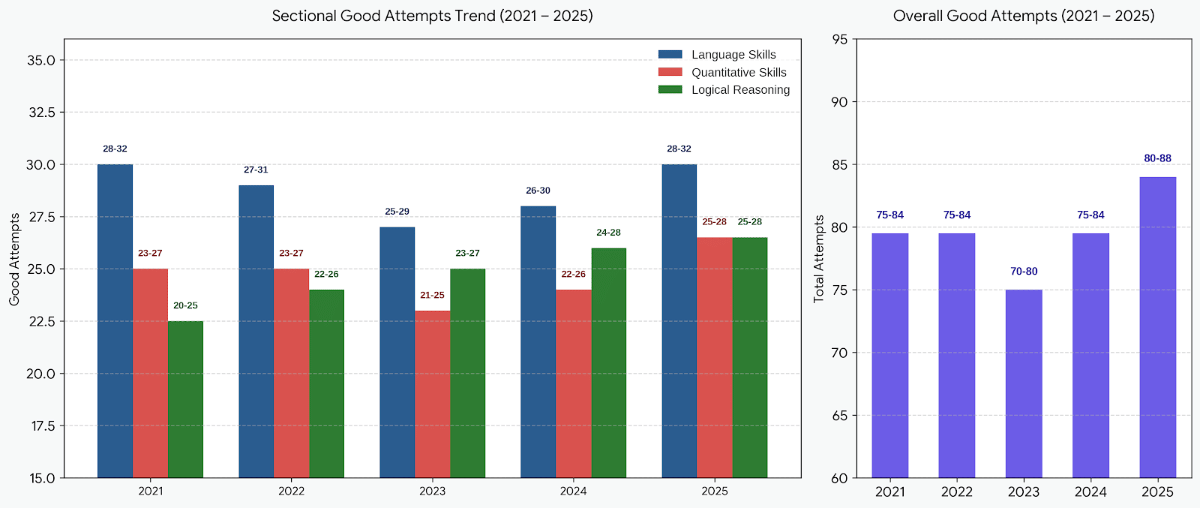
NMAT Paper Analysis 2026: Expert Review
Based on previous years' trends, experts shared the following observations for the NMAT 2026 Paper Analysis:
- Experts noted that the overall NMAT paper remained moderate, with slight variations across different exam slots.
- They observed that Logical Reasoning was the most time-consuming section due to lengthy reasoning sets.
- Quantitative Skills required strong calculation speed, while Language Skills rewarded fast reading and grammar accuracy.
- Experts recommend attempting all questions, as NMAT has no negative marking, while maintaining speed and accuracy throughout the exam.
Also Read: NMAT 2026 Exam Pattern: 3 Sections, 108 Questions and Scaled Scoring
NMAT Paper Analysis 2026: Student Reactions for Previous Years' Exam
Students on Reddit shared the previous year's exam analysis that helps directly shape the NMAT 2026 Paper Analysis.

Source: Reddit
- Students found the overall paper moderate and manageable with a good preparation strategy.
- Many emphasized that mock tests helped them develop the right section order and time management.
- Candidates suggested attempting all questions, as NMAT has no negative marking and unattempted questions reduce the score.
- Several students felt that avoiding lengthy questions and maintaining speed was the key to maximizing their score.
NMAT Paper Analysis 2026: Expected Cutoff Based on Paper
- According to previous years' trends, a score of 240–250+ is considered competitive for admission to leading NMIMS campuses.
- NMIMS also applies a sectional cutoff of around 62 out of 120 for its core programmes.
- Students targeting NMIMS Mumbai should aim for 230 and above to stay safe.
| College | Programme | Expected NMAT 2026 Cutoff (Out of 360) |
|---|---|---|
| NMIMS Mumbai | MBA and MBA HR | 209 and above |
| NMIMS Bengaluru | MBA | 200-209 |
| NMIMS Hyderabad | MBA | 200 – 206 |
| NMIMS Navi Mumbai | MBA | 200 – 209 |
| NMIMS Indore | MBA | 200 – 206 |
| NMIMS Mumbai | MBA Pharmaceutical Management | 190 and above |
| KJ Somaiya, Mumbai | MBA | 220-225 |
| XIM Bhubaneswar | MBA and MBA HR | 200-225 |
| TAPMI Manipal | PGDM | 200-215 |
| SDA Bocconi Asia Center | MBA | 200 and above |
| Great Lakes and SOIL Gurgaon | PGDM | 200-215 |
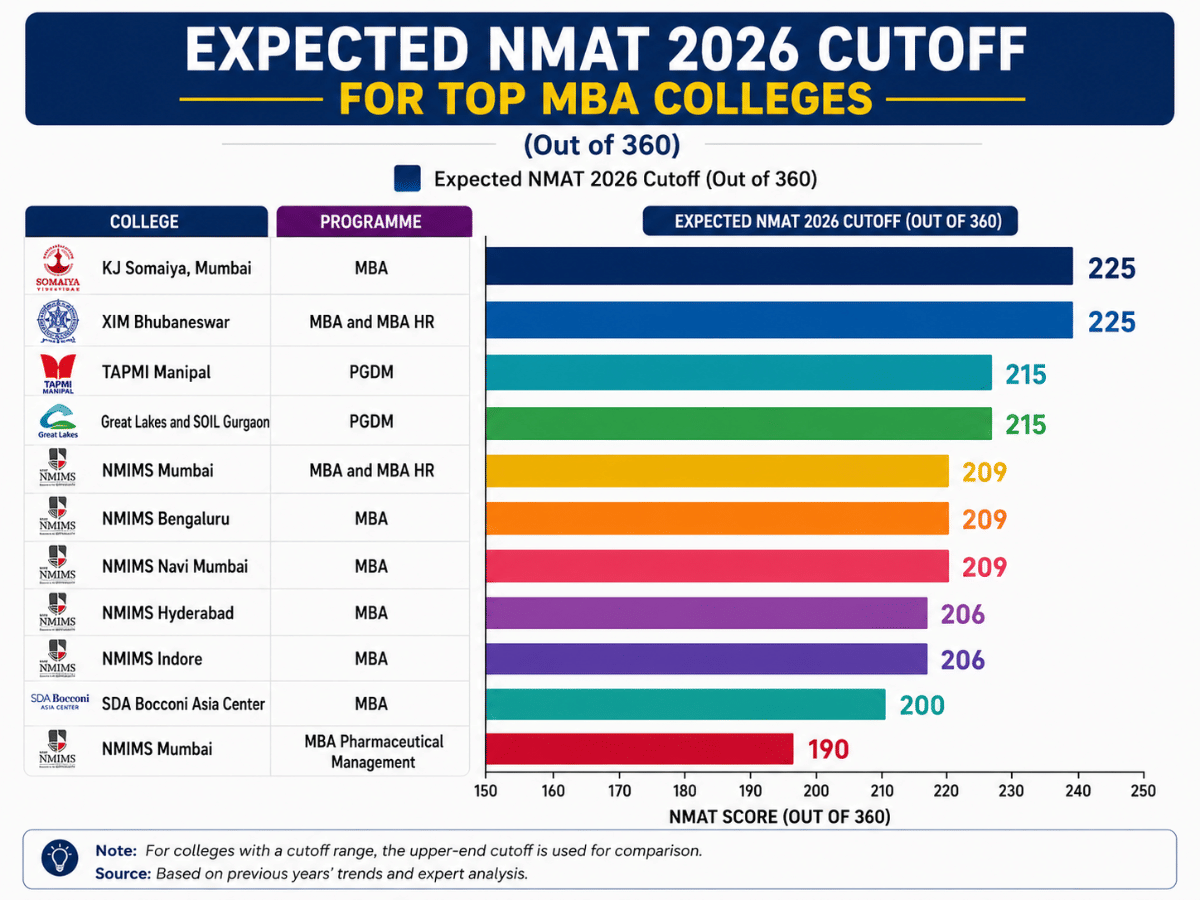
Also Read:
- NMAT 2026 Safe Score for Top MBA Colleges: School-Wise Cutoffs and GD-PI Shortlist
- NMAT Cutoff 2026: Expected Cutoff, Safe Score, Top NMIMS Colleges & B-schools
- NMAT GD, PI, and WAT Tips To Crack NMIMS Selection Process
NMAT Paper Analysis 2026: Previous Year Paper Comparison
- Based on previous years' trends, the NMAT 2025 paper was moderate in overall difficulty.
- The Quantitative Skills section was the most calculation-intensive.
- Logical Reasoning required careful time management due to lengthy questions.
- The NMAT 2026 exam is expected to follow a similar pattern, with speed and accuracy playing a key role.
| Parameter | NMAT 2026 (Expected) | NMAT 2025 (Actual) | NMAT 2024 (Actual) |
|---|---|---|---|
| Overall Difficulty | Easy to Moderate | Easy to Moderate | Moderate |
| Toughest Section | Quantitative Skills | Quantitative Skills | Quantitative Skills |
| Easiest Section | Language Skills | Language Skills | Language Skills |
| Total Questions | 108 | 108 | 108 |
| RC Passages | 3 passages, 12 questions | 3 passages, 12 questions | 3 passages, 12 questions |
| Para-jumbles | 4-5 | 4-5 | 6 |
| DI Sets | 2 sets of 4 questions | 2 sets of 4 questions | 2 sets of 4 questions |
| Data Sufficiency | 4-5 | 5 | 4 |
| Geometry Questions | Nil | Nil | Nil |
| Verbal Share in Logical Reasoning | Around 65 percent | Around 65 percent | Around 53 percent |
| Expected Good Attempts | 80-85 | 80-85 | Not published |
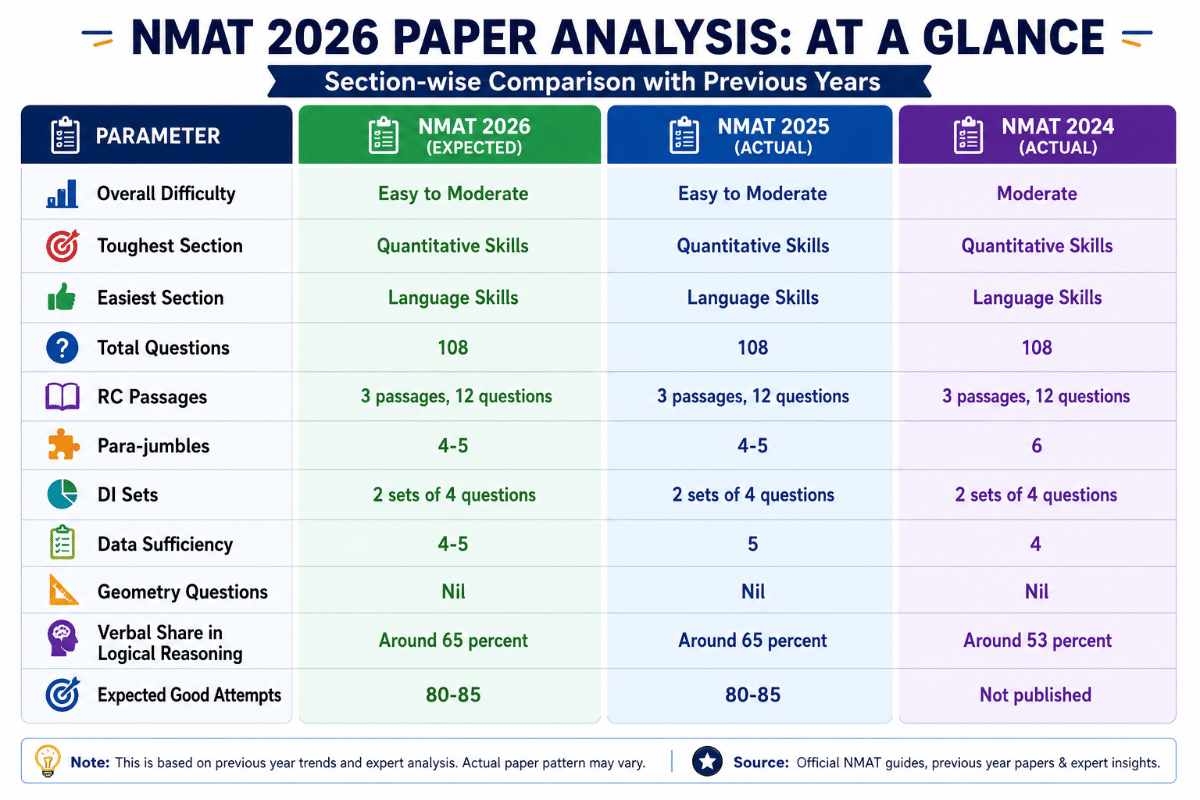
NMAT Paper Analysis 2026 FAQs
Ques. Will the NMAT 2026 paper be tough?
Ans. NMAT 2026 is expected to be Easy to moderate, in line with the last cycle. The paper tests speed rather than conceptual depth. Quantitative Skills is expected to feel the toughest because of the calculation load.
Ques. How many good attempts are needed in NMAT 2026?
Ans. Around 80-85 genuine attempts out of 108 is a strong benchmark. That works out to 24-26 confident attempts per section with 85 percent accuracy. You should still mark all 108 questions.
Ques. Which is the toughest section in NMAT?
Ans. Students rate Quantitative Skills as the toughest section. Two Data Interpretation sets and Data Sufficiency questions make it calculation-heavy. The concepts stay basic, but the clock is tight.
Ques. Which is the easiest section in NMAT 2026?
Ans. Language Skills is expected to be the easiest section. Reading Comprehension carries 12 of the 36 questions. The rest come from grammar, analogy, and para-jumbles.
Ques. Will Geometry questions appear in NMAT 2026?
Ans. Geometry did not appear in NMAT 2024 or NMAT 2025. It is unlikely to return in 2026. Modern Maths and Arithmetic take up that space instead.
Ques. What is the expected NMAT 2026 cutoff based on this paper?
Ans. NMIMS Mumbai is expected to hold its cutoff at 209 and above. Other NMIMS campuses are expected between 200 and 209. Aim for 230 and above for a comfortable call.
Ques. Does the difficulty level change between NMAT slots?
Ans. Slot difficulty varies slightly across the 45-day window. GMAC uses scaled scoring to correct for this. So an easier slot does not give you a scoring advantage.
Ques. Should I attempt all 108 questions in NMAT 2026?
Ans. Yes, you should mark every question. NMAT has no negative marking at all. The skip option is disabled, so you must answer before moving ahead.
Ques. When will the NMAT 2026 slot-wise analysis be released?
Ans. Slot-wise analysis will be published from 5 November 2026.
Preparation Tips
NMAT Preparation 2026 requires a fundamentally different approach from exams like CAT or XAT. Conducted by the Graduate Management Admission Council (GMAC), NMAT by GMAC 2026 is expected to be held in a testing window from November to December 2026, accepting over 75,000 candidates across 50+ B-schools in India and abroad. Unlike most MBA entrance exams, NMAT allows candidates to attempt the exam up to three times per testing cycle, making strategic, well-paced preparation the key differentiator between an average score and a 230+ performance.
- Registration Opens: NMAT 2026 registration is expected to open in August 2026 — last year it opened on August 1, 2025. Register early as preferred test slots and centres fill up fast.
- Exam Window: NMAT 2026 is tentatively scheduled from November to December 2026 — a 45-day window. In 2025, the window ran from November 5 to December 19, 2025.
- Cut-off Target: NMIMS Mumbai requires an overall score of 209+ (sectional cut-off: 62). Targeting 220-230+ gives you a competitive buffer across multiple NMAT colleges.
- Retake Policy: You get one free retake; a second retake costs a separate fee. Best score across attempts is considered — plan your attempt schedule early.
Related Links:

What is NMAT 2026?
NMAT by GMAC (Narsee Monjee Management Aptitude Test) is a national-level MBA entrance exam conducted by the Graduate Management Admission Council for admission into MBA and PGDM programmes. NMAT 2026 is one of the most student-friendly MBA entrance exams in India, known for its no negative marking policy, adaptive format, flexible testing window, and multiple attempt option.
The exam is accepted by 50+ B-schools including NMIMS Mumbai, XIM Bhubaneswar, K J Somaiya Institute of Management, VIT Vellore, Shiv Nadar University, IBS Group, and partner universities in South Africa, Morocco, the Philippines, Hungary, and Nigeria. Over 75,000 candidates are expected to appear for NMAT 2026.
| Feature | Details |
|---|---|
| Conducting Body | Graduate Management Admission Council (GMAC) |
| Full Form | Narsee Monjee Management Aptitude Test |
| Mode of Exam | Computer-Based Test (CBT) at centres; Online Proctored at home |
| Total Questions | 108 |
| Total Duration | 120 minutes |
| Sections | Language Skills, Quantitative Skills, Logical Reasoning |
| Negative Marking | No |
| Attempts Allowed | Up to 3 (1 attempt + 2 retakes) |
| Score Range | 36 to 360 |
| Exam Window (Expected) | November to December 2026 |
| Colleges Accepting | 50+ B-schools in India and abroad |
NMAT 2026 Exam Pattern and Marking Scheme
Understanding the NMAT exam pattern is the non-negotiable first step in any effective NMAT preparation strategy. NMAT 2026 consists of three timed sections with no option to carry over time between sections. The adaptive nature of NMAT means that early accuracy in each section determines the difficulty level of subsequent questions — and higher-difficulty questions carry more weight in score calculation. This makes your first 10-12 questions in each section especially critical.
| Section | No. of Questions | Time Limit | Score Range | Time Per Question |
|---|---|---|---|---|
| Language Skills | 36 | 28 minutes | 12–120 | ~47 seconds |
| Quantitative Skills | 36 | 52 minutes | 12–120 | ~87 seconds |
| Logical Reasoning | 36 | 40 minutes | 12–120 | ~67 seconds |
| Total | 108 | 120 minutes | 36–360 | – |
Key structural rules for NMAT 2026 candidates to note:
- You can choose the order in which you attempt the three sections.
- Once you move past a question, you cannot return to it (adaptive format).
- All questions are MCQ-type — there are no TITA (Type in the Answer) questions unlike CAT.
- Three marks are awarded for each correct answer; no penalty for wrong answers.
- Sectional cut-offs apply at top colleges alongside overall cut-off scores.
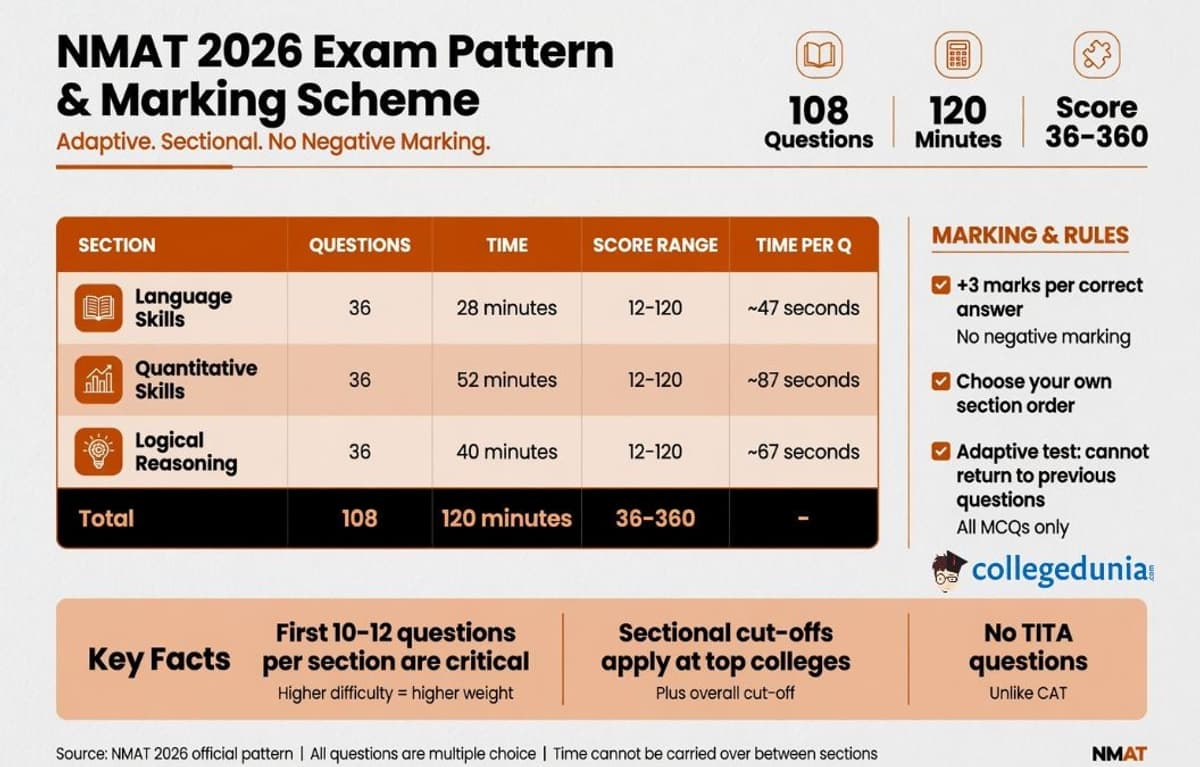
Related Links:
NMAT 2026 Syllabus: Section-wise Topics
NMAT by GMAC does not publish a fixed official syllabus, but analysis of previous year papers consistently reveals a defined set of topics across all three sections. Your NMAT syllabus preparation should be guided by topic frequency and score contribution rather than attempting to cover all possible topics exhaustively.
| Section | Key Topics |
|---|---|
| Language Skills | Reading Comprehension (400+ word passages), Vocabulary (Synonyms, Antonyms, Analogies), Grammar & Usage, Fill in the Blanks, Jumbled Paragraphs, Prepositions, Sentence Correction |
| Quantitative Skills | Arithmetic (Percentages, Ratios, Averages, Profit & Loss, Time-Speed-Distance), Algebra (Quadratic Equations, Logarithms), Geometry & Mensuration, Data Interpretation (Bar Graphs, Pie Charts, Line Graphs), Permutations & Combinations, Probability, Number Systems |
| Logical Reasoning | Seating Arrangements, Blood Relations, Direction Sense, Series (Number, Letter), Syllogisms, Critical Reasoning, Decision Making, Numerical Grids, Family Tree, Verbal Reasoning |
Important: NMAT is a performance-based test, not a syllabus-completion exam. Prioritise high-frequency topics and accuracy over attempting to cover every possible concept.
NMAT Topper Preparation Strategy | What to Study & How to Plan Ft. Omung Bhardwaj NMIMS Mumbai
CATKing's video featuring Omung Bhardwaj, an NMIMS Mumbai student and NMAT topper, is one of the most watched and cited NMAT preparation resources among aspirants. The video covers how he planned his preparation, section priorities, and what he specifically studied to crack the NMAT and secure a seat at NMIMS Mumbai.
Key takeaways from this topper strategy that directly apply to your NMAT 2026 preparation:
- Start with your strongest section to build early momentum on exam day — confidence in the first section sets a positive adaptive trajectory.
- Language Skills is the most underestimated section, yet it offers the quickest improvement gains. Toppers consistently rank it as the best section to master first.
- Logical Reasoning requires the most daily practice time due to the variety of question types. Omung recommends solving at least 3 LR sets daily throughout preparation.
- Do not neglect sectional cut-offs — even a 240+ overall score cannot compensate for a weak sectional performance at colleges like NMIMS.
- The retake option is a strategic asset, not a safety net. Plan your first attempt as the real attempt; treat the second as a targeted improvement attempt.
NMAT Preparation 2026: Section-wise Strategy
Language Skills: 36 Questions in 28 Minutes
Language Skills is widely underestimated by NMAT aspirants, yet it offers the highest scoring potential when approached correctly. With only 47 seconds per question on average, the key is building reading fluency and vocabulary over weeks, not cramming word lists in the last few days. Focus consistently on reading comprehension passages (aim for 2-3 passages daily), and build your vocabulary through reading quality editorials rather than memorising long word lists.
High-priority topics for Language Skills:
- Reading Comprehension: Passages are typically 400 words. Practice identifying main idea, inference, tone, and author's purpose rapidly.
- Vocabulary: Focus on Synonyms, Antonyms, Analogies, and contextual word usage. Word Power Made Easy by Norman Lewis is the most recommended resource for this.
- Grammar and Sentence Correction: Cover Subject-Verb Agreement, Tense Consistency, Modifiers, and Parallelism.
- Jumbled Paragraphs and Fill in the Blanks: Practice elimination-based approaches to solve faster.
Quantitative Skills: 36 Questions in 52 Minutes
The Quantitative Skills section provides the most time per question (87 seconds), making it possible to score well even without exceptional speed if your conceptual foundation is strong. Begin with basics — LCM, HCF, prime numbers, odd/even properties — before moving to advanced topics like Coordinate Geometry and Probability. Data Interpretation questions within this section require fast calculation; practise DI sets regularly from the third month onwards.
High-priority topics for Quantitative Skills:
- Arithmetic: Percentages, Profit and Loss, Ratios and Proportions, Time-Speed-Distance, and Simple and Compound Interest constitute the highest share of questions.
- Data Interpretation: Bar graphs, Pie charts, and Line graphs — practice reading data sets quickly without a calculator.
- Algebra: Linear and Quadratic equations, Logarithms — these appear regularly and respond well to formula-based practice.
- Modern Maths: Permutations and Combinations, and Probability — typically 3-5 questions per NMAT paper.
Logical Reasoning: 36 Questions in 40 Minutes
Logical Reasoning is the most diverse section in NMAT and the one that most students find hardest to improve quickly. The section rewards regular, varied practice more than any other approach. Unlike CAT, NMAT LR questions are mostly standalone or 2-3 question sets rather than lengthy 5-question sets, which means speed and quick pattern recognition are at a premium.
High-priority topics for Logical Reasoning:
- Seating Arrangements and Blood Relations: These are the most frequently appearing question types in NMAT.
- Series: Number series, Letter series, and Mixed series — practice identifying patterns fast.
- Syllogisms and Critical Reasoning: Appear regularly; respond well to structured approach practice.
- Decision Making and Numerical Grid: Unique to NMAT-style papers; practice from official NMAT mock tests.
NMAT 2026 Full Guide | Syllabus, Exam Pattern, Eligibility, Dates & Preparation Tips
This comprehensive video guide covers everything a first-time NMAT aspirant needs to understand before beginning their preparation — from the full NMAT 2026 syllabus breakdown and adaptive exam pattern to eligibility conditions and key registration dates. It is especially useful for students who are preparing for NMAT alongside CAT or other MBA exams and need to quickly orient themselves to how NMAT differs in structure and approach.
Core themes covered in the video that directly shape your NMAT 2026 preparation approach:
- NMAT is a computer-adaptive test — difficulty adjusts per question based on your earlier responses. This is fundamentally different from the fixed-difficulty format of CAT.
- Eligibility is accessible: a Bachelor's degree with 50% marks from a recognised university qualifies you. Final-year students can also apply. There is no age limit or mandatory work experience.
- Registration typically opens in August and closes in October — candidates who register early get access to better test slot options and dates.
- The testing window spans approximately 45 days, allowing you to strategically time your attempt based on preparation readiness.
NMAT 2026 Study Plan: 30/60/90-Day Schedule
Most candidates need 2 to 3 months of focused preparation to crack NMAT 2026 with a competitive score. Beginners without prior MBA exam exposure should target 3 to 4 months. The structured study plan below covers the full preparation cycle from concept building to mock-based refinement.
| Month | Focus Area | Key Activities |
|---|---|---|
| Month 1 (Weeks 1-4) | Concept Building | Cover Quant basics (Arithmetic, Algebra), Language Skills foundations (RC daily, vocabulary 10-15 words/day), LR basics (blood relations, series, directions). Take one baseline full-length mock to diagnose weak areas. Do not focus on speed yet. |
| Month 2 (Weeks 5-8) | Sectional Practice | Cover remaining topics: Geometry, DI, Probability in Quant; Seating Arrangements, Syllogisms in LR; Grammar and Sentence Correction in Language. Take 1 sectional test per section per week. Register for NMAT 2026 early in this phase. |
| Month 3 (Weeks 9-12) | Mock & Revision | Take 2-3 full-length mock tests per week. Analyse every mock: section score, accuracy per topic, time distribution. Revise only weak areas. Finalise section-attempt order strategy. Do not start new topics. |
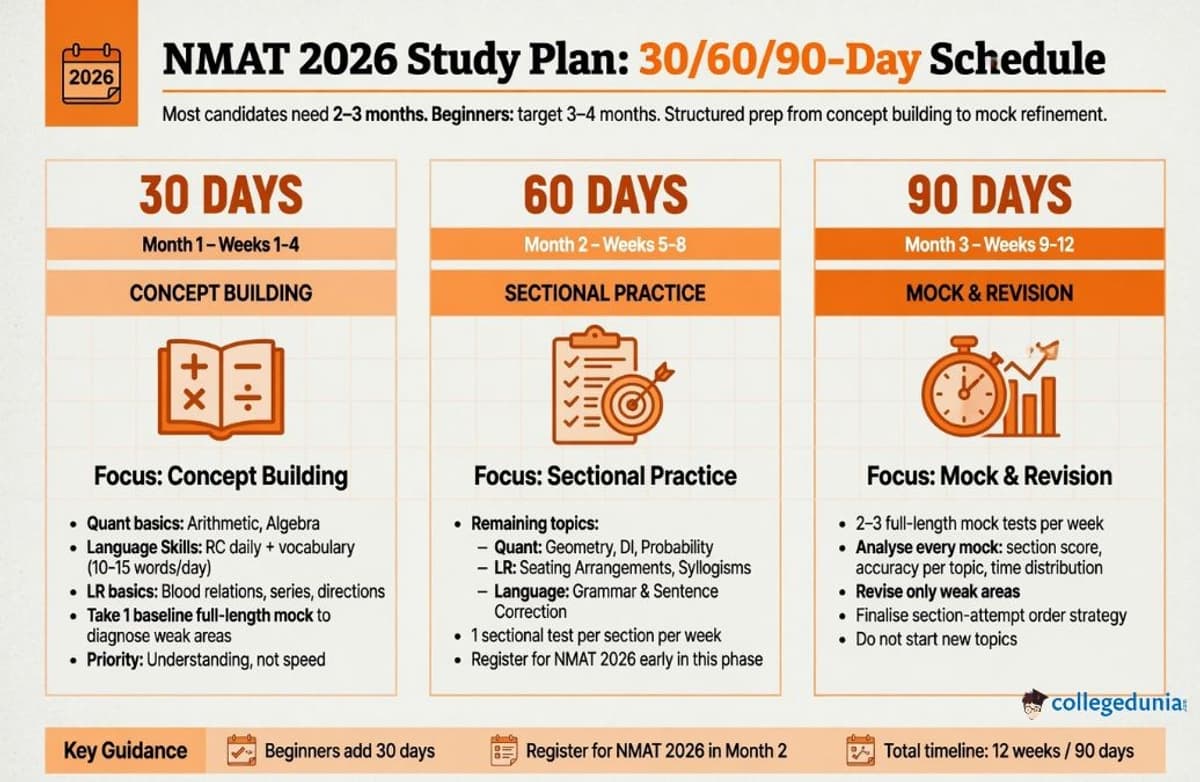
First 30 Days: Foundation Phase
- Take one full-length NMAT mock before starting — your baseline score tells you exactly where to focus first.
- Spend the first two weeks on Quantitative basics: arithmetic, percentages, ratios, and algebra.
- Begin vocabulary building from day one: 10-15 new words daily through reading, not rote memorisation.
- Practise basic reasoning puzzles — blood relations, directions, and series — for 30 minutes daily.
Days 31–60: Sectional Practice Phase
- Cover remaining Quant topics: geometry, probability, and data interpretation.
- Work through 2-3 Reading Comprehension passages daily.
- Practise Logical Reasoning sets: seating arrangements, syllogisms, and critical reasoning.
- Start taking sectional timed tests — one per section per week.
Days 61–90: Mock & Refinement Phase
- Take 2-3 full-length mock tests per week under actual exam conditions.
- Analyse every mock for accuracy rate, section-wise time management, and error patterns.
- Finalise your section-attempt order based on where you consistently score highest first.
- Aim to hit your target score consistently across mocks before scheduling your actual exam.
Daily Preparation Plan to Ace NMAT Exam | Complete Strategy Guide
CATKing's NMAT daily preparation plan video outlines a practical day-by-day schedule that balances all three sections throughout the preparation period. The guide is particularly useful for working professionals and students preparing for NMAT alongside college studies who need a realistic, time-efficient preparation framework rather than a full-time study approach.
Key points from this daily strategy guide for NMAT 2026 preparation:
- Dedicate the first 45 minutes of every study session to Language Skills — RC and vocabulary practice improve cumulatively and cannot be rushed in the final week.
- Alternate between Quant and LR in the second half of each session, spending roughly equal time on both unless one section is a clear weak spot.
- Solve at least one timed mini-test (10-12 questions per section) every alternate day to keep speed sharp even during the concept phase.
- Sunday is dedicated to full-length mock analysis, not new concept learning. Review errors methodically and note recurring mistake patterns.
- Avoid studying more than 4-5 hours daily in a sustained manner — NMAT preparation is about consistency over months, not cramming bursts.
Best Books for NMAT Preparation 2026
The right books form the foundation of effective NMAT 2026 preparation. The NMAT by GMAC Official Guide is the single most important resource, as it is the only source that contains authentic NMAT-style questions created by the actual exam conducting body. Supplement it with standard MBA preparation books for concept building.
| Section | Book | Author/Publisher |
|---|---|---|
| All Sections (Official) | NMAT by GMAC Official Guide | GMAC (Graduate Management Admission Council) |
| Quantitative Skills | How to Prepare for Quantitative Aptitude for CAT (13th Edition) | Arun Sharma (McGraw Hill) |
| Quantitative Skills | Quantitative Aptitude Quantum CAT | Sarvesh K. Verma |
| Quantitative Skills | Quantitative Aptitude for Competitive Examinations | R.S. Aggarwal |
| Language Skills (Vocabulary) | Word Power Made Easy | Norman Lewis |
| Language Skills (RC & Grammar) | How to Prepare for Verbal Ability and Reading Comprehension | Arun Sharma & Meenakshi Upadhyay |
| Logical Reasoning | How to Prepare for Logical Reasoning for CAT | Arun Sharma |
| Logical Reasoning | A Modern Approach to Logical Reasoning | R.S. Aggarwal |
Students Ask: "Is 3 Months Preparation Enough for NMAT?" (From Quora & Careers360)
One of the most frequently asked questions by NMAT aspirants across Quora, Careers360, and MBA forums is whether 3 months of preparation is sufficient to crack NMAT. The answer, based on student experiences shared across these platforms, is a clear yes — with the right approach.
A highly upvoted Careers360 response from an NMAT qualifier summarises the community consensus well: NMAT does not require you to study 12 to 14 hours daily like CAT or XAT, but it does demand a strategic approach to selecting and answering questions under time pressure. Students who treated NMAT like CAT — spending months on advanced maths and complex LR sets — often found themselves over-prepared on difficulty but under-prepared on speed and adaptive test-taking.
Here is how the 3-month timeline typically breaks down for most aspirants based on community-shared plans:
- Month 1: Concept revision and baseline mock assessment. Students report that identifying your weak section in week one saves weeks of misdirected study.
- Month 2: Topic-wise practice and first sectional tests. The most common mistake shared on forums is skipping regular timed practice during this phase and over-investing in reading theory.
- Month 3: Full-length mocks, error analysis, and refining section-attempt order. Students who took 15 or more full mocks reported significantly more confidence on exam day.
Important from student discussions: If you are simultaneously preparing for CAT 2026, your NMAT preparation timeline can be compressed to 4-6 weeks of NMAT-specific practice, as the core concepts significantly overlap.
What NMAT Takers on Reddit and MBA Forums Say About Mock Tests
Across Reddit's r/MBA, PagalGuy, and InsideIIM forums, mock test strategy is the single most discussed topic among NMAT aspirants. The community experience across multiple exam cycles consistently surfaces the same findings for NMAT 2026 preparation.
The most upvoted insight from MBA forums: official NMAT mocks from GMAC are significantly more representative of actual exam difficulty and adaptive pattern than third-party mock tests. Multiple test takers have noted that students who relied exclusively on coaching institute mocks found the actual NMAT adaptive format surprising, while students who practised on official GMAC mocks felt the real exam was closely calibrated to what they had practised.
Key mock test advice from student communities:
- Take your first mock before beginning preparation — not after — to get an unbiased baseline. Most students who did this report it reshaped their entire preparation focus.
- Do not take back-to-back mocks without deep analysis. Forum discussions consistently flag that students who took 30 mocks without proper review improved less than those who took 12-15 mocks with thorough post-mock analysis.
- Simulate real exam conditions during every mock: no interruptions, no pausing, same time of day as your actual exam slot.
- Track your score trend across mocks — not just the final score but section-wise accuracy and time usage per section. Many students discovered hidden Quant speed issues only through mock analysis, not through section scores alone.
- The NMAT adaptive format means your wrong answers early in a section can cascade into easier (lower-scoring) questions. Forum posts from toppers confirm that aiming for 80%+ accuracy in the first 10-12 questions of each section is more impactful than raw speed throughout.
How to Score 230+ in NMAT 2025? Last Minute Strategy by Toppers
This highly-watched video from Great Lakes Gurgaon-enrolled toppers Shikhar Jolly (scored 229) and fellow NMAT qualifiers breaks down the specific last-minute strategies that helped them push out of the 200-210 score plateau that stalls many mid-level NMAT aspirants. The video is especially relevant for candidates in the 60-to-30-day window before their NMAT exam date.
The actionable last-minute strategies shared by NMAT scorers of 220-230+ in this video:
- Switch from concept learning to 100% mock-and-analyse mode at least 30 days before your exam. No new topics. Only revision and error correction.
- Practice your section-attempt order in every mock — do not walk into the actual exam still experimenting with which section to attempt first.
- In the Language Skills section, avoid spending more than 5 minutes on any single RC passage. Train yourself to skip difficult passages and return only if time allows.
- The 200-210 score ceiling often comes from poor accuracy in the first 8-10 questions of each section when nerves are highest. Do a dedicated drill of solving first 10 questions from each section under simulated pressure.
- On exam day, arrive early, stay hydrated, and use the tutorial time before the exam to mentally warm up — do not skip it.
Students Ask: "Which Books Should I Use for NMAT?" (From Quora)
On Quora, the question "Which books should I use for NMAT preparation?" has received over 40 answers from past NMAT takers, coaching faculty, and B-school students. The community response has evolved significantly since NMAT transitioned to a computer-adaptive format, and the book recommendations have shifted accordingly.
The most consistently upvoted Quora answers make three key observations that every NMAT 2026 aspirant should know before buying preparation material:
- No single book is a complete solution. The most successful NMAT takers report using 3-4 sources — one official guide, one Quant book, one vocabulary resource, and one LR workbook — rather than trying to find one comprehensive all-in-one guide.
- The adaptive format changes book selection priorities. Since NMAT became adaptive, the emphasis has shifted toward practising question-type familiarity over topic depth. Quora answers consistently flag that books written for CAT's fixed-difficulty format can over-train students for the wrong level of complexity.
- The NMAT by GMAC Official Guide is non-negotiable. Multiple Quora answers from NMIMS and K J Somaiya students mention that the official guide is the only source with authentic adaptive-pattern practice questions. Third-party books may cover concepts well but do not replicate the actual NMAT question style.
Additional reading tips shared frequently on Quora for NMAT Language Skills preparation: reading The Hindu editorials, Economic Times opinion pieces, and Harvard Business Review excerpts is more effective than any single RC practice book, as it builds genuine reading speed and comprehension rather than pattern-matching skills.
NMAT 2026 Mock Test Strategy: How to Prepare Using Full-Length Tests
Mock tests are the backbone of NMAT 2026 preparation. NMAT mock tests serve a dual purpose: they build exam temperament under timed pressure, and they reveal exactly which topics and question types are costing you the most score in each section.
A structured mock test approach for NMAT 2026:
- Take 20-30 mock tests in total across the preparation period — not all in the final month.
- Start with one diagnostic mock in week one (before any preparation) to get a baseline.
- From month two onwards, take at least one full-length mock per week under actual exam conditions.
- In month three, scale up to 2-3 mocks per week.
- After every mock, spend 2x the test duration on analysis: identify wrong answers, near-misses, and time-drain questions.
- Track your section-wise accuracy separately from overall score — a 200+ overall score with a 50 sectional score in one section will not meet cut-off at NMIMS.
Important: NMAT is highly speed-oriented. Blind guessing is not penalised, but strategic skipping of difficult questions in the adaptive format can lower your question difficulty level. Attempt every question, but prioritise accuracy in the first 10-12 questions of each section.
Related Links:
NMAT 2026 Cut-off: Target Scores for Top B-Schools
Understanding the NMAT cut-off for your target colleges should directly inform your preparation score target. Setting your target score at least 10-15 points above the expected cut-off gives you a buffer for off-day performance and sectional variability.
| College | Expected Overall Cut-off 2026 | Sectional Cut-off (Approx.) |
|---|---|---|
| NMIMS Mumbai (MBA Core) | 209+ | 62 per section |
| NMIMS Mumbai (MBA Pharma Management) | 190+ | 50 per section |
| NMIMS Bengaluru / Hyderabad | 190–200+ | 50 per section |
| XIM Bhubaneswar (PGDM) | 210+ | Sectional minimum applies |
| K J Somaiya Institute of Management | 200+ | 50 per section |
| Shiv Nadar University | 195+ | Varies |
| VIT Vellore / Chennai | 180+ | Varies |
| IBS Group | 170+ | Varies |
Students Ask: "Should I Use All Three NMAT Attempts?" (From Reddit & Pagalguy)
The three-attempt policy is one of NMAT's most discussed features on MBA preparation forums. Reddit's MBA and Indian MBA subreddits, as well as PagalGuy threads, contain extensive discussions from students who have navigated the multi-attempt strategy across previous NMAT cycles.
The community view on using all three attempts for NMAT 2026 preparation:
- The first attempt should always be treated as the real exam. Forum discussions consistently warn against using the first attempt as a "trial run." NMIMS has in certain years considered only the first attempt score for shortlisting purposes, which makes under-preparation for the first attempt a risky strategy.
- Retakes are most valuable for targeted improvement, not broad re-preparation. Students who scored 180-200 in their first attempt and spent 2-3 weeks specifically drilling their weakest section consistently report 15-25 point improvements in retakes. Students who "started fresh" across all sections rarely improved by more than 5-8 points.
- Gap between attempts matters. GMAC requires a minimum 15-day gap between attempts. Forum advice suggests using this gap for intensive targeted practice (1-2 mock tests every 2-3 days, focused on the problem section) rather than broad revision.
- Not all colleges average or consider all attempts. Most top NMAT colleges take your best score. However, verify individual college policies at the time of application, as policies can change cycle to cycle.
NMAT 2026 Eligibility Criteria
NMAT 2026 has one of the most accessible eligibility structures among all major MBA entrance exams in India. There is no age restriction, no mandatory work experience requirement, and no domain restriction on undergraduate discipline.
- Educational Qualification: Bachelor's degree or equivalent from a recognised university with a minimum of 50% aggregate marks.
- Final Year Students: Students in their final year of undergraduate study are eligible to appear for NMAT 2026, subject to submitting proof of graduation before the date of joining the programme.
- Work Experience: Not mandatory for most programmes. Some specialised MBA programmes at NMIMS (such as Executive MBA) may have work experience requirements — check individual programme eligibility.
- Number of Attempts: One attempt plus up to two retakes per testing cycle. Best score is considered for shortlisting by most colleges.
NMAT 2026 Important Dates (Expected)
| Event | Expected Date 2026 | 2025 Reference Date |
|---|---|---|
| NMAT 2026 Registration Opens | August 2026 (Expected) | August 1, 2025 |
| NMAT 2026 Registration Closes | October 2026 (Expected) | October 18, 2025 |
| Exam Slot Scheduling Opens | August 2026 (with registration) | August 1, 2025 |
| NMAT 2026 Exam Window Starts | November 2026 (Expected) | November 5, 2025 |
| NMAT 2026 Exam Window Ends | December 2026 (Expected) | December 19, 2025 |
| Retake Registration | Post first attempt | 15-day minimum gap required |
| NMAT 2026 Score Declaration | Post exam window closes | Scores released within 48 hours of each attempt |
Note: All dates above are tentative based on previous year patterns. Official NMAT 2026 dates will be announced by GMAC on the official website. Candidates should bookmark nmat.org and check regularly from July 2026 onwards.
NMAT 2026 Exam Day Tips
All preparation ultimately comes down to execution on the day of your scheduled NMAT exam. These exam day tips are drawn from topper interviews and student experiences shared across forums and counselling sessions:
- Arrive at the test centre at least 30 minutes before your scheduled slot. Late arrivals are not admitted.
- Carry valid photo ID (Aadhaar, PAN, Passport, or Driving License) — the same ID you used during registration.
- Use the tutorial time before the actual test to mentally switch into exam mode. Do not skip it.
- Attempt your pre-planned section order. Do not change strategy on exam day based on the first question being hard.
- Focus on the first 10-12 questions of each section with maximum accuracy — these set your adaptive difficulty trajectory for the remainder of that section.
- Do not leave any question unanswered. Since there is no negative marking, attempt every question even if you are unsure.
- Avoid last-minute revision on exam day. Sleep well the night before and eat a light meal before the test.
Colleges Accepting NMAT Scores 2026
NMAT by GMAC 2026 scores are accepted by 50+ institutions for MBA and PGDM admissions in India and internationally. Top colleges accepting NMAT scores include:
- NMIMS Mumbai, Bengaluru, Hyderabad, Navi Mumbai, Indore, and Dhule
- XIM Bhubaneswar (XIMB)
- K J Somaiya Institute of Management, Mumbai
- Shiv Nadar School of Management, Greater Noida
- VIT Vellore and VIT Chennai
- IBS Group (Mumbai, Gurgaon, Pune, Bengaluru, Hyderabad)
- Alliance University, Bengaluru
- ISB Hyderabad (for Executive MBA — check programme eligibility)
- International partner universities in South Africa, Morocco, Philippines, Hungary, and Nigeria
Frequently Asked Questions (FAQs) on NMAT Preparation 2026
Ques. How many months of preparation are required for NMAT 2026?
Ans. Most candidates need 2 to 3 months of focused NMAT preparation. Beginners with no prior MBA exam exposure should aim for 3 to 4 months. Candidates who are simultaneously preparing for CAT 2026 can typically crack NMAT with 4 to 6 additional weeks of NMAT-specific practice, as the core concepts overlap significantly.
Ques. Is NMAT easier than CAT?
Ans. Yes, NMAT is considered moderately easier than CAT in terms of overall difficulty level and question complexity. However, NMAT's adaptive format, strict sectional time limits, and no-review-allowed policy make it a unique challenge that requires dedicated preparation beyond just CAT-level readiness. Speed and accuracy in the first few questions of each section are more critical in NMAT than in CAT.
Ques. Can I crack NMAT 2026 without coaching?
Ans. Yes, self-study with structured resources is equally effective for NMAT preparation. The NMAT by GMAC Official Guide, standard Quant and LR books by Arun Sharma, Word Power Made Easy, and regular mock tests on the official GMAC platform are sufficient for most candidates to achieve a competitive score without coaching.
Ques. What is a good score in NMAT 2026?
Ans. A score of 210 to 220 is considered good for NMAT 2026, making you competitive at most NMAT-accepting colleges. A score of 220 to 240 is excellent and makes you competitive at NMIMS Mumbai. Scores of 240 and above put you among the top percentile of test takers.
Ques. How many mock tests should I take for NMAT 2026?
Ans. Aim for 20 to 30 full-length mock tests across your preparation period. More importantly, analyse each mock thoroughly — reviewing errors and identifying speed bottlenecks is more valuable than simply increasing the number of tests taken.
Ques. Can I choose the order of sections in NMAT 2026?
Ans. Yes, NMAT allows candidates to choose which section they attempt first. Most toppers recommend starting with your strongest section to build confidence and set a favourable adaptive difficulty trajectory early in the exam. Practise your preferred section order across all mock tests before exam day.
Ques. Should I use all three NMAT attempts?
Ans. You do not need to use all three attempts. The best strategy is to be fully prepared for your first attempt and treat it as the primary one. Use the retake option if you genuinely believe targeted improvement in one or two specific sections can significantly boost your overall score. Check your target college's attempt policy before scheduling retakes, as some colleges have attempt-specific preferences.
Ques. What is the best NMAT preparation book?
Ans. The NMAT by GMAC Official Guide is the most important book for NMAT preparation. Supplement it with Arun Sharma's Quantitative Aptitude for CAT for Quant and LR, Word Power Made Easy by Norman Lewis for vocabulary, and the Arun Sharma-Meenakshi Upadhyay Verbal Ability book for Language Skills.
Ques. What is the section-wise cut-off for NMIMS Mumbai in NMAT 2026?
Ans. Based on the 2025 cut-off trends, NMIMS Mumbai requires an overall NMAT score of 209+ with a sectional minimum of approximately 62 per section for the MBA (Core) programme. The MBA Pharmaceutical Management programme has a lower cut-off of approximately 190 overall with a 50 sectional minimum. These figures are expected to remain similar for NMAT 2026.
Ques. What topics should I prioritise in NMAT 2026 preparation?
Ans. For Quantitative Skills, prioritise Arithmetic, Data Interpretation, and Algebra. For Language Skills, focus on Reading Comprehension, Vocabulary, and Grammar. For Logical Reasoning, prioritise Seating Arrangements, Blood Relations, Series, and Syllogisms. These topics collectively cover the highest proportion of NMAT questions across all previous exam cycles.
PYQ
Prepare for NMAT Exam, with a comprehensive collection of NMAT PYQs. This guide covers NMAT Previous Year Questions subject-wise, namely Quantitative Ability (QA), Logical Reasoning (LR), and Verbal Ability & Reading Comprehension (VARC) organized by topic to help candidates strengthen NMAT exam preparation. The practice of PYQs is one of the best ways to understand exam trends and question difficulty and to improve time management skills.
NMAT PYQs (Previous Year Questions)
| Puzzle NMAT PYQs | Politics and Government NMAT PYQs |
| Table NMAT PYQs | Syllogisms NMAT PYQs |
| Reading Comprehension NMAT PYQs | Mensuration NMAT PYQs |
| Data Sufficiency NMAT PYQs | Permutations and Combinations NMAT PYQs |
| Fill in the Blanks NMAT PYQs | Films and Entertainment NMAT PYQs |
| Number Systems NMAT PYQs | Statements and Arguments NMAT PYQs |
| Sentence Correction NMAT PYQs | Mixtures and Allegations NMAT PYQs |
| Equations NMAT PYQs | Probability NMAT PYQs |
| Odd one Out NMAT PYQs | Art and Culture NMAT PYQs |
| Percentage NMAT PYQs | Science Technology and Inventions NMAT PYQs |
| Synonyms and Antonyms NMAT PYQs | Statements and Assumptions NMAT PYQs |
| Course of Action NMAT PYQs | Commercial Maths NMAT PYQs |
| Geography NMAT PYQs | distance NMAT PYQs |
| Statements and Conclusions NMAT PYQs | Time, Speed and Distance NMAT PYQs |
| Business and Economy NMAT PYQs | Arithmetic Progressions NMAT PYQs |
| Coding Decoding NMAT PYQs | Division Of Fractions NMAT PYQs |
| Idioms NMAT PYQs | Geometry NMAT PYQs |
| Para Jumbles NMAT PYQs | Inequalities NMAT PYQs |
| SI & CI NMAT PYQs | LCM and HCF NMAT PYQs |
| Current Affairs NMAT PYQs | Ratio NMAT PYQs |
| Economics NMAT PYQs | Ratio and Proportion NMAT PYQs |
| Sports and Physical Education NMAT PYQs | Surds and Indices NMAT PYQs |
| Equations NMAT PYQs | Time and Work NMAT PYQs |
| Profit and Loss NMAT PYQs | Trigonometry NMAT PYQs |
| Analogies NMAT PYQs | Venn Diagrams NMAT PYQs |
Quant Skills Sample Paper
The Quantitative Skills section of NMAT has 36 questions and 52 minutes, mixing arithmetic, algebra, geometry and data interpretation. These sample papers help you build the speed and accuracy this section rewards.
Official website: www.nmat.org
NMAT Quantitative Skills Sample Papers 2026
NMAT Quantitative Skills Sample Paper 1
Download NMAT Quantitative Skills Sample Paper 2
Download NMAT Quantitative Skills Sample Paper 3
Download NMAT Quantitative Skills Sample Paper 4
Download NMAT Quantitative Skills Sample Paper 5
Download NMAT Quantitative Skills Sample Paper 6
Download NMAT Quantitative Skills Sample Paper 7
Download NMAT Quantitative Skills Sample Paper 8
Download NMAT Quantitative Skills Sample Paper 9
Download NMAT Quantitative Skills Sample Paper 10
Download Each NMAT Quantitative Skills sample paper has 36 questions to be solved in about 52 minutes, matching the pace of the real section. Solve one paper, mark your answers, and note the calculation shortcuts you missed.
You can download every NMAT Quantitative Skills sample paper free on an external review site, and you can also check the latest pattern on the official site www.nmat.org before you begin.
- NMAT Quantitative Skills Sample Papers 2026
- NMAT Quantitative Skills Exam Pattern and Marks Distribution 2026
- NMAT Quantitative Skills Sample Papers - Why Recent Papers Matter Most
- NMAT Quantitative Skills Topic Wise Weightage - High Scoring Topics to Focus in Sample Papers
- NMAT Quantitative Skills Sample Paper Video Solutions 2026 - Watch Before You Start Solving
- How to Use NMAT Quantitative Skills Sample Papers to Clear in First Attempt
- NMAT Quantitative Skills No Negative Marking and Speed Strategy
- NMAT Quantitative Skills 4 Week Preparation Plan Using Sample Papers
- FAQs on NMAT Quantitative Skills Sample Papers 2026
- Section: Quantitative Skills, worth 36 questions in the NMAT paper.
- Paper format: all multiple-choice questions with four options each.
- Marking: +3 for every correct answer, with no negative marking, so attempt all 36.
- Time budget: 52 minutes for the section, about 87 seconds per question.
- What it tests: arithmetic, algebra, number systems, geometry, modern maths, data interpretation and data sufficiency.
- Preparation base: strong Class 10 arithmetic and quick mental calculation, no fixed board syllabus.
NMAT Quantitative Skills Exam Pattern and Marks Distribution 2026
Quantitative Skills is the largest of the three NMAT sections by time. It blends quick arithmetic with data interpretation, so a steady method beats raw speed here.
- Questions: 36 questions to be solved in 52 minutes.
- Question type: single-correct multiple-choice questions only.
- Marking: +3 for correct, no negative marking, 0 for unattempted.
- Pace: about 87 seconds per question, so bank time on easy arithmetic for the longer data sets.
Key advice: clear the short arithmetic and number questions first, then invest the saved minutes in the data interpretation and data sufficiency blocks.
NMAT Quantitative Skills Sample Papers - Why Recent Papers Matter Most
NMAT Quantitative Skills has settled into a steady mix of arithmetic, algebra, geometry and data interpretation. Recent-format papers train you on exactly this mix and pace.
- Recent papers reflect the current share of arithmetic and data interpretation questions.
- They keep the data sets at the moderate length NMAT uses today.
- They help you fix a target of attempting all 36 questions within 52 minutes.
NMAT Quantitative Skills Topic Wise Weightage - High Scoring Topics to Focus in Sample Papers
The table below shows the topics that usually appear in the 36-question Quantitative Skills section and how hard each one tends to be.
| Topic | Questions | Difficulty | What to Watch For |
|---|---|---|---|
| Arithmetic (percentage, ratio, TSD, time and work, interest) | 9-11 | Easy to Moderate | The biggest block, so drill percentage and ratio shortcuts. |
| Algebra and Number System | 5-7 | Moderate | Revise equations, surds and number properties. |
| Geometry and Mensuration | 4-6 | Moderate | Keep area, volume and triangle formulas ready. |
| Modern Maths (permutation, combination, probability) | 2-4 | Moderate | Practise counting cases carefully to avoid slips. |
| Data Interpretation (tables, bar and pie charts) | 6-8 | Moderate | Read the chart title and units before calculating. |
| Data Sufficiency | 3-5 | Moderate | Judge each statement alone before combining them. |
Note: arithmetic and data interpretation together carry the most questions, so master both to lift your score fastest.
NMAT Quantitative Skills Sample Paper Video Solutions 2026 - Watch Before You Start Solving
Watching solved Quantitative Skills questions shows you the shortcuts for arithmetic and data interpretation that save the most time. This is helpful before your first timed paper.
Watch the walkthrough once, then attempt a sample paper the same day so the methods stay fresh.
Watch:
Source: NMAT quantitative skills and data interpretation practice lecture covering arithmetic, algebra and charts (YouTube)
How to Use NMAT Quantitative Skills Sample Papers to Clear in First Attempt
Use each Quantitative Skills paper as a full, timed drill. Follow these steps every time.
- Set a 52-minute timer and solve the full 36-question paper in one sitting.
- Clear the short arithmetic and number questions in the first pass.
- Attempt the data interpretation sets next, noting units before you calculate.
- Since there is no negative marking, mark an answer for every question.
- Add every slow question and its shortcut to a running notes page and revise it weekly.
NMAT Quantitative Skills No Negative Marking and Speed Strategy
Quantitative Skills has no negative marking, so a wrong guess never costs you, but the 52-minute clock means you must not get stuck on one long calculation.
- Attempt all 36 questions, since a guess can only add marks.
- Do not chase a tough algebra or geometry question; move on and return later.
- Solve one full data interpretation set at a time rather than jumping between them.
- Keep the last two minutes to mark answers for any questions left blank.
NMAT Quantitative Skills 4 Week Preparation Plan Using Sample Papers
- Week 1: Revise percentage, ratio and averages, then solve two sample papers.
- Week 2: Practise algebra, number system and geometry, and solve three papers under timer.
- Week 3: Focus on data interpretation and data sufficiency, and solve three more papers.
- Week 4: Take the remaining papers every alternate day and review errors, keeping the last two days for light revision only.
FAQs on NMAT Quantitative Skills Sample Papers 2026
Ques.How many questions are there in the NMAT Quantitative Skills section?
Ans.The NMAT Quantitative Skills section has 36 multiple-choice questions to be solved in 52 minutes.
Ques.What topics does NMAT Quantitative Skills cover?
Ans.It covers arithmetic, algebra, number system, geometry and mensuration, modern maths, data interpretation and data sufficiency.
Ques.Is there negative marking in the NMAT Quantitative Skills section?
Ans.No, there is no negative marking. You get +3 for every correct answer and lose nothing for a wrong one, so attempt all 36 questions.
Ques.Are these NMAT Quantitative Skills sample papers free to download?
Ans.Yes, all 10 NMAT Quantitative Skills sample papers on this page are free to download in PDF form with answer keys and solutions.
Ques.How can I score high in NMAT Quantitative Skills quickly?
Ans.Master arithmetic shortcuts and data interpretation, attempt the easy calculation questions first, and keep steady practice with timed sample papers.
Ques.How many Quantitative Skills sample papers should I solve?
Ans.Solving all 10 papers on this page gives you enough practice to build the speed and accuracy the section needs.
Quant Preparation
NMAT 2026 quant preparation tips focus on improving calculation speed and conceptual clarity, and time management.
The Quantitative Skills section consists of 36 questions to be solved in 52 minutes, so candidates should prioritise Arithmetic, Data Interpretation ( DI) and Algebra, as these topics carry the highest weightage.
- Start by understanding the basic concepts of Arithmetic, Algebra, Data Interpretation, Number System, Geometry, and Modern Mathematics before solving advanced-level questions.
- Focus on Arithmetic, DI, and Algebra first, as these topics contribute the highest number of questions in the Quant section.
- Solve topic-wise questions and sectional quizzes regularly to improve speed, accuracy, and exam-day time management.
- Revise important formulas, calculation shortcuts, and concepts every week to strengthen retention and reduce calculation errors.
- Attempt NMAT Mock Tests regularly and analyze every mistake to identify weak areas and improve your overall score.
- Practice NMAT Previous Year Questions (PYQs) and NMAT Sample Papers to understand the exam pattern and build confidence before the exam
Related Links:
- NMAT Syllabus 2026: Check Latest Section-Wise Key Topics, Download Syllabus PDF, Books & Preparation Tips
- NMAT Exam Analysis 2026: Check Overall & Section-wise Difficulty Level Analysis
- NMAT 2026 Question Paper (Available): Download NMAT Previous Year Papers PDFs with Solutions
NMAT 2026 Quant Preparation Tips Overview
| Aspect | Details |
|---|---|
| Section | Quantitative Skills |
| Difficulty Level | Moderate |
| Recommended Study Time | 1–2 hours daily |
| Preparation Duration | 3–6 months (depending on current proficiency) |
| High-Weightage Topics | Arithmetic, Algebra, Data Interpretation, Geometry, Modern Mathematics, Number System |
| Focus Areas | Concept clarity, speed, accuracy, and time management |
| Best Practice Resources | Topic-wise questions, Previous Year Questions (PYQs), Sample Papers, Sectional Tests, Full-Length Mock Tests |
| Revision Strategy | Revise formulas, shortcuts, and weak topics weekly |
| Mock Test Frequency | 1–2 sectional tests and 1 full-length mock every week |
| Success Mantra | Build concepts, practice consistently, analyze mocks, and revise regularly. |
NMAT 2026 Quant Preparation Tips: Topic-Wise Weightage
Knowing which topics carry more weight in NMAT 2026 Quant Preparation Tips helps you plan your study hours better. The table below shows the expected topic-wise split for Quantitative Skills based on past year trends.
| Topic | Expected Questions | Priority Level | Recommended Study Time |
|---|---|---|---|
| Arithmetic (Percentage, Ratio, Profit and Loss, Time-Speed-Distance, Time and Work) | 10 to 12 | High | 35-40% |
| Data Interpretation (tables, graphs, charts) | 6 to 8 | High | 20-25% |
| Algebra (Equations, Inequalities) | 5 to 6 | Medium | 15-20% |
| Number Properties | 4 to 5 | Medium | 10-15% |
| Data Sufficiency | 3 to 4 | Medium | 5-10% |
| Probability | 2 to 3 | Low | 5-10% |
Preparation Tip: If you're short on time, complete Arithmetic, Data Interpretation, and Algebra first. Together, these topics contribute the majority of questions in the NMAT Quant section and can significantly improve your overall score.
Also Check: NMAT 2026 Quantitative Skills Chapter Weightage: Top Topics
NMAT 2026 Quant Preparation Tips: How to start the Prep?
The first step in preparing for NMAT 2026 Quant is to understand the exam pattern and complete the syllabus.
- This section tests how well you know basic math and how quickly you can solve problems.
- It covers Arithmetic, Algebra, Geometry, Modern Math, and Number Systems.
| Preparation Step | What You Should Do |
|---|---|
| Understand the NMAT Quant Syllabus | Go through the complete syllabus and prioritize high-weightage topics such as Arithmetic, Algebra, and Data Interpretation. |
| Strengthen Basic Concepts | Revise fundamental formulas, concepts, and calculation shortcuts before attempting advanced-level questions. |
| Create a Study Plan | Dedicate 1–2 hours daily to Quant, balancing concept learning, practice, and revision. |
| Practice Topic-wise Questions | Solve chapter-wise questions regularly to improve accuracy and identify weak areas. |
| Improve Calculation Speed | Practice mental math, percentages, ratios, squares, cubes, and approximation techniques daily. |
| Take Sectional & Full-Length Mock Tests | Attempt weekly mocks to improve time management, assess your preparation, and build exam-day confidence. |
| Analyze Your Performance | Review every mock test, identify mistakes, and focus on improving weaker topics. |
| Revise Regularly | Maintain a formula notebook and revise key concepts and shortcuts every week for better retention. |
Also Check:
- Score 250+ in NMAT 2026: Preparation Strategy for Early Starters
- NMAT 2026 Preparation Strategy and Timetable for Beginners
NMAT 2026 Quant Preparation Tips: 3-month Study Plan
As the exam approaches, a structured NMAT 2026 Quant Preparation Tips for 3 months can help you cover the syllabus systematically, practice consistently, and revise effectively before the exam.
- Complete the Quant basics by the end of August.
- Use September and October for practice and mock tests.
- In the final weeks, focus only on revision and mocks.
| Month | Focus Area | Preparation Tips |
|---|---|---|
| August 2026 | Build Concepts, Practice & Speed | Complete Arithmetic, Algebra, Geometry, Number System, and Modern Math basics.Solve topic-wise questions, improve calculation speed, and revise formulas. |
| September 2026 | Mock Tests | Attempt sectional and full-length mocks, analyze mistakes, and strengthen weak topics. |
| October 2026 | Final Revision | Revise formulas, solve PYQs and sample papers, and take regular mock tests. |
Also Check:
- NMAT 2026 Score 220+: Section-Wise Strategy and 90-Day Study Plan
- NMAT 2026 Expected to Be Tougher? Last Year Analysis & What to Expect
NMAT 2026 Quant Preparation Tips: Daily Study Routine
A 1–2 hour daily study routine is sufficient for effective NMAT 2026 Quant preparation tips when followed consistently.
- Begin with concept building and formula revision, followed by topic-wise practice to strengthen accuracy and speed.
- Dedicate time to sectional quizzes or mock tests and analyze your mistakes regularly.
- This structured routine helps you complete the Quant syllabus and improve performance before the exam.
| Time Allocation | Activity | Objective |
|---|---|---|
| 20–30 minutes | Revise formulas and shortcuts | Strengthen concepts and improve retention |
| 45–60 minutes | Learn or revise one Quant topic | Build conceptual clarity |
| 45–60 minutes | Solve topic-wise practice questions | Improve accuracy and problem-solving skills |
| 20–30 minutes | Practice calculation techniques | Enhance speed in percentages, ratios, squares, and approximations |
| 30–45 minutes | Attempt a sectional quiz or mini mock | Improve time management and exam temperament |
| 15–20 minutes | Analyze mistakes and revise weak areas | Avoid repeating errors and track progress |

Source: Reddit
The user ōn Reddit has shared that they are retaking the NMAT exam and find the Quantitative Skills section the most difficult. They are watching lectures and solving past questions but still feel overwhelmed with Quant preparation. They are asking for effective study methods and YouTube recommendations to improve their score.
Don't try to master every topic at once—focus on one concept each day and practice a few questions regularly. Take short sectional quizzes, review your mistakes, and stay consistent; steady practice will gradually improve both your confidence and Quant score.
How to Prepare for NMAT 2026 Quant in 4 Months While Working?
Working professionals can prepare for NMAT 2026 Quant by following a consistent 1.5–2.5 hour daily study routine.
- Focus on concept building during weekdays and dedicate extra time on weekends for mock tests, revision, and performance analysis.
| Time | Activity | Purpose |
|---|---|---|
| 30–45 minutes | Revise formulas and concepts | Strengthen fundamentals and improve retention |
| 45–60 minutes | Learn one Quant topic | Build conceptual clarity and cover the syllabus |
| 30–45 minutes | Solve topic-wise practice questions | Improve accuracy and problem-solving speed |
| 20–30 minutes | Practice calculations and shortcuts | Enhance speed for the actual exam |
| Weekend (2–3 hours) | Attempt a sectional/full-length mock | Build exam temperament and time management |
| 30–45 minutes (Post Mock) | Analyze mistakes and revise weak topics | Track progress and improve performance |
Also Check:
- NMAT 2026 Last 30 Days Study Plan: Section-Wise Preparation Strategy
NMAT 2026 Quant Preparation Tips: Topic-Wise Study Plan
NMAT 2026 Quant Preparation Tips recommend dividing your study plan into three phases: concept building, topic-wise practice, and full-length mock tests to ensure comprehensive preparation and steady improvement.
- Do not start mocks before you have cleared the basics of arithmetic and DI.
| Section / Topic | Preparation Strategy | Recommended Practice |
|---|---|---|
| Arithmetic | Build strong fundamentals in percentages, profit & loss, time & work, averages, ratios, and SI/CI. | Solve 20–30 questions daily and revise formulas regularly. |
| Algebra | Focus on linear equations, quadratic equations, inequalities, logarithms, and functions. | Practice concept-based and application-oriented questions. |
| Geometry & Mensuration | Learn key theorems, properties, and formulas for 2D and 3D figures. | Revise formulas weekly and solve mixed-level questions. |
| Number System | Strengthen concepts of divisibility, HCF-LCM, remainders, factors, and cyclicity. | Practice shortcut-based questions to improve speed. |
| Modern Mathematics | Cover permutations & combinations, probability, progressions, and set theory. | Solve previous year and mock-test questions regularly. |
| Data Interpretation (DI) | Practice tables, bar graphs, pie charts, and line graphs with a focus on calculation speed. | Attempt timed DI sets and improve approximation techniques. |
| Overall Revision | Revise formulas, shortcuts, and frequently asked concepts every week. | Take sectional tests and full-length mocks to track progress. |
Expert Tip: Don't wait until you've completed the syllabus before attempting mocks. Start sectional tests after finishing Arithmetic and Data Interpretation to improve speed and identify weak areas early.
NMAT Subject Wise Sample Papers 2026
| NMAT Language Skills Sample Paper | Download PDF |
| NMAT Quantitative Skills Sample Paper | Download PDF |
| NMAT Logical Reasoning Sample Paper | Download PDF |
NMAT 2026 Quant Preparation Tips: Mock Test
Aim to take at least 2-3 full-length mocks per week in the final two months, followed by thorough analysis of every mistake, focusing especially on Data Interpretation sets and time-consuming arithmetic problems.
| NMAT 2026 Quant 2026 Mock Test | Download PDF |
|---|---|
| NMAT 2026 Quant 2026 Mock Test 1 | Click here |
| NMAT 2026 Quant 2026 Mock Test 2 | Click here |
| NMAT 2026 Quant 2026 Mock Test 3 | Click here |
| NMAT 2026 Quant 2026 Mock Test 4 | Click here |
| NMAT 2026 Quant 2026 Mock Test 5 | Click here |
| NMAT 2026 Quant 2026 Mock Test 6 | Click here |
| NMAT 2026 Quant 2026 Mock Test 7 | Click here |
| NMAT 2026 Quant 2026 Mock Test 8 | Click here |
| NMAT 2026 Quant 2026 Mock Test 9 | Click here |
| NMAT 2026 Quant 2026 Mock Test 10 | Click here |
Also Check: How to Analyse NMAT Mock Test for Score Improvement
Common Mistakes to Avoid in NMAT Quant
| Mistake | Why It Hurts | Solution |
|---|---|---|
| Spending 5+ minutes on one question | Wastes valuable time | Skip and revisit later |
| Ignoring DI | High-weightage topic | Practice 2–3 sets daily |
| Not analyzing mocks | Same mistakes repeat | Maintain an error log |
| Memorizing formulas without practice | Concepts remain weak | Apply formulas through timed questions |
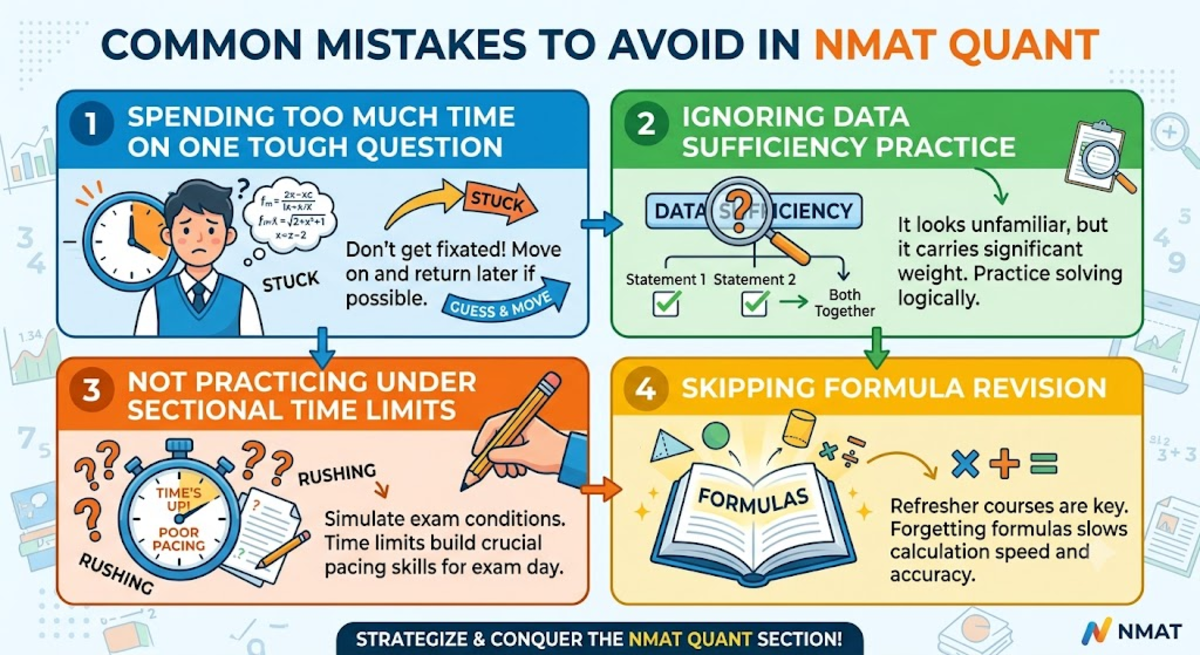
Best Books to cover NMAT 2026 Quant Preparation Tips
Start with R.S. Aggarwal/Arun Sharma for concepts, move to Quantum CAT for advanced practice, and solve previous years’ NMAT questions + mocks regularly. Focus on speed since NMAT allows sectional time management.
| Book Title | Author | Best For | Why Recommended? |
|---|---|---|---|
| How to Prepare for Quantitative Aptitude for CAT (latest edition) | Arun Sharma | Concept building + Advanced practice | Comprehensive coverage, excellent for speed and accuracy; highly popular for NMAT/CAT overlap. |
| Quantitative Aptitude for Competitive Examinations | R.S. Aggarwal | Basics + Moderate practice | Clear explanations, huge question bank for foundational topics like Arithmetic and Algebra. |
| Quantum CAT | Sarvesh K. Verma | Advanced problem-solving | In-depth concepts and challenging questions, great for DI and higher difficulty problems. |
| Quantitative Aptitude for the CAT | Nishit K. Sinha | Data Sufficiency + Modern Math | Strong focus on shortcuts and NMAT-style questions. |
| Quantitative Aptitude for MBA Entrance Examinations | Abhijit Guha | Overall practice | Good mix of theory and solved examples. |
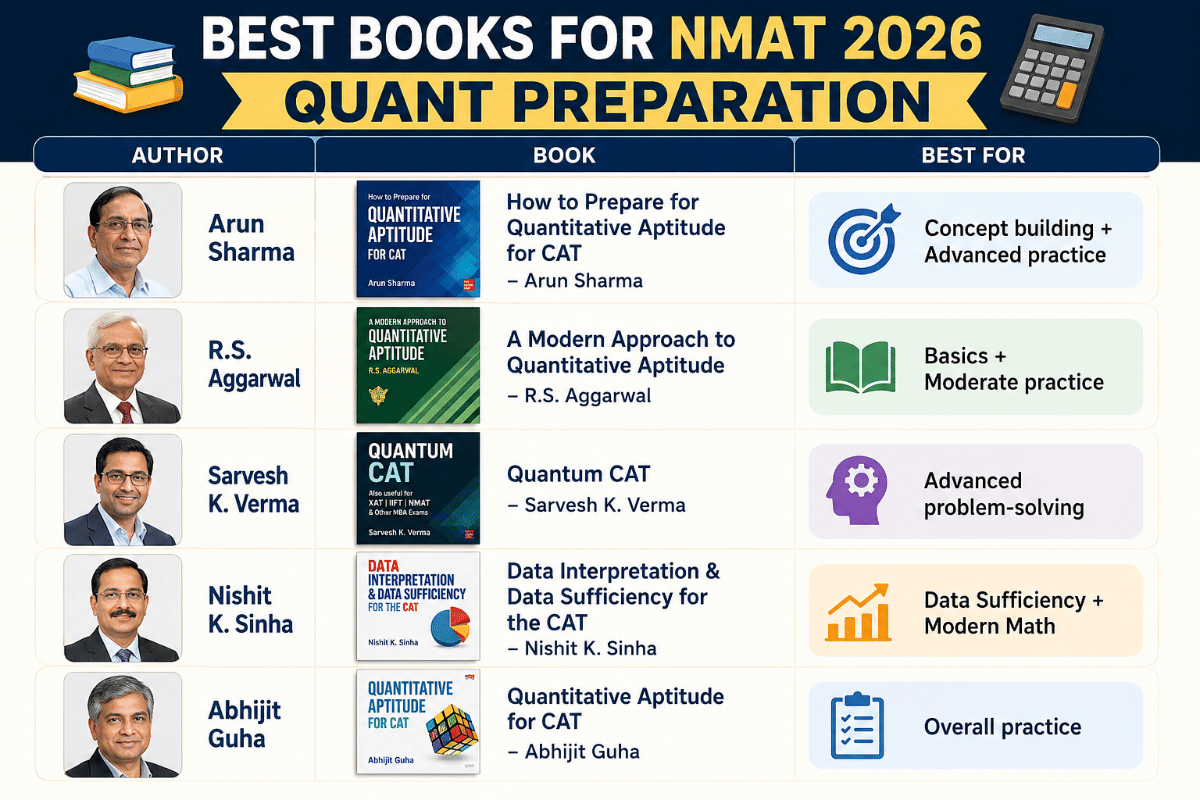
Also Check:
- Best Books for NMAT 2026 Preparation: Recommended Study Material
- NMAT 2026 Best Books: Section-Wise Guide for Language Skills, Quantitative Skills and Logical Reasoning
- NMAT 2026 Best Books for Preparation: Section-Wise Guide
NMAT 2026 Quant Preparation Tips FAQs
Ques. How many questions are asked in NMAT Quant 2026?
Ans. NMAT Quantitative Skills section has 36 questions to be solved in 52 minutes.
Ques. Does NMAT Quant have negative marking?
Ans. No, NMAT has no negative marking. You get +3 marks for every correct answer.
Ques. Is Geometry important for NMAT Quant?
Ans. No, Geometry is largely absent from NMAT, unlike CAT. You should focus more on Arithmetic and DI.
Ques. What is the best way to prepare for Data Sufficiency in NMAT?
Ans. Learn the Data Sufficiency framework separately and practice it as its own topic rather than mixing it with regular arithmetic questions.
Ques. How much time should you give to Quant while preparing for NMAT?
Ans. Since all three sections carry equal weightage, you should split your time evenly, but Arithmetic and DI need extra practice due to the higher question count.
Quantitative Skills
NMAT Quantitative Skills Syllabus comprises topics like arithmetic, number properties, algebra, probability, DI caselets and Tables, DI graphs and Charts, Data sufficiency. Quantitative Skills section is designed to assess a candidate's numerical abilities and mathematical aptitude. As per the test-takers, the overall difficulty level of the Quantitative Skills is from moderate to high.
As per NMAT 2025 Exam Pattern for Quantitative Skills, 36 MCQs will be asked. The sectional time limit for this section will be 52 minutes.
- Quantitative Skills is considered to be the most time-consuming section, hence it is essential to develop the right strategy to attempt QA and DI questions in minimum time with maximum accuracy.
- It is mandatory to clear the sectional cut offs for admission to NMIMS Mumbai and other campuses. Based on the previous years’ cut off trends, scoring 72+ in the Quantitative Skills section would be required to meet the sectional cut off criteria.

All about NMAT Quantitative Skills
Quantitative Skills section is of a moderate difficulty level; the applicant must concentrate on time management because some of the questions are calculation-intensive and complex. Before deciding on a particular preparation strategy, candidates should review the highlights of the Quantitative Skills section, which are listed below.
| Particulars | Details |
|---|---|
| Number of Questions | 36 |
| Type of Questions | Objective Type- MCQ |
| Number of Answer Choices per Question | 4 |
| Sectional Weightage in Syllabus | 33% |
| Marks Awarded | 1 mark for each correct answer |
| Negative Marking | No negative marking |
| Time Allotted | 52 minutes |
| Exam Duration | 120 minutes (2 hours) |
NMAT Quantitative Skills Syllabus
Going through the Quantitative Skills syllabus is the initial step in exam preparation process.
- The QA component of the exam syllabus contains principles from arithmetic, algebra, geometry, and mensuration.
- Candidates should also keep in mind that Data Interpretation (DI) and Data Sufficiency make up a significant portion of the syllabus for Quant, accounting for approximately 10-12 problems. The detailed syllabus is given below.
| Topic | Syllabus |
|---|---|
| Arithmetic | Time & Work, Percentage, Average, Age, Speed, Ratio & Proportion, Time & Distance. Pipes & Cisterns, Mixtures, Alligation, Profit & Loss, Discount, Train, Boats & Streams |
| Algebra | Sequence & Series, Quadratic Equation, Permutation & Combination, Inequalities |
| Number System | HCF & LCM and Product of Numbers, BODMAS, Simplification, Unit’s Digit Theorem and Number of Zeros |
| Geometry | Lines: Parallel lines, Transversal, Perpendicular lines, Collinearity, Types of angles and their properties. |
| Circles: Chords, Concentric Circles, Circumscribed Circle, Inscribed Circle, Semicircle, Sector, Theorems. | |
| Polygons: Quadrilaterals, Parallelogram, Square, Rectangle, Rhombus, Trapezium, Angles & Diagonals of Polygons | |
| Triangles: Theorems, Right-angled Triangles, Equilateral Triangles, Median, Centroid, Congruent Triangles, Similar Triangles, Perpendicular Bisector, | |
| Trigonometry | Trigonometric ratios, Identities, Theorems, Height and Distance, Applications of Trigonometry |
| Mensuration | Area and Volume of Rectangles, Squares, Triangles, Circles, Spheres, Cubes, Cuboids, Cones, Cylinders, etc., Area of shaded regions, Area under curves |
| Data Interpretation | Question sets are based on the information given in the form of charts (pie, comparison), graphs (bar, multiple, line), tables, caselets involving data analysis, extraction of information, and calculation. |
| Data Sufficiency | Questions followed by 2-3 statements are given based on any of the application-based arithmetic topics and you are required to tell whether one, two, or all the statements are sufficient to answer the given question. |
Important Topics of the Quantitative Skills Syllabus
Although it is generally preferable to complete the entire curriculum, due to the vast Quant Syllabus, applicants may choose for selective study. As a result, candidates should not overlook the crucial areas for Quantitative Skills preparation listed below. With proper approach and practice, students can achieve the maximum possible score in this part. The most important topics in the syllabus for Quantitative Skills are:
| Number System | Pipes and Cisterns |
| LCM and HCF | Time, Speed, and Distance |
| Surds and Indices | Algebra |
| Problems on Numbers Ages | Geometry (2D and 3D geometry) |
| Percentage | Trigonometry, Height, and Distance |
| Profit, Loss, and Discount | Data Interpretation |
NMAT Quantitative Skills Exam Analysis
The exam is conducted in 2 phases- 75 days in phase 1 and 5 days in phase 2. The overall difficulty level of the quantitative skills was rated moderate by test-takers. The topic-wise distribution of questions, difficulty level, and good attempts is tabulated below for your reference:
| Topic | Number of Questions | Difficulty Level | Good Attempts |
|---|---|---|---|
| Arithmetic | 8 | Easy to Moderate | 5-7 |
| Numbers | 3 | Moderate | 1-2 |
| Algebra | 5 | Easy to Moderate | 3-4 |
| Data Interpretation | 12 | Moderate | 8-10 |
| Data Sufficiency | 4 | Easy to Moderate | 2-3 |
| Modern Math | 4 | Moderate | 2-3 |
| Total | 36 | Easy to Moderate | 27-29 |
NMAT Quantitative Skills Preparation Books
| Name of the Books | Author |
|---|---|
| NMAT by GMAC official guide | GMAC |
| Quantitative Aptitude for Competitive Examinations | R.S. Aggarwal |
| How to Prepare for Quantitative Aptitude for CAT | Arun Sharma |
| Quantitative Aptitude | Abhijit Guha |
| Quantitative Aptitude for CAT | Nishit K Sinha |
| Quantum CAT | Sarvesh K Verma |
| MBA-NMAT by GMAC Narsee Monjee | Team of Experts |
If aspirants follow a thorough preparation approach and a good plan, they can easily pass the NMAT by GMAC exam. The following are crucial considerations for efficient preparation:
- Practice - In order to improve their scores, students should practice more questions from the quantitative skills section. Candidates must first analyze the syllabus for all the sections before planning how to complete the entire syllabus on time.
- Maintain speed and precision - The two most crucial aspects for students to improve their grades are speed and accuracy. Because speed and accuracy can only be improved by practice, students should solve questions while keeping track of time to maintain speed. Candidates can practice answering the previous year's question papers in the time provided to assess their speed and accuracy and learn how to strike a balance between the two.
- Revision - It is critical to revise in order to achieve good results on any exam. Students should revise all of the sections thoroughly using brief notes and NMAT books. Students can revise the entire course in a short amount of time by using handwritten notes. As a result, students should take notes on all subjects in order to cover all of the relevant topics in the shortest period possible.
- Take practice tests - Practice tests assist pupils in identifying their strengths and limitations. Students can take online mock test or any of the many other mock tests available online. Students can determine which areas require more work by reviewing their scores on sample tests.
- Time management - It is essential for success during the preparation process. Students should stick to a healthy schedule that suits them, and they should devote adequate/ equal time studying each area of the Syllabus. Students must also set aside time to practice their hobbies in order to stress-free prepare for exams. Between periods of continuous study, they should take a 30-minute break.
Mistakes to Avoid while Attempting Quantitative Skills Section
- Selecting the Wrong Question - The Quantitative skills paper ranges from easy to moderate difficult questions. It becomes important to pick easy questions first and solve as many questions as possible. Candidates tend to stick to the questions which might be difficult and time-consuming.
- Not focusing on Options- Some questions, particularly those dependent on the number system and algebra, can be easily addressed utilizing the option-based elimination technique. Use this approach to swiftly and accurately answer similar questions.
- Making Silly Mistakes- This is a very regular occurrence that results in unnecessarily lost marks. If you have time, thoroughly answer the questions and review the answers.
- Not using a logic-based approach- Candidates may avoid using reasoning while answering questions. Certain questions do not require further calculations, which can be avoided if the question is treated sensibly. Some questions on quadratic equations, for example, can sometimes be solved just by looking at the question and do not take a lot of work.
- Attempting questions that require lengthy calculations- Attempting questions that require extensive computations can result in a small number of attempts. Avoid such questions since you will be able to complete more questions in the time it takes to complete one.
Free NMAT Mock Test
- GMAC provides free Mock Test on its official website- mba.com. Apart from the free mock test, 2 more paid mock tests are provided at just INR 899 (plus taxes).
- The mock test is as per the actual paper pattern and contains 36 questions each from Quantitative Skills, Logical Reasoning, and Language Skills.
- All 108 MCQs are from previous year question papers and reflect the actual level and type of questions asked in the exam.
- Practicing NMAT mock tests is beneficial for revision and to get acquainted with the actual exam scenario.
NMAT Quantitative Skills FAQs
Ques. Does GMAC provide official practice papers for NMAT exam?
Ans. Yes, GMAC offers official practice papers for NMAT exam preparation. Follow the below-mentioned steps to check the same:
- Visit the official website- mba.com/en-in/exams/nmat
- In the taskbar, look for the "NMAT by GMAC Official Prep" link.
- A new page will display with checkboxes for "Practice 1," "Practice 2," and "Practice 3."
- To take the practice test for free, go to "Register for Practice 1." The other 2 tests will be paid.
- Candidates must attempt the sample tests using their NMAT by GMAC login created at the time of registration.
- Candidates will be given a link to take the practice tests once they have registered.
Ques. Is NMAT Quantitative Skills more difficult than CAT Quant section?
Ans. Overall, CAT exam is tougher than NMAT. Hence, CAT Quant section is also tougher than NMAT quantitative skills section in terms of the type & structure of questions.
Ques. What is the expected sectional cut-off for Quantitative skills in ?
Ans. The Cut off depends on various factors including the difficulty level of the exam. The cut off score for Quantitative skills is expected in between the range of 70-80.
Ques. What is considered a good attempt in the Quantitative Skills section?
Ans. A total of 36 MCQs will be asked from NMAT quantitative skills. Based on previous year cut offs, it is advised to attempt at least 24-27 questions with 95% accuracy to get a high score in the exam.
Ques. How many times is NMAT conducted?
Ans. NMAT is held over 75+ days. It is generally held in one session every year. However, in the last 2 years, NMAT has been conducted in an additional phase for 5-10 more days.
Ques. How many B-schools in India accept NMAT scores?
Ans. NMAT scores are accepted by 43+ major B-schools in India, including NMIMS Mumbai, NMIMS Bengaluru, NMIMS Hyderabad, ISB, SPJIMR, Xavier University, IBS Hyderabad, and many others.
Ques. Which colleges outside India will accept NMAT scores?
Ans. There are 25 colleges in 4 countries- Morocco, South Africa, Nigeria, and Philippines that will accept NMAT scores for MBA/ PGDM admissions.
Ques. Will there be any negative marking for incorrect answers in the exam?
Ans. No, there won’t be any negative marking for incorrect answers in the exam. Also, no marks will be deducted for unattempted questions.
Ques. How much time is needed to complete NMAT Quantitative Skills Syllabus?
Ans. It is recommended that you cover all of the important topics in NMAT Quantitative Skills Syllabus. It would take about 3-4 months to complete the syllabus if you devote 3-4 hours every day. Last few weeks should be focused on solving sample papers and mock tests.
Question Paper
The NMAT 2026 is being conducted from January 13, 2026 to January 17, 2026 for admissions into various top MBA and management institutions in India and abroad.
The NMAT 2026 question paper with solutions is now available for download along with NMAT Previous Year Question Papers. It includes questions from Language Skills, Quantitative Skills, and Logical Reasoning. Each of the three sections has 36 questions, making a total of 108 questions.
NMAT 2026 Question Paper with Solutions PDF
| Paper/ Subject | Question Paper PDF | Solution PDF |
|---|---|---|
| NMAT 2026 Question Paper | Download PDF | Check Solutions |
NMAT 2025 Question Paper with Solutions PDF
| Paper/ Subject | Question Paper PDF | Solution PDF |
|---|---|---|
| NMAT 2025 Question Paper | Download PDF | Check Solutions |
NMAT 2024 Question Paper with Solutions PDF
| Paper/ Subject | Question Paper PDF | Solution PDF |
|---|---|---|
| NMAT 2024 Question Paper | Download PDF | Check Solutions |
NMAT 2023 Question Paper with Solutions PDF
| Paper/ Subject | Question Paper PDF | View Solutions PDF |
|---|---|---|
| NMAT 2023 Quantitative Question Paper | Download PDF | Check Solutions |
| NMAT 2023 Language Question Paper | Download PDF | Check Solutions |
| NMAT 2023 Logical Reasoning Question Paper | Download PDF | Check Solutions |
NMAT 2022 Question Papers with Solutions PDF
| Subject | Question Paper PDF | View Solutions PDF |
|---|---|---|
| Quantitative | Download PDF | Check Solutions |
| Language | Download PDF | Check Solutions |
| Logical Reasoning | Download PDF | Check Solutions |
NMAT Sample Papers with Solutions PDF
| Question Paper | Question Paper PDF | Solution PDF |
|---|---|---|
| Question Paper 1 | Download | Download |
| Question Paper 2 | Download | Download |
| Question Paper 3 | Download | Download |
| Question Paper 4 | Download | Download |
| Question Paper 5 | Download | Download |

Frequently Asked Questions
Ques: What is the marking scheme in NMAT exam?
Ans: Candidates are awarded +1 for every correct answer and there is no negative marking for wrong answers.
Ques: What is the benefit of solving NMAT Previous Year Papers?
Ans: Solving NMAT Previous Year Papers and NMAT Mock Test helps in understanding the exam pattern and syllabus, improving time management, identifying and rectifying common errors.
Ques: Should a calculator be used while attempting NMAT Sample Papers?
Ans: No, Using a calculator is not recommended as it is not allowed in the actual NMAT exam.
Sample Paper
NMAT by GMAC is the entrance test for NMIMS and many other top MBA colleges. Solving full sample papers is the best way to get used to its fast, sectional-timed format.
Official website: www.nmat.org
NMAT Subject Wise Sample Papers 2026
Each NMAT sample paper is built to be solved section by section under a timer, just like the real test where every section has its own time limit. Attempt one section, check your answers, and note where you slowed down.
You can download every NMAT sample paper free on an external review site, and you can also check the official pattern on www.nmat.org. The subject-wise papers above open as soon as each subject page goes live.
- NMAT Subject Wise Sample Papers 2026
- NMAT Exam Pattern and Marks Distribution 2026
- NMAT Sample Papers - Why Recent Papers Matter Most
- NMAT Subject Wise Weightage - High Scoring Areas to Focus in Sample Papers
- NMAT Sample Paper Video Solutions 2026 - Watch Before You Start Solving
- How to Use NMAT Sample Papers to Clear in First Attempt
- NMAT No Negative Marking and Sectional Time Strategy
- NMAT 4 Week Preparation Plan Using Sample Papers
- FAQs on NMAT Sample Papers 2026
- Exam name: NMAT by GMAC, conducted by the Graduate Management Admission Council for MBA and PGDM admission.
- Paper format: 108 multiple-choice questions across three sections.
- Marking: +3 for every correct answer, with no negative marking for wrong or unattempted questions.
- Mode and duration: computer-based online test of 120 minutes with sectional time limits.
- Sections: Language Skills, Quantitative Skills, and Logical Reasoning, each with 36 questions.
- Attempts: you may take the exam up to three times in a cycle, and the best score is used.
NMAT Exam Pattern and Marks Distribution 2026
NMAT has a fast, sectional-timed structure. You get 108 questions in 120 minutes, and each section runs on its own clock, so pacing matters a lot.
- Language Skills: 36 questions in 28 minutes, covering reading, grammar and vocabulary.
- Quantitative Skills: 36 questions in 52 minutes, covering arithmetic, algebra and data interpretation.
- Logical Reasoning: 36 questions in 40 minutes, covering verbal and analytical reasoning.
- Marking: +3 for correct, with no negative marking, so attempt every question.
Key advice: since there is no negative marking, never leave a question blank; make an intelligent guess before the section clock runs out.
NMAT Sample Papers - Why Recent Papers Matter Most
NMAT has kept a steady 108-question, three-section format in recent years. Recent-format papers train you on the exact pacing and difficulty you will now face.
- Recent papers match the current 36-question, sectional-timed structure.
- They reflect the present, moderate difficulty across all three sections.
- They help you set a realistic target attempt in each section within its time limit.
NMAT Subject Wise Weightage - High Scoring Areas to Focus in Sample Papers
The table below shows how the 108 questions split across the three sections, with the kind of topics each one tests.
| Section | Questions | Time | What to Watch For |
|---|---|---|---|
| Language Skills | 36 | 28 min | Tightest clock, so vocabulary and grammar must be quick and accurate. |
| Quantitative Skills | 36 | 52 min | The most time is given here, so aim for high accuracy. |
| Logical Reasoning | 36 | 40 min | Mixes verbal and analytical reasoning, so practise both types. |
Note: since there is no negative marking anywhere, attempt every question in every section before the clock ends.
NMAT Sample Paper Video Solutions 2026 - Watch Before You Start Solving
A quick walkthrough of previous NMAT questions helps you understand the pacing before you attempt a full paper. This is useful if you are new to the NMAT format.
Watch the video once, then solve a paper the same day so the tips stay fresh.
Watch:
Source: NMAT previous-year questions walkthrough covering the Language Skills section and exam pacing (YouTube)
How to Use NMAT Sample Papers to Clear in First Attempt
Sample papers only help if you use them the right way. Follow these steps for each paper you solve.
- Solve each section under its own timer, just like the real exam.
- Do a full first pass picking only the questions you can solve quickly.
- Come back for the harder questions in a second pass within the same time.
- Since there is no negative marking, mark an answer for every question.
- Write down every topic that slowed you down and revise it before the next paper.
NMAT No Negative Marking and Sectional Time Strategy
NMAT is a computer-based test with no negative marking, but each section has its own strict time limit, so you cannot borrow time from another section.
- Attempt every question, since a guess can only add marks and never lose them.
- Do not spend too long on one question when the section clock is running.
- Decide your section order in advance based on your strongest area.
- Keep the last minute of each section to mark answers for any questions left blank.
NMAT 4 Week Preparation Plan Using Sample Papers
- Week 1: Revise grammar, vocabulary and basic arithmetic, and solve one Language Skills sample paper.
- Week 2: Focus on Quantitative Skills and data interpretation, and solve two full-length papers under timer.
- Week 3: Build speed in Logical Reasoning, and take three full papers with strict sectional timing.
- Week 4: Take one full paper every two days and review errors, keeping the last two days for light revision only.
FAQs on NMAT Sample Papers 2026
Ques.How many questions and sections are there in NMAT 2026?
Ans.NMAT 2026 has 108 multiple-choice questions across three sections, Language Skills, Quantitative Skills and Logical Reasoning, to be solved in 120 minutes.
Ques.Is there negative marking in NMAT 2026?
Ans.No, NMAT has no negative marking. You get +3 for every correct answer and lose nothing for a wrong or unattempted one, so you should attempt every question.
Ques.Does NMAT have sectional time limits?
Ans.Yes, each of the three sections has its own time limit, and you choose the order in which you attempt them before the test begins.
Ques.Are NMAT sample papers on an external review site free to download?
Ans.Yes, all NMAT sample papers listed on this page are free to download in PDF form for every section.
Ques.How many times can I attempt NMAT?
Ans.You can take NMAT up to three times in one cycle, including a retake, and your best score is used for admissions.
Ques.How many NMAT sample papers should I solve before the exam?
Ans.Aim to solve at least eight to ten section-wise papers so you build both speed and the habit of working within each section's time limit.
Scheduling
NMAT Scheduling 2026 enables candidates to self-select their exam date, time, and test centre within the allotted time period on their official website, mba.com/exams/nmat. The scheduling window is expected to open on August 1, 2026, and close around October 18, 2026.
Interested candidates can book their slots only after their NMAT registration fee is confirmed. The NMAT 2026 exam is expected to be held from November 5 to December 19, 2026.
- Once your Rs 3,000 (plus taxes) registration fee is confirmed, you can choose your exam date, time, and centre across 76 locations in India.
- Book early to secure your preferred date and city for up to 3 NMAT attempts, as slots are available on a first-come, first-served basis.
- You can reschedule your date or venue up to 72 hours before your scheduled test time by paying a fee.
- Your admit card becomes available on the dashboard within 24 hours of scheduling your exam.
Related Links:
- NMAT 2026 Registration: Dates (Aug 1-Oct 18), Fees, Steps, and Documents Required
- NMAT Admit Card 2026: Download NMAT by GMAC Hall Ticket @mba.com, Exam Day Guidelines
- NMAT Exam Dates 2026: Additional Phase Exam Dates Out, Admit Card, Scheduling & Result Dates
What is NMAT Scheduling 2026?
NMAT is a self-scheduled exam conducted by GMAC over a testing window of about 40 to 50 days. Unlike fixed-date exams, you choose your own exam date, time slot, and test centre. This process is also called NMAT slot booking.
- Scheduling is a separate step from registration.
- First, you register and pay the fee, then you book your exam slot.
- You select your exam mode during scheduling - either a physical test centre or online proctored at home.
- Once you select your exam mode, it cannot be changed later.
NMAT Scheduling 2026: Dates
The scheduling window opens alongside registration and closes before the testing window ends. Check the expected dates below.
| Event | Expected Date |
|---|---|
| NMAT 2026 Registration Opens | August 1, 2026 |
| Scheduling Window Opens | August 2026 |
| Registration and Scheduling Last Date | October 18, 2026 |
| NMAT 2026 Exam Window | November 5 to December 19, 2026 |
| Result and Scorecard | Within 48 hours of each attempt |
Related Links: NMAT Exam Centers 2026: Check NMAT Test Cities, Exam Day Guidelines
NMAT Scheduling 2026: Important Dates & Trends from 2025 and Previous Years
The pattern remains consistent every year. Scheduling in the first 2–3 weeks of November has been the sweet spot for most students in the last 2–3 years, as it balances preparation time, slot availability, and B-school application deadlines.
| Event | 2026-27 (Expected) | 2025-26 (Actual) | 2024-25 (Actual) |
|---|---|---|---|
| Registration Start | August 1, 2026 | August 1, 2025 | August 1, 2024 |
| Registration Last Date | October 10–12, 2026 | October 10, 2025 | October 10, 2024 |
| Scheduling Window Start | August 1–2, 2026 | August 1, 2025 | August 1, 2024 |
| Scheduling Last Date | October 25–26, 2026 | Mid-October 2025 | October 14, 2024 |
| Exam Delivery Window | Nov 4 – Dec 20, 2026 | Nov 5 – Dec 19, 2025 | Nov 5 – Dec 20, 2024 |
| Best Recommended Scheduling | Early to Mid November | Early to Mid November | Early November |
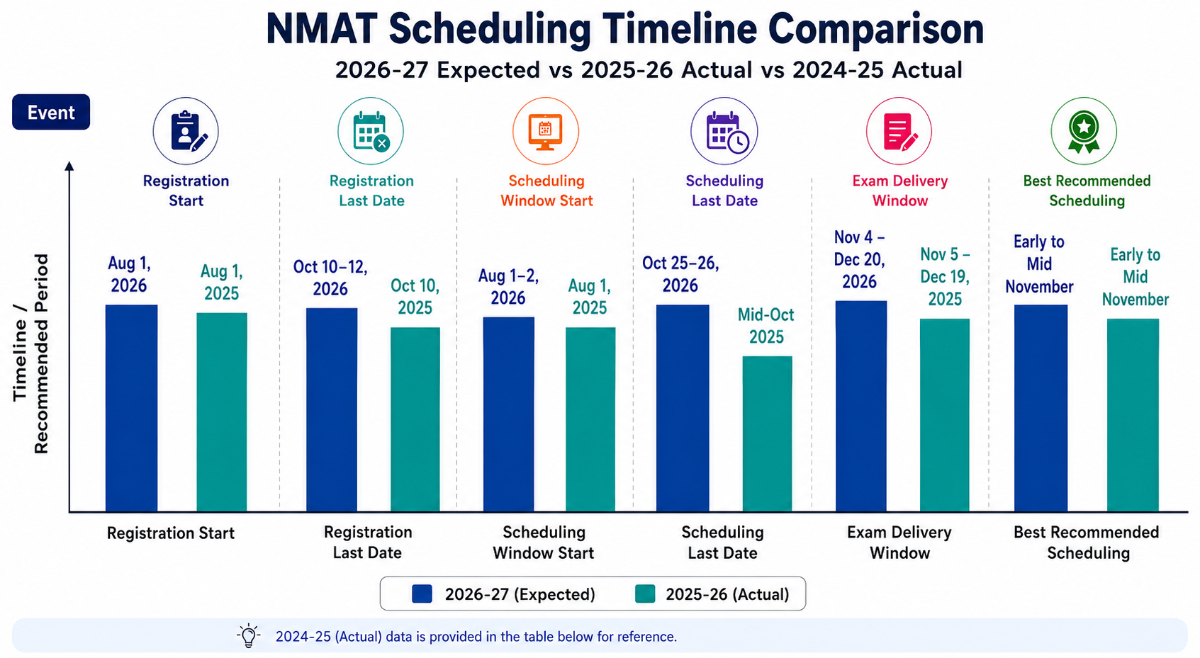
NMAT Scheduling 2026: Available Slots
You can pick from morning, afternoon, and evening slots across the testing window. Time slots are shown automatically in your local time zone.
| Detail | Available Options |
|---|---|
| Exam Window | November 5 to December 19, 2026 (expected) |
| Daily Shifts | Morning, Afternoon, Evening |
| Cities | 70+ cities, including Delhi, Mumbai, Kolkata, Bengaluru, Chennai, Hyderabad, Pune |
| Centres | 76 test centres across 73 cities |
| Number of Attempts | Up to 3 (first attempt plus two retakes) |
Your preferred exam date is not guaranteed if all slots in your city are full. Book early to secure the date and shift you want.
NMAT Scheduling 2026: How to Book a Slot?
Once your fee payment is confirmed, the scheduling option becomes active on your dashboard. Follow these steps.
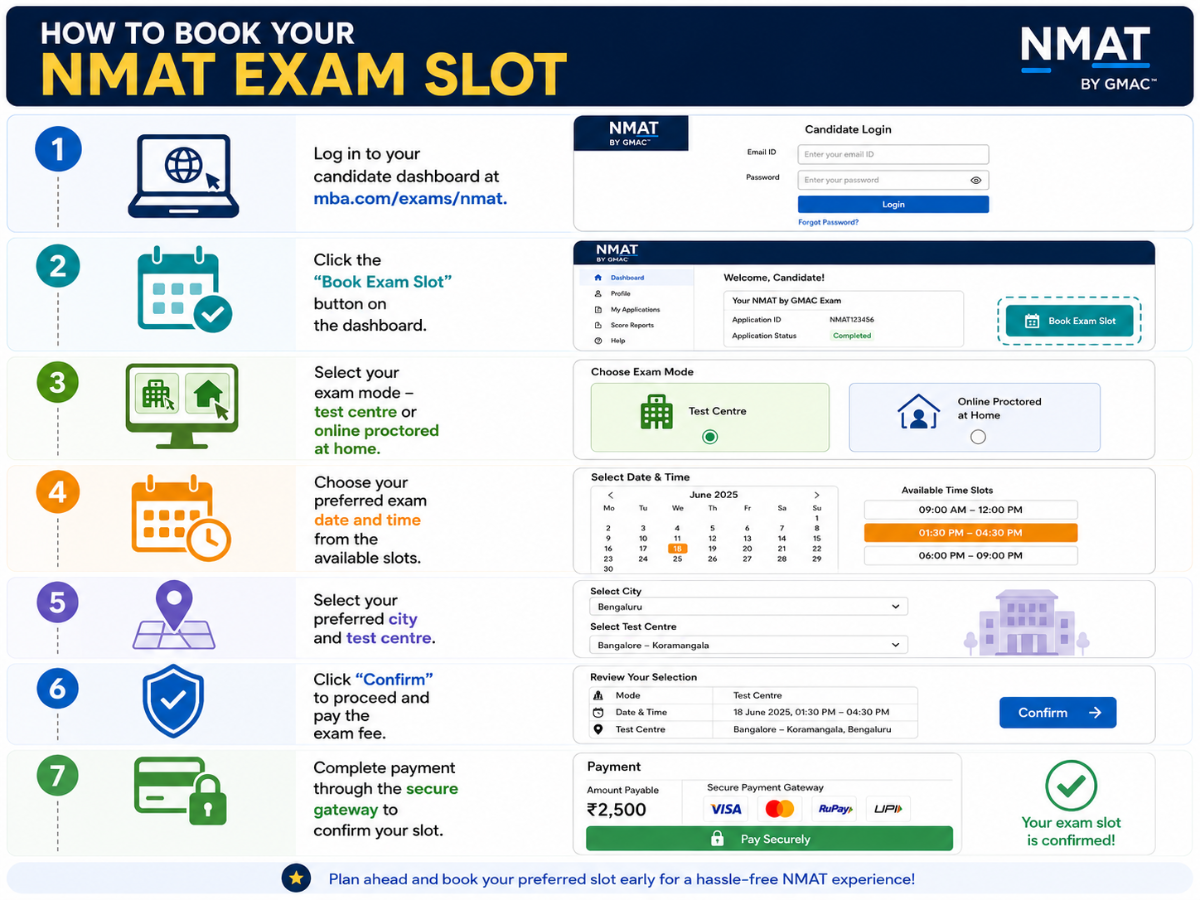
Slot booking follows a first-come, first-served policy - book as early as possible. You will receive a confirmation email with your exam details once scheduling is complete.
Note: Double-check your time zone before confirming, as you will not be able to change it later.
Related Links: NMAT 2026 Exam Day Guidelines
NMAT Scheduling 2026: Slot Rescheduling Policy
You can change your exam date or venue if your plans change. Rescheduling is done through your login dashboard.
- Rescheduling requires an additional fee, payable online by credit or debit card.
- Log in, open the "Schedule Exam" tab, select a new date, time, and venue, then proceed to pay.
- For a retake, schedule a new attempt at least 15 days after your previous valid attempt.
Rescheduling is allowed only within the window and requires an additional fee.
What to Do If NMAT Scheduling 2026 Fails?
If your slot booking does not go through, try these steps before contacting support.
- Confirm your registration fee payment was successful and reflected on your dashboard.
- Refresh or log in again to the candidate dashboard and retry the "Book Exam Slot" option.
- Clear your browser cache or try a different browser if the scheduling page does not load.
- Check if your preferred slot is full and select an alternate date or a nearby centre.
- For payment or technical issues, email NMAT support at nmatsupport@gmac.com.
NMAT Scheduling 2026: Reddit Discussion
Ques. I forgot to Book My NMAT Slot Before the Deadline. Can I Still Appear for the exam, or Is There Any Way to Get Help?
Source: Reddit
Note: If your payment is deducted but the slot is not confirmed, do not pay again. Contact GMAC support with your transaction details first.
NMAT Scheduling 2026: What is the Best Time to Schedule NMAT 2026 to Meet B-school Application Deadlines?
Early to mid-November is considered the most strategic window for NMAT Scheduling 2026, as it provides ample time for score evaluation, retake planning, and B-school applications.
- Results are available within 48 hours.
- You get sufficient time to review your score and plan a retake (minimum 15-day gap required).
- Major B-schools have application deadlines from January to March 2027 — November gives you a safe buffer.
- Higher chance of getting preferred slots and test centers.
Scheduling in December is still possible, but leaves less room for flexibility or retakes.
Is There Any Issue with NMAT Scheduling 2026 in December?
No major issues with NMAT scheduling 2026 in December, but there are a few important things you should consider:
- Application Deadlines: Most NMAT-accepting B-schools close applications by Jan–Feb 2027, making a December test slot a safe choice.
- Slot Availability: December slots (especially weekends) tend to fill up faster in popular cities. It’s safer to book early.
- Preparation Time: Many students prefer giving the exam in early November to get their scores sooner and have time for retakes if needed.
- Retake Window: If you schedule late in December and want a retake, you may have limited dates left before the testing window closes.
Recommendation: If your preparation is solid, aim for November to mid-December. Late December is still safe for most colleges, but avoid the very last few days unless necessary.
Can I schedule NMAT 2026 before paying the fee?
No, you cannot schedule your NMAT 2026 exam before completing the payment.
In the NMAT Scheduling 2026 process, payment is mandatory before you can access the slot booking option. Here’s how it works:
- Register on the official NMAT website.
- Fill in your details and make the payment (₹3,000 + taxes for the first attempt).
- Once payment is confirmed, the “Book Exam Slot” or scheduling option becomes active in your dashboard.
- You can then choose your preferred test center, date, and time.
Tip: Complete your registration and payment early to avoid a last-minute rush and get better slot choices during NMAT Scheduling 2026.
NMAT Scheduling 2026 FAQs
Ques. When will the NMAT 2026 scheduling open?
Ans. NMAT 2026 scheduling is expected to open in August 2026, alongside the registration window, and close around October 2026.
Ques. Can I change my NMAT exam date after booking?
Ans. Yes, you can reschedule your date or venue up to 72 hours before your scheduled test time by paying a rescheduling fee.
Ques. What if all slots in my city are full?
Ans. If your preferred city slots are full, you must choose another available date, an alternate shift, or a nearby test centre.
Ques. Is the scheduling fee refundable?
Ans. No, the NMAT registration and scheduling fee is generally non-refundable. Rescheduling also requires a separate fee.
Ques. How many times can I schedule the NMAT exam?
Ans. You can take NMAT up to three times in one cycle, including the first attempt and two retakes, each scheduled separately.
Ques. Can I change my exam mode after scheduling?
Ans. No, once you select the test centre or online proctored mode, it is final and cannot be changed later.
Ques. When do I get my admit card after scheduling?
Ans. Your admit card becomes available on the dashboard within 24 hours of scheduling, with the exam date, time, and venue printed on it.
Ques. Do I need to book a slot for each attempt?
Ans. Yes, every attempt needs separate scheduling and payment. A retake can be booked for a date at least 15 days after your previous attempt.
Ques. How do I know my scheduled date and time?
Ans. You receive a confirmation email after scheduling, and the details are shown on your dashboard and your admit card.
NMAT Score vs Percentile
In NMAT, candidates’ scaled score and percentile rank both are important for MBA admissions. For admission in NMIMS Mumbai, a score of 235+ i.e. 98th-99th percentile is required. Although the official minimum eligibility cutoff is 209(with 62 being the required sectional score) but last year students got admissions at score of 235 and above.
- For Tier 2 colleges like K J Somaiya or TAPMI, a score between 220 and 230 (93rd to 96th percentile) is generally competitive.
- For other good colleges like IBS, Shiv Nadar, or Alliance, a score around 150 to 210 (50th to 85th percentile) is required
To secure admission calls from the extended Top 10 NMAT Colleges list, including NMIMS campuses (Bangalore/Hyderabad), XIMB, and SOIL, a highly competitive scaled score between 215 and 235 is required.
| NMAT Scaled Score Range | Estimated Percentile Range | Performance Level | Best College Options |
|---|---|---|---|
| 235 - 250+ | 98 - 99+ | Outstanding | NMIMS Mumbai (Core MBA), SPJIMR (GMP) |
| 230 - 234 | 96 - 98 | Excellent | NMIMS Mumbai (Many programs), TAPMI, K J Somaiya |
| 220 - 229 | 90 - 95 | Very Strong | NMIMS Bangalore/Navi Mumbai, XIMB, IFMR GSB |
| 200 - 219 | 70 - 90 | Good | NMIMS Hyderabad/Indore, SDA Bocconi, Shiv Nadar University |
| Below 200 | Below 70 | Average/Below | Other NMAT-accepting B-schools |
Related Links
- Check List of NMAT Score accepting Colleges
- Check NMAT Cutoff Trends of last 5 years
- Get details about NMAT Selection Process including GD and PI
This article will help you in understanding what is the relationship between NMAT score, percentile and admission to top MBA colleges.
What is NMAT Score Vs Percentile?
NMAT score is a scaled score you receive after taking exam. Your correct answers (raw scores) are further converted into scaled score through normalisation. The total NMAT Score range from 36 to 360. Most B- schools use this scaled score as primary criteria for shortlisting candidates
Candidates should note that apart from overall scaled score, there is a sectional score range too i.e 12 to 120.
Now talking about NMAT percentile. It is percentage of candidates who scored less than you. NMAT percentile ranges from 0 to 100. For e.g. A percentile of 90 means you outperformed 90% of candidates.
The table below shows NMAT score to percentile mappings based on previous years’ trends

Source: NMAT Percentile Ranking
| NMAT Score (Approx.) | Estimated Percentile |
|---|---|
| 235 - 245+ | 99th Percentile |
| 225 - 234 | 98th Percentile |
| 210 - 224 | 95th Percentile |
| 200 - 209 | 90th Percentile |
This mapping can vary depending upon number of applicants and difficulty level.
Ques. What is the minimum NMAT score required for 70 percentile colleges like IBS Hyderabad?
For colleges like IBS Hyderabad, which fall within the 70th percentile range, a minimum NMAT score of 170-180 is typically required. This score range helps meet the eligibility criteria, though the exact requirement may vary depending on the applicant pool and exam performance. Scoring within this range boosts your chances of securing admission.
What were the NMAT sectional cutoffs for NMIMS Mumbai in 2024 and 2025?
The NMAT sectional cutoffs for NMIMS Mumbai in 2024 and 2025 were as follows:
- Language Skills: 62
- Quantitative Skills: 62
- Logical Reasoning: 62
Note that sectional cutoff is only minimum eligibility to apply; actual cutoff is above 235 score.
NMAT 2025 Sectional Cutoff
A high overall score is not enough. All top NMAT-accepting colleges, particularly NMIMS, have sectional cutoffs that must be cleared in addition to the overall score.
| Section | Scaled Score Range | Max Score | Required for 90th+ Percentile (Est.) |
|---|---|---|---|
| Language Skills (LS) | 12 - 120 | 120 | 70 - 80+ |
| Quantitative Skills (QS) | 12 - 120 | 120 | 70 - 75+ |
| Logical Reasoning (LR) | 12 - 120 | 120 | 70 - 75+ |
The sectional cutoff is same for all NMIMS campuses offering MBA programs, with the expected sectional cutoff of 62 each for LR, LS, and QS, and an overall score of 209 except for the MBA Pharmaceutical Management the NMAT cutoff is expected to be 50 and the total to 190.
| Program | LR | LS | QS | NMAT Cutoff 2025 |
|---|---|---|---|---|
| MBA Mumbai | 62 | 62 | 62 | 209 |
| MBA HR | 62 | 62 | 62 | 209 |
| MBA Business Analytics | 62 | 62 | 62 | 209 |
| MBA Digital Transformation | 62 | 62 | 62 | 209 |
| MBA Pharmaceutical Management | 50 | 50 | 50 | 190 |
| MBA Bangalore | 62 | 62 | 62 | 209 |
| MBA Navi Mumbai | 62 | 62 | 62 | 209 |
| MBA Hyderabad | 62 | 62 | 62 | 209 |
| MBA Indore | 62 | 62 | 62 | 209 |
Note on NMIMS Cutoffs: The official minimum overall cutoff for NMIMS MBA programs (Mumbai, Bangalore, etc.) was standardized to 209 (with sectional cutoffs of 62} for all three sections) for the last cycle. However, this is the minimum eligibility score—candidates with scores 230+ range were historically given higher weightage and still have the best chance of final admission for the flagship Mumbai campus due to competition.
Ques. What Score is 70 Percentile in NMAT?
Ans. The 70th percentile in NMAT is expected to be a moderate score for the candidates, making them eligible for new and Tier-3 B-Schools.
| Estimated NMAT Score | Approximate Percentile |
|---|---|
| 215 | 70 |
| 213 – 215 | 68 – 70 |
| 210 | 66 |
Ques. What is 95 Percentile in NMAT?
Ans. The 95th Percentile is considered an excellent score in NMAT, which is sufficient for all the colleges accepting the NMAT Score except the NMIMS Mumbai.
| Percentile | Estimated NMAT Score |
|---|---|
| 95 | 241 – 243 |
| 94 | 239 – 240 |
| 93 | 238 |
NMAT Cutoff for Top 5 Colleges
| Rank | Institute | Program (Focus) | Expected NMAT Score (Scaled) | Estimated Percentile |
|---|---|---|---|---|
| 1 | K J Somaiya Institute of Management, Mumbai | MBA | 220 - 230+ | 95 - 98+ |
| 2 | TAPMI (T. A. Pai Management Institute), Manipal | MBA (All Specializations) | 220 - 225+ | 90 - 95+ |
| 3 | Xavier University, Bhubaneswar (XIMB) | MBA-HRM (Highest Cutoff) | 210 - 225+ | 90 - 95+ |
| 4 | SDA Bocconi Asia Center, Mumbai | International Master in Business (IMB) | 200 - 215+ | 80 - 90+ |
| 5 | IFMR Graduate School of Business | MBA | 200 - 215+ | 80 - 90+ |
Ques. What NMAT score is required for 99 percentile in 2025?
To achieve a 99 percentile in the NMAT 2025, a scaled score of 230-240 is required. This score range is generally considered competitive for securing a 99th percentile ranking
Good Score in NMAT 2025
A Good score in NMAT is expected to be between 220 to 250+, which depends on the college the candidate is targeting.
- NMAT is a scaled score exam with a score range of 36 to 360, with no negative marking.
- Candidates can also improve their score by taking a retake attempt and by getting an estimation of their score with the NMAT Score calculator.
- Most of the top B-Schools accept scores with a range of 210 to 230, which generally makes this a good score.
NMAT 2025 Good Score
| Score Range | Performance Level | College Opportunities |
|---|---|---|
| 250 – 360 | Excellent | NMIMS Mumbai (Core), Top profile-based shortlists |
| 230 – 249 | Very Good | NMIMS Bengaluru, Navi Mumbai, KJ Somaiya, XIMB |
| 210 – 229 | Good | NMIMS Indore/Hyderabad, SDA Bocconi, IFMR GSB |
| 190 – 209 | Moderate | Woxsen, ISBR, Alliance University |
| < 190 | Low | Fewer options, retake advised for better college options |
Ques. What counts as a good NMAT 2025 score?
Ans. The scores which counts as a good NMAT 2025 score are:
- 230+ marks: Outstanding performance, usually lands in the 99+ percentile, ideal for top B-schools.
- 220–230 marks: Very competitive score, can secure admission in many reputed institutes.
- 200+ marks: Decent score, may open opportunities in good B-schools depending on the competition and cutoffs.
- Scores below 200 may still give chances in mid-tier institutes but may require strong overall profiles.
Ques. Is percentile alone enough for admission?
Ans. No. While a high percentile strengthens your application, top B-schools consider other factors too:
- Academic record and consistency.
- Relevant work experience.
- Performance in interviews, group discussions, and essays.
A holistic approach is used, so even with a high percentile, other aspects of your profile matter.
MBA Colleges with lower NMAT Score Cutoff
If your NMAT Scaled Score is less than 220-230 score, there are still many reputable MBA and PGDM programs that accept scores in the 160-210 range. These colleges offer strong programs with good Return on Investment (ROI), especially for candidates who may have a decent score but did not meet the very high cutoffs of Tier 1 institutes like NMIMS Mumbai.
The table below provides estimated cutoffs for colleges that are excellent options for candidates with moderate NMAT scores
| Institute (Location) | Program Type | Expected NMAT Score Range | Estimated Percentile | Key Feature / ROI |
|---|---|---|---|---|
| ICFAI Business School (IBS), Hyderabad | MBA/PGDM | 150 - 180+ | 55 - 75% | Known for its large alumni base & case-study methodology. |
| Shiv Nadar University (SNU), Greater Noida | MBA / Global MBA | 160 - 180+ | 60 - 75% | Focus on innovation and global exposure; strong placements. |
| Alliance School of Business, Bangalore | MBA | 160 - 180+ | 60 - 75% | Strong reputation in the South; known for placements in IT/ITES. |
| Woxsen University, Hyderabad | MBA/PGDM | 160 - 180+ | 60 - 75% | Offers modern curriculum with strong international exchange options. |
| Thapar School of Management (LMTSM), Mohali | MBA | 150 - 170+ | 50 - 65% | Backed by the Thapar Group; good industry connections. |
| BML Munjal University (BMU), Gurgaon | MBA | 150 - 170+ | 50 - 65% | Strategic partnership with Imperial College London. |
| ITM Business School, Navi Mumbai | PGDM iConnect | 160 - 190+ | 60 - 78% | Excellent ROI option in the Mumbai region; diverse specializations. |
| Amity Business School, Noida/Gurgaon | MBA (Various) | 150 - 170+ | 50 - 65% | Wide range of specialized programs; large intake. |
NMAT Score vs percentile Previous Year Trends
| NMAT Score Range | Estimated Percentile |
|---|---|
| 264 – 360 | 100 |
| 254 – 263 | 99 |
| 246 – 253 | 97 – 98 |
| 241 – 245 | 95 – 96 |
| 233 – 240 | 90 – 94 |
| 225 – 232 | 82 – 89 |
| 215 – 224 | 70 – 81 |
| 205 – 214 | 56 – 69 |
| 195 – 204 | 42 – 55 |
| 185 – 194 | 30 – 41 |
| 175 – 184 | 20 – 29 |
| 160 – 174 | 10 – 19 |
| 140 – 159 | 5 – 9 |
| 120 – 139 | 2 – 4 |
| Below 120 | 0 – |
- With an NMAT Score of 240+, candidates will get a 99+ percentile, which is required for the top institutes like NMIMS Mumbai.
- With a score range of 230-240, candidates will get a percentile between 90-94, which is required for colleges NMIMS and XIMB.
- With a score of 215-225, candidates will get around 70-81 percentile, which makes them eligible for colleges like K.J. Somaiya, Woxsen and ISBR.
- With a score below 180, candidates will get a percentile below 25, through which only limited options will be available for them, of low-tier or new B-Schools.
NMAT Score vs Percentile 2025 College-Wise
The B-Schools accepting the NMAT Score have different cutoffs and percentiles depending upon the college reputation, total seats and selection criteria.
The GMAC will not release official percentiles, but according to the previous year trends, the top colleges accept scores between 210 to 250, which ranges between 90-99 percentiles.
Expected College-Wise NMAT Score vs percentile 2025
- Among all the colleges, NMIMS Mumbai is the most competitive NMAT College, which requires a 235+ score, which places it in the 98+ percentile, with a sectional score of 62 for each section.
- The Tier 1 institutes like K.J. Somaiya and XIMB require more than 210-230 scores, which is equal to around 90-95 percentile.
- The Tier 2 Institutes like IFMR, Woxsen and SDA Bocconi offer flexibility by accepting scores in the range of 190-215 with around 75-90 percentile.
- Candidates with a score below 200 should target new B-Schools or can also improve their score by taking the re-exam.
- Candidates should aim for a score of above 225, which makes them eligible for top institutes.
NMAT Score vs percentile for NMIMS
| Campus/Program | Expected Score (2025) | Estimated Percentile | Details |
|---|---|---|---|
| NMIMS Mumbai (MBA Core) | 235 – 250 | 96 – 99+ | Sectional cutoff: 62+ |
| NMIMS Mumbai (MBA HR/Pharma) | 209 – 220 | 75 – 85 | Lower cutoff for Pharma |
| NMIMS Bengaluru | 225 – 235 | 90 – 95 | Competitive profile |
| NMIMS Navi Mumbai | 220 – 230 | 88 – 93 | Sectionals apply |
| NMIMS Hyderabad | 210 – 225 | 80 – 90 | Acceptable with lower scores |


NMAT Score vs percentile for XIMB
| Program | Expected Score (2025) | Estimated Percentile | Details |
|---|---|---|---|
| MBA – Business Mgmt | 210 – 220 | 90 – 95 | Sectionals may apply |
| Other PGDM Programs | 200 – 210 | 85 – 90 | Includes HR/SM options |
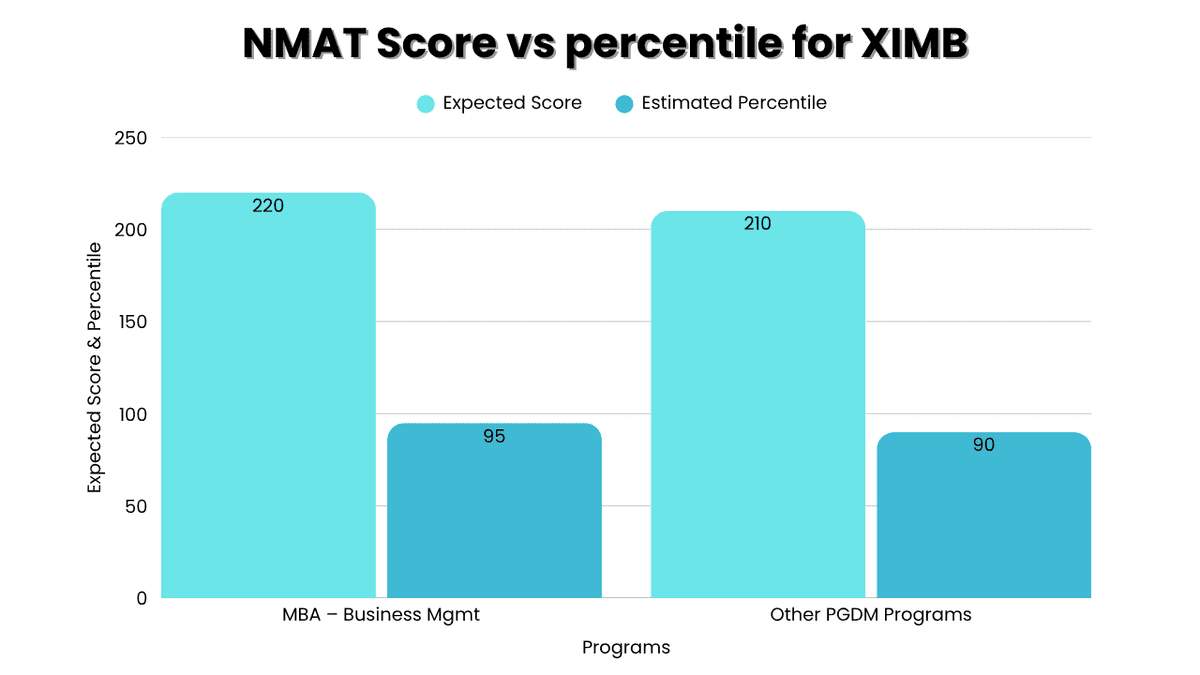
NMAT Score vs percentile for KJ Somaiya Institute of Management
| Program | Expected Score (2025) | Estimated Percentile |
|---|---|---|
| All Programs | 225 – 230 | 90 – 94 |
NMAT Score vs percentile for other B-Schools Accepting NMAT Scores
| Institute | Expected Score | Percentile Range | Remarks |
|---|---|---|---|
| SDA Bocconi Asia Centre (Mumbai) | 200 – 215 | 80 – 90 | Profile-based selection |
| Woxsen University (Hyderabad) | 190 – 210 | 70 – 85 | Accepts moderate scores |
| IFMR GSB (Krea University) | 200 – 215 | 80 – 90 | Balanced academics preferred |
| ISBR Business School (Bangalore) | 180 – 200 | 60 – 75 | Low score threshold |
| Alliance University (Bangalore) | 170 – 190 | 50 – 70 | Accepts lower NMAT scores |
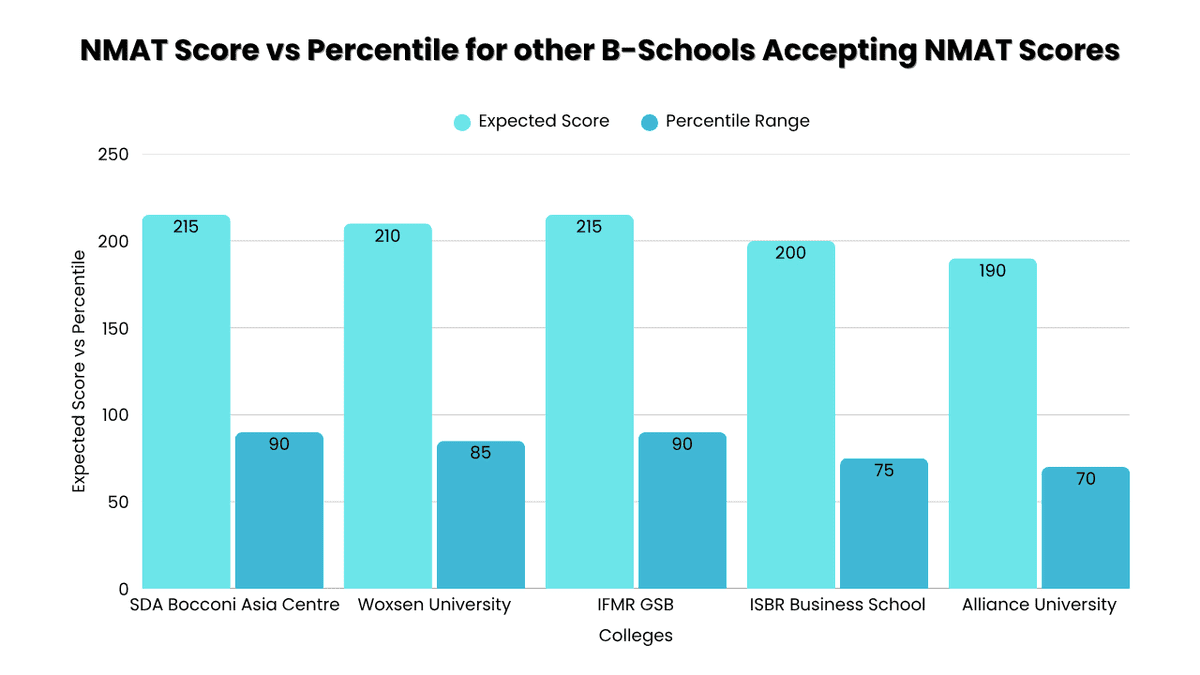
Ques. What Percentile is 240 on the NMAT?
Ans. In NMAT, a score range of 240 will rank the candidates in the percentile range of 94 to 96, which is sufficient for colleges like NMIMS Bengaluru, K.J. Somaiya and XIMB.
But the score range of 245 will still be less for NMIMS Mumbai.
Ques. How Much NMAT Score is Required for KJ Somaiya?
Ans. The K.J. Somaiya Institute of Management is amongst the top B-schools that accept the NMAT Score, with a proper profile-based selection process as well.
| Program | Expected Score (2025) | Estimated Percentile |
|---|---|---|
| MBA/PGDM | 225 – 230 | 90 – 94 |
Ques. How much percentile is 170 in NMAT?
Ans. A score of 170 in NMAT typically corresponds to around 17-18 percentile, based on the official NMAT 2024 score-percentile data released by GMAC.
- A score of 160-165 is around 11-13 percentile.
- A score of 170-172 is around 17-18 percentile.
- A score of 180 reaches roughly 25 percentile.
Percentiles may vary slightly each year depending on the overall performance of candidates, but 170 is generally considered below the median range in NMAT.
How to calculate the NMAT 2025 Score?
The NMAT Score calculator will be based on the number of correct answers given by the candidates. The NMAT has 3 sections, each will be scored separately and with a scaled score in the range of 12 to 120.
The total NMAT Score will range from 36 to 360, whereas the raw scores will be converted into scaled scores by ensuring fairness among each shift.
Ques. How is raw score converted to scaled score in NMAT 2025?
Ans. The raw score are converted to scaled score by following the steps given below:
- Each correct answer fetches 1 mark.
- No negative marks for wrong or skipped questions.
- The raw total (sum of corrects) is then scaled to adjust for exam difficulty across sessions.
- GMAC uses a normalization algorithm to derive the scaled scores.
Ques. How does scaling work in NMAT 2025?
Ans. Raw marks are converted into a scaled score so that no test window is unfairly easy or difficult compared to others. The exact formula is not disclosed, but scaling ensures fairness across all sessions.
Ques. Does GMAC publish the exact score to percentile conversion formula for NMAT?
Ans. No, the precise conversion / normalization formula is not made public. But a scaled score and percentile is given in your scorecard of the candidate.
NMAT 2025 Exam Structure & Scoring
| Section | No. of Questions | Score Range | Time Limit |
|---|---|---|---|
| Language Skills | 36 | 12 – 120 | 28 minutes |
| Quantitative Skills | 36 | 12 – 120 | 52 minutes |
| Logical Reasoning | 36 | 12 – 120 | 40 minutes |
| Total | 108 | 36 – 360 | 120 minutes |
Ques. What are the scoring rules in NMAT 2025?
Ans. The NMAT 2025 scoring system is very student-friendly and follows the following scoring rules:.
- Every correct answer gives you +1 mark.
- There is no penalty for wrong or skipped answers.
- Scores are reported on a scaled system to balance difficulty across test slots.
- Each section is scored between 12 and 120.
- The overall score ranges from 36 to 360.
- Your percentile is calculated based on these scaled scores.
NMAT Score Calculator: Step-by-Step
Step 1: Raw Score Calculation
- Each Correct Answer will give the candidate +3 marks.
- No Negative marking for wrong answers.
Step 2: Scaled Score Conversion
The Raw Score of the candidates will be converted into a scaled score between 12 to 120 for each section, by equating and normalising the score and with different difficulty levels among each exam shift and date.
Example: NMAT Score Calculation
Let’s assume a candidate gets the following number of correct responses:
| Section | Correct Answers (Raw Score) | Estimated Scaled Score |
|---|---|---|
| Language Skills | 28 / 36 | 94 |
| Quantitative Skills | 30 / 36 | 102 |
| Logical Reasoning | 25 / 36 | 90 |
| Total | 83 / 108 | 94 + 102 + 90 = 286 |
The final NMAT score of the candidate would be approximately 286 (scaled out of 360).
Selection Process
NMAT Selection Process 2025 will start soon after the release of NMAT 2025 Cut off by NMIMS and other MBA colleges. There is no common selection process followed by participating B-schools and each school will release its own NMAT Cut off. Check NMAT Cutoff
NMAT selection process 2025 involves 3 steps i.e. WAT, GD, and PI. There are more than 40 NMAT score accepting colleges including NMIMS Mumbai, NMIMS Hyderabad, NMIMS Bangalore, ICFAI Business School, VIT Vellore, and XIM Bhubaneswar. Check NMAT 2025 College Predictor
Candidates preparing for NMAT 2025 are advised to look through the process to get a glance at the areas one needs to work on.
NMAT Selection Process 2025 Important Dates
The schedule for NMAT selection process will be released soon on the official website of NMIMS. Till then, candidates can check the tentative schedule provided below:
| Events | Tentative Dates |
|---|---|
| NMAT Result | Within 48 hours of exam delivery |
| Release of NMAT Cut off | January 2026 |
| Registration of GD/ PI process | February 2026 |
| GI/ PI | March 2026 |
NMAT Selection Process 2025
NMAT 2025 selection process will begin with candidates registering and appearing for the entrance exam.
- Appear for NMAT 2025: Only candidates who appeared for NMAT 2025 are eligible for admission.
- NMAT Result 2025: All B-schools will release their respective NMAT 2025 cut-offs. Candidates will have to clear the exam cut-off in order to proceed with the selection process.
- Appearing for screening process: In the third step, the candidate will have to appear for further screening rounds organized by B-schools which includes GD (Group Discussion) or WAT followed by PI (Personal Interview) rounds.
- Final Selection: The final selection of the candidate depends upon the score achieved in the screening rounds. The weightage of each round in NMAT score will be decided by respective MBA college.
NMAT Written Ability Test 2025
Last year due to the pandemic situation the WAT round was conducted online. Candidates had provided their WAT test articles on Google Docs.
- Written Ability Test (WAT) is introduced by a few B-schools only. During this round candidates will be judged for the knowledge on the provided topic.
- Candidates will also be judged for Grammar, Language, Vocabulary, Clarity Of Thought etc.
NMAT Group Discussion 2025
Case Discussion is a round common to many of the B-schools accepting NMAT score admission process. Candidates’ knowledge is tested around varied topics of political, social, economical, sports, arts, educational nature. For group discussion, candidates will be divided into groups of 5- 10. Each group of student will get about 15 – 20 minutes to discuss the assigned topic and will be judged on the following factors:
- Leadership Skills
- Communication Skills
- Managerial Skills
- Negotiation Skills
- Personality
- Listening Skills
- Confidence of Speaking
NMAT Group Discussion Topics
Group discussion round is a rather difficult part of NMAT Selection Process. Group Discussion topics often come as a surprise to students as they are mostly unpredictable. However some common topics which can be expected include:
- Social issues
- Political events
- Science and Technology
- Finance and Economics
- Latest global happening such as COVID 19
NMAT Personal Interview 2025
PI round is the second most common round of the admission process of colleges accepting NMAT score. This round is usually conducted as a panel discussion with 3-4 panelists. The panelists include senior interviewers from B-schools and experts of various fields. During this session, the panelists try to assess the candidate on the basis of his/her interests, attitude, personality, and future aspirations. Academic and work profile of the applicant is also considered.
Last year the PI round was conducted over Zoom Call. Following points must be kept in mind of the candidate on which s/he will be tested:
- Personality
- Communication Skills
- Confidence
- Academic Profile
Selection Process Tips for NMAT 2025
Here are some of the tips to help candidates clear the GD, WAT, and PI rounds.
- Group Discussion: A topic will be provided by the B-school on the spot for candidates to indulge in group discussion. The topic may be related to any field. So, applicants are advised to be familiar with current affairs related to social, political, and economic walks of life along with knowledge of their respective fields.
- Written Ability Test: The WAT round is conducted to test candidates’ writing skills. Candidates are made to write an essay on a given topic. It is necessary to first understand the topic well, jot down the necessary points and plan out a structure before beginning with the essay.
- Personal Interview: This round involves candidates appearing for a face-to-face interview session with panelists. The panel may include members from the B-school selection committee as well as independent experts. It is essential for candidates to be presentable and alert while making conscious answers.
NMAT Documents Required for Selection Process
Candidates who are selected after clearing of the selection process of NMAT 2025 are required to complete the documentation process and admission formalities. Following documents must be kept ready for further procedures:
- NMAT 2025 Scorecard
- NMAT Admit Card 2025
- Category Certificate for students (If Applicable)
- Address Proof / Domicile Certificate
- Birth Certificate
- Class 10 Marksheet / Matriculation - Certificate
- Class 12 Marksheet / Intermediate - Certificate
- Degree Certificate / Graduation Marksheet
- Photocopies of all the certificates
- Six recent Passport size Photographs
- Identity Proof (Aadhar Card, Voter ID, License, Passport)
NMAT Participating Colleges Cut off
| Institute/ University in India | Cutoff (General) |
|---|---|
| NMIMS Mumbai Campus | 215-230 |
| NMIMS Bengaluru Campus | 200-210 |
| NMIMS Hyderabad Campus | 200-210 |
| ICFAI Business School (IBS), Hyderabad | 68 |
| Indian School of Business, Mohali | 65 |
| SDA Bocconi Asia Center | 200 |
| Alliance University, Bangalore | 100 |
| SRM University, Chennai | 180 |
| VIT University, Vellore | 85 |
| Mody University, Rajasthan | 60 |
| Thapar School of Management, Chandigarh | 65 |
| Woxsen School of Business Management, Hyderabad | 160 |
| Amity University, Delhi NCR | 65 |
| University of Petroleum & Energy Studies (UPES), Dehradun | 140 |
| GITAM School of International Business, Visakhapatnam | 140 |
NMAT Sectional Cut Off
NMAT cut off will be released soon after the declaration of the result. However, an idea of the cut off can be made from previous year cut offs.
| Section | Marks | Sectional Cutoff |
|---|---|---|
| Language Skills | 96 | 55 |
| Quantitative Skills | 144 | 70 |
| Logical Reasoning | 120 | 55 |
| Total | 360 | - |
Know more about NMAT Cut Off
NMAT 2025 Selection Process FAQs
Ques. When is NMAT 2025 Selection Process likely to start?
Ans. NMAT 2025 Selection Process will start soon after the declaration of results. The tentative time for the beginning of the process is February 2026.
Ques. What is the criteria for shortlisting candidates in NMAT Selection Process?
Ans. In NMAT Selection Process, a candidate’s collaborative performance in Group Discussion, Personal Interview, and Written Ability Test is considered while shortlisting.
Ques. What documents does a candidate need to carry at the time of the NMAT Selection Process?
Ans. Once a candidate gets shortlisted for the selection process, s/he is required to carry the following documents:
- NMAT Scorecard
- NMAT Admit Card
- Category Certificate for students (If Applicable)
- Address Proof / Domicile Certificate
- Birth Certificate
- Class 10 Marksheet / Matriculation - Certificate
- Class 12 Marksheet / Intermediate - Certificate
- Degree Certificate / Graduation Marksheet
- Photocopies of all the certificates
- Six recent Passport size Photographs
- Identity Proof (Aadhar Card, Voter ID, License, Passport)