
Joint Entrance Exam Main chemistry-preparation 2026
Joint Entrance Exam Main chemistry-preparation
To prepare for JEE Main Chemistry, you should follow a proper study plan by covering the syllabus, conceptual clarity and doing regular practice. In the JEE Main Chemistry Exam 2026, 25 Questions will be asked and will carry a weightage of 100 marks from the 300-mark exam in the JEE Main.
The JEE Main Chemistry 2026 Official Syllabus will be released by NTA on the official website jeemain.nta.nic.in.
- For JEE Main Chemistry Preparation, you should focus on the NCERT books for Classes 11 and 12, along with reference books like O.P. Tandon, P. Bahadur, and J.D. Lee for advanced problem-solving.
- A Few Topics such as Coordination compounds (4-5 Questions), Chemical Bonding(3-4 Questions), Hydrocarbons (2-3 Questions), and Aldehydes, Ketones & Carboxylic Acids (2-3 Questions) for more than 35-40% of the chemistry section.
For Effective JEE Main Chemistry Preparation, you should practice the previous year papers, mock tests and from various online apps as well. This will help your problem-solving skills, along with time management during the exam.
Also Read
| Key Summary: In this Article, we have discussed about JEE Main Chemistry Preparation 2026, including the preparation plan, syllabus, weightage, mock tests and books.
|
- JEE Main Chemistry Preparation Strategy
- JEE Main Chemistry Preparation: Exam Pattern
2.1 JEE Main Chemistry Exam Pattern
- JEE Main Chemistry Preparation Tips
- How to prepare for JEE Main Chemistry 2026?
4.1 JEE Main Chemistry Monthly-Preparation Plan
- JEE Main Chemistry Preparation: Mock Test
- JEE Main Chemistry Previous Year Papers
- JEE Main Chemistry Preparation 2026:Section-wise
7.1 JEE Main Chemistry Preparation: Physical Chemistry
7.2 JEE Main Chemistry Preparation: Organic Chemistry
7.3 JEE Main Chemistry Preparation: Inorganic Chemistry
- JEE Main Chemistry Preparation: Last-Minute Tips
- Most Important Chapters for JEE Mains Chemistry 2026
9.1 JEE Main Physical Chemistry: Important Chapters
9.2 JEE Main Organic Chemistry: Important Chapters
9.3 JEE Main Inorganic Chemistry: Important Chapters
- JEE Main Chemistry Topic-wise weightage
- JEE Main Chemistry Syllabus
11.1 JEE Main Physical Chemistry Syllabus
11.2 JEE Main Organic Chemistry Syllabus
11.3 JEE Main Inorganic Chemistry Syllabus
- JEE Main Chemistry Preparation: Important Books
12.1 Important Books for JEE Main Chemistry
- FAQs for JEE Main Chemistry Preparation
JEE Main Chemistry Preparation Strategy
By the following video, you can understand properly about JEE Main Chemistry preparation, including the exam pattern, syllabus, topic-wise weightage and month-wise preparation strategy.
JEE Main Chemistry Preparation: Exam Pattern
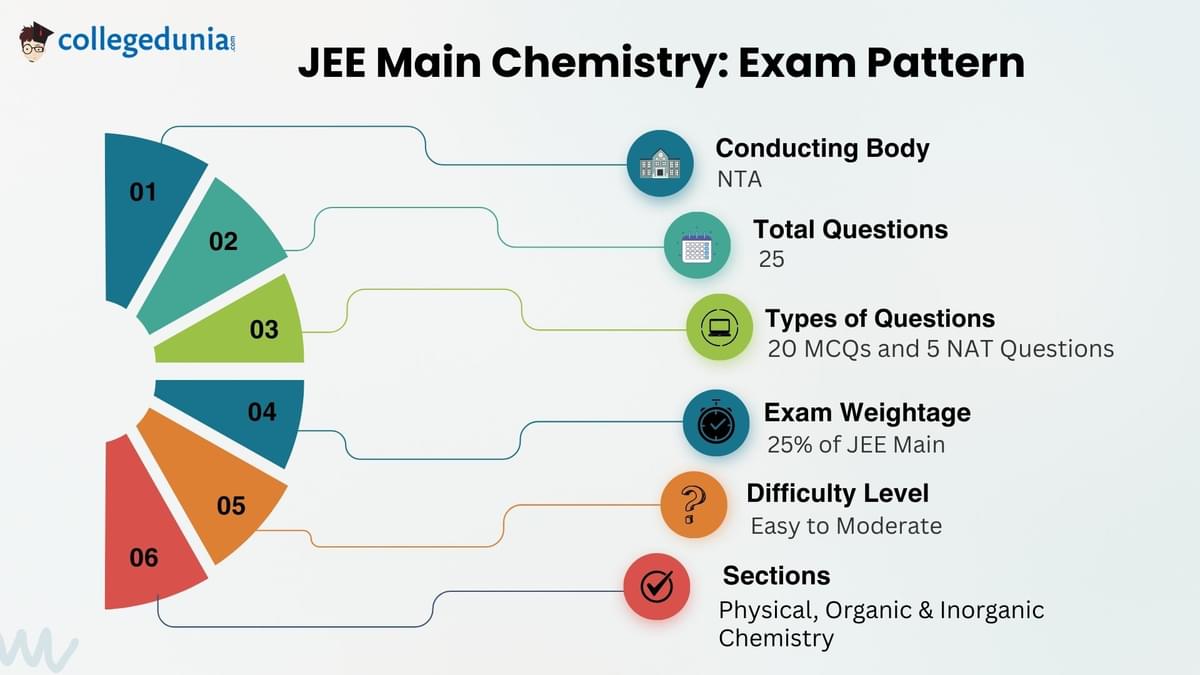
The JEE Main Chemistry Section in 2026 is a part of Paper 1 and carries 25 Questions of 100 marks.
- The JEE Main chemistry section will include 20 MCQs and 5 Numerical Value-based questions.
- The JEE Main chemistry difficulty level is expected to be moderate to easy, which makes JEE Main chemistry a scoring section, as compared to physics and mathematics.
JEE Main Chemistry Exam Pattern
| Parameter | Details |
|---|---|
| Total Questions | 25 |
| Type of Questions | 20 MCQs + 5 Numerical Value Questions |
| Marks per Question |
|
| Total Marks | 100 |
| Weightage in Paper | 25% of JEE Main (100 out of 300 marks) |
| Difficulty Level | Moderate (NCERT-based, with application-based questions in Physical & Organic) |
| Key Scoring Areas | Inorganic (direct NCERT), Organic mechanisms, Physical formula-based numericals |
| Marking Trend | 15–18 easy, 5–7 moderate, 1–2 tough questions in recent years |
Also Read
JEE Main Exam PatternJEE Main Chemistry Preparation Tips
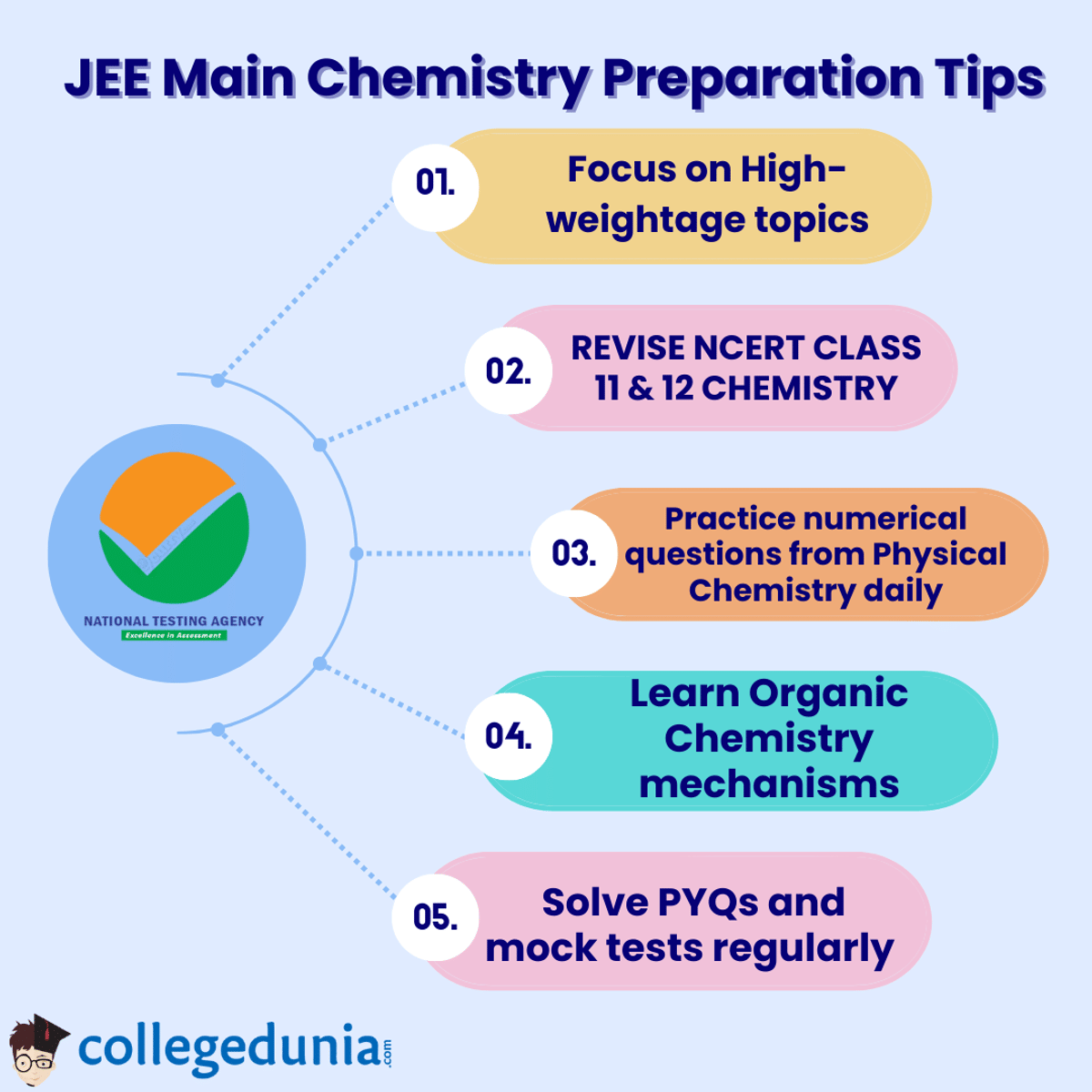
The JEE Main Chemistry section is considered to be amongst the most scoring sections, in which 70-75% of the questions are NCERT-based. It includes 25 Questions which carry 100 marks. By following focused preparation, candidates can secure a strong percentile.
Also, Check:
How to prepare for JEE Main Chemistry 2026?
To score high marks in the JEE Main Chemistry Section, it is necessary to follow a preparation plan. As more than 70% of the questions are NCERT-based, the JEE Main chemistry section is considered to be the easiest to score.
For JEE Main Chemistry Preparation, candidates should follow a monthly preparation plan which covers the NCERT, along with the high-weightage chapters and practice previous year questions and revise the mock tests.
JEE Main Chemistry Monthly-Preparation Plan
JEE Main Chemistry Preparation: September 2025
| Focus Area | Strategy |
|---|---|
| NCERT Coverage | Complete Class 11 Inorganic Chemistry (Periodic Table, Chemical Bonding, Redox, States of Matter). |
| Physical Chemistry | Start with the Mole Concept, Atomic Structure, and Thermodynamics. |
| Organic Basics | Begin with General Organic Chemistry (GOC), resonance, inductive effect, and hybridisation. |
| Practice | Solve chapter-wise NCERT examples & PYQs (2019–2023). |
| Weekly Target | 3–4 chapters + 200–250 practice questions. |
JEE Main Chemistry Preparation: October 2025
| Focus Area | Strategy |
|---|---|
| NCERT Coverage | Finish Class 11 Organic (Hydrocarbons, Haloalkanes, Alcohols) and Class 12 Inorganic basics. |
| Physical Chemistry | Cover Equilibrium, Chemical Kinetics, Solutions, Electrochemistry. |
| Organic Chemistry | Start Aldehydes, Ketones & Carboxylic Acids, named reactions. |
| Practice | Attempt chapter-wise mock tests after every unit. |
| Weekly Target | 200–300 MCQs along with 2 sectional mock tests. |
JEE Main Chemistry Preparation: November 2025
| Focus Area | Strategy |
|---|---|
| Inorganic Chemistry | Complete p-block, d-block, f-block, Coordination Compounds. |
| Organic Chemistry | Cover Amines, Biomolecules, Polymers, and Everyday Chemistry. |
| Physical Chemistry | Revise Thermodynamics, Electrochemistry, and Equilibrium with numerical focus. |
| Practice | Solve the last 10 years PYQs topic-wise. |
| Weekly Target | 250–300 MCQs along with 1 full-length mock test. |
JEE Main Chemistry Preparation: December 2025
| Focus Area | Strategy |
|---|---|
| Full Syllabus Revision |
|
| Mock Tests | Take 2–3 full-length JEE Main mock tests every week. |
| Mistake Analysis | Maintain an error log of incorrect answers and revise weak concepts thoroughly. |
| Quick Notes | Revise flashcards, summary notes, and formulas daily. |
| Weekly Target | 3–4 full mock tests along with 300 questions. |
JEE Main Chemistry Preparation: January 2026 (Exam Month)
| Focus Area | Strategy |
|---|---|
| Final Revision | Revise summary notes & NCERT diagrams (esp. Inorganic). |
| Mock Tests | Attempt 1 mock test every day till the exam is conducted |
| Last 7 Days | Focus only on high-weightage topics & weak areas. |
| Exam Readiness | Practice time management, and 45 minutes max should be given to the Chemistry section. |
| Target | 10 full mock tests and the last 3 years’ PYQs revision. |
Also Read
Android Apps for JEE Main PreparationJEE Main Chemistry Preparation: Mock Test
In JEE Main Chemistry Preparation, practising from JEE Main Mock Tests is necessary, as they give candidates an exam-day experience. You can solve the Chemistry mock tests for JEE Main provided by MyKollege.
JEE Main Chemistry Previous Year Papers
For JEE Main Chemistry Preparation, practising from previous year papers is necessary to prepare effectively. By practising the previous year's papers, you can know about the types of questions asked and the repetitive questions in the JEE Main Exam.
Also Read
JEE Main Chemistry Preparation 2026:Section-wise
The Chemistry section in JEE Main is divided into Physical, Organic and Inorganic chemistry; each section carries equal weightage of around 30 to 33%.
For JEE Main Chemistry Preparation, a strategic approach should be used, for proper time distribution along with numerical practice and NCERT Revision as well.
Check the section-wise JEE Main Chemistry preparation plan with marks distribution and focus areas:
JEE Main Chemistry Preparation: Physical Chemistry
| Focus Area | Sub-topics | Marks Weightage | Preparation Strategy |
|---|---|---|---|
| Mole Concept & Stoichiometry |
| 4–8 marks | Daily numerical practice and formulas revision |
| Thermodynamics & Thermochemistry |
| 4 marks | Solve PYQs, focus on numerical-based theory |
| Electrochemistry & Chemical Kinetics |
| 4–8 marks | Practice numerical problems regularly |
| Equilibrium (Chemical + Ionic) |
| 4 marks | Revise NCERT & practice application-based questions |
JEE Main Chemistry Preparation: Organic Chemistry
| Focus Area | Sub-topics | Marks Weightage | Preparation Strategy |
|---|---|---|---|
| General Organic Chemistry (GOC) |
| 4 marks | Build a strong conceptual base |
| Hydrocarbons & Alkyl/Aryl Halides |
| 4–8 marks | Remember mechanisms and practice PYQs |
| Alcohols, Phenols, Ethers |
| 4 marks | Short notes for fast revision |
| Biomolecules & Polymers |
| 4 marks | Direct NCERT-based, revise frequently |
JEE Main Chemistry Preparation: Inorganic Chemistry
| Focus Area | Sub-topics | Marks Weightage | Preparation Strategy |
|---|---|---|---|
| Periodic Table & Chemical Bonding |
| 4–8 marks | NCERT diagrams & PYQs are a must |
| Coordination Compounds |
| 4–8 marks | Focus on NCERT examples |
| p-block Elements | Group 13–18 properties & compounds | 4–8 marks | NCERT theory revision and repeated PYQs |
| Metallurgy & Environmental Chemistry |
| 2–4 marks | Purely NCERT and theory-based |
Also Read
JEE Main Chemistry PatternJEE Main Chemistry Preparation: Last-Minute Tips
In the last few days before the JEE Main 2026 Exam. You should focus on revision based on NCERT Theory, formulas and high-weightage chapters.
Chemistry is among the most scoring sections; the last-minute preparation should be strategic and time-based.
| Strategy | Key Focus | Time Allocation |
|---|---|---|
| Revise NCERT | Inorganic & Organic key reactions, named reactions, and exceptions | 40% of revision time |
| Formula & Reaction Sheets | Physical Chemistry formulas, Electrochemistry equations, Organic reaction mechanisms | 20% of the time |
| Mock Test Practice | Daily 1–2 timed sectional/mixed tests with analysis | 25% of the time |
| Error Log Revision | Recheck mistakes from previous mocks & weak chapters | 10% of the time |
| Quick Flashcards | Biomolecules, Polymers, Environmental Chemistry, periodic trends | 5% of the time |
Most Important Chapters for JEE Mains Chemistry 2026
In the JEE Main Chemistry section, around 70% of the questions will be NCERT-based. As per the last 10 years' papers of JEE Main chemistry, equal weightage is given to all sections, but a few chapters carry a bit higher marks.
JEE Main Physical Chemistry: Important Chapters
| Chapter | Weightage (Marks) | Why Important |
|---|---|---|
| Mole Concept & Stoichiometry | 6 | Core for numerical chemistry, the basis of many problems |
| Thermodynamics | 4 | Conceptual + numerical, asked every year |
| Equilibrium (Chemical & Ionic) | 5 | High frequency, pH & solubility questions |
| Electrochemistry | 4 | Application-based numerical questions |
JEE Main Organic Chemistry: Important Chapters
| Chapter | Weightage (Marks) | Why Important |
|---|---|---|
| General Organic Chemistry (GOC) | 4 | Foundation for mechanisms, must-know concepts |
| Hydrocarbons | 4 | Repeated reaction-based questions |
| Alcohols, Phenols & Ethers | 4 | High-scoring, conversion questions |
| Biomolecules & Polymers | 4 | Easy NCERT-based, direct questions |
JEE Main Inorganic Chemistry: Important Chapters
| Chapter | Weightage (Marks) | Why Important |
|---|---|---|
| Chemical Bonding & Periodic Table | 8 | Important for concepts & structures |
| Coordination Compounds | 6 | Very frequent in JEE |
| p-block Elements (Groups 13–18) | 4–8 | High weightage, NCERT-based & factual questions |
| Metallurgy & Environmental Chemistry | 2–4 | Short, fact-based and easy to revise |
Also Read
JEE Main Reduced SyllabusJEE Main Chemistry Topic-wise weightage
In the JEE Main Exam, 25 Questions are asked from the chemistry section, which is divided equally into Physical, Organic and Inorganic chemistry.
As per the previous year's analysis, some topics carry high weightage in the JEE Main Chemistry section.
Below is a concise topic-wise weightage table based on previous year papers.
| Section | Key Topics | Average Weightage (Marks) | No. of Questions |
|---|---|---|---|
| Physical Chemistry |
| 24–28 | 6–7 |
| Organic Chemistry |
| 28–32 | 7–8 |
| Inorganic Chemistry |
| 28–32 | 7–8 |
Also Read
JEE Main Chapter-wise weightageJEE Main Chemistry Syllabus
The JEE Main chemistry syllabus includes Physical Chemistry, Organic Chemistry and Inorganic Chemistry, contributing around 30-33% of the total chemistry section.
The JEE Main Physical Chemistry focuses on concepts and numerical applications, organic chemistry focuses on reaction mechanisms, and inorganic chemistry is majorly NCERT-based.
JEE Main Physical Chemistry Syllabus
| Unit | Topics Covered |
|---|---|
| Some Basic Concepts of Chemistry | Mole concept, stoichiometry, laws of chemical combination |
| States of Matter | Gaseous state, kinetic theory, ideal gas law, real gases |
| Atomic Structure | Bohr’s model, quantum numbers, and electronic configuration |
| Thermodynamics | First law, enthalpy, Hess’s law, spontaneity |
| Chemical & Ionic Equilibrium | Law of mass action, Le-Chatelier principle, solubility product |
| Electrochemistry | Redox reactions, EMF, Nernst equation, conductance |
| Chemical Kinetics | Order, molecularity, rate law, Arrhenius equation |
| Solutions & Colligative Properties | Raoult’s law, osmotic pressure, boiling/freezing points |