

Joint Entrance Exam Main physics-preparation 2026
Joint Entrance Exam Main physics-preparation
If you are preparing for JEE Main Physics, follow a proper study plan along with consistent practice. The JEE Main Physics will include 25 Questions, 20 MCQs and 5 NAT Questions, carrying a weightage of 100 marks in a 300-mark exam of JEE Mains.
The JEE Main Physics Syllabus will be released by NTA on the official website, jeemain.nta.nic.in.
- Topics with the most weightage, like Mechanics 30-35%, Electrostatics and current electricity around 20-25%, optics & modern physics, including around 20-25% weightage, are important for JEE Main Physics Preparation 2026.
- Around 60-65% of the weightage will be from numerical-based questions, practising previous year papers and reference books from H.C. Verma and D.C. Pandey will be helpful.
You should regularly revise the formulas, derivations and practical concepts for JEE Main Physics Preparation and stay updated on the official website for any current updates.
Also Read
| Key Summary: In this Article, we have discussed about JEE Main Physics Preparation 2026, including the Time Table, Preparation Plan & Mock Tests.
|
- JEE Main Physics Preparation Strategy
- Smart Physics Preparation Hacks for JEE Main 2026
- JEE Main Physics Preparation: Topic Weightage
- JEE Main Physics Preparation: Important Topics
- JEE Main Physics Previous Year Question Paper
- Study Notes and Topic Wise Weightage
- Part A: Theory Preparation Tips
- Part B: Practical Components Preparation Tips
- JEE Main Physics Last Minute Preparation
- Ideal way to Score 100+ in JEE Main Physics section
- JEE Main vs JEE Advanced Physics Topic Wise Comparison
- NEET Physics Preparation vs JEE Physics Preparation
- NCERT and Other Books for JEE Main Physics
- Tricks to Solve JEE Main Physics Questions
- Preparation Through NTA Content Based Lectures
-
JEE Main Physics Preparation Strategy
The JEE Main Physics includes 25 Questions, 20 MCQs and 5 NAT Questions, carrying a 100 marks weightage. As per the previous year's trends, Mechanics, Electricity & Magnetism and Optics & Modern Physics carry almost 70% of the exam.
Below is the JEE Main Physics preparation plan for the remaining months:
JEE Main Physics Preparation: September 2025
- Complete all the Mechanics Chapters, including Kinetics, Law of motions, work-energy & power, Rotational motion, Gravitation, carrying 35% of the weightage.
- Solve around 200-250 questions from H.C. Verma and NCERT Questions.
- Major focus should be on derivations like Newton’s Law, energy theorems, torque, and angular momentum.
- Topics like motion graphs and full-body diagrams should be properly revised.
- Attempt at least 1 Part mock test till the end of the month.
JEE Main Physics Preparation: October 2025
- Cover topics like Electrostatics, Current Electricity, Magnetism, EM Induction and Alternating current as they carry around 20-25% weightage.
- Practice the numerical-based problems like Ohm’s law, Kirchhoff’s rule and capacitor circuits.
- Graph-based questions should be properly revised.
- Solve the last 10 years' previous year question papers for current electricity and electrostatics.
- Solve 3-4 full-length mock tests under time restrictions.
JEE Main Physics Preparation: November 2025
- Focus on topics like Ray Optics, Wave Optics, Heat & Thermodynamics, Kinetic theory and modern physics, which includes 25 to 28% weightage.
- Prepare the lens/mirror combination problems and interference/diffraction numericals.
- Revise the law of thermodynamics, Carnot engine and entropy as they are directly asked in the exam.
- Cover modern physics topics as they are scoring and formula-based.
- At least 300 practice problems should be attempted this month.
JEE Main Physics Preparation: December 2025
- Prepare the semiconductors, communication system, EM Waves, Gravitation, SHM, which carries 10-12% of the weightage.
- Revise Class 12 NCERT Experiments, including resistance, potentiometer, pris,m, etc.
- Start doing full syllabus mock tests at least 2 mock tests per week.
- Analyse your performance, focus on weak areas and manage your time effectively.
- Revise class 11 chapters as well.
JEE Main Physics Preparation: January 2026
- Revise all the high-weightage chapters like mechanics, Electricity, Magnetism, and Modern Physics.
- Attempt full 8-10 full-length mock tests in the last days.
- Revise formulas and flashcards for at least 30-40 mins.
- Revise the numerical shortcuts for problem solving.
- In the last few days, do a light revision and solve PYQs instead of practice.
Also Read
Smart Physics Preparation Hacks for JEE Main 2026
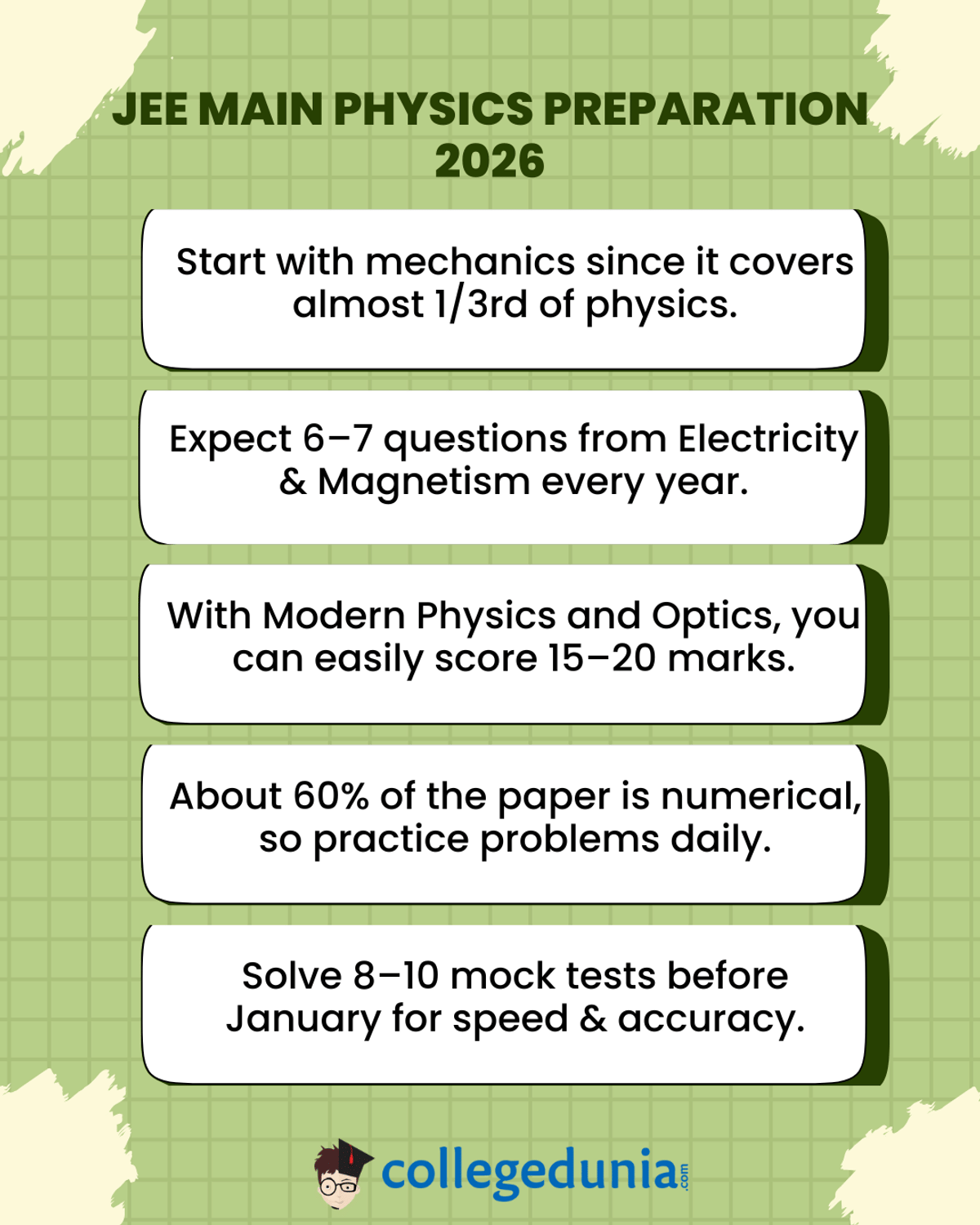
The JEE Main Physics section includes 60-65% of the numerical-based questions. For proper preparation, conceptual clarity, problem-solving speed, and weightage-wise topic prioritisation are important.
Also Read
JEE Main SyllabusHow to Study Physics for JEE from Zero Level?
To start JEE Main Physics Preparation from scratch a proper preparation plan is required. As JEE Main Physics Preparation involves both concepts and problem-solving, students should focus on building basics from NCERT, and then go towards advanced problems.
JEE MAIN Physics Preparation from Zero
| Step | What to Do | Data-Oriented Focus |
|---|---|---|
| 1. NCERT First | Read NCERT line by line for Class 11 & 12 Physics | Covers 70% of theory-based questions directly |
| 2. Concept Building | Use books like HC Verma & DC Pandey for deeper understanding | Improves accuracy by 20–25% in numerical questions |
| 3. Chapter Prioritization | Start with Mechanics, then Electrostatics, Current Electricity, Optics, and Modern Physics | These 5 units contribute 55–60% of JEE Physics marks |
| 4. Daily Practice | Solve at least 30–40 numericals per day | Builds speed and reduces negative marking by 15–20% |
| 5. Mock Tests | Attempt topic-wise & full-length mocks every 2 weeks | Boosts score consistency by 25–30 marks |
| 6. Formula Revision | Prepare a short formula sheet and revise daily | Helps in solving 70% of numerical-based questions quickly |
JEE Main Physics Preparation: Topic-Wise Weightage
As per the previous year analysis, a few topics in JEE Main Physics, like Mechanics, Electricity & Magnetism and Modern Physics, along with optics, cover 70% of the paper.
JEE Main Physics Topic-wise Weightage
- Mechanics is the most important topic, and contributes around 30-35% of the physics section.
- Electricity & Magnetism carries around 20-25% weightage, making it a high-priority section for class 12.
- Around 60-65% questions are numerical-based, which requires consistent practice from the NCERT and PYQs.
| Major Topics | Approx. Weightage (%) | Important Chapters. |
|---|---|---|
| Mechanics | 30–35% | Kinematics, Laws of Motion, WEP, Rotational Motion, Gravitation, Oscillations |
| Electricity & Magnetism | 20–25% | Electrostatics, Current Electricity, Magnetism, EMI, Alternating Current |
| Optics + Modern Physics | 15–18% | Ray Optics, Wave Optics, Photoelectric Effect, Bohr Model, Nuclear Physics |
| Heat & Thermodynamics | 8–10% | Laws of Thermodynamics, Kinetic Theory, Heat Transfer |
| Waves & Sound | 5–7% | Wave Motion, Sound Waves, Doppler Effect |
| Electromagnetic Waves + AC | 3–5% | EM Waves, AC Circuits |
| Semiconductors & Communication | 3–5% | Logic Gates, Diodes, Transistors, Communication Systems |
| Experimental/Practical Physics | 2–3% | Errors, Measurements, Practical-based Questions |
Also Read
JEE Main Chapter-Wise WeightageJEE Main Physics Preparation: Important Topics
JEE Main Physics includes 25 questions, as per the previous year analysis 70% of the physics section from 12-13 chapters.
Class 11 topics like mechanics and class 12 topics like Electrostatics, current electricity, optics, and modern physics carry high weightage.
| Class 11 Topics (Physics) | Class 12 Topics (Physics) |
|---|---|
| Kinematics | Electrostatics |
| Laws of Motion | Current Electricity |
| Work, Energy & Power | Magnetism & Electromagnetic Induction |
| Rotational Motion | Alternating Current |
| Gravitation | Ray Optics & Wave Optics |
| Oscillations & SHM | Modern Physics (Atoms & Nuclei) |
| Waves & Sound | Semiconductor & Communication Systems |
| Heat & Thermodynamics | Electromagnetic Waves |
JEE Main Physics Previous Year Question Paper
JEE Main Physics Preparation 2026: Study Notes and Weightage
Here is the chapter wise weightage for JEE Main Physics syllabus, based on the previous year trends.
| Topics | No of Questions | Weightage |
|---|---|---|
| Electrostatics | 1 | 3.33% |
| Current Electricity | 3 | 10.00% |
| Capacitor | 1 | 3.33% |
| Magnetic Effect of Current & Magnetism | 2 | 6.67% |
| Alternating Current | 2 | 6.67% |
| KTG & Thermodynamics | 2 | 6.67% |
| SHM | 1 | 3.33% |
| Sound Waves | 1 | 3.33% |
| KInematics | 1 | 3.33% |
| Work Power Energy | 1 | 3.33% |
| Laws of motion | 1 | 3.33% |
| Centre Of Mass | 2 | 6.67% |
| Rotational Dynamics | 2 | 6.67% |
| Modern Physics | 2 | 6.67% |
| NLM | 1 | 3.33% |
| Elasticity | 1 | 3.33% |
| Wave Optics | 2 | 6.67% |
| Error | 1 | 3.33% |
| Circular Motion | 1 | 3.33% |
| Electromagnetic Waves | 1 | 3.33% |
| Semiconductors | 1 | 3.33% |
| Communication System | 1 | 3.33% |
| Total | 30 | 100% |
Also Read
JEE Main Chapter-wise papersJEE Main Physics Preparation Part A: Theory Preparation Tips
Once you understand the topic-wise weightage and the number of questions that could be asked, you can develop a good approach towards preparation of important topics.
Mechanics
Mechanics is one of the topics with the highest weightage. It consists of 9 chapters. While preparing for this topic, consider the weightage of each chapter and dedicate an appropriate amount of time and effort.
Some of the important concepts for your preparation in Mechanics are -
| Dimensional and error analysis |
| Acceleration due to gravity |
| Conservation of momentum & energy and collisions |
| Equations of motion |
| Kepler’s laws |
| Mechanics of common forces |
| Moment of inertia and dynamics of rotational motion |
| Pascal’s law, Bernoulli’s principle, viscosity and Reynolds’ number |
| Potential energy of a spring |
| Projectile and circular motion |
| Relative motion |
| Satellites |
| Simple Harmonic motion |
| Standing waves & Beats, Doppler effect |
| Transverse and longitudinal waves: superposition and reflection |
Electrostatics and Magnetism
This section needs an utmost clarity of concepts. Almost 4 questions are asked every year from electrostatics in JEE Main. Concept of Physics by HC Verma is a good book to cover core fundamentals and also contains good quality numerical solved questions.
Some of the important concepts in Electrostatics and Magnetism for your preparation are -
| Ampere's Circuital law |
| Bandwidth and modulation of signals in communication systems |
| Bar magnet and magnetic field lines |
| Biot-Savart Law |
| Capacitance and Capacitors |
| Continuous charge distribution and Gauss’s Law |
| Electric charge and Coulomb’s Law |
| Electric field, field lines, flux |
| Electromagnetic waves and spectrum |
| Electrostatic potential and work done |
| Electrostatics of conductors and Dielectrics |
| Force between two parallel currents |
| Motion in electric and magnetic fields and Cyclotrons |
| Potential energy in an external field |
| The earth’s magnetism |
| Torque on current loop and magnetic dipole |
Optics
This is one of the scoring topics and contains some important chapters like Huygens principle. To get a grasp of these topics, go through advanced optics, understanding physics for JEE Main and Modern Physics by DC Pandey.
Heat and Thermodynamics
- Clearly know all of your basics regarding this JEE Main Physics portion.
- Understand the principles of Zeroth Law of Thermodynamics, Joules Law and the First Law of Thermodynamics.
- Practice model papers on Carnot Engine - Efficiency and Coefficient of Performance.
- Kinetic Theory of Gasses is a portion that can be easily solved with practice.
Some of the important concepts in Heat and Thermodynamics for your preparation are -
| First Law of Thermodynamics and Heat Capacity |
| Heat engines, refrigerators and heat pumps |
| Heat transfer |
| Law of equipartition of energy, specific heat capacity and mean free path |
| Newton’s Law of Cooling |
| Reversible and irreversible processes and Carnot engine |
| Second law of thermodynamics |
| Specific Heat Capacity and Calorimetry |
| Thermodynamic state variables, equation of state and thermodynamic processes |
| Transfer of Thermal Expansion |
Motion of System, Particles and Rigid Body
- Questions for determining torque and moment of inertia of regular bodies using the theorem of parallel and perpendicular axes is considered an essential section in JEE Main Physics. Train more for questions like these.
- Practice numerical based questions on angular momentum, conservation and rolling motion.
- Circular Motion problems are easy for the candidates to answer. Do practice answering these questions.
Kinematics
- Kinematics is the most important segment of JEE Main Physics. This chapter is considered simple and interesting by most students.
- In JEE Main Physics, problems focused on finding maximum height, range, flight time, and velocity at any point in the trajectory are considered important. Practice is important.
- Make copies of all important formulae, theorems and derivations. That will help you prepare at the last minute.
- Gain clarity on the definitions of displacement, acceleration, average velocity, and relative velocity.
Modern Physics
One of the important topics for JEE Main and JEE Advanced, this is a scoring section. Sub topics in this section to be covered up include radioactive substances, nuclear fusion and fission, dual nature of matter and x rays. Bohr’s model should not be forgotten. The trick to ace this section includes solving numerical problems.
NCERT is the best source to cover up the basics. Then students can move onto HC Verma for covering up the theory part and 3000 numerical problems by Schaum for practice
More on Joint Entrance Exam Main
Request a callback
You're on the list
A counsellor will call you on shortly.