
Andhra Pradesh Engineering Agriculture and Pharmacy Common Entrance Test
The AP EAPCET is a state-level entrance exam for admission to undergraduate engineering, agriculture, and pharmacy courses in Andhra Pradesh.
Overview
AP EAPCET 2026 Registration Started
The AP EAPCET 2026 registration process started on 4th February 2026 on the official website. The exam is scheduled to be held from 12th May to 20th May 2026.
The exam is for admission to undergraduate engineering, agriculture, and pharmacy courses in Andhra Pradesh.
What is the AP EAPCET Exam?
The Andhra Pradesh Engineering, Agriculture and Pharmacy Common Entrance Test (AP EAPCET) is a state-level entrance exam. It is conducted by the Jawaharlal Nehru Technical University (JNTU) Kakinada on behalf of APSCHE (AP State Council of Higher Education).
The exam facilitates admissions into the following streams:
- Engineering: Engineering, Bio-Technology, B.Tech. (Dairy Technology), B.Tech. (Agr. Engg.), B.Tech. (Food Science and Technology)
- Agriculture: B.Sc. (Ag), B.Sc. (Hort), B.V.Sc. & A.H, B.F.Sc
- Pharmacy: B Pharm, D Pharm
AP EAPCET 2026 Exam Details
| Particular | Details |
|---|---|
| Name of Exam | AP EAPCET 2026 |
| Mode of Examination | Online (Computer-Based Test) |
| Total Number of Questions | 160 |
| Mathematics | 80 Questions |
| Physics | 40 Questions |
| Chemistry | 40 Questions |
| Medium of Question Paper | English & Telugu |
| Urdu Medium Candidates | Translation assistance is available only at the Kurnool Test Centre |
| Final Authority in Case of Ambiguity | English version of the question paper |
| Official Website | https://cets.apsche.ap.gov.in |
AP EAPCET 2026 Important Dates
The official notification regarding the AP EAPCET 2026 exam dates has been released on the official website. Candidates can fill out the application form as the registration has already begun.
AP EAPCET 2026 Exam Pattern
The exam pattern differs by stream. For the Engineering stream, the paper consists of Mathematics (80 questions), Physics (40), and Chemistry (40).
The streams of Agriculture and Pharmacy comprise Physics, Chemistry, Botany, and Zoology with 40 questions each.
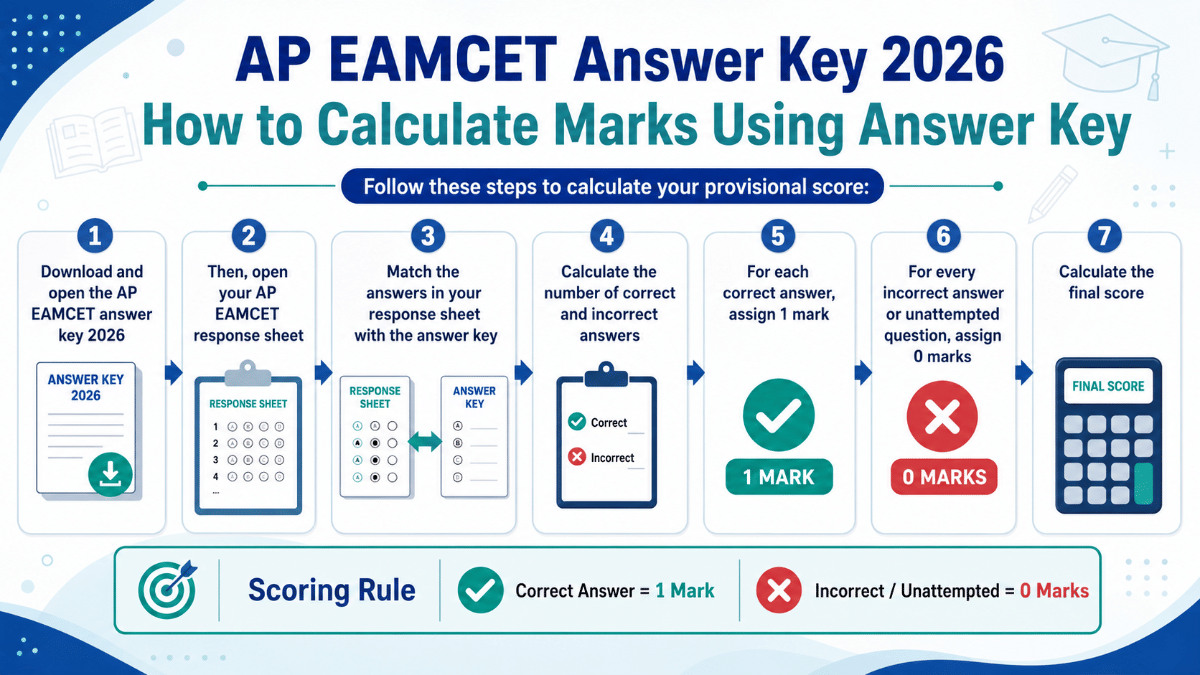
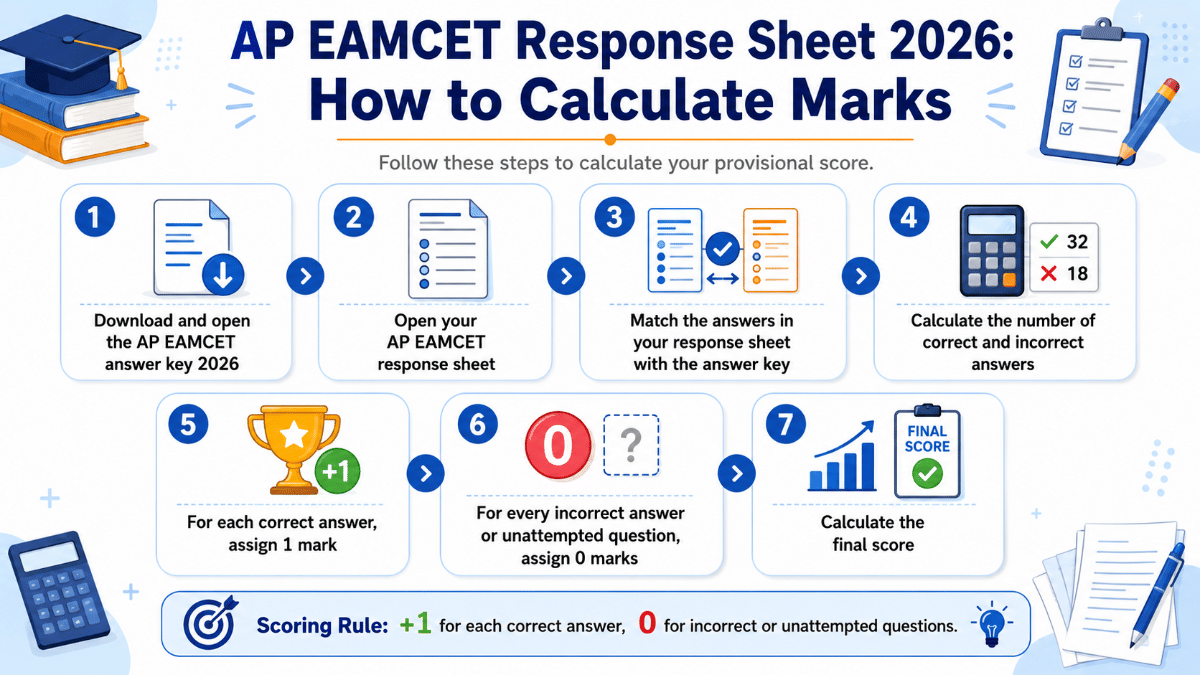
Candidates receive 1 mark for each correct response. There is no negative marking.
AP EAPCET 2026 Registration Trend
Like every year, more than 2 lakh aspirants appeared for the engineering stream. Approximately 80,000 appeared for agriculture and pharmacy.
Candidates are advised to fill out the application forms as soon as possible to avoid last-minute hassles.
AP EAPCET 2026 Important Dates
The AP EAPCET 2026 online application process begins on 04-02-2026. The last date to apply without a late fee is 07-03-2026.
| Date and Day | Activity |
|---|---|
| 04-02-2026 (Wednesday) | Commencement of submission of Online Applications |
| 07-03-2026 (Saturday) | Last date for submission of Online Applications without Late Fee |
| 12-03-2026 (Thursday) | Last date for submission of Online Applications with Late Fee (Rs.1000/-) |
| 17-03-2026 (Tuesday) | Last date for submission of Online Applications with Late Fee (Rs.2000/-) |
| 21-03-2026 (Saturday) | Last date for submission of Online Applications with Late Fee (Rs.4000/-) |
| 26-03-2026 (Thursday) | Last date for submission of Online Applications with Late Fee (Rs.10000/-) |
| 26-03-2026 (Thursday) to 28-03-2026 (Saturday) | Correction of online application data already submitted by the candidate |
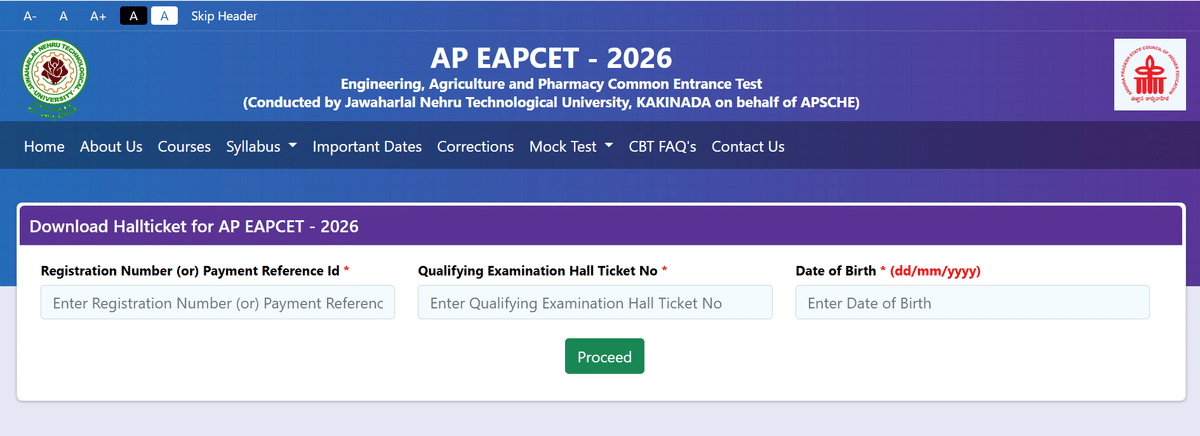
| 28-04-2026 (Tuesday) | Downloading Hall-Tickets from the website/ through WhatsApp |
| 12-05-2026 (Tuesday) to 15-05-2026 (Friday) and 18-05-2026 (Monday) | Dates of Examination (Engineering) |
| Two sessions | Sessions per Day |
| 9:00 A.M. – 12:00 P.M. | Session 1 Timing |
| 2:00 P.M. – 5:00 P.M. | Session 2 Timing |
| 25-05-2026 (Monday) | Last date for receiving Objections on Preliminary Key (Engineering, Agriculture & Pharmacy)* |
| 01-06-2026 (Monday) | Release of results tentatively |
AP EAPCET 2026 Eligibility Criteria
Candidates must meet the defined eligibility criteria for age, domicile, and educational qualifications to apply for an AP EAPCET course. These factors determine whether a student qualifies for a course of study in Andhra Pradesh.
- Candidates must achieve a minimum qualifying score on the AP EAPCET before applying.
- Candidates must meet the minimum educational qualifications to apply for an AP EAPCET course.
- Students who have not yet received their qualifying exam results may apply on a probationary basis.
- To be accepted to an AP EAPCET course, candidates must have successfully passed their qualifying exam.
- Age limitations vary for different degrees of study (Engineering, Pharmacy, Agriculture) according to professional guidelines.
| Eligibility Aspect | Details |
|---|---|
| Nationality | Indian Nationals / PIO / OCI Card Holders |
| State Requirement | Must belong to Andhra Pradesh and satisfy Local / Non-Local status as per AP Government Orders (2026–27) |
| Minimum Marks | 45% aggregate in specified subjects (40% for reserved category candidates) |
| Eligible Courses | Engineering, B.Pharmacy (M.P.C), Pharm.D, B.Tech (Dairy Technology), B.Tech (Agr. Engineering), B.Tech (FS & T), B.Sc (Agriculture Engg) |
| Qualification – Option I | Passed Intermediate (10+2) with Mathematics, Physics & Chemistry or relevant vocational courses (AP Board or equivalent); appearing candidates may apply provisionally |
| Qualification – Option II | Passed Diploma in Engineering (AP SBTET or equivalent); appearing candidates may apply provisionally |
| Age – Engineering & Pharmacy | Minimum 16 years as on 31 Dec 2026; no upper age limit |
| Age – Agriculture/Dairy/FS&T Courses | Minimum 17 years; upper age limit 22 years (25 years for SC/ST) as on 31 Dec 2026 |
| Pharm.D Qualification | Passed Intermediate (10+2) with Physics, Chemistry & Mathematics or equivalent; appearing candidates eligible provisionally |
| Pharm.D Age Limit | Minimum 17 years as on 31 Dec 2026 |
AP EAPCET 2026 Registration
The registration process for AP EAPCET 2026 began on 4th February. Candidates can submit the application form until 26 March 2026 with a penalty fee.
AP EAPCET 2026 Application Correction Window
A correction window will be available after the last application date. Candidates can use it to fix important information in their submitted application forms.
AP EAPCET 2026 Registration Fee
Payment of the registration fee is the first step for submitting the online application form. The fee must be paid through online modes only.
- Open category: Rs. 800/-
- SC/ST candidates: Rs. 700/-
- BC candidates: Rs. 750/-
Payment can be made via Credit Card, Debit Card, Net Banking, or AP Online from any recognised bank.
AP EAPCET 2026 Important Dates
| Facilities | Last Dates |
|---|---|
| Last date for submission of Online Applications without Late Fee | 07-03-2026 (Saturday) |
| Last date for submission of Online Applications with Late Fee (Rs.1000/-) | 12-03-2026 (Thursday) |
| Last date for submission of Online Applications with Late Fee (Rs.2000/-) | 17-03-2026 (Tuesday) |
| Last date for submission of Online Applications with Late Fee (Rs.4000/-) | 21-03-2026 (Saturday) |
| Last date for submission of Online Applications with Late Fee (Rs.10000/-) | 26-03-2026 (Thursday) |
| Correction of online application data already submitted by the candidate | 26-03-2026 (Thursday) to 28-03-2026 (Saturday) |
AP EAPCET Previous Year Registration Trend (2023-25)
The table below shows the total applications received in the last three years. It also gives the stream-wise and gender-wise breakdown.
| Year | Total Applications | Engineering Stream | Agriculture Stream | Female Candidates | Male Candidates |
|---|---|---|---|---|---|
| 2025 | 362,448 | 264,840 | 97,608 | 182,283 | 180,165 |
| 2024 | 362,851 | 274,213 | 88,638 | 182,283 | 180,566 |
| 2023 | 337,500 | 230,000 (approx.) | 107,500 (approx.) | Not specified | Not specified |
Related links: AP EAPCET Application Form Correction 2026, AP EAPCET 2026 Admit Card.
AP EAPCET 2026 Exam Pattern
The EAPCET exam is divided into the Engineering stream and the Agriculture & Pharmacy stream. Each stream has a different subject distribution.
- The Engineering stream has 80 questions from maths, and 40 questions each from chemistry and physics. The total is 160 questions, with +1 mark for each correct answer. There is no negative marking.
- The Agriculture & Pharmacy stream has 80 questions from biology, with 40 questions each from physics and chemistry.
AP EAPCET 2026 Exam Pattern
The AP EAPCET 2026 exam pattern is different for the Engineering stream and the Agriculture & Pharmacy stream. The Engineering stream is for MPC students, and the Agriculture & Pharmacy stream is for BiPC students.
Both streams have a total of 160 questions, and the exam is conducted online as a Computer-Based Test (CBT).
Engineering Stream (MPC)
The Engineering stream primarily targets B.Tech courses. These include Engineering, Biotechnology, Dairy Technology, Agricultural Engineering, and Food Science & Technology. B.Pharmacy is also available through the MPC route in some cases.
The subjects tested are Mathematics, Physics, and Chemistry. Mathematics carries the highest weightage.
- Mathematics: 80 questions, 80 marks
- Physics: 40 questions, 40 marks
- Chemistry: 40 questions, 40 marks
- Total: 160 questions, 160 marks
Agriculture & Pharmacy Stream (BiPC)
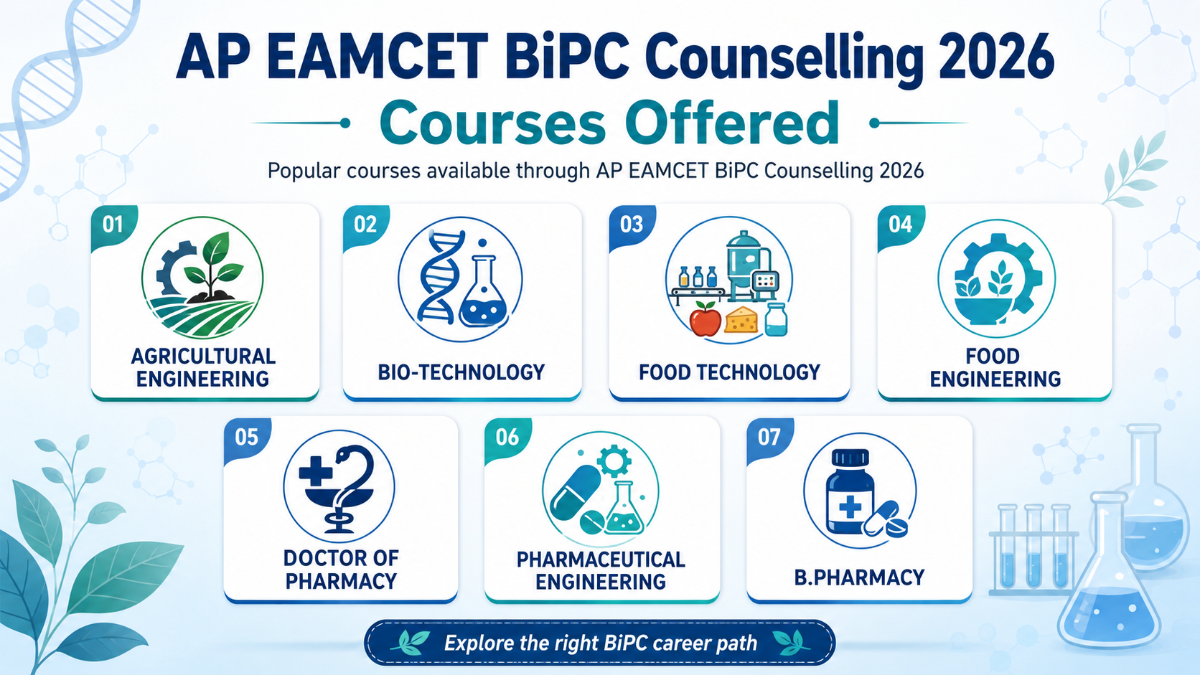
The Agriculture & Pharmacy stream targets B.Sc. Agriculture, B.Sc. Horticulture, B.V.Sc. & A.H., B.F.Sc., B.Pharmacy, and Pharm.D courses. The subjects tested are Biology, Physics, and Chemistry.
Biology has the highest weightage and is divided into Botany and Zoology.
- Biology: 80 questions (40 Botany + 40 Zoology), 80 marks
- Physics: 40 questions, 40 marks
- Chemistry: 40 questions, 40 marks
- Total: 160 questions, 160 marks
Common Exam Details
The exam duration for both streams is 3 hours (180 minutes). All questions are MCQs with 4 options each.
The marking scheme awards +1 mark for each correct answer. There is no negative marking.
The exam is available in English and Telugu. Urdu help is available only at Kurnool.
Exam Dates and Sessions
The AP EAPCET 2026 Engineering exam is scheduled from 12 May to 18 May 2026. There is no exam on 16 and 17 May.
The Agriculture exam is typically held on 19–20 May 2026, or it may overlap with late Engineering slots as per recent patterns.
Session timings for both streams are the same.
- Forenoon (FN): 9:00 AM – 12:00 PM
- Afternoon (AN): 2:00 PM – 5:00 PM
Normalization and Qualifying Marks
Normalization is applied to scores across multiple exam sessions. The qualifying marks are the same for both streams.
- General category: 25% (40/160)
- SC/ST category: No minimum marks, limited to reserved seats
Rank Calculation and Tie-Breaking
The final rank is calculated using 75% of normalized EAPCET marks and 25% of Intermediate marks. The Intermediate subjects considered differ by stream.
- Engineering: Intermediate Maths + Physics + Chemistry
- Agriculture: Intermediate Biology + Physics + Chemistry
The tie-breaking criteria are applied in a specific order.
| Order | Engineering Stream | Agriculture Stream |
|---|---|---|
| 1 | EAPCET total marks | EAPCET total marks |
| 2 | Mathematics marks | Biology marks |
| 3 | Physics marks | Chemistry marks |
| 4 | Age (older preferred) | Age (older preferred) |
Preparation Focus
For the Engineering stream, strong preparation in Mathematics is key. Focus on algebra, calculus, and coordinate geometry, with balanced preparation in Physics and Chemistry.
For the Agriculture stream, strong preparation in Biology is key. Focus on botany, zoology, human physiology, and genetics, with balanced preparation in Physics and Chemistry.
AP EAPCET Previous Year Question Papers
Previous year question papers are available for download. These papers help candidates understand the exam format and question types.
| AP EAPCET Question Paper | Download |
|---|---|
| AP EAPCET Question Paper 2025 | Download PDF |
| AP EAPCET Question Paper 2024 | Download PDF |
| AP EAPCET Question Paper 2023 | Download PDF |
| AP EAPCET Question Paper 2022 | Download PDF |
| AP EAPCET Question Paper 2021 | Download PDF |
| AP EAPCET Question Paper 2020 | Download PDF |
| AP EAPCET Question Paper 2019 | Download PDF |
| AP EAPCET Question Paper 2018 | Download PDF |
| AP EAPCET Question Paper 2017 | Download PDF |
AP EAPCET 2026 Syllabus
The AP EAPCET 2026 syllabus has been released on the official website. Candidates should read the syllabus for their respective stream to understand the requirements.
The syllabus is different for the Engineering (MPC) and Agriculture & Pharmacy (BiPC) streams.
| Feature | Engineering (MPC) | Agriculture & Pharmacy (BiPC) |
|---|---|---|
| Subjects | Physics, Chemistry, Mathematics | Physics, Chemistry, Botany, Zoology |
| Focus Areas | Technical and Mathematical Concepts | Biological and Agricultural Sciences |
| Career Pathways | Engineering, Technology | Agriculture, Pharmacy, Medical Sciences |
Subject-wise Syllabus Links
Detailed subject-wise syllabi are available for each subject.
| AP EAMCET Syllabus Subject-wise | Check Here |
|---|---|
| AP EAPCET Mathematics Syllabus | Check Here |
| AP EAPCET Biology Syllabus | Check Here |
| AP EAPCET Chemistry Syllabus | Check Here |
| AP EAPCET 2024 Physics Syllabus | Check Here |
AP EAPCET 2026 Subject-Wise Weightage
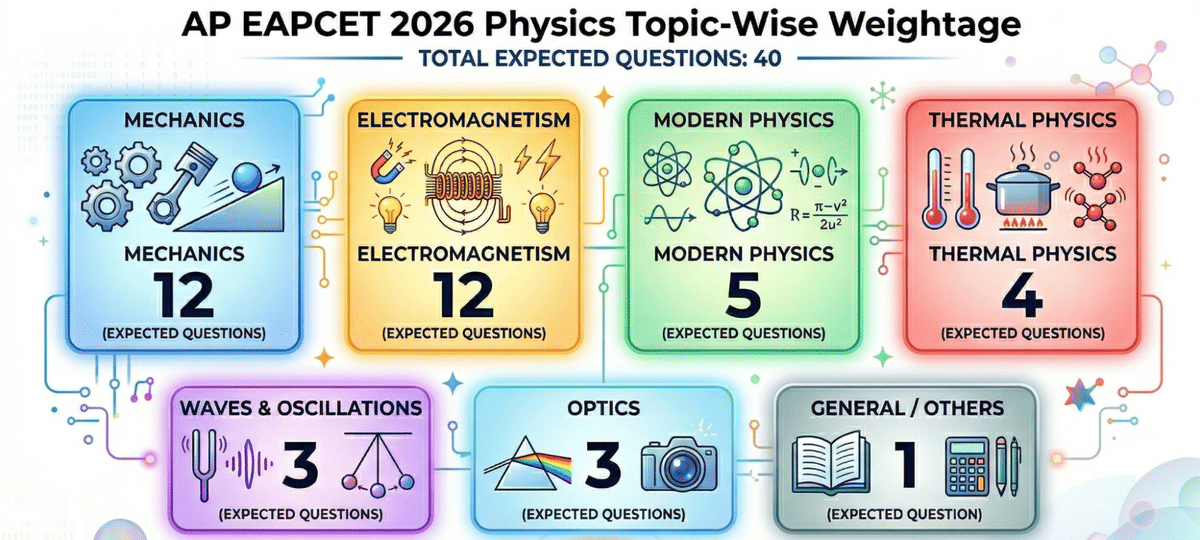
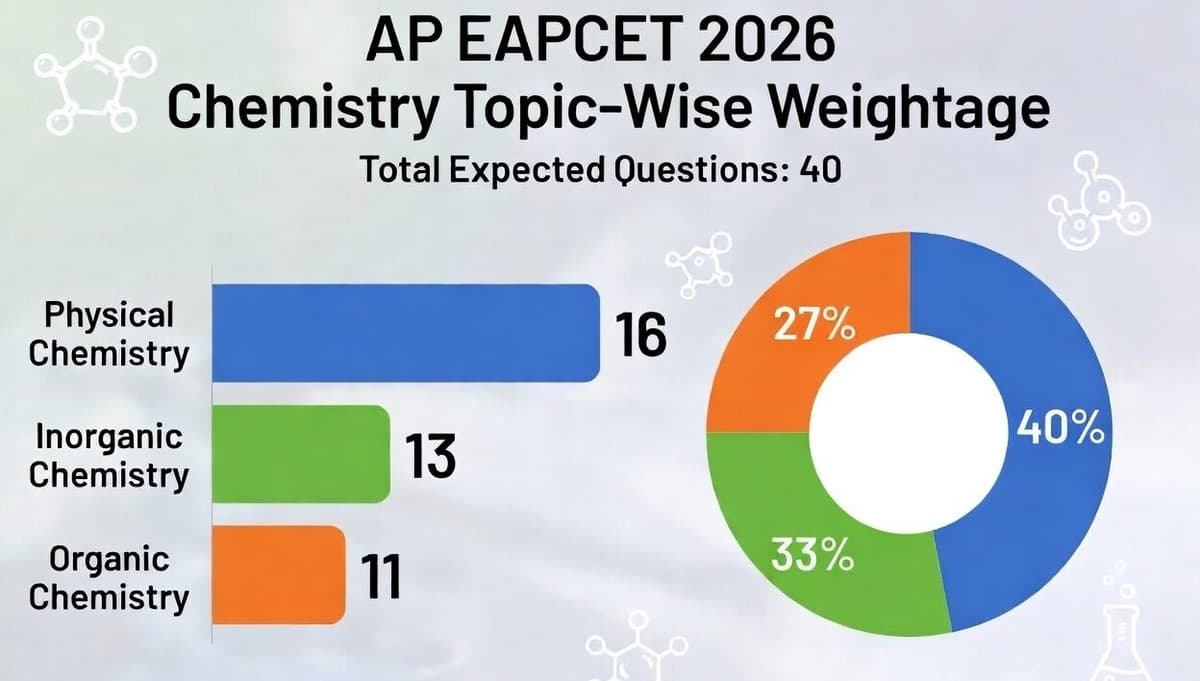
The engineering stream has three subjects: Physics, Chemistry, and Maths. The tables below show the topic-wise weightage for each subject.
Physics Weightage (Engineering, Pharmacy and Agriculture Streams)
| Topic | Weightage (No. of Questions) | Weightage (%) |
|---|---|---|
| Heat and Thermodynamics | 9–10 | 22.5% |
| Systems of Particles and Rotational Motion | 6–7 | 17.5% |
| Work, Energy, and Power | 5–6 | 15% |
| Motion in a Plane | 4–5 | 12.5% |
| Laws of Motion | 5–6 | 15% |
| Gravitation | 3–4 | 10% |
| Moving Charges and Magnetism | 4–5 | 12.5% |
| Oscillations | 4–5 | 12.5% |
| Current Electricity | 3–4 | 10% |
| Waves | 3–4 | 10% |
Chemistry Weightage (Engineering, Pharmacy and Agriculture Streams)
| Topic | Weightage (No. of Questions) | Weightage (%) |
|---|---|---|
| Atomic Structure | 2–3 | 7.5% |
| Chemical Bonding and Molecular Structure | 3–4 | 12.5% |
| States of Matter | 2–3 | 7.5% |
| Thermodynamics | 3–4 | 12.5% |
| Equilibrium | 3–4 | 12.5% |
| Redox Reactions | 2–3 | 7.5% |
| s-Block Elements | 2–3 | 7.5% |
| Some p-Block Elements | 2–3 | 7.5% |
| Organic Chemistry – Some Basic Principles and Techniques | 3–4 | 12.5% |
| Hydrocarbons and Environmental Chemistry | 3–4 | 12.5% |
Maths Weightage (Engineering Stream Only)
| Topic | Weightage (No. of Questions) | Weightage (%) |
|---|---|---|
| Algebra | 10–12 | 12.5% |
| Trigonometry | 10–12 | 12.5% |
| Probability and Statistics | 11–15 | 15% |
| Vector Algebra | 11–15 | 15% |
| Coordinate Geometry | 10–12 | 12.5% |
| Calculus | 11–15 | 15% |
Botany and Zoology Weightage (Agriculture and Pharmacy Streams Only)
| Topic | Weightage (No. of Questions) | Weightage (%) |
|---|---|---|
| Diversity in the Living World | 15–18 | 18.75% |
| Structural Organisation in Animals | 12–15 | 15% |
| Cell Structure and Function | 12–15 | 15% |
| Plant Physiology | 12–15 | 15% |
| Human Physiology | 12–15 | 15% |
| Reproduction | 12–15 | 15% |
| Genetics and Evolution | 12–15 | 15% |
AP EAPCET 2026 Preparation Tips
Preparation for AP EAPCET 2026 requires a month-wise strategy. A 9-month plan divided into four phases balances concept clarity, practice, and exam strategy.
- Phase 1 (Months 1–3): Build a foundation of basic concepts. Read NCERT textbooks, take notes, and solve basic problems for around 4–5 hours a day.
- Phase 2 (Months 4–6): Raise performance by studying 5–6 hours a day. Do topic-wise practice, solve last year's papers, and attempt moderate to difficult questions.
- Phase 3 (Months 7–8): Take full-length mock tests to maximise speed. Practice error analysis with 6–7 hours of daily study to learn time management and accuracy before the exam.
- Phase 4 (Month 9): In the final phase, spend 4–5 hours a day on rapid revision of high-weightage subjects. Practise the last 5 years' papers and focus on stress management.
AP EAPCET 2026 Preparation Plan
A nine-month preparation plan for AP EAPCET 2026 is divided into four phases. Each phase has a specific focus and suggested daily study hours.
The plan starts with building concepts and ends with final revision and exam strategy.
Phase-wise Time Allocation
| Phase | Months | Focus | Activities | Suggested Daily Preparation Hours |
|---|---|---|---|---|
| Phase 1 | 1–3 | Foundation & Concept Building | Study NCERT textbooks thoroughly, make concept notes, and practice basic problems | 4–5 hours |
| Phase 2 | 4–6 | Intensive Practice & Application | Topic-wise practice, previous year papers, moderate to difficult questions, and revise formulas | 5–6 hours |
| Phase 3 | 7–8 | Mock Tests & Speed Optimization | Full-length mock tests, time management, identify and correct mistakes | 6–7 hours |
| Phase 4 | 9 | Final Revision & Exam Strategy | Quick revision of high-weightage topics, last 5-year solved papers, and stress management | 4–5 hours |
Phase Activities Summary
| Phase | Months | Focus | Activities |
|---|---|---|---|
| Phase 1 | 1–3 | Foundation & Concept Building | NCERT study, basic problem practice |
| Phase 2 | 4–6 | Intensive Practice & Application | Topic-wise practice, previous year papers |
| Phase 3 | 7–8 | Mock Tests & Speed Optimisation | Full-length mocks, time management |
| Phase 4 | 9 | Final Revision & Exam Strategy | Revision, quick mocks, stress management |
AP EAMCET mock tests are available online. A direct link provides a free mock test for MPC and BPC streams.
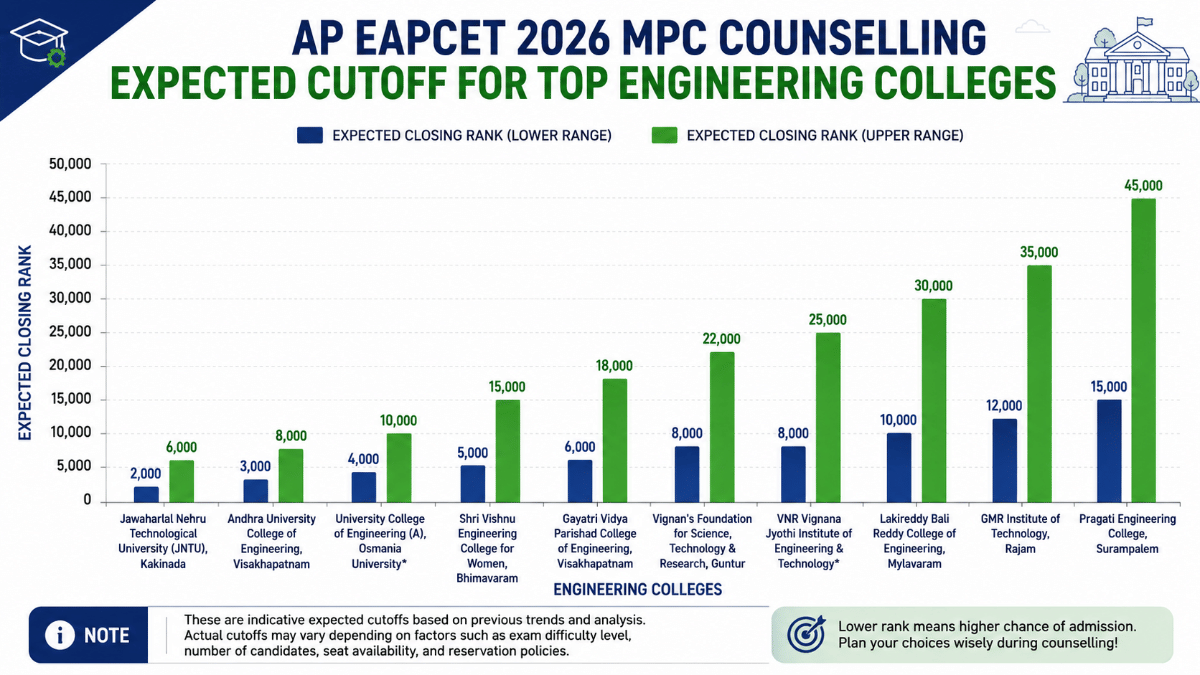
AP EAPCET 2026 Expected Cutoff
Small differences in test scores can cause significant variations in rank. The difficulty of the exam, the number of candidates, and the number of available seats also affect the final cutoff.
In the Engineering stream, scores of 150-160 yield rankings of 1-100. Scores of 140-149 yield rankings of 101-500, and scores of 130-139 produce rankings of 501-1000.
In the Agriculture and Pharmacy stream, a score of 140-160 yields rankings up to the top 500. Scores of 120 through 129 yield rankings from 1001 through 2000.
A score above 120 is generally enough to qualify for almost all good colleges. Scores of 100-109 could qualify for some mid-range colleges.
Engineering Stream (MPC) Expected Cutoff
| Marks | Estimated Rank Range |
|---|---|
| 150–160 | 1–100 |
| 140–149 | 101–500 |
| 130–139 | 501–1,000 |
| 120–129 | 1,001–2,000 |
| 110–119 | 2,001–3,000 |
| 100–109 | 3,001–5,000 |
Agriculture & Pharmacy Stream Expected Cutoff
| Marks | Estimated Rank Range |
|---|---|
| 140–160 | 1–500 |
| 130–139 | 501–1,000 |
| 120–129 | 1,001–2,000 |
| 110–119 | 2,001–3,000 |
| 100–109 | 3,001–5,000 |
Related resources include the AP EAPCET Answer Key, AP EAMCET Counselling 2026, and AP EAPCET Marks vs Rank 2026.
AP EAMCET Colleges List 2026
The Andhra Pradesh State Council of Higher Education (APSCHE) has accredited many public and private institutions in the state. These institutions provide undergraduate degrees through the AP EAPCET examination.
Some well-known institutions include:
- Jawaharlal Nehru Technological University - Kakinada (JNTUK - Kakinada)
- Andhra University College of Engineering - Visakhapatnam
- Sri Venkateswara University College of Engineering - Tirupati
- VIT-AP University - Amaravati
- GMR Institute of Technology - Rajam
- Gayatri Vidya Parishad College of Engineering - Visakhapatnam
- RVR & JC College of Engineering - Guntur
- Velagapudi Ramakrishna Siddhartha Engineering College - Vijayawada
AP EAMCET Courses (Branch Codes)
The AP EAPCET 2026 exam offers a variety of undergraduate courses. The table below presents all available branches for candidates.
AP EAPCET Branch Codes and Names
The table below lists the branch codes and corresponding branch names for AP EAPCET.
| Branch Code | Branch Name |
|---|---|
| AGR | Agricultural Engineering |
| AI | Artificial Intelligence |
| AID | Artificial Intelligence and Data Science |
| AIM | Artificial Intelligence and Machine Learning |
| ASE | Aerospace Engineering |
| AUT | Automobile Engineering |
| BDT | Dairy Technology |
| BIO | Biotechnology |
| CAD | Computer Science Engineering (AI & Data Science) |
| CAI | Computer Science and Engineering (AI) |
| CBA | Computer Science Engineering (Big Data Analytics) |
| CBC | Computer Science Engineering (Blockchain) |
Related Resources
- List of Engineering Colleges in India Accepting AP EAPCET Based on 2025 Ranking
- AP EAMCET (EAPCET) Mock Test 2026: Take an online free mock test for MPC and BPC
FAQs on AP EAPCET
What is the purpose of the AP EAPCET exam?
AP EAPCET is a state-level entrance test that grants entry into undergraduate programs in engineering, pharmacy, and agriculture. These programs are offered at institutions located within Andhra Pradesh.
It serves as a single reference point for students seeking admission into B.Tech, B.Pharm, B.Sc. (Agriculture), and other similar courses.
Which student achieved 1st rank in AP EAPCET 2025?
Avanaganti Anirudh Reddy from Vanasthalipuram, Hyderabad achieved the 1st rank in the engineering stream. He scored 96.3969 out of 100.
Ramayanam Venkata Naga Sai Harshavardhan from Penamaluru, Krishna district, was awarded the 1st ranking in the agriculture and pharmacy streams.
Will the AP EAPCET Examination be offered in multiple languages/mediums?
Yes, the AP EAPCET is offered in both English and Telugu.
Is Mathematics compulsory for all candidates?
No, Mathematics is not compulsory for all candidates. It is mandatory only for candidates applying for the Engineering stream (B.Tech).
Candidates applying for the Agriculture or Pharmacy stream do not need Mathematics as a compulsory subject.
Can candidates from other states apply for AP EAMCET 2026?
Yes, candidates from other states can apply for AP EAMCET 2026, provided they meet the eligibility criteria. They will be considered under the Unreserved (OU) category and will not be eligible for the local quota.
Are there any reservations for SC/ST candidates?
Yes, reservations for SC/ST candidates exist as per government norms. SC/ST candidates are eligible for a qualifying percentage of 40% in the qualifying examination.
Can I change my exam centre after submission?
No, the exam centre cannot be changed after submitting the application. The AP EAMCET correction window does not allow changes to exam centre preferences.
The correction window only permits changes to certain details such as name, date of birth (DOB), and community.
AP EAPCET Overview
AP EAPCET is a state-level entrance test for undergraduate programs in Andhra Pradesh. The exam provides entry to engineering, pharmacy, and agriculture courses.
The test is a single reference point for admission into B.Tech, B.Pharm, B.Sc. (Agriculture), and similar courses. These programs are offered at institutions within Andhra Pradesh.
AP EAPCET 2025 Toppers
Avanaganti Anirudh Reddy from Vanasthalipuram, Hyderabad secured the 1st rank in the engineering stream. He scored 96.3969 out of 100.
Ramayanam Venkata Naga Sai Harshavardhan from Penamaluru, Krishna district, secured the 1st rank in the agriculture and pharmacy streams.
Exam Language
The AP EAPCET exam is offered in two languages. Candidates can take the test in either English or Telugu.
Mathematics Requirement
Mathematics is not compulsory for all candidates. It is mandatory only for those applying to the Engineering stream (B.Tech).
Candidates applying for the Agriculture or Pharmacy stream do not need Mathematics. The requirement depends on the chosen stream.
Eligibility for Out-of-State Candidates
Candidates from other states can apply for AP EAMCET 2026. They must meet the eligibility criteria to apply.
Such candidates are considered under the Unreserved (OU) category. They will not be eligible for the local quota.
Reservation for SC/ST Candidates
Reservations for SC/ST candidates are available as per government norms. The qualifying percentage for SC/ST candidates is 40% in the qualifying examination.
Exam Centre Change
Exam centre preferences cannot be changed after submitting the application. The AP EAMCET correction window does not allow changes to exam centre choices.
The correction window permits changes to certain details only. These details include name, date of birth, and community.
Eligibility Criteria
AP EAPCET 2025 Eligibility Criteria
The AP EAPCET 2025 eligibility is decided by JNTU on behalf of the APSCHE. Candidates must meet age, educational, and residency requirements to be eligible.
Around 70% of applicants opt for the Engineering stream, and 25-30% opt for Agriculture and Pharmacy courses.
Who Can Apply
Candidates should be Indian citizens or PIO/OCI holders. Candidates from Andhra Pradesh or Telangana must satisfy Local or Non-local status requirements.
- Minimum age for Engineering and Pharmacy courses is 16 years as on December 31, 2025. There is no maximum age limit.
- For Agriculture courses, the minimum age is 17 years. The maximum age is 22 years for general candidates and 25 years for SC/ST candidates.
- For specific courses such as B.Tech Dairy Technology and B.Tech Agricultural Engineering, the minimum age is 17 years as of December 31, 2024.
Educational Qualifications
Candidates must have passed Class 12 from the Board of Intermediate Education, AP/Telangana, or an equivalent board.
- Engineering courses require Mathematics, Physics, and Chemistry as subjects.
- Agriculture and Pharmacy streams require Physics, Chemistry, and Biology.
- General candidates need a minimum of 45% marks.
- SC/ST candidates need a minimum of 40% marks.
- Candidates with a Diploma in Engineering from the State Board of Technical Education, AP/Telangana are also eligible.
Domicile Requirements
Candidates must meet the local or non-local status requirements as specified in the Andhra Pradesh Educational Institutions (Regulation of Admissions) Order, 1974.
Local Candidates: Those who have lived in Andhra Pradesh for a minimum of 4 years, or who have passed their qualifying examination from a school within the state, are local candidates.
Non-Local Candidates: Any candidate who is not eligible to become a local candidate falls under the non-local category. Aspirants from other states can apply as non-local candidates, provided they meet specific eligibility criteria.
In past years, around 85% of applicants were local candidates and the remaining 15% were non-local. Seat allocation in educational institutes tends to favor local candidates.
Eligibility Criteria Summary
| Eligibility Criteria | Details |
|---|---|
| Nationality | Indian citizens or PIO/OCI holders |
| Domicile | Local/Non-local status as per Andhra Pradesh Educational Institutions Order, 1974 |
| Age Limit | Minimum 16 years as of December 31, 2025 for Engineering and Pharmacy. Maximum 22 years for General and 25 years for SC/ST for Agriculture courses |
| Academic Qualification | Class 12 with Physics, Mathematics, and Chemistry for Engineering, or Physics, Chemistry, and Biology for Agriculture and Pharmacy |
| Marks Required | 45% aggregate for General category, 40% for SC/ST candidates |
| Weightage | 75% weightage for AP EAPCET normalised marks, 25% weightage for Class 12 marks |
AP EAPCET 2025 Qualifying Marks
The qualifying marks for AP EAPCET 2025 follow the same pattern as previous years. Candidates must secure the minimum required marks in both the entrance exam and their qualifying examination.
The final merit is calculated with 75% weightage for AP EAPCET normalised marks and 25% weightage for Class 12 marks.
AP EAPCET 2025 Educational Qualifications
Candidates must check the educational qualifications before applying for AP EAPCET 2025. Meeting these prerequisites is necessary to participate in the exam.
| Course | Eligibility Criteria |
|---|---|
| Engineering (B.Tech/BE) |
|
| Pharmacy (B.Pharm) |
|
| Agriculture & Medical (B.Sc. Agriculture, B.V.Sc.) |
|
| Diploma Holders (Engineering) |
|
In the previous year, around 75% of candidates cleared the Engineering stream exam. Candidates with higher marks are typically placed in top ranks which opens the door to more competitive courses and institutions.
AP EAPCET 2025 Reservation Policies
Reservation policies of AP EAPCET 2025 provide fair access to higher education for different categories of candidates. The policies follow APSCHE guidelines and the Government of Andhra Pradesh.
- Category Reservation: Seats are earmarked for candidates of certain categories, such as Scheduled Castes (SC), Scheduled Tribes (ST), Backward Classes (BC), Economically Weaker Sections (EWS), etc. The percentage of reservations is determined by the applicable government rules.
- Horizontal Reservation: Horizontal reservations are offered in all categories for women, differently-abled people, and children of defense personnel.
- Special Categories: Provision is made for candidates belonging to special categories such as NCC, CAP, Sports, etc., who can have different eligibility criteria and percentages of reservation.
| Category | Reservation Percentage |
|---|---|
| Scheduled Castes (SC) | 15% |
| Scheduled Tribes (ST) | 6% |
| Backward Classes (BC) | 29% |
| Economically Weaker Sections (EWS) | 10% |
| Other (General/Unreserved) | 40% |
| Women (Horizontal Reservation) | 33% of total seats |
| Differently Abled (PH) | 3% (Horizontal Reservation) |
- SC (Scheduled Castes): SC candidates can claim 15% reservation in Engineering as well as in Agriculture/Pharmacy courses.
- ST (Scheduled Tribes): 6% of seats are reserved for ST category candidates.
- BC (Backward Classes): The BC category is further sub-divided into BC-A, BC-B, BC-C, BC-D, and BC-E, and together they are given 29% reservation.
- EWS (Economically Weaker Sections): 10% reservation of seats is provided for applicants belonging to the EWS category, which was added recently in order to bring social and educational parity.
- Women (Horizontal Reservation): 33% of the total number of available seats are reserved for women candidates in all categories.
- Differently-abled (PH): 3% of seats are horizontally reserved for differently-abled candidates (with a minimum of 40% disability).
Around 30% of the total applicants belonged to reserved categories, with SC/ST applicants often having a lower cut-off than General category candidates.
AP EAPCET 2025 Eligibility Age Limit
The AP EAPCET 2025 has specific age limit criteria for candidates. These criteria apply to candidates aspiring to pursue undergraduate courses in Engineering, Agriculture, and Pharmacy.
AP EAPCET 2025 Age Limit
The age limit for AP EAPCET 2025 depends on the course applied for. Candidates must meet the age requirement as of December 31, 2025.
Engineering and Pharmacy Courses
- Minimum Age: 16 years as of December 31, 2025.
- Maximum Age: No upper age limit.
Agriculture and Specific Engineering Courses
This applies to B.Tech. Dairy Technology, B.Tech. Agricultural Engineering, B.Tech. Food Science and Technology, and B.Sc. Agricultural Engineering.
- Minimum Age: 17 years as of December 31, 2025.
- Maximum Age: 22 years for all candidates. SC/ST candidates have a maximum age of 25 years as of December 31, 2025.
Eligibility Courses and Subject Combinations
AP EAPCET 2025 requires specific subject combinations at the 10+2 (Intermediate) level. The required subjects vary by course.
| Course | Mandatory Subjects in 10+2 / Equivalent | Additional Notes |
|---|---|---|
| B.Tech. (Engineering Courses) | Mathematics, Physics, and Chemistry (MPC stream) | Diploma holders in Engineering recognized by the State Board of Technical Education and Training, Andhra Pradesh or Telangana, are also eligible. |
| B.Tech. (Dairy Technology) | Mathematics, Physics, and Chemistry (MPC stream) | Candidates must have completed 10+2 with MPC subjects. |
| B.Tech. (Agricultural Engineering) | Mathematics, Physics, and Chemistry (MPC stream) | No additional subjects required. |
| B.Tech. (Food Science & Technology) | Mathematics, Physics, and Chemistry (MPC stream) | Candidates must have completed 10+2 with MPC subjects. |
| B.Sc. (Agriculture/Horticulture/Forestry) | Biology, Physics, and Chemistry (BPC stream) | Must meet minimum aggregate criteria. |
| B.Sc. (Community Science/Home Science) | Biology, Physics, and Chemistry (BPC stream) or Mathematics, Physics, and Chemistry (MPC stream) | Candidates from both MPC and BPC streams can apply. |
| B.Pharmacy | Biology, Physics, and Chemistry (BPC stream) or Mathematics, Physics, and Chemistry (MPC stream) | Either stream is acceptable. |
| Pharma-D (Doctor of Pharmacy) | Biology, Physics, and Chemistry (BPC stream) or Mathematics, Physics, and Chemistry (MPC stream) | Minimum 45% aggregate required (40% for SC/ST). |
AP EAPCET 2025 Qualifying Marks
General and OBC candidates must score at least 25% of the total marks to qualify. The exam is out of 160 marks, so the minimum qualifying score is 40 marks.
SC/ST candidates have no minimum qualifying mark. Their admission is limited to the reserved seats for those categories.
Expected Cutoff Marks for EAMCET 2025
The relation between marks and ranks changes every year. It depends on the number of candidates, exam difficulty, and seat availability.
- 160–150 marks: likely to get top 10 ranks, allowing selection of highly competitive branches.
- 149–140 marks: ranks between 11–50, permitting admission into top colleges, possibly with less popular courses.
- 139–120 marks: ranks between 50–500, still allows admission in reputable colleges, but with less competitive branches.
- 119–100 marks: ranks between 500–1500, leading to opportunities in tier-2 colleges.
- Less than 100 marks: ranks between 1500–30,000, indicating greater dependence on private colleges or low-demand programs.
With lower marks, candidates are more likely to consider private colleges or newer fields with fewer applications.
AP EAPCET 2025 Marks vs Rank
The table below shows the expected rank range for a given marks range in AP EAPCET 2025. These are expected figures based on previous years.
| Marks Range | Expected Rank Range |
|---|---|
| 160–150 | 1–10 |
| 149–140 | 11–50 |
| 139–130 | 50–100 |
| 129–120 | 101–500 |
| 119–110 | 501–800 |
| 109–100 | 801–1,500 |
| 99–90 | 1,501–3,000 |
| 89–80 | 3,001–7,000 |
| 79–70 | 7,001–10,000 |
| 69–60 | 10,001–20,000 |
| 59–50 | 20,001–30,000 |
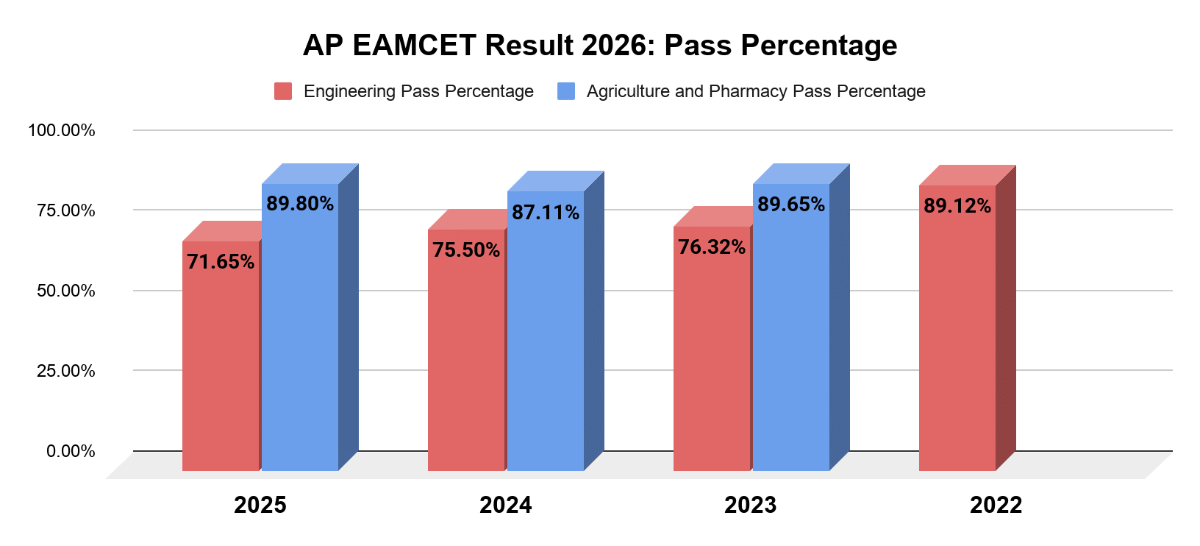
In the previous year, out of 258,374 students who appeared for the Engineering stream exam, 195,092 candidates successfully cleared it. This marks a pass rate of 75.51%.
How to Apply for EAMCET 2025
The Application Form 2025 is likely to start in March 2025 and end by April 2025. Late submission with late fee arrangements will stretch through May 2025.
The AP EAMCET 2025 Application Form link will be available on the official website.
Application Fee Payment
Pay the application fee using online payment modes like credit card, debit card, or net banking. The application fee varies based on the stream and category.
| Stream | General Category | BC Category | SC/ST Category |
|---|---|---|---|
| Engineering | ₹600 | ₹550 | ₹500 |
| Agriculture | ₹600 | ₹550 | ₹500 |
| Both Engineering and Agriculture | ₹1,200 | ₹1,100 | ₹1,000 |
AP EAPCET Application Correction
Candidates can correct their application forms within the designated correction period in May 2025. It is necessary to check all details entered before final submission to prevent the requirement for corrections.
Application Process
AP EAPCET 2026 Registration Started
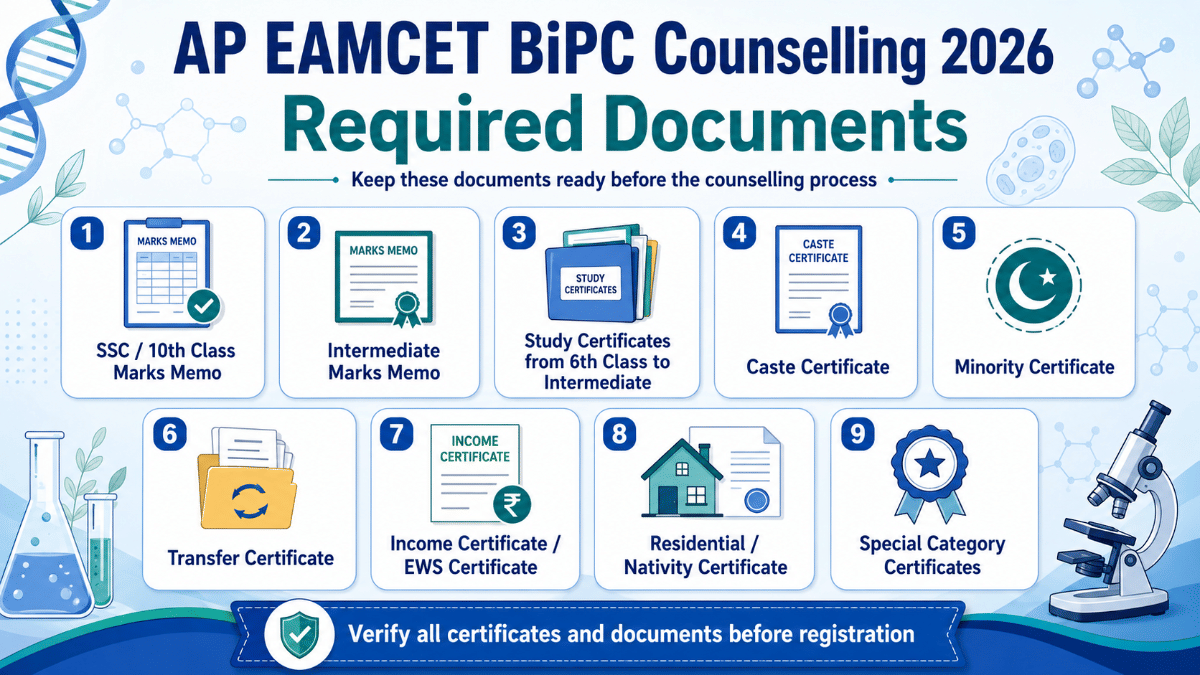
AP EAMCET 2026 registrations have started from 4th Feb 2026. Applicants must upload all required documents, such as photos, educational certificates, caste certificates, and address proofs.
Application fees depend on the reservation category of the applicants.
- Open category: 600 rupees
- BC category: 550 rupees
- SC/ST students: 500 rupees
The eligibility criteria for the AP EAPCET 2026 exam include being either an Indian citizen or having a PIO/OCI status. Candidates must complete 12th grade with relevant subjects and fulfill age requirements. The minimum age is 16 years for engineering and 17 years for agriculture/pharmacy.
The correction window for application forms will be opened in May 2026 on the official site.
As per past years' registration trends, around 70-75% applicants chose the engineering subject. The remaining students opted for agriculture and pharmacy.
AP EAPCET Application Form Latest Trends
The AP EAPCET Syllabus 2026 is expected to follow previous patterns.
What is the last date for EAPCET Registration?
The last date for EAPCET 2025 Registration is the 2nd week of April with no late fee. Applications with late fees can be submitted by the 2nd week of May.
It is always better to apply early to save a few bucks.
AP EAPCET 2025 Dates
The Andhra Pradesh State Council of Higher Education (APSCHE) has announced the examination schedule for 2025.
| S.No | Activity | Date/Dates |
|---|---|---|
| 1 | Notification of APEAPCET 2025 | 12.03.2025 |
| 2 | Commencement of submission of Online Applications | 15.03.2025 |
| 3 | Last date for submission of Online Applications without Late fee | 24.04.2025 |
| 4 | Last date for submission of Online Applications with late fee of Rs.1000/- | 01.05.2025 |
| 5 | Last date for submission of Online Applications with late fee of Rs.2000/- | 07.05.2025 |
| 6 | Correction of Online Data already submitted by the candidates | 06.05.2025 to 08.05.2025 |
| 7 | Last date for submission of Online Applications with late fee of Rs.4000/- | 12.05.2025 |
| 8 | Last date for submission of Online Applications with late fee of Rs.10000/- | 16.05.2025 |
| 9 | Downloading of Hall tickets from the website /(through Whatsapp) | 12.05.2025 |
| 10 | Dates of APEAPCET 2025 (Agriculture & Pharmacy) | 19.05.2025 & 20.05.2025 |
| 11 | Date of Preliminary key Release (Agriculture & Pharmacy) | 21.05.2025 |
| 12 | Last date of Receiving Objections on Preliminary key (Agriculture & Pharmacy) | 25.05.2025 |
| 13 | Dates of AP EAPCET 2025 (Engineering) | 21.05.2025 to 27.05.2025 |
| 14 | Date of Preliminary key Release (Engineering) | 28.05.2025 |
| 15 | Last date of Receiving Objections on preliminary key (Engineering) | 01.06.2025 |
| 16 | Date of Final Key Release | 05.06.2025 |
AP EAPCET Eligibility Criteria 2025
To be able to apply for AP EAPCET 2025, candidates should be Indian citizens or holders of PIO/OCI status. They should also fulfill the conditions of local or non-local status.
- For the Engineering stream, the candidates should pass 12th grade with subjects of Physics, Mathematics, and Chemistry with a minimum of 45% marks (40% for SC/ST candidates).
- For streams of Agriculture and Pharmacy, candidates should pass the 12th class with subjects of Physics, Chemistry, and Biology/Mathematics. The minimum age is 16 years for Engineering and 17 years for Agriculture/Pharmacy with a maximum age limit for SC/ST candidates.
Who is eligible for AP EAPCET?
Candidates must meet the nationality, educational, and age requirements listed above. The specific subject combination and minimum marks depend on the stream chosen.
AP EAPCET 2025 Eligibility Criteria
Indian Nationals, OCI, and PIO candidates are eligible for AP EAPCET 2025. Candidates must be residents of Andhra Pradesh or Telangana and meet the local or non-local status requirements.
Educational Qualification for Engineering and Pharmacy Courses
Candidates must have passed or appeared for 10+2 with Mathematics, Physics, and Chemistry. A Diploma in Engineering recognized by the AP or Telangana Board of Technical Education is also eligible.
Minimum Marks for Engineering and Pharmacy
- 45% aggregate for the General category.
- 40% aggregate for SC/ST candidates.
Educational Qualification for Agriculture and Medical Courses
Candidates must have passed or appeared for 10+2 with Biology (Botany and Zoology), Physics, and Chemistry.
Age Limit for Engineering and Pharmacy Courses
The minimum age is 16 years as of December 31, 2025. There is no upper age limit.
Age Limit for Specific B.Tech and B.Sc Courses
This applies to B.Tech. (Dairy Technology), B.Tech. (Agricultural Engineering), B.Tech. (Food Science and Technology), and B.Sc. (Agricultural Engineering). The minimum age is 17 years as of December 31, 2025. The upper age limit is 22 years for General candidates and 25 years for SC/ST candidates.
AP EAPCET 2025 Required Documents
Candidates need to upload several documents during the application process. Each document has specific file format and size requirements.
| Document | Specification | File Format | File Size | Additional Details |
|---|---|---|---|---|
| Passport-sized Photograph | Recent photo with a white or light background | JPEG | 20 KB to 50 KB | Dimensions: 3.5 cm x 4.5 cm. The photograph should be clear and well-lit. |
| Signature of the Candidate | Digital signature of the candidate | JPEG | 10 KB to 30 KB | Dimensions: 2 cm x 4 cm. Signature should be legible and clear. |
| Class 10th (SSC) Marks Sheet | For proof of date of birth and educational qualifications | PDF/JPEG | 100 KB to 150 KB | Must be clear and readable; uploaded as a scanned copy. |
| Class 12th (Intermediate) Marks Sheet | For candidates who have completed or are appearing for the exam | PDF/JPEG | 100 KB to 150 KB | Required for Engineering, Agriculture, or Pharmacy streams. |
| Caste Certificate (if applicable) | For SC/ST/OBC candidates applying for reservation benefits | PDF/JPEG | 100 KB to 150 KB | Must be issued by a competent authority and should be valid. |
| Income Certificate (if applicable) | For fee reimbursement or concession for reserved category students | PDF/JPEG | 100 KB to 150 KB | Required for candidates seeking fee reimbursement or under economically weaker sections. |
| Disability Certificate (if applicable) | For candidates with disabilities seeking reservation under PWD quota | PDF/JPEG | 100 KB to 150 KB | Must be issued by a recognized medical board. |
| Domicile Certificate (if applicable) | For candidates applying under the local category | PDF/JPEG | 100 KB to 150 KB | Proof of residency for local candidates. |
In 2024, about 10-15% of applicants faced difficulties in uploading the right documents because of size, format, or illegibility. Verify that all documents meet the specified requirements to prevent delays or rejections during the application process.
AP EAPCET Application Fees 2025
The AP EAPCET application fee varies by stream (Engineering, Agriculture, and Pharmacy) and candidate category (General, SC/ST/OBC).
AP EAPCET 2025 Application Fee
The application fee for AP EAPCET 2025 depends on the candidate's category and the stream selected.
| Category | Engineering Stream (B.Tech) | Agriculture & Pharmacy Stream | Both Engineering & Agriculture/Pharmacy Stream |
|---|---|---|---|
| General | ₹600 | ₹600 | ₹1200 |
| SC/ST | ₹500 | ₹500 | ₹1000 |
Historically, approximately 70% of applicants choose the Engineering stream, whereas approximately 30% apply for the Pharmacy and Agriculture streams.
Approximately 10-15% of applicants apply to both streams to maintain a backup option.
Payment Methods for AP EAPCET 2025 Application Fee
Candidates can pay the application fee through the following methods:
- Online Payment (Preferred Method)
- Credit/Debit Card
- Net Banking
- Offline Payment (AP Online Centers)
- Candidates can also pay through AP Online Centers for a small processing fee.
AP EAPCET Form Correction 2025
Andhra Pradesh State Council of Higher Education (APSCHE) gives a window for correction to candidates in order to correct any error or mistake in their already submitted application forms.
Correction Window Details
- Availability: The window for correction is generally available in the first week of May 2025.
- Mode: Corrections can be made online through the official AP EAPCET website.
Details That Can Be Edited
During the correction period, candidates can modify the following details:
| Editable Details |
|---|
| Qualifying Examination – Year of Appearing/Passing |
| Medium of Instruction in Qualifying Exam |
| Place of Study – Intermediate or equivalent |
| Bridge Course Hall Ticket Number |
| Mother's Name |
| Birth State and District |
| Gender |
| Community (Caste) |
| Special Category (e.g., SC/ST/OBC) |
| Local Area Status |
| Non-Minority/Minority |
| Annual Income of Parents |
| Study Details (10+2 studies) |
| Place of Study – SSC or equivalent |
| SSC Hall Ticket Number & Year of Passing |
| Address for Correspondence |
| Mobile Number and Email ID |
| Aadhaar Card Details |
Note: Changes to these details can be made directly through the correction window.
Details That Cannot Be Edited
Some information cannot be edited within the correction window. To make a change, applicants should send a request letter to the Convener, AP EAPCET-2025, by email at helpdeskapeapcet@apsche.org, submitting valid documents.
| Non-Editable Details |
|---|
| Name of the Candidate |
| Father's Name |
| Date of Birth (as per SSC or Equivalent) |
| Signature |
| Photograph |
| Examination Stream (Engineering/Agriculture/Pharmacy) |
| Qualifying Examination Hall Ticket Number |
AP EAPCET 2025 Previous Years Registration Analysis
As per the previous years' registration statistics, the trends in applicant numbers, gender composition, and stream choice are as follows.
In 2024, 194,752 candidates registered for the Engineering stream, comprising 115,381 male candidates and 79,371 female candidates, reflecting a dominant male enrollment.
In contrast, the Agriculture stream had 87,744 registrations, with a larger number of female candidates (60,471) than male candidates (27,273).
AP EAPCET 2024 Registration Statistics:
AP EAPCET 2024 Registration Statistics
AP EAPCET 2024 registration data shows the total number of candidates who applied for the Engineering and Agriculture streams. The Engineering stream had 194,752 total registrations, while the Agriculture stream had 87,744 total registrations.
| Category | Male Candidates | Female Candidates | Total Candidates |
|---|---|---|---|
| Engineering | 115,381 | 79,371 | 194,752 |
| Agriculture | 27,273 | 60,471 | 87,744 |
AP EAPCET 2023 Registration Statistics
In AP EAPCET 2023, the Engineering stream had 266,467 registered candidates. The Agriculture stream had 31,953 registered candidates.
| Category | Male Candidates | Female Candidates | Total Candidates |
|---|---|---|---|
| Engineering | 166,460 | 100,007 | 266,467 |
| Agriculture | 16,953 | 15,000 | 31,953 |
Gender Representation in AP EAPCET Registrations
The Engineering stream consistently shows a higher number of male candidates compared to female candidates. The Agriculture stream shows a higher number of female candidates.
- Engineering stream: Male candidates outnumber female candidates in both 2024 and 2023.
- Agriculture stream: Female candidates outnumber male candidates in 2024, while the numbers were closer in 2023.
- Overall participation: The total number of candidates registering for the Engineering stream is significantly higher than for the Agriculture stream.
Comparison of Male and Female Ratio in AP EAPCET 2024 and 2023
The registration data for AP EAPCET 2024 and AP EAPCET 2023 shows how male and female participation changed across the two years. The comparison covers both the Engineering and Agriculture streams.
Engineering Stream
In 2024, 59.3% of Engineering candidates were male and 40.7% were female. In 2023, male candidates represented 62.5% and female candidates represented 37.5%.
- Male participation in Engineering decreased from 2023 to 2024.
- Female participation in Engineering increased marginally from 2023 to 2024.
- The Engineering stream is still dominated by male candidates.
| Year | Male Candidates | Female Candidates | Total Candidates | Male Ratio (%) | Female Ratio (%) |
|---|---|---|---|---|---|
| 2024 | 115,381 | 79,371 | 194,752 | 59.3% | 40.7% |
| 2023 | 166,460 | 100,007 | 266,467 | 62.5% | 37.5% |
Agriculture Stream
In 2024, 68.9% of Agriculture candidates were female and 31.1% were male. In 2023, the gender distribution was 53.1% male and 46.9% female.
- Female participation in Agriculture increased substantially in 2024.
- Female candidates surpassed male candidates in Agriculture in 2024, while male participation was higher in 2023.
- The shift indicates an increasing trend of female interest in Agriculture courses.
AP EAPCET 2024 Gender-wise Candidate Statistics
The total number of candidates who appeared for the AP EAPCET in 2024 was 87,744. This is a significant increase from the 31,953 candidates in 2023.
| Year | Male Candidates | Female Candidates | Total Candidates | Male Ratio (%) | Female Ratio (%) |
|---|---|---|---|---|---|
| 2024 | 27,273 | 60,471 | 87,744 | 31.1% | 68.9% |
| 2023 | 16,953 | 15,000 | 31,953 | 53.1% | 46.9% |
Engineering Stream Gender Trends
Male participation remains dominant in the Engineering stream. However, the gap between male and female candidates narrowed slightly in 2024 compared to 2023.
Agriculture Stream Gender Trends
The Agriculture stream shows a reverse trend in 2024. Female participation overtook male participation, a change from 2023 when male candidates were in the majority.
Interpretation of the Data
These shifts indicate a growing interest among female candidates in Engineering, a field traditionally dominated by males. There is also a rise in female interest in Agriculture-related courses.
Exam Pattern
AP EAPCET 2026 Exam Pattern
The AP EAPCET 2026 exam pattern is the same as previous years. JNTU Kakinada conducts the exam on behalf of APSCHE for undergraduate admissions to engineering, agriculture, and pharmacy courses in Andhra Pradesh.
The exam is a Computer-Based Test (CBT) with 160 multiple choice questions. The duration is 3 hours (180 minutes).
| Parameter | Details |
|---|---|
| Exam Mode | Computer-Based Test (CBT) |
| Duration | 3 Hours (180 minutes) |
| Total Questions | 160 |
| Total Marks | 160 |
| Question Type | Multiple Choice Questions (MCQs) |
| Marking Scheme | +1 for each correct answer |
| Negative Marking | None |
| Medium | English & Telugu (Urdu assistance at Kurnool centre) |
| Official Website | cets.apsche.ap.gov.in |
Engineering Stream (MPC) Exam Pattern
The engineering stream follows the MPC pattern. It has three subjects with a total of 160 questions.
- Physics: 40 questions
- Chemistry: 40 questions
- Maths: 80 questions
Agriculture and Pharmacy Stream (BiPC) Exam Pattern
The agriculture and pharmacy stream follows the BiPC pattern. It has four subjects with a total of 160 questions.
- Physics: 40 questions
- Chemistry: 40 questions
- Zoology: 40 questions
- Botany: 40 questions
Marking Scheme and Qualifying Marks
Each correct answer carries +1 mark. There is no negative marking for wrong answers.
General category candidates must score 40 out of 160 (25%) to qualify. No minimum qualifying marks are prescribed for SC/ST candidates.
Medium of Language
The exam is conducted in English and Telugu. Urdu assistance is available only at the Kurnool centre.
Frequently Asked Questions
What are the qualifying marks for AP EAPCET 2026?
General category candidates must score 40 out of 160 (25%). No minimum qualifying marks are prescribed for SC/ST candidates.
In which languages is AP EAPCET 2026 conducted?
The exam is conducted in English and Telugu. Urdu assistance is available only at the Kurnool centre.
AP EAPCET 2026 Exam Pattern
AP EAPCET 2026 is a computer-based test (CBT) with 160 MCQs. The exam is conducted for 3 hours and carries 160 marks. There is no negative marking.
AP EAPCET 2026: Engineering Stream (MPC) Exam Pattern
The engineering syllabus of the AP EAPCET exam pattern is primarily focused on mathematics. This is done to test the problem-solving and analytical skills of the candidates.
| Subject | Questions | Marks |
|---|---|---|
| Mathematics | 80 | 80 |
| Physics | 40 | 40 |
| Chemistry | 40 | 40 |
| Total | 160 | 160 |
AP EAPCET Engineering Stream Syllabus 2026
- Physics: Mechanics, Work, Energy, Power, Thermodynamics, Properties of Matter, Waves and Oscillations, etc.
- Chemistry: Physical Chemistry, Organic Chemistry, Inorganic Chemistry, Chemical Kinetics, Electrochemistry, etc.
- Mathematics: Algebra, Calculus, Trigonometry, Coordinate Geometry, Probability, etc.
AP EAPCET 2026: Engineering Stream Subject-Wise Important Topics
A list of important topics that cover roughly 70% of the weightage has been provided below.
- In mathematics, calculus and coordinate geometry dominate.
- In Physics, mechanics and Electricity & Magnetism prevail.
- Chemistry emphasises organic and physical chemistry for conceptual depth.
| Subject | Key High-Weightage Topics | Why Important? |
|---|---|---|
| Mathematics | Calculus (Differentiation, Integration, Applications) | Highest weightage (8–10%); real-world problem-solving, limits, derivatives, definite integrals |
| Coordinate Geometry (Straight Lines, Circles, Conics) | Frequent questions on equations, parabolas, ellipses, and hyperbolas | |
| Algebra (Matrices, Determinants, Quadratic Equations, Progressions) | Core concepts: includes Binomial Theorem, Functions, Permutations & Combinations | |
| Trigonometry (Identities, Equations, Triangles) | Useful for solving angles, identities, and applications | |
| Probability & Statistics (Permutations, Combinations, Probability) | Data analysis, distributions, and a consistent scoring area | |
| Physics | Mechanics (Laws of Motion, Work-Energy-Power, Gravitation) | Fundamental; high questions on motion, forces, energy |
| Electricity & Magnetism (Coulomb's Law, Ohm's Law, Magnetic Fields) | Key for modern applications: current, electrostatics, electromagnetism | |
| Optics (Reflection, Refraction, Lenses) | Light behaviour, formulas, and ray diagrams | |
| Thermodynamics & Heat Transfer | Laws, processes, and temperature control | |
| Waves & Oscillations (SHM, Sound Waves) | Periodic motion, engineering relevance | |
| Chemistry | Organic Chemistry (Hydrocarbons, Functional Groups, Reactions) | Molecular structures, reactions, very high weightage |
| Inorganic Chemistry (Periodic Table, Bonding, Coordination Compounds) | Trends, bonding, compounds; scoring if memorised | |
| Physical Chemistry (Thermodynamics, Equilibrium, Electrochemistry) | Concepts for industrial processes; calculations-based | |
| Biochemistry (Biomolecules: Sugars, Amino Acids) | Structure & function; often linked to everyday life |
AP EAPCET 2026: BiPC (Agriculture and Pharmacy Stream) Exam Pattern and Syllabus
The BiPC stream covers the Agriculture and Pharmacy courses. The exam pattern and syllabus for this stream are detailed in the official notification.
AP EAPCET 2026 Conducting Body
AP EAPCET 2026 is conducted by JNTU Kakinada on behalf of APSCHE.
AP EAPCET 2026 Engineering Stream Questions
The Engineering (MPC) stream has 160 questions. The distribution is Mathematics (80), Physics (40), and Chemistry (40).
AP EAPCET 2026 Agriculture and Pharmacy Stream Exam Pattern
The Agriculture and Pharmacy stream of AP EAPCET 2026 has 160 questions for 160 marks. The exam is conducted for a total duration of 3 hours (180 minutes).
| Subject | Questions | Marks |
|---|---|---|
| Botany | 40 | 40 |
| Zoology | 40 | 40 |
| Physics | 40 | 40 |
| Chemistry | 40 | 40 |
| Total | 160 | 160 |
AP EAPCET Agriculture and Pharmacy Stream Syllabus 2026
The syllabus for this stream covers Physics, Chemistry, and Biology. The subjects and their main topics are listed below.
- Physics: Mechanics, Waves, Work, Energy, Power, etc.
- Chemistry: Organic Chemistry, Physical Chemistry, Inorganic Chemistry, etc.
- Biology: Cell Biology, Plant Biology, Animal Kingdom, Genetics, Ecology, etc.
AP EAPCET 2026: Pharmacy and Agriculture Stream Subject-Wise Important Topics
Biology carries the highest weightage in this exam. Focus on human physiology, genetics, plant physiology, and cell biology.
- For chemistry, master organic and biochemistry, including biomolecules and reactions related to living systems.
- Physics has comparatively lower weightage, so prioritise waves and optics with a biological context.
| Subject | Key High-Weightage Topics | Why Important? |
|---|---|---|
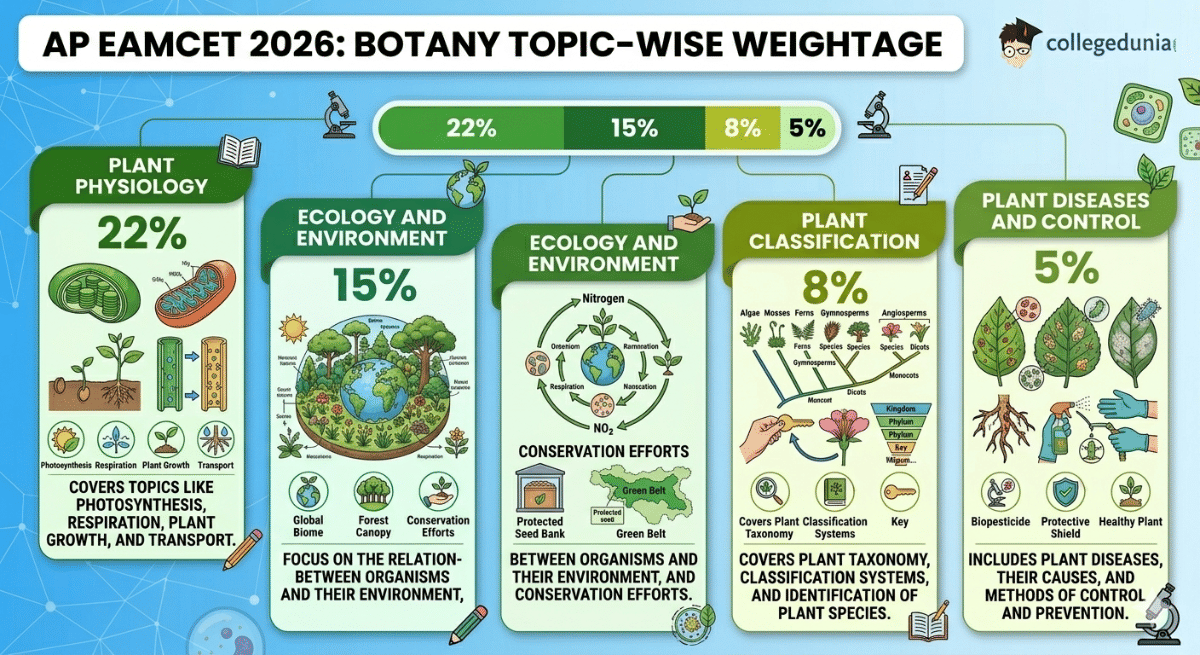
| Botany | Cell Biology | Cell structure, function, division (mitosis/meiosis) – foundation of life sciences |
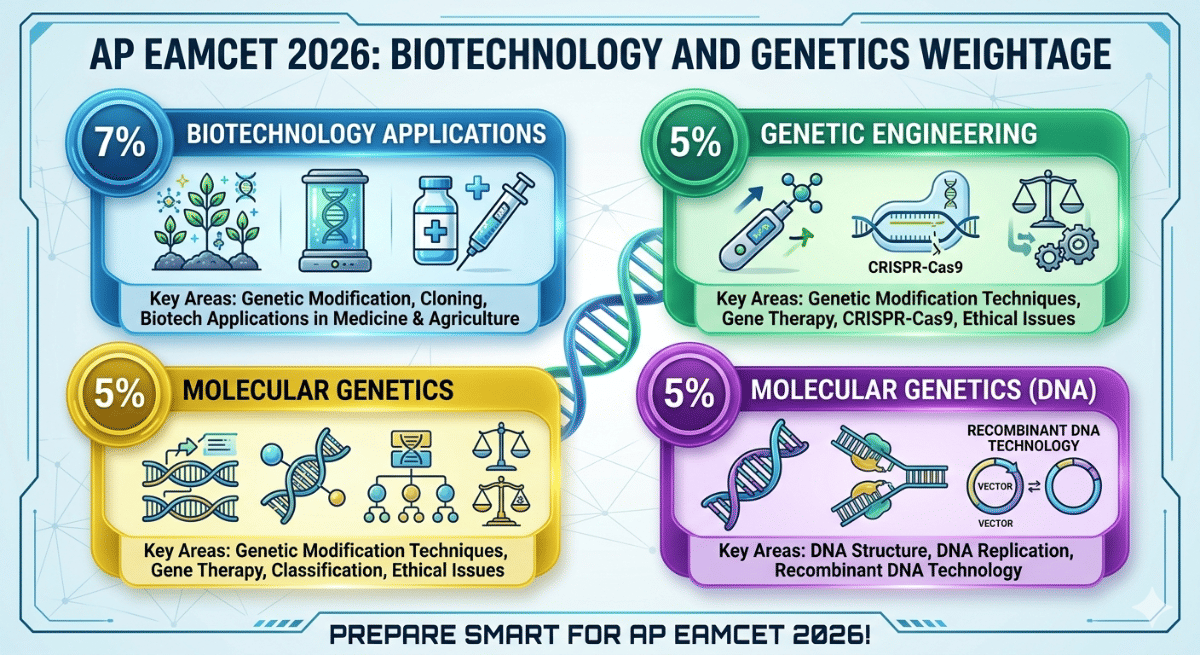
| Genetics | Mendelian inheritance, genetic disorders, biotechnology in plant breeding – core scoring area | |
| Plant Physiology | Photosynthesis, respiration, transpiration, plant growth – essential for agriculture questions | |
| Ecology | Ecosystems, pollution, biodiversity, conservation – high relevance to environmental issues | |
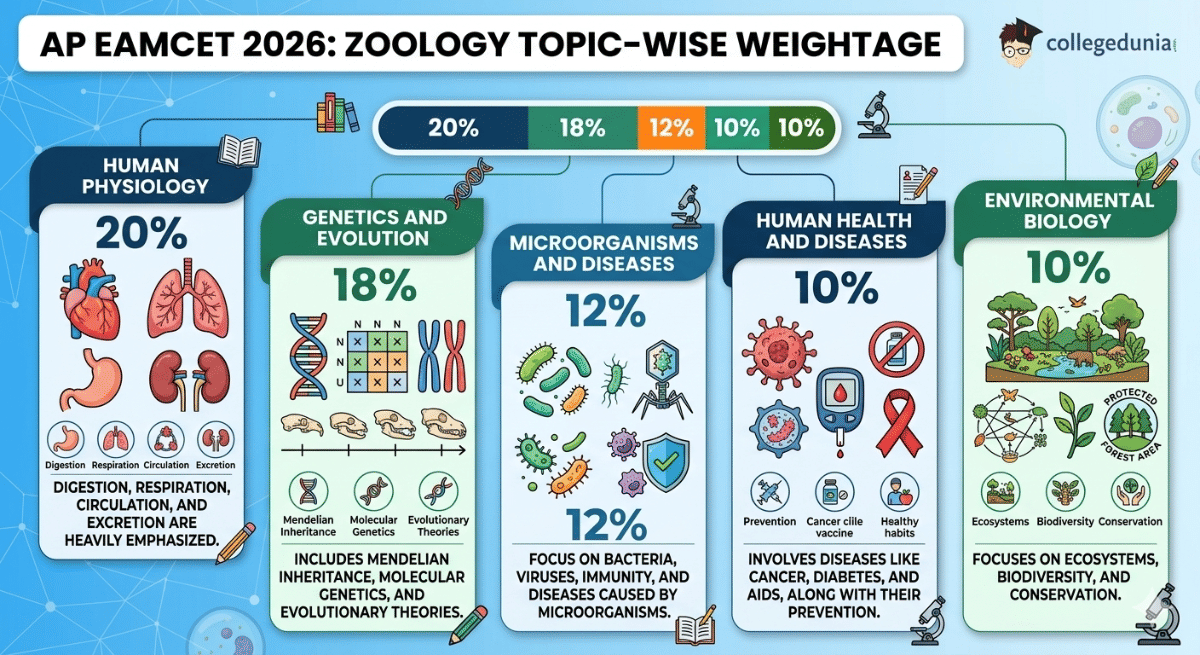
| Zoology | Human Physiology | Circulatory, digestive, excretory, reproductive systems – very high weightage, health-related |
| Animal Diversity | Classification of animals, major phyla characteristics – biodiversity & conservation focus | |
| Reproductive Biology | Human reproduction, gametogenesis, life cycles – important for veterinary/pharmacy relevance | |
| Physics | Light and Sound Waves | Reflection, refraction, wave properties, sound phenomena – emphasis on biological applications |
| Chemistry | Organic Chemistry | Hydrocarbons, functional groups, reactions – crucial for understanding biomolecules & drugs |
| Biochemistry | Structure & function of proteins, lipids, carbohydrates, nucleic acids – highest weightage in Agri/Pharmacy | |
| Physical Chemistry (selected) | Thermodynamics, equilibrium – basic concepts linked to biological processes |
AP EAPCET 2026 Marking Scheme
The marking scheme for AP EAPCET 2026 awards +1 mark for a correct answer, and there is no negative marking. Both the Engineering and Agriculture & Pharmacy streams carry a total of 160 marks.
| Question Type | Marks Awarded | Negative Marking |
|---|---|---|
| Correct Answer | +1 mark | None |
| Incorrect Answer | 0 marks | None |
| Unanswered Questions | 0 marks | None |
AP EAPCET 2026 Qualifying Marks
The qualifying marks for AP EAPCET 2026 is 25% of the maximum marks used for ranking. For example, 40 marks out of 160 for general category students.
- For the SC/ST category candidates, there will be no prescribed minimum qualifying marks.
- SC/ST candidates' admission is restricted to the seats reserved specifically for these categories.
AP EAPCET 2026: Medium of Language
Candidates who studied their exam in Urdu mediums and need translation assistance will be assigned the Kurnool centre only.
AP EAPCET Question Paper Language
The question paper will be available in English and Telugu mediums in general.
In case of ambiguity or discrepancy between the Telugu and English versions, the English version will prevail and be considered final.
AP EAPCET Exam Pattern for Agriculture and Pharmacy Streams
The Agriculture & Pharmacy (BiPC) stream includes Botany (40), Zoology (40), Physics (40), and Chemistry (40) — a total of 160 questions.
Negative Marking in AP EAPCET 2026
No, there is no negative marking in AP EAPCET 2026.
AP EAPCET Model Paper PDFs
The AP EAPCET model paper official PDFs for Botany, Zoology, Physics and Chemistry subjects are provided below for practice:
- AP EAPCET Botany Model Paper Official PDF (Download PDF)
- AP EAPCET Zoology Model Paper Official PDF (Download PDF)
- AP EAPCET Physics and Chemistry Model Paper Official PDF (Download PDF)
AP EAPCET Previous Years' Question Papers (2024-2017)
Previous years' question papers are available for download.
| Year | Question Paper Link |
|---|---|
| 2025 | Check Here |
| 2024 | Check Here |
| 2023 | Check Here |
| 2022 | Check Here |
| 2021 | Check Here |
| 2020 | Check Here |
| 2019 | Check Here |
| 2018 | Check Here |
| 2017 | Check Here |
Also Check:
- AP EAMCET (EAPCET) Mock Test 2026: Take an online free mock test for MPC and BPC
- AP EAMCET Previous Year Question Paper- Download Solution PDF with Answer Keys [2024-2013]
FAQs
Which subject has the highest weightage in AP EAPCET Engineering?
Mathematics has the highest weightage with 80 marks in the Engineering stream.
Which subject dominates the AP EAPCET Agriculture & Pharmacy stream?
Biology (Botany + Zoology) dominates with a combined 80 marks.
What are the most important Mathematics topics for AP EAPCET 2026?
High-weightage topics include Calculus, Coordinate Geometry, Algebra, Trigonometry, and Probability.
What are the important Physics topics for AP EAPCET 2026?
Key topics are Mechanics, Electricity & Magnetism, Optics, Thermodynamics, and Waves.
Which Chemistry topics are most important for AP EAPCET 2026?
Organic Chemistry, Physical Chemistry (Thermodynamics, Electrochemistry), and Inorganic Chemistry carry major weightage.
What are the important Biology topics for AP EAPCET 2026?
Important topics include Cell Biology, Genetics, Plant Physiology, Human Physiology, and Ecology.
AP EAPCET 2026 Overview
AP EAPCET 2026 is the Andhra Pradesh Engineering, Agriculture and Pharmacy Common Entrance Test. JNTU Kakinada conducts the exam on behalf of APSCHE.
The exam is a computer-based test (CBT) for admission to engineering, agriculture, and pharmacy courses in Andhra Pradesh.
Exam Pattern
AP EAPCET 2026 is a computer-based test (CBT) with 160 multiple-choice questions (MCQs). The total duration is 3 hours (180 minutes) for both streams.
Each correct answer carries +1 mark. Incorrect or unanswered questions carry 0 marks. There is no negative marking.
Engineering (MPC) Stream
The Engineering stream has 160 questions with Mathematics having the highest weightage.
- Mathematics: 80 questions
- Physics: 40 questions
- Chemistry: 40 questions
Agriculture & Pharmacy (BiPC) Stream
The Agriculture & Pharmacy stream also has 160 questions. Biology (Botany + Zoology) dominates with a combined 80 marks.
- Botany: 40 questions
- Zoology: 40 questions
- Physics: 40 questions
- Chemistry: 40 questions
Qualifying Marks
General category candidates must score 40 out of 160 (25%) to qualify. No minimum qualifying marks are prescribed for SC/ST candidates.
Exam Language
The exam is conducted in English and Telugu. Urdu assistance is available only at the Kurnool centre.
Syllabus
AP EAPCET syllabus includes Mathematics/Biology, Physics, and Chemistry based on the chosen stream.
Important Mathematics Topics
High-weightage topics include Calculus, Coordinate Geometry, Algebra, Trigonometry, and Probability.
Important Physics Topics
Key topics are Mechanics, Electricity & Magnetism, Optics, Thermodynamics, and Waves.
Important Chemistry Topics
Organic Chemistry, Physical Chemistry (Thermodynamics, Electrochemistry), and Inorganic Chemistry carry major weightage.
Important Biology Topics
Important topics include Cell Biology, Genetics, Plant Physiology, Human Physiology, and Ecology.
Key Details at a Glance
| Particular | Details |
|---|---|
| Conducting Body | JNTU Kakinada on behalf of APSCHE |
| Exam Mode | Computer-Based Test (CBT) |
| Total Questions | 160 MCQs |
| Duration | 3 hours (180 minutes) |
| Total Marks | 160 |
| Marking Scheme | +1 for correct, 0 for incorrect/unanswered |
| Negative Marking | None |
| Qualifying Marks (General) | 40 out of 160 (25%) |
| Qualifying Marks (SC/ST) | None prescribed |
| Languages | English, Telugu (Urdu assistance at Kurnool centre only) |
Syllabus
AP EAPCET 2026 Syllabus Overview
The AP EAPCET 2026 exam is conducted for engineering, agriculture, and pharmacy courses in Andhra Pradesh. The syllabus has been released in the official notification for both Engineering and Agriculture & Pharmacy streams.
- The syllabus is divided into two streams: Engineering and Agriculture & Pharmacy.
- The Engineering stream (MPC) includes Maths, Physics, and Chemistry with 80, 40, and 40 questions respectively.
- The Agriculture and Pharmacy stream (BiPC) includes Biology (Botany and Zoology), Physics, and Chemistry with 80, 40, and 40 questions respectively.
- The AP EAPCET 2026 syllabus is largely based on the Andhra Pradesh Board of Intermediate Education (BIE) class 11 and class 12 syllabus.
AP EAMCET 2026 Syllabus PDF Download
The official syllabus PDFs are available for download from the AP State Council of Higher Education (APSCHE) website.
- Download AP EAMCET Pharmacy Syllabus pdf
- Download AP EAMCET Engineering Syllabus pdf
AP EAMCET 2026 Exam Date
The AP EAMCET 2026 exam is scheduled to be held from 12th to 20th May 2026. The exam will be conducted in CBT (Computer-Based Test) mode only.
AP EAMCET 2026 Syllabus Details
The AP EAMCET 2026 syllabus covers fundamental topics in physics, chemistry, maths, zoology, and botany.
- The Engineering stream (MPC) includes Maths, Physics, and Chemistry subjects.
- The Agriculture & Pharmacy stream includes Biology, Physics, and Chemistry subjects.
AP EAMCET 2026 Subject-Wise Weightage For MPC Engineering
| Stream | Subject | Key Topic Areas | No. of Q. | Marks |
|---|---|---|---|---|
| Engineering (MPC) | Mathematics | Algebra, Trigonometry, Coordinate Geometry, Calculus, Probability, Vectors | 80 | 80 |
| Physics | Mechanics, Thermodynamics, Waves & Oscillations, Optics, Electricity & Magnetism | 40 | 40 | |
| Chemistry | Atomic Structure, Chemical Bonding, Thermodynamics, Organic Chemistry, Inorganic Chemistry | 40 | 40 | |
| Total | — | — | 160 | 160 |
AP EAMCET 2026 Subject-wise Weightage For BiPC Pharmacy & Agriculture
The Agriculture and Pharmacy stream covers Biology, Physics, and Chemistry. The detailed subject-wise weightage and chapter-wise distribution are provided in the official syllabus booklet.
Best Books for AP EAMCET 2026 Syllabus: Subject Wise
Recommended books for AP EAMCET 2026 preparation are based on the BIE class 11 and class 12 syllabus. Students should refer to the official syllabus PDF for the complete list of topics and recommended study material.
AP EAPCET Model Paper PDFs
Model papers for AP EAPCET 2026 are available for practice. These papers help students understand the exam pattern and question types.
AP EAPCET Previous Year Question Paper
Previous year question papers are useful for exam preparation. They provide insight into the difficulty level and frequently asked topics.
AP EAMCET 2026 Syllabus of Maths with Chapter Wise Weightage
The Mathematics syllabus for the Engineering stream includes Algebra, Trigonometry, Coordinate Geometry, Calculus, Probability, and Vectors. The chapter-wise weightage is available in the official syllabus PDF.
AP EAMCET 2026 Syllabus of Physics with Chapterwise Weightage
The Physics syllabus covers Mechanics, Thermodynamics, Waves & Oscillations, Optics, and Electricity & Magnetism. The chapter-wise weightage is provided in the official notification.
AP EAPCET 2026 Syllabus of Chemistry with Chapter-wise Weightage
The Chemistry syllabus includes Atomic Structure, Chemical Bonding, Thermodynamics, Organic Chemistry, and Inorganic Chemistry. Detailed chapter-wise weightage is available in the official syllabus document.
AP EAMCET 2026 Syllabus of Botany with Chapterwise Weightage
The Botany syllabus for the Agriculture and Pharmacy stream is based on the BIE class 11 and class 12 curriculum. The chapter-wise weightage is specified in the official syllabus PDF.
AP EAPCET 2026 Syllabus of Zoology with Subject-wise Weightage
The Zoology syllabus for the Agriculture and Pharmacy stream follows the BIE class 11 and class 12 syllabus. Subject-wise weightage details are available in the official notification.
FAQs
Frequently asked questions about the AP EAPCET 2026 syllabus, exam pattern, and preparation strategy are addressed in the official information booklet.
AP EAPCET Agriculture and Pharmacy (BiPC) Exam Pattern
The Agriculture and Pharmacy stream of AP EAPCET has 160 questions for 160 marks. Each subject in this stream carries 40 questions and 40 marks.
| Subject | Key Topic Areas | No. of Questions | Marks |
|---|---|---|---|
| Botany | Plant Diversity, Cell Biology, Plant Physiology, Genetics, Ecology | 40 | 40 |
| Zoology | Human Physiology, Animal Diversity, Reproduction, Evolution | 40 | 40 |
| Physics | Classical Mechanics, Properties of Matter, Wave Phenomena | 40 | 40 |
| Chemistry | Physical Chemistry Fundamentals, Organic Chemistry Basics, Environmental Chemistry | 40 | 40 |
| Total | — | 160 | 160 |
Also check the AP EAPCET Mathematics Syllabus 2026 for details on PDF download, weightage, important topics, and best books.
Best Books for AP EAMCET 2026 Syllabus
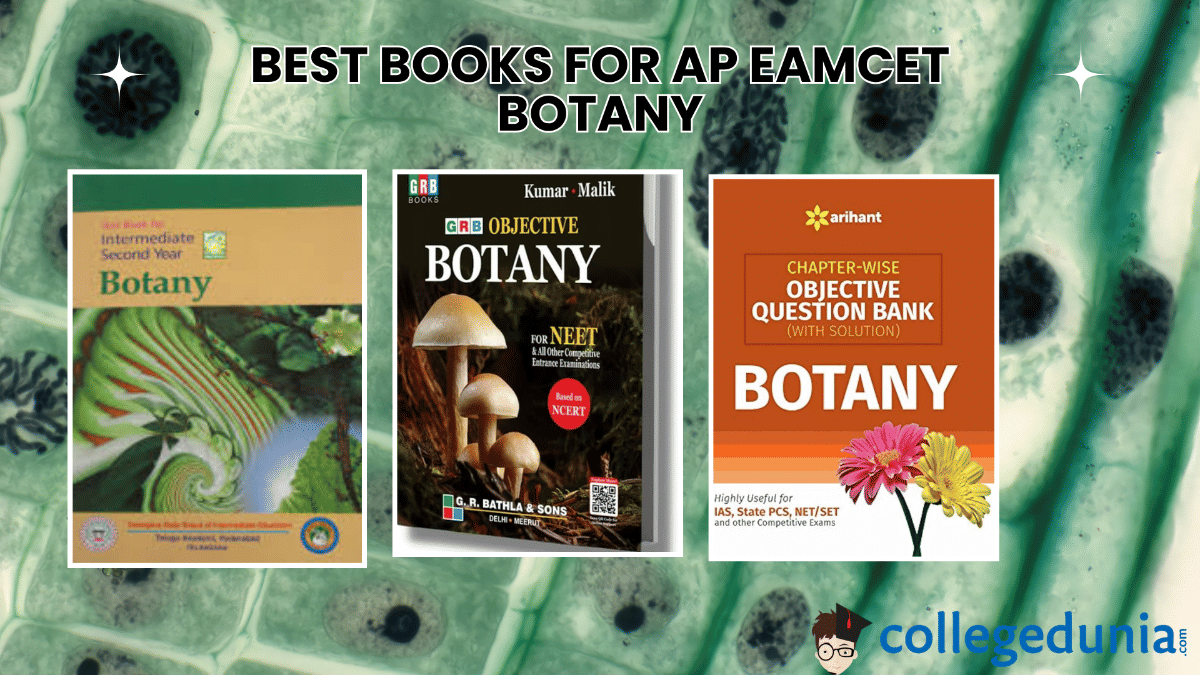
NCERT books are strongly recommended by exam experts and top-scoring students. Physics and Mathematics need concept-building books, while NCERT Chemistry is considered sufficient.
Candidates should also solve model papers and previous year questions (PYQs) along with these books.
Subject-wise Recommended Books
| Subject | Recommended Books | Expert and Student Opinions |
|---|---|---|
| Physics |
|
Community discussions suggest Arihant and NCERT as core starters and H.C. Verma for concepts. One Reddit example states, "I have Deepthi books, but focus on PYQs and Arihant." |
| Chemistry |
|
Reddit aspirants suggest focusing on NCERT and PYQ practice over coaching material. One comment reads, "Don't Buy Books For EAPCET… just PYQs & free videos." |
| Mathematics |
|
A Reddit thread compares Arihant and Deepthi series as top material. It states, "Arihant EAMCET PYQ books & Arihant handbooks are suggested." |
| Biology (Botany & Zoology) |
|
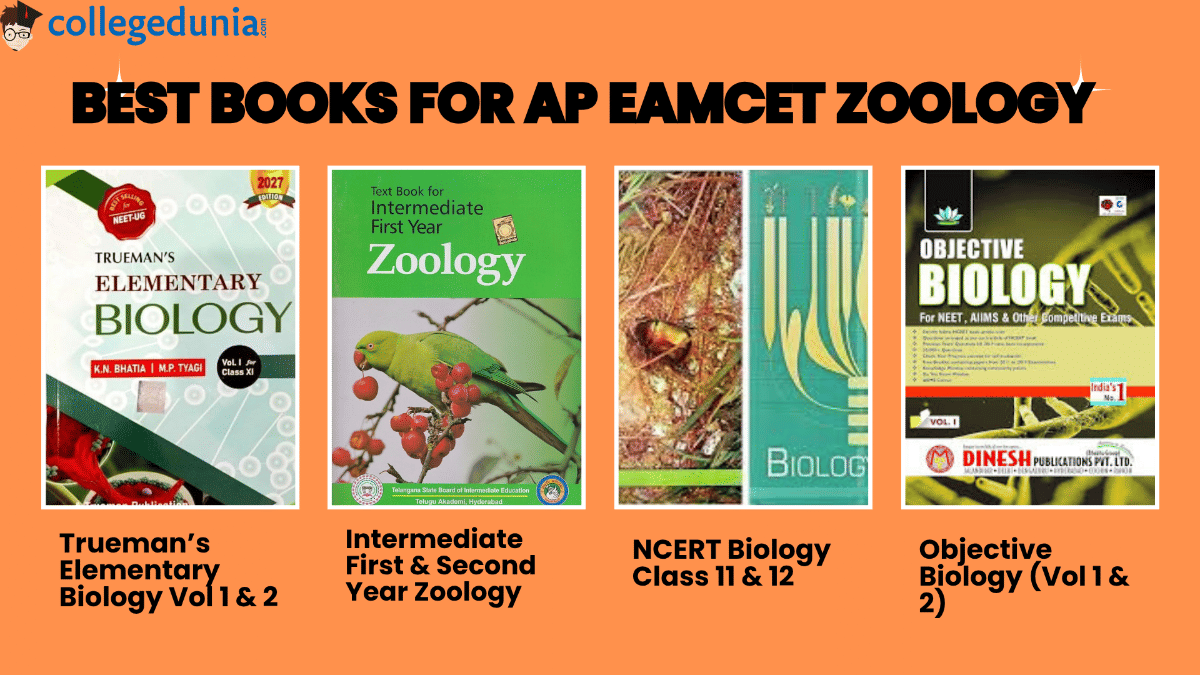
Multiple expert lists recommend NCERT, Arihant, and Objective Biology sets as core study material. |
Ques. How many years of previous question papers should be solved?
Ans. Students should practice at least 10–15 years of AP EAMCET previous year question papers for trend analysis.
AP EAPCET Model Paper PDFs
Official model paper PDFs for Botany, Zoology, Physics, and Chemistry are available for practice.
- AP EAPCET Botany Model Paper Official PDF (Download PDF)
- AP EAPCET Zoology Model Paper Official PDF (Download PDF)
- AP EAPCET Physics and Chemistry Model Paper Official PDF (Download PDF)
Ques. Are questions repeated in AP EAMCET?
Ans. Similar concept-based questions are often repeated with slight variations.
Check the AP EAMCET (EAPCET) Mock Test 2026 to take a free online mock test for MPC and BPC streams.
AP EAPCET Previous Year Question Papers
Previous years' papers for all subjects are provided below for practice.
AP EAPCET Previous Year Question Papers
Previous year question papers are available for download. These papers help candidates understand the exam format and question types.
| Question Paper Year | Check Here |
|---|---|
| AP EAPCET Question Paper 2025 | Download PDF |
| AP EAPCET Question Paper 2024 | Download PDF |
| AP EAPCET Question Paper 2023 | Download PDF |
| AP EAPCET Question Paper 2022 | Download PDF |
| AP EAPCET Question Paper 2021 | Download PDF |
| AP EAPCET Question Paper 2020 | Download PDF |
| AP EAPCET Question Paper 2019 | Download PDF |
| AP EAPCET Question Paper 2018 | Download PDF |
| AP EAPCET Question Paper 2017 | Download PDF |
AP EAMCET 2026 Syllabus of Maths with Chapter Wise Weightage
The AP EAPCET 2026 maths syllabus is extensive and concept-driven. It covers fundamental topics such as algebra, trigonometry, vector algebra, coordinate geometry, probability, and calculus in alignment with BIE class 11 and 12.
The syllabus balances theory with application-based questions. It focuses on conceptual clarity rather than rote memorisation.
These topics enhance problem-solving skills. They also increase analytical understanding.
Maths Unit Weightage Table
| Unit / Chapter | Major Topics & Key Subtopics | Approx. Weightage (%) | Approx. Questions (out of 80) | Priority / Notes |
|---|---|---|---|---|
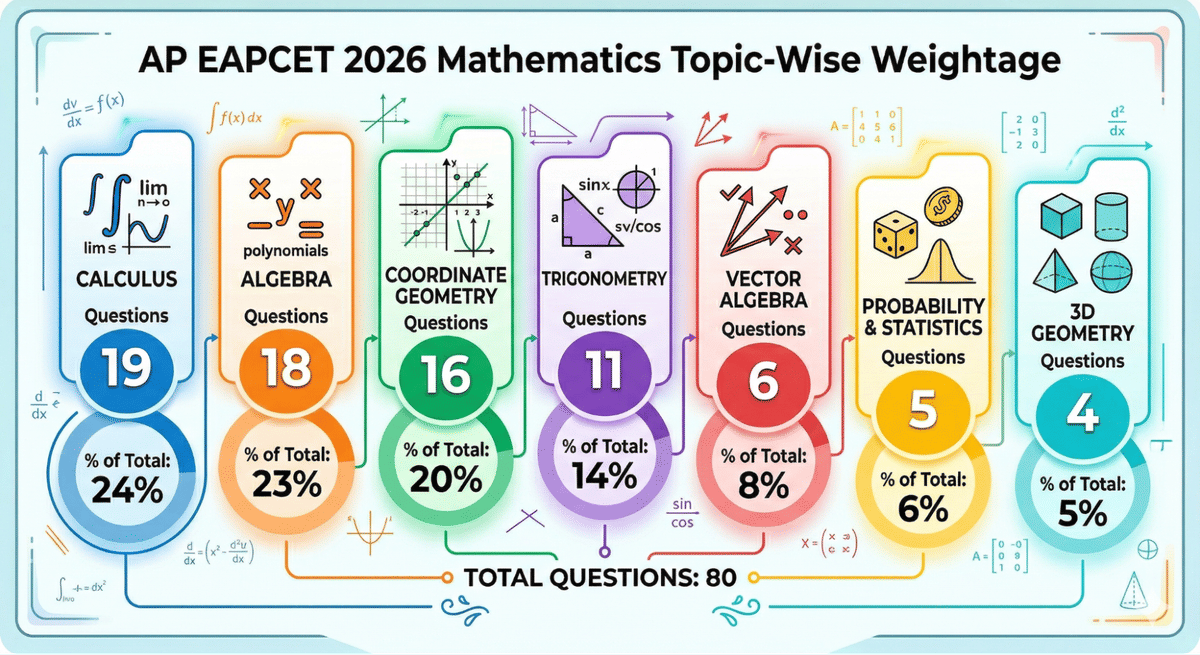
| Coordinate Geometry | Locus, Straight Lines, Pair of Lines, Circle, System of Circles, Parabola, Ellipse, Hyperbola, 3D Geometry (Lines, Planes, Distance) | ~30–31% | 24–25 | Very High – Highest weightage; focus on conics, lines & circles |
| Calculus | Limits & Continuity, Differentiation (Standard functions, Applications, Maxima/Minima, Tangents/Normals), Integration (Methods, Definite Integrals, Areas), Differential Equations (First order linear/homogeneous) | ~12–13% | 10–11 | Very High – Consistent & scoring; master derivatives & integrals |
| Trigonometry | Ratios, Compound/Multiple Angles, Identities, Equations, Inverse Functions, Hyperbolic Functions, Properties of Triangles | ~10–11% | 8–9 | High – Strong presence; focus on identities & triangle formulae |
| Probability & Statistics | Measures of Dispersion (Mean deviation, Variance, SD), Probability (Classical, Conditional, Bayes’, Binomial distribution) | ~9–10% | 7–8 | High – Easy scoring; focus on distributions & theorems |
| Vector Algebra | Vector addition/products, Scalar triple product, Lines & Planes in 3D | ~8–9% | 6–7 | High – Important for 3D geometry questions |
| Algebra (Core) | Functions, Mathematical Induction, Matrices & Determinants, Complex Numbers, Quadratic Expressions, Theory of Equations | ~8–9% | 6–7 | High – Matrices & Complex Numbers repeat often |
| Binomial Theorem & Combinatorics | Binomial expansion, Permutations & Combinations, Counting principles | ~7–8% | 5–6 | Medium-High – Direct & scoring |
| Matrices & Determinants | Types, Operations, Adjoint/Inverse, Linear equations, Rank | ~5–6% | 4–5 | Medium – Overlaps with core Algebra |
| Complex Numbers | Algebra, Polar form, De Moivre’s theorem, Roots of unity | ~4–5% | 3–4 | Medium – Usually 3–5 Qs |
| Minor Topics | Partial Fractions, Theory of Equations, Locus problems, etc. | ~3–4% | 2–3 | Low – Useful for extra marks |
AP EAPCET 2026 Syllabus FAQs
Ques. Has the AP EAPCET 2026 Syllabus changed?
Ans. As per the latest pattern, AP EAMCET follows the Intermediate syllabus just like in the previous year. Any changes will be officially notified by APSCHE on the official website.
Ques. What is the exam pattern of AP EAMCET 2026 Syllabus?
Ans. It is CBT based online test carrying 160 questions with the same maximum total marks. MPC includes 80 Maths, 40 Physics, and 40 Chemistry questions. BiPC includes 40 Botany, 40 Zoology, 40 Physics, and 40 Chemistry.
Check: AP EAPCET 2025 Agriculture Exam Pattern: Marking Scheme, BSc Agriculture Rank, IPE Marks & Syllabus
AP EAMCET 2026 Syllabus of Physics with Chapterwise Weightage
The AP EAPCET 2026 syllabus for physics has a balanced distribution of class 11 and 12 topics. It emphasizes mechanics, electrostatics, magnetism, optics, and modern physics.
Depth-driven topics have more weightage. These include laws of motion, rotational mechanics, thermodynamics, and current electricity.
Modern physics and semiconductor electronics are formula-based and scoring. Wave optics, EMI AC, and basic units test conceptual clarity and fundamental understanding.
AP EAPCET 2026 Physics Syllabus: Chapter-wise Weightage
The AP EAPCET 2026 Physics syllabus is based on the AP BIE Class 11 and 12 curriculum. The table below lists the units, chapters, key subtopics, and approximate weightage for the Physics section.
The Physics section has 40 questions. The weightage for each unit varies from 3% to 10%.
| Unit / Chapter | Chapters Covered | Key Subtopics | Approx. Weightage (%) | Approx. Questions (out of 40) |
|---|---|---|---|---|
| Basics of Physics | Physical World; Units & Measurements | Scope of physics, units, errors, dimensions, significant figures | 3–5% | 1–2 |
| Kinematics | Motion in a Straight Line; Motion in a Plane | Velocity, acceleration, vectors, projectile motion, circular motion | 8–10% | 3–4 |
| Laws of Motion & Energy | Laws of Motion; Work, Energy & Power | Newton’s laws, friction, work-energy theorem, collisions | 7–9% | 3 |
| Rotational Mechanics | System of Particles & Rotational Motion | Centre of mass, torque, angular momentum, rolling motion | 6–8% | 2–3 |
| Oscillations & Gravitation | Oscillations; Gravitation | SHM, pendulum, Kepler’s laws, satellites, escape velocity | 6–8% | 2–3 |
| Properties of Matter | Mechanical Properties of Solids & Fluids | Elasticity, viscosity, surface tension, Bernoulli’s principle | 5–7% | 2 |
| Thermal Physics | Thermal Properties of Matter; Thermodynamics; Kinetic Theory | Heat transfer, laws of thermodynamics, gas laws | 6–8% | 2–3 |
| Waves | Waves | Sound waves, Doppler effect, standing waves | 5–7% | 2 |
| Optics | Ray Optics; Wave Optics | Mirrors, lenses, interference, diffraction, polarization | 8–10% | 3–4 |
| Electrostatics | Electric Charges & Fields; Electrostatic Potential & Capacitance | Coulomb’s law, Gauss law, capacitors | 8–10% | 3–4 |
| Current Electricity | Current Electricity | Ohm’s law, circuits, Kirchhoff’s laws | 7–9% | 3 |
| Magnetism | Moving Charges & Magnetism; Magnetism & Matter | Magnetic fields, electromagnets, Earth’s magnetism | 6–8% | 2–3 |
| Electromagnetic Induction & AC | EMI; Alternating Current | Faraday’s laws, transformers, AC circuits | 6–8% | 2–3 |
| EM Waves | Electromagnetic Waves | Spectrum, Maxwell’s theory | 3–5% | 1–2 |
| Modern Physics | Dual Nature; Atoms; Nuclei | Photoelectric effect, Bohr model, radioactivity | 8–10% | 3–4 |
| Electronics | Semiconductor Electronics | Diodes, transistors, logic gates, ICs | 4–6% | 2 |
| Communication Systems | Communication Systems | Modulation, bandwidth, signal transmission | 3–5% | 1–2 |
Is NCERT Enough for AP EAPCET 2026 Physics Preparation?
NCERT (Intermediate textbooks) is essential and forms the base for preparation. However, solving previous year papers and practice books improves accuracy and speed.
AP EAPCET 2026 Chemistry Syllabus: Chapter-wise Weightage
The chemistry syllabus is well balanced across physical, organic, and inorganic chemistry on the lines of the AP BIE class 11 and 12. Physical chemistry units like thermodynamics, equilibrium, electrochemistry, and solutions emphasise numerical problem solving.
- Inorganic chemistry covers periodic table trends like p-block, s-block, d-f block elements, requiring memorisation.
- Organic chemistry forms a significant portion, focusing on reaction mechanisms, functional groups and hydrocarbons.
AP EAMCET 2026 Chemistry Syllabus: Chapter-wise Weightage
The AP EAMCET 2026 Chemistry syllabus is divided into three main sections: Organic Chemistry, Physical Chemistry, and Inorganic Chemistry. The table below shows the weightage for each section.
| Unit / Chapter | Chapters Covered | Key Highweightage Subtopics | Approx. Weightage (%) | Approx. Questions (out of 40) |
|---|---|---|---|---|
| Organic Chemistry | Basic Principles, Hydrocarbons, Haloalkanes, Alcohols, Phenols, Ethers, Aldehydes, Ketones, Carboxylic Acids, Amines, Diazonium Salts, Biomolecules, Polymers, Chemistry in Everyday Life | IUPAC naming, isomerism, reaction mechanisms, intermediates, alkanes/alkenes/alkynes, benzene, SN1/SN2, acidity, carbonyl reactions, name reactions, diazotisation, carbohydrates/proteins/nucleic acids, polymers, drugs/food additives | 35–38% | 14–15 |
| Physical Chemistry | Stoichiometry, States of Matter, Thermodynamics, Solutions, Chemical Equilibrium, Acids-Bases, Electrochemistry, Chemical Kinetics, Surface Chemistry | Mole concept, gas laws, enthalpy/entropy/Gibbs, colligative properties, Kc/Kp, pH/buffers, Nernst equation, rate laws, adsorption/catalysis | 32–35% | 13–14 |
| Inorganic Chemistry | Atomic Structure, Periodic Classification, Chemical Bonding, Hydrogen & s-Block, p-Block, d & f Block + Coordination Compounds, Metallurgy, Environmental Chemistry | Quantum numbers/orbitals, periodic trends, VSEPR/MOT, hydrides/alkali metals, p-block trends/oxoacids, CFT/isomerism, ore extraction/Ellingham diagram, pollution control | 27–30% | 11–12 |
Topic-wise Weightage for AP EAMCET 2026 Chemistry
Organic Chemistry carries the highest weightage in the exam. Physical Chemistry and Inorganic Chemistry follow closely. The table below gives the weightage for individual topics.
| Unit / Chapter | Chapters Covered | Key Highweightage Subtopics | Approx. Weightage (%) | Approx. Questions (out of 40) |
|---|---|---|---|---|
| Atomic Structure & Periodic Properties | Atomic Structure; Classification of Elements & Periodicity | Atomic models, quantum numbers, electronic configuration, periodic trends | 4–5% | 2 |
| Chemical Bonding & Molecular Structure | Chemical Bonding & Molecular Structure | Ionic/covalent bonding, VSEPR, hybridisation, MOT, hydrogen bonding | 5–6% | 2 |
| States of Matter & Stoichiometry | States of Matter; Stoichiometry | Gas laws, real gases, mole concept, redox, concentration terms | 6–7% | 2–3 |
| Thermodynamics | Thermodynamics | Laws of thermodynamics, enthalpy, entropy, Gibbs energy | 6–7% | 2–3 |
| Chemical & Ionic Equilibrium | Chemical & Ionic Equilibrium | Equilibrium constant, Le Chatelier, acids-bases, buffers, solubility product | 6–7% | 2–3 |
| Electrochemistry & Chemical Kinetics | Electrochemistry; Chemical Kinetics | Galvanic cells, Nernst equation, rate laws, half-life, catalysts | 6–7% | 2–3 |
| Hydrogen & s-Block Elements | Hydrogen and Its Compounds; s-Block Elements | Hydrides, water, H₂O₂, alkali & alkaline earth metals, compounds | 3–4% | 1–2 |
| p-Block Elements | Groups 13–18 | Boron/carbon families, allotropes, oxides, silicates, nitrogen/oxygen/halogens | 6–7% | 2–3 |
| d & f Block + Coordination Compounds | d-Block, f-Block & Coordination Compounds | Transition metals, CFT, VBT, isomerism, applications | 4–5% | 2 |
| Surface Chemistry | Surface Chemistry | Adsorption, catalysis, colloids, emulsions | 2–3% | 1 |
| Metallurgy | General Principles of Metallurgy | Ore concentration, extraction, refining, Ellingham diagram | 2–3% | 1 |
| Environmental Chemistry | Environmental Chemistry | Pollution types, green chemistry, control measures | 2–3% | 1 |
AP EAMCET vs JEE Main: Difficulty Level
AP EAMCET is generally considered easier than JEE Main. The questions in AP EAMCET are more direct and syllabus-bound.
AP EAMCET 2026 Syllabus of Botany with Chapter-wise Weightage
The Botany syllabus covers both conceptual and applied biology. Core scoring areas such as plant physiology, genetics, and molecular biology demand a strong conceptual understanding.
- Anatomy and Morphology topics are memory-oriented and scoring.
- Reproductive and cell biology have both components of theory and application.
- Biotechnology and Human welfare reflect modern biology trends and are becoming more relevant.
AP EAPCET 2026 Botany Syllabus: Chapter-wise Weightage
The Botany section of AP EAPCET 2026 is based on the AP BIE Class 11 and 12 syllabus. The table below lists the units, chapters, key subtopics, approximate weightage, and the number of questions expected out of 40.
| Unit / Chapter | Chapters Covered | Key Subtopics | Approx. Weightage (%) | Approx. Questions (out of 40) |
|---|---|---|---|---|
| Diversity in the Living World | Living World, Biological Classification, Plant Kingdom | Taxonomy, five-kingdom system, plant groups (Algae, Bryophyta, Pteridophyta, Gymnosperms, Angiosperms), alternation of generations | 5–7% | 2–3 |
| Structural Organisation in Plants (Morphology) | Morphology of Flowering Plants | Root, stem, leaf modifications, inflorescence, flower parts, fruits, seeds, placentation | 8–10% | 3–4 |
| Reproduction in Plants | Plant Reproduction | Asexual & sexual reproduction, pollination types, double fertilization, endosperm, seed & fruit development | 6–8% | 2–3 |
| Plant Systematics | Taxonomy of Angiosperms | Classification systems, floral formula/description, families: Fabaceae, Solanaceae, Liliaceae, Asteraceae | 5–7% | 2–3 |
| Cell Structure and Function | Cell Biology & Biomolecules | Cell organelles, chromosomes, cell cycle, mitosis/meiosis, biomolecules (proteins, carbohydrates, lipids, enzymes) | 7–9% | 3 |
| Internal Organisation of Plants | Anatomy of Flowering Plants | Plant tissues (meristematic/permanent), tissue systems, dicot/monocot anatomy, secondary growth, wood anatomy | 6–8% | 2–3 |
| Plant Ecology | Ecology & Environment | Adaptations (hydrophytes/xerophytes), ecological succession, plant communities, ecosystem services, pollution | 5–7% | 2–3 |
| Plant Physiology | Transport, Nutrition, Metabolism, Growth | Photosynthesis, respiration, enzymes, mineral nutrition, translocation, plant growth regulators (auxins, gibberellins, cytokinins, ethylene, ABA), photoperiodism, vernalisation | 12–15% | 5–6 |
| Microbiology | Bacteria & Viruses | Structure, reproduction, life cycles (bacteriophage, lysogenic/lytic), economic importance | 4–6% | 2 |
| Genetics | Principles of Inheritance | Mendel’s laws, monohybrid/dihybrid, linkage, crossing over, mutations, sex determination | 8–10% | 3–4 |
| Molecular Biology | Molecular Basis of Inheritance | DNA structure, replication, transcription, translation, gene regulation (lac operon), genetic code | 8–10% | 3–4 |
| Biotechnology | Biotechnology Principles & Applications | Recombinant DNA technology, PCR, restriction enzymes, vectors, transgenic plants, gene therapy, ethical issues | 7–9% | 3 |
| Plants, Microbes & Human Welfare | Applied Biology | Plant breeding, biofertilizers, biopesticides, microbes in industry (fermentation, antibiotics), single-cell protein | 5–7% | 2–3 |
Preparation Strategy for Botany
Focus on high-weightage chapters first. Solve mock tests regularly and practice previous year questions (PYQs) extensively.
Revise formulas and diagrams daily to retain conceptual clarity.
AP EAPCET 2026 Syllabus of Zoology with Subject-wise Weightage
The zoology syllabus is well-balanced and based on the AP BIE Class 11 and 12 syllabus. Core topics like diversity, morphology, and reproduction are conceptual.
- Human physiology is the most scoring area and requires diagram understanding.
- Genetics and evolution are important and appear frequently in numerical questions.
- Ecology and applied biology focus on application-based and current relevance questions.
AP EAPCET 2026 Zoology Syllabus: Unit-Wise Weightage
The AP EAPCET 2026 Zoology syllabus is divided into 16 units. The table below shows the chapters, key subtopics, approximate weightage, and the number of questions expected from each unit out of 40 questions.
| Unit | Chapters Covered | Key Subtopics | Approx. Weightage (%) | Approx. Questions (out of 40) |
|---|---|---|---|---|
| Diversity of the Living World | Basics of Zoology & Biodiversity | Classification principles, Animal Kingdom, biodiversity types, conservation, IUCN, wildlife protection | 5–6% | 2–3 |
| Structural Organisation in Animals | Animal Body Organisation | Levels of organization, symmetry, coelom types, animal tissues (epithelial, connective, muscular, nervous) | 6–7% | 2–3 |
| Animal Diversity – I (Invertebrates) | Invertebrate Phyla | Porifera to Hemichordata, general characters, examples, earthworm type study | 8–9% | 3–4 |
| Animal Diversity – II (Chordata) | Chordata | Chordates, vertebrate classes, frog as a type study, salient features | 8–9% | 3–4 |
| Locomotion & Reproduction in Protozoa | Protozoan Biology | Cilia, flagella, locomotion, asexual & sexual reproduction | 4–5% | 2 |
| Biology in Human Welfare | Health & Diseases | Parasites, diseases (malaria, filariasis), drugs, alcohol abuse | 5–6% | 2–3 |
| Type Study – Cockroach | Cockroach (Periplaneta americana) | Anatomy, organ systems (digestive, nervous, respiratory, reproductive), ommatidium | 6–7% | 2–3 |
| Ecology & Environment | Ecosystem & Environment | Ecosystem types, food chains/webs, biogeochemical cycles, pollution, population, environmental movements | 7–8% | 3 |
| Human Physiology – I | Digestion & Respiration | Digestive enzymes, nutrition disorders, breathing mechanism, respiratory diseases | 9–10% | 4 |
| Human Physiology – II | Circulation & Excretion | Heart structure, blood circulation, kidney, urine formation, disorders | 9–10% | 4 |
| Human Physiology – III | Muscles & Nervous System | Muscle contraction, skeleton, neural control, vision & hearing | 8–9% | 3–4 |
| Human Physiology – IV | Endocrine & Immune System | Hormones, endocrine disorders, immunity, vaccines | 7–8% | 3 |
| Human Reproduction | Reproductive Biology | Gametogenesis, menstrual cycle, pregnancy, contraception, ART/IVF | 7–8% | 3 |
| Genetics | Heredity & Variation | Mendelism, linkage, recombination, mutations, genetic disorders, HGP | 8–9% | 3–4 |
| Organic Evolution | Evolutionary Biology | Evolution theories, Hardy–Weinberg law, speciation, human evolution | 5–6% | 2–3 |
| Applied Biology | Biotechnology & Animal Husbandry | Medical imaging, vaccines, gene therapy, transgenics, animal breeding | 4–5% | 2 |
AP EAPCET 2026 Total Marks
The total marks for AP EAPCET 2026 are 160. Each question carries 1 mark, and there is no negative marking.
Important Maths Chapters for AP EAPCET 2026
High-weightage Maths chapters include Coordinate Geometry, Calculus, Trigonometry, Probability, and Vector Algebra.
FAQs
Is the AP EAPCET 2026 syllabus the same for Engineering and Agriculture/Pharmacy streams?
No. Physics and Chemistry are common to both, but:
- Engineering has Mathematics (detailed Algebra, Calculus, etc.).
- Agriculture/Pharmacy has Biology (Botany: Diversity, Plant Physiology; Zoology: Human Physiology, Genetics, etc.).
Where can I find the latest updates on the AP EAPCET 2026 syllabus and exam?
Check the official website: https://cets.apsche.ap.gov.in/EAPCET regularly. It includes syllabus PDFs, notification (expected March 2026), exam dates (May 12–20, 2026, for Engineering), and mock tests.
Is the AP EAPCET 2026 syllabus based on NCERT or AP Board?
Primarily Andhra Pradesh Board of Intermediate Education (Class 11 & 12). NCERT overlaps a lot, but stick to AP Intermediate textbooks + official syllabus PDFs for exact coverage.
AP EAPCET 2026 Syllabus
The AP EAPCET 2026 syllabus is based on the Andhra Pradesh Intermediate (Class 11 and 12) curriculum. No reductions or major changes have been reported for 2026.
The syllabus covers the following subjects:
- Engineering (MPC): Mathematics (80 questions), Physics (40 questions), Chemistry (40 questions).
- Agriculture and Pharmacy (BiPC): Biology (Botany and Zoology, 80 questions), Physics (40 questions), Chemistry (40 questions).
Official Syllabus PDFs
Official PDFs are available directly from APSCHE.
- Engineering Stream Syllabus: Download PDF
- Agriculture and Pharmacy Stream Syllabus: Download PDF
Visit the official site at https://cets.apsche.ap.gov.in/EAPCET for the latest updates, instruction booklets, and mock tests.
AP EAPCET 2026 Exam Frequency
No, the AP EAPCET is not conducted twice a year. It is conducted only once annually, in May 2026, across multiple shifts and days.
AP EAPCET 2026 Competition by Stream
Engineering (MPC) usually has higher competition and cutoffs due to more seats. Agriculture and Pharmacy (BiPC) is comparatively easier for top ranks if Biology is strong.
AP EAPCET 2026 Syllabus Overview
The AP EAPCET 2026 syllabus is based on the Andhra Pradesh Intermediate (Class 11 and 12) curriculum. No major reductions or changes have been reported for 2026.
The exam is conducted for two streams: Engineering (MPC) and Agriculture and Pharmacy (BiPC). Physics and Chemistry are common to both streams.
Exam Pattern
The AP EAPCET is a computer-based test (CBT) with 160 questions. Each question carries 1 mark, and there is no negative marking.
- Engineering (MPC): Mathematics (80 questions), Physics (40 questions), Chemistry (40 questions).
- Agriculture and Pharmacy (BiPC): Botany (40 questions), Zoology (40 questions), Physics (40 questions), Chemistry (40 questions).
Stream-wise Syllabus Details
The syllabus differs for the two streams. Physics and Chemistry are common, but the third subject varies.
- Engineering: Mathematics includes detailed Algebra, Calculus, Coordinate Geometry, Trigonometry, Probability, and Vector Algebra.
- Agriculture and Pharmacy: Biology includes Botany (Diversity, Plant Physiology) and Zoology (Human Physiology, Genetics).
Important Chapters for Mathematics
High-weightage Mathematics chapters for the Engineering stream include Coordinate Geometry, Calculus, Trigonometry, Probability, and Vector Algebra.
Preparation Strategy
Students should practice at least 10-15 years of AP EAMCET previous year question papers for trend analysis. Similar concept-based questions are often repeated with slight variations.
NCERT (Intermediate textbooks) is essential and forms the base for preparation. Solving previous year papers and practice books improves accuracy and speed.
For Botany, focus on high-weightage chapters, solve mock tests regularly, revise formulas daily, and practice previous year questions extensively.
Difficulty Level
AP EAMCET is generally considered easier than JEE Main. Questions are more direct and syllabus-bound.
Engineering (MPC) usually has higher competition and cutoffs due to more seats. Agriculture and Pharmacy (BiPC) is comparatively easier for top ranks if Biology is strong.
Official Syllabus and Updates
The official website for the latest updates is https://cets.apsche.ap.gov.in/EAPCET. It includes syllabus PDFs, notification, exam dates, and mock tests.
The syllabus is primarily based on the Andhra Pradesh Board of Intermediate Education (Class 11 and 12). NCERT overlaps a lot, but students should stick to AP Intermediate textbooks and official syllabus PDFs for exact coverage.
Important Dates
| Event | Expected Date |
|---|---|
| Notification | March 2026 |
| Engineering Exam Dates | May 12-20, 2026 |
Exam Frequency
The AP EAPCET is conducted only once annually. The 2026 exam is scheduled for May 2026, in multiple shifts or days.
Cut-offs
AP EAPCET 2026 Cutoff
AP EAPCET 2026 cutoff is the minimum marks or rank required to qualify for counselling and secure admission into engineering, agriculture, and pharmacy courses in Andhra Pradesh. The Andhra Pradesh State Council of Higher Education (APSCHE) will release the cutoff after the counselling rounds.
- General category candidates must score 25% of the total marks in EAPCET 2026 to qualify for counselling.
- There is no minimum qualifying mark for the SC/ST category for counselling.
- AP EAMCET 2026 cutoff will require 120+ marks for top-tier colleges in Andhra Pradesh.
- Seat allotment depends on the AP EAMCET rank, the cutoff rank of the particular course and college, and the candidate's category.
Cutoff changes every year based on the number of candidates, the difficulty level of the exam, the category, and the total number of seats available.
Category-wise Expected Cutoff 2026
The Agriculture and Pharmacy (BiPC) stream requires higher marks compared to the Engineering (MPC) stream for top ranks.
- Engineering (MPC) has a wider rank range due to a higher number of seats and colleges.
- Agriculture & Pharmacy seats are limited, leading to tighter competition and higher score requirements.
- Reserved categories (BC, SC, ST) have relatively lower cutoff marks and wider rank flexibility.
Note: SC/ST/PwD have no minimum qualifying cutoff, so no minimum marks are required for counselling, but admission depends on reserved seat availability. For General and OBC, the qualifying cutoff is 25% of the total marks (40 marks) for counselling.
Expected Cutoff for Engineering (MPC)
| Category | Expected Qualifying Marks (Out of 160) | Expected Closing Rank Range (General Engineering) |
|---|---|---|
| OC (General) | 40–50+ | ~12,000 – 18,000 |
| OC (Girls) | 38–48+ | ~13,000 – 20,000 |
| BC-A | 35–45+ | ~18,000 – 24,000 |
| BC-B | 36–46+ | ~15,000 – 22,000 |
| BC-C | 30–40+ | ~35,000 – 45,000 |
| BC-D | 35–45+ | ~16,000 – 24,000 |
| BC-E | 32–42+ | ~22,000 – 30,000 |
| SC | No minimum prescribed* | ~30,000 – 48,000 |
| ST | No minimum prescribed* | ~35,000 – 52,000 |
Expected Cutoff for Agriculture & Pharmacy (BiPC)
The BiPC stream has fewer seats, so the cutoff marks are higher than the MPC stream. Candidates need a stronger score to secure a seat in agriculture and pharmacy courses.
| Category | Expected Qualifying Marks (Out of 160) | Expected Closing Rank Range |
|---|---|---|
| OC (General) | 50–60+ | ~8,000 – 12,000 |
| OC (Girls) | 48–58+ | ~9,000 – 14,000 |
| BC-A | 45–55+ | ~12,000 – 18,000 |
| BC-B | 46–56+ | ~10,000 – 16,000 |
| BC-C | 40–50+ | ~20,000 – 28,000 |
| BC-D | 45–55+ | ~11,000 – 17,000 |
| BC-E | 42–52+ | ~15,000 – 22,000 |
| SC | No minimum prescribed* | ~22,000 – 35,000 |
| ST | No minimum prescribed* | ~25,000 – 40,000 |
College-wise Expected Cutoff 2026
Top colleges in Andhra Pradesh have higher cutoff ranks due to demand. The cutoff for engineering and agriculture courses varies by college and branch.
Expected College-wise Cutoff (Engineering)
| College | Expected Closing Rank (OC) |
|---|---|
| JNTU College of Engineering, Anantapur | ~1,500 – 3,000 |
| JNTU College of Engineering, Kakinada | ~2,000 – 4,000 |
| JNTU College of Engineering, Vizianagaram | ~3,000 – 6,000 |
| SV University College of Engineering, Tirupati | ~2,500 – 5,000 |
| AU College of Engineering, Visakhapatnam | ~1,000 – 2,500 |
| Vasireddy Venkatadri Institute of Technology | ~4,000 – 8,000 |
Expected College-wise Cutoff (Agriculture & Pharmacy)
| College | Expected Closing Rank (OC) |
|---|---|
| ANGRAU, Guntur | ~1,000 – 2,500 |
| SV Agricultural College, Tirupati | ~1,500 – 3,500 |
| Agricultural College, Bapatla | ~2,000 – 4,500 |
| College of Pharmacy, Andhra University | ~3,000 – 6,000 |
| University College of Pharmaceutical Sciences, JNTU | ~4,000 – 8,000 |
AP EAMCET 2025 College-Wise Closing Ranks (CSE, OC / Boys)
The closing ranks for Computer Science Engineering (CSE) in top colleges for the OC/Boys category in 2025 are listed below. These ranks indicate the last rank admitted in the previous year.
| College | Closing Rank (CSE, OC/Boys) |
|---|---|
| JNTU College of Engineering, Anantapur | ~2,800 |
| JNTU College of Engineering, Kakinada | ~3,500 |
| AU College of Engineering, Visakhapatnam | ~1,800 |
| SV University College of Engineering, Tirupati | ~3,200 |
| Vasireddy Venkatadri Institute of Technology | ~5,500 |
AP EAMCET Top Colleges Cut-off 2024 for CSE
The 2024 cutoff for CSE in top colleges is a reference for 2026 applicants. The ranks show the competition level for the branch.
| College | Cutoff Rank (CSE, OC) | ||||||||||||||||||||||||||||||||||||||||||||||||||||||||||||||||||||||||||||||||||||||||||||||||||||||||||||||||||||||||||||||||||||||||||||||||||||||||||||||||||||||||||||||||||||||||||||||||||||||||||||||||||||||||||||||||||||||||||||||||||||||||||||||||||||||||||||||||||||||||||||||||||||||||||||||||||||||||||||||||||||||||||||||||||||||||||||||||||||||||||||||||||||||||||||||||||||||||||||||||||||||||||||||||||||||||||||||||||||||||||||||||||||||||||||||||||||||||||||||||||||||||||||||||||||||||||||||||||||||||||||||||||||||||||||||||||||||||||||||||||||||||||||||||||||||||||||||||||||||||||||||||||||||||||||||||||||||||||||||||||||||||||||||||||||||||||||||||||||||||||||||||||||||||||||||||||||||||||||||||||||||||||||||||||||||||||||||||||||||||||||||||||||||||||||||||||||||||||||||||||||||||||||||||||||||||||||||||||||||||||||||||||||||||||||||||||||||||||||||||||||||||||||||||||||||||||||||||||||||||||||||||||||||||||||||||||||||||||||||||||||||||||||||||||||||||||||||||||||||
|---|---|---|---|---|---|---|---|---|---|---|---|---|---|---|---|---|---|---|---|---|---|---|---|---|---|---|---|---|---|---|---|---|---|---|---|---|---|---|---|---|---|---|---|---|---|---|---|---|---|---|---|---|---|---|---|---|---|---|---|---|---|---|---|---|---|---|---|---|---|---|---|---|---|---|---|---|---|---|---|---|---|---|---|---|---|---|---|---|---|---|---|---|---|---|---|---|---|---|---|---|---|---|---|---|---|---|---|---|---|---|---|---|---|---|---|---|---|---|---|---|---|---|---|---|---|---|---|---|---|---|---|---|---|---|---|---|---|---|---|---|---|---|---|---|---|---|---|---|---|---|---|---|---|---|---|---|---|---|---|---|---|---|---|---|---|---|---|---|---|---|---|---|---|---|---|---|---|---|---|---|---|---|---|---|---|---|---|---|---|---|---|---|---|---|---|---|---|---|---|---|---|---|---|---|---|---|---|---|---|---|---|---|---|---|---|---|---|---|---|---|---|---|---|---|---|---|---|---|---|---|---|---|---|---|---|---|---|---|---|---|---|---|---|---|---|---|---|---|---|---|---|---|---|---|---|---|---|---|---|---|---|---|---|---|---|---|---|---|---|---|---|---|---|---|---|---|---|---|---|---|---|---|---|---|---|---|---|---|---|---|---|---|---|---|---|---|---|---|---|---|---|---|---|---|---|---|---|---|---|---|---|---|---|---|---|---|---|---|---|---|---|---|---|---|---|---|---|---|---|---|---|---|---|---|---|---|---|---|---|---|---|---|---|---|---|---|---|---|---|---|---|---|---|---|---|---|---|---|---|---|---|---|---|---|---|---|---|---|---|---|---|---|---|---|---|---|---|---|---|---|---|---|---|---|---|---|---|---|---|---|---|---|---|---|---|---|---|---|---|---|---|---|---|---|---|---|---|---|---|---|---|---|---|---|---|---|---|---|---|---|---|---|---|---|---|---|---|---|---|---|---|---|---|---|---|---|---|---|---|---|---|---|---|---|---|---|---|---|---|---|---|---|---|---|---|---|---|---|---|---|---|---|---|---|---|---|---|---|---|---|---|---|---|---|---|---|---|---|---|---|---|---|---|---|---|---|---|---|---|---|---|---|---|---|---|---|---|---|---|---|---|---|---|---|---|---|---|---|---|---|---|---|---|---|---|---|---|---|---|---|---|---|---|---|---|---|---|---|---|---|---|---|---|---|---|---|---|---|---|---|---|---|---|---|---|---|---|---|---|---|---|---|---|---|---|---|---|---|---|---|---|---|---|---|---|---|---|---|---|---|---|---|---|---|---|---|---|---|---|---|---|---|---|---|---|---|---|---|---|---|---|---|---|---|---|---|---|---|---|---|---|---|---|---|---|---|---|---|---|---|---|---|---|---|---|---|---|---|---|---|---|---|---|---|---|---|---|---|---|---|---|---|---|---|---|---|---|---|---|---|---|---|---|---|---|---|---|---|---|---|---|---|---|---|---|---|---|---|---|---|---|---|---|---|---|---|---|---|---|---|---|---|---|---|---|---|---|---|---|---|---|---|---|---|---|---|---|---|---|---|---|---|---|---|---|---|---|---|---|---|---|---|---|---|---|---|---|---|---|---|---|---|---|---|---|---|---|---|---|---|---|---|---|---|---|---|---|---|---|---|---|---|---|---|---|---|---|---|---|---|---|---|---|---|---|---|---|---|---|---|---|---|---|---|---|---|---|---|---|---|---|---|---|---|---|---|---|---|---|---|---|---|---|---|---|---|---|---|---|---|---|---|---|---|---|---|---|---|---|---|---|---|---|---|---|---|---|---|---|---|---|---|---|---|---|---|---|---|---|---|---|---|---|---|---|---|---|---|---|---|---|---|---|---|---|---|---|---|---|---|---|---|---|---|---|---|---|---|---|---|---|---|---|---|---|---|---|---|---|---|---|---|---|---|---|---|---|---|---|---|---|---|---|---|---|---|---|---|---|---|---|---|---|---|---|---|---|---|---|---|---|---|---|---|---|---|---|---|---|---|---|---|---|---|---|---|---|---|---|---|---|---|---|---|---|---|---|---|---|---|---|---|---|---|---|---|---|---|---|---|---|---|---|---|---|---|---|---|---|---|---|---|---|---|---|---|---|---|---|---|---|---|---|---|---|---|---|---|---|---|---|---|---|---|---|---|---|---|---|---|---|---|---|---|---|---|---|---|---|---|---|---|---|---|---|---|---|---|---|---|---|---|---|---|---|---|---|---|---|---|---|---|---|---|---|---|---|---|---|
| Category | Expected Qualifying Marks (Out of 160) | Expected Closing Rank Range (Agri & Pharma) |
|---|---|---|
| OC (General) | 55–70+ | ~3,000 – 8,000 |
| OC (Girls) | 50–65+ | ~4,000 – 9,000 |
| BC-A | 45–60+ | ~6,000 – 12,000 |
| BC-B | 48–62+ | ~5,000 – 11,000 |
| BC-C | 35–50+ | ~15,000 – 22,000 |
| BC-D | 45–60+ | ~6,000 – 12,000 |
| BC-E | 40–55+ | ~8,000 – 15,000 |
| SC | No minimum prescribed* | ~12,000 – 25,000 |
| ST | No minimum prescribed* | ~18,000 – 35,000 |
AP EAPCET 2026 Notification and Official Website
The official notification for AP EAPCET 2026 was released on February 3, 2026 (Tuesday). The official website is cets.apsche.ap.gov.in/EAPCET.
The exam is conducted by JNTU Kakinada on behalf of APSCHE.
Expected Cut-off for Top Engineering Colleges
Top government engineering colleges like JNTU Kakinada and Andhra University are highly competitive. Computer Science and Engineering (CSE) closes at around 1,200-3,000 ranks.
Electronics and Communication Engineering (ECE) follows closely. Core branches like Mechanical and Civil close at relatively higher ranks due to moderate demand.
VIT AP College shows strong demand and preference. GVP and RVR & JC show stable, moderate demand.
College-wise Expected Cut-off (Engineering)
| Institute Name | Course Name | Expected Closing Rank (2026) |
|---|---|---|
| JNTU College of Engineering, Kakinada | Computer Science & Engineering | 1,200 – 2,200 |
| Electronics & Communication Engineering | 2,200 – 3,200 | |
| Electrical & Electronics Engineering | 3,200 – 4,200 | |
| Mechanical Engineering | 4,000 – 5,500 | |
| Andhra University College of Engineering, Visakhapatnam | Computer Science & Engineering | 1,800 – 2,800 |
| Electronics & Communication Engineering | 2,800 – 3,800 | |
| Civil Engineering | 5,000 – 6,500 | |
| Gayatri Vidya Parishad College of Engineering (GVP), Vizag | Computer Science & Engineering | 5,500 – 6,800 |
| Electronics & Communication Engineering | 6,500 – 8,000 | |
| RVR & JC College of Engineering, Guntur | Computer Science & Engineering | 7,500 – 9,000 |
| Electronics & Communication Engineering | 8,500 – 10,500 | |
| Mechanical Engineering | 10,000 – 12,000 | |
| VIT-AP University, Amaravati* | Computer Science & Engineering | 3,000 – 4,000 |
| Electronics & Communication Engineering | 4,000 – 5,000 | |
| Mechanical Engineering | 5,000 – 6,500 |
Expected Cut-off for Agriculture and Pharmacy Colleges
In the Agriculture and Pharmacy stream, ANGRAU campuses are the most competitive. BSc Agriculture at ANGRAU closes at the lowest ranks.
Government pharmacy colleges close earlier than private ones. Tier 2 private colleges extend up to 25,000 ranks, reflecting wider seat availability.
College-wise Expected Cut-off (Agriculture & Pharmacy)
| Institute Name | Course | Expected Closing Rank (2026) |
|---|---|---|
| ANGRAU – Bapatla Campus | B.Sc Agriculture | 1,000 – 2,500 |
| ANGRAU – Tirupati Campus | B.Sc Agriculture | 2,000 – 3,500 |
| ANGRAU (All Campuses Avg.) | B.Sc Agriculture | 1,000 – 4,000 |
| Agricultural Engineering Colleges (State Quota) | B.Tech Agricultural Engineering | 3,000 – 6,000 |
| Andhra University College of Pharmaceutical Sciences, Vizag | B.Pharmacy | 3,000 – 6,000 |
| Pharm.D | 4,000 – 7,000 | |
| Sri Padmavati Mahila Visvavidyalayam (SPMVV), Tirupati | B.Pharmacy | 5,000 – 8,000 |
| JNTU Anantapur (OTC Campus) | B.Pharmacy | 6,000 – 10,000 |
| Acharya Nagarjuna University (ANU), Guntur | B.Pharmacy | 7,000 – 12,000 |
| Gayatri Vidya Parishad (Pharmacy Wing) | B.Pharmacy | 8,000 – 13,000 |
| RVR & JC College (Pharmacy) | B.Pharmacy | 9,000 – 15,000 |
| Private Tier-2 Pharmacy Colleges (AP) | B.Pharmacy | 12,000 – 25,000 |
| Private Agriculture Colleges (AP) | B.Sc Agriculture | 5,000 – 12,000 |
AP EAPCET 2026 Application Fee
Fees vary by stream and category. General category candidates pay between ₹600 and ₹1200, while SC/ST/BC candidates pay lower amounts.
- Late fee penalties range from ₹1000 to ₹10,000.
- Payment is made online through the official portal at cets.apsche.ap.gov.in/EAPCET.
AP EAPCET 2026 Expected Cut-off for Top Branches
Computer Science and Engineering (CSE) is expected to be the most competitive branch in AP EAPCET 2026. The expected closing rank for CSE is between 1,000 and 2,500.
Artificial Intelligence & Data Science (AI & DS) is emerging as a strong competitor to traditional CSE. Core branches like EEE, Mechanical, and Civil show higher rank closings due to larger seat intake and slightly lower demand.
| Branch | Expected Closing Rank 2026 (General/OC) | Trend Basis / Notes |
|---|---|---|
| CSE – Computer Science & Engineering | ~1,000 – 2,500 | Topmost competitive branch; top colleges like JNTUK/AUCE (similar to past trends) |
| ECE – Electronics & Communication Engineering | ~2,500 – 4,000 | Strong demand; often next to CSE in cutoffs |
| IT – Information Technology | ~3,000 – 5,000 | Close to ECE trend for general colleges |
| EEE – Electrical & Electronics Engineering | ~4,000 – 6,000 | Slightly lower demand than CSE/ECE but stable |
| Mechanical Engineering | ~5,000 – 8,000 | Good demand, larger seat base |
| Civil Engineering | ~6,000 – 10,000 | Moderate demand; ranks vary widely across colleges |
| AI & DS – Artificial Intelligence & Data Science | ~2,000 – 3,500 | Highly preferred specialisation in some colleges |
AP EAPCET 2026 Hall Ticket Release Date
Hall ticket download starts from April 28, 2026 (Tuesday) onwards. Candidates can download it from the official website using their registration number and date of birth.
AP EAMCET 2025 College-Wise Closing Ranks for CSE (OC / Boys)
The table below lists the AP EAMCET 2025 closing ranks for Computer Science and Engineering for the Open Category (OC) / Male candidates at various colleges.
| College Name | Branch / Programme | AP EAMCET 2025 Closing Rank (OC / Male) |
|---|---|---|
| JNTU College of Engineering, Kakinada (JNTUK) | Computer Science & Engineering | ~1,686 |
| Andhra University College of Engineering, Vizag (AUCE) | Computer Science & Engineering | ~1,912 |
| Gayatri Vidya Parishad College of Engineering, Visakhapatnam (GVPCE) | Computer Science & Engineering | ~3,158 |
| JNTU College of Engineering, Anantapur (JNTUA) | Computer Science & Engineering | ~5,527 |
| RVR & JC College of Engineering, Guntur | Computer Science & Engineering | ~7,273 |
| Vishnu Institute of Technology, Bhimavaram (VIT) | Computer Science & Engineering | ~4,988 |
| Sri Venkateswara University College of Engineering, Tirupati (SVUCE) | Computer Science & Engineering | ~19,834 |
| Anil Neerukonda Institute of Technology & Sciences (ANITS) | Computer Science & Engineering | ~5,738 |
| Lakireddy Bali Reddy College of Engineering (LBRCE) | Computer Science & Engineering | ~22,553 |
| Prasad V. Potluri Siddhartha Institute of Technology (PVPSIT) | Computer Science & Engineering | ~11,292 |
AP EAPCET 2026 Mock Test
Official mock tests are available for AP EAPCET 2026. They can be accessed on the website at cets.apsche.ap.gov.in under the "Mock Test" link.
No login is needed for practice.
AP EAMCET Top Colleges Cut-off 2024 for CSE
The table below lists the AP EAMCET 2024 opening ranks for Computer Science and Engineering (CSE) at top colleges. Ranks are shown for the General category and for BC-A, BC-B, BC-C, BC-D, and BC-E categories.
| College Name | General | BCA | BCB | BCC | BCD | BCE |
|---|---|---|---|---|---|---|
| JNTUK University College of Engineering, Kakinada | 1101 | 1624 | 1014 | - | 26826 | 2337 |
| Gayatri Vidya Parishad College of Engineering | 2665 | 152900 | 90707 | 7131 | 82678 | 14079 |
| University College of Engineering, JNTUK | 3930 | 5153 | 5283 | 1350 | 4238 | 19762 |
| Sri Venkateswara University College of Engineering | 4128 | 4902 | 4931 | - | 42968 | 7252 |
| Vishnu Institute of Technology | 5091 | 7132 | 6961 | 15169 | 6342 | 15488 |
| RVR and JC College of Engineering | 5876 | 10838 | 10108 | - | 7394 | 10932 |
| Anil Neerukonda Institute of Technology & Sciences | 6335 | 8193 | 8285 | - | 49438 | 30331 |
| GMR Institute of Technology | 8495 | 13091 | 81759 | 37478 | 51244 | 39023 |
| Vignan's Institute of Information Technology | 12768 | 17958 | 20678 | 19516 | 11610 | 39212 |
| Vasireddy Venkatadri Institute of Technology | 14033 | 139309 | 83568 | 15479 | 17169 | 21619 |
| Maharaj Vijayaram Gajapathi Raj College of Engineering | 14711 | 17702 | 21443 | 49320 | 11245 | 42789 |
| Pragati Engineering College | 20452 | 135396 | 76042 | 65924 | 126717 | 88636 |
| Sri Venkateswara College of Engineering | 21454 | 70863 | 38764 | 96531 | 30024 | 28997 |
| The Apollo University | 22015 | 59683 | 56243 | - | 30034 | 75149 |
| Lakireddy Bali Reddy College of Engineering | 22038 | 31515 | 166066 | 40782 | 28783 | 39650 |
AP EAMCET Top Colleges Cut-off 2024 for ECE
The table below lists the AP EAMCET 2024 opening ranks for Electronics and Communication Engineering (ECE) at top colleges. Ranks are shown for the General category and for BC-A, BC-B, BC-C, BC-D, and BC-E categories.
| College Name | General | BCA | BCB | BCC | BCD | BCE | |||||||||||||||||||||||||||||||||||||||||||||||||||||||||||||||||||||||||||||||||||||||||||||||||||||||||||||||||||||||||||||||||||||||||||||||||||||||||||||||||||||||||||||||||||||||||||||||||||||||||||||||||||||||||||||||||||||||||||||||||||||||||||||||||||||||||||||||||||||||||||||||||||||||||||||||||||||||||||||||||||||||||||||||||||||||||||||||||||||||||||||||||||||||||||||||||||||||||||||||||||||||||||||||||||||||||||||||||||||||||||||||||||||||||||||||||||||||||||||||||||||||||||||||||||||||||||||||||||||||||||||||||||||||||||||||||||||||||||||||||||||||||||||||||||||||||||||||||||||||||||||||||||||||||||||||||||||||||||||||||||||||||||||||||||||||||||||||||||||||||||||||||||||||||||||||||||||||||||||||||||||||||||||||||||||||||||||||||||||||||||||||||||||||||||||||||||||||||||||||||||||||||||||||||||||||||||||||||||||||||||||||||||||||||||||||||||||||||||||||||||||||||||||||||||||||||||||||||||||||||||||||||||||||||||||||||||||||||||||||||||||||||||||||||||||||||||||||||
|---|---|---|---|---|---|---|---|---|---|---|---|---|---|---|---|---|---|---|---|---|---|---|---|---|---|---|---|---|---|---|---|---|---|---|---|---|---|---|---|---|---|---|---|---|---|---|---|---|---|---|---|---|---|---|---|---|---|---|---|---|---|---|---|---|---|---|---|---|---|---|---|---|---|---|---|---|---|---|---|---|---|---|---|---|---|---|---|---|---|---|---|---|---|---|---|---|---|---|---|---|---|---|---|---|---|---|---|---|---|---|---|---|---|---|---|---|---|---|---|---|---|---|---|---|---|---|---|---|---|---|---|---|---|---|---|---|---|---|---|---|---|---|---|---|---|---|---|---|---|---|---|---|---|---|---|---|---|---|---|---|---|---|---|---|---|---|---|---|---|---|---|---|---|---|---|---|---|---|---|---|---|---|---|---|---|---|---|---|---|---|---|---|---|---|---|---|---|---|---|---|---|---|---|---|---|---|---|---|---|---|---|---|---|---|---|---|---|---|---|---|---|---|---|---|---|---|---|---|---|---|---|---|---|---|---|---|---|---|---|---|---|---|---|---|---|---|---|---|---|---|---|---|---|---|---|---|---|---|---|---|---|---|---|---|---|---|---|---|---|---|---|---|---|---|---|---|---|---|---|---|---|---|---|---|---|---|---|---|---|---|---|---|---|---|---|---|---|---|---|---|---|---|---|---|---|---|---|---|---|---|---|---|---|---|---|---|---|---|---|---|---|---|---|---|---|---|---|---|---|---|---|---|---|---|---|---|---|---|---|---|---|---|---|---|---|---|---|---|---|---|---|---|---|---|---|---|---|---|---|---|---|---|---|---|---|---|---|---|---|---|---|---|---|---|---|---|---|---|---|---|---|---|---|---|---|---|---|---|---|---|---|---|---|---|---|---|---|---|---|---|---|---|---|---|---|---|---|---|---|---|---|---|---|---|---|---|---|---|---|---|---|---|---|---|---|---|---|---|---|---|---|---|---|---|---|---|---|---|---|---|---|---|---|---|---|---|---|---|---|---|---|---|---|---|---|---|---|---|---|---|---|---|---|---|---|---|---|---|---|---|---|---|---|---|---|---|---|---|---|---|---|---|---|---|---|---|---|---|---|---|---|---|---|---|---|---|---|---|---|---|---|---|---|---|---|---|---|---|---|---|---|---|---|---|---|---|---|---|---|---|---|---|---|---|---|---|---|---|---|---|---|---|---|---|---|---|---|---|---|---|---|---|---|---|---|---|---|---|---|---|---|---|---|---|---|---|---|---|---|---|---|---|---|---|---|---|---|---|---|---|---|---|---|---|---|---|---|---|---|---|---|---|---|---|---|---|---|---|---|---|---|---|---|---|---|---|---|---|---|---|---|---|---|---|---|---|---|---|---|---|---|---|---|---|---|---|---|---|---|---|---|---|---|---|---|---|---|---|---|---|---|---|---|---|---|---|---|---|---|---|---|---|---|---|---|---|---|---|---|---|---|---|---|---|---|---|---|---|---|---|---|---|---|---|---|---|---|---|---|---|---|---|---|---|---|---|---|---|---|---|---|---|---|---|---|---|---|---|---|---|---|---|---|---|---|---|---|---|---|---|---|---|---|---|---|---|---|---|---|---|---|---|---|---|---|---|---|---|---|---|---|---|---|---|---|---|---|---|---|---|---|---|---|---|---|---|---|---|---|---|---|---|---|---|---|---|---|---|---|---|---|---|---|---|---|---|---|---|---|---|---|---|---|---|---|---|---|---|---|---|---|---|---|---|---|---|---|---|---|---|---|---|---|---|---|---|---|---|---|---|---|---|---|---|---|---|---|---|---|---|---|---|---|---|---|---|---|---|---|---|---|---|---|---|---|---|---|---|---|---|---|---|---|---|---|---|---|---|---|---|---|---|---|---|---|---|---|---|---|---|---|---|---|---|---|---|---|---|---|---|---|---|---|---|---|---|---|---|---|---|---|---|---|---|---|---|---|---|---|---|---|---|---|---|---|---|---|---|---|---|---|---|---|---|---|---|---|---|---|---|---|---|---|---|---|---|---|---|---|---|---|---|---|---|---|---|---|---|---|---|---|---|---|---|---|---|---|---|---|---|---|---|---|---|---|---|---|---|---|---|---|---|---|---|---|---|---|---|---|---|---|---|---|---|---|---|---|---|---|---|---|---|---|---|---|---|---|---|---|---|---|---|---|---|---|---|---|---|---|---|---|---|---|---|---|---|---|---|---|---|---|---|---|---|---|---|---|---|---|---|---|---|---|---|---|---|---|---|---|
| JNTUK University College of Engineering, Kakinada | 2233 | 159996 | 2232 | 3704 | 2389 | 7462 | |||||||||||||||||||||||||||||||||||||||||||||||||||||||||||||||||||||||||||||||||||||||||||||||||||||||||||||||||||||||||||||||||||||||||||||||||||||||||||||||||||||||||||||||||||||||||||||||||||||||||||||||||||||||||||||||||||||||||||||||||||||||||||||||||||||||||||||||||||||||||||||||||||||||||||||||||||||||||||||||||||||||||||||||||||||||||||||||||||||||||||||||||||||||||||||||||||||||||||||||||||||||||||||||||||||||||||||||||||||||||||||||||||||||||||||||||||||||||||||||||||||||||||||||||||||||||||||||||||||||||||||||||||||||||||||||||||||||||||||||||||||||||||||||||||||||||||||||||||||||||||||||||||||||||||||||||||||||||||||||||||||||||||||||||||||||||||||||||||||||||||||||||||||||||||||||||||||||||||||||||||||||||||||||||||||||||||||||||||||||||||||||||||||||||||||||||||||||||||||||||||||||||||||||||||||||||||||||||||||||||||||||||||||||||||||||||||||||||||||||||||||||||||||||||||||||||||||||||||||||||||||||||||||||||||||||||||||||||||||||||||||||||||||||||||||||||||||||||
| VIT University | 3413 | 6346 | 5739 | 7008 | 6909 | - | |||||||||||||||||||||||||||||||||||||||||||||||||||||||||||||||||||||||||||||||||||||||||||||||||||||||||||||||||||||||||||||||||||||||||||||||||||||||||||||||||||||||||||||||||||||||||||||||||||||||||||||||||||||||||||||||||||||||||||||||||||||||||||||||||||||||||||||||||||||||||||||||||||||||||||||||||||||||||||||||||||||||||||||||||||||||||||||||||||||||||||||||||||||||||||||||||||||||||||||||||||||||||||||||||||||||||||||||||||||||||||||||||||||||||||||||||||||||||||||||||||||||||||||||||||||||||||||||||||||||||||||||||||||||||||||||||||||||||||||||||||||||||||||||||||||||||||||||||||||||||||||||||||||||||||||||||||||||||||||||||||||||||||||||||||||||||||||||||||||||||||||||||||||||||||||||||||||||||||||||||||||||||||||||||||||||||||||||||||||||||||||||||||||||||||||||||||||||||||||||||||||||||||||||||||||||||||||||||||||||||||||||||||||||||||||||||||||||||||||||||||||||||||||||||||||||||||||||||||||||||||||||||||||||||||||||||||||||||||||||||||||||||||||||||||||||||||||||||
| SRM University | 4976 | 6696 | 5037 | 16204 | 4411 | 8964 | |||||||||||||||||||||||||||||||||||||||||||||||||||||||||||||||||||||||||||||||||||||||||||||||||||||||||||||||||||||||||||||||||||||||||||||||||||||||||||||||||||||||||||||||||||||||||||||||||||||||||||||||||||||||||||||||||||||||||||||||||||||||||||||||||||||||||||||||||||||||||||||||||||||||||||||||||||||||||||||||||||||||||||||||||||||||||||||||||||||||||||||||||||||||||||||||||||||||||||||||||||||||||||||||||||||||||||||||||||||||||||||||||||||||||||||||||||||||||||||||||||||||||||||||||||||||||||||||||||||||||||||||||||||||||||||||||||||||||||||||||||||||||||||||||||||||||||||||||||||||||||||||||||||||||||||||||||||||||||||||||||||||||||||||||||||||||||||||||||||||||||||||||||||||||||||||||||||||||||||||||||||||||||||||||||||||||||||||||||||||||||||||||||||||||||||||||||||||||||||||||||||||||||||||||||||||||||||||||||||||||||||||||||||||||||||||||||||||||||||||||||||||||||||||||||||||||||||||||||||||||||||||||||||||||||||||||||||||||||||||||||||||||||||||||||||||||||||||||
| Gayatri Vidya Parishad College of Engineering | 6376 | 8046 | 15609 | - | 4806 | 25539 | |||||||||||||||||||||||||||||||||||||||||||||||||||||||||||||||||||||||||||||||||||||||||||||||||||||||||||||||||||||||||||||||||||||||||||||||||||||||||||||||||||||||||||||||||||||||||||||||||||||||||||||||||||||||||||||||||||||||||||||||||||||||||||||||||||||||||||||||||||||||||||||||||||||||||||||||||||||||||||||||||||||||||||||||||||||||||||||||||||||||||||||||||||||||||||||||||||||||||||||||||||||||||||||||||||||||||||||||||||||||||||||||||||||||||||||||||||||||||||||||||||||||||||||||||||||||||||||||||||||||||||||||||||||||||||||||||||||||||||||||||||||||||||||||||||||||||||||||||||||||||||||||||||||||||||||||||||||||||||||||||||||||||||||||||||||||||||||||||||||||||||||||||||||||||||||||||||||||||||||||||||||||||||||||||||||||||||||||||||||||||||||||||||||||||||||||||||||||||||||||||||||||||||||||||||||||||||||||||||||||||||||||||||||||||||||||||||||||||||||||||||||||||||||||||||||||||||||||||||||||||||||||||||||||||||||||||||||||||||||||||||||||||||||||||||||||||||||||||
| Sri Venkateswara University College of Engineering | 6958 | 10947 | 8639 | 36293.1 | 11385 | 158872 | |||||||||||||||||||||||||||||||||||||||||||||||||||||||||||||||||||||||||||||||||||||||||||||||||||||||||||||||||||||||||||||||||||||||||||||||||||||||||||||||||||||||||||||||||||||||||||||||||||||||||||||||||||||||||||||||||||||||||||||||||||||||||||||||||||||||||||||||||||||||||||||||||||||||||||||||||||||||||||||||||||||||||||||||||||||||||||||||||||||||||||||||||||||||||||||||||||||||||||||||||||||||||||||||||||||||||||||||||||||||||||||||||||||||||||||||||||||||||||||||||||||||||||||||||||||||||||||||||||||||||||||||||||||||||||||||||||||||||||||||||||||||||||||||||||||||||||||||||||||||||||||||||||||||||||||||||||||||||||||||||||||||||||||||||||||||||||||||||||||||||||||||||||||||||||||||||||||||||||||||||||||||||||||||||||||||||||||||||||||||||||||||||||||||||||||||||||||||||||||||||||||||||||||||||||||||||||||||||||||||||||||||||||||||||||||||||||||||||||||||||||||||||||||||||||||||||||||||||||||||||||||||||||||||||||||||||||||||||||||||||||||||||||||||||||||||||||||||||
| University College of Engineering, JNTUK | 8820 | 10801 | 9574 | - | 7115 | 39363 | |||||||||||||||||||||||||||||||||||||||||||||||||||||||||||||||||||||||||||||||||||||||||||||||||||||||||||||||||||||||||||||||||||||||||||||||||||||||||||||||||||||||||||||||||||||||||||||||||||||||||||||||||||||||||||||||||||||||||||||||||||||||||||||||||||||||||||||||||||||||||||||||||||||||||||||||||||||||||||||||||||||||||||||||||||||||||||||||||||||||||||||||||||||||||||||||||||||||||||||||||||||||||||||||||||||||||||||||||||||||||||||||||||||||||||||||||||||||||||||||||||||||||||||||||||||||||||||||||||||||||||||||||||||||||||||||||||||||||||||||||||||||||||||||||||||||||||||||||||||||||||||||||||||||||||||||||||||||||||||||||||||||||||||||||||||||||||||||||||||||||||||||||||||||||||||||||||||||||||||||||||||||||||||||||||||||||||||||||||||||||||||||||||||||||||||||||||||||||||||||||||||||||||||||||||||||||||||||||||||||||||||||||||||||||||||||||||||||||||||||||||||||||||||||||||||||||||||||||||||||||||||||||||||||||||||||||||||||||||||||||||||||||||||||||||||||||||||||||
| Sagi Ramakrishnam Raju Engineering College | 13656 | 102814 | 19651 | 20919 | 34482 | 36542 | |||||||||||||||||||||||||||||||||||||||||||||||||||||||||||||||||||||||||||||||||||||||||||||||||||||||||||||||||||||||||||||||||||||||||||||||||||||||||||||||||||||||||||||||||||||||||||||||||||||||||||||||||||||||||||||||||||||||||||||||||||||||||||||||||||||||||||||||||||||||||||||||||||||||||||||||||||||||||||||||||||||||||||||||||||||||||||||||||||||||||||||||||||||||||||||||||||||||||||||||||||||||||||||||||||||||||||||||||||||||||||||||||||||||||||||||||||||||||||||||||||||||||||||||||||||||||||||||||||||||||||||||||||||||||||||||||||||||||||||||||||||||||||||||||||||||||||||||||||||||||||||||||||||||||||||||||||||||||||||||||||||||||||||||||||||||||||||||||||||||||||||||||||||||||||||||||||||||||||||||||||||||||||||||||||||||||||||||||||||||||||||||||||||||||||||||||||||||||||||||||||||||||||||||||||||||||||||||||||||||||||||||||||||||||||||||||||||||||||||||||||||||||||||||||||||||||||||||||||||||||||||||||||||||||||||||||||||||||||||||||||||||||||||||||||||||||||||||||
| University College of Engineering Narasaraopet, JNTUK | 15663 | 17940 | 22994 | - | 15852 | 36534 | |||||||||||||||||||||||||||||||||||||||||||||||||||||||||||||||||||||||||||||||||||||||||||||||||||||||||||||||||||||||||||||||||||||||||||||||||||||||||||||||||||||||||||||||||||||||||||||||||||||||||||||||||||||||||||||||||||||||||||||||||||||||||||||||||||||||||||||||||||||||||||||||||||||||||||||||||||||||||||||||||||||||||||||||||||||||||||||||||||||||||||||||||||||||||||||||||||||||||||||||||||||||||||||||||||||||||||||||||||||||||||||||||||||||||||||||||||||||||||||||||||||||||||||||||||||||||||||||||||||||||||||||||||||||||||||||||||||||||||||||||||||||||||||||||||||||||||||||||||||||||||||||||||||||||||||||||||||||||||||||||||||||||||||||||||||||||||||||||||||||||||||||||||||||||||||||||||||||||||||||||||||||||||||||||||||||||||||||||||||||||||||||||||||||||||||||||||||||||||||||||||||||||||||||||||||||||||||||||||||||||||||||||||||||||||||||||||||||||||||||||||||||||||||||||||||||||||||||||||||||||||||||||||||||||||||||||||||||||||||||||||||||||||||||||||||||||||||||||
| RVR and JC College of Engineering | 16091 | 21147 | 24843 | - | 16043 | 31372 | |||||||||||||||||||||||||||||||||||||||||||||||||||||||||||||||||||||||||||||||||||||||||||||||||||||||||||||||||||||||||||||||||||||||||||||||||||||||||||||||||||||||||||||||||||||||||||||||||||||||||||||||||||||||||||||||||||||||||||||||||||||||||||||||||||||||||||||||||||||||||||||||||||||||||||||||||||||||||||||||||||||||||||||||||||||||||||||||||||||||||||||||||||||||||||||||||||||||||||||||||||||||||||||||||||||||||||||||||||||||||||||||||||||||||||||||||||||||||||||||||||||||||||||||||||||||||||||||||||||||||||||||||||||||||||||||||||||||||||||||||||||||||||||||||||||||||||||||||||||||||||||||||||||||||||||||||||||||||||||||||||||||||||||||||||||||||||||||||||||||||||||||||||||||||||||||||||||||||||||||||||||||||||||||||||||||||||||||||||||||||||||||||||||||||||||||||||||||||||||||||||||||||||||||||||||||||||||||||||||||||||||||||||||||||||||||||||||||||||||||||||||||||||||||||||||||||||||||||||||||||||||||||||||||||||||||||||||||||||||||||||||||||||||||||||||||||||||||||
| JNTUA College of Engineering | 16355 | 22839 | 21597 | 38553 | 15883 | 15628 | |||||||||||||||||||||||||||||||||||||||||||||||||||||||||||||||||||||||||||||||||||||||||||||||||||||||||||||||||||||||||||||||||||||||||||||||||||||||||||||||||||||||||||||||||||||||||||||||||||||||||||||||||||||||||||||||||||||||||||||||||||||||||||||||||||||||||||||||||||||||||||||||||||||||||||||||||||||||||||||||||||||||||||||||||||||||||||||||||||||||||||||||||||||||||||||||||||||||||||||||||||||||||||||||||||||||||||||||||||||||||||||||||||||||||||||||||||||||||||||||||||||||||||||||||||||||||||||||||||||||||||||||||||||||||||||||||||||||||||||||||||||||||||||||||||||||||||||||||||||||||||||||||||||||||||||||||||||||||||||||||||||||||||||||||||||||||||||||||||||||||||||||||||||||||||||||||||||||||||||||||||||||||||||||||||||||||||||||||||||||||||||||||||||||||||||||||||||||||||||||||||||||||||||||||||||||||||||||||||||||||||||||||||||||||||||||||||||||||||||||||||||||||||||||||||||||||||||||||||||||||||||||||||||||||||||||||||||||||||||||||||||||||||||||||||||||||||||||||
| Prasad V. Potluri Siddhartha Institute of Technology | 19272 | 26697 | 23230 | - | 19345 | 30665 | |||||||||||||||||||||||||||||||||||||||||||||||||||||||||||||||||||||||||||||||||||||||||||||||||||||||||||||||||||||||||||||||||||||||||||||||||||||||||||||||||||||||||||||||||||||||||||||||||||||||||||||||||||||||||||||||||||||||||||||||||||||||||||||||||||||||||||||||||||||||||||||||||||||||||||||||||||||||||||||||||||||||||||||||||||||||||||||||||||||||||||||||||||||||||||||||||||||||||||||||||||||||||||||||||||||||||||||||||||||||||||||||||||||||||||||||||||||||||||||||||||||||||||||||||||||||||||||||||||||||||||||||||||||||||||||||||||||||||||||||||||||||||||||||||||||||||||||||||||||||||||||||||||||||||||||||||||||||||||||||||||||||||||||||||||||||||||||||||||||||||||||||||||||||||||||||||||||||||||||||||||||||||||||||||||||||||||||||||||||||||||||||||||||||||||||||||||||||||||||||||||||||||||||||||||||||||||||||||||||||||||||||||||||||||||||||||||||||||||||||||||||||||||||||||||||||||||||||||||||||||||||||||||||||||||||||||||||||||||||||||||||||||||||||||||||||||||||||||
| G. Pulla Reddy Engineering College | 19605 | 26927 | 23807 | 120937 | 25488 | 26075 | |||||||||||||||||||||||||||||||||||||||||||||||||||||||||||||||||||||||||||||||||||||||||||||||||||||||||||||||||||||||||||||||||||||||||||||||||||||||||||||||||||||||||||||||||||||||||||||||||||||||||||||||||||||||||||||||||||||||||||||||||||||||||||||||||||||||||||||||||||||||||||||||||||||||||||||||||||||||||||||||||||||||||||||||||||||||||||||||||||||||||||||||||||||||||||||||||||||||||||||||||||||||||||||||||||||||||||||||||||||||||||||||||||||||||||||||||||||||||||||||||||||||||||||||||||||||||||||||||||||||||||||||||||||||||||||||||||||||||||||||||||||||||||||||||||||||||||||||||||||||||||||||||||||||||||||||||||||||||||||||||||||||||||||||||||||||||||||||||||||||||||||||||||||||||||||||||||||||||||||||||||||||||||||||||||||||||||||||||||||||||||||||||||||||||||||||||||||||||||||||||||||||||||||||||||||||||||||||||||||||||||||||||||||||||||||||||||||||||||||||||||||||||||||||||||||||||||||||||||||||||||||||||||||||||||||||||||||||||||||||||||||||||||||||||||||||||||||||||
| GMR Institute of Technology | 20774 | 22234 | 26750 | - | 16038 | 69852 | |||||||||||||||||||||||||||||||||||||||||||||||||||||||||||||||||||||||||||||||||||||||||||||||||||||||||||||||||||||||||||||||||||||||||||||||||||||||||||||||||||||||||||||||||||||||||||||||||||||||||||||||||||||||||||||||||||||||||||||||||||||||||||||||||||||||||||||||||||||||||||||||||||||||||||||||||||||||||||||||||||||||||||||||||||||||||||||||||||||||||||||||||||||||||||||||||||||||||||||||||||||||||||||||||||||||||||||||||||||||||||||||||||||||||||||||||||||||||||||||||||||||||||||||||||||||||||||||||||||||||||||||||||||||||||||||||||||||||||||||||||||||||||||||||||||||||||||||||||||||||||||||||||||||||||||||||||||||||||||||||||||||||||||||||||||||||||||||||||||||||||||||||||||||||||||||||||||||||||||||||||||||||||||||||||||||||||||||||||||||||||||||||||||||||||||||||||||||||||||||||||||||||||||||||||||||||||||||||||||||||||||||||||||||||||||||||||||||||||||||||||||||||||||||||||||||||||||||||||||||||||||||||||||||||||||||||||||||||||||||||||||||||||||||||||||||||||||||||
| JNTUA College of Engineering | 23067 | 23320 | 18841 | - | 22316 | 21186 | |||||||||||||||||||||||||||||||||||||||||||||||||||||||||||||||||||||||||||||||||||||||||||||||||||||||||||||||||||||||||||||||||||||||||||||||||||||||||||||||||||||||||||||||||||||||||||||||||||||||||||||||||||||||||||||||||||||||||||||||||||||||||||||||||||||||||||||||||||||||||||||||||||||||||||||||||||||||||||||||||||||||||||||||||||||||||||||||||||||||||||||||||||||||||||||||||||||||||||||||||||||||||||||||||||||||||||||||||||||||||||||||||||||||||||||||||||||||||||||||||||||||||||||||||||||||||||||||||||||||||||||||||||||||||||||||||||||||||||||||||||||||||||||||||||||||||||||||||||||||||||||||||||||||||||||||||||||||||||||||||||||||||||||||||||||||||||||||||||||||||||||||||||||||||||||||||||||||||||||||||||||||||||||||||||||||||||||||||||||||||||||||||||||||||||||||||||||||||||||||||||||||||||||||||||||||||||||||||||||||||||||||||||||||||||||||||||||||||||||||||||||||||||||||||||||||||||||||||||||||||||||||||||||||||||||||||||||||||||||||||||||||||||||||||||||||||||||||||
| Vignan's Institute of Information Technology | 25732 | 34601 | 30811 | 58289
AP EAMCET 2024 Cut-off Ranks for Top Engineering CollegesThe table below lists the AP EAMCET 2024 opening ranks for admission to various engineering colleges. Ranks are shown for the General category and for the BCA, BCB, BCC, BCD, and BCE reserved categories. Cut-off Ranks for Computer Science and Engineering (CSE)
Cut-off Ranks for Mechanical Engineering (ME)
Cut-off Ranks for Civil Engineering (CE)The cut-off ranks for Civil Engineering are listed below. A dash (-) indicates that no seat was allotted in that category for the college. AP EAMCET College-wise Cutoff 2023 (Top Branches)The table below lists the AP EAMCET 2023 cutoff ranks for top engineering branches at various colleges. Cutoff ranks are shown for General and category-wise seats.
AP EAMCET Cutoff 2023 by Category (Top Branches)Cutoff ranks for Computer Science and related branches are listed by category. A range indicates the opening and closing ranks.
AP EAMCET College-wise Cutoff 2023 (Core Branches)Cutoff ranks for core engineering branches are given below. A range shows the opening and closing ranks for that category.
| |||||||||||||||||||||||||||||||||||||||||||||||||||||||||||||||||||||||||||||||||||||||||||||||||||||||||||||||||||||||||||||||||||||||||||||||||||||||||||||||||||||||||||||||||||||||||||||||||||||||||||||||||||||||||||||||||||||||||||||||||||||||||||||||||||||||||||||||||||||||||||||||||||||||||||||||||||||||||||||||||||||||||||||||||||||||||||||||||||||||||||||||||||||||||||||||||||||||||||||||||||||||||||||||||||||||||||||||||||||||||||||||||||||||||||||||||||||||||||||||||||||||||||||||||||||||||||||||||||||||||||||||||||||||||||||||||||||||||||||||||||||||||||||||||||||||||||||||||||||||||||||||||||||||||||||||||||||||||||||||||||||||||||||||||||||||||||||||||||||||||||||||||||||||||||||||||||||||||||||||||||||||||||||||||||||||||||||||||||||||||||||||||||||||||||||||||||||||||||||||||||||||||||||||||||||||||||||||||||||||||||||||||||||||||||||||||||||||||||||||||||||||||||||||||||||||||||||||||||||||||||||||||||||||||||||||||||||||||||||||||||||||||||||||||||||||||||||||||||