

Eligibility Criteria
UCEED Eligibility Criteria 2027 Overview
UCEED 2027 eligibility conditions are set by IIT Bombay, which will conduct the exam on January 17, 2027. Candidates must meet the criteria below to apply.
| Parameter | UCEED 2027 Eligibility |
|---|---|
| Minimum qualification | Passed or appearing in Class 12 (10+2) or equivalent |
| Accepted streams | Any stream – Science, Commerce, Arts & Humanities, Vocational |
| Minimum duration of the degree | 10+2 (ongoing or completed) |
| Age limit | General/EWS/OBC-NCL: Born on or after 1 Oct 2002 SC/ST/PwD: Born on or after 1 Oct 1997 |
| Number of attempts | Maximum 2 attempts in 2 consecutive years |
| Minimum marks required | No minimum percentage required |
| Backlogs allowed | Yes (for appearing candidates) |
| Nationality | Indian nationals, OCI/PIO card holders |
| Number of papers | Only one paper (UCEED) |
| Score validity | Valid for one year only (for admissions in the same academic year) |
Educational Qualification
Candidates must have passed Class 12 (10+2) or equivalent, or be appearing for it in 2027. Any stream is accepted, including Science, Commerce, Arts & Humanities, and Vocational.
There is no minimum percentage requirement for UCEED 2027. Candidates who passed Class 12 in 2025 or earlier are not eligible.
| Criteria | Details |
|---|---|
| Qualifying Examination | Class 12 (10+2) or equivalent |
| Streams Allowed | Science, Commerce, Arts & Humanities, Vocational – All streams eligible |
| Year of Passing/Appearing | First time in 2026 or appearing in 2027 |
| Minimum Marks | No minimum percentage required |
| Additional Note | Candidates who passed Class 12 in 2025 or earlier are not eligible for UCEED 2027 |
Age Limit
General/EWS/OBC-NCL candidates must be born on or after 1 October 2002. SC/ST/PwD candidates get a 5-year relaxation and must be born on or after 1 October 1997.
- OPEN/EWS/OBC-NCL: born on/after October 1, 2002
- SC/ST/PwD: born on/after October 1, 1997
Number of Attempts
Candidates can attempt UCEED only twice. The two attempts must be in consecutive years.
National & International Students
Indian nationals, OCI/PIO card holders, and foreign nationals are eligible to apply for UCEED 2027. The UCEED 2027 scorecard will remain valid for one year.
Reservation Criteria
SC/ST/PwD candidates need 45% marks in Class 12, while OPEN/EWS/OBC-NCL candidates need 50% marks. The age relaxation for SC/ST/PwD candidates is 5 years.
Who is not eligible for UCEED 2027?
Candidates who passed Class 12 in 2025 or earlier are not eligible. Candidates who have already used their two attempts in consecutive years cannot apply again.
UCEED Registration 2027: Documents Required
Documents required for UCEED 2027 registration are not listed in the source. Candidates should check the official UCEED website for the document list.
UCEED 2027 Eligibility Criteria: Age Limit
UCEED 2027 has a specific age limit based on the candidate's category. The date of birth requirement differs for General and reserved categories.
| Category | Date of Birth Requirement | Age Relaxation |
|---|---|---|
| Open / EWS / OBC-NCL | Must be born on or after October 1, 1999 | No relaxation |
| SC / ST / PwD | Must be born on or after October 1, 1994 | 5 years of relaxation |
UCEED 2027 Eligibility: Number of Attempts
A candidate can attempt the UCEED examination a maximum of two times in total. These two attempts must be made in consecutive years.
- For example, a candidate can attempt the exam in 2026 and then again in 2027.
- Each UCEED score is valid for only one academic year. A previous year's score cannot be used for a later admission cycle.
UCEED 2027 Eligibility for National and International Students
Indian nationals can apply if they meet the standard Class 12 eligibility and age criteria. Foreign nationals with OCI or PIO cards are eligible under the same rules as Indian candidates.
- International students without OCI or PIO cards may apply as foreign nationals.
| Category | Eligibility Status | Key Requirements |
|---|---|---|
| Indian Nationals | Eligible | Standard Class 12 + Age criteria |
| OCI / PIO Card Holders | Eligible | Treated at par with Indian nationals |
| Other Foreign Nationals | Eligible | May apply; limited seats, check institute-wise rules |
UCEED 2027 Eligibility for B.Des
UCEED 2027 consists of a single paper only, which all eligible candidates must attempt in full. There are no separate eligibility criteria for different papers.
- The exam has two compulsory parts — Part A (Computer-based) and Part B (Pen & Paper).
| Particulars | Details |
|---|---|
| Number of Papers | Only 1 Paper (UCEED) |
| Parts in the Paper | Part A (Objective) + Part B (Drawing & Design Aptitude) – Both compulsory |
| Eligibility | Same for all candidates who meet the overall UCEED 2027 criteria |
| Mode | Part A: Computer-Based Test; Part B: Pen & Paper |
| Note | No separate eligibility or choice for papers; all candidates appear for the complete 3-hour exam |
UCEED 2027 Reservation Criteria
Seats are reserved as per the Government of India norms under UCEED 2027. This reservation benefit is available across all categories for eligible candidates.
| Category | Reservation of Seats |
|---|---|
| Economically Weaker Sections (EWS) | 10% |
| Other Backward Classes belonging to the Non-Creamy Layer (OBC-NCL) | 27% |
| Scheduled Caste (SC) | 15% |
| Scheduled Tribe (ST) | 7.5% |
| Person with Disability (PwD) | 5% |
Who is not eligible for UCEED 2027?
- Candidates who passed Class 12 (or equivalent) in 2025 or earlier are not eligible.
- Students born before 1 October 2002 (General/EWS/OBC-NCL category) or before 1 October 1997 (SC/ST/PwD category).
- Candidates who have already used their two allowed attempts in the previous two consecutive years.
- Students who are currently pursuing or have completed a degree after Class 12 (e.g., diploma holders who do not meet the 10+2 criteria).
- Those who fail to meet the nationality requirements (non-OCI/PIO foreign nationals without proper documentation or seat availability at institutes).
UCEED Registration 2027: Documents Required
Candidates must upload digital copies of their qualifying documents when filling out the UCEED 2027 application form on the registration portal.
Documents Required for UCEED Application
Applicants must upload specific documents while filling out the UCEED application form. The list of required documents and their purposes is given below.
| Document | Purpose |
|---|---|
| Class 10 Certificate | Proof of date of birth |
| Class 12 Mark Sheet / Passing Certificate | Proof of educational qualification (for passed candidates) |
| Class 12 Admit Card / Bonafide Certificate | Required for candidates appearing in Class 12 |
| Recent Passport-size Photograph | Upload in the prescribed format and size |
| Candidate's Signature | Upload in the prescribed format and size |
| Category Certificate (SC/ST/OBC-NCL/EWS) | Required to claim reservation benefits (if applicable) |
| PwD Certificate | Required for candidates applying under the PwD category |
| Valid Photo ID Proof | Identity verification during admission, if required |
| OCI/PIO Card or Passport (if applicable) | Proof of nationality for OCI/PIO/foreign candidates |
PwD applicants must upload a valid disability certificate to request a scribe or compensatory time. Admitting institutes will re-verify all original certificates during the final admission process.
UCEED Eligibility Criteria 2027: Reddit Discussion
A candidate on Reddit asked whether a person with color blindness could appear for UCEED. The question was whether the condition makes the candidate ineligible.
The student wanted to know if color blindness affects admission to design institutes through UCEED.
Yes, candidates with color blindness can appear for UCEED if they meet the prescribed eligibility criteria. However, some design institutes or programs may have specific medical or vision requirements during the admission process, so candidates should check the institute's guidelines.
Frequently Asked Questions on UCEED Eligibility
Ques. Do you need 75 percent criteria for UCEED?
Ans. No, UCEED does not require candidates to score 75% marks in Class 12 to be eligible. Candidates only need to meet the prescribed Class 12 qualification, age limit, and attempt criteria set by IIT Bombay.
Ques. How many attempts can I give for UCEED?
Ans. Candidates can attempt UCEED a maximum of two times, and these attempts must be in two consecutive years. You must also satisfy the age limit and Class 12 eligibility criteria for each attempt.
Ques. Is there a minimum percentage required in Class 12 for UCEED 2027?
Ans. No, there is no minimum marks or percentage requirement to appear for the exam.
Ques. Can a candidate with backlogs in Class 12 apply for UCEED 2027?
Ans. Yes, appearing candidates with backlogs are eligible as long as they are appearing for their Class 12 exams in 2026.
Ques. Can girls get any special eligibility relaxation in UCEED 2027?
Ans. No age or qualification relaxation, but lower application fee for female candidates.
Ques. Can I apply for UCEED 2026 if I am appearing for Class 12 through NIOS?
Ans. Yes, NIOS and other recognized open school boards are accepted.
Ques. Are there any additional eligibility criteria set by individual IITs?
Ans. Yes, participating institutes may have their own rules regarding stream, minimum marks, or other requirements during counselling.
Ques. Which years can I write UCEED if I passed 11th in 2025-2026?
Ans. If you passed 11th in 2025-2026 (appearing for 12th in 2026-27), you can attempt UCEED in 2027 and 2028 only.
Ques. Are there any special provisions for international students in UCEED Eligibility Criteria 2027?
Ans. Yes, OCI/PIO card holders are treated at par with Indian nationals under UCEED Eligibility Criteria 2027, while other foreign nationals can apply subject to availability of supernumerary seats at participating institutes.
Ques. Does UCEED Eligibility Criteria 2027 allow candidates with a gap year after Class 12 to apply?
Ans. Yes, as long as the candidate meets the age limit and has passed or is appearing for Class 12 in the allowed years, a gap year is generally acceptable under UCEED Eligibility Criteria 2027.
UCEED Eligibility Criteria 2027
UCEED, or the Undergraduate Common Entrance Examination for Design, is conducted by IIT Bombay. The eligibility criteria for UCEED 2027 are based on Class 12 qualification, age limit, and the number of attempts.
Class 12 Qualification
Candidates must have passed or be appearing for the Class 12 examination in 2026. There is no minimum percentage required in Class 12 to appear for the exam.
Candidates with backlogs in Class 12 are eligible to apply, provided they are appearing for their Class 12 exams in 2026. The exam is open to students from all streams.
Accepted Boards
NIOS and other recognized open school boards are accepted for UCEED eligibility. The qualification must be from a board recognized by the authorities.
Age Limit and Attempts
Candidates can attempt UCEED a maximum of two times, and these attempts must be in two consecutive years. The age limit and Class 12 eligibility criteria must be satisfied for each attempt.
If you passed 11th in 2025-2026 and are appearing for 12th in 2026-27, you can attempt UCEED in 2027 and 2028 only.
Gap Year and Other Provisions
Candidates with a gap year after Class 12 can apply, as long as they meet the age limit and have passed or are appearing for Class 12 in the allowed years. There is no age or qualification relaxation for female candidates, but they have a lower application fee.
OCI/PIO card holders are treated at par with Indian nationals under UCEED Eligibility Criteria 2027. Other foreign nationals can apply subject to the availability of supernumerary seats at participating institutes.
Additional Institute Criteria
Participating institutes may have their own rules regarding stream, minimum marks, or other requirements during counselling. Candidates must check the specific criteria of the institutes they wish to apply to.
Key Eligibility Points
- No 75% criteria for Class 12.
- No minimum percentage required.
- Maximum of two attempts in consecutive years.
- Backlogs allowed if appearing in 2026.
- NIOS and open school boards accepted.
- Gap year generally acceptable.
- Lower application fee for female candidates.
Application Process
UCEED Registration 2027 Overview
The Undergraduate Common Entrance Examination for Design (UCEED) 2027 registration is expected to begin on October 1, 2026. The official website for registration is uceed.iitb.ac.in.
IIT Bombay is the conducting body for UCEED 2027. The exam is tentatively scheduled for January 17, 2027, from 9:00 am to 12:00 pm.
Important Dates for UCEED 2027
The registration process is expected to start in October 2026. Candidates should apply early to avoid the late fee.
| Event | Expected Date |
|---|---|
| Registration Start Date | October 1, 2026 (01:00 pm) (Tentative) |
| Last Date for Registration (Regular Fee) | Late October / Early November 2026 |
| Last Date with Late Fee | Mid-November 2026 |
| Exam Date | January 17, 2027 (Sunday), 9:00 am – 12:00 pm |
| Result Date | Early March 2027 |
| Scorecard Availability | March – July 2027 |
Eligibility Criteria
Students from any stream (Science, Commerce, or Arts) can apply for UCEED 2027. Candidates must have passed Class 12 or be taking their Class 12 exams in 2026.
Application Fee
The application fee varies by category. A late fee of ₹500 is extra if you register after the regular deadline.
| Category | Fee |
|---|---|
| General/OBC Male | ₹4,000 |
| SC/ST/PwD/All Female Candidates | ₹2,000 |
| Late Fee (extra) | ₹500 |
How to Register for UCEED 2027
Registration is done online only at uceed.iitb.ac.in. Candidates must complete the process before the deadline.
- Register online on the official website.
- Fill in personal and academic details.
- Upload the required documents.
- Choose an exam centre.
- Pay the application fee.
Documents Required
Candidates need to upload specific documents during registration. Keep these ready before starting the form.
- Passport-size photo
- Signature
- Class 12 / Qualifying Exam certificate or proof of appearing
- Category/PwD certificate (if applicable)
Participating Institutes and Seat Intake
UCEED scores are accepted by multiple institutes for admission to B.Des programs. The expected total intake is around 200–250 seats across all participating institutes.
- IIT Bombay
- IIT Delhi
- IIT Guwahati
- IIT Hyderabad
- IIT Indore
- IIT Roorkee
- IIITDM Jabalpur
Seat distribution varies by institute. For example, IIT Bombay has 37 seats and IIT Delhi has 20 seats.
After Registration
After the exam, results are expected in early March 2027. Scorecards will be available from March to July 2027.
Counselling and seat allocation will be done through a centralized UCEED admissions portal using the Joint Seat Allocation process.
Application Correction Window
Candidates may get a chance to correct errors in their application form after submission. Details about the correction window will be updated on the official website.
Registration Trends
Around 16,000 candidates registered for the 2026 UCEED exam, with over 15,000 appearing. This shows strong interest in undergraduate B.Des programs at IITs and other institutes.
UCEED 2027 Registration Dates
UCEED 2027 registration is expected to start on 1st October 2026 on the official website uceed.iitb.ac.in. The exam is conducted once a year by IIT Bombay, usually in January.
| Event | Important Dates (Tentative) |
|---|---|
| Official Notification Release | October 1, 2026 |
| Online Registration Starts | First week of October 2026 |
| Last Date to Apply (Regular Fee) | First week of November 2026 |
| Last Date to Apply (With Late Fee) | Second week of November 2026 |
| Admit Card Release | First week of January 2027 |
| UCEED 2027 Exam Date | January 17, 2027 (Sunday, Forenoon) |
| Declaration of Results | Early March 2027 |
How to Register for UCEED 2027
Registration for UCEED 2027 is expected to open in early October 2026 on the official portal uceed.iitb.ac.in. The detailed Information Brochure will be released before registration begins.
Candidates must complete the online application form and pay the fee before the deadline. The application correction window, if announced, usually opens in November.
UCEED 2027 Application Fee
The UCEED 2027 registration fee follows a differential structure. Indian female, SC, ST, and PwD candidates pay a lower fee than General and OBC male candidates.
| Candidate Category | Regular Fee | With Late Fee |
|---|---|---|
| Indian Nationals | ||
| Female Candidates (All Categories) | ₹2,000 | ₹2,500 |
| SC, ST, and PwD Candidates | ₹2,000 | ₹2,500 |
| All Other Candidates (General / OBC Male) | ₹4,000 | ₹4,500 |
| Foreign Nationals (OCI / PIO Card Holders included) | ||
| Candidates from SAARC Countries | US$ 200 | US$ 250 |
| Candidates from Non-SAARC Countries | US$ 250 | US$ 300 |
What Happens After UCEED Registration
After completing registration and paying the fee, the application goes through several stages before the exam. Candidates should track each stage carefully.
| Stage | What Happens? |
|---|---|
| Application Confirmation | Candidates should download and save the application form and payment receipt for future reference. |
| Application Verification | IIT Bombay verifies the submitted details and uploaded documents (photo, signature, certificates). |
| Application Correction Window (If Announced) | A limited period to edit permitted fields like photographs, signatures, or documents. |
| Admit Card Release | Eligible candidates can download the UCEED 2027 admit card from the official portal a few days before the exam. |
| UCEED 2027 Examination | Appear for the exam on 17 January 2027 at the allotted centre with the admit card and a valid photo ID. |
| Result Declaration | Check the UCEED result online and download the scorecard if qualified. |
| B.Des Admission Process | Apply through the Joint Seat Allocation process for seats in participating IITs and institutes. |
UCEED Application Correction Window
After the UCEED 2027 registration closes, IIT Bombay may open an application correction window, usually in November. During this period, candidates can correct permitted details in the application form.
- Permitted corrections include photograph, signature, and other allowed information.
- Double-check all details before submitting, since only limited changes are allowed later.
UCEED and IIT Admissions
UCEED is conducted only once a year by IIT Bombay, usually in January. Candidates can attempt the exam in different years if they meet the eligibility criteria and attempt limit.
Several IITs accept UCEED scores for admission to their Bachelor of Design (B.Des) programs. Participating institutes include IIT Bombay, IIT Delhi, IIT Guwahati, IIT Hyderabad, IIT Indore, and IIT Roorkee.
UCEED 2027 Registration: Technical Issue Reported
A candidate on Reddit has reported a technical issue with the official UCEED 2026 online registration portal. The candidate has been unable to upload required application documents since the previous night.
This issue is typically caused by high server traffic, temporary portal glitches, or files exceeding the prescribed size and format limits. To fix it, try clearing your browser cache, switching to a different internet browser, or uploading the documents during off-peak hours.
UCEED Registration 2027: Documents Required
Candidates must upload required scanned documents in the prescribed format and size to complete UCEED Registration.
UCEED Registration 2027: Eligibility
The UCEED Eligibility Criteria shows who can apply for the UCEED Exam based on educational qualification. Candidates must meet these criteria to get admission in B.Des. at participating universities.
| Criteria | Details |
|---|---|
| Educational Qualification | Passed or appearing in Class 12 (10+2) or equivalent examination from any stream (Science, Commerce, Arts & Humanities, or Vocational) |
| Final Year Students | Candidates appearing for Class 12 in 2027 are eligible to apply |
| Age Limit | General/EWS/OBC-NCL: Born on or after October 1, 2002 SC/ST/PwD: Born on or after October 1, 1997 (5-year relaxation) |
| Nationality | Indian nationals, OCI/PIO cardholders are eligible |
| Additional Notes | Maximum 2 attempts allowed in consecutive years; specific participating IITs may have additional stream requirements (e.g., PCM for some institutes); always refer to the official UCEED 2027 Information Brochure |
UCEED 2027 FAQs
What is the last date to apply for UCEED 2027 without a late fee?
The regular registration deadline is usually in the last week of October 2026. Late registration with an additional fee is typically allowed till mid-November 2026.
Can Class 12 appearing students register for UCEED 2027?
Yes, class 12 students appearing for their final examination in 2027 can register for UCEED 2027, provided they meet all the eligibility criteria prescribed by IIT Bombay.
Can I crack UCEED without coaching?
Yes, anyone can crack UCEED without coaching with consistent practice, a clear understanding of the syllabus, and regular mock tests. Focus on design aptitude, observation, logical reasoning, and previous years' question papers to improve your preparation.
Is there a second round for UCEED?
Yes, UCEED counselling typically includes multiple rounds (usually 5 rounds) of seat allotment for B.Des admissions. You can participate in subsequent rounds if you are not allotted a seat in earlier rounds or wish to upgrade.
Is UCEED Online or Offline?
UCEED is conducted as a computer-based (online) examination at designated test centres across India. Candidates must appear at the allotted exam centre to take the test on a computer.
What is UCEED?
UCEED stands for Undergraduate Common Entrance Examination for Design. It is a national-level entrance exam for admission to Bachelor of Design (B.Des) programs.
The exam is conducted by IIT Bombay. It is held once a year, usually in January.
Participating Institutes
Several IITs accept UCEED scores for admission to their B.Des programs. The participating institutes are:
- IIT Bombay
- IIT Delhi
- IIT Guwahati
- IIT Hyderabad
- IIT Indore
- IIT Roorkee
Eligibility Criteria
Class 12 students appearing for their final examination in 2027 can register for UCEED 2027. They must meet all the eligibility criteria prescribed by IIT Bombay.
Candidates can attempt the exam in different years if they meet the eligibility criteria and the attempt limit.
Exam Pattern
UCEED is a computer-based (online) examination. Candidates must appear at the allotted exam centre to take the test on a computer.
Application Fee and Dates
The regular registration deadline is usually in the last week of October 2026. Late registration with an additional fee is typically allowed till mid-November 2026.
| Event | Typical Timeline |
|---|---|
| Regular registration deadline | Last week of October 2026 |
| Late registration deadline | Mid-November 2026 |
| Exam date | January |
Counselling and Seat Allotment
UCEED counselling includes multiple rounds of seat allotment for B.Des admissions. There are usually 5 rounds.
Candidates can participate in subsequent rounds if they are not allotted a seat in earlier rounds. They can also participate if they wish to upgrade their allotted seat.
Preparation
Anyone can crack UCEED without coaching with consistent practice and a clear understanding of the syllabus. Regular mock tests are important.
Focus on design aptitude, observation, and logical reasoning. Practice previous years' question papers to improve your preparation.
Exam Pattern
What is UCEED 2026?
The Undergraduate Common Entrance Examination for Design (UCEED) is the national entrance test for admission to B.Des programmes at participating institutes. The main participating institute is IIT Bombay.
The exam is used to shortlist candidates for design courses based on their aptitude and skills.
UCEED 2026 Exam Pattern
The UCEED 2026 exam has two parts: Part A and Part B.
- Part A checks aptitude with observation, reasoning, numeracy and design sensitivity.
- Part B assesses drawing and sketching skills, including composition, perspective, and creativity.
The total marks for the exam are 300.
UCEED 2026 Marking Scheme
The total marks are divided between the two parts of the exam.
| Exam Part | Marks |
|---|---|
| Part A | 200 |
| Part B | 100 |
| Total | 300 |
Official Information and Downloads
For the official pattern and rules, download the UCEED information brochure or question-paper PDF from the official UCEED site.
A direct link to download the UCEED 2026 Exam Pattern PDF is also available.
Quick Links
- UCEED 2026
- UCEED Exam Dates
What is the Undergraduate Common Entrance Examination for Design?
The Undergraduate Common Entrance Examination for Design (UCEED) is the entrance exam for admission to Bachelor of Design (B.Des) programmes at Indian Institutes of Technology (IITs). The exam tests a candidate's aptitude for design through visual perception, drawing, and creative thinking.
UCEED scores are accepted by IIT Bombay, IIT Delhi, IIT Guwahati, IIT Hyderabad, and IIT Jabalpur. Several other institutes also use UCEED scores for admission to their design programmes.
Eligibility Criteria
Candidates must have passed Class 12 or an equivalent examination from a recognised board. Candidates appearing for their Class 12 final examination in the same year are also eligible to apply.
There is no age limit for appearing in UCEED. Candidates can attempt the exam a maximum of three times, with attempts spread across consecutive years.
Exam Pattern
UCEED is a computer-based test conducted in two parts. Part A contains multiple-choice questions (MCQs) and numerical answer type (NAT) questions. Part B contains drawing and design questions that are evaluated manually.
The total duration of the exam is three hours. The total marks for the exam are 300, with Part A carrying 240 marks and Part B carrying 60 marks.
| Section | Question Type | Number of Questions | Marks |
|---|---|---|---|
| Part A | Multiple Choice Questions (MCQ) | 30 | 90 |
| Part A | Numerical Answer Type (NAT) | 20 | 60 |
| Part A | Multiple Select Questions (MSQ) | 30 | 90 |
| Part B | Drawing and Design Questions | 2 | 60 |
Syllabus
The UCEED syllabus covers visual perception, environmental and social awareness, and design thinking. It also includes topics on colour, typography, and composition.
Part A questions test observation, analytical reasoning, and problem-solving skills. Part B questions test drawing skills, creativity, and the ability to communicate ideas visually.
Application Fee
The application fee for UCEED depends on the category of the candidate. The fee is payable online through the official UCEED website.
| Category | Application Fee |
|---|---|
| General and OBC-NCL | ₹2,900 |
| SC, ST, and PwD | ₹1,450 |
| Female candidates (all categories) | ₹1,450 |
Important Dates
The application process for UCEED typically begins in the first week of October. The last date to submit the application form is usually in the third week of November.
The admit card is released in the first week of January. The exam is conducted in the second week of January, and results are announced in the first week of March.
| Event | Expected Date |
|---|---|
| Application form release | First week of October |
| Last date to apply | Third week of November |
| Admit card release | First week of January |
| Exam date | Second week of January |
| Result announcement | First week of March |
How to Apply
Candidates must register on the official UCEED website using a valid email ID and phone number. After registration, candidates must fill in their personal and academic details in the application form.
Candidates must upload scanned copies of their photograph and signature in the specified format. The application fee must be paid online through net banking, credit card, or debit card.
After successful submission, candidates should download and print the confirmation page for future reference. Candidates must keep their registration number and password safe for downloading the admit card.
Admit Card
The UCEED admit card is released online on the official website. Candidates must download the admit card using their registration number and date of birth.
The admit card contains the candidate's name, photograph, exam centre, and important instructions. Candidates must carry a printed copy of the admit card to the exam centre along with a valid photo ID proof.
Result and Score Card
UCEED results are announced online on the official website. Candidates can view their scores and rank using their registration number and password.
The score card displays the candidate's total score, category rank, and All India Rank (AIR). A separate merit list is prepared for each category based on the candidate's performance in the exam.
Participating Institutes
The following institutes accept UCEED scores for admission to their B.Des programmes:
- IIT Bombay
- IIT Delhi
- IIT Guwahati
- IIT Hyderabad
- IIT Jabalpur
- IIITDM Jabalpur
Selection Process
Admission to B.Des programmes is based on the candidate's UCEED rank and performance in the counselling process. Candidates must register for counselling separately after the results are announced.
Seat allocation is done through a centralised counselling process conducted by the organising institute. Candidates must report to the allotted institute with the required documents for verification and admission.
What is the Undergraduate Common Entrance Examination for Design?
The Undergraduate Common Entrance Examination for Design (UCEED) is the entrance exam for admission to undergraduate design programmes. It is conducted for admission to the Bachelor of Design (B.Des) course at Indian Institutes of Technology (IITs). The exam tests the candidate's aptitude for design through various sections.
Exam Pattern
The UCEED exam consists of multiple sections that evaluate different skills. The total duration of the exam is three hours. The exam is divided into three parts: Part A, Part B, and Part C.
- Part A: This section contains multiple-choice questions (MCQs) and numerical answer type (NAT) questions. It tests visualisation, spatial ability, and analytical reasoning.
- Part B: This section contains multiple-select questions (MSQs). It tests observation, design sensitivity, and environment awareness.
- Part C: This section contains subjective questions that require drawing and sketching. It tests drawing skills, creativity, and communication of ideas.
Part A and Part B are conducted online, while Part C is conducted offline on a drawing sheet. The total marks for the exam are 300.
Marking Scheme
The marking scheme varies for each part of the exam. Part A has a total of 120 marks, Part B has 60 marks, and Part C has 120 marks.
| Section | Question Type | Total Marks | Marking |
|---|---|---|---|
| Part A | MCQ and NAT | 120 | +4 for correct, -1 for incorrect MCQ; +4 for correct NAT, no negative marking |
| Part B | MSQ | 60 | +4 for fully correct, partial marks for partially correct, -2 for incorrect |
| Part C | Subjective drawing | 120 | Evaluated based on drawing quality and creativity |
Eligibility Criteria
Candidates must meet the eligibility requirements to appear for UCEED. The candidate must have passed Class 12 or equivalent examination in 2025 or 2026. Candidates appearing for the Class 12 examination in 2026 are also eligible to apply.
The candidate must have studied Physics, Chemistry, and Mathematics as compulsory subjects. There is no age limit for appearing in the UCEED exam. Candidates can attempt the exam a maximum of two times, and the attempt must be in consecutive years.
Application Fee
The application fee for UCEED depends on the category of the candidate. The fee is non-refundable and must be paid online during the application process.
| Category | Application Fee |
|---|---|
| General and OBC-NCL | ₹2,900 |
| SC, ST, and PwD | ₹1,450 |
| Female candidates (all categories) | ₹1,450 |
Important Dates
The UCEED exam is conducted once a year. The application process typically begins in the first week of October. The last date to submit the application form is in the last week of November.
| Event | Date |
|---|---|
| Release of application form | First week of October 2025 |
| Last date to apply | Last week of November 2025 |
| Admit card release | Second week of January 2026 |
| UCEED exam date | Third week of January 2026 |
| Result declaration | Second week of March 2026 |
How to Apply
Candidates must apply online through the official UCEED website. The application process involves registration, filling the application form, uploading documents, and paying the fee.
- Visit the official UCEED website and register with a valid email ID and phone number.
- Fill in the application form with personal details, educational qualifications, and choice of exam city.
- Upload scanned copies of the photograph, signature, and required certificates.
- Pay the application fee online using a credit card, debit card, or net banking.
- Submit the application form and take a printout of the confirmation page for future reference.
Admit Card
The admit card is released online on the official website. Candidates must download the admit card and take a printout to carry to the exam centre. The admit card contains the candidate's name, roll number, exam centre details, and instructions for the exam day.
Candidates must carry a valid photo ID proof along with the admit card to the exam centre. Without the admit card, entry to the exam hall is not permitted.
Result and Rank
The result is declared online on the official UCEED website. Candidates can check their score and rank using their application number and date of birth. The rank is calculated based on the total marks obtained in all three parts of the exam.
A separate merit list is prepared for each category. The rank is used for admission to the B.Des programme at participating IITs. The counselling process is conducted separately by the Joint Admission Board (JAB) for Design.
Participating Institutes
UCEED scores are accepted by several IITs for admission to their B.Des programmes. The participating institutes include IIT Bombay, IIT Delhi, IIT Guwahati, IIT Hyderabad, and IIT Kanpur. Each institute has its own seat intake and admission procedure based on the UCEED rank.
Preparation Tips
Preparation for UCEED requires practice in drawing, observation, and creative thinking. Candidates should practice sketching regularly and work on improving their speed and accuracy. Solving previous year question papers and taking mock tests can help in understanding the exam pattern and time management.
Focus on developing visualisation skills and the ability to think of innovative solutions. Reading about design concepts and observing everyday objects can also help in preparing for the exam.
About the Undergraduate Common Entrance Examination for Design
The Undergraduate Common Entrance Examination for Design (UCEED) is a national-level entrance test. It is conducted for admission to Bachelor of Design (B.Des) programmes.
The exam is held once a year. It is a computer-based test.
Exam Pattern
UCEED is a computer-based test. The total duration of the exam is three hours.
The question paper has three sections. The sections are Part A, Part B, and Part C.
- Part A: This section has multiple-choice questions (MCQs). It also has multiple-select questions (MSQs).
- Part B: This section has numerical answer type (NAT) questions.
- Part C: This section has subjective questions that require drawing or designing answers.
Part A and Part B are evaluated by a computer. Part C is evaluated manually by examiners.
Marking Scheme
The marking scheme is different for each section. Negative marking is applicable in some parts.
| Section | Question Type | Marks per Correct Answer | Negative Marking |
|---|---|---|---|
| Part A | MCQ | 4 | -1 |
| Part A | MSQ | 4 | -1 |
| Part B | NAT | 4 | 0 |
| Part C | Subjective | Varies | 0 |
Eligibility Criteria
Candidates must have passed Class 12 or an equivalent examination. The qualifying examination must be from a recognised board.
Candidates appearing for the Class 12 exam in the same year are also eligible. There is no age limit for appearing in UCEED.
A candidate can attempt UCEED a maximum of two times. The two attempts must be in consecutive years.
Application Fee
The application fee depends on the category of the candidate. The fee is paid online.
| Category | Application Fee |
|---|---|
| General and OBC | ₹2,900 |
| SC, ST, and PwD | ₹1,450 |
Female candidates from all categories pay a reduced fee. The fee for female candidates is ₹1,450.
Important Dates
The exam is conducted in January every year. The application process starts in October of the previous year.
| Event | Tentative Date |
|---|---|
| Application form release | First week of October |
| Last date to apply | Last week of November |
| Admit card release | First week of January |
| UCEED exam date | Third week of January |
| Result declaration | Second week of March |
How to Apply
The application process is conducted online. Candidates must visit the official UCEED website to register.
Candidates need to provide personal details and academic information. They must upload scanned copies of their photograph and signature.
The application fee must be paid online. Payment can be made through net banking, credit card, or debit card.
Participating Institutes
UCEED scores are accepted by several Indian Institutes of Technology (IITs). The following institutes accept UCEED scores for admission to their B.Des programmes:
- IIT Bombay
- IIT Delhi
- IIT Guwahati
- IIT Hyderabad
- IIT Kanpur
- IIT Roorkee
Some other institutes also accept UCEED scores. Candidates must check the official website for the complete list.
Result and Rank
The result is declared in the form of a rank. The rank is calculated based on the total marks obtained in all three sections.
Part A and Part B marks are normalised. The normalisation process accounts for any variation in difficulty across different shifts of the exam.
Part C marks are added to the normalised marks of Part A and Part B. The final rank is based on this combined score.
Admission Process
Admission is based on the UCEED rank. Candidates with a valid rank must apply for counselling.
The counselling process is conducted separately by each participating institute. Candidates must meet the individual institute's cut-off rank to be eligible for admission.
Seat allocation is done based on the candidate's rank, category, and preference of institute.
What is the Undergraduate Common Entrance Examination for Design?
The Undergraduate Common Entrance Examination for Design is a national-level entrance test for admission to undergraduate design programmes. It is a qualifying exam for candidates seeking admission to design courses in participating institutes.
The exam evaluates a candidate's aptitude for design through various sections. The test is conducted in multiple stages, including a written exam and a studio test.
Exam Pattern
The examination is conducted in two stages. The first stage is a written exam, and the second stage is a studio test.
The written exam consists of three sections. The total duration of the written exam is three hours.
- Section 1: Design Aptitude Test
- Section 2: General Knowledge and Awareness
- Section 3: English Comprehension
The studio test is conducted for candidates who qualify in the written exam. The studio test duration is two hours.
Eligibility Criteria
Candidates must have passed Class 12 or equivalent examination from a recognised board. The minimum qualifying marks required are 50 percent for General category candidates.
For candidates belonging to Scheduled Caste, Scheduled Tribe, and Other Backward Classes, the minimum qualifying marks are 45 percent. Candidates appearing for their Class 12 final examination in the same year are also eligible to apply.
Application Fee
The application fee varies based on the category of the candidate. The fee is payable through online mode only.
| Category | Application Fee |
|---|---|
| General and OBC | Rs. 2,500 |
| SC and ST | Rs. 1,250 |
Important Dates
The application process typically begins in the month of November. The last date to submit the application form is usually in the month of January.
| Event | Date |
|---|---|
| Release of application form | November |
| Last date to apply | January |
| Admit card release | February |
| Written exam date | March |
| Result declaration | April |
| Studio test | May |
How to Apply
Candidates need to apply online through the official website of the examination. The application process involves registration, filling the application form, uploading documents, and paying the application fee.
After successful submission, candidates should download and print the confirmation page for future reference. The admit card will be available for download from the official website before the exam date.
Admit Card
The admit card is released online on the official website. Candidates must download the admit card and carry it to the examination centre.
The admit card contains details such as the candidate's name, roll number, exam centre, and exam timings. No candidate will be allowed to enter the examination hall without a valid admit card.
Result and Merit List
The result is declared online on the official website. Candidates can check their results by entering their roll number and date of birth.
A merit list is prepared based on the candidate's performance in the written exam and studio test. The final selection is based on the combined score of both stages.
Participating Institutes
Several design institutes across India accept the scores of this entrance examination. The list of participating institutes is available on the official website.
Candidates must apply separately to each institute after qualifying in the entrance examination. Admission to design programmes is granted based on the candidate's rank in the merit list and the availability of seats.
What is the Undergraduate Common Entrance Examination for Design?
The Undergraduate Common Entrance Examination for Design (UCEED) is an entrance exam for admission to undergraduate design programmes. It is conducted for admission to the Bachelor of Design (B.Des) course at Indian Institutes of Technology (IITs) and other participating institutes.
The exam tests a candidate's aptitude for design through various sections. It evaluates visual perception, drawing skills, and creative problem-solving ability.
Exam Pattern
UCEED is a computer-based test conducted in two parts. Part A contains multiple-choice questions and Part B contains drawing-based questions.
The total duration of the exam is three hours. Part A carries a total of 240 marks and Part B carries 120 marks.
Part A Details
- Part A contains 60 multiple-choice questions.
- Each question carries 4 marks.
- There is a negative marking of 1 mark for each incorrect answer.
- Questions are from sections on Visualisation and Spatial Ability, Observation and Design Sensitivity, Environmental and Social Awareness, Analytical and Logical Reasoning, Language and Creativity.
Part B Details
- Part B contains 2 drawing-based questions.
- Each question carries 60 marks.
- There is no negative marking in Part B.
- Questions test drawing skills, creativity, and communication of ideas.
Eligibility Criteria
Candidates must have passed Class 12 or equivalent examination from a recognised board. Candidates appearing for the Class 12 examination in the same year are also eligible to apply.
There is no age limit for appearing in UCEED. Candidates from all streams - Science, Commerce, and Arts - are eligible to apply.
Number of Attempts
- A candidate can appear for UCEED a maximum of two times.
- The two attempts must be in consecutive years.
- Candidates who have already taken admission to any IIT or other participating institute are not eligible.
Application Fee
The application fee for UCEED depends on the category of the candidate. The fee is payable online through the official website.
| Category | Application Fee |
|---|---|
| General and OBC-NCL | Rs. 2,500 |
| SC, ST, and PwD | Rs. 1,250 |
| Female candidates (all categories) | Rs. 1,250 |
Important Dates
The exam is conducted once a year. The application process typically begins in the first week of October.
| Event | Tentative Date |
|---|---|
| Release of application form | First week of October |
| Last date to apply | First week of November |
| Admit card release | Second week of January |
| UCEED examination | Third week of January |
| Result declaration | Second week of March |
How to Apply
Candidates must apply online through the official UCEED website. The application process involves registration, filling the application form, uploading documents, and paying the fee.
- Visit the official UCEED website and register with a valid email ID and mobile number.
- Fill in personal details, academic qualifications, and choice of exam city.
- Upload scanned copies of photograph, signature, and category certificate (if applicable).
- Pay the application fee online using net banking, credit card, or debit card.
- Submit the application form and take a printout for future reference.
Participating Institutes
UCEED scores are accepted by several institutes for admission to their B.Des programmes. The participating institutes include all IITs that offer design courses.
- IIT Bombay
- IIT Delhi
- IIT Guwahati
- IIT Hyderabad
- IIT Kanpur
- IIT Roorkee
- IIITDM Jabalpur
- IIITDM Kancheepuram
Admission Process
Admission to B.Des programmes is based on the UCEED score and the choices filled by the candidate. Candidates must participate in the centralised seat allocation process.
Seat allocation is done through the Joint Seat Allocation Authority (JoSAA) for IITs. For other participating institutes, separate counselling processes may be conducted.
Candidates must secure the minimum qualifying marks in UCEED to be eligible for seat allocation. The qualifying marks vary for different categories.
Preparation Tips
Preparation for UCEED requires practice in drawing and visualisation. Candidates should regularly practise sketching objects, scenes, and ideas from memory and observation.
Solving previous years' question papers helps in understanding the exam pattern. Time management during the exam is important, especially for Part A where negative marking applies.
For Part B, candidates should focus on clarity of expression and neatness of drawing. The questions in Part B require creative thinking and the ability to communicate ideas visually.
What is the Undergraduate Common Entrance Examination for Design?
The Undergraduate Common Entrance Examination for Design is a national-level entrance test for admission to undergraduate design programmes. The exam assesses a candidate's aptitude for design through multiple-choice questions.
Exam Pattern
The exam is conducted in an online mode. It consists of multiple-choice questions covering various sections.
- Design aptitude and observation
- General knowledge and awareness
- Language proficiency
- Logical reasoning and analytical ability
The total duration of the exam is 90 minutes. Each correct answer carries a certain number of marks, and there is no negative marking for incorrect answers.
Eligibility Criteria
Candidates must have passed Class 12 or an equivalent examination from a recognised board. The minimum percentage required in Class 12 is 50% for general category candidates.
For reserved category candidates, the minimum percentage is 45%. Candidates appearing for their Class 12 final examination in the same year are also eligible to apply.
Application Fee
The application fee varies based on the candidate's category. The fee is payable online through net banking, credit card, or debit card.
| Category | Application Fee |
|---|---|
| General | Rs. 2,000 |
| Reserved (SC/ST/PwD) | Rs. 1,000 |
Important Dates
The application process typically begins in the month of January. The last date to submit the application form is usually in March.
| Event | Date |
|---|---|
| Release of application form | January |
| Last date to apply | March |
| Admit card release | April |
| Examination date | May |
| Result announcement | June |
How to Apply
Candidates need to visit the official website of the exam conducting body. The application process is completed online in a few simple steps.
- Register on the official website with a valid email ID and mobile number
- Fill in the application form with personal and academic details
- Upload scanned copies of photograph and signature
- Pay the application fee online
- Submit the form and take a printout for future reference
Admit Card
The admit card is released on the official website in April. Candidates must download it using their application number and date of birth.
The admit card contains important details such as the candidate's name, roll number, exam centre, and exam timings. Candidates must carry a printed copy of the admit card to the examination hall along with a valid photo ID proof.
Result and Counselling
The result is announced in June on the official website. Candidates can check their scores and rank using their login credentials.
Shortlisted candidates are called for counselling and seat allocation. The counselling process is conducted online, and candidates need to choose their preferred colleges and courses during the process.
Participating Colleges
Several design colleges across India accept the Undergraduate Common Entrance Examination for Design scores. These include both government and private institutions offering undergraduate design programmes.
Candidates are advised to check the list of participating colleges on the official website before applying. The final admission is based on the candidate's rank in the exam and the availability of seats in the chosen college.
What is the Undergraduate Common Entrance Examination for Design?
The Undergraduate Common Entrance Examination for Design is a national-level entrance test for admission to undergraduate design programmes. It is a common gateway for candidates seeking admission to participating design institutions across India.
The examination evaluates a candidate's aptitude for design through various sections. It is conducted for admission to the academic session as specified by the participating institutes.
Exam Pattern
The examination consists of multiple sections that test different skills. The sections include Design Aptitude, General Knowledge, and Language Proficiency.
- Design Aptitude: This section assesses the candidate's observation, creativity, and design sensitivity.
- General Knowledge: This section covers current affairs and general awareness.
- Language Proficiency: This section tests the candidate's command of the English language.
The total duration of the examination is 180 minutes. The question paper is divided into two parts.
Marking Scheme
The total marks for the examination are 200. Each correct answer carries a specific weightage.
| Section | Number of Questions | Marks per Question |
|---|---|---|
| Design Aptitude | 50 | 2 |
| General Knowledge | 50 | 1 |
| Language Proficiency | 50 | 1 |
There is no negative marking for incorrect answers. Unanswered questions do not attract any penalty.
Eligibility Criteria
Candidates must have passed Class 12 or an equivalent examination from a recognised board. The minimum aggregate marks required are 50% for General category candidates.
For candidates belonging to SC, ST, and OBC categories, the minimum aggregate marks required are 45%. Candidates appearing for their final examination are also eligible to apply.
Application Fee
The application fee varies based on the candidate's category. The fee is payable online through the official website.
| Category | Application Fee |
|---|---|
| General | Rs. 2000 |
| SC/ST/OBC | Rs. 1000 |
The application fee is non-refundable. Candidates must complete the payment process to confirm their application.
Important Dates
The examination is conducted once a year. The application process typically begins in the month of January.
| Event | Date |
|---|---|
| Release of Application Form | First week of January |
| Last Date to Apply | Last week of February |
| Admit Card Release | Second week of March |
| Examination Date | First week of April |
| Result Declaration | Last week of April |
All dates are tentative and subject to change. Candidates must check the official website for updates.
How to Apply
Candidates must apply online through the official website of the examination. The application process involves registration, filling of details, and uploading of documents.
- Visit the official website and register with a valid email ID and mobile number.
- Fill in the application form with personal and academic details.
- Upload scanned copies of photograph and signature in the specified format.
- Pay the application fee through the available online payment modes.
- Submit the application form and take a printout for future reference.
Candidates must ensure that all details provided are correct. Any discrepancy may lead to rejection of the application.
Admit Card
The admit card is released online on the official website. Candidates must download it using their application number and date of birth.
The admit card contains the candidate's name, photograph, signature, and examination details. It is mandatory to carry the admit card to the examination centre.
Result and Counselling
The result is declared online on the official website. Candidates can check their result using their application number and date of birth.
Shortlisted candidates are called for counselling. The counselling process involves document verification and seat allocation based on merit.
Participating Institutes
The examination is accepted by multiple design institutes across India. The list of participating institutes is available on the official website.
- National Institute of Design
- National Institute of Fashion Technology
- Indian Institute of Craft and Design
- Unitedworld Institute of Design
The final admission is subject to the candidate meeting the eligibility criteria of the respective institute. Each institute may have its own additional selection process.
What is the Undergraduate Common Entrance Examination for Design?
The Undergraduate Common Entrance Examination for Design (UCEED) is a national-level entrance exam. It is conducted for admission to Bachelor of Design (B.Des) programmes.
The exam is held once a year. It is a computer-based test.
Eligibility Criteria
Candidates must have passed Class 12 or an equivalent examination. The qualifying examination must be from a recognised board.
Candidates appearing for their final Class 12 exam in the same year are also eligible to apply. There is no age limit for appearing in UCEED.
Exam Pattern
The question paper has two parts. Part A is a computer-based test, and Part B is a drawing test.
Part A contains multiple-choice questions (MCQs), multiple-select questions (MSQs), and numerical answer type (NAT) questions. Part B requires candidates to draw and sketch.
The total duration of the exam is three hours. Part A is for two and a half hours, and Part B is for thirty minutes.
Application Fee
The application fee depends on the candidate's category. The fee structure is as follows:
- General and OBC-NCL candidates: ₹2900
- SC, ST, and PwD candidates: ₹1450
- Female candidates (all categories): ₹1450
The fee is payable online. Payment can be made through net banking, credit card, or debit card.
Important Dates
The application process usually begins in the first week of October. The last date to apply is typically in the last week of November.
The admit card is released in the first week of January. The exam is conducted in the second half of January.
The result is announced in the first week of March. The counselling and seat allocation process starts after the result.
How to Apply
Candidates must apply online through the official UCEED website. The application process has several steps.
First, candidates need to register with a valid email ID and phone number. Then, they must fill in the application form with personal and academic details.
Candidates must upload scanned copies of their photograph and signature. The application fee must be paid after filling the form. Finally, candidates should take a printout of the completed application form for future reference.
Admit Card
The admit card is issued online only. It is not sent by post.
Candidates must download the admit card from the official website. The admit card contains the candidate's name, roll number, exam centre, and exam timings.
Candidates must carry a valid photo ID to the exam centre. The admit card and photo ID are mandatory for entry into the exam hall.
Result and Score Card
The result is declared online on the official website. Candidates can check their result using their application number and date of birth.
The score card shows the candidate's total score and percentile. A rank is also assigned based on the performance.
Candidates who qualify are called for the counselling process. Seat allocation is based on the rank and category of the candidate.
Counselling and Seat Allocation
Counselling is conducted online. Candidates need to register for counselling after the result is declared.
Seat allocation is done based on the candidate's rank, category, and preference of institute. Candidates must fill in their choice of institutes during counselling.
After seat allocation, candidates must report to the allotted institute for document verification and fee payment. The admission is confirmed only after this process is complete.
Participating Institutes
Several Indian Institutes of Technology (IITs) accept UCEED scores for admission to their B.Des programmes. The Indian Institute of Science (IISc) Bangalore also accepts UCEED scores.
Other participating institutes include the Indian Institute of Technology Bombay, Indian Institute of Technology Delhi, Indian Institute of Technology Hyderabad, and Indian Institute of Technology Guwahati.
The list of participating institutes is available on the official UCEED website. Candidates should check the website for the latest list.
Preparation Tips
Candidates should focus on improving their drawing and observation skills. Practising previous year question papers is helpful.
Time management is important during the exam. Candidates should practise solving questions within the given time limit.
Regular practice of sketching and visualisation exercises can improve performance in Part B. Candidates should also stay updated with current affairs and general knowledge for the exam.
What is the Undergraduate Common Entrance Examination for Design?
The Undergraduate Common Entrance Examination for Design is a national-level entrance test. It is conducted for admission to undergraduate design programs.
The exam is held once a year. It is a common platform for admission to multiple design institutes across India.
Exam Pattern
The examination is conducted in two stages. The first stage is a written test, and the second stage is a studio test and interview.
The written test consists of three papers. Each paper is of 100 marks.
- Paper 1: Design Aptitude Test
- Paper 2: Creative Ability Test
- Paper 3: General Knowledge and Awareness
The duration of each paper is two hours. The questions are objective and subjective in nature.
Eligibility Criteria
Candidates must have passed Class 12 or an equivalent examination. The qualifying examination must be from a recognized board.
Candidates appearing for the final examination are also eligible to apply. There is no age limit for appearing in the exam.
Application Fee
The application fee varies based on the category of the candidate. The fee is payable online through net banking, credit card, or debit card.
| Category | Application Fee |
|---|---|
| General and OBC | Rs. 3000 |
| SC, ST, and PwD | Rs. 1500 |
Important Dates
The application process usually begins in the month of November. The last date to submit the application is generally in December.
| Event | Tentative Date |
|---|---|
| Release of notification | November |
| Start of online application | November |
| Last date to apply | December |
| Admit card release | January |
| Date of written exam | January |
| Result declaration | February |
How to Apply
Candidates must apply online through the official website. The application form is available on the official portal.
Steps to apply are given below.
- Visit the official website of the exam.
- Register with a valid email ID and mobile number.
- Fill in the application form with personal and academic details.
- Upload scanned copies of photograph and signature.
- Pay the application fee online.
- Submit the form and take a printout for future reference.
Admit Card
The admit card is released online on the official website. It is issued only to candidates who have successfully submitted the application.
Candidates must download the admit card and carry it to the exam centre. No admit card is sent by post.
Result and Merit List
The result is declared on the official website. Candidates can check their result using their application number and date of birth.
A merit list is prepared based on the marks obtained in the written test. Shortlisted candidates are called for the studio test and interview.
Participating Institutes
The exam is accepted by several design institutes in India. Some of the participating institutes are listed below.
- National Institute of Design (NID), Ahmedabad
- National Institute of Design (NID), Bengaluru
- National Institute of Design (NID), Gandhinagar
- Indian Institute of Technology (IIT), Bombay
- Indian Institute of Technology (IIT), Delhi
- Indian Institute of Technology (IIT), Hyderabad
- Indian Institute of Technology (IIT), Kanpur
- Indian Institute of Technology (IIT), Roorkee
- Indian Institute of Technology (IIT), Guwahati
- School of Planning and Architecture (SPA), Delhi
- School of Planning and Architecture (SPA), Bhopal
- School of Planning and Architecture (SPA), Vijayawada
Contact Details
For any queries, candidates can contact the exam conducting authority. The contact details are given below.
- Email: helpdesk@uceed.ac.in
- Phone: 011-12345678
- Address: National Testing Agency, New Delhi
What is the Undergraduate Common Entrance Examination for Design?
The Undergraduate Common Entrance Examination for Design (UCEED) is a national-level entrance exam. It is conducted for admission to Bachelor of Design (B.Des) programmes at Indian Institutes of Technology (IITs) and other participating institutes.
The exam tests a candidate's aptitude for design through various sections. It evaluates visual perception, creativity, and problem-solving skills.
Who can apply
Candidates must have passed Class 12 or an equivalent examination from a recognised board. They must have secured a minimum of 75% marks in aggregate (65% for SC, ST, and PwD candidates) in their qualifying examination.
Candidates appearing for their Class 12 final examination in the same year are also eligible to apply. There is no age limit for appearing in UCEED.
Exam pattern
UCEED is a computer-based test (CBT). The exam duration is three hours. It consists of three parts: Part A, Part B, and Part C.
Part A contains multiple-choice questions (MCQs) and numerical answer type (NAT) questions. Part B contains multiple-select questions (MSQs). Part C is a drawing and design aptitude test that is evaluated manually.
| Section | Question Type | Marks |
|---|---|---|
| Part A | MCQs and NAT | 120 |
| Part B | MSQs | 60 |
| Part C | Drawing and design | 120 |
There is a negative marking for incorrect answers in Part A and Part B. No negative marking is applicable for Part C.
Application fee
The application fee for UCEED varies by category. Candidates must pay the fee online during the application process.
- General and OBC-NCL candidates: ₹2,900
- SC, ST, and PwD candidates: ₹1,450
- Female candidates: ₹1,450
The fee is non-refundable. Payment can be made through net banking, credit card, or debit card.
Important dates
The application process for UCEED typically begins in the first week of October. The last date to apply is usually in the third week of November.
| Event | Expected Date |
|---|---|
| Application form release | First week of October |
| Last date to apply | Third week of November |
| Admit card release | Second week of January |
| Exam date | Third week of January |
| Result announcement | Second week of March |
Dates may change. Candidates should check the official UCEED website for the final schedule.
How to apply
Candidates must apply online through the official UCEED website. The application process involves registration, filling in personal and academic details, uploading documents, and paying the fee.
After successful submission, candidates must take a printout of the application form for future reference. The admit card will be available for download from the official website.
Admit card
The UCEED admit card is released online. It contains the candidate's name, roll number, exam centre, and photograph.
Candidates must carry the admit card to the exam centre along with a valid photo ID. Without the admit card, entry to the exam hall is not permitted.
Result and counselling
The UCEED result is declared online. It includes the candidate's score and All India Rank (AIR).
Qualified candidates are called for counselling and seat allocation. Seat allotment is based on the candidate's rank, category, and preference of institute.
Participating institutes
UCEED scores are accepted by several institutes for B.Des admission. The primary participating institutes are the IITs.
- IIT Bombay
- IIT Delhi
- IIT Guwahati
- IIT Hyderabad
- IIT Kanpur
- IIT Roorkee
Other participating institutes include the Indian Institute of Crafts and Design (IICD) Jaipur and the Indian Institute of Art and Design (IIAD) Delhi.
What is the Undergraduate Common Entrance Examination for Design?
The Undergraduate Common Entrance Examination for Design (UCEED) is a national-level entrance test. It is conducted for admission to Bachelor of Design (B.Des) programmes at Indian Institutes of Technology (IITs) and other participating institutes.
The exam assesses a candidate's aptitude for design through visual perception, creative thinking, and problem-solving skills. It is a computer-based test conducted once a year.
Who can apply
Candidates must have passed Class 12 or an equivalent examination from a recognised board. Candidates appearing for their final Class 12 examination in the same year are also eligible to apply.
There is no age limit for appearing in UCEED. However, candidates must meet the specific eligibility criteria of the institutes they wish to apply to.
Exam pattern
UCEED is a computer-based test (CBT) with a total duration of three hours. The question paper consists of multiple-choice questions (MCQs), multiple-select questions (MSQs), and numerical answer type (NAT) questions.
The exam is divided into three sections: Part A, Part B, and Part C. Part A has MCQs and MSQs, Part B has NAT questions, and Part C is a drawing or design aptitude test.
| Section | Question Type | Marks |
|---|---|---|
| Part A | MCQs and MSQs | 120 |
| Part B | NAT questions | 36 |
| Part C | Drawing/Design aptitude | 60 |
Part A and Part B are evaluated through a computer-based scanning process. Part C is evaluated manually by examiners.
Application fee
The application fee for UCEED varies based on the candidate's category. The fee is non-refundable and must be paid online during the application process.
- General and OBC-NCL candidates: Rs. 2,500
- SC, ST, and PwD candidates: Rs. 1,250
- Female candidates: Rs. 1,250
Important dates
The application process for UCEED typically begins in the first week of October. The last date to submit the application form is usually in the third week of November.
| Event | Expected Date |
|---|---|
| Release of application form | First week of October |
| Last date to apply | Third week of November |
| Admit card release | Second week of January |
| UCEED exam date | Third week of January |
| Result announcement | First week of March |
These dates are indicative and may change. Candidates should check the official UCEED website for the final schedule.
How to apply
Candidates must apply online through the official UCEED website. The application process involves registration, filling in personal and academic details, uploading documents, and paying the application fee.
After successful submission, candidates can download their admit card from the official website. The admit card is mandatory for entry to the examination hall.
Result and counselling
UCEED results are announced in the first week of March. A rank list is prepared based on the candidate's performance in the exam.
Shortlisted candidates are called for counselling and seat allocation. The counselling process is conducted by the organising IIT for the respective year.
Participating institutes
UCEED scores are accepted by IIT Bombay, IIT Delhi, IIT Guwahati, IIT Hyderabad, and IIT Kanpur. The score is also accepted by several other design institutes in India.
Candidates must apply separately to each institute after the UCEED result is declared. Admission is based on the UCEED rank and the candidate's preference for the institute.
Syllabus
UCEED Syllabus 2027 Overview
IIT Bombay will release the UCEED Syllabus 2027 in the official information brochure at uceed.iitb.ac.in. The syllabus is split into two parts: Part A tests design aptitude and reasoning, and Part B tests drawing and design skills.
The UCEED 2027 exam is split into two sections. Part A is CBT Mode, while Part B is a paper-based drawing test.
- Part A covers six aptitude areas across NAT, MSQ, and MCQ questions worth 200 marks.
- Part B covers Sketching and Design Aptitude through two subjective questions worth 100 marks.
- The UCEED Syllabus 2027 is expected to stay the same as UCEED 2026, with no major change.
- Visualization and reasoning carry the highest weightage in Part A.
| Particulars | Details |
|---|---|
| Conducting Body | IIT Bombay |
| Exam Name | Undergraduate Common Entrance Examination for Design (UCEED) |
| Parts | Part A (aptitude) and Part B (drawing and design) |
| Part A Areas | Six aptitude areas across NAT, MSQ, and MCQ |
| Part B Areas | Sketching and Design Aptitude |
| Medium | English |
| Official Website | uceed.iitb.ac.in |
UCEED Syllabus 2027: What's New?
The UCEED 2027 syllabus is expected to stay the same in line with previous years. It will keep its usual mix of six topics for Part A and two for Part B.
Students should still check the official 2027 brochure when it comes out to confirm there are no last-minute changes.
UCEED Syllabus 2027: Key Summary
- The UCEED 2027 syllabus is expected to stay the same as the 2026 syllabus.
- Part A tests six aptitude areas through 57 objective questions.
- Part B tests drawing and design aptitude through 2 subjective questions.
- Visualization and spatial reasoning appear in every UCEED paper.
- Use NCERT-free sources like R.S. Aggarwal, Design Drawing, and daily sketching practice.
UCEED Syllabus 2027: Preparation Notes
IIT Bombay's UCEED Syllabus 2027 focuses on students' creative skills rather than traditional school-style theory. Grouping these topics into Part A and Part B helps students plan their daily study schedule effectively.
Part A tests rapid reasoning to clear the initial cutoff, while Part B evaluates practical drawing and design skills. Students must excel in both, but scoring well in Part A is crucial since Part B is only graded if they pass the first section.
How to Download UCEED Syllabus 2027 PDF?
Follow these steps to download the official UCEED syllabus PDF from IIT Bombay.
UCEED Syllabus 2027: Part A Syllabus
Part A is a computer-based test with 57 questions worth 200 marks.
It checks the students' aptitude across six areas. Each area draws from a different skill, so balanced practice is needed.
| Part A Syllabus Area | What It Tests |
|---|---|
| Visualization and Spatial Reasoning | Ability to mentally rotate, fold, and manipulate 2D shapes and 3D objects (e.g., perspectives, mirror images). |
| Practical and Scientific Knowledge | Understanding of how everyday objects, tools, materials, and basic scientific principles function. |
| Observation and Design Sensitivity | Eye for catching hidden details, identifying visual patterns, and comparing complex shapes or scenes. |
| Environment and Society | General awareness of art forms, cultural heritage, sustainability, and design history. |
| Analytical and Logical Reasoning | Ability to analyze structured data, interpret charts, solve logical puzzles, and spot sequence patterns. |
| Language and Creativity | Proficiency in standard English grammar, reading comprehension, analogies, and non-verbal creative thinking. |
UCEED Syllabus 2027: Part B
Part B is a pen-and-paper test with 2 questions worth 100 marks.
Students draw their answers in the booklet given at the centre. This part checks drawing skill and design thinking.
| Part B Syllabus Area | What It Tests |
|---|---|
| Sketching | Ability to draw people, products, or full scenes using accurate proportions, correct perspective, clean lines, and realistic shading. |
| Design Aptitude | Capacity to solve a real-world problem with an original, practical, and empathetic design solution. |
UCEED Syllabus 2027: Section-Wise Weightage
Part A marks are split across three question types. Within Part A, visualization and reasoning take the largest share of questions.
The table below shows the section-wise weightage based on the previous year's pattern.
| Section | Question Type | Questions | Marks |
|---|---|---|---|
| Section 1 | Numerical Answer Type (NAT) | 14 | 56 |
| Section 2 | Multiple Select Questions (MSQ) | 15 | 60 |
| Section 3 | Multiple Choice Questions (MCQ) | 28 | 84 |
| Part B | Sketching and Design Aptitude | 2 | 100 |
UCEED Syllabus 2027: Topic-wise Weightage
Visualization and reasoning stay dominant year after year.
- Students should give these two areas the most daily practice.
- The remaining areas need steady but lighter revision.
UCEED Syllabus 2027: Topic-wise Weightage
The UCEED 2027 syllabus is divided into six main topic areas. Each area carries a fixed weightage in the exam.
| Topic Area | Approx. Weightage (%) |
|---|---|
| Visualization and Spatial Reasoning | 20% |
| Analytical and Logical Reasoning | 20% |
| Observation and Design Sensitivity | 15% |
| Language and Creativity | 15% |
| Environment and Society | 15% |
| Practical and Scientific Knowledge | 15% |
Best Books to cover the UCEED Syllabus 2027
The right books save your time and keep your focus on the UCEED syllabus. The table below lists proven books for Part A and Part B.
| Area | Book Name | Author / Publisher | Why This Book |
|---|---|---|---|
| Reasoning and Aptitude | Quantitative Aptitude | R.S. Aggarwal | Builds speed for NAT and reasoning questions |
| Reasoning | Verbal and Non-Verbal Reasoning | R.S. Aggarwal | Covers analogy, series, and pattern questions |
| Drawing (Part B) | Design Drawing | Francis D.K. Ching | Trains proportion, perspective, and line quality |
| English | Word Power Made Easy | Norman Lewis | Improves comprehension speed in the language area |
| General Awareness | Manorama Yearbook / Lucent GK | Malayala Manorama / Lucent | Supports environmental and societal questions |
| Full UCEED Prep | Cracking CEED and UCEED | Ashok Goel and Arjun Kamal | Gives previous year papers and mock tests |
How to Prepare for UCEED 2027?
The UCEED is one of the most competitive exams in which more than 14,000 candidates compete for around 600 IIT Design Seats.
- The UCEED Exam tests the design aptitude, creativity, logical reasoning, visualisation, and drawing skills.
- Candidates should follow a smart preparation plan that includes daily practice, time management, and subject-wise focus to score high.
UCEED Syllabus 2027: Preparation Tips
Good UCEED preparation splits time between Part A aptitude and Part B drawing. Use these area-wise tips to cover the full syllabus.
| Section | Key Tips | Practice Focus | Daily/Weekly Time |
|---|---|---|---|
| Exam Pattern | Know Part A (200 marks, CBT) + Part B (100 marks, Drawing). Practice both. | Official PYQs & samples | 1-2 days initial study |
| Visualization & Spatial | Mental rotation, paper folding, 3D views, perspective | Cube nets, shadows, orthographic | 45-60 mins daily |
| Observation & Design | Detail spotting, product analysis, textures | Everyday objects, visual puzzles | 30-45 mins daily |
| Reasoning & Quant | Puzzles, series, ratios, geometry | RS Aggarwal + past NAT/MSQ/MCQ | 45 mins daily |
| GK & Environment | Design trends, sustainability, and current affairs | Newspapers + yearbooks | 20-30 mins daily |
| Drawing (Part B) | Perspective, proportion, shading, speed | Human figures, objects, scenes | 45-60 mins daily |
| Design Aptitude | Creative problem-solving & ideas | Product redesign, storyboarding | Integrated with drawing |
| Mocks & Revision | Solve timed papers, analyze errors | 1-2 full mocks/week | Increase in the last 2 months |
UCEED Previous Year Question Papers
Previous year question papers and answer keys are available for UCEED from 2020 to 2026. Candidates can download the PDF for each year and check the official solutions.
| Year | Question Paper | Answer Key |
|---|---|---|
| UCEED 2026 Question Paper | Download PDF | Check Solutions |
| UCEED 2025 Question Paper | Download PDF | Check Solutions |
| UCEED 2024 Question Paper | Download PDF | Check Solutions |
| UCEED 2023 Question Paper | Download PDF | Check Solutions |
| UCEED 2022 Question Paper | Download PDF | Check Solutions |
| UCEED 2021 Question Paper | Download PDF | Check Solutions |
| UCEED 2020 Question Paper | Download PDF | Check Solutions |
UCEED Syllabus 2027: Mock Test
Logical Reasoning Mock Test
A mock test for the Logical Reasoning section is available for UCEED 2027 preparation. This mock test helps candidates practise the type of questions asked in the exam.
UCEED Logical Reasoning Mock Tests
Five UCEED Logical Reasoning mock tests are available for practice. Each test can be downloaded as a PDF.
| UCEED LR Mock Test | Download PDF |
|---|---|
| Test 1 | Click here |
| Test 2 | Click here |
| Test 3 | Click here |
| Test 4 | Click here |
| Test 5 | Click here |
Visualization and Spatial Reasoning Mock Tests
Five UCEED Visualization and Spatial Reasoning mock tests are available. Each test can be downloaded as a PDF.
| UCEED Visualization & Spatial Reasoning Mock Test | Download PDF |
|---|---|
| Test 1 | Click here |
| Test 2 | Click here |
| Test 3 | Click here |
| Test 4 | Click here |
| Test 5 | Click here |
Design Aptitude Mock Tests
Five UCEED Design Aptitude mock tests are available. Each test can be downloaded as a PDF.
| UCEED Design Aptitude Mock Test | Download PDF |
|---|---|
| Test 1 | Click here |
| Test 2 | Click here |
| Test 3 | Click here |
| Test 4 | Click here |
| Test 5 | Click here |
UCEED Sample Papers 2027 - Download Free PDF with Solutions
Ten full-length UCEED sample papers are available for download. Each PDF contains the complete paper, step-by-step Part A solutions, and an answer key.
Start with Paper 1 and move up as your accuracy improves.
UCEED Sample Papers 2027
UCEED provides official sample papers for practice. There are 10 sample papers available for download.
| Sample Paper | Download PDF |
|---|---|
| UCEED Sample Paper 1 | Download PDF |
| UCEED Sample Paper 2 | Download PDF |
| UCEED Sample Paper 3 | Download PDF |
| UCEED Sample Paper 4 | Download PDF |
| UCEED Sample Paper 5 | Download PDF |
| UCEED Sample Paper 6 | Download PDF |
| UCEED Sample Paper 7 | Download PDF |
| UCEED Sample Paper 8 | Download PDF |
| UCEED Sample Paper 9 | Download PDF |
| UCEED Sample Paper 10 | Download PDF |
UCEED Syllabus 2027: FAQs
Is the UCEED 2027 syllabus the same as last year's?
Yes, no major change is expected. IIT Bombay has kept the six Part A areas and two Part B skills stable.
How many parts are there in the UCEED syllabus?
There are two parts. Part A tests aptitude through objective questions. Part B tests drawing and design aptitude through subjective questions.
What does Part A of the UCEED syllabus cover?
Part A covers six areas. These are visualization, practical knowledge, observation, environment and society, reasoning, language, and creativity.
What does Part B of the UCEED syllabus cover?
Part B covers Sketching and Design Aptitude. You draw products, people, or scenes and solve a design problem on paper.
Which section has the highest weightage in UCEED Part A?
The MCQ section carries the most marks at 84. Within topics, visualization and reasoning take the largest share of questions.
Is NCERT useful for UCEED preparation?
NCERT is not the main source for UCEED. You need reasoning, drawing, and general awareness practice instead of board theory.
Which are the best books for UCEED Part B?
Design Drawing by Francis D.K. Ching is widely used. Daily freehand sketching practice matters more than any single book.
Where can I download the UCEED 2027 syllabus PDF?
You can download it from the official website uceed.iitb.ac.in. The syllabus appears inside the UCEED 2027 information brochure.
UCEED 2027 Syllabus: Key Facts
The UCEED 2027 syllabus is expected to be the same as last year's. IIT Bombay has kept the six Part A areas and two Part B skills stable.
The exam has two parts. Part A tests aptitude through objective questions. Part B tests drawing and design aptitude through subjective questions.
Part A Syllabus
Part A covers six areas. These are visualization, practical knowledge, observation, environment and society, reasoning, language, and creativity.
The MCQ section carries the most marks at 84. Within topics, visualization and reasoning take the largest share of questions.
Part B Syllabus
Part B covers Sketching and Design Aptitude. You draw products, people, or scenes and solve a design problem on paper.
Preparation Resources
NCERT is not the main source for UCEED. You need reasoning, drawing, and general awareness practice instead of board theory.
Design Drawing by Francis D.K. Ching is widely used. Daily freehand sketching practice matters more than any single book.
Downloading the Syllabus PDF
You can download the syllabus from the official website uceed.iitb.ac.in. The syllabus appears inside the UCEED 2027 information brochure.
Preparation Time
Around five to six months of steady work is enough. Split each day between Part A aptitude and Part B drawing practice.
General Knowledge in UCEED
Yes, the environment and society area tests design-linked general awareness. Daily reading on art, heritage, and sustainability helps you here.
Cut-offs
UCEED Cutoff 2026 Released
IIT Bombay has released the UCEED Cutoff 2026 for Part A on 5th February 2026. The cutoff is available on the official website, uceed.iitb.ac.in.
The cutoff includes the mean and standard deviation, which are 70.86 and 25.77 respectively. IIT Bombay first releases the Part A qualifying cutoff. The admission cutoff is later announced as category-wise opening and closing ranks for each round of UCEED seat allotment.
Expected Category-wise Cutoff Marks for Part A
As per the UCEED Cutoff of Part A, the expected cutoff for different categories is as follows:
- General (CRL) Category: Candidates need at least 83.7 marks to qualify.
- OBC/EWS Category: Around 75.37 cutoff marks are required.
- SC/ST/PwD Category: A cutoff of 41.87 marks is needed.
What is the UCEED Cutoff?
The UCEED Cutoff is the minimum qualifying marks a candidate must score in the UCEED exam to be eligible for counselling and seat allotment for B.Des (Bachelor of Design) in participating institutes like IIT Bombay, IIT Delhi, and IIT Guwahati.
There are 2 types of the UCEED Cutoff:
- Score Cutoff (Qualifying Marks): The minimum marks a candidate needs to qualify for UCEED.
- Rank Cutoff (Admission Cutoff): The All-India Rank (AIR) below which seats are allotted during counselling.
IIT Bombay releases UCEED cutoff for 2 parts: Part A - Computer-based (objective + NAT + MSQ) and Part B - Offline drawing/design aptitude test.
If you do not clear Part A cutoff, your Part B will not be evaluated, and you will not get a rank.
| Concept | Meaning |
|---|---|
| Part A Cutoff | Minimum marks required to qualify for rank list |
| Part B Cutoff | No separate cutoff; score added to Part A |
| Real Competition | Happens in final rank calculation |
UCEED Qualifying Marks 2026
Candidates must achieve the minimum marks and percentage in Part A to qualify. The qualifying marks vary as per the different categories.
UCEED Qualifying Marks 2026
The UCEED qualifying marks for 2026 vary by category. The General category cutoff is 83.75 marks.
| Category | UCEED Qualifying Marks (Approx.) |
|---|---|
| General (Open) | 83.75 |
| OBC-NCL / EWS | 75.37 |
| SC / ST / PwD | 41.87 |
UCEED Cutoff of Part A
The Part A cutoff is the minimum qualifying marks in Part A. These marks are required to evaluate the candidate’s answer sheet of Part B and for inclusion in the rank list.
How is Part A Cutoff Calculated?
It is statistically determined using the mean and standard deviation of Part A marks.
- Mean (μ) of Part A marks is 70.86
- Standard Deviation (σ) of Part A marks is 25.77
Source: uceed.iitb.ac.in/2026
Formula for the UCEED Cutoff
IIT Bombay has provided the formula to calculate the UCEED cutoff in its official Information Bulletin.
- General (Open Category) - Cutoff = μ + (0.5 × σ)
- OBC-NCL / EWS - Cutoff = 0.9 × (General Cutoff)
- SC / ST / PwD - Cutoff = 0.5 × (General Cutoff)
Source: UCEED 2026 Information Bulletin
Final Computed UCEED Part A Cutoffs
The UCEED Part A cutoff shows that this year the competition was quite strong, with a mean score of 70.86. The high standard deviation of 25.77 shows that marks were widely spread out, with a big gap between high and low scorers, which pushed the cutoff higher.
- The General category cutoff of 83.75 marks is about 13 marks higher than the average, meaning students had to score well above average to qualify.
- The OBC/EWS cutoff (75.37) is slightly above the average but lower than the General cutoff, giving some relaxation.
- The SC/ST/PwD cutoff (41.87) is much lower, allowing more candidates from these categories to qualify.
| Category | Formula Applied | Applying Mean and Standard Deviation | Final Cutoff (Approx.) |
|---|---|---|---|
| General (Open) | μ + (0.5 × σ) | 70.86 + (0.5 × 25.77) | 83.75 |
| OBC-NCL / EWS | 0.9 × General | 0.9 × 83.75 | 75.37 |
| SC / ST / PwD | 0.5 × General | 0.5 × 83.75 | 41.87 |
These cutoffs are expected benchmarks for shortlisting candidates for rank list inclusion and counselling eligibility.
UCEED Score and Admission Queries
Score of 94 in Part A and 65 in Part B
If you have scored 94 in Part A and 65 in Part B, then your total expected score will be around 159. With this marks range you will have a competitive rank within top 100-150 overall.
With this marks range you can get DTU easily.
Part A Cutoff of 68.35
That number refers to the minimum qualifying marks in Part A required to evaluate your Part B and be included in the rank list. It is not the IIT admission cutoff.
A cutoff this high generally suggests the paper was moderate to easy or that candidates performed well overall, not that it was a low-scoring year.
Score of 62 in UCEED 2025
If 62 is your total score (Part A + Part B), then your chances of getting admission into IIT are very unlikely. As per previous years data, the safe scores for IIT B.Des will start around 110+ even higher for top IITs.
UCEED Part B Cutoff
There is no separate official Part B cutoff score announced independently. Part B is evaluated only for candidates who qualify the Part A cutoff.
Once you clear Part A, your Part B is evaluated. Your final rank is calculated using this formula:
Total Score = Part A + Part B
Final admission depends on All India Rank (AIR), category, institute preference, and seat availability. It does not depend only on the qualifying cutoff.
UCEED Part-B Evaluation Process
Part B answers are evaluated by more than one evaluator. The process depends on the difference in marks given by the evaluators.
| Condition | Action |
|---|---|
| The difference in marks between two evaluators is less than or equal to 10 marks | Take a simple average of the two evaluations. |
| Difference in marks is greater than 10 | A third evaluator will be consulted. The evaluation continues until the difference is less than or equal to 10 marks. |
| After several evaluations, if the difference remains greater than 10 | A moderator will examine the answers. |
| Moderator's Evaluation | If the moderator's evaluation differs from the two previous ones, the higher average of the closest evaluations will be considered. |
Final Calculation of UCEED Score
- The total UCEED score is the sum of the marks obtained in Part-A and Part-B.
- This total score is used to determine the final result and rank.
Common Questions About UCEED Part B
Is there any cutoff marks for UCEED Part B?
No, there is no separate sectional cutoff for Part B in UCEED. However, there is a minimum overall qualifying criterion to be included in the UCEED rank list.
How many marks do I require to clear UCEED and get a good institute?
To qualify for UCEED and get a rank, the general category needs around 120+ marks minimum. The OBC/EWS candidates will require 95–105+ marks to get admission into a good institute.
UCEED 2026 Expected Category-Wise Final Cutoff Ranks
IIT Bombay is the most competitive, with Open category ranks closing within 1–15. IIT Delhi follows with ranks closing around 15–40.
Top IITs close within 40 ranks. Mid-tier institutes like IIT Indore and IIT Roorkee extend beyond 100.
IIITDM Jabalpur has the widest closing range, with Open category up to around 200. This indicates comparatively lower competition.
UCEED Cutoff for IIT Bombay
| Category | Expected Final Rank |
|---|---|
| Open (All India) | 1–15 |
| EWS | 1–5 |
| OBC-NCL | 4–14 |
| SC | 1–7 |
| ST | 1–5 |
UCEED Cutoff for IIT Delhi
| Category | Expected Final Rank |
|---|---|
| Open (All India) | ~15–40 |
| EWS | ~8–16 |
| OBC-NCL | ~15–30 |
| SC | ~8–12 |
| ST | ~7–10 |
UCEED Cutoff for IIT Guwahati
| Category | Expected Final Rank |
|---|---|
| Open (All India) | ~20–90 |
| EWS | ~7–22 |
| OBC-NCL | ~25–55 |
| SC | ~10–28 |
| ST | ~4–9 |
UCEED Cutoff for IIT Hyderabad
| Category | Expected Final Rank |
|---|---|
| Open (All India) | ~20–65 |
| EWS | ~10–20 |
| OBC-NCL | ~25–45 |
| SC | ~5–20 |
| ST | ~8–12 |
UCEED Cutoff for IIT Roorkee
| Category | Expected Final Rank |
|---|---|
| Open (All India) | ~80–110 |
| EWS | ~15–20 |
| OBC-NCL | ~45–60 |
| SC | ~25–35 |
| ST | ~9–13 |
UCEED Cutoff for IIT Indore
| Category | Expected Final Rank |
|---|---|
| Open (All India) | ~70–130 |
| EWS | ~20–25 |
| OBC-NCL | ~50–65 |
| SC | ~25–35 |
| ST | ~10–15 |
Expected Final Rank by Category for UCEED
The expected final rank ranges for UCEED vary by category. These estimates are based on previous years' trends.
| Category | Expected Final Rank |
|---|---|
| Open (All India) | ~90–200 |
| EWS | ~20–40 |
| OBC-NCL | ~80–130 |
| SC | ~30–60 |
| ST | ~15–25 |
Expected OBC-NCL Closing Ranks for IITs
Based on UCEED 2025 counselling closing ranks and expert analysis for UCEED 2026, IIT Guwahati is expected to have a closing rank of around 50 for OBC-NCL. IIT Hyderabad is expected to have a closing rank of about 44 for the same category.
| Institute | OBC-NCL Closing Rank (UCEED 2025) |
|---|---|
| IIT Guwahati | ~50 |
| IIT Hyderabad | ~44 |
For a rank around 107-150 in OBC-NCL, the final allotment cutoff for IIT Guwahati is generally below this range. The closing rank for IIT Roorkee is likely above this range.
| Institute | OBC-NCL Closing Rank (Final Round) |
|---|---|
| IIT Guwahati | ~50 |
| IIT Roorkee | ~56 |
Good Score for UCEED
Based on previous years' trends, a score between 170-199 is considered a good score. This range can get a rank between top 50-120, which is competitive for institutes like IIT Guwahati, IIT Hyderabad, and IIITDM Jabalpur.
| Score Range | Expected Rank Range | Admission Chances | Performance Level |
|---|---|---|---|
| 220+ | Top 1–20 | Very high chance for IIT Bombay, IIT Delhi | Excellent |
| 200–219 | Top 20–50 | Strong chance for top IITs | Very Good |
| 170–199 | Top 50–120 | Good chance for IIT Guwahati, IIT Hyderabad | Good |
| 150–169 | Top 120–250 | Possible admission in participating institutes | Competitive |
| 130–149 | 250+ | Limited IIT chances, other design colleges possible | Average |
| Below 130 | 400+ | Low chances for top IITs | Below Average |
Admission with UCEED Score at LPU
A good UCEED score can directly get admission into the B.Des program at Lovely Professional University (LPU). LPU is a result-sharing institute that accepts UCEED scores for B.Des admissions.
This means your UCEED 2026 result can be used instead of other tests like LPUNEST for eligibility. Admission is not completely automatic just because you have a good UCEED score.
- You must apply separately to LPU through its admission portal. UCEED Counselling at IITs does not include LPU.
- You must meet the eligibility criteria of LPU, which is 50% in Class 12 with English.
Interview After UCEED
An interview is not required for UCEED Counselling with IITs/IIITDM. Private institutes that accept UCEED scores may require an interview.
UCEED Seat Matrix 2026
The UCEED 2025–26 seat matrix shows 245 total B.Des seats available across seven institutes. IIITDM Jabalpur has 66 seats and IIT Guwahati has 56 seats, the highest numbers.
Students may have slightly better chances at these institutes compared to IIT Indore (16 seats) or IIT Delhi (20 seats), where seats are fewer. The source for this information is the UCEED 2026 Information Bulletin.
UCEED 2026 Seat Matrix: Total Seats
The UCEED 2026 seat matrix has been officially published for B.Des admissions on the UCEED official website by IIT Bombay. The total number of seats is 245 across all participating institutes.
The seat matrix shows institute-wise and category-wise seat allocation for the academic year 2025-26. This matrix is used for UCEED 2026 admissions across all participating IITs and IIITDM Jabalpur.
General Category Seats in UCEED 2026
The UCEED general category is divided into two sub-categories: Open and Open-PwD. The total number of seats for general category (Open + Open-PwD) is 99 seats across all participating institutes.
- Open: 94 seats
- Open-PwD: 5 seats
| Institute | Open | Open-PwD | General Total |
|---|---|---|---|
| IIT Bombay | 14 | 0 | 14 |
| IIT Delhi | 8 | 1 | 9 |
| IIT Guwahati | 22 | 1 | 23 |
| IIT Hyderabad | 11 | 1 | 12 |
| IIT Roorkee | 8 | 0 | 8 |
| IIITDM Jabalpur | 25 | 1 | 26 |
| IIT Indore | 6 | 1 | 7 |
General vs Reserved Seat Split
If IIT Bombay has only 37 seats, only 14 of those are general seats. The majority of seats are reserved category seats.
Roughly 40% of total seats are open to all candidates irrespective of reservation. Around 60% are reserved for various reserved categories (EWS, OBC-NCL, SC, ST, etc.).
| Category | Seats | % of Total (245) |
|---|---|---|
| General (Open + Open-PwD) | 99 | ~40% |
| Reserved (EWS + OBC-NCL + SC + ST & PwD) | 146 | ~60% |
UCEED Cutoff 2025: Category-wise Opening and Closing Ranks
The UCEED 2025 cutoff ranks are listed below for each institute. These ranks show the opening and closing ranks for each category.
| Institute | Open | EWS | OBC-NCL | SC | ST |
|---|---|---|---|---|---|
| IIT Bombay | 1–14 | 1–4 | 5–13 | 1–7 | 2–5 |
| IIT Delhi | 15–41 | 9–15 | 16–28 | 8–11 | 8–8 |
| IIT Guwahati | 19–96 | 7–21 | 22–50 | 9–27 | 1–7 |
| IIT Hyderabad | 23–61 | 13–19 | 24–44 | 3–19 | 10–11 |
| IIT Indore | 67–119 | 22–23 | 52–61 | 24–31 | 13–13 |
| IIT Roorkee | 87–111 | 17–18 | 51–56 | 26–33 | 9–12 |
| IIITDM Jabalpur | 93–267 | 24–39 | 63–104 | 36–51 | 14–19 |
UCEED Cutoff 2024: Category-wise Opening and Closing Ranks
The UCEED 2024 cutoff ranks are given below for each category and institute. These ranks include PwD and foreign national (FN) categories.
| Category | IIT Bombay | IIT Delhi | IIT Guwahati | IIT Hyderabad | IIT Roorkee | IITDM Jabalpur |
|---|---|---|---|---|---|---|
| Open | 1-14 | 15-32 | 22-75 | 18-55 | 73-94 | 76-147 |
| EWS | 1-4 | 7-8 | 5-15 | 6-13 | 16-18 | 19-26 |
| OBC-NCL | 5-14 | 20-26 | 25-46 | 21-36 | 49-63 | 47-75 |
| SC | 1-5 | 8-10 | 7-22 | 6-15 | 23-25 | 17-38 |
| ST | 1-3 | 5-6 | 4-11 | 7-10 | 14-15 | 12-21 |
| Open-PwD | 1 | 3 | - | - | 7 | 4 |
| EWS-PwD | - | - | 2 | - | - | - |
| OBC-NCL PwD | 1 | - | - | 2 | - | 3 |
| SC-PwD | - | - | 1 | - | - | - |
| FN | - | - | 60 | - | - | - |
UCEED Cutoff 2023 (All Rounds)
The UCEED 2023 cutoff data covers all rounds of seat allocation. The details are available for each participating institute.
UCEED 2025 Cutoff for IIT Bombay
The UCEED 2025 cutoff for IIT Bombay is listed below. The opening and closing ranks are given for each category.
| Institute | Category | Opening Rank | Closing Rank |
|---|---|---|---|
| IIT Bombay | Open | 1 | 16 |
| EWS | 1 | 4 | |
| OBC-NCL | 4 | 14 | |
| SC | 1 | 5 | |
| ST | 1 | 3 |
UCEED 2025 Cutoff for IIT Delhi
The UCEED 2025 cutoff for IIT Delhi is listed below. The opening and closing ranks are given for each category.
| Institute | Category | Opening Rank | Closing Rank |
|---|---|---|---|
| IIT Delhi | Open | 18 | 35 |
| EWS | 6 | 7 | |
| OBC-NCL | 15 | 20 | |
| OBC-NCL-PWD | 2 | 2 | |
| SC | 6 | 9 | |
| ST | 4 | 8 |
UCEED 2025 Cutoff for IIT Guwahati
The UCEED 2025 cutoff for IIT Guwahati is listed below. The opening and closing ranks are given for each category.
| Institute | Category | Opening Rank | Closing Rank |
|---|---|---|---|
| IIT Guwahati | Open | 19 | 70 |
| Open-PWD | 1 | 1 | |
| EWS | 5 | 12 | |
| OBC-NCL | 21 | 42 | |
| OBC-NCL-PWD | 1 | 1 | |
| SC | 7 | 25 | |
| ST | 5 | 11 |
UCEED 2025 Cutoff for IIT Hyderabad
The UCEED 2025 cutoff for IIT Hyderabad is listed below. The opening and closing ranks are given for each category.
| Institute | Category | Opening Rank | Closing Rank |
|---|---|---|---|
| IIT Hyderabad | Open | 20 | 57 |
| EWS | 13 | 15 | |
| OBC-NCL | 17 | 44 | |
| SC | 10 | 20 | |
| ST | 9 | 10 |
UCEED 2025 Cutoff for IIITDM Jabalpur
The UCEED 2025 cutoff for IIITDM Jabalpur is listed below. The opening and closing ranks are given for each category.
| Institute | Category | Opening Rank | Closing Rank |
|---|---|---|---|
| IIITDM Jabalpur | Open | 67 | 120 |
| Open-PWD | 2 | 2 | |
| EWS | 16 | 25 | |
| OBC-NCL | 46 | 68 | |
| OBC-NCL-PWD | 3 | 3 | |
| SC | 15 | 33 | |
| ST | 12 | 17 |
UCEED 2022 Cutoff (All Rounds)
The UCEED 2022 cutoff for all rounds is listed below. The opening and closing ranks are given for each category.
| Institute | Category | Round 1 (Opening-Closing) | Round 2 (Opening-Closing) | Round 3 (Opening-Closing) | |||||||||||||||||||||||||||||||||||||||||||||||||||||||||||||||||||||||||||||||||||||||||||||||||||||||||||||||||||||||||||||||||||||||||||||||||||||||||||||||||||||||||||||||||||||||||||||||||||||||||||||||||||||||||||||||||||||||||||||||||||||||||||||||||||||||||||||||||||||||||||||||||||||||||||||||||||||||||||||||||||||||||||||||||||||||||||||||||||||||||||||||||||||||||||||||||||||||||||||||||||||||||||||||||||||||||||||||||||||||||||||||||||||||||||||||||||||||||||||||||||||||||||||||||||||||||||||||||||||||||||||||||||||||||||||||||||||||||||||||||||||||||||||||||||||||||||||||||||||||||||||||||||||||||||||||||||||||||||||||||||||||||||||||||||||||||||||||||||||||||||||||||||||||||||||||||||||||||||||||||||||||||||||||||||||||||||||||||||||||||||||||||||||||||||||||||||||||||||||||||||||||||||||||||||||||||||||||||||||||||||||||||||||||||||||||||||||||||||||||||||||||||||||||||||||||||||||||||||||||||||||||||||||||||||||||||||||||||||||||||||||||||||||||||||||||||||||||||||
|---|---|---|---|---|---|---|---|---|---|---|---|---|---|---|---|---|---|---|---|---|---|---|---|---|---|---|---|---|---|---|---|---|---|---|---|---|---|---|---|---|---|---|---|---|---|---|---|---|---|---|---|---|---|---|---|---|---|---|---|---|---|---|---|---|---|---|---|---|---|---|---|---|---|---|---|---|---|---|---|---|---|---|---|---|---|---|---|---|---|---|---|---|---|---|---|---|---|---|---|---|---|---|---|---|---|---|---|---|---|---|---|---|---|---|---|---|---|---|---|---|---|---|---|---|---|---|---|---|---|---|---|---|---|---|---|---|---|---|---|---|---|---|---|---|---|---|---|---|---|---|---|---|---|---|---|---|---|---|---|---|---|---|---|---|---|---|---|---|---|---|---|---|---|---|---|---|---|---|---|---|---|---|---|---|---|---|---|---|---|---|---|---|---|---|---|---|---|---|---|---|---|---|---|---|---|---|---|---|---|---|---|---|---|---|---|---|---|---|---|---|---|---|---|---|---|---|---|---|---|---|---|---|---|---|---|---|---|---|---|---|---|---|---|---|---|---|---|---|---|---|---|---|---|---|---|---|---|---|---|---|---|---|---|---|---|---|---|---|---|---|---|---|---|---|---|---|---|---|---|---|---|---|---|---|---|---|---|---|---|---|---|---|---|---|---|---|---|---|---|---|---|---|---|---|---|---|---|---|---|---|---|---|---|---|---|---|---|---|---|---|---|---|---|---|---|---|---|---|---|---|---|---|---|---|---|---|---|---|---|---|---|---|---|---|---|---|---|---|---|---|---|---|---|---|---|---|---|---|---|---|---|---|---|---|---|---|---|---|---|---|---|---|---|---|---|---|---|---|---|---|---|---|---|---|---|---|---|---|---|---|---|---|---|---|---|---|---|---|---|---|---|---|---|---|---|---|---|---|---|---|---|---|---|---|---|---|---|---|---|---|---|---|---|---|---|---|---|---|---|---|---|---|---|---|---|---|---|---|---|---|---|---|---|---|---|---|---|---|---|---|---|---|---|---|---|---|---|---|---|---|---|---|---|---|---|---|---|---|---|---|---|---|---|---|---|---|---|---|---|---|---|---|---|---|---|---|---|---|---|---|---|---|---|---|---|---|---|---|---|---|---|---|---|---|---|---|---|---|---|---|---|---|---|---|---|---|---|---|---|---|---|---|---|---|---|---|---|---|---|---|---|---|---|---|---|---|---|---|---|---|---|---|---|---|---|---|---|---|---|---|---|---|---|---|---|---|---|---|---|---|---|---|---|---|---|---|---|---|---|---|---|---|---|---|---|---|---|---|---|---|---|---|---|---|---|---|---|---|---|---|---|---|---|---|---|---|---|---|---|---|---|---|---|---|---|---|---|---|---|---|---|---|---|---|---|---|---|---|---|---|---|---|---|---|---|---|---|---|---|---|---|---|---|---|---|---|---|---|---|---|---|---|---|---|---|---|---|---|---|---|---|---|---|---|---|---|---|---|---|---|---|---|---|---|---|---|---|---|---|---|---|---|---|---|---|---|---|---|---|---|---|---|---|---|---|---|---|---|---|---|---|---|---|---|---|---|---|---|---|---|---|---|---|---|---|---|---|---|---|---|---|---|---|---|---|---|---|---|---|---|---|---|---|---|---|---|---|---|---|---|---|---|---|---|---|---|---|---|---|---|---|---|---|---|---|---|---|---|---|---|---|---|---|---|---|---|---|---|---|---|---|---|---|---|---|---|---|---|---|---|---|---|---|---|---|---|---|---|---|---|---|---|---|---|---|---|---|---|---|---|---|---|---|---|---|---|---|---|---|---|---|---|---|---|---|---|---|---|---|---|---|---|---|---|---|---|---|---|---|---|---|---|---|---|---|---|---|---|---|---|---|---|---|---|---|---|---|---|---|---|---|---|---|---|---|---|---|---|---|---|---|---|---|---|---|---|---|---|---|---|---|---|---|---|---|---|---|---|---|---|---|---|---|---|---|---|---|---|---|---|---|---|---|---|---|---|---|---|---|---|---|---|---|---|---|---|---|---|---|---|---|---|---|---|---|---|---|---|---|---|---|---|---|---|---|---|---|---|---|---|---|---|---|---|---|---|---|---|---|---|---|---|---|---|---|---|---|---|---|---|---|---|---|---|---|---|---|---|---|---|---|---|---|---|---|---|---|---|---|---|---|---|---|---|---|---|---|---|---|---|---|---|---|---|---|---|---|---|---|---|---|---|---|---|---|---|---|---|---|---|---|---|---|---|---|---|---|---|---|
| IIT Bombay | Open | 1-14 | 1-14 | 1-14 | |||||||||||||||||||||||||||||||||||||||||||||||||||||||||||||||||||||||||||||||||||||||||||||||||||||||||||||||||||||||||||||||||||||||||||||||||||||||||||||||||||||||||||||||||||||||||||||||||||||||||||||||||||||||||||||||||||||||||||||||||||||||||||||||||||||||||||||||||||||||||||||||||||||||||||||||||||||||||||||||||||||||||||||||||||||||||||||||||||||||||||||||||||||||||||||||||||||||||||||||||||||||||||||||||||||||||||||||||||||||||||||||||||||||||||||||||||||||||||||||||||||||||||||||||||||||||||||||||||||||||||||||||||||||||||||||||||||||||||||||||||||||||||||||||||||||||||||||||||||||||||||||||||||||||||||||||||||||||||||||||||||||||||||||||||||||||||||||||||||||||||||||||||||||||||||||||||||||||||||||||||||||||||||||||||||||||||||||||||||||||||||||||||||||||||||||||||||||||||||||||||||||||||||||||||||||||||||||||||||||||||||||||||||||||||||||||||||||||||||||||||||||||||||||||||||||||||||||||||||||||||||||||||||||||||||||||||||||||||||||||||||||||||||||||||||||||||||||||||
| Open-PwD | 1-2 | 1-2 | 1-2 | ||||||||||||||||||||||||||||||||||||||||||||||||||||||||||||||||||||||||||||||||||||||||||||||||||||||||||||||||||||||||||||||||||||||||||||||||||||||||||||||||||||||||||||||||||||||||||||||||||||||||||||||||||||||||||||||||||||||||||||||||||||||||||||||||||||||||||||||||||||||||||||||||||||||||||||||||||||||||||||||||||||||||||||||||||||||||||||||||||||||||||||||||||||||||||||||||||||||||||||||||||||||||||||||||||||||||||||||||||||||||||||||||||||||||||||||||||||||||||||||||||||||||||||||||||||||||||||||||||||||||||||||||||||||||||||||||||||||||||||||||||||||||||||||||||||||||||||||||||||||||||||||||||||||||||||||||||||||||||||||||||||||||||||||||||||||||||||||||||||||||||||||||||||||||||||||||||||||||||||||||||||||||||||||||||||||||||||||||||||||||||||||||||||||||||||||||||||||||||||||||||||||||||||||||||||||||||||||||||||||||||||||||||||||||||||||||||||||||||||||||||||||||||||||||||||||||||||||||||||||||||||||||||||||||||||||||||||||||||||||||||||||||||||||||||||||||||||||||||||
| EWS | 3-7 | 3-7 | 3-7 | ||||||||||||||||||||||||||||||||||||||||||||||||||||||||||||||||||||||||||||||||||||||||||||||||||||||||||||||||||||||||||||||||||||||||||||||||||||||||||||||||||||||||||||||||||||||||||||||||||||||||||||||||||||||||||||||||||||||||||||||||||||||||||||||||||||||||||||||||||||||||||||||||||||||||||||||||||||||||||||||||||||||||||||||||||||||||||||||||||||||||||||||||||||||||||||||||||||||||||||||||||||||||||||||||||||||||||||||||||||||||||||||||||||||||||||||||||||||||||||||||||||||||||||||||||||||||||||||||||||||||||||||||||||||||||||||||||||||||||||||||||||||||||||||||||||||||||||||||||||||||||||||||||||||||||||||||||||||||||||||||||||||||||||||||||||||||||||||||||||||||||||||||||||||||||||||||||||||||||||||||||||||||||||||||||||||||||||||||||||||||||||||||||||||||||||||||||||||||||||||||||||||||||||||||||||||||||||||||||||||||||||||||||||||||||||||||||||||||||||||||||||||||||||||||||||||||||||||||||||||||||||||||||||||||||||||||||||||||||||||||||||||||||||||||||||||||||||||||||||
| OBC-NCL | 3-13 | 3-13 | 3-13 | ||||||||||||||||||||||||||||||||||||||||||||||||||||||||||||||||||||||||||||||||||||||||||||||||||||||||||||||||||||||||||||||||||||||||||||||||||||||||||||||||||||||||||||||||||||||||||||||||||||||||||||||||||||||||||||||||||||||||||||||||||||||||||||||||||||||||||||||||||||||||||||||||||||||||||||||||||||||||||||||||||||||||||||||||||||||||||||||||||||||||||||||||||||||||||||||||||||||||||||||||||||||||||||||||||||||||||||||||||||||||||||||||||||||||||||||||||||||||||||||||||||||||||||||||||||||||||||||||||||||||||||||||||||||||||||||||||||||||||||||||||||||||||||||||||||||||||||||||||||||||||||||||||||||||||||||||||||||||||||||||||||||||||||||||||||||||||||||||||||||||||||||||||||||||||||||||||||||||||||||||||||||||||||||||||||||||||||||||||||||||||||||||||||||||||||||||||||||||||||||||||||||||||||||||||||||||||||||||||||||||||||||||||||||||||||||||||||||||||||||||||||||||||||||||||||||||||||||||||||||||||||||||||||||||||||||||||||||||||||||||||||||||||||||||||||||||||||||||||||
| SC | 1-5 | 1-5 | 1-5 | ||||||||||||||||||||||||||||||||||||||||||||||||||||||||||||||||||||||||||||||||||||||||||||||||||||||||||||||||||||||||||||||||||||||||||||||||||||||||||||||||||||||||||||||||||||||||||||||||||||||||||||||||||||||||||||||||||||||||||||||||||||||||||||||||||||||||||||||||||||||||||||||||||||||||||||||||||||||||||||||||||||||||||||||||||||||||||||||||||||||||||||||||||||||||||||||||||||||||||||||||||||||||||||||||||||||||||||||||||||||||||||||||||||||||||||||||||||||||||||||||||||||||||||||||||||||||||||||||||||||||||||||||||||||||||||||||||||||||||||||||||||||||||||||||||||||||||||||||||||||||||||||||||||||||||||||||||||||||||||||||||||||||||||||||||||||||||||||||||||||||||||||||||||||||||||||||||||||||||||||||||||||||||||||||||||||||||||||||||||||||||||||||||||||||||||||||||||||||||||||||||||||||||||||||||||||||||||||||||||||||||||||||||||||||||||||||||||||||||||||||||||||||||||||||||||||||||||||||||||||||||||||||||||||||||||||||||||||||||||||||||||||||||||||||||||||||||||||||||||
| ST | 1-3 | 1-3 | 1-3 | ||||||||||||||||||||||||||||||||||||||||||||||||||||||||||||||||||||||||||||||||||||||||||||||||||||||||||||||||||||||||||||||||||||||||||||||||||||||||||||||||||||||||||||||||||||||||||||||||||||||||||||||||||||||||||||||||||||||||||||||||||||||||||||||||||||||||||||||||||||||||||||||||||||||||||||||||||||||||||||||||||||||||||||||||||||||||||||||||||||||||||||||||||||||||||||||||||||||||||||||||||||||||||||||||||||||||||||||||||||||||||||||||||||||||||||||||||||||||||||||||||||||||||||||||||||||||||||||||||||||||||||||||||||||||||||||||||||||||||||||||||||||||||||||||||||||||||||||||||||||||||||||||||||||||||||||||||||||||||||||||||||||||||||||||||||||||||||||||||||||||||||||||||||||||||||||||||||||||||||||||||||||||||||||||||||||||||||||||||||||||||||||||||||||||||||||||||||||||||||||||||||||||||||||||||||||||||||||||||||||||||||||||||||||||||||||||||||||||||||||||||||||||||||||||||||||||||||||||||||||||||||||||||||||||||||||||||||||||||||||||||||||||||||||||||||||||||||||||||||
| IIT Delhi | Open | 5-22 | 5-22 | 5-22 | |||||||||||||||||||||||||||||||||||||||||||||||||||||||||||||||||||||||||||||||||||||||||||||||||||||||||||||||||||||||||||||||||||||||||||||||||||||||||||||||||||||||||||||||||||||||||||||||||||||||||||||||||||||||||||||||||||||||||||||||||||||||||||||||||||||||||||||||||||||||||||||||||||||||||||||||||||||||||||||||||||||||||||||||||||||||||||||||||||||||||||||||||||||||||||||||||||||||||||||||||||||||||||||||||||||||||||||||||||||||||||||||||||||||||||||||||||||||||||||||||||||||||||||||||||||||||||||||||||||||||||||||||||||||||||||||||||||||||||||||||||||||||||||||||||||||||||||||||||||||||||||||||||||||||||||||||||||||||||||||||||||||||||||||||||||||||||||||||||||||||||||||||||||||||||||||||||||||||||||||||||||||||||||||||||||||||||||||||||||||||||||||||||||||||||||||||||||||||||||||||||||||||||||||||||||||||||||||||||||||||||||||||||||||||||||||||||||||||||||||||||||||||||||||||||||||||||||||||||||||||||||||||||||||||||||||||||||||||||||||||||||||||||||||||||||||||||||||||||
| Open-PwD | 3-3 | 3-3 | 3-3 | ||||||||||||||||||||||||||||||||||||||||||||||||||||||||||||||||||||||||||||||||||||||||||||||||||||||||||||||||||||||||||||||||||||||||||||||||||||||||||||||||||||||||||||||||||||||||||||||||||||||||||||||||||||||||||||||||||||||||||||||||||||||||||||||||||||||||||||||||||||||||||||||||||||||||||||||||||||||||||||||||||||||||||||||||||||||||||||||||||||||||||||||||||||||||||||||||||||||||||||||||||||||||||||||||||||||||||||||||||||||||||||||||||||||||||||||||||||||||||||||||||||||||||||||||||||||||||||||||||||||||||||||||||||||||||||||||||||||||||||||||||||||||||||||||||||||||||||||||||||||||||||||||||||||||||||||||||||||||||||||||||||||||||||||||||||||||||||||||||||||||||||||||||||||||||||||||||||||||||||||||||||||||||||||||||||||||||||||||||||||||||||||||||||||||||||||||||||||||||||||||||||||||||||||||||||||||||||||||||||||||||||||||||||||||||||||||||||||||||||||||||||||||||||||||||||||||||||||||||||||||||||||||||||||||||||||||||||||||||||||||||||||||||||||||||||||||||||||||||||
| EWS | 12-14 | 12-14 | 12-14 | ||||||||||||||||||||||||||||||||||||||||||||||||||||||||||||||||||||||||||||||||||||||||||||||||||||||||||||||||||||||||||||||||||||||||||||||||||||||||||||||||||||||||||||||||||||||||||||||||||||||||||||||||||||||||||||||||||||||||||||||||||||||||||||||||||||||||||||||||||||||||||||||||||||||||||||||||||||||||||||||||||||||||||||||||||||||||||||||||||||||||||||||||||||||||||||||||||||||||||||||||||||||||||||||||||||||||||||||||||||||||||||||||||||||||||||||||||||||||||||||||||||||||||||||||||||||||||||||||||||||||||||||||||||||||||||||||||||||||||||||||||||||||||||||||||||||||||||||||||||||||||||||||||||||||||||||||||||||||||||||||||||||||||||||||||||||||||||||||||||||||||||||||||||||||||||||||||||||||||||||||||||||||||||||||||||||||||||||||||||||||||||||||||||||||||||||||||||||||||||||||||||||||||||||||||||||||||||||||||||||||||||||||||||||||||||||||||||||||||||||||||||||||||||||||||||||||||||||||||||||||||||||||||||||||||||||||||||||||||||||||||||||||||||||||||||||||||||||||||||
| OBC-NCL | 19-29 | 19-29 | 19-29 | ||||||||||||||||||||||||||||||||||||||||||||||||||||||||||||||||||||||||||||||||||||||||||||||||||||||||||||||||||||||||||||||||||||||||||||||||||||||||||||||||||||||||||||||||||||||||||||||||||||||||||||||||||||||||||||||||||||||||||||||||||||||||||||||||||||||||||||||||||||||||||||||||||||||||||||||||||||||||||||||||||||||||||||||||||||||||||||||||||||||||||||||||||||||||||||||||||||||||||||||||||||||||||||||||||||||||||||||||||||||||||||||||||||||||||||||||||||||||||||||||||||||||||||||||||||||||||||||||||||||||||||||||||||||||||||||||||||||||||||||||||||||||||||||||||||||||||||||||||||||||||||||||||||||||||||||||||||||||||||||||||||||||||||||||||||||||||||||||||||||||||||||||||||||||||||||||||||||||||||||||||||||||||||||||||||||||||||||||||||||||||||||||||||||||||||||||||||||||||||||||||||||||||||||||||||||||||||||||||||||||||||||||||||||||||||||||||||||||||||||||||||||||||||||||||||||||||||||||||||||||||||||||||||||||||||||||||||||||||||||||||||||||||||||||||||||||||||||||||||
| SC | 6-13 | 6-16 | 6-16 | ||||||||||||||||||||||||||||||||||||||||||||||||||||||||||||||||||||||||||||||||||||||||||||||||||||||||||||||||||||||||||||||||||||||||||||||||||||||||||||||||||||||||||||||||||||||||||||||||||||||||||||||||||||||||||||||||||||||||||||||||||||||||||||||||||||||||||||||||||||||||||||||||||||||||||||||||||||||||||||||||||||||||||||||||||||||||||||||||||||||||||||||||||||||||||||||||||||||||||||||||||||||||||||||||||||||||||||||||||||||||||||||||||||||||||||||||||||||||||||||||||||||||||||||||||||||||||||||||||||||||||||||||||||||||||||||||||||||||||||||||||||||||||||||||||||||||||||||||||||||||||||||||||||||||||||||||||||||||||||||||||||||||||||||||||||||||||||||||||||||||||||||||||||||||||||||||||||||||||||||||||||||||||||||||||||||||||||||||||||||||||||||||||||||||||||||||||||||||||||||||||||||||||||||||||||||||||||||||||||||||||||||||||||||||||||||||||||||||||||||||||||||||||||||||||||||||||||||||||||||||||||||||||||||||||||||||||||||||||||||||||||||||||||||||||||||||||||||||||||
| ST | 5-6 | 5-6 | 5-6 | ||||||||||||||||||||||||||||||||||||||||||||||||||||||||||||||||||||||||||||||||||||||||||||||||||||||||||||||||||||||||||||||||||||||||||||||||||||||||||||||||||||||||||||||||||||||||||||||||||||||||||||||||||||||||||||||||||||||||||||||||||||||||||||||||||||||||||||||||||||||||||||||||||||||||||||||||||||||||||||||||||||||||||||||||||||||||||||||||||||||||||||||||||||||||||||||||||||||||||||||||||||||||||||||||||||||||||||||||||||||||||||||||||||||||||||||||||||||||||||||||||||||||||||||||||||||||||||||||||||||||||||||||||||||||||||||||||||||||||||||||||||||||||||||||||||||||||||||||||||||||||||||||||||||||||||||||||||||||||||||||||||||||||||||||||||||||||||||||||||||||||||||||||||||||||||||||||||||||||||||||||||||||||||||||||||||||||||||||||||||||||||||||||||||||||||||||||||||||||||||||||||||||||||||||||||||||||||||||||||||||||||||||||||||||||||||||||||||||||||||||||||||||||||||||||||||||||||||||||||||||||||||||||||||||||||||||||||||||||||||||||||||||||||||||||||||||||||||||||||
| IIT Guwahati | Open | 17-59 | 17-59 | 17-59 | |||||||||||||||||||||||||||||||||||||||||||||||||||||||||||||||||||||||||||||||||||||||||||||||||||||||||||||||||||||||||||||||||||||||||||||||||||||||||||||||||||||||||||||||||||||||||||||||||||||||||||||||||||||||||||||||||||||||||||||||||||||||||||||||||||||||||||||||||||||||||||||||||||||||||||||||||||||||||||||||||||||||||||||||||||||||||||||||||||||||||||||||||||||||||||||||||||||||||||||||||||||||||||||||||||||||||||||||||||||||||||||||||||||||||||||||||||||||||||||||||||||||||||||||||||||||||||||||||||||||||||||||||||||||||||||||||||||||||||||||||||||||||||||||||||||||||||||||||||||||||||||||||||||||||||||||||||||||||||||||||||||||||||||||||||||||||||||||||||||||||||||||||||||||||||||||||||||||||||||||||||||||||||||||||||||||||||||||||||||||||||||||||||||||||||||||||||||||||||||||||||||||||||||||||||||||||||||||||||||||||||||||||||||||||||||||||||||||||||||||||||||||||||||||||||||||||||||||||||||||||||||||||||||||||||||||||||||||||||||||||||||||||||||||||||||||||||||||||||
| Open-PwD | 5-12 | 5-12 | 5-12 | ||||||||||||||||||||||||||||||||||||||||||||||||||||||||||||||||||||||||||||||||||||||||||||||||||||||||||||||||||||||||||||||||||||||||||||||||||||||||||||||||||||||||||||||||||||||||||||||||||||||||||||||||||||||||||||||||||||||||||||||||||||||||||||||||||||||||||||||||||||||||||||||||||||||||||||||||||||||||||||||||||||||||||||||||||||||||||||||||||||||||||||||||||||||||||||||||||||||||||||||||||||||||||||||||||||||||||||||||||||||||||||||||||||||||||||||||||||||||||||||||||||||||||||||||||||||||||||||||||||||||||||||||||||||||||||||||||||||||||||||||||||||||||||||||||||||||||||||||||||||||||||||||||||||||||||||||||||||||||||||||||||||||||||||||||||||||||||||||||||||||||||||||||||||||||||||||||||||||||||||||||||||||||||||||||||||||||||||||||||||||||||||||||||||||||||||||||||||||||||||||||||||||||||||||||||||||||||||||||||||||||||||||||||||||||||||||||||||||||||||||||||||||||||||||||||||||||||||||||||||||||||||||||||||||||||||||||||||||||||||||||||||||||||||||||||||||||||||||||||
| EWS | 8-17 | 8-17 | 8-17 | ||||||||||||||||||||||||||||||||||||||||||||||||||||||||||||||||||||||||||||||||||||||||||||||||||||||||||||||||||||||||||||||||||||||||||||||||||||||||||||||||||||||||||||||||||||||||||||||||||||||||||||||||||||||||||||||||||||||||||||||||||||||||||||||||||||||||||||||||||||||||||||||||||||||||||||||||||||||||||||||||||||||||||||||||||||||||||||||||||||||||||||||||||||||||||||||||||||||||||||||||||||||||||||||||||||||||||||||||||||||||||||||||||||||||||||||||||||||||||||||||||||||||||||||||||||||||||||||||||||||||||||||||||||||||||||||||||||||||||||||||||||||||||||||||||||||||||||||||||||||||||||||||||||||||||||||||||||||||||||||||||||||||||||||||||||||||||||||||||||||||||||||||||||||||||||||||||||||||||||||||||||||||||||||||||||||||||||||||||||||||||||||||||||||||||||||||||||||||||||||||||||||||||||||||||||||||||||||||||||||||||||||||||||||||||||||||||||||||||||||||||||||||||||||||||||||||||||||||||||||||||||||||||||||||||||||||||||||||||||||||||||||||||||||||||||||||||||||||||||
| OBC-NCL | 14-39 | 14-39 | 14-39 | ||||||||||||||||||||||||||||||||||||||||||||||||||||||||||||||||||||||||||||||||||||||||||||||||||||||||||||||||||||||||||||||||||||||||||||||||||||||||||||||||||||||||||||||||||||||||||||||||||||||||||||||||||||||||||||||||||||||||||||||||||||||||||||||||||||||||||||||||||||||||||||||||||||||||||||||||||||||||||||||||||||||||||||||||||||||||||||||||||||||||||||||||||||||||||||||||||||||||||||||||||||||||||||||||||||||||||||||||||||||||||||||||||||||||||||||||||||||||||||||||||||||||||||||||||||||||||||||||||||||||||||||||||||||||||||||||||||||||||||||||||||||||||||||||||||||||||||||||||||||||||||||||||||||||||||||||||||||||||||||||||||||||||||||||||||||||||||||||||||||||||||||||||||||||||||||||||||||||||||||||||||||||||||||||||||||||||||||||||||||||||||||||||||||||||||||||||||||||||||||||||||||||||||||||||||||||||||||||||||||||||||||||||||||||||||||||||||||||||||||||||||||||||||||||||||||||||||||||||||||||||||||||||||||||||||||||||||||||||||||||||||||||||||||||||||||||||||||||||||
| SC | 7-17 | 7-20 | 7-20 | ||||||||||||||||||||||||||||||||||||||||||||||||||||||||||||||||||||||||||||||||||||||||||||||||||||||||||||||||||||||||||||||||||||||||||||||||||||||||||||||||||||||||||||||||||||||||||||||||||||||||||||||||||||||||||||||||||||||||||||||||||||||||||||||||||||||||||||||||||||||||||||||||||||||||||||||||||||||||||||||||||||||||||||||||||||||||||||||||||||||||||||||||||||||||||||||||||||||||||||||||||||||||||||||||||||||||||||||||||||||||||||||||||||||||||||||||||||||||||||||||||||||||||||||||||||||||||||||||||||||||||||||||||||||||||||||||||||||||||||||||||||||||||||||||||||||||||||||||||||||||||||||||||||||||||||||||||||||||||||||||||||||||||||||||||||||||||||||||||||||||||||||||||||||||||||||||||||||||||||||||||||||||||||||||||||||||||||||||||||||||||||||||||||||||||||||||||||||||||||||||||||||||||||||||||||||||||||||||||||||||||||||||||||||||||||||||||||||||||||||||||||||||||||||||||||||||||||||||||||||||||||||||||||||||||||||||||||||||||||||||||||||||||||||||||||||||||||||||||||
| ST | 4-11
UCEED Cutoff for IIT Guwahati B.DesFor IIT Guwahati B.Des, the General category closing rank will fall between 60-100. For the General category, it is safer to score under 70-80. For reserved categories, the closing ranks are different:
Separate Cutoff for UCEED Part BYes, UCEED has a separate cutoff for UCEED Part B. It is mandatory for candidates to clear both. Candidates must meet two requirements:
If a candidate fails to meet the minimum Part B requirement, they will not be included in the rank list. This applies even if their Part A score is high. Chances of Admission with a Reserved Category AIRYour chances depend on both your category rank and overall seat availability. For example, an SC AIR 90 is generally considered a strong position. With SC AIR 90, you may have:
UCEED Score vs. Admission ChancesYour total UCEED score (Part A + Part B) determines your rank and admission chances. A score of 159 (94 in Part A and 65 in Part B) is competitive and can place you within the top 100-150 overall rank, making admission to DTU likely. A total score of 62 makes admission to any IIT very unlikely. Based on previous years' data, safe scores for IIT B.Des programs start around 110 and go higher for top IITs. UCEED Cutoff MarksThe Part A cutoff is the minimum qualifying marks required to have your Part B evaluated and to be included in the rank list. A high Part A cutoff, such as 68.35 for UCEED 2026, suggests the paper was moderate to easy or that candidates performed well overall. There is no separate sectional cutoff for Part B. Part B is evaluated only for candidates who qualify the Part A cutoff. For a good institute, the general category needs a minimum of around 120+ marks. OBC/EWS candidates will require 95-105+ marks to get admission. Expected Closing Ranks for OBC-NCLBased on UCEED 2025 counselling closing ranks and expert analysis for UCEED 2026, the expected closing ranks for OBC-NCL are as follows:
With an OBC-NCL rank around 107-150, admission is generally below the final allotment cutoff for IIT Guwahati, but likely above the cutoff for IIT Roorkee. Admission to Private InstitutesA good UCEED score can directly get you admission into the B.Des program at Lovely Professional University (LPU). LPU is a result-sharing institute that accepts UCEED scores instead of other tests like LPUNEST for eligibility. Admission is not automatic. You must apply separately to LPU through its admission portal, as UCEED Counselling at IITs does not include LPU. You must also meet LPU's eligibility criteria of 50% in Class 12 with English. An interview is not required for UCEED Counselling with IITs/IIITDM, but private institutes that accept UCEED scores may require one. UCEED 2026 Seat MatrixThe UCEED 2026 seat matrix has been officially published by IIT Bombay on the UCEED official website. The total number of seats is 245 across all participating institutes for the academic year 2025-26. The general category is divided into two sub-categories: Open and Open-PwD. The total number of general seats is 99 across all participating institutes.
Institute-wise General Seats
If IIT Bombay has only 37 seats, only 14 of those are general seats. This means roughly 40% of seats are open to all candidates, while ~60% are reserved for various categories. B.Des Cutoff for IITsThe B.Des cutoff for UCEED varies every year. It depends on exam difficulty, number of applicants, and seat availability. What is UCEED?UCEED stands for Undergraduate Common Entrance Examination for Design. It is the entrance exam for admission to the Bachelor of Design (B.Des) programs at Indian Institutes of Technology (IITs) and other participating institutes. The exam is conducted for admission to B.Des programs at IIT Bombay, IIT Delhi, IIT Guwahati, IIT Hyderabad, IIT Roorkee, and IIITDM Jabalpur. Exam PatternUCEED has two parts: Part A and Part B. Candidates must clear the cutoff for both parts to be included in the rank list. Part A is the objective section, and Part B is the drawing section. There is a separate cutoff for Part B, and it is mandatory to clear it. If a candidate fails to meet the minimum Part B requirement, they will not be included in the rank list, even if their Part A score is high. Score vs. RankA score of 200+ marks is generally considered a safe score for admission to top IITs like IIT Bombay or IIT Delhi. This score range typically places a candidate in a rank within the Top 50-70. A score between 170-190 marks is considered competitive. This range can help secure seats at IIT Guwahati, IIT Hyderabad, or IIT Roorkee. The minimum qualifying marks to be included in the rank list are much lower than the admission cutoffs. These qualifying marks vary by category. Seat AvailabilityThe total number of seats across all participating institutes has been approximately 225-245 seats combined in recent years. Seats are distributed across IIT Bombay, IIT Delhi, IIT Guwahati, IIT Hyderabad, IIT Roorkee, and IIITDM Jabalpur. Category-wise Cutoffs for IIT GuwahatiFor the General category, the closing rank for IIT Guwahati B.Des typically falls between 60-100. For the General category, it is safer to score under 70-80. For reserved categories, the closing ranks are different:
Chances with a Reserved Category RankYour chances of admission depend on both your category rank and overall seat availability. An SC AIR 90 is generally considered a strong position. With an SC AIR 90, you may have good chances at IIT Guwahati, IIT Hyderabad, and IIT Roorkee. You may also have possible chances at IIT Bombay or IIT Delhi, depending on the year's competition. ResultsUCEED 2026 Result and ScorecardThe UCEED 2026 Scorecards are available from 10 March to 11 June 2026. Candidates can download the scorecard using their email ID and password on the candidate's portal. IIT Bombay released the UCEED Result 2026 on 6th March 2026 for admission into B.Des programs. The result includes the Part A Score, Part B Score, and a Common Merit Rank (AIR).
UCEED 2026 Qualifying CutoffThe UCEED qualifying cutoff was released on 5th February 2026. The mean score was 70.86, and the standard deviation was 25.77.
UCEED 2026 Seat AvailabilityAround 245-255 B.Des seats are available in different participating institutes. These include IIT Bombay, IIT Delhi, IIT Guwahati, IIT Hyderabad, and IIITDM Jabalpur. How to Check UCEED Result 2026Log in using the official website and download the scorecard. The result includes your marks, rank, and qualifying status. After 10-15 days of result declaration, the B.Des application window will open. Download the scorecard at an early stage. UCEED Result and CounsellingThe UCEED result determines the rank and eligibility for counselling. Final admission depends on seat allotment, category, and institute preference during the counselling process. More than 30 design institutes accept UCEED scores. This increases options beyond IIT for candidates with a rank of more than 1000. What is the UCEED Result 2026?The UCEED Result is the official score and rank announcement for candidates who appeared in UCEED 2026. It is conducted by IIT Bombay.
Source: uceed.iitb.ac.in/2026/results.html UCEED 2026 Result DateOn the result date, candidates can check their score, download the scorecard, and proceed with the admission process. The UCEED will first release the Part A Cutoff, and the shortlisted candidates will be evaluated for Part B before the final ranks are released. Candidates should be aware of all these dates to avoid missing important updates and counselling deadlines.
Source: UCEED Information Brochure UCEED Result 2026: Frequently Asked QuestionsQues. What is the official date and time for the UCEED 2026 result declaration? Ans. The UCEED Result will be declared on 6th March. The exact time is not fixed yet, but it is expected to be released in the morning.
Ques. How can I download the UCEED 2026 scorecard, and how long is it valid? Ans. You can download the scorecard from your candidate portal by using the registered login and credentials.
How to Check UCEED Result 2026?IIT Bombay will release the UCEED 2026 Result. Candidates must log in to the official website to check their marks, rank, and qualifying status. After checking the result, candidates can prepare for the B.Des application and seat allotment rounds from March to April 2026. UCEED 2026 Scorecard SampleThe scorecard will be available for download from March 10, 2026. Candidates must use their registered login credentials to access it from the official portal. UCEED Result 2026: Scorecard and Key DetailsThe UCEED Result will be released as a scorecard. The scorecard will include your marks, rank, and qualifying status for B.Des admissions. Keep the scorecard safe and make a copy of it. You will need it during counselling and seat allotment. UCEED Result Trends: Registrations vs Qualified CandidatesThe UCEED Result Statistics show the competition for the design entrance exam over the last few years. Every year, around 15,000 to 16,000 candidates appear for UCEED. Only around 35 to 40% of these candidates qualify for the merit list. UCEED Result Statistics (2025-2023)
*2026 numbers are expected based on previous trends. Final data will be released with the official result. UCEED 2026 Expected CutoffThe UCEED Part A Cutoff is calculated using the official formula released by IIT Bombay. The shortlisting mark (δ) equals mean + (standard deviation ÷ 2). Only if you meet the Part A cutoff will you be evaluated for Part B. You will only be considered for the final ranking if you meet this cutoff. UCEED 2026 Part-A Shortlisting Cutoff (Calculated)
Expected Admission Cutoff (IITs - Rank/Score Range)
UCEED Previous-Year Cutoff AnalysisIn the last 3 years, the UCEED Cutoff has seen major changes. The general category cutoff has changed mainly because of paper difficulty and normalisation patterns. UCEED Part-A Qualifying Cutoff (Category-wise)
UCEED Previous-Year Cutoff AnalysisThe table below shows the UCEED cutoff scores for the last four years across different categories. These figures are the qualifying marks for the Part-A section of the exam.
Expected Part-A Qualifying Cutoffs for UCEED 2026The Part-A cutoff decides which candidates get their Part-B score evaluated and receive a rank. It is calculated using the mean and standard deviation of all scores.
How the UCEED 2026 Final Merit Rank Is CalculatedThe final All India Rank (AIR) in UCEED is based on both Part-A and Part-B scores. You must clear Part-A to be eligible for ranking.
How Are UCEED Ranks Decided: Merit List & Tie-Break RuleThe UCEED merit list will be released by IIT Bombay along with the results. Only candidates who clear the Part-A cutoff are considered for ranking and final AIR, based on the combined performance of Part-A and Part-B.
How Is the All India Rank (AIR) Calculated?The UCEED AIR is prepared using both Part-A and Part-B scores. If you clear the Part-A cutoff, then your Part-B cutoff will be evaluated, after which the final score determines the rank list for counselling and seat allotment.
Tie-Breaking Rules: Part-B Marks vs Sectional ScoresWhen 2 or more candidates score the same marks, the tie-breaking rule is applied to decide the rank order. UCEED Tie-Breaking Order
Participating IITs in Joint Seat Allocation 2026The IITs participate in UCEED 2026 for the joint counselling process for B.Des admissions. The participating institutes are:
Seat Matrix for B.Des Admissions Across IITs in 2026In UCEED, around 245 seats are expected across IITs and IIITDM Jabalpur for admissions.
UCEED Participating and Result-Sharing InstitutesUCEED counselling includes two types of institutes: participating and result-sharing. Participating institutes take part in joint counselling, while result-sharing institutes use UCEED scores separately for their own admission process.
UCEED 2026 Participating InstitutesThe participating institutes of UCEED 2026 are IITs and other design colleges that accept UCEED scores for admission to B.Des. IIT Bombay, IIT Delhi, IIT Guwahati, IIT Hyderabad, and IIITDM Jabalpur conduct direct admissions. Many other institutes also accept UCEED scores for design courses. The expected seat distribution for the conducting institutes is given below.
UCEED Result 2026 Declaration TimeThe UCEED Result will be released on 6th March 2026 by IIT Bombay on the official website. The result is generally released in the morning hours, around 10:00 A.M., as per previous year trends. Keep checking the official website for the login dashboard on the result day. UCEED 2026 Seat MatrixThe UCEED Seat Matrix includes the total number of B.Des seats available in IITs and participating institutes that accept UCEED scores. Admission is based on the AIR, category, and seat availability in counselling rounds.
Highest Score in UCEED 2025The highest score in UCEED 2025 was around 230 to 240 marks as per the toppers' trends. Top rankers typically score well above 200 due to strong performance in both Part-A and Part-B. UCEED Score vs Rank AnalysisThe table below shows the approximate highest scores and the score range for AIR 1 in recent UCEED exams.
Is 75 a Good Score in UCEED?A score of 75 is usually above the qualifying cutoff for certain categories, but it is not enough for IIT admission. It can still secure a rank and eligibility for counselling.
Can I Get IIT Bombay at 5000 Rank?An AIR of 5000 is not enough for IIT Bombay B.Des admission. IIT Bombay seats are usually closed within AIR 1 to 20 for the general category and higher for reserved categories.
Is 125 a Good Score in UCEED?A score of 125 in UCEED 2025 is above average and can provide a good All-India Rank (AIR).
UCEED 2026 Result Date and TimeThe UCEED Result will be declared on 6th March 2026 by IIT Bombay on the official website. The exact time is not fixed yet, but it is expected to be released in the morning.
How to Download the UCEED 2026 ScorecardYou can download the scorecard from your candidate portal, only by using the registered login and credentials. The UCEED Scorecard is valid for 1 academic year and can be downloaded from the official website.
UCEED 2026 Part-A Qualifying CutoffsThe Part A cutoff will determine which candidates will get their Part B Score evaluated and will get a rank. It is calculated by using the mean and standard deviation of all the scores.
How the UCEED 2026 Final Merit Rank is CalculatedThe Final AIR in UCEED is based on Part A and Part B Scores. You should clear Part A to be eligible for the ranking.
Participating Institutes in Joint Seat Allocation 2026The IITs participate in the UCEED 2026 for the joint counselling process for B.Des Admissions. The participating institutes are:
Seat Matrix for B.Des Admissions Across IITs in 2026In UCEED, around 245 seats are expected across IITs and IIITDM Jabalpur for admissions.
Participating vs Result-Sharing InstitutesThe Participating institutes take part in UCEED counselling, while result-sharing institutes use scores separately. The IITs are Participating Institutions, and many private design colleges are result-sharing institutions.
UCEED 2026 Seat Matrix DetailsThe UCEED Seat Matrix includes the total number of B.Des Seats available in IITs and Participating institutes that accept the UCEED Scores. The Admission is based on the AIR, category and seat availability in counselling rounds.
Highest Score in UCEED 2025The Highest score in UCEED 2025 was around 230 to 240 marks as per the toppers' trends. The Top rankers typically score well above 200 due to strong performance in both Part-A and Part-B.
Score Range and Admission ChancesThe table below shows the expected admission chances based on UCEED score ranges.
Is 75 a Good Score in UCEED?A Score of 75 is usually above the qualifying cutoff for certain categories, but it is not enough for IIT Admission. It can still secure a rank and eligibility for counselling.
Can I Get IIT Bombay at 5000 Rank?An AIR of 5000 is not enough for IIT Bombay B.Des Admission. IIT Bombay seats are usually closed within AIR 1 to 20 for the general category and higher for reserved categories.
Important DatesUCEED is typically held in January every year. The application process usually begins in October of the previous year.
How to ApplyCandidates must apply online through the official UCEED website. The application process involves registration, filling the form, uploading documents, and paying the fee.
UCEED Score and Admission ChancesUCEED scores are used for admission to B.Des programmes at IITs and other participating institutes. The score range determines the level of competition and expected admission chances at different institutes.
Top IITs can be demanding with their score requirements. Other design schools can accept candidates with lower scores. Participating InstitutesUCEED scores are accepted by several institutes for B.Des admission. The primary participating institutes are the IITs.
Each institute has its own cutoff and counselling process. Candidates must apply separately to each institute after receiving their UCEED score. Admit CardUCEED admit card 2026 is available with details like name, registration ID, roll number, date of birth, photograph, signature, examination schedule, examination centre details and guidelines. Before going for the exam you must go through the detail mentioned on the UCEED admit card 2026. In case of any discrepancy in UCEED admit card candidates must contact the office at IIT Bombay within the specified date. No further actions will be taken after the date is over. Latest Update:
UCEED 2026 exam date is January 18 2026, 9 AM to 12 PM. It is mandatory to carry a printout of the admit card along with a valid id proof in original to UCEED exam cnter 2026. Applicants must report to UCEED exam centre at 7:00 AM on January 18, 2026, as mentioned in the admit card. No electronic gadgets, log books, or geometry boxes are allowed inside the premises. Ques. What is the name of the UCEED Exam Center 2026? Ans. 27 cities have been allotted as UCEED exam centre. The name of the cities is Ahmedabad, Bengaluru, Bhopal, Bhubaneswar, Chandigarh, Chennai, Coimbatore, Dehradun, Delhi, Ernakulam, Guwahati, Hyderabad, Jaipur, Kolkata, Kozhikode, Lucknow, Mumbai, Mysuru, Nagpur, Noida, Panaji, Patna, Pune, Raipur, Thiruvananthapuram, Thrissur, and Visakhapatnam. Ques. Will the examination authority provide the stationary for UCEED exam? Ans: No, the examination authority does not provide any stationary to the candidate for the exam: You must carry your drawing material like pens, pencils, sketch pens and colours for the examination. You should NOT bring drawing sheets to the examination hall. Ques. How will the identification process be done for UCEED exam 2026? Ans. You must carry a valid identity proof with UCEED admit card during the examination. During the identification, if any doubt is been found by the invigilators the candidate may not be allowed to appear for the examination. However, at their discretion, the authorities may permit the candidate to appear for the examination after completing certain formalities. No extra time will be allowed to complete the examination instead of the time taken to complete these formalities. So you must carry a proper identification document with you. UCEED Admit Card Dates UCEED Admit Card 2026 Important DatesUCEED admit card 2026 release date has been mentioned by Indian Institute of Technology, Bombay (IIT Bombay). Candidates can check all important UCEED exam dates 2026 related to admit card:
Download UCEED Admit card How to Download UCEED Admit Card 2026?Candidates must bring carry a printout copy of UCEED admit card 2026 on the day of examination. In order to download UCEED admit card 2026, candidates will be required to undergo the following steps:
UCEED Admit Card Details Details on UCEED Admit Card 2026Candidates should verify all the details mentioned on the admit card. In case of any discrepancy occurs, candidates must inform the higher official (IIT Bombay) at earliest convenience. UCEED admit card 2026 is an official and important document, and candidates will not be allowed without it inside the examination hall. Details mentioned on UCEED admit card 2026 are as follows:
UCEED Admit Card Errors How to Report Discrepancy in UCEED Admit Card 2026?Caandidates must verify all the details as mentioned in UCEED admit card 2026. Deadline to report any discrepancy in UCEED 2026 exam is January 8, 2026. Some common discrepancies include incorrect spelling of candidate’s name, missing information of roll number and exam centre. Procedure to report discrepancies in UCEED admit card 2026 are as follows:
UCEED 2026 HelpdeskIn case of any discrepancy in the admit card, candidates must immediately contact at the below-mentioned address:
UCEED Important Documents UCEED 2026 Important DocumentsAlong with UCEED admit card 2026, candidates are advised to carry photo identity proof for verification purposes. Please note that if any of the candidates fails to produce UCEED 2026 Admit Card and one of the below given photo-identity proofs, then she/he will not be allowed to appear for the examination. The following photo-identity proofs are considered valid for appearing in UCEED 2026 exam:
UCEED Exam Centers UCEED 2026 Exam CentersUCEED 2026 exam will be held in the following 27 cities in India:
People Also AskQues. How will the identity of the candidate be verified at UCEED 2026 exam centre? Ans. Candidates' photo identity proof will be required for biometric verification at the exam centre. Invigilators and IT investors will also verify identity proof and UCEED admit card 2026. Ques. Will exam officials provide stationery to candidates in the UCEED 2026 exam centre? Ans. No stationery will be provided from the official’s end. Candidates must carry respective stationery along with them on the day of UCEED exam 2026. Ques. Are any fees required for UCEED admit card 2026? Ans. Candidates are not required to submit any fees for UCEED admit card 2026. UCEED Exam Centers 2026 Important InstructionsPlease note the following points with reference to the examination centers.
Exam Day Instructions UCEED 2026 Exam Day InstructionsCandidates appearing for UCEED 2026 exam must go through the below mentioned instructions carefully to avoid any disturbance and disqualification from the exam thereafter. Some of these instructions will be stated on the back of UCEED 2026 Admit Card and should be strictly followed by the candidate. The instructions stated on admit card is as follows:
Frequently Asked Questions Frequently Asked QuestionsQues. I have made a mistake in the UCEED 2026 Application form. How do I correct it? Ans. You have to send an email to uceed@iitb.ac.in with details like – Registration Number, your Name and Mobile phone number. You have to then mention the nature of your mistake. The institute will rectify the mistake if possible or they advise you on what is the next step. Ques. I have filled up the UCEED 2026 Application Form, but I am not able to complete the fee payment successfully. What should I do? Ans. Firstly make sure that you’re using the recommended browser only and the versions that are allowed. You can also clear your browser cookies, cache or you can try using a different browser. Ques. Besides uploading the photo and signature in UCEED 2026 Application form, what other documents should I upload? Ans. Candidates have to upload the following documents in UCEED 2026 Application Form
Ques. What are the documents to carry to the Exam Centre along with UCEED 2026 Admit Card? Ans. Candidates only have to carry a printed copy of UCEED 2026 Admit Card to the exam centre along with valid identity proof. Ques. There is an error in my UCEED 2026 Admit Card. What should I do now? Ans. You can contact the Chairman, UCEED & CEED 2026, if any discrepancy in UCEED 2026 admit card comes to your notice as they are the final and binding authority on all the applicants.
Ques. Do I have to carry a hard copy of UCEED 2026 Admit Card to the exam centre? Ans. Yes, you have to carry a printed copy of UCEED 2026 Admit Card to the exam centre. Ques. What is the reporting time at the Exam Centre? Ans. Candidates must at least report at the exam centre at least 30 minutes before the start of the exam centre. Ques. Can I carry my mobile phone to the exam hall? Ans. No, candidates are not allowed to carry their mobile phones, smart phones, digital/ smart watches, calculators, tablets, slide rule, log books, study material of any type, geometry box, or any electronic device to the exam centre. Answer KeyUCEED Answer Key is released by the conducting authority to help candidates evaluate their performance and check the correctness of their answers. The answer key provides a comprehensive list of correct responses to the questions asked in both Part A and Part B of the UCEED 2026 exam. The draft answer key will be open for two days only. So candidates can add comments till January 22, 2026, 5 PM. Comments can be added in the candidate portal only.
How to Download UCEED 2026 Answer Key?How to Download Answer Key To download the draft answer key for the UCEED 2026 exam, you can follow the steps below: Step 1: Visit the official website of UCEED 2026 - uceed.iitb.ac.in Once you have downloaded the answer key, you can compare your answers with the ones marked in the answer key to calculate your UCEED score. It is important to note that the draft answer key is not final and may be subject to change after considering any objections raised by candidates. The final answer key will be released after the resolution of objections, and the UCEED results will be declared based on the final answer key. Steps to challenge UCEED Provisional Answer Key 2026To challenge the UCEED Provisional Answer Key 2026, candidates can follow these steps:
How to Raise Objections How to Raise Objections on UCEED 2026 Answer Key?If you have any objections or comments on the UCEED draft answer key, you can follow the steps mentioned below to raise them: Step 1: Visit the official website of UCEED and click on the link for the UCEED answer key. Note:
Previous Year Papers How to Download UCEED Previous Year Question Paper?UCEED 2026 Question Paper will only be released after the completion of the exam and will be made available for the reference of the candidates. Candidates can use it to check their answers with the UCEED Answer Key, which is released later by IIT Bombay. Meanwhile, candidates can download the UCEED 2023 Question Paper. The UCEED Question Paper is an important resource for candidates who wish to evaluate their performance and assess their preparation level for the exam. To download the UCEED 2023 Question Paper, candidates can follow the steps below: Step 1: Visit the official website of UCEED (https://www.uceed.iitb.ac.in). Response Sheets How to Download UCEED Response Sheets 2026?UCEED Candidate Response Sheet is available for a limited period of time on the official website. Therefore, candidates must download and save their response sheet as soon as it is made available. The UCEED Candidate Response Sheet contains the responses marked by the candidate during the exam, which can be used to compare with the answers given in the UCEED Answer Key. Candidates can calculate their expected UCEED scores using these two resources. To view and download the UCEED 2026 Candidate Response Sheet, candidates need to follow the steps mentioned below: Step 1: Visit the official website of UCEED 2026 - uceed.iitb.ac.in In case of any discrepancies or objections, candidates can raise them through the objection raising window provided by the exam authorities. The final UCEED score will be calculated based on the revised answer key, taking into consideration the objections raised by the candidates. Frequently Asked Questions UCEED Answer Key 2026 FAQsQues. What is UCEED Answer Key? Ans. UCEED Answer Key 2026 contains the correct answers to all the questions asked in the exam. It is used to calculate the score of the candidates, and it also helps the candidates to estimate their chances of getting admission to their desired institute. Ques. When will the UCEED 2026 answer key be released? Ans. The UCEED 2026 answer key is out. It is available on the official website of UCEED (www.uceed.iitb.ac.in). Ques. How can I download the UCEED 2026 answer key? Ans. To download the UCEED 2026 answer key, follow these steps:
Ques. Can I challenge the UCEED 2026 answer key? Ans. Yes, you can challenge the UCEED 2026 answer key if you have any objections. The procedure for challenging the answer key will be mentioned on the official website. Ques. Is the UCEED 2026 answer key the final result? Ans. No, the UCEED 2026 answer key is not the final result. It is only a provisional answer key. The final result will be based on the marks obtained in the exam and will be declared later. CounsellingUCEED 2026 Counselling is conducted centrally by IIT Bombay for B.Des admissions across seven participating design institutes, with a total of 245 seats allocated over five rounds of joint seat allotment. Round V — the final vacant-seat round — declared its allotment on July 9, 2026, and the seat acceptance fee payment window for Round V closes today, July 13, 2026, at 6:00 PM.
Exam DatesIIT Bombay will conduct UCEED 2027 on Sunday, January 17, 2027 (forenoon session). The exam will be held in a single session from 9:00 AM to 12:00 Noon across 27 cities in India. The full notification and registration details will be released by October 1, 2026, at uceed.iitb.ac.in.
Also Read:  UCEED Exam Dates 2027
 Source: uceed.iitb.ac.in - Official Announcement, May 25, 2026 UCEED 2027 Exam Day BreakdownSunday, January 17, 2027 - Single Day Exam:
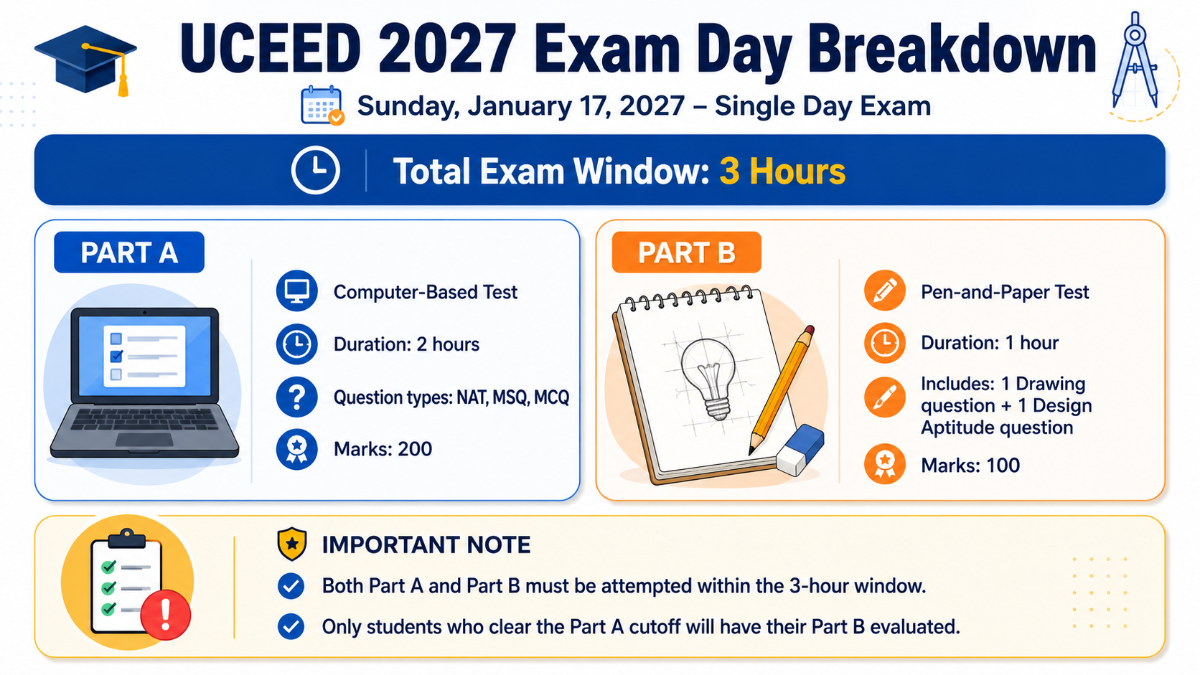 Ques: Who will conduct UCEED in 2027? Ans. IIT Bombay will conduct UCEED 2027. Unlike GATE or JEE Advanced, UCEED is always organized by IIT Bombay. IIT Bombay has been the sole conducting body since UCEED was introduced in 2015.
UCEED Previous Year Exam Dates
Source: uceed.iitb.ac.in UCEED 2027 Important Dates
Source: uceed.iitb.ac.in 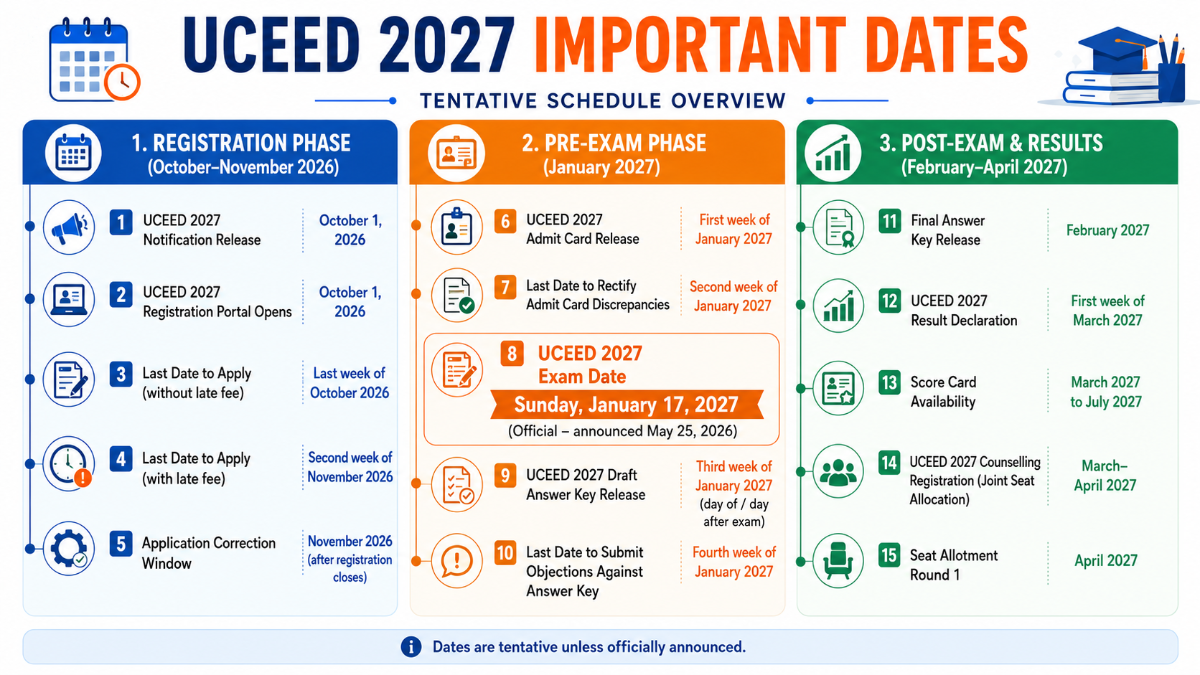 Ques. When can I apply for UCEED 2027? Ans. The UCEED 2027 application process is expected to begin from October 1, 2026, with the last date to apply without a late fee around the last week of October 2026, and extended till the second week of November 2026 with a late fee. Related Links: UCEED 2027 Preparation Tips UCEED 2027 Admit CardIIT Bombay is expected to release the UCEED 2027 admit card in the first week of January 2027 on the official website, uceed.iitb.ac.in.
UCEED 2027 ResultIIT Bombay is expected to declare the UCEED 2027 result in the first week of March 2027 on the official website, uceed.iitb.ac.in.
UCEED 2027 Answer KeyThe draft answer key for UCEED 2027 is expected to be released in the third week of January 2027, shortly after the exam.
UCEED 2027 CounsellingUCEED 2027 counselling, also known as the Joint Seat Allocation process, is expected to begin in March or April 2027 after the result declaration.
Description of the Exam Pattern for UCEED 2027Below are the key features of the exam pattern of UCEED 2027 and its marking scheme. IIT Bombay will release the official UCEED 2027 exam pattern with the information brochure in October 2026. The pattern is expected to remain similar to UCEED 2026.
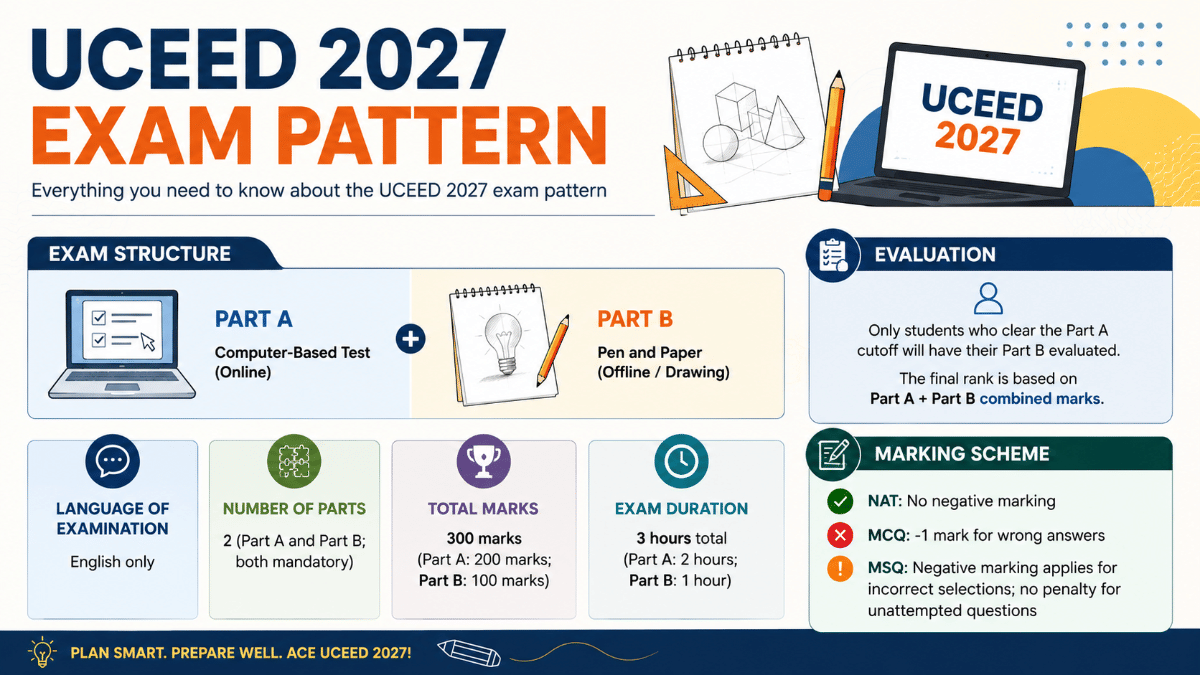 Related Links: Ques. Is UCEED 2027 a single-day exam? Ans. Yes. UCEED is a single-day, single-session exam held from 9:00 AM to 12:00 Noon. The 3-hour window covers both Part A (2 hours) and Part B (1 hour). UCEED 2027 Exam CentresIIT Bombay will manage the UCEED 2027 exam centres across approximately 27 cities in India.
The exact final list of exam cities for UCEED 2027 will be published in the official information brochure in October 2026.
Ques. How many exam centres are there for UCEED 2027? Ans. UCEED 2027 is expected to be held across 27 cities in India, along with one international centre in Dubai. The final city list will be confirmed in the official information brochure in October 2026. UCEED 2027 Exam Dates: Frequently Asked QuestionsQues. What is the official UCEED 2027 exam date? Ans. The official UCEED 2027 exam date is Sunday, January 17, 2027, confirmed by IIT Bombay on May 25, 2026. The exam will be held in a single forenoon session from 9:00 AM to 12:00 Noon. Ques. Who will conduct UCEED 2027? Ans. IIT Bombay will conduct UCEED 2027. IIT Bombay is the sole conducting body for UCEED and organizes the exam every year since its inception in 2015. Ques. When will the UCEED 2027 admit card be released? Ans. The UCEED 2027 admit card is expected to be released in the first week of January 2027. You can download it by logging in with your registered email ID and password at uceed.iitb.ac.in. Ques. What is the last date to register for UCEED 2027? Ans. Registration for UCEED 2027 is expected to start on October 1, 2026, with the last date to apply without a late fee around the last week of October 2026, and with a late fee in the second week of November 2026. Ques. When will UCEED 2027 results be declared? Ans. UCEED 2027 results are expected to be declared in the first week of March 2027. The result will be available only at uceed.iitb.ac.in through your registered login. Ques. Can I change my UCEED 2027 exam city after registration? Ans. No. Centre change requests are not entertained once registration is complete. You must select three cities in order of preference while filling out the application form. Choose carefully. Ques. What is the total duration of the UCEED 2027 exam? Ans. The total UCEED 2027 exam duration is 3 hours - Part A is 2 hours (computer-based) and Part B is 1 hour (pen and paper). Both parts are mandatory. Question PaperUCEED question paper (2026 to 2015) with answer key is available here for download. The UCEED question paper is divided into two parts. Part A computer-based (online) and Part B is pen and paper based (offline). Part A of UCEED question paper has both negative and partial marking.  UCEED 2025 Question Paper with Solution PDF
UCEED 2024 Question Paper with Solution PDF
Year-wise UCEED Question Paper with Solution PDF
Frequently Asked QuestionsQues. What is question pattern of UCEED 2024? Ans. UCEED question paper of UCEED 2024 is: Part A (Online and Computer-Based), and Part B (Offline, Pen and Paper Based) Ques. Was UCEED 2023 tough? Ans.According to responses submitted by students, difficulty level of UCEED 2023 examination was moderate to difficult. Ques. Is the UCEED exam hard? Ans.UCEED exam depends on student’s ability along with logical and analytical skills. Ques. What is the benefit of solving the UCEED 2024 sample papers? Ans.Candidates can get following benefits of solving UCEED 2024 question papers:
Ques. Do candidates need to login with email ID to download UCEED 2024 question papers? Ans.No, candidates are not required to login separately with registered email ID and password to download either UCEED question paper 2024 and answer key. Ques. Can students also download the solutions of UCEED 2024 question papers? Ans.Yes, candidates can download UCEED answer key 2024 containing correct responses of all the questions. Ques. What is UCEED 2024 Syllabus? Ans..
Ques. Are mock tests the same as UCEED sample papers? Ans.UCEED mock test series helps in understanding question paper pattern. However, it is not similar to that UCEED question paper 2024. Question Paper 2015The UCEED 2015 question paper along with the answer key is available for download here. The exam is divided into two parts: Part A (computer-based) and Part B (pen-and-paper based). Please note that Part A includes both negative and partial marking for incorrect or partially correct answers. UCEED 2015 Question Paper with Solution PDF
UCEED Exam PatternThe UCEED (Undergraduate Common Entrance Examination for Design) is an entrance exam conducted by IIT Bombay for admission to undergraduate design programs. The exam assesses a candidate's aptitude for design through various sections that test visualization, creativity, logical reasoning, and drawing skills. The UCEED exam consists of a single paper divided into three sections. Each section evaluates different aspects of design thinking and creativity, with a mix of objective and subjective questions.
Frequently Asked QuestionsQues. What is question pattern of UCEED? Ans. UCEED question paper of UCEED is: Part A (Online and Computer-Based), and Part B (Offline, Pen and Paper Based) Ques. Was UCEED tough? Ans. According to responses submitted by students, difficulty level of UCEED examination was moderate to difficult. Ques. Is the UCEED exam hard? Ans. UCEED exam depends on student’s ability along with logical and analytical skills. Ques. What is the benefit of solving the UCEED sample papers? Ans.Candidates can get following benefits of solving UCEED question papers:
Ques. Do candidates need to login with email ID to download UCEED question papers? Ans.No, candidates are not required to login separately with registered email ID and password to download either UCEED question paper and answer key. Ques. Can students also download the solutions of UCEED question papers? Ans.Yes, candidates can download UCEED answer key containing correct responses of all the questions. Ques. What is UCEED Syllabus? Ans..
Ques. Are mock tests the same as UCEED sample papers? Ans.UCEED mock test series helps in understanding question paper pattern. However, it is not similar to that UCEED question paper. Question Paper 2016The UCEED 2016 question paper along with the answer key is available for download here. The exam is divided into two parts: Part A (computer-based) and Part B (pen-and-paper based). Please note that Part A includes both negative and partial marking for incorrect or partially correct answers. UCEED 2016 Question Paper with Solution PDF
UCEED Exam PatternThe UCEED (Undergraduate Common Entrance Examination for Design) is an entrance exam conducted by IIT Bombay for admission to undergraduate design programs. The exam assesses a candidate's aptitude for design through various sections that test visualization, creativity, logical reasoning, and drawing skills. The UCEED exam consists of a single paper divided into three sections. Each section evaluates different aspects of design thinking and creativity, with a mix of objective and subjective questions.
Frequently Asked QuestionsQues. What is question pattern of UCEED? Ans. UCEED question paper of UCEED is: Part A (Online and Computer-Based), and Part B (Offline, Pen and Paper Based) Ques. Was UCEED tough? Ans. According to responses submitted by students, difficulty level of UCEED examination was moderate to difficult. Ques. Is the UCEED exam hard? Ans. UCEED exam depends on student’s ability along with logical and analytical skills. Ques. What is the benefit of solving the UCEED sample papers? Ans.Candidates can get following benefits of solving UCEED question papers:
Ques. Do candidates need to login with email ID to download UCEED question papers? Ans.No, candidates are not required to login separately with registered email ID and password to download either UCEED question paper and answer key. Ques. Can students also download the solutions of UCEED question papers? Ans.Yes, candidates can download UCEED answer key containing correct responses of all the questions. Ques. What is UCEED Syllabus? Ans..
Ques. Are mock tests the same as UCEED sample papers? Ans.UCEED mock test series helps in understanding question paper pattern. However, it is not similar to that UCEED question paper. Question Paper 2017The UCEED 2017 question paper along with the answer key is available for download here. The exam is divided into two parts: Part A (computer-based) and Part B (pen-and-paper based). Please note that Part A includes both negative and partial marking for incorrect or partially correct answers. UCEED 2017 Question Paper with Solution PDF
UCEED Exam PatternThe UCEED (Undergraduate Common Entrance Examination for Design) is an entrance exam conducted by IIT Bombay for admission to undergraduate design programs. The exam assesses a candidate's aptitude for design through various sections that test visualization, creativity, logical reasoning, and drawing skills. The UCEED exam consists of a single paper divided into three sections. Each section evaluates different aspects of design thinking and creativity, with a mix of objective and subjective questions.
Frequently Asked QuestionsQues. What is question pattern of UCEED? Ans. UCEED question paper of UCEED is: Part A (Online and Computer-Based), and Part B (Offline, Pen and Paper Based) Ques. Was UCEED tough? Ans. According to responses submitted by students, difficulty level of UCEED examination was moderate to difficult. Ques. Is the UCEED exam hard? Ans. UCEED exam depends on student’s ability along with logical and analytical skills. Ques. What is the benefit of solving the UCEED sample papers? Ans.Candidates can get following benefits of solving UCEED question papers:
Ques. Do candidates need to login with email ID to download UCEED question papers? Ans.No, candidates are not required to login separately with registered email ID and password to download either UCEED question paper and answer key. Ques. Can students also download the solutions of UCEED question papers? Ans.Yes, candidates can download UCEED answer key containing correct responses of all the questions. Ques. What is UCEED Syllabus? Ans..
Ques. Are mock tests the same as UCEED sample papers? Ans.UCEED mock test series helps in understanding question paper pattern. However, it is not similar to that UCEED question paper. Question Paper 2018The UCEED 2018 question paper along with the answer key is available for download here. The exam is divided into two parts: Part A (computer-based) and Part B (pen-and-paper based). Please note that Part A includes both negative and partial marking for incorrect or partially correct answers. UCEED 2018 Question Paper with Solution PDF
UCEED Exam PatternThe UCEED (Undergraduate Common Entrance Examination for Design) is an entrance exam conducted by IIT Bombay for admission to undergraduate design programs. The exam assesses a candidate's aptitude for design through various sections that test visualization, creativity, logical reasoning, and drawing skills. The UCEED exam consists of a single paper divided into three sections. Each section evaluates different aspects of design thinking and creativity, with a mix of objective and subjective questions.
Frequently Asked QuestionsQues. What is question pattern of UCEED? Ans. UCEED question paper of UCEED is: Part A (Online and Computer-Based), and Part B (Offline, Pen and Paper Based) Ques. Was UCEED tough? Ans. According to responses submitted by students, difficulty level of UCEED examination was moderate to difficult. Ques. Is the UCEED exam hard? Ans. UCEED exam depends on student’s ability along with logical and analytical skills. Ques. What is the benefit of solving the UCEED sample papers? Ans.Candidates can get following benefits of solving UCEED question papers:
Ques. Do candidates need to login with email ID to download UCEED question papers? Ans.No, candidates are not required to login separately with registered email ID and password to download either UCEED question paper and answer key. Ques. Can students also download the solutions of UCEED question papers? Ans.Yes, candidates can download UCEED answer key containing correct responses of all the questions. Ques. What is UCEED Syllabus? Ans..
Ques. Are mock tests the same as UCEED sample papers? Ans.UCEED mock test series helps in understanding question paper pattern. However, it is not similar to that UCEED question paper. Question Paper 2019The UCEED 2019 question paper along with the answer key is available for download here. The exam is divided into two parts: Part A (computer-based) and Part B (pen-and-paper based). Please note that Part A includes both negative and partial marking for incorrect or partially correct answers. UCEED 2019 Question Paper with Solution PDF
UCEED Exam PatternThe UCEED (Undergraduate Common Entrance Examination for Design) is an entrance exam conducted by IIT Bombay for admission to undergraduate design programs. The exam assesses a candidate's aptitude for design through various sections that test visualization, creativity, logical reasoning, and drawing skills. The UCEED exam consists of a single paper divided into three sections. Each section evaluates different aspects of design thinking and creativity, with a mix of objective and subjective questions.
Frequently Asked QuestionsQues. What is question pattern of UCEED? Ans. UCEED question paper of UCEED is: Part A (Online and Computer-Based), and Part B (Offline, Pen and Paper Based) Ques. Was UCEED tough? Ans. According to responses submitted by students, difficulty level of UCEED examination was moderate to difficult. Ques. Is the UCEED exam hard? Ans. UCEED exam depends on student’s ability along with logical and analytical skills. Ques. What is the benefit of solving the UCEED sample papers? Ans.Candidates can get following benefits of solving UCEED question papers:
Ques. Do candidates need to login with email ID to download UCEED question papers? Ans.No, candidates are not required to login separately with registered email ID and password to download either UCEED question paper and answer key. Ques. Can students also download the solutions of UCEED question papers? Ans.Yes, candidates can download UCEED answer key containing correct responses of all the questions. Ques. What is UCEED Syllabus? Ans..
Ques. Are mock tests the same as UCEED sample papers? Ans.UCEED mock test series helps in understanding question paper pattern. However, it is not similar to that UCEED question paper. Question Paper 2020The UCEED 2020 question paper, along with the official answer key, is now available for download here. The exam is divided into two distinct parts: Part A, which is a computer-based test (online), and Part B, which is pen-and-paper based (offline). UCEED 2020 Question Paper with Solution PDF
Frequently Asked QuestionsQues. What is question pattern of UCEED? Ans. UCEED question paper of UCEED is: Part A (Online and Computer-Based), and Part B (Offline, Pen and Paper Based) Ques. Was UCEED tough? Ans. According to responses submitted by students, difficulty level of UCEED examination was moderate to difficult. Ques. Is the UCEED exam hard? Ans. UCEED exam depends on student’s ability along with logical and analytical skills. Ques. What is the benefit of solving the UCEED sample papers? Ans.Candidates can get following benefits of solving UCEED question papers:
Ques. Do candidates need to login with email ID to download UCEED question papers? Ans.No, candidates are not required to login separately with registered email ID and password to download either UCEED question paper and answer key. Ques. Can students also download the solutions of UCEED question papers? Ans.Yes, candidates can download UCEED answer key containing correct responses of all the questions. Ques. What is UCEED Syllabus? Ans..
Ques. Are mock tests the same as UCEED sample papers? Ans.UCEED mock test series helps in understanding question paper pattern. However, it is not similar to that UCEED question paper. Question Paper 2021The UCEED 2021 question paper, along with the official answer key, is now available for download here. The exam is divided into two distinct parts: Part A, which is a computer-based test (online), and Part B, which is pen-and-paper based (offline). UCEED 2021 Question Paper with Solution PDF
Frequently Asked QuestionsQues. What is question pattern of UCEED? Ans. UCEED question paper of UCEED is: Part A (Online and Computer-Based), and Part B (Offline, Pen and Paper Based) Ques. Was UCEED tough? Ans. According to responses submitted by students, difficulty level of UCEED examination was moderate to difficult. Ques. Is the UCEED exam hard? Ans. UCEED exam depends on student’s ability along with logical and analytical skills. Ques. What is the benefit of solving the UCEED sample papers? Ans.Candidates can get following benefits of solving UCEED question papers:
Ques. Do candidates need to login with email ID to download UCEED question papers? Ans.No, candidates are not required to login separately with registered email ID and password to download either UCEED question paper and answer key. Ques. Can students also download the solutions of UCEED question papers? Ans.Yes, candidates can download UCEED answer key containing correct responses of all the questions. Ques. What is UCEED Syllabus? Ans..
Ques. Are mock tests the same as UCEED sample papers? Ans.UCEED mock test series helps in understanding question paper pattern. However, it is not similar to that UCEED question paper. Question Paper 2022The UCEED 2022 question paper along with the answer key is available for download here. The exam is divided into two parts: Part A (computer-based) and Part B (pen-and-paper based). Please note that Part A includes both negative and partial marking for incorrect or partially correct answers. UCEED 2022 Question Paper with Solution PDF
UCEED Exam PatternThe UCEED (Undergraduate Common Entrance Examination for Design) is an entrance exam conducted by IIT Bombay for admission to undergraduate design programs. The exam assesses a candidate's aptitude for design through various sections that test visualization, creativity, logical reasoning, and drawing skills. The UCEED exam consists of a single paper divided into three sections. Each section evaluates different aspects of design thinking and creativity, with a mix of objective and subjective questions.
Frequently Asked QuestionsQues. What is question pattern of UCEED? Ans. UCEED question paper of UCEED is: Part A (Online and Computer-Based), and Part B (Offline, Pen and Paper Based) Ques. Was UCEED tough? Ans. According to responses submitted by students, difficulty level of UCEED examination was moderate to difficult. Ques. Is the UCEED exam hard? Ans. UCEED exam depends on student’s ability along with logical and analytical skills. Ques. What is the benefit of solving the UCEED sample papers? Ans.Candidates can get following benefits of solving UCEED question papers:
Ques. Do candidates need to login with email ID to download UCEED question papers? Ans.No, candidates are not required to login separately with registered email ID and password to download either UCEED question paper and answer key. Ques. Can students also download the solutions of UCEED question papers? Ans.Yes, candidates can download UCEED answer key containing correct responses of all the questions. Ques. What is UCEED Syllabus? Ans..
Ques. Are mock tests the same as UCEED sample papers? Ans.UCEED mock test series helps in understanding question paper pattern. However, it is not similar to that UCEED question paper. Question Paper 2023The UCEED 2023 question paper along with the answer key is available for download here. The exam is divided into two parts: Part A (computer-based) and Part B (pen-and-paper based). Please note that Part A includes both negative and partial marking for incorrect or partially correct answers. UCEED 2023 Question Paper with Solution PDF
UCEED Exam PatternThe UCEED (Undergraduate Common Entrance Examination for Design) is an entrance exam conducted by IIT Bombay for admission to undergraduate design programs. The exam assesses a candidate's aptitude for design through various sections that test visualization, creativity, logical reasoning, and drawing skills. The UCEED exam consists of a single paper divided into three sections. Each section evaluates different aspects of design thinking and creativity, with a mix of objective and subjective questions.
Frequently Asked QuestionsQues. What is question pattern of UCEED? Ans. UCEED question paper of UCEED is: Part A (Online and Computer-Based), and Part B (Offline, Pen and Paper Based) Ques. Was UCEED tough? Ans. According to responses submitted by students, difficulty level of UCEED examination was moderate to difficult. Ques. Is the UCEED exam hard? Ans. UCEED exam depends on student’s ability along with logical and analytical skills. Ques. What is the benefit of solving the UCEED sample papers? Ans.Candidates can get following benefits of solving UCEED question papers:
Ques. Do candidates need to login with email ID to download UCEED question papers? Ans.No, candidates are not required to login separately with registered email ID and password to download either UCEED question paper and answer key. Ques. Can students also download the solutions of UCEED question papers? Ans.Yes, candidates can download UCEED answer key containing correct responses of all the questions. Ques. What is UCEED Syllabus? Ans..
Ques. Are mock tests the same as UCEED sample papers? Ans.UCEED mock test series helps in understanding question paper pattern. However, it is not similar to that UCEED question paper. Question Paper 2024The UCEED 2024 question paper, along with the official answer key, is now available for download here. The exam is divided into two distinct parts: Part A, which is a computer-based test (online), and Part B, which is pen-and-paper based (offline). UCEED 2024 Question Paper with Solution PDF
Frequently Asked QuestionsQues. What is question pattern of UCEED? Ans. UCEED question paper of UCEED is: Part A (Online and Computer-Based), and Part B (Offline, Pen and Paper Based) Ques. Was UCEED tough? Ans. According to responses submitted by students, difficulty level of UCEED examination was moderate to difficult. Ques. Is the UCEED exam hard? Ans. UCEED exam depends on student’s ability along with logical and analytical skills. Ques. What is the benefit of solving the UCEED sample papers? Ans.Candidates can get following benefits of solving UCEED question papers:
Ques. Do candidates need to login with email ID to download UCEED question papers? Ans.No, candidates are not required to login separately with registered email ID and password to download either UCEED question paper and answer key. Ques. Can students also download the solutions of UCEED question papers? Ans.Yes, candidates can download UCEED answer key containing correct responses of all the questions. Ques. What is UCEED Syllabus? Ans..
Ques. Are mock tests the same as UCEED sample papers? Ans.UCEED mock test series helps in understanding question paper pattern. However, it is not similar to that UCEED question paper. Question Paper 2025UCEED question paper 2025 with answer key is available here for download. The question paper is divided into two parts. Part A computer-based (online) and Part B is pen and paper based (offline). Part A of UCEED question paper has both negative and partial marking. UCEED 2025 Question Paper with Solution PDF
Year-wise UCEED Question Paper with Solution PDF
Frequently Asked QuestionsQues. What is question pattern of UCEED 2025? Ans. UCEED question paper of UCEED 2025 is: Part A (Online and Computer-Based), and Part B (Offline, Pen and Paper Based) Ques. Was UCEED 2025 tough? Ans.According to responses submitted by students, difficulty level of UCEED 2025 examination was moderate to difficult. Ques. Is the UCEED exam hard? Ans.UCEED exam depends on student’s ability along with logical and analytical skills. Ques. What is the benefit of solving the UCEED 2025 sample papers? Ans.Candidates can get following benefits of solving UCEED 2025 question papers:
Ques. Do candidates need to login with email ID to download UCEED 2025 question papers? Ans.No, candidates are not required to login separately with registered email ID and password to download either UCEED question paper 2025 and answer key. Ques. Can students also download the solutions of UCEED 2025 question papers? Ans.Yes, candidates can download UCEED answer key 2024 containing correct responses of all the questions. Ques. What is UCEED 2025 Syllabus? Ans..
Ques. Are mock tests the same as UCEED sample papers? Ans.UCEED mock test series helps in understanding question paper pattern. However, it is not similar to that UCEED question paper 2024. Question Paper 2026UCEED 2026 Question paper with answer key is available here for download. The question paper is divided into two parts. Part A computer-based (online) and Part B is pen and paper based (offline). Part A of UCEED question paper has both negative and partial marking. UCEED 2026 Question Paper with Solution PDF
UCEED 2026 Exam PatternThe UCEED (Undergraduate Common Entrance Examination for Design) is an entrance exam conducted by IIT Bombay for admission to undergraduate design programs. The exam assesses a candidate's aptitude for design through various sections that test visualization, creativity, logical reasoning, and drawing skills. The UCEED exam consists of a single paper divided into three sections. Each section evaluates different aspects of design thinking and creativity, with a mix of objective and subjective questions.
UCEED 2026 Exam StrategyFrequently Asked QuestionsQues. What is question pattern of UCEED 2026? Ans. UCEED question paper of UCEED 2026 is: Part A (Online and Computer-Based), and Part B (Offline, Pen and Paper Based) Ques. Was UCEED 2026 tough? Ans.According to responses submitted by students, difficulty level of UCEED 2026 examination was moderate to difficult. Ques. Is the UCEED exam hard? Ans.UCEED exam depends on student’s ability along with logical and analytical skills. Ques. What is the benefit of solving the UCEED 2026 sample papers? Ans.Candidates can get following benefits of solving UCEED 2026 question papers:
Ques. Do candidates need to login with email ID to download UCEED 2026 question papers? Ans.No, candidates are not required to login separately with registered email ID and password to download either UCEED question paper 2026 and answer key. Ques. Can students also download the solutions of UCEED 2026 question papers? Ans.Yes, candidates can download UCEED answer key 2026 containing correct responses of all the questions. Ques. What is UCEED 2026 Syllabus? Ans..
Ques. Are mock tests the same as UCEED sample papers? Ans.UCEED mock test series helps in understanding question paper pattern. However, it is not similar to that UCEED question paper 2026. UCEED Sample PapersThis page gives you 20 full-length UCEED sample papers with solutions that you can download as free PDFs and solve under real exam conditions. Each paper follows the latest UCEED exam pattern, so you practise Part A and Part B exactly the way they appear in the actual test. Use the papers to build speed, fix weak topics, and plan your last few weeks. The official website for the exam is uceed.iitb.ac.in. UCEED Sample Papers 2026 - Download Free PDF with SolutionsDownload any of the 20 full-length UCEED sample papers below. Each PDF has the complete paper, step-by-step Part A solutions, and an answer key. Start with Paper 1 and move up as your accuracy improves.
UCEED Exam Pattern and Marks Distribution 2026UCEED is a single integrated design-aptitude test - there are no separate subjects like Physics or Maths. The paper is split by question type, not subject. Solve every sample paper with this structure in mind.
Why UCEED Part B Drawing Practice Matters as Much as Part AMost students spend all their time on Part A objective questions and leave Part B for the last week. That is the single biggest mistake. Part B carries a third of the marks and has its own qualifying cut-off, so a strong Part A cannot rescue a weak drawing.
UCEED Topic Wise Weightage - High Scoring Areas to Focus in Sample PapersPart A questions come from a fixed set of topic areas. Use this rough weightage to decide where to spend your practice time while solving the sample papers.
Easy marks to lock in: the awareness and general-knowledge questions are the quickest to revise and rarely tricky, so treat them as guaranteed marks and never leave them for the end. UCEED Sample Paper Video Solutions 2026 - Watch Before You Start SolvingWatching one expert walkthrough before solving on your own shows you the ideal solving approach - not just the answer, but the thinking behind it. This video solves a full UCEED Part A paper and explains the strategy for the next attempt. Source: SANYUKTA SINGH STUDIO How to Use UCEED Sample Papers to Clear in First AttemptSolving papers only helps if you review them the right way. Follow this method for every paper you download here.
How to Practise UCEED Part B Sketching - The Skill Most Students IgnorePart B is a drawing and design test, and examiners reward clear thinking shown through sketches, not fancy art. Build these habits alongside your sample papers.
UCEED 4 Week Preparation Plan Using Sample PapersFour weeks is enough to peak if you use these papers with a clear plan. Keep drawing practice running through every week.
UCEEED Sample Paper FAQsQues. How many UCEED sample papers are enough to clear in the first attempt? Ans. Solving 15 to 20 full-length UCEED sample papers under actual exam conditions is generally sufficient, provided every paper is thoroughly analysed. Reviewing mistakes and improving weak areas is more important than simply solving a large number of papers. Ques. Are UCEED previous year questions repeated in new papers? Ans. Exact questions are rarely repeated in UCEED. However, the exam follows similar concepts, question types, and difficulty levels every year. Practising previous year questions along with fresh sample papers helps candidates become familiar with the actual exam pattern. Ques. Which UCEED sample paper should I start with? Ans. Candidates should begin with Paper 1 and solve the papers sequentially. This approach helps build familiarity with the exam pattern before attempting more challenging papers. It is also recommended to complete an entire paper before checking the solutions. Ques. Can I clear UCEED in 30 days using only sample papers? Ans. Sample papers are an important part of a 30-day preparation strategy, but they should be combined with regular Part B sketching practice. Candidates should solve one full paper at a time, analyse their mistakes, and improve weak topics while maintaining consistent drawing practice. Ques. Where can I download UCEED sample papers with solutions PDF for free? Ans. Candidates can download all 20 UCEED sample papers with solutions free of cost from the table available on this page. Each PDF contains the complete question paper, detailed Part A solutions, and answer key. Official previous year papers and answer keys are also available on the UCEED official website. Ques. Is there negative marking in UCEED sample papers? Ans. Yes, the sample papers follow the official UCEED marking scheme. MCQs carry negative marking of -0.71 for every incorrect answer, while MSQs carry -1 if any incorrect option is selected. NAT questions and Part B do not have negative marking. Seat MatrixUCEED 2026 seat intake covers a total of 245 B.Des seats across seven premier design institutions in India — six IITs and IIITDM Jabalpur. IIT Bombay conducts UCEED on behalf of all participating institutes, and all 245 seats are filled through a centralised Joint Admission Process (JAP) based on UCEED 2026 scores.
Key Summary
UCEED 2026 Seat Intake: Overview UCEED 2026 Seat Intake: OverviewUCEED (Undergraduate Common Entrance Examination for Design) is a national-level entrance exam conducted by IIT Bombay for admission to the Bachelor of Design (B.Des) programme. UCEED 2026 seat intake stands at 245 seats distributed across six IITs and IIITDM Jabalpur. All 245 seats are for the four-year B.Des programme. There is no state quota or All India Quota (AIQ) split in UCEED — all seats are in the All India Pool, filled through the centralised Joint Admission Process (JAP) run by IIT Bombay. This distinguishes UCEED from medical and engineering exams where state and central quotas operate as separate pools.
UCEED 2026 ran five centralised rounds of seat allotment between April and July 2026. Round V was the final round — allotment was released on July 9, 2026, and the fee acceptance deadline (FREEZE option) was July 13, 2026. No withdrawal is permitted after Round V. With the fee acceptance window now closed, the main Joint Admission Process is complete. The official post-Round V vacancy snapshot — showing any seats that remain unfilled across all institutes — is expected to be published on the UCEED portal shortly.
Institute-Wise Seat Intake UCEED 2026 Institute-Wise Seat IntakeThe 245 B.Des seats for UCEED 2026 are spread across seven institutes in six states. Seat counts per institute range from 16 seats at IIT Indore to 66 seats at IIITDM Jabalpur. The table below reflects the official UCEED 2026 seat matrix published on the UCEED portal, with category-wise figures per institute.
Note: PwD seats are horizontal reservations carved from within each vertical category. Where shown, "incl. 1 PwD" means one seat in that cell is sub-reserved for PwD students. The 13 total PwD sub-seats are included in the category and institute totals above — they are not additional seats. For the complete sub-category breakdown (Open-PwD, EWS-PwD, OBC-NCL-PwD, SC-PwD, ST-PwD per institute), refer to the official seat matrix at uceed.iitb.ac.in. Madhya Pradesh accounts for 82 of the 245 seats — the highest for any state — owing to both IIT Indore (16 seats) and IIITDM Jabalpur (66 seats) being located there. Assam (IIT Guwahati, 56 seats) and Maharashtra (IIT Bombay, 37 seats) are the next-largest represented states. UCEED 2026 Seat Intake in MaharashtraIIT Bombay’s IDC School of Design offers 37 B.Des seats for UCEED 2026. The category split is 15 Open, 10 OBC-NCL, 5 SC, 4 EWS, and 3 ST. Two PwD sub-seats are included within the Open and OBC-NCL categories respectively. IIT Bombay’s IDC is historically the most competitive UCEED destination — its 37-seat intake relative to nationwide applicant demand produces the tightest closing ranks of any participating institute. UCEED 2026 Seat Intake in AssamIIT Guwahati’s Department of Design offers 56 B.Des seats for UCEED 2026 — the second-highest intake across all participating institutes. With 23 Open-category seats (the highest Open allocation after IIITDM Jabalpur), IIT Guwahati is among the most accessible IITs in UCEED. Three PwD sub-seats are distributed across the Open, EWS, and OBC-NCL categories. UCEED 2026 Seat Intake in Madhya PradeshTwo institutes in Madhya Pradesh participate in UCEED 2026. IIITDM Jabalpur contributes 66 seats — the highest among all institutes — while IIT Indore’s School of Innovation contributes 16 seats. Together, they account for 82 B.Des seats. IIITDM Jabalpur is also the only institute permitted to run an institutional spot round for any seats unfilled after all five JAP rounds. UCEED 2026 Seat Intake in TelanganaIIT Hyderabad’s Department of Design offers 30 B.Des seats for UCEED 2026. The breakdown is 12 Open, 8 OBC-NCL, 5 SC, 3 EWS, and 2 ST. Two PwD sub-seats are included — one in OBC-NCL and one in ST. UCEED 2026 Seat Intake in UttarakhandIIT Roorkee’s Department of Design offers 20 B.Des seats for UCEED 2026. One PwD sub-seat is in the SC category. IIT Roorkee is among the newer UCEED participants, expanding access to IIT-branded design education in northern India. UCEED 2026 Seat Intake in DelhiIIT Delhi’s Department of Design offers 20 B.Des seats for UCEED 2026. One PwD sub-seat is in the EWS category. Despite its smaller intake of 20 seats, IIT Delhi’s brand and location in the national capital make it among the most sought-after UCEED destinations, with closing ranks that typically rival IIT Bombay. How Many Seats in UCEED? How Many Seats Are in UCEED 2026?UCEED 2026 offers 245 B.Des seats in total. This is a limited seat pool compared to engineering or medical entrance exams, making UCEED one of the most selective design entrance exams in India. Every seat is for the four-year Bachelor of Design (B.Des) programme — UCEED does not cover postgraduate design programmes. The seat count has grown as more IITs joined the Joint Admission Process. UCEED 2026 has seven participating institutes — a significant expansion from the three institutes that made up the original cohort when the exam was introduced in 2015. IIT Indore and IIT Roorkee are among the more recent additions, each contributing 16 and 20 seats respectively to the overall pool and lowering cutoff pressure across the board.
IIITDM Jabalpur and IIT Guwahati together account for nearly half (49.8%) of all UCEED 2026 seats. Students open to these two institutes gain access to the largest share of the total pool — a factor that significantly improves allotment probability, especially at mid-range UCEED ranks. Category-Wise Seat Distribution UCEED 2026 Seat Matrix: Category-Wise DistributionUCEED 2026 seat distribution follows the reservation policy mandated by the Government of India for central educational institutions. Of the 245 total seats, 148 seats (60.4%) are reserved for OBC-NCL, SC, ST, and EWS students. The remaining 97 seats (39.6%) are in the Open (General / Unreserved) category.
PwD (Persons with Disability) seats are horizontal reservations — 5% of seats in each vertical category are sub-reserved for PwD students. The 13 PwD sub-seats are included in the category totals above; they do not add to the 245 figure. A PwD student in the OBC-NCL category competes within the OBC-NCL-PwD sub-pool (5 seats across all institutes in total). Key eligibility conditions for category seats in UCEED 2026:
NRI / OCI / Foreign National Seats UCEED 2026 Seats for NRI / OCI / Foreign NationalsUCEED 2026 allows foreign nationals and certain categories of Overseas Citizens of India (OCI) to participate in the Joint Admission Process. Eligible applicants are considered for supernumerary seats capped at 10% of total seats per programme per institute. These supernumerary seats are not pre-fixed in the published seat matrix. They are allocated dynamically — a foreign national or eligible OCI applicant is allotted a seat only after Indian national admission in each round, and only if their UCEED 2026 rank equals or betters the closing rank of the Open (General) category at that programme.
The supernumerary foreign national quota does not displace the 245 seats available to Indian nationals. No separate NRI quota number is published in the UCEED 2026 seat matrix — these seats are supernumerary and allocated institute-programme-wise after Indian national rounds close. How Seat Matrix Affects Cutoff How the UCEED Seat Matrix Affects CutoffThe UCEED seat matrix directly shapes the competitiveness of closing ranks at each institute and category. With only 245 total B.Des seats across all institutes, UCEED is one of the most selective design entrance exams in India. Understanding seat distribution by institute helps you interpret why certain programmes have tighter cutoffs than others. The underlying principle: fewer seats relative to demand at a given institute means higher UCEED scores are needed to secure admission there. Here is how this plays out across UCEED 2026 institutes:
Since all five UCEED 2026 counselling rounds are now complete, closing ranks for every institute, programme, and category combination are available on the official UCEED portal. These Round V closing ranks — the final cutoffs for UCEED 2026 — serve as the benchmark for planning preparation targets for UCEED 2027. List of Courses and Seats List of Courses and Seats Under UCEED 2026UCEED 2026 is an entrance exam exclusively for undergraduate design education. All 245 seats available through UCEED 2026 are for the Bachelor of Design (B.Des) programme — a 4-year undergraduate degree. UCEED does not offer seats in any postgraduate or other programme.
While every institute awards a B.Des degree, the programme character differs meaningfully by institute:
Students seeking M.Des admission must appear for CEED (Common Entrance Exam for Design) — a separate national-level exam also conducted by IIT Bombay, with its own eligibility criteria and syllabus. UCEED scores are not valid for CEED-based M.Des admissions. Frequently Asked Questions UCEED 2026 Seat Matrix FAQsQues. How many total seats are available in UCEED 2026? Ans. UCEED 2026 has a total of 245 B.Des seats across seven participating institutes — IIT Bombay (37), IIT Delhi (20), IIT Guwahati (56), IIT Hyderabad (30), IIT Indore (16), IIT Roorkee (20), and IIITDM Jabalpur (66). All seats are for the 4-year Bachelor of Design programme. Ques. Which institute offers the highest and lowest seats in UCEED 2026? Ans. IIITDM Jabalpur has the highest intake at 66 seats — about 26.9% of all UCEED 2026 seats. IIT Indore has the fewest seats at 16. IIT Delhi and IIT Roorkee are tied at 20 seats each — the joint second-lowest. Ques. How many OBC-NCL seats are available in UCEED 2026? Ans. 66 seats are reserved for OBC-NCL (Other Backward Classes — Non-Creamy Layer) students in UCEED 2026, which is 27% of the total intake. Within these 66 seats, 5 are sub-reserved for OBC-NCL-PwD students. Only Non-Creamy Layer OBC students are eligible — a valid NCL certificate is mandatory. Ques. How many PwD seats are there in UCEED 2026 and how are they distributed? Ans. There are 13 PwD sub-seats in UCEED 2026, distributed as horizontal reservation within each vertical category: 3 in Open, 5 in OBC-NCL, 2 in EWS, 2 in SC, and 1 in ST. These are not additional seats — they are carved from within the 245 total. A minimum of 40% certified disability is required to claim PwD reservation. Ques. Are there NRI or foreign national seats in UCEED 2026? Ans. Yes. Foreign nationals and eligible OCI card holders (card issued on or after March 4, 2021) may be allotted supernumerary seats capped at 10% of total seats per programme per institute. These are allocated dynamically after Indian national admission in each round, and only if the applicant matches or betters the Open category closing rank in that round. No fixed NRI quota number is published in the seat matrix. Ques. Does UCEED 2026 have any state quota seats? Ans. No. All 245 UCEED 2026 seats are in the All India Pool. Unlike NEET or JEE Mains (which have 15% AIQ and 85% state quota splits), UCEED has no state quota. Admission is centralised through the Joint Admission Process (JAP) run by IIT Bombay, equally open to students from all states. Ques. How does the UCEED seat matrix affect cutoffs? Ans. Fewer seats at an institute relative to applicant demand means a tighter closing rank (cutoff). IIT Bombay (37 seats) and IIT Delhi (20 seats) historically record the most competitive UCEED closing ranks. IIITDM Jabalpur, with 66 seats, tends to show more accessible closing ranks. Within any institute, the Open category cutoff is typically the highest, since all eligible students compete in it. Ques. What happens to UCEED 2026 seats that are not filled after Round V? Ans. After Round V — the final and binding round — any seats at the six IITs that remain unfilled lapse; those IITs do not conduct spot rounds. IIITDM Jabalpur is the only exception — it is permitted to conduct an institutional-level spot round for any of its seats remaining vacant after the main JAP concludes. The official post-Round V vacancy snapshot, confirming unfilled seat counts across all institutes, is expected on the UCEED portal. Ques. Are OCI card holders eligible for reserved category seats in UCEED 2026? Ans. No — OCI card holders are not entitled to OBC-NCL, SC, ST, or EWS reservation benefits under UCEED 2026. OCI/PIO card holders whose cards were issued on or after March 4, 2021 are treated as foreign nationals (eligible for supernumerary seats only). Those whose cards were issued before March 4, 2021 are treated as Indian nationals but compete only in the Open (General) category — without reserved category benefits. Ques. Can you apply for M.Des programmes using UCEED 2026 scores? Ans. No. UCEED scores are valid only for B.Des (undergraduate) admissions. Admission to M.Des programmes at IITs or IISc requires qualifying CEED (Common Entrance Exam for Design) — a separate exam also conducted by IIT Bombay, with a different syllabus and eligibility criteria targeting postgraduate design education. Disclaimer: The seat matrix data provided here is based on official UCEED 2026 sources and publicly available information as of July 17, 2026. Actual seat counts, including post-Round V vacancy figures, may vary. Always verify with the official UCEED portal at uceed.iitb.ac.in before making academic decisions. Preparation TipsUCEED study materials include books on Quantitative Aptitude, Verbal & Non-verbal Reasoning by R.S. Agarwal, PYQs, mock tests, books, and Video tutorials on Sketching. 68% of toppers rely on a fixed mix of 3-4 books. R.S.Agarwal books are suggested by 82% of top rankers. 64% aspirants use online tutorials alongside sketching workbooks. PYQs, as an important study guide, contribute to a 40% practice boost.
Also Read  Key Summary
UCEED Study Material Free PDF DownloadUCEED Study material free PDF Download is not widely available online. While several blogs, platforms provide study materials but they come with certain fees ranging up to ₹8000.
UCEED Study Materials-Recommended BooksUCEED Study Materials come with a combination of 3-4 recommended textbooks covering all the syllabus topics.
Here is the table of recommended books by topics covered in the syllabus;  Also Read UCEED Question Paper
UCEED Question Papers as UCEED Study material
UCEED Previous Question Papers- Official Link
UCEED Online Study MaterialWith over 13,000 aspirants competing for fewer than 600 B.Des seats annually, online study materials have become a core part of UCEED study materials. Over 70% of UCEED candidates now rely on online study material alongside books. Several Quora users have suggested Bhanwar Ratho Design Studio Materials and Pahal Design Online materials to the question “How do I study for the UCEED Exam?” These online materials include;
Some notable online preparation platforms include;
 UCEED Sample Papers as UCEED Study Materials
UCEED 2026 Exam Pattern
Also Read UCEED 2025 Information brochureWhat is the UCEED Syllabus?Understanding the syllabus is a must to decide on proper UCEED study materials.
Also Read UCEED Syllabus Official LinkUCEED Study Material FAQsQues. How should I prepare for UCEED? Ans. To Prepare for you, follow the following steps.
Ques. What is the study material for UCEED 2026? Ans.UCEED Study Materials come with a combination of 3-4 recommended textbooks covering all the syllabus topics.
Ques. How many attempts for UCEED? Ans.As per IIT Bombay eligibility rules, a candidate can attempt UCEED a maximum of two times in consecutive years immediately after Class 12.
Ques. Is 3 months enough for UCEED? Ans. Yes, three months are enough for UCEED, only if;
Ques. Is UCEED easier than JEE? Ans. In terms of question paper difficulty, JEE papers are tougher than UCED.
Ques. Is UCEED easier than NIFT? Ans. NIFT papers are generally easier than UCEED.
Ques. Was UCEED 2025 tough? Ans.The UCEED 2025 paper was easy to moderate.
Ques. Which stream is best for UCEED? Ans.UCEED is open for all candidates who have passed 12th or equivalent, irrespective of the stream.
Ques. How many people pass the UCEED? Ans.The passing rate for UCEED ranges from 30%-40%.
More on Undergraduate Common Entrance Examination for Design
Eligibility Criteria
Application Process
Exam Pattern
Syllabus
Cut-offs
Results
Admit Card
Answer Key
Counselling
Exam Dates
Question Paper
Question Paper 2015
Question Paper 2016
Question Paper 2017
Question Paper 2018
Question Paper 2019
Question Paper 2020
Question Paper 2021
Question Paper 2022
Question Paper 2023
Question Paper 2024
Question Paper 2025
Question Paper 2026
UCEED Sample Papers
Seat Matrix
Preparation Tips
Request a callbackYou're on the listA counsellor will call you on shortly. | ||||||||||||||||||||||||||||||||||||||||||||||||||||||||||||||||||||||||||||||||||||||||||||||||||||||||||||||||||||||||||||||||||||||||||||||||||||||||||||||||||||||||||||||||||||||||||||||||||||||||||||||||||||||||||||||||||||||||||||||||||||||||||||||||||||||||||||||||||||||||||||||||||||||||||||||||||||||||||||||||||||||||||||||||||||||||||||||||||||||||||||||||||||||||||||||||||||||||||||||||||||||||||||||||||||||||||||||||||||||||||||||||||||||||||||||||||||||||||||||||||||||||||||||||||||||||||||||||||||||||||||||||||||||||||||||||||||||||||||||||||||||||||||||||||||||||||||||||||||||||||||||||||||||||||||||||||||||||||||||||||||||||||||||||||||||||||||||||||||||||||||||||||||||||||||||||||||||||||||||||||||||||||||||||||||||||||||||||||||||||||||||||||||||||||||||||||||||||||||||||||||||||||||||||||||||||||||||||||||||||||||||||||||||||||||||||||||||||||||||||||||||||||||||||||||||||||||||||||||||||||||||||||||||||||||||||||||||||||||||||||||||||||||||||||||||||||||||||||||||
