West Bengal Joint Entrance Examination
The West Bengal Joint Entrance Examination (WBJEE) is an offline exam for Class 12 students, admitting them to undergraduate courses in Engineering, Pharmacy, and Architecture in West Bengal.
Overview
What is WBJEE 2026?
WBJEE is a state-level entrance exam conducted by the WBJEE Board. It selects students for admission to undergraduate courses in Engineering & Technology, Pharmacy, and Architecture in West Bengal.
Admission is offered in Universities, Govt. Colleges, and Self-Financed Institutes in the state. The exam is conducted in OMR-based offline mode in 2 papers.
- Candidates appearing in both papers are eligible for the General Merit Rank (GMR) and Pharmacy Merit Rank (PMR).
- Such candidates are considered for admission in all courses of Engineering and Pharmacy.
- Candidates appearing only in Paper II are eligible for the Pharmacy Merit Rank (PMR) only.
- Candidates appearing only in Paper I are not eligible for any rank.
WBJEE 2026 Highlights
The official notification and registration schedule were released on March 5 on the official website of WBJEE, wbjeeb.nic.in. The exam is held offline and covers three subjects: Physics, Chemistry, and Mathematics.
In 2025, as per official data, around 1,01,643 candidates appeared for the exam. This included 23,850 candidates from outside West Bengal.
WBJEE Registration Past Year Trends (2020-2025)
The number of candidates appearing for WBJEE has dropped in recent years. The table below shows the registration trend.
| Year | Number of Candidates |
|---|---|
| 2024 | 1,42,694 |
| 2025 | 1,01,643 |
In 2025, Aniruddha Chakrabarti from the CISCE board topped the exam with All India Rank 1. The pass percentage in the exam has remained high, around 98-99%, since 2021.
WBJEE 2026 Exam Pattern
The exam consists of 2 papers. Paper 1 is Mathematics, and Paper 2 is Physics and Chemistry.
| Paper | Subject | Number of Questions | Marks |
|---|---|---|---|
| Paper 1 | Mathematics | 75 | 100 |
| Paper 2 | Physics and Chemistry | 40 each | 100 |
WBJEE 2026 Eligibility Criteria
To be eligible, a candidate must have passed class 12th or be appearing in class 12th. The lower age limit is 17 years, and there is no upper age limit for the exam.
WBJEE 2026 Application Fee
The application fee depends on the gender and category of the candidate. The fee structure is given below.
| Category | Fee |
|---|---|
| Male candidates in the general category | Rs. 500 |
| Female candidates | Rs. 400 |
WBJEE 2026 Merit Rank and Results
The merit ranks are prepared based on the marks secured in the entrance test. The document will be verified by the respective institutes during and after the results.
WBJEE 2026: Highlights
The West Bengal Joint Entrance Examination (WBJEE) is a state-level entrance test. It is conducted once a year by the WBJEE Board.
| Particulars | Details |
|---|---|
| Exam | West Bengal Joint Entrance Examination (WBJEE) |
| Official Website | wbjeeb.nic.in |
| Conducting Body | WBJEE Board |
| Frequency of Exam | Once a year |
| Mode of Application | Online |
| Mode of Exam | Offline |
| Question Type | Multiple Choice Questions (MCQs) |
| Exam Duration | 2 hours for each paper |
| Mode of Counselling | Online |
| Subjects | Physics, Chemistry, and Mathematics |
| Courses offered | Engineering & Technology, Pharmacy, and Architecture |
| Marking Scheme | Category 1 questions: ¼ Category 2 questions: ½ Category 3 questions: No negative marking |
WBJEE 2026: Important Dates
The official notification for WBJEE 2026 is expected to be released on March 5. The application process will begin on March 10.
| Activity | Dates (Out) |
|---|---|
| Official Notification Release | March 5 |
| Start of online application with payment of fees | March 10 |
| Last Date of Online Application | April 5 |
| Online correction and downloading revised confirmation page | Second Week of April |
| Admit Card | Late April |
| Date of Examination | May 24 |
| Answer Key | May 2026 |
| Results | June 2026 |
| Counselling | June/July 2026 |
WBJEE 2026: Eligibility Criteria
The WBJEE Board will release the official eligibility criteria on its website along with the information bulletin. The criteria below are based on the previous year's pattern.
Eligibility for appearing in WBJEE
- Must be a citizen of India or OCI
- Passed or appearing in 10+2 or class 12th
- The lower age limit is 17 years, with no upper age limit
Note: For admission to the degree-level Marine Engineering Course, the upper age limit is 25 Years.
Academic Criteria
For Engineering/Technology courses
- Candidates should have passed 10+2 examination with the following subjects:
Physics/Mathematics/ Chemistry/ Computer Science/ Electronics/ Information Technology/ Biology/Informatics Practices/ Biotechnology/ Technical Vocational subject/ Agriculture/ Engineering Graphics/ Business Studies/ Entrepreneurship
- For agriculture engineering: Must have obtained at least 45% marks (40% in case of reserved categories)
- Other criteria to be fulfilled for admission
- Passed in English in 12th with at least 30% marks
- Passed theoretical and practical/project exams in all permitted subject combinations
For Pharmacy courses
- Must have passed '10+2' examination with Physics, Chemistry, Mathematics/Biology as compulsory subjects with individual pass marks.
- Must have obtained at least 45% marks (40% in case of reserved categories)
- Passed in English in 12th with at least 30% marks
For Architecture Course
- Passed an examination at the end of the 10+2 scheme of examination with 50% marks in Physics, Chemistry, and Mathematics taken together with individual pass marks.
- 50% marks in aggregate of the 10+2 level examination
- Candidate must also qualify for the NATA (National Aptitude Test in Architecture)
Marine Engineering and Mining Engineering
There are specific criteria for admission into Marine Engineering and Mining Engineering.
Marine Engineering
- Candidates must pass the 10+2 Examination from a recognised Council/Board in regular class mode.
- 60% marks in Physics, Chemistry and Mathematics taken together with individual pass marks in each subject.
- Minimum of 50% marks in English as a subject in either the '10' standard or in the '10+2' standard.
WBJEE Past Year Qualification Trends (2020-2025)
The number of candidates appearing for WBJEE has varied over the years. The qualification rate has remained high in recent years.
| Year | Total Appeared | Total Qualified | Qualification Rate (%) |
|---|---|---|---|
| 2025 | 1,01,643 | 1,00,502 | ~98.88 |
| 2024 | 1,42,694 | 1,42,023 | 99.53 |
| 2023 | 1,24,919 | 97,524 | 99.40 |
| 2022 | 81,393 | ~80,600 | 98.85 |
| 2021 | 65,170 | ~64,835 | 99.50 |
| 2020 | 73,119 | ~69,650 | 95.23 |
Mining Engineering Eligibility
For mining engineering, the eligibility criteria are the same as for general engineering courses. However, a candidate must not have colour blindness or uniocularity.
WBJEE 2026: Registration Process
The WBJEE Registration process will start in February 2026 after the official notification is released by the WBJEE Board on its official website.
- To register for WBJEE 2026, candidates have to fill out the application form online on the official WBJEEB website, wbjeeb.nic.in.
- The WBJEE Registration process will include filling in personal and academic details, uploading scanned documents, and paying the registration fees.
Confirmation Page
After registering for WBJEE 2026, candidates have to download the confirmation page. The application is not complete until the confirmation page is generated.
The confirmation page needs to be generated for a successful registration and does not need to be downloaded. However, it can be used for future references, hence students are advised to keep it safe.
WBJEE 2026: Documents Required
The following documents need to be uploaded during the online application form. The photo and signature must be uploaded in one go.
| Particular | Size | Format |
|---|---|---|
| Photograph | 10 to 200 KB | JPG/JPEG |
| Signature | 4 to 30 KB | JPG/JPEG |
Photo and Signature Re-upload
A candidate has to reupload a photograph and signature if there is any discrepancy or the image is blurry. If a candidate does not re-upload a corrected photo or signature, the admit card will not be issued.
There will be no date limit for taking a photograph. However, the image must be recently taken so that it matches the candidate's physical features.
WBJEE 2026: Fee Structure
The fee structure for the WBJEE 2026 application form is given below. The fee once paid by the candidates is not refundable under any circumstances.
The transaction receipt is generated by the bank and is not required by the Board. But if there is a payment failure or break at the end of the bank, the candidates may need it to recover their money from the bank.
WBJEE 2026: Admit Card
The admit cards will be released around 10 days before the commencement of the examination. The admit card is the ticket to enter the examination hall.
It includes details such as the candidate's details, examination details, and the exam centre details.
- Carry the printed copy of the admit card to the exam centre.
- Carry a valid photo ID.
- Carry the colour photograph uploaded in the application form.
WBJEE 2026: Exam Pattern
The WBJEE Exam 2026 will be held in an offline mode, in three subjects: Mathematics, Physics, and Chemistry. The exam will include 2 papers: Paper 1, Mathematics, and Paper 2, Physics and Chemistry, including MCQ Questions of 200 marks.
| Paper | Subjects | Number of Questions | Marks | Duration | Question Type |
|---|---|---|---|---|---|
| Paper 1 | Mathematics | 75 | 100 | 2 hours | MCQ |
| Paper 2 | Physics and Chemistry | Physics: 40 Chemistry: 40 |
100 | 2 Hours | MCQ |
| Total | 155 | 200 | 4 hours |
WBJEE 2026 Syllabus
The WBJEE Board will release the syllabus for 2026 along with the official information brochure on its website. The syllabus is not expected to change from the previous year.
The syllabus for all three subjects, based on the 2025 exam, is given below.
Mathematics Syllabus
| Topics | Topics |
|---|---|
| Algebra | Sets, Relations, and Mappings |
| Logarithms | Relation and its properties. Equivalence relation |
| Complex Numbers | Statistics and Probability |
| Polynomial equation | Trigonometry |
| Permutation and combination | Coordinate geometry of two dimensions |
| Principle of mathematical induction | Coordinate geometry of three dimensions |
| Binomial theorem | Calculus |
| Matrices | Vectors |
Calculus includes differential calculus, Rolle's Theorem and Lagrange's Mean Value Theorem, integral calculus, differential equations, and application of calculus.
Physics Syllabus
| Topics | Topics |
|---|---|
| Physical World, Measurements, Units & dimensions | Current Electricity |
| Kinematics | Magnetic effect of current |
| Laws of motion | Magnetics |
| The motion of the centre of mass, connected systems, and friction | Electromagnetic induction & alternating current |
| Gravitation | Electromagnetic waves |
| Bulk properties of matter | Optics I (Ray optics) |
| Viscosity | Optics II (Wave Optics) |
| Thermodynamics | Atomic Physics |
| Kinetic theory of gases | Nuclear Physics |
| Oscillations & Waves | Solid State Electronics |
| Electrostatics |
Solid State Electronics includes energy bands in solids, conductors, insulators & semiconductors, and semiconductor diode.
Chemistry Syllabus
| Topics | Topics |
|---|---|
| Atoms, Molecules, and Chemical Arithmetic | Ionic and Redox Equilibria |
| Atomic Structure | Hydrogen |
| Radioactivity and Nuclear Chemistry | Chemistry of Non-Metallic Elements and Their Compounds |
| The Periodic Table and Chemical Families | Chemistry of Metals |
| Chemical Bonding and Molecular Structure | Chemistry in Industry |
| Coordination Compounds | Polymers |
| Solid State | Surface Chemistry |
| Liquid State | Environmental Chemistry |
| Gaseous State | Chemistry of Carbon Compounds |
| Chemical Energetics and Chemical Dynamics | Compounds |
| Physical Chemistry of Solutions | Haloalkanes and Haloarenes |
| Alcohols | Introduction to Bio-Molecules |
| Ethers | Aliphatic Amines |
| Aromatic Compounds | Carboxylic Acids |
| Application Oriented chemistry | Principles of Qualitative Analysis |
Ionic and Redox Equilibria includes ionic equilibria and redox equilibria. Chemistry of Non-Metallic Elements covers carbon, oxygen and sulphur, and halogens.
Chemistry of Metals covers general principles of metallurgy, principles of chemistry, lanthanoids, and actinoids. Chemical Energetics and Chemical Dynamics includes chemical energetics, chemical equilibria, chemical dynamics, and order and molecularity.
Physical Chemistry of Solutions includes colloidal solutions, electrolytic solutions, and non-electrolytic solutions. Chemistry of Carbon Compounds covers hybridization of carbon and conformations of ethane and n-butane.
Compounds includes alkanes, alkenes and alkynes, and oxymercuration-demarcation. Introduction to Bio-Molecules covers carbohydrates, and ADP and ATP. Aromatic Compounds includes amines, haloarenes, phenols, and aromatic aldehydes.
WBJEE 2026 Preparation Tips
The WBJEE 2026 notification has not been released yet. Based on previous year trends, the exam will likely be held in late April.
A dedicated preparation strategy is required to get a good rank. The following tips can help with preparation.
Understanding the Exam
- Understanding the exam pattern is the first and most important step.
- Analyse the syllabus and previous year's questions to limit study resources.
Exam Pattern
- The exam has 2 papers.
- Paper 1 is Mathematics.
- Paper 2 is Physics and Chemistry.
- Mathematics has a 50% weightage with 75 questions.
- Physics and Chemistry have 40 questions each, worth 100 total marks.
Prioritise High-Weightage Topics
Prioritise important chapters and topics based on previous year questions. Cover those topics first.
Mathematics
- Calculus
- Coordinate Geometry
- Algebra
- Vectors & Probability
- Trigonometry & Differential Equations
WBJEE 2026 Syllabus: Physics and Chemistry Topics
The WBJEE 2026 syllabus for Physics and Chemistry is based on the Class 11 and 12 curriculum. The key topics are listed below.
Physics Topics
- Current Electricity & Magnetic Effects
- Heat & Thermodynamics
- Electrostatics
- Modern Physics (Atoms, Nuclei, Semiconductors)
- Mechanics (Laws of Motion, Rotational, SHM, Waves)
Chemistry Topics
- Physical: Chemical Kinetics, Thermodynamics, Equilibrium, Redox
- Organic: Aldehydes/Ketones, Carboxylic Acids, Amines, Aromatic Compounds (Benzene, Phenols, Diazonium)
- Inorganic: p-Block, d/f Block, Coordination, Metallurgy
WBJEE 2026: 3 Months Preparation Plan
This plan covers the final three months before the exam. It is divided into three phases, starting from February 10.
Phase 1: Feb 10 – March 15 (5 weeks)
- Morning: Mathematics (3–4 hrs) – focus on concepts and problem-solving. Practice multiple questions to build speed gradually.
- Afternoon: Physics (2–3 hrs) – Study theory and basic concepts and do numerical practice.
- Evening: Chemistry (2–3 hrs) – Clear basic concepts and revise reactions.
- Weekly: Revision and mock test with thorough analysis.
Phase 2: March 16 – April 10 (4 weeks)
- Do intense revision along with daily sectional mock tests.
- Try to attempt 2-3 full mocks weekly, as mock tests broaden your knowledge.
- Revise weak chapters and short notes.
- Focus on speed & accuracy in time bound manner.
Phase 3: April 11 – Exam Day (2–3 weeks)
- Daily full-length mock test with analysis in a very short time.
- Revise short notes, formulas, and reactions.
- Focus more on revising what you have studied already, and not on studying new topics or resources.
Daily Routine: Study consistently for 8-10 hours, giving around 2-3 hours per subject, along with solving MCQs and weekly mock tests.
Subject-Specific Tips
- Physics: Daily numerical practice with strong conceptual understanding.
- Chemistry: Use flashcards for reactions and periodic tables.
- Mathematics: Create formula sheets and practice questions in a time-bound manner.
WBJEE 2026: Best Books
The following books are recommended for WBJEE 2026 preparation. They cover the full syllabus for all subjects.
| Subject | Book Title / Series | Author/Publisher |
|---|---|---|
| All Subjects | NCERT Textbooks (Class 11 & 12) | NCERT |
| Mathematics | Objective Mathematics | R.D. Sharma |
| Mathematics | WBJEE Explorer / Chapterwise Solved Papers | MTG / Arihant |
| Physics | Concepts of Physics (Vol 1 & 2) | H.C. Verma |
| Physics | Understanding Physics Series (Mechanics, Electricity, etc.) | D.C. Pandey (Arihant) |
| Chemistry (Physical) | Physical Chemistry | O.P. Tandon |
| Chemistry (Inorganic) | Inorganic Chemistry | O.P. Tandon |
| Chemistry (Organic) | Organic Chemistry | O.P. Tandon / Morrison & Boyd |
| Chemistry (General) | Concise Inorganic Chemistry | J.D. Lee |
| Practice / PYQs | WBJEE Chapterwise Explorer / Solved Papers | MTG / Arihant |
| WB Board Specific | Chhaya Prakashani (Class 11 & 12) and Problem Sets | Chhaya |
WBJEE 2026: Mock tests
Mock tests simulate the actual exam, helping improve time management, accuracy, identify weak areas, reduce anxiety, and build exam temperament.
Find below the WBJEE 2026 Mock tests:
| Physics Mock Test | Chemistry Mock Test | Mathematics Mock Test |
WBJEE 2026: Results
The results are usually declared one month after the exam is conducted. In 2025, it was declared in August, around 4 months after the exam, due to reservation/OBC list issues.
The overall pass percentage was ~99% in 2025 with 1,00,502 qualified candidates.
| Particular | Date (Expected) |
|---|---|
| Result | June 2026 |
WBJEE 2026: Counselling
The online counselling will start after the declaration of results. After that, candidates will enter options for preferred colleges and courses.
- Include multiple rounds of seat allotment, such as initial allotment, upgradation, etc.
- Document verification at the allotted institute
Frequently Asked Questions
Ques. Can an OCI candidate apply for WBJEE 2026?
Ans. Yes, OCI candidates can also apply for WBJEE 2026. However, OCI candidates will be eligible for only Unreserved seats in the All-India quota.
Ques. What is the minimum and maximum age requirement in WBJEE 2026?
Ans. The lower age limit is 17 years, and there is no upper age limit. However, for admission to the degree-level Marine Engineering Course, the upper age limit is 25 Years.
WBJEE 2026: Frequently Asked Questions
Admission Criteria for Marine Engineering and Mining Engineering
Specific eligibility criteria apply for admission to Marine Engineering and Mining Engineering courses.
For Marine Engineering, a candidate must pass the 10+2 Examination from a recognised Council or Board in regular class mode. The candidate needs 60% marks in Physics, Chemistry and Mathematics taken together, with individual pass marks in each subject. A minimum of 50% marks in English is required in either the 10th standard or the 10+2 standard.
For Mining Engineering, the eligibility criteria are the same as for general engineering. The candidate must not have colour blindness or uniocularity.
Confirmation Page and Registration
After registering for WBJEE 2026, candidates must download the confirmation page. The application is not complete until the confirmation page is generated.
The confirmation page must be generated for a successful registration, but it does not need to be downloaded. It can be used for future reference, so candidates are advised to keep it safe.
Photograph and Signature Requirements
A candidate must re-upload a photograph and signature if there is any discrepancy or if the image is blurry. If a candidate does not re-upload a corrected photo or signature, the admit card will not be issued.
There is no date limit for taking a photograph. The image must be recently taken so that it matches the candidate's physical features.
Application Fee Refund Policy
The application fee is not refundable under any circumstances. This applies even if a candidate does not sit for the examination.
Transaction Receipt
The transaction receipt is generated by the bank and is not required by the Board. Candidates may need it if there is a payment failure or break at the end of the bank, to recover their money from the bank.
Admit Card Download
The admit card will be released around 10 days before the exam. Candidates will be able to download it from the official website.
OCI Candidate Eligibility
OCI candidates can apply for WBJEE 2026. OCI candidates will be eligible for only Unreserved seats in the All-India quota.
Age Requirements
The lower age limit is 17 years, and there is no upper age limit. For admission to the degree-level Marine Engineering Course, the upper age limit is 25 years.
PwD Category Eligibility
To be eligible for the PwD category, a candidate must have 40% of a specified disability and above. A concessional application fee, compensatory time, and a scribe or reader will be provided for PwD category candidates.
Document Verification
All academic and other documents of the candidates will be verified by the allotted institution during the counselling or admission process. Candidates are advised to keep the original documents safe.
Eligibility Criteria
WBJEE Eligibility Criteria 2026
WBJEE Eligibility Criteria 2026 are the minimum requirements a student must meet to appear for the exam. A minimum of 45% in Class 12th or an equivalent examination is mandatory for WBJEE 2026. Not meeting the eligibility requirements can lead to cancellation of candidature at any stage of the WBJEE 2026 admission process.
- Eligibility differs according to the course chosen: Architecture, Engineering, or Pharmacy.
- The minimum age for the WBJEE exam is 17 years. There is no maximum age limit set by the conducting board.
Key Summary
- Nationality: WBJEE applicants must be Indian citizens; OCI is allowed only for unreserved All-India quota seats.
- Age Limit: Minimum 17 years (all courses); WBJEE Marine Engineering requires 17–25 years. No upper age limit for other courses.
- Academic Eligibility (Engineering/Tech): 10+2 with Physics, Mathematics + one approved subject; 45% (General), 40% (Reserved); English 30%.
- WBJEE Pharmacy: 10+2 with Physics, Chemistry, Math/Biology; 45% (General), 40% (Reserved); English 30%.
- WBJEE Architecture: 10+2 with PCM; 50% in PCM & overall aggregate; NATA qualification required.
- WBJEE Marine Engineering: 10+2 with PCM, 60% aggregate, 50% in English (Class 10 or 12).
- WBJEE Mining Engineering: Same as Engineering + medical fitness (no colour blindness/uni-ocularity).
- Domicile: WBJEE domicile is needed for government seats, 90% seats at Jadavpur University. Proof via residence of 10 years or parents’ permanent residency.
- Reservation & TFW: SC/ST/OBC-A/OBC-B/EWS/PwD as per West Bengal rules; Tuition Fee Waiver available with a valid income certificate.
- WBJEE Paper Choice: Papers I & II → Engineering + Pharmacy; Paper II only → Pharmacy; Paper I only → No rank.
General Eligibility Criteria
WBJEE eligibility criteria are different for different courses, categories, and colleges. The general eligibility criteria for WBJEE 2026 are listed below.
- Citizenship: Students must be residents of India or OCI.
- Qualification: Aspirants must have completed or be appearing for Class 12th or equivalent before or in 2026.
- Age Requirements: Students must be at least 17 years of age as of 31 December 2026 or must be born on or before 31 December 2009. There is no upper age restriction for WBJEE 2026. For WBJEE Marine Engineering courses, the upper age limit is 25 years as of 31 December 2026.
Academic Requirements
Academic requirements for WBJEE 2026 vary by course. The table below shows the Class 12 subjects and marks needed for each course.
| Course | Required Subjects | Minimum Marks |
|---|---|---|
| Engineering/Technology | Physics, Mathematics + one approved subject | 45% (General), 40% (Reserved); English 30% |
| Pharmacy | Physics, Chemistry, Math/Biology | 45% (General), 40% (Reserved); English 30% |
| Architecture | PCM | 50% in PCM & overall aggregate; NATA qualification required |
| Marine Engineering | PCM | 60% aggregate, 50% in English (Class 10 or 12) |
| Mining Engineering | Same as Engineering | Same as Engineering + medical fitness (no colour blindness/uni-ocularity) |
West Bengal Domicile Criteria
WBJEE domicile is required for government seats and for 90% of seats at Jadavpur University. Domicile can be proven through residence in West Bengal for 10 years or through parents' permanent residency in the state.
Reservation and Tuition Fee Waiver
Reservation for SC/ST/OBC-A/OBC-B/EWS/PwD categories is provided as per West Bengal rules. A Tuition Fee Waiver (TFW) is available for eligible candidates with a valid income certificate.
WBJEE Paper Choice and Eligibility
The choice of papers in WBJEE 2026 determines which courses a candidate is eligible for.
- Papers I & II: Eligible for Engineering and Pharmacy courses.
- Paper II only: Eligible for Pharmacy courses.
- Paper I only: No rank will be awarded.
WBJEE 2026 Eligibility Criteria
The West Bengal Joint Entrance Examination (WBJEE) 2026 eligibility criteria set the basic conditions for applying. Candidates must meet the nationality, age, and academic requirements listed below.
| Criteria | Requirement |
|---|---|
| Domicile | No prior requirement of West Bengal domicile status |
| Nationality | Must be a citizen of India |
| Minimum Age Requirement | 17 years as of December 31, 2026 |
| Academic Requirement | Passed or appearing in Class 12th with the required compulsory subjects |
| Minimum Qualifying Marks | 45% marks aggregate in the three compulsory subjects for the General category and 40% marks for SC, ST, OBC-A, OBC-B, and PwD candidates |
WBJEE 2026 Age Limit
A candidate must be born on or before December 31, 2005, to be eligible for all courses offered through WBJEE 2026. The lower age limit is 17 years as of December 31, 2026.
- There is no upper age limit to apply for WBJEE 2026.
- For admission to the Marine Engineering course, the upper age limit is 25 years.
WBJEE Academic Requirements 2026
Candidates must have passed Class 12th with a minimum of 45% marks or an equivalent qualification examination. A student appearing for the Class 12th examination in 2026 can also appear for WBJEE 2026.
In such cases, the student is eligible for seat allotment only if he or she passes the qualifying examination with the minimum required marks. The sections below cover the minimum marks required for engineering and pharmacy courses.
WBJEE Eligibility 2026 for Engineering Courses
- Compulsory courses required in Class 12th: Physics and Mathematics, along with one of Chemistry, Biotechnology, Biology, Computer Science, or a Technical Vocational Subject
- Minimum Marks: 45% marks in the above three subjects taken together. For reserved category candidates (SC, ST, OBC-A, OBC-B, PwD), the minimum marks required are 40%.
- Candidates must have passed English with at least 30% marks.
- Board of Qualifying Examination: Any board recognized by the Central or State Government concerned.
WBJEE Eligibility 2026 for Pharmacy Courses
- Compulsory courses required in Class 12th: Physics, Chemistry, Mathematics, or Biology
- Minimum Marks: 45% marks in the above three subjects taken together. For reserved category candidates (SC, ST, OBC-A, OBC-B, PwD), the minimum marks required are 40%.
- Candidates must have passed English with at least 30% marks.
- Board of Qualifying Examination: Any board recognized by the Central or State Government concerned. Candidates with non-formal, irregular class mode, non-classroom-based schooling, open school learning, or distance education are not eligible for admission to B.Pharm courses through WBJEE 2026.
Admission to Pharmacy courses at Jadavpur University through WBJEE 2026 is different.
WBJEE Eligibility 2026 for Five-Year Degree Course in Architecture
- As per the Council of Architecture (COA), candidates are offered admission to Architecture courses only after completing Class 12th with at least 50% marks in PCM in aggregate.
- Students are also required to appear for the NATA examination conducted by COA to be eligible for WBJEE Architecture courses.
WBJEE Eligibility 2026 for Marine Engineering
- According to the Director General of Shipping, candidates must have secured a minimum of 60% marks in PCM in aggregate.
- Students must also have secured a minimum of 50% marks in English in Class 10th or 12th to be eligible for WBJEE 2026 Marine Engineering courses.
WBJEE 2026 Academic Eligibility for Mining Engineering (Medical Fitness)
- Mining Engineering has the same academic rules as Engineering, plus the candidate must not have colour blindness or uni-ocularity (medical fitness condition).
WBJEE 2026 West Bengal Domicile Criteria
Nationality:
- Candidates must be of Indian origin or OCI to participate in WBJEE 2026.
- OCI candidates are eligible for WBJEE 2026 for unreserved seats in the all-India quota.
Domicile:
There is no prior requirement of West Bengal domicile status for WBJEE 2026.
Who Can Apply for WBJEE 2026
To be eligible for WBJEE 2026, a candidate must be a permanent resident of West Bengal for 10 consecutive years as of December 31, 2026. Candidates whose parents are permanent residents of the state with a permanent residential address will also be considered for WBJEE registration 2026.
Residential/Domicile Requirement for WBJEE 2026
The domicile requirement for WBJEE 2026 depends on the type of institute and the category of seats. The table below shows the requirement for each case.
| Type of Institute | Category of Seats | Domicile Requirement |
|---|---|---|
| State-Aided Universities offering Engineering/ Technology/ Pharmacy /Architecture courses | General | No |
| State-Aided Universities offering Engineering/ Technology/ Pharmacy /Architecture courses | Reserved | Yes |
| Government Engineering & Technology Colleges | General | Yes |
| Government Engineering & Technology Colleges | Reserved | Yes |
| Self-Financing Institutions offering Engineering/ Technology/ Pharmacy /Architecture courses | General | No |
| Self-Financing Institutions offering Engineering/ Technology/ Pharmacy /Architecture courses | Reserved | Yes |
Securing a rank in WBJEE 2026 does not confirm a seat. WBJEEB does not verify the candidate's information at the time of WBJEE registration. The verification process is held at the time of admission to the respective allotted institution. If the applicant is found ineligible at any stage after the examination, his/her candidature is deemed cancelled.
Who is Treated as a West Bengal Domicile for WBJEE Eligibility
A candidate is treated as a West Bengal domicile if they meet one of the following conditions:
- Has resided in West Bengal continuously for at least 10 years as on the cut-off date requirement, OR
- Has parent(s) who are permanent residents of West Bengal with a permanent address in the state (proof required).
WBJEE 2026 Domicile Certificate Requirement
Candidates must use the prescribed Proforma (a1/a2/b) from the WBJEE bulletin (2025) for the domicile certificate. Certificates must be signed by designated authorities such as District Magistrate/Additional DM/SDO or certain Police Commissioners.
Certificates from elected representatives such as MLAs or Councillors are not acceptable. If an SC/ST/OBC/EWS/PwD candidate cannot produce a domicile certificate but submits category certificates, they may still be treated as non-WB domicile if domicile proof fails at verification.
WBJEE Eligibility Criteria 2026 - Institute-wise
WBJEE Eligibility Criteria for University of Calcutta
The eligibility criteria for the University of Calcutta varies by course. For all available courses except Jute & Fibre Technology, the requirements are listed below.
- All available Courses except Jute & Fibre Technology
- Minimum Qualification: Pass Class 12th or equivalent examination from a recognised Council/Board in a regular class mode.
- Compulsory Subjects: Mathematics, Physics and Chemistry
- Minimum Marks: 60% marks (55% marks for ST, ST, OBC-A, OBC-B, PwD) in the above three subjects
- Candidates must have passed English with at least 30% marks.
- Jute & Fibre Technology
- Minimum Qualification: Pass Class 12th or equivalent examination from a recognised Council/Board in a regular class mode.
- Compulsory Subjects: Physics, Mathematics and Chemistry/ Biotechnology/ Biology
- Minimum Marks: 60% marks (50% marks for ST, ST, OBC-A, OBC-B, PwD) in the above three subjects
- Candidates must have passed English with at least 30% marks.
WBJEE Eligibility Criteria for Jadavpur University (Faculty of Engineering & Technology)
The eligibility criteria for Jadavpur University differs for Engineering/Technology/Pharmacy and Architecture courses. The requirements for each are given below.
- Engineering/ Technology and Pharmacy Courses
- Minimum Qualification: Pass Class 12th or equivalent examination from a recognised Council/Board in a regular class mode.
- Compulsory Subjects: Mathematics, Physics and Chemistry
- Minimum Marks: 60% marks (45% marks for ST, ST, OBC-A, OBC-B, PwD) in the above three subjects
- Candidates must have 60% marks (45% marks for ST, ST, OBC-A, OBC-B, PwD) in Mathematics
- Candidates must have passed English with at least 30% marks.
- Architecture Courses
- Minimum Qualification: Pass Class 12th or equivalent examination from a recognised Council/Board in a regular class mode.
- Compulsory Subjects: Mathematics, Physics and Chemistry
- Minimum Marks: 50% marks in Mathematics, Physics and Chemistry and 50% aggregate in Class 12th (37% marks for ST, ST, OBC-A, OBC-B, PwD).
- Candidates must have passed English with at least 30% marks.
- Candidates must additionally qualify NATA 2026 or JEE Main Paper 2.
WBJEE Eligibility Criteria for West Bengal University of Animal and Fishery Sciences
For the B. Tech (Dairy Technology) course at West Bengal University of Animal and Fishery Sciences, the eligibility criteria are as follows.
- B. Tech (Dairy Technology) course
- Candidate must be a domicile of West Bengal
- Candidates must qualify WBJEE 2026
- Minimum Qualification: Pass Class 12th or equivalent examination from a recognized Council/Board in a regular class mode.
- Compulsory Subjects: Mathematics, Physics, Chemistry and English
- Minimum Marks: 50% marks (40% marks for ST, ST, OBC-A, OBC-B, PwD) in the above four subjects.
WBJEE Eligibility Criteria for Neotia University
For the B.Tech course in Marine Engineering at Neotia University, the eligibility criteria are listed below.
- B.Tech course in Marine Engineering
- Minimum Qualification: Pass Class 12th or equivalent examination from a recognised Council/Board
- Compulsory Subjects: Mathematics, Physics and Chemistry
- Minimum Marks: 60% marks in the above three subjects
- Candidates must have passed English with at least 50% marks.
WBJEE 2026 Eligibility Criteria
WBJEE 2026 eligibility criteria define the academic and other requirements a candidate must meet to apply for the exam. The criteria vary depending on the course and the participating institution.
General Eligibility Criteria for WBJEE 2026
The general eligibility criteria apply to all candidates appearing for WBJEE 2026.
- Nationality: Only Indian citizens can apply. Candidates with an OCI (Overseas Citizen of India) card are also eligible, but only for unreserved All-India quota seats.
- Age Limit: Candidates must be at least 17 years old as of 31 December 2026. There is no upper age limit for most courses, except for Marine Engineering, where the maximum age is 25 years.
- Qualification: Candidates must have passed Class 12 (10+2) or an equivalent examination, or be appearing in 2026.
- Domicile: There is no domicile requirement for West Bengal. Candidates from any state can apply.
Course-wise Eligibility Criteria for WBJEE 2026
The eligibility criteria differ for each course. The table below lists the requirements for the main courses offered through WBJEE.
| Course | Minimum Qualification | Compulsory Subjects | Minimum Marks |
|---|---|---|---|
| B.Tech in Chemical Engineering | Pass Class 12th or equivalent from a recognised board | Physics, Chemistry and Mathematics | 45% in the above three subjects (40% for SC/ST/PwD candidates) |
| B.Tech in Textile Technology | Pass Class 12th or equivalent from a recognised board | Physics, Chemistry and Mathematics | 45% in the above three subjects (40% for SC/ST/PwD candidates) |
| B.Pharm | Pass Class 12th or equivalent from a recognised board | Mathematics, Physics and Chemistry/Biology | 60% in the above three subjects |
| B.Tech in Other Engineering Branches | Pass Class 12th or equivalent from a recognised board | Mathematics, Physics and Chemistry/Biology/Biotechnology/Computer Science/Computer Application | 60% in the above three subjects |
| Degree in Marine Engineering | Pass Class 12th or equivalent from a recognised board | Mathematics, Physics and Chemistry | 60% in PCM with individual pass marks in all three subjects. Also, a minimum of 50% marks in English in Class 10th or Class 12th. |
| 5-Year Degree in Architecture | Pass Class 12th or equivalent with Mathematics as a subject | Mathematics | 50% aggregate marks. Candidate must also qualify in NATA or JEE Main Paper 2. |
Institute-wise Eligibility Criteria for WBJEE 2026
Some participating institutions have their own specific eligibility criteria in addition to the general ones.
WBJEE Eligibility Criteria for Aliah University
- Minimum Qualification: Pass Class 12th or equivalent examination from a recognised Council/Board.
- Compulsory Subjects: Mathematics, Physics and Chemistry with 100 marks in total in each subject.
- Minimum Marks: 60% overall in PCM with individual pass marks in all three subjects.
WBJEE Eligibility Criteria for Sister Nivedita University
The eligibility criteria for Sister Nivedita University vary by course.
- Computer Science & Engineering, Electronics & Communication Engineering and Electrical Engineering courses:
- Minimum Qualification: Pass Class 12th or equivalent examination from a recognised Council/Board.
- Compulsory Subjects: Physics and Mathematics along with one of Chemistry/ Biotechnology/ Biology/ Computer Science/ Technical Vocational Subject.
- Minimum Marks: 45% marks in the above three subjects taken together. For reserved category candidates (SC/ ST/ OA-A/ OBC-B/ PwD), the minimum is 40%.
- Candidates must have passed English with at least 30% marks.
- Computer Science and Business Systems (TCS-Industry Integrated) course:
- Compulsory Subjects: Physics, Mathematics and Chemistry.
- Minimum Marks: 60% marks in the above three subjects along with 60% aggregate in Class 12th.
What may change for WBJEE 2026?
Some details for the 2026 exam may be updated. Candidates should check the official notification for any changes.
- Cut-off dates, such as "as on 31-12-2026", may be updated.
- COA/NATA or AICTE year-specific clauses may change.
- Institute-specific addenda published before counselling may vary.
Candidates should keep an eye on the WBJEE page and the 2026 Information on the official website of the WBJEE Board.
Frequently Asked Questions (FAQs)
Ques. Who can apply for WBJEE 2026?
Ans. Only Indian citizens can apply. Candidates with an OCI (Overseas Citizen of India) card are also allowed, but only for unreserved All-India quota seats.
Ques. What is the minimum age to appear?
Ans. You must be at least 17 years old as of 31 December 2026. For most courses, there is no upper age limit, but for Marine Engineering, the maximum age is 25 years.
Ques. What educational qualification is required?
Ans. You should have either passed Class 12 (10+2) or an equivalent exam, or be appearing in 2026. The required subjects and minimum marks will depend on the course you choose.
Ques. Do I need to be a domicile of West Bengal?
Ans. No, there is no domicile requirement. Candidates from any state can apply for WBJEE.
WBJEE 2026 Eligibility Criteria
WBJEE 2026 eligibility depends on citizenship, age, domicile, and Class 12 marks. Candidates must meet all conditions to apply for the exam.
Who Can Apply for WBJEE?
Candidates with Indian citizenship are eligible to apply. Candidates with OCI (Overseas Citizen of India) status are also eligible, but only for unreserved seats in the All-India quota, subject to approval of OCI status by the authorities.
Candidates must have qualified Class 12 (10+2) or an equivalent exam, or be appearing in the current year.
Age Limit for WBJEE 2026
The minimum age required to appear for WBJEE 2026 is 17 years. There is no upper age limit for most courses.
For the Marine Engineering Course, the upper age limit is 25 years.
Domicile Requirements for WBJEE
Domicile is mandatory for certain seats in WBJEE participating colleges. Candidates must be a resident of West Bengal for 10 years, or their parents must have a permanent residence in West Bengal, to get state reservation.
Domicile is required for the following categories:
- Government and Government-aided colleges (including general seats)
- 90% of general seats at Jadavpur University
- Any reserved category seat (SC, ST, OBC-A, OBC-B, PwD, TFW, EWS)
For private institutes under unreserved quota, domicile is usually not needed. Candidates from other states can apply for WBJEE 2026, but they will be treated as general category students and will not get state reservation.
Class 12 Marks Required for WBJEE
Minimum marks in Class 12 vary by course and category. The table below shows the requirements for different courses.
| Course | Minimum Marks Required |
|---|---|
| Marine Engineering | 60% in PCM in Class 12 |
| Other Engineering Courses (General) | 45% in PCM in Class 12 |
| Other Engineering Courses (Reserved) | 40% in PCM in Class 12 |
For admission to pharmacy courses through WBJEE 2026, it is compulsory to pass English with at least 30% marks in 10+2.
Jadavpur University Admission Requirements
Applicants need to fulfil specific admission requirements for Jadavpur University through WBJEE 2026. These requirements vary by course.
Engineering, Technology and Pharmacy Courses
- Minimum Qualification: Pass Class 12th or equivalent examination from a recognized Council/Board in a regular class mode.
- Compulsory Subjects: Mathematics, Physics and Chemistry
- Minimum Marks: 60% marks (45% marks for ST, ST, OBC-A, OBC-B, PwD) in the above three subjects
- Candidates must have 60% marks (45% marks for ST, ST, OBC-A, OBC-B, PwD) in Mathematics
- Candidates must have passed English with at least 30% marks.
Architecture Courses
- Minimum Qualification: Pass Class 12th or equivalent examination from a recognized Council/Board in a regular class mode.
- Compulsory Subjects: Mathematics, Physics and Chemistry
- Minimum Marks: 50% marks in Mathematics, Physics and Chemistry and 50% aggregate in Class 12th (37% marks for ST, ST, OBC-A, OBC-B, PwD).
- Candidates must have passed English with at least 30% marks.
- Candidates must additionally qualify NATA 2026 or JEE Main Paper 2.
B. Arch Admission Requirements
As per the norms and standards of the Council of Architecture (COA), candidates need to score minimum 50% marks in aggregate in Class 12th with Mathematics as a compulsory subject. Candidates must also qualify either NATA or JEE Main Paper 2 exam.
University of Calcutta Admission Requirements
Reserved category candidates (ST, ST, OBC-A, OBC-B, PwD candidates) must get at least 55% marks in Physics, Chemistry, and Mathematics in Class 12th for admission to the University of Calcutta through WBJEE 2026. For the jute and fibre technology course, the requirement is 40% marks in these subjects.
Candidates must also score at least 30% marks in English in Class 12th exam.
Tuition Fee Waiver
State domicile of West Bengal is a mandatory requirement for tuition fee waivers in WBJEE participating colleges. Candidates who are not residents of West Bengal cannot get a tuition fee waiver.
Seat Cancellation Rules
If a candidate gets admission into a college through the WBJEE result 2026 but fails to pass a Class 12 subject before admissions, the seat will be cancelled. Candidates who do not fulfill all the required criteria during admissions, including clearing Class 12th exams as prescribed, will not be eligible for a seat in WBJEE 2026 participating institutes.
Application Process
WBJEE 2026 Exam Date and Notification
The West Bengal Joint Entrance Examinations Board (WBJEEB) has released the official notification for WBJEE 2026. The WBJEE 2026 exam will be conducted on May 24, 2026.
The exam will be held in offline mode as a pen-and-paper-based test. The official notification is available on the WBJEE official website.
Key Dates for WBJEE 2026
The registration process for WBJEE 2026 will begin on March 10, 2026. The application process will be open till April 4, 2026.
| Event | Date |
|---|---|
| Official Notification Release | 5th March 2026 |
| Application Form Start Date | 10th March 2026 |
| Last Date to Submit Application Form | 5th April 2026 |
| Admit Card Release | 15th May 2026 |
| Examination Date | 24th May 2026 |
The correction window will open after the closing of registration dates. Over one lakh students are expected to take this exam this year.
Application Process
Application for the examination must be done online only. No printed application form is available.
Candidates are advised to fill in the online application as soon as possible to avoid last-minute hassle and issues. The direct link to register will be available from 10th March 2026.
Application Fee
The application fee for WBJEE will be between Rs 200 and Rs 500. The fee depends on the gender and category of the candidate.
Eligibility Criteria
The lower age limit for WBJEE 2026 is 17 years as on 31.12.2026. There is no upper age limit.
For admission to the degree-level Marine Engineering Course, the upper age limit is 25 years as on 31.12.2026.
Photograph and Signature Specifications
The size of the photograph should be between 10 and 200 KB. The size of the signature should be between 4 and 30 KB.
These specifications are detailed in Section 8.3 of the Information Bulletin.
Exam Centres
Exams are held all over West Bengal. Some centres are also located outside the state.
Several engineering colleges and universities in West Bengal participate in WBJEE.
WBJEE 2026 Registration Dates
The WBJEE board has announced the registration dates for 2026. The registration link will be activated on 10th Mar'26 on the official site.
The registration process will be held online only. Candidates must fill in a valid mobile number and email address to register.
How to Apply for WBJEE 2026
Registration is done online through the official website. Candidates must keep all required documents ready before starting the application.
- Keep an original and printed copy of all required documents ready for the application process.
- Enter personal and academic details carefully, including Name, Parents' name, domicile, and Date of Birth.
- Ensure the information matches the school or college documents such as admit card, mark sheets, and result certificate.
- Upload scanned copies of photo and signature in the prescribed format to avoid form rejection.
- Pay the application fee using debit card, credit card, UPI, QR code, or Net banking.
- Keep the confirmation page and admit card copy until the results are declared.
Correction Period
Candidates can rectify information in the application during the specified "Correction Period". This does not apply to name, father's name, mother's name, domicile, and date of birth.
The Board will restrict or stop any more changes after the correction period ends.
WBJEE 2026 Application Fee
The WBJEE registration fee is expected to be the same as the previous years. The fee depends on the candidate's gender and category.
| Category | Fee |
|---|---|
| General | As per official bulletin |
| Reserved | As per official bulletin |
Fee details are available in the official information bulletin.
Fee Concessions
PwD candidates can get a concession in application fees. They can also get compensatory time and scribe or reader facility.
EWS reservation is available in colleges through the WBJEE exam 2026.
WBJEE 2026 Eligibility Criteria
Candidates must check the eligibility criteria before filling out the application form. Candidates who do not fulfill all eligibility criteria will be disqualified even if they score well.
The academic criteria change according to the course chosen. Students should see the official notification for details.
PwD Category Eligibility
For the PwD category, a candidate must have 40% of a specified disability or above to be eligible.
Exam Language
The question paper is set in two languages: English and Bengali. All questions, instructions, and OMR sheets are provided in both languages.
WBJEE 2026: Admin Approval After Photo Re-upload
After a candidate re-uploads a corrected photograph or signature, the Board must approve the revised image. This approval process takes about 3 days.
WBJEE Registration 2026: Documents Required to Apply
Candidates applying for WBJEE 2026 must have the following documents for a smooth application process.
| S.N. | Document / Item | Purpose | Format / Size / Specifications | Mandatory? | Notes from Bulletin |
|---|---|---|---|---|---|
| 1 | Recent colour photograph (passport size) | Uploaded during application | JPG/JPEG, 10–200 KB | Yes | Must be clear and recent. If rejected by the board via SMS/email, correct within 1 day or the admit card will not be issued. |
| 2 | Scanned signature | Uploaded during application | JPG/JPEG, 4–30 KB | Yes | Must follow guidelines, usually black ink on white paper. Same correction rule as the photo. |
| 3 | Valid mobile number | For registration and all future SMS/communication | — | Yes | Must be active. The board sends OTP, application number, and SMS alerts. A wrong number means no communication responsibility on the board. |
| 4 | Unique valid email ID | For registration and all future emails | — | Yes | Must be working. Used for confirmation and application number. |
| 5 | Photo ID proof number (any one) | Entered during registration | — | Yes | Aadhaar, PAN, Passport, Voter ID, 10th admit card, or School ID. Number only, no upload. This ID must be carried on exam day. |
| 6 | Class 10th details (for DOB proof) | Entered manually (date of birth) | — | Yes | DOB cannot be changed later. It must match all future documents like mark sheets and certificates. |
| 7 | Personal details (name, father's name, mother's name, gender, domicile status) | Entered during registration | — | Yes | Cannot be changed after submission under any circumstances (Section 5 & 8.1). Must match exactly with all certificates and mark sheets shown later. |
If a candidate does not re-upload a corrected photo or signature, the admit card cannot be issued. The application fee is not refundable under any circumstances, even if the candidate does not sit for the examination.
WBJEE 2026 Form Correction Window
The WBJEE Board provides a form correction window to rectify mistakes made while filling out the form. The window opens on the official website after the registration dates close.
- Candidates might have to pay extra fees for availing this facility and for any changes made during this window.
- The fields that cannot be changed in the form correction window are:
- Name of the candidate
- Mother's name
- Father's name
- Gender
- Date of Birth (DoB)
WBJEE 2026 Exam Centres (Zones)
The WBJEE board does not list individual exam centres. It allocates zones district or city wise, which will be mentioned on the admit card only. Candidates must select any three zones for their preference during the application process.
For candidates from outside West Bengal, including Assam and Tripura, only the following limited zones can be selected:
- Salkia/Bally/Uttarpara (Howrah)
- Salt Lake/New Town (Kolkata)
- South Kolkata (Ballygunge/Minto Park/Bhowanipore/Tollygunge/Jadavpur)
- West Kolkata (Joka/Behala/Alipore/Chetla/Khidderpore/Budge Budge)
- Asansol (Paschim Bardhaman)
- Durgapur (Paschim Bardhaman)
- Kharagpur (Paschim Medinipur)
For all centres and zones, refer to the official notification.
Documents Required at the WBJEE 2025 Exam Centre
Carry the following documents to enter the examination centre.
- A hard copy of the admit card of WBJEE-2025.
- A copy of the colour photograph as it was uploaded during the online application.
- Any photo identity card in original, such as Aadhaar card/ PAN card/ Passport/ Voter card/ 10th standard admit card/ School-ID card as uploaded during Application.
What to Do If the Application Number Was Not Received on Mobile
The candidate must have a valid mobile number and must have the mobile in hand during form filling. The network connection should be good so that the SMS is not missed.
If the application number is still not received, contact the Help Desk.
Exam Pattern
WBJEE Exam Pattern 2026
The West Bengal Joint Entrance Examination Board (WBJEEB) will release the WBJEE exam pattern for the 2026 session on its official website. The exam is a state-level engineering entrance test conducted in offline mode.
The WBJEE exam is a 4-hour test divided into 2 papers. Paper I covers mathematics, while Paper II covers physics and chemistry. The exam is offline, with answers marked on an OMR sheet, and all questions are multiple choice.
Key Details of WBJEE Exam Pattern 2026
- Total marks: 200
- Total questions: 155
- Exam duration: 4 hours (2 hours per paper)
- Mode: Offline (OMR-based)
- Question type: Multiple choice
Subject-Wise Question Distribution
| Subject | Number of Questions |
|---|---|
| Mathematics | 75 |
| Physics | 40 |
| Chemistry | 40 |
| Total | 155 |
Marking Scheme
The question paper has three categories of questions, each with different marks and negative marking rules.
| Category | Correct Answer | Wrong Answer |
|---|---|---|
| Category I | +1 | -0.25 |
| Category II | +2 | -0.5 |
| Category III | +2 | No negative marking |
Exam Schedule
The exam is expected to be conducted in two slots on the same day. Paper 1 (Mathematics) is scheduled from 11:00 am to 1:00 pm, and Paper 2 (Physics and Chemistry) from 2:00 pm to 4:00 pm.
No extra time will be given to students who fail to complete the paper within the allotted time.
Syllabus
The WBJEE 2026 syllabus covers mathematics, physics, and chemistry topics from Class 11 and 12 NCERT. Some advanced application-based concepts are also included.
Previous Years' Papers
Previous years' papers are available for students to practise. These papers help in understanding the exam pattern and question types.
WBJEE 2026 Exam Pattern Overview
The West Bengal Joint Entrance Examination (WBJEE) 2026 is a state-level entrance exam conducted by the West Bengal Joint Entrance Examinations Board (WBJEEB). The exam is held offline using an OMR-based system.
| Aspect | Details |
|---|---|
| Exam Name | West Bengal Joint Entrance Examination (WBJEE) 2026 |
| Conducting Body | West Bengal Joint Entrance Examinations Board (WBJEEB) |
| Exam Level | State-Level Entrance Exam |
| Mode of Exam | Offline (OMR-Based) |
| Papers | Paper I – Mathematics; Paper II – Physics & Chemistry (Combined) |
| Total Marks | 200 Marks |
| Question Type | Multiple Choice Questions (MCQs) |
| Total Duration | 4 Hours (2 Hours per Paper) |
| Medium of Exam | English & Bengali |
| Mode of Evaluation | Optical Mark Recognition (OMR) Sheet |
Eligibility for Courses
The papers a candidate takes decide which courses they can apply for. The eligibility rules are given below.
- Both Papers: Engineering, Technology, Architecture, Pharmacy
- Only Paper II: Pharmacy (except Jadavpur University)
- Only Paper I: Not eligible for admission
Exam Timing
The exam is held in two shifts on the same day. Each paper has a fixed time slot.
- Paper I (Mathematics): 11:00 AM – 1:00 PM
- Paper II (Physics & Chemistry): 2:00 PM – 4:00 PM
Marking Scheme
Questions are divided into three categories, each with a different marking rule. Negative marking applies only to Categories I and II.
| Category | Marks per Question | Negative Marking |
|---|---|---|
| Category 1 | 1 mark/question | -0.25 for wrong |
| Category 2 | 2 marks/question | -0.5 for wrong |
| Category 3 | 2 marks/question | No negative marking; one or more correct options |
OMR Sheet Evaluation
WBJEE uses an optical mark recognition (OMR) system to evaluate the answer sheets. The OMR sheet only detects fully darkened circles corresponding to the correct option.
- Incorrect or incomplete markings like partially filled bubbles, tick marks, cross marks, stray marks, or markings outside the bubble may lead to wrong or partial answers.
- Responses cannot be edited or erased.
Tips for OMR Sheet Accuracy
Some strategies can help improve speed and accuracy while filling the OMR sheet. These are listed below.
| Strategy | Key Tip |
|---|---|
| Practice | Use sample OMR sheets to get familiar with the layout. |
| Darken Bubbles | Blue/black pen, fill circles. |
| Avoid Stray Marks | Keep sheet clean; no ticks, dots, or extra marks. |
| Time Management | Maths > Physics ≈ Chemistry; start with Category I. |
| Verify Before Marking | Confirm answer; Category III requires all correct options. |
| Mock Practice | Simulate exam with past papers; track time & reduce mistakes. |
Subject-Wise Exam Pattern
All questions are multiple-choice with four options against each question. There are three categories of questions in each subject: Physics, Chemistry, and Mathematics.
Physics
Physics has a weightage of 40 questions with 40 marks. Candidates should prioritize Category I for speed and accuracy while practicing Categories II and III carefully.
| Category | No. of Questions | Marks per Question | Total Marks |
|---|---|---|---|
| Category I (1 correct option) | 30 | 1 | 30 |
| Category II (1 correct option) | 5 | 1 | 5 |
| Category III (1 or more correct options) | 5 | 1 | 5 |
| Total | 40 | — | 40 |
Chemistry
Chemistry has a weightage of 40 questions with 40 marks. Candidates should prioritize Category I for speed and accuracy while practicing Categories II and III carefully.
| Category | No. of Questions | Marks per Question | Total Marks |
|---|---|---|---|
| Category I (1 correct option) | 30 | 1 | 30 |
| Category II (1 correct option) | 5 | 1 | 5 |
| Category III (1 or more correct options) | 5 | 1 | 5 |
| Total | 40 | — | 40 |
Mathematics
The number of questions and maximum marks for each category in Mathematics are given in the table below.
| Category | No. of Questions | Marks per Question | Total Marks |
|---|---|---|---|
| Category I (1 correct option) | 30 | 1 | 30 |
| Category II (1 correct option) | 5 | 1 | 5 |
| Category III (1 or more correct options) | 5 | 1 | 5 |
| Total | 40 | — | 40 |
WBJEE 2026 Exam Pattern: Question Distribution
Mathematics carries the highest number of questions in WBJEE 2026, with 75 questions. Category I questions dominate all subjects and focus on basics, while Categories II and III are fewer but slightly tougher.
| Category | No. of Questions | Marks per Question | Total Marks |
|---|---|---|---|
| Category I (1 correct option) | 50 | 1 | 50 |
| Category II (1 correct option) | 15 | 1 | 15 |
| Category III (1 or more correct options) | 10 | 1 | 10 |
| Total | 75 | — | 75 |
WBJEE 2026 Marking Scheme
The marking scheme specifies how marks are distributed across questions in the paper. Each category has its own rules for correct, incorrect, and unattempted answers.
- Category 1 questions are simple but have 25% negative marking, so accuracy matters.
- Category 2 questions carry 2 marks with moderate negative marking, offering a slightly higher reward.
- Category 3 questions require all correct options to score full marks, making them more challenging.
- Unattempted questions get zero marks, so strategic and careful answering is key.
There are three categories of questions for physics, chemistry, and mathematics in WBJEE.
| Category | Correct Answer | Incorrect Answer / Multiple Marks | Unattempted Question |
|---|---|---|---|
| Category 1 (Only one correct option) | +1 mark | -0.25 mark for wrong answer or multiple options | 0 marks |
| Category 2 (Only one correct option) | +2 marks | -0.5 mark for wrong answer or multiple options | 0 marks |
| Category 3 (One or more correct options) | +2 marks if all correct options selected | 0 marks for any wrong or partially correct combination; for partially correct: 2 × (no. of correct options marked ÷ total correct options) | 0 marks |
Negative Marking in WBJEE 2026
Category 1 and 2 questions have negative marking of ¼ and ½ respectively, so blind guessing should be avoided. Category 3 questions have no negative marking, allowing candidates to attempt them confidently to maximize scores.
| Category | Negative Marking |
|---|---|
| Category 1 | ¼ mark (-0.25) |
| Category 2 | ½ mark (-0.5) |
| Category 3 | No negative marking |
Preparation Strategy for WBJEE 2026
To score above 90%, focus on accuracy in Categories I and II, practice mathematics consistently, and attempt all Category III questions confidently. Combine speed, accuracy, and smart question selection to maximize marks.
| Subject | Strategy | Focus Area |
|---|---|---|
| Mathematics | Allocate the most time (the largest number of questions) | Start with Category I for quick marks, then attempt Categories II & III carefully |
| Overall Strategy | Balance speed and accuracy across subjects | Attempt easier questions first, avoid blind guessing in Categories I & II, attempt all Category III confidently (no negative marking) |
WBJEE 2026 Syllabus
The WBJEE 2026 syllabus covers mathematics, physics, and chemistry topics from Class 11 and 12 NCERT with some advanced application-based concepts.
- Mathematics: Focuses heavily on algebra, calculus, and coordinate geometry. Questions often test problem-solving and application skills rather than rote memorization.
- Physics: Emphasizes Mechanics, Electrodynamics, and Modern Physics. Numerical problems dominate, with optics and thermodynamics frequently appearing in exams.
- Chemistry: Divided into physical, organic, and inorganic chemistry. Physical Chemistry and Organic Chemistry topics like Chemical Kinetics, Thermodynamics, and Carbon Compounds carry high weightage.
WBJEE 2026 Syllabus: Subject-Wise Topics
The WBJEE 2026 syllabus covers three subjects: Mathematics, Physics, and Chemistry. The key topics for each subject are listed below.
Mathematics Topics
- Algebra: AP, GP, HP, Log, Complex Numbers, Polynomials, Permutations & Combinations, Matrices, Sets & Relations, Probability
- Trigonometry
- 2D & 3D Coordinate Geometry
- Calculus: Differential, Integral, Differential Equations, Applications
- Vectors
Physics Topics
- Mechanics
- Gravitation
- Properties of Matter
- Oscillations & Waves
- Thermodynamics
- Electrostatics
- Current Electricity
- Magnetism
- EM Waves
- Optics
- Atomic & Nuclear Physics
- Solid-State Electronics
Chemistry Topics
- Atomic Structure
- Periodic Table
- Chemical Bonding
- Coordination Compounds
- States of Matter
- Chemical Kinetics
- Thermodynamics
- Solutions
- Redox & Ionic Equilibria
- Hydrogen, s- & p-Block Elements
- Metals
- Organic Chemistry: Haloalkanes, Alcohol, Aromatics
- Polymers
- Surface & Environmental Chemistry
- Bio-molecules
- Qualitative Analysis
WBJEE Exam 2026: Topic-Wise Weightage
The WBJEE 2026 exam tests mathematics, physics, and chemistry through 155 MCQs in an offline OMR-based format. Mathematics has the highest weightage, while physics and chemistry share equal marks.
Mathematics Weightage
Mathematics has a total of 75 questions carrying 100 marks. The high-weightage topics are calculus (~25%), algebra (~20%), and coordinate geometry (~18%).
| Topic | Approx. Weightage |
|---|---|
| Calculus | 25% |
| Algebra | 20% |
| Coordinate Geometry | 18% |
| Trigonometry | 10% |
| Probability | 8% |
| Vectors & 3D Geometry | 10% |
Physics Weightage
Physics has a total of 40 questions carrying 50 marks. The high-weightage topics include Mechanics (25%), Electromagnetism (15%), and Thermodynamics (10%).
| Topic | Approx. Weightage |
|---|---|
| Mechanics | 25% |
| Electromagnetism | 15% |
| Thermodynamics | 10% |
| Optics | 8% |
| Modern Physics | 7% |
| Current Electricity | 10% |
| Electrostatics | 6% |
| Waves & Oscillations | 6% |
Chemistry Weightage
Chemistry has a total of 40 questions carrying 50 marks. The high-weightage topics are inorganic chemistry (15%), organic chemistry basics (12%), and chemical bonding (10%).
| Topic | Approx. Weightage |
|---|---|
| Inorganic Chemistry | 15% |
| Organic Chemistry (Basics) | 12% |
| Chemical Bonding | 10% |
| Coordination Compounds | 8% |
| Electrochemistry | 7% |
| Thermodynamics | 8% |
| Redox Reactions | 5% |
| Ionic Equilibrium | 4% |
| Alcohols, Phenols, Ethers | 4% |
WBJEE Exam 2026 Important Books
The table below lists the recommended books for WBJEE 2026 preparation across physics, chemistry, and mathematics. It includes both conceptual and practice-focused books from reputed authors and NCERT.
| Subject | Book Name | Author/Publisher |
|---|---|---|
| Physics | Concepts of Physics | H.C. Verma |
| Physics Problems | I.E., Irodov | |
| NCERT Physics | NCERT | |
| Chemistry | Chemistry by Pradeep's | Pradeep's |
| Organic Chemistry | O.P. Tandon & A.K. Virmani | |
| XII Chemistry | NCERT | |
| Mathematics | Mathematics | R.S. Agarwal |
| XII Mathematics | NCERT | |
| XI Mathematics | NCERT | |
| Mathematics | R.D. Sharma |
Frequently Asked Questions
What are the most important chapters in the WBJEE math syllabus?
The highest weightage chapters in the WBJEE 2026 math syllabus are given below:
| S.No. | Topics |
|---|---|
| 1 | Algebra (AP, GP, HP, & Polynomials) |
| 2 | Calculus (Differential & Integrals) |
| 3 | 2D & 3D Coordinate Geometry |
| 4 | Vectors |
Focus on solving previous years' application-based problems for these areas.
Important Topics for Physics in WBJEE
To score 90% in the WBJEE Physics paper, focus on these key topics:
- Mechanics (laws of motion, center of mass)
- Electrostatics
- Optics
- Thermodynamics
Practising numerical problems in these chapters can significantly boost scores.
How to Balance Chemistry Subjects for WBJEE
Prioritise chapters according to their high weightage in the exam.
- Physical Chemistry: Prioritise Chemical Kinetics, Thermodynamics, Solutions, and Ionic/Redox equilibria.
- Organic Chemistry: Focus on Carbon Compounds, Haloalkanes, Alcohols, Aromatic Compounds, and reaction mechanisms.
- Inorganic Chemistry: Emphasise s- and p-block elements and coordination compounds.
WBJEE Previous Years' Question Papers
The table below provides WBJEE previous years' question papers along with direct download links. These papers help understand the exam pattern, difficulty level, and question trends, and are useful for practising time management.
| WBJEE Question Papers | Download Link |
|---|---|
| WBJEE 2024 Question Paper | Check Here |
| WBJEE 2023 Question Paper | Check Here |
| WBJEE 2022 Question Paper | Check Here |
| WBJEE 2021 Question Paper | Check Here |
| WBJEE 2020 Question Paper | Check Here |
Download: WBJEE Sample Papers
WBJEE Preparation Tips
Some important preparation tips for the WBJEE exam 2026 are given below.
| Strategy | How to Implement | Recommended Time/Notes |
|---|---|---|
| Time Management |
|
|
| Solve Previous Papers |
|
|
| Expert Guidance/Coaching |
|
|
| Make Short Notes |
|
|
| Clear Basic Concepts |
|
|
Check: WBJEE Preparation
WBJEE Exam Pattern
The WBJEE exam consists of two papers. The details are given below.
| Paper | Subjects | Exam Duration | Number of Questions |
|---|---|---|---|
| Paper 1 | Mathematics | 2 hours | 75 |
| Paper 2 | Physics & Chemistry | 2 hours | 40 each (80 total) |
- Mode of Exam: Offline (OMR-based)
- Types of questions: Multiple-choice questions
- Medium: English & Bengali
Total Marks in WBJEE
The total mark in the WBJEE exam is given below.
| Subject | Total Questions | Maximum Marks |
|---|---|---|
| Mathematics | 75 | 100 |
| Physics | 40 | 50 |
| Chemistry | 40 | 50 |
| Total | 135 | 200 |
Is 75 a Good Score in WBJEE?
A score of 75 in WBJEE is considered moderate, not excellent.
- Expected rank range: Between 35,000 and 45,000 approximately
- May get lower-tier private engineering colleges in West Bengal
- Limited chances in government colleges
- Unlikely to qualify for top branches or top colleges like Jadavpur University
Categories 1, 2, and 3 in WBJEE
WBJEE questions are divided into three categories based on the marking scheme and the number of correct options.
WBJEE Exam Pattern
The WBJEE exam consists of two papers. The exam is conducted offline in OMR-based mode.
- Paper 1: Mathematics
- Paper 2: Physics and Chemistry
| Paper | Subject | Exam Duration | Number of Questions |
|---|---|---|---|
| Paper 1 | Mathematics | 2 hours | 75 |
| Paper 2 | Physics & Chemistry | 2 hours | 40 each (80 total) |
Questions are multiple-choice. The exam is available in English and Bengali.
Total Marks in WBJEE
The total mark in the WBJEE exam is 200. The marks are distributed across three subjects.
| Subject | Total Questions | Maximum Marks |
|---|---|---|
| Mathematics | 75 | 100 |
| Physics | 40 | 50 |
| Chemistry | 40 | 50 |
| Total | 135 | 200 |
Marking Scheme Categories
WBJEE questions are divided into three categories. The categories are based on the marking scheme and the number of correct options.
| Category | No. of Correct Options | Marks per Question | Negative Marking |
|---|---|---|---|
| 1 | One correct option | +1 | -0.25 |
| 2 | One correct option | +2 | -0.5 |
| 3 | One or more correct options | +2 | No negative marking; partial marking is possible. |
What Rank is 120 Marks in WBJEE?
A score of 120 marks in WBJEE is considered very good. The expected rank range is around 3000-5000, and it varies yearly.
With this rank:
- Core branches like CSE, ECE, ME, etc., are possible in most top state colleges.
- Chances for Jadavpur University in non-CSE branches are very good.
- CSE may be borderline depending on category and domicile.
Is 75 a Good Score in WBJEE?
A score of 75 in WBJEE is considered moderate, not excellent. The expected rank range is between 35,000 and 45,000 approximately.
With this score:
- Lower-tier private engineering colleges in West Bengal are possible.
- Limited chances exist in government colleges.
- Top branches or top colleges like Jadavpur University are unlikely.
Can I Get Jadavpur University with a 12,000 Rank?
At a 12,000 WBJEE rank, admission to Jadavpur University is highly unlikely for core and popular branches.
These branches include:
- Computer Science and Engineering
- Electronics and Communication
- Mechanical or Electrical
There may be a chance in the least opted branches, such as:
- Construction Engineering
- Printing Engineering
- Food Technology
Syllabus
WBJEE Syllabus 2026 Overview
The WBJEE syllabus 2026 has not been released yet. Based on previous years, it will cover Physics, Chemistry, and Mathematics from the NCERT 10+2 curriculum.
The syllabus has not seen major changes for nearly 10 years. The exam pattern is moving towards testing conceptual clarity and multi-chapter integration, especially through Category 2 and Category 3 questions.
The West Bengal Joint Entrance Examination Board (WBJEEB) official website is the source for official syllabus notifications.
WBJEE 2026 Exam Pattern
The WBJEE 2026 question paper will have 155 questions for 200 marks. Mathematics carries the highest weightage.
- Mathematics: 75 questions
- Physics: 40 questions
- Chemistry: 40 questions
Chapter-wise Weightage
Certain chapters dominate the paper every year. Candidates should focus on these high-weightage topics.
| Subject | High-Weightage Chapters |
|---|---|
| Mathematics | Algebra (15-18%), Calculus (15-18%) |
| Chemistry | Chemical Bonding, Thermodynamics, Kinetics |
| Physics | Optics, Mechanics, Electrodynamics |
Subjects Covered
WBJEEB has developed the syllabus covering Mathematics, Physics, and Chemistry of Classes 11 and 12 through the NCERT and WBCHSE curriculum. It includes Algebra, Calculus, Mechanics, Thermodynamics, Organic and Physical Chemistry.
WBJEE Mathematics Syllabus
The curriculum contains standard Class 11 and 12 work with emphasis on Algebra, Calculus, and Coordinate Geometry. Sound conceptual understanding and problem-solving skills are crucial.
| Unit / Topic | Key Concepts Covered |
|---|---|
| Algebra | Polynomials, Complex Numbers, Quadratic Equations, Sequences & Series, Binomial Theorem |
| Matrices & Determinants | Types of Matrices, Determinants, Properties, and Inverse of Matrices |
| Theory of Equations | Roots of Equations, Relation between Roots and Coefficients |
| Sets, Relations & Functions | Types of Sets, Relations, Functions, Composition of Functions |
| Trigonometry | Trigonometric Ratios, Identities, Equations, and Inverse Trigonometric Functions |
| Coordinate Geometry | Straight Lines, Circles, Parabola, Ellipse, Hyperbola |
| Calculus | Limits, Continuity, Differentiability, Differentiation, Applications of Derivatives |
| Integral Calculus | Definite & Indefinite Integrals, Applications |
| Differential Equations | Formation, Solutions of First-Order Equations |
| Vectors & 3-D Geometry | Scalar & Vector Products, Lines and Planes in 3D |
| Probability & Statistics | Probability Rules, Conditional Probability, Mean, Median, Mode, Variance, Standard Deviation |
Mathematics Weightage
The weightage of mathematics is the highest at 100 out of 200 marks. A good understanding of Algebra, Calculus, and Coordinate Geometry is highly important since these form a large portion of the exam.
Preparation Strategy
Begin with practising NCERT Class 11 and 12, then work on topic-based questions. Practice heavily weighted topics such as Calculus and Algebra, do past papers, and solve papers under time constraints to develop accuracy and speed.
WBJEE Physics Syllabus
The WBJEE Physics syllabus covers topics from Classes 11 and 12. The main focus areas are Mechanics, Thermodynamics, Electromagnetism, and Modern Physics.
Strong conceptual understanding and regular practice of numerical problems are needed to master these topics.
| Unit / Topic | Key Concepts Covered |
|---|---|
| Physical World & Units | Measurement, Units, Dimensions, Significant Figures |
| Kinematics | Motion in One & Two Dimensions, Velocity, Acceleration |
| Laws of Motion | Newton’s Laws, Friction, Dynamics of Particles, Work-Energy Theorem |
| Gravitation | Universal Law of Gravitation, Motion of Planets, Satellites |
| Properties of Matter | Elasticity, Surface Tension, Viscosity |
| Oscillations & Waves | Simple Harmonic Motion, Wave Motion, Sound Waves |
| Thermodynamics & Kinetic Theory | Laws of Thermodynamics, Heat Transfer, Kinetic Theory of Gases |
| Electrostatics | Coulomb’s Law, Electric Field, Potential, Capacitance |
| Current Electricity | Ohm’s Law, Kirchhoff’s Laws, Electrical Circuits, Heating Effect of Current |
| Magnetism & Electromagnetic Induction | Biot-Savart Law, Ampere’s Law, Faraday’s Law, Lenz’s Law |
| Optics | Reflection, Refraction, Lens Formula, Interference, Diffraction |
| Modern Physics | Photoelectric Effect, Bohr’s Model, Dual Nature of Light, Atomic Structure |
| Solid State, Semiconductors & Electronics | Crystal Structure, Band Theory, Semiconductor Devices, Logic Gates |
High Weightage Topics in Physics
Mechanics, Electrostatics, and Thermodynamics tend to have higher weightage. These topics require strong basics and numerical problem-solving skills.
Practicing these areas improves accuracy and helps in scoring well in the exam.
How to Prepare for Physics
Start with NCERT textbooks to build the basics. Then move to reference books for numerical and conceptual problems.
Solve past WBJEE papers and take topic-wise mock tests. This helps focus on weak areas and improve speed.
WBJEE Chemistry Syllabus
The WBJEE Chemistry syllabus combines Physical, Inorganic, and Organic chemistry. Chemical Bonding, Thermodynamics, Equilibrium, and Organic Chemistry are important for scoring high marks.
Regular revision and practice of numerical problems and reaction mechanisms are the key to success.
| Unit / Topic | Key Concepts Covered |
|---|---|
| Basic Concepts of Chemistry | Mole Concept, Atomic Structure, Chemical Arithmetic |
| States of Matter | Gases & Liquids, Solids, Ideal Gas Laws, Real Gases |
| Atomic Structure | Bohr’s Model, Quantum Numbers, Electron Configuration |
| Chemical Bonding & Molecular Structure | Ionic & Covalent Bonds, VSEPR Theory, Hybridisation, Molecular Orbital Theory |
| Thermodynamics & Chemical Kinetics | Laws of Thermodynamics, Enthalpy, Entropy, Reaction Rates |
| Equilibrium | Chemical Equilibrium, Ionic Equilibrium, Buffer Solutions |
| Electrochemistry | Galvanic Cells, Electrolysis, Nernst Equation |
| Redox Reactions | Oxidation & Reduction, Balancing Redox Equations |
| Chemical Periodicity | Periodic Table Trends, Group & Period Properties |
| Inorganic Chemistry - s, p, d, f Blocks | Properties, Preparation & Uses of Elements and Compounds |
| Coordination Compounds | Nomenclature, Bonding Theories, Isomerism |
| Organic Chemistry | Hydrocarbons, Alcohols, Ethers, Aldehydes, Ketones, Carboxylic Acids, Amines |
| Biomolecules & Polymers | Carbohydrates, Proteins, Nucleic Acids, Synthetic Polymers |
| Surface Chemistry | Adsorption, Colloids, Catalysis |
High Weightage Topics in Chemistry
Inorganic Chemistry topics like Chemical Bonding, Periodicity, and Coordination Compounds are likely to have high weightage. Physical Chemistry topics like Thermodynamics, Chemical Kinetics, and Equilibria are also important.
In Organic Chemistry, Hydrocarbons and Functional Groups are the most significant areas.
How to Study Chemistry
Use NCERT textbooks to develop a solid foundation. Practice reaction mechanisms for Organic Chemistry and mathematical problems for Physical Chemistry.
Focus on theory problems in Inorganic Chemistry. Solve previous papers and take mock exams to improve speed and precision.
WBJEE 2024 Question Paper
The WBJEE 2024 question paper is available for reference. Students can use it to understand the exam pattern and question types.
WBJEE 2026 Subject-wise Question Papers
The table below lists the question papers and solution PDFs for each WBJEE subject.
| Subject/Paper | Download PDF | Solutions PDF |
|---|---|---|
| Maths | Download | Check Solutions |
| Physics | Download | Check Solutions |
| Chemistry | Download | Check Solutions |
WBJEE 2026 Syllabus Predicted New or Tricky Topics
Over the last 5-10 years, WBJEE has shifted from straightforward problem-solving to Category 2 and 3 questions. These test concept integration and logical reasoning. They carry higher marks (2 each) and often have no negative marking in Category 3, making them high-gain and high-risk.
- Topics like Wave–Particle Duality, Semiconductors & Logic Gates, Rotational Dynamics, Motional EMF, and Graph-based error analysis appear unpredictably in PYQs (2018–2023). They often act as Category 2/3 differentiators.
- Coordination Compounds, Electrochemistry, Thermodynamics–Equilibrium crossovers, and Named Organic Reactions are frequently tested through tricky conceptual numericals or mechanism-based problems.
- Parametric equations, Differential equations, Definite integrals, Vectors & 3D geometry, Probability, and Complex transformations have shown a steady increase in weightage (12% to 18-20%). They often appear as multi-step Category 2/3 problems.
- These tricky topics do not change year to year, but their framing does. Mastering them gives a clear percentile advantage, as they are designed to filter out surface-level preparation. Regular PYQ practice and concept linking are key to cracking these.
Predicted Tricky Topics by Subject
| Subject | Predicted Tricky Topics | Why It’s Tricky / Important | Type of Questions to Expect |
|---|---|---|---|
| Physics | Wave–Particle Duality & Photoelectric Effect | Rarely asked; fits modern physics crossover; can integrate with optics | Conceptual + numerical (work function, threshold frequency) |
| Semiconductor Devices & Logic Gates | NCERT coverage is brief; WBJEE often frames band theory or diode logic questions | Band diagrams, n/p-type, truth tables | |
| Rotational Dynamics (Rolling Motion) | Students memorize formulas but miss derivations | Multi-concept Category 2/3 numericals | |
| Thermodynamics + Kinetic Theory | Integrative, often skipped during revision | Heat transfer, PV relations, kinetic energy | |
| Magnetic Induction + Motional EMF | Appears unexpectedly, mixes rules | Fleming’s rules + calculus problems | |
| Error & Graph Analysis | Tests analytical thinking; common Category 3 discriminator | Slope/intercept logic, tricky graphs | |
| Chemistry | Coordination Compounds & Organometallics | Frequently under-prepared | Complex formation, oxidation states, IUPAC |
| Surface Chemistry & Adsorption | Conceptual; often 1–2 odd questions | Match-the-column, Langmuir isotherm | |
| Electrochemistry (Conductance + EMF) | Concept twists, not just formulas | Category 2 numericals, cell notation | |
| Solid State & Defects | Visualization-based; error-prone | Packing, voids, Schottky/Frenkel defects | |
| Thermodynamics–Equilibrium Crossover | Tests conceptual integration | ΔG, Kp–Kc, shift problems | |
| Organic Named Reactions | Mechanism-based; often skipped | Intermediate ID, reagent-action | |
| Mathematics | Parametric Equations & Curve Tracing | Rare but high discriminator | Derivation-based Category 3 |
| Differential Equations | Neglected beyond basics | Integration-based trick questions | |
| 3D Geometry & Vectors | Lengthy, multi-step | Skew lines, vector projections | |
| Definite Integration (Substitution Tricks) | Twisted forms are common | Category 2/3, unusual limits | |
| Probability (Conditional/Bayes’) | Subtle, multi-stage | Multi-step conditional problems | |
| Complex Numbers (Loci & Transformation) | Under-prepared beyond basics | Locus, rotation, Argand transformations |
WBJEE Syllabus Chapter-wise Weightage 2026
The exam syllabus identifies the most significant subjects in Physics, Chemistry, and Mathematics based on likely trends and analysis of past years' papers. These subjects are ranked in order of their probable weight in the exam. Students get an idea of what to prepare for and which areas carry the highest weight to score better.
WBJEE Syllabus 2026 Maths Weightage
Math majors focus on Calculus, Algebra, and Coordinate Geometry. Study Trigonometry and Probability as well, since this guarantees better marks in the exam.
WBJEE Syllabus 2026 Maths Weightage
Calculus, Algebra, and Coordinate Geometry carry the highest weightage in the WBJEE Mathematics section. Focus on these topics first to use preparation time efficiently.
| Topic / Chapter | Estimated Weightage (%) |
|---|---|
| Algebra (Polynomials, Complex Numbers, Sequences & Series, Binomial Theorem) | 10-12% |
| Calculus (Limits, Differentiation, Integration, Differential Equations) | 16-18% |
| Coordinate Geometry (Straight Lines, Circles, Parabola, Ellipse, Hyperbola) | 10% |
| Trigonometry (Identities, Equations, Inverse Functions) | 8% |
| Matrices, Determinants & Theory of Equations | 7-8% |
| Probability & Statistics (Probability Rules, Mean, Median, Mode, Variance) | 6% |
| Vectors & 3‑D Geometry | 5-6% |
| Sets, Relations & Functions | 4-5% |
Which Mathematics topics should I prioritise for the preparation?
The most significant and heavily weighted topics are Calculus, Algebra, and Coordinate Geometry. Prioritise these to use preparation time efficiently.
Pay attention to learning concepts and the ability to solve numerical problems. Practising questions from previous years gives a high chance of reaching maximum points.
What should I do to study high-weightage Mathematics topics for the exam?
Dedicate more time to Calculus, Algebra, and Coordinate Geometry. Simultaneously prepare for Trigonometry and Probability.
Solve exercises on topics, take mock tests, and practise previous WBJEE papers. Revise regularly to practice speed, accuracy, and confidence before the exam.
WBJEE Syllabus 2026 Physics Weightage
Mechanics, Electrostatics, and Thermodynamics have high weightage in the Physics section. These topics require a good grasp of the concepts.
Scoring well means balancing preparation of all subjects with much focus on numerical problem-solving.
| Topic / Chapter | Estimated Weightage (%) |
|---|---|
| Mechanics & Laws of Motion | 10% |
| Thermodynamics & Kinetic Theory | 8-10% |
| Electrostatics | 8-10% |
| Current Electricity | 7-8% |
| Magnetism & Electromagnetic Induction | 8-9% |
| Oscillations & Waves | 6-7% |
| Optics | 8-9% |
| Modern Physics | 8% |
| Solid State, Semiconductors & Electronics | 5% |
| Gravitation & Properties of Matter | 6-7% |
Which Physics topics should I focus on while preparing?
The weightage of Mechanics, Electrostatics, and Thermodynamics is the highest. Profound knowledge of concepts is the most important precondition to score high.
Frequent exercises with numericals in these subjects are also essential.
What should I do to prepare for topics of high weightage?
First prepare Mechanics, Thermodynamics, and Electrostatics. Then systematically update other subjects.
Solve past year papers and mock exams to be more accurate, faster, and more confident for the exam.
WBJEE Syllabus 2026 Chemistry Weightage
Chemical Kinetics, Thermodynamics, Chemical Bonding, and Inorganic Chemistry have the highest weightage in the Chemistry section. Balancing Inorganic, Organic, and Physical Chemistry is important.
Emphasis on high-weightage subjects helps maximise the exam scores.
| Topic / Chapter | Estimated Weightage (%) |
|---|---|
| Chemical Kinetics & Thermodynamics | 10% |
| Chemical Bonding & Molecular Structure | 8% |
| Inorganic Chemistry (s‑block, p‑block, d‑block, f‑block) | 10-12% |
| Organic Chemistry (Hydrocarbons, Functional Groups, Reaction Mechanisms) | 10% |
| Equilibria, Redox & Ionic Equilibria | 8% |
| States of Matter, Surface Chemistry, Polymers | 6% |
| Atomic Structure & Periodicity | 7% |
| Electrochemistry | 6% |
| Coordination Compounds | 5% |
| Biomolecules & Environmental Chemistry | 5% |
Which Chemistry topics are most important?
Chemical Kinetics, Thermodynamics, Chemical Bonding, and Inorganic Chemistry are the most important topics. These carry the highest weightage in the exam.
Expected Number of Questions per Subject in WBJEE 2026
WBJEE changes the number of questions slightly every year. The tables below show an approximation of questions likely to appear in 2026 in Physics, Mathematics, and Chemistry, based on trends from the past five years.
Physics
| Unit | Number of Questions Expected |
|---|---|
| Electrostatics & Electromagnetism | 13-14 |
| Mechanics 1 | 8-10 |
| Mechanics 2 | 3-4 |
| Miscellaneous (Physics) | 2-3 |
| Modern Physics | 1-2 |
| Optics | 3-4 |
| Thermodynamics | 3-4 |
Mathematics
| Important Topics | Expected Number of Questions |
|---|---|
| Sets, Relations & Functions | 4-5 |
| Limit, Continuity & Differentiability | 7-8 |
| Application of Derivatives | 4-6 |
| Integration | 7-9 |
| Straight Line, Circle, Hyperbola, Parabola, Ellipse | 15-17 |
| Areas under the Curve | 4-5 |
| Complex Numbers | 3-4 |
| Matrices & Determinants | 5 |
| Frictions | 4 |
Chemistry
| Important Topics | Expected Number of Questions |
|---|---|
| Structure of Atom | 2-4 |
| Chemical Bonding | 2-5 |
| Solutions | 2-3 |
| Equilibrium | 2-5 |
| Thermodynamics & Thermochemistry | 3-6 |
| Chemical Kinetics | 2-4 |
| Redox Reactions & Electrochemistry | 2-4 |
| s‑block, p‑block, d‑block, f‑block | 4-7 |
| Coordination Compounds | 2-3 |
| GOC, Nomenclature, Isomerism | 3-6 |
| Hydrocarbons | 2-3 |
| Carbonyl Compounds | 3-7 |
| Polymers & Biomolecules | 2-3 |
High-Weightage Topics in WBJEE
Chemical Kinetics, Thermodynamics, Chemical Bonding, and Inorganic Chemistry (of the p-block and d-block elements in particular) are of great importance. These subjects are of high grade and demand critical knowledge of concepts and numerical drills.
How to Prepare for High-Weightage Topics
Give importance to Chemical Kinetics, Thermodynamics, and Inorganic Chemistry and be certain of good conceptual knowledge. Solve numerical questions, review Organic Chemistry, and practise past WBJEE questions to reinforce preparation and exam readiness.
How to Use Expected Question Distribution for Preparation
Knowing the question distribution allows prioritising the topics, arranging the study schedule, and spending time on preparation appropriately. It enables applicants to concentrate on the areas with high weightage, gives accuracy and speed, and makes sure that all other critical sections are covered before the test.
Will the Number of Questions Stay the Same?
No, the number of questions can be slightly different annually. The trends in history, however, are quite dependable in estimating the facts and preparing accordingly. Applicants need to use these figures as a guide and make sure to cover the entire syllabus and not just rely on predictions.
Best Way to Prepare for All Subjects
Balance preparation by assigning time to each subject according to its weightage and the number of questions to be asked. Give more emphasis to heavyweight subjects such as Calculus, Mechanics, Thermodynamics, and Chemical Bonding, but revise all subjects. Confidence, speed, and accuracy are enhanced through regular practice of the mock tests.
WBJEE Previous Year Question Papers
Practising past WBJEE question papers is a key part of exam preparation. It helps reinforce learning and improves readiness for the actual test.
WBJEE Previous Year Question Papers
Previous year question papers are available for WBJEE from 2019 to 2024. The table below shows the subjects covered in each year's paper.
| Year | Physics and Chemistry | Mathematics |
|---|---|---|
| 2024 | Physics, Chemistry | Mathematics |
| 2023 | Physics and Chemistry | Mathematics |
| 2022 | Physics and Chemistry | Mathematics |
| 2020 | Physics and Chemistry | Mathematics |
| 2019 | Physics and Chemistry | Mathematics |
Check: WBJEE 2025 Question Paper (Available) - Download Solution pdf with Answer Key
Best Books for WBJEE 2026
Recommended books for WBJEE preparation include NCERT textbooks for basics and reference books for higher-level problem solving. For Physics and Chemistry, O.P. Tandon, H.C. Verma, and D.C. Pandey are recommended for conceptual clarity. For Mathematics, R.S. Aggarwal and R.D. Sharma are suggested.
| Subjects | Name of the Books |
|---|---|
| Physics |
|
| Chemistry |
|
| Mathematics |
|
Why are NCERT books essential for exam preparation?
NCERT textbooks for Physics, Chemistry, and Mathematics provide the foundation for WBJEE preparation. They match the exam syllabus and help students build conceptual clarity, which is needed to solve higher-difficulty problems efficiently.
How should I choose the right reference books?
Choose reference books based on your subject strengths and weaknesses. Use NCERT for concepts, H.C. Verma and D.C. Pandey for Physics, O.P. Tandon for Chemistry, and R.S. Aggarwal or R.D. Sharma for Mathematics. Balance concept building and practice wisely.
WBJEE Syllabus FAQs
What do I need to do to prepare for the exam?
Start by learning the syllabus. Begin with NCERT textbooks in all subjects, focus on Mathematics, Physics, and Chemistry, and then move to reference books. Create a schedule and practice previous papers to improve accuracy and speed.
What is the significance of the weightage and the distribution of questions?
Knowing the weightage and expected question distribution helps candidates focus on key areas. This knowledge improves efficiency, supports better time management during preparation, and helps prioritise high-impact chapters without ignoring other topics.
Which is the most effective time management approach towards the examination?
Give equal time to Mathematics and the Physics-Chemistry paper, but prioritise high-weightage and easier topics. Practice mock tests under timed conditions to build speed. Avoid spending too long on difficult questions; attempt easy ones first to secure marks.
What is the best way to utilise the exam pattern?
Understanding the exam pattern helps in efficient preparation. Work on multiple-choice questions, Category 1 and Category 2 questions, and avoid guessing due to negative marking. Use mock tests to build confidence and improve time management.
Which books should I use to prepare for the exam?
Use NCERT textbooks for conceptual knowledge and reference books for specific subjects, such as H.C. Verma for Physics, O.P. Tandon for Chemistry, and R.S. Aggarwal or R.D. Sharma for Mathematics. Select books based on topic weightage, difficulty level, and your strengths and weaknesses.
How to Prepare for the Exam
Begin preparation by understanding the full syllabus. Start with NCERT textbooks for all subjects, focusing on Mathematics, Physics, and Chemistry, then move to reference books.
Create a study schedule and practice previous years' question papers. This helps improve accuracy and speed.
Importance of Weightage and Question Distribution
Knowing the weightage and expected number of questions for each topic helps in targeted preparation. Candidates can focus on key areas with this knowledge.
This approach improves efficiency and time management during preparation. It also helps in scoring by prioritising high-impact chapters while not ignoring other topics.
Time Management Strategy for the Exam
Divide time equally between Mathematics and the Physics-Chemistry paper. Give preference to topics with high weightage and those that are easier to solve.
Take mock tests under timed conditions to increase speed. Attempt easy questions first and avoid spending too much time on difficult ones to secure marks in solvable areas.
How to Use the Exam Pattern
Knowing the exam pattern helps in preparing efficiently. Focus on multiple-choice questions, Category 1 and Category 2 questions, and the negative marking rule by avoiding random guessing.
Use mock tests to build confidence and improve time management skills.
Recommended Books for Preparation
Use NCERT textbooks for building conceptual knowledge. For deeper practice, use standard reference books for each subject.
- Physics: H.C. Verma
- Chemistry: O.P. Tandon
- Mathematics: R.S. Aggarwal or R.D. Sharma
Choose books based on topic weightage, difficulty level, and personal strengths and weaknesses.
Cut-offs
WBJEE 2025 Cutoff
The West Bengal Joint Entrance Examination Board (WBJEEB) released the WBJEE cutoff after the WBJEE result 2025 was declared.
The WBJEE cutoff is the minimum marks or rank required for admission into engineering colleges in West Bengal. The cutoff varies across categories, branches, and colleges.
Expected Cutoff by Category
- General: 120–130 marks or more for top colleges like Jadavpur University (JU). For competitive branches like Computer Science and Engineering (CSE), the rank range is around 1–120.
- OBC-A/B: Around 110–120 marks. The expected rank range is 150–250.
- SC and ST: 60–80 marks. The rank range is around 4,000–11,000 for core branches at JU, government, or private institutes.
Key Cutoff Details
In WBJEE 2024, the total marks were 199/200, and the topper had a 99.99 percentile. Jadavpur University's closing rank for CSE was 123 (General), and the closing rank for ECE and IT was 600.
The WBJEE cutoff depends on several factors, including institute, course, category, and quota.
Institute-wise Closing Ranks
- Jadavpur University (CSE – up to Rank 600)
- IEM Kolkata (CSE – up to Rank 5000)
- Heritage Institute (CSE – up to Rank 7500)
- MAKAUT, Techno India, Narula Institute, and more
Course-wise Cutoffs
BTech CSE has the highest demand, followed by ECE, IT, EE, ME, CE, and AEIE. CSE cutoffs are usually 5x more competitive than CE or ME.
Category-wise Cutoffs
- General (CSE at JU closes at ~600)
- SC (closes ~5000)
- ST (~12,000)
- OBC-A/B (~3000–4000)
- TFWS/EWS/PwD will have the least cutoff
Quota-wise Cutoffs
Home State Quota has lower closing ranks compared to All India. TFW Quota offers fee waivers and closes earlier for top colleges.
Round-wise Cutoffs
- Round 1: Highest competition – Jadavpur CSE (Rank ~600)
- Round 2: Slight relaxation – JU CSE ~800, IEM CSE ~5500
- Round 3–4: More seats fill – lower branches like AEIE/ME/CE close at 15,000–25,000
In 2024, ~15% of seats in some colleges like IIEST Shibpur and Techno India were filled via JEE Main scores in addition to WBJEE ranks. A score of more than 120 in WBJEE is considered safe for CSE at Jadavpur University (General category).
Cutoff ranks are released by WBJEEB after each counselling round on the official website.
WBJEE Qualifying Marks
The WBJEE qualifying marks are the minimum marks required to be eligible for ranking and participating in WBJEE Counselling.
There are no official qualifying marks in WBJEE. Candidates need to score a minimum percentage in Physics, Chemistry, and Mathematics to be eligible for the merit ranking.
Expected Minimum Marks by Category
| Category | Expected Minimum Marks (out of 200) | Approx. % Required |
|---|---|---|
| General | 45–50 marks | 22% – 25% |
| OBC | 40–45 marks | 20% – 22% |
| SC/ST | 30–40 marks | 15% – 20% |
| PwD | 25–35 marks | 12% – 18% |
WBJEE 2025 Qualifying Marks
- General category: approx. 45–50 marks
- SC/ST/OBC/PwD categories: approx. 40–45 marks
WBJEE Category-wise Cutoff 2025
The expected WBJEE 2025 cutoff will decide admission into more than 116 participating universities in West Bengal. These universities offer undergraduate programs in engineering, pharmacy, and architecture.
What is the cut-off marks for WBJEE?
- For the general category, Jadavpur University is the top college. Its CSE branch has a closing rank of around 120, and ECE closes around 400.
- Mid-tier colleges like IEM Kolkata and Heritage Institute have a CSE/IT closing rank between 6,000 and 12,000 for the general category. This shows high demand for these courses.
- For the OBC category, Jadavpur University CSE closes between 150 and 250. ECE and IT close between 650 and 850. Private colleges offer CSE/IT from 8,500 to 14,000.
- The SC category cutoff is slightly lower, giving more access to top colleges. Jadavpur University CSE closes at 500-900, and private colleges accept ranks up to 18,000 for CSE/IT.
WBJEE Cut-off for General Category
| Institute | Branch | Expected Closing Rank |
|---|---|---|
| Jadavpur University | CSE | 1 – 120 |
| Jadavpur University | ECE | 150 – 400 |
| IEM Kolkata | CSE | 6000 – 9000 |
| Heritage Institute of Tech | IT | 9000 – 12000 |
| Techno India, Salt Lake | ECE | 11000 – 15000 |
| Kalyani Govt. Engg. College | EE | 2000 – 4000 |
| Jalpaiguri Govt. Engg. College | ME | 3000 – 6000 |
WBJEE Cut-off for OBC Category
| College | Branch | OBC-A Cutoff Range |
|---|---|---|
| Jadavpur University (JU) | CSE | 150 – 250 |
| Jadavpur University (JU) | ECE | 400 – 650 |
| Jadavpur University (JU) | IT | 600 – 850 |
| IEM, Kolkata | CSE | 8,500 – 11,000 |
| IEM, Kolkata | ECE | 13,000 – 15,000 |
| Heritage Institute of Tech | CSE | 11,000 – 13,500 |
| Heritage Institute of Tech | IT | 11,000 – 14,000 |
| Techno India, Salt Lake | CSE | 14,000 – 17,000 |
| Techno India, Salt Lake | ECE | 14,500 – 17,500 |
| Kalyani Govt. Engg. College | EE | 3,000 – 5,000 |
| Jalpaiguri Govt. Engg. College | ME | 5,000 – 7,500 |
WBJEE Cut-off for SC Category
| College | Branch | SC Cutoff Range |
|---|---|---|
| Jadavpur University (JU) | CSE | 500 – 900 |
| Jadavpur University (JU) | ECE | 1,000 – 1,500 |
| Jadavpur University (JU) | IT | 1,500 – 1,800 |
| IEM, Kolkata | CSE | 12,000 – 15,000 |
| IEM, Kolkata | ECE | 16,000 – 19,000 |
| Heritage Institute of Tech | CSE | 14,000 – 18,000 |
| Heritage Institute of Tech | IT | 15,000 – 18,000 |
| Techno India, Salt Lake | CSE | 17,000 – 20,000 |
| Techno India, Salt Lake | ECE | 17,000 – 20,000 |
| Kalyani Govt. Engg. College | EE | 5,000 – 8,000 |
| Jalpaiguri Govt. Engg. College | ME | 7,000 – 10,000 |
WBJEE Cut-off for ST Category
| College | Branch | ST Cutoff Range |
|---|---|---|
| Jadavpur University (JU) | CSE | 900 – 1,600 |
| Jadavpur University (JU) | ECE | 1,600 – 2,200 |
| Jadavpur University (JU) | IT | 2,000 – 2,500 |
| IEM, Kolkata | CSE | 15,000 – 18,000 |
| IEM, Kolkata | ECE | 19,000 – 22,000 |
| Heritage Institute of Tech | CSE | 17,000 – 20,000 |
| Heritage Institute of Tech | IT | 18,000 – 21,000 |
| Techno India, Salt Lake | CSE | 19,000 – 22,000 |
| Techno India, Salt Lake | ECE | 20,000 – 23,000 |
| Kalyani Govt. Engg. College | EE | 8,000 – 11,000 |
| Jalpaiguri Govt. Engg. College | ME | 10,000 – 13,000 |
WBJEE 2025 Branch-wise Cutoff (Expected)
The WBJEE 2025 cutoff for all branches depends on the candidate's preference, the difficulty level of the exam, and seat availability.
CSE, ECE, and IT branches have the maximum competition. Mechanical and Civil usually have comparatively higher closing ranks.
WBJEE 2025 Cutoff for Computer Science Engineering
The General Category cutoff for Computer Science Engineering (CSE) at Jadavpur University is expected to be below rank 120. This corresponds to more than 130 marks in WBJEE 2025.
For OBC candidates, there can be a relaxation of 20-30% in the closing ranks of top universities. The closing rank for JU CSE is expected to be 250 for this category.
- SC category cutoffs for top branches (CSE, ECE, EE) in JU are expected to fall between 900–1800.
- ST category cutoffs for the same branches will reach up to 2500–2700.
- Top private colleges like IEM and Heritage have CSE closing ranks between 9000 to 12000, which makes 95–105 marks in WBJEE.
WBJEE Cutoff 2025 for Computer Science Engineering
| Institute | General | OBC-A | SC | ST |
|---|---|---|---|---|
| Jadavpur University | 1 – 120 | 150 – 250 | 500 – 900 | 900 – 1600 |
| IEM Kolkata | 6000 – 9000 | 8500 – 11000 | 12000 – 15000 | 15000 – 18000 |
| Heritage Institute of Technology | 9000 – 12000 | 11000 – 13500 | 14000 – 18000 | 17000 – 20000 |
| Techno India, Salt Lake | 12000 – 15000 | 14000 – 17000 | 17000 – 20000 | 19000 – 22000 |
WBJEE Cutoff 2025 for Electronics and Communication Engineering
| Institute | General | OBC-A | SC | ST |
|---|---|---|---|---|
| Jadavpur University | 150 – 400 | 400 – 650 | 1000 – 1500 | 1600 – 2200 |
| IEM Kolkata | 10000 – 13000 | 13000 – 15000 | 16000 – 19000 | 19000 – 22000 |
| Heritage Institute of Technology | 12000 – 15000 | 14500 – 17500 | 17000 – 20000 | 20000 – 23000 |
WBJEE Cutoff 2025 for Information Technology
| Institute | General | OBC-A | SC | ST |
|---|---|---|---|---|
| Jadavpur University | 400 – 600 | 600 – 850 | 1500 – 1800 | 2000 – 2500 |
| Heritage Institute of Technology | 9000 – 12000 | 11000 – 14000 | 15000 – 18000 | 18000 – 21000 |
| Techno India, Salt Lake | 11000 – 14000 | 13000 – 16000 | 16000 – 19000 | 19000 – 22000 |
WBJEE Cutoff 2025 for Electrical Engineering
| Institute | General | OBC-A | SC | ST |
|---|---|---|---|---|
| Jadavpur University | 300 – 600 | 500 – 800 | 1000 – 1800 | 1800 – 2500 |
| Kalyani Govt. Engg. College | 2000 – 4000 | 3000 – 5000 | 5000 – 8000 | 8000 – 11000 |
| Jalpaiguri Govt. Engg. College | 3000 – 6000 | 4500 – 7000 | 7000 – 10000 | 10000 – 13000 |
WBJEE Cutoff 2025 for Mechanical Engineering
| Institute | General | OBC-A | SC | ST |
|---|---|---|---|---|
| Jadavpur University | 400 – 700 | 600 – 1000 | 1300 – 2000 | 2000 – 2700 |
| Kalyani Govt. Engg. College | 2500 – 4500 | 4000 – 6500 | 6000 – 9000 | 9000 – 12000 |
| Jalpaiguri Govt. Engg. College | 3500 – 6000 | 5000 – 7500 | 7000 – 10000 | 10000 – 13000 |
WBJEE Cutoff Ranges for Top Colleges 2025
Jadavpur University is the most competitive college in the WBJEE 2025 cutoff for top engineering colleges in West Bengal. Its CSE closes at rank 120, and ECE and IT close around rank 600.
- IEM Kolkata and Heritage Institute of Technology are next, with CSE and IT closing ranks between 9,000–13,000.
- Techno India Salt Lake has slightly lower cutoffs, with CSE and ECE closing at 12,000–15,000.
- Among government colleges, Kalyani Government Engineering College and Jalpaiguri Government Engineering College offer core branches like EE and ME at comparatively competitive cutoffs, with closing ranks at 4,000 and 6,000 respectively.
WBJEE Cutoff Ranks for Top Engineering Colleges
The table below shows the opening and closing ranks for various colleges and branches in WBJEE counselling. These ranks are for the General category.
| College | Branch | Opening Rank | Closing Rank |
|---|---|---|---|
| Jadavpur University (JU) | CSE | 1 | 120 |
| ECE | 150 | 400 | |
| IT | 400 | 600 | |
| Institute of Engineering & Management (IEM), Kolkata | CSE | 6,000 | 9,000 |
| ECE | 10,000 | 13,000 | |
| Heritage Institute of Technology | CSE | 9,000 | 12,000 |
| IT | 9,000 | 12,000 | |
| Techno India, Salt Lake | CSE | 12,000 | 15,000 |
| ECE | 11,000 | 15,000 | |
| Kalyani Govt. Engineering College | EE | 2,000 | 4,000 |
| Jalpaiguri Govt. Engineering College | ME | 3,000 | 6,000 |
Can I Get Jadavpur With a 5000 Rank in WBJEE?
Getting admission to Jadavpur University (JU) with a WBJEE 2025 General Merit Rank (GMR) of 5,000 is difficult. This is especially true for popular B.E./B. Tech branches.
A candidate needs a rank of approximately 2,500 to get admission into Jadavpur University.
Jadavpur University WBJEE 2024 Closing Ranks (General Category)
The table lists the closing ranks for JU branches in the 2024 WBJEE counselling. It shows separate closing ranks for Home State and All India candidates.
| Branch | Home State Closing Rank | All India Closing Rank |
|---|---|---|
| Computer Science & Engineering (CSE) | 309 | 57 |
| Electronics & Telecommunication Engineering (ETCE) | 502 | 407 |
| Information Technology (IT) | 445 | 197 |
| Electrical Engineering | 788 | 518 |
| Mechanical Engineering | 1,032 | 836 |
| Civil Engineering | 1,855 | 1,162 |
| Chemical Engineering | 1,269 | 1,115 |
| Power Engineering | 1,420 | 848 |
| Production Engineering | 1,391 | 1,126 |
| Metallurgical Engineering | 1,620 | 961 |
| Printing Engineering | 2,623 | 1,449 |
| Food Technology & Biochemical Engineering | 2,687 | 1,603 |
| Construction Engineering | 2,108 | 1,335 |
| Architecture | 14,472 | 2,872 |
Is 14000 a Good Rank in WBJEE?
A 14000 rank in WBJEE is a good rank. It can get admission into some reputable private and government engineering colleges.
Possible colleges at this rank include Heritage Institute of Technology, Kolkata and Institute of Engineering & Management (IEM). Likely branches include ECE, IT, and EE.
College & Branch Possibilities at 14,000 Rank
The table below shows the colleges and branches a candidate with a 14,000 rank may get. It also lists the expected closing ranks for the General category.
| College Name | Type | Branch Options Likely Available | Expected Closing Rank (Gen) | Remarks |
|---|---|---|---|---|
| Heritage Institute of Technology, Kolkata | Private (Tier-1) | ECE, IT, EE, AEIE | 13,000 – 18,000 | CSE may not be available |
| Institute of Engineering & Management (IEM) | Private (Top) | EE, ECE, IT, ME | 10,000 – 17,000 | High competition; CSE likely unavailable |
| Techno India Salt Lake (TISL) | Private (Top) | IT, ECE, EE, Civil | 12,000 – 20,000 | CSE closes earlier (~9,000–11,000) |
| Academy of Technology (Adisaptagram) | Private | CSE, ECE, EE, ME | 11,000 – 20,000 | Good private college with balanced intakes |
| St. Thomas’ College of Engineering & Tech. | Private | ECE, EE, IT, ME | 10,000 – 18,500 | Reputed among mid-range Kolkata colleges |
| Narula Institute of Technology | Private (NBA) | CSE, ECE, Civil, EE | 12,000 – 22,000 | NBA accredited; popular for core streams |
| Netaji Subhash Engineering College | Private | CSE, IT, EE, ECE | 12,000 – 21,000 | Flexible in lateral rounds |
| University Institute of Technology, Burdwan | Govt. Aided | EE, ECE, Civil, ME | 10,000 – 17,000 | Decent placements for core branches |
| Cooch Behar Government Engineering College | Government | Civil, EE, ECE | 13,000 – 19,000 | Limited seats; good for core engineering |
| Jalpaiguri Government Engineering College | Government | Civil, ME, EE | 11,000 – 15,000 | One of the best govt colleges after JU |
| Kalyani Government Engineering College | Government | ME, EE | 9,000 – 13,500 | CSE closes around 6,000–9,000 |
WBJEE Cutoff for Jadavpur University CSE
WBJEE 2025 Cutoff for Jadavpur University CSE
For the general category, the Home state cutoff ranged from 15 to 266, and the All India closing rank was 52. Only the top-ranking candidates can take admission into the CSE Program of Jadavpur University.
Reserved category candidates have higher cutoff ranks. The TFW (General) closing cutoff will be 498.
| Quota | Category | Opening Rank | Closing Rank |
|---|---|---|---|
| Home State | General | 15 | 266 |
| All India | General | 5 | 52 |
| Home State | OBC-A | 141 | 739 |
| Home State | OBC-B | 116 | 595 |
| Home State | SC | 97 | 1656 |
| Home State | ST | 1172 | 5695 |
| Home State | TFW (General) | 38 | 49 |
WBJEE 2025: Previous Year Cut Offs (2024-2022)
Understanding the closing ranks of all categories for the past years can help candidates get an approximate college for WBJEE 2025. CSE at Jadavpur University closes below Rank 600 for each category, keeping it the best competitive course of West Bengal.
SC and ST candidates observed closing ranks around 25000–32000 in top private colleges, providing an opportunity even after medium performance. Tier-1 private colleges (IEM, Heritage) offer opportunities to General category students up to Rank 12,000–13,000, and up to 30,000 to reserved categories.
WBJEE 2024 Overall Cutoffs
| College | Branch | GEN | OBC-A | OBC-B | SC | ST |
|---|---|---|---|---|---|---|
| Jadavpur University | CSE | 123 | 515 | 480 | 1300 | 3200 |
| Jadavpur University | ECE | 400 | 1100 | 950 | 2900 | 6000 |
| IEM Kolkata | CSE | 8800 | 12500 | 11800 | 22000 | 28000 |
| Heritage Inst. of Tech. | IT | 11200 | 15000 | 14300 | 24500 | 30000 |
| Kalyani Govt. Engg. Clg. | EE | 6300 | 9200 | 8800 | 17000 | 21000 |
WBJEE 2023 Overall Cutoffs
| College | Branch | GEN | OBC-A | OBC-B | SC | ST |
|---|---|---|---|---|---|---|
| Jadavpur University | CSE | 130 | 560 | 510 | 1400 | 3300 |
| Jadavpur University | IT | 500 | 1350 | 1200 | 3100 | 6700 |
| IEM Kolkata | ECE | 9200 | 13000 | 12400 | 23500 | 29500 |
| Heritage Inst. of Tech. | CSE | 11500 | 15200 | 14500 | 25000 | 31000 |
| Jalpaiguri Govt. Engg. | ME | 9500 | 12700 | 12000 | 22000 | 27000 |
WBJEE Cutoff 2022
| College | Branch | GEN | OBC-A | OBC-B | SC | ST |
|---|---|---|---|---|---|---|
| Jadavpur University | CSE | 136 | 585 | 540 | 1500 | 3400 |
| Jadavpur University | ECE | 490 | 1380 | 1250 | 3050 | 6400 |
| IEM Kolkata | IT | 9500 | 13300 | 12600 | 23000 | 28500 |
| Heritage Inst. of Tech. | ME | 13000 | 15800 | 15000 | 26000 | 32000 |
| RCC Institute of Tech. | EE | 10500 | 14000 | 13200 | 24000 | 29500 |
Good Score for WBJEE 2025
A WBJEE 2025 good score is based on factors such as the difficulty level, the total candidates, and category. It is a score that will be able to get admission into top engineering colleges like Jadavpur University, IEM, Heritage Institute of Technology, and government colleges.
- A mark of 130+ puts a candidate in Top 300 ranks, which is good enough for CSE or ECE at Jadavpur University (General category).
- 100–120 marks are suitable for private colleges like IEM and Heritage for streams like IT, EE, ME.
- Backward classes such as SC/ST may obtain government colleges with scores as low as 60–80, mainly in less competitive streams.
- Scores above 140+ are in the superior range for all categories, making them eligible for top programs.
WBJEE 2025 Good Score (Category-Wise Estimate)
WBJEE Marks vs Rank: Expected Scores for Different Categories
The table below shows expected WBJEE scores for different categories and the type of college they may lead to. Scores are out of 200.
| Category | Excellent Score (Top Govt. Colleges) | Good Score (Tier-1 Pvt. Colleges) | Average Score (Mid-Level Colleges) |
|---|---|---|---|
| General | 130+ | 100–120 | 70–90 |
| OBC-A | 115+ | 90–110 | 60–85 |
| OBC-B | 110+ | 85–105 | 60–80 |
| SC | 90+ | 70–90 | 50–70 |
| ST | 75+ | 60–75 | 40–60 |
| TFW (Gen) | 120+ | 100–115 | 75–90 |
Is 70 a Good Score in WBJEE?
A score of 70 out of 200 in WBJEE is below average. It places the candidate in the General Merit Rank (GMR) of approximately 30,500 to 33,500.
This rank limits options for top-tier engineering colleges in West Bengal. Admission to Jadavpur University, the Institute of Engineering and Management (IEM), or the Heritage Institute of Technology is difficult with a rank in the 30,000+ range.
Candidates may still get opportunities in private engineering colleges with less competitive branches. These include:
- Techno India University
- Narula Institute of Technology
- Guru Nanak Institute of Technology
- Camellia Institute of Technology
What is a Safe Score on the WBJEE 2025?
A safe score in WBJEE 2025 is one that can guarantee admission to a good engineering college in West Bengal. The safe score depends on category, branch choice, and college category.
WBJEE 2025 Safe Score (Expected)
| Category | Safe Score for Top Govt. Colleges (e.g., JU) | Safe Score for Tier-1 Private Colleges (e.g., IEM, Heritage) |
|---|---|---|
| General | 130+ | 100–110 |
| OBC-A | 115+ | 90–100 |
| OBC-B | 110+ | 85–95 |
| SC | 90+ | 70–80 |
| ST | 75+ | 60–70 |
| TFW (General) | 120+ | 95–105 |
Is 80 a Good Score in WBJEE?
A score of 80 in WBJEE is considered average. It can give a rank between 15,000 to 25,000, depending on the difficulty level of the exam.
- With 80 marks, candidates can get admission in mid-tier private or government colleges for top branches in reserved categories (SC/ST/OBC).
- It is not enough for top colleges such as Jadavpur University in the General category.
WBJEE Marks vs Rank
The Marks vs Rank for WBJEE 2025 helps candidates estimate a rank based on raw scores and college selection.
- In WBJEE 2024, the topper scored 199/120. Scores above 130+ give a rank below 2000, which is decent for admission to top colleges like Jadavpur University and EIM.
- Applicants who scored 90-100 had a rank of less than 2000, which is decent for admission to Jadavpur University and EIM.
- Rank changes count more at higher ranks, as every mark above 180 can alter the rank by 10-20 seats.
- A decrease from 130 to 110 marks can cause a rank drop of 2,000 to 3,000, showing the competition level.
WBJEE 2025 Expected Marks vs Rank
| Marks Range | Expected Rank Range |
|---|---|
| 190 – 200 | 1 – 30 |
| 170 – 189 | 31 – 200 |
| 150 – 169 | 201 – 700 |
| 130 – 149 | 701 – 2,000 |
| 110 – 129 | 2,001 – 5,000 |
| 90 – 109 | 5,001 – 10,000 |
| 70 – 89 | 10,001 – 20,000 |
| 50 – 69 | 20,001 – 40,000 |
| 30 – 49 | 40,001 – 70,000 |
| Below 30 | 70,001 and above |
What Rank is 90 Marks in WBJEE?
A score of 90 in WBJEE can place the candidate in the expected rank range of 8,500 to 11,500 in WBJEE 2025. These marks are considered above-average.
Expected Closing Ranks for WBJEE 2025
The table below lists expected closing ranks for General category candidates in WBJEE 2025, based on previous year trends.
| College Name | Branch | Expected Closing Rank (General) |
|---|---|---|
| Jalpaiguri Govt. Engineering College | Mechanical Engineering | ~4,455 |
| Civil Engineering | ~5,839 | |
| Electrical Engineering | ~3,446 | |
| Cooch Behar Govt. Engineering College | Mechanical Engineering | ~15,889 |
| Civil Engineering | ~17,524 | |
| Electrical Engineering | ~11,451 | |
| Kalyani Govt. Engineering College | Mechanical Engineering | ~3,849 |
| Civil Engineering | ~1,432 | |
| Electrical Engineering | ~2,982 | |
| Aliah University | Mechanical Engineering | ~14,569 |
| Civil Engineering | ~15,827 | |
| Electrical Engineering | ~10,615 | |
| Heritage Institute of Technology | Information Technology | ~12,000 |
| Electronics & Comm Engineering | ~13,000 | |
| Narula Institute of Technology | Computer Science Engineering | ~12,000 |
| Electronics & Comm Engineering | ~13,000 | |
| Techno India University, Kolkata | Computer Science Engineering | ~15,000 |
| Information Technology | ~15,000 |
What rank will I get with 70 marks in WBJEE?
If you get 70 marks in WBJEE 2025, your probable rank range will be around 3,050, as per last year trends.
This rank can shift based on the general difficulty level of the exam and also the performance of other candidates.
At this rank, you can:
- Get mid-tier private colleges like Narula, Techno India, or Swami Vivekananda Institute for branches like EE, ME, CE, or IT.
- Not be able to secure CSE or ECE in top-tier colleges like Jadavpur University or IEM Kolkata (for General category).
WBJEE 2025 Colleges Accepting Scores
More than 100+ engineering and technology colleges in West Bengal will consider WBJEE 2025 scores for B.Tech and B.Pharm admissions.
They are top government colleges, state universities, private colleges, and deemed universities with different core and emerging branches. The final admission is based on WBJEE rank, category, and choice preference.
| Institute Name | Type | Location |
|---|---|---|
| Jadavpur University | Govt. University | Kolkata |
| Kalyani Government Engineering College | Govt. Engineering | Kalyani |
| Jalpaiguri Government Engineering College | Govt. Engineering | Jalpaiguri |
| University of Calcutta (Rajabazar Campus) | State University | Kolkata |
| IEM – Institute of Engineering & Management | Private | Kolkata |
| Heritage Institute of Technology | Private | Kolkata |
| Netaji Subhas Engineering College | Private | Kolkata |
| Narula Institute of Technology | Private | Agarpara |
| Techno India University | Private University | Kolkata |
| JIS University | Private University | Agarpara |
| Academy of Technology | Private | Hooghly |
| RCC Institute of Information Technology | Govt. Aided | Kolkata |
| Asansol Engineering College | Private | Asansol |
| Dr. B.C. Roy Engineering College | Private | Durgapur |
| Siliguri Institute of Technology | Private | Siliguri |
WBJEE Cutoff 2021
In the WBJEE cutoff 2021, CSE at Jadavpur University (JU) was the most competitive branch, with the closing rank under 100 for General candidates and around 800 for OBC-A category candidates.
WBJEE Cutoff 2025: Jadavpur University and IEM Kolkata
WBJEE cutoff ranks for 2025 show that Jadavpur University (JU) and IEM Kolkata are the most sought-after options. The closing ranks vary by branch, category, and round of counselling.
Jadavpur University (Home State Quota – Round 3) [OBC-A Category]
The OBC-A category cutoff for JU in Round 3 is listed below. The opening and closing ranks differ across branches.
| Branch | Opening Rank | Closing Rank |
|---|---|---|
| Computer Science & Engineering | 170 | 805 |
| Information Technology | 869 | 2,030 |
| Electrical Engineering | 2,508 | 3,438 |
| Mechanical Engineering | 3,402 | 5,469 |
| Chemical Engineering | 1,322 | 5,833 |
| Civil Engineering | 4,177 | 7,233 |
Jadavpur University (Home State Quota – Round 1) [Multiple Categories]
In Round 1, the JU cutoff for Computer Science and Civil Engineering is given for General, OBC-A, SC, and ST categories. The General category closing rank for CSE is 60.
| Branch | Category | Opening Rank | Closing Rank |
|---|---|---|---|
| Computer Science & Engineering | General | 7 | 60 |
| Computer Science & Engineering | OBC-A | 170 | 805 |
| Computer Science & Engineering | SC | 71 | 542 |
| Computer Science & Engineering | ST | 806 | 3,751 |
| Civil Engineering | General | 553 | 1,095 |
| Civil Engineering | OBC-A | 4,177 | 7,233 |
| Civil Engineering | SC | 1,639 | 6,174 |
| Civil Engineering | ST | 5,942 | 23,204 |
IEM Kolkata (All India Quota – Round 1)
IEM Kolkata is a competitive private institute for CSE and its allied specialisations. The General category cutoff for CSE starts around 225 and goes up to 2,174.
| Branch | Opening Rank | Closing Rank |
|---|---|---|
| CSE | 225 | 2,174 |
| CSE (AI & Machine Learning) | 1,387 | 3,815 |
| CSE (IoT & Cyber Security) | 1,833 | 4,590 |
WBJEE Cutoff 2025 FAQs
Is 25k a good rank in WBJEE?
No, 25,000 in WBJEE is not considered a good rank. This rank will not place candidates in the top colleges, but it can provide opportunities for mid-tier colleges.
Top colleges with a 25k rank in WBJEE 2025 are listed below. The closing ranks are estimates.
| College / Institute | Branch / Notes | Closing Rank Estimate |
|---|---|---|
| Narula Institute of Technology (CSE) | CSE | ~25,285 |
| University of Calcutta (CSE) | CSE | ~25,819 |
| Heritage Institute of Technology (ChE) | Chemical Engineering (Open) | ~27,836 |
| Academy of Technology, Hooghly | EE, ECE, Civil | ~11,000–25,000 |
| Abacus Institute of Engg. & Mgmt. | EE, ECE, Civil | ~32,000–43,000 |
| Adamas University | EE, ECE, CSE, Civil | ~26,000–48,000 |
| Asansol Engineering College | CSE, IT | ~25,000–45,000 |
Can I get Jadavpur with 5000 rank?
A rank of ~5000 is not sufficient for Jadavpur University, especially for General Category candidates. Jadavpur University has a closing rank of under 1200 for CSE, ECE, IT, and EE branches.
WBJEE cutoff ranks for Jadavpur University are shown below. A 5000 rank may work only for non-core seats under home state quotas.
| Branch / Category | Closing Rank (General) | Can 5000 Rank Get In? |
|---|---|---|
| CSE, ECE, IT, EE (JU – Core Branches) | < 1200 | No |
| Mechanical / Civil / Chemical Engineering | ~500–1200 | No |
| All branches combined (Home State quotas) | Up to ~8598 | Possible in non-core seats |
Does WBJEE Counselling accept JEE Mains score?
Yes, WBJEE Counselling does accept JEE Main Score, but within specific limits. JEE Main rank holders can register for WBJEE counselling.
- This applies specifically to up to 10% of approved seats in self-financed engineering and technology colleges in West Bengal.
- These candidates compete alongside WBJEE rank holders.
- They must meet the same eligibility and admission rules.
| Feature | WBJEE Rank Holder | JEE Main Rank Holder |
|---|---|---|
| Eligible for counselling | Yes | Yes (limited seats) |
| Seat availability | Broad in all colleges | Up to 10% in self-financed colleges |
| Application process | Same as JEE Main | Same as WBJEE |
How many marks are required for pharmacy in WBJEE?
The source does not provide specific marks required for pharmacy in WBJEE. No cutoff data for pharmacy courses is available in the provided information.
WBJEE Pharmacy Closing Ranks
For admission to Pharmacy courses through WBJEE, the required rank depends on the institution. Top institutes like Institute of Pharmacy (Jalpaiguri) and Guru Nanak Institute require ranks around 3,600 and 8,400, respectively.
| Institution | Closing Rank (General, Home State / Round 1) |
|---|---|
| Institute of Pharmacy, Jalpaiguri | ~3,622 |
| Guru Nanak Institute of Pharmaceutical Science & Technology, Sodepur | ~8,448 |
| Others (e.g., NSHM Kolkata, Barasat colleges) | Ranges up to ~60,000 depending on institution |
Results
WBJEE Result 2026
The WBJEE result 2026 will be announced on the official website at wbjeeb.nic.in/wbjee. The scorecard and merit list are released together with the result on the same website.
- Candidates can download the WBJEE Result by logging in with their application number and password. The result can be downloaded as a rank card.
- A printout of the rank card is required during the admissions process. The counseling process for WBJEE 2026 will be open to qualified students.
- The WBJEE results are expected to be released in June 2026 along with the WBJEE 2026 cutoff. Seats will be assigned to participating colleges based on WBJEE 2026 rankings.
- According to 2025 data, the expected closing ranks for CSE programs in the Open category are 1-150 for admission to top colleges such as Jadavpur University. A rank below 800 is required for SC/ST candidates to get admitted.
- Candidates can check which colleges they can secure admission in based on their rank by using the WBJEE College Predictor.
The official notification for WBJEE 2026 Exam is expected to be released in December 2025. The registration process will open in January 2026, and the WBJEE Exam will be conducted in April 2026.
WBJEE Results 2026: Overview
The WBJEE Results will be released in June 2026 on the official WBJEEB website, wbjeeb.nic.in. The results will include the marks of candidates, ranks, and qualifying status.
- Qualifying candidates will be eligible for the counseling process, conducted in different rounds.
- The WBJEE Counseling process will involve choice filling, seat allotment, document verification, and final admission.
WBJEE Results 2026: Tentative Date
The WBJEE result 2026 is expected to be released in June 2026. The exact date will be confirmed after the official notification is released.
| Event | Tentative Date |
|---|---|
| Official Notification Release | December 2025 |
| Registration Process | January 2026 |
| WBJEE Exam | April 2026 |
| WBJEE Result | June 2026 |
WBJEE Scorecard 2026: Check your Result and Rank
The WBJEE scorecard 2026 will contain the candidate's marks, rank, and qualifying status. Candidates need their application number and password to access the scorecard.
- The scorecard is released along with the merit list on the official website.
- Candidates should download and print the rank card, as it is required during the admissions process.
- The rank card will be used for counseling and seat allotment in participating colleges.
WBJEE 2026 Expected Qualifying Marks
The qualifying marks for WBJEE 2026 will be determined by the exam authority. Candidates must secure the minimum qualifying marks to be eligible for counseling.
- Qualifying marks vary by category.
- Only candidates who meet the qualifying criteria will be considered for rank and merit list.
WBJEE 2026 Expected Cutoff
The WBJEE 2026 cutoff will be released along with the result in June 2026. The cutoff indicates the minimum ranks required for admission to various colleges and programs.
| Category | Program | Expected Closing Rank |
|---|---|---|
| Open | CSE | 1-150 |
| SC/ST | CSE | Below 800 |
Based on 2025 data, a rank between 1 and 150 in the Open category is expected for admission to CSE programs at top colleges like Jadavpur University. SC/ST candidates need a rank below 800 for admission.
WBJEE 2026 Marks VS Rank
The WBJEE marks versus rank relationship helps candidates estimate their probable rank based on their score. The exact marks-to-rank mapping will be available after the result is declared.
- Higher marks generally correspond to better ranks.
- The marks versus rank data from previous years can be used as a reference.
WBJEE 2026 Accepting Colleges
Several colleges in West Bengal accept WBJEE scores for admission. Candidates are assigned to participating colleges based on their WBJEE 2026 rankings.
- Jadavpur University is one of the top colleges accepting WBJEE scores.
- Other participating colleges will be listed in the official counseling brochure.
How is the WBJEE 2026 rank calculated?
The WBJEE rank is calculated based on the candidate's performance in the examination. The rank determines the candidate's position in the merit list.
- The rank is calculated from the total marks obtained in the exam.
- Candidates with higher marks receive better ranks.
WBJEE 2026 Tie Breaking Criteria
In case two or more candidates secure the same marks, the tie-breaking criteria will be applied to determine the rank. The criteria are set by the exam authority.
- The tie-breaking rules will be specified in the official notification.
- Candidates with the same marks will be ranked based on the tie-breaking criteria.
WBJEE 2026 Counseling
The counseling process for WBJEE 2026 will be open to qualified candidates. The process will be conducted in different rounds.
- The counseling process will involve choice filling, seat allotment, document verification, and final admission.
- A printout of the rank card is required during the admissions process.
WBJEE Previous Years' Result Statistics
Previous years' result statistics provide an idea of the number of candidates who appeared, qualified, and the cutoff trends. These statistics help candidates understand the competition level.
- The statistics from previous years are available on the official website.
- Candidates can use this data to estimate their chances of admission.
WBJEE Previous Year Toppers List
The list of toppers from previous years is released along with the results. This list shows the top rank holders in the examination.
- The toppers list is published on the official website.
- It includes the names and ranks of the top candidates.
WBJEE Results FAQs
Common questions about the WBJEE result are answered here. Candidates should check the official website for the most accurate and updated information.
- The result is released on the official website wbjeeb.nic.in/wbjee.
- Candidates need their application number and password to download the result.
- The result includes marks, rank, and qualifying status.
WBJEE Result 2026: Key Facts
The WBJEE 2026 result is expected to be declared in June 2026. The result will be available online at the official website, wbjeeb.nic.in.
| Stage | Details |
|---|---|
| Result Declaration | June 2026 (tentative) |
| Result Mode | Online at wbjeeb.nic.in |
| Details in the Result | Marks obtained, Rank (All India & State Rank), Qualifying Status |
| Counselling Start | June/July 2026 (tentative) |
| Counselling Mode | Online (E-Counseling) |
| Number of Rounds | 2–3 Rounds (including mop-up round) |
| Activities During Counseling | Choice filling, Seat allotment, Document verification, Payment of fees |
| Seat Allotment Basis | Candidate’s WBJEE rank, category, and choices filled |
| Documents Required | WBJEE 2026 admit card, Class 12 mark sheet, DOB proof, category certificate (if applicable), domicile certificate |
WBJEE 2026 Tentative Dates
The table below lists the tentative important dates for the WBJEE 2026 exam.
| Tentative Dates | Event |
|---|---|
| December 2025 | Official Notification Release |
| Last Week of December 2025 | Application Form Release |
| January 2026 | Last Date to Submit Application Form |
| Mid-January 2026 | Application Correction Window |
| April 2026 (1 week before the exam) | Admit Card Release |
| Fourth Week of April 2026 | WBJEE 2026 Exam Date |
| May 2026 | Answer Key Release |
| June 2026 | Result Declaration |
| June/July 2026 | Counseling Process Begins |
How to Check the WBJEE Scorecard 2026
The West Bengal Joint Entrance Examinations Board (WBJEEB) will release the WBJEE 2026 scorecard, also known as the rank card, on its official websites, wbjeeb.nic.in and wbjeeb.in.
- Candidates can access their results by logging in using their application number, password, and security pin.
Details on the WBJEE 2026 Scorecard
The WBJEE scorecard includes key personal and examination details.
- Candidate’s Name
- Roll Number and Application Number
- Date of Birth and Photograph
- Total Marks Obtained
- Paper-wise Marks — Paper 1 (Mathematics) and Paper 2 (Physics & Chemistry)
- General Merit Rank (GMR) and/or Pharmacy Merit Rank (PMR)
- Qualifying Status for counseling and admission
Steps to Download the WBJEE Scorecard 2026
To check the WBJEE scorecard 2026, follow the steps given below.
- Visit the official WBJEEB website.
- Log in using the application number, password, and security pin.
- View and download the scorecard.
Use of the Scorecard
The scorecard is essential for the following purposes.
- Participating in WBJEE 2026 counseling
- Verifying eligibility for engineering, pharmacy, and architecture courses
- Document verification and college admission procedures
No physical copy will be sent by post. The rank card is valid only for the 2026–27 academic session. Any discrepancy in marks or personal details should be reported immediately to WBJEEB.
How to Check WBJEE 2026 Result
Follow these steps to view and download the WBJEE 2026 result. The rank card is required for counseling and admission.
| Step | Action |
|---|---|
| 1 | Visit wbjeeb.nic.in/wbjee. |
| 2 | Click on the "WBJEE 2026 Result" link. |
| 3 | Log in using your Application Number and Date of Birth. |
| 4 | View your scores and rank on the screen. |
| 5 | Download and save the rank card (PDF format). |
| 6 | Use the rank card during counseling and admission. |
WBJEE 2026 Expected Qualifying Marks
Qualifying marks are the minimum marks needed to be eligible for ranking and for participating in WBJEE counseling. There are no official qualifying marks in WBJEE.
Candidates must score a minimum percentage in Physics, Chemistry, and Mathematics to be eligible for the merit ranking. The expected minimum marks vary by category.
| Category | Expected Minimum Marks (out of 200) | Approx. % Required |
|---|---|---|
| General | 45–50 marks | 22% – 25% |
| OBC | 40–45 marks | 20% – 22% |
| SC/ST | 30–40 marks | 15% – 20% |
| PwD | 25–35 marks | 12% – 18% |
WBJEE 2026 Expected Cutoff
The WBJEE 2026 cutoff is expected to be released with the result tentatively in June-July 2026. CSE is one of the most popular branches with the highest cutoff across all universities.
The highest cutoff is expected to be of Jadavpur University, especially for the CSE branch. The expected cutoff for the most popular branches in Jadavpur University are: CSE (1 - 200), IT (200 - 400), ECE (400 - 700).
Expected WBJEE 2026 Cutoff (General Category)
| Institute | Branch | Expected Cutoff Rank Range (2026) |
|---|---|---|
| Jadavpur University (JU) | CSE | 1 – 180 |
| Jadavpur University (JU) | IT | 180 – 380 |
| Jadavpur University (JU) | ECE | 350 – 650 |
| Jadavpur University (JU) | Electrical Engineering | 600 – 1,100 |
| Jadavpur University (JU) | Mechanical Engineering | 900 – 1,700 |
| Jadavpur University (JU) | Civil Engineering | 1,400 – 2,300 |
| Jadavpur University (JU) | Chemical Engineering | 1,700 – 2,800 |
| IEM, Kolkata | CSE | 500 – 1,100 |
| IEM, Kolkata | IT | 900 – 1,700 |
| IEM, Kolkata | ECE | 1,700 – 2,700 |
| Heritage Institute of Technology (HIT) | CSE | 900 – 1,800 |
| Heritage Institute of Technology (HIT) | IT | 1,300 – 2,800 |
| Heritage Institute of Technology (HIT) | ECE | 2,200 – 3,800 |
| Techno India, Salt Lake | CSE | 1,800 – 3,300 |
| Techno India, Salt Lake | IT | 2,800 – 4,800 |
| Techno India, Salt Lake | ECE | 3,800 – 5,800 |
| MAKAUT (Govt. Colleges) | EE / ME / CE | 2,800 – 5,500 |
| Private Engineering Colleges (Average) | Any Core Branch | 9,000 – 38,000 |
| Lower Private Colleges | Any Available Branch | 38,000 – 80,000+ |
WBJEE 2026 Marks vs Rank
The Marks vs Rank for WBJEE 2026 helps estimate a rank based on raw scores and college selection. In WBJEE 2025, the topper scored 199/200.
Scores above 130+ secured ranks below 2000, enough for Jadavpur University or IEM. Scores between 90–100 ranged around 6,000–10,000 ranks.
Every mark above 180 changed ranks by 10–20 positions. A drop from 130 to 110 marks caused a 2,000–3,000 rank fall, showing the exam's intense competition.
WBJEE 2025 Expected Marks vs Rank
| Marks Range (out of 200) | Expected Rank Range (2026) | Performance Level |
|---|---|---|
| 180 – 200 | 1 – 100 | Outstanding (JU CSE-level) |
| 160 – 179 | 100 – 500 | Excellent |
| 130 – 159 | 500 – 2,000 | Very Good |
| 100 – 129 | 2,000 – 6,000 | Good |
| 70 – 99 | 6,000 – 15,000 | Moderate |
| 50 – 69 | 15,000 – 30,000 | Average |
| 30 – 49 | 30,000 – 60,000 | Below Average |
| Below 30 | 60,000+ | Low (eligible for private colleges only) |
Does WBJEE have category-wise cutoffs?
Yes, WBJEE releases category-wise cutoffs every year. Each participating institute publishes separate cutoff ranks for different categories.
The categories include General, OBC-A, OBC-B, SC, ST, and TFW (Tuition Fee Waiver).
WBJEE 2026 Cutoff for Top Colleges
The WBJEE 2026 cutoff is the rank that decides admission to engineering colleges in West Bengal. The cutoff varies by institute, branch, and category.
Here are the expected opening and closing ranks for some popular colleges and branches in WBJEE 2026:
| Institute | Branch | General (Open) | OBC-A/B | SC | ST |
|---|---|---|---|---|---|
| Jadavpur University | CSE | 1 – 180 | 400 – 800 | 1,000 – 2,000 | 2,000 – 3,500 |
| IEM Kolkata | IT | 1,000 – 1,800 | 2,000 – 3,000 | 3,000 – 4,500 | 5,000+ |
| Heritage Institute of Technology | ECE | 2,200 – 3,800 | 3,500 – 5,000 | 6,000 – 8,000 | 9,000+ |
| Techno India, Salt Lake | CSE | 1,800 – 3,500 | 3,000 – 4,800 | 5,500 – 8,000 | 9,000+ |
WBJEE 2026 Cutoff Release Date
The WBJEE 2026 cutoff will be released after the result announcement. It is likely to come out during the counseling process in July 2026.
| Event | Tentative Date (2026) |
|---|---|
| WBJEE 2026 Result Declaration | 4th week of June 2026 |
| Round 1 Cutoff (Opening & Closing Ranks) | 1st week of July 2026 |
| Round 2 Cutoff | 2nd week of July 2026 |
| Mop-up Round / Final Cutoff | 3rd week of July 2026 |
Marks Required for Jadavpur University CSE
To get admission to Jadavpur University (JU) for Computer Science and Engineering (CSE), a candidate needs very high marks in WBJEE. The closing rank for CSE at JU has stayed close to 150 in recent years.
| Year | Opening Rank (CSE) | Closing Rank (CSE) | Approx. Marks Required |
|---|---|---|---|
| 2023 | 1 | 134 | 178 – 200 |
| 2024 | 1 | 145 | 180 – 200 |
| 2025 | 1 | 150 | 180 – 200 |
| 2026 (Expected) | 1 | 150 | 180 – 200 |
WBJEE 2026 Accepting Colleges
More than 100 engineering and technology colleges in West Bengal will consider WBJEE 2026 scores for B.Tech. and B.Pharm admissions. These include government colleges, state universities, private colleges, and deemed universities.
Final admission depends on the WBJEE rank, category, and choice preference filled during counseling.
| Institute Name | Type | Location |
|---|---|---|
| Jadavpur University | Govt. University | Kolkata |
| Kalyani Government Engineering College | Govt. Engineering | Kalyani |
| Jalpaiguri Government Engineering College | Govt. Engineering | Jalpaiguri |
| University of Calcutta (Rajabazar Campus) | State University | Kolkata |
| IEM – Institute of Engineering & Management | Private | Kolkata |
| Heritage Institute of Technology | Private | Kolkata |
| Netaji Subhas Engineering College | Private | Kolkata |
| Narula Institute of Technology | Private | Agarpara |
| Techno India University | Private University | Kolkata |
| JIS University | Private University | Agarpara |
| Academy of Technology | Private | Hooghly |
| RCC Institute of Information Technology | Govt. Aided | Kolkata |
| Asansol Engineering College | Private | Asansol |
| Dr. B.C. Roy Engineering College | Private | Durgapur |
| Siliguri Institute of Technology | Private | Siliguri |
How is the WBJEE 2026 Rank Calculated?
The WBJEE rank is based on the candidate’s performance in the WBJEE 2026 exam. It uses the raw marks from both Paper I (Mathematics) and Paper II (Physics and Chemistry).
There are two types of rank in the WBJEE 2025 exam:
WBJEE Rank Types
WBJEE uses two types of merit ranks for preparing the result list.
- GMR (General Merit Rank): Based on total marks in Paper 1 (Maths) + Paper 2 (Physics + Chemistry).
- PMR (Pharmacy Merit Rank): Based on only Paper 2 (Physics + Chemistry) for Pharmacy (except JU).
WBJEE 2026 Tie Breaking Criteria
If two or more candidates score equal marks in WBJEE 2026, tie-breaking criteria are applied to decide who gets a better rank.
The tie-breaking criteria are applied in the following order:
| Tie-Breaking Basis | Description |
|---|---|
| Higher Marks in Mathematics | The candidate who scores higher in the Mathematics paper gets a better rank. |
| Higher Marks in Physics | If the tie remains, the candidate with higher marks in the Physics paper is ranked higher. |
| Higher Total in 2-Mark Questions (Maths + Physics) | If still tied, the candidate with a higher total score in only the 2-mark questions of Mathematics and Physics is preferred. |
| Fewer Negative Marks in 2-Mark Questions (All Subjects) | The candidate with fewer total negative marks in 2-mark questions across all subjects is ranked higher. |
| Fewer Negative Marks in All Questions | If the tie persists, the candidate with the least number of wrong answers across all questions is preferred. |
| Older Candidate (By Date of Birth) | As a last resort, the older candidate (by date of birth) is awarded the higher rank. |
WBJEE 2026 Counseling
The WBJEE 2026 counseling process is expected to begin in August 2026 once the WBJEE 2026 results are announced.
- A 99.5% qualifying rate is expected this year due to the increase in the number of registered candidates and rise in the performance levels.
- More qualifying candidates means that there will be a hike in the level of competition for admissions in the top universities, as there is limited seat availability.
WBJEE Previous Years’ Result Statistics
The overall qualifying percentage for WBJEE has remained consistently high, around 99–99.5%.
- 2024 saw the highest participation in recent years, with over 1.4 lakh candidates appearing.
- For 2025, participation slightly decreased, but the qualifying trend remains stable.
| Year | Total Candidates Appeared | Total Candidates Qualified / Passed | Percentage of Qualified Candidates |
|---|---|---|---|
| 2023 | 1,24,919 | 97,524 | 99.40% |
| 2024 | 1,42,694 | 1,12,963 | 99.53% |
| 2025 | 101,643 | 100,502 | 98.87% |
WBJEE Previous Year Toppers List
WBJEEB releases the WBJEE 2025 toppers list with name and rank only. The topper's marks are not released due to privacy concerns.
Check the WBJEE 2025 toppers list below:
| Rank | Topper Name | School Name | Board |
|---|---|---|---|
| 1 | Aniruddha Chakrabarti | Don Bosco School, Park Circus, Kolkata | CISCE |
| 2 | Samyajyoti Biswas | Kalyani Central Model School, Kalyani | CBSE |
| 3 | Dishaanth Basu | Delhi Public School, Ruby Park, Kolkata | CBSE |
| 4 | Aritro Ray | Delhi Public School, Ruby Park, Kolkata | CBSE |
| 5 | Trishanjit Doloi | PURV International School, Durgapur | CBSE |
| 6 | Sagnik Patra | Midnapore Collegiate School, Midnapore | WBCHSE |
| 7 | Sambit Mukhopadhyay | Burdwan Model School, Purba Bardhaman | CBSE |
| 8 | Archisman Nandy | DAV Model School, Kharagpur | CBSE |
| 9 | Pratik Dhanuka | Delhi Public School, Rajarhat, Kolkata | CISCE |
| 10 | Arka Banerjee | Burdwan Municipal High School, Purba Bardhaman | WBCHSE |
WBJEE Results FAQs
Ques. What is the result date of WBJEE 2026?
Ans. The declaration of WBJEE results for 2026 is expected to be released in August 2026.
WBJEE 2026 Result Date
The WBJEE 2026 result is expected to be released in August 2026. The tentative schedule for the exam and related events is given below.
| Event | Tentative Date for 2026 |
|---|---|
| Start of application/registration | December 2025 – January 2026 |
| Last date to submit the application fee | February 2026 |
| Admit card release | April 2026 (3rd-4th week) |
| Examination date | Last week of April 2026 |
| Release of the answer key | 1st week of May 2026 |
| Declaration of results | 4th week of May 2026 (or sometime in May) |
Was the WBJEE 2025 Result Postponed?
Yes, the WBJEE 2025 result was postponed. The exam was held on 27 April 2025.
- The delay happened mainly because of legal issues regarding OBC reservation lists and verification of credentials, which held up the merit list preparation.
- Initial expectation had been that the result might come out earlier (e.g., around July), but it got pushed to 22 August.
Is a Rank of ~25,000 Good in WBJEE 2026?
Whether a rank of ~25,000 is "good" depends on several factors. These include category (General / SC / ST / OBC), desired branch (CSE, ECE, etc.), and desired college or institute.
The approximate marks-to-rank estimation for the General Category is given below.
| Score Range | Expected Rank Range (General) |
|---|---|
| 190–200 | 1–60 |
| 170–189 | approx. 100–150 |
| 150–169 | approx. 176–351 |
| 120–149 | approx. 2,401–2,801 |
| 100–119 | approx. 5,900–6,300 |
| 80–99 | approx. 9,900–10,300 |
| 60–79 | approx. 15,750–16,250 |
| 40–59 | approx. 34,750–35,250 |
Who Was the Topper of WBJEE 2025?
The topper of WBJEE 2025 is Aniruddha Chakrabarti, from Don Bosco School, Park Circus, Kolkata. The top three rank holders are listed below.
- Rank 1: Aniruddha Chakrabarti
- Rank 2: Samyajyoti Biswas
- Rank 3: Dishaanth Basu
What Rank Corresponds to ~70 Marks in WBJEE?
The estimated rank range for various scores in the General Category is given below. These figures depend on the competition level in a given year.
| Approximate Score | Estimated Rank Range (General Category) |
|---|---|
| ~70 marks | ~8,000 – ~12,000 (if trend similar to 2025) |
| ~60 marks | ~12,000 – ~25,000 |
| ~50 marks | ~25,000 – ~40,000+ depending on competition |
Admit Card
WBJEEB has released the WBJEE Admit Card 2026 on 15 May 2026 on its official website. It will be available to download till 24 May 2026 (4 PM).
Candidates can download the WBJEE 2026 admit card from the link given below after entering their application number and password.
- The WBJEE admit card contains details such as a candidate's roll no, exam date, and session timings.
- Candidates are advised to carry only the hard copy of the WBJEE admit card along with ID proof on the exam day.
- The WBJEE exam date is 24 May 2026, with paper timings as follows:
- Paper 1(Mathematics): 11 AM to 1 PM
- Paper 2(Physics and Chemistry): 2 PM to 4 PM
- The WBJEE 2025 admit card was released on 17 April 2025.
A screenshot of the WBJEE login portal 2026 is given below:
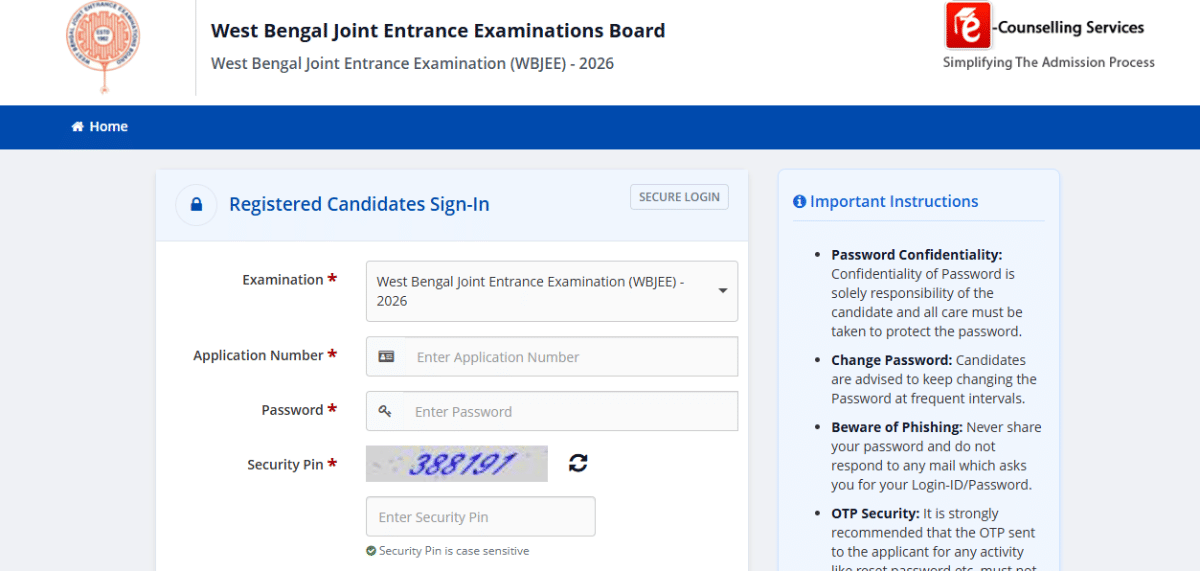
Related Links:
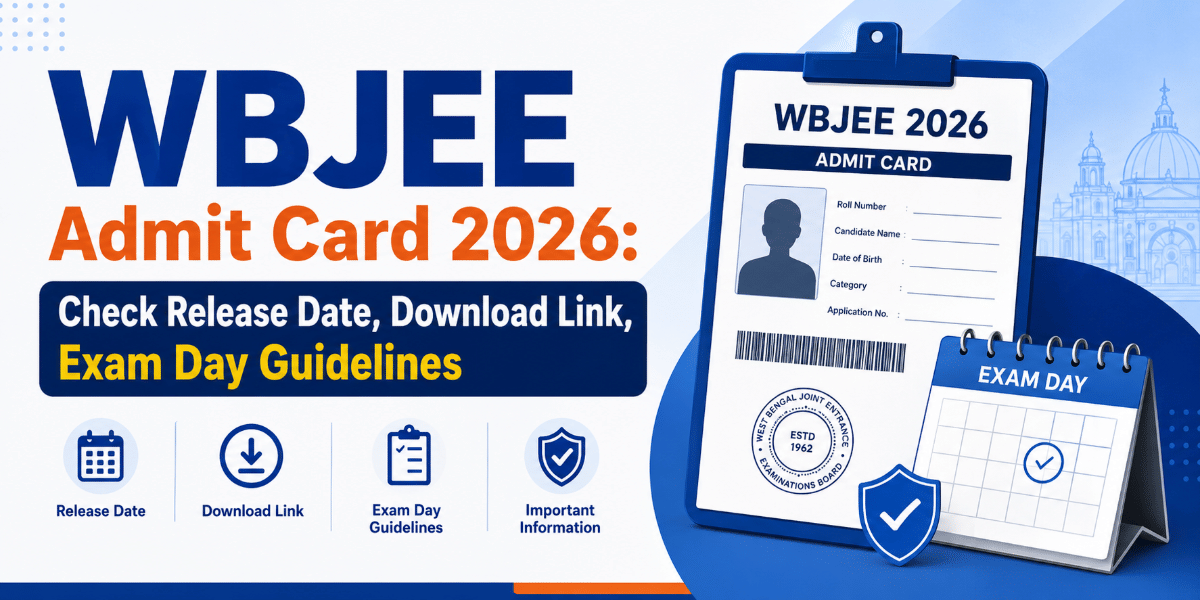
What is the WBJEE Admit Card?
The WBJEE admit card provides the candidates important details like exam date and timings, exam guidelines, etc.
Carrying the WBJEE admit card along with a valid ID proof is essential to get entry in the exam hall.
A WBJEE Admit Card contains the following details related to a candidate:
- Candidate's Name & Photo – Should be exactly as filled in the application form.
- Roll Number & Application Number – Exclusive identification for the exam.
- Exam Date & Time – Includes session information and reporting time.
- Name & Address of Exam Center – The venue allotted for the exam.
- Category & Domicile Status – As per details submitted during registration.
- Exam Day Instructions – Guidelines on permitted items and rules to be followed.
A sample WBJEE Admit Card for representation purposes is shown below:
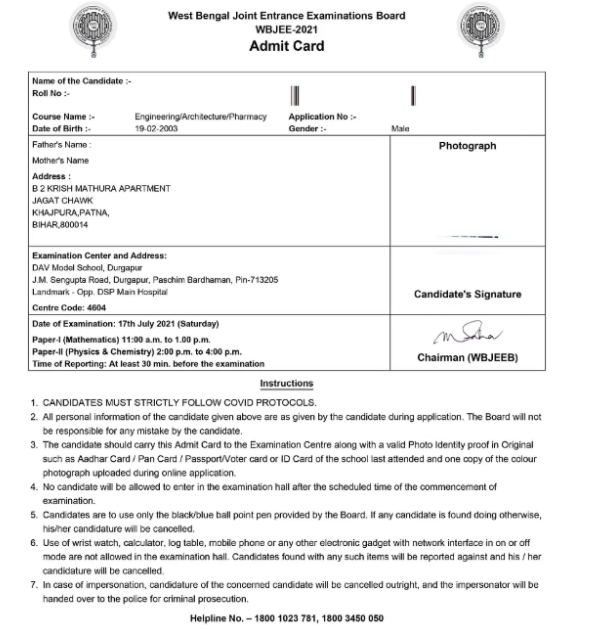
How to Download the WBJEE Admit Card in 2026
A step-by-step guide to downloading the WBJEE Admit Card is given below:
- Step 1: Visit the Official WBJEE Site @wbjeeb.nic.in.
- Step 2: Click on the "Download WBJEE 2026 Admit Card" link.
- Step 3: Enter your Application Number and Password or Date of Birth.
- Step 4: Click on the admit card download button and print the document.
Ques: Is the WBJEE admit card released?
Ans: The WBJEE 2026 admit card will be released on 15 May 2026. The candidates should log in using their application number and password to download it.
Ques: What is the WBJEE admit card 2026 official website?
Ans: The official website to download the WBJEE Admit Card 2026 is @wbjeeb.nic.in/wbjee. Candidates can download the admit card by entering their application number and password.
Common Issues While Downloading WBJEE Admit Card & Solutions
The candidates can face various problems while downloading their WBJEE 2026 admit cards because of technical glitches, invalid credentials, or other reasons.
The following are some of the most common issues faced during WBJEE admit card download and their solutions:
| Issue | Possible Cause | Solution |
|---|---|---|
| Incorrect Login Credentials | Entering the wrong application number or password | Double-check information or use the "Forgot Password" feature to reset |
| Website Not Loading | High traffic on the official website | Attempt to access at off-peak times or try another browser |
| Admit Card Not Available | Application rejected or incomplete form | Seek clarification from the WBJEE helpline |
| Blank or Incorrect Details on Admit Card | Printing error or database issue | Report to WBJEEB immediately for correction |
| Slow Internet Connection | Poor network connectivity | Switch to a stable network or use another device |
In a Reddit Post, a user complains about not being able to download WBJEE admit card even after successful registration for the same. The user also complains that the portal says the registration is not done.
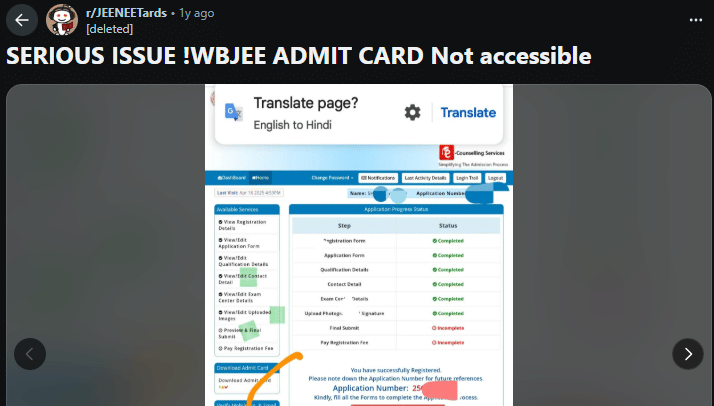
Source: Reddit Post
Ques: Can I download WBJEE admit card after May 24 2026?
Ans: No, you cannot download the WBJEE 2026 admit card after May 24 as the last date the admit card will be available is 24 May, till 4 PM. Candidates are advised to keep the admit card safe after downloading it for future references.
WBJEE 2026 Exam Day Guidelines
To avoid any inconveniences, candidates must follow the WBJEE exam day guidelines provided by the WBJEEB.
These include the reporting time, documents needed, and banned items as shown in the infographics below:
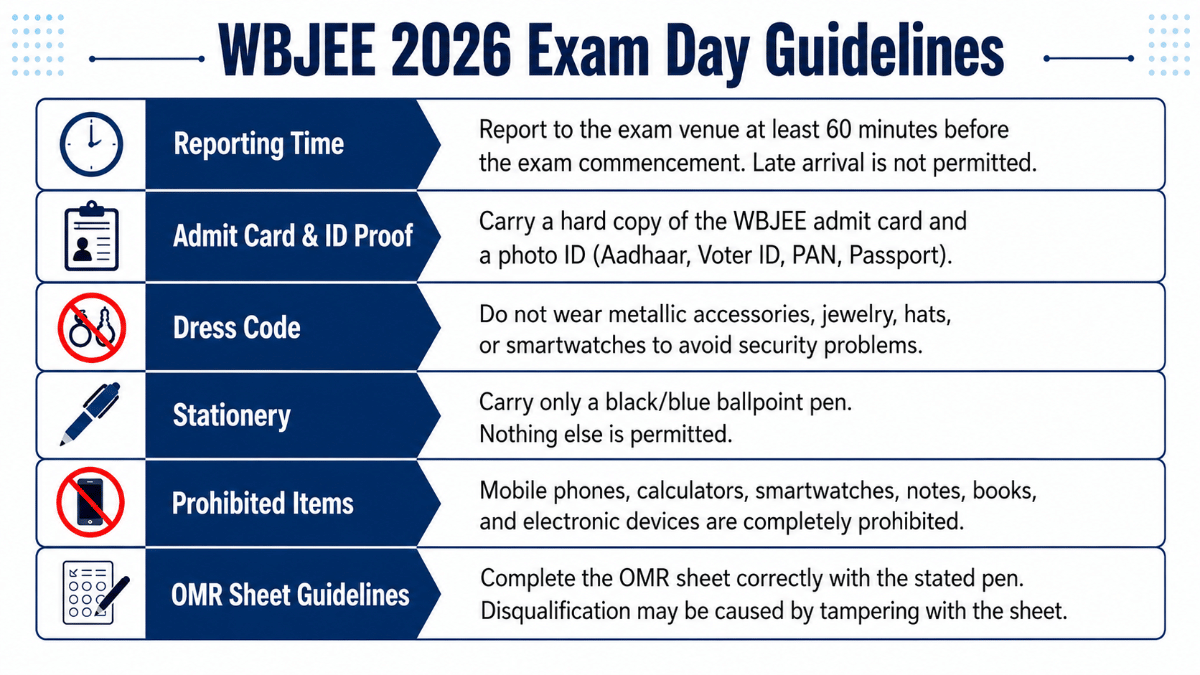
WBJEE 2026 Helpline: Contact Details & Support
Applicants who encounter problems with their WBJEE admit card, like download failure, wrong information, or misplaced credentials, can contact the WBJEEB helpline with the following channels:
| Channel | Contact Details |
|---|---|
| Official Website | wbjeeb.nic.in/wbjee |
| Helpline Number | 1800-123-4782 (Toll-Free) |
| Email Support | info@wbjeeb.in |
| Office Address | WBJEEB RUPANNA DB-118, Sector –I, Salt Lake City, Kolkata-700064 |
WBJEE Exam Centres 2026 District-wise
WBJEE Exam is expected to be conducted in 25 cities, which are further divided into several zones. Candidates can check all the district-wise WBJEE 2026 Exam Centres in the table below:
| Districts | Zone | Zone code |
|---|---|---|
| Alipurduar | Alipurduar | 10 |
| Bankura | Bankura | 11 |
| Bankura | Bishnupur | 12 |
| Birbhum | Bolpur | 13 |
| Birbhum | Suri | 14 |
| Cooch Behar | Cooch Behar | 15 |
| Dakshin Dinajpur | Balurghat | 16 |
| Darjeeling | Kurseong | 17 |
| Darjeeling | Siliguri | 18 |
| Hooghly | Arambagh | 19 |
| Hooghly | Bandel/Chinsurah | 20 |
| Hooghly | Serampore | 21 |
| Howrah | Howrah Maidan/Shibpur | 22 |
| Howrah | Salkia/Bally/Uttarpara | 23 |
| Howrah | Santragachi/Domjur | 24 |
| Howrah | Uluberia | 25 |
| Jalpaiguri | Jalpaiguri | 26 |
| Jhargram | Jhargram | 27 |
| Kalimpong | Kalimpong | 28 |
| Kolkata | Central Kolkata (Moulali/Beliaghata/Narkel Danga/Phool Bagan/Kakurgachi/Park Circus) | 29 |
| Kolkata | North Kolkata (Shyam bazar/ Bagh Bazar/Girish Park/Burra Bazar/ College Street/Sealdah) | 30 |
| Kolkata | Salt Lake/New Town (Salt Lake/Lake Town/New Town/Rajar Hat) | 31 |
| Kolkata | South Kolkata (Ballygaunge/Minto Park/Bhowanipore/Tollygaunge/Jadavpur) | 32 |
| Kolkata | West Kolkata (Joka/Behala/Alipore/Chetla/Khidirpore/Budge Budge) | 33 |
| Malda | Malda | 34 |
| Murshidabad | Berhampur | 35 |
| Murshidabad | Jiaganj | 36 |
| Murshidabad | Raghunathganj | 37 |
| Nadia | Kalyani | 38 |
| Nadia | Krishnanagar | 39 |
| Nadia | Nabadwip | 40 |
| North 24 Parganas | Ashoknagar | 41 |
| North 24 Parganas | Barasat (Airport/Madhyamgram/Barasat) | 42 |
| North 24 Parganas | Barrackpur (Dum Dum Jn. To Barrackpur) | 43 |
| North 24 Parganas | Basirhat | 44 |
| Paschim Burdwan | Asansol | 45 |
| Paschim Burdwan | Durgapur | 46 |
| Paschim Medinipur | Garbeta | 47 |
| Paschim Medinipur | Kharagpur | 48 |
| Paschim Medinipur | Medinipur | 49 |
| Purba Burdwan | Burdwan | 50 |
| Purba Medinipur | Contai | 51 |
| Purba Medinipur | Haldia | 52 |
| Purba Medinipur | Tamluk | 53 |
| Purulia | Purulia | 54 |
| South 24 Parganas | Garia/Sonarpur/Baruipur | 55 |
| South 24 Parganas | Jainagar | 56 |
| Uttar Dinajpur | Raiganj | 57 |
Source: WBJEE 2026 Information Bulletin
WBJEE Registration Trends
WBJEE has witnessed a mixed attendance over the last 5 years.
The following is a summary of the approximate number of candidates who enrolled and appeared for WBJEE exam:
- There has been a steady increase in the number of registered candidates from 2021 to 2025, showing an increasing interest in WBJEE.
- The number of candidates turning up for the exam has varied, with the maximum turnout being in 2024, roughly 82%.
- At roughly 70%, 2021 saw the lowest turnout in WBJEE exam.
| Year | Registered Candidates | Appeared Candidates |
|---|---|---|
| 2025 | 1.4 Lakh | 1,00,502 |
| 2024 | 1,42,694 | 1,14,155 |
| 2023 | 1,24,919 | 97,524 |
| 2022 | 1,01,413 | 81,393 |
| 2021 | 92,695 | 65,170 |
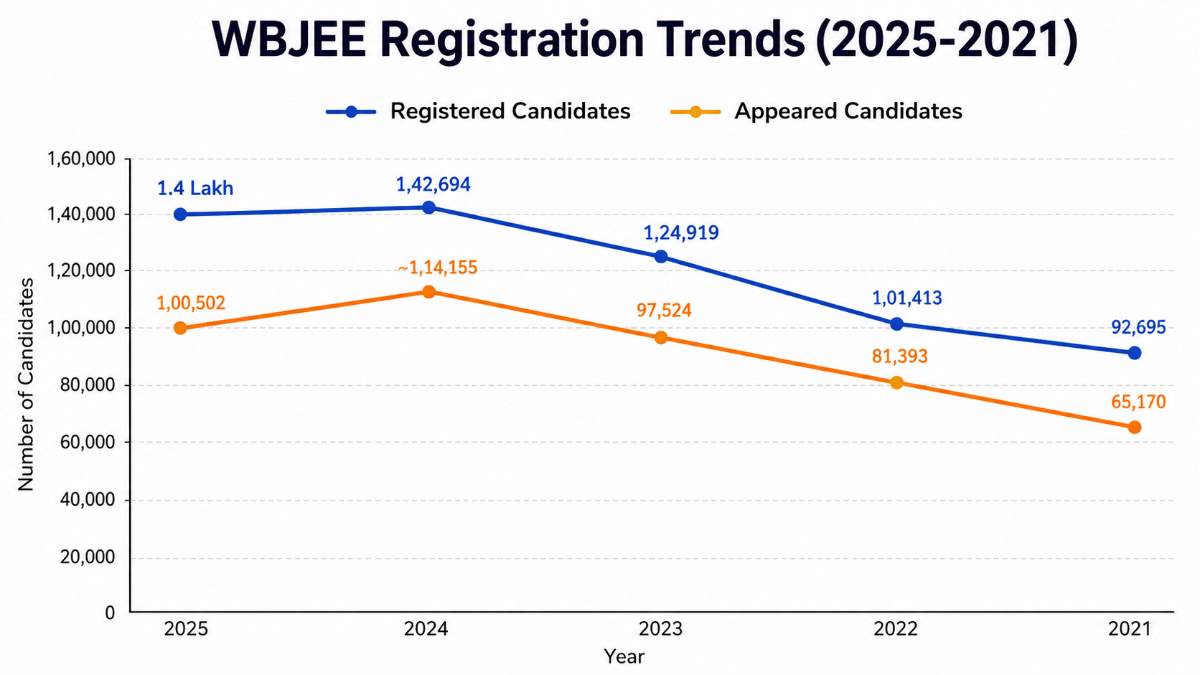
WBJEE Admit Card 2026 FAQs
Ques: What is the exam date of WBJEE 2026?
Ans: The WBJEE 2026 is scheduled to be conducted on 24 May 2026 with paper 1 and paper 2 timings as follows:
- Paper 1(Mathematics) Timings: 11 AM to 1 PM
- Paper 2(Physics and Chemistry) Timings: 2 PM to 4 PM
Ques: Can I get a duplicate WBJEE admit card on the exam day?
Ans: No, WBJEEB does not issue duplicate admit cards for WBJEE exam at the exam center. Candidates must download and print their admit card in advance. It is advised to keep multiple copies for backup.
Ques: What documents do I need to carry along with my WBJEE admit card?
Ans: Candidates must carry the following documents with their WBJEE 2026 admit card at the exam centre:
- Valid Photo ID Proof (Aadhaar Card, Voter ID, Passport, PAN Card, or School ID).
- Passport-sized Photograph (same as uploaded in the application form).
Ques: Can I change my WBJEE exam center after the admit card is issued?
Ans: No, WBJEEB does not allow candidates to change their WBJEE exam center once the admit card has been issued. Candidates must appear at the allotted center mentioned on their admit cards.
Chemistry Sample Paper
WBJEE Chemistry Sample Papers 2026 are put together to help students get a clear sense of the latest exam pattern, how questions are distributed, and which chapters tend to matter most in the upcoming WBJEE exam. The papers include a mix of numerical, conceptual, and application-based questions in line with the WBJEE syllabus.
Students preparing for WBJEE 2026 can use these Chemistry sample papers to works on question-solving speed, spot the topics that aren't really sticking, and get used to the kind of difficulty the actual paper throws at you.
WBJEE Chemistry Sample Paper 2026 PDF Download
| WBJEE Chemistry Sample Paper | Direct Link |
|---|---|
| WBJEE Chemistry Sample Paper 20 (Latest) | Download PDF |
| WBJEE Chemistry Sample Paper 19 (Latest) | Download PDF |
| WBJEE Chemistry Sample Paper 18 (Latest) | Download PDF |
| WBJEE Chemistry Sample Paper 17 (Latest) | Download PDF |
| WBJEE Chemistry Sample Paper 16 (Latest) | Download PDF |
| WBJEE Chemistry Sample Paper 15 (Latest) | Download PDF |
| WBJEE Chemistry Sample Paper 14 (Latest) | Download PDF |
| WBJEE Chemistry Sample Paper 13 (Latest) | Download PDF |
| WBJEE Chemistry Sample Paper 12 (Latest) | Download PDF |
| WBJEE Chemistry Sample Paper 11 (Latest) | Download PDF |
| WBJEE Chemistry Sample Paper 10 | Download PDF |
| WBJEE Chemistry Sample Paper 9 | Download PDF |
| WBJEE Chemistry Sample Paper 8 | Download PDF |
| WBJEE Chemistry Sample Paper 7 | Download PDF |
| WBJEE Chemistry Sample Paper 6 | Download PDF |
| WBJEE Chemistry Sample Paper 5 | Download PDF |
| WBJEE Chemistry Sample Paper 4 | Download PDF |
| WBJEE Chemistry Sample Paper 3 | Download PDF |
| WBJEE Chemistry Sample Paper 2 | Download PDF |
| WBJEE Chemistry Sample Paper 1 | Download PDF |
Related Articles:
- WBJEE Chemistry Syllabus: Topic-wise Breakdown
- WBJEE Chemistry Mock Tests with Solutions
- WBJEE Chemistry Previous Year Questions (PYQs)
Why Should You Solve WBJEE Chemistry Sample Papers?
A lot of aspirants spend most of their preparation on theory — re-reading NCERT, revising reactions. That's fine, but Chemistry is a subject where regular problem-solving creates a sharper marks difference than another revision pass does.
Solving Chemistry sample papers helps you see how concepts from Physical, Organic, and Inorganic Chemistry actually get framed in the paper. It also gets you used to mixed-concept questions, which WBJEE leans on quite a bit.
Some major benefits of solving WBJEE Chemistry sample papers are listed below:
- Better understanding of question pattern: WBJEE Chemistry pulls questions from multiple sections at varying difficulty levels. Practising sample papers makes the Category-1, Category-2, and Category-3 format feel familiar instead of unfamiliar on exam day.
- Helps in time management: A lot of students get stuck on numerical Chemistry questions and end up running out of time. Regular mock practice slowly fixes that — calculations get faster, and you stop bleeding minutes on questions that aren't going anywhere.
- Identifies important chapters: After a few papers, the pattern becomes obvious. Chapters like Mole Concept, Chemical Bonding, Chemical Kinetics, Atomic Structure, and p-Block Chemistry usually carry higher weightage, and you start noticing this on your own.
- Improves accuracy: Negative marking in WBJEE can quietly drag your final score down. Regular practice cuts down on silly mistakes, especially in assertion-based and calculation-heavy questions.
- Builds exam confidence: Attempting full-length papers before the real thing makes the exam environment feel less foreign. It's a small thing, but on exam day it matters more than students expect.
WBJEE Exam Pattern and Marking Scheme
As per the official information bulletin 2026 released by the WBJEE Board, the WBJEE Chemistry exam pattern includes 3 sections: Category-1 (30 questions), Category-2 (5 questions), Category-3 (5 questions).
The exam will be conducted offline (OMR-based).
- The Chemistry paper will include 40 questions (all compulsory).
- The time provided to attempt the paper will be 60 minutes.
- The Chemistry paper will have a total of 50 marks.
Of these, 30 questions carry a positive marking of +1, and the remaining 10 carry +2.
Marking Scheme for Chemistry Subject
| Category | No. of Questions | Marks per Q | Negative Marking | Type |
|---|---|---|---|---|
| Category 1 | 30 | 1 | -0.25 | Single correct |
| Category 2 | 5 | 2 | -0.5 | Single correct |
| Category 3 | 5 | 2 | No negative | One or more correct |
Source: WBJEE 2026 Information Bulletin
WBJEE 2026 Chemistry Sample Papers: Topic-wise weightage
The Chemistry sample papers are prepared based on the chapter-wise trend seen in previous WBJEE examinations. Physical Chemistry, along with a few select Organic Chemistry chapters, generally carries higher weightage in the exam.
Students are advised to prioritise high-weightage chapters first before moving on to low-weightage topics.
| Unit / Topic | Avg Qs/Year | % Weightage | Priority |
|---|---|---|---|
| Some Basic Concepts (Mole Concept, Stoichiometry, Solutions) | 4 | 9% | High |
| Atomic Structure & Nuclear Chemistry | 3 | 7% | High |
| Chemical Bonding | 3 | 7% | High |
| States of Matter (Gaseous, Liquid & Solid State) | 2 | 5% | Medium |
| Chemical Thermodynamics & Thermodynamics | 2 | 5% | Medium |
| Chemical & Ionic Equilibrium | 2 | 5% | Medium |
| Chemical Kinetics | 3 | 7% | High |
| Redox Reactions (including permanganometry) | 2 | 5% | Medium |
| Electrochemistry | 2 | 5% | Medium |
| s‑Block Elements | 2 | 5% | Medium |
| p‑Block Elements | 3 | 7% | High |
| d‑ & f‑Block Elements (Transition Metals) | 2 | 6% | High |
| Coordination Compounds | 2 | 5% | Medium |
| Environmental Chemistry | 1 | 2% | Low |
| Basic Principles & Nomenclature | 2 | 5% | Medium |
| Hydrocarbons (Alkanes, Alkenes, Alkynes, Aromatics) | 2 | 5% | Medium |
| Haloalkanes & Haloarenes | 2 | 5% | Medium |
| Alcohols, Phenols & Ethers | 1 | 2% | Low |
| Aldehydes, Ketones & Carboxylic Acids | 1 | 2% | Low |
| Organic Compounds containing Nitrogen (Amines, Diazonium salts) | 1 | 2% | Low |
| Biomolecules (Carbohydrates, Proteins, Nucleic Acids) | 1 | 2% | Low |
| Polymers | 1 | 2% | Low |
FAQs
Ques. Are WBJEE Chemistry sample papers based on the latest syllabus?
Ans. Yes, most WBJEE Chemistry sample papers are prepared according to the latest syllabus and recent exam trends released by the WBJEE Board.
Ques. Which Chemistry chapters carry the highest weightage in WBJEE?
Ans. Topics like Mole Concept, Chemical Bonding, Chemical Kinetics, Atomic Structure, p-Block Elements, and Coordination Compounds are generally considered important for WBJEE Chemistry.
Ques. How many Chemistry sample papers should I solve before WBJEE?
Ans. Ideally, students should aim for at least 15–20 full-length Chemistry papers along with sectional tests during the final months of preparation.
Ques. Is NCERT enough for WBJEE Chemistry preparation?
Ans. NCERT forms the base for WBJEE Chemistry preparation, especially for Organic and Inorganic Chemistry. That said, you'll also want to practise mock tests and previous year questions to be properly exam-ready.
Ques. Do WBJEE Chemistry sample papers include solutions?
Ans. Yes, most Chemistry sample papers come with detailed solutions and explanations, which help in understanding concepts and improving your problem-solving approach.
Chemistry Syllabus
The WBJEE Chemistry syllabus 2026 includes the 11th and 12th-grade West Bengal Board syllabus covering various concepts from Physical Chemistry, Inorganic Chemistry, and Organic Chemistry that are introduced to students in Class XI–XII.
- The topics like atomic structure, mole concept, gaseous and liquid states, thermodynamics, chemical equilibrium, and ionic equilibrium are covered to facilitate the understanding of the principles of physical processes.
- Besides that, the topics also include redox reactions, chemical kinetics, surface chemistry, solid state, solutions, and electrochemistry, with the focus on quantitative and conceptual understanding.
The WBJEE Syllabus 2026 is the initial step of the journey for those students who are willing to get admitted to the top engineering, pharmacy, and architecture colleges of West Bengal.
Key Summary
In this article, we have discussed the WBJEE Chemistry Syllabus 2026:
- The WBJEE Chemistry syllabus covers the concepts from Physical Chemistry, Inorganic Chemistry, and Organic Chemistry that students in Class XI–XII are expected to have learnt.
- Topics like atomic structure, mole concept, gaseous and liquid states, thermodynamics, chemical equilibrium, and ionic equilibrium are included in the syllabus with a view of providing a better understanding of the principles of physical processes.
- There are also topics like redox reactions, chemical kinetics, surface chemistry, solid state, solutions, and electrochemistry, where the main emphasis is put on quantitative and conceptual understanding.
Also Read:
- What is the WBJEE 2026 Chemistry Syllabus?
- WBJEE Chemistry Syllabus 2026
- WBJEE Chemistry Expected Topic-wise Weightage
- WBJEE 2026 Exam Pattern
- WBJEE Exam 2026 Marking Scheme
- WBJEE Chemistry 2026 Recommended Books
- WBJEE Chemistry Previous Years' Question Papers
- WBJEE Chemistry Preparation Tips 2026
- WBJEE Chemistry Syllabus 2026 FAQs
What is the WBJEE 2026 Chemistry Syllabus?
Chemistry in WBJEE 2026 is one of the main parts of the paper where the most points can be scored by a student.
- It checks the student’s conceptual clarity, logical reasoning, and application of chemical principles taught in Classes XI and XII.
- The topics covered in the syllabus are from physical, inorganic, and organic chemistry, thus ensuring that the students are equally tested for their numerical skills, theoretical understanding, and the ability to solve reaction-based problems.
| Particulars | Details |
|---|---|
| Exam Name | West Bengal Joint Entrance Examination (WBJEE) 2026 |
| Conducting Body | West Bengal Joint Entrance Examinations Board (WBJEEB) |
| Exam Level | State-level entrance test |
| Courses Offered | B.Tech, B.E, B.Pharm, B.Arch |
| Key Topics | Coordination Compounds, Stereochemistry, Periodic Table, and Elements |
| Syllabus Basis | Class 11 & Class 12 syllabus (WBCHSE & equivalent boards) |
| Exam Date (Tentative) | April 2026 |
| Official Website | wbjeeb.nic.in |
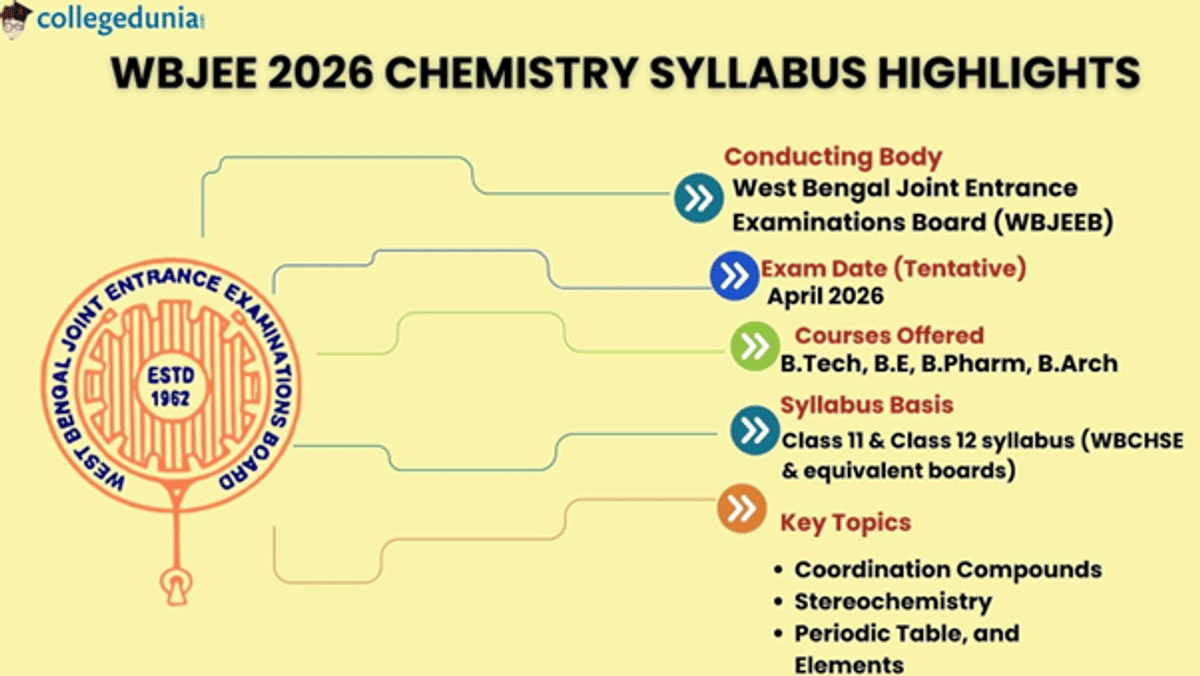
Check:
Ques. Are other state students accepted via WBJEE?
Ans. The admission requirements are as discussed below:
- Yes, WBJEE admission is open to candidates from all states of India.
- West Bengal domiciled applicants, however, have mostly access to certain reserved category seats, Tuition Fee Waivers (TFW), and state quota advantages.
Ques. Are WBJEE colleges valuable? Are placements excellent?
Ans. The placement scenario through WBJEE is as stated below:
- Top institutions like Jadavpur University, IEM, Heritage, KGEC, and Techno India provide great academic quality and good placements, sometimes on par with NIT-level results for top branches like CSE and ECE.
- Every year, many graduates find positions with businesses like TCS, Wipro, Deloitte, Cognizant, Amazon, and core industry companies.
WBJEE Chemistry Syllabus 2026
WBJEE 2026 Chemistry portion is entirely made from the ideas taught in Classes 11 and 12 under typical school curricula, including CBSE and WBCHSE.
- From Class 12, it combines fundamental themes of physical chemistry, including the mole notion, thermodynamics, surface chemistry, and solid state.
- The inorganic chemistry section spans coordination compounds, s–, p–, d–, and f–block elements, the periodic table, chemical bonding, and qualitative analysis across both years.
- Likewise, the organic chemistry syllabus moves purposefully from Class 11's fundamental ideas, bonding, and isomerism to Class 12's extensive reaction processes and functional group chemistry.
| Class 11 Topics | Class 12 Topics |
|---|---|
| Some Basic Concepts of Chemistry | Solid State |
| Structure of an Atom | Solutions |
| Classification of Elements & Periodicity | Electrochemistry |
| Chemical Bonding and Molecular Structure | Chemical Kinetics |
| States of Matter: Gases and Liquids | Surface Chemistry |
| Thermodynamics | The p-Block Element (Group 15, 16, 17, 18) |
| Equilibrium | The d-Block Element (Transition Elements) |
| The Redox Reaction | The f-Block Element (Lanthanides and Actinides) |
| The Hydrogen & The s-Block Element (Alkali & Alkaline earth metals) | Haloalkanes and Haloarenes |
| The p-Block Element (Groups 13 and 14) | Alcohols, Phenols, and Ethers |
| Organic Chemistry – Basic Principles and Techniques | Aldehydes, Ketones, and Carboxylic Acids |
| The Hydrocarbons & The Environmental Chemistry | Amines |
| Polymers & Biomolecules | |
| Chemistry in Everyday Life |
Also Read:
Ques. Who may register for WBJEE?
Ans. The WBJEE Eligibility requirements are as follows:
- You have either passed or will be attending Class 12 with Physics, Mathematics, and Chemistry/Biology/Computer Science as major topics.
- You have to score the lowest needed percentage (changes for General/SC/ST/OBC).
- Usually, 17 years old on or before December 31 of the admission year is the minimum age.
- Though for Marine Engineering courses, the upper age is 25 years, engineering has no age limit.
Ques. Is WBJEE harder or easier than JEE Main?
Ans. The difficulty level of WBJEE is given below:
- Usually, WBJEE is seen as simpler than JEE.
- Mostly because the question style is more formula-based and directly connected with the Class 11–12 curriculum, without too many difficult ideas.
- With few prestigious universities and seats, competition is fierce; thus, relative performance matters more than actual difficulty.
WBJEE Chemistry Expected Topic-wise Weightage
Weightage from important chapters from the WBJEE Chemistry Syllabus is mentioned below:
- With significant contributions from subjects including thermodynamics, equilibrium, electrochemistry, solutions, and concept-based MCQs, physical chemistry is projected to make up around 30 to 35 percent of all chemistry questions.
- Usually making 25–30% of the paper, inorganic chemistry has a major portion from p-block elements, coordination compounds, and chemical bonding.
- Usual organic chemistry accounts for 35–40%, encompassing hydrocarbons, alcohols, phenols, and carbonyl molecules.
| Topics | Chapter Weightage |
|---|---|
| p- Block Elements | 6% |
| Redox Reactions | 5% |
| Ionic Equilibrium | 4% |
| Chemical Equilibrium | 4% |
| Coordination Compounds | 4% |
| Carboxylic Acids & Derivatives | 4% |
| Alcohol Phenol Ether | 4% |
| Chemical Thermodynamics | 4% |
| Chemical Kinetics | 7% |
| Chemical Bonding | 6% |
| Transition Elements (d & f block) | 6% |
| S block elements | 6% |
| Organic Chemistry | 6% |
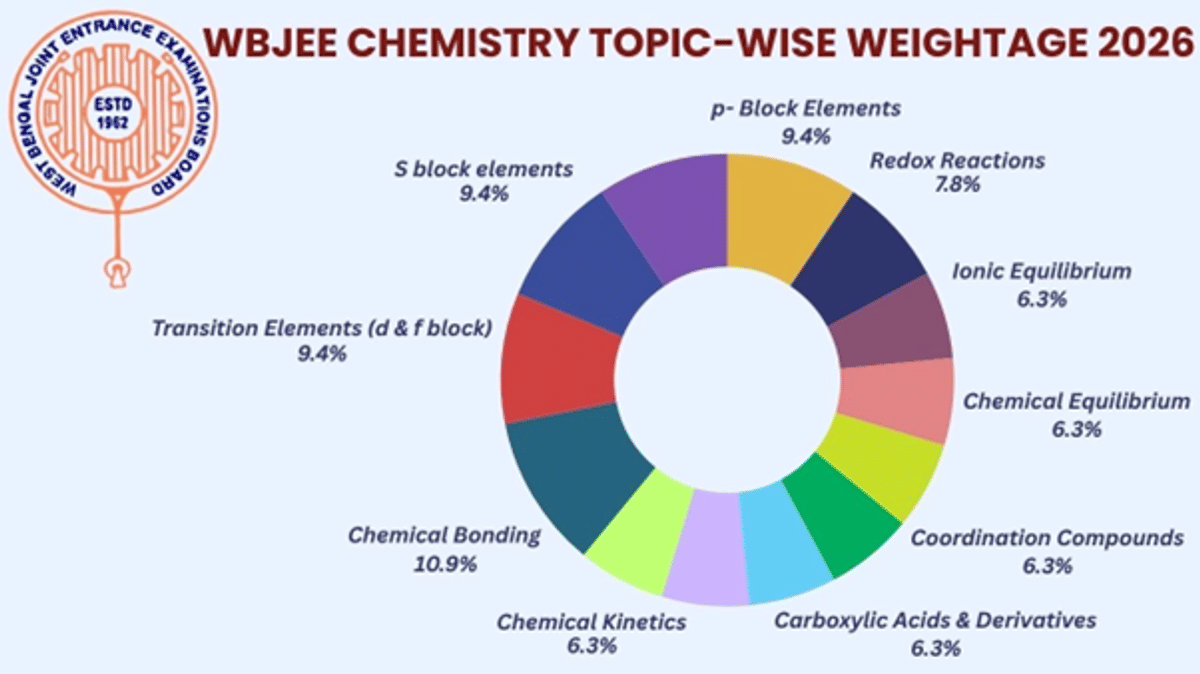
Ques. What are the important chapters for WBJEE Chemistry?
Ans. The important topics for WBJEE Chemistry are:
- Chemical Kinetics
- Chemical Bonding
- Block elements
- Organic Chemistry
- Redox Reaction.
You must cover these topics thoroughly, as these topics have a weightage of around 6 to 7 percent.
Ques. How many times is WBJEE conducted in a year, and when?
Ans. The frequency of WBJEE is as discussed below:
- WBJEE is held once every year, usually in April or May.
- The notification releases typically occur between December and January, followed by the application, admit card, exam, and counselling stages.
WBJEE 2026 Exam Pattern
The number of questions, as well as maximum marks for each, for the WBJEE exam pattern for chemistry, are given in the following table:
- Chemistry has a weightage of 40 questions with 40 marks.
- You should prioritize Category I for speed and accuracy while practicing Categories II and III carefully.
| Category | No. of Questions | Marks per Question | Total Marks |
|---|---|---|---|
| Category I (1 correct option) | 30 | 1 | 30 |
| Category II (1 correct option) | 5 | 1 | 5 |
| Category III (1 or more correct options) | 5 | 1 | 5 |
| Total | 40 | — | 40 |
Also Read:
Ques. What rank is needed for Jadavpur University engineering?
Ans. The rank analysis for Jadavpur University is given below:
- Admission to Jadavpur University is extremely competitive.
- Should you be targeting CSE, ECE, Mechanical, or IT, you would require a ranking of under 150–400 (which may change somewhat year to year).
- Other branches enable somewhat greater ranks, yet only top performers guarantee JU seats.
Ques. Do we need coaching for WBJEE?
Ans. Although not required, coaching is beneficial for uncertainty resolution and structure.
- Many students crack WBJEE by self-study by mastering NCERTs, solving previous year papers, taking timed mocks, and frequently reviewing mistakes.
- Success relies more on discipline and approach than it does on coaching enrollment.
WBJEE Exam 2026 Marking Scheme
The marking scheme of the exam specifies the mark distribution over several questions in the question paper.
- Category 1: 25% negative marking, emphasising accuracy.
- Category 2:+ 2 marks with moderate negative marking, offering a slightly higher reward.
- Category 3: Require all correct options to score full marks, making them more challenging.
- Unattempted questions get zero marks.
In WBJEE, there are three categories of questions for physics, chemistry, and mathematics, which are described below:
| Category | Correct Answer | Incorrect Answer / Multiple Marks | Unattempted Question |
|---|---|---|---|
| Category 1(Only one correct option) | +1 mark | -0.25 mark for wrong answer or multiple options | 0 marks |
| Category 2(Only one correct option) | +2 marks | -0.5 mark for wrong answer or multiple options | 0 marks |
| Category 3(One or more correct options) | +2 marks if all correct options selected | 0 marks for any wrong or partially correct combination; for partially correct: 2 × (no. of correct options marked ÷ total correct options) | 0 marks |
Also Read:
Ques. How does negative marking affect guessing in the WBJEE Exam?
Ans. The table below shows the WBJEE negative marking for 2026.
- Category 1 and 2 questions have negative marking (¼ and ½, respectively), so accuracy is important, and blind guessing should be avoided.
- Category 3 questions have no negative marking, allowing candidates to attempt them confidently to maximise scores.
| Category | Negative Marking |
|---|---|
| Category 1 | ¼ mark (-0.25) |
| Category 2 | ½ mark (-0.5) |
| Category 3 | No negative marking |
Ques. What rank is 120 marks in WBJEE?
Ans. A score of 120 marks in WBJEE is considered very good. Expected Rank range: Around 3000-5000 (varies yearly)
With this rank:
- You can expect core branches like CSE, ECE, ME, etc., in most top state colleges.
- Very good chances for Jadavpur University in non-CSE branches.
- CSE may be borderline depending on your category and domicile
WBJEE Chemistry 2026 Recommended Books
Here are some recommended books for you to follow to excel in the WBJEE 2026 examination:
| Name of Books | Authors |
|---|---|
| NCERT Chemistry (Best Recommended Book for WBJEE) | -- |
| Dinesh Chemistry | Dinesh |
| Concise Inorganic Chemistry | J. D. LEE |
| Numerical Chemistry | P. Bahadur |
| Modern Approach to Chemical Calculations | R.C. Mukherjee |
| WB JEE Chapter-wise Explorer Chemistry | MTG Editorial Board |
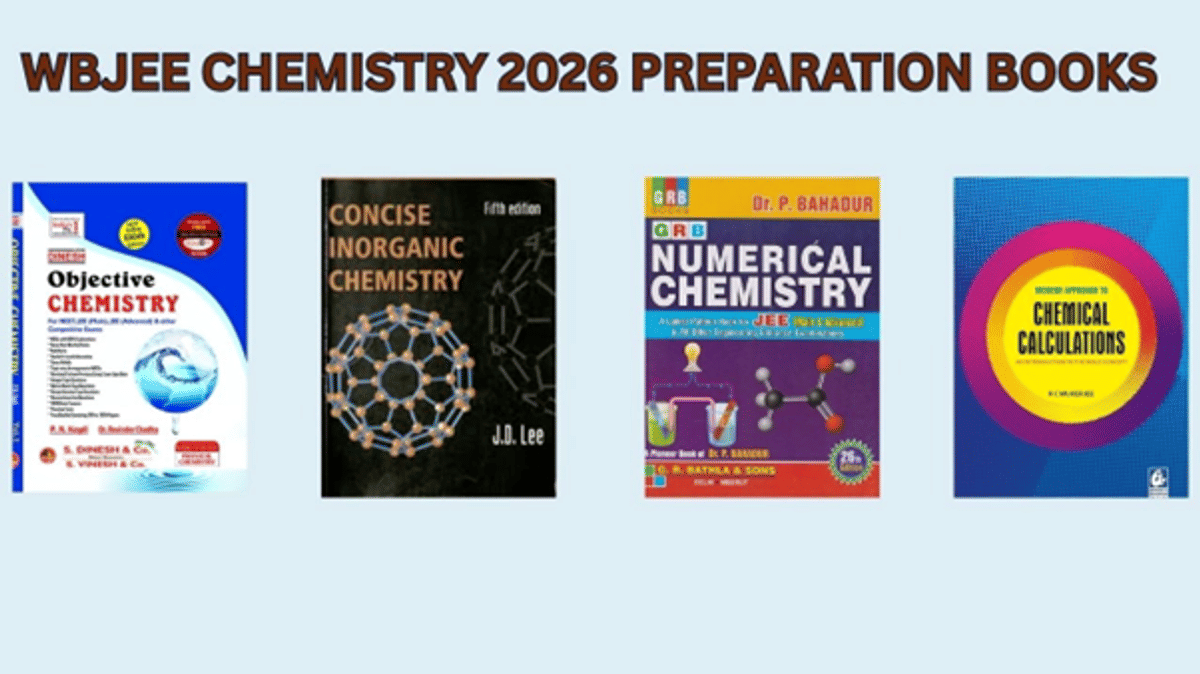
Check:
Ques. What is the basic book for practising Chemistry for WBJEE 2024?
Ans. NCERT Chemistry is the basic book for practising WBJEE Chemistry.
Students can also refer to:
- Dinesh Chemistry
- Handbook of Chemistry by R.P. Singh
- Numerical Chemistry by P Bahadur, etc., to cover all the major chemistry topics for WBJEE 2024.
Ques. Do pharmacy seats have different cutoffs in WBJEE?
Ans. Yes, pharmacy seats generally have different and usually higher (i.e., more relaxed) cutoffs compared to engineering seats. The reason is:
- The number of Applicants is Lower
- Separate Demand Level
- Separate Seat Pool in Counselling
WBJEE Chemistry Previous Years' Question Papers
You need to solve WBJEE Question Papers, which will enable them to practice more and recognise their preparation levels.
The table below includes the link for WBJEE Previous Years’ Physics Question Papers and Answer Keys.
Also Read:
WBJEE Chemistry Preparation Tips 2026
WBJEE is a speed and accuracy-based state-level exam where Physics, Chemistry, and Mathematics are tested from the Class 11–12 syllabus, but with competitive depth.
- To score well, you must focus on conceptual clarity, formula retention, timed practice with PYQs and mock tests, and strict error analysis rather than just revision.
- Since the paper is OMR-based with negative marking, exam temperament and decision-making under time pressure become equally important as subject knowledge.
- The table below gives a strategy to prepare efficiently for the WBJEE Chemistry 2026 exam.
| Area | What To Do |
|---|---|
| Syllabus Mastery | Finish NCERT + standard notes before starting mocks |
| PYQs & Pattern Familiarity | Solve the last 10 years of WBJEE PYQs chapter-wise |
| Timed Mock Tests | Take weekly full-length OMR mocks under strict timing |
| Error Log Maintenance | Record all mistakes and re-attempt them every 3–4 days |
| Formula & Short-Note Revision | Maintain a one-page formula sheet per subject |
| Cut Negative Marking | Skip blind guesses; attempt only when >50% confidence |
| Healthy Study Rhythm | 2–3 focused study blocks per day with breaks |
Also Read:
Ques. What are Freeze, Float, and Withdraw options in WBJEE Counselling?
Ans. The Freeze, Float, and Withdraw options in WBJEE Counselling are explained below:
- Freeze: Accept the current seat and skip further rounds
- Float: Accept but allow upgrade in the next rounds
- Withdraw: Exit from counselling (seat will be lost)
Ques. Is it possible to get Heritage / IEM with a 10,000 rank in WBJEE?
Ans. Yes, seats in private colleges like Heritage, Techno India, and IEM are sometimes available up to ranks 20k–40k, depending on the branch, but high-demand branches (CSE/ECE) close earlier.
Closing ranks of certain streams are given below:
- Biotechnology: 15000
- Civil: 17000
WBJEE Chemistry Syllabus 2026 FAQs
Ques. When can I expect the completion of the admission process through WBJEE 2026?
Ans. The WBJEE 2026 expected dates are given below:
- The admission process through WBJEE 2026 is expected to be closed in the last week of June or 1st week of 2026, after the conclusion of all the counselling rounds.
- Only after the successful completion of the verification round will the admission process be concluded.
Ques. What is the last date to correct the online WBJEE 2026 Application Form?
Ans. WBJEEB offers a one-time opportunity to make corrections to your WBJEE application form.
- The form correction facility will open in February 2026.
- Check WBJEE 2026 Form Correction
Ques. What is the number of times a candidate can sit for WBJEE 2026?
Ans. The age limit for WBJEE 2026 is given below:
- No restrictions will be maintained for both the number of attempts and age for WBJEE 2026.
- However, candidates who want to register themselves for the program in marine biology can attempt the test till 25 years of age.
Ques. Is it very difficult to get a good score in WBJEE Chemistry?
Ans. No, it is not very difficult to do well in WBJEE 2024 Chemistry.
- By practising the WBJEE previous year questions, candidates can easily get 85% - 90% marks.
- You also need to go through the syllabus and understand the exam pattern to excel in the exam.
Ques. How many rounds are in WBJEE counselling?
Ans. WBJEE Counselling is conducted in 3 rounds — including 2 regular rounds and 1 mop-up round.
| Round | Description |
|---|---|
| Round 1 | Initial Allotment |
| Round 2 | Upgradation |
| Round 3 | Mop-up/Final Round |
Ques. Which courses come under WBJEE?
Ans. Through WBJEE, candidates can get admission into Engineering, Architecture, and Pharmacy programs.
| Course | Duration | Example Programs |
|---|---|---|
| B.Tech | 4 Years | CSE, ECE, ME, CE |
| B.Pharm | 4 Years | Pharmacy |
| B.Arch | 5 Years | Architecture |
Counselling
The West Bengal Joint Entrance Examinations Board (WBJEEB) released the WBJEE 2026 Round 2 seat allotment result on July 21, 2026, at the official counselling portal, wbjeeb.nic.in. The Round 2 registration and choice filling, which was conducted between July 13, 2026 and July 17, 2026, following the Round 1 allotment that was released on July 7, 2026. Candidates who have secured a seat are required to pay the seat acceptance fee and report to their allotted institutes for document verification, with the reporting and withdrawal window kept open from July 21, 2026 to July 23, 2026. Candidates who remain unsatisfied or unallotted after this round will subsequently be eligible to participate in the Round 3 Mop-Up counselling.
WBJEE 2026 Latest Updates
- WBJEEB has released the WBJEE 2026 Round 2 seat allotment result on July 21, 2026, and candidates can check their status by logging into the candidate portal with their roll number and password.
- Candidates allotted a seat in Round 2 are required to pay the seat acceptance fee and complete reporting or document verification at their allotted institute between July 21, 2026 and July 23, 2026.
- Round 2 registration and choice filling had earlier been conducted from July 13, 2026 to July 17, 2026, following the Round 1 allotment result declared on July 7, 2026.
- Compared with the previous cycle, the Round 2 allotment for WBJEE 2026 has been released on July 21, 2026, notably earlier than the corresponding WBJEE 2024 Round 2 result, which had been declared on July 31, 2024.
- Registration and choice filling for the Round 3 Mop-Up round is expected to be held from July 24, 2026 to July 26, 2026, with the Mop-Up allotment result likely to be released on July 28, 2026.

Source: wbjeeb.nic.in/wbjee
WBJEE 2026 Counselling Important Dates
| Event | Date |
|---|---|
| Round 1 seat allotment result | July 7, 2026 |
| Round 1 fee payment and reporting | July 7 to 11, 2026 |
| Round 2 registration and choice filling | July 13 to 17, 2026 |
| Round 2 seat allotment result | July 21, 2026 |
| Round 2 fee payment, reporting and withdrawal | July 21 to 23, 2026 |
| Round 3 (Mop-Up) registration and choice filling | is expected to be held from July 24 to 26, 2026 |
| Round 3 (Mop-Up) seat allotment result | likely to be released on July 28, 2026 |
What is WBJEE Counselling 2026?
WBJEE 2026 counselling is the state-level, centralised, online admission process through which seats in engineering (B.Tech/B.E.) and pharmacy (B.Pharm) programmes across West Bengal are allocated to eligible students. The West Bengal Joint Entrance Examinations Board (WBJEEB) conducts this process on behalf of the Government of West Bengal. All participating institutions — government, state-aided, and self-financing — offer seats through this single counselling window, eliminating the need for separate applications to individual colleges.
WBJEEB conducts three sequential rounds of centralised seat allotment: Round 1, Round 2 (upgrade/float), and Round 3 (Mop-Up). Students who rank higher in a later round can upgrade from their current allotment to a more preferred institute or branch. The entire process — from registration to choice locking to allotment — is conducted online at wbjeeb.nic.in/wbjee. Physical document verification occurs directly at the allotted institute after each round’s acceptance window closes.
Registering for WBJEE counselling is mandatory — your exam rank alone does not guarantee a seat. Students who received a Round 1 allotment and wish to try for a better option must re-register and refill choices in Round 2 under the Upgrade or Float status.
WBJEE 2026 result was declared on June 17, 2026, with 92,573 students qualifying out of 1,20,857 registered. Round 1 registration closed on July 5, 2026, with allotment released on July 7. Round 2 is now active: registration and choice filling are open through July 17, 2026.
WBJEE 2026 Counselling Schedule
The table below lists all counselling events with upcoming events first (in chronological order), followed by events that have already concluded — also in chronological order, oldest first.
| Event | Date(s) | Status |
|---|---|---|
| Round 2 — Registration & Choice Filling (Last Date) | July 13–17, 2026 | Open Now |
| Round 2 — Seat Allotment | July 21, 2026 | Upcoming |
| Round 2 — Seat Acceptance Fee Payment & Reporting | To be notified after July 21 allotment | Upcoming |
| Round 3 (Mop-Up) — Registration & Choice Filling | July 24–26, 2026 | Upcoming |
| Round 3 (Mop-Up) — Seat Allotment | July 28, 2026 | Upcoming |
| Final Withdrawal Window | July 28–30, 2026 | Upcoming |
| WBJEE 2026 Result & Rank Card Released | June 17, 2026 | Over |
| Round 1 — Registration & Choice Filling | June 30 – July 5, 2026 | Over |
| Round 1 — Seat Allotment | July 7, 2026 | Over |
| Round 1 — Seat Acceptance Fee Payment & Reporting | July 7–11, 2026 | Over |
Note: WBJEEB may revise the schedule without prior notice. Always verify current dates at the official portal wbjeeb.nic.in/wbjee before taking any action.
WBJEE Counselling Eligibility Criteria 2026
To participate in WBJEE 2026 counselling, you must satisfy all of the following conditions. Failing any single criterion makes you ineligible even if you hold a valid WBJEE rank.
- Qualifying Rank: You must hold a valid General Merit Rank (GMR) in WBJEE 2026, OR a qualifying score in JEE Main 2026 (Paper 1) meeting the WBJEEB-notified percentile threshold. Both are accepted for AIQ and applicable State Quota seats.
- Class 12 Subjects: You must have passed Class 12 (or equivalent) with Physics, Chemistry, and Mathematics as core subjects from a board recognised by WBJEEB. For B.Pharm admission, Physics, Chemistry, and Biology (or Mathematics) are accepted.
- Minimum PCM Aggregate — General / EWS: You must have secured at least 45% aggregate marks in Physics, Chemistry, and Mathematics combined in your qualifying examination.
- Minimum PCM Aggregate — SC / ST / OBC-A / OBC-B / PwD: The minimum PCM aggregate is relaxed to 40% for students in these categories, provided they hold a valid West Bengal-issued category certificate.
- Mathematics Threshold: Regardless of category, you must have scored a minimum of 60% marks in Mathematics alone in the Class 12 board examination.
- English Requirement: You must have passed English in Class 12 (minimum pass marks as per your board, or at least 30% in English).
- Age: There is no upper age limit for WBJEE 2026 counselling participation as per the current WBJEEB notification.
- Domicile for State Quota: A valid West Bengal domicile certificate is mandatory to claim SC, ST, OBC-A, OBC-B, EWS, or TFW reservation benefits and to be eligible for the 85% State Quota seats. Students without this certificate compete only for the 15% All India Quota seats on open merit.
Students who qualify JEE Advanced 2026 and accept a seat through JoSAA counselling are generally ineligible to simultaneously hold a WBJEE counselling seat. You must commit to one admission process.
Reservation of Quotas for WBJEE Counselling 2026
WBJEE 2026 seat allocation follows reservation norms mandated by the Government of West Bengal. All category reservation benefits apply exclusively to students with a valid West Bengal domicile certificate. The 15% All India Quota seats are unreserved (open merit) for non-West Bengal students. The percentages below apply to the 85% State Quota pool.
| Category | Reservation (%) | Key Condition |
|---|---|---|
| Scheduled Caste (SC) | 22% | Valid SC certificate issued by the West Bengal government |
| Scheduled Tribe (ST) | 6% | Valid ST certificate issued by the West Bengal government |
| Other Backward Classes — Category A (OBC-A) | 10% | Non-Creamy Layer (NCL) OBC-A certificate issued in West Bengal |
| Other Backward Classes — Category B (OBC-B) | 7% | Non-Creamy Layer (NCL) OBC-B certificate issued in West Bengal |
| Economically Weaker Section (EWS) | 10% | Family income ≤ ₹8 lakh per annum; valid EWS certificate required |
| Persons with Disability (PwD) | 5% (horizontal) | Minimum 40% disability; PwD certificate from a government medical board required |
| Tuition Fee Waiver (TFW) | Supernumerary designated seats | Family income ≤ ₹2.5 lakh per annum; applicable only at institutes offering the TFW scheme |
PwD reservation is horizontal — it is distributed proportionally across the General, SC, ST, OBC-A, OBC-B, and EWS categories, not as a separate vertical pool. The combined SC + ST + OBC-A + OBC-B reservation totals 45%; adding EWS at 10% brings the total reserved quota to 55% within the State Quota seats.
OBC-A and OBC-B certificates must be issued under the West Bengal state OBC classification framework. Central Government OBC certificates alone are not valid for WBJEE counselling reservation purposes. Submitting a false, expired, or incorrectly issued category certificate results in immediate cancellation of allotment and may attract legal action under applicable law.
How to Apply for WBJEE Counselling 2026?
The entire WBJEE 2026 counselling process — from registration to seat acceptance — is conducted online at wbjeeb.nic.in/wbjee. There are no offline or institute-level application steps prior to final document verification. A single ₹500 registration fee covers participation across all counselling rounds; students who were not allotted in Round 1 simply fill fresh choices in Round 2 without re-paying the fee.
Step 1: Registration
Visit wbjeeb.nic.in/wbjee and click the Counselling Login link. Enter your WBJEE 2026 application number, rank card number, and date of birth. First-time users must complete a one-time registration by setting a password and confirming contact details (mobile number and email). Students applying with a JEE Main 2026 score must enter their JEE Main application number and score card details. Registering for counselling is mandatory — your exam rank alone does not guarantee a seat.
Step 2: Counselling Fee Payment
After registration, pay the non-refundable counselling registration fee of ₹500 via net banking, UPI, debit card, or credit card before the choice filling window closes. Only students who have paid this fee are included in the allotment algorithm. This ₹500 fee is separate from the ₹5,000 seat acceptance fee paid later upon allotment — paying the registration fee does not reserve a seat; it only authorises your participation in the allotment process.
Step 3: Choice Filling
Log in and navigate to "Choice Filling." The portal lists all participating institutes, branches, and available category seats (General, SC, ST, OBC-A, OBC-B, EWS, TFW, PwD). Use search and filter tools — by district, institute type, or branch name — to find preferred combinations. Add each selected college-branch combination to your list and arrange them in strict descending order of preference, with your most desired combination at Position 1. Fill at least 15–20 choices to maximise your chances across all rounds. There is no upper limit on the number of choices you may add.
Step 4: Choice Locking
Before the Round 2 deadline of July 17, 2026, review your complete choice list and click "Lock Choices." Once locked, choices cannot be edited, reordered, or deleted for that round. If you do not lock manually before the deadline, the system auto-locks whatever choices were saved at the time the window closes — the order may not reflect your true preference. Always lock manually to confirm you are satisfied with the sequence. The allotment engine uses your locked list and merit rank to determine the best possible seat available to you.
Step 5: Seat Acceptance and Reporting
When Round 2 allotment results are published (July 21, 2026), log in and check your allotted institute and branch. To confirm the seat, pay the seat acceptance fee of ₹5,000 (₹3,000 for TFW; ₹40,000 for self-financing institutes) within the window announced post-allotment. Download your Provisional Allotment Letter and physically report to the allotted institute with all original documents for verification. Failure to pay the acceptance fee and report within the window results in automatic cancellation of your allotment and forfeiture of the seat acceptance fee.
How to Lock Choices in WBJEE Counselling 2026 (Step-by-Step Guide)
Choice locking is the most consequential action in the WBJEE 2026 counselling process. The steps below apply for Round 2 (deadline: July 17, 2026) and Round 3. The allotment engine assigns the highest-ranked option from your locked list for which a seat exists at your merit rank — the order of your choices directly determines your allotment.
Step 1: Visit the Official Portal
- Go to wbjeeb.nic.in/wbjee.
- Click "Counselling Login" on the homepage.
Step 2: Log In to Your Account
- Enter your Application Number / Rank Card Number and the password set during registration.
- Complete the CAPTCHA and click "Login."
Step 3: Navigate to Choice Filling
- From your dashboard, click "Choice Filling and Locking."
- Use search filters (institute type, district, branch name, category) to locate preferred college-branch combinations.
- Click "Add" next to each combination you want in your list.
Step 4: Arrange Choices in Order of Preference
- Use the drag-and-drop interface or the up/down arrows to reorder choices so your most preferred combination appears at Position 1.
- The algorithm assigns the highest-ranked available option — Position 1 must be the option you genuinely want most, not simply the one you think is easiest to secure.
- Review the top 5–10 entries at least twice; a misplaced entry near the top can yield an allotment at a less-preferred institute that you must either accept or formally withdraw from.
Step 5: Lock Your Choices
- Click "Lock Choices" at the bottom of the page.
- A confirmation pop-up displays your top choices — verify the order before clicking "Confirm Lock."
- After confirmation, the list is frozen for this round. Screenshot or download your locked choice list as a record of submission.
After locking, WBJEEB sends a confirmation SMS and email to your registered contact details. If you do not receive a confirmation within a few minutes, log in and verify that your choices display the "Locked" status before the deadline passes.
| Action | Round 2 Deadline | Consequence of Missing |
|---|---|---|
| Registration + Fee Payment | July 17, 2026 | Not considered for Round 2 allotment |
| Fill Choices | July 17, 2026 | System auto-locks whatever was saved; order may not reflect your preference |
| Lock Choices (manual) | July 17, 2026 | Auto-lock applies if skipped; strongly advised to lock manually and verify confirmation |
| Pay Seat Acceptance Fee (after allotment) | To be announced post-July 21 | Allotment cancelled; seat released to the next eligible student |
WBJEE Counselling Documents Required 2026
Carry both originals and one set of self-attested photocopies to the allotted institute at the time of reporting. Category-specific documents are needed only if you are claiming reservation benefits. Documents not in English or Bengali must be accompanied by a certified translation.
- WBJEE 2026 Rank Card (downloaded from wbjeeb.nic.in after result declaration)
- WBJEE 2026 Admit Card
- Class 10 Mark Sheet and Passing Certificate (for date of birth verification)
- Class 12 Mark Sheet (final board result showing subject-wise and aggregate marks)
- Class 12 Passing Certificate / Migration Certificate (Migration Certificate required for students from boards other than WBCHSE)
- West Bengal Domicile / Residential Certificate — mandatory for State Quota participation and for all reservation benefits (SC/ST/OBC/EWS/TFW)
- Aadhaar Card or other government-issued photo identity proof (Voter ID, Passport, Driving Licence)
- Recent Passport-Size Photographs (4–6 copies; white background; taken within the last 3 months)
- Transfer Certificate (TC) from the last attended institution
- Character Certificate from the last attended institution
- Caste / Category Certificate — SC / ST / OBC-A / OBC-B certificate issued by the competent authority in West Bengal (not required for General or EWS students)
- EWS Income and Asset Certificate (for EWS category; family income ≤ ₹8 lakh per annum; issued by the appropriate West Bengal authority)
- Income Certificate for TFW Scheme (for TFW category; family income ≤ ₹2.5 lakh per annum)
- PwD Certificate (for Persons with Disability; minimum 40% disability; issued by a government medical board)
- Medical Fitness Certificate (from a registered medical practitioner; some institutes require this separately at the time of final admission)
- JEE Main 2026 Score Card (only for students using JEE Main rank; replaces the WBJEE Rank Card in their case)
Note: Carry at least two photocopies of every document. Missing originals during reporting may result in provisional admission being withheld until documents are produced, or in cancellation of allotment in severe cases.
How Much Money is Needed for WBJEE Counselling 2026?
WBJEE 2026 counselling involves two distinct payments at different stages. The first is a fixed one-time charge paid at registration; the second varies by institute type and is paid only upon receiving and choosing to accept a seat. Keep both amounts available before the respective deadlines.
Non-Refundable Fees
| Fee Component | Amount | Refundable? | When Paid |
|---|---|---|---|
| Counselling Registration Fee | ₹500 | No — non-refundable under all circumstances | At registration, before the choice filling window closes |
Every student who wishes to participate in WBJEE 2026 counselling must pay this ₹500 fee, regardless of category or institute preference. It is not refunded even if no seat is allotted after all three rounds. Students joining from Round 2 or Round 3 who did not register in Round 1 must also pay this fee before their first round of participation.
Refundable Fees
| Institute Category | Seat Acceptance Fee | Refund Condition |
|---|---|---|
| Government / State-Aided Institutes | ₹5,000 | Refundable if formal withdrawal is completed within the final withdrawal window (July 28–30, 2026) |
| Self-Financing Institutes | ₹40,000 | Refundable if formal withdrawal is completed within the final withdrawal window |
| TFW (Tuition Fee Waiver) Category | ₹3,000 | Refundable if formal withdrawal is completed within the final withdrawal window |
The seat acceptance fee is paid online after your allotment is published and you choose to accept the seat. It is subsequently adjusted against your first-year tuition fee — it is not an additional charge on top of college fees. The ₹40,000 figure for self-financing institutes reflects the higher institutional commitment required to hold that seat type. If you withdraw after accepting a seat outside the official withdrawal window (July 28–30, 2026), the seat acceptance fee is forfeited in full. Withdrawal must be done formally through the WBJEEB portal — simply not reporting to the college does not constitute withdrawal and results in fee loss.
Round-Wise Seat Allotment in WBJEE Counselling 2026
WBJEE 2026 counselling runs across three rounds, each using the same merit-based allotment algorithm. The system matches your locked choice list against available seats in your category and assigns you the highest-preference option for which a seat exists at your rank. The table below shows upcoming rounds first, followed by concluded rounds.
| Round | Activity | Date(s) | Status |
|---|---|---|---|
| Round 2 (Upgrade / Float) | Registration & Choice Filling | July 13–17, 2026 | Open Now |
| Seat Allotment | July 21, 2026 | Upcoming | |
| Seat Acceptance & Reporting | To be announced post-July 21 | Upcoming | |
| Round 3 (Mop-Up) | Registration & Choice Filling | July 24–26, 2026 | Upcoming |
| Seat Allotment | July 28, 2026 | Upcoming | |
| Final Withdrawal Window | July 28–30, 2026 | Upcoming | |
| Round 1 | Registration & Choice Filling | June 30 – July 5, 2026 | Over |
| Seat Allotment | July 7, 2026 | Over | |
| Seat Acceptance & Reporting | July 7–11, 2026 | Over |
Between rounds, students with a current allotment must declare one of four statuses — Upgrade, Float, Freeze, or Withdraw — which determines whether and how they participate in subsequent rounds. Students without any allotment simply register fresh for the next round; no status declaration is needed for them.
- Why Round 2 can be more accessible than Round 1: Seats vacated because Round 1 allottees upgraded, floated, or withdrew — plus seats unfilled in Round 1 — are pooled together for Round 2. In branches and institutes with high Round 1 withdrawal rates, Round 2 closing ranks can be lower (more accessible) than Round 1 for the same programme.
- Round 3 (Mop-Up) is the final opportunity: All remaining vacant seats across every participating institute are offered in Round 3. Students who received no allotment in Rounds 1 or 2 must register during July 24–26, 2026 — no further counselling is conducted by WBJEEB after Round 3 concludes.
Reporting to the Allotted College
After paying the seat acceptance fee, you must physically report to your allotted institute within the acceptance window. Online acceptance alone does not complete your admission — the institute must verify your original documents and issue a confirmed seat. Failing to report within the window results in automatic cancellation of allotment, with no option to re-enter the same round.
Steps to complete reporting after Round 2 allotment (expected July 21, 2026):
- Log in to wbjeeb.nic.in/wbjee after allotment is published and download your Provisional Allotment Letter.
- Pay the seat acceptance fee online (₹5,000 / ₹3,000 TFW / ₹40,000 self-financing) within the window announced by WBJEEB post-allotment.
- Contact your allotted institute directly to confirm the Document Verification (DV) centre location, timings, and any institute-specific requirements before travelling.
- Report to the designated DV centre with all original documents and one set of self-attested photocopies of each.
- Submit documents for verification; the institute retains the photocopies and returns originals after checking.
- After successful document verification, pay the first-year college fees (tuition, development charges, hostel if applicable) — the seat acceptance fee is adjusted against this amount.
- Collect the admission confirmation receipt or student registration acknowledgement from the institute’s admission cell.
Note: If your documents are found incomplete, expired, or inconsistent with your application at the time of verification, your provisional allotment may be cancelled or withheld pending rectification. Ensure all documents are valid and correctly self-attested before travelling to the institute.
Students who received a Round 1 allotment, opted for Upgrade or Float in Round 2, and then received a new allotment in Round 2 must report to the new allotted institute within the Round 2 acceptance window. The earlier Round 1 reporting does not transfer to the new institute.
Upgrade, Freeze, or Withdraw — What Should You Do?
If you received a Round 1 allotment and the acceptance window has closed, your decision between Upgrade, Float, Freeze, and Withdraw shapes the rest of your WBJEE 2026 counselling journey. The guide below maps common situations to the appropriate choice and its downstream consequences.
| Your Situation | Recommended Status | Effect on Your Current Seat |
|---|---|---|
| Satisfied with your allotment; no interest in changing | Freeze | Seat confirmed; you exit all further rounds automatically |
| Want to try for a better branch at the same or a higher-ranked institute | Upgrade | Seat held as a safety net; if a higher-preference option is found in Round 2, you move to it and the current seat is released |
| Want to try for any improvement across your entire locked choice list | Float | Seat held; algorithm searches your full locked list for any choice ranked above your current allotment |
| Not pursuing WBJEE admission; joining another institution or programme | Withdraw | Seat released permanently; you exit counselling; refund depends on whether withdrawal falls within July 28–30, 2026 |
| Received no allotment in Round 1 | Register Fresh for Round 2 | No prior seat; compete for any available seat from your newly locked choice list |
Key rules for Upgrade and Float:
- You must re-fill and re-lock your choice list for Round 2 — your Round 1 locked choices do not carry over automatically.
- The algorithm upgrades you only to a choice ranked higher (closer to Position 1) than your current allotment in your new locked list. If no better option is available at your rank, your existing Round 1 seat is retained unchanged.
- If you receive a new allotment in Round 2 at a different institute, you must pay the acceptance fee for the new institute and report there within the Round 2 window. Refer to the WBJEEB notification for adjustment or refund of your Round 1 acceptance fee in this scenario.
Key rules for Withdrawal:
- Withdrawal must be completed formally through the WBJEEB counselling portal. Not reporting to the allotted college does not constitute withdrawal and results in forfeiture of the seat acceptance fee without any refund.
- The final withdrawal window is July 28–30, 2026. Withdrawing within this window entitles you to a refund of the seat acceptance fee.
- If you withdraw after accepting a seat, the seat acceptance fee is not refunded if withdrawal is done outside the July 28–30 window. Withdraw only after careful, considered decision-making.
Students who were not allotted in either Round 1 or Round 2 must register for Round 3 (Mop-Up) during July 24–26, 2026. Round 3 is the final WBJEE 2026 counselling round — vacant seats remaining after Round 3 revert to the respective institutes’ management or direct admission processes, where applicable.
FAQs
Ques: Is a separate registration required for each round of WBJEE 2026 counselling?
Ans: No — a single ₹500 registration fee covers participation across all three rounds for students who remain in the process from Round 1. However, you must actively fill and lock fresh choices before each round’s deadline. Students who did not register in Round 1 and are joining from Round 2 or Round 3 must register and pay the ₹500 fee before that round’s closing date.
Ques: I was allotted a seat in Round 1 but want a better college in Round 2 — what exactly should I do?
Ans: Select the "Upgrade" or "Float" status during Round 2. Both options hold your Round 1 seat as a safety net while the algorithm searches for a better match. The key guarantee: if the system finds nothing better than your current allotment, you are never moved to a worse option — your Round 1 seat is automatically retained. You must re-fill and re-lock your choice list for Round 2; Round 1 choices do not carry over.
- Log in to wbjeeb.nic.in/wbjee during July 13–17, 2026.
- Select Upgrade or Float and fill your updated choice list with preferred options ranked above your current allotment.
- Lock choices before July 17, 2026. If no improvement is found, your Round 1 seat is automatically retained.
Ques: I was not allotted any seat in Round 1. Can I still participate in Round 2?
Ans: Yes. Students who received no allotment in Round 1 can participate in Round 2 by logging in to wbjeeb.nic.in/wbjee, paying the ₹500 registration fee if not already paid, and filling a fresh choice list before July 17, 2026. If Round 2 also yields no allotment, those students can register for Round 3 (Mop-Up) during July 24–26, 2026 — the final opportunity in WBJEE 2026 counselling.
Ques: What is the last date to register for WBJEE 2026 Round 2 counselling?
Ans: The last date to complete registration, pay the fee, fill choices, and lock them for Round 2 is July 17, 2026. Do not wait until the last hour — bank gateway failures or portal congestion on the final day can cause missed registration. Complete the fee payment at least 24–48 hours ahead of the deadline and lock your choices well before July 17 to eliminate technical risk.
Ques: Can students from outside West Bengal participate in WBJEE 2026 counselling?
Ans: Yes, through the 15% All India Quota (AIQ) seats. Students without a West Bengal domicile certificate may also use their JEE Main 2026 score (Paper 1) if it meets WBJEEB’s notified percentile threshold. However, non-West Bengal students are not eligible for SC, ST, OBC-A, OBC-B, EWS, or TFW reservation benefits — they compete only in the open/general pool within the AIQ portion of seats.
Ques: Is the seat acceptance fee refundable?
Ans: Yes, conditionally. The seat acceptance fee is refunded only if you formally withdraw through the WBJEEB portal within the final withdrawal window of July 28–30, 2026. Outside this window — or if you simply do not report without formal withdrawal — the fee is forfeited. The amounts differ by institute type: ₹5,000 for government/state-aided, ₹40,000 for self-financing, and ₹3,000 for TFW. If you proceed with admission, the fee is adjusted against your first-year tuition, so it is not an extra cost on top of college fees.
Ques: Can I change my choice list after locking?
Ans: No. Once you click "Lock Choices" and confirm, your list is frozen for that round — no edits, deletions, or reordering are permitted. In Round 2 (and Round 3), you fill a completely fresh choice list, giving you a new opportunity to revise your preferences based on Round 1 allotment experience. This is why reviewing the top 5–10 entries very carefully before locking is so important — the allotment outcome is most sensitive to the order at the top of your list.
Ques: Does IIEST Shibpur participate in WBJEE 2026 counselling?
Ans: No. IIEST Shibpur (Indian Institute of Engineering Science and Technology, Shibpur) is an Institute of National Importance and does not participate in WBJEE counselling. Admission to IIEST Shibpur is conducted exclusively through JoSAA centralised counselling using JEE Main scores. If IIEST Shibpur is your target, you must participate in JoSAA — WBJEE counselling is a separate state-level process with no overlap with JoSAA-administered institutes.
Ques: How many choices should I fill in WBJEE 2026 counselling?
Ans: WBJEEB advises filling at least 20 choices. There is no upper limit. Filling more choices — across different institutes, branches, districts, and category seats — directly improves your probability of receiving an allotment, particularly if your rank falls in a range where top choices are already claimed by students ranked above you. Students who fill only 3–5 choices risk receiving no allotment if all those options are exhausted at ranks above theirs.
Ques: What happens if I do not report to the allotted college within the acceptance window?
Ans: If you pay the seat acceptance fee but do not physically report for document verification within the acceptance window, your provisional allotment is cancelled and the seat is released for subsequent rounds. The acceptance fee is forfeited. If you had upgraded to a Round 2 allotment at a new institute and fail to report there, your Round 1 seat is also unavailable — both allotments are lost simultaneously. To avoid fee loss, formally withdraw through the WBJEEB portal within July 28–30, 2026 if you decide not to join any allotted institute.
Note: Simply not reporting to the college is NOT treated as withdrawal. You must complete the withdrawal process on the WBJEEB portal to be eligible for a refund of the seat acceptance fee.
Ques: What documents must I carry during Round 2 college reporting?
Ans: Document requirements are identical across all rounds. Carry originals and self-attested photocopies of your WBJEE 2026 Rank Card, Admit Card, Class 10 and Class 12 mark sheets and certificates, West Bengal domicile certificate, Aadhaar card, passport-size photographs, Transfer Certificate, Character Certificate, and any applicable category certificate (SC/ST/OBC-A/OBC-B/EWS/TFW/PwD). If you received a new Round 2 allotment at a different institute than Round 1, report to the new institute — the earlier round’s reporting does not transfer.
Disclaimer: The information on WBJEE 2026 counselling is compiled from official notifications published by the West Bengal Joint Entrance Examinations Board (WBJEEB) at wbjeeb.nic.in and other publicly available sources as of July 14, 2026. Dates, fees, and procedures are subject to revision by WBJEEB without prior notice. Students are advised to verify all details on the official website before taking any action related to counselling registration, choice filling, seat acceptance, or withdrawal.
Exam Centers
The list for WBJEE test centres 2026 (Zone-wise) is out on the official website, wbjeeb.nic.in. The choice of exam centres must be filled by candidates during the WBJEE Registration for 2026.
- Students can select up to any three zones based on the available options and convenience.
- The WBJEE exam centres 2026 will be allocated as per availability and first come, first-served basis.
- Students who could not appear for the test centres inside the West Bengal state can also opt for other centres.
- Like the previous year, the West Bengal Joint Entrance Examination Board has provided a few test centres in the Assam and Tripura states apart from West Bengal.
The West Bengal Joint Entrance Examination or WBJEE 2026 is scheduled on May 24, 2026. Students can expect the admit card a week before the exam. The hall ticket will mention the time, date, and exact WBJEE exam centre for the 2026 exam.
Also Check:
What are WBJEE Exam Centres 2026?
The West Bengal Joint Entrance Examination Board releases the list of zone-wise centres where WBJEE will be conducted.
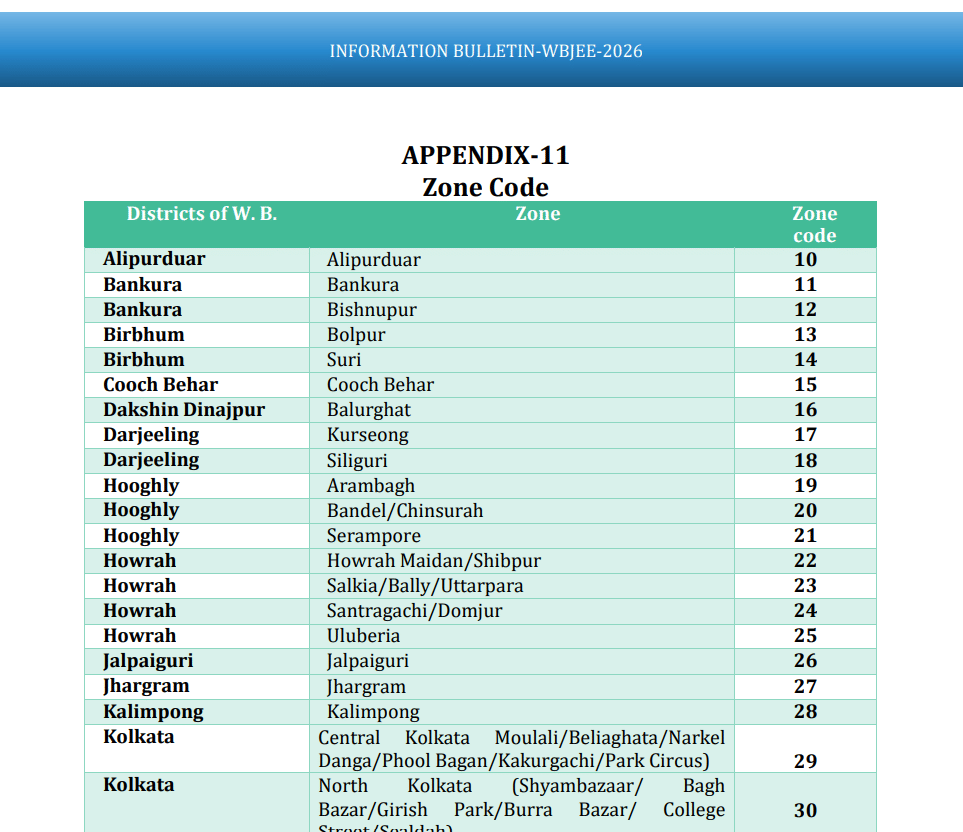
Source: WBJEE Exam Centres 2026 (Zone-wise)
- Students are required to select any three zones among the available options.
- The examination authority will allocate the final exam centres from the selected options only.
- Thus, students are advised to select their WBJEE exam centres carefully during the form filling process. Once submitted, test centres can not be changed.
WBJEE Exam Centres 2026 Highlights
| Particulars | Details |
|---|---|
| Exam Name | WBJEE 2026 |
| Conducting Body | WBJEEB |
| Exam Mode | Offline (Per and Paper-Based) |
| Exam Center Allocation | Based on preference and availability |
| Center Confirmation | Mentioned on the admit card |
Ques: Are WBJEE exam centres only in West Bengal?
Ans: No, WBJEE exam centres for 2026 will also be spread across selected centres in Assam and Tripura apart from the West Bengal state.
Ques: Will the city intimation slip for WBJEE mention the exam centre for 2026?
Ans: Unlike NTA, the WBJEEB does not release the city intimation slip for WBJEE. Students can check their exam centres in the admit card.
Ques: Can I choose WBJEE exam centres outside West Bengal?
Ans: Yes, students can opt for exam centres outside West Bengal. The conducting authority has given options for two states (Assam and Tripura) outside the West Bengal Exam centres.
How to Select WBJEE Exam Centres 2026?
Depending on which state the candidate belongs to, the zones available for the candidate will be different, as discussed below:
- West Bengal, Assam, and Tripura: Candidates belonging to these states are free to choose any three zones. Ensure that the zones are entered in the order of preference.
- Other States: Candidates belonging to this group have to select, in order of preference, any three zones from the following options –
- Kolkata
- Howrah
- North 24 Parganas
- South 24 Parganas
WBJEE Exam Centres 2026 District-wise
WBJEE Exam is expected to be conducted in 25 cities, which are further divided into several zones. WBJEE Exam Centres 2026, once allotted to the candidates is final, and no request for any change will be entertained by the authorities. Candidates can check all the district-wise WBJEE Exam Centres below:
| Districts of W. B. | Zone | Zone code |
|---|---|---|
| Alipurduar | Alipurduar | 10 |
| Bankura | Bankura | 11 |
| Bankura | Bishnupur | 12 |
| Birbhum | Bolpur | 13 |
| Birbhum | Suri | 14 |
| Cooch Behar | Cooch Behar | 15 |
| Dakshin Dinajpur | Balurghat | 16 |
| Darjeeling | Kurseong | 17 |
| Darjeeling | Siliguri | 18 |
| Hooghly | Arambagh | 19 |
| Hooghly | Bandel/Chinsurah | 20 |
| Hooghly | Serampore | 21 |
| Howrah | Howrah Maidan/Shibpur | 22 |
| Howrah | Salkia/Bally/Uttarpara | 23 |
| Howrah | Santragachi/Domjur | 24 |
| Howrah | Uluberia | 25 |
| Jalpaiguri | Jalpaiguri | 26 |
| Jhargram | Jhargram | 27 |
| Kalimpong | Kalimpong | 28 |
| Kolkata | Central Kolkata (Moulali/Beliaghata/Narkel Danga/Phool Bagan/Kakurgachi/Park Circus) | 29 |
| Kolkata | North Kolkata (Shyam bazar/ Bagh Bazar/Girish Park/Burra Bazar/ College Street/Sealdah) | 30 |
| Kolkata | Salt Lake/New Town (Salt Lake/Lake Town/New Town/Rajar Hat) | 31 |
| Kolkata | South Kolkata (Ballygaunge/Minto Park/Bhowanipore/Tollygaunge/Jadavpur) | 32 |
| Kolkata | West Kolkata (Joka/Behala/Alipore/Chetla/Khidirpore/Budge Budge) | 33 |
| Malda | Malda | 34 |
| Murshidabad | Berhampur | 35 |
| Murshidabad | Jiaganj | 36 |
| Murshidabad | Raghunathganj | 37 |
| Nadia | Kalyani | 38 |
| Nadia | Krishnanagar | 39 |
| Nadia | Nabadwip | 40 |
| North 24 Parganas | Ashoknagar | 41 |
| North 24 Parganas | Barasat (Airport/Madhyamgram/Barasat) | 42 |
| North 24 Parganas | Barrackpur (Dum Dum Jn. To Barrackpur) | 43 |
| North 24 Parganas | Basirhat | 44 |
| Paschim Burdwan | Asansol | 45 |
| Paschim Burdwan | Durgapur | 46 |
| Paschim Medinipur | Garbeta | 47 |
| Paschim Medinipur | Kharagpur | 48 |
| Paschim Medinipur | Medinipur | 49 |
| Purba Burdwan | Burdwan | 50 |
| Purba Medinipur | Contai | 51 |
| Purba Medinipur | Haldia | 52 |
| Purba Medinipur | Tamluk | 53 |
| Purulia | Purulia | 54 |
| South 24 Parganas | Garia/Sonarpur/Baruipur | 55 |
| South 24 Parganas | Jainagar | 56 |
| Uttar Dinajpur | Raiganj | 57 |
WBJEE Exam Centres 2026 List in West Bengal
Most exam centres are located across major districts so that students from different regions can travel conveniently. Popular cities generally include district headquarters and educational hubs.
| City | Likely Zone |
|---|---|
| Kolkata | Central Region |
| Howrah | South Bengal |
| Durgapur | Industrial Belt |
| Asansol | Western Zone |
| Siliguri | North Bengal |
| Malda | Northern Region |
WBJEE Exam Centres 2026 Outside West Bengal
WBJEE may also provide limited centres outside West Bengal for candidates from nearby states. These centres help students who cannot travel long distances within the state.
| state | City |
|---|---|
| Assam | Guwahati |
| Tripura | Agartala |
| Jharkhand | Ranchi |
| Bihar | Patna |
Do's and Don'ts at WBJEE Exam Centres 2026
The duration of WBJEE 2026 will be of 2 hours. Candidates are expected to follow the guidelines and instructions mentioned below to ensure the smooth conduct of the exam at WBJEE Exam Centres 2026.
| Do’s | Dont’s |
|---|---|
| Reach the exam centre at least 60 minutes before the scheduled time of the exam. | Electronic devices such as cellphones, electronic calculators, pagers, etc., are not allowed inside the examination hall. |
| Carry a valid identity proof along with the WBJEE 2026 Admit Card to the exam centre | Aspirants should not carry any bits of paper or documents to the WBJEE 2026 Test Centre except the WBJEE Admit Card 2026. |
| Sign the attendance sheet in the presence of an exam invigilator. | Candidates will not be permitted to go outside the exam hall during the conduct of the WBJEE exam. |
| Take the allotted seat in the examination hall. Bring a pen or pencil as required. | Any violation of the rules or any unfair means used during the examination can lead to the disqualification of the candidature. |
FAQs
Ques: Can I change my WBJEE exam center after submitting the form?
Ans: Usually, the board does not allow changes after final submission, so candidates should choose their preferences carefully during registration.
Ques: When will the allotted exam center be confirmed?
Ans: The allotted center is confirmed only after the admit card is released by WBJEEB before the examination.
Ques: Are WBJEE exam centers available outside West Bengal?
Ans: Yes, a few selected cities outside West Bengal may be available depending on board notification and candidate demand.
Ques: Can two candidates get different centers in the same city?
Ans: Yes, candidates selecting the same city may still get different venues depending on available capacity.
Ques: What happens if I arrive late at the exam center?
Ans: Late entry may not be permitted once the gate closes, so reaching early is strongly recommended.
Ques: Is the exact address printed on the WBJEE admit card?
Ans: Yes, the admit card clearly mentions the complete exam center address along with reporting instructions.
Exam Dates
The WBJEE 2026 result was declared on June 18, 2026, on the official portal wbjeeb.nic.in. The West Bengal Joint Entrance Examinations Board (WBJEEB) conducted the WBJEE 2026 exam on May 24, 2026 across examination centres in West Bengal. Out of 1,20,856 students who appeared, 92,753 have qualified and are now eligible for centralised counselling. Counselling registration is set to begin on June 30, 2026, with the complete round-wise schedule to be notified by WBJEEB.
- WBJEE 2026 exam conducted: May 24, 2026 (Sunday) in two papers — Paper I (Mathematics) from 11:00 AM to 1:00 PM and Paper II (Physics and Chemistry) from 2:00 PM to 4:00 PM.
- Result declared June 18, 2026: 92,753 students qualified out of 1,20,856 who appeared — a qualification rate of approximately 76.7%.
- Counselling registration opens June 30, 2026 at wbjeeb.nic.in; the round-wise schedule covering choice filling, seat allotment, upgradation, and mop-up will be published by WBJEEB shortly after registration opens.
- Counselling fee: INR 500 (non-refundable); WBJEEB recommends filling a minimum of 20 college-branch choices during the choice-filling stage.
- For WBJEE 2027: Based on the five-year pattern, registration is expected to open around December 2026–January 2027, with the exam likely in late April or early May 2027.
For all the current updates, students should regularly visit the official website wbjeeb.nic.in for official information regarding the counselling schedule and final dates.
Key Summary
In this Article, we have discussed about WBJEE 2026 important dates, the complete schedule from notification to counselling, and year-wise exam date trends.
- WBJEE 2026 was conducted on May 24, 2026 (Sunday) — Paper I (Mathematics) in the morning (11:00 AM–1:00 PM) and Paper II (Physics and Chemistry) in the afternoon (2:00 PM–4:00 PM).
- Registration ran from March 10 to April 5, 2026; the application correction window was open from April 7–9, 2026.
- The admit card was released on May 15, 2026; students were required to report to the exam centre at least 90 minutes before the exam.
- Result was declared on June 18, 2026; 92,753 students qualified; counselling registration opens June 30, 2026 with the complete round-wise schedule to follow.
- WBJEE is held annually in April–May; WBJEE 2027 registration is expected to open around December 2026–January 2027.
WBJEE 2026 Exam Dates: From Registration to Result
The WBJEE 2026 cycle covered a compact three-month span — from the official notification on March 6, 2026 to the result declaration on June 18, 2026. Registration opened on March 10 and closed on April 5; the admit card was released on May 15; and the exam was conducted on May 24, 2026. With the result now out, the cycle enters its final stage: centralised counselling opens on June 30, 2026, with the complete round-wise schedule covering choice filling, Round 1 and Round 2 seat allotment, and the mop-up round to be published by WBJEEB on wbjeeb.nic.in.
Note: WBJEE is a state-level entrance examination. Admission through WBJEE 2026 counselling is restricted to students who satisfy the West Bengal domicile and eligibility criteria as specified in the official WBJEEB information brochure. Students from outside West Bengal are not eligible to apply through WBJEE counselling.
For students targeting WBJEE 2027: based on six years of historical data, registration is expected to begin around December 2026 or January 2027, with the exam likely in the last week of April or first week of May 2027. The official notification for WBJEE 2027 will be released on wbjeeb.nic.in.
Check WBJEE Exam Dates 2026
| Event | Updated Date / Timeline | Data Insight |
| Counselling Registration Opens | 30 June 2026 | Begins tomorrow; registration fee INR 500, non-refundable; portal: wbjeeb.nic.in |
| Choice Filling and Locking | July 2026 (Expected) | WBJEEB recommends minimum 20 choices; exact dates to be notified |
| Round 1 Seat Allotment | July 2026 (Expected) | Allotment based on rank, category, and submitted college-branch preferences |
| Round 2 (Upgradation) | July–August 2026 (Expected) | Students with Round 1 allotment may participate to improve their seat |
| Mop-Up Round | August 2026 (Expected) | Final round to fill remaining vacant seats; typically 2–3 weeks after Round 2 |
| Official Notification Release | 6 March 2026 (Over) | WBJEEB released the official brochure and information bulletin for 2026 cycle |
| Online Registration Opens | 10 March 2026 (Over) | Registration opened at wbjeeb.nic.in; fee payment via net banking or debit card |
| Online Registration Closes | 5 April 2026 (Over) | 26-day registration window; no late registration accepted under any circumstances |
| Application Correction Window | 7–9 April 2026 (Over) | Three-day window for editing application details; limited fields editable |
| Admit Card Release | 15 May 2026 (Over) | Available for download May 15–24, 2026; carried exam centre, roll number, timings |
| WBJEE 2026 Exam Date | 24 May 2026 (Over) | Paper I: 11:00 AM–1:00 PM; Paper II: 2:00–4:00 PM; 1,20,856 students appeared |
| Answer Key Release | Late May 2026 (Over) | Published on wbjeeb.nic.in; objection window typically open for 2–3 days |
| Result Declaration | 18 June 2026 at 4:00 PM (Over) | 92,753 students qualified out of 1,20,856 who appeared (~76.7% qualification rate) |
Why Is WBJEE Almost Always Held in April–May?
WBJEE’s April–May window is determined by West Bengal’s academic calendar and the need to complete counselling and seat allotment before the new semester begins in August. Conducting the exam in late April or May gives WBJEEB roughly six to eight weeks to process results, declare ranks, and complete multiple rounds of counselling before the academic year opens. WBJEE 2026 shifted slightly to May 24 — about four weeks later than the 2023–2025 window — likely due to board exam schedule alignment. Historically, four of the five non-pandemic years (2022–2025) fell in the April 27–30 window.
WBJEE Previous Year Exam Dates (2021–2025)
The table below shows WBJEE exam dates for the five years preceding WBJEE 2026, in descending order.
| Year | Exam Date | Month | Day |
|---|---|---|---|
| 2025 | 27 April 2025 | April | Sunday |
| 2024 | 28 April 2024 | April | Sunday |
| 2023 | 30 April 2023 | April | Sunday |
| 2022 | 30 April 2022 | April | Saturday |
| 2021 | 17 July 2021 | July | Saturday |
The five-year trend confirms a strong April 27–30 window. The 2021 exam was the sole exception — deferred to July due to COVID-19 disruptions. WBJEE 2026’s shift to May 24 marks a departure from that April anchor, though it remains within the pre-semester window. Students can use this pattern to plan WBJEE 2027 preparation timelines.
Note: The complete WBJEE 2026 counselling schedule — including exact dates for choice filling, Round 1 seat allotment, Round 2 upgradation, and the mop-up round — has not yet been officially announced as of June 29, 2026. WBJEEB has confirmed counselling registration opens June 30, 2026. Students should monitor wbjeeb.nic.in for the detailed schedule.
Ques. Has the WBJEE 2026 counselling schedule been released?
Ans. As of June 29, 2026, WBJEEB has confirmed that centralised counselling registration opens on June 30, 2026. The detailed round-wise schedule for choice filling, seat allotment, upgradation, and the mop-up round has not yet been published. Students should check wbjeeb.nic.in regularly for updates.
What are the WBJEE 2026 Exam Dates?
The WBJEE 2026 lifecycle ran from the notification in early March 2026 through the result in June 2026. The post-result phase — centralised counselling — begins on June 30, 2026. Below is a detailed breakdown of each event in the WBJEE 2026 schedule, covering the completed phases and what lies ahead in counselling.
WBJEE 2026 Registration Date: March–April 2026 (Concluded)
WBJEEB released the official notification for WBJEE 2026 on March 6, 2026, and opened online registration four days later on March 10, 2026. The registration window remained open for 26 days, closing on April 5, 2026. Students were required to fill the application form, upload scanned photographs and signatures, and pay the application fee at wbjeeb.nic.in within this period.
- Notification Release: 6 March 2026
- Registration Start Date: 10 March 2026
- Registration End Date: 5 April 2026
- Application Correction Window: 7–9 April 2026 (limited fields editable)
- Status: Closed — no late registration is accepted
Note: The WBJEE 2026 registration window is now closed. No late applications were accepted. Students who missed the 2026 deadline must wait for the WBJEE 2027 cycle, with registration expected around December 2026–January 2027.
Ques. When did WBJEE 2026 registration open and close?
Ans. WBJEE 2026 registration opened on March 10, 2026 and closed on April 5, 2026 — a 26-day window. An application correction window was additionally available from April 7–9, 2026, allowing students to make limited edits to their submitted application. Both windows are now closed.
WBJEE 2026 Admit Card Date: May 2026 (Concluded)
The WBJEE 2026 admit card was released on May 15, 2026 — nine days before the exam. Students downloaded their hall ticket from wbjeeb.nic.in using their application number and date of birth. The admit card contained the student’s photograph, roll number, allotted exam centre address, paper-wise timing, and reporting instructions. Students were advised to carry a printed copy along with a valid photo ID to the exam centre.
- Admit Card Release: 15 May 2026
- Last Date to Download: 24 May 2026 (exam day)
- Documents to carry: Printed admit card + valid photo ID (Aadhaar, school identity card, or passport)
- Status: Concluded
Note: Students were required to report to the exam centre at least 90 minutes before the exam. Late entry was not permitted under any circumstances — even with a valid admit card.
WBJEE 2026 Exam Date: 24 May 2026 (Concluded)
WBJEE 2026 was conducted on Sunday, May 24, 2026, in offline (OMR-based) mode. The exam was held in two papers on the same day — Paper I covering Mathematics in the morning and Paper II covering Physics and Chemistry in the afternoon. Both papers were held at examination centres across West Bengal. Students were not permitted to leave the exam premises during the break between Paper I and Paper II. A total of 1,20,856 students appeared for the exam.
- Exam Date: 24 May 2026 (Sunday)
- Paper I (Mathematics): 11:00 AM – 1:00 PM (2 hours)
- Paper II (Physics and Chemistry): 2:00 PM – 4:00 PM (2 hours)
- Exam Mode: Offline, OMR-based (pen-and-paper)
- Reporting Time: At least 90 minutes before Paper I (by 9:30 AM)
- Total Students Appeared: 1,20,856
Note: Students were not permitted to leave the examination hall or the exam premises during the interval between Paper I and Paper II.
WBJEE 2026 Answer Key Date: Late May 2026 (Concluded)
Following the May 24, 2026 exam, WBJEEB released the WBJEE 2026 answer key on its official website. The answer key enabled students to tally their responses against the officially published answers and estimate their raw scores ahead of the result. An objection window was open for a limited period — typically 2–3 days — during which students could formally challenge any answer by submitting an objection with supporting references. After reviewing valid objections, WBJEEB released the final answer key, which formed the basis for result computation and rank generation.
- Answer Key Release: Late May 2026 (wbjeeb.nic.in)
- Objection Window: 2–3 days post-release
- Final Answer Key: Released after processing objections; used for result computation
- Status: Concluded
WBJEE 2026 Result Date: 18 June 2026 (Declared)
The WBJEE 2026 result was declared on June 18, 2026 at 4:00 PM on wbjeeb.nic.in. The result was released along with the rank card and category-wise rank lists. Of the 1,20,856 students who appeared for the exam, 92,753 were declared qualified — a qualification rate of approximately 76.7%. Qualified students received their WBJEE 2026 rank and category rank, which determine eligibility and preference order during centralised counselling.
- Result Declaration Date: 18 June 2026 at 4:00 PM
- Official Website: wbjeeb.nic.in
- Students Appeared: 1,20,856
- Students Qualified: 92,753 (~76.7% qualification rate)
- Documents Released: Rank card, category-wise rank list
- Status: Declared
Ques. When was the WBJEE 2026 result declared?
Ans. The WBJEE 2026 result was declared on June 18, 2026 at 4:00 PM on wbjeeb.nic.in. Out of 1,20,856 students who appeared, 92,753 were declared qualified — a qualification rate of approximately 76.7%. The rank card and category-wise rank list were released alongside the result. Qualified students are eligible to register for centralised counselling, which opens on June 30, 2026.
WBJEE 2026 Counselling Schedule: Begins June 30, 2026
WBJEEB has announced that centralised counselling registration for WBJEE 2026 opens on June 30, 2026 — the day after this article goes live. The counselling process is conducted in three rounds: Round 1 (Allotment), Round 2 (Upgradation), and the Mop-Up Round. Each round involves six sequential stages: online registration and fee payment, choice filling and locking, seat allotment result, document verification at the reporting centre, and final admission at the allotted institute. The complete round-wise date schedule has not yet been published as of June 29, 2026.
- Counselling Registration Start: 30 June 2026 (wbjeeb.nic.in)
- Counselling Registration Fee: INR 500 (non-refundable, expected)
- Choice Filling: July 2026 (Expected) — minimum 20 choices recommended by WBJEEB
- Round 1 Seat Allotment: July 2026 (Expected)
- Round 2 (Upgradation): July–August 2026 (Expected)
- Mop-Up Round: August 2026 (Expected)
Note: The detailed WBJEE 2026 counselling schedule, including exact dates for each round of choice filling, seat allotment, and document verification, has not yet been published as of June 29, 2026. WBJEEB will release the complete schedule on wbjeeb.nic.in shortly after registration opens.
Ques. When does WBJEE 2026 counselling start and what is the process?
Ans. WBJEE 2026 centralised counselling registration opens on June 30, 2026 at wbjeeb.nic.in. The complete round-wise schedule for choice filling, Round 1 and Round 2 seat allotment, and the mop-up round will be published by WBJEEB shortly. The counselling process involves six stages:
- Step 1: Online registration and payment of counselling fee (INR 500, non-refundable)
- Step 2: Choice filling and locking (minimum 20 choices recommended)
- Step 3: Seat allotment result (published online)
- Step 4: Document verification at the designated reporting centre
- Step 5: Payment of seat acceptance fee (if applicable)
- Step 6: Reporting to the allotted institute for final admission
Year-wise WBJEE Exam Dates and Trends
The table below compares WBJEE exam dates across six years (2021–2026) to identify scheduling patterns useful for planning ahead. Entries are in descending order — most recent year first.
| Year | Exam Date | Month | Day of Week | Note |
|---|---|---|---|---|
| 2026 | 24 May 2026 | May | Sunday | Shifted ~4 weeks later than the 2023–2025 average |
| 2025 | 27 April 2025 | April | Sunday | Within the standard late-April window |
| 2024 | 28 April 2024 | April | Sunday | Within the standard late-April window |
| 2023 | 30 April 2023 | April | Sunday | Within the standard late-April window |
| 2022 | 30 April 2022 | April | Saturday | Post-pandemic return to normal schedule |
| 2021 | 17 July 2021 | July | Saturday | Delayed due to COVID-19 pandemic |
Excluding the 2021 COVID outlier, WBJEE has been held in the April 27 – May 24 range. Four consecutive years (2022–2025) clustered tightly around April 27–30, making that the statistical baseline. WBJEE 2026’s shift to May 24 represents a notable departure — whether this signals a new May window or was a one-year calendar adjustment will become clear when the WBJEE 2027 notification is released. For planning purposes, students targeting WBJEE 2027 should treat the late-April to mid-May window as the working assumption, with registration expected to open in December 2026 or January 2027.
Ques. Has WBJEE ever been postponed?
Ans. WBJEE 2021 was the only edition significantly delayed — held on July 17, 2021, roughly three months later than the usual April window, due to COVID-19 restrictions and academic calendar disruptions. WBJEE 2022 was also shifted from an initial April 23 date to April 30. In all other non-pandemic years, WBJEE maintained a consistent late-April schedule. Students should always check wbjeeb.nic.in for any date revisions.
Will WBJEE 2027 Be Held in April or May?
Based on six years of scheduling data, WBJEE 2027 is most likely to be held in late April or early May 2027. The April 27–30 window dominated four consecutive years (2022–2025). WBJEE 2026’s move to May 24 raises the question of whether WBJEEB is settling into a later May window or whether the 2026 shift was a one-cycle calendar alignment. Two scenarios are equally plausible for 2027:
- Scenario A (April return): WBJEE 2027 reverts to the April 27–30 window — consistent with 2022–2025. Registration would then need to open by January 2027 at the latest.
- Scenario B (May consolidation): WBJEEB normalises the May window. In this case, expect the exam in the third or fourth week of May 2027, with registration opening February–March 2027.
- Notification is the definitive signal: The WBJEE 2027 official notification on wbjeeb.nic.in will confirm the exam date. Students should monitor the site from November 2026.
- Mode will remain offline: WBJEE has always been conducted in pen-and-paper (OMR) mode; no change is expected for 2027.
- Paper structure unchanged: Two papers on the same day — Paper I (Mathematics) and Paper II (Physics and Chemistry) — is expected to continue.
Ques. When will WBJEE 2027 registration start?
Ans. WBJEE 2027 registration dates have not been announced yet. Based on the 2026 pattern — notification March 6, registration March 10 — and the broader historical window, registration for WBJEE 2027 is expected to begin around December 2026 or January 2027. The official notification will be published on wbjeeb.nic.in. Students should begin monitoring the site from October–November 2026.
Countdown to WBJEE 2027
With WBJEE 2026 concluded, the table below provides a projected milestone calendar for the WBJEE 2027 cycle. All timelines are estimates based on the 2026 schedule and six-year historical patterns. Official dates will be confirmed in the WBJEE 2027 notification on wbjeeb.nic.in.
Source: Historical WBJEE date patterns from wbjeeb.nic.in and wbjeeb.in
| WBJEE 2027 Milestone | Expected Timeline | Basis |
|---|---|---|
| Official Notification | December 2026 – January 2027 | WBJEE 2026 notification: March 6, 2026; earlier cycles suggest a December–January window |
| Online Registration Opens | January – February 2027 | Typically opens within a week of notification; 25–30 day registration window |
| Online Registration Closes | February – March 2027 | 26-day window in 2026 (March 10 – April 5) |
| Application Correction Window | March 2027 | Typically 3–5 days after registration closes; limited field edits only |
| Admit Card Release | April – May 2027 | Released 8–10 days before the exam in 2026 (May 15 for May 24 exam) |
| WBJEE 2027 Exam Date | Late April – Mid-May 2027 | April 27–30 (2022–2025 pattern) or May (2026 pattern); both remain possible |
| Answer Key Release | May – June 2027 | Typically within 1–2 weeks after the exam; objection window 2–3 days |
| Result Declaration | June 2027 | WBJEE 2026 result came 25 days after the exam (May 24 to June 18) |
| Counselling Registration | June – July 2027 | WBJEE 2026 counselling opens 12 days after result (June 18 to June 30) |
| Seat Allotment and Admission | July – August 2027 | Three rounds (Allotment, Upgradation, Mop-Up); must complete before semester begins |
FAQs
Ques. When was the WBJEE 2026 exam held?
Ans. WBJEE 2026 was held on May 24, 2026 (Sunday) in offline, OMR-based mode across examination centres in West Bengal. The exam comprised two papers on the same day:
- Paper I (Mathematics): 11:00 AM – 1:00 PM
- Paper II (Physics and Chemistry): 2:00 PM – 4:00 PM
A total of 1,20,856 students appeared for WBJEE 2026.
Ques. When was the WBJEE 2026 result declared?
Ans. The WBJEE 2026 result was declared on June 18, 2026 at 4:00 PM on wbjeeb.nic.in. Of the 1,20,856 students who appeared, 92,753 qualified — a qualification rate of approximately 76.7%. The rank card and category-wise rank list were published alongside the result.
Ques. When does WBJEE 2026 counselling start?
Ans. WBJEE 2026 centralised counselling registration opens on June 30, 2026 at wbjeeb.nic.in. The complete round-wise schedule covering choice filling, Round 1 seat allotment, Round 2 upgradation, and the mop-up round will be announced by WBJEEB shortly after registration begins. As of June 29, 2026, the detailed schedule has not yet been published.
Ques. What is the WBJEE 2026 counselling registration fee?
Ans. The WBJEE 2026 counselling registration fee is expected to be INR 500 (non-refundable), payable online at wbjeeb.nic.in. WBJEEB recommends that students fill a minimum of 20 college-branch choices during the choice-filling stage to maximise allotment chances across all three counselling rounds.
Ques. How many rounds does WBJEE 2026 counselling have?
Ans. WBJEE 2026 counselling runs in three rounds — Round 1 (Allotment), Round 2 (Upgradation), and the Mop-Up Round. Each round involves six stages: online registration and fee payment, choice filling and locking, seat allotment, document verification at the reporting centre, seat acceptance fee payment, and reporting to the allotted institute for final admission.
Ques. When did WBJEE 2026 registration open?
Ans. WBJEE 2026 registration opened on March 10, 2026 following the official notification on March 6, 2026. The window closed on April 5, 2026, giving students a 26-day period to apply. A limited application correction window was available from April 7–9, 2026. Both windows are now closed.
Ques. When was the WBJEE 2026 admit card released?
Ans. The WBJEE 2026 admit card was released on May 15, 2026 — nine days before the exam. It was available for download on wbjeeb.nic.in until May 24, 2026 (the exam day). Students were required to report to the exam centre at least 90 minutes before Paper I, i.e., by 9:30 AM.
Ques. What time does the WBJEE exam start?
Ans. WBJEE is conducted in two papers on the same day. In 2026, Paper I (Mathematics) started at 11:00 AM and ran until 1:00 PM, and Paper II (Physics and Chemistry) ran from 2:00 PM to 4:00 PM. Students were required to report at least 90 minutes before Paper I — i.e., by 9:30 AM. Students were not permitted to leave the exam premises during the interval between Paper I and Paper II.
Ques. Are the WBJEE 2026 counselling dates confirmed?
Ans. As of June 29, 2026, WBJEEB has officially confirmed that counselling registration opens on June 30, 2026. However, the round-wise schedule — covering exact dates for choice filling, Round 1 and Round 2 seat allotment, and the mop-up round — has not yet been published. Students should monitor wbjeeb.nic.in for the complete schedule.
Ques. When is WBJEE 2027 expected to be held?
Ans. Based on historical patterns, WBJEE 2027 is expected in late April or early May 2027. The 2022–2025 exams clustered in the April 27–30 window; WBJEE 2026 was held on May 24. Registration for WBJEE 2027 is expected to open around December 2026 or January 2027. No official dates have been announced yet — students should monitor wbjeeb.nic.in from October 2026 onwards.
Ques. Where can I check the official WBJEE 2026 exam dates and counselling schedule?
Ans. All official WBJEE 2026 dates, notifications, and schedule updates are published on the official WBJEEB portal at wbjeeb.nic.in. This includes the counselling schedule, round-wise seat allotment dates, and any revisions to the calendar. Students should check the official site directly for the most accurate and up-to-date information.
Ques. Who is eligible for WBJEE 2026 counselling?
Ans. Students who qualified in WBJEE 2026 — i.e., those who received a valid rank in the result declared on June 18, 2026 — are eligible to register for centralised counselling. Students must also satisfy the West Bengal domicile and eligibility criteria as specified in the WBJEEB information brochure. Counselling registration opens June 30, 2026 at wbjeeb.nic.in.
Form Correction
WBJEEB has opened the WBJEE 2025 correction window from February 25 to February 27, 2025. Candidates who want to make changes in the application form can do it through the official website of WBJEE at wbjee.nic.in. You can also use the following direct link to WBJEE official website and make changes to your application form within the specified date.
WBJEE form correction facility is provided only to the registred candidates who have paid their application fee on time. You can make changes, if required, in domicile, PwD status, category, tuition fee waiver status, WBJEE Exam Centre, photograph, signature and other details. However, details like the candidate’s name, parent’s name, gender, and date of birth cannot be changed.
No additional fee is required for making additional changes in the WBJEE application form. In case of image discrepancy, you can change your photo or signature as per the specifications laid out by the conducting body. The file size of the photograph should be between 3 KB to 100 KB and for the signature between 3 KB to 30 KB.
Ques. Can we make corrections to our disability status during WBJEE form correction 2025?
Ans. Yes, you can correct your disability status and type of disability during the given WBJEE form correction 2025.
Ques. What is the fee for WBJEE application form correction?
Ans. Candidates need not pay any amount to modify or edit details of their WBJEE application form.
| Table of Contents |
WBJEE Form Correction 2025 Highlights
The key points about WBJEE Form Correction 2025 are highlighted below:
| WBJEE Official Website | wbjeeb.in |
| Mode of WBJEE Form Correction | Online |
| WBJEE Registration 2025 Date | January 22, 2024 |
| Last day to fill WBJEE 2025 Application Form | February 23, 2025 |
| WBJEE Form Correction 2025 will begin in | February 25, 2025 |
Steps for WBJEE Form Correction 2025
The steps involved in WBJEE form correction 2025 are mentioned below:
- Visit the official website i.e. wbjeeb.in
- Click on the link for WBJEE form correction.
- Enter Application Number and Password.
- Submit and click on the ‘Login’ button.
- Check and edit the details on the Application Form.
Also Check WBJEE 2025 Admit Card
Details in WBJEE Application Form 2025
WBJEE Form Correction 2025 is a one-time opportunity that students can avail to make corrections in their WBJEE application form. The table below lists the correctable and uncorrectable details that are to be filled at the time of completing WBJEE application form:
| Correctable Details | Uncorrectable Details |
|---|---|
| Domicile | Candidate’s name |
| Category/ Pwd Status | Father’s name |
| Tuition Fee Waiver Status | Mother’s name |
| Exam Centers | Gender |
| Photograph, Signature etc | Date of Birth |
WBJEE 2025 Photo and Signature Guidelines
In case there is any WBJEE correction window for image discrepancy in the uploaded photograph or signature, you make changes to these areas as well. The images must be in the specifications as per the requirement defined which are as follows:
| Images | Format | File Size | Dimension |
|---|---|---|---|
| Photograph | JPG/ JPEG | 3 KB to 100 KB | 4 cm x 3 cm |
| Signature | JPG/ JPEG | 3 KB to 30 KB | 4 cm x 1.5 cm |
Steps to make corrections in uploaded images of WBJEE 2025 Application Form are mentioned below:
- Visit the official website and click on ‘Remove Image Discrepancy in Photograph and Signature’
- Enter Application Number, Password and Security Pin
- Remove the image that has a discrepancy.
- Take the image of the required specification and scan it to 300 dpi.
- Crop the scanned image to the size of the photograph.
- Resize the image to ‘Email Small’.
- Save and upload the image.
WBJEE Form Correction Particulars
WBJEEB will not consider the request made for corrections after the due date under any circumstances. The following corrections can be made on the application form:
- Domicile and Category
- For domiciles of West Bengal:
- General
- SC
- ST
- OBC – A
- OBC – B
- For domicile in other states/UTs- General
- For domiciles of West Bengal:
- Person with Disability Status: Yes or No
- Type of Disability
- Locomotor disability
- Visual Impairment
- Hearing impairment
- Speech and language disability
- Percentage of Disability
- Home District: Write the name of the home district if it is not present in the dropdown list of West Bengal districts.
- Income Category:
- Above 10 lakhs
- From 6.0 lakhs to below 10 lakh
- From 2.5 lakhs to below 6.0 lakhs
- Below 2.5 lakhs
- TFW Status (Tuition Fee Waiver): ‘YES’, If the income category given above is 4 and domicile of WB else ‘NO’
- Religion:
- Hindu
- Muslim
- Christian
- Buddhist
- Sikh
- Others
- Nationality: Indian
- Aadhaar Number: It is optional
- Choice of Exam Centers: You can change the preference of WBJEE Exam Centers as per your convenience.
- Educational Qualification: Select class 12th or equivalent
- Pass Status: Enter either Pass or Appearing
- Course/Stream Name: Class 12th or equivalent
- Board/University Name: Select from the drop-down list
- Year of Passing Class 12: Select from the drop-down list
- Maximum Marks, Marks Obtained, Marks (in percentage)
- Roll Number/Enrollment Number
- Name of the Institute and address
- Complete Address for Communication
- Create the Password
- Security Question and Answer
WBJEE 2025 Helpline
Controller of Examinations
West Bengal Joint Entrance Examinations Board
AQ 13/1, Sector-V, SaltLake City,
Kolkata – 700091
Reception: 033- 23671198, Reception Telefax: 033- 23671148
Examination: 1800-102-3781 (Toll Free), 033- 23671149/ 23671159/ 23671199
Examination Telefax: 033- 23671149 Registrar: 033- 23671148
What After WBJEE Form Correction?
After form correction date is over, WBJEEB will release the WBJEE admit card 2025 in April 2025. Applicants who have successfully sibmitted their application without any error can download their admit card at wbjeeb.nic.in. The admit card will have details of the exam center, reporting time and guidelines to follow at the exam center.
WBJEE Form Correction 2025 FAQs
Ques. Where can I go to make corrections in my WBJEE 2025 form?
Ans. To make form corrections for WBJEE, you have to go to their official website, ie: wbjeeb.in. There you will find the direct link to edit your WBJEE application form. The expected date for WBJEE Form Correction window is last week of January 2025.
Ques. What are the changes that I can make during WBJEE form correction 2025 period?
Ans.Except the details entered during registration, all other particulars can be corrected/ changed during WBJEE form correction 2025.
Ques. For WBJEE Form Correction 2025, do I need to pay an extra fee?
Ans. As for now, there is no extra fee for making corrections in WBJEE application form. If there is an additional fee then it will be updated here.
Ques. What are the details that once entered in WBJEE online forms cannot be corrected?
Ans. The particulars entered during WBJEE 2025 Registration such as Name, Father’s Name, Mother’s Name, Gender and Date of Birth, cannot be edited once the form is successfully submitted.
Ques. While filling in my WBJEE application form, I made a mistake in filling my name. Will I be able to correct this?
Ans. No. You cannot correct your name on your WBJEE Application Form.
Ques. If I make a mistake while entering my Aadhaar Card Number. Can I correct it in WBJEE Form Correction 2025?
Ans. Yes, the wrongly entered Aadhaar Number can be corrected in this one-time WBJEE form correction facility.
Ques. What happens if there is a discrepancy in the images uploaded during WBJEE 2025 applications?
Ans. You can also make changes in uploaded images during the prescribed WBJEE 2025 form correction window. Fix any discrepancies accordingly during this time. The required size and dimensions are given below for reference.
| Images | Format | File Size | Dimension |
|---|---|---|---|
| Photograph | JPG/ JPEG | 3 KB to 100 KB | 4 cm x 3 cm |
| Signature | JPG/ JPEG | 3 KB to 30 KB | 4 cm x 1.5 cm |
Ques. What do I do if the name of my district is not present in the drop-down list of West Bengal districts in the given WBJEE online form?
Ans. If the given WBJEE Application Form does not have the name of your district in the drop-down list, then you have to type it in manually.
Marks vs Rank
WBJEE 2026 Marks vs Rank maps your raw score out of 200 to the General Merit Rank (GMR) assigned by the West Bengal Joint Entrance Examinations Board (WBJEEB). The exam was held on May 24, 2026, and the rank card was released on June 18, 2026, at wbjeeb.nic.in. WBJEE does not normalise scores — your actual marks out of 200 directly determine your GMR. Round 2 seat allotment is out today (July 21, 2026). Round 2 data confirms this year’s marks-to-rank correlations across all counselled colleges.
- Students scoring 185–200 marks receive a GMR in the top 50 rank band in WBJEE 2026.
- Jadavpur University CSE (General, Home State) closed at approximately GMR 150 in Round 1 — the most competitive engineering seat in West Bengal.
- A score of 120+ marks is the general threshold for reputed government and private engineering colleges in West Bengal.
- WBJEE is a single-shift, single-paper exam with no normalisation — your net marks directly map to GMR without any shift adjustment.
- Your rank card shows a GMR (B.Tech admissions) and a PMR (Pharmacy Merit Rank) based only on Paper II marks for B.Pharm.
- Round 2 allotment is out today — log in to the official WBJEE counselling portal to check your seat. Seat acceptance closes July 23, 2026.
- Minimum qualifying marks for General and EWS students is approximately 40–50 marks; SC, ST, OBC, and PwD students qualify at around 40–45 marks.
Key Summary — WBJEE 2026 Marks vs Rank
| Detail | Info |
|---|---|
| Conducting Body | WBJEEB (West Bengal Joint Entrance Examinations Board) |
| Exam Date | May 24, 2026 |
| Total Marks | 200 (Paper I: Mathematics 100 + Paper II: Physics 50 + Chemistry 50) |
| Rank Card Released | June 18, 2026 |
| Round 2 Allotment | July 21, 2026 (Out Today) |
| Rank Types | GMR (B.Tech) + PMR (B.Pharm, from Paper II only) |
| Score Normalisation | None — raw marks map directly to GMR |
| Good Score (JU Top Branches) | 165+ marks |
| Good Score (Govt. Engineering Colleges) | 120–130+ marks |
| Students Appeared (Approx.) | ~94,901 out of 1,20,857 registered |
What is WBJEE Marks vs Rank?
WBJEE Marks vs Rank is the direct mapping between your total exam score and the position WBJEEB assigns you on the official merit list. The exam runs as a single offline session on one day for all students. You write Paper I (Mathematics, 100 marks) and Paper II (Physics and Chemistry, 100 marks). Your combined raw total out of 200 — after applying the marking scheme — determines your GMR.
WBJEEB issues two ranks on every rank card. The GMR (General Merit Rank) covers B.Tech engineering admissions. The PMR (Pharmacy Merit Rank) is for B.Pharm seats. GMR uses Paper I + Paper II combined. PMR uses only Paper II scores. For reserved-category seats, WBJEEB also maintains sub-lists for OBC-A, OBC-B, SC, ST, EWS, and TFW categories — all derived from the same GMR order.
Unlike NTA-conducted exams such as JEE Main, WBJEE does not normalise scores. Every student writes the same paper. Two students with the same net total always receive the same base rank (before tie-breaking). This makes WBJEE marks-to-rank prediction more reliable year on year than any multi-session percentile-based exam.
WBJEEB does not publish a public marks-to-rank equivalence table. Your official rank card — downloadable from wbjeeb.nic.in — is the only authoritative record of your GMR and marks. The conversion data below draws on aggregated rank card data, post-result coaching analyses, and Round 1 and Round 2 counselling allotment records.
WBJEE 2026: Important Dates
Upcoming events appear first in chronological order. Past events follow in the sequence they occurred.
| Event | Date | Status |
|---|---|---|
| Round 2 Seat Allotment | July 21, 2026 | Out Today |
| Round 2 Seat Acceptance and Fee Payment | July 21–23, 2026 | Open Now |
| Round 3 Registration and Choice Filling | July 24–26, 2026 | Upcoming |
| Round 3 Seat Allotment | July 28, 2026 | Upcoming |
| Round 3 Fee Payment and Reporting | July 28–30, 2026 | Upcoming |
| Document Verification and Institutional Reporting | To be announced | Upcoming |
| Application Form (Open – Close) | March 10 – April 8, 2026 | Over |
| Admit Card Release | May 15, 2026 | Over |
| WBJEE 2026 Exam (Paper I and Paper II) | May 24, 2026 | Over |
| Provisional Answer Key Released | May 26, 2026 | Over |
| Answer Key Objection Window Closed | May 29, 2026 | Over |
| Final Answer Key and Rank Card (GMR / PMR) | June 18, 2026 | Over |
| Round 1 Registration and Choice Filling | June 30 – July 5, 2026 | Over |
| Round 1 Seat Allotment | July 7, 2026 | Over |
| Round 1 Seat Acceptance and Reporting | July 7–11, 2026 | Over |
| Round 2 Registration and Choice Filling | July 13–17, 2026 | Over |
Source: - WBJEEB Official Portal — Counselling Schedule 2026
Round 2 seat allotment is live today. Log in to the WBJEEB counselling portal with your application number and password. You have until July 23, 2026 to pay the seat acceptance fee and confirm your Round 2 seat. Round 3 registration opens on July 24.
Factors Affecting WBJEE Marks vs Rank
The same score can yield a very different rank from one year to the next. These seven factors drive that movement.
1. Paper difficulty level
A harder Mathematics paper lowers average scores across all students. Fewer students cross the 160-mark threshold in a tough year. In difficult years, the same marks that gave rank 400 in an easier year may give rank 150. The WBJEE 2026 paper, held on May 24, had a moderately challenging Mathematics section — a pattern reflected in tighter top-rank bands versus 2024.
2. Total number of students appearing
WBJEE 2026 saw approximately 94,901 students appear out of 1,20,857 registered. A larger pool compresses rank bands at every score level. Even a one-mark difference at the 175+ marks level can move a rank by 30–50 positions.
3. Negative marking accumulation
Category I wrong answers cost 0.25 marks each; Category II wrong answers cost 0.50 marks each. Aggressive attempts on uncertain questions erode your net score faster than most students expect. Fewer, more accurate attempts almost always outperform attempting everything at 65–70 percent accuracy.
4. Mathematics dominance in Paper I
Paper I (Mathematics) carries 100 marks — half the total. Your Maths performance has the largest single impact on your GMR. Students who excel in Maths but score average in Physics and Chemistry can still outrank students with the same total via tie-breaking rules that check Mathematics first.
5. Category for reserved seats
Your GMR places you in the open merit pool. Reserved-category students (SC, ST, OBC-A, OBC-B, EWS, TFW) also receive a separate category rank. A reserved-category student with a GMR of 9,000 may hold an SC category rank near 1,700 — enough for reserved seats at government colleges closed to General-category students at that GMR.
6. Home State vs Outside State seat allocation
Around 90 percent of WBJEE seats go to West Bengal home-state students. The closing rank for home-state (HS) seats at top colleges is tighter than for outside-state (OS) seats. Your eligibility category determines which seat pool you compete in.
7. Year-on-year cohort strength
Coaching penetration in West Bengal has grown steadily. Reaching rank 3,000 in 2026 demands higher marks than it did in 2023 for most score bands. The Previous Year Trends table shows exactly how much rank thresholds have shifted across four cycles.
WBJEE Marks vs Rank 2026 Table
The table below maps WBJEE 2026 score bands to expected GMR ranges. Data is compiled from the official June 18, 2026 rank card and confirmed by Round 2 allotment analysis released July 21, 2026. Use this as a planning reference alongside your official rank card.
| Marks (out of 200) | Expected GMR Range (2026) | Competitive Outlook |
|---|---|---|
| 185–200 | 1–50 | Exceptional; JU CSE and IT from Round 1 |
| 175–184 | 51–200 | Outstanding; all JU branches accessible across rounds |
| 165–174 | 201–500 | Very strong; JU ECE, EE; top government college CSE |
| 155–164 | 501–1,000 | Strong; JU Mechanical, Civil; GCECT and KGEC CSE |
| 145–154 | 1,001–2,000 | Competitive; state government colleges, RCCIIT CSE and ECE |
| 135–144 | 2,001–3,500 | Solid government college options across branches |
| 121–134 | 3,501–5,500 | Mid-tier government colleges; Heritage and RCCIIT CSE |
| 111–120 | 5,501–8,000 | MAKAUT-affiliated government colleges; most branches open |
| 101–110 | 8,001–11,000 | Aided colleges; tier-1 private CSE (Heritage, Techno India) |
| 91–100 | 11,001–15,000 | Mid-tier private engineering colleges |
| 81–90 | 15,001–21,000 | Private colleges; government options narrow sharply |
| 71–80 | 21,001–27,000 | Primarily private engineering colleges across WB |
| 61–70 | 27,001–35,000 | Lower-tier private colleges; B.Pharm viable |
| 51–60 | 35,001–48,000 | Few private college seats; B.Pharm increasingly practical |
| 41–50 | 48,001–65,000 | Near qualifying floor; B.Pharm is the main viable route |
| Below 40 (General / EWS) | Below qualifying threshold | No GMR assigned for B.Tech; only PMR route remains |
Important: These ranges are compiled estimates from rank card and Round 2 allotment data — not official WBJEEB projections. Your actual GMR on your rank card is the only number valid for counselling.
Source: - WBJEEB Rank Card Data; Round 2 Allotment, July 21, 2026
Inline FAQ: How reliable is a WBJEE marks vs rank prediction?
Ans. WBJEE rank prediction is more reliable than NTA-conducted exams because no normalisation is applied. Your raw score maps directly to rank. Analyses from 2026 rank card data typically align within a 5–10 percent rank band of actual placement. Use the table above as a planning tool — your downloaded rank card is the only official figure.
WBJEE Marks vs Rank: Branch Wise Analysis
Branch-wise closing ranks show the tightest GMR that secured a seat in each branch during WBJEE 2026 counselling. Round 1 data is from July 7, 2026. Round 2 allotment released today (July 21, 2026) confirms these rank bands and provides updated closing figures.
Jadavpur University (JU) — Closing Ranks 2026 (General, Home State)
| Branch | Round 1 Closing GMR (Approx.) | Marks Needed (Approx.) |
|---|---|---|
| Computer Science & Engineering (CSE) | ~150 | 175+ marks |
| Information Technology (IT) | ~200 | 170+ marks |
| Electronics & Telecom Engineering (ETCE) | ~420 | 165+ marks |
| Electrical Engineering (EE) | ~800 | 158+ marks |
| Mechanical Engineering (ME) | ~1,100 | 155+ marks |
| Civil Engineering | ~1,500 | 150+ marks |
| Chemical Engineering | ~1,800 | 147+ marks |
| Production Engineering | ~2,300 | 141+ marks |
JU CSE closed at approximately GMR 150 in Round 1 — the most sought-after engineering seat in all of WBJEE counselling. Round 2 movement at JU CSE is typically minimal, as top-ranked students consolidate their seats early. If your GMR falls in the 200–500 range, focus on JU ETCE and EE in Round 3 — small upward movement can occur as top students consolidate and vacate lower preferences.
Government and Aided Colleges — Round 1 Closing Ranks 2026 (General, Approx.)
| College | Branch | Round 1 Closing GMR (General, Approx.) |
|---|---|---|
| GCECT (Govt. College of Engineering & Ceramic Technology), Kolkata | Computer Science & Engineering | ~2,500 |
| Kalyani Government Engineering College (KGEC) | Computer Science & Engineering | ~3,500 |
| Jalpaiguri Government Engineering College (JGEC) | Computer Science & Engineering | ~4,000 |
| RCCIIT (RCC Institute of Information Technology), Kolkata | Computer Science & Engineering | ~5,000 |
Private Colleges — Round 1 Closing Ranks 2026 (General, Approx.)
| College | Branch | Round 1 Closing GMR (General, Approx.) |
|---|---|---|
| Heritage Institute of Technology, Kolkata | Computer Science & Engineering | ~11,500 |
| Techno India Group | Computer Science & Engineering | ~14,000–18,000 |
| Narula Institute of Technology, Kolkata | Computer Science & Engineering | ~16,000–20,000 |
| JIS College of Engineering | Computer Science & Engineering | ~20,000–25,000 |
Source: - WBJEEB; Round 1 and Round 2 Closing Rank Data, July 2026
Important: IIEST Shibpur (Howrah) does not participate in WBJEE counselling. Admission to IIEST Shibpur uses JEE Main scores and JoSAA centralised counselling exclusively. Your WBJEE GMR has no validity for IIEST Shibpur. If IIEST Shibpur is your target, you need a valid JEE Main Paper 1 score and must participate in JoSAA separately.
CSE closes fastest at every government college in West Bengal. A GMR under 2,500 gives reliable access to CSE at a well-regarded state government institution. Below GMR 8,000, options shift primarily to aided and private colleges across Kolkata and district campuses.
WBJEE Marks vs Rank: Category Wise Analysis
WBJEEB issues separate merit sub-lists for each reservation category. Your category rank applies to reserved seats; your GMR applies to open seats. The counselling system uses whichever rank gives you a better outcome. The table below shows estimated category-wise rank ranges for WBJEE 2026.
| Marks (out of 200) | General GMR | OBC-A Rank | OBC-B Rank | SC Rank | ST Rank |
|---|---|---|---|---|---|
| 160–200 | 1–500 | 1–200 | 1–120 | 1–100 | 1–30 |
| 140–159 | 501–2,000 | 201–750 | 121–420 | 101–320 | 31–100 |
| 120–139 | 2,001–5,500 | 751–2,200 | 421–1,200 | 321–900 | 101–300 |
| 100–119 | 5,501–11,000 | 2,201–5,000 | 1,201–2,800 | 901–2,100 | 301–700 |
| 80–99 | 11,001–21,000 | 5,001–10,000 | 2,801–6,000 | 2,101–5,000 | 701–1,700 |
| 60–79 | 21,001–35,000 | 10,001–18,000 | 6,001–11,000 | 5,001–9,000 | 1,701–3,200 |
| Below 60 | 35,001+ | 18,001+ | 11,001+ | 9,001+ | 3,201+ |
Source: - WBJEEB Category Merit Sub-List Data; WBJEE 2025–2026 Counselling Records
Your rank card shows both your GMR and your category rank — always check both and use whichever opens better seats during counselling.
Seat reservation in WBJEE follows these quotas: OBC-A (10 percent), OBC-B (7 percent), SC (22 percent), ST (6 percent), and EWS (10 percent). Minimum qualifying marks are approximately 45–50 marks for General and EWS students and 40–45 marks for SC, ST, OBC, and PwD students. An SC student scoring above 75 marks often accesses solid government college seats through their category rank even if their open-merit GMR is relatively weak.
WBJEE Marks vs Rank: Previous Year Trends
The four-year comparison below shows how the marks-to-rank relationship has shifted across WBJEE cycles. A harder paper in any year compresses the top-score distribution — producing better (lower-number) ranks at the same high marks relative to an easier year.
| Marks (out of 200) | GMR 2023 (Approx.) | GMR 2024 (Approx.) | GMR 2025 (Approx.) | GMR 2026 |
|---|---|---|---|---|
| 185–200 | 1–80 | 1–90 | 1–80 | 1–50 |
| 170–184 | 81–400 | 91–500 | 81–300 | 51–200 |
| 155–169 | 401–1,100 | 501–1,200 | 301–1,000 | 201–1,000 |
| 140–154 | 1,101–2,800 | 1,201–3,200 | 1,001–2,500 | 1,001–2,000 |
| 125–139 | 2,801–5,500 | 3,201–5,800 | 2,501–5,500 | 2,001–5,500 |
| 110–124 | 5,501–11,000 | 5,801–12,500 | 5,501–9,000 | 5,501–8,000 |
| 90–109 | 11,001–20,000 | 12,501–21,000 | 9,001–16,000 | 8,001–15,000 |
| 70–89 | 20,001–33,000 | 21,001–35,000 | 16,001–27,000 | 15,001–27,000 |
| 50–69 | 33,001–52,000 | 35,001–54,000 | 27,001–44,000 | 27,001–48,000 |
| Below 50 | 52,001+ | 54,001+ | 44,001+ | 48,001+ |
The 2026 top bands (185+ marks) show the tightest rank distribution of any year in this four-year window — suggesting the May 24, 2026 paper was moderately harder at the high end. A student scoring 155 marks gets approximately GMR 600 in 2026 versus GMR 800–1,000 in 2024. Students targeting JU Mechanical or Civil with marks in the 145–155 range have more headroom in 2026 compared to the 2023–2024 cycle. Data for 2023–2025 is from aggregated coaching institute records and should be treated as approximate.
What is a Good Score in WBJEE 2026?
A good score in WBJEE 2026 depends entirely on the college tier you are targeting. The threshold shifts by 30–50 marks depending on whether you are aiming for Jadavpur University or a MAKAUT-affiliated government college.
| Score Range (out of 200) | GMR Band | College Tier Accessible | Verdict |
|---|---|---|---|
| 165+ marks | Top 500 | Jadavpur University — CSE, IT, ETCE (all rounds) | Excellent |
| 145–164 marks | 501–2,000 | JU EE, Civil, Mech; GCECT and KGEC CSE; RCCIIT | Good |
| 120–144 marks | 2,001–5,500 | Government engineering colleges (MAKAUT-affiliated); Heritage Institute | Average — viable with category advantage |
| 90–119 marks | 5,501–15,000 | Aided colleges; mid-tier private colleges across Kolkata | Below average for top options |
| Below 90 marks | 15,001+ | Lower-ranked private colleges; near qualifying floor | Limited quality options |
If Jadavpur University is your goal, 165 marks is the practical floor — 175+ marks gives a reliable shot at CSE and IT. For reliable access to any government college seat in a core engineering branch, clearing 120 marks is the key milestone regardless of category. Below 100 marks in the General category, most realistic options are private engineering colleges in West Bengal.
For reserved-category students, the effective threshold drops. An SC student scoring 90 marks may access GEC seats that a General student needs 130+ marks to reach — through the reserved seat pool and their category rank. Check your category rank on the rank card and compare it against the category-specific Round 2 closing ranks from the official portal.
If your score falls between 100 and 130 marks, multiple private college options in Kolkata and district towns are within reach. In Round 3, private college seats at closing ranks in this band can open further as higher-ranked students consolidate and vacate lower preferences — making Round 3 choice filling strategy crucial.
How WBJEE Rank is Calculated
WBJEE rank assignment is direct — no normalisation, no percentile formula, no shift adjustment factor.
WBJEE 2026 Marking Scheme
| Question Category | Type | Correct Answer | Wrong Answer | Unattempted |
|---|---|---|---|---|
| Category I | Single correct MCQ | +1 | −0.25 | 0 |
| Category II | Single correct MCQ | +2 | −0.50 | 0 |
| Category III | Multiple correct MCQ | +2 (all correct) / +1 (partial, no wrong selected) | 0 (no negative deduction) | 0 |
Paper-Wise Question Distribution
| Paper | Subject | Total Questions | Total Marks |
|---|---|---|---|
| Paper I | Mathematics | 75 (50 Cat. I + 15 Cat. II + 10 Cat. III) | 100 |
| Paper II | Physics + Chemistry | 80 (40 per subject; Cat. I + II + III mix) | 100 (50 per subject) |
| Total | All subjects | 155 questions | 200 marks |
WBJEEB sums each student’s correct-answer marks, subtracts all Category I and II negatives, and ranks everyone from highest to lowest net score. Your total out of 200 is the only number determining your merit position — no moderation, no normalisation, no cross-shift factor.
Category III strategy matters: marking all correct options earns +2; marking only some correct options with no wrong options earns +1; marking even one wrong option returns 0 for that question — but does not reduce your running total, since Category III carries no negative penalty. Always attempt Category III questions regardless of certainty.
WBJEE Marks vs Rank: Tie-Breaking Rules
When two students score identical totals, WBJEEB works through a fixed sequence until one earns a better rank.
- Higher Mathematics score (Paper I). The student with more Maths marks ranks higher. This resolves most ties, since Paper I accounts for 100 marks and hundreds of students cluster at the same totals.
- Higher Physics score. If Maths marks are also equal, Physics marks from Paper II decide the order.
- Higher Chemistry score. If Physics marks also match, Chemistry marks are compared.
- Fewer negative marks in Mathematics. Students who lost fewer marks to wrong Paper I answers rank higher.
- Fewer negative marks in Physics, then Chemistry. Applied in that order within Paper II.
- Older date of birth. The student born earlier receives the better rank when all marks-based criteria are equal.
Subject split decides rank, not just total marks. Two students tied at 130 total can rank differently based on how those 130 marks are distributed across Maths, Physics, and Chemistry. Strong Paper I performance helps both your GMR and your position in any tied band.
How to Use WBJEE Marks vs Rank for College Selection
Round 2 allotment is out today. Round 3 registration opens July 24. Use these four steps to act before the Round 3 window closes.
- Confirm your GMR and category rank from the official rank card.
Log in at wbjeeb.nic.in using your application number and date of birth. Note your GMR, your category rank, and your subject-wise scores — all appear on the same card. Use the lower-number rank; it unlocks better seats during allotment. - Map your rank to the college-tier and branch-wise tables in this article.
GMR 1–500 covers JU’s premium branches. GMR 500–2,500 covers state government colleges (GCECT, KGEC, JGEC). GMR 2,500–8,000 reaches aided colleges and RCCIIT. Beyond GMR 8,000, your options shift to Heritage, Techno India, Narula, and similar private campuses. CSE at a solid government college may serve you better than a low-demand branch at a more prestigious campus. - Evaluate your Round 2 allotment against your preferences.
If you hold a Round 2 seat and want something better in Round 3, you have two options:- Float: You keep your Round 2 seat while competing for a better one. If Round 3 gives you a better allotment, you move automatically. If not, you retain Round 2. Float is the safer strategy for most students.
- Upgrade: You surrender your current seat to compete for something better. If Round 3 does not allot a better seat, you lose your current allotment. Use upgrade only when confident your rank can reach a better option.
- Build a layered preference list for Round 3 (July 24–26, 2026).
List stretch options just above your rank band, realistic options within your range, and safety options well below. Fill as many preferences as the portal allows. Do not leave the list short — WBJEEC allots the highest-priority seat your rank satisfies. A complete, tiered list maximises your chances across all available seats.
WBJEE Marks vs Rank FAQs
Ques. How many marks do I need for a rank under 1,000 in WBJEE 2026?
Ans. You need approximately 155–164 marks for a General category GMR under 1,000 in WBJEE 2026. This corresponds to around 77–82 percent effective accuracy across both papers after negative mark deductions. Reserved-category students may achieve a category rank under 1,000 with lower marks — always check your category sub-rank on the rank card alongside the open GMR.
Ques. When was the WBJEE 2026 rank card released?
Ans. The WBJEE 2026 rank card was released on June 18, 2026 at wbjeeb.nic.in. You can download it by logging in with your application number and date of birth. The rank card shows your GMR, Pharmacy Merit Rank (PMR), subject-wise marks, and total score for both papers.
Ques. Does WBJEE use normalisation like JEE Main?
Ans. No. WBJEE runs as a single offline session on one day for all students. WBJEEB assigns ranks directly from raw net scores. There is no percentile calculation, no shift adjustment, and no normalisation factor. This is a fundamental difference from JEE Main, where NTA normalises scores across multiple sessions before assigning percentiles.
Ques. What rank can I expect with 120 marks in WBJEE 2026?
Ans. A score of 120 marks in WBJEE 2026 typically yields a General category GMR of approximately 3,500–5,500, based on 2026 rank card analysis. This range gives access to mid-tier government engineering college seats and CSE at RCCIIT. Reserved-category students at 120 marks often hold category ranks around 350–600 (SC), which qualifies for government college seats in several branches through reserved pools.
Ques. What rank do I need for Jadavpur University CSE in WBJEE 2026?
Ans. Jadavpur University CSE closed at approximately GMR 150 in Round 1 of WBJEE 2026 counselling (General, Home State). JU IT closed at approximately GMR 200. You need 175+ marks to target JU CSE with confidence. For reserved-category seats, JU CSE OBC-A closed around rank 250 and SC around rank 900 in 2025 counselling — 2026 final figures will be confirmed after Round 3 closes.
Ques. Is there negative marking in WBJEE 2026?
Ans. Yes, for Category I and II questions. Category I carries −0.25 per wrong answer; Category II carries −0.50 per wrong answer. Category III (multiple correct type) has no negative marking — selecting a wrong option returns 0 for that question without reducing your running total. Category III is the safest type to attempt aggressively, regardless of certainty level.
Ques. What is the difference between GMR and PMR in WBJEE?
Ans. GMR (General Merit Rank) is calculated from Paper I + Paper II combined (total 200 marks) and governs engineering admissions. PMR (Pharmacy Merit Rank) uses Paper II alone (Physics and Chemistry, 100 marks) and governs B.Pharm admissions. Both ranks appear on your single rank card. Students who score strongly in Physics and Chemistry but weakly in Maths may have a much better PMR than GMR.
Ques. Is a score of 100 marks enough for a government college seat in WBJEE 2026?
Ans. For General category students, 100 marks typically gives a GMR of 8,001–11,000 — below most government college CSE closing ranks. To reliably access government college CSE as a General student, aim for 120+ marks. An SC or OBC-A student scoring 100 marks may hold a category rank that qualifies for government college reserved seats — always check category-specific closing ranks from the WBJEEB counselling portal.
Ques. How do the float and upgrade options work in WBJEE Round 3?
Ans. When registering for Round 3 (July 24–26, 2026), if you hold a Round 2 seat, choose Float to keep it while competing for a better one — Round 3 moves you up automatically if a better seat is available; otherwise Round 2 is retained. Choose Upgrade only if willing to surrender your current seat to compete for a specific better option. If Round 3 does not deliver the better option after Upgrade, your existing seat is released. Float is the safer strategy for most students in Round 3.
Ques. How is a tie resolved if two students score the same total in WBJEE 2026?
Ans. WBJEEB applies six tiebreakers in order: (1) higher Mathematics marks, (2) higher Physics marks, (3) higher Chemistry marks, (4) fewer negative marks in Mathematics, (5) fewer negative marks in Physics then Chemistry, (6) older date of birth. Mathematics is the most commonly triggered tiebreaker since hundreds of students cluster at the same totals in dense score bands. Your rank card already reflects the outcome of this full process.
Ques. Can I use WBJEE rank for admission to IIEST Shibpur?
Ans. No. IIEST Shibpur (Howrah) does not participate in WBJEE counselling. Admission to IIEST Shibpur runs through JEE Main scores and JoSAA centralised counselling only. Your WBJEE GMR has no role in IIEST Shibpur admissions. If IIEST Shibpur is your target, you need a valid JEE Main Paper 1 score and must register separately for JoSAA.
Ques. Does WBJEE rank consider Class 12 board marks?
Ans. No. WBJEE rank is based entirely on your entrance exam score. Class 12 board marks are checked at counselling only to confirm minimum eligibility — typically 75 percent aggregate in Physics, Chemistry, and Mathematics, or the top 20 percentile in your board. Board marks do not affect your GMR or category rank in any way.
Ques. What is a good WBJEE score for SC and ST students in 2026?
Ans. A score above 75 marks is considered strong for SC and ST students in WBJEE 2026. Scores in the 55–75 mark range can still produce category ranks low enough for government and aided college seats through reserved pools. SC students scoring above 110 marks typically qualify for ECE or EE branches at state government colleges through SC reserved seats. Always check your SC or ST category sub-rank on your rank card for an accurate picture of your options.
*The article might have information for the previous academic years, which will be updated soon subject to the notification issued by the University/College.
Mathematics Syllabus
The WBJEE Mathematics Syllabus 2026 consists of topics like Sets, Relations and Functions, and Mathematical Logic from the concepts of Classes 11 and 12.
-
It also covers Trigonometry, including trigonometric equations, identities, inverse trigonometric functions, heights, and distances.
- Algebra area comprises such topics as Complex Numbers, Quadratic Equations, Permutations and Combinations, Binomial Theorem, Sequences and Series, and Matrices and Determinants.
The students aspiring to get admission in the top-notch engineering, architecture, and pharmacology colleges in the state of West Bengal align their preparation with the WBJEE Syllabus 2026.
Related Links:
Key Summary
In this article, we have discussed the WBJEE Mathematics Syllabus 2026:
- The mathematics syllabus for WBJEE 2026 comprises topics dealing with Sets, Relationships, and Functions, and Mathematical Logic from the concepts taught in the 11th and 12th classes of school.
- It covers trigonometry first of all, where the features are trigonometric equations, identities, inverse trigonometric functions, heights, and distances.
- Among the topics under algebra are Complex Numbers, Quadratic Equations, Permutations and Combinations, Binomial Theorem, Sequences and Series.
- What is the WBJEE Mathematics Syllabus 2026?
- WBJEE Mathematics Syllabus 2026
- WBJEE Mathematics Syllabus 2026: Expected Topic-wise Weightage
- WBJEE 2026 Exam Pattern
- WBJEE Exam 2026 Marking Scheme
- WBJEE Mathematics 2026 Recommended Books
- WBJEE Mathematics Previous Years' Question Papers
- WBJEE Mathematics Preparation Tips 2026
- WBJEE Mathematics Syllabus 2026 FAQs
What is the WBJEE Mathematics Syllabus 2026?
The WBJEE Mathematics syllabus 2026 is fully based on the concepts covered in CBSE, WBCHSE, and other similar boards of Classes 11 and 12, and it gives more importance to students' problem-solving skills than mere formula-based recall.
- By including major subjects such as algebra, trigonometry, coordinate geometry, calculus, vectors, 3-D geometry, probability, and statistics, the syllabus ensures a comprehensive coverage of both analytical and numerical skills.
- They are conceptual clarity, speed, accuracy, and logical reasoning that the questions here intend to check by means of formula application, derivations, and multi-step numerical problems in a combined manner.
| Particulars | Details |
|---|---|
| Exam Name | West Bengal Joint Entrance Examination (WBJEE) 2026 |
| Conducting Body | West Bengal Joint Entrance Examinations Board (WBJEEB) |
| Exam Level | State-level entrance test |
| Courses Offered | B.Tech, B.E, B.Pharm, B.Arch |
| Key Topics | Calculus, Trigonometry, 3-D Geometry |
| Syllabus Basis | Class 11 & Class 12 syllabus (WBCHSE & equivalent boards) |
| Exam Date (Tentative) | April 2026 |
| Official Website | wbjeeb.nic.in |
Also Read:
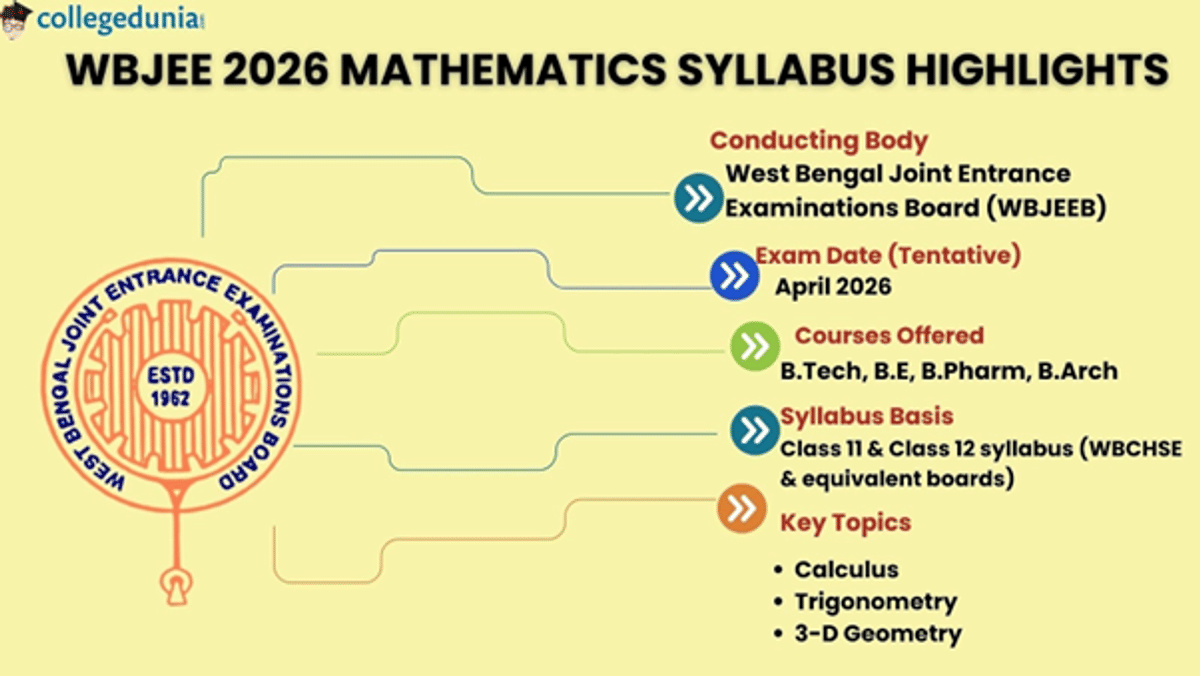
Ques. Through WBJEE, do pupils from other states get admission?
Ans. The admission requirements are as below:
- Yes, WBJEE admission is open to candidates from every Indian state.
- For West Bengal domicile applicants, certain reserved category seats, tuition fee waiver (TFW) programs, and state quota benefits are most readily accessible.
Ques. What advantages are WBJEE colleges? Do placements seem acceptable?
Ans. Through WBJEE, the placement strategy is as specified below:
- Top universities such as Jadavpur University, IEM, Heritage, KGEC, and Techno India provide great academic quality and good placements that are sometimes comparable to NIT-level results for premium departments like CSE and ECE.
- Graduates find employment in TCS, Wipro, Deloitte, Cognizant, Amazon, and core sector firms.
WBJEE Mathematics Syllabus 2026
Ensuring a simple transition from the school-level curriculum to entrance-level problem-solving, the Mathematics portion of WBJEE 2026 is arranged from the topics taught in Classes 11 and 12.
- From Class 11, it draws ideas like sets, relations, trigonometry, sequences and series, and coordinate geometry, and goes into more complex fields like calculus. Class 12 three-dimensional geometry, vectors, and chance.
- Together, these subjects evaluate a student's capacity to apply advanced-secondary mathematics in multi-concept numerical issues common in engineering entrance exams, therefore making conceptual clarity and systematic practice imperative.
| Class 11 Topics | Class 12 Topics |
|---|---|
| Sets, Relations, and Functions | Relations and Functions (Advanced) |
| Trigonometric Functions | Inverse Trigonometric Functions |
| Principle of Mathematical Induction | Matrices and Determinants |
| Linear Inequalities | Continuity and Differentiability |
| Permutations and Combinations | Application of Derivatives |
| Binomial Theorem | Integrals and Differential Equations |
| Sequence and Series | Vector Algebra |
| Straight Lines | Three-Dimensional Geometry |
| Conic Sections (Parabola, Ellipse, Hyperbola) | Probability |
| Introduction to 3D Geometry | Linear Programming |
| Limits and Derivatives | |
| Statistics | |
| Mathematical Reasoning |
WBJEE 2024 Question Paper
| Subject/Paper | Download PDF | Solutions PDF |
|---|---|---|
| Maths | Download | Check Solutions |
Ques. Who may register for WBJEE?
Ans. The WBJEE Eligibility requirements are as follows:
- You have either passed or will be attending Class 12 with Physics, Mathematics, and Chemistry/Biology/Computer Science as major topics.
- You have to score the lowest needed percentage (changes for General/SC/ST/OBC).
- Usually, 17 years old on or before December 31 of the admission year is the minimum age.
- Though for Marine Engineering courses, the upper age is 25 years, engineering has no age limit.
Ques. Is WBJEE harder or easier than JEE Main?
Ans. The difficulty level of WBJEE is given below:
- Usually, WBJEE is seen as simpler than JEE.
- Mostly because the question style is more formula-based and directly connected with the Class 11–12 curriculum, without too many difficult ideas.
- With few prestigious universities and seats, competition is fierce; thus, relative performance matters more than actual difficulty.
WBJEE Mathematics Syllabus 2026: Expected Topic-wise Weightage
The WBJEE 2026 exam tests mathematics, physics, and chemistry through 155 MCQs in an offline OMR-based format.
- Mathematics has the most weight; physics and chemistry get equal points.
- Calculus (approximately 25%), algebra (around 20%), and coordinate geometry (approximately 18%) are the heavily weighted issues.
Mathematics weights for the 2026 WBJEE exam are given in the table below, where:
| Topic | Approx. Weightage |
|---|---|
| Calculus | 25% |
| Algebra | 20% |
| Coordinate Geometry | 18% |
| Trigonometry | 10% |
| Probability | 8% |
| Vectors & 3D Geometry | 10% |
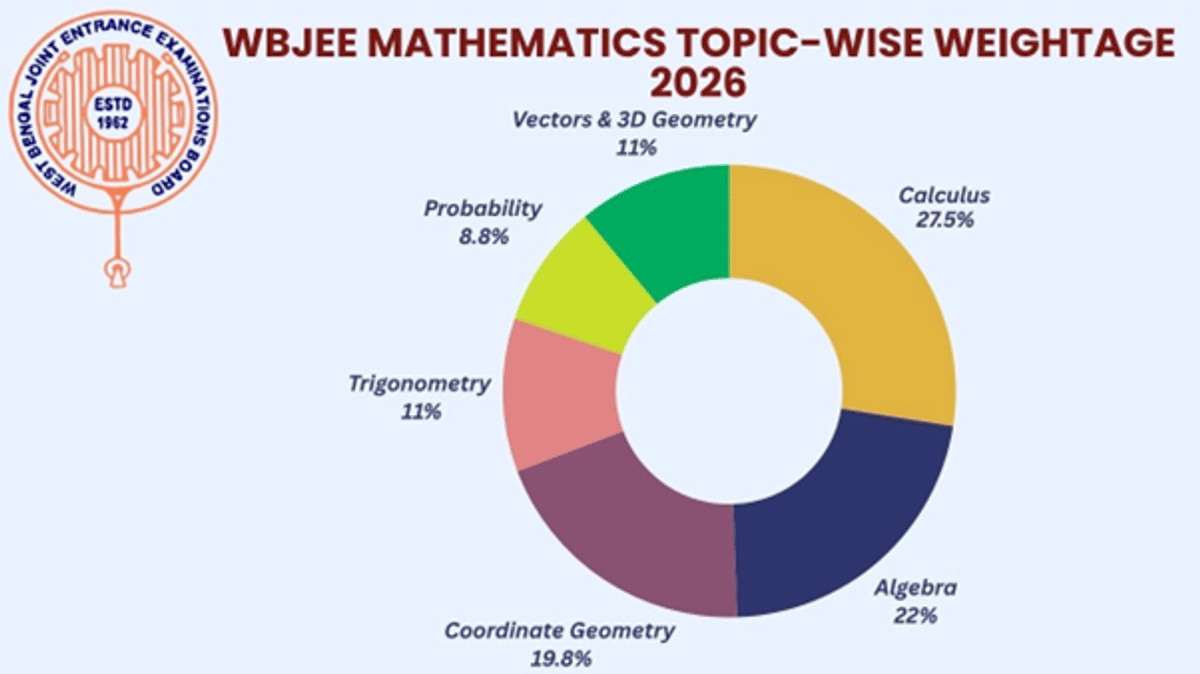
Ques. What is the usual difficulty level of the WBJEE Mathematics exam?
Ans. Based on the previous year’s trends, the mathematics section is considered the most difficult one.
- This is because the problems are not only complex, but they are lengthy too.
- To ace this section, you must solve as many practice papers as possible.
Ques. What are the most important chapters in the WBJEE math syllabus?
Ans. The highest weightage chapters in the WBJEE 2026 math syllabus are given below. Focus on solving previous years’ application-based problems for these areas.
| S.No. | Topics |
|---|---|
| 1 | Algebra (AP, GP, HP, & Polynomials) |
| 2 | Calculus (Differential & Integrals) |
| 3 | 2D & 3D Coordinate Geometry |
| 4 | Vectors |
WBJEE 2026 Exam Pattern
The number of questions, as well as maximum marks for each, for the WBJEE exam pattern for math are given in the following table:
- Mathematics has the highest number of questions (75), making it the highest-scoring subject.
- Category I questions dominate all subjects, emphasising basics, while Categories II and III are fewer but slightly tougher.
| Category | No. of Questions | Marks per Question | Total Marks |
|---|---|---|---|
| Category I (1 correct option) | 50 | 1 | 50 |
| Category II (1 correct option) | 15 | 1 | 15 |
| Category III (1 or more correct options) | 10 | 1 | 10 |
| Total | 75 | — | 75 |
Check:
Ques. What is the category-wise distribution of questions in WBJEE Mathematics 2024?
Ans. The WBJEE Mathematics 2024 section consists of three categories.
- The first category contains a total of 50 questions.
- The second category contains 15 questions
- The third category contains a total of 10 questions.
Ques. How much time does it take to complete the WBJEE Mathematics Syllabus 2024?
Ans. The preparation time depends entirely on the students.
- Some students study only for 2-3 months, others study for 2 years.
- You need to analyse your strong and weak points.
- Set up the timetable and follow it accordingly.
WBJEE Exam 2026 Marking Scheme
The marking scheme of the exam specifies the mark distribution over several questions in the question paper.
- Category 1: 25% negative marking, emphasising accuracy.
- Category 2:+ 2 marks with moderate negative marking, offering a slightly higher reward.
- Category 3: Require all correct options to score full marks, making them more challenging.
- Unattempted questions get zero marks.
In WBJEE, there are three categories of questions for physics, chemistry, and mathematics, which are described below:
| Category | Correct Answer | Incorrect Answer / Multiple Marks | Unattempted Question |
|---|---|---|---|
| Category 1(Only one correct option) | +1 mark | -0.25 mark for wrong answer or multiple options | 0 marks |
| Category 2(Only one correct option) | +2 marks | -0.5 mark for wrong answer or multiple options | 0 marks |
| Category 3(One or more correct options) | +2 marks if all correct options selected | 0 marks for any wrong or partially correct combination; for partially correct: 2 × (no. of correct options marked ÷ total correct options) | 0 marks |
Also Read:
Ques. How does negative marking affect guessing in the WBJEE Exam?
Ans. The table below shows the WBJEE negative marking for 2026.
- Category 1 and 2 questions have negative marking (¼ and ½, respectively), so accuracy is important, and blind guessing should be avoided.
- Category 3 questions have no negative marking, allowing candidates to attempt them confidently to maximise scores.
| Category | Negative Marking |
|---|---|
| Category 1 | ¼ mark (-0.25) |
| Category 2 | ½ mark (-0.5) |
| Category 3 | No negative marking |
Ques. What rank is 120 marks in WBJEE?
Ans. A score of 120 marks in WBJEE is considered very good. Expected Rank range: Around 3000-5000 (varies yearly)
With this rank:
- You can expect core branches like CSE, ECE, ME, etc., in most top state colleges.
- Very good chances for Jadavpur University in non-CSE branches.
- CSE may be borderline depending on your category and domicile.
WBJEE Mathematics 2026 Recommended Books
Here are some recommended books for you to follow to excel in the WBJEE 2026 examination:
| Name of the Book | Name of the Author/Publisher |
|---|---|
| NCERT Mathematics (class 11th and 12th) | -- |
| Mathematics | S. N. Dey |
| Algebra (Overall Reference) | R.D. Sharma |
| Algebra | S.K. Goyal |
| Objective Mathematics | R.D. Sharma |
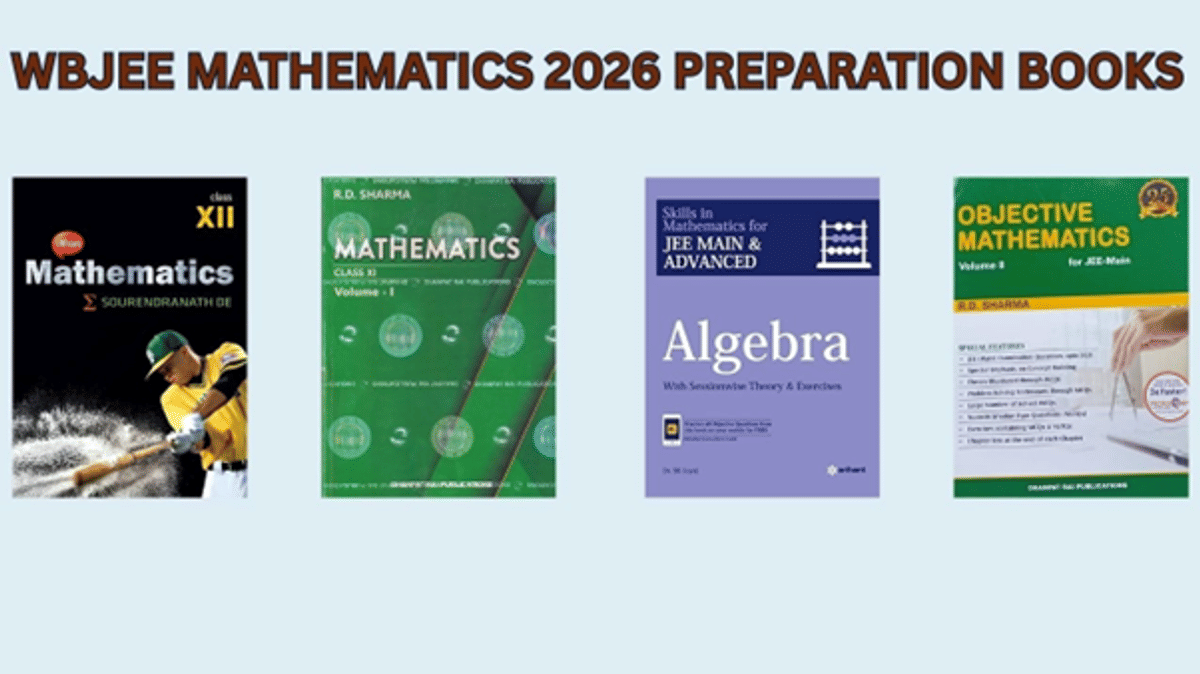
Ques. How many times is WBJEE conducted in a year, and when?
Ans. The frequency of WBJEE is as discussed below:
- WBJEE is held once every year, usually in April or May.
- The notification releases typically occur between December and January, followed by the application, admit card, exam, and counselling stages.
Ques. How does WBJEE counselling happen?
Ans. WBJEE counselling is conducted online by WBJEEB after the results.
- You have to register, upload documents, choose colleges & branches (choice filling), and then seats are allotted based on rank, category, and seat availability.
- Multiple rounds are held, and candidates can accept, upgrade, or withdraw based on the round.
WBJEE Mathematics Previous Years' Question Papers
You need to solve WBJEE Question Papers, which will enable them to practice more and recognise their preparation levels.
The table below includes the link for WBJEE Previous Years’ Physics Question Papers and Answer Keys.
WBJEE Mathematics Preparation Tips 2026
WBJEE is a speed and accuracy-based state-level exam where Physics, Chemistry, and Mathematics are tested from the Class 11–12 syllabus, but with competitive depth.
- To score well, you must focus on conceptual clarity, formula retention, timed practice with PYQs and mock tests, and strict error analysis rather than just revision.
- Since the paper is OMR-based with negative marking, exam temperament and decision-making under time pressure become equally important as subject knowledge.
- The table below gives a strategy to prepare efficiently for the WBJEE Mathematics 2026 exam.
| Area | What To Do |
|---|---|
| Syllabus Mastery | Finish NCERT + standard notes before starting mocks |
| PYQs & Pattern Familiarity | Solve the last 10 years of WBJEE PYQs chapter-wise |
| Timed Mock Tests | Take weekly full-length OMR mocks under strict timing |
| Error Log Maintenance | Record all mistakes and re-attempt them every 3–4 days |
| Formula & Short-Note Revision | Maintain a one-page formula sheet per subject |
| Cut Negative Marking | Skip blind guesses; attempt only when >50% confidence |
| Healthy Study Rhythm | 2–3 focused study blocks per day with breaks |
Also Read:
Ques. How should I divide my time for the math subject in the WBJEE exam?
Ans. The table shows the details for the math subject:
| Subject | Strategy | Focus Area |
|---|---|---|
| Mathematics | Allocate the most time (the largest number of questions) | Start with Category I for quick marks, then attempt Categories II & III carefully |
| Overall Strategy | Balance speed and accuracy across subjects | Attempt easier questions first, avoid blind guessing in Categories I & II, attempt all Category III confidently (no negative marking) |
Ques. How to achieve a qualifying score in WBJEE Mathematics 2024?
Ans. Solving mock tests will assist one in increasing the scores.
- Doing these mock tests enhances time management skills and allows the candidates to know their strengths and areas that need improvement.
- Apart from this, regular practice will help students achieve their desired scores in WBJEE Mathematics.
WBJEE Mathematics Syllabus 2026 FAQs
Ques. How many seats are in WBJEE?
Ans. WBJEE offers around 35,000 to 40,000 seats across government and private colleges in West Bengal.
The following table shows the same:
| Types of Colleges | Approx. Seats |
|---|---|
| Government | 8,000+ |
| Private | 27,000–30,000 |
| Total | 35,000–40,000 |
Ques- What is the cut off for Calcutta University B.Tech?
Ans- Here is the complete list of Calcutta University cutoff for B.Tech:
- The last round closing rank for B.E. in Computer Science & Engineering at Calcutta University (General category, All-India / Home State) is about 980
- For some branches (E & C, Electrical, etc.), the expected 2025 closing ranks (General) are:
- ECE: 1392
- Electrical Engineering: 1634
- Chemical Engineering: 2282
Ques. Which courses come under WBJEE?
Ans. Through WBJEE, candidates can get admission into Engineering, Architecture, and Pharmacy programs.
| Course | Duration | Example Programs |
|---|---|---|
| B.Tech | 4 Years | CSE, ECE, ME, CE |
| B.Pharm | 4 Years | Pharmacy |
| B.Arch | 5 Years | Architecture |
Ques- What is the package of CSE Calcutta University?
Ans- Here is a list of in-campus placements in CSE Calcutta University:
- Median package for BTech (incl. CSE) in 2023-24 ₹10 LPA
- Median package for UG 3-year courses (non-BTech) ₹9.20 LPA
- Highest reported packages across CU (for BTech / UG / PG) in the latest reports: ₹12 LPA
Ques. What is the last date to correct the online WBJEE 2026 Application Form?
Ans. WBJEEB offers a one-time opportunity to make corrections to your WBJEE application form.
- The form correction facility will open in February 2026.
- Check WBJEE 2026 Form Correction
Ques. What is the number of times a candidate can sit for WBJEE 2026?
Ans. The age limit for WBJEE 2026 is given below:
- No restrictions will be maintained for both the number of attempts and age for WBJEE 2026.
However, candidates who want to register themselves for the program in marine biology can attempt the test till 25 years of age.
Maths Sample Paper
The WBJEE 2026 Mathematics Sample Papers were created with previous year questions (PYQs) along with expected questions based on the latest exam trends. Candidates can download the WBJEE Sample Papers using the links below.
| WBJEE Mathematics Sample Paper | Direct Link |
|---|---|
| WBJEE Mathematics Sample Paper 1 | Download PDF |
| WBJEE Mathematics Sample Paper 2 | Download PDF |
| WBJEE Mathematics Sample Paper 3 | Download PDF |
| WBJEE Mathematics Sample Paper 4 | Download PDF |
| WBJEE Mathematics Sample Paper 5 | Download PDF |
| WBJEE Mathematics Sample Paper 6 | Download PDF |
| WBJEE Mathematics Sample Paper 7 | Download PDF |
| WBJEE Mathematics Sample Paper 8 | Download PDF |
| WBJEE Mathematics Sample Paper 9 | Download PDF |
| WBJEE Mathematics Sample Paper 10 | Download PDF |
| WBJEE Mathematics Sample Paper 11 | Download PDF |
| WBJEE Mathematics Sample Paper 12 | Download PDF |
| WBJEE Mathematics Sample Paper 13 | Download PDF |
| WBJEE Mathematics Sample Paper 14 | Download PDF |
| WBJEE Mathematics Sample Paper 15 | Download PDF |
| WBJEE Mathematics Sample Paper 16 | Download PDF |
| WBJEE Mathematics Sample Paper 17 | Download PDF |
| WBJEE Mathematics Sample Paper 18 | Download PDF |
| WBJEE Mathematics Sample Paper 19 | Download PDF |
| WBJEE Mathematics Sample Paper 20 | Download PDF |
| WBJEE Mathematics Sample Paper 21 | Download PDF |
Related Articles:
- WBJEE Mathematics Syllabus: Topic-wise Breakdown
- WBJEE Mathematics Mock Tests with Solutions
- WBJEE Mathematics Previous Year Questions (PYQs)
The WBJEE Exam will be held on 24 May 2026 in offline (OMR) mode. The WBJEE Mathematics paper carries 100 marks out of the total 200 marks, making it the highest weightage section.
WBJEE Mathematics sample papers and previous papers are the most effective resources for preparation because they follow the official syllabus and exam pattern.
Importance of WBJEE 2026 Mathematics Sample Papers
WBJEE Mathematics sample papers mirror the actual exam in difficulty level, question types, and pattern (Category 1, 2 & 3 questions). Toppers and expert teachers repeatedly highlight the importance of solving sample papers and mock tests during preparation.
Here’s why they are essential:
- Familiarity with Exam Pattern: Get used to the exact format — 75 questions in 2 hours, different categories with varying marking and negative marking.
- Understanding Topic Weightage: These Sample papers contain high-weightage chapters, such as Calculus, Algebra, Coordinate Geometry, Application of Calculus, etc.
- Improves Speed & Time Management: Mathematics is a time-consuming subject. By regularly solving sample papers, students develop better question-solving strategies, improve calculation speed, and enhance their time management skills during the exam
- Identifying Strengths and Weaknesses: After solving sample papers, analyzing your mistakes carefully helps you understand which topics need more practice, such as Application of Derivatives or 3D Geometry. This allows you to focus on your weak areas and progress consistently.
- Enhanced Problem-Solving & Accuracy: When students solve sample papers regularly, they develop faster shortcuts, smart elimination techniques, and better strategies for solving Category 3 questions, where there is no negative marking.
- Reduces Silly Errors: With regular practice, students become more careful and confident, which helps them avoid calculation errors and incorrect OMR filling during the actual exam
WBJEE Mathematics Exam Pattern & Marking Scheme
- Paper: Mathematics (Paper 1)
- Total Questions: 75
- Total Marks: 100
- Duration: 2 hours
- Question Categories:
| Category | No. of Questions | Marks per Q | Negative Marking | Type |
|---|---|---|---|---|
| Category 1 | 50 | 1 | -0.25 | Single correct |
| Category 2 | 15 | 2 | -0.5 | Single correct |
| Category 3 | 10 | 2 | No negative | One or more correct |
- Pro Tip: A strong score in Mathematics, especially 60+ marks, can significantly boost your overall WBJEE rank and improve your chances of getting a better college and branch.
WBJEE 2026 Mathematics Sample Papers : Topic-wise weightage
We have created the Mathematics Sample Papers based on the topic-wise weightage of questions asked in previous WBJEE exams. Calculus and Coordinate Geometry carry the highest weightage in WBJEE Mathematics. Around 20 questions are generally asked from Calculus, while nearly 12 questions are asked from Coordinate Geometry in the exam.
| Topic (As per syllabus) | Avg Qs | Weightage(%) | Priority |
|---|---|---|---|
| Algebra (A.P., G.P., H.P., Logarithms, Permutation & Combination, Binomial Theorem) | 10 | 13% | High |
| Complex Numbers & Quadratic Equations | 5 | 7% | Medium |
| Matrices & Determinants | 5 | 7% | Medium |
| Sets, Relations & Functions | 3 | 4% | Low |
| Probability & Statistics | 5 | 7% | Medium |
| Trigonometry & Inverse Trigonometry | 4 | 5% | Medium |
| Coordinate Geometry (Straight Lines, Circle, Parabola, Ellipse, Hyperbola) | 12 | 16% | High |
| 3D Geometry (Direction cosines, Planes, Shortest distance) | 4 | 5% | Medium |
| Vectors (Dot & Cross products, Scalar triple product) | 5 | 7% | Medium |
| Calculus (Limits, Differentiation, Integration, Differential Equations) | 21 | 28% | High |
| Application of Calculus (Monotonicity, Maxima/Minima, Area, Motion) | 6 | 8% | High |
FAQs
Ques. Are WBJEE 2026 Mathematics Sample Papers different from the previous year's papers?
Ans. Yes. Sample or model papers contain expected questions based on the latest exam trends, while previous year papers (especially from 2023–2025) include actual WBJEE exam questions. Solving both helps students understand the exam pattern, improve practice, and prepare more effectively.
Ques. How many Mathematics sample papers should I solve?
Ans. Solve at least 15–25 full-length Mathematics sample papers, including PYQs, during the last 1–2 months before the exam. Along with this, regularly practice chapter-wise tests for weak topics to improve accuracy and confidence.
Ques. Can solving sample papers guarantee good marks in WBJEE Maths?
Ans. No, there is no guarantee, but regular practice along with proper analysis can greatly improve your speed, accuracy, and confidence, which ultimately helps in achieving better scores in the exam.
Ques. How do I analyze the WBJEE Mathematics sample paper effectively?
Ans. Follow this method:
- Note the time taken and the score.
- Categorize mistakes (conceptual, calculation, silly).
- Revise concepts immediately for wrong questions.
- Maintain a formula/error notebook.
- Track progress across multiple papers.
Ques. Do WBJEE Mathematics sample papers include solutions?
Ans. Yes, sample papers and PYQ booklets include detailed solutions and answer keys prepared by expert teachers, which help students understand concepts and learn the correct approach to solving questions.
Merit List
The WBJEE 2026 Merit List was declared by the West Bengal Joint Entrance Examinations Board (WBJEEB) on June 18, 2026, along with individual rank cards available at wbjeeb.nic.in. WBJEEB releases two ranked lists every year: the General Merit Rank (GMR) for engineering and technology admissions and the Pharmacy Merit Rank (PMR) for B.Pharm seats.
- Merit List Status: Released. WBJEE 2026 rank cards have been live at wbjeeb.nic.in since June 18, 2026; no separate consolidated public PDF is issued.
- Two Merit Lists: WBJEEB issues a General Merit Rank (GMR) covering B.Tech and B.Arch seats and a Pharmacy Merit Rank (PMR) for B.Pharm seats.
- Category Ranks: Students from reserved groups receive an additional category rank (OBC-A, OBC-B, SC, ST, EWS, TFW, PwD) alongside their GMR on the same rank card.
- 2026 Topper: Shaswat Banerjee secured GMR 1 in WBJEE 2026, followed by Souridhha Mondal (GMR 2) and Umang Bhoot (GMR 3).
- Next Step — Counselling Begins June 30, 2026: WBCAP centralised counselling registration opens the very next day; seat allotment is strictly based on GMR order within each category.
- No Public Rank PDF: WBJEEB does not release a consolidated rank list for public download; each student accesses their individual merit rank via the official login portal.
- Tie-Breaking: When two students score equally, the student with higher marks in Mathematics ranks higher; if still tied, Physics marks decide; for a persistent tie, the older student receives the better rank.
Counselling registration opens June 30, 2026 — log in to the official portal at wbjeeb.nic.in right now to confirm your GMR and category rank, then prepare all documents (class 10, class 12, income certificate for reserved categories) ahead of choice filling for engineering and pharmacy seats across West Bengal.
Key Summary
The WBJEE 2026 Merit List is the board-assigned rank order of all qualified students, used solely by WBCAP to determine seat allotment priority in West Bengal engineering and pharmacy colleges.
- Exam Authority: West Bengal Joint Entrance Examinations Board (WBJEEB), Kolkata.
- Merit Lists Issued: General Merit Rank (GMR) for B.Tech/B.Arch; Pharmacy Merit Rank (PMR) for B.Pharm.
- Release Date: June 18, 2026 (rank cards live on wbjeeb.nic.in at 4:00 PM).
- 2026 Topper: Shaswat Banerjee (GMR 1); Souridhha Mondal (GMR 2); Umang Bhoot (GMR 3).
- Counselling: WBCAP registration from June 30, 2026.
- Category Ranks: OBC-A, OBC-B, SC, ST, EWS, TFW, PwD ranks displayed on the rank card alongside GMR.
- Total Exam Marks: 200 marks (Paper I: Physics & Chemistry; Paper II: Mathematics).
What is WBJEE Merit List 2026?
The WBJEE 2026 Merit List is the rank-ordered list of every student who appeared in the West Bengal Joint Entrance Examination 2026 and obtained a valid score. WBJEEB assigns each student a unique General Merit Rank (GMR) based solely on raw marks scored across Paper I (Physics and Chemistry) and Paper II (Mathematics) — there is no normalisation, no percentile, and no session-wise adjustment. Your GMR is your exact position on this ranked list and is the only number WBCAP uses to determine which college and branch you can be allotted during counselling.
The merit list differs from the result in one critical respect: the result tells you your marks and whether you passed; the merit list tells you your competitive standing against every other student who appeared. A student who scored 160 out of 200 knows their absolute performance from the result, but the merit list tells them they rank, say, 312th among all qualified students — the number that actually determines admission. WBJEEB does not publish a single downloadable PDF ranking all students; instead, each student accesses their personal merit rank by logging in to the official candidate portal.
Types of WBJEE Merit List 2026
WBJEEB releases two distinct merit lists every year. Students who appear in both Paper I and Paper II appear on the GMR list for engineering seats. Students who sat only Paper I appear on the PMR list for pharmacy seats. Students who appeared in both papers automatically receive both ranks on the same rank card.
| Merit List Type | Full Form | Covers | Papers Required |
|---|---|---|---|
| GMR | General Merit Rank | B.Tech, B.E., B.Arch in WB engineering and architecture colleges | Paper I (Physics & Chemistry) + Paper II (Mathematics) |
| PMR | Pharmacy Merit Rank | B.Pharm in WB pharmacy colleges | Paper I (Physics & Chemistry) only |
Every student who appeared in Paper I and Paper II automatically receives both a GMR and a PMR, giving them eligibility for both engineering/architecture seats and pharmacy seats during WBCAP counselling. Students who appeared only in Paper I receive only a PMR and may compete only for pharmacy seats.
WBJEE Merit List Important Dates 2026
The table below lists every key event in the WBJEE 2026 merit list and counselling calendar. Upcoming events are shown first in the order they will occur; past events follow in the order they happened.
| Event | Date | Status |
|---|---|---|
| WBCAP Counselling Registration Opens | June 30, 2026 | Upcoming |
| Choice Filling for WBCAP Round 1 | Expected July 2026 | Upcoming |
| Round 1 Seat Allotment (WBCAP) | Expected August 2026 | Upcoming |
| Round 2 Seat Allotment (WBCAP) | Expected August–September 2026 | Upcoming |
| Round 3 / Mop-Up Seat Allotment | Expected September 2026 | Upcoming |
| Document Verification & College Reporting | Expected September–October 2026 | Upcoming |
| WBJEE 2026 Examination | April 2026 | Over |
| Provisional Answer Key Released | May 2026 | Over |
| Final Answer Key Released | June 2026 | Over |
| WBJEE 2026 Result & Rank Card (Merit List) Declared | June 18, 2026 | Over |
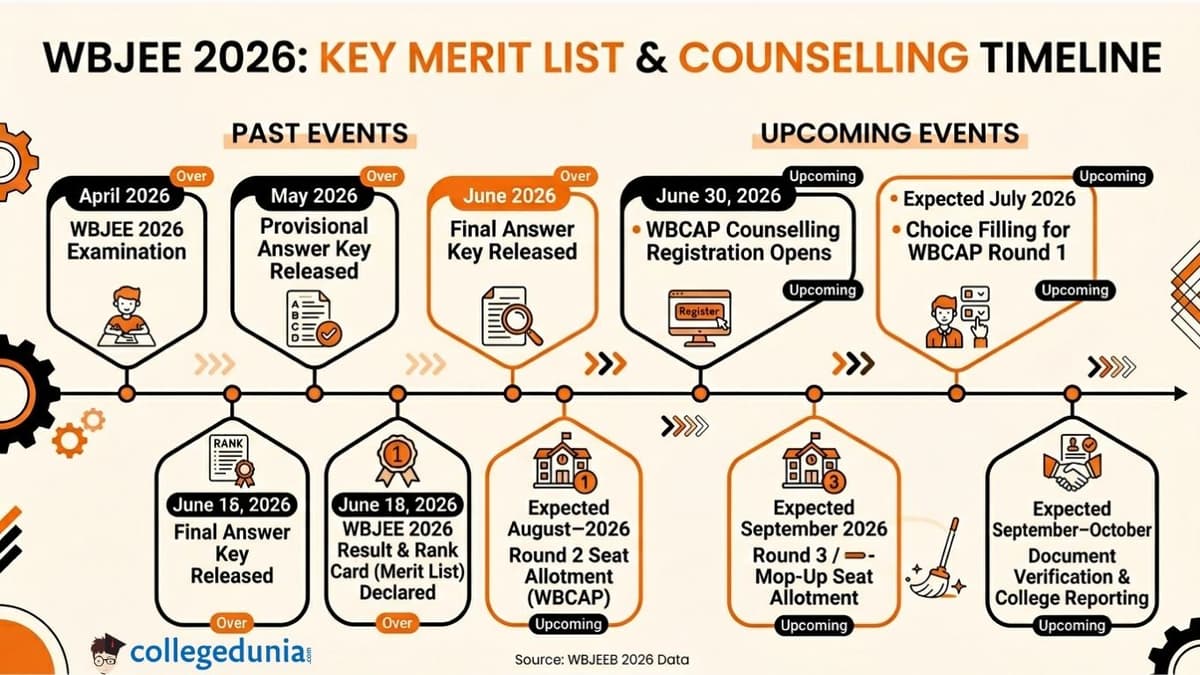
Category-wise WBJEE Merit List 2026
The WBJEE 2026 rank card displays your General Merit Rank (GMR) alongside a separate category rank if you registered under a reserved category. Both ranks appear on one document accessible via the candidate login portal. WBJEEB does not publish standalone category-wise rank PDFs for public download. The category rank is used during WBCAP counselling to fill reserved-category seats, which are distributed on top of the open-merit GMR competition.
| Category | Certificate Required | Approximate Seat Reservation (WB State Policy) | Rank Shown on Rank Card |
|---|---|---|---|
| General / Unreserved (UR) | None | Open merit (no reservation) | GMR only |
| OBC-A | WB State OBC-A certificate | 10% | GMR + OBC-A category rank |
| OBC-B | WB State OBC-B certificate | 7% | GMR + OBC-B category rank |
| SC | WB SC certificate | 22% | GMR + SC category rank |
| ST | WB ST certificate | 6% | GMR + ST category rank |
| EWS | WB EWS income certificate (family income ≤8 LPA) | 10% | GMR + EWS category rank |
| TFW (Tuition Fee Waiver) | WB family income ≤2.5 LPA certificate | Per-college quota | GMR + TFW category rank |
| PwD (Person with Disability) | Disability certificate (≥40% benchmark disability) | 5% horizontal reservation | GMR + PwD category rank |
Note: All category certificates must be issued by a competent authority in West Bengal. Central-government OBC-NCL certificates are not accepted for WBJEE OBC-A or OBC-B reserved seats. Students who claimed a reservation at registration must verify their certificate is West-Bengal-state-issued before reporting for document verification at their allotted college.
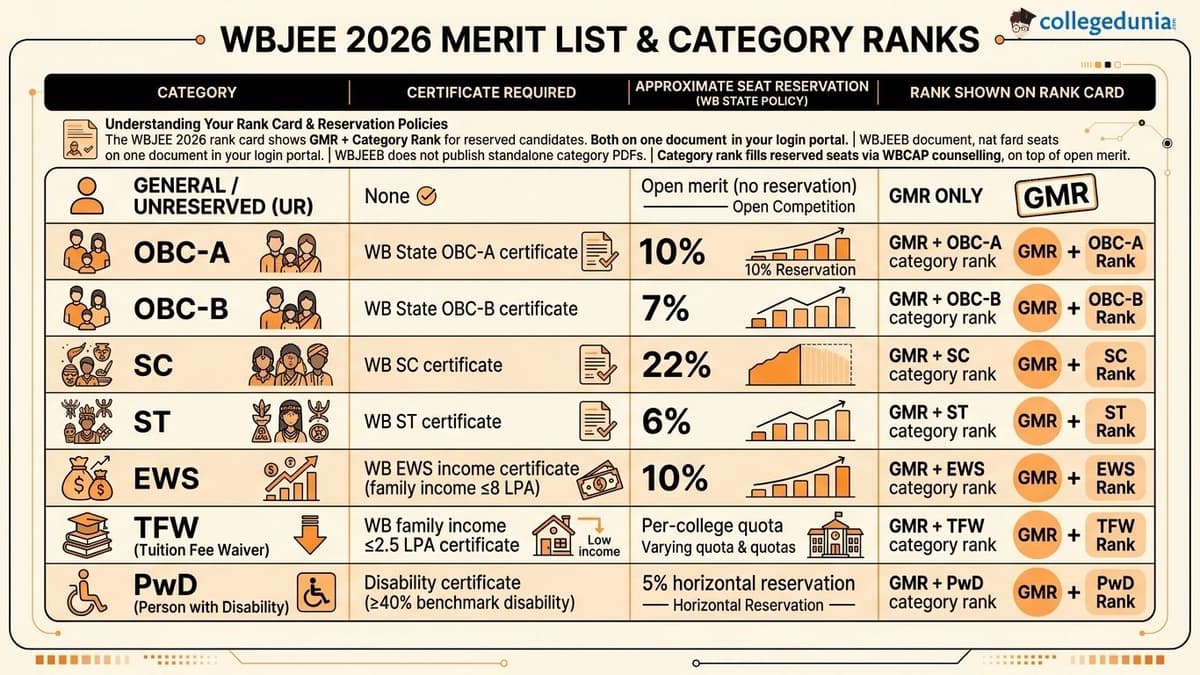
How to Check WBJEE Merit List 2026
The steps below walk you through accessing your GMR, PMR, and category rank on the official WBJEE portal. Keep your application number and password ready before you start.
| Step | Action |
|---|---|
| Step 1 | Visit the official WBJEE portal: wbjeeb.nic.in. |
| Step 2 | Click on the “WBJEE 2026” tab and then select the result or rank card link from the candidate activity section. |
| Step 3 | Enter your application number and password. If you forgot your password, use your date of birth in DD-MM-YYYY format to reset it. |
| Step 4 | Click “Login.” Your rank card will appear on screen showing your marks in each paper, your GMR, your PMR, and your category rank if applicable. |
| Step 5 | Note all three values: GMR (for engineering/architecture seats), PMR (for pharmacy seats), and category rank if you belong to a reserved group. |
| Step 6 | Download and save the rank card as a PDF. Keep it ready for WBCAP counselling registration opening June 30, 2026 — you will need your GMR to fill college and branch choices. |
WBJEE Cutoff 2026
The WBJEE 2026 counselling cutoff is expressed as opening and closing GMR ranks per college, course, and category. WBJEEB publishes these cutoffs after each WBCAP counselling round; 2026 round-wise cutoffs will be available from August 2026 onwards. WBJEEB does not announce a single qualifying cutoff score — the effective cutoff is simply the closing GMR at which the last seat in a given college, branch, and category was filled during that round. The table below provides indicative closing ranks from WBJEE 2025 Round 2 as a reference for planning your WBCAP 2026 choices.
| College | Branch | General Closing GMR (2025 Round 2) | OBC-A Closing GMR (2025 Round 2) | SC Closing GMR (2025 Round 2) |
|---|---|---|---|---|
| Jadavpur University | Computer Science & Engineering | ~120 | ~250 | ~900 |
| Jadavpur University | Electronics & Communication Engineering | ~400 | ~650 | ~1,800 |
| IIEST Shibpur | Computer Science & Engineering | ~500 | ~800 | ~2,500 |
| IIEST Shibpur | Electronics & Telecommunication Engineering | ~800 | ~1,200 | ~4,000 |
| IIEST Shibpur | Civil Engineering | ~2,500 | ~4,000 | ~9,000 |
| Govt. College of Engineering & Leather Technology | Leather Technology | ~8,000 | ~12,000 | ~25,000 |
| Self-financed colleges (various) | CSE / ECE | ~15,000–80,000 | — | — |
Note: All figures above are approximate, drawn from WBJEE 2025 Round 2 results. Official WBJEE 2026 cutoffs will be published after each WBCAP 2026 counselling round and updated accordingly.
How Many Marks are Required for a Good Rank in WBJEE 2026?
The table below maps marks ranges to approximate GMR bands for WBJEE 2026. Because WBJEEB applies no normalisation, a raw score maps directly to a rank, making these benchmarks more reliable than in exams that use percentile systems. Even a 2–3 mark difference in the 150–185 range can shift your GMR by 50–200 positions, so accuracy matters at the top of the scale.
| Marks Scored (out of 200) | Approximate GMR Range (2026) | Likely Admission Prospects |
|---|---|---|
| 185–200 | 1–50 | Jadavpur University CSE, all top branches within reach |
| 170–184 | 51–200 | Most JU branches, IIEST Shibpur CSE |
| 150–169 | 201–600 | IIEST Shibpur CSE and core branches, select JU non-CS seats |
| 130–149 | 601–2,000 | Government engineering colleges, good IIEST Shibpur branches |
| 100–129 | 2,001–10,000 | Most government colleges, better self-financed institutions |
| 70–99 | 10,001–30,000 | Self-financed engineering colleges in West Bengal |
| Below 70 | 30,001+ | Limited options; private institutions with available seats |
WBJEE Merit List 2025
The WBJEE 2025 merit list was declared by WBJEEB in June 2025, with rank cards released at wbjeeb.nic.in using the same GMR and PMR structure. The 2025 merit list served as the basis for WBCAP 2025 counselling. General category GMR ranks ranged from 1 to approximately 1,412,739 in WBJEE 2025, reflecting a slight increase in the number of qualified students compared to 2024 and making 2025 the more competitive of the two preceding cycles.
| Event | Date (2025) |
|---|---|
| WBJEE 2025 Examination | April 27, 2025 |
| WBJEE 2025 Result & Merit List Declared | June 2025 |
| WBCAP 2025 Counselling Registration | June 2025 |
| WBJEE 2025 Round 2 Cutoff Released | September 10, 2025 |
Jadavpur University CSE closed at approximately GMR 120 in Round 2 of WBCAP 2025 for the General category, while the SC category closing rank at JU CSE was approximately 900 in the same round — a gap that illustrates the significant advantage category reservation provides in the most competitive WBJEE admission stakes. WBJEE 2026 aspirants use the 2025 Round 2 data as their primary planning benchmark, pending the release of 2026 cutoffs after counselling.
WBJEE Previous Year Merit List (2023–2024)
WBJEEB has followed the same GMR and PMR merit list structure in every recent cycle. The tables below cover the WBJEE 2024 and 2023 cycles as historical reference. In each year, merit lists were accessible only via the official candidate portal; no consolidated public rank PDF was issued.
WBJEE Merit List 2024
The WBJEE 2024 merit list was declared in June 2024. WBCAP 2024 counselling used GMR order for seat allotment across all participating West Bengal engineering colleges. General category ranks ranged from 1 to approximately 1,381,931 in WBJEE 2024 — slightly fewer qualified students than in 2025, which saw higher competition across both the GMR and PMR lists.
| Event | Date (2024) |
|---|---|
| WBJEE 2024 Examination | April 28, 2024 |
| WBJEE 2024 Result & Merit List Declared | June 2024 |
| WBCAP 2024 Counselling | July–September 2024 |
WBJEE Merit List 2023
The WBJEE 2023 merit list was published in June 2023 after the exam was held in April 2023. The 2023 cycle ran a full three-round WBCAP counselling structure that has continued unchanged in 2024, 2025, and 2026. Merit list access in 2023 was exclusively through the official portal login; WBJEEB has not released a consolidated public rank PDF in any year.
| Event | Date (2023) |
|---|---|
| WBJEE 2023 Examination | April 30, 2023 |
| WBJEE 2023 Result & Merit List Declared | June 2023 |
| WBCAP 2023 Counselling | July–September 2023 |
WBJEE Good Score 2026
A “good score” in WBJEE 2026 is defined by your target college and branch, not by any single universal threshold. Because WBJEE uses raw scores with no normalisation, your marks directly determine your GMR, making score-to-college mapping more straightforward than in percentile-based systems.
- For Jadavpur University CSE (the highest-demand seat in all of WBJEE): Treat 175+ marks as the safe minimum. Scores below 170 carry a real risk of missing JU CSE across all three WBCAP rounds for General category students; SC students may compete from approximately SC category rank 900.
- For IIEST Shibpur CSE: Scores of 150–170 marks typically produce a GMR in the 200–600 range, which has historically been sufficient for IIEST Shibpur CSE in most counselling rounds.
- For Government Engineering Colleges (GECs) in West Bengal: Scores of 100–130 marks typically yield a GMR of 2,000–10,000, which covers most government college branches across West Bengal.
- For self-financed colleges: Scores between 60 and 100 marks (GMR roughly 10,000–50,000) provide access to most self-financed engineering institutions participating in WBCAP.
- WBJEE 2026 Topper Shaswat Banerjee (GMR 1) set the top of the 2026 merit list. In recent years, the GMR 1 score has typically been 195 marks or above out of 200.
- Category reservation meaningfully expands options: An SC student with a GMR of 9,000 may hold an SC category rank near 1,700, opening branches at government colleges that would be out of reach in open-merit competition at that GMR level.
Is 150 Marks a Good Score in WBJEE 2026?
Yes, 150 marks out of 200 in WBJEE 2026 is a competitive score, placing you in an approximate GMR range of 201 to 600. This band is sufficient for IIEST Shibpur CSE and most branches at leading government engineering colleges in West Bengal. However, 150 marks falls below the typical safe-minimum of 175 marks required for Jadavpur University CSE, so JU CSE remains unlikely for General category students at this score.
Students who scored around 150 marks have solid choices across West Bengal: JU non-CSE branches such as Electrical Engineering become realistic options depending on the exact GMR; IIEST Shibpur CSE is achievable; and government colleges across the state remain comfortably within reach.
Admission Possibilities with 150 Marks in WBJEE 2026
| College | Branch | Admission Possibility at 150 Marks (General Category) |
|---|---|---|
| Jadavpur University | Computer Science & Engineering | Unlikely — typical closing rank ~120 in 2025 |
| Jadavpur University | Electrical Engineering | Possible — closing rank in the 500–700 range in 2025 |
| IIEST Shibpur | Computer Science & Engineering | Likely — closing rank ~500 in 2025 |
| IIEST Shibpur | Civil / Mechanical Engineering | Comfortable — closing ranks typically in the 1,500–2,500 range |
| Government Engineering Colleges (GEC Kalyani, etc.) | Most branches | Comfortable — well within the GMR band for all GEC branches |
| Self-financed colleges | All branches | Comfortable — all seats accessible at this GMR |
Note: Closing ranks are based on WBJEE 2025 Round 2 data and are indicative only. WBJEE 2026 official closing ranks will be available after WBCAP 2026 counselling concludes.
WBJEE Marks vs Rank 2026
WBJEE 2026 uses a direct raw-score-to-rank system. Your combined marks in Paper I (Physics and Chemistry) and Paper II (Mathematics) out of 200 determine your GMR with no normalisation and no session adjustment. This makes WBJEE one of the few major engineering entrance exams where marks-to-rank prediction is highly reliable year on year.
- No percentile, no normalisation: Unlike JEE Main, WBJEE does not normalise scores across sessions. One raw-to-rank computation, based on a single exam date, applies to all students equally.
- Negative marking applies: Category 1 (single-correct MCQ) and Category 2 questions carry a 0.25 mark deduction per wrong answer. Category 3 of Paper II (multiple-correct MCQ) has no negative marking, making it a scoring opportunity for students who identify all correct options.
- Small mark differences matter at the top: A 2–3 mark difference in the 150–185 range can shift your GMR by 50–200 positions, which may mean the difference between IIEST Shibpur CSE and JU non-core branches.
- Category rank is derived from GMR: Your category rank counts only students in your specific category who scored higher total marks than you; it is not a separate exam-score calculation.
| Marks (out of 200) | Approximate GMR Range (2026) | Approximate Percentile |
|---|---|---|
| 185–200 | 1–50 | 99.99%+ |
| 170–184 | 51–200 | 99.98%+ |
| 155–169 | 201–600 | 99.95%+ |
| 140–154 | 601–2,000 | 99.85%+ |
| 120–139 | 2,001–8,000 | 99.4%+ |
| 100–119 | 8,001–20,000 | 98.5%+ |
| 80–99 | 20,001–50,000 | 96%+ |
| 60–79 | 50,001–1,00,000 | 92%+ |
| Below 60 | 1,00,001+ | Below 92% |
GMR ranges are estimates based on declared WBJEE 2026 rank card data and 2025 trend analysis. Your actual GMR may vary by 10–20% from these estimates depending on the score distribution across the full student pool.
FAQs on WBJEE Merit List 2026
Ques: What is the WBJEE 2026 merit list and how is it different from the result?
Ans: The WBJEE 2026 result tells you your marks in Paper I and Paper II and whether you qualified. The merit list is the complete rank-ordered list of all qualified students; your GMR or PMR position on that list is what drives seat allotment in WBCAP counselling. A score of 160 marks tells you how you performed in absolute terms; a GMR of 312 tells you that 311 students scored higher than you and that your counselling priority is 312th — the number that actually determines which college and branch you are offered.
Ques: When was the WBJEE 2026 merit list declared?
Ans: WBJEEB declared the WBJEE 2026 merit list alongside the rank cards on June 18, 2026 at 4:00 PM at the official portal wbjeeb.nic.in. All qualified students have had access to their GMR, PMR, and category rank for over ten days as of today, June 29, 2026. Counselling registration opens the very next day, June 30, 2026.
Ques: How can I check my WBJEE 2026 merit rank / rank card?
Ans: Visit wbjeeb.nic.in, navigate to the WBJEE 2026 candidate activity section, click the rank card link, and log in with your application number and password. Your rank card shows your marks in each paper, your GMR, your PMR, and your category rank if you registered under a reserved category. Download the rank card as a PDF and keep it ready for WBCAP counselling registration opening June 30, 2026.
Ques: What is GMR and PMR in WBJEE 2026?
Ans: GMR stands for General Merit Rank and is the rank used for admission to B.Tech, B.E., and B.Arch seats in West Bengal engineering colleges. PMR stands for Pharmacy Merit Rank and is used for B.Pharm admissions. Students who appeared in both Paper I (Physics & Chemistry) and Paper II (Mathematics) receive both a GMR and a PMR on the same rank card. Students who appeared only in Paper I receive only a PMR and may compete for pharmacy seats only.
Ques: What are the WBJEE 2026 tie-breaking rules when two students score the same marks?
Ans: When two or more students score identical total marks in WBJEE 2026, WBJEEB applies the following tie-breaking criteria in order until the tie is resolved:
| Tie-Breaking Order | Criterion Applied |
|---|---|
| 1st | Higher marks in Mathematics (Paper II) |
| 2nd | Higher marks in Physics (Paper I) |
| 3rd | Higher marks in Chemistry (Paper I) |
| 4th | Higher ratio of correct answers to incorrect answers across all papers |
| 5th | Age: the older student receives the better (lower number) rank |
The age rule is the most frequently misunderstood tie-breaker in WBJEE — unlike most competitive exams that favour the younger student, WBJEE explicitly awards the higher rank to the older student when all other criteria are exhausted.
Ques: Will I receive a category rank alongside my GMR in WBJEE 2026?
Ans: Yes. If you registered under a reserved category (OBC-A, OBC-B, SC, ST, EWS, TFW, or PwD), your rank card shows both your GMR and your category rank. Your category rank is your position among all students in your specific category who appeared and scored. This category rank is used during WBCAP counselling to fill reserved seats; your GMR is used for open-merit seat competition. Both ranks appear together on the same downloadable rank card.
Ques: Is the WBJEE 2026 merit list available as a PDF listing all students?
Ans: No. WBJEEB does not publish a consolidated merit list PDF that lists all ranked students for public download. This policy is consistent across every year and is designed to protect individual student privacy. Each student can download only their own rank card (showing their personal GMR, PMR, and category rank) by logging into the official portal with their application number and password. There is no public file that lists every student alongside their rank.
Ques: How is the WBJEE 2026 merit rank calculated?
Ans: WBJEE 2026 merit rank (GMR) is calculated by adding your raw scores in Paper I (Physics & Chemistry) and Paper II (Mathematics) and ranking all students from highest to lowest combined total. WBJEE applies absolutely no normalisation — there are no percentile calculations or session adjustments, unlike JEE Main. Negative marking applies: one-fourth of a mark is deducted per wrong answer in Category 1 and Category 2 questions; Category 3 questions in Paper II carry no negative marking.
Ques: When does WBCAP counselling start for WBJEE 2026 qualified students?
Ans: WBCAP (West Bengal Common Admission Process) counselling registration for WBJEE 2026 opens on June 30, 2026 — one day from today. The detailed counselling schedule including choice filling dates, seat allotment round dates, and document verification timelines will be published on the official portal alongside the registration notice. Seat allotment is strictly based on GMR order for engineering/architecture seats and PMR order for pharmacy seats, within each respective category.
Ques: What documents do I need for WBCAP 2026 counselling after checking the merit list?
Ans: Keep the following documents ready for WBCAP 2026 counselling registration and document verification at your allotted college:
- WBJEE 2026 rank card (downloaded from wbjeeb.nic.in)
- Class 10 marksheet and passing certificate (for date of birth proof)
- Class 12 marksheet showing Physics, Chemistry, and Mathematics scores
- Category certificate for OBC-A, OBC-B, SC, ST, EWS, TFW, or PwD issued by a West Bengal competent authority (required only if claiming reservation)
- Domicile or residential proof for West Bengal domicile seat quota
- Passport-size photographs
- Aadhaar card or any valid government-issued photo identity
All category certificates must be original documents issued by competent West Bengal state authorities. Central government OBC-NCL certificates are not valid for WBJEE reserved category seats.
Answer Key
The West Bengal Joint Entrance Examinations Board (WBJEEB) released the WBJEE 2026 provisional answer key on May 27, 2026, at the official website wbjeeb.nic.in. The challenge/objection window has now closed (May 29, 2026, 11:59 PM), and the WBJEE 2026 final answer key is expected to be released shortly before the result, tentatively scheduled around June 22, 2026. Students can download the provisional key, compare their responses using the OMR response sheet, and use the official marking scheme to estimate their score and expected rank in the West Bengal merit list.
| Direct Link to WBJEE 2026 Provisional Answer Key (Out) |
| Direct Link to WBJEE 2026 Final Answer Key (Soon) |
Source: WBJEEB Official Website – wbjeeb.nic.in
- The WBJEE 2026 provisional answer key for Paper 1 (Mathematics) and Paper 2 (Physics & Chemistry) was released on May 27, 2026 — three days after the exam held on May 24, 2026.
- Students could cross-check their marked responses using the OMR response sheet, also released on the WBJEEB portal alongside the provisional answer key.
- The answer key challenge/objection window for WBJEE 2026 is now closed (closed May 29, 2026 at 11:59 PM). The non-refundable objection fee was ₹500 per question challenged. No further objections can be submitted.
- The WBJEE 2026 final answer key is awaited and expected in June 2026. It will be used to prepare the official rank card, with the result tentatively expected around June 22, 2026.
Once the WBJEE 2026 final answer key is out, use it — not the provisional version — to calculate your verified estimated score and predict your rank in the West Bengal engineering merit list.
In 2025, over 1 lakh students appeared for WBJEE, competing for undergraduate engineering and pharmacy seats across 103 colleges in West Bengal.
WBJEE 2026 Provisional Answer Key (Available)
WBJEEB released the WBJEE 2026 provisional answer key (model answer) for both papers on May 27, 2026. The key is accessible only after logging in to the WBJEEB portal with your application number, password, date of birth, and security pin. The final answer key will be published after the board reviews all valid objections submitted during the May 27–29 challenge window.
| WBJEE 2026 Provisional Answer Key | Download PDF |
|---|---|
| WBJEE 2026 Provisional Answer Key – Paper 1 (Mathematics) | Download PDF (Login Required) |
| WBJEE 2026 Provisional Answer Key – Paper 2 (Physics & Chemistry) | Download PDF (Login Required) |
| WBJEE 2026 Final Answer Key – Paper 1 (Mathematics) | To be released |
| WBJEE 2026 Final Answer Key – Paper 2 (Physics & Chemistry) | To be released |
WBJEE 2026 Unofficial Answer Key (Available)
Several leading coaching institutes released unofficial WBJEE 2026 answer keys on exam day (May 24, 2026), based on student feedback and memory-recalled questions. These are for indicative reference only. Always rely on the official WBJEEB answer key for your actual score calculation.
| Institute | WBJEE 2026 Unofficial Answer Key |
|---|---|
| Aakash Institute | Available at Aakash’s official website |
| PW (Physics Wallah) | Available at PW’s official website |
| Allen Career Institute | Available at Allen’s official website |
| Motion Education | Available at Motion’s official website |
WBJEE Answer Key 2026 – Important Dates
The following table lists all key events in the WBJEE 2026 answer key and result cycle. Upcoming events are shown first, followed by events that have already taken place, in chronological order.
| Event | Date |
|---|---|
| WBJEE 2026 Final Answer Key | Expected June 2026 (To Be Announced by WBJEEB) |
| WBJEE 2026 Result / Rank Card | June 22, 2026 (Tentative) |
| WBJEE 2026 Counselling – Round 1 | July 2026 (Tentative) |
| WBJEE 2026 Exam (Over) | May 24, 2026 (Paper 1: 11 AM–1 PM | Paper 2: 2 PM–4 PM) |
| WBJEE 2026 Provisional Answer Key Release (Over) | May 27, 2026 |
| WBJEE 2026 Answer Key Challenge / Objection Window (Over) | May 27 – May 29, 2026 (Closed at 11:59 PM) |
WBJEE 2025 Answer Key with Solutions PDF
The WBJEE 2025 exam was conducted on April 27, 2025, in the same two-paper format. The board released the WBJEE 2025 final answer key on August 22, 2025, well after the objection review cycle — a longer gap than 2026’s expected timeline suggests. Students preparing for engineering admissions can download the WBJEE 2025 question papers and official answer keys from the WBJEEB old question paper archive for practice.
| WBJEE 2025 Answer Key | Download PDF |
|---|---|
| WBJEE 2025 Answer Key – Paper 1 (Mathematics) | Download from Official Archive |
| WBJEE 2025 Answer Key – Paper 2 (Physics & Chemistry) | Download from Official Archive |
How to Download the WBJEE Answer Key 2026?
Here are the complete guided steps to download the WBJEE 2026 answer key from the official WBJEEB portal:
- Step 1: Visit the official WBJEEB website at wbjeeb.nic.in.
- Step 2: On the homepage, locate the link labelled "WBJEE 2026 Answer Key" or "Model Answer" in the notifications or latest updates section.
- Step 3: Click the link — you will be redirected to the candidate login page.
- Step 4: Enter your Application Number, Password, Date of Birth, and the on-screen Security Pin / Captcha.
- Step 5: Click Submit to access your WBJEEB account dashboard.
- Step 6: The WBJEE 2026 answer key PDFs — one for Paper 1 (Mathematics) and one for Paper 2 (Physics & Chemistry) — will be available for download.
- Step 7: Save both PDFs. Compare each response in your OMR sheet against the answer key, noting the question category (I, II, or III), and tally your estimated score using the marking scheme.
Note: Keep your application number and password saved — these credentials are required to access the answer key, OMR response sheet, and the WBJEE 2026 result/rank card.
Ques. Is the WBJEE 2026 answer key available without logging in?
Ans. No. The official WBJEE 2026 answer key is accessible only after logging in to the WBJEEB portal with your application number, password, date of birth, and security pin. There is no publicly accessible direct PDF link for the official WBJEE 2026 answer key without authentication.
Ques. Where exactly do I find the answer key link on wbjeeb.nic.in?
Ans. Visit wbjeeb.nic.in and check the "Latest Updates" or "Notifications" section on the homepage. The answer key link — labelled "Model Answer" or "WBJEE 2026 Answer Key" — will appear there when published. Click it, log in with your credentials, and download the PDFs for Paper 1 and Paper 2.
Details Mentioned on WBJEE Answer Key 2026
The WBJEE 2026 official answer key (model answer) is a question-level reference document that specifies the correct response for each question in both papers. Here is what the answer key contains:
- Question serial number as printed in the exam booklet
- Paper designation (Paper 1 – Mathematics or Paper 2 – Physics & Chemistry)
- Question category (Category I, Category II, or Category III) — which determines the marks awarded and whether negative marking applies
- Correct option(s): a single correct option for Category I and Category II; one or more correct options for Category III
- Subject reference (Mathematics / Physics / Chemistry) for Paper 2 questions
Students should match each question in their OMR response sheet to the corresponding entry in the answer key and apply the correct category-wise marking rule before computing their estimated total score.
Note: The provisional answer key may be revised in the final version if valid objections are accepted. Always use the final WBJEE 2026 answer key — not the provisional one — for the most accurate score estimate.
How to Challenge the WBJEE Answer Key 2026?
Important: The WBJEE 2026 answer key challenge/objection window closed on May 29, 2026 at 11:59 PM. No further objections can be submitted. The following process is documented for reference and for future exam cycles.
WBJEEB gave students a two-day window (May 27–29, 2026) to raise objections against any question in the WBJEE 2026 provisional answer key. A non-refundable fee of ₹500 per question was applicable. After the challenge window closed, subject experts appointed by WBJEEB reviewed all valid objections. Any question found to be incorrectly answered in the provisional key will be corrected in the final answer key, which is currently awaited.
Here are the steps that were followed to challenge the WBJEE 2026 provisional answer key:
- Step 1: Log in to wbjeeb.nic.in using your application number, password, date of birth, and security pin.
- Step 2: Navigate to the "Answer Key Challenge" or "Objection Submission" section on your dashboard.
- Step 3: Select the question number(s) you wished to challenge from the dropdown or question list.
- Step 4: Enter your objection reason with documentary evidence — for example, a specific page from an NCERT textbook, a peer-reviewed source, or a WBJEEB-prescribed reference book — supporting your claim.
- Step 5: Pay the non-refundable fee of ₹500 per question challenged via the WBJEEB payment gateway (net banking, UPI, or debit/credit card).
- Step 6: Submit the objection form and save the payment confirmation receipt. Incomplete submissions or unpaid objections were not processed.
WBJEEB does not communicate the outcome of individual objections. If a challenge is accepted, the correction appears silently in the final answer key — the only way to confirm a change is to compare the provisional and final keys side by side.
Ques. Is the WBJEE 2026 objection fee refunded if the challenge is accepted?
Ans. No. The objection fee of ₹500 per question for WBJEE 2026 was strictly non-refundable, regardless of whether WBJEEB accepts or rejects the challenge. This has been WBJEEB’s consistent policy across previous years as well.
Ques. When will the WBJEE 2026 final answer key be released?
Ans. WBJEEB has not yet announced an exact date for the WBJEE 2026 final answer key. Based on the tentative result date of June 22, 2026, and the board’s typical timeline of releasing the final key a few days before or alongside the result, the WBJEE 2026 final answer key is expected in early-to-mid June 2026. Bookmark the official website wbjeeb.nic.in for the official update.
WBJEE Answer Key 2026 vs OMR Response Sheet
WBJEEB releases both the answer key (model answer) and the OMR response sheet at the same time. Together, they allow you to calculate your estimated score independently — before the official result. Understanding the distinction between the two is essential to use them correctly.
What Is the WBJEE 2026 Answer Key (Model Answer)?
- The official document specifying the correct option(s) for every question in Paper 1 and Paper 2, as determined by WBJEEB
- Released in two stages: provisional (May 27, 2026) for student review, then final (expected June 2026) after incorporating valid objections
- Categorised by question type (Category I, II, III) to indicate which marking rule applies to each question
- Serves as the single authoritative benchmark used to compute scores and prepare the WBJEE 2026 rank card
- May differ between provisional and final versions — if a challenged answer is revised, the final key reflects the correction and the result is based on the final key alone
What Is the WBJEE 2026 OMR Response Sheet?
- A scanned digital image of your actual OMR bubble sheet captured by WBJEEB after the exam on May 24, 2026
- Released alongside the provisional answer key on May 27, 2026 — accessible after logging in to the WBJEEB portal
- Shows exactly which option you filled in for each question — it carries no information about correctness by itself
- Compare it with the answer key question by question, applying category-wise marking, to arrive at your estimated score
- If you believe your OMR has been incorrectly scanned (e.g., a bubble you darkened is not recorded), raise an OMR-related objection through the board’s designated process — this is separate from the answer key challenge process
Note: The OMR response sheet is your individual record of what you submitted; the answer key is the board’s benchmark for correctness. Only by cross-referencing both, question by question with the correct category marking, can you calculate an accurate score estimate.
How to Calculate Your Score Using the WBJEE Answer Key 2026
To calculate your estimated WBJEE 2026 score, download both your OMR response sheet and the WBJEE 2026 answer key from the WBJEEB portal. WBJEE uses a three-category marking scheme — the marks awarded and whether negative marking applies depend on the category of each question.
- Download your OMR response sheet and the WBJEE 2026 answer key (Paper 1 and Paper 2) from wbjeeb.nic.in after logging in
- For each Category I question: award +1 mark for a correct answer and deduct −0.25 mark (−¼) for a wrong answer; unattempted questions carry 0 marks
- For each Category II question: award +2 marks for a correct answer and deduct −0.5 mark (−½) for a wrong answer; unattempted questions carry 0 marks
- For each Category III question (one or more correct options): award +2 marks for a fully correct response; no negative marking applies — partially correct or incorrect answers carry 0 marks
- Sum the marks from all categories across Paper 1 and Paper 2 to get your total estimated score out of 200
Note: Only the official WBJEE Result 2026 (rank card) will reflect your verified final score, calculated using the final answer key. Score estimates using the provisional answer key may change if objections lead to corrections in the final key.
Example of WBJEE 2026 Score Calculation
| Parameter | Category I | Category II | Category III |
|---|---|---|---|
| Marks Per Correct Answer | +1 | +2 | +2 |
| Negative Marking Per Wrong Answer | −0.25 | −0.5 | None (0) |
| Example: Correct Answers (Hypothetical) | 85 | 15 | 8 |
| Example: Wrong Answers (Hypothetical) | 15 | 5 | 2 (no deduction) |
| Marks from Correct Answers | 85 × 1 = 85 | 15 × 2 = 30 | 8 × 2 = 16 |
| Negative Marks Deducted | 15 × 0.25 = −3.75 | 5 × 0.5 = −2.5 | 0 |
| Net Score Per Category | 81.25 | 27.5 | 16 |
| Total Estimated WBJEE 2026 Score = 81.25 + 27.5 + 16 = 124.75 out of 200 | |||
Ques. What is the WBJEE 2026 marking scheme?
Ans. The WBJEE 2026 marking scheme has three categories applicable across both papers:
- Category I: +1 mark for a correct answer; −0.25 for a wrong answer; 0 for unattempted
- Category II: +2 marks for a correct answer; −0.5 for a wrong answer; 0 for unattempted
- Category III: +2 marks for a fully correct answer; 0 for a wrong or unattempted answer (no negative marking; one or more options may be correct)
The exam totals 200 marks across 155 questions (Paper 1 – Mathematics: 75 questions, 100 marks; Paper 2 – Physics & Chemistry: 80 questions, 100 marks).
WBJEE 2026 Marking Scheme – Subject-Wise Breakdown
| Paper | Subject | Category | No. of Questions | Marks Per Correct Answer | Negative Marking | Total Marks |
|---|---|---|---|---|---|---|
| Paper 1 | Mathematics | Category I | 50 | +1 | −0.25 | 50 |
| Category II | 15 | +2 | −0.5 | 30 | ||
| Category III | 10 | +2 | None | 20 | ||
| Paper 2 | Physics | Category I | 30 | +1 | −0.25 | 30 |
| Category II | 5 | +2 | −0.5 | 10 | ||
| Category III | 5 | +2 | None | 10 | ||
| Chemistry | Category I | 30 | +1 | −0.25 | 30 | |
| Category II | 5 | +2 | −0.5 | 10 | ||
| Category III | 5 | +2 | None | 10 | ||
| Grand Total | 155 | — | 200 | |||
WBJEE Marks vs Rank 2026
The table below provides an estimated WBJEE 2026 marks vs rank correlation for General category students, derived from WBJEE 2025 rank analysis and historical year-on-year trends. Actual 2026 ranks will vary based on overall exam difficulty, number of appearing students, and board-level rank normalisation.
| WBJEE 2026 Marks (Out of 200) | Expected General Category Rank (Approx.) |
|---|---|
| 191 – 200 | 1 – 60 |
| 181 – 190 | 61 – 150 |
| 171 – 180 | 151 – 300 |
| 161 – 170 | 301 – 600 |
| 151 – 160 | 601 – 1,000 |
| 141 – 150 | 1,001 – 1,800 |
| 131 – 140 | 1,801 – 3,000 |
| 121 – 130 | 3,001 – 5,000 |
| 111 – 120 | 5,001 – 8,000 |
| 101 – 110 | 8,001 – 12,000 |
| 86 – 100 | 12,001 – 20,000 |
| 71 – 85 | 20,001 – 35,000 |
| 50 – 70 | 35,001 – 60,000 |
Note: This table is based on WBJEE 2025 rank data and expert projections. WBJEE 2026 actual ranks are subject to change. Category-wise ranks (SC/ST/OBC-A/OBC-B/EWS) will differ from the General Merit Rank and are released separately on the official rank card.
Download the Previous Year WBJEE Answer Key With Question Paper
Practising with previous year WBJEE question papers and official answer keys helps you understand recurring question patterns, category-wise difficulty distribution, and time allocation across subjects. WBJEEB archives official question papers and answer keys on its website for all past years.
WBJEE 2025 Answer Key and Question Paper
WBJEE 2025 was held on April 27, 2025. The provisional key was challenged by students, and after expert review, WBJEEB released the WBJEE 2025 final answer key on August 22, 2025 — a longer post-exam gap compared to the 2026 cycle’s expected June result. Solving this paper gives insight into the difficulty of Category III (multiple-correct) questions.
| WBJEE 2025 Paper | Download |
|---|---|
| WBJEE 2025 Question Paper + Answer Key – Paper 1 (Mathematics) | Download PDF |
| WBJEE 2025 Question Paper + Answer Key – Paper 2 (Physics & Chemistry) | Download PDF |
WBJEE 2024 Answer Key and Question Paper
WBJEE 2024 is valuable for benchmarking: the marks vs rank data from 2024 (where 150 marks broadly corresponded to a rank of approximately 500) reflects how competitive the exam was that year relative to 2025 and the expected 2026 benchmark. Use it to calibrate your preparation level.
| WBJEE 2024 Paper | Download |
|---|---|
| WBJEE 2024 Question Paper + Answer Key – Paper 1 (Mathematics) | Download PDF |
| WBJEE 2024 Question Paper + Answer Key – Paper 2 (Physics & Chemistry) | Download PDF |
WBJEE 2023 Answer Key and Question Paper
WBJEE 2023 is useful for understanding how the board frames Category III (multi-correct) questions across subjects — this question type has no negative marking but demands precision, making it a high-reward, low-risk category if approached strategically.
| WBJEE 2023 Paper | Download |
|---|---|
| WBJEE 2023 Question Paper + Answer Key – Paper 1 (Mathematics) | Download PDF |
| WBJEE 2023 Question Paper + Answer Key – Paper 2 (Physics & Chemistry) | Download PDF |
Colleges Accepting WBJEE 2026
WBJEE 2026 scores are accepted by over 103 engineering and pharmacy colleges in West Bengal. Admissions to most of these institutions are conducted through WBJEEB-led centralised counselling. The table below covers a representative selection across government universities, government engineering colleges, and private institutions.
| Category | College Name | City |
|---|---|---|
| Government Universities | Jadavpur University | Kolkata |
| University Institute of Technology, University of Burdwan | Burdwan | |
| Government Engineering Colleges | Kalyani Government Engineering College | Kalyani |
| Jalpaiguri Government Engineering College | Jalpaiguri | |
| Government College of Engineering and Ceramic Technology (GCECT) | Kolkata | |
| Government College of Engineering and Leather Technology (GCELT) | Kolkata | |
| Government College of Engineering and Textile Technology, Serampore | Serampore | |
| Government College of Engineering and Textile Technology, Berhampore | Berhampore | |
| Private Engineering Colleges | Heritage Institute of Technology | Kolkata |
| Institute of Engineering and Management (IEM) | Kolkata | |
| Techno India University | Kolkata | |
| Sister Nivedita University | Kolkata | |
| Brainware University | Kolkata |
Note: IIEST Shibpur (Indian Institute of Engineering Science and Technology) admits students through JoSAA/CSAB counselling — not through WBJEEB. The full list of all 103 participating institutions is available on the WBJEEB website at wbjeeb.nic.in.
WBJEE Answer Key 2026 FAQs
Ques. How can I download the official WBJEE 2026 answer key?
Ans. To download the official WBJEE 2026 answer key, follow these steps:
- Visit the official WBJEEB website: wbjeeb.nic.in
- Click on the "WBJEE 2026 Answer Key" or "Model Answer" link in the homepage notifications
- Log in using your Application Number, Password, Date of Birth, and Security Pin
- Download the answer key PDFs for Paper 1 (Mathematics) and Paper 2 (Physics & Chemistry)
- Cross-check against your OMR response sheet, applying category-wise marking to estimate your score
Ques. What is the WBJEE 2026 objection fee, and is it refundable?
Ans. The WBJEE 2026 objection/challenge fee was ₹500 per question, and it was strictly non-refundable — regardless of whether the board accepts or rejects the challenge. The objection window closed on May 29, 2026 at 11:59 PM. No further objections can be submitted for WBJEE 2026.
Ques. When will the WBJEE 2026 final answer key be released?
Ans. WBJEEB has not announced a specific date for the WBJEE 2026 final answer key as of June 9, 2026. Based on the tentative result date of around June 22, 2026, the final answer key is expected to be released in early-to-mid June 2026. Check wbjeeb.nic.in regularly for the official update.
Ques. What is the difference between the WBJEE provisional and final answer key?
Ans. The provisional answer key is the board’s initial release, open to student challenges. After subject experts review valid objections, WBJEEB releases the final answer key — which may differ from the provisional version if any answers are revised. The WBJEE 2026 result and rank card will be calculated exclusively using the final answer key. Always use the final version for your official score estimate.
Ques. How many questions are in WBJEE 2026 and what are the total marks?
Ans. WBJEE 2026 has 155 questions totalling 200 marks. Paper 1 (Mathematics) has 75 questions for 100 marks over 2 hours; Paper 2 (Physics & Chemistry) has 80 questions (40 each) for 100 marks over 2 hours. Each paper uses three question categories: Category I (+1/−0.25), Category II (+2/−0.5), and Category III (+2/no negative marking).
Ques. What score in WBJEE 2026 is needed to get into Jadavpur University?
Ans. Based on WBJEE 2025 trends, a score of approximately 170–185 marks out of 200 is generally needed for popular branches like Computer Science and Electronics at Jadavpur University for General category students. The exact requirement varies by branch and category (SC/ST/OBC/EWS cutoffs are lower). Your WBJEE 2026 rank — based on the final answer key — will determine actual eligibility during WBJEEB counselling.
Paper Analysis
WBJEE 2026 was conducted on May 24, 2026, in offline OMR-based mode across examination centres in West Bengal. Paper I (Mathematics) was held from 11:00 AM to 1:00 PM, and Paper II (Physics & Chemistry) from 2:00 PM to 4:00 PM. The West Bengal Joint Entrance Examinations Board (WBJEEB) declared the WBJEE 2026 result on June 18, 2026, with Shaswat Banerjee securing Rank 1 among the 94,901 students who appeared. The final answer key, incorporating corrections from the objection window, was published on June 17, 2026. Overall, WBJEE 2026 was rated Moderate to Difficult — Mathematics emerged as the toughest section in five years, while Chemistry remained the most scoring subject for prepared students. WBJEE 2026 counselling registration is expected to begin on June 29, 2026.
Students who sat for WBJEE 2026 shared a wide range of reactions after exiting exam centres in Kolkata, Howrah, Durgapur, and Siliguri. While Chemistry provided a welcome reprieve, Mathematics drew nearly universal comments for its length and calculation intensity. Physics surprised many with an unusual topic distribution — Semiconductor Electronics carried notably high weightage while Oscillations and Gravitation were largely absent. Collegedunia gathered first-hand feedback from students at centres across the state immediately after both papers concluded.
"Mathematics was so lengthy I couldn’t even read the last 10 questions properly — it felt like a race against the clock, not a knowledge test."
- WBJEE 2026 overall difficulty was Moderate to Difficult, with Paper I (Mathematics) the toughest and Paper II (Physics & Chemistry) rated Easy to Moderate to Difficult depending on subject.
- Mathematics was dominated by Calculus, Algebra, and Coordinate Geometry; Category III multi-correct questions made time and accuracy management critical.
- Physics carried an unexpectedly high 4-question presence from Semiconductor Electronics and 4 questions from Fluid Mechanics, while Oscillations, SHM, and Gravitation were completely absent.
- Chemistry was the most scoring section, with NCERT-aligned Inorganic questions and predictable Organic reaction mechanisms rewarding thorough preparation.
- A good attempt of 110–132 questions out of 155 with high accuracy is considered competitive for a rank under 1,000.
- Out of 94,901 students who appeared, 92,753 qualified — a pass percentage of 97.74%. The WBJEE 2026 result was declared on June 18, 2026.
- One Induced EMF question in Physics had a figure error; it was corrected in the final answer key released June 17, 2026, marginally improving scores for affected students.
Based on the final answer key and expert analysis, the expected competitive score range for a rank under 500 in WBJEE 2026 is approximately 130–145 marks out of 200.
WBJEE 2026 Question Paper with Solution PDF
| WBJEE 2026 Paper I — Mathematics Question Paper | Download PDF | Check Solutions |
| WBJEE 2026 Paper II — Physics & Chemistry Question Paper | Download PDF | Check Solutions |
WBJEE 2026 Students’ Feedback
Student feedback from exam centres across West Bengal painted a consistent picture for WBJEE 2026. Mathematics was described as demanding and calculation-heavy, requiring significantly more time than students had budgeted. Chemistry rewarded students who had thoroughly revised NCERT. Physics reactions were the most divided — unusual topic coverage favoured students who had prepared Semiconductor Electronics and Fluid Mechanics in depth while penalising those who had banked on Oscillations and Gravitation. Students from CBSE and ISC boards generally reported a stronger footing in Physics, while state-board students flagged the Bengali–English translation discrepancy in one Physics question.
- Mathematics was widely described as "the toughest paper in five years" — students from multiple coaching institutes in Kolkata and Durgapur echoed this assessment.
- Many students reported leaving 10–15 Mathematics questions unattempted due to time pressure, particularly from Category II and III questions.
- Physics showed a complete absence of Oscillations, Simple Harmonic Motion, and Gravitation — topics that typically account for 4–5 questions every year.
- Semiconductor Electronics appeared in 4 questions in Physics — double its typical weightage in recent years.
- A discrepancy between the Bengali and English versions of one Physics question was flagged at multiple state-board exam centres.
- Chemistry was rated as the most predictable and scoring section — students who had covered NCERT Class XI and XII completely reported clearing 30+ questions confidently.
- The Induced EMF figure error in Physics was confirmed after provisional answer key release; it was corrected in the final answer key on June 17, 2026.
| Subject | Paper | Difficulty Level | Total Questions | Total Marks | Good Attempts | Expected Marks (Good Attempts) |
|---|---|---|---|---|---|---|
| Mathematics | Paper I | Moderate to Difficult | 75 | 100 | 55–65 | 65–78 |
| Physics | Paper II | Moderate to Difficult | 40 | 50 | 25–32 | 28–38 |
| Chemistry | Paper II | Easy to Moderate | 40 | 50 | 30–35 | 32–40 |
| Overall | Paper I + II | Moderate to Difficult | 155 | 200 | 110–132 | 125–156 |
WBJEE 2026 Students’ Reaction (Ground Feedback)
Collegedunia collected ground-level feedback from students at centres in Kolkata, Howrah, Siliguri, and Durgapur immediately after both papers. Reactions ranged from satisfied — among Chemistry-strong students who cleared Paper II efficiently — to frustrated among those who had heavily revised Oscillations and Gravitation and found those topics missing. The defining feature of WBJEE 2026 was that high subject breadth in Physics and raw speed in Mathematics separated the top scorers from the rest.
Student-Wise Insights
| Student Profile | Attempt Type | Exam Experience | Score Expectation | Key Observations |
|---|---|---|---|---|
| CBSE Board student, Kolkata | First attempt | Paper I very tough; Paper II manageable | 105–115 marks | Calculus questions required 3–4 steps; Chemistry felt like a scoring opportunity |
| ISC Board student, Howrah | First attempt | Physics surprised with Semiconductor Electronics weightage | 95–112 marks | Had revised Gravitation intensively; its complete absence was unexpected and costly |
| WB State Board student, Durgapur | Second attempt | Mathematics much tougher than 2025; Physics slightly easier than 2025 | 112–127 marks | Bengali–English mismatch in one Physics question caused 4–5 minutes of confusion |
| CBSE Board student, Siliguri | First attempt | Chemistry was straightforward; ran out of time in Mathematics | 100–115 marks | Attempted only 52 of 75 Mathematics questions; Chemistry was the highlight of the day |
Mathematics Section Feedback
- Mathematics (Paper I) was the most discussed section post-exam, rated Moderate to Difficult and described as the longest WBJEE Math paper in recent memory.
- Calculus dominated — approximately 24 questions spanned Differential Calculus, Integral Calculus, and Differential Equations, many requiring multi-step computation.
- Category III questions (one or more correct, 2 marks, −½ penalty) in Mathematics were particularly tricky; students who attempted them selectively fared better.
- Algebra was extensive — Complex Numbers, Matrices and Determinants, Probability, and Sequences appeared in combination across categories.
- Coordinate Geometry had heavy weightage from Circles, Parabola, and Ellipse, including problems that combined two conic sections.
- Finishing 75 questions in 120 minutes required solving at under 1 minute 36 seconds per question on average — a challenge even for well-prepared students.
- Students who had practised WBJEE previous year papers and JEE Main-level Calculus reported a meaningful advantage in speed.
Physics Section Feedback
- Physics was rated Moderate to Difficult, with reactions more divided than any other section — students who had covered Semiconductor Electronics and Fluid Mechanics in depth scored well.
- Semiconductor Electronics had 4 questions — significantly above its usual 1–2 question presence; students who deprioritised this chapter paid a heavy price.
- Fluid Mechanics also had 4 questions, including multi-concept application problems combining pressure, flow, and buoyancy.
- Oscillations, SHM, and Gravitation — which typically account for 4–5 questions per year — were completely absent from WBJEE 2026.
- Single-step numericals made up a larger fraction than usual, rewarding formula recall and unit analysis over multi-step reasoning chains.
- One Induced EMF question had a figure error that generated confusion among students; this was officially corrected in the final answer key released June 17, 2026, and affected students received appropriate credit.
Chemistry Section Feedback
- Chemistry was the most scoring and accessible section, rated Easy to Moderate by the large majority of students and experts alike.
- Organic Chemistry dominated with approximately 15 questions — reaction mechanisms, aromatic compound transformations, and IUPAC nomenclature were prominent.
- Physical Chemistry questions on Thermodynamics, Electrochemistry, and Chemical Kinetics were formula-based and direct, with no tricky framing.
- Inorganic Chemistry followed NCERT Class XI and XII closely; students who had memorised NCERT reactions and periodic properties cleared this sub-section efficiently.
- 4–5 questions in the section were rated Difficult, requiring application-level mechanism knowledge beyond direct NCERT recall.
- No language ambiguity or figure errors were reported in Chemistry — the section was clean and unambiguous throughout.
Attempt & Score Expectations
- Students aiming for a rank under 500 should target approximately 130–145 marks after applying final answer key corrections.
- A score of 115–130 marks is competitive for admission to top government engineering colleges outside Jadavpur University and IIEST Shibpur’s flagship branches.
- Students who attempted 55+ questions in Mathematics with approximately 75% accuracy, 28+ in Physics, and 32+ in Chemistry are in a strong position for a rank under 1,000.
- Negative marking in Category II and III can significantly erode raw scores; students who exercised caution in multi-correct questions report more consistent score estimates.
- The final answer key correction for the Induced EMF question is expected to provide a marginal score uplift for students who had selected the answer now deemed correct.
- Overall, a total correct attempt count of 110–120 questions with 80%+ accuracy across all three subjects should yield a score in the 120–140 mark range.
WBJEE 2026 Mathematics Analysis
| Aspect | Details |
| Paper & Timing | Paper I — May 24, 2026, 11:00 AM to 1:00 PM (120 minutes) |
| Structure | 75 questions: Category I — 50 questions × 1 mark (no negative); Category II — 15 questions × 2 marks (−½ for wrong); Category III — 10 questions × 2 marks, one or more correct (−½ for wrong) |
| Total Marks | 100 (Category I: 50 marks; Category II: 30 marks; Category III: 20 marks) |
| Difficulty Level | Moderate to Difficult — the toughest Mathematics paper in five years |
| Topic Distribution | Differential Calculus (~14 Q) | Integral Calculus & Differential Equations (~10 Q) | Algebra — Complex Numbers, Matrices, Determinants, Sequences, Probability (~20 Q) | Coordinate Geometry — Circles, Conics, Straight Lines (~15 Q) | Vectors & 3D Geometry (~8 Q) | Trigonometry (~4 Q) | Mathematical Logic & Sets (~4 Q) |
| Good Attempts | 55–65 out of 75 questions |
| Expected Marks (Good Attempts) | 65–78 out of 100 |
| Compared to WBJEE 2025 | Significantly tougher — 2025 Mathematics was moderate; 2026 had more multi-step Category III questions and a longer overall paper |
| Key Challenge | Time management — finishing 75 questions in 120 minutes required solving below 1 minute 36 seconds per question on average |
| Topics with Lighter Presence | Mathematical Induction and Statistics appeared minimally; Trigonometry had fewer questions than in previous years |
| Expert Verdict | Strong command of Calculus and Algebra was essential; students who practised WBJEE previous years and JEE Main-level problems held a clear speed advantage |
WBJEE 2026 Physics Analysis
| Aspect | Details |
| Paper & Timing | Paper II — May 24, 2026, 2:00 PM to 4:00 PM (120 minutes, shared with Chemistry) |
| Structure | 40 questions: Category I — 30 questions × 1 mark; Category II — 5 questions × 2 marks (−½); Category III — 5 questions × 2 marks, one or more correct (−½) |
| Total Marks | 50 (Category I: 30 marks; Category II: 10 marks; Category III: 10 marks) |
| Difficulty Level | Moderate to Difficult |
| Topic Distribution | Electrostatics & Current Electricity (~7 Q) | Magnetism & EMI (~6 Q, including 1 with figure error corrected) | Semiconductor Electronics (~4 Q) | Fluid Mechanics (~4 Q) | Mechanics — Laws of Motion, Work-Energy (~5 Q) | Optics (~4 Q) | Modern Physics — Photoelectric Effect, Nuclear (~4 Q) | Thermodynamics (~3 Q) | Waves (~3 Q) |
| Good Attempts | 25–32 out of 40 questions |
| Expected Marks (Good Attempts) | 28–38 out of 50 |
| Compared to WBJEE 2025 | Slightly easier overall than 2025 Physics (which was rated Difficult), but unusual topic distribution made it harder for students who had focused on standard high-weightage chapters |
| Topics Absent | Oscillations, Simple Harmonic Motion, and Gravitation — all perennial WBJEE chapters — were completely absent in 2026, the first time in recent memory |
| Notable Issue | One Induced EMF question had a figure error; officially corrected in the final answer key released June 17, 2026 |
| Expert Verdict | Students with strong coverage of Semiconductor Electronics and Fluid Mechanics gained a clear advantage; the unusual topic distribution made prediction-based preparation risky |
WBJEE 2026 Chemistry Analysis
| Aspect | Details |
| Paper & Timing | Paper II — May 24, 2026, 2:00 PM to 4:00 PM (120 minutes, shared with Physics) |
| Structure | 40 questions: Category I — 30 questions × 1 mark; Category II — 5 questions × 2 marks (−½); Category III — 5 questions × 2 marks, one or more correct (−½) |
| Total Marks | 50 (Category I: 30 marks; Category II: 10 marks; Category III: 10 marks) |
| Difficulty Level | Easy to Moderate |
| Topic Distribution | Organic Chemistry — Name Reactions, Aromatic Compounds, Mechanisms (~15 Q) | Physical Chemistry — Thermodynamics, Electrochemistry, Chemical Kinetics, Equilibrium (~13 Q) | Inorganic Chemistry — p-Block Elements, Coordination Compounds, NCERT-based (~12 Q) |
| Good Attempts | 30–35 out of 40 questions |
| Expected Marks (Good Attempts) | 32–40 out of 50 |
| Compared to WBJEE 2025 | Similar in difficulty and topic spread to 2025 Chemistry; Chemistry has been Easy to Moderate for five consecutive years in WBJEE |
| Topics with Lighter Presence | Surface Chemistry had minimal presence; Nuclear Chemistry was not asked |
| Key Insight | 4–5 questions in Organic Chemistry were application-level, requiring mechanism knowledge beyond direct NCERT recall; the remaining 35–36 questions were accessible to any student with solid NCERT preparation |
| Expert Verdict | NCERT coverage was sufficient for approximately 65% of the Chemistry paper; students who additionally revised reaction mechanisms in Organic Chemistry cleared 30+ questions comfortably |
WBJEE 2025 Paper Analysis
WBJEE 2025 was conducted on April 27, 2025, in offline mode. The overall difficulty was rated Moderate to Difficult, with Physics emerging as the hardest section — a reversal of the 2026 pattern where Mathematics claimed that distinction. Chemistry in 2025 was heavily NCERT-aligned and remained the most scoring subject. Mathematics in 2025 was rated Moderate — notably more accessible than 2026. Students who appeared in both years consistently observed that 2026 Mathematics was significantly harder while 2026 Physics was slightly more manageable than its 2025 counterpart.
- Physics 2025 was the toughest section — tricky conceptual questions from Electromagnetism and Mechanics made it the most discussed paper post-exam.
- Oscillations, SHM, and Gravitation had standard weightage in 2025 — typically 4–5 questions — making their complete absence in 2026 a significant break from trend.
- Mathematics 2025 was Moderate — Calculus and Algebra-heavy but with fewer multi-step Category III problems than in 2026; students reported better time availability.
- Chemistry 2025 was Easy to Moderate, dominated by NCERT-based Inorganic questions and predictable Organic reaction-type questions.
- Good attempts in 2025 were higher than in 2026 overall, reflecting the shorter and less calculation-intensive Mathematics paper that year.
| Subject | Difficulty Level (2025) | Most Asked Topics | Remarks |
|---|---|---|---|
| Mathematics | Moderate | Calculus, Sequences & Series, Probability, Coordinate Geometry | Manageable length; fewer multi-step problems than 2026; good attempts ~60–68/75 |
| Physics | Difficult | Electromagnetism, Mechanics, Modern Physics, Oscillations & SHM | Toughest section in 2025; tricky conceptual framing; good attempts ~22–28/40 |
| Chemistry | Easy to Moderate | Organic Chemistry (Name Reactions), NCERT Inorganic, Chemical Bonding, Ionic Equilibrium | Most scoring; heavily NCERT-aligned; accessible across all boards; good attempts ~30–35/40 |
WBJEE Paper Analysis Last 10 Years
- From 2017 to 2019, WBJEE maintained a consistent Moderate difficulty range — Mathematics was the hardest section in all three years, but papers were shorter and less calculation-intensive than post-2022 editions.
- In 2020 and 2021, difficulty eased — the 2021 online exam conducted due to COVID-19 disruptions had a notably lower difficulty across all three subjects.
- From 2022 to 2024, difficulty crept upward: Mathematics shifted from Moderate to Moderate-to-Difficult, and Physics began showing non-standard topic distributions.
- 2025 and 2026 represent the highest-difficulty years of the decade — 2025 had the toughest Physics, and 2026 had the toughest Mathematics.
- Chemistry has been the most reliable scoring section across all 10 years — rated Easy or Easy to Moderate in 9 out of 10 years, making it a consistent preparation anchor.
| Year | Overall Difficulty | Mathematics | Physics | Chemistry | Paper Nature | Good Attempts (out of 155) |
|---|---|---|---|---|---|---|
| 2026 | Moderate to Difficult | Moderate to Difficult | Moderate to Difficult | Easy to Moderate | Calculation-heavy; unusual Physics topic distribution; Oscillations absent | 110–132 |
| 2025 | Moderate to Difficult | Moderate | Difficult | Easy to Moderate | Physics-dominated difficulty; manageable Mathematics length | 112–130 |
| 2024 | Moderate to Difficult | Moderate to Difficult | Moderate | Easy | Lengthy Mathematics with high 3D Geometry weightage; Chemistry easiest in recent years | 115–133 |
| 2023 | Moderate to Difficult | Difficult | Moderate | Moderate | Toughest Mathematics year before 2026; Chemistry slightly trickier than usual | 105–125 |
| 2022 | Moderate | Moderate | Moderate | Easy to Moderate | Balanced paper; first offline exam after 2020; return to standard difficulty | 115–135 |
| 2021 | Easy to Moderate | Moderate | Easy to Moderate | Easy | Online mode due to COVID-19; lower difficulty across all subjects; not representative of standard pattern | 120–140 |
| 2020 | Moderate | Moderate | Moderate | Easy to Moderate | Standard balanced paper; consistent topic distribution; close to 2019 pattern | 115–132 |
| 2019 | Moderate to Difficult | Moderate to Difficult | Moderate | Easy to Moderate | Algebra-heavy Mathematics; Physics was conceptual but manageable | 108–128 |
| 2018 | Moderate | Moderate | Moderate | Easy to Moderate | Well-balanced; shorter questions across all subjects; accessible for prepared students | 118–138 |
| 2017 | Moderate | Moderate | Moderate to Difficult | Easy | Physics was the toughest subject in 2017 — a role later assumed by Mathematics from 2019 onward | 112–130 |
WBJEE Section-Wise Dominance
| Section | 10-Year Trend (2017–2026) |
|---|---|
| Mathematics (Paper I) | Consistently the most challenging section across all 10 years without exception. Calculus (Differential + Integral) accounts for 25–32% of total Mathematics questions every single year. Algebra — Complex Numbers, Matrices, Probability — and Coordinate Geometry complete the top three most-asked areas. Difficulty has escalated noticeably since 2022, with multi-step Category III questions growing harder year-on-year. Students who anchor their preparation on Calculus and Algebra score consistently across years, regardless of difficulty spikes. |
| Physics (Paper II) | The most volatile section year-on-year — both in difficulty and topic distribution. Electrostatics, Current Electricity, and Magnetism appear in every paper across all 10 years and remain the safest preparation anchors. Modern Physics, Optics, and Mechanics appear regularly. Oscillations and SHM appeared in 9 of 10 years — their absence in 2026 was the single most unusual topic event of the decade. Semiconductor Electronics has grown from 1–2 questions (2017–2022) to 4 questions (2026), reflecting a syllabus emphasis shift students must account for going forward. |
| Chemistry (Paper II) | The most consistent and accessible section. Organic Chemistry (Name Reactions, Mechanisms, Aromatic Compounds) has dominated with 35–40% of Chemistry questions in every year from 2017 to 2026. Physical Chemistry (Thermodynamics, Electrochemistry, Kinetics) is a reliable second pillar. Inorganic Chemistry has remained NCERT-aligned across all 10 years — Class XI and XII NCERT study is both necessary and sufficient for this sub-section. Chemistry has been the highest-scoring subject for top-rank holders in 9 of 10 years; a student who maximises Chemistry and Physics creates a strong rank-protection buffer. |
WBJEE Mathematics Analysis (2017–2026)
- Calculus has been the single largest contributor to Mathematics questions in WBJEE across all 10 years, consistently accounting for 28–35% of Paper I.
- Coordinate Geometry has grown in weightage since 2020 — problems on Circles, Parabola, and Ellipse have appeared with increasing complexity.
- Vectors and 3D Geometry have had inconsistent year-on-year presence — negligible in some years (2018, 2021), but significant (8+ questions) in 2024 and 2026.
- Category III (multi-correct, 2 marks, −½ penalty) questions in Mathematics have become harder and more time-consuming since 2022 — selective attempts are increasingly important.
- Statistics, Mathematical Induction, and Trigonometry have lighter but consistent presence; they reward preparation but rarely determine rank-level outcomes on their own.
| Year | Difficulty | Key Topics | Numerical % | Remarks |
|---|---|---|---|---|
| 2026 | Moderate to Difficult | Differential & Integral Calculus, Algebra (Complex Numbers, Matrices, Probability), Coordinate Geometry, Vectors & 3D | ~35% | Toughest in 5 years; time management the decisive factor; ~24 Calculus questions |
| 2025 | Moderate | Calculus, Sequences & Series, Coordinate Geometry, Probability | ~30% | Manageable length; well-balanced across categories; fewer multi-step problems |
| 2024 | Moderate to Difficult | Vectors & 3D Geometry, Calculus, Theory of Equations, Algebra | ~32% | 3D Geometry had unusually high weightage; multi-step but not as lengthy as 2026 |
| 2023 | Difficult | Algebra (Complex Numbers, Determinants), Calculus, Coordinate Geometry | ~33% | Hardest Mathematics year before 2026; lengthy multi-step problems across categories |
| 2022 | Moderate | Calculus, Algebra (Matrices), Coordinate Geometry | ~28% | First offline exam after 2020; balanced paper; return to standard difficulty range |
| 2021 | Moderate | Calculus, Probability, Coordinate Geometry | ~25% | Online mode due to COVID-19; shorter questions; easier framing; not standard reference year |
| 2020 | Moderate | Algebra, Calculus, Trigonometry | ~30% | Standard paper; consistent with prior year patterns; predictable topic spread |
| 2019 | Moderate to Difficult | Algebra (Complex Numbers, Permutations), Calculus, Coordinate Geometry | ~32% | Algebra heavier than usual; Calculus standard; early sign of difficulty escalation |
| 2018 | Moderate | Calculus, Coordinate Geometry, Trigonometry | ~28% | Balanced and shorter questions than recent years; accessible for thorough preparation |
| 2017 | Moderate | Algebra, Calculus, Vectors | ~25% | Manageable Mathematics that year; Physics was the harder paper; earliest reference year |
WBJEE Physics Analysis (2017–2026)
- Electrostatics and Current Electricity have appeared in every single WBJEE Physics paper across all 10 years — making them the most reliable preparation anchors in the subject.
- Magnetism and Electromagnetic Induction have consistently high weightage, typically contributing 5–7 questions per year.
- Modern Physics (Photoelectric Effect, Nuclear Physics, Atomic Structure) appears reliably at 3–5 questions per year across the decade.
- Oscillations and SHM appeared in 9 of 10 years (absent only in 2026) — their sudden disappearance in 2026 was the single most surprising topic development of the decade.
- Semiconductor Electronics has grown from 1–2 questions pre-2022 to 4 questions in 2026 — a rising priority topic that future aspirants must now treat as high-weightage.
| Year | Difficulty | Nature of Questions | Key Focus Areas | Remarks |
|---|---|---|---|---|
| 2026 | Moderate to Difficult | Mix of single-step numericals and conceptual; one figure error corrected in final key | Semiconductor Electronics (4 Q), Fluid Mechanics (4 Q), Electrostatics & Current Electricity, Magnetism, Modern Physics | Unusual distribution; Oscillations & Gravitation completely absent for first time |
| 2025 | Difficult | Conceptual; multi-step numericals with tricky option framing | Electromagnetism, Mechanics, Modern Physics, Oscillations & SHM, Gravitation | Toughest Physics in the last 5 years; standard topic coverage but very hard question framing |
| 2024 | Moderate | Application-based; moderate numericals; balanced conceptual load | Magnetic Effects, Electromagnetic Waves, Current Electricity, Oscillations, Waves | Balanced and manageable for well-prepared students; no major surprises |
| 2023 | Moderate | Conceptual and direct formula-based | Electrostatics, Thermodynamics, Optics, Mechanics, SHM | Standard distribution; predictable pattern; no unusual topic absences |
| 2022 | Moderate | Balanced; heavy on formula recall | Current Electricity, Mechanics, Waves, Modern Physics, Optics | First offline post-COVID; predictable and well-structured paper |
| 2021 | Easy to Moderate | Direct formula-based; shorter questions | Mechanics, Electrostatics, Modern Physics, Thermodynamics | Online exam; easier numerical framing; not a standard reference for difficulty benchmarking |
| 2020 | Moderate | Conceptual + standard numericals | Electrostatics, Optics, Mechanics, Current Electricity, SHM | Standard paper; consistent topic spread matching prior year patterns |
| 2019 | Moderate | Conceptual + application-level problems | Electromagnetism, SHM, Modern Physics, Fluid Mechanics, Gravitation | Slightly heavier conceptual load than 2018; early growth in Fluid Mechanics weightage |
| 2018 | Moderate | Direct formula + conceptual mix | Current Electricity, Optics, Mechanics, Waves, Modern Physics | Balanced; within expected difficulty range; suitable benchmark for comparison |
| 2017 | Moderate to Difficult | Conceptual; multi-step numericals | Electromagnetism, Mechanics, Optics, Modern Physics, Thermodynamics | Physics was the toughest subject in 2017 — a role later assumed by Mathematics from 2019 onward |
WBJEE Chemistry Analysis (2017–2026)
| Year | Difficulty | Key Topics | Dominant Sub-Area | Remarks |
|---|---|---|---|---|
| 2026 | Easy to Moderate | Organic (Name Reactions, Aromatic Mechanisms), Physical (Thermodynamics, Electrochemistry), Inorganic (p-Block, Coordination Compounds) | Organic Chemistry (~15 Q) | Most scoring section; NCERT-aligned Inorganic; 4–5 harder application-level Organic questions |
| 2025 | Easy to Moderate | Organic Chemistry, Chemical Bonding, Ionic Equilibrium, NCERT Inorganic | Organic Chemistry (~14 Q) | Heavily NCERT-based; accessible across boards; standard scoring pattern |
| 2024 | Easy | Organic Chemistry, Physical Chemistry (Kinetics, Thermo), p-Block Elements | Organic Chemistry (~15 Q) | Easiest Chemistry paper in recent years; very straightforward formula application throughout |
| 2023 | Moderate | Organic Mechanisms, Electrochemistry, Coordination Compounds, Redox | Organic Chemistry (~14 Q) | Slightly trickier than 2022; some application-level questions requiring mechanism depth |
| 2022 | Easy to Moderate | Organic Chemistry, Thermodynamics, Chemical Bonding, Equilibrium | Organic Chemistry (~13 Q) | Balanced and NCERT-oriented; return to standard pattern after online 2021 exam |
| 2021 | Easy | Organic Reactions, Chemical Bonding, Periodic Table, Basic Physical Chemistry | Organic Chemistry (~12 Q) | Easiest Chemistry year; online format with simplified question framing throughout |
| 2020 | Easy to Moderate | Organic Chemistry, Physical Chemistry, Inorganic (NCERT) | Organic Chemistry (~13 Q) | Standard paper; NCERT coverage fully adequate for a competitive score |
| 2019 | Easy to Moderate | Organic Chemistry, Thermodynamics, p-Block, Electrochemistry | Organic Chemistry (~14 Q) | Consistent with prior year trends; Electrochemistry appeared more prominently than in 2018 |
| 2018 | Easy to Moderate | Organic Chemistry, Electrochemistry, Chemical Bonding, Coordination Compounds | Organic Chemistry (~13 Q) | Manageable; NCERT base sufficient; Coordination Compounds had notable presence |
| 2017 | Easy | Organic Chemistry (Name Reactions), Inorganic NCERT, Physical Chemistry basics | Organic Chemistry (~12 Q) | Most accessible year in the decade; entirely NCERT-aligned; very predictable paper |
Disclaimer: The WBJEE 2026 paper analysis is based on student reactions collected from exam centres, coaching institute expert reviews, and the official final answer key released by WBJEEB on June 17, 2026. Good attempt figures, expected scores, and rank projections are indicative estimates based on expert analysis and may vary based on individual student preparation and accuracy. Official college-wise cutoff ranks will be published by WBJEEB after each counselling round. For official information and updates, visit the official website at wbjeeb.nic.in.
WBJEE 2026 Paper Analysis — Frequently Asked Questions
Q: What was the overall difficulty level of WBJEE 2026?
WBJEE 2026 was rated Moderate to Difficult overall. Paper I (Mathematics) was the toughest section — described by many students as the hardest Mathematics paper in five years. Paper II (Physics & Chemistry) was rated Easy to Moderate to Moderate to Difficult depending on the subject, with Chemistry being the most accessible and Physics showing an unusual topic distribution.
Q: Which was the toughest section in WBJEE 2026?
Mathematics (Paper I) was the toughest section in WBJEE 2026. It was calculation-heavy, lengthy, and required students to solve 75 questions in 120 minutes across three categories including difficult multi-correct Category III questions. Calculus dominated with approximately 24 questions, and many students could not complete the paper in time.
Q: How many students appeared for WBJEE 2026, and how many qualified?
A total of 94,901 students appeared for WBJEE 2026. Of these, 92,753 qualified — a pass percentage of 97.74%. The result was officially declared on June 18, 2026 at wbjeeb.nic.in.
Q: What is considered a good score in WBJEE 2026?
Based on expert analysis and the final answer key, a score of 130–145 marks out of 200 is considered competitive for a rank under 500. For a rank under 1,000, a score of 115–130 marks is typically sufficient. Students aiming for top colleges such as Jadavpur University (CSE/ECE) or IIEST Shibpur should target 140+ marks.
Q: What were the key topics in WBJEE 2026 Mathematics?
Mathematics in WBJEE 2026 was dominated by Calculus (approximately 24 questions covering Differential Calculus, Integral Calculus, and Differential Equations), Algebra (Complex Numbers, Matrices, Determinants, Probability — approximately 20 questions), and Coordinate Geometry (approximately 15 questions on Circles, Parabola, and Ellipse). Vectors and 3D Geometry had higher weightage than usual with approximately 8 questions.
Q: Why was WBJEE 2026 Physics surprising for students?
WBJEE 2026 Physics surprised students because Oscillations, Simple Harmonic Motion (SHM), and Gravitation — topics that appear almost every year — were completely absent. At the same time, Semiconductor Electronics (4 questions) and Fluid Mechanics (4 questions) had unusually high weightage. Additionally, one Induced EMF question had a figure error that was corrected in the final answer key released on June 17, 2026.
Q: Is WBJEE 2026 tougher than WBJEE 2025?
Overall, both years are rated Moderate to Difficult. However, the difficulty distribution shifted: WBJEE 2026 had a significantly tougher Mathematics paper compared to 2025, while 2025 had a harder Physics section. Students who appeared in both years generally found 2026 Mathematics the harder challenge and 2026 Physics slightly more manageable than 2025 Physics.
Q: When will WBJEE 2026 counselling begin?
WBJEE 2026 counselling registration is expected to begin on June 29, 2026. The full counselling process — including registration, choice filling, seat allotment rounds, and document verification — is expected to run through July and August 2026. Students should monitor the official WBJEEB website at wbjeeb.nic.in for the official schedule.
Q: When was the WBJEE 2026 final answer key released?
The provisional WBJEE 2026 answer key was released on May 27, 2026, shortly after the exam on May 24. Students could raise objections through May 29, 2026. The final answer key, incorporating all accepted corrections, was released by WBJEEB on June 17, 2026. It included a correction to an Induced EMF question in Physics that had a figure error.
Physics Sample Paper
The WBJEE 2026 Sample Papers include previous-year questions along with expected questions for WBJEE 2026. Candidates can download the WBJEE 2026 Sample Paper using the links below:
| WBJEE Physics Sample Paper | Direct Link |
|---|---|
| WBJEE Physics Sample Paper 20 (Latest) | Download PDF |
| WBJEE Physics Sample Paper 19 (Latest) | Download PDF |
| WBJEE Physics Sample Paper 18 (Latest) | Download PDF |
| WBJEE Physics Sample Paper 17 (Latest) | Download PDF |
| WBJEE Physics Sample Paper 16 (Latest) | Download PDF |
| WBJEE Physics Sample Paper 15 (Latest) | Download PDF |
| WBJEE Physics Sample Paper 14 (Latest) | Download PDF |
| WBJEE Physics Sample Paper 13 (Latest) | Download PDF |
| WBJEE Physics Sample Paper 12 (Latest) | Download PDF |
| WBJEE Physics Sample Paper 11 (Latest) | Download PDF |
| WBJEE Physics Sample Paper 10 | Download PDF |
| WBJEE Physics Sample Paper 9 | Download PDF |
| WBJEE Physics Sample Paper 8 | Download PDF |
| WBJEE Physics Sample Paper 7 | Download PDF |
| WBJEE Physics Sample Paper 6 | Download PDF |
| WBJEE Physics Sample Paper 5 | Download PDF |
| WBJEE Physics Sample Paper 4 | Download PDF |
| WBJEE Physics Sample Paper 3 | Download PDF |
| WBJEE Physics Sample Paper 2 | Download PDF |
| WBJEE Physics Sample Paper 1 | Download PDF |
Related Articles:
- WBJEE Physics Syllabus: Topic-wise Breakdown
- WBJEE Physics Mock Tests with Solutions
- WBJEE Physics Previous Year Questions (PYQs)
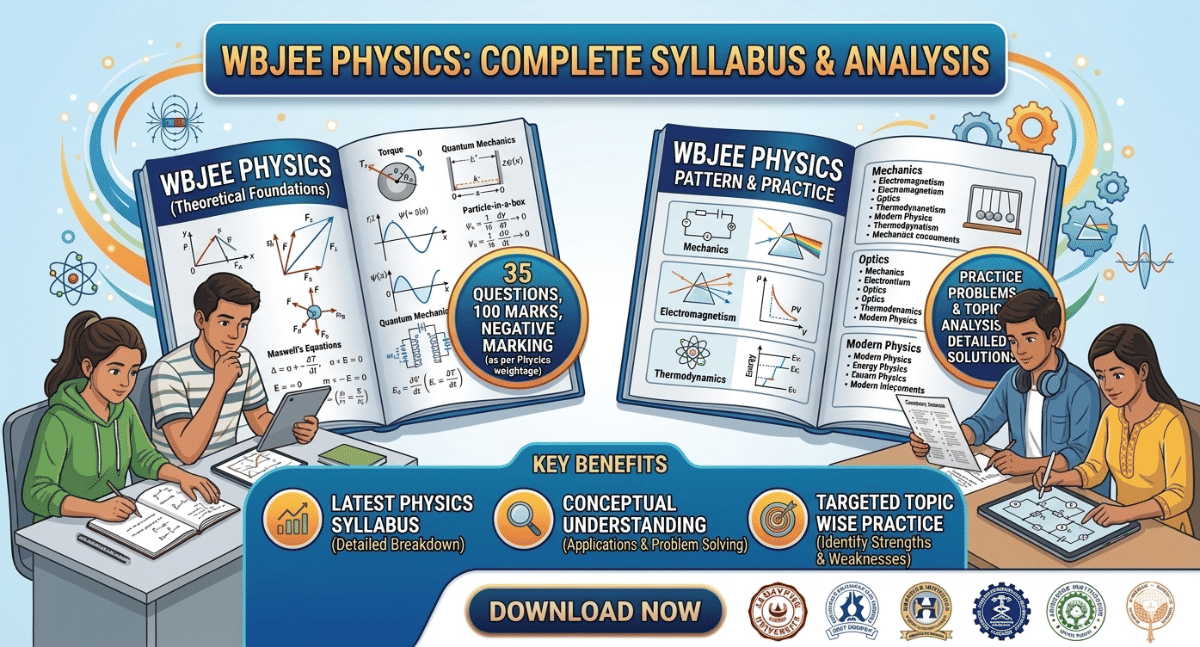
WBJEE is the state-level entrance exam. The WBJEE exam is scheduled on 24 May 2026 in offline mode. The WBJEE sample papers will help you effectively prepare for the exam, as they are aligned with the official WBJEE syllabus released by the WBJEE Board on its official website, wbjeeb.nic.in.
- Physics sample papers will help students understand the WBJEE exam format.
- Sample papers will help you get used to the tricky and unexpected questions.
- These will also improve your speed, along with helping you identify your mistakes.
The importance of sample papers has been highlighted many times by toppers as well as teachers.
Importance of WBJEE Physics Sample Papers 2026
WBJEE Physics sample papers similar to the actual exam in difficulty level, question types, and pattern (Category 1, 2 & 3 questions). Toppers and expert teachers repeatedly highlight the importance of solving sample papers and mock tests during preparation.
The importance of the WBJEE sample papers can be understood by the following:
- Familiarity with Exam Pattern: These papers familiarize students with the latest trends, such as increased emphasis on the NCERT-based concepts or application-based questions.
- Understanding Topic Weightage: By solving multiple papers, you will be able to identify the important topics and chapters, such as Heat & Thermodynamics, KTG, Properties of Matter, Kinematics, Electrostatics, Magnetic Effect of Current & Magnetism.
- Improves Speed: Attempting sample papers regularly not only increases your speed but also reduces your knowledge gap by showing the topics and concepts that need more improvement.
- Identifying Strengths and Weaknesses: Post-paper analysis will help you identify your weak and strong areas, and you can work on those weak areas with the use of detailed, easy-to-understand solutions.
- Enhanced Problem-Solving Skills and Accuracy: By attempting multiple papers, you will be able to identify as well as develop your own way of solving questions quickly using certain shortcuts or elimination methods.
- Reduce Errors: The errors made during the sample papers practice will ensure that you will not make those same mistakes in the actual exam.
WBJEE Exam Pattern and Marking Scheme
As per the official information bulletin 2026 released by the WBJEE Board, the WBJEE Physics exam pattern includes 3 sections: Category-1 (30 questions), Category-2 (5 questions), Category-3 (5 questions).
The exam will be conducted offline (OMR-based).
- The physics paper will include 40 questions (all compulsory).
- The time provided to attempt the paper will be 60 minutes.
- The physics paper will have a total of 50 marks.
In the exam, 30 questions have a positive marking of +1, and the remaining 10 questions have a positive marking of +2.
Marking Scheme for Physics Subject
| Category | No. of Questions | Marks per Q | Negative Marking | Type |
|---|---|---|---|---|
| Category 1 | 30 | 1 | -0.25 | Single correct |
| Category 2 | 5 | 2 | -0.5 | Single correct |
| Category 3 | 5 | 2 | No negative | One or more correct |
Source: WBJEE 2026 Information Bulletin
WBJEE 2026 Physics Sample Papers: Topic-wise weightage
We have created the Physics Sample Papers based on the topic-wise weightage of questions asked in previous WBJEE exams. Heat & Thermodynamics, KTG carry the highest weightage in WBJEE Physics. Around 4 questions are generally asked from Heat & Thermodynamics, KTG, while nearly 3 questions are asked from Properties of Matter, Oscillations & Waves, and Electrostatics.
| Topic | Avg Qs | 1‑mark Qs (1 mark) | 2‑mark Qs (2 marks) |
|---|---|---|---|
| Physical World, Units & Dimensions, Errors | 2 | 2 | 0 |
| Kinematics (1‑D & 2‑D, Projectile, Vectors) | 2 | 2 | 0 |
| Laws of Motion, Friction, Circular Motion | 2 | 2 | 0 |
| Work, Energy, Power, Collisions | 2 | 1 | 1 |
| Rotational Motion, Moment of Inertia | 2 | 1 | 1 |
| Gravitation | 1 | 1 | 0 |
| Properties of Matter (Elasticity, Fluids, Viscosity, Surface Tension) | 3 | 2 | 1 |
| Heat & Thermodynamics, KTG | 4 | 2 | 2 |
| Oscillations & Waves (SHM, Sound, Doppler) | 3 | 2 | 1 |
| Electrostatics | 3 | 2 | 1 |
| Current Electricity | 3 | 1 | 2 |
| Magnetic Effect of Current & Magnetism | 3 | 2 | 1 |
| Electromagnetic Induction & AC | 2 | 1 | 1 |
| Electromagnetic Waves | 1 | 1 | 0 |
| Ray Optics | 2 | 1 | 1 |
| Wave Optics | 1 | 1 | 0 |
| Modern Physics (Photoelectric, Atomic, Nuclear, X‑rays) | 3 | 2 | 1 |
| Solid State Electronics (Semiconductors, Diodes, Transistors, Logic Gates) | 1 | 1 | 0 |
FAQs
Ques. Are the WBJEE physics Sample Papers 2026 different from the previous year's papers?
Ans. Yes, physics sample papers are a repository of model questions based on PYQs and expected questions designed for that particular year. Sample papers will help you to get used to the current exam pattern.
Ques. How many WBJEE physics sample papers should I solve?
Ans. You should solve at least 20-30 full-length papers along with multiple physics sectional papers, simultaneously covering the syllabus.
Ques. Can solving WBJEE physics sample papers guarantee good marks?
Ans. No, sample papers do not guarantee good marks since it totally depends on the student. However, if you utilise it effectively along with complete coverage of your syllabus, it can definitely enhance your chances of getting good marks.
Ques. How do I analyze the WBJEE physics sample paper effectively?
Ans. Candidates can use the following way to effectively analyse the physics sample paper:
- Calculate the score and time taken to complete the test.
- Document your mistakes, such as silly errors in reading the questions or mistakenly marking the wrong option.
- Revise the concepts of the wrong answers and make short notes or highlight them.
- Track improvement over multiple papers to check accuracy and improvement over weak areas.
Ques. Do WBJEE physics sample papers include solutions?
Ans. Yes, the physics sample papers also include detailed solutions made by experts with easy-to-understand explanations that will help you quickly revise when the exam is approaching.
Physics Syllabus
The WBJEE Physics syllabus covers both Class 11 and Class 12 topics, with a strong emphasis on Mechanics, Electricity & Magnetism, and Modern Physics.
-
Key areas include kinematics, laws of motion, electrostatics, current electricity, magnetic effects, and oscillations and waves.
- WBJEE Physics Paper will be held in combination with WBJEE Chemistry, under the same slot.
The WBJEE Syllabus 2026 forms the foundation of preparation for students aiming to secure admission into top engineering, architecture, and pharmacy colleges in West Bengal.
Key Summary
In this article, we have discussed the WBJEE Physics Syllabus 2026:
- The WBJEE Physics syllabus covers both Class 11 and Class 12 topics, with a strong emphasis on Mechanics, Electricity & Magnetism, and Modern Physics.
- Key areas include kinematics, laws of motion, electrostatics, current electricity, magnetic effects, and oscillations and waves.
- WBJEE Physics Paper will be held in combination with WBJEE Chemistry, under the same slot.
Also Read:
- What is the WBJEE 2026 Physics Syllabus?
- WBJEE Physics Syllabus 2026
- WBJEE Physics Expected Topic-wise Weightage
- WBJEE 2026 Exam Pattern
- WBJEE Exam 2026 Marking Scheme
- WBJEE Physics 2026 Recommended Books
- WBJEE Physics Previous Years' Question Papers
- WBJEE Preparation Tips 2026
- WBJEE Physics Syllabus 2026 FAQs
What is the WBJEE 2026 Physics Syllabus?
The West Bengal Joint Entrance Examinations Board (WBJEEB) conducts the WBJEE each year for admission into various undergraduate engineering, technology, pharmacy, and architecture courses in West Bengal.
- The syllabus is broad but structured: you’ll need to cover both classical mechanics (motion, forces, energy) and modern physics (atoms, electronics), along with waves & optics.
- Most topics align with what you study in Class 11 & 12 boards — so your board-prep and entrance-prep largely overlap.
| Particulars | Details |
|---|---|
| Exam Name | West Bengal Joint Entrance Examination (WBJEE) 2026 |
| Conducting Body | West Bengal Joint Entrance Examinations Board (WBJEEB) |
| Exam Level | State-level entrance test |
| Courses Offered | B.Tech, B.E, B.Pharm, B.Arch |
| Key Topics | Mechanics, Electricity & Magnetism, and Modern Physics |
| Syllabus Basis | Class 11 & Class 12 syllabus (WBCHSE & equivalent boards) |
| Exam Date (Tentative) | April 2026 |
| Official Website | wbjeeb.nic.in |
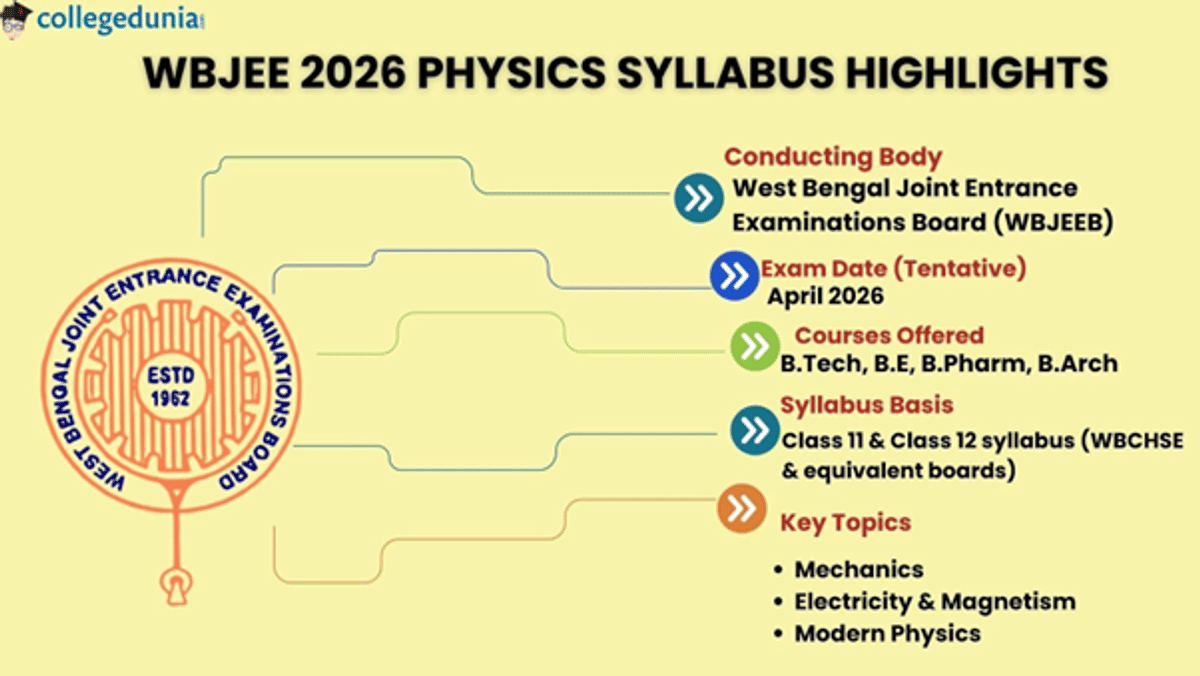
Also Read:
Ques. Who can apply for WBJEE?
Ans. The WBJEE Eligibility criteria for 2026 are as follows:
- A candidate must have passed or be appearing in Class 12 with Physics, Mathematics, and Chemistry/Biology/Computer Science as main subjects.
- You must score the minimum required percentage (varies for General/SC/ST/OBC).
- The minimum age is generally 17 years on or before December 31 of the admission year.
- There is no upper age limit for engineering, but for Marine Engineering courses, the maximum age is 25 years.
Ques. Is WBJEE easier or tougher than JEE Main?
Ans. The difficulty level of WBJEE is given below:
- WBJEE is usually considered easier than JEE Main because the question style is more formula-based and directly linked with the Class 11–12 syllabus without too many tricky concepts.
- However, the competition remains intense due to a limited number of top-tier colleges and seats, so relative performance matters more than absolute difficulty.
WBJEE Physics Syllabus 2026
Mechanics usually contributes a significant number of conceptual and numerical questions because it builds the foundation of Physics.
- Topics like motion, Newton’s laws, work-energy, and gravitation are most frequently tested since they check both fundamental understanding and problem-solving speed.
- Questions from fluids, elasticity, surface tension, and thermodynamics test your clarity of laws and formula application.
| Class 11 Topics | Class 12 Topics |
|---|---|
| Physical World, Units and Measurements | Electrostatics |
| Motion in a Straight Line & Plane | Current Electricity |
| Laws of Motion | Magnetic Effects of Current & Magnetism |
| Work, Energy, and Power | Electromagnetic Induction & Alternating Currents |
| System of Particles and Rotational Motion | Electromagnetic Waves |
| Gravitation | Optics (Ray and Wave) |
| Thermodynamics | Dual Nature of Matter and Radiation |
| Oscillations | Atoms and Nuclei |
| Waves | Electronic Devices |
| Properties of Bulk Matter | Communication Systems |
| Behaviour of a Perfect Gas and Kinetic Theory |
Also Read:
Ques. Do students from other states get admission through WBJEE?
Ans. The admission criteria are as discussed below:
- Yes, candidates from all states of India can sit for WBJEE and get admission.
- However, certain reserved category seats, Tuition Fee Waiver (TFW) schemes, and state quota benefits are primarily available to West Bengal domicile candidates.
Ques. What is the value of WBJEE colleges — are placements good?
Ans. The placement scenario through WBJEE is as stated below:
- Top institutes like Jadavpur University, IEM, Heritage, KGEC, and Techno India offer excellent academic quality and strong placements, often comparable to NIT-level outcomes for top branches like CSE and ECE.
- Many graduates secure jobs in companies like TCS, Wipro, Deloitte, Cognizant, Amazon, and core sector companies each year.
WBJEE Physics Expected Topic-wise Weightage
Here is the expected topic-wise weightage analysis, based on previous years:
- Mechanics is expected to carry the highest share of 18-22%because it forms the base of Class 11 physics.
- Electrostatics & Current Electricity produce a cluster of questions every year because they test conceptual clarity plus numerical application.
- Magnetic effects and electromagnetic induction almost always appear with at least a moderate weightage, focusing on right-hand rules, inductive effects, and transformer/AC circuit basics.
| Important topics | Chapter Weightage |
|---|---|
| Current Electricity | 7% |
| Heat and Thermodynamics | 6% |
| Electrostatics | 6% |
| Magnetic Effects of Current and Magmatism | 6% |
| Work Energy Power | 5% |
| Wave Motion | 5% |
| Nuclear Physics | 5% |
| Solids & Semiconductor Devices | 5% |
| Modern Physics – Atomic Models | 5% |
| Laws of Motion | 4% |
| Rotational Motion | 4% |
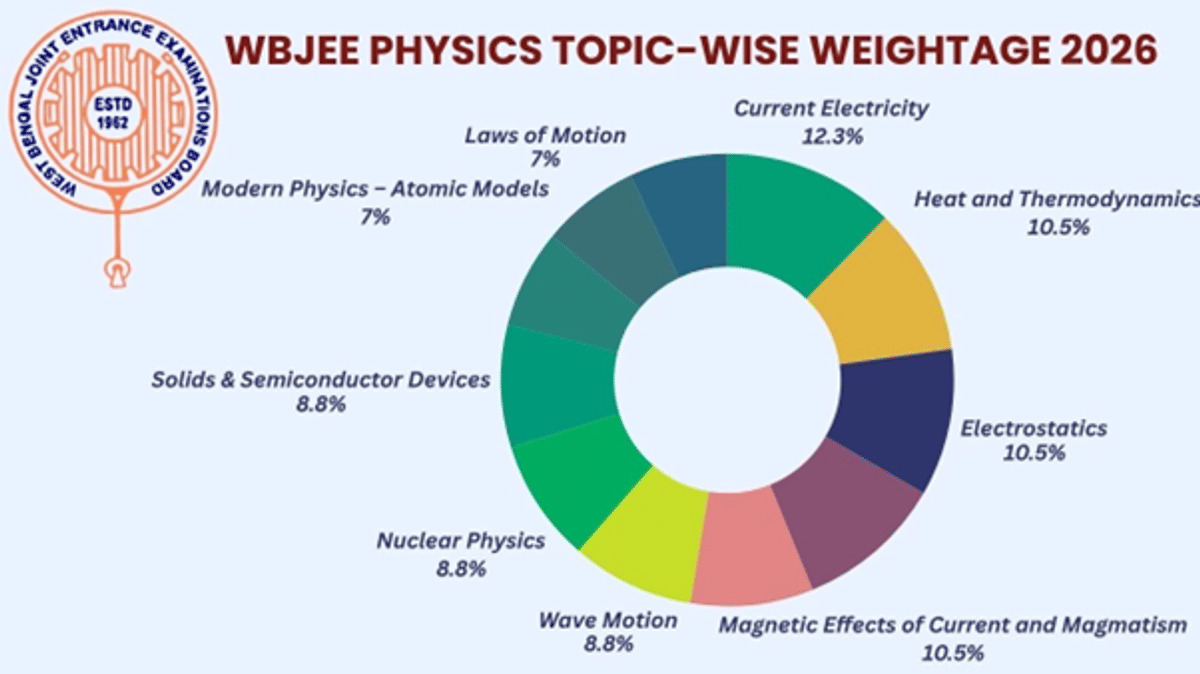
Also Read:
Ques. What rank is needed for Jadavpur University engineering?
Ans. The rank analysis for Jadavpur University is given below:
- Admission to Jadavpur University is extremely competitive.
- If you are aiming for core branches like CSE, ECE, IT, or Mechanical, typically you would need a rank below 150–400 (may vary slightly year to year).
- Other branches allow slightly higher ranks, but overall, only top performers secure JU seats.
Ques. Is there any reservation or special quota in WBJEE?
Ans. Coaching is helpful for structure and doubt clearing, but not mandatory.
- Many students crack WBJEE with self-study by mastering NCERTs, solving previous year papers, taking timed mocks, and regularly analyzing mistakes.
- Success depends more on discipline and strategy than on coaching enrollment.
WBJEE 2026 Exam Pattern
The number of questions, as well as maximum marks for each, for the WBJEE exam pattern for physics, are given in the following table:
- Physics has a weightage of 40 questions with 40 marks.
- You should prioritize Category I for speed and accuracy while practicing Categories II and III carefully.
| Category | No. of Questions | Marks per Question | Total Marks |
|---|---|---|---|
| Category I (1 correct option) | 30 | 1 | 30 |
| Category II (1 correct option) | 5 | 1 | 5 |
| Category III (1 or more correct options) | 5 | 1 | 5 |
| Total | 40 | — | 40 |
Also Read:
Ques. What is the category-wise distribution of questions in WBJEE Physics 2026?
Ans. The WBJEE Physics section consists of three categories.
- The first category contains a total of 50 questions.
- The second category contains 15 questions, and the last category
- The third category contains a total of 10 questions.
Ques. How many times is WBJEE conducted in a year, and when?
Ans. The frequency of WBJEE is as discussed below:
- WBJEE is held once every year, usually in April or May.
- The notification releases typically between December and January, followed by the application, admit card, exam, and counselling stages.
WBJEE Exam 2026 Marking Scheme
The marking scheme of the exam specifies the mark distribution over several questions in the question paper.
- Category 1 questions are simple but have 25% negative marking, emphasizing accuracy.
- Category 2 questions carry 2 marks with moderate negative marking, offering a slightly higher reward.
- Category 3 questions require all correct options to score full marks, making them more challenging. Unattempted questions get zero marks, so strategic and careful answering is key.
In WBJEE, there are three categories of questions for physics, chemistry, and mathematics, which are described below:
| Category | Correct Answer | Incorrect Answer / Multiple Marks | Unattempted Question |
|---|---|---|---|
| Category 1(Only one correct option) | +1 mark | -0.25 mark for wrong answer or multiple options | 0 marks |
| Category 2(Only one correct option) | +2 marks | -0.5 mark for wrong answer or multiple options | 0 marks |
| Category 3(One or more correct options) | +2 marks if all correct options selected | 0 marks for any wrong or partially correct combination; for partially correct: 2 × (no. of correct options marked ÷ total correct options) | 0 marks |
Ques. How does negative marking affect guessing in the WBJEE Exam?
Ans. The table below shows the WBJEE negative marking for 2026.
- Category 1 and 2 questions have negative marking (¼ and ½, respectively), so accuracy is important, and blind guessing should be avoided.
- Category 3 questions have no negative marking, allowing candidates to attempt them confidently to maximize scores.
| Category | Negative Marking |
|---|---|
| Category 1 | ¼ mark (-0.25) |
| Category 2 | ½ mark (-0.5) |
| Category 3 | No negative marking |
Ques. What rank is 120 marks in WBJEE?
Ans. A score of 120 marks in WBJEE is considered very good. Expected Rank range: Around 3000-5000 (varies yearly)
With this rank:
- You can expect core branches like CSE, ECE, ME, etc., in most top state colleges.
- Very good chances for Jadavpur University in non-CSE branches.
- CSE may be borderline depending on your category and domicile.
WBJEE Physics 2026 Recommended Books
Here are some recommended books for you to follow to excel in the WBJEE 2026 examination:
| Name of the Book | Name of the Author/Publisher |
|---|---|
| Principles of Physics | V.K. Mehta |
| Concepts of Physics | H.C. Verma |
| Problems in General Physics | I.E. Irodov |
| Fundamentals of Physics | V.K. Mehta |
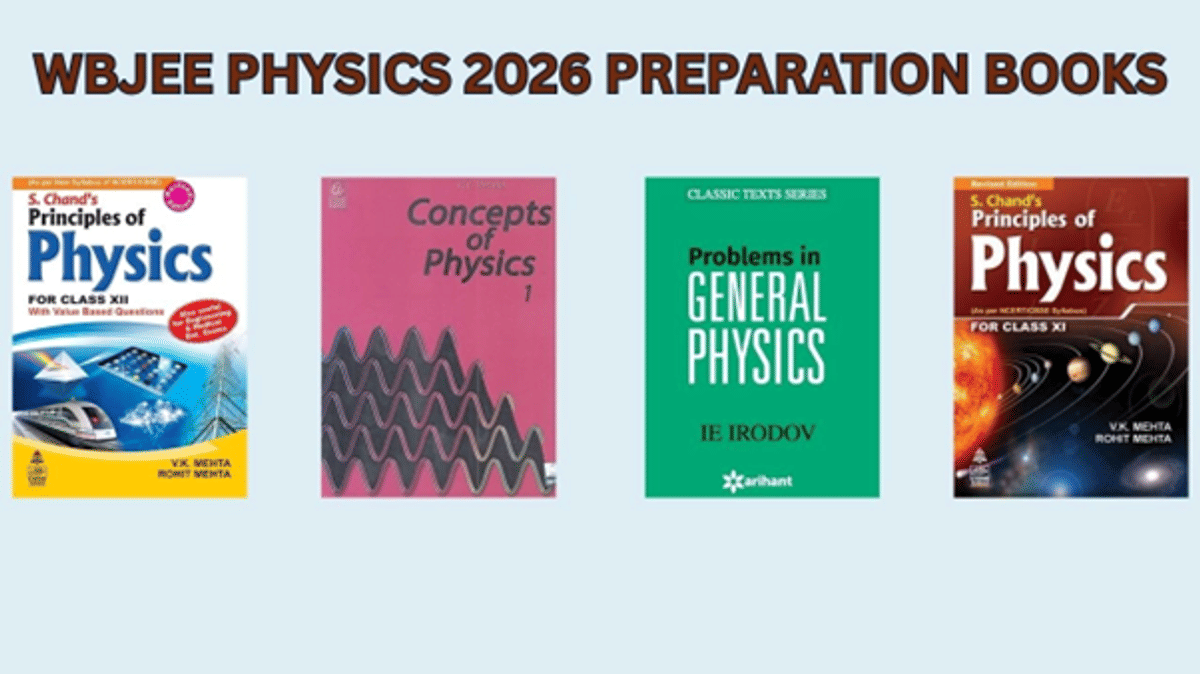
Also Read:
Ques. How does WBJEE counselling happen?
Ans. WBJEE counselling is conducted online by WBJEEB after the results.
- You have to register, upload documents, choose colleges & branches (choice filling), and then seats are allotted based on rank, category, and seat availability.
- Multiple rounds are held, and candidates can accept, upgrade, or withdraw based on the round.
Ques. What are Freeze, Float, and Withdraw options in WBJEE Counselling?
Ans. The Freeze, Float, and Withdraw options in WBJEE Counselling are explained below:
- Freeze: Accept the current seat and skip further rounds
- Float: Accept but allow upgrade in the next rounds
- Withdraw: Exit from counselling (seat will be lost)
WBJEE Physics Previous Years' Question Papers
You need to solve WBJEE Question Papers, which will enable them to practice more and recognize their preparation levels.
The table below includes the link for WBJEE Previous Years’ Physics Question Papers and Answer Keys.
| Year | Link for WBJEE Paper I (Physics) Question Paper | Link for WBJEE Paper I (Physics) Answer Key |
|---|---|---|
| 2025 | Check Here | Check Here |
| 2024 | Check Here | Check Here |
| 2023 | Check Here | Check Here |
| 2022 | Check Here | Check Here |
| 2021 | Check Here | Check Here |
| 2020 | Check Here | Check Here |
| 2019 | Check Here | Check Here |
| 2018 | Check Here | Check Here |
Also Read:
WBJEE Preparation Tips 2026
WBJEE is a speed and accuracy-based state-level exam where Physics, Chemistry, and Mathematics are tested from the Class 11–12 syllabus, but with competitive depth.
- To score well, you must focus on conceptual clarity, formula retention, timed practice with PYQs and mock tests, and strict error analysis rather than just revision.
- Since the paper is OMR-based with negative marking, exam temperament and decision-making under time pressure become equally important as subject knowledge.
- The table below gives a strategy to prepare efficiently for the WBJEE Physics 2026 exam.
| Area | What To Do |
|---|---|
| Syllabus Mastery | Finish NCERT + standard notes before starting mocks |
| PYQs & Pattern Familiarity | Solve the last 10 years of WBJEE PYQs chapter-wise |
| Timed Mock Tests | Take weekly full-length OMR mocks under strict timing |
| Error Log Maintenance | Record all mistakes and re-attempt them every 3–4 days |
| Formula & Short-Note Revision | Maintain a one-page formula sheet per subject |
| Cut Negative Marking | Skip blind guesses; attempt only when >50% confidence |
| Healthy Study Rhythm | 2–3 focused study blocks per day with breaks |
Also Read:
Ques. Is it possible to get Heritage / IEM with a 10,000 rank in WBJEE?
Ans. Yes, seats in private colleges like Heritage, Techno India, and IEM are sometimes available up to ranks 20k–40k, depending on the branch, but high-demand branches (CSE/ECE) close earlier.
Closing ranks of certain streams are given below:
- Biotechnology: 15000
- Civil: 17000
Ques. Do pharmacy seats have different cutoffs in WBJEE?
Ans. Yes, pharmacy seats generally have different and usually higher (i.e., more relaxed) cutoffs compared to engineering seats. The reason is:
- The number of Applicants is Lower
- Separate Demand Level
- Separate Seat Pool in Counselling
WBJEE Physics Syllabus 2026 FAQs
Ques. How many seats are in WBJEE?
Ans. WBJEE offers around 35,000 to 40,000 seats across government and private colleges in West Bengal.
The following table shows the same:
| Types of Colleges | Approx. Seats |
|---|---|
| Government | 8,000+ |
| Private | 27,000–30,000 |
| Total | 35,000–40,000 |
Ques. How many rounds are in WBJEE counselling?
Ans. WBJEE Counselling is conducted in 3 rounds — including 2 regular rounds and 1 mop-up round.
| Round | Description |
|---|---|
| Round 1 | Initial Allotment |
| Round 2 | Upgradation |
| Round 3 | Mop-up/Final Round |
Ques. Which courses come under WBJEE?
Ans. Through WBJEE, candidates can get admission into Engineering, Architecture, and Pharmacy programs.
| Course | Duration | Example Programs |
|---|---|---|
| B.Tech | 4 Years | CSE, ECE, ME, CE |
| B.Pharm | 4 Years | Pharmacy |
| B.Arch | 5 Years | Architecture |
Ques. When can I expect the completion of the admission process through WBJEE 2026?
Ans. The WBJEE 2026 expected dates are given below:
- The admission process through WBJEE 2026 is expected to be closed in the last week of June or 1st week of 2026 after the conclusion of all the counselling rounds.
- Only after the successful completion of the verification round, the admission process be concluded.
Ques. What is the last date to make a correction in the online WBJEE 2026 Application Form?
Ans. WBJEEB offers a one-time opportunity to make corrections to your WBJEE application form.
- The form correction facility will open in February 2026.
- Check WBJEE 2026 Form Correction
Ques. What is the number of times a candidate can sit for WBJEE 2026?
Ans. The age limit for WBJEE 2026 is given below:
- No restrictions will be maintained for both the number of attempts and age for WBJEE 2026.
However, candidates who want to register themselves for the program in marine biology can attempt the test till 25 years of age.
Preparation Tips
Preparing for WBJEE requires a well-structured strategy, strong conceptual clarity, and consistent practice.
- WBJEE 2026 preparation requires a clear study plan, regular practice, and strong conceptual understanding of Mathematics, Physics, and Chemistry.
- Start with NCERT books, then move to standard reference books for advanced problem-solving and exam-level questions.
- Follow a realistic timetable that balances theory, numerical practice, revision, and mock tests throughout the week.
- Solve previous years' WBJEE question papers to understand the exam pattern, difficulty level, and important topics.
- Take full-length mock tests regularly to improve speed, accuracy, time management, and question-selection skills.
The WBJEE Paper 1 (Mathematics) and Paper 2 (Physics and Chemistry) were held on the same day. WBJEE 2026 was held on May 24, 2026.
Also Read:

Key Preparation Tips for WBJEE at a Glance
- Finish the NCERT Class 11 and 12 syllabus first, because WBJEE asks no topics outside the NCERT.
- Spend the most time on Mathematics, as Paper 1 alone carries 100 marks.
- Always attempt Category 3 questions, since they carry no negative marking.
- Solve at least 10 years of WBJEE previous year question papers (PYQs).
- Take a full-length mock test every week and analyse every mistake.
- Keep the last 30 days only for revision, formula sheets, and mock tests.

Source: Reddit
Reddit users were discussing preparation and consistency tips for the 2026 WBJEE examination.
Why a Strategy Matters for WBJEE 2026?
WBJEE rewards accuracy more than speed. The exam has three question categories, each marked differently, so a blind attempt can cost you your rank.
- Category 1 gives 1 mark with a 0.25 penalty
- Category 2 gives 2 marks with a 0.50 penalty
- Category 3 gives 2 marks with zero penalty.
- A student who understands this scheme attempts smarter and scores higher than one who just studies hard.
Understand the WBJEE 2026 Exam Pattern First
You cannot plan your preparation without knowing the structure of the paper. The table below shows the WBJEE 2026 exam pattern.
| Feature | Details |
|---|---|
| Mode | Offline (OMR / pen and paper) |
| Papers | Paper 1 - Mathematics; Paper 2 - Physics and Chemistry |
| Total Questions | 155 |
| Total Marks | 200 |
| Duration | 2 hours per paper (4 hours total) |
| Languages | English and Bengali |
| Question Type | Multiple Choice Questions (MCQs) |
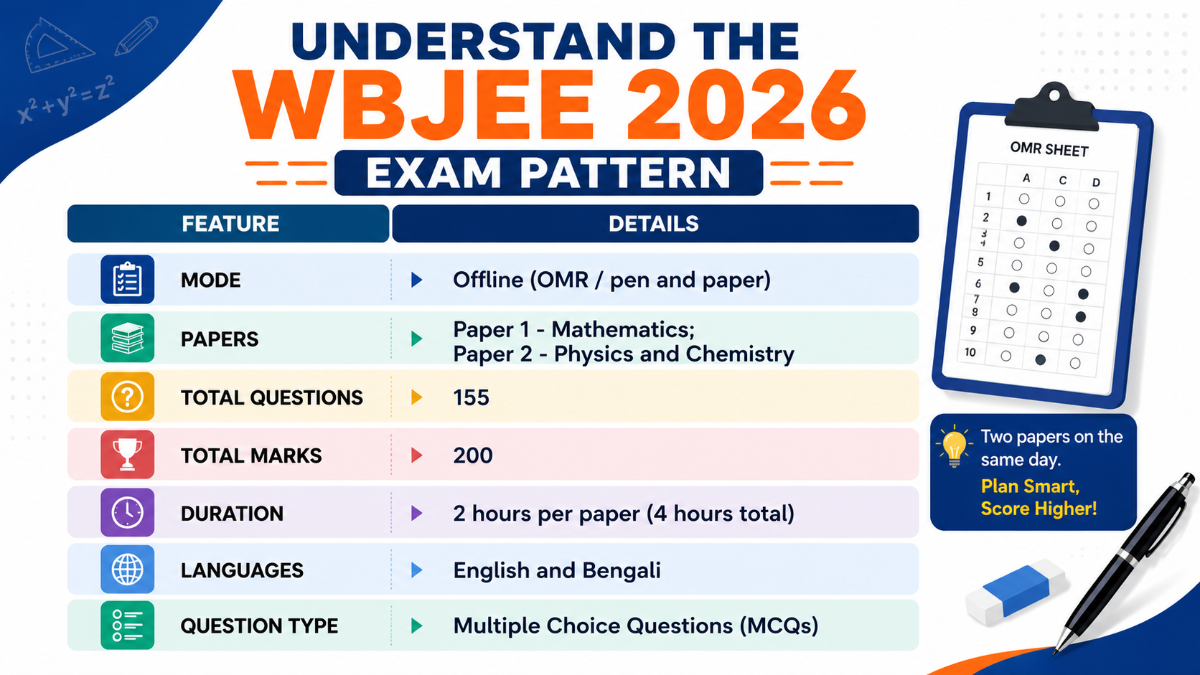
WBJEE Marking Scheme
Category 1 has one correct option and carries 1 mark for each correct answer and -0.25 marks for each incorrect answer.
- Category 2 has one correct option and carries 2 marks for each correct answer and -0.50 marks for each incorrect answer.
- Category 3 has one or more correct options and carries 2 marks for each correct answer and has no negative marking.
| Category | Correct Options | Marks for Correct | Negative Marking |
|---|---|---|---|
| Category 1 | One | +1 | -0.25 |
| Category 2 | One | +2 | -0.50 |
| Category 3 | One or more | +2 | None (partial marks allowed) |
Category 3 is your biggest advantage in WBJEE, so never leave these questions blank. Even a partly correct attempt can earn you marks here.
Best Books for WBJEE 2026 Preparation
Start with NCERT for every subject, then move to standard reference books. The table below lists the most recommended WBJEE books.
| Subject | Recommended Books |
|---|---|
| Physics | NCERT (Class 11 and 12), Concepts of Physics by HC Verma, DC Pandey series |
| Chemistry | NCERT (Class 11 and 12), Physical Chemistry by OP Tandon, Organic Chemistry by MS Chouhan |
| Mathematics | NCERT, Objective Mathematics by RD Sharma, IIT Mathematics by ML Khanna |
NCERT should be your base book, because WBJEE questions are built directly on the NCERT syllabus.
- Use reference books only to practise more variety and tougher problems.
Subject-Wise Preparation Tips
Mathematics Preparation Tips
Mathematics is the highest-scoring section, so give it the most practice time.
- Master Algebra, Calculus, Coordinate Geometry, and Trigonometry, as they carry heavy weightage.
- Practise problems daily to improve both speed and accuracy.
- Keep a separate formula notebook and revise it every morning.
- Solve PYQs to learn the exact difficulty level WBJEE expects from you.
Physics Preparation Tips
Physics needs strong concepts plus regular numerical practice.
- Build clear concepts in Mechanics, Electrostatics, Current Electricity, and Modern Physics.
- Learn the derivation logic, not just the final formula.
- Practice numericals every day to handle the calculation-heavy questions.
- Revise units and dimensions early, because they help you eliminate wrong options quickly.
Chemistry Preparation Tips
Chemistry is the most scoring subject if you cover all three branches well.
- Read the NCERT line by line for Inorganic and Physical Chemistry.
- Memorise reactions, named reactions, and exceptions in Organic Chemistry.
- Practice Mole Concept, Equilibrium, and Thermodynamics for Physical Chemistry numericals.
- Make short notes of periodic trends and key reactions for last-day revision.
How to Make a WBJEE Study Plan
A timetable keeps your preparation balanced across all three subjects. The plan below is a simple structure you can follow and adjust.
| Phase | Duration | Focus |
|---|---|---|
| Phase 1 - Build | First few months | Complete the NCERT and core concepts of all subjects |
| Phase 2 - Practise | Middle phase | Solve topic-wise questions and previous year papers |
| Phase 3 - Test | Final phase | Take full mock tests and analyse weak areas |
| Phase 4 - Revise | Last 30 days | Revise formulas, notes, and attempt timed mocks |
Study all three subjects every day instead of finishing one subject at a time. A daily mix keeps every subject fresh in your memory.
WBJEE Preparation Strategy
As per the Let’s Improve YouTube channel, you should follow the following strategies for a high score in the WBJEE exam:
| Preparation Tip | Details |
|---|---|
| Smart Time Allocation | Reserve the final 15–20 days exclusively for revision, mock tests, and practice. If you're starting late, spend the first 10–15 days covering high-weightage chapters. |
| One Chapter Per Day Rule | Complete one chapter from each subject daily to ensure systematic syllabus coverage and consistent progress. |
| Study Hours | Study for 12 hours per day if you're beginning preparation now. If you're already revising, aim for 9–10 hours daily. |
| Prioritize Practice Over Theory | Focus on solving 30–50 MCQs per subject every day. Include Previous Year Questions (PYQs) to understand the exam pattern and frequently asked concepts. |
| Mock Test Strategy | Attempt mock tests during the actual exam timings (11:00 AM–1:00 PM and 2:00 PM–4:00 PM) to build exam-day stamina and concentration. |
| Analyze Your Mistakes | After every mock test, review incorrect answers to identify whether mistakes are caused by conceptual gaps or careless errors. |
| Formula Revision | Spend 30–60 minutes daily revising Physics and Chemistry formulas to improve retention and speed during the exam. |
For more information, check out the Let’s Improve channel’s video:
WBJEE 2026 Important Chapters and Topic-Wise Weightage
Knowing the most important chapters can help you prioritize your preparation and maximize your score in a limited time. While WBJEE does not officially release chapter-wise weightage, previous year trends show that certain topics consistently contribute a large number of questions.
| Subject | Important Topic | Expected Weightage |
|---|---|---|
| Mathematics | Probability | 7% |
| Vectors | 7% | |
| 3D Geometry | 6% | |
| Definite Integration | 5% | |
| Indefinite Integration | 5% | |
| Limits, Continuity & Differentiability | 5% | |
| Matrices & Determinants | 5% | |
| Sets, Relations & Functions | 5% | |
| Physics | Current Electricity | 7% |
| Electrostatics | 6% | |
| Magnetic Effects of Current & Magnetism | 6% | |
| Heat & Thermodynamics | 6% | |
| Wave Motion | 5% | |
| Simple Harmonic Motion | 5% | |
| Modern Physics | 5% | |
| Nuclear Physics | 5% | |
| Chemistry | Chemical Kinetics | 7% |
| Chemical Bonding | 6% | |
| Organic Chemistry | 6% | |
| p-Block Elements | 6% | |
| d & f Block Elements | 6% | |
| s-Block Elements | 6% | |
| Redox Reactions | 5% | |
| Coordination Compounds | 4% |
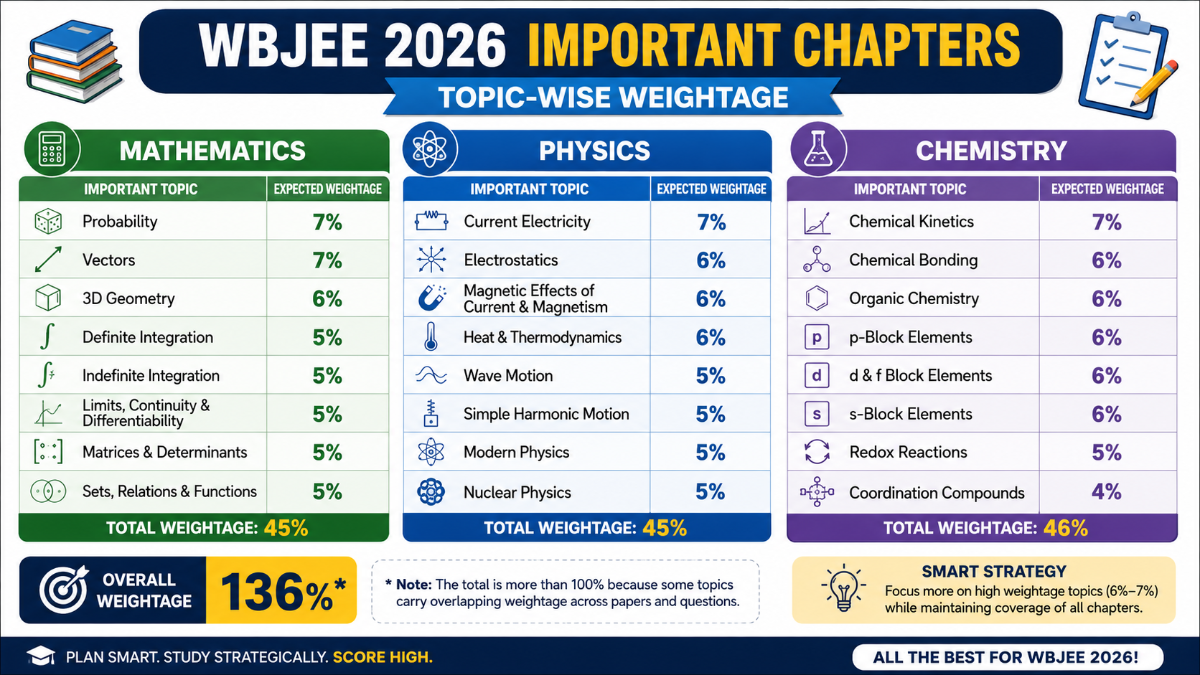
Also Read:
WBJEE 2026 Rank vs Marks Analysis
A score of 170 marks or above usually places a candidate within the top 100 ranks, making admission to the most competitive branches and colleges highly achievable.
- Students scoring between 150 and 170 marks can generally expect a rank within the top 500, which is still considered an excellent performance.
- A score in the 130–150 range often translates to a rank within the top 2,000, keeping many good engineering options open.
- Candidates scoring 110–130 marks may secure a rank within the top 5,000, while those in the 90–110 mark range typically fall within the top 10,000.
| Expected Marks | Approximate Rank Range |
|---|---|
| 170+ | Top 100 |
| 150–170 | Top 500 |
| 130–150 | Top 2,000 |
| 110–130 | Top 5,000 |
| 90–110 | Top 10,000 |
| Below 90 | Rank varies significantly |
Students targeting top engineering colleges should aim for at least 130–150 marks to remain competitive.
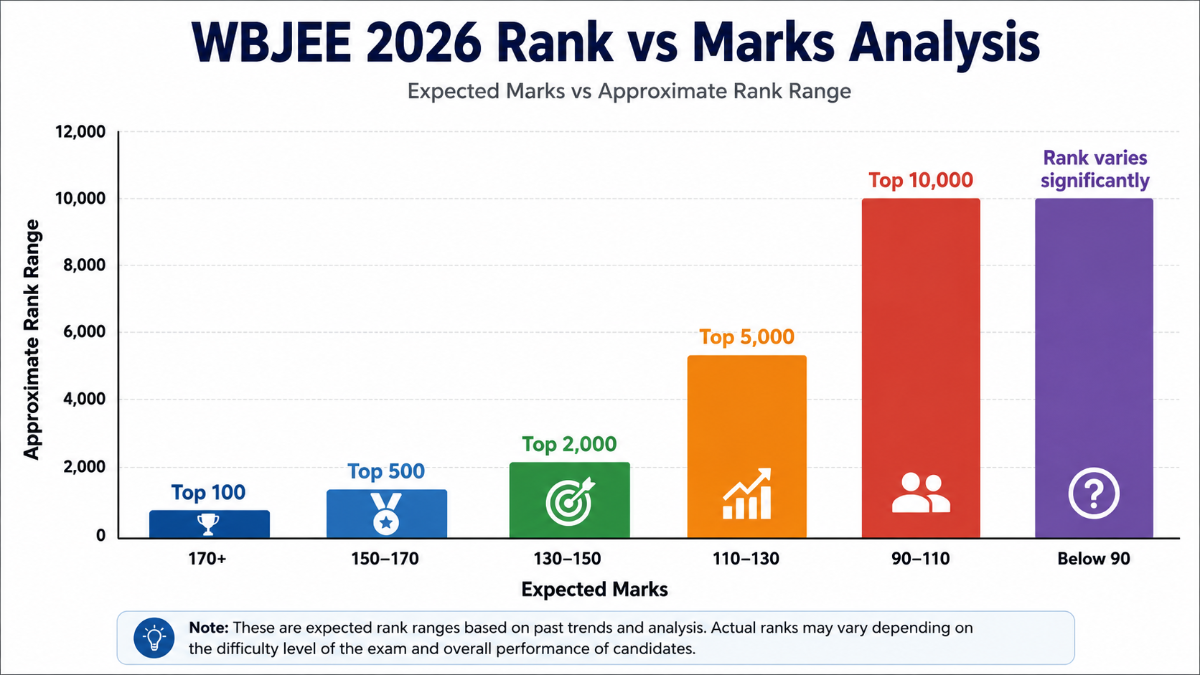
Check: WBJEE Marks vs Rank 2026: Expected Analysis, College-Wise Trends and Cutoff
Time Management and Attempt Strategy
Smart time management in the exam can raise your score without extra study.
- Spend around 1 to 1.5 minutes on each Category 1 question.
- Attempt easy and known questions first to secure quick marks.
- Be careful with Category 2 questions, since wrong answers cost you 0.50 marks.
- Attempt every Category 3 question, as there is no penalty for a wrong answer.
- Fill the OMR sheet carefully with a black or blue ball pen, and avoid stray marks.
Use Mock Tests and Previous Year Papers
Mock tests turn your knowledge into real exam performance.
- Take one full-length mock test every week in real exam conditions.
- Solve at least 10 years of WBJEE PYQs to understand the recurring pattern.
- Analyse every mock test, because finding your mistakes matters more than your score.
- Track your accuracy, speed, and silly errors after each test.
Check: WBJEE Question Paper (Available), Download Previous Years Question Paper and Answer Key PDFs
Revision Strategy for the Final Month
The last month decides how much of your preparation you can actually recall in the exam.
- Stop learning new topics and focus only on revision.
- Revise from your own short notes and formula sheets.
- Solve one or two mock tests every week to stay exam-ready.
- Sleep well and avoid stress in the final days.
Common Mistakes to Avoid
Many students lose rank because of avoidable errors.
- Ignoring NCERT and jumping straight to tough reference books.
- Guessing Category 1 and 2 questions without confidence.
- Skipping mock test analysis after every attempt.
- Studying only the favourite subject and ignoring the weak one.
- Leaving Category 3 questions blank and losing easy marks.
Top Engineering Colleges Accepting WBJEE Scores
Understanding the colleges you can get through WBJEE helps you set a realistic score and rank target. West Bengal has several reputed engineering institutes that offer admission through WBJEE counselling.
| College | Popular Courses |
|---|---|
| Jadavpur University | Computer Science, IT, Electronics, Mechanical Engineering |
| IIEST Shibpur | Computer Science, Electrical Engineering, Civil Engineering |
| Heritage Institute of Technology | Computer Science, IT, Electronics and Communication |
| Institute of Engineering and Management (IEM) | Computer Science, AI & ML, Electronics |
| Techno India University | Computer Science, Data Science, Electronics |
| Kalyani Government Engineering College | Electrical, Mechanical, Computer Science |
| Government College of Engineering and Ceramic Technology | CSE, IT, Ceramic Technology |
FAQs on WBJEE Preparation Tips 2026
Ques: How many hours should I study daily for WBJEE 2026?
Ans. You should study around 6 to 8 focused hours daily, with all three subjects covered each day.
Ques: Is NCERT enough for WBJEE 2026?
Ans. NCERT is your most important book, but you should add reference books for extra practice and tougher questions.
Ques: Should I attempt all WBJEE questions?
Ans. You should attempt every Category 3 question since it has no negative marking, and attempt Categories 1 and 2 only when you are confident.
Ques: How many previous year papers should I solve?
Ans. You should solve at least 10 years of WBJEE previous year papers to learn the exam pattern and difficulty level.
Ques: Are mock tests important for WBJEE preparation?
Ans. Yes, weekly mock tests improve your speed, accuracy, and time management, and help you find your weak areas before the exam.
Ques: Which subject should I focus on the most?
Ans. You should give the most time to Mathematics, because Paper 1 alone carries 100 marks out of 200.
Question Paper 2016
WBJEE 2016 Question Papers are now available for download. The difficulty level was moderate to difficult. The question paper was based on the high school ( 11th + 12th ) syllabus. There was a negative marking in the following question paper. A total number of 80 questions were asked in Physics & Chemistry section, and 75 questions were asked in the Mathematics section.
WBJEE 2016 Question Paper
| Paper/Subject | Exam Date | Slot/Session | Question Paper |
|---|---|---|---|
| Physics & Chemistry | May 17 | Afternoon Session | Check here |
| Mathematics | May 17 | Forenoon Session | Check here |
Question Paper 2017
WBJEE 2017 Question Paper is provided here which you can download using the link given below. The exam was deemed as moderate in terms of overall difficulty level with Physics section as the most difficult one. The paper was easier than JEE Main 2016.
WBJEE 2017 Question Paper with Answer Key PDFs
| Exam Date | Paper | Question Paper |
|---|---|---|
| April 23, 2017 | Mathematics | Check Here |
| Physics & Chemistry | Check Here |
Question Paper 2018
WBJEE 2018 Question Paper is provided here below. The exam was deemed as being moderate in terms of difficulty level with Mathematics and Chemistry sections being comparatively easy as compared to Physics.
WBJEE 2018 Question Paper with Answer Key PDFs
| WBJEE 2018 Exam Date | WBJEE 2018 Paper | WBJEE 2018 Question Paper |
|---|---|---|
| April 22, 2018 | Mathematics | Check Here |
| Physics & Chemistry | Check Here |
Question Paper 2019
WBJEE 2019 Question Paper is provided here with solutions PDF for download. The exam was deemed moderate in terms of overall difficulty by the candidates. The Chemistry section, as always, was comparatively easier and thus more scoring. No new changes were made to WBJEE Syllabus and Exam Pattern for the year.
WBJEE 2019 Question Paper with Answer Key
| Exam Date | Subject | Question Paper |
|---|---|---|
| May 26, 2019 | Mathematics | Check Here |
| Physics & Chemistry | Check Here |
Question Paper 2020
WBJEE 2020 Question Paper is provided here for Mthematics, Physics and Chemistry. The exam was deemed difficult, especially the Mathematics paper (Paper-I). The only respite in the entire exam was provided by the Chemistry section which was comparatively easier and thus more scoring.
WBJEE 2020 Question Paper with Solution PDF
| Exam Date | Subject | Question Paper |
|---|---|---|
| February 2, 2020 | Mathematics | Check Here |
| Physics & Chemistry | Check Here |
Question Paper 2021
WBJEE 2021 Question Papers are available here for download. The exam was deemed as moderate in terms of difficulty by the candidates wherein Paper-I (Mathematics) was moderate but lengthy while Paper-II (Physics & Chemistry) was easy to moderate.
WBJEE 2021 Question Paper with Solution PDFs
| Exam Date | Question Paper | ||
|---|---|---|---|
| Paper Sets | Paper I (Mathematics) | Paper-II ( Physics & Chemistry) | |
| July 17, 2021 | Set A | Check Here | Check Here |
| Set B | Available Soon | Available Soon | |
| Set C | Check Here | Check Here | |
| Set D | Check Here | Check Here | |
Question Paper 2022
WBJEE 2022 Question Papers are provided here. The exam was conducted in offline mode. The question paper of WBJEE is divided into Paper 1 and Paper 2. Paper 1 is conducted for Mathematics subject and Paper 2 is conducted for Physics and Chemistry subject.
| Set Code | Question Paper |
|---|---|
| Set A | Check Here |
| Set B | To be updated |
| Set C | Check Here |
| Set D | To be updated |
WBJEE 2022 Physics & Chemistry (Paper 2) Question Paper
| Set Code | Question Paper |
|---|---|
| Set A | Check Here |
| Set B | To be updated |
| Set C | Check Here |
| Set D | To be updated |
Question Paper 2023
WBJEE 2023 Question Paper PDF are available here. WBJEEB releases the question paper separately for Paper 1 (Mathematics) and Paper 2 (Physics & Chemistry). There are 75 questions in the Mathematics paper and 40 questions in Physics & Chemistry paper each. WBJEE 2023 question paper carries a total weightage of 200 marks.
WBJEE 2023 Question Paper with Solution PDF
| Paper | Question Paper |
|---|---|
| Maths | Check Here |
| Physics | Check Here |
| Chemistry | Check Here |
Year-wise WBJEE Question Papers
| Year | Question Paper Link |
|---|---|
| 2022 | Download PDF |
| 2021 | Download PDF |
| 2020 | Download PDF |
| 2019 | Download PDF |
| 2018 | Download PDF |
| 2017 | Download PDF |
| 2016 | Download PDF |
Question Paper 2024
WBJEE 2024 Question Paper PDF are available for download here. The question paper consists of 75 questions in Mathematics and 40 each in Physics and Chemistry papers. 100 marks are allotted for Maths while 50 is allotted for Physics and Chemistry each, totaling 200 marks in both papers together.
WBJEE 2024 Question Paper with Answer Key PDF
| Subject/Paper | Download PDF | Solutions PDF |
|---|---|---|
| Maths | Download | Check Solutions |
| Physics | Download | Check Solutions |
| Chemistry | Download | Check Solutions |
Year-wise WBJEE Question Papers
| Year | Question Paper Link |
|---|---|
| 2023 | Download PDF |
| 2022 | Download PDF |
| 2021 | Download PDF |
| 2020 | Download PDF |
| 2019 | Download PDF |
| 2018 | Download PDF |
| 2017 | Download PDF |
| 2016 | Download PDF |
WBJEE Question Paper Pattern
There are three categories of WBJEE questions asked in the exam.
- Category 1: only 1 option is correct. 1 mark is awarded for choosing the correct option. 1/4th mark is deducted for an incorrect answer.
- Category 2: only 1 option is correct. 2 marks are awarded for each correct answer. ½ mark is deducted for an incorrect answer.
- Category 3: more than 1 option is correct and all correct answers are to be chosen to receive 2 marks.
| Subject | Total Questions | Total marks |
|---|---|---|
| Mathematics | 50 + 15 + 10 = 75 | 100 |
| Chemistry | 30 + 5 + 5 = 40 | 50 |
| Physics | 30 + 5 + 5 = 40 | 50 |
| Total | 110 + 25 + 20 = 155 | 200 |
Question Paper 2025
WBJEE 2025 Question Paper PDF are available for download here. The question paper consists of 75 questions in Mathematics and 40 each in Physics and Chemistry papers. 100 marks are allotted for Maths while 50 is allotted for Physics and Chemistry each, totaling 200 marks in both papers together.

WBJEE 2025 Question Paper with Answer Key PDF
| Subject/Paper | Download PDF | Solutions PDF |
|---|---|---|
| WBJEE 2025 Mathematics | Download | Check Solutions |
| WBJEE 2025 Physics & Chemistry | Download | Check Solutions |
WBJEE 2025 Question Paper Pattern
There are three categories of WBJEE questions asked in the exam.
- Category 1: Only 1 option is correct. 1 mark is awarded for choosing the correct option. 1/4th mark is deducted for an incorrect answer.
- Category 2: Only 1 option is correct. 2 marks are awarded for each correct answer. ½ mark is deducted for an incorrect answer.
- Category 3: More than 1 option is correct and all correct answers are to be chosen to receive 2 marks.
| Subject | Total Questions | Total Marks |
|---|---|---|
| Mathematics | 50 + 15 + 10 = 75 | 100 |
| Chemistry | 30 + 5 + 5 = 40 | 50 |
| Physics | 30 + 5 + 5 = 40 | 50 |
| Total | 110 + 25 + 20 = 155 | 200 |
Question Paper 2026
WBJEE 2026 Question Papers will be available for download here. West Bengal Joint Entrance Examinations Board (WBJEEB) is conducting WBJEE 2026 exam on May 24. WBJEE 2026 Question Paper consists of 80 questions for 100 marks in Mathematics and 40 questions each in Physics and Chemistry for 100 marks. Each subject is divided into 3 question categories.
- Category 1 contains questions for 1 mark each and negative marking of 0.25.
- Category 2 contains questions for 2 marks each and negative marking of 0.5.
- Category 3 contains questions for 2 marks each and no negative marking.
WBJEE 2026 Question Paper with Solution PDF
| Paper | Question Paper PDF | Solution PDF |
|---|---|---|
| WBJEE 2026 Mathematics Question Paper | Download PDF | Check Here |
| WBJEE 2026 Physics & Chemistry Question Paper | Download PDF | Check Here |
WBJEE Exam Pattern 2026
| Aspect | Details |
|---|---|
| Exam Name | West Bengal Joint Entrance Examination (WBJEE) 2026 |
| Conducting Body | West Bengal Joint Entrance Examinations Board (WBJEEB) |
| Exam Level | State-Level Entrance Exam |
| Mode of Exam | Offline (OMR-Based) |
| Papers | Paper I – Mathematics Paper II – Physics & Chemistry (Combined) |
| Eligibility for Courses | Both Papers: Engineering, Technology, Architecture, Pharmacy Only Paper II: Pharmacy (except Jadavpur University) Only Paper I: Not eligible for admission |
| Total Marks | 200 Marks |
| Question Type | Multiple Choice Questions (MCQs) |
| Marking Scheme | Category 1: 1 mark/question, -0.25 for wrong Category 2: 2 marks/question, -0.5 for wrong Category 3: 2 marks/question, one or more correct, no negative marking |
| Total Duration | 4 Hours (2 Hours per Paper) |
| Exam Timing | Paper I (Mathematics): 11:00 AM – 1:00 PM Paper II (Physics & Chemistry): 2:00 PM – 4:00 PM |
| Medium of Exam | English & Bengali |
WBJEE 2026 Revision
Question Papers
WBJEE 2025 question papers PDF are now available for download. The question paper consists of 75 questions in Maths and 40 each in Physics and Chemistry papers. 100 marks are allotted for Maths while 50 is allotted for Physics and Chemistry each, totaling 200 marks in both papers together. The question paper is modeled along the lines of JEE Main exam.
WBJEE 2026 Question Paper with Solution PDF
| Paper | Question Paper PDF | Solution PDF |
|---|---|---|
| WBJEE 2026 Mathematics Question Paper | Download PDF | Check Here |
| WBJEE 2026 Physics & Chemistry Question Paper | Download PDF | Check Here |
WBJEE 2025 Question Paper with Solution PDF
| Paper | Question Paper PDF | Solution PDF |
|---|---|---|
| WBJEE 2025 Mathematics | Download PDF | Check Here |
| WBJEE 2025 Physics & Chemistry | Download PDF | Check Here |
WBJEE 2024 Question Paper
| Subject/Paper | Download PDF | Solutions PDF |
|---|---|---|
| Maths | Download | Check Solutions |
| Physics | Download | Check Solutions |
| Chemistry | Download | Check Solutions |
Year-wise WBJEE Question Paper
WBJEE 2023 Question Paper
| Paper | Question Paper |
|---|---|
| Maths | Check Here |
| Physics | Check Here |
| Chemistry | Check Here |
WBJEE 2022 Question Paper: Mathematics (Paper 1)
| Set Code | Question Paper |
|---|---|
| Set A | Check Here |
| Set B | To be updated |
| Set C | Check Here |
| Set D | To be updated |
WBJEE 2022 Question Paper: Physics & Chemistry (Paper 2)
| Set Code | Question Paper |
|---|---|
| Set A | Check Here |
| Set B | To be updated |
| Set C | Check Here |
| Set D | To be updated |
WBJEE 2021 Question Paper
| Papers | Paper I (Mathematics) | Paper-II ( Physics & Chemistry) |
|---|---|---|
| Set A | Check Here | Check Here |
| Set B | Available Soon | Available Soon |
| Set C | Check Here | Check Here |
| Set D | Check Here | Check Here |
WBJEE 2020 Question Paper
| Paper | Question Paper |
|---|---|
| Mathematics | Check Here |
| Physics & Chemistry | Check Here |
WBJEE 2019 Question Paper
| Paper | Question Paper |
|---|---|
| Mathematics | Check Here |
| Physics & Chemistry | Check Here |
WBJEE 2018 Question Paper
| Paper | Question Paper |
|---|---|
| Mathematics | Check Here |
| Physics & Chemistry | Check Here |
WBJEE 2017 Question Paper
| Paper | Question Paper |
|---|---|
| Mathematics | Check Here |
| Physics & Chemistry | Check Here |
WBJEE 2016 Question Paper
| Paper | Question Paper |
|---|---|
| Mathematics | Check Here |
| Physics & Chemistry | Check Here |
WBJEE 2015 Question Paper
| Paper | Question Paper |
|---|---|
| Mathematics | Check Here |
| Physics & Chemistry | Check Here |
WBJEE 2014 Question Paper
| Paper | Question Paper |
|---|---|
| Mathematics | Check Here |
| Physics | Check Here |
| Chemistry | Check Here |
WBJEE 2013 Question Paper
| Paper | Question Paper |
|---|---|
| Mathematics | Check Here |
| Physics | Check Here |
| Chemistry | Check Here |
WBJEE 2012 Question Paper
| Paper | Question Paper |
|---|---|
| Mathematics | Check Here |
| Physics & Chemistry | Check Here |
WBJEE 2011 Question Paper
| Paper | Question Paper |
|---|---|
| Mathematics | Check Here |
| Physics & Chemistry | Check Here |
WBJEE Important Topics and Weightage
The number of questions asked from every topic in WBJEE is a dynamic factor; it keeps on changing every year. However, we have studied the past year's trends and curated a rough idea of the weightage. It is better to mention here that WBJEEB has not made any announcement about changes in the syllabus following the syllabus reduction by most boards initiated this year. Any such decision is likely to hamper the weightage too.
| Paper / Subject | Topics | Weightage |
|---|---|---|
| Paper I - Mathematics | Vectors | 7% |
| Probability | 7% | |
| 3D Geometry | 6% | |
| Matrices & Determinants | 5% | |
| Limits | 5% | |
| Indefinite Integration | 5% | |
| Sets, Relation, and Functions | 5% | |
| Definite Integration | 5% | |
| Theory of Equations | 4% | |
| Permutations and Combination | 4% | |
| Complex Numbers | 4% | |
| Paper-II - Chemistry | Chemical Kinetics | 7% |
| D & F Block elements | 6% | |
| Basic Organic chemistry | 6% | |
| S block elements | 6% | |
| Chemical bonding | 6% | |
| p-block elements | 6% | |
| Mole concept & Redox reaction | 5% | |
| Coordination compounds | 4% | |
| Chemical and Ionic equations | 4% | |
| Chemical thermodynamics | 4% | |
| Aldehyde, Ketone & Carboxylic | 4% | |
| Paper-II - Physics | Current electricity | 7% |
| Heat and thermodynamics | 6% | |
| Electrostatics | 6% | |
| Magnetism | 6% | |
| Work, Power, and Energy | 5% | |
| Wave Motion | 5% | |
| Nuclear Physics | 5% | |
| Solids and semiconductor devices | 5% | |
| Modern Physics – Atomic models | 5% | |
| Laws of Motion | 4% | |
| Rotational motion | 4% |
Frequently Asked Questions
Ques. Is it necessary to appear for both Papers I and II in WBJEE?
Ans. Candidates who want to get admitted to Engineering, Technology, Architecture, or Pharmacy courses must appear for both Papers I and II. However, those who want to take admission in Pharmacy courses can appear for only Paper-II.
Ques. How many questions will be there in WBJEE?
Ans. There will be a total of 155 questions in the two papers combined for WBJEE 2024. Total marks will be 200.
Ques. Which is the most difficult part of WBJEE?
Ans. WBJEE Maths is considered the most difficult out of all the sections, specially because its generally the lengthiest section.
Ques. Which is the topic with the most weightage in WBJEE Mathematics?
Ans. The topic which has the most weightage in WBJEE Mathematics based on previous years papers is Vectors.
Ques. Which is the topic with the most weightage in WBJEE Physics?
Ans. The topic which has the most weightage in WBJEE Physics based on previous years papers is Current Electricity.
Ques. Which is the topic with the most weightage in WBJEE Chemistry?
Ans. The topic which has the most weightage in WBJEE Chemistry based on previous years papers is Chemical Kinetics.
Reservation
WBJEE Reservation 2025 is subject to several factors. Candidates belonging to SC/ST/OBC-A/OBC-B/ PwD category students and those who fall under Defense quota are provided WBJEE Reservation. Also, each participating institute has its own reservation criteria. To avail the use of reservation scheme under WBJEE 2025, candidates must mention their correct category during the registration.
There are four categories of institutions that participate in WBJEE Exam :
- Category 1: State University/ University Depts.
- Category 2: Govt. Engg./ Technology/ Pharmacy Colleges
- Category 3: Pvt. & Self-Financing Engg./ Tech./ Pharmacy Colleges
- Category 4: Pvt. & Self- Financing Universities
These institutes also have their own reservation criteria that can be availed at the time of WBJEE 2025 Counselling.
WBJEE Reservation 2025
Depending on the category of participating institutes, WBJEE reservation 2025 for such category of candidates shall be available following the guidelines tabulated below:
| Nature of Institutions | Applicability of Reservation Rules |
|---|---|
| State University/ University Depts. | Reservation rules of concerned University |
| Govt. Engg./ Tech./ Pharma. Colleges | Reservation rules of the State Govt. |
| Pvt./ Self-Financing Engg./ Tech./ Pharma. Colleges | As per the decision of concerned Institution |
| Pvt. & Self-Financing Universities | As per the decision of concerned Authority |
Important Note(s):
- The availability of such reserved category seats shall be restricted to students domiciled in West Bengal only.
- These candidates must submit a relevant certificate issued from either of the competent authorities.
- The certificates must be produced at the time of counselling.
- If certificates are found invalid, the candidate will lose admission or fail to claim admission under reserved category.
- The system will automatically transfer the candidate under general category and the facility will be available from 2nd round of counselling.
- The decision of the Counsellor will be considered final.
WBJEE Reservation 2025 for SC/ST Candidates
For SC/ST candidates, there are certain guidelines that they need to follow to claim WBJEE Reservation 2025. The aforementioned certificates, which are required to be submitted, should have been issued by any of the following authorities:
- The various officers/authorities of Kolkata that issue the certificate to prove the WBJEE Reservation 2025 of the candidate is mentioned below:
- Deputy Collector of Land Revenue, Kolkata
- Collector of Stamp Revenue, Kolkata
- Metropolitan Magistrate, Kolkata
- Additional Chief Metropolitan Magistrate, Kolkata
- Chief Metropolitan Magistrate, Kolkata
- 1st Class Stipendiary Magistrate
- Executive Magistrate
- Sub-divisional Magistrate
- Sub-divisional Officer
- Deputy Collector
- Additional District Magistrate
- Collector
- District Magistrate within their respective local jurisdictions – if candidates reside ordinarily within such jurisdictions.
- The various competent authorities in West Bengal that issue the reservation certificate for the SC/ST candidates are given below:
- Deputy Director, Backward Classes Welfare Directorate, W.B.
- Commissioner, Backward classes welfare W.B. – if candidates reside ordinarily in any part of West Bengal.
For claiming WBJEE reservation 2025 for SC/ ST candidates, the required certificates, issued by aforementioned authorities, should be uploaded and issued on a date prior to the actual online application submission. Such a certificate issued on a later date will not be accepted for admission during WBJEE Counselling.
WBJEE Reservation 2025 for OBC-A/ OBC-B Candidates
- The Sub Divisional Officer of a Sub-Division in a District is a certificate issuing authority for the OBC category candidates. In Kolkata, the certificate is issued by an officer authorized by modification by the State Government.
- District Welfare Officer, Kolkata and Ex-officio Joint Director, BCW act as the certificate-issuing authority for Kolkata covering the Kolkata Municipal Corporation jurisdiction.
- For claiming OBC-A/ OBC-B quota, the required certificates, issued by aforementioned authorities, should be uploaded and issued on a date prior to the actual online application submission. Such a certificate issued on a later date will not be accepted for admission during WBJEE 2025 Counselling.
WBJEE Reservation 2025 for PwD (Persons with Disabilities) Candidates
Candidates with physical disabilities are permitted to give WBJEE 2025. The candidates who are disabled physically can claim the reservation through PwD category. The considerations for claiming WBJEE Reservation 2025 through PwD category for various categories are mentioned below:
- For admission to B.E/B. Tech/B. Arch/B. Pharm Courses
The reservation can be claimed by the candidates with at least 40% disability with respect to Loco-motor disorder, Visual impairment, Speech & Hearing Impairment with a condition that they can ably carry out all practical and theory work without any special concession and exemption.
- For Admission to MBBS/BDS Courses
- WBJEE Reservation 2025 can be claimed by the candidates having at least 50-70% Loco-motor disability of lower limb only.
- In case of earmarked quota stays unfilled due to non-availability of candidates with a locomotor disability between 50% - 70%, such vacancy will be filled by candidates having a loco-motor disability of lower limbs between 40% to less than 50%.
- The candidates with disabilities other than loco-motor disability are not eligible for claiming WBJEE Reservation 2025
- The PwD certificate should be issued by Officer-in-Charge or Medical Head of Primary Health Centers, Block Primary Health Centers, State General Hospitals, Rural Hospitals, Sub-Divisional Hospitals or the District Hospitals run by the State Government or any hospital run by a statutory body or authority.
- All certificates are verified by The Medical Board constituted at IPGMR / SSKM Hospital during WBJEE 2025 Counselling.
WBJEE Reservation 2025 for Candidates under Minority Quota
- For admission through WBJEE 2025, 50% of the approved seats are available for minority candidates in the higher Technical Education Institutes, which have been granted the Minority Status.
- Though, minority category candidates may seek admission in the government-approved minority institutes against specified minority quota notified by the State Government of West Bengal.
WBJEE Reservation 2025 for Candidates under Defence Quota
Candidate needs to apply to Rajya Sainik Board through the concerned Zila Sainik Board of West Bengal (for ex-servicemen) and Units (for serving soldiers) in the prescribed form along with an attested copy of WBJEE 2025 Admit Card for claiming defence quota. This certificate should not be uploaded but produced for defence quota during offline counselling.
Also Check Step by Step WBJEE Counselling Procedure
The seat allotment under Defence Quota is not conducted through e-counselling. A separate merit list for the offline counselling and allotment of seats under the defence quota is published by the WBJEEB.
Under defence quota, a total of 9 seats are reserved out of which seven are reserved for different courses in Govt. Engineering & Technology Colleges and the remaining two are reserved in Jadavpur University. The university authority will decide the courses of such seats in Jadavpur University.
The number of seats per college for Defence quota is displayed below:
| Name of the Govt. Engg./ Technology College | Course Name | No. of Seats |
|---|---|---|
| Jalpaiguri Govt. Engineering College | Mechanical Engineering | 1 |
| Information Technology | 1 | |
| Govt. College of Engg. & Textile Tech., Serampur | Information Technology | 1 |
| Govt. College of Engg. & Textile Tech., Berhampur | Computer Science & Engineering | 1 |
| Govt. College of Engg. & Ceramic Tech., Kolkata | Information Technology | 1 |
| Govt. College of Engg. & Leather Tech., Kolkata | Leather Technology | 1 |
| Kalyani Govt. Engineering College, Kalyani | Electrical Engineering | 1 |
| Purulia Govt. Engineering College | Computer Science Engineering | 1 |
| Electronics & Communication Engineering | 1 | |
| Coochbehar Govt. Engineering College | Computer Science Engineering | 1 |
| Electronics & Communication Engineering | 1 |
Check WBJEE Engineering Cut Off
WBJEE Reservation 2025 for JEE Main Candidates
- Up to 10% of the approved seats in all Self-Financed Engineering & Technology Colleges of West Bengal are made available for students merit listed in JEE Main.
- The basis of allotment of seat adopted by the board during the e-counselling process should strictly be merit and preference of the institution mentioned by the candidates.
- For JEE Main merit listed candidates, the eligibility and other criteria as mentioned for various courses under WBJEE for various degree level courses shall be applicable.
- Though, the candidates are not required to be domiciled in West Bengal.
WBJEE 2025 Management Quota
Management quota is applicable for Self Financing Colleges of the State offering B.E. /B.Tech. / B. Pharm / B. Arch. Courses as well as courses running on self-financing basis under the University Institute of Technology, Burdwan University. Though, the university may decide to not take admission under this quota.
Under management quota, at most 10% of sanctioned seats may be admitted directly by the institution management. Academic qualification, citizenship, age restrictions etc. are stipulated as eligibility criteria under the Management Quota for admission to degree level Engineering/Technology, Pharmacy, Architecture courses. Though, there is no need for candidates to be domiciled West Bengal.
Read More WBJEE 2025 Eligibility
Documents Required for WBJEE Reservation 2025
During WBJEE Registrations, candidates are required to upload a few documents after filling the details in the WBJEE Application Form 2025. The table below displays a list of the documents that must be uploaded along with the file size they are required to be uploaded in:
| Document Name | File Size |
|---|---|
| Recent coloured passport-sized photograph | 4 to 100 KB |
| Signature | 1 to 30 KB |
| Left-hand thumb impression | 1 to 30 KB |
| WBJEE 2021 Admit card/ registration certificate/ mark sheet of 10th standard, where the date of birth is mentioned or birth certificate | 50 to 300 KB |
| Domicile certificate | 50 to 300 KB |
| SC/ST/OBCA/OBCB certificate | 50 to 300 KB |
| PwD certificate | 50 to 300 KB |
| Income certificate | 50 to 300 KB |
Uploading and Verification of Certificates to Prove Reservation Claim
- Candidates who are claiming WBJEE reservation 2025 must upload the above-listed documents during WBJEE Registration.
- The required certificates should be issued by the competent authority within the prescribed time period. Any delay may amount to non-acceptance for admission.
- In case it is found that certificates are not in order, then the candidate will be ineligible for further admission process.
- During WBJEE Counselling, the authorities verify the certificates.
- Candidates are required to produce the same as uploading them during the registration is not enough on its own.
- A failure to produce the required certificates for verification in the counselling process means that the candidate can’t claim WBJEE reservation 2025.
Check WBJEE Cutoff
WBJEE Reservation 2025 FAQs
Ques. Can WBJEE Reservation 2025 be claimed by candidates of any state?
Ans. No, WBJEE Reservation 2025 can only be claimed by candidates who possess a domicile in the state of West Bengal.
Ques. Is it compulsory to be a West Bengal domicile to avail the management quota in WBJEE 2025?
Ans. No, there is no need for candidates to be domiciled in West Bengal. Management quota seats through WBJEE 2025 are available for all-state candidates.
Ques. What are the documents required for reservation registration in WBJEE 2025?
Ans. The documents required for applying for WBJEE reservation 2025 are:
- Passport sized coloured photograph
- Signature
- Left thumb impression
- Any document where date of birth is mentioned
- Domicile Certificate
- Reserved category certificate issued by the Government
- Income Certificate
Ques. How does registration for WBJEE Reservation 2025 take place?
Ans. The whole procedure for WBJEE Reservation 2025 will be done online. Candidates have to upload required documents on the official website of WBJEE.
Ques. How many seats are reserved for minority candidates in admission through WBJEE 2025?
Ans. For admission through WBJEE 2025, 50% of the approved seats are available for minority candidates in the higher Technical Education Institutes, which have been granted the Minority Status.
Ques. What are the given criteria under WBJEE reservation 2025 for government institutes as compared to private institutes?
Ans. Depending on the category of the participating institute, WBJEE reservation 2025 determining factors are as follows
| Nature of Institutions | Applicability of Reservation Rules |
|---|---|
| State University/ University Depts. | Reservation rules of concerned University |
| Govt. Engg./ Tech./ Pharma. Colleges | Reservation rules of the State Govt. |
| Pvt./ Self-Financing Engg./ Tech./ Pharma. Colleges | As per the decision of concerned Institution |
| Pvt. & Self-Financing Universities | As per the decision of concerned Authority |
Ques. Which bodies issue certificates that prove eligibility for WBJEE reservation 2025?
Ans. There are multiple authorized government bodies that can issue the related certificates to prove that a candidate meets the given WBJEE reservation criteria. The list of such officers/authorities are as follows,
- Deputy Collector of Land Revenue, Kolkata
- Collector of Stamp Revenue, Kolkata
- Metropolitan Magistrate, Kolkata
- Additional Chief Metropolitan Magistrate, Kolkata
- Chief Metropolitan Magistrate, Kolkata
- 1st Class Stipendiary Magistrate
- Executive Magistrate
- Sub-divisional Magistrate
- Sub-divisional Officer
- Deputy Collector
- Additional District Magistrate
- Collector
- District Magistrate within their respective local jurisdictions – if candidates reside ordinarily within such jurisdictions.
Ques. Is it fine if I get my OBC certificate issued after the sumission of WBJEE application form 2025?
Ans. No. In order to claim the OBC-A / OBC-B quota through WBJEE reservation 2025, you need to have the corresponding certificate issued before the date of submission of your WBJEE application form.
Ques. What are the specific requirements to apply for WBJEE reservation 2025 under the PwD category in B.Tech?
Ans. WBJEE reservation 2025 under PwD in B.Tech courses can be claimed by the candidates with at least 40% disability with respect to Loco-motor disorder, Visual impairment, Speech & Hearing Impairment with a condition that they can ably carry out all practical and theory work without any special concession and exemption.
Ques. Do we need to bring the certificates backing up our WBJEE reservation category during counselling?
Ans. Yes. Just uploading the corresponding certificates for WBJEE reservation 2025 during the application process is not enough. You also need to bring a copy of it during counselling for further verification.
Ques. Is there a separate merit list for candidates applying for WBJEE reservation 2025 under the defence quota?
Ans. Yes. The seat allotment under Defence Quota through WBJEE reservation 2025 is not conducted through e-counselling. A separate merit list for the offline counselling and allotment of seats under the defence quota is published by the WBJEEB.
WBJEE Sample Paper 2026
WBJEE Sample Papers are carefully designed according to the latest WBJEE 2026 exam pattern, question types, marking scheme, and official syllabus released by WBJEEB.
- These papers closely match the actual exam structure and difficulty level, giving students a real exam-like experience. They help students understand the exam pattern better and prepare more effectively for WBJEE 2026.
- Solving WBJEE Sample Papers improves speed by helping students solve questions faster and increases accuracy by reducing mistakes through regular practice. It also improves time management skills by teaching students how to manage time effectively during the actual exam.
- Previous year toppers and teachers recommend solving the WBJEE sample papers as they widen the knowledge base and help you identify your weak areas.
WBJEE Sample Paper 2026: Download PDF
| WBJEE Subject-wise Sample Paper | Sample Paper |
|---|---|
| WBJEE Mathematics Sample Paper | Download PDF |
| WBJEE Physics Sample Paper | Download PDF |
| WBJEE Chemistry Sample Paper | Download PDF |
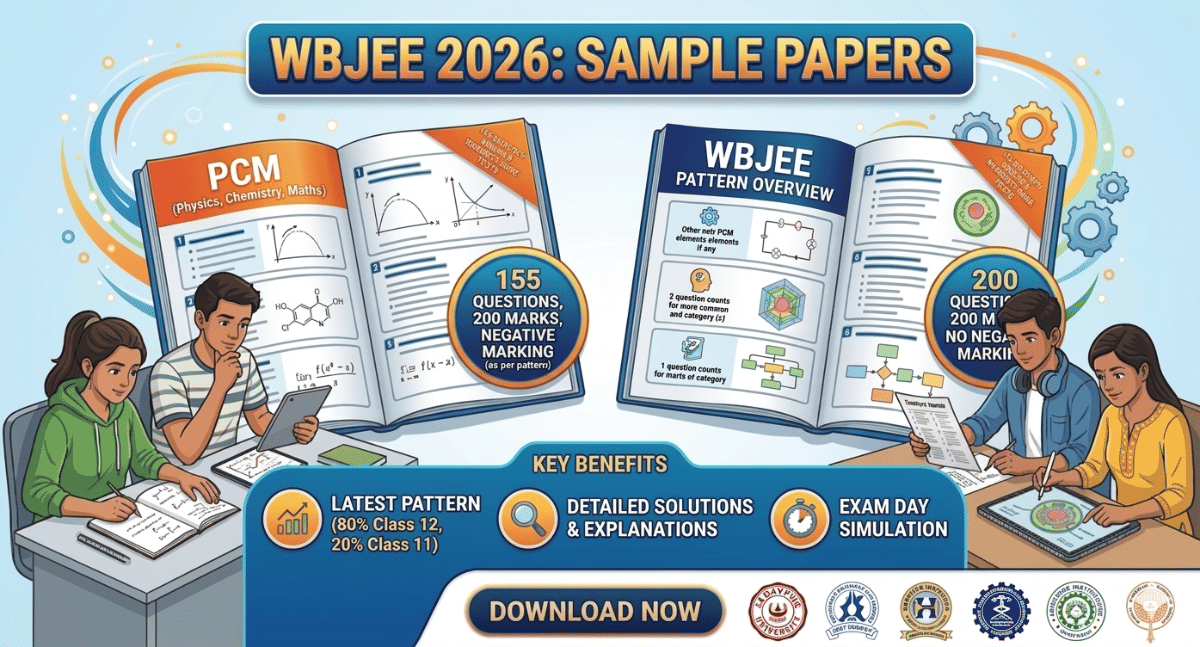
How to Solve WBJEE Sample Papers (Best Method)
Candidates can maximize the benefits of the sample papers by following a structured approach to solving or attempting the WBJEE sample papers.
- Create Real Exam Conditions — You should attempt the sample paper in a quiet room, set an exact 2-hour timer for each sample paper, and no phone or any help.
- Quick First Look — Spend 5-10 minutes reading the paper and mark easy and hard questions for you. You should always solve those questions first that you have 100% confidence in.
- Strategic Order — Most students start solving strong subjects first, so they will give more time to hard subjects.
- Solve Carefully — For solving questions, use rough work for calculations. Be careful with negative marking.
- Attempt Strategy — Try to attempt all the questions that you feel confident about and do not attempt those questions that create confusion for you.
- Post-Paper Analysis (Most Important):
- Check your score and note the time taken
- Review every wrong and unattempted question
- Note down your mistakes in a notebook so that you can revise them later
- Revise weak concepts immediately so that they become strong before the exam
WBJEE Sample Paper 2026: Importance
The sample papers are an important part of preparation because they are similar to real exam patterns and help students to understand the type of questions and exam format.
- Familiarity with exam pattern: Sample papers help students to understand the distribution of questions, trends, difficulty level, and important topics.
- Time management skills: The exam demands speed as you have to attempt 80 questions in 120 minutes for Physics & Chemistry and 75 questions in 120 minutes for Mathematics, which requires practice.
- Accuracy and Speed: As there is negative marking in the exam, you have to focus on accuracy rather than maximising the attempts. By solving multiple sample papers, candidates can increase their speed.
- Self-Evaluation: You can evaluate your performance by doing the post-paper analysis, which will help you identify your weak areas.
- Confidence Boost: By solving multiple sample papers, you will get an idea about the exam pattern & questions format, which will help you score well and boost your confidence.
Why choose Collegedunia’s WBJEE sample paper 2026
Collegedunia is trusted by thousands of WBJEE aspirants because:
- Latest & Accurate: Papers are based on the latest WBJEE 2026 pattern and follow the latest syllabus of WBJEE 2026.
- Detailed Solutions: Solutions are Easy-to-understand, deeply step-by-step explanations prepared by expert teachers so that you can focus on your weak areas.
- User-Friendly: Easy to navigate with clear links between questions and answers, hyperlinked, you can easily move to solutions directly and redirect back to questions, which makes them user-friendly.
- Regular Updates: The Sample Papers are updated as per the latest guidelines & syllabus.
- Free to Download: All sample papers and resources are completely free and can be easily downloaded by clicking on the Download PDF link.
- Quality Questions: All questions in the sample papers are created by experienced subject experts; each and every question is from the WBJEE syllabus 2026 and has a higher chance to appear in the WBJEE 2026 exam.
WBJEE 2026: Understanding the Exam Pattern
The WBJEE has two papers: Mathematics, Physics & Chemistry:
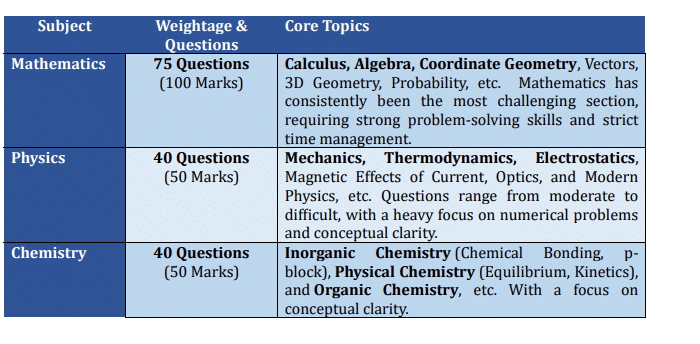
- The Mathematics paper will include 75 (100 Marks) Questions, which are to be attempted in 120 minutes. There are three categories in the paper.
Question Categories:
Category 1 has 50 questions (positive marking +1) (Negative marking 0.25). In this category, only one option will be correct.
Category 2 has 15 questions (positive marking +2) (Negative marking 0.5). In this category, only one option will be correct.
Category 3 has 10 questions (positive marking +2) (Negative marking -No negative marking). In this category, one or more options may be correct. You will get full marks only if you mark all the correct options.
- The Physics & Chemistry paper will include 80 Questions (100 Marks), which are to be attempted in 120 minutes. Each Subject has 40 Questions. There will be three categories in the question paper for each subject.
Question Categories:
Category 1 has 30 questions (positive marking +1) (Negative marking -0.25). In this category, only one option will be correct.
Category 2 has 5 questions (positive marking +2) (Negative marking -0.5). In this category, only one option will be correct.
Category 3 has 5 questions (positive marking +2) (Negative marking -0.5). In this category, one or more options may be correct. You will get full marks only if you mark all the correct options.
Other important resources for WBJEE 2026
To enhance your preparation, we have provided you with other resources that you can use along with your current resources to take the edge over other candidates.
| Particular | Direct Link |
|---|---|
| Best Books | Click to Download |
| Mock Test | Click to Download |
| Question Papers | Click to Download |
Mistakes to Avoid While Solving Sample Papers
Candidates should ensure that the mistakes made while attempting sample papers are not repeated in the actual exam.
Given below are some mistakes that you can avoid even while solving the sample papers:
- Do not start full-length papers until the completion of most of your syllabus.
- You must not do most common mistake made by candidates of ignoring the analysis part after solving the sample papers.
- You should focus on attempting the questions with accuracy rather than making random guesses.
- Don't ignore the time limit, as neglecting time management during practice may lead to time management issues during the actual exam.
- Using outdated or non-aligned sample papers that don't match the current exam pattern.
- In the initial phase, go through the solutions of even those questions that you had attempted correctly.
FAQs on WBJEE Sample Papers
Ques. How many sample papers should I solve for WBJEE 2026?
Ans. You should aim to solve 15–30 full-length papers, but focus more on analyzing your mistakes and performance instead of just solving a large number of papers.
Ques. Are previous year papers enough?
Ans. PYQs help understand exam trends and question patterns, but you should also solve new sample papers and mock tests for better understanding and preparation of the latest trends and patterns.
Ques. Where can I get the best WBJEE sample papers?
Ans. Collegedunia provides a good collection of subject-wise full-length sample papers. You can also check the official WBJEEB website for the official mock test available on the WBJEE portal wbjee.org.
Ques. Should I solve subject-wise or full papers?
Ans. You can start with subject-wise papers for concept building, then move to full-length papers for exam simulation. In the early phase, you can also attempt a sectional paper for a particular subject.
Ques. Is there negative marking in WBJEE?
Ans. Yes, there is negative marking in Categories 1 and 2. So, solve only those questions that you are fully confident in.But there is no negative marking in Category-3 Questions.
Ques. How can sample papers improve my score?
Ans. If you solve more sample papers, then you become aware of the question trends. Candidates can improve their score by focusing on sample paper analysis, maintaining an error log, revising weak topics weekly, and working on speed. Consistent practice can easily push your percentile higher.
Seat Allotment
WBJEE 2026 Round 2 seat allotment result was released on July 21, 2026, at the official portal wbjeeb.nic.in, and the acceptance and reporting deadline for Round 2 allottees is July 23, 2026. The West Bengal Joint Entrance Examination Board (WBJEEB) conducts seat allotment in multiple rounds for admission to B.Tech, B.E., B.Arch, and B.Pharm programmes across government, state-aided, and self-financing institutes in West Bengal. Round 1 allotment was declared on July 7, 2026. Round 3 allotment is expected on July 28, 2026, with registration opening from July 24–26, 2026. This page covers the complete round-wise allotment schedule, how to check your result on the portal, Freeze and Upgrade options and what each means, the seat acceptance fee by category, documents required for physical reporting, and what to do if no seat is allotted.
| Direct Link to WBJEE 2026 Seat Allotment Result – Round 2 (OUT) | Round 3 (Soon) |
WBJEE Seat Allotment 2026 Dates
WBJEEB releases the seat allotment result in separate rounds, each followed by a defined window for fee payment, Freeze or Upgrade selection, and physical document reporting at the allotted institute. Students allotted in Round 2 must complete fee payment and report to their institute by July 23, 2026 – missing this deadline forfeits the allotted seat automatically. The table below lists all rounds with their allotment result dates and acceptance windows. Upcoming events appear first; past events follow in chronological order.
| Round | Allotment Result Date | Seat Acceptance & Reporting Window | Status |
|---|---|---|---|
| Round 3 | July 28, 2026 (Expected) | To be announced | Awaited |
| Round 1 | July 7, 2026 | Closed | Released (Over) |
| Round 2 | July 21, 2026 | July 21–23, 2026 | Released (Active – closes July 23) |
Round 3 registration is scheduled from July 24–26, 2026, for students who remain unallotted after Round 2 or who participated in Round 2 with the Upgrade option. Seats released by Round 2 students who choose Withdraw or fail to report within the deadline are added back into the Round 3 pool, which typically widens availability compared with earlier rounds. After all regular rounds conclude, WBJEEB may announce a Spot Round (Mop-Up Round) to fill any remaining vacant seats. No Spot Round schedule has been confirmed as of July 22, 2026.
How to Check WBJEE Seat Allotment Result 2026
The WBJEE 2026 seat allotment result is available exclusively on the official portal wbjeeb.nic.in. No third-party website has authorised access to your allotment data. Follow the steps below to access your allotment letter for any round.
- Open the official WBJEE counselling portal at wbjeeb.nic.in/wbjee/.
- Click on the active link labelled "WBJEE 2026 Seat Allotment Result – Round 2" (or the current round’s link once Round 3 is released).
- Log in with your WBJEE 2026 Application Roll Number and your registered portal password.
- Your allotment letter will display, showing the allotted institute name, course (branch), category, and seat type.
- Review every detail carefully before taking any action – confirm the institute name, branch, and seat category are what you expected.
- Download and print the allotment letter and keep multiple physical copies, as you must submit a printout during document reporting at the allotted institute.
- Log back in to select your post-allotment option (Freeze or Upgrade) and then pay the seat acceptance fee – both steps must be completed within the acceptance window.
If you have forgotten your password, use the "Forgot Password" link on the login page and reset it via your registered mobile number or email ID. The portal closes for acceptance responses at the end of the deadline date. Log in well before the July 23 cut-off for Round 2 to avoid last-minute technical issues.
Freeze or Upgrade – What to Do After Allotment
After viewing your allotted seat, you must select one of the following options within the acceptance window. Your choice determines whether your current seat is locked in and whether you remain eligible for a better allotment in Round 3.
| Option | What It Means | When to Choose It |
|---|---|---|
| Accept and Freeze | You permanently accept the allotted seat and exit all subsequent rounds. Your admission at this institute is confirmed subject to successful document verification. | You are satisfied with the allotted institute and course and do not want any change in Round 3. |
| Accept and Upgrade | You accept the current seat as a backup and remain in the pool for a higher-preference allotment in Round 3. The system never downgrades you – if no better option opens in Round 3, your current seat remains intact. | You have higher-preference choices remaining in your list and want a chance at them in Round 3 without giving up your current seat. |
| Withdraw | You exit the WBJEE 2026 counselling process entirely. The allotted seat is released back into the pool for other students. | You are certain you will not pursue admission through WBJEE 2026, for example because you have confirmed admission elsewhere. |
Students who were allotted their first-choice college and branch are not eligible for the Upgrade option, since the system has already fulfilled their top preference – only Freeze or Withdraw is available in such cases. Both Accept and Freeze and Accept and Upgrade require fee payment to become effective. If you do not respond within the acceptance window, the system treats your allotment as lapsed and excludes you from Round 3 entirely.
WBJEE Seat Acceptance Fee 2026
After selecting Freeze or Upgrade, you must pay the seat acceptance fee online through the official WBJEE 2026 counselling portal. The fee amount differs by institute type and by category.
| Institute / Category Type | Seat Acceptance Fee | Nature |
|---|---|---|
| Government and State-Aided Institutes | ₹5,000 | Refundable – adjusted against first-semester tuition fee at the institute |
| Self-Financing Universities and Institutes | ₹40,000 | Refundable – adjusted against first-semester tuition fee at the institute |
| TFW (Tuition Fee Waiver) Category | ₹3,000 | Refundable – adjusted against first-semester tuition fee at the institute |
Fee payment is mandatory within the acceptance window; non-payment by the July 23 deadline for Round 2 results in automatic forfeiture of the allotted seat. Payment can be made via debit card, credit card, net banking, or UPI on the official portal. Save the payment confirmation and print the fee receipt – you must submit this printout during document reporting at the institute as proof that the online fee was paid before you arrived.
Students who choose Upgrade in Round 2 and then receive a better allotment in Round 3 will typically have their Round 2 fee applied toward the Round 3 seat. Students who choose Withdraw after paying are subject to the refund policy in the official WBJEE 2026 counselling brochure at wbjeeb.nic.in – the refund amount depends on the stage at which Withdrawal is submitted.
Documents Required for Reporting
After paying the seat acceptance fee online, you must physically report to your allotted institute within the reporting window with original documents and self-attested photocopies. Carry at least 3–4 sets of self-attested photocopies of every document listed below – institutes retain a set of copies for their own records. Missing even one mandatory document can result in provisional admission being withheld until the gap is rectified.
| Document | Purpose |
|---|---|
| WBJEE 2026 Rank Card | Confirms your rank and eligibility for the allotted seat |
| WBJEE 2026 Admit Card | Identity and exam-participation proof |
| WBJEE 2026 Seat Allotment Letter (printout) | Confirms allotted institute, course, and seat category |
| Class 10 Marksheet and Passing Certificate | Age verification and English subject-mark verification |
| Class 12 Marksheet and Passing Certificate | Subject eligibility verification (Physics, Chemistry, Mathematics/Biology) |
| West Bengal Domicile Certificate | Mandatory for students claiming a state quota seat |
| Aadhaar Card (or other valid government-issued photo ID) | Identity verification at the institute |
| Passport-Size Photographs (minimum 6) | For institute admission forms and identity records |
| Transfer Certificate (TC) | Required for enrolment at the institute |
| Character Certificate | Required by most institutes for formal enrolment |
| Category Certificate (SC / ST / OBC-A / OBC-B) | Mandatory if allotted under a reserved category; must be issued by an authorised West Bengal government authority |
| PwD Certificate | Required only if allotted under the Persons with Disabilities category |
| Seat Acceptance Fee Payment Receipt (printout) | Proof that the online fee was paid before arriving for reporting |
Contact your allotted institute directly before travelling to confirm exact reporting timings, the document verification centre location within the campus, and any institute-specific additional requirements. The Round 2 reporting window closes on July 23, 2026 – do not delay.
What If No Seat Is Allotted
Not receiving a seat in Round 1 or Round 2 does not end your WBJEE 2026 admission options. WBJEEB redistributes every seat released by students who choose Withdraw or fail to accept within the deadline, so subsequent rounds often carry more availability than earlier ones.
Round 3 registration opens July 24–26, 2026 – students who remained unallotted after Round 2 must register afresh within this window to be considered for Round 3 allotment, expected on July 28, 2026. Even a modest release of vacated seats can shift closing ranks meaningfully, so register and review your choice order before the Round 3 window opens.
If you received a Round 2 allotment and chose Upgrade, you do not need to re-register for Round 3. The system automatically considers you for a higher-preference seat from your existing choice list. If Round 3 produces no better match, your Round 2 seat is retained intact and you must complete all reporting formalities for that seat within the Round 3 acceptance window.
After all regular rounds conclude, WBJEEB may run a Spot Round (Mop-Up Round) to fill remaining vacant seats. The Spot Round, if held, typically operates on a compressed 2–3 day timeline covering registration, choice filling, allotment, and acceptance. Eligibility is limited to students who participated in the regular counselling rounds but did not receive an allotment. No Spot Round schedule for WBJEE 2026 has been announced as of July 22, 2026 – check wbjeeb.nic.in for updates after Round 3 concludes.
Students who complete all rounds without receiving any allotment are not charged a seat acceptance fee at any stage, so no refund issue arises. You exit the process automatically after the final round.
WBJEE Seat Allotment 2026 FAQs
Ques. How do I check my WBJEE 2026 seat allotment result?
Ans. Visit wbjeeb.nic.in/wbjee/, click the active seat allotment result link for the current round, and log in with your WBJEE 2026 Application Roll Number and password. Your allotment letter showing the institute name, course, and category will appear. Download and print it – you must carry this printout when you report to the institute for document verification.
Ques. What is the difference between Freeze and Upgrade in WBJEE 2026 counselling?
Ans. Freeze permanently locks in your current allotted seat and removes you from all future rounds. Upgrade accepts the current seat as a backup while keeping you eligible for a higher-preference seat in the next round. The Upgrade option never downgrades you – if no better seat opens in Round 3, your existing Round 2 seat remains fully intact.
Ques. What is the WBJEE 2026 seat acceptance fee, and is it refundable?
Ans. The fee is ₹5,000 for government and state-aided institutes, ₹40,000 for self-financing institutes, and ₹3,000 for the TFW (Tuition Fee Waiver) category. All amounts are refundable and are adjusted against the first-semester tuition fee when you complete physical admission at the institute. The refund amount on Withdrawal depends on the stage – refer to the official WBJEE 2026 counselling brochure at wbjeeb.nic.in for the exact policy.
Ques. What is the last date to accept the WBJEE 2026 Round 2 seat allotment?
Ans. The deadline for Round 2 acceptance, fee payment, and document reporting is July 23, 2026. Students must log in to wbjeeb.nic.in, select Freeze or Upgrade, pay the seat acceptance fee online, and physically report to their allotted institute with original documents before this date. Missing the deadline causes the allotted seat to be cancelled automatically.
Ques. Can I participate in WBJEE 2026 Round 3 if I already accepted a Round 2 seat?
Ans. Yes, if you chose Upgrade in Round 2 and paid the acceptance fee, you are automatically included in Round 3 based on your existing choice list – no separate registration is needed. If you chose Freeze in Round 2, you are not eligible for Round 3. Students who remained entirely unallotted after Round 2 must register afresh during the July 24–26, 2026 Round 3 registration window.
Ques. What documents do I need to carry for WBJEE 2026 document reporting?
Ans. Carry your WBJEE 2026 Rank Card, Admit Card, and Seat Allotment Letter (printed); Class 10 and Class 12 marksheets and certificates; West Bengal Domicile Certificate; Aadhaar Card; at least 6 passport-size photographs; Transfer Certificate; Character Certificate; category certificate (SC/ST/OBC-A/OBC-B, if applicable); PwD certificate (if applicable); and the seat acceptance fee payment receipt. Bring 3–4 sets of self-attested photocopies of every document alongside the originals.
Ques. When is WBJEE 2026 Round 3 seat allotment expected?
Ans. Round 3 seat allotment is expected on July 28, 2026. Registration for Round 3 is open from July 24–26, 2026. Unallotted students and those who chose the Upgrade option in Round 2 are eligible. Confirm the exact schedule on the official portal wbjeeb.nic.in before registering.
Ques. What happens if I do not receive a seat in any round of WBJEE 2026 counselling?
Ans. Students who complete all regular rounds without receiving an allotment exit the process automatically at no fee cost, since the seat acceptance fee is charged only to students who receive and accept a seat. WBJEEB may conduct a Spot Round after all regular rounds to fill remaining vacant seats – watch wbjeeb.nic.in for announcements after Round 3. No Spot Round date for WBJEE 2026 has been announced as of July 22, 2026.
Toppers
Shaswat Banerjee from Salt Lake, Kolkata has topped WBJEE 2026 with General Merit Rank (GMR) 1, and a total of 92,753 candidates have qualified the examination as per the official result declared on June 18, 2026 by the West Bengal Joint Entrance Examinations Board (WBJEEB).
- Shaswat Banerjee from Salt Lake, Kolkata (CBSE Board) has secured General Merit Rank 1 in WBJEE 2026.
- Souriddha Mondal from Bishnupur, South 24 Parganas (ISC Board) holds GMR 2, followed by Umang Gupta at GMR 3.
- A total of 92,753 candidates have qualified WBJEE 2026 out of 94,901 who appeared, with a pass percentage of 97.74%.
- WBJEE 2026 was held on May 24, 2026; the result was declared on June 18, 2026 at a WBJEEB press conference, with rank cards released the same day at wbjeeb.nic.in.
- WBJEE 2026 Round 1 seat allotment was released on July 7, 2026; candidates can track subsequent counselling rounds on the official WBJEEB portal.
Key Summary — WBJEE Toppers 2026
- GMR 1: Shaswat Banerjee, Salt Lake, Kolkata (CBSE Board)
- GMR 2: Souriddha Mondal, Bishnupur, South 24 Parganas (ISC Board)
- Total Qualified: 92,753
- Pass Percentage: 97.74%
- Result Date: June 18, 2026
- Authority: West Bengal Joint Entrance Examinations Board (WBJEEB)
Table of Contents
- WBJEE 2026 Official GMR List
- WBJEE 2026: GMR 1 to 10 Rank Holders
- WBJEE 2026 Toppers: School Board Distribution
- WBJEE 2026: Category Merit Ranks
- WBJEE Result 2026: Date and Statistics
- How to Check WBJEE Result 2026
- WBJEE Toppers: Previous Year Trends
- WBJEE Topper Preparation Strategy
- What to Do After WBJEE Result 2026
- FAQs on WBJEE Toppers 2026
WBJEE Toppers 2026: Official GMR List
The West Bengal Joint Entrance Examinations Board (WBJEEB) declared the WBJEE 2026 result on June 18, 2026 at a formal press conference and simultaneously made rank cards available at wbjeeb.nic.in. Shaswat Banerjee, a CBSE Board student from Salt Lake, Kolkata, secured the top position with GMR 1, continuing a trend of CBSE-affiliated students heading the WBJEE merit list. He is followed by Souriddha Mondal (GMR 2, ISC Board) from Bishnupur, South 24 Parganas, and Umang Gupta at GMR 3.
Unlike percentile-based national examinations, WBJEE ranks candidates on aggregate marks scored out of a total of 200 — Paper 1 (Mathematics) carries 100 marks and Paper 2 (Physics and Chemistry) carries 100 marks. Rankings are determined directly from marks obtained, with ties broken first by Mathematics score, then Physics, then Chemistry, then age (older candidate preferred). WBJEEB additionally publishes a separate Pharmacy Merit Rank (PMR) list for candidates seeking B.Pharm admissions, which runs parallel to the GMR list for engineering and architecture courses.
- GMR 1: Shaswat Banerjee — Salt Lake, Kolkata (CBSE Board)
- GMR 2: Souriddha Mondal — Bishnupur, South 24 Parganas (ISC Board)
- GMR 3: Umang Gupta
- Total candidates who qualified: 92,753
WBJEE 2026: GMR 1 to 10 Rank Holders
WBJEEB officially announced the top 10 General Merit Rank holders for WBJEE 2026 at the result press conference on June 18, 2026. The confirmed board affiliations show CBSE-board students holding four of the top 10 positions, a pattern consistent with the past three WBJEE cycles. The board typically identifies the school board and home district of each top rank holder during the press conference. Individual marks scored are accessible only through each candidate’s personal rank card at wbjeeb.nic.in using the application number and password.
| GMR | Candidate Name | School Board | Location |
|---|---|---|---|
| 1 | Shaswat Banerjee | CBSE | Salt Lake, Kolkata |
| 2 | Souriddha Mondal | ISC (CISCE) | Bishnupur, South 24 Parganas |
| 3 | Umang Gupta | — | — |
| 4 | Rahul Konar | ISC (CISCE) | — |
| 5 | Sarban Bhattacharya | CBSE | — |
| 6 | Arha Bhattacharya | — | — |
| 7 | Srijan Sur | — | — |
| 8 | Manish Senapati | — | — |
| 9 | Sabyasachi Laskar | CBSE | — |
| 10 | Debojit Pal | CBSE | — |
Note: WBJEEB identifies the school board of top rank holders in the official announcement. Board details for GMR 3, 6, 7, and 8, and location details for GMR 3 onwards, were not confirmed in the public result notification. Individual marks scored are available only on each candidate’s personal rank card at wbjeeb.nic.in.
WBJEE 2026 Toppers: School Board Distribution
A defining characteristic of WBJEE result analysis is the school board breakdown of the top 10 rank holders. WBJEEB highlights, at the result press conference, whether each topper is affiliated with CBSE, CISCE (ISC), or the West Bengal Council of Higher Secondary Education (WBCHSE). In WBJEE 2026, students from the CBSE Board dominated the confirmed board affiliations, occupying four of the positions for which board details were officially disclosed. The ISC (CISCE) board contributed two confirmed toppers, including GMR 2 Souriddha Mondal and GMR 4 Rahul Konar. This continued dominance by CBSE students reflects the strong alignment between the CBSE curriculum and WBJEE’s Mathematics, Physics, and Chemistry syllabus.
| School Board | Confirmed GMR Holders in Top 10 (2026) | GMR Positions (Confirmed) |
|---|---|---|
| CBSE | 4 | GMR 1 (Shaswat Banerjee), GMR 5 (Sarban Bhattacharya), GMR 9 (Sabyasachi Laskar), GMR 10 (Debojit Pal) |
| ISC / CISCE | 2 | GMR 2 (Souriddha Mondal), GMR 4 (Rahul Konar) |
Note: Board affiliations for GMR 3, 6, 7, and 8 were not confirmed in official public communications at the time of result declaration. The complete school board breakdown for all 10 positions is available in the official WBJEEB result notification issued on June 18, 2026.
WBJEE 2026: Category Merit Ranks
In addition to the General Merit Rank (GMR), WBJEEB assigns a Category Merit Rank (CMR) to candidates from reserved categories and a Special Merit Rank (SMR) to candidates qualifying under special quota schemes. These ranks are used during centralised WBJEE counselling to allocate seats reserved under each category. WBJEEB does not publicly release the names of the highest-ranked candidate in each category — unlike some national exams that publish a category-wise topper list alongside the general list. Individual CMR and SMR details are accessible only through a candidate’s personal rank card at wbjeeb.nic.in using the application number and password.
| Category | Rank Type Assigned by WBJEEB | Seat Quota Used In |
|---|---|---|
| OBC-A | Category Merit Rank (CMR) | OBC-A reserved seats across West Bengal engineering colleges |
| OBC-B | Category Merit Rank (CMR) | OBC-B reserved seats across West Bengal engineering colleges |
| SC | Category Merit Rank (CMR) | SC reserved seats across West Bengal engineering and pharmacy colleges |
| ST | Category Merit Rank (CMR) | ST reserved seats across West Bengal engineering and pharmacy colleges |
| EWS | Category Merit Rank (CMR) | EWS reserved seats in state and private institutions |
| Persons with Disability (PwD) | Special Merit Rank (SMR) | Horizontal PwD quota across all participating institutes |
| TFW (Tuition Fee Waiver) | Special Merit Rank (SMR) | Tuition fee waiver seats for economically weaker candidates in participating institutes |
Note: WBJEEB assigns CMR and SMR to all eligible candidates but does not release a consolidated public list of category-wise rank 1 holders. OBC-A and OBC-B are West Bengal-specific sub-classifications of Other Backward Classes as recognised by the state government. Candidates can check their individual category ranks on their personal rank card at wbjeeb.nic.in.
WBJEE Result 2026: Date and Statistics
WBJEEB declared the WBJEE 2026 result on June 18, 2026, approximately 25 days after the examination was held on May 24, 2026. The result statistics reveal a high qualification rate: 97.74% of candidates who appeared have qualified. This near-universal qualification rate is characteristic of WBJEE — the exam functions as a ranking exercise, with admission competition determined by rank bands rather than a binary pass or fail threshold. Of the 1,20,856 candidates who registered, 94,901 appeared and 92,753 qualified.
| Particular | Details |
|---|---|
| Result Declared On | June 18, 2026 |
| WBJEE 2026 Exam Date | May 24, 2026 |
| Total Registered | 1,20,856 |
| Total Appeared | 94,901 |
| Total Qualified | 92,753 |
| Pass Percentage | 97.74% |
| GMR 1 Holder | Shaswat Banerjee — Salt Lake, Kolkata (CBSE Board) |
| Total Exam Marks | 200 (Paper 1: Mathematics 100 marks + Paper 2: Physics & Chemistry 100 marks) |
| Counselling Round 1 Seat Allotment | July 7, 2026 |
| Official Website | wbjeeb.nic.in |
Source: WBJEEB Official Website — wbjeeb.nic.in
How to Check WBJEE Result 2026
Candidates can download their WBJEE 2026 rank card from the official WBJEEB portal. The rank card displays the GMR, and where applicable the CMR and SMR, along with marks obtained in each paper — details that are essential for the counselling process. Note that WBJEE uses an application number and password-based login rather than a date of birth login used by some national exams.
- Visit the official WBJEEB website at wbjeeb.nic.in.
- Click on the WBJEE 2026 Result / Rank Card link displayed on the homepage.
- Enter your Application Number and Password in the candidate login fields.
- Click Submit to view your WBJEE 2026 rank card.
- Download and save a printed copy of the rank card for use during counselling, document verification, and institute reporting.
WBJEE Toppers: Previous Year Trends
WBJEE has historically produced its top rank holders from urban centres and well-established schools across West Bengal. Over the past four years, Kolkata has dominated — with three of the last four GMR 1 holders based in the city — while 2024 saw a notable break with GMR 1 coming from Bankura, a district outside the Kolkata metropolitan area. School board diversity is visible across years: CBSE, CISCE, and WBCHSE have each produced GMR 1 holders in recent cycles, confirming that WBJEE is accessible across board curricula when preparation is specifically calibrated to the exam’s syllabus and question types.
| Year | GMR 1 Topper | School / Location | Board |
|---|---|---|---|
| 2026 | Shaswat Banerjee | Salt Lake, Kolkata | CBSE |
| 2025 | Aniruddha Chakrabarti | Don Bosco School, Park Circus, Kolkata | CISCE |
| 2024 | Kingshuk Patra | Bankura Zilla School, Bankura | WBCHSE |
| 2023 | Md Sahil Akhter | — | — |
Note: Individual scores for WBJEE toppers are not officially published by WBJEEB in consolidated press releases. Location and board details for the 2023 topper were not confirmed in available official public communications.
WBJEE Topper Preparation Strategy
Analysis of WBJEE topper profiles and the exam’s structure over recent years reveals consistent preparation approaches that separate top rank holders from the broader candidate pool. The insights below are grounded in how the exam is built — its three question categories, its subject-wise marks split, and the specific depth at which topics are tested.
- NCERT mastery before advanced resources: WBJEE Paper 2 (Physics and Chemistry) draws a significant share of questions directly from NCERT Class 11 and 12 concepts. Toppers consistently report completing NCERT thoroughly before moving to reference books. Attempting advanced material without an NCERT foundation creates gaps precisely where the easiest marks are available.
- Mathematics is the rank differentiator: With Paper 1 entirely dedicated to Mathematics (100 of the total 200 marks), candidates who score close to full marks in Maths nearly always land a top 10 rank. Algebra, Calculus, and Co-ordinate Geometry carry the highest question density in Paper 1 and receive disproportionate preparation time from toppers.
- Master the three question categories: WBJEE uses Category 1 (single correct, −0.25 per wrong answer), Category 2 (single correct, −0.5 per wrong answer), and Category 3 (one or more correct answers valid, no negative marking). Category 3 is frequently underestimated — it offers high-value marks without penalty risk, making it ideal for candidates who can identify even one correct option confidently.
- Ten years of previous year WBJEE papers: Solving the last 10 years of WBJEE papers under timed, exam-day conditions is a near-universal practice among top rankers. WBJEE repeats question patterns and topic distributions more predictably than national-level entrance exams, making historical papers a high-yield preparation resource.
- Structured mock test schedule: Weekly full-length mocks during the initial 6–8 months of preparation, increasing to two to three mock tests per week in the final two months, is the preparation rhythm most commonly associated with top WBJEE finishers. Each mock should be followed by a focused error analysis session.
- WBJEE-specific syllabus calibration: While WBJEE and JEE Main share considerable overlap, WBJEE tests Statistics and certain Co-ordinate Geometry topics at a depth not always covered in standard JEE Main preparation. Candidates who cross-reference WBJEE’s official syllabus against their study plan and address those gaps explicitly gain a measurable advantage.
What to Do After WBJEE Result 2026
- Download the WBJEE 2026 rank card from wbjeeb.nic.in using your application number and password; this document is mandatory for all counselling and reporting stages.
- Review your General Merit Rank (GMR) and, where applicable, your Category Merit Rank (CMR) to identify which college-branch combinations fall within your rank band based on WBJEE marks-vs-rank data.
- WBJEE 2026 Round 1 seat allotment was released on July 7, 2026; if you received an allotment and completed the acceptance process, verify your status and prepare required documents for the allocated institute.
- Monitor the WBJEEB official website for Round 2 and subsequent counselling rounds; candidates not allotted a preferred seat in Round 1, or those not allotted at all, are eligible to participate in further rounds and any mop-up or spot rounds announced by WBJEEB.
- Prepare the standard document checklist in advance: WBJEE 2026 rank card, Class 10 and Class 12 marksheets and pass certificates, category certificate (if applicable), valid photo identity proof, domicile certificate, and recent passport-size photographs.
- Candidates who also qualified in JEE Main 2026 may separately pursue admission to NITs, IIITs, and GFTIs through the JoSAA counselling process, which runs independently of WBJEE counselling and has its own registration and choice-filling timeline.
FAQs on WBJEE Toppers 2026
Question: Who is the GMR 1 topper in WBJEE 2026?
Ans. Shaswat Banerjee from Salt Lake, Kolkata, a student of the CBSE Board, has secured General Merit Rank 1 (GMR 1) in WBJEE 2026. The result was declared by WBJEEB on June 18, 2026. He is followed by Souriddha Mondal (GMR 2, ISC Board) and Umang Gupta (GMR 3).
Question: When was WBJEE 2026 result declared?
Ans. The WBJEE 2026 result was declared on June 18, 2026 by the West Bengal Joint Entrance Examinations Board (WBJEEB) at a press conference, approximately 25 days after the exam was held on May 24, 2026. Individual rank cards were made available for download on wbjeeb.nic.in the same day.
Question: How many candidates qualified WBJEE 2026?
Ans. A total of 92,753 candidates qualified WBJEE 2026 out of 94,901 who appeared for the examination, giving a pass percentage of 97.74%. A total of 1,20,856 candidates had registered for the exam. The high qualification rate reflects WBJEE’s design as a ranking examination where admission competition is determined by rank, not a pass-fail threshold.
Question: Who are the GMR 2 and GMR 3 holders in WBJEE 2026?
Ans. Souriddha Mondal from Bishnupur, South 24 Parganas (ISC / CISCE Board) secured GMR 2 in WBJEE 2026, followed by Umang Gupta at GMR 3. The complete top 10 GMR list announced by WBJEEB on June 18, 2026 is accessible on the official portal at wbjeeb.nic.in.
Question: Does WBJEEB release a category-wise topper list?
Ans. WBJEEB does not publicly release a consolidated list of category-wise rank 1 holders for WBJEE. While each qualifying candidate from a reserved category (OBC-A, OBC-B, SC, ST, EWS) receives a Category Merit Rank (CMR), and candidates under special quota schemes (PwD, TFW) receive a Special Merit Rank (SMR) alongside their GMR, these individual ranks are not announced publicly. Candidates can view their own CMR and SMR on their personal rank card at wbjeeb.nic.in.
Question: What is the total marks for WBJEE 2026?
Ans. The total marks for WBJEE 2026 is 200. The exam is divided into two papers: Paper 1 (Mathematics) carries 100 marks and Paper 2 (Physics and Chemistry) carries 100 marks. The marking scheme includes negative marking in Category 1 (−0.25 per wrong answer) and Category 2 (−0.5 per wrong answer), while Category 3 questions carry no negative marking for incorrect selections.
Question: Which school board produced the most WBJEE 2026 toppers?
Ans. Students from the CBSE Board dominated the confirmed board affiliations in the WBJEE 2026 top 10 GMR list. Of the six positions for which board details were officially confirmed, four belong to CBSE-board students: GMR 1 Shaswat Banerjee, GMR 5 Sarban Bhattacharya, GMR 9 Sabyasachi Laskar, and GMR 10 Debojit Pal. The ISC (CISCE) Board contributed GMR 2 Souriddha Mondal and GMR 4 Rahul Konar.
Question: How can I check my WBJEE 2026 rank card?
Ans. Candidates can check the WBJEE 2026 rank card by visiting the official website at wbjeeb.nic.in, clicking the WBJEE 2026 result link on the homepage, and logging in with their Application Number and Password. The rank card displays the GMR, CMR (if applicable), and SMR (if applicable), along with marks in each paper and personal details required for the counselling process.
Question: Who topped WBJEE in previous years?
Ans. Aniruddha Chakrabarti from Don Bosco School, Park Circus, Kolkata (CISCE Board) secured GMR 1 in WBJEE 2025, followed by Samyajyoti Biswas (GMR 2) and Dishaanth Basu (GMR 3). In WBJEE 2024, Kingshuk Patra from Bankura Zilla School, Bankura (WBCHSE Board) secured GMR 1 — notable as a state-board topper from outside Kolkata. In WBJEE 2023, Md Sahil Akhter held GMR 1.