
Overview
JEE Advanced 2026 Exam Date and Registration
IIT Roorkee will conduct the JEE Advanced exam on 17 May 2026. The registration will begin on 23 April 2026 at 10 am on the official website, jeeadv.ac.in.
- As per last year’s data, 1,87,223 candidates registered for the exam, but there were only 18,188 seats available across 23 IITs.
- Candidates who qualify for JEE Main and meet the eligibility criteria related to age limit, number of attempts, and Class 12 examination are eligible to appear for the exam.
- As per trends, the exam pattern varies section-wise. Multi-correct questions have partial marking, whereas numerical answers have no negative marking.
Key Summary
This article covers the registration, eligibility, syllabus, exam pattern, preparation strategy, and PYQs or mock papers for JEE Advanced 2026.
- As per trends, in 2026 there may be around 1,85,000 registrations of JEE Main-qualified candidates competing for almost 18,200 seats at 23 IITs.
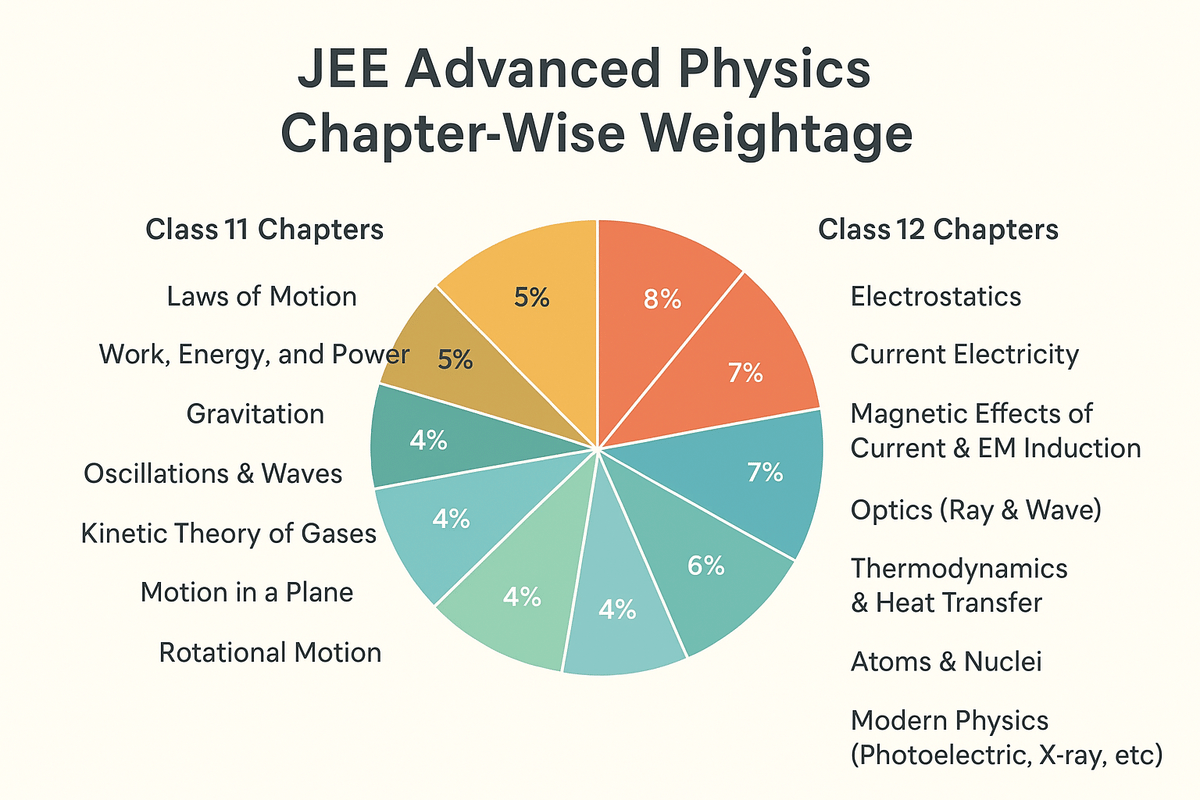
- The syllabus comes from Class 11 and 12, but numerical and multi-correct questions have almost 50% of total weightage.
- For admission, all candidates require 75% aggregate in Boards, or be within the Top 20 Percentile of their respective boards.
- Candidates must obtain Minimum Percentage of Marks per subject to avoid disqualification regardless of a high aggregate score.
What is JEE Advanced?
The Joint Entrance Examination (JEE) Advanced is a national-level entrance examination conducted for students seeking admission to IITs in India.
- The exam will be conducted in two mandatory papers: Paper 1 and Paper 2 on the same day in 2 shifts.
- Both papers will be conducted in CBT mode, consisting of 17 questions in Physics, Chemistry, and Mathematics respectively.
- After qualifying for this exam, admission is available to undergraduate programs in engineering and science at IITs, and also other institutes like IISc, IIPE, IIST, RGIPT, etc.
Last year, among 2,50,000 JEE Main qualified candidates, only approx. 75% registered for the exam. 54,378 candidates qualified for admission, among whom only 18,188 actual allotted seats were available at 23 IITs through JoSAA.
- The Joint Implementation Committee (JIC) sets a minimum qualifying mark to ensure they have roughly three candidates per seat.
- This happens because many top rankers may drop out of counselling to join other top non-IITs (like IISc, IIST, and IISERs) or top NITs or less preferred IITs based on their preference and availability.
JEE Advanced 2026 Overview
JEE Advanced 2026 is a national entrance test for admission to the Indian Institutes of Technology (IITs). The exam is conducted online as a Computer-Based Test (CBT).
| Particulars | Details |
|---|---|
| Governing Body | IIT Council |
| Exam Level | National Entrance Test |
| Exam Mode | Online (CBT) |
| Papers | Paper 1 and Paper 2 |
| Subjects | Physics, Chemistry, Mathematics |
| Medium | English & Hindi |
| Exam Date | 17 May 2026 |
| Registration Dates | 23 April 2026, 10 am to 02 May 2026 |
| Eligibility | Top 2,50,000 JEE Main 2026 qualifiers |
| No. of Attempts allowed | 2 attempts (consecutive years) |
| Total Questions | 102 questions (51 questions in each paper) |
| Expected Seat Intake | 18,200 across 23 IITs |
| Information Brochure | PDF Link (English) |
| Official Website | jeeadv.ac.in |
Important Dates
The JEE Advanced 2026 exam will be held on 17 May 2026. Registration for qualified candidates starts on 23 April 2026.
| Date (Timeline) | Event |
|---|---|
| 6 April 2026, 10am | Online Registration Start Date (Foreign National and OCI/PIO (F) Candidates) |
| 23 April 2026, 10am | Online Registration Start Date (for JEE Main 2026 Qualified Candidates) |
| 2 May 2026 | Registration End Date |
| 4 May 2026 | Last date for Fee Payment |
| 11 May 2026, 10am - 17 May 2026, 2:30pm | Admit Card Dates |
| 16th May 2026 | Choosing of scribe by PwD candidates |
| 17 May 2026 | JEE Advanced Exam Date |
| Paper 1: 9 am-12 pm Paper 2: 2:30pm - 5:30pm | Paper Timing Slots |
Source: jeeadv.ac.in
Conducting IIT for JEE Advanced 2026
IIT Roorkee will conduct the JEE Advanced 2026 exam. This decision follows a rotational pattern among the IITs.
- There is a rotational pattern of IITs that follows a 7-year cycle, with all seven zonal IITs taking turns in each year to organize the JEE Advanced exam.
- The IIT Roorkee last conducted the JEE Advanced in 2019, making it their turn again in 2026 (as per the 7-year rotational cycle).
JEE Advanced vs JEE Main
The key differences between JEE Advanced and JEE Main are listed below. JEE Advanced is considered more difficult than JEE Main.
| Feature | JEE Main | JEE Advanced |
|---|---|---|
| Conducting Body | NTA | Any one of the 7 old IITs |
| Entrance Exams | NITs, IITs, GFTIs | Primarily for IITs |
| Eligibility | Class 12 appearing/passed | Top 2,50,000 JEE Main qualifiers |
| Attempts | 3 years (2 sessions/year) | 2 attempts in 2 consecutive years |
| Exam Level | Easier Than Advanced | Very Difficult |
| Subjects | Physics, Chemistry, Mathematics | Physics, Chemistry, Mathematics |
Eligibility Criteria
Candidates must meet specific eligibility criteria to appear for JEE Advanced 2026. These criteria cover performance in JEE Main, age, and previous admission to IITs.
| Criteria | Eligibility |
|---|---|
| Performance in JEE Main 2026 | Top 2,50,000 JEE Main 2026 qualified candidates across all categories |
| Age Limit | Candidates born on or after October 1, 2001 (5-year relaxation for SC/ST/PwD) |
| Number of attempts | A maximum of two times in two consecutive years |
| Appearance in Class 12 (or equivalent) exam | Candidates passing Class 12 in 2025 or 2026 with PCM or 12th results after 18 June 2024 are also eligible |
| Earlier admission at IITs | Candidates not admitted to an IIT under any academic program listed in JoSAA Business Rules of 2025 |
| Foreign Nationals and OCI/PIO Candidates | Candidates are not required to write JEE Main 2026 and may register for JEE Advanced 2026 directly (General Category) |
Source: jeeadv.ac.in
JEE Advanced 2026 Eligibility for Class 12 (2025) Students
Yes, you are eligible for JEE Advanced 2026 if you passed Class 12 in 2025, even if you failed or dropped a year. This is subject to the official eligibility rules.
- You can apply for JEE Advanced 2026 if you appeared for Class 12 in 2025 or 2026, even if you did not clear a previous attempt or took a year drop.
- Candidates who appeared for Class 12 in 2024 or before are not eligible for JEE Advanced 2026.
Class 12 Improvement Exam and Top 20 Percentile
No, you cannot use the top 20 percentile criterion if you reappear in only some subjects of Class 12. You must reappear in all subjects for improvement to qualify via this route.
- The Class 12 improvement exam must be cleared to be eligible for JEE Advanced.
- Partial improvements in some subjects are not allowed for qualifying via the percentile.
JEE Advanced 2026 Registration
The JEE Advanced 2026 registration process will start on 23rd April 2026, after the JEE Mains results are declared. The registration portal will close by 2nd May 2026.
JEE Advanced 2026 Registration Fees
The JEE Advanced registration fee is similar to the previous year. The fee structure is expected to differ according to the candidate's category, gender, and nationality.
JEE Advanced Registration Trends
In recent years (2023 to 2025), the gap between registered and appeared candidates is typically approx. 4,000 to 9,000. This indicates high turnout ratios.
- Registrations rose steadily from around 1,50,000–1,70,000 (2017 to 2022) to around 1,80,000–1,90,000 in 2023 to 2025.
- From 2023 to 2025, the number of candidates who appeared for the exam was approximately around 1,80,000 candidates.
| Year | Registered Candidates | Appeared Candidates |
|---|---|---|
| 2017 | 171,814 | 159,540 |
| 2018 | 165,656 | 155,158 |
| 2019 | 174,432 | 161,319 |
| 2020 | 160,838 | 150,838 |
| 2021 | 151,193 | 141,699 |
| 2022 | 160,038 | 155,538 |
| 2023 | 189,744 | 180,372 |
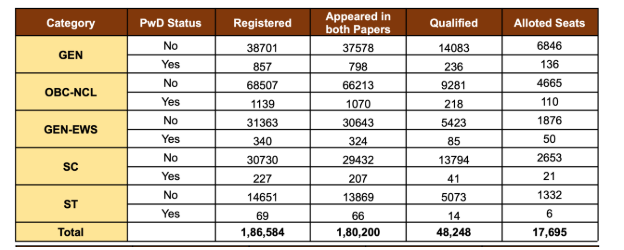
| 2024 | 186,584 | 180,200 |
| 2025 | 187,223 | 180,422 |
Documents Required for Registration After Improvement
For JEE Advanced 2026 registration, you must upload your 2025 improvement exam marksheet as the primary document. You should also upload your 2024 original Class 12 marksheet as a supporting document.
- Primary Document: Upload your 2025 improvement exam marksheet during JEE Advanced 2026 registration.
- Supporting Documents: Upload your 2024 original Class 12 marksheet along with the 2025 marksheet.
- Calculation of Best Marks: For subjects where you appeared for improvement, the best marks from either the 2024 or 2025 exams will be considered.
- For JEE Main 2026 and JoSAA Counselling: You must upload both your 2024 and 2025 marksheets to verify you meet the 75% aggregate marks requirement or are in the top 20 percentile of your board.
EWS Certificate for JEE Advanced Registration
Yes, you can apply under the GEN-EWS category for JEE Advanced 2026 even if you did not renew or get an EWS certificate during JEE Main. You must upload a valid GEN-EWS certificate issued on or after April 1, 2025.
- GEN-EWS Certificate Requirement: Upload a valid GEN-EWS certificate issued on or after April 1, 2025, during the JEE Advanced 2025 registration process.
- Declaration in place of Certificate: If you cannot get the GEN-EWS certificate before the registration deadline, you can submit a self-declaration stating that you belong to the GEN-EWS category.
JEE Advanced 2026 Exam Pattern
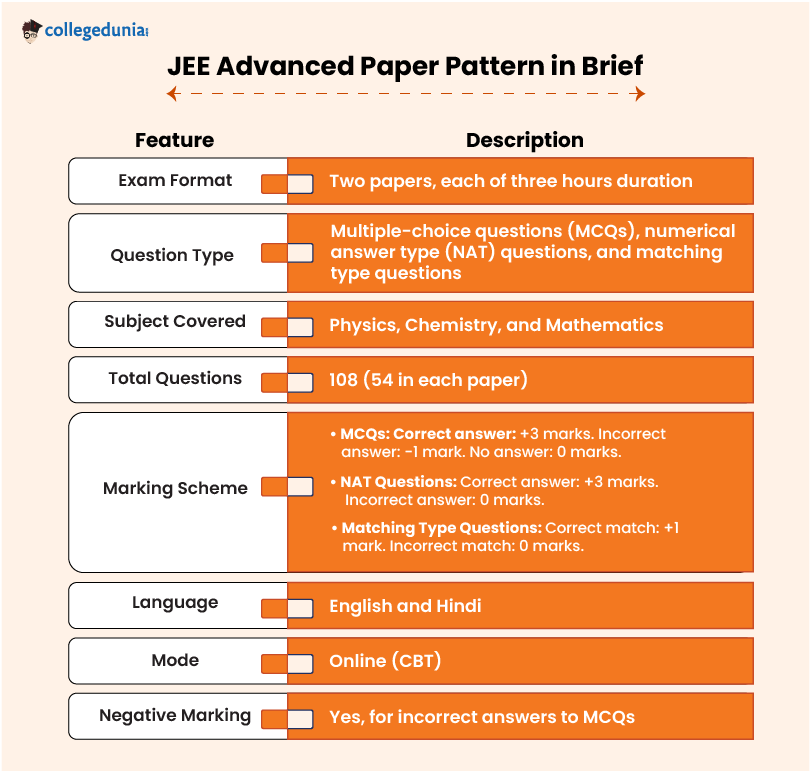
The JEE Advanced 2026 exam will be held in online CBT mode. It will have 2 compulsory exams: Paper 1 and Paper 2, each of 3 hours.
The exam will test Physics, Chemistry, and Mathematics using different types of questions, including MCQs, MSQs, and NAT questions.
JEE Advanced 2026 Paper 1
Paper 1 of JEE Advanced 2026 will be held on 17 May 2026 from 9:00 AM to 12:00 PM. The paper tests conceptual clarity and accuracy through Mixed MCQs, NATs, and Matching Questions.
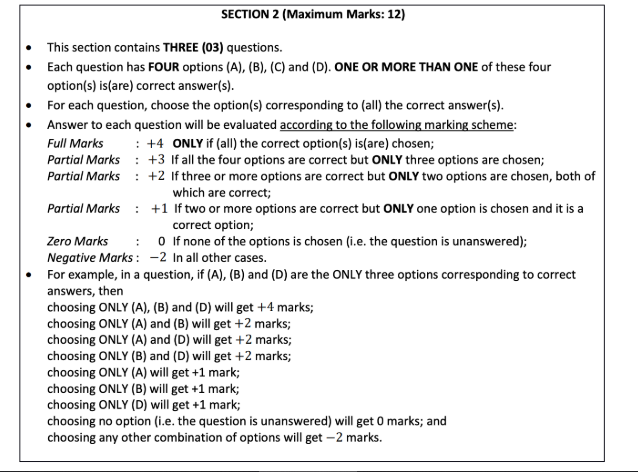
Partial marking is applicable for Multiple Correct MCQs. Numerical Answer Type (NAT) questions have no negative marking.
Paper 1 Pattern (Subject-wise)
| Section | Type of Questions | No. of Questions | Marking Scheme | Total Marks |
|---|---|---|---|---|
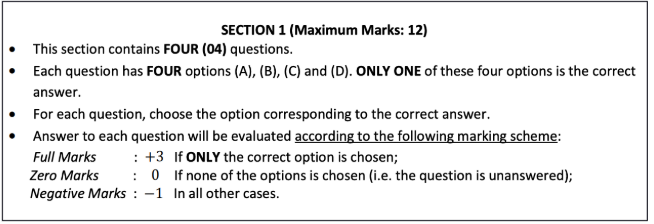
| 1 | Single Correct MCQs | 4 | +3 for correct, -1 for incorrect, 0 for unattempted | 12 |
| 2 | Multiple Correct MCQs | 3 | +4 (all correct), +3 (3 out of 4 correct), +2 (2 correct), +1 (1 correct), 0 (none), -2 (others) | 12 |
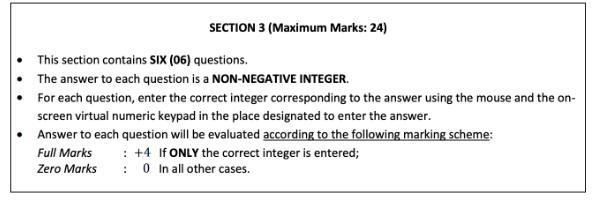
| 3 | Numerical Answer Type (NAT) | 6 | +4 for correct, no negative marking | 24 |
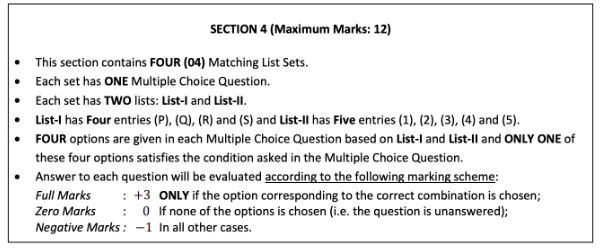
| 4 | Matrix Match | 4 (2) | +4 for fully correct, -1 for incorrect, 0 for unattempted | 12 |
| Total | 17 | 60 |
JEE Advanced 2026 total marks for Paper 1 are calculated as follows: Physics + Chemistry + Mathematics = 60 + 60 + 60 = 180 Marks.
JEE Advanced 2026 Paper 2
Paper 2 will be conducted on 17 May 2026 from 2:30 PM to 5:30 PM. The paper is expected to be more lengthy and includes objective-type and numerical solving skills with complex NATs.
There are more Numerical Answer Questions in Paper 2, which gives an advantage in solving questions.
Paper 2 Pattern (Subject-wise)
| Section | Type of Questions | No. of Questions | Total Marks |
|---|---|---|---|
| 1 | Single Correct MCQs | 4 | 12 |
| 2 | Multiple Correct MCQs | 3 | 12 |
| 3 | Numerical Answer Type (NAT) | 6 | 24 |
| 4 | Paragraphs | 4 (2) | 12 |
| Total | 17 | 60 |
JEE Advanced 2026 total marks for Paper 2 are calculated as follows: Physics + Chemistry + Mathematics = 60 + 60 + 60 = 180 Marks.
JEE Advanced 2026 Marks Distribution
JEE Advanced does not have a fixed marking scheme. As every year, the exam pattern, number of questions, and marking scheme vary and are mentioned at the time of the exam in the question paper.
Exam Duration and Extra Time for PwD
Each paper in JEE Advanced is 3 hours long, with a total of 6 hours for both papers. The PwD candidates with at least 40% disability are eligible for one additional hour per paper, making a total of 8 hours and 4 hours per paper.
Question Types in 2026
Yes, the question types in JEE Advanced 2026 are expected to remain consistent as per the previous years, and soon the official exam pattern will be released on the portal. The expected question types are:
- Multiple Choice Questions (MCQs): Both single-correct and multiple-correct answer questions.
- Numerical Answer Type (NAT) Questions: Questions where the answer is a numerical value.
- Match the Following: Questions that require matching items from two lists.
- Integer-based Questions: Questions where the answer is an integer.
JEE Advanced 2026 Syllabus
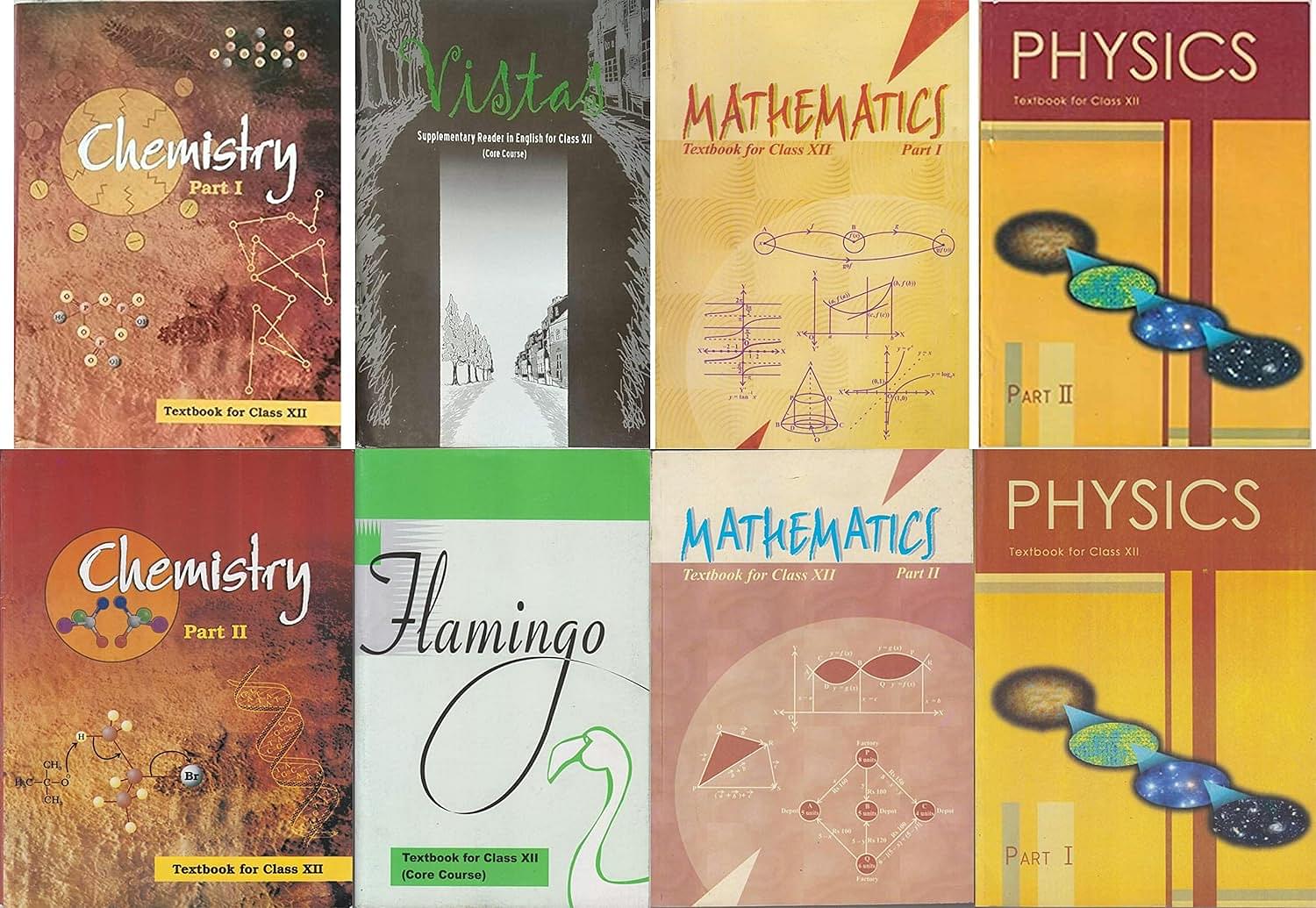
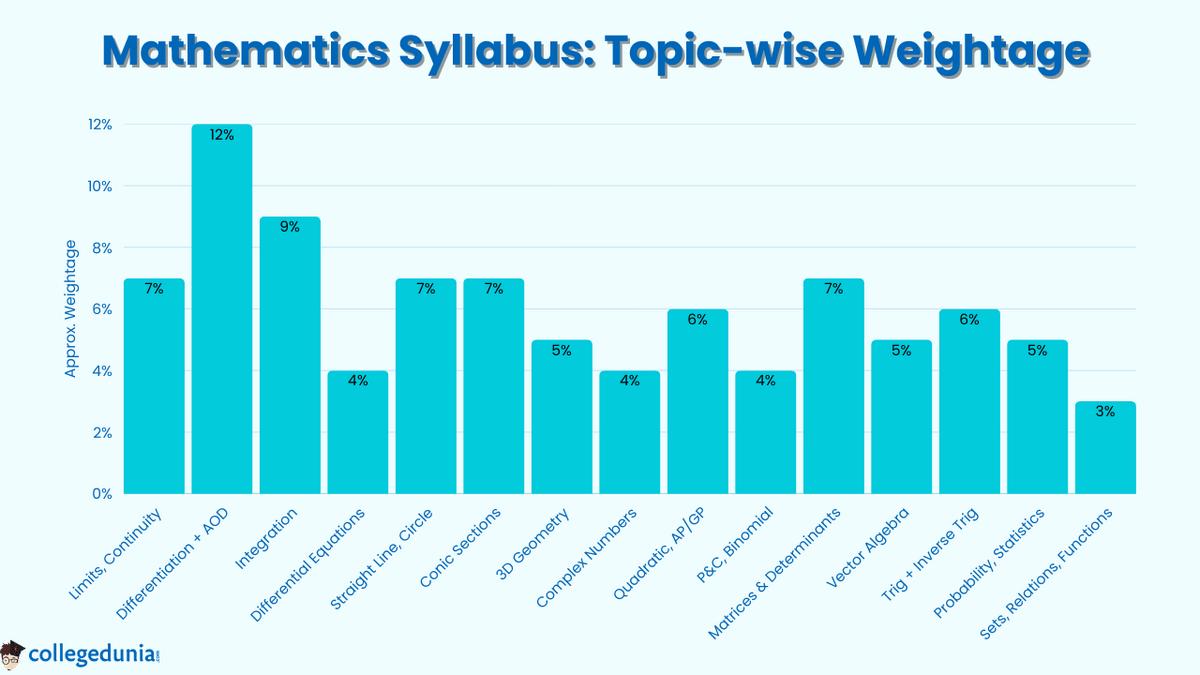
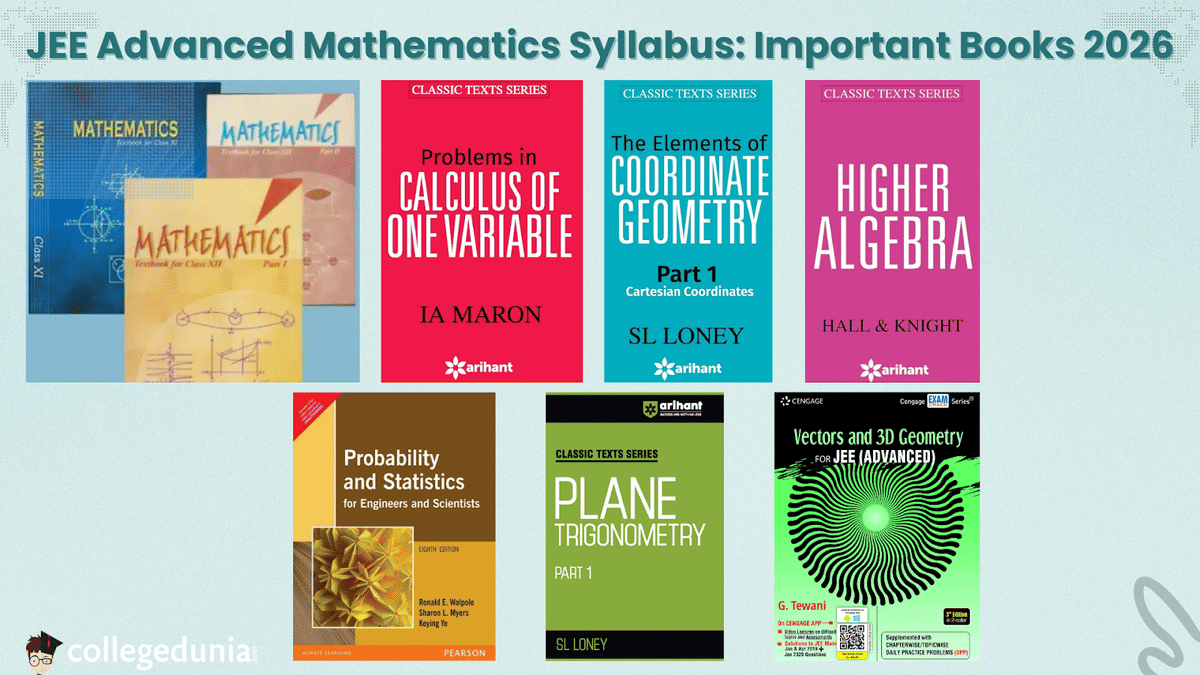
The JEE Advanced syllabus for 2026 has been released and can be downloaded from the official website at jeeadv.ac.in. The syllabus follows the pattern of NCERT Class 11 & 12 Physics, Chemistry, and Mathematics, along with the application and integration of concepts.
JEE Advanced Paper 1 focuses on the basics and application, and Paper 2 will test advanced concepts.
JEE Advanced Paper 1 Syllabus
- The JEE Advanced Paper 1 includes the basics of all concepts.
- More weightage is given to Mechanics, Algebra and Physical Chemistry.
- The Questions are based on the application, and problem-solving fundamentals are required.
| Subject | Key Topics |
|---|---|
| Physics | Mechanics, Thermodynamics, Waves and Oscillations, Electrodynamics, Modern Physics |
| Chemistry |
|
JEE Advanced 2026 Paper 2 Syllabus
Paper 2 focuses on advanced problem-solving skills. It covers topics like Optics, Modern Physics, Organic Chemistry, and Advanced Calculus.
| Subject | Key Topics |
|---|---|
| Physics | Rotational Dynamics, Gravitation, Electromagnetic Waves, Optics, Modern Physics |
| Chemistry |
|
| Mathematics | Matrices and Determinants, Differential Equations, 3D Geometry, Integral Calculus and Vectors |
Source: jeeadv.ac.in/syllabus.pdf
Common Questions About JEE Advanced Syllabus
Will there be out-of-syllabus questions in JEE Advanced 2026?
There has been no official statement regarding out-of-syllabus questions in JEE Advanced 2026. The exam is known for its challenging nature, and questions are expected from the syllabus, which includes Physics, Chemistry, and Mathematics as per the NCERT curriculum for Classes 11 and 12.
How different are Advanced-level concepts from Main-level for Physics and Chemistry?
There are conceptual differences between Main and Advanced exam patterns.
- In JEE Main, the level of questions is more in-depth, with emphasis on fundamental understanding, direct formula application, moderately tricky problems, and some combinational questions.
- JEE Advanced questions require deeper conceptual understanding, multi-concept integration, tricky twists, application under varied constraints, more rigorous derivations, and higher difficulty.
JEE Advanced Previous Year Question Papers
| Question Paper Name | Question Paper PDF |
|---|---|
| JEE Advanced 2025 | Click Here |
| JEE Advanced 2024 | Click Here |
| JEE Advanced 2023 | Click Here |
| JEE Advanced 2022 | Click Here |
| JEE Advanced 2021 | Click Here |
| JEE Advanced 2020 | Click Here |
| JEE Advanced 2019 | Click Here |
| JEE Advanced 2018 | Click Here |
| JEE Advanced 2017 | Click Here |
| JEE Advanced 2016 | Click Here |
Read More: The big changes in paper and detailed papers with solution PDF
Related News Link: Are PYQs relatable in JEE Advanced 2026 exam?
JEE Advanced 2026 Qualifying Marks
To be eligible for the JEE Advanced rank list, candidates should clear the category-wise minimum marks in each subject as per the previous year's trends.
JEE Advanced Expected Qualifying Marks 2026
In the CRL, a minimum of 7 marks is required per subject, and 74 marks are required in aggregate. The SC/ST Category has to score 3 marks for each subject and 37 marks in aggregate.
| Category/Rank List | Minimum Marks Subject-Wise | Minimum Aggregate Marks (out of 300) |
|---|---|---|
| Common Rank List (CRL) | 7 marks | 74 marks (20.56%) |
| GEN-EWS | 6 marks | 66 marks (18.33%) |
| OBC-NCL | 6 marks | 66 marks (18.33%) |
| SC/ST/PwD (all lists) | 3 marks | 37 marks (10.28%) |
| Preparatory Course (PC) | 1 mark | 18 marks (5%) |
4-Month Preparation Strategy
This plan is aligned to exam behavior: subject cut-offs, section-wise marking, and combined Paper 1 & Paper 2 scoring.
JEE Advanced 16-Week Preparation Plan
This is a 16-week study plan for JEE Advanced preparation. It is divided into four phases of four weeks each.
The plan focuses on solving previous year questions (PYQs), fixing weak areas, and building exam temperament.
Week 1–4: Pattern and Weakness Mapping
In the first month, you analyse the exam pattern and find your weak areas. This phase builds the base for all later preparation.
- Pattern and Weakness Mapping: Analyse 10–15 years of PYQs; tag questions by type and subject; identify cutoff-risk areas in PCM.
- Concept Gaps: Revise weak Class 11 topics first, then Class 12; re-derive formulas used in PYQs.
- Error Tracking: Maintain an error log; classify mistakes into logic, calculation, and reading.
Week 5–8: Section-wise Practice
This phase moves from analysis to focused practice. You practise each question type separately before combining them.
- Section-wise Practice: Practice single, multi-correct, numerical, matrix match separately; limit attempts in high-negative sections.
- Numerical Accuracy: Focus on calculation precision and estimation; avoid guess-based attempts.
- Subject Balance: Improve the lowest-scoring subject to stay above cutoff range.
Week 9–12: Paper Solving
In this phase, you start solving full papers under timed conditions. The goal is to build stamina and a fixed attempt order.
- Paper Solving: Solve Paper 1 and Paper 2 individually, then together under full time limits.
- Time Strategy: Fix attempt order; decide skip rules for risky questions.
- Practice Strategy: Practice continuous 6-hour mock sessions weekly.
Week 13–16: Attempt Strategy and Final Revision
The final month is for polishing your attempt strategy and revising only what you already know. No new topics should be started here.
- Attempt Strategy: Finalise safe vs risky attempt strategy; reduce over-attempting.
- Error Reduction: Eliminate recurring mistakes from logs; tighten option checking.
- Final Revision: Revise formulas and PYQ-based concepts only; no new sources.
JEE Advanced Mock Test
Here are the full-length mock test links to attempt directly from here according to the paper difficulty level and in the given time:
| JEE Advanced Mock Tests | Test Links | Difficulty Level of Mock Test |
|---|---|---|
| Mock Test 1 | Click Here | Basic |
| Mock Test 2 | Click Here | Basic |
| Mock Test 3 | Click Here | Basic |
| Mock Test 4 | Click Here | Basic |
| Mock Test 5 | Click Here | Advanced |
JEE Advanced Topper's Strategy
This video by @ALLEN JEE features an in-depth interview with Rajit Gupta, AIR-1 in JEE Advanced 2025, who shared his preparation journey, study strategies, and mindset related to the highly competitive IIT entrance exams.
Key Insights
- Maintaining a flexible daily study routine, rather than rigid schedules, helps students to focus on the syllabus.
- Consistent work with the right direction is the key to success.
Exam Day Approach
- Calm and compared approach, leveraged test practice to manage exam stress and temperament.
- Exam requires innovative thinking and a thorough preparation strategy.
Final Advice
"Hard work has no substitute. Only Hard work can give you success."
JEE Advanced 2026 FAQs
What about the 75% board marks vs Top 20 Percentile?
For admission through JEE Advanced in an IIT, you must meet either one of these criteria:
- 75% Board Marks: You must secure at least 75% aggregate marks in your Class 12 (or equivalent) board exam for General/EWS/OBC and 65% for SC/ST candidates.
- Top 20 Percentile in Board: If you are unable to meet the 75% criteria, then you can still be eligible if you fall in the top 20th percentile of successful candidates in your Class 12 board.
If I am a dropper (did not qualify last year / didn't register), can I still register now?
Yes, if you are a dropper and you did not qualify for the JEE Advanced in the previous years or chose not to register, you can still register for JEE Advanced 2026:
- You must have appeared for the Class 12 (or equivalent) examination for the first time in 2024 or 2025.
- You must have qualified for JEE Main 2026 and be among the top 2,50,000 candidates (across all categories).
- You should have been born on or after October 1, 2000 (or October 1, 1995 for SC, ST, and PwD candidates).
What is the seat distribution among different categories?
The JEE Advanced seat distribution varies across different categories:
- General (GEN): ~40%
- OBC-NCL: ~27%
- SC: ~15%
- ST: ~7.5%
- EWS: ~10%
- PwD: Reserved within each category
What should I do if I encounter issues downloading the admit card?
To solve any issues related to downloading the admit card, it should be thoroughly checked before reporting it to officials.
JEE Advanced 2026: Frequently Asked Questions
What about the 75% board marks vs Top 20 Percentile?
For admission through JEE Advanced in an IIT, you must meet either one of these criteria:
- 75% Board Marks: You must secure at least 75% aggregate marks in your Class 12 (or equivalent) board exam for General/EWS/OBC and 65% for SC/ST candidates.
- Top 20 Percentile in Board: If you are unable to meet the 75% criteria, then you can still be eligible if you fall in the top 20th percentile of successful candidates in your Class 12 board.
If I am a dropper (did not qualify last year / didn't register), can I still register now?
Yes, if you are a dropper and you did not qualify for the JEE Advanced in the previous years or chose not to register, you can still register for JEE Advanced 2026.
- You must have appeared for the Class 12 (or equivalent) examination for the first time in 2024 or 2025.
- You must have qualified for JEE Main 2026 and be among the top 2,50,000 candidates (across all categories).
- You should have been born on or after October 1, 2000 (or October 1, 1995 for SC, ST, and PwD candidates).
What is the seat distribution among different categories?
The JEE Advanced seat distribution varies across different categories:
| Category | Seat Distribution |
|---|---|
| General (GEN) | ~40% |
| OBC-NCL | ~27% |
| SC | ~15% |
| ST | ~7.5% |
| EWS | ~10% |
| PwD | Reserved within each category |
What should I do if I encounter issues downloading the admit card?
To solve any issues related to downloading the admit card, it should be thoroughly checked before reporting it to officials:
- Check the official website for server downtime or maintenance notices.
- Ensure a stable internet connection and disable pop-ups.
- Verify login details (application number, DOB, password) carefully.
- If the issue persists, contact the exam authority's helpline or email support with registration details.
Is the JEE Advanced exam difficult?
Yes, the JEE Advanced exam is considered one of the toughest engineering entrance exams, demanding deep conceptual understanding, analytical skills, and faster problem-solving beyond JEE Main.
- It features tricky, multi-concept questions and low success rates (6-10%), requiring strong fundamentals and rigorous preparation.
- This exam involves deeper understanding and analytical ability, with fewer, harder, multi-step problems.
Eligibility Criteria
JEE Advanced 2026 Exam Date
JEE Advanced 2026 will be conducted on May 17, 2026. The exam will have 2 papers and is being organized by IIT Roorkee.
JEE Advanced 2026 Eligibility for Indian Nationals
Indian candidates must meet all required criteria for nationality and reservation to qualify for JEE Advanced 2026.
Candidates who completed Class XII in 2025 or 2026 are eligible. Candidates who attempted the exam first in 2024 or earlier are not permitted to appear in JEE Advanced 2026, regardless of subjects taken.
About the JEE Advanced Exam
The JEE Advanced exam is conducted by one of the seven zonal coordinating IITs under JAB. It is held for admission to Bachelor, Integrated Master, and Dual Degree programs in all IITs.
JEE Advanced 2026 Eligibility Criteria for Foreign Nationals
Foreign nationals have separate eligibility criteria for JEE Advanced 2026. Candidates should check the official rules for their specific category.
JEE Advanced 2026 Eligibility FAQs
Common questions about JEE Advanced 2026 eligibility are answered in the official FAQ section. Candidates should refer to the official website for detailed responses.
Official Eligibility Criteria
Check the official eligibility criteria on the JEE Advanced website at jeeadv.ac.in/eligibility.html.
JEE Advanced 2026: Eligibility Criteria
The first step to appear for JEE Advanced 2026 is to qualify in JEE Main 2026. Only candidates who clear the JEE Main cutoff are eligible to apply for the Advanced exam.
Candidates must also be among the top 2,50,000 successful candidates in JEE Main 2026. This includes candidates from all categories.
JEE Advanced 2026: Age Limit
There is a specific age limit for appearing in JEE Advanced 2026. Candidates must have been born on or after October 1, 2001.
A relaxation of 5 years is provided for candidates belonging to SC, ST, and PwD categories. This means they must have been born on or after October 1, 1996.
JEE Advanced 2026: Number of Attempts
A candidate can attempt JEE Advanced a maximum of two times in consecutive years. This means a candidate can appear for the exam in two consecutive years only.
Candidates who appeared for JEE Advanced 2025 are also eligible for JEE Advanced 2026, provided they meet all other criteria. This will be their second and final attempt.
JEE Advanced 2026: Qualifying Examination
Candidates must have appeared for their Class 12 (or equivalent) examination for the first time in 2025 or 2026. Candidates who appeared for the first time in 2024 or earlier are not eligible.
Candidates must have passed their Class 12 (or equivalent) examination in 2025 or 2026. The marks obtained in the qualifying examination are also a factor for eligibility.
JEE Advanced 2026: Marks in Qualifying Examination
Candidates must have secured a minimum percentage of marks in their Class 12 (or equivalent) examination. The required percentage varies according to the candidate's category.
- General (GEN): 75% aggregate marks
- General-PwD (GEN-PwD): 65% aggregate marks
- Other Backward Classes-Non Creamy Layer (OBC-NCL): 75% aggregate marks
- OBC-NCL-PwD: 65% aggregate marks
- Scheduled Caste (SC): 65% aggregate marks
- SC-PwD: 65% aggregate marks
- Scheduled Tribe (ST): 65% aggregate marks
- ST-PwD: 65% aggregate marks
The aggregate marks are calculated for the subjects of Physics, Chemistry, and Mathematics. Alternatively, candidates must be in the top 20 percentile of successful candidates in their respective Class 12 (or equivalent) examination.
JEE Advanced 2026: Exam Pattern
JEE Advanced 2026 will be a computer-based test (CBT). The exam will be conducted in two papers: Paper 1 and Paper 2.
Both papers are compulsory for all candidates. Each paper will have three sections: Physics, Chemistry, and Mathematics.
| Particulars | Details |
|---|---|
| Mode of Exam | Computer-Based Test (CBT) |
| Number of Papers | 2 (Paper 1 and Paper 2) |
| Subjects | Physics, Chemistry, Mathematics |
| Duration of Each Paper | 3 Hours |
| Total Marks | 306 Marks (183 for Paper 1, 183 for Paper 2) |
| Type of Questions | Multiple Choice Questions (MCQs) and Numerical Answer Type |
| Marking Scheme | Varies per question type; negative marking applies for incorrect answers in some sections |
JEE Advanced 2026: Application Fee
The application fee for JEE Advanced 2026 depends on the candidate's category and gender. The fee is different for Indian nationals and candidates from other countries.
| Category | Fee for Indian Nationals | Fee for Foreign Nationals |
|---|---|---|
| General (GEN), General-PwD (GEN-PwD), Other Backward Classes-Non Creamy Layer (OBC-NCL), OBC-NCL-PwD | Rs. 2,800 (Male) / Rs. 1,400 (Female) | Rs. 14,000 |
| Scheduled Caste (SC), Scheduled Tribe (ST), SC-PwD, ST-PwD | Rs. 1,400 (Male) / Rs. 1,400 (Female) | Rs. 14,000 |
JEE Advanced 2026: Important Dates
The official schedule for JEE Advanced 2026 has been released. Candidates must note the key dates for registration and the exam.
| Event | Date |
|---|---|
| Release of Official Brochure | April 2026 |
| Start of Online Registration | April 2026 |
| Last Date for Online Registration | May 2026 |
| Last Date for Fee Payment | May 2026 |
| Release of Admit Card | May 2026 |
| JEE Advanced 2026 Exam Date | May 2026 |
| Release of Answer Key | May 2026 |
| Declaration of Result | June 2026 |
JEE Advanced 2026: How to Apply
The application process for JEE Advanced 2026 is conducted online. Candidates must register on the official JEE Advanced website.
Candidates need to fill in their personal details, academic information, and choice of exam city. The application fee can be paid online through debit card, credit card, or net banking.
After successful submission and fee payment, candidates must download and print the confirmation page. The admit card for the exam will be released separately on the official website.
Joint Entrance Examination Advanced: Overview
Joint Entrance Examination Advanced (JEE Advanced) is the entrance test for admission to the Indian Institutes of Technology (IITs). It is the second stage of the two-part JEE system, taken after qualifying in JEE Main.
The exam is conducted once a year. Only candidates who clear the JEE Main cutoff are eligible to appear for JEE Advanced.
Who Can Apply
Candidates must first qualify in JEE Main to be eligible for JEE Advanced. The eligibility criteria include age limits, number of attempts, and performance in Class 12 board exams.
- Candidates must be among the top rank holders in JEE Main.
- Candidates must have passed Class 12 or equivalent examination in the previous year or the year of the exam.
- Candidates must have secured at least 75% marks in Class 12 (or be in the top 20 percentile of their board). For SC/ST candidates, the minimum is 65%.
- Candidates can attempt JEE Advanced a maximum of two times in consecutive years.
- Candidates must be born on or after October 1 of a specified year (relaxation of 5 years for SC/ST/PwD candidates).
Exam Pattern
JEE Advanced is a computer-based test (CBT) conducted in two papers. Both papers are compulsory and held on the same day.
| Paper | Subjects | Duration |
|---|---|---|
| Paper 1 | Physics, Chemistry, Mathematics | 3 hours |
| Paper 2 | Physics, Chemistry, Mathematics | 3 hours |
Each paper contains multiple-choice questions and numerical answer type questions. There is negative marking for incorrect answers in some question types.
Application Fee
The application fee for JEE Advanced varies by category. The fee is paid online during the registration process.
| Category | Fee (India) |
|---|---|
| General (Male) | ₹2,800 |
| General (Female) | ₹1,400 |
| OBC-NCL (Male) | ₹2,800 |
| OBC-NCL (Female) | ₹1,400 |
| SC/ST/PwD | ₹1,400 |
For candidates outside India, the fee is higher. The fee is non-refundable.
Important Dates
The exam is usually held in June. Registration typically opens in April or May.
| Event | Typical Time |
|---|---|
| JEE Main result | April |
| JEE Advanced registration | April–May |
| Admit card release | May–June |
| JEE Advanced exam | June |
| Result declaration | June |
Exact dates are announced by the conducting IIT each year. Candidates must check the official website for updates.
How to Apply
Candidates apply online through the official JEE Advanced website. The application process has several steps.
- Register with a valid email ID and phone number.
- Fill in personal, academic, and JEE Main details.
- Upload scanned documents: photograph, signature, and category certificate if applicable.
- Pay the application fee online.
- Submit the form and download the confirmation page.
Candidates must keep a printout of the confirmation page for future reference. Admit cards are issued online only.
Rank and Result
JEE Advanced results are declared in the form of rank lists. Separate rank lists are prepared for each category.
- Common Rank List (CRL) for all candidates.
- Category-wise rank lists for OBC-NCL, SC, ST, and PwD candidates.
- Preparatory rank lists for SC/ST/PwD candidates with lower scores.
Ranks are based on total marks in both papers. Tie-breaking rules are applied if two candidates score the same marks.
Seat Allotment
Seats in IITs are allotted through JoSAA (Joint Seat Allocation Authority) counselling. Candidates must register for JoSAA separately after the result.
Seat allotment is based on the JEE Advanced rank, category, and choice of institute and branch. Multiple rounds of counselling are conducted.
To accept a seat, candidates must pay a seat acceptance fee and report to the allotted institute. The fee is adjusted against the first semester tuition fee.
Joint Entrance Examination Advanced: Overview
Joint Entrance Examination Advanced, commonly called JEE Advanced, is the second stage of the two-part engineering entrance exam in India. It is conducted for admission to the Indian Institutes of Technology (IITs).
The exam is held after the Joint Entrance Examination Main (JEE Main). Only candidates who qualify in JEE Main are eligible to appear for JEE Advanced.
Who Can Apply
Candidates must first clear JEE Main to be eligible for JEE Advanced. The detailed eligibility criteria are set by the organising IIT each year.
Applicants should check the official JEE Advanced website for the specific age limit, attempt limit, and academic requirements. The number of attempts is limited as per the official rules.
Exam Pattern
JEE Advanced is a computer-based test. The exam consists of two papers: Paper 1 and Paper 2.
Both papers are compulsory. Each paper covers three subjects: Physics, Chemistry, and Mathematics.
- Paper 1: Held in the morning session
- Paper 2: Held in the afternoon session
- Question types: Multiple choice, numerical answer, and match the following
- Marking scheme: Varies by question type, with negative marking for some questions
Syllabus
The syllabus for JEE Advanced is based on the Class 11 and Class 12 NCERT curriculum. The topics are from Physics, Chemistry, and Mathematics.
The syllabus is largely similar to JEE Main but includes some additional topics. Candidates must study the complete syllabus from the official information brochure.
Application Fee
The application fee for JEE Advanced is different for different categories of candidates. The fee also depends on the exam centre country.
| Category | Fee for Centres in India | Fee for Centres Outside India |
|---|---|---|
| General, OBC-NCL, EWS | ₹2,900 | USD 160 |
| SC, ST, PwD | ₹1,450 | USD 80 |
All female candidates are required to pay the same fee as the SC, ST, and PwD category. The fee is non-refundable.
Important Dates
The exam is conducted once a year, usually in June. The application process typically begins in April or May.
| Event | Tentative Timeframe |
|---|---|
| Release of information brochure | April |
| Registration and application | April to May |
| Admit card release | May |
| JEE Advanced exam | June |
| Result declaration | June |
How to Apply
Applications are accepted online only through the official JEE Advanced website. Candidates must register using their JEE Main roll number and other details.
The application process involves filling in personal details, choosing exam centres, uploading documents, and paying the fee. Candidates must take a printout of the final submitted application form for future reference.
Admit Card
The admit card is released online on the official website. It is not sent by post.
Candidates must download the admit card and carry it to the exam centre. Entry to the exam hall is not allowed without a valid admit card and a photo ID.
Result and Rank List
The result is declared online on the official website. It includes the total score and the All India Rank (AIR) for each candidate.
A rank list is prepared based on the performance in both Paper 1 and Paper 2. The rank is used for admission to the IITs and other participating institutes.
Seat Allotment
Seat allotment is done through a separate counselling process called JoSAA (Joint Seat Allocation Authority). JoSAA is a common platform for admission to multiple institutes.
Candidates must register for JoSAA counselling and fill in their choices of institute and branch. Seats are allotted based on the JEE Advanced rank, category, and availability of seats.
Participating Institutes
The following institutes accept JEE Advanced scores for admission:
- All 23 Indian Institutes of Technology (IITs)
- Indian Institute of Science (IISc) Bangalore
- Indian Institute of Petroleum and Energy (IIPE) Visakhapatnam
- Rajiv Gandhi Institute of Petroleum Technology (RGIPT) Jais
Important Points
JEE Advanced is considered more difficult than JEE Main. The questions are designed to test a deep understanding of concepts.
Candidates must secure the minimum qualifying marks in each subject and in the aggregate to be eligible for rank. The minimum qualifying marks vary by category.
There is no provision for re-evaluation or re-checking of answer sheets. The decision of the examination committee is final.
What is JEE Advanced
JEE Advanced is the second stage of the Joint Entrance Examination for admission to undergraduate engineering programmes at the Indian Institutes of Technology (IITs). It is conducted after the JEE Main examination.
Candidates must qualify in JEE Main to be eligible to appear for JEE Advanced. The exam is held once a year.
Eligibility Criteria
Candidates must meet the eligibility criteria set by the organising IIT to appear for JEE Advanced. The criteria include age limit, number of attempts, and performance in JEE Main.
- Candidates must have secured a rank within the top 2,50,000 in JEE Main (including all categories).
- Candidates must have been born on or after October 1, 1999 (for General and OBC-NCL categories).
- For SC, ST, and PwD categories, candidates must have been born on or after October 1, 1994.
- Candidates can attempt JEE Advanced a maximum of two times in consecutive years.
- Candidates must have appeared for Class 12 (or equivalent) examination for the first time in either 2024 or 2025.
Exam Pattern
JEE Advanced is a computer-based test (CBT) conducted in two papers. Both papers are compulsory.
| Particular | Details |
|---|---|
| Number of papers | 2 (Paper 1 and Paper 2) |
| Duration of each paper | 3 hours |
| Subjects | Physics, Chemistry, Mathematics |
| Total marks | 306 marks (combined for both papers) |
| Marking scheme | Varies by question type; negative marking applies for incorrect answers |
Each paper contains questions from all three subjects. Question types include multiple-choice questions (MCQs), numerical answer type questions, and match-the-following type questions.
Syllabus
The JEE Advanced syllabus covers topics from Class 11 and Class 12 Physics, Chemistry, and Mathematics. The syllabus is similar to the JEE Main syllabus but includes additional topics.
- Physics: Mechanics, Thermodynamics, Electrodynamics, Optics, Modern Physics, and more.
- Chemistry: Physical Chemistry, Inorganic Chemistry, and Organic Chemistry.
- Mathematics: Algebra, Calculus, Coordinate Geometry, Trigonometry, and more.
The detailed syllabus is published in the official information brochure. Candidates should refer to the official website for the complete list of topics.
Application Fee
The application fee for JEE Advanced varies by category and exam centre location. The fee is payable online through the official website.
| Category | Fee for centres in India | Fee for centres outside India |
|---|---|---|
| General (GEN) | Rs. 2,900 | Rs. 15,000 |
| General (GEN) - Female | Rs. 1,450 | Rs. 7,500 |
| OBC-NCL | Rs. 2,900 | Rs. 15,000 |
| SC, ST, PwD | Rs. 1,450 | Rs. 7,500 |
The fee for candidates opting for exam centres in India is lower than for centres outside India. Female candidates in all categories pay a reduced fee.
Important Dates
The exam dates for JEE Advanced are announced by the organising IIT. The table below shows the typical schedule for the exam cycle.
| Event | Tentative date |
|---|---|
| Release of information brochure | April 2025 |
| Start of online registration | April 2025 |
| Last date to register | May 2025 |
| Admit card release | May 2025 |
| JEE Advanced exam date | May 2025 |
| Result declaration | June 2025 |
These dates are indicative and may change. Candidates must check the official website for the final schedule.
How to Apply
Candidates must register online through the official JEE Advanced website. Registration opens after the JEE Main results are declared.
- Visit the official JEE Advanced website (jeeadv.ac.in).
- Click on the registration link and fill in the required personal and academic details.
- Upload scanned copies of the required documents, including photograph, signature, and category certificate (if applicable).
- Pay the application fee online using a credit card, debit card, or net banking.
- Submit the application form and take a printout of the confirmation page for future reference.
Candidates must also select their preferred exam city while filling the form. The organising IIT will allot the exam centre based on availability.
Admit Card
The admit card for JEE Advanced is released online on the official website. It is not sent by post.
Candidates must download the admit card using their registration number and date of birth. The admit card contains the candidate's name, photograph, exam centre, and other details. Candidates must carry a printed copy of the admit card to the exam hall along with a valid photo ID.
Result and Rank List
The result of JEE Advanced is declared online. The rank list is prepared based on the total marks scored in both papers.
Separate merit lists are prepared for each category (GEN, OBC-NCL, SC, ST, and PwD). The All India Rank (AIR) is used for admission to IITs and other participating institutes.
Admission Process
Admission to IITs is done through JoSAA (Joint Seat Allocation Authority) counselling. Candidates who qualify in JEE Advanced must register for JoSAA counselling.
Seat allocation is based on the candidate's rank, category, and choice of institute and branch. Candidates must lock their choices and participate in multiple rounds of counselling. After seat allocation, candidates must report to the allotted institute for document verification and fee payment.
Participating Institutes
JEE Advanced scores are accepted by 23 IITs and other participating institutes. The list includes all IITs across India.
- IIT Madras, IIT Delhi, IIT Bombay, IIT Kanpur, IIT Kharagpur, IIT Roorkee, and IIT Guwahati.
- IIT Hyderabad, IIT Indore, IIT Jodhpur, IIT Mandi, IIT Patna, IIT Ropar, IIT Bhubaneswar, IIT Gandhinagar, IIT Hyderabad, and others.
- Some other centrally funded technical institutions (CFTIs) also accept JEE Advanced scores.
The complete list of participating institutes is available in the official information brochure.
Number of Attempts
A candidate can appear for JEE Advanced a maximum of two times. The two attempts must be in consecutive years.
If a candidate appears in 2024 and 2025, they cannot appear again in 2026. Candidates who have been admitted to any IIT in the past are not eligible to appear for JEE Advanced.
Reservation Policy
Reservation in JEE Advanced is provided as per the Government of India rules. The reservation applies to seats in IITs and other participating institutes.
| Category | Reservation percentage | ||||||||||||||||||||||||||||||||||||||||||||||||||||||||||||||||||||||||||||||||||||||||||||||||||||||||||||||||||||||||||||||||||||||||||||||||||||||||||||||||||||||||||||||||||||||||||||||||||||||||||||||||||||||||||||||||||||||||||||||||||||||||||||||||||||||||||||||||||||||||||||||||||||||||||||||||||||||||||||||||||||||||||||||||||||||||||||||||||||||||||||||||||||||||||||||||||||||||||||||||||||||||||||||||||||||||||||||||||||||||||||||||||||||||||||||||||||||||||||||||||||||||||||||||||||||||||||||||||||||||||||||||||||||||||||||||||||||||||||||||||||||||||||||||||||||||||||||||||||||||||||||||||||||||||||||||||||||||||||||||||||||||||||||||||||||||||||||||||||||||||||||||||||||||||||||||||||||||||||||||||||||||||||||||||||||||||||||||||||||||||||||||||||||||||||||||||||||||||||||||||||||||||||||||||||||||||||||||||||||||||||||||||||||||||||||||||||||||||||||||||||||||||||||||||||||||||||||||||||||||||||||||||||||||||||||||||||||||||||||||||||||||||||||||||||||||||||||||||||||
|---|---|---|---|---|---|---|---|---|---|---|---|---|---|---|---|---|---|---|---|---|---|---|---|---|---|---|---|---|---|---|---|---|---|---|---|---|---|---|---|---|---|---|---|---|---|---|---|---|---|---|---|---|---|---|---|---|---|---|---|---|---|---|---|---|---|---|---|---|---|---|---|---|---|---|---|---|---|---|---|---|---|---|---|---|---|---|---|---|---|---|---|---|---|---|---|---|---|---|---|---|---|---|---|---|---|---|---|---|---|---|---|---|---|---|---|---|---|---|---|---|---|---|---|---|---|---|---|---|---|---|---|---|---|---|---|---|---|---|---|---|---|---|---|---|---|---|---|---|---|---|---|---|---|---|---|---|---|---|---|---|---|---|---|---|---|---|---|---|---|---|---|---|---|---|---|---|---|---|---|---|---|---|---|---|---|---|---|---|---|---|---|---|---|---|---|---|---|---|---|---|---|---|---|---|---|---|---|---|---|---|---|---|---|---|---|---|---|---|---|---|---|---|---|---|---|---|---|---|---|---|---|---|---|---|---|---|---|---|---|---|---|---|---|---|---|---|---|---|---|---|---|---|---|---|---|---|---|---|---|---|---|---|---|---|---|---|---|---|---|---|---|---|---|---|---|---|---|---|---|---|---|---|---|---|---|---|---|---|---|---|---|---|---|---|---|---|---|---|---|---|---|---|---|---|---|---|---|---|---|---|---|---|---|---|---|---|---|---|---|---|---|---|---|---|---|---|---|---|---|---|---|---|---|---|---|---|---|---|---|---|---|---|---|---|---|---|---|---|---|---|---|---|---|---|---|---|---|---|---|---|---|---|---|---|---|---|---|---|---|---|---|---|---|---|---|---|---|---|---|---|---|---|---|---|---|---|---|---|---|---|---|---|---|---|---|---|---|---|---|---|---|---|---|---|---|---|---|---|---|---|---|---|---|---|---|---|---|---|---|---|---|---|---|---|---|---|---|---|---|---|---|---|---|---|---|---|---|---|---|---|---|---|---|---|---|---|---|---|---|---|---|---|---|---|---|---|---|---|---|---|---|---|---|---|---|---|---|---|---|---|---|---|---|---|---|---|---|---|---|---|---|---|---|---|---|---|---|---|---|---|---|---|---|---|---|---|---|---|---|---|---|---|---|---|---|---|---|---|---|---|---|---|---|---|---|---|---|---|---|---|---|---|---|---|---|---|---|---|---|---|---|---|---|---|---|---|---|---|---|---|---|---|---|---|---|---|---|---|---|---|---|---|---|---|---|---|---|---|---|---|---|---|---|---|---|---|---|---|---|---|---|---|---|---|---|---|---|---|---|---|---|---|---|---|---|---|---|---|---|---|---|---|---|---|---|---|---|---|---|---|---|---|---|---|---|---|---|---|---|---|---|---|---|---|---|---|---|---|---|---|---|---|---|---|---|---|---|---|---|---|---|---|---|---|---|---|---|---|---|---|---|---|---|---|---|---|---|---|---|---|---|---|---|---|---|---|---|---|---|---|---|---|---|---|---|---|---|---|---|---|---|---|---|---|---|---|---|---|---|---|---|---|---|---|---|---|---|---|---|---|---|---|---|---|---|---|---|---|---|---|---|---|---|---|---|---|---|---|---|---|---|---|---|---|---|---|---|---|---|---|---|---|---|---|---|---|---|---|---|---|---|---|---|---|---|---|---|---|---|---|---|---|---|---|---|---|---|---|---|---|---|---|---|---|---|---|---|---|---|---|---|---|---|---|---|---|---|---|---|---|---|---|---|---|---|---|---|---|---|---|---|---|---|---|---|---|---|---|---|---|---|---|---|---|---|---|---|---|---|---|---|---|---|---|---|---|---|---|---|---|---|---|---|---|---|---|---|---|---|---|---|---|---|---|---|---|---|---|---|---|---|---|---|---|---|---|---|---|---|---|---|---|---|---|---|---|---|---|---|---|---|---|---|---|---|---|---|---|---|---|---|---|---|---|---|---|---|---|---|---|---|---|---|---|---|---|---|---|---|---|---|---|---|---|---|---|---|---|---|---|---|---|---|---|---|---|---|---|---|---|---|---|---|---|---|---|---|---|---|---|---|---|---|---|---|---|---|---|---|---|---|---|---|---|---|---|---|---|---|---|---|---|---|---|---|---|---|---|---|---|---|---|---|---|---|---|---|---|---|---|---|---|---|---|---|---|---|---|---|---|---|---|---|---|---|---|---|---|---|---|---|---|---|---|---|---|---|---|---|---|---|---|---|---|---|---|---|---|---|---|---|---|---|---|---|---|---|---|---|
| OBC-NCL | 27% | ||||||||||||||||||||||||||||||||||||||||||||||||||||||||||||||||||||||||||||||||||||||||||||||||||||||||||||||||||||||||||||||||||||||||||||||||||||||||||||||||||||||||||||||||||||||||||||||||||||||||||||||||||||||||||||||||||||||||||||||||||||||||||||||||||||||||||||||||||||||||||||||||||||||||||||||||||||||||||||||||||||||||||||||||||||||||||||||||||||||||||||||||||||||||||||||||||||||||||||||||||||||||||||||||||||||||||||||||||||||||||||||||||||||||||||||||||||||||||||||||||||||||||||||||||||||||||||||||||||||||||||||||||||||||||||||||||||||||||||||||||||||||||||||||||||||||||||||||||||||||||||||||||||||||||||||||||||||||||||||||||||||||||||||||||||||||||||||||||||||||||||||||||||||||||||||||||||||||||||||||||||||||||||||||||||||||||||||||||||||||||||||||||||||||||||||||||||||||||||||||||||||||||||||||||||||||||||||||||||||||||||||||||||||||||||||||||||||||||||||||||||||||||||||||||||||||||||||||||||||||||||||||||||||||||||||||||||||||||||||||||||||||||||||||||||||||||||||||||||||
| SC | 15% | ||||||||||||||||||||||||||||||||||||||||||||||||||||||||||||||||||||||||||||||||||||||||||||||||||||||||||||||||||||||||||||||||||||||||||||||||||||||||||||||||||||||||||||||||||||||||||||||||||||||||||||||||||||||||||||||||||||||||||||||||||||||||||||||||||||||||||||||||||||||||||||||||||||||||||||||||||||||||||||||||||||||||||||||||||||||||||||||||||||||||||||||||||||||||||||||||||||||||||||||||||||||||||||||||||||||||||||||||||||||||||||||||||||||||||||||||||||||||||||||||||||||||||||||||||||||||||||||||||||||||||||||||||||||||||||||||||||||||||||||||||||||||||||||||||||||||||||||||||||||||||||||||||||||||||||||||||||||||||||||||||||||||||||||||||||||||||||||||||||||||||||||||||||||||||||||||||||||||||||||||||||||||||||||||||||||||||||||||||||||||||||||||||||||||||||||||||||||||||||||||||||||||||||||||||||||||||||||||||||||||||||||||||||||||||||||||||||||||||||||||||||||||||||||||||||||||||||||||||||||||||||||||||||||||||||||||||||||||||||||||||||||||||||||||||||||||||||||||||||||
| ST | 7.5% | ||||||||||||||||||||||||||||||||||||||||||||||||||||||||||||||||||||||||||||||||||||||||||||||||||||||||||||||||||||||||||||||||||||||||||||||||||||||||||||||||||||||||||||||||||||||||||||||||||||||||||||||||||||||||||||||||||||||||||||||||||||||||||||||||||||||||||||||||||||||||||||||||||||||||||||||||||||||||||||||||||||||||||||||||||||||||||||||||||||||||||||||||||||||||||||||||||||||||||||||||||||||||||||||||||||||||||||||||||||||||||||||||||||||||||||||||||||||||||||||||||||||||||||||||||||||||||||||||||||||||||||||||||||||||||||||||||||||||||||||||||||||||||||||||||||||||||||||||||||||||||||||||||||||||||||||||||||||||||||||||||||||||||||||||||||||||||||||||||||||||||||||||||||||||||||||||||||||||||||||||||||||||||||||||||||||||||||||||||||||||||||||||||||||||||||||||||||||||||||||||||||||||||||||||||||||||||||||||||||||||||||||||||||||||||||||||||||||||||||||||||||||||||||||||||||||||||||||||||||||||||||||||||||||||||||||||||||||||||||||||||||||||||||||||||||||||||||||||||||||
| EWS | 10% | ||||||||||||||||||||||||||||||||||||||||||||||||||||||||||||||||||||||||||||||||||||||||||||||||||||||||||||||||||||||||||||||||||||||||||||||||||||||||||||||||||||||||||||||||||||||||||||||||||||||||||||||||||||||||||||||||||||||||||||||||||||||||||||||||||||||||||||||||||||||||||||||||||||||||||||||||||||||||||||||||||||||||||||||||||||||||||||||||||||||||||||||||||||||||||||||||||||||||||||||||||||||||||||||||||||||||||||||||||||||||||||||||||||||||||||||||||||||||||||||||||||||||||||||||||||||||||||||||||||||||||||||||||||||||||||||||||||||||||||||||||||||||||||||||||||||||||||||||||||||||||||||||||||||||||||||||||||||||||||||||||||||||||||||||||||||||||||||||||||||||||||||||||||||||||||||||||||||||||||||||||||||||||||||||||||||||||||||||||||||||||||||||||||||||||||||||||||||||||||||||||||||||||||||||||||||||||||||||||||||||||||||||||||||||||||||||||||||||||||||||||||||||||||||||||||||||||||||||||||||||||||||||||||||||||||||||||||||||||||||||||||||||||||||||||||||||||||||||||||||
| PwD | 5
About Joint Entrance Examination AdvancedJoint Entrance Examination Advanced (JEE Advanced) is the entrance test for admission to undergraduate programs at the Indian Institutes of Technology (IITs). It is conducted once a year. The exam is held after the Joint Entrance Examination Main (JEE Main). Only candidates who qualify in JEE Main are eligible to appear for JEE Advanced. Eligibility CriteriaCandidates must qualify in JEE Main to be eligible for JEE Advanced. The candidate must also be among the top rank holders in JEE Main as per the specified category-wise cutoff. Candidates must have been born on or after October 1 of a specified year. Age relaxation is applicable for candidates from reserved categories as per the rules. A candidate can attempt JEE Advanced a maximum of two times in consecutive years. The candidate must have appeared for Class 12 (or equivalent) examination for the first time in a specified year. Exam PatternJEE Advanced is a computer-based test. The exam consists of two papers — Paper 1 and Paper 2. Both papers are compulsory. Each paper has three sections: Physics, Chemistry, and Mathematics. The total duration for each paper is three hours. The question types include multiple-choice questions with one or more correct options, numerical answer type questions, and match-the-following type questions. The marking scheme varies by question type, and negative marking is applicable for incorrect answers in some sections. Application FeeThe application fee for JEE Advanced is different for each category. The fee is payable online through the designated payment gateway.
The fee is non-refundable. Candidates must pay the fee during the registration process after qualifying JEE Main. Important DatesThe exam is conducted in the month of June every year. The registration process typically begins in April or May.
These dates are tentative and may change. Candidates must check the official website for the final schedule. How to ApplyCandidates must first qualify JEE Main. After qualifying, they need to register for JEE Advanced on the official website. The registration process involves filling in personal details, choosing exam centres, uploading documents, and paying the application fee. Candidates must keep a valid email ID and mobile number for communication. After successful registration, candidates can download the admit card from the official website. The admit card is mandatory for entry to the exam hall. Results and CounsellingThe result of JEE Advanced is declared in the form of a rank list. The rank is calculated based on the performance in both Paper 1 and Paper 2. Category-wise cutoffs are released along with the result. Candidates who secure a rank above the cutoff are eligible for seat allocation. Seat allocation is done through Joint Seat Allocation Authority (JoSAA) counselling. Candidates must register for counselling and fill in their choice of courses and institutes. The counselling process is conducted in multiple rounds. Candidates are allotted seats based on their rank, category, and choice preference. Reservation PolicyReservation is applicable as per the Government of India rules. The categories include Scheduled Caste (SC), Scheduled Tribe (ST), Other Backward Classes (OBC-NCL), Economically Weaker Sections (EWS), and Persons with Disabilities (PwD).
Candidates belonging to reserved categories must produce valid certificates at the time of document verification. The certificates must be issued by the competent authority. Documents RequiredCandidates need to keep certain documents ready for registration and counselling. The documents are verified at the time of admission.
All documents must be in original. Photocopies are not accepted during verification. Contact DetailsThe conducting IIT for a given year is responsible for the exam. The official website for JEE Advanced is jeeadv.ac.in. Candidates can contact the helpdesk through the official website for any queries. The contact details are updated on the website during the registration period. What is JEE AdvancedJEE Advanced is the second stage of the Joint Entrance Examination for admission to Indian Institutes of Technology (IITs). It is conducted after the JEE Main examination. Candidates who qualify in JEE Main are eligible to appear for JEE Advanced. The exam is held once a year. Eligibility CriteriaCandidates must qualify in JEE Main to be eligible for JEE Advanced. The detailed eligibility criteria are specified by the conducting IIT each year. Only candidates who meet the age, attempt, and academic requirements can appear for the exam. Candidates must have passed Class 12 or an equivalent qualifying examination. Exam PatternJEE Advanced is a computer-based test conducted in two papers. Both papers are compulsory for all candidates.
Application FeeThe application fee for JEE Advanced varies by category. The fee structure is announced along with the official notification.
Fee payment is done online through the official website. Candidates must pay the fee for each paper they appear for. Important DatesThe exam is conducted in the month of June every year. The official notification is released in April or May.
How to ApplyCandidates must register online through the official JEE Advanced website. The registration process is completely online.
Result and Rank ListThe result is declared in the form of a rank list. Candidates are ranked based on their performance in both papers. The rank list includes the category-wise ranks for all qualified candidates. The rank is used for seat allocation in IITs and other participating institutes. Seat AllocationSeat allocation is done through JoSAA (Joint Seat Allocation Authority) counselling. Candidates must register for counselling after the result is declared. Seats are allocated based on the candidate's rank, category, and choice of institute and branch. The counselling process is conducted in multiple rounds. What is JEE AdvancedJoint Entrance Examination Advanced is the second stage of the two-part engineering entrance exam in India. It is conducted for admission to the Indian Institutes of Technology. The exam is held after the Joint Entrance Examination Main. Only candidates who qualify in JEE Main are eligible to appear for JEE Advanced. Eligibility CriteriaCandidates must qualify in JEE Main to be eligible for JEE Advanced. The candidate must also be among the top rank holders in JEE Main. Other conditions apply based on age, number of attempts, and year of passing Class 12. Candidates should check the official notification for the complete list of requirements. Exam PatternJEE Advanced is a computer-based test. The exam has two papers — Paper 1 and Paper 2. Both papers are compulsory. Each paper covers Physics, Chemistry, and Mathematics.
Marking SchemeThe marking scheme varies by question type. Some questions carry full marks for a correct answer. Partial marks are awarded in some question types. Negative marks apply to certain incorrect answers.
SyllabusThe syllabus is based on Class 11 and Class 12 topics. Physics, Chemistry, and Mathematics are the three subjects. The syllabus is largely the same as JEE Main but with some additional topics. Candidates should refer to the official syllabus for the full list. Application FeeThe application fee depends on the candidate's category and gender. The fee is paid online during registration.
Important DatesThe exam is held once a year, usually in June. Registration typically opens in April or May.
How to ApplyRegistration is done online through the official JEE Advanced website. Candidates must first register for JEE Main and qualify in it. After qualifying, candidates fill the JEE Advanced application form. The form requires personal details, academic details, and choice of exam city. Upload the required documents and pay the application fee. After submission, download the confirmation page for future reference. Admit CardThe admit card is released online a few weeks before the exam. It is available for download from the official website. The admit card contains the candidate's name, roll number, exam centre, and photograph. Candidates must carry a printed copy to the exam centre along with a valid photo ID. Result and RankThe result is declared online in June. The rank is based on the total marks obtained in both papers. A rank list is prepared for all qualified candidates. The rank is used for seat allocation in IITs and other participating institutes. Seat AllocationSeat allocation is done through JoSAA (Joint Seat Allocation Authority). Candidates must register for JoSAA counselling after the result. Seats are allocated based on the JEE Advanced rank, category, and choice of institute and branch. The counselling process has multiple rounds. Participating InstitutesAdmission is offered to all 23 IITs across India. Some other institutes also accept JEE Advanced scores.
Number of AttemptsA candidate can appear for JEE Advanced a maximum of two times in consecutive years. The candidate must have passed Class 12 in the same year or the previous year. Candidates who appeared for Class 12 earlier are not eligible. The attempt limit applies to all categories equally. What is JEE AdvancedJoint Entrance Examination Advanced, commonly called JEE Advanced, is the second stage of the two-part engineering entrance exam in India. It is conducted for admission to the Indian Institutes of Technology (IITs). The exam is held once a year. Only candidates who qualify in JEE Main are eligible to appear for JEE Advanced. Eligibility CriteriaCandidates must first qualify in JEE Main to be eligible for JEE Advanced. The detailed eligibility conditions are given below.
Exam PatternJEE Advanced is a computer-based test conducted in two papers. Both papers are compulsory.
Application FeeThe application fee for JEE Advanced depends on the candidate's category and gender. The fee is payable online.
Important DatesThe exam is conducted in May or June every year. The registration process begins after the JEE Main results are announced.
How to ApplyRegistration for JEE Advanced is done online only through the official website. Candidates need to use their JEE Main application number and password to log in. After logging in, candidates must fill in their personal details, choose exam cities, and upload required documents. The application fee must be paid online through net banking, credit card, or debit card. Candidates must take a printout of the filled application form for future reference. The admit card is issued separately and must be downloaded from the official website. Rank and AdmissionAll India Rank (AIR) is calculated based on the total marks obtained in both papers of JEE Advanced. The rank is used for admission to undergraduate programs at all 23 IITs. Seat allocation is done through a centralized counselling process called JoSAA (Joint Seat Allocation Authority). Candidates must register for JoSAA separately after the JEE Advanced result is declared. Admission is also subject to meeting the Class 12 eligibility criteria and document verification. The final seat allotment depends on the candidate's rank, category, and choice of institute and branch. Joint Entrance Examination Advanced: OverviewJoint Entrance Examination Advanced, commonly called JEE Advanced, is the second stage of the two-part engineering entrance exam in India. It is conducted for admission to undergraduate engineering programs at the Indian Institutes of Technology (IITs). The exam is held after the Joint Entrance Examination Main, or JEE Main. Only candidates who qualify in JEE Main are eligible to appear for JEE Advanced. Eligibility CriteriaCandidates must first clear JEE Main to be eligible for JEE Advanced. The eligibility criteria include specific requirements for age, number of attempts, and qualifying examination marks. Only candidates who meet all the conditions set by the exam conducting authority can register for the exam. The detailed eligibility conditions are listed in the official information brochure. Exam PatternJEE Advanced is a computer-based test conducted in two papers. Both papers are compulsory for all candidates.
Each paper contains questions from Physics, Chemistry, and Mathematics. The questions are objective type with multiple choice and numerical answer type formats. Application FeeThe application fee for JEE Advanced varies based on the candidate's category and gender. The fee is payable online during the registration process.
All fee payments are made through online modes such as net banking, credit card, or debit card. The fee once paid is non-refundable. Important DatesThe exam is conducted once every year, typically in the month of June. The registration process usually begins in April or May.
Candidates must check the official website regularly for the exact dates. The schedule may change based on the academic calendar. How to ApplyCandidates must apply online through the official JEE Advanced website. The application process is entirely online and no offline forms are accepted.
Candidates must keep their JEE Main roll number and registration details ready. Any error in the application form can lead to rejection. Admit CardThe admit card is released online on the official website. It is not sent by post or email. Candidates must download the admit card and take a printout. The admit card contains the candidate's name, roll number, exam centre, and instructions for the exam day. No candidate is allowed to enter the exam hall without a valid admit card. Along with the admit card, candidates must carry a valid photo ID proof. Result and Rank ListThe result is declared online on the official website. It includes the candidate's total score, category rank, and All India Rank (AIR). A rank list is prepared based on the performance in both papers. The rank is used for seat allocation in the IITs and other participating institutes. Candidates can download their scorecard from the official website after the result is declared. The scorecard is valid only for the current admission year. Seat AllocationSeat allocation is done through a separate counselling process called JoSAA (Joint Seat Allocation Authority). Candidates must register for JoSAA counselling after the result is declared. Seats are allocated based on the candidate's rank, category, and choice of institute and course. The counselling process involves multiple rounds of seat allocation. Participating institutes include all 23 IITs, along with other centrally funded technical institutions. The complete list of participating institutes is available on the JoSAA website. What is JEE Advanced?JEE Advanced is the Joint Entrance Examination Advanced. It is the second stage of the two-part exam for admission to the Indian Institutes of Technology (IITs). Only candidates who qualify in JEE Main are eligible to appear for JEE Advanced. Eligibility CriteriaCandidates must first qualify in JEE Main to be eligible for JEE Advanced. The candidate must also be among the top rank holders in JEE Main. Additional conditions apply. These include age limit, number of attempts, and the year of passing Class 12 or equivalent examination. Exam PatternThe exam consists of two papers: Paper 1 and Paper 2. Both papers are compulsory. Each paper covers three subjects. These subjects are Physics, Chemistry, and Mathematics.
Both papers contain questions from Physics, Chemistry, and Mathematics. The questions are objective type with multiple-choice and numerical answer type questions. Application FeeThe application fee varies by category. The fee is different for male and female candidates.
All candidates from outside India pay a fee of USD 150. The fee is payable online. Important DatesThe exam is held once a year. The dates for JEE Advanced are announced by the organizing IIT.
These dates are typical for the exam cycle. Candidates must check the official website for the exact dates for their year. How to ApplyCandidates must apply online. The application process is on the official JEE Advanced website.
Rank and ResultJEE Advanced results are declared in the form of ranks. The rank list is based on the total marks scored in both papers. The rank is used for admission to IITs. A category-wise rank list is also prepared for reserved categories. The result includes the total score and the All India Rank (AIR). Candidates can download their scorecard from the official website. Admission ProcessAdmission to IITs is based on the JEE Advanced rank. Candidates must participate in the JoSAA (Joint Seat Allocation Authority) counselling process. Seats are allocated based on rank, category, and choice of institute and branch. Candidates must report to the allotted institute for document verification and fee payment. Joint Entrance Examination Advanced OverviewJoint Entrance Examination Advanced, commonly called JEE Advanced, is the second stage of the two-part engineering entrance exam in India. It is conducted for admission to undergraduate programs at the Indian Institutes of Technology (IITs). Only candidates who qualify in JEE Main are eligible to appear for JEE Advanced. The exam is held once a year. Eligibility CriteriaCandidates must meet specific requirements to be eligible for JEE Advanced. The eligibility criteria include age limits, number of attempts, and qualifying exam scores.
Exam PatternJEE Advanced is a computer-based test conducted in two papers. Both papers are compulsory for all candidates.
Each paper is divided into three sections, one for each subject. Questions are of multiple-choice and numerical-answer types. Application FeeThe application fee for JEE Advanced depends on the candidate's category and exam centre choice. The fee is paid online during the registration process.
Female candidates of all categories pay a reduced fee. The fee for female candidates in the GEN and OBC-NCL categories is Rs. 1,400, and for SC, ST, and PwD female candidates it is Rs. 1,400. Important DatesThe exam dates for JEE Advanced are announced by the conducting IIT. The registration process typically begins in April and the exam is held in May or June.
All dates are tentative and subject to change. Candidates should check the official JEE Advanced website for the final schedule. How to ApplyCandidates must register online through the official JEE Advanced website. The application process is entirely online.
Candidates must keep their JEE Main application number and password ready before starting the registration. Any mistake in the application form can lead to rejection. Admit CardThe admit card for JEE Advanced is released online on the official website. It is not sent by post. Candidates must download the admit card and take a printout. The admit card contains the candidate's name, roll number, exam centre, and photograph. It must be carried to the exam hall along with a valid photo ID. Result and Rank ListThe result of JEE Advanced is declared online. A rank list is prepared based on the marks obtained in both papers. The rank list includes separate categories: Common Rank List (CRL), Other Backward Classes - Non-Creamy Layer (OBC-NCL), Scheduled Caste (SC), Scheduled Tribe (ST), and Persons with Disability (PwD). The rank determines admission to IITs and other participating institutes. Seat AllotmentSeat allotment is done through JoSAA (Joint Seat Allocation Authority) counselling. Candidates who qualify in JEE Advanced must register for JoSAA counselling to get a seat. The counselling process involves choice filling, locking of choices, and seat allotment in multiple rounds. Candidates must report to the allotted institute within the given dates to confirm admission. Application ProcessJEE Advanced 2026 Registration DateThe JEE Advanced 2026 application form will be released by IIT Roorkee on April 23, 2026, at 10 AM for Indian nationals. Registration for foreign nationals (OCI/PIO) will begin on April 6, 2026. The last date of registration for both Indian and foreign nationals is May 2, 2026. The last date for the application fee payment is May 4, 2026.
JEE Advanced 2026 Registration ProcessThe JEE Advanced registration involves application form filing, uploading of required documents and payment of the application fee. Candidates also have to choose eight exam cities according to their preference. The final exam centre will be listed on the JEE Advanced 2026 admit card. The application process includes logging in using the JEE Main application number, entering required details, uploading scanned documents, paying the application fee online and printing the registration confirmation. Once the application is submitted, the form cannot be edited or corrected. JEE Advanced 2026 Registration FeesJEE Advanced registration fees are INR 1600 for female (all categories), SC, ST and PwD candidates. For all the other candidates, the JEE Advanced application fee is INR 3200. The candidates have to pay the fees on the MOPS page. Payment can be made through Debit Card/Credit Card/Internet Banking/UPI. Foreign Nationals must use International Debit/Credit Cards issued by Foreign Banks. Documents Required for JEE Advanced 2026 RegistrationCandidates must upload scanned documents in PDF format during registration. The table below lists the required documents and their specifications.
JEE Advanced 2026 Exam PatternThe JEE Advanced exam will be conducted in two shifts. Paper 1 will be held from 9 AM to 12 PM and Paper 2 from 2:30 PM to 5:30 PM. JEE Advanced 2026 Application FeeThe JEE Advanced 2026 application fee depends on the candidate's nationality, category, and gender. The fee for exams taken inside India is listed below.
JEE Advanced 2026 Registration Fees for Exam Centres Outside IndiaThe fee structure is different for candidates who choose an exam centre outside India. The following fees apply for such candidates.
Eligibility CriteriaTo be eligible for JEE Advanced 2026, a candidate must be among the top 2.5 lakh students who qualify the JEE Main 2026 exam. A candidate cannot attempt JEE Advanced more than two times in two years. Candidates must be born on or after October 1, 2001. For reserved categories, there is a five-year relaxation, so they must be born on or after October 1, 1996. Candidates who were admitted to any IIT through JoSAA 2024 and whose admission was later cancelled by the IIT after joining are not eligible to register for JEE Advanced 2026.
Category-Wise Reservation in JEE Advanced 2026The Government of India offers a reservation policy to various categories to ensure equal opportunities. JEE Advanced 2026 follows these policies and offers reserved seats to SC, ST, OBC, EWS and PwD category candidates. Foreign Nationals are not eligible to avail the reservation benefits. GEN-EWS and OBC-NCL category candidates must have their category certificates issued on or after April 1, 2026. A 5% horizontal reservation is applicable for PwD candidates across all categories. One seat is reserved in every institute for PwD candidates with Dyslexia.
JEE Advanced 2026 Eligibility for Foreign NationalsForeign national students are not required to appear for the JEE Main 2026 in order to apply for the JEE Advanced 2026 exam. Foreign national students are not included in the 2.5 lakh students qualifying for JEE Advanced through JEE Main. Foreign Nationals Eligibility for JEE Advanced 2026Foreign nationals can appear for JEE Advanced 2026 without taking JEE Main 2026. They must register directly for JEE Advanced 2026. If a foreign national qualifies, the seats allotted are supernumerary. These extra seats are limited to 10% of the total number of seats in every course. Foreign nationals are not eligible for reserved seats under the EWS, OBC-NCL, SC, ST and PwD categories. They are also not eligible for JoSAA counselling.
Documents Required for Foreign Nationals RegistrationThe following documents are needed for JEE Advanced 2026 registration as a foreign national. All documents must be uploaded in PDF format with a size between 50–300 KB.
JEE Advanced 2026 Exam CentresCandidates have to select an exam centre according to their preference and convenience at the time of registration. The final JEE Advanced 2026 exam centre will be mentioned in the JEE Advanced Admit Card. Tabulated below are the various exam centres the candidates can choose from:
JEE Advanced Exam Centres Outside IndiaThe Dubai Exam Centre has been removed for the JEE Advanced 2026 exam. Tabulated below are the two JEE Advanced 2026 International Exam Centres:
JEE Advanced 2026 Application Form Correction WindowThe application form correction window allows candidates to make changes to their submitted JEE Advanced 2026 application form. Candidates can edit details such as personal information, exam centre preference, and uploaded documents during this period. JEE Advanced 2026 Application Form CorrectionThere is no application form correction window for JEE Advanced. Once you submit the JEE Advanced application form 2026, it cannot be edited. You must be careful while filling in the application because no corrections are allowed later. After registration ends, the JEE Advanced 2026 Admit Card will be issued to eligible candidates. Frequently Asked QuestionsCan I directly apply for JEE Advanced?Indian nationals, including OCI/PIO cardholders issued the card before March 4, 2021, cannot directly apply for JEE Advanced. You must qualify for JEE Main 2026 with a rank below 2,50,000 to apply for JEE Advanced 2026. Only foreign nationals, including OCI/PIO cardholders issued the cards on or after March 4, 2021, can apply directly for JEE Advanced 2026. How much percentile is required in JEE Main to apply for JEE Advanced?Based on last year's JEE Main percentile vs rank analysis, 80 percentile or above is likely to get you a rank below 2,50,000. This makes you eligible to apply for JEE Advanced. What is the category-wise distribution of the top 250000 JEE Main candidates for JEE Advanced?IIT Madras will shortlist the top 2,50,000 candidates across all categories based on their JEE Main performance. The category-wise distribution is given below.
Note: The total number of candidates may be higher than 2,50,000 in case of ties in ranks or marks. I appeared for my class 12 boards in 2022. Am I eligible to apply for JEE Advanced 2026?If you appeared for the first time in class 12 boards or equivalent examination in 2023, you are not eligible for JEE Advanced 2026. However, if your board result was declared on or after September 21, 2023, you can apply for JEE Advanced 2026. Is IIT JEE Advanced registration only for B.Tech?Yes, JEE Advanced registration 2026 from April 21 to 30 is only for B.E/B.Tech in IITs. For B.Arch admission in IIT Roorkee, IIT Kharagpur, and IIT Varanasi, the Architecture Aptitude Test (AAT) is conducted. The registration for AAT 2026 will be carried out separately on jeeadv.ac.in from June 02 to 03, 2026. JEE Advanced 2026 OverviewJEE Advanced is the entrance examination for admission to Bachelor of Engineering (B.E.) and Bachelor of Technology (B.Tech) programs at the Indian Institutes of Technology (IITs). The exam is conducted by IIT Madras for 2026. To apply for JEE Advanced 2026, a candidate must first qualify in JEE Main 2026. The application process for JEE Advanced is separate from JEE Main. Who Can ApplyIndian nationals cannot directly apply for JEE Advanced. Qualifying for JEE Main 2026 with a rank below 2,50,000 is mandatory to apply for JEE Advanced 2026. Only foreign nationals can apply directly for JEE Advanced 2026. This includes OCI (Overseas Citizen of India) and PIO (Person of Indian Origin) cardholders who were issued their cards on or after March 4, 2021. Indian nationals who hold OCI or PIO cards issued before March 4, 2021 are treated as Indian nationals for eligibility. They must qualify in JEE Main to apply. JEE Main Percentile RequirementBased on last year's JEE Main percentile vs rank analysis, a score of 80 percentile or above is likely to get a rank below 2,50,000. This rank makes a candidate eligible to apply for JEE Advanced. Category-wise Distribution of Top 2,50,000 CandidatesIIT Madras will shortlist the top 2,50,000 candidates across all categories based on their JEE Main performance. The category-wise distribution is given below.
Note: The total number of candidates may be higher than 2,50,000 in case of ties in ranks or marks. Class 12 Board Examination EligibilityA candidate who appeared for the first time in class 12 boards or equivalent examination in 2023 is not eligible for JEE Advanced 2026. However, if the board result was declared on or after September 21, 2023, the candidate can apply for JEE Advanced 2026. Registration for B.E. and B.TechJEE Advanced registration 2026 from April 21 to 30 is only for B.E. and B.Tech programs in IITs. For B.Arch admission in IIT Roorkee, IIT Kharagpur, and IIT Varanasi, a separate Architecture Aptitude Test (AAT) is conducted. The registration for AAT 2026 will be carried out separately on jeeadv.ac.in from June 02 to 03, 2026. Exam PatternJEE Advanced 2026 Exam Date and Basic StructureThe JEE Advanced exam will be held on 17 May 2026 in CBT Mode. The exam has two mandatory papers: Paper 1 & Paper 2.
The Official Information Brochure has been released on 31 December 2025. Exam Pattern 2026 HighlightsThe exam is conducted in two papers, with a total of 102 questions and 360 marks. Each paper has 51 questions and is worth 180 marks.
JEE Advanced Marking SchemeQuestions carry 3-4 marks, so avoiding negative marking is crucial. The marking scheme is different for different types of questions. JEE Advanced 2026 allows section-wise marking variation.
Types of Questions in JEE Advanced 2026Numerical and multiple-choice questions test accuracy and clarity. The different question types are MCQs, MSQs, matrix matches, and NAT Questions. JEE Advanced Exam Pattern: Section-Wise DistributionEach paper includes questions from Physics, Chemistry, and Mathematics. Each subject of the question paper carries 17 questions, with 51 questions combined in 3 subjects in one paper. All three subjects contribute almost equally to the total score. JEE Advanced 2026 SyllabusChapters involving multiple concepts appear frequently in the exam. Recent papers focus on reasoning and application rather than formulas. JEE Advanced Previous Years' PapersPracticing previous years' questions (PYQs) is part of the preparation for the exam pattern. Exam Pattern FAQsQues. Can different sections in the same paper have different marking schemes? Ans. Yes, JEE Advanced 2026 allows section-wise marking variation. Ques. Does JEE Advanced 2026 follow the same pattern in both shifts? Ans. Yes, there is only one scheduled attempt. JEE Advanced 2026 Exam PatternJEE Advanced 2026 will have two papers, Paper 1 and Paper 2, held on the same day. There are no multiple exam shifts like JEE Main, and all candidates face identical papers. This pattern consistency ensures fair ranking. JEE Advanced Marking SchemeThe marking scheme in JEE Advanced is different for different types of questions. Each subject of JEE Advanced includes four sections with a different number of questions. Exam Pattern for Paper 1Paper 1 will be conducted on 17 May 2026, with timings from 9am to 12pm.
Paper 1: Marking Scheme for Each Subject
Therefore, JEE Advanced 2026 total marks for Paper 1 are Physics + Chemistry + Mathematics = 60 + 60 + 60 = 180 Marks. Exam Pattern for Paper 2Paper 2 will be conducted on 17 May 2026, with timings from 2:30pm to 5:30pm.
Paper 2: Marking Scheme for Each Subject
Therefore, JEE Advanced 2026 total marks for Paper 2 are Physics + Chemistry + Mathematics = 60 + 60 + 60 = 180 Marks. Can Paper 2 Be Tougher Than Paper 1?Yes, difficulty is not uniform in both papers.
Are Total Marks Fixed for JEE Advanced 2026?No, total marks are not pre-declared.
Types of Questions in JEE Advanced 2026JEE Advanced uses multiple question formats to test accuracy, logic, and conceptual understanding. Since the weightage and difficulty level differ across subjects, the marks allotted to questions also vary from one section to another in a paper. Question Formats Used:
JEE Advanced Exam Pattern: Section-Wise DistributionAccording to the previous year's paper pattern trends, the paper is divided into four sections: 4 questions of 3 marks, 3 questions of 4 marks, 6 questions of 4 marks, and 4 questions of 3 marks, respectively. Each paper of JEE Advanced carries 51 questions, with 17 questions from each subject. JEE Advanced 2026 Exam PatternJEE Advanced 2026 has two papers: Paper 1 and Paper 2. Both papers have the same structure and total marks. Each paper is divided into four sections. The number of questions and marks vary by section.
A video by @MyKollege Exams explains the subject-wise and topic-wise distribution for JEE Advanced 2026. JEE Advanced 2026 SyllabusThe syllabus of JEE Advanced 2026 exam is divided into Class 11 and 12 topics in Physics, Chemistry and Mathematics.
Note: The syllabus for JEE Advanced 2026 remains the same as JEE Advanced 2025. Expected High-weightage topics for 2026Some topics carry more weight than others in the exam. The table below lists the high-weightage topics for each subject.
Source: For topics check here, Official Syllabus PDF Weightage FAQsQues. Does the syllabus affect question weightage in JEE Advanced? Ans. Yes, but not all the topics are equally important in weightage.
Ques. Is there an equal weightage for Physics, Chemistry, and Mathematics? Ans. Yes, subject weightage is nearly balanced.
JEE Advanced Previous Years’ PapersTo understand the JEE Advanced Exam Pattern and JEE Advanced Syllabus, aspirants must go through the JEE Advanced previous years’ papers.
Read More: Detailed Breakdown of Question Paper Related News:
Exam Pattern FAQsQues. Does JEE Advanced 2026 focus more on speed or accuracy? Ans. Accuracy is more important than speed.
Ques. Is JEE Advanced tougher than JEE Main due to its pattern? Ans. Yes, JEE Advanced is tougher mainly because of pattern complexity.
Ques. Can students switch languages during the JEE Advanced exam? Ans. Yes, language switching is allowed.
Ques. Are numerical questions safer than MCQs in JEE Advanced? Ans. Numerical questions often carry less risk.
Ques. How should aspirants adapt to changing JEE Advanced patterns? Ans. Flexibility of preparation plan is the key to success.
SyllabusJEE Advanced 2026 Syllabus: Key DetailsThe JEE Advanced 2026 syllabus has been released by IIT Roorkee, the organizing institute. It is available on the official website, jeeadv.ac.in. The syllabus covers three sections: Physics, Mathematics, and Chemistry. The syllabus is based on the Class 11th and Class 12th NCERT curriculum. In 2023, the syllabus was revised to align with the National Education Policy (2020). Since then, it has remained unchanged. Subject-Wise WeightageEach subject in the syllabus gives different weightage to its topics. The distribution is as follows:
Syllabus Overlap with JEE MainThe JEE Advanced syllabus overlaps 80-90% with the JEE Main syllabus. It includes certain extra topics and in-depth concepts. Some questions might feel out of the syllabus during the exam. However, most of the time they are from the syllabus itself. For example, a question on radioactivity appeared in 2023. Important Topics Post 2023Certain topics have become more important after the 2023 revision. These include:
JEE Advanced 2026: Overview
Key Summary
JEE Advanced 2026: Key DetailsJEE Advanced 2026 is the second stage of the Joint Entrance Examination for admission to Indian Institutes of Technology (IITs). The exam is conducted by IIT Roorkee.
JEE Advanced 2026: Detailed SyllabusThe detailed syllabus has been released by the organizing institute on the official website of JEE Advanced, jeeadv.ac.in. The syllabus of JEE Advanced for both papers includes three sections:
Physics SyllabusThe Physics syllabus given below is based on the official PDF released on the JEE Advanced Website, jeeadv.ac.in.
Chemistry SyllabusThe syllabus of Chemistry was released on the official website of JEE Advanced, jeeadv.ac.in by IIT Roorkee.
Mathematics SyllabusThe Mathematics syllabus for JEE Advanced was released by IIT Roorkee on the official website jeeadv.ac.in.
JEE Advanced 2026: Chapter-Wise WeightagePhysicsHeat & Thermodynamics has the highest weightage in Physics at around 12-14%, followed by Electrostatics.
ChemistryPhysical Chemistry has the highest weightage in Chemistry at around 35%, followed by Organic Chemistry.
MathematicsCalculus is the most important section in Mathematics, with a weightage of around 30%.
JEE Advanced 2026: Chapter-Wise Weightage for MathematicsThe weightage of chapters in Mathematics for JEE Advanced 2026 is given below. This distribution is based on the approximate marks each topic carries in the exam.
JEE Advanced 2026: Best BooksThe best books for JEE Advanced 2026 preparation are listed below. These are recommended by most toppers and used by most students.
JEE Advanced 2026: Preparation TipsJEE Advanced 2026 is scheduled for May 17, 2026. Candidates can start their preparation now, as the exam is just around 3 months away. Students need a dedicated preparation strategy to get a good rank. The following tips can help in preparation. Understanding the Exam
Exam Pattern
Prioritize High-Weightage TopicsPrioritize important chapters based on previous year's questions. Try to cover those topics first. Important Topics per SubjectMathematics
Physics
Chemistry
~3 Months PlanMonth 1
Month 2
Month 3
Daily RoutineStudy consistently for 8-10 hours, giving around 2-3 hours per subject. Solve MCQs and take weekly mock tests. Preparation Tips for JEE Advanced 2026Subject-wise preparation tips for JEE Advanced 2026 are given below.
JEE Advanced 2026: Mock TestsMock tests simulate the actual exam. They help improve time management, accuracy, identify weak areas, reduce anxiety, and build exam temperament. Find below the JEE Advanced 2026 Mock tests:
Frequently Asked QuestionsIs the syllabus the same for both Paper 1 and Paper 2?Yes, the syllabus is similar for both papers. Both papers have three sections: Physics, Chemistry, and Mathematics. However, the questions slightly differ in style, difficulty and arrangement. Does the syllabus match exactly with NCERT Class 11 and 12?Mostly yes, the syllabus overlaps 80-90% with the NCERTs. But in JEE Advanced, the concepts are more in-depth and application-based. For example, some topics, such as qualitative probability density plots in Atomic Structure and floor/ceiling functions in Maths, are emphasized more conceptually than in boards. Can questions come from outside the official syllabus?No, the questions are based on the syllabus only. However, some questions in the exam might feel out of the syllabus, but they are mostly from the syllabus with in-depth application and twisted patterns. Does the syllabus include practical/experimental-based questions or only theory?Yes, questions based on practical/experimental-based topics are also asked. These include error analysis, least count, significant figures, graphical interpretation, etc., under General Physics or conceptual sections. Which chapters/topics appear almost every year with high marks?The important topics that appear in the exam almost every year are given below:
Are there any topics that look simple in NCERT but become very tough in the JEE Advanced?Yes, some topics look simple in NCERTs but become tough in the JEE Advanced exam. These include probability/Bayes', functions (floor/ceiling), atomic structure plots, thermodynamics applications, and rotational mechanics with constraints. Which topics appear very rarely (once in 4–5 years) but remain in the JEE Advanced syllabus?Topics such as environmental Chemistry, Chemistry in everyday life, statistics & data interpretation, mathematical reasoning, nuclear processes in depth, and resolving power details appear very rarely in the exam. However, post 2023, their weightage has increased slightly. JEE Advanced Syllabus: Common Questions AnsweredIs the syllabus the same for both Paper 1 and Paper 2?Yes, the syllabus is similar for both papers. Both papers have three sections: Physics, Chemistry, and Mathematics. However, the questions slightly differ in style, difficulty and arrangement. Does the syllabus match exactly with NCERT Class 11 and 12?Mostly yes, the syllabus overlaps 80-90% with the NCERTs. But in JEE Advanced, the concepts are more in-depth and application-based. For example, some topics, such as qualitative probability density plots in Atomic Structure and floor/ceiling functions in Math, are emphasized more conceptually than in boards. Can questions come from outside the official syllabus?No, the questions are based on the syllabus only. However, some questions in the exam might feel out of the syllabus. They are mostly from the syllabus with in-depth application and twisted patterns. Does the syllabus include practical/experimental-based questions or only theory?Yes, questions based on practical/experimental work are also asked. These cover topics such as error analysis, least count, significant figures, and graphical interpretation. They appear under General Physics or conceptual sections. Which chapters/topics appear almost every year with high marks?The important topics that appear in the exam almost every year are given below:
Are there any topics that look simple in NCERT but become very tough in the JEE Advanced?Yes, some topics look simple in NCERTs but become tough in the JEE Advanced exam. These include:
Which topics appear very rarely but remain in the JEE Advanced syllabus?The following topics appear very rarely in the exam, once in 4-5 years:
However, post 2023, their weightage has increased slightly. Cut-offsWhat is JEE Advanced Cutoff 2026?The JEE Advanced cutoff 2026 will be released after the JEE Advanced result is declared on June 01, 2026. The cutoff is divided into two parts: Qualifying Cutoff and Admission Cutoff.
Only candidates who appear for both paper 1 and paper 2 will be considered for ranking. The rank lists will be prepared based on the aggregate marks in JEE Advanced. Key Summary
Expected Qualifying Cutoff for 2026For 2026, the minimum aggregate marks expected for general category candidates are around 85-95. For SC/ST categories, the expected aggregate marks will likely be between 40-50. JoSAA Counselling CutoffThe admission cutoff will be released by JoSAA after each round of counselling. The cutoff for each IIT and branch is released on the JoSAA official website. In 2025, CSE was the most competitive branch. The last round closing rank for the general category was 66 in IIT Bombay and 126 in IIT Delhi. How is JEE Advanced Cutoff Calculated?The cutoff is calculated based on the aggregate marks obtained by candidates. The aggregate marks are the sum of marks awarded in Physics, Chemistry, and Mathematics. The qualifying cutoff makes students eligible for the rank list. The admission cutoff is determined after each round of JoSAA counselling. Factors Influencing JEE Advanced Cutoff 2026The cutoff depends on several factors, including the number of candidates appearing, the difficulty level of the exam, and the number of seats available. The previous year's cutoff trends also play a role. JoSAA JEE Advanced 2025 Last Round Cutoff for B.Tech CSE (General-Gender Neutral)The table below shows the last round closing ranks for B.Tech CSE in 2025 for the general category.
JoSAA JEE Advanced 2025 Last Round Cutoff for General-Gender Neutral Category (Other Branches)The cutoff for other branches like EE, ECE, Mechanical Engineering, and Mathematics and Computing is also released after each round. These cutoffs vary by IIT and are available on the JoSAA website. JoSAA JEE Advanced 2024 Last Round Cutoff for B.Tech CSE (General-Gender Neutral)The 2024 cutoff data for B.Tech CSE is available for reference. Candidates can check the JoSAA website for the detailed branch-wise and IIT-wise cutoff. JoSAA JEE Advanced 2023 Last Round Cutoff for B.Tech CSE (General-Gender Neutral)The 2023 cutoff data for B.Tech CSE is available for reference. Candidates can check the JoSAA website for the detailed branch-wise and IIT-wise cutoff. JoSAA JEE Advanced 2022 Last Round Cutoff for B.Tech CSE (General-Gender Neutral)The 2022 cutoff data for B.Tech CSE is available for reference. Candidates can check the JoSAA website for the detailed branch-wise and IIT-wise cutoff. Frequently Asked QuestionsCommon questions about the JEE Advanced cutoff include the release date, the difference between qualifying and admission cutoff, and the minimum marks required. The cutoff is released on the official websites of JEE Advanced and JoSAA. JEE Advanced 2026: Expected Qualifying CutoffThe minimum qualifying percentage for JEE Advanced 2026 is given in the official information brochure. The actual minimum qualifying cutoff will be released after the exam based on its difficulty level. Below is the expected minimum qualifying marks table:
JEE Advanced 2026: Expected JoSAA Counselling CutoffThe admission cutoff is the closing rank released by JoSAA during counselling for admission to various programs at IITs. The expected cutoff ranks for the top IITs are given below. IIT Bombay JEE Advanced Cutoff 2026
IIT Delhi JEE Advanced Cutoff 2026
IIT Madras JEE Advanced Cutoff 2026
IIT Kanpur JEE Advanced Cutoff 2026
IIT Kharagpur JEE Advanced Cutoff 2026The table below shows the expected JEE Advanced cutoff ranks for IIT Kharagpur in 2026. The ranks are divided into Round 1 Opening, Round 1 Closing, and Last Round Closing.
IIT Roorkee JEE Advanced Cutoff 2026The table below shows the expected JEE Advanced cutoff ranks for IIT Roorkee in 2026. The ranks are divided into Round 1 Opening, Round 1 Closing, and Last Round Closing.
IIT Guwahati JEE Advanced Cutoff 2026The table below shows the expected JEE Advanced cutoff ranks for IIT Guwahati in 2026. The ranks are divided into Round 1 Opening, Round 1 Closing, and Last Round Closing.
IIT Hyderabad JEE Advanced Cutoff 2026The table below shows the expected JEE Advanced cutoff ranks for IIT Hyderabad in 2026. The ranks are divided into Round 1 Opening, Round 1 Closing, and Last Round Closing.
IIT (BHU) Varanasi JEE Advanced Cutoff 2026The table below shows the expected JEE Advanced cutoff ranks for IIT (BHU) Varanasi in 2026. The ranks are divided into Round 1 Opening, Round 1 Closing, and Last Round Closing.
IIT Indore JEE Advanced Cutoff 2026The cutoff data for IIT Indore is not provided in the source. Only the institute name is listed. IIT Indore JEE Advanced Cutoff 2026 (Expected)The expected JEE Advanced cutoff ranks for IIT Indore are given below. These are opening and closing ranks for different branches.
How is JEE Advanced Cutoff Calculated?The JEE Advanced cutoff is divided into two parts: qualifying cutoff and admission cutoff. The qualifying cutoff decides whether a candidate is eligible for the rank list. The qualifying cutoff is based on total marks in JEE Main. Candidate performance is compared to set a minimum qualifying cutoff for JEE Advanced. Each reserved category has a separate cutoff and minimum marks per subject.
The JEE Advanced admission cutoff is the closing rank needed for admission to an IIT. It is declared by JoSAA after each counselling round.
Factors Influencing JEE Advanced Cutoff 2026The JEE Advanced cutoff changes every year. It depends on exam difficulty, number of candidates, and seat availability. The factors that influence the cutoff are listed below.
JoSAA JEE Advanced 2025 Last Round Cutoff for B.Tech CSE (General-Gender Neutral)JoSAA has released the official opening and closing cutoff ranks for IITs for 2025 on the official website, jeeadv.ac.in. The official cutoff for 2025 is given below. JoSAA JEE Advanced 2025 Last Round Cutoff for B.Tech CSE (General-Gender Neutral)The table below lists the opening and closing ranks for B.Tech Computer Science and Engineering (CSE) at various IITs for the last round of JoSAA counselling in 2025.
JoSAA JEE Advanced 2025 Last Round Cutoff for General-Gender Neutral Category (Other Branches)The closing ranks for other B.Tech branches in the last round of JoSAA 2025 are given below. These ranks apply to the General-Gender Neutral category. B.Tech EE
B.Tech ECE
B.Tech Mechanical Engineering (ME)
B.Tech Mathematics and Computing (MnC)
JoSAA JEE Advanced 2024 Last Round Cutoff for B.Tech CSE (General-Gender Neutral)The JoSAA has released the official opening and closing cutoff ranks for IITs for the year 2024 on the official website, jeeadv.ac.in. Given below are the official cutoff for 2024. JoSAA JEE Advanced 2024 Last Round Cutoff for B.Tech CSE (General-Gender Neutral)The JoSAA has released the official opening and closing cutoff ranks for IITs for the year 2024 on the official website, jeeadv.ac.in. Given below are the official cutoffs for 2024.
JoSAA JEE Advanced 2023 Last Round Cutoff for B.Tech CSE (General-Gender Neutral)The JoSAA has released the official opening and closing cutoff ranks for IITs for the year 2023 on the official website, jeeadv.ac.in. Given below are the official cutoffs for 2023.
JoSAA JEE Advanced 2022 Last Round Cutoff for B.Tech CSE (General-Gender Neutral)The JoSAA has released the official opening and closing cutoff ranks for IITs for the year 2022 on the official website, jeeadv.ac.in. Given below are the official cutoffs for 2022. JEE Advanced 2026 Qualifying CutoffThe official JEE Advanced 2026 qualifying cutoff will be released along with the result on June 01, 2026. The organizing institute, IIT Roorkee, will release it on the official JEE Advanced website, jeeadv.ac.in. Number of Candidates QualifyingAround 40,000 to 50,000 candidates usually qualify for the JEE Advanced rank list. In 2025, 54,378 candidates qualified for the JEE Advanced rank list as per official data.
Safe Score for Top 1,000 RankThe safe score depends on the difficulty level of the paper. Based on past year trends, a safe score of 220-280+ will likely be required for a top 1,000 rank in JEE Advanced 2026.
Qualifying JEE Advanced and IIT Seat GuaranteeQualifying JEE Advanced only guarantees a rank, not a seat. Seat allotment depends on your rank, choices filled, category, and seat availability during JoSAA counselling. Importance of Subject-Wise Minimum MarksSubject-wise minimum marks are extremely important. Even if a candidate's aggregate score is high, failing to secure minimum marks in any subject leads to disqualification. Cutoff Variation Across ProgramsCutoffs are different for all programs. Top branches such as CSE and AI/Data Science are more competitive and require top ranks, while less popular branches like Civil Engineering and Metallurgy have more relaxed cutoffs. Female-Only and Supernumerary SeatsYes, female-only and supernumerary seats have a separate pool of seats. Closing ranks for female candidates are usually relaxed, improving opportunities for girls. JoSAA JEE Advanced 2022 Last Round Cutoff for B.Tech CSEThe table below shows the opening and closing ranks for B.Tech CSE in the last round of JoSAA counselling for JEE Advanced 2022.
JEE Advanced 2026 Qualifying CutoffThe official JEE Advanced 2026 qualifying cutoff will be released along with the result on June 01, 2026. The organizing institute, IIT Roorkee, will release it on the official website, jeeadv.ac.in. Number of Qualified CandidatesAround 40,000 to 50,000 candidates usually qualify for the JEE Advanced rank list. In 2025, 54,378 candidates qualified as per official data.
Safe Score for Top 1,000 RankThe safe score depends on the difficulty level of the paper. Based on past year trends, a safe score of 220-280+ will likely be required for a top 1,000 rank in JEE Advanced 2026.
Qualifying vs. Seat GuaranteeNo, qualifying JEE Advanced only guarantees a rank, not a seat. Seat allotment depends on your rank, choices filled, category, and seat availability during JoSAA counselling. Importance of Subject-Wise Minimum MarksSubject-wise minimum marks are extremely important. Even if your aggregate score is high, failing to secure the minimum marks in any subject disqualifies you. Cutoff Variation by ProgramNo, the cutoffs are different for all programs. Top branches such as CSE and AI/Data Science are more competitive and require top ranks, while less popular branches like Civil Engineering and Metallurgy have more relaxed cutoffs. Effect of Female-Only and Supernumerary SeatsYes, they have a separate pool of seats. The closing ranks for female candidates are usually relaxed, improving opportunities for girls. ResultsJEE Advanced 2025 ResultIIT Kanpur released the JEE Advanced 2025 result on 2 June 2025 at 6:00 AM IST on the official website of JEE Advanced 2025 IIT Kanpur. The JEE Advanced scorecard 2025 was released along with the result. Candidates can check their JEE Advanced results on the official JEE Advanced website by entering their registration number and date of birth.
JEE Advanced 2025 CutoffThe qualifying cutoff marks for JEE Advanced 2025 vary across different categories. The table below shows the minimum percentage of marks required in each subject and in aggregate.
A candidate with higher aggregate marks, such as 300, has a better chance of securing admission into the top IITs in courses like CSE. To get admission into IIT Bombay with the CSE course, a candidate is required to score above 330 marks. A candidate with 150 marks will find it difficult to secure admission into IITs, especially in competitive branches. Such candidates have other options like NITs, IIITs, or GFTIs, where the competition is comparatively less. JEE Advanced 2025 Result DatesIIT Kanpur released the JEE Advanced result on 2 June 2025. The JEE Advanced Counselling Process by JoSAA began on 3 June 2025.
JEE Advanced AAT 2025 ResultIIT Kanpur released the JEE Advanced Architecture Aptitude Test (AAT) 2025 results on 8 June 2025. The scorecard is available on the official website – jeeadv.ac.in. Candidates can check their AAT result 2025 by logging in with their JEE Advanced registration number, date of birth, and mobile number. Candidates who have qualified for the AAT can take admission to the Bachelor of Architecture (BArch) programmes offered by the IIT BHU Varanasi, IIT Kharagpur, and IIT Roorkee. JEE Advanced Result 2025In JEE Advanced 2025, a total of 1,87,223 candidates registered. Out of these, 1,80,422 candidates appeared for the exam, and 54,378 qualified. The pass rate in 2025 is 12.7%, which is higher than the previous year. Rajit Gupta from the IIT Delhi zone is the topper of JEE Advanced 2025. He secured 332 marks out of 360. Devdutta Majhi secured the top rank among female candidates with AIR 16. Category-Wise Result
Gender-Wise ResultThe gender-wise performance has also improved. A total of 44,974 male and 9,404 female candidates qualified for the JoSAA Counselling 2025.
JEE Advanced 2025 Score CalculationThe JEE Advanced 2025 exam has two mandatory papers - Paper 1 and Paper 2. Each paper is for 3 hours and includes Physics, Chemistry, and Mathematics. Each paper is divided into 4 sections, with a total of 183 marks per paper, making a total of 366 marks. Marking Scheme for JEE AdvancedJEE Advanced uses different marking rules for different question types. The total score is the sum of marks earned in all sections of both papers.
The performance of candidates is measured according to the correctness of their answers, with allowance for partial credit in some question types. JEE Advanced ScorecardThe JEE Advanced scorecard is released after the results are declared. It contains the candidate's marks and rank details. JEE Advanced Topper 2025The JEE Advanced toppers list is released with the declaration of JEE Advanced Results. The candidates who score the maximum marks out of 360 will be considered the AIR 1 in JEE Advanced 2025.
JEE Advanced 2025 Toppers: Top 10 Candidates in CRLRajit Gupta has scored 332 marks out of 360, placing him in the CRL 1, followed by Saksham Jindal at CRL 2 and Majid Mujahid Husain at CRL 3. Other top rankers include Parth Mandar Vartak, Ujjwal Kesari, Akshat Kumar Chaurasia, Sahil Mukesh Deo, Devesh Pankaj Bhaiya, Arnav Singh, and Vadlamudi Lokesh, holding CRL 4 to 10, respectively. Devdutta Majhi has secured the CRL 16 among the female candidates.
Who got the AIR 1 in JEE Advanced?Rajit Gupta secured the AIR 1 in JEE Advanced 2025, scoring 332 marks out of 360, representing the IIT Delhi zone. Devdutta Mazhi, a female candidate from the IIT Kharagpur zone, secured the highest marks among female candidates by scoring 312 out of 360 marks. Who got 360 in JEE Advanced?In JEE Advanced, no one has scored the 360. This year, Rajit Gupta was the topper with 332 marks out of 360 whereas Devdutta Mazhi was the female topper with 312 marks out of 360 in JEE Advanced 2025. In 2024, Ved Lahoti secured the AIR 1 in JEE Advanced 2024 by scoring 355 out of 360. Kalpit Veerwal scored 360/360 in JEE Main in 2017. JEE Advanced 2025 Qualifying MarksThe JEE Advanced 2025 qualifying marks vary based on category: General (CRL), OBC-NCL / EWS, and SC / ST / PwD. For the General category (CRL), a minimum of 5.83% marks in individual subjects and a minimum of 20.56% in aggregate is required, which means not less than 74 out of 360 marks. For those belonging to OBC-NCL/EWS categories, slightly lower percentages are asked, with a minimum of 5.25% subject-wise and a minimum of 18.50% aggregate, giving a minimum of 66 marks. For SC, ST, and PwD candidates, the passing requirements are relaxed further, demanding only 2.92% in each subject and 10.28% overall, which is equivalent to a minimum of 37 marks. JEE Advanced 2025 Marks vs RankThe JEE Advanced 2025 marks vs rank table shows the expected rank for a given score. A score of 250+ can place a candidate in the top 500 ranks. Marks between 230–250 are expected to result in a rank between 501–1000. A score of 100–110 can result in ranks between 15001–20000.
Qualifying Marks for JEE Advanced 2025 Rank ListsThe qualifying marks for JEE Advanced 2025 vary by rank list. The Common Rank List (CRL) requires a minimum of 5.83% in each subject and 20.56% aggregate. The minimum marks in each subject for the CRL is 7, and the minimum aggregate is 74. The OBC-NCL and GEN-EWS rank lists have the same qualifying criteria.
Expected IIT Branches and Closing RanksThe table below shows the estimated closing ranks for specific branches at some IITs. These are expected Common Rank List (CRL) closing ranks.
Expected NIT Branches and Closing RanksThe table below shows the estimated closing ranks for selected branches at various NITs. These ranks are based on the Common Rank List (CRL).
Expected IIIT Branches and Closing RanksThe table below shows the estimated closing ranks for selected branches at various IIITs. These ranks are based on the Common Rank List (CRL).
Expected GFTI Branches and Closing RanksThe table below shows the estimated closing ranks for selected branches at various GFTIs. These ranks are based on the Common Rank List (CRL).
What rank is 150 marks in Advanced?A score of 150 out of 360 in JEE Advanced is expected to place the candidate in the AIR in the range of 7,000 to 10,000. This rank will provide the candidate the opportunity to get the admission into newer IITs, NITs, and IIITs for less competitive branches. Top colleges with 150 Marks in JEE AdvancedJEE Advanced 2025 Expected CutoffThe JEE Advanced 2025 cutoff will be released after the declaration of results by IIT Kanpur on their official website. The expected cutoff is based on analysis of previous years' trends.
What Rank is 70 Marks in JEE Advanced?A score of 70 marks in JEE Advanced results in an AIR in the range of 35,000 to 45,000. This estimation is based on trends observed in previous years.
Estimated Rank Range for 70 MarksThe rank range of 35,000-40,000 does not qualify for top IITs. It may qualify for lower NITs and state colleges through JoSAA counseling, depending on category and home state. JEE Advanced Closing Ranks for InstitutesThe estimated closing ranks for various institutes and branches are listed below. These ranks are based on previous years' data.
JEE Advanced Score vs Rank: What is a Good Score?A score between 200 and 239 in JEE Advanced out of 360 is considered a good score. This score range results in an expected rank between 1,500 and 3,000. This rank range provides opportunities for admission into older IITs with core branches. Higher scores lead to better ranks and more competitive branches.
Mock Test JEE Advanced Mock Test 2024 (Out)
JEE Advanced Sample Papers
AAT Question Papers Architecture Aptitude Test (AAT) Past Question Papers
NCERT Exemplar Questions JEE Advanced Solved Questions from NCERT ExemplarJEE Advanced Solved Questions- NCERT Exemplar Mathematics Class 11
JEE Advanced Solved Questions- NCERT Exemplar Mathematics Class 12
JEE Advanced Solved Questions- NCERT Exemplar Physics Class 11
JEE Advanced Solved Questions- NCERT Exemplar Physics Class 12
JEE Advanced Solved Questions- NCERT Exemplar Chemistry Class 11
JEE Advanced Solved Questions- NCERT Exemplar Chemistry Class 12
Frequently Asked Questions Frequently Asked QuestionsQues. Is it easy to score 120 in JEE ADV? Ans. It is not easy to score 120 in JEE Advanced if you haven’t prepared well. JEE Advanced paper is considered to be the toughest engineering test of India. The questions are challenging and go beyond the mere application of simple logic and formulas. You need to be thorough with the concepts in depth and study for at least 6 hours daily before the exam. You are competing with the top JEE Main qualified candidates in JEE Adv, expect the level of competition to be extremely high. Check what is a good score in JEE Advanced 2024? Ques. Is JEE Advanced difficult? Ans. Yes, JEE Advanced is tough. Unlike JEE Mains, IIT JEE Advanced question paper contains both objective and subjective questions that require application of conceptual knowledge. JEE Advanced question paper is usually lengthy with complex theoretical questions. If we look at the subject-wise difficulty analysis, we can conclude that Mathematics and Physics are comparatively tougher and more time consuming than Chemistry. For detailed analysis, click here Ques. Which IIT sets JEE Advanced question paper? Ans. JEE Advanced is conducted by one of the 7 zonal IITs on a rotational basis. However, the conducting IIT does not set JEE Advanced paper. The conducting IIT is responsible for the overall administration of the examination while the question paper is set by a panel of experts comprising prominent professors from all the IITs. Ques. Which is the toughest JEE Advanced paper? Ans. Most experts consider JEE Advanced question paper 2016 to be the toughest till date. Make sure you go through the questions in JEE Advanced question paper 2016 before appearing for the upcoming examination. Ques. Are previous year JEE Advanced question papers enough to qualify? Ans. Previous year JEE Advanced question papers are important but not necessarily enough to qualify the exam. You also need to attempt JEE Adv mock tests and sample papers to increase your score. JEE Advanced question papers will provide insights on what to expect in the upcoming exam (pattern, difficulty & type of questions) while the mock tests will guide you on the exam taking strategy and preparation. ReservationJEE Advanced follows a structured reservation policy to promote social justice, equity, and representation of underprivileged sections of society. The term ‘reservation’ refers to the affirmative action taken by the government to promote the backward sections of society.
Candidates belonging to the creamy layer of OBC are not entitled to reservation. Such candidates will be eligible only for the OPEN category seats. In 2025, 3,633 female-only seats (including female supernumerary seats) were allotted, and 31 female candidates secured seats through the gender-neutral pool. –JIC report Related Articles:
 Key Summary
What is JEE Advanced 2026 Reservation?The JEE Advanced 2026 reservation policy applies to all IITs and is designed to provide opportunities to candidates from diverse backgrounds.
The category of candidates for the JEE Advanced will be the same as filled by them during the JEE Main registration. A request for a change of category will not be entertained. JEE Advanced Reservation 2026: Category-WiseThe JEE Advanced reservation of seats varies by different categories. The reservation for various categories as per the Indian government rules is as follows: The percentages of various categories of candidates to be shortlisted are: 10% for GEN-EWS, 27% for OBC-NCL, 15% for SC, 7.5% for ST, and the remaining 40.5% is OPEN for all.
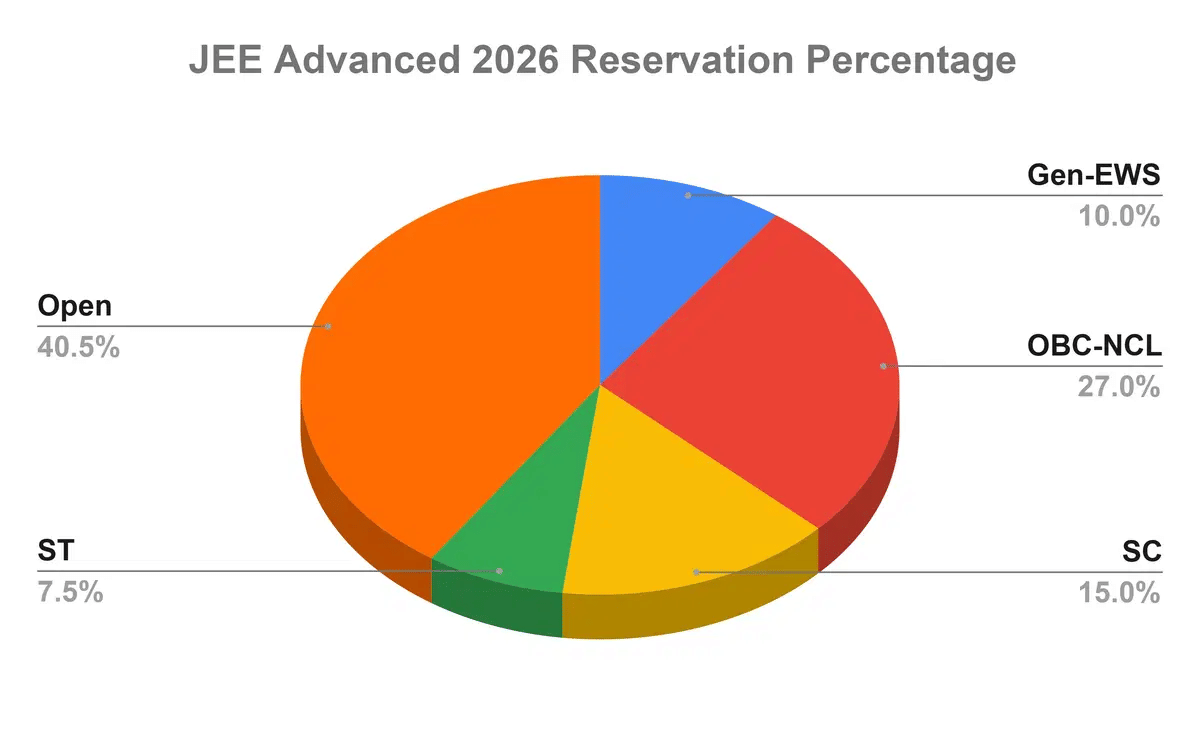 General-EWSThe General-EWS candidates are entitled to 10% reserved seats in every course as per the guidelines of the Government of India.
OBC (Non-creamy layer)The candidates belonging to the non-creamy layer in the OBC category have 27% seats reserved for them in the JEE Advanced 2026.
Scheduled Caste (SC)Scheduled caste candidates will have 15% seats reserved for them as per the reservation policy.
Scheduled Tribe (ST)As per the reservation policy, 7.5% of the seats will be reserved for the Scheduled Tribe (ST) community.
The category-wise seat distribution of the top 2,50,000 candidates qualifying through JEE Main 2026 is as follows:
Source: Official Information Bulletin 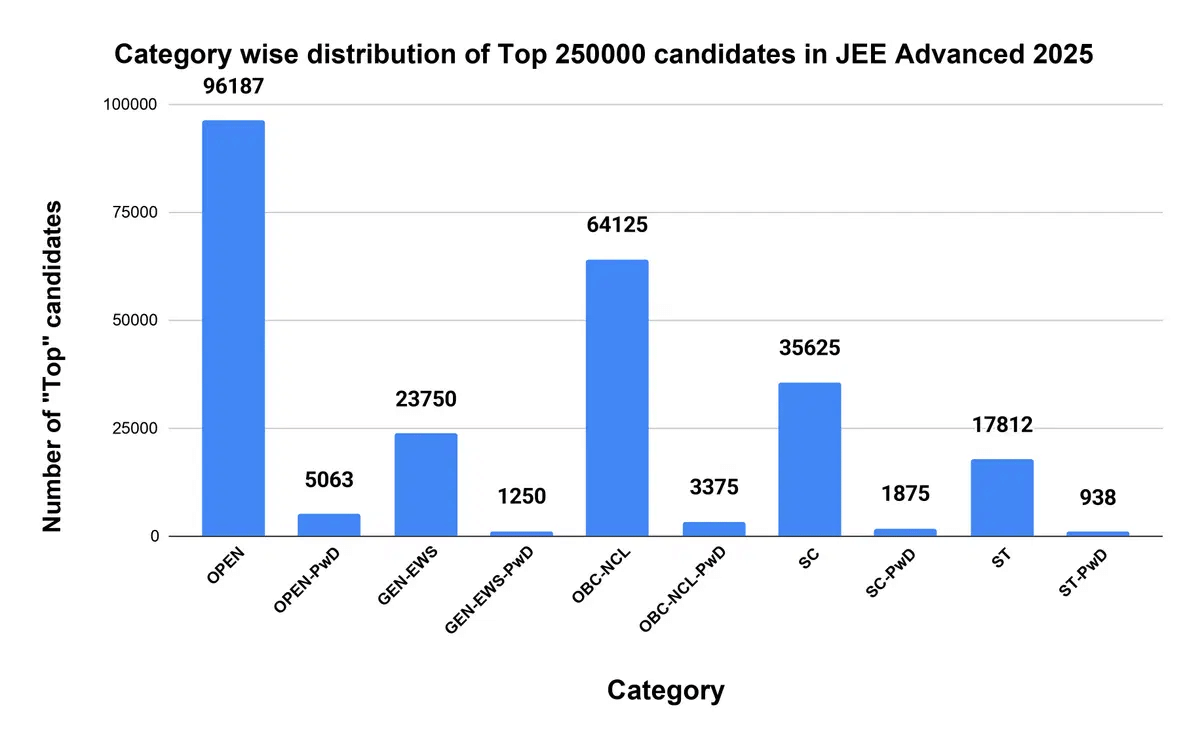 JEE Advanced Reservation 2026: PwD CandidatesThe PwD candidates are given 5% horizontal reservation within each category, i.e., OPEN, GEN-EWS, OBC-NCL, SC, and ST.
JEE Advanced Reservation 2026: Defence Service CandidatesThe JEE Advanced reservation policy includes the reservation of seats for the defence service (DS) candidates.
JEE Advanced Reservation 2026: Supernumerary QuotaThe supernumerary seats are created for both female candidates and foreign national candidates. However, there is a difference in both kinds of supernumerary seats as given below: For Females The supernumerary seats for female candidates are created to improve the gender balance in the undergraduate programs in IITs.
For Foreign National Candidates Candidates who are not citizens of India shall be considered as foreign nationals. The seats allotted to such candidates are supernumerary, with a limit of 10% of the total number of seats in every course.
JEE Advanced Reservation 2026: Documents RequiredThe scanned copies of documents and certificates will be uploaded during the time of online registration for JEE Advanced 2026. The link to certificate formats is given below: Documents required
Frequently Asked QuestionsQues. What is Horizontal reservation, and how does it apply to PwD in JEE Advanced 2026? Ans. Candidates belonging to the PwD category have the horizontal reservation of 5% across the categories. It means 5% seats in each category are reserved for the PwD candidates with at least 40% impairment. Ques. Who is eligible for GEN-EWS reservation in JEE Advanced 2026? Ans. The general category candidates whose gross family income is below Rs. 8 lakh and who meet the asset criteria as decided by the government of India. A valid income and asset certificate is a must to avail the benefit of the EWS reservation. Ques. Is there any change in the reservation for JEE Advanced 2026? Ans. No, the reservation policy of 2026 remains the same as 2025, as per the official information brochure of JEE Advanced released by IIT Roorkee on its official website, jeeadv.ac.in. Ques. How are ranks and qualifying marks affected by the category in JEE Advanced 2026? Ans. There are separate rank lists for each category. The minimum qualifying marks are different for each category.
Ques. What is the preparatory course for JEE Advanced 2026? Ans. The reserved seats allocated during the JoSAA counselling process are offered to the candidates from the same reserved category through a one-year preparatory course.
Ques. Can I change my category mentioned in the JEE Main 2026? Ans. No, candidates cannot change the category mentioned in the JEE Main database, as during the JEE Advanced registration, the data is automatically filled in the application form. Response SheetThe JEE Advanced 2026 Response Sheet 2026 for both Papers, Paper 1 and Paper 2 is available to download by IIT Roorkee on 21 May 2026 at 5:00 PM IST on the official website - jeeadv.ac.in/index.html The JEE Advanced Response sheet contains the answers marked by the candidates in the exam.
Related Links:
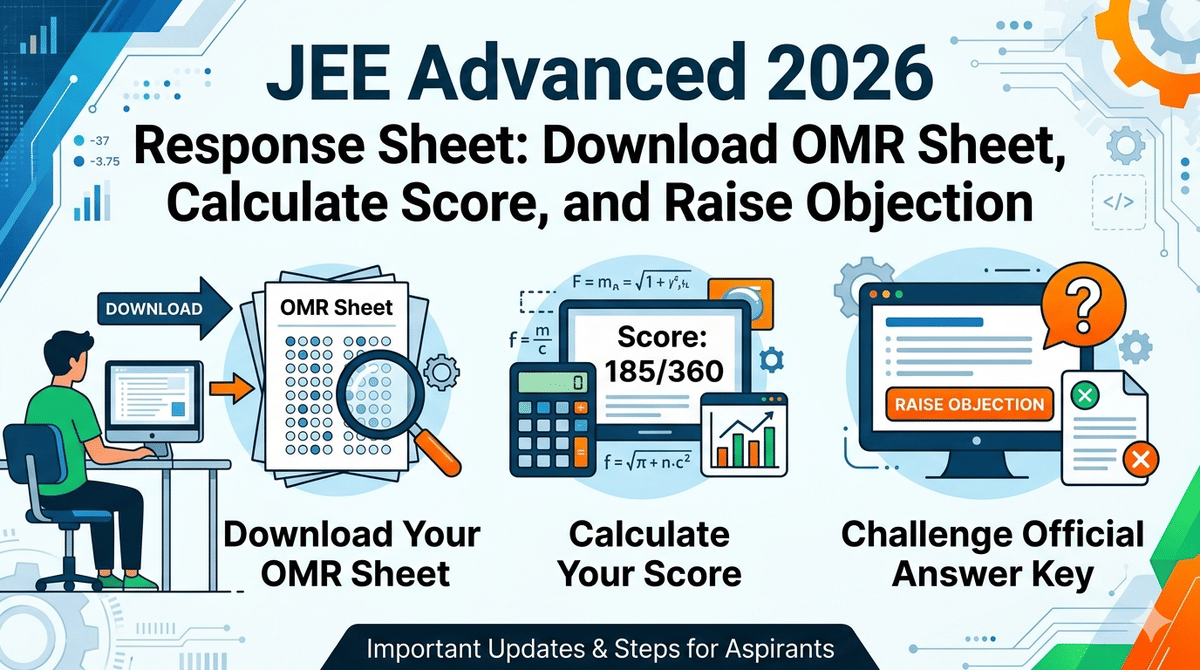 Table of Contents
What is the JEE Advanced Response Sheet?The JEE Advanced Response Sheet is a digital record of your computer-recorded answers from the exam. It shows exactly what you marked during the test, question by question, not what the correct answers are. IIT Roorkee releases this document so you can verify your performance before the official result.
Also Check: JEE Advanced 2026 Answer Key: Release Dates, How to Challenge, Previous Year Answer Key PDF Ques. Do we get a response sheet in JEE Advanced? Ans. Yes, this years IIT Roorkee is releasing the JEE Advanced response sheet after 4 days of the exam.
Ques. What rank is 70 marks in JEE Advanced? Ans. A score of 70 marks in JEE Advanced is generally considered close to the qualifying cutoff range, it will place you in the approximate rank between 25,000 and 40,000. For General category candidates, admission chances in top IITs are limited at this score. However, candidates may still get:
JEE Advanced Response Sheet 2026: Release DateIIT Roorkee released the JEE Advanced 2026 response sheet on May 21, 2026, at jeeadv.ac.in. This year, the response sheet will be released 4 days after the exam and four days before the provisional answer key (May 25, 2026).
How to Download JEE Advanced Response Sheet 2026To download the JEE Advanced 2026 Response sheet, you are required to visit the official website - jeeadv.ac.in or the candidate portal at cportal.jeeadv.ac.in. Note: The response sheet is accessible only through login. There is no direct, open-access PDF link; every student has a unique response sheet. You can download your response sheet by using your application number and password. How to Use Response Sheet with Answer KeyThe response sheet alone will not tell you your score. You need to pair it with the JEE Advanced Provisional Answer Key (releasing May 25, 2026) to estimate your marks. Follow these steps carefully:
Pro tip: Create a simple spreadsheet with columns for Question ID, Your Option ID, Correct Option ID, and Marks Awarded. This makes the cross-check much faster and error-free. Related Links: How to Calculate Score from Response SheetJEE Advanced 2026 has a complex, section-wise marking scheme where the marking rules vary by question type. The total marks for both papers combined is 360 (180 per paper), with 60 marks each for Physics, Chemistry, and Mathematics per paper. The marking scheme is released on the day of the exam and is printed in the official question paper. Always refer to the official scheme for your year. Based on the 2025 paper pattern (as a reference for estimation), the likely structure is:
Important: The actual marking scheme for 2026 will be confirmed only via the official question paper and the JEE Advanced 2026 answer key released at jeeadv.ac.in. The above is based on recent year trends and is for reference only. Score Calculation ExampleSuppose in Paper 1, Physics section, you attempted 5 questions with these results:
Total for these 5 questions = +3 − 1 + 2 + 4 + 0 = 8 marks Repeat this process for all questions across both papers and both subjects to arrive at your expected total score. Also Check: JEE Advanced 2026 Marks vs RankThe expected JEE Advanced 2026 marks vs rank analysis suggests that the exam was comparatively difficult, especially in Chemistry and Mathematics Paper 2, leading to a likely drop in overall scores.
Also Check: JEE Advanced 2026 Score Calculator - How to Calculate Marks What if Your Response Sheet is Wrong?If your response sheet shows an answer you did not mark, raise a grievance immediately. While errors are rare in CBT exams, students do occasionally find discrepancies between what they recall marking and what the system has recorded. Here is what you should do:
Special Note: IIT Roorkee investigates all genuine grievances. However, because JEE Advanced is CBT-based, the computer records are treated as primary evidence. Students are advised to flag concerns as soon as the response sheet is released and not wait until results are declared. JEE Advanced Help Desk
Many candidates have faced issues in their JEE Advanced Response Sheet like “Computer shutdown or technical problems at the center leading to unrecorded answers (e.g., Paper 1 showing nothing answered despite attempts).” “Options jumbled (e.g., you selected B, sheet shows D) due to not following "clear response" before changing answers.”
Source - Reddit And some of Reddit users saw, “Sudden drop in marks when cross-checking (e.g., "messed up 10 more marks").”  JEE Advanced Response Sheet vs Answer Key: Key DifferencesStudents often confuse the response sheet with the answer key. They are two separate documents released at different times and serve completely different purposes. Here is a clear comparison:
Colleges Accepting JEE Advanced 2026The JEE Advanced 2026 exam is crucial for the top engineering colleges in India. Although the main emphasis is on the 23 IITs, many other institutions also use JEE Advanced scores as a way to gain admission into their undergraduate courses.
JEE Advanced Response Sheet 2026 FAQsQues When was the JEE Advanced 2026 response sheet released? Ans. The JEE Advanced 2026 response sheet was released on May 21, 2026, at jeeadv.ac.in. Ques. Is the JEE Advanced response sheet free to download? Ans. Yes, downloading your response sheet is completely free. No fee is charged for accessing this document. Ques. Does the response sheet show the correct answers? Ans. No. The response sheet only shows what you marked during the exam — not the correct answers. You need the official answer key (releasing May 25) for correct answers. Ques. Can I see my response sheet for both Paper 1 and Paper 2? Ans. Yes. Response sheets for both Paper 1 and Paper 2 are available separately through your candidate login on jeeadv.ac.in. Ques. What should I do if my response sheet shows a wrong answer? Ans. If you notice a discrepancy, raise a grievance through the official JEE Advanced helpdesk on jeeadv.ac.in. Do this as soon as possible — do not wait until after results are declared. Ques. Can I calculate my JEE Advanced score using the response sheet alone? Ans. No. You need both the response sheet and the official answer key. Always use the final answer key with your response sheet — not the provisional one — for your definitive score estimate. Ques. How long is the response sheet available on the website? Ans. IIT Roorkee typically keeps the response sheet accessible through the results period. However, you should download and save it immediately after release to avoid any access issues later. Ques. Will the response sheet help me in raising an answer key objection? Ans. Yes, If you believe the official answer key has an error, your response sheet confirms that you actually attempted that question with a specific option. It supports your objection when you challenge the provisional answer key. Ques. When will the JEE Advanced 2026 result be declared? Ans. The JEE Advanced 2026 final result will be declared on June 1, 2026, along with the final answer key, at jeeadv.ac.in. Seat MatrixThe JEE Advanced Seat Matrix 2026 will be released by the Joint Seat Allocation Authority (JoSAA) at josaa.nic.in. They are published after the JEE Advanced 2026 result is declared on June 1, 2026. The JEE Advanced seat matrix offers 17,760–18,160 B.Tech and dual-degree seats available in the 23 IITs across all programs, categories, and gender pools.
Also Check:
 Key Summary – JEE Advanced Seat Matrix 2026
What is the JEE Advanced Seat Matrix 2026?The JEE Advanced seat matrix 2026 covers approximately 17,760–18,200 seats across 23 IITs in India. These seats are filled exclusively through JEE Advanced qualification. The JEE Advanced 2026 seat matrix covers the following programme types at IITs:
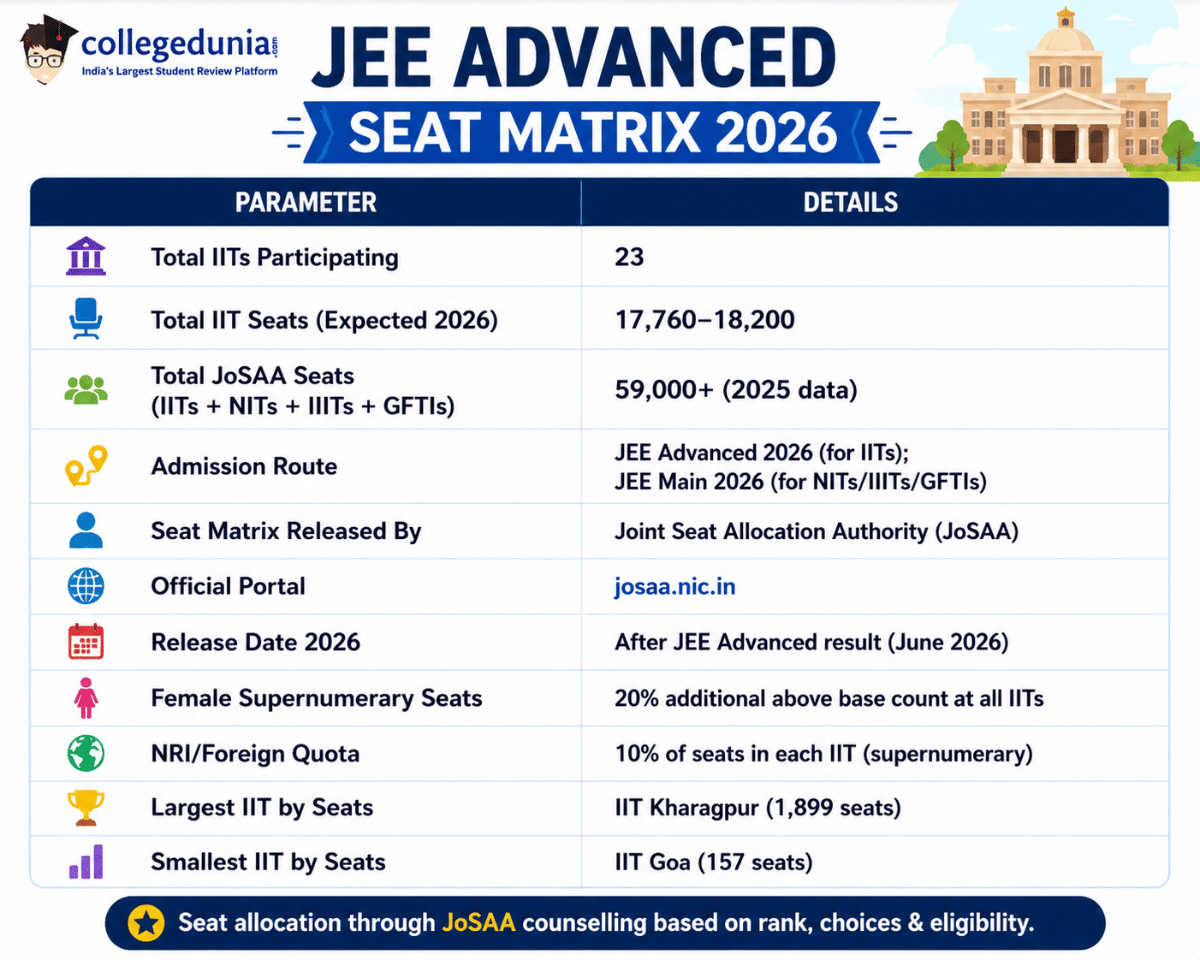 Related Links: JEE Advanced Seat Matrix 2026: Category-Wise DistributionAll IITs follow the reservation policy set by the Government of India. The JEE Advanced 2026 category-wise seats are distributed as follows across all 23 IITs.
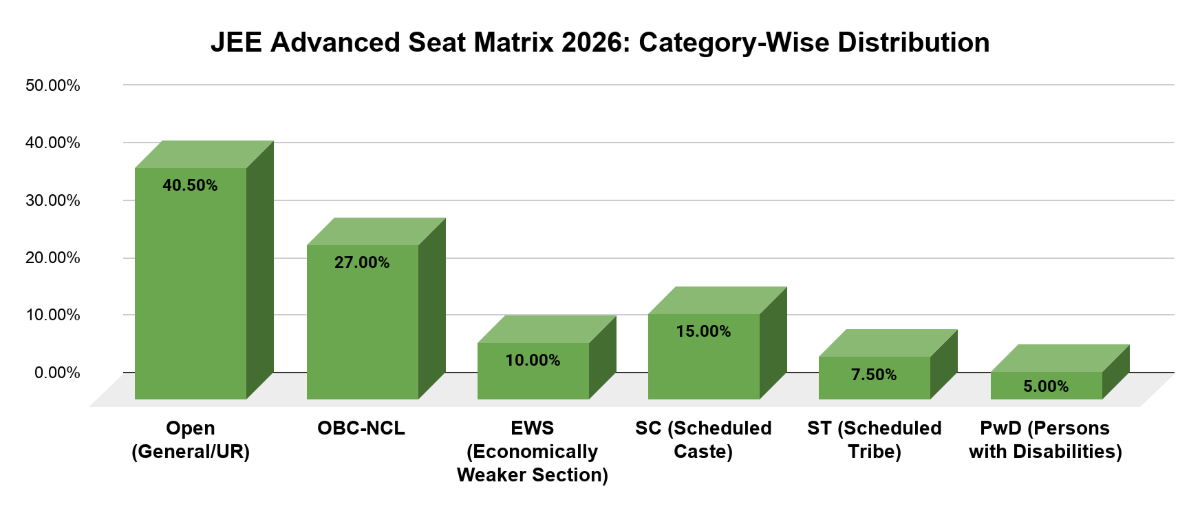 Related Links: JEE Advanced Seat Matrix 2026: Institute-Wise Seats in IITsThe table below shows the expected institute-wise seat count for JEE Advanced 2026 based on 2025 official JoSAA data. The number of seats may change slightly in 2026 as IITs add new programs, expand capacity, or reorganise existing ones.
Related Links: JEE Advanced Seat Matrix of Top 5 IITs: Branch-wise SeatsThe top 5 IITs by preference — IIT Bombay, IIT Delhi, IIT Madras, IIT Kanpur, and IIT Kharagpur — are the most competitive. Here is an approximate branch-wise seat breakdown for these IITs. IIT Bombay – Approximate Branch-Wise Seats (2025)
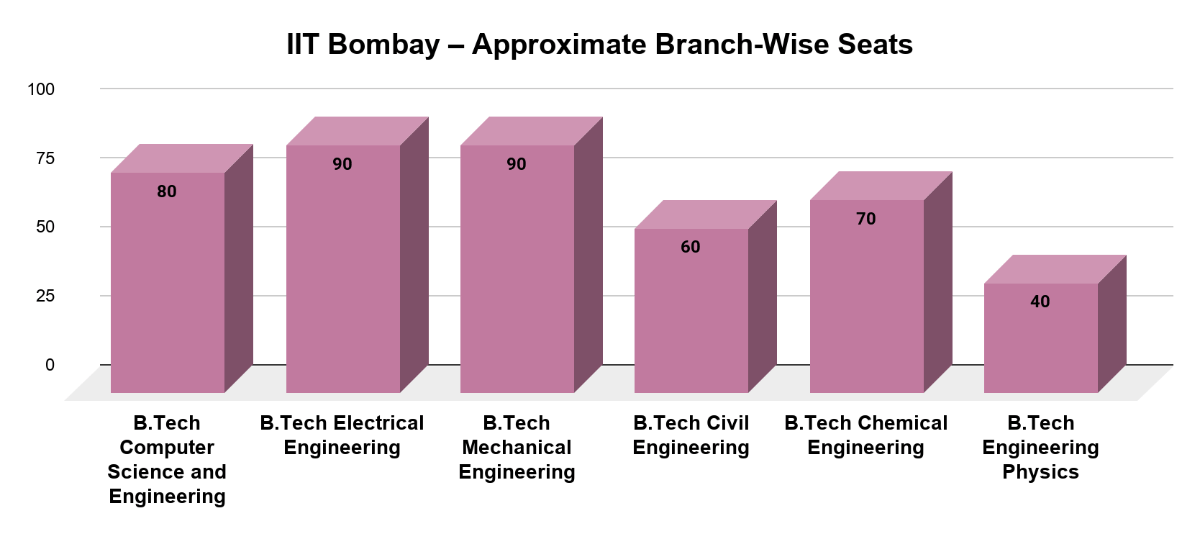 IIT Delhi – Approximate Branch-Wise Seats (2025)
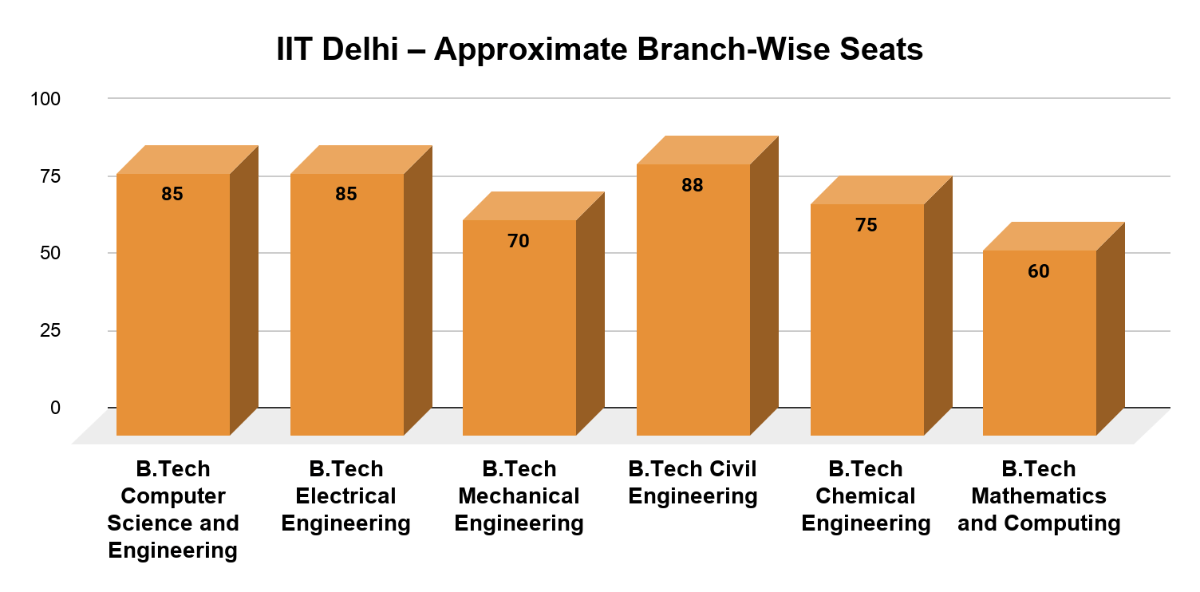 Also Read: IIT Kanpur – Approximate Branch-Wise Seats (2025)
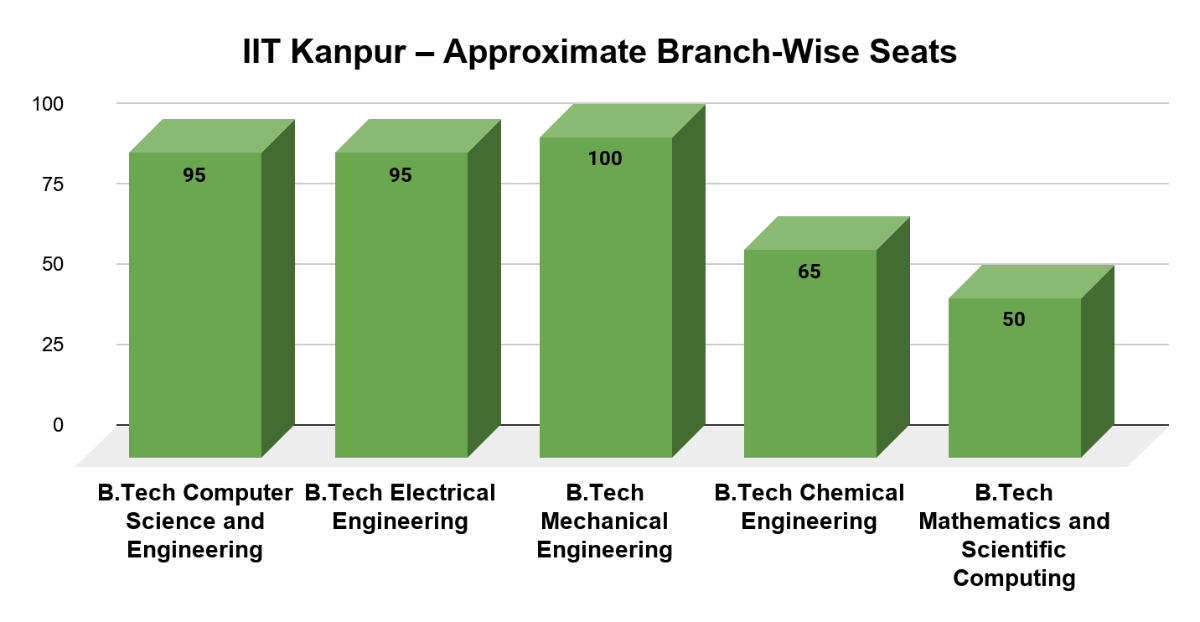 Related Links: JEE Advanced Seat Matrix 2026: Course-Wise BreakdownThe course-wise seat distribution shows how seats are spread across engineering branches in IITs.
Related Links: Female Supernumerary Seats in IITs 2026Female supernumerary seats mean female students have more seats available than what appears in the base seat matrix. These seats are not carved out of existing seats — they are extra seats that do not reduce the number of seats available to male students.
Related Links: NRI and Foreign National Seats in IITs 2026
JEE Advanced Seat Matrix: Previous Year TrendIIT seat count has been growing steadily over the years. The table below shows the year-wise total IIT seat count from 2021 to 2025, helping you understand the expansion trend for 2026.
The total number of IIT seats has grown by approximately 17% over the last 5 years — from around 15,500 in 2021 to 18,160 in 2025. This growth is driven by expansion at newer IITs (Bhilai, Dharwad, Goa, Jammu, Palakkad, Tirupati) and addition of new programs (AI, Data Science, Design, Integrated Circuits) at older IITs. For 2026, a minor increase of around 200–400 seats is expected. Related Links: JEE Advanced Seat Matrix 2026: FAQsQues. How many total seats are available through JEE Advanced 2026? Ans. JEE Advanced 2026 is expected to offer approximately 17,760–18,200 seats across 23 IITs. The official seat matrix will be released on josaa.nic.in after the JEE Advanced 2026 result on June 1, 2026. Ques. Which IIT has the most seats? Ans. IIT Kharagpur has the highest seat count among all IITs with approximately 1,899 seats in 2025, making it the largest IIT by intake. It is followed by IIT BHU Varanasi (1,589), IIT Bombay (1,368), and IIT Roorkee (1,353). Ques. Which IIT has the fewest seats? Ans. IIT Goa has the fewest seats among the 23 IITs with approximately 157 seats in 2025. Other newer IITs like IIT Dharwad (187), IIT Palakkad (200), and IIT Bhilai (200) also have relatively small intakes but are expanding every year. Ques. How many CSE seats are available across all IITs? Ans. The total CSE seats across all 23 IITs in 2024 was approximately 1,928. IIT Bombay CSE has around 80 seats, IIT Delhi CSE has around 85 seats, and IIT Kanpur CSE has around 95 seats. CSE is the most competitive branch due to very high demand and limited supply. Ques. What is the reservation breakdown for IIT seats? Ans. IIT seats are reserved as follows: Open (General) 40.5%, OBC-NCL 27%, EWS 10%, SC 15%, ST 7.5%. PwD reservation is horizontal at 5% within each category. Female supernumerary seats (up to 20% extra) are additional and do not cut into any category's seats. Ques. When will the JEE Advanced 2026 seat matrix be released? Ans. The official JEE Advanced 2026 seat matrix will be released by JoSAA at josaa.nic.in after the JEE Advanced result on June 1, 2026. Counselling registration begins June 2, 2026, and the seat matrix is typically published at the same time. Ques. Are female supernumerary seats separate from the regular seat count? Ans. Yes. Female supernumerary seats are additional seats above the base count — they do not reduce seats for male students. IITs offer up to 20% extra seats exclusively for female students to improve gender diversity. These seats are distributed across all categories (Open, OBC, SC, ST, EWS). Ques. Can NRI students get IIT seats through JEE Advanced 2026? Ans. Yes. NRI, OCI, and PIO students who qualify JEE Advanced 2026 are eligible for up to 10% supernumerary NRI quota seats at each IIT through JoSAA counselling. Foreign nationals who have not written JEE Advanced can apply through DASA (dasanit.org) using SAT scores. Ques. How does the seat matrix affect JEE Advanced cutoff? Ans. Fewer seats in a branch leads to a lower closing rank and a tighter cutoff. For example, IIT Bombay CSE with 32 Open seats closes around AIR 67 — while a branch with 150+ Open seats at the same IIT may close at AIR 800+. When planning your JoSAA choices, always check the seat count alongside previous year cutoffs. Ques. Do new IITs have lower cutoffs despite fewer seats? Ans. Generally yes. Newer IITs (established post-2008) like IIT Goa, IIT Bhilai, IIT Dharwad, and IIT Palakkad have lower demand relative to their seat count — so closing ranks are typically much higher (looser) than older IITs. If you aim for CSE at a newer IIT, your closing rank in 2025 ranged between around 4,000–8,000 in the General category depending on the specific IIT. Ques. Will IIT seats increase in 2026 compared to 2025? Ans. Yes, a minor increase is expected. In 2025, total IIT seats grew by 116 compared to 2024. For 2026, newer IITs are likely to add more seats and new programs (especially in AI, Data Science, and interdisciplinary engineering), while some older IITs may also expand specific branches. The official count will be confirmed in the JoSAA 2026 seat matrix. ToppersThe JEE Advanced 2026 toppers list will be released by IIT Roorkee along with the result on June 1, 2026, at 10:00 AM IST at the official website jeeadv.ac.in. The toppers list includes the overall AIR 1 topper, top 10 in the Common Rank List (CRL), zone-wise male and female toppers, and category-wise rank 1 holders.
In 2025, Rajit Gupta (IIT Delhi zone) secured AIR 1 with 332/360 marks, while Devdutta Majhi (IIT Kharagpur zone) emerged as the female topper with AIR 16 and 312 marks. Related Links:
 Key Summary
JEE Advanced Toppers 2026: AIR 1 and Top 10 ListThe JEE Advanced 2026 topper list will be released by IIT Roorkee on June 1, 2026, on their official website - jeeadv.ac.in/index.html. The 2026 AIR 1 will be announced along with the results at 10:00 AM IST. IIT Roorkee releases toppers in the following categories with the result:
JEE Advanced Toppers 2025 AIR 1 List (Category-wise)IIT Roorkee publishes the JEE Advanced 2025 AIR 1 Rank List for each category. IIT Kanpur and IIT Hyderabad dominated the category-wise topper list, securing four and two top spots, respectively, across various reserved and PwD categories.
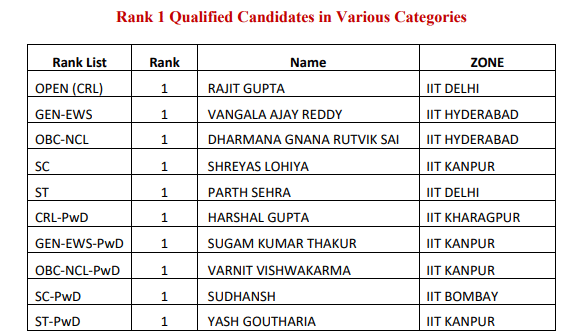 Source: JEE Advanced 2025 Press Release JEE Advanced 2025: Top 10 Candidates List
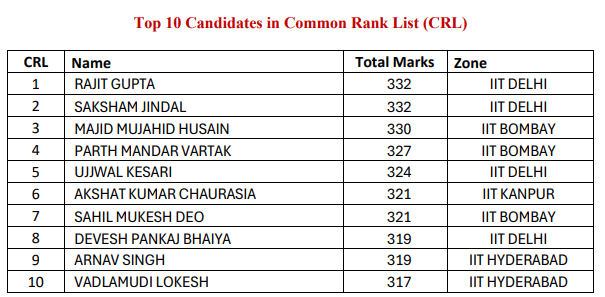 Source: JEE Advanced 2025 Press Release JEE Advanced 2025 Zone-wise Top Female Candidates
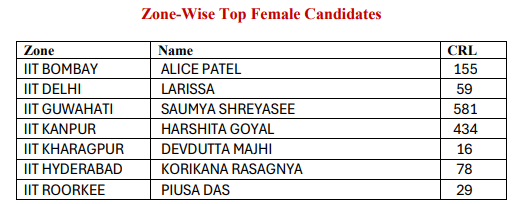 Source: JEE Advanced 2025 Press Release JEE Advanced Year-wise Female Topper TrendFemale toppers consistently break into the Top 100 All India Ranks, peaking in 2024 when Dwija Dharmeshkumar Patel secured AIR 7 with an impressive score of ~332/360.
JEE Advanced 2026: Important Dates After ResultAfter the JEE Advanced 2026 results on June 1, there are several important events to track, especially AAT registration and JoSAA counselling. Missing any of these can affect your IIT admission.
AAT registration is only open June 1–2, 2026, a very short window. If you want to apply for B.Arch at IIT Kharagpur, IIT Roorkee, or IIT (BHU) Varanasi, register immediately after the results are declared. There is no separate fee for AAT. Related Links: JEE Advanced Counselling 2025 Starts: JOSAA Round 6 Seat Allotment Out, Schedule, Eligibility, Cutoff, & Reservation JEE Advanced Toppers: Previous Year StatisticsWhile the total number of appearing candidates has stabilised around 1.8 lakh over the last three years, the number of qualifying students peaked significantly in 2025 at approximately 54,000.
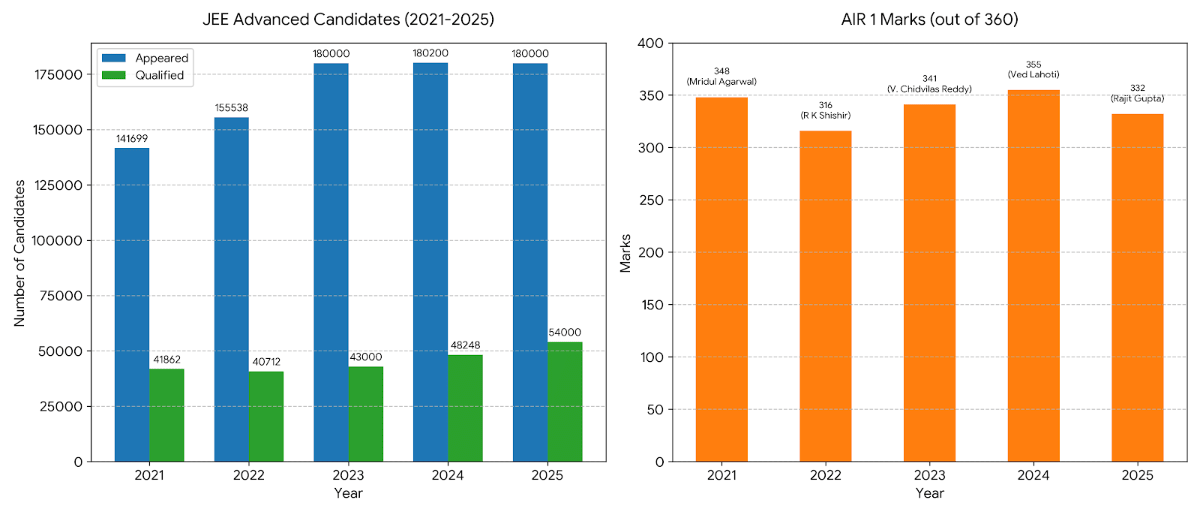 JEE Advanced 2024 Topper Ved Lahoti and Top 10JEE Advanced 2024 was conducted by IIT Madras on May 26, 2024. Ved Lahoti from the IIT Delhi zone secured AIR 1 with an exceptional score of 355 out of 360 marks — the highest score by any topper in recent years.
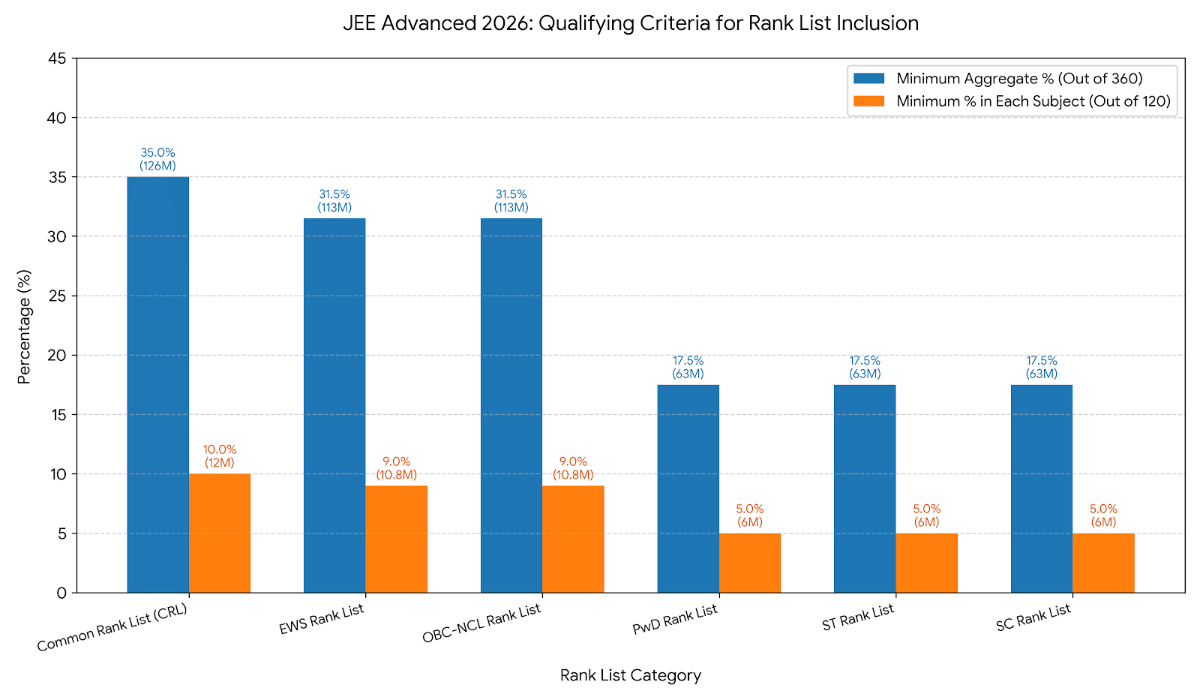 Source: JEE Advanced 2024 Press Release JEE Advanced 2023 Toppers ListJEE Advanced 2023 was conducted by IIT Guwahati. Vavilala Chidvilas Reddy from Hyderabad secured AIR 1 with 341 out of 360 marks. Ramesh Surya Theja secured AIR 2 and Rishi Kalra secured AIR 3. The female topper was Nayakanti Naga Bhavya Sree from Hyderabad zone with CRL 56.
JEE Advanced Toppers 2026: Qualifying Marks for Rank ListThe JEE Advanced 2026 total marks are 360 (120 per subject – Physics, Chemistry, Mathematics, across Paper 1 and Paper 2 combined). For CRL inclusion, you need at least 10% in each subject (i.e., 12 marks in each of Physics, Chemistry, and Mathematics) and 35% aggregate (i.e., at least 126 marks total out of 360).
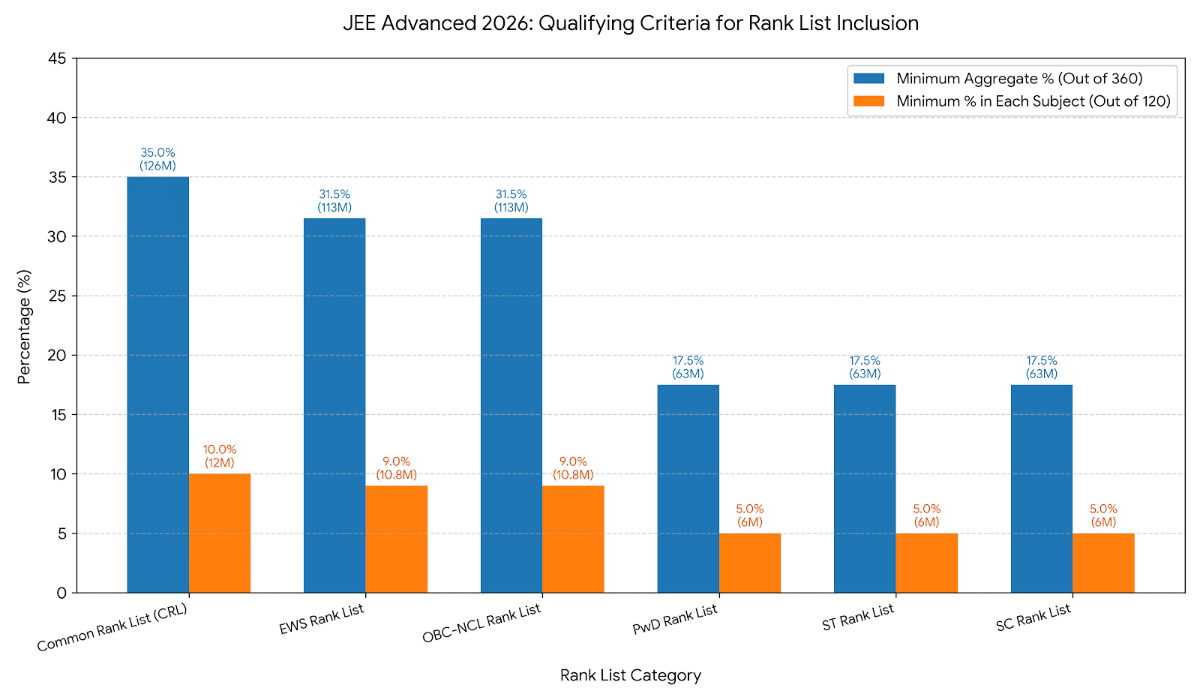 Meeting the qualifying marks for the rank list does NOT guarantee IIT admission. Your final IIT seat depends on your AIR, the choices you fill during JoSAA counselling, and the availability of seats in your preferred branch and category. What to Do After the JEE Advanced 2026 Result?Following the JEE Advanced 2026 results, candidates must immediately verify their scores and secure colour printouts of their scorecard for verification. This initiates the mandatory JoSAA counselling process, requiring strategic choices from optional AAT registration to branch locking and final institutional reporting.
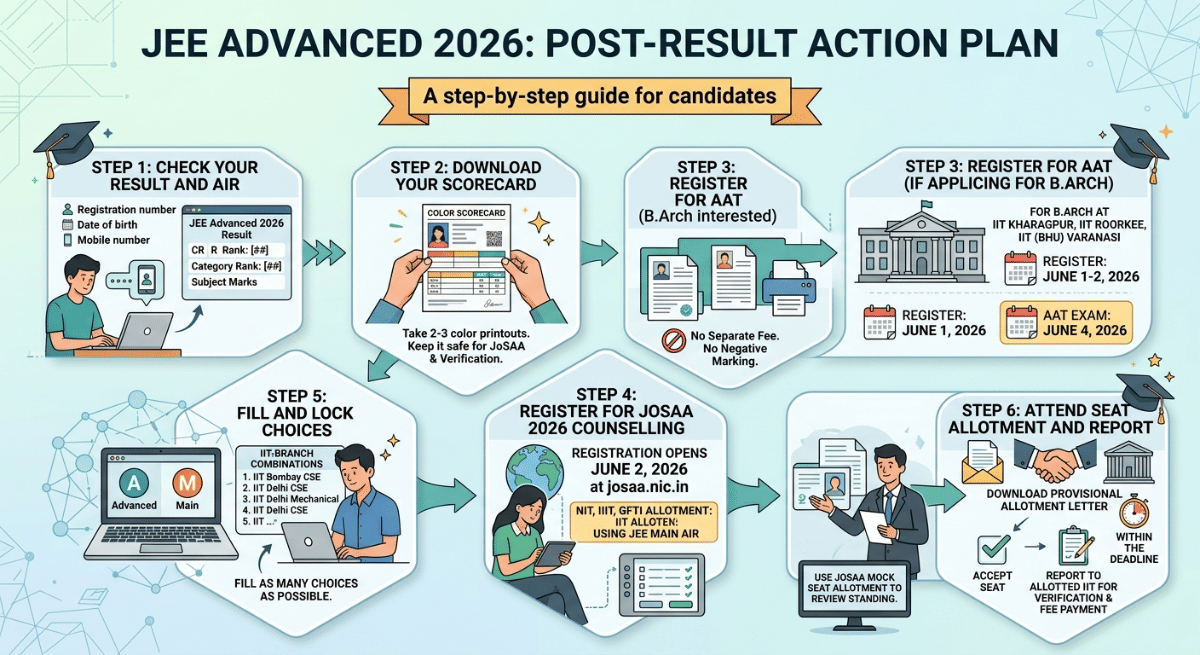 Also Check: List of Top Colleges in India Accepting JEE Advanced Based on 2026 Ranking JEE Advanced Toppers 2026: FAQsQues. Who is the JEE Advanced 2026 topper? Ans. The JEE Advanced 2026 topper (AIR 1) will be announced by IIT Roorkee along with the result on June 1, 2026 at 10:00 AM at jeeadv.ac.in. In 2025, Rajit Gupta from the IIT Delhi zone topped with 332 out of 360 marks. Ques. When will the JEE Advanced 2026 toppers list be released? Ans. The JEE Advanced 2026 toppers list will be released on June 1, 2026 at jeeadv.ac.in — the same day and time as the result declaration at 10:00 AM IST. Ques. How many students qualified JEE Advanced 2025? Ans. Around 54,000 candidates qualified JEE Advanced 2025 out of approximately 1.8 lakh who appeared — a qualifying rate of about 30%. The exact number for 2026 will be announced with the result on June 1. Ques. Who was the female topper in JEE Advanced 2025 and 2024? Ans. In 2025, Devdutta Majhi was the female topper. In 2024, Dwija Dharmeshkumar Patel from the IIT Bombay zone topped among female candidates with an overall CRL rank of 7 and 332 marks out of 360 — one of the best ever performances by a female student in JEE Advanced. Ques. What is the highest marks ever scored in JEE Advanced? Ans. The highest score in JEE Advanced history is 348 out of 360 marks (96.67%) by Mridul Agarwal from Jaipur in 2021. In recent years, the highest was 355/360 by Ved Lahoti in 2024. Ques. How is the JEE Advanced topper decided? What are the tie-breaking rules? Ans. The topper is the student with the highest aggregate marks in JEE Advanced (sum of Physics + Chemistry + Mathematics across Paper 1 and Paper 2). In case of a tie in aggregate marks, the following rules are applied in order: (1) Higher positive marks overall; (2) Higher marks in Mathematics; (3) Higher marks in Physics. If the tie still persists, all tied students are given the same rank. Ques. Which zone produces the most JEE Advanced toppers? Ans. The IIT Delhi zone and the IIT Madras zone consistently produce the most top rankers. In 2024, the IIT Madras zone had 4 of the top 10 CRL rankers, and the IIT Delhi zone produced the AIR 1 (Ved Lahoti). In 2025, Rajit Gupta (AIR 1) was also from the IIT Delhi zone. Ques. What marks are needed to get an AIR under 100 in JEE Advanced 2026? Ans. Based on previous year trends, you typically need 285+ marks out of 360 to secure a rank within the top 100. A score above 300 marks is generally considered competitive for a rank in the top 50. The exact 2026 benchmark will depend on overall paper difficulty and student performance. Ques. Is the JEE Advanced 2026 toppers list released on the official website? Ans. Yes. IIT Roorkee releases the official JEE Advanced toppers list at jeeadv.ac.in along with the result on June 1, 2026. The list is also published in the JEE Advanced official report PDF that is released on the same portal. Ques. What happens if I don't qualify for JEE Advanced 2026? Ans. If you don't qualify for JEE Advanced 2026, you can still get admission to NITs, IIITs, and GFTIs through JoSAA counselling based on your JEE Main 2026 AIR. You can also consider state engineering counselling processes based on your JEE Main score. You can attempt JEE Advanced again next year if you are still within the eligibility limits (maximum 2 attempts in consecutive years). Ques. What is the AAT and who needs to take it? Ans. The Architecture Aptitude Test (AAT) is a separate test for students who want to join the B.Arch programme at IIT Kharagpur, IIT Roorkee, or IIT (BHU) Varanasi. Only qualified JEE Advanced students can appear for AAT. In 2026, AAT is on June 4, and results are on June 7. No separate fee is charged. AAT is not needed for B.Tech or other engineering programmes. More on Joint Entrance Examination Advanced
Overview
Eligibility Criteria
Application Process
Exam Pattern
Syllabus
Cut-offs
Results
Admit Card
JEE Advanced AAT
AAT Pattern
Important Books
Chapter Wise Weightage
Chemistry Preparation
Chemistry Syllabus
Counselling
Documents Required
Dress Code
Exam Centers
Exam Date
Exam Day Guidelines
Mark vs Rank
Mathematics Syllabus
Answer Key
Paper Analysis
Physics Syllabus
Preparation Tips
Question Paper 2016
Question Paper 2017
Question Paper 2018
Question Paper 2019
Question Paper 2020
Question Paper 2021
Question Paper 2022
Question Paper 2023
Question Paper 2024
Question Paper 2025
Question Paper 2026
Question Papers
Reservation
Response Sheet
Seat Matrix
Toppers
Request a callbackYou're on the listA counsellor will call you on shortly. | ||||||||||||||||||||||||||||||||||||||||||||||||||||||||||||||||||||||||||||||||||||||||||||||||||||||||||||||||||||||||||||||||||||||||||||||||||||||||||||||||||||||||||||||||||||||||||||||||||||||||||||||||||||||||||||||||||||||||||||||||||||||||||||||||||||||||||||||||||||||||||||||||||||||||||||||||||||||||||||||||||||||||||||||||||||||||||||||||||||||||||||||||||||||||||||||||||||||||||||||||||||||||||||||||||||||||||||||||||||||||||||||||||||||||||||||||||||||||||||||||||||||||||||||||||||||||||||||||||||||||||||||||||||||||||||||||||||||||||||||||||||||||||||||||||||||||||||||||||||||||||||||||||||||||||||||||||||||||||||||||||||||||||||||||||||||||||||||||||||||||||||||||||||||||||||||||||||||||||||||||||||||||||||||||||||||||||||||||||||||||||||||||||||||||||||||||||||||||||||||||||||||||||||||||||||||||||||||||||||||||||||||||||||||||||||||||||||||||||||||||||||||||||||||||||||||||||||||||||||||||||||||||||||||||||||||||||||||||||||||||||||||||||||||||||||||||||||||||||||||